Theoretical Discrete
Probability Distribution-
Binomial Distribution
1. What is Discrete Probability Distribution
2. Types of Theoretical Discrete Probability
Distribution
3. Binomial Distribution
4. Properties of Binomial Distribution
5. Examples of Binomial distribution
6. Fitting of Binomial Distribution
7. Application of Binomial distribution
Topic Covered:
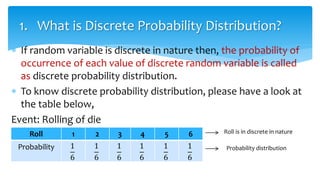
 If random variable is discrete in nature then, the probability of
occurrence of each value of discrete random variable is called
as discrete probability distribution.
 To know discrete probability distribution, please have a look at
the table below,
Event: Rolling of die
1. What is Discrete Probability Distribution?
Roll is in discrete in nature
Probability distribution
Roll 1 2 3 4 5 6
Probability 1
6
1
6
1
6
1
6
1
6
1
6
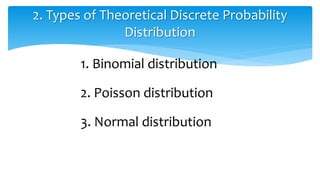
1. Binomial distribution
2. Poisson distribution
3. Normal distribution
2. Types of Theoretical Discrete Probability
Distribution
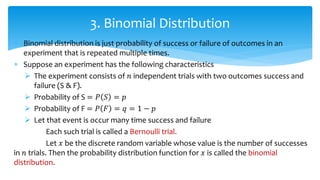
 Binomial distribution is just probability of success or failure of outcomes in an
experiment that is repeated multiple times.
 Suppose an experiment has the following characteristics
 The experiment consists of 𝑛 independent trials with two outcomes success and
failure (S & F).
 Probability of S = 𝑃 𝑆 = 𝑝
 Probability of F = 𝑃 𝐹 = 𝑞 = 1 − 𝑝
 Let that event is occur many time success and failure
Each such trial is called a Bernoulli trial.
Let 𝑥 be the discrete random variable whose value is the number of successes
in 𝑛 trials. Then the probability distribution function for 𝑥 is called the binomial
distribution.
3. Binomial Distribution
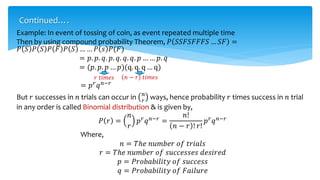
Example: In event of tossing of coin, as event repeated multiple time
Then by using compound probability Theorem, 𝑃 𝑆𝑆𝐹𝑆𝐹𝐹𝐹𝑆 … 𝑆𝐹 =
𝑃 𝑆 𝑃 𝑆 𝑃 𝐹 𝑃 𝑆 … … 𝑃 𝑠 𝑃(𝐹)
= 𝑝. 𝑝. 𝑞. 𝑝. 𝑞. 𝑞. 𝑞. 𝑝 … … 𝑝. 𝑞
= (𝑝. 𝑝. 𝑝 … 𝑝)(q. q. q … q)
= 𝑝 𝑟
𝑞 𝑛−𝑟
But 𝑟 successes in 𝑛 trials can occur in 𝑛
𝑟
ways, hence probability 𝑟 times success in 𝑛 trial
in any order is called Binomial distribution & is given by,
𝑃 𝑟 =
𝑛
𝑟
𝑝 𝑟
𝑞 𝑛−𝑟
=
𝑛!
𝑛 − 𝑟 ! 𝑟!
𝑝 𝑟
𝑞 𝑛−𝑟
Where,
𝑛 = 𝑇ℎ𝑒 𝑛𝑢𝑚𝑏𝑒𝑟 𝑜𝑓 𝑡𝑟𝑖𝑎𝑙𝑠
𝑟 = 𝑇ℎ𝑒 𝑛𝑢𝑚𝑏𝑒𝑟 𝑜𝑓 𝑠𝑢𝑐𝑐𝑒𝑠𝑠𝑒𝑠 𝑑𝑒𝑠𝑖𝑟𝑒𝑑
𝑝 = 𝑃𝑟𝑜𝑏𝑎𝑏𝑖𝑙𝑖𝑡𝑦 𝑜𝑓 𝑠𝑢𝑐𝑐𝑒𝑠𝑠
𝑞 = 𝑃𝑟𝑜𝑏𝑎𝑏𝑖𝑙𝑖𝑡𝑦 𝑜𝑓 𝐹𝑎𝑖𝑙𝑢𝑟𝑒
Continued….
𝑟 𝑡𝑖𝑚𝑒𝑠 𝑛 − 𝑟 𝑡𝑖𝑚𝑒𝑠
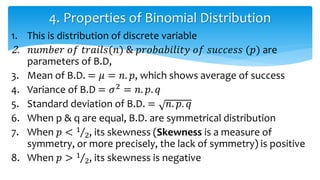
1. This is distribution of discrete variable
2. 𝑛𝑢𝑚𝑏𝑒𝑟 𝑜𝑓 𝑡𝑟𝑎𝑖𝑙𝑠(𝑛) & 𝑝𝑟𝑜𝑏𝑎𝑏𝑖𝑙𝑖𝑡𝑦 𝑜𝑓 𝑠𝑢𝑐𝑐𝑒𝑠𝑠 (𝑝) are
parameters of B.D,
3. Mean of B.D. = 𝜇 = 𝑛. 𝑝, which shows average of success
4. Variance of B.D = 𝜎2 = 𝑛. 𝑝. 𝑞
5. Standard deviation of B.D. = 𝑛. 𝑝. 𝑞
6. When p & q are equal, B.D. are symmetrical distribution
7. When 𝑝 < 1
2, its skewness (Skewness is a measure of
symmetry, or more precisely, the lack of symmetry) is positive
8. When 𝑝 > 1
2, its skewness is negative
4. Properties of Binomial Distribution
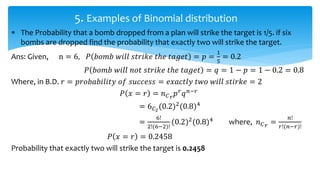
 The Probability that a bomb dropped from a plan will strike the target is 1/5. if six
bombs are dropped find the probability that exactly two will strike the target.
Ans: Given, n = 6, 𝑃 𝑏𝑜𝑚𝑏 𝑤𝑖𝑙𝑙 𝑠𝑡𝑟𝑖𝑘𝑒 𝑡ℎ𝑒 𝑡𝑎𝑔𝑒𝑡 = 𝑝 =
1
5
= 0.2
𝑃 𝑏𝑜𝑚𝑏 𝑤𝑖𝑙𝑙 𝑛𝑜𝑡 𝑠𝑡𝑟𝑖𝑘𝑒 𝑡ℎ𝑒 𝑡𝑎𝑔𝑒𝑡 = 𝑞 = 1 − 𝑝 = 1 − 0.2 = 0.8
Where, in B.D. 𝑟 = 𝑝𝑟𝑜𝑏𝑎𝑏𝑖𝑙𝑖𝑡𝑦 𝑜𝑓 𝑠𝑢𝑐𝑐𝑒𝑠𝑠 = 𝑒𝑥𝑎𝑐𝑡𝑙𝑦 𝑡𝑤𝑜 𝑤𝑖𝑙𝑙 𝑠𝑡𝑖𝑟𝑘𝑒 = 2
𝑃 𝑥 = 𝑟 = 𝑛 𝐶 𝑟 𝑝 𝑟
𝑞 𝑛−𝑟
= 6 𝐶2
(0.2)2
(0.8)4
=
6!
2!(6−2)!
(0.2)2
(0.8)4
where, 𝑛 𝐶 𝑟 =
𝑛!
𝑟!(𝑛−𝑟)!
𝑃 𝑥 = 𝑟 = 0.2458
Probability that exactly two will strike the target is 0.2458
5. Examples of Binomial distribution
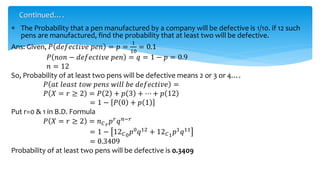
 The Probability that a pen manufactured by a company will be defective is 1/10. if 12 such
pens are manufactured, find the probability that at least two will be defective.
Ans: Given, 𝑃 𝑑𝑒𝑓𝑒𝑐𝑡𝑖𝑣𝑒 𝑝𝑒𝑛 = 𝑝 =
1
10
= 0.1
𝑃 𝑛𝑜𝑛 − 𝑑𝑒𝑓𝑒𝑐𝑡𝑖𝑣𝑒 𝑝𝑒𝑛 = 𝑞 = 1 − 𝑝 = 0.9
𝑛 = 12
So, Probability of at least two pens will be defective means 2 or 3 or 4….
𝑃 𝑎𝑡 𝑙𝑒𝑎𝑠𝑡 𝑡𝑜𝑤 𝑝𝑒𝑛𝑠 𝑤𝑖𝑙𝑙 𝑏𝑒 𝑑𝑒𝑓𝑒𝑐𝑡𝑖𝑣𝑒 =
𝑃 𝑋 = 𝑟 ≥ 2 = 𝑃 2 + 𝑝 3 + ⋯ + 𝑝 12
= 1 − 𝑃 0 + 𝑝 1
Put r=0 & 1 in B.D. Formula
𝑃 𝑋 = 𝑟 ≥ 2 = 𝑛 𝐶 𝑟
𝑝 𝑟
𝑞 𝑛−𝑟
= 1 − 12 𝐶0
𝑝0
𝑞12
+ 12 𝐶1
𝑝1
𝑞11
= 0.3409
Probability of at least two pens will be defective is 0.3409
Continued….
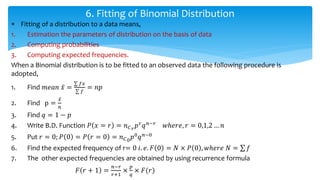
 Fitting of a distribution to a data means,
1. Estimation the parameters of distribution on the basis of data
2. Computing probabilities
3. Computing expected frequencies.
When a Binomial distribution is to be fitted to an observed data the following procedure is
adopted,
1. Find 𝑚𝑒𝑎𝑛 𝑥 =
𝑓𝑥
𝑓
= 𝑛𝑝
2. Find p =
𝑥
𝑛
3. Find 𝑞 = 1 − 𝑝
4. Write B.D. Function 𝑃 𝑥 = 𝑟 = 𝑛 𝐶 𝑟
𝑝 𝑟
𝑞 𝑛−𝑟
𝑤ℎ𝑒𝑟𝑒, 𝑟 = 0,1,2 … 𝑛
5. Put 𝑟 = 0; 𝑃 0 = 𝑃 𝑟 = 0 = 𝑛 𝐶0
𝑝0
𝑞 𝑛−0
6. Find the expected frequency of r= 0 𝑖. 𝑒. 𝐹 0 = 𝑁 × 𝑃 0 , 𝑤ℎ𝑒𝑟𝑒 𝑁 = 𝑓
7. The other expected frequencies are obtained by using recurrence formula
𝐹 𝑟 + 1 =
𝑛−𝑟
𝑟+1
×
𝑝
𝑞
× 𝐹(𝑟)
6. Fitting of Binomial Distribution
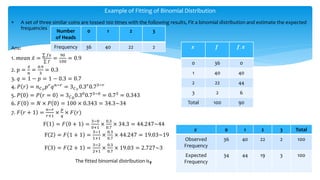
 A set of three similar coins are tossed 100 times with the following results, Fit a binomial distribution and estimate the expected
frequencies
Ans:
1. 𝑚𝑒𝑎𝑛 𝑥 =
𝑓𝑥
𝑓
=
90
100
= 0.9
2. p =
𝑥
𝑛
=
0.9
3
= 0.3
3. 𝑞 = 1 − 𝑝 = 1 − 0.3 = 0.7
4. 𝑃 𝑟 = 𝑛 𝐶 𝑟
𝑝 𝑟
𝑞 𝑛−𝑟
= 3 𝐶 𝑟
0.3 𝑟
0.73−𝑟
5. 𝑃 0 = 𝑃 𝑟 = 0 = 3 𝐶0
0.30
0.73−0
= 0.73
= 0.343
6. 𝐹 0 = 𝑁 × 𝑃 0 = 100 × 0.343 = 34.3~34
7. 𝐹 𝑟 + 1 =
𝑛−𝑟
𝑟+1
×
𝑝
𝑞
× 𝐹(𝑟)
F 1 = 𝐹 0 + 1 =
3−0
0+1
×
0.3
0.7
× 34.3 = 44.247~44
F 2 = 𝐹 1 + 1 =
3−1
1+1
×
0.3
0.7
× 44.247 = 19.03~19
F 3 = 𝐹 2 + 1 =
3−2
2+1
×
0.3
0.7
× 19.03 = 2.727~3
The fitted binomial distribution is,
Example of Fitting of Binomial Distribution
Number
of Heads
0 1 2 3
Frequency 36 40 22 2 𝒙 𝒇 𝒇. 𝒙
0 36 0
1 40 40
2 22 44
3 2 6
Total 100 90
𝒙 0 1 2 3 Total
Observed
Frequency
36 40 22 2 100
Expected
Frequency
34 44 19 3 100
1. If a new drug is introduced to cure a disease then it either cure
the disease or doesn’t
2. If a person purchase a lottery ticket then he is either going to
win it or not.
3. The number of successful sale calls.
4. The no of defective products in a production run.
5. In Radar detection
7.Application of Binomial distribution
Thank you

Binonmial distribution

  • 1.
  • 2.
    1. What isDiscrete Probability Distribution 2. Types of Theoretical Discrete Probability Distribution 3. Binomial Distribution 4. Properties of Binomial Distribution 5. Examples of Binomial distribution 6. Fitting of Binomial Distribution 7. Application of Binomial distribution Topic Covered:
  • 3.
     If randomvariable is discrete in nature then, the probability of occurrence of each value of discrete random variable is called as discrete probability distribution.  To know discrete probability distribution, please have a look at the table below, Event: Rolling of die 1. What is Discrete Probability Distribution? Roll is in discrete in nature Probability distribution Roll 1 2 3 4 5 6 Probability 1 6 1 6 1 6 1 6 1 6 1 6
  • 4.
    1. Binomial distribution 2.Poisson distribution 3. Normal distribution 2. Types of Theoretical Discrete Probability Distribution
  • 5.
     Binomial distributionis just probability of success or failure of outcomes in an experiment that is repeated multiple times.  Suppose an experiment has the following characteristics  The experiment consists of 𝑛 independent trials with two outcomes success and failure (S & F).  Probability of S = 𝑃 𝑆 = 𝑝  Probability of F = 𝑃 𝐹 = 𝑞 = 1 − 𝑝  Let that event is occur many time success and failure Each such trial is called a Bernoulli trial. Let 𝑥 be the discrete random variable whose value is the number of successes in 𝑛 trials. Then the probability distribution function for 𝑥 is called the binomial distribution. 3. Binomial Distribution
  • 6.
    Example: In eventof tossing of coin, as event repeated multiple time Then by using compound probability Theorem, 𝑃 𝑆𝑆𝐹𝑆𝐹𝐹𝐹𝑆 … 𝑆𝐹 = 𝑃 𝑆 𝑃 𝑆 𝑃 𝐹 𝑃 𝑆 … … 𝑃 𝑠 𝑃(𝐹) = 𝑝. 𝑝. 𝑞. 𝑝. 𝑞. 𝑞. 𝑞. 𝑝 … … 𝑝. 𝑞 = (𝑝. 𝑝. 𝑝 … 𝑝)(q. q. q … q) = 𝑝 𝑟 𝑞 𝑛−𝑟 But 𝑟 successes in 𝑛 trials can occur in 𝑛 𝑟 ways, hence probability 𝑟 times success in 𝑛 trial in any order is called Binomial distribution & is given by, 𝑃 𝑟 = 𝑛 𝑟 𝑝 𝑟 𝑞 𝑛−𝑟 = 𝑛! 𝑛 − 𝑟 ! 𝑟! 𝑝 𝑟 𝑞 𝑛−𝑟 Where, 𝑛 = 𝑇ℎ𝑒 𝑛𝑢𝑚𝑏𝑒𝑟 𝑜𝑓 𝑡𝑟𝑖𝑎𝑙𝑠 𝑟 = 𝑇ℎ𝑒 𝑛𝑢𝑚𝑏𝑒𝑟 𝑜𝑓 𝑠𝑢𝑐𝑐𝑒𝑠𝑠𝑒𝑠 𝑑𝑒𝑠𝑖𝑟𝑒𝑑 𝑝 = 𝑃𝑟𝑜𝑏𝑎𝑏𝑖𝑙𝑖𝑡𝑦 𝑜𝑓 𝑠𝑢𝑐𝑐𝑒𝑠𝑠 𝑞 = 𝑃𝑟𝑜𝑏𝑎𝑏𝑖𝑙𝑖𝑡𝑦 𝑜𝑓 𝐹𝑎𝑖𝑙𝑢𝑟𝑒 Continued…. 𝑟 𝑡𝑖𝑚𝑒𝑠 𝑛 − 𝑟 𝑡𝑖𝑚𝑒𝑠
  • 7.
    1. This isdistribution of discrete variable 2. 𝑛𝑢𝑚𝑏𝑒𝑟 𝑜𝑓 𝑡𝑟𝑎𝑖𝑙𝑠(𝑛) & 𝑝𝑟𝑜𝑏𝑎𝑏𝑖𝑙𝑖𝑡𝑦 𝑜𝑓 𝑠𝑢𝑐𝑐𝑒𝑠𝑠 (𝑝) are parameters of B.D, 3. Mean of B.D. = 𝜇 = 𝑛. 𝑝, which shows average of success 4. Variance of B.D = 𝜎2 = 𝑛. 𝑝. 𝑞 5. Standard deviation of B.D. = 𝑛. 𝑝. 𝑞 6. When p & q are equal, B.D. are symmetrical distribution 7. When 𝑝 < 1 2, its skewness (Skewness is a measure of symmetry, or more precisely, the lack of symmetry) is positive 8. When 𝑝 > 1 2, its skewness is negative 4. Properties of Binomial Distribution
  • 8.
     The Probabilitythat a bomb dropped from a plan will strike the target is 1/5. if six bombs are dropped find the probability that exactly two will strike the target. Ans: Given, n = 6, 𝑃 𝑏𝑜𝑚𝑏 𝑤𝑖𝑙𝑙 𝑠𝑡𝑟𝑖𝑘𝑒 𝑡ℎ𝑒 𝑡𝑎𝑔𝑒𝑡 = 𝑝 = 1 5 = 0.2 𝑃 𝑏𝑜𝑚𝑏 𝑤𝑖𝑙𝑙 𝑛𝑜𝑡 𝑠𝑡𝑟𝑖𝑘𝑒 𝑡ℎ𝑒 𝑡𝑎𝑔𝑒𝑡 = 𝑞 = 1 − 𝑝 = 1 − 0.2 = 0.8 Where, in B.D. 𝑟 = 𝑝𝑟𝑜𝑏𝑎𝑏𝑖𝑙𝑖𝑡𝑦 𝑜𝑓 𝑠𝑢𝑐𝑐𝑒𝑠𝑠 = 𝑒𝑥𝑎𝑐𝑡𝑙𝑦 𝑡𝑤𝑜 𝑤𝑖𝑙𝑙 𝑠𝑡𝑖𝑟𝑘𝑒 = 2 𝑃 𝑥 = 𝑟 = 𝑛 𝐶 𝑟 𝑝 𝑟 𝑞 𝑛−𝑟 = 6 𝐶2 (0.2)2 (0.8)4 = 6! 2!(6−2)! (0.2)2 (0.8)4 where, 𝑛 𝐶 𝑟 = 𝑛! 𝑟!(𝑛−𝑟)! 𝑃 𝑥 = 𝑟 = 0.2458 Probability that exactly two will strike the target is 0.2458 5. Examples of Binomial distribution
  • 9.
     The Probabilitythat a pen manufactured by a company will be defective is 1/10. if 12 such pens are manufactured, find the probability that at least two will be defective. Ans: Given, 𝑃 𝑑𝑒𝑓𝑒𝑐𝑡𝑖𝑣𝑒 𝑝𝑒𝑛 = 𝑝 = 1 10 = 0.1 𝑃 𝑛𝑜𝑛 − 𝑑𝑒𝑓𝑒𝑐𝑡𝑖𝑣𝑒 𝑝𝑒𝑛 = 𝑞 = 1 − 𝑝 = 0.9 𝑛 = 12 So, Probability of at least two pens will be defective means 2 or 3 or 4…. 𝑃 𝑎𝑡 𝑙𝑒𝑎𝑠𝑡 𝑡𝑜𝑤 𝑝𝑒𝑛𝑠 𝑤𝑖𝑙𝑙 𝑏𝑒 𝑑𝑒𝑓𝑒𝑐𝑡𝑖𝑣𝑒 = 𝑃 𝑋 = 𝑟 ≥ 2 = 𝑃 2 + 𝑝 3 + ⋯ + 𝑝 12 = 1 − 𝑃 0 + 𝑝 1 Put r=0 & 1 in B.D. Formula 𝑃 𝑋 = 𝑟 ≥ 2 = 𝑛 𝐶 𝑟 𝑝 𝑟 𝑞 𝑛−𝑟 = 1 − 12 𝐶0 𝑝0 𝑞12 + 12 𝐶1 𝑝1 𝑞11 = 0.3409 Probability of at least two pens will be defective is 0.3409 Continued….
  • 10.
     Fitting ofa distribution to a data means, 1. Estimation the parameters of distribution on the basis of data 2. Computing probabilities 3. Computing expected frequencies. When a Binomial distribution is to be fitted to an observed data the following procedure is adopted, 1. Find 𝑚𝑒𝑎𝑛 𝑥 = 𝑓𝑥 𝑓 = 𝑛𝑝 2. Find p = 𝑥 𝑛 3. Find 𝑞 = 1 − 𝑝 4. Write B.D. Function 𝑃 𝑥 = 𝑟 = 𝑛 𝐶 𝑟 𝑝 𝑟 𝑞 𝑛−𝑟 𝑤ℎ𝑒𝑟𝑒, 𝑟 = 0,1,2 … 𝑛 5. Put 𝑟 = 0; 𝑃 0 = 𝑃 𝑟 = 0 = 𝑛 𝐶0 𝑝0 𝑞 𝑛−0 6. Find the expected frequency of r= 0 𝑖. 𝑒. 𝐹 0 = 𝑁 × 𝑃 0 , 𝑤ℎ𝑒𝑟𝑒 𝑁 = 𝑓 7. The other expected frequencies are obtained by using recurrence formula 𝐹 𝑟 + 1 = 𝑛−𝑟 𝑟+1 × 𝑝 𝑞 × 𝐹(𝑟) 6. Fitting of Binomial Distribution
  • 11.
     A setof three similar coins are tossed 100 times with the following results, Fit a binomial distribution and estimate the expected frequencies Ans: 1. 𝑚𝑒𝑎𝑛 𝑥 = 𝑓𝑥 𝑓 = 90 100 = 0.9 2. p = 𝑥 𝑛 = 0.9 3 = 0.3 3. 𝑞 = 1 − 𝑝 = 1 − 0.3 = 0.7 4. 𝑃 𝑟 = 𝑛 𝐶 𝑟 𝑝 𝑟 𝑞 𝑛−𝑟 = 3 𝐶 𝑟 0.3 𝑟 0.73−𝑟 5. 𝑃 0 = 𝑃 𝑟 = 0 = 3 𝐶0 0.30 0.73−0 = 0.73 = 0.343 6. 𝐹 0 = 𝑁 × 𝑃 0 = 100 × 0.343 = 34.3~34 7. 𝐹 𝑟 + 1 = 𝑛−𝑟 𝑟+1 × 𝑝 𝑞 × 𝐹(𝑟) F 1 = 𝐹 0 + 1 = 3−0 0+1 × 0.3 0.7 × 34.3 = 44.247~44 F 2 = 𝐹 1 + 1 = 3−1 1+1 × 0.3 0.7 × 44.247 = 19.03~19 F 3 = 𝐹 2 + 1 = 3−2 2+1 × 0.3 0.7 × 19.03 = 2.727~3 The fitted binomial distribution is, Example of Fitting of Binomial Distribution Number of Heads 0 1 2 3 Frequency 36 40 22 2 𝒙 𝒇 𝒇. 𝒙 0 36 0 1 40 40 2 22 44 3 2 6 Total 100 90 𝒙 0 1 2 3 Total Observed Frequency 36 40 22 2 100 Expected Frequency 34 44 19 3 100
  • 12.
    1. If anew drug is introduced to cure a disease then it either cure the disease or doesn’t 2. If a person purchase a lottery ticket then he is either going to win it or not. 3. The number of successful sale calls. 4. The no of defective products in a production run. 5. In Radar detection 7.Application of Binomial distribution
  • 13.