BINARY OPERATIONS
Lecture:
Dr. Soya Mathew
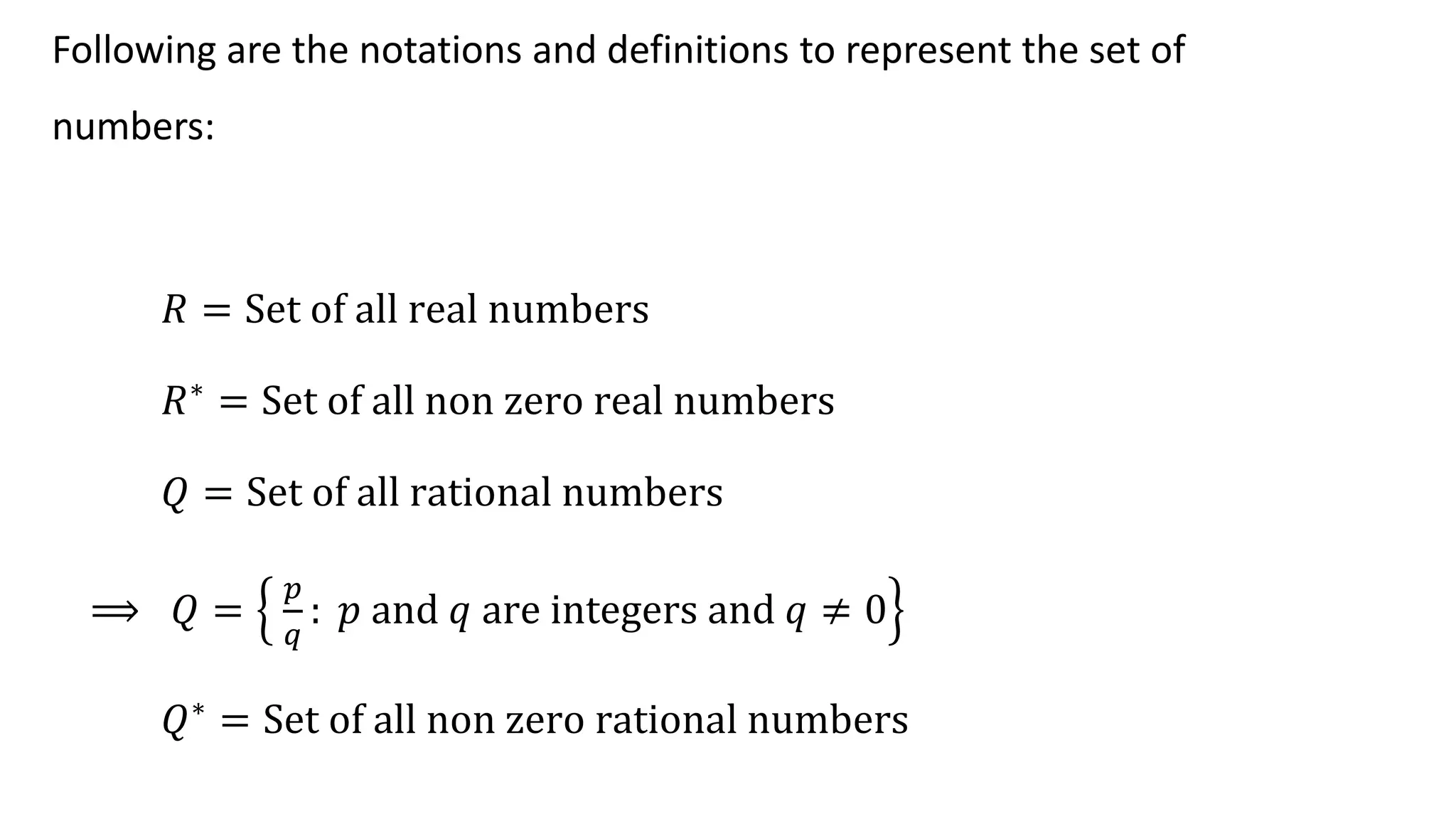
Following are the notations and definitions to represent the set of
numbers:
𝑅 = Set of all real numbers
𝑅∗
= Set of all non zero real numbers
𝑄 = Set of all rational numbers
⟹ 𝑄 =
𝑝
𝑞
: 𝑝 and 𝑞 are integers and 𝑞 ≠ 0
𝑄∗
= Set of all non zero rational numbers
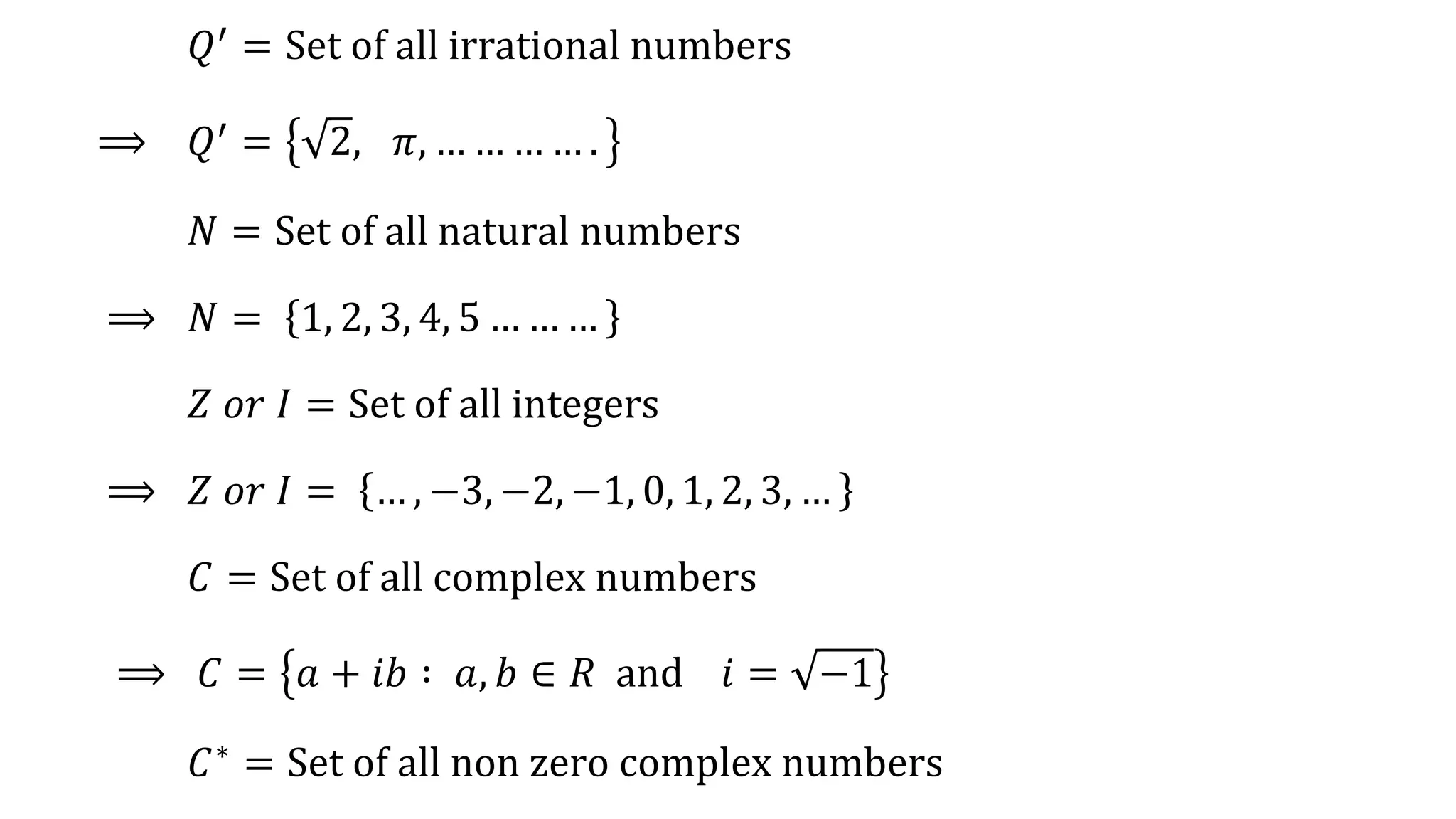
𝑄′ = Set of all irrational numbers
⟹ 𝑄′ = 2, 𝜋, … … … … .
𝑁 = Set of all natural numbers
⟹ 𝑁 = 1, 2, 3, 4, 5 … … …
𝑍 𝑜𝑟 𝐼 = Set of all integers
⟹ 𝑍 𝑜𝑟 𝐼 = … , −3, −2, −1, 0, 1, 2, 3, …
𝐶 = Set of all complex numbers
⟹ 𝐶 = 𝑎 + 𝑖𝑏 ∶ 𝑎, 𝑏 ∈ 𝑅 and 𝑖 = −1
𝐶∗ = Set of all non zero complex numbers
Binary Operations (Compositions)
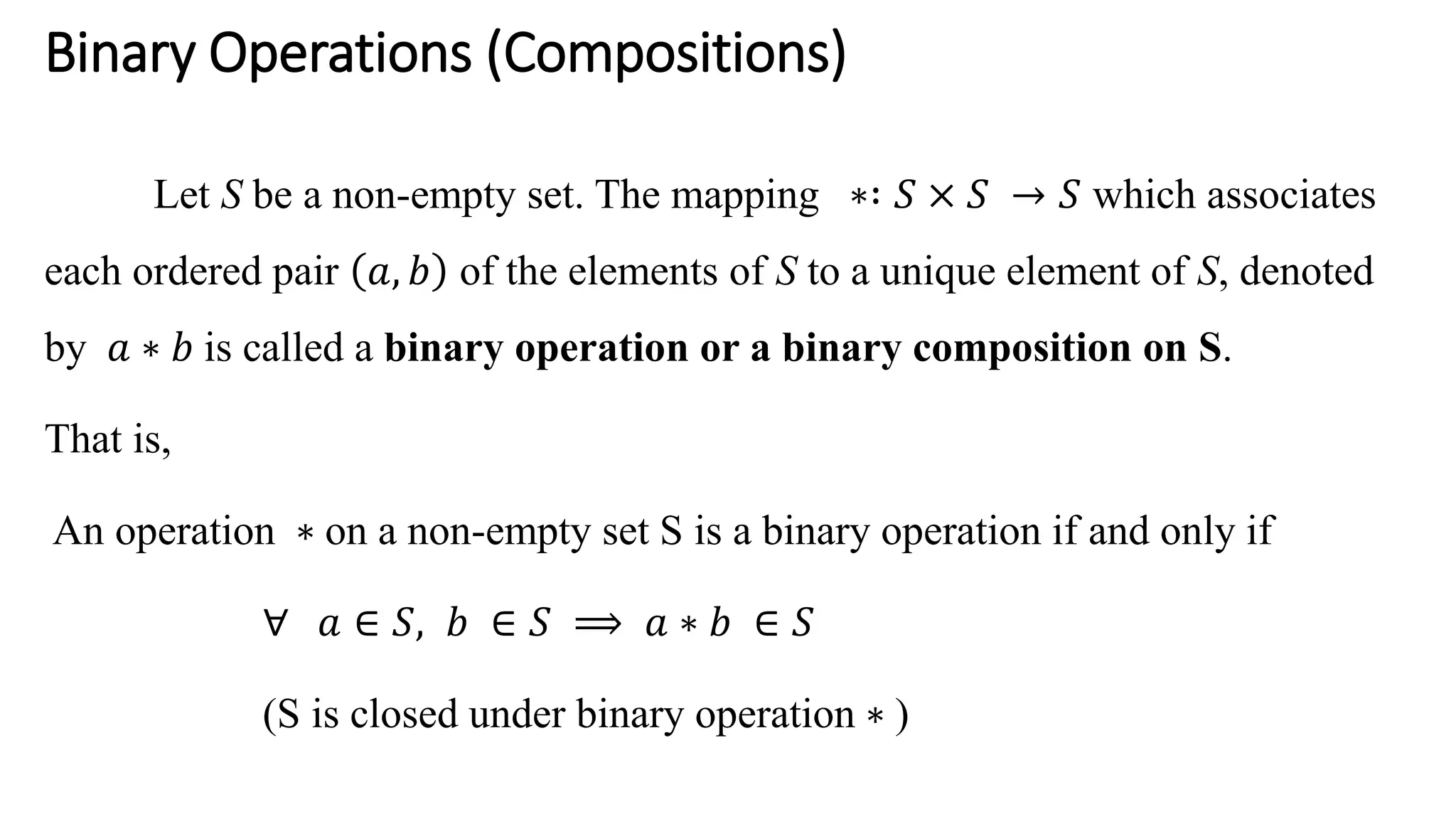
Let S be a non-empty set. The mapping ∗∶ 𝑆 × 𝑆 → 𝑆 which associates
each ordered pair 𝑎, 𝑏 of the elements of S to a unique element of S, denoted
by 𝑎 ∗ 𝑏 is called a binary operation or a binary composition on S.
That is,
An operation ∗ on a non-empty set S is a binary operation if and only if
∀ 𝑎 ∈ 𝑆, 𝑏 ∈ 𝑆 ⟹ 𝑎 ∗ 𝑏 ∈ 𝑆
(S is closed under binary operation ∗ )
Examples:
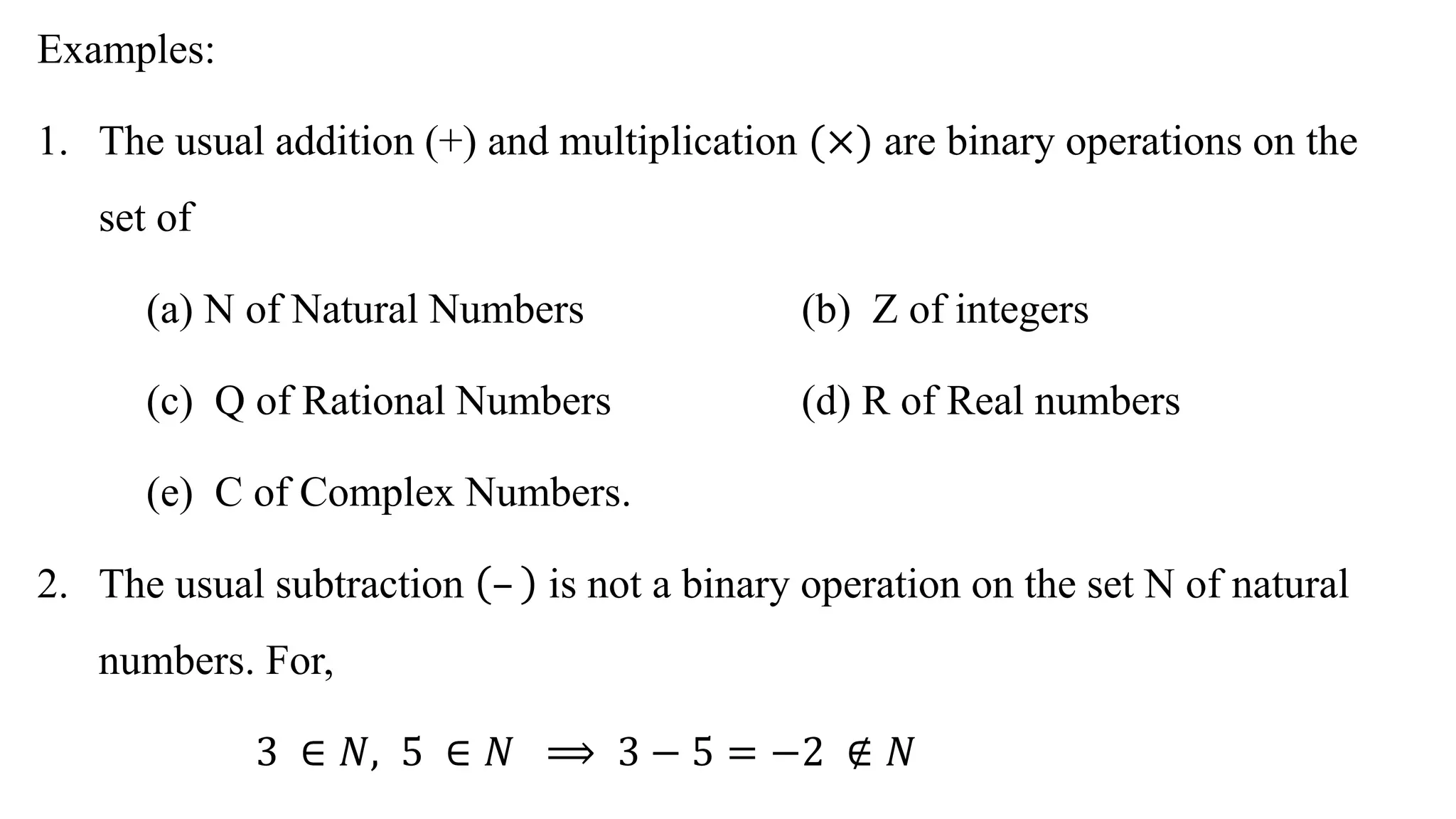
1. The usual addition (+) and multiplication (×) are binary operations on the
set of
(a) N of Natural Numbers (b) Z of integers
(c) Q of Rational Numbers (d) R of Real numbers
(e) C of Complex Numbers.
2. The usual subtraction – is not a binary operation on the set N of natural
numbers. For,
3 ∈ 𝑁, 5 ∈ 𝑁 ⟹ 3 − 5 = −2 ∉ 𝑁
Laws of Binary Operation
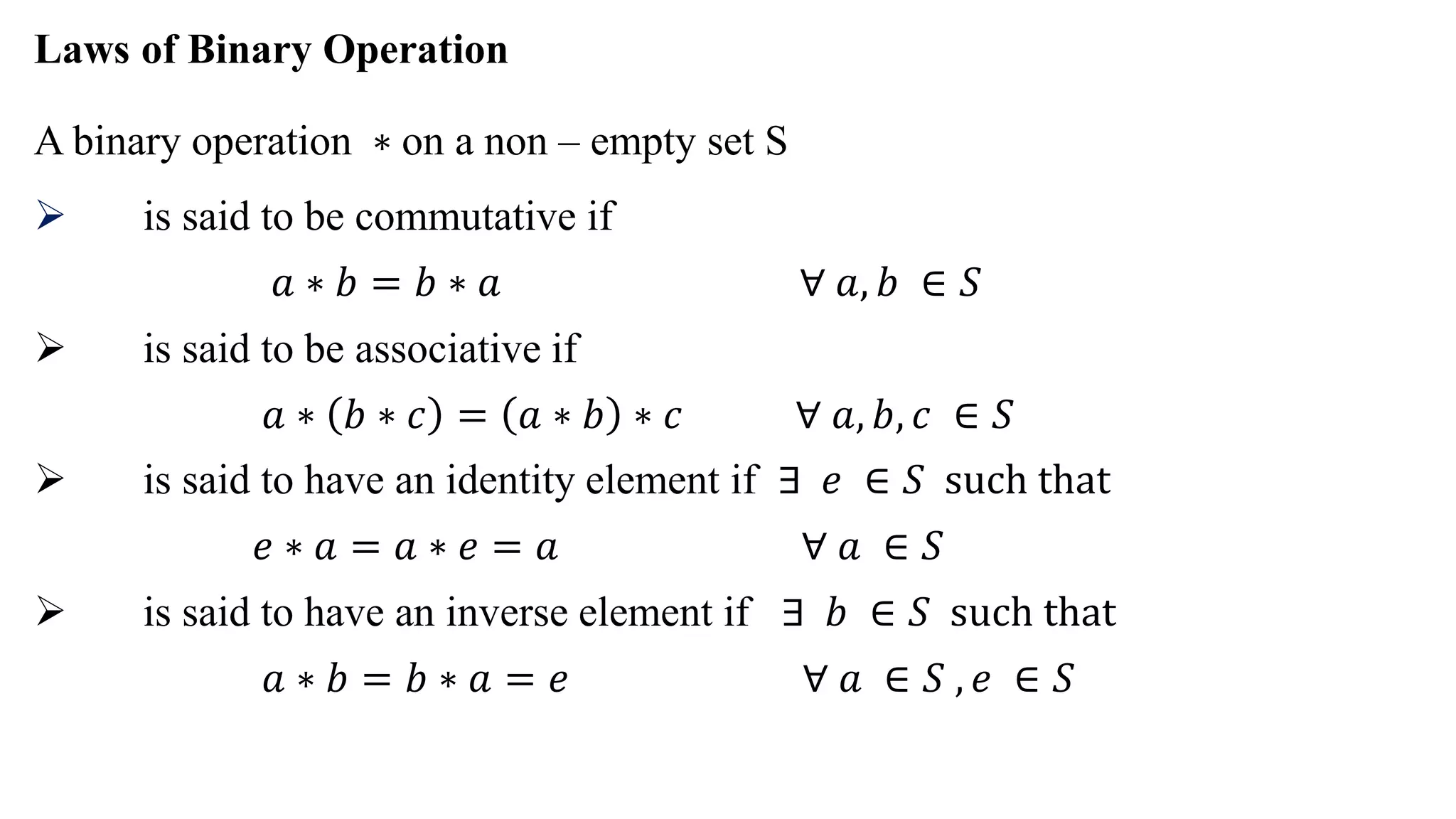
A binary operation ∗ on a non – empty set S
 is said to be commutative if
𝑎 ∗ 𝑏 = 𝑏 ∗ 𝑎 ∀ 𝑎, 𝑏 ∈ 𝑆
 is said to be associative if
𝑎 ∗ 𝑏 ∗ 𝑐 = 𝑎 ∗ 𝑏 ∗ 𝑐 ∀ 𝑎, 𝑏, 𝑐 ∈ 𝑆
 is said to have an identity element if ∃ 𝑒 ∈ 𝑆 such that
𝑒 ∗ 𝑎 = 𝑎 ∗ 𝑒 = 𝑎 ∀ 𝑎 ∈ 𝑆
 is said to have an inverse element if ∃ 𝑏 ∈ 𝑆 such that
𝑎 ∗ 𝑏 = 𝑏 ∗ 𝑎 = 𝑒 ∀ 𝑎 ∈ 𝑆 , 𝑒 ∈ 𝑆
Problems
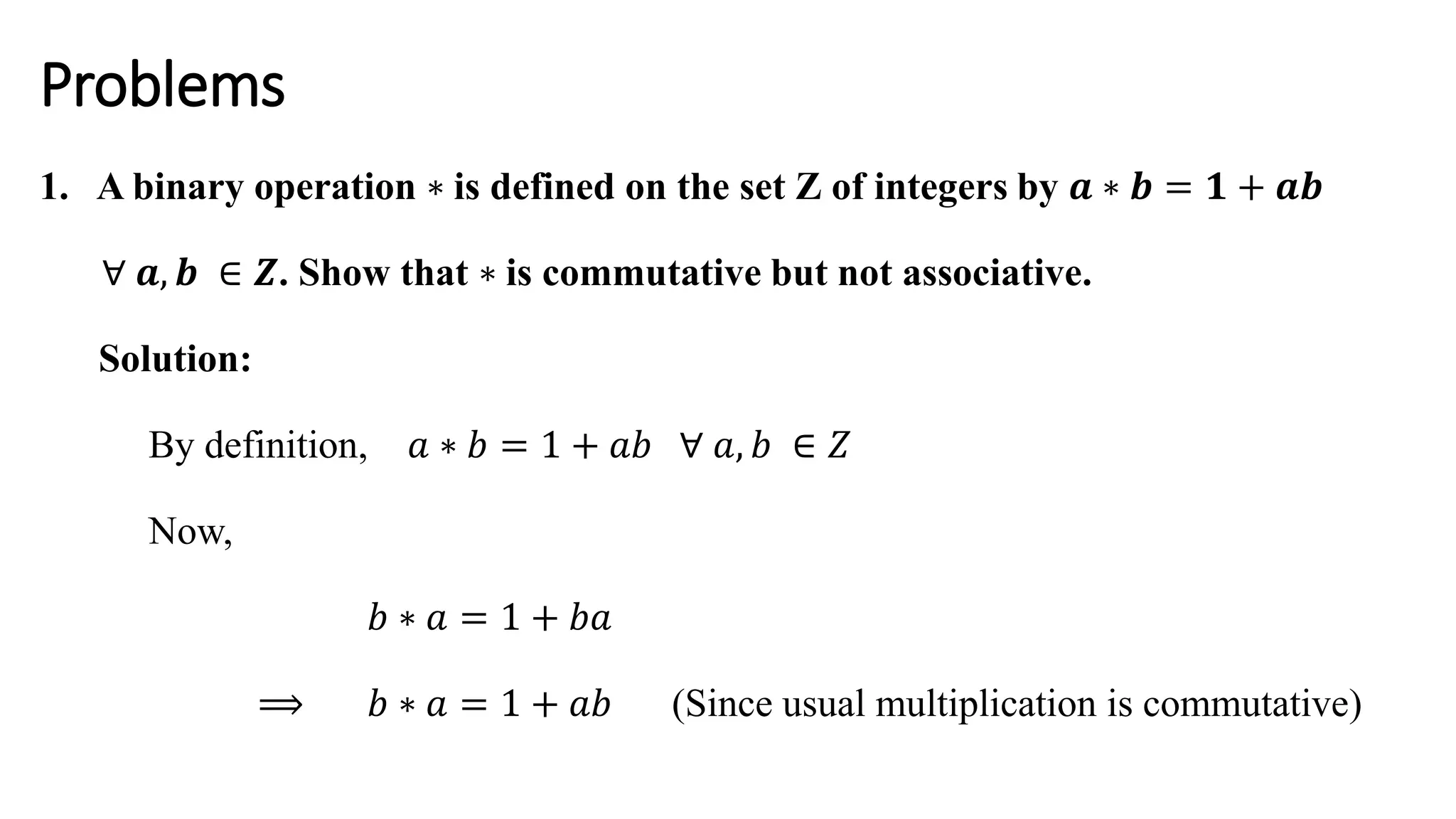
1. A binary operation ∗ is defined on the set Z of integers by 𝒂 ∗ 𝒃 = 𝟏 + 𝒂𝒃
∀ 𝒂, 𝒃 ∈ 𝒁. Show that ∗ is commutative but not associative.
Solution:
By definition, 𝑎 ∗ 𝑏 = 1 + 𝑎𝑏 ∀ 𝑎, 𝑏 ∈ 𝑍
Now,
𝑏 ∗ 𝑎 = 1 + 𝑏𝑎
⟹ 𝑏 ∗ 𝑎 = 1 + 𝑎𝑏 (Since usual multiplication is commutative)
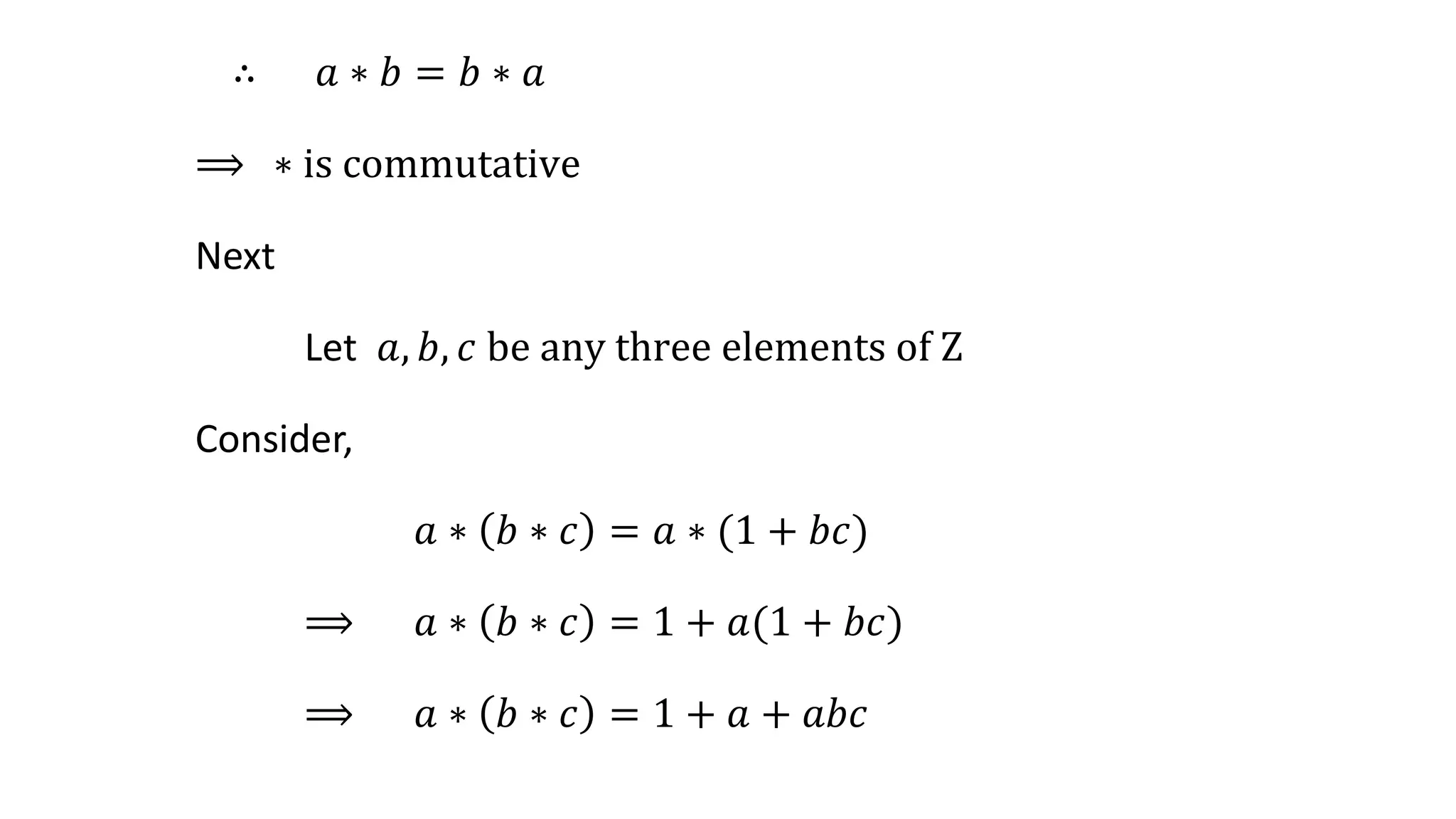
∴ 𝑎 ∗ 𝑏 = 𝑏 ∗ 𝑎
⟹ ∗ is commutative
Next
Let 𝑎, 𝑏, 𝑐 be any three elements of Z
Consider,
𝑎 ∗ 𝑏 ∗ 𝑐 = 𝑎 ∗ (1 + 𝑏𝑐)
⟹ 𝑎 ∗ 𝑏 ∗ 𝑐 = 1 + 𝑎(1 + 𝑏𝑐)
⟹ 𝑎 ∗ 𝑏 ∗ 𝑐 = 1 + 𝑎 + 𝑎𝑏𝑐
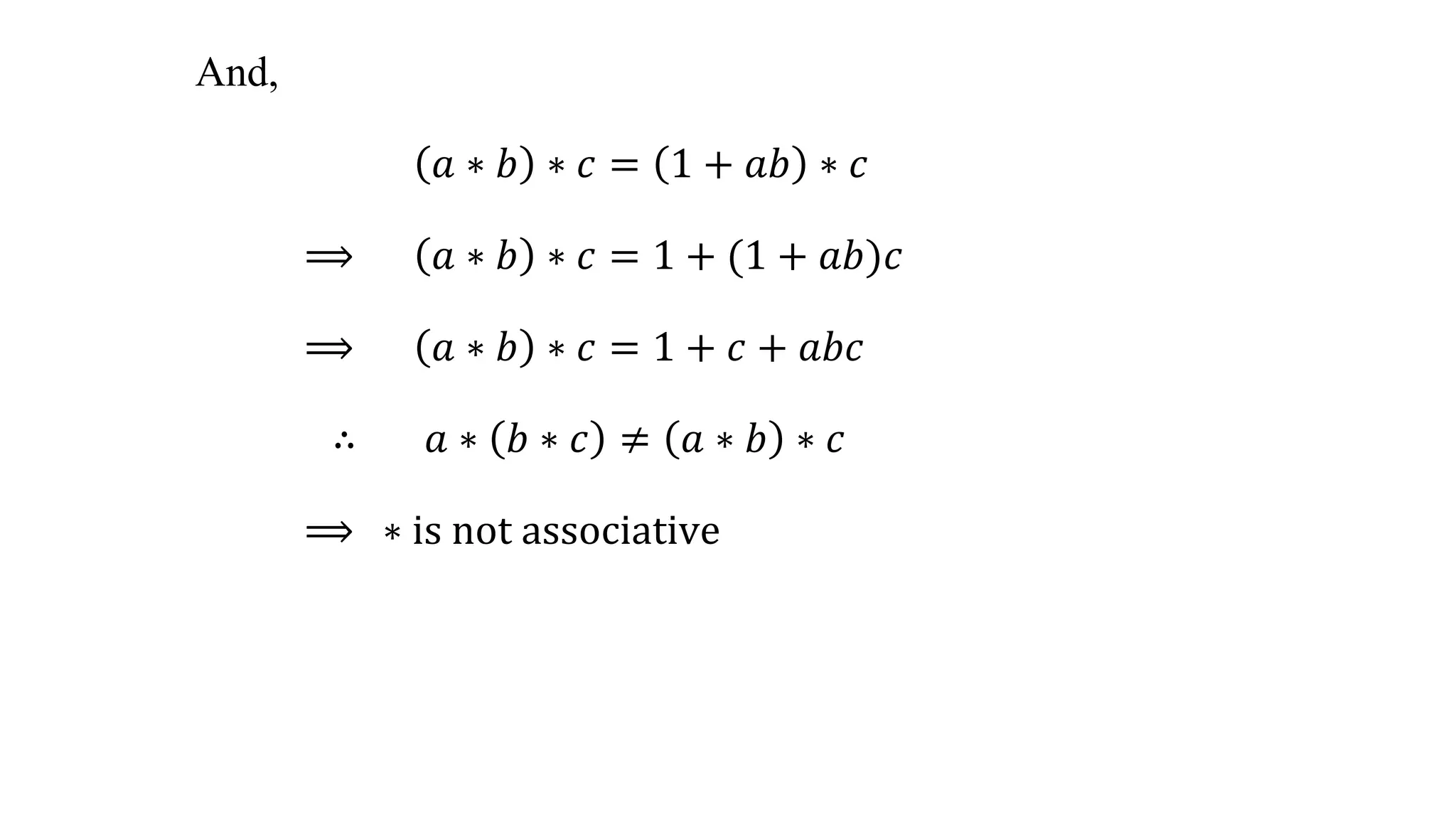
And,
𝑎 ∗ 𝑏 ∗ 𝑐 = 1 + 𝑎𝑏 ∗ 𝑐
⟹ 𝑎 ∗ 𝑏 ∗ 𝑐 = 1 + (1 + 𝑎𝑏)𝑐
⟹ 𝑎 ∗ 𝑏 ∗ 𝑐 = 1 + 𝑐 + 𝑎𝑏𝑐
∴ 𝑎 ∗ 𝑏 ∗ 𝑐 ≠ 𝑎 ∗ 𝑏 ∗ 𝑐
⟹ ∗ is not associative
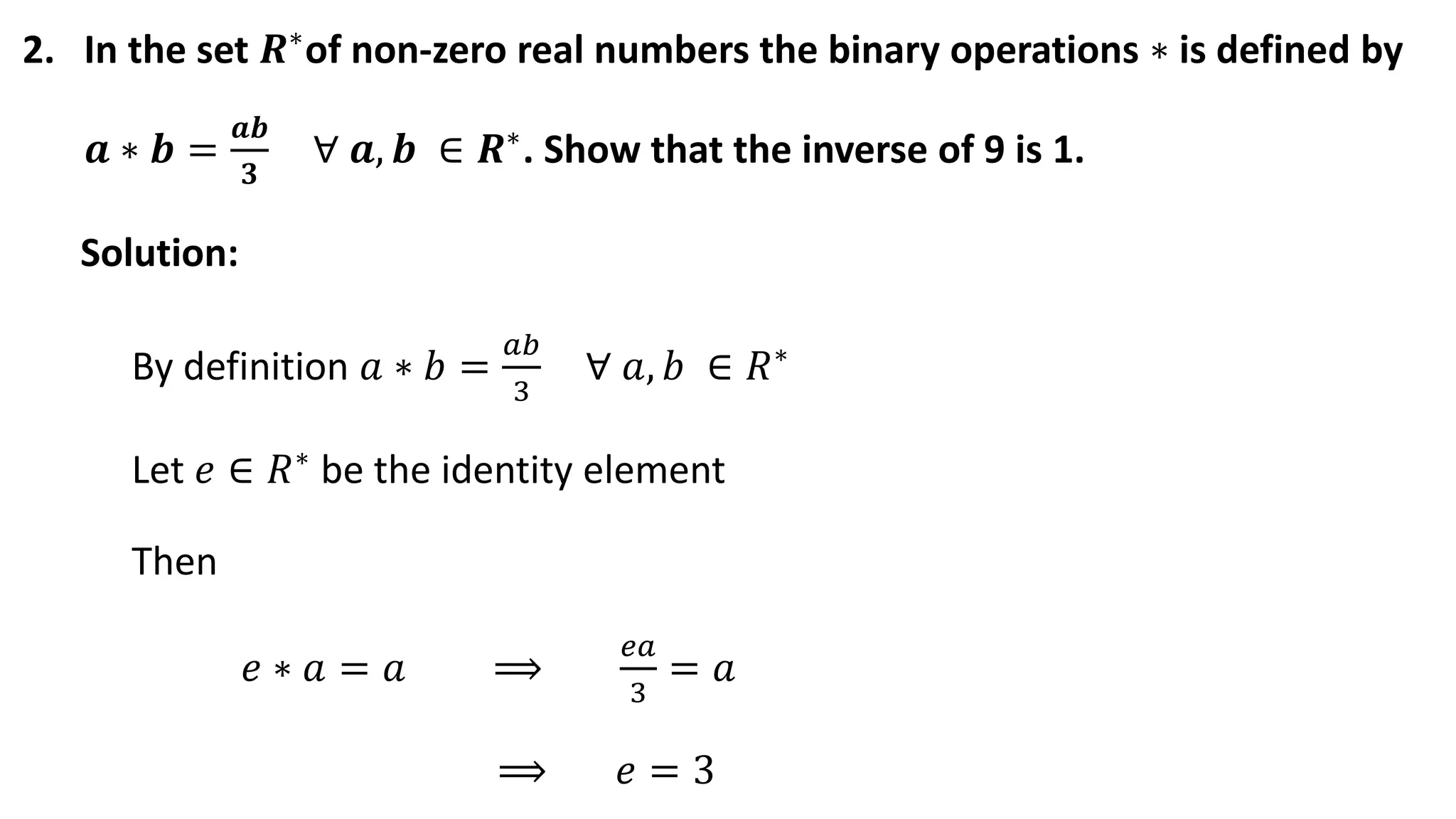
2. In the set 𝑹∗of non-zero real numbers the binary operations ∗ is defined by
𝒂 ∗ 𝒃 =
𝒂𝒃
𝟑
∀ 𝒂, 𝒃 ∈ 𝑹∗. Show that the inverse of 9 is 1.
Solution:
By definition 𝑎 ∗ 𝑏 =
𝑎𝑏
3
∀ 𝑎, 𝑏 ∈ 𝑅∗
Let 𝑒 ∈ 𝑅∗ be the identity element
Then
𝑒 ∗ 𝑎 = 𝑎 ⟹
𝑒𝑎
3
= 𝑎
⟹ 𝑒 = 3
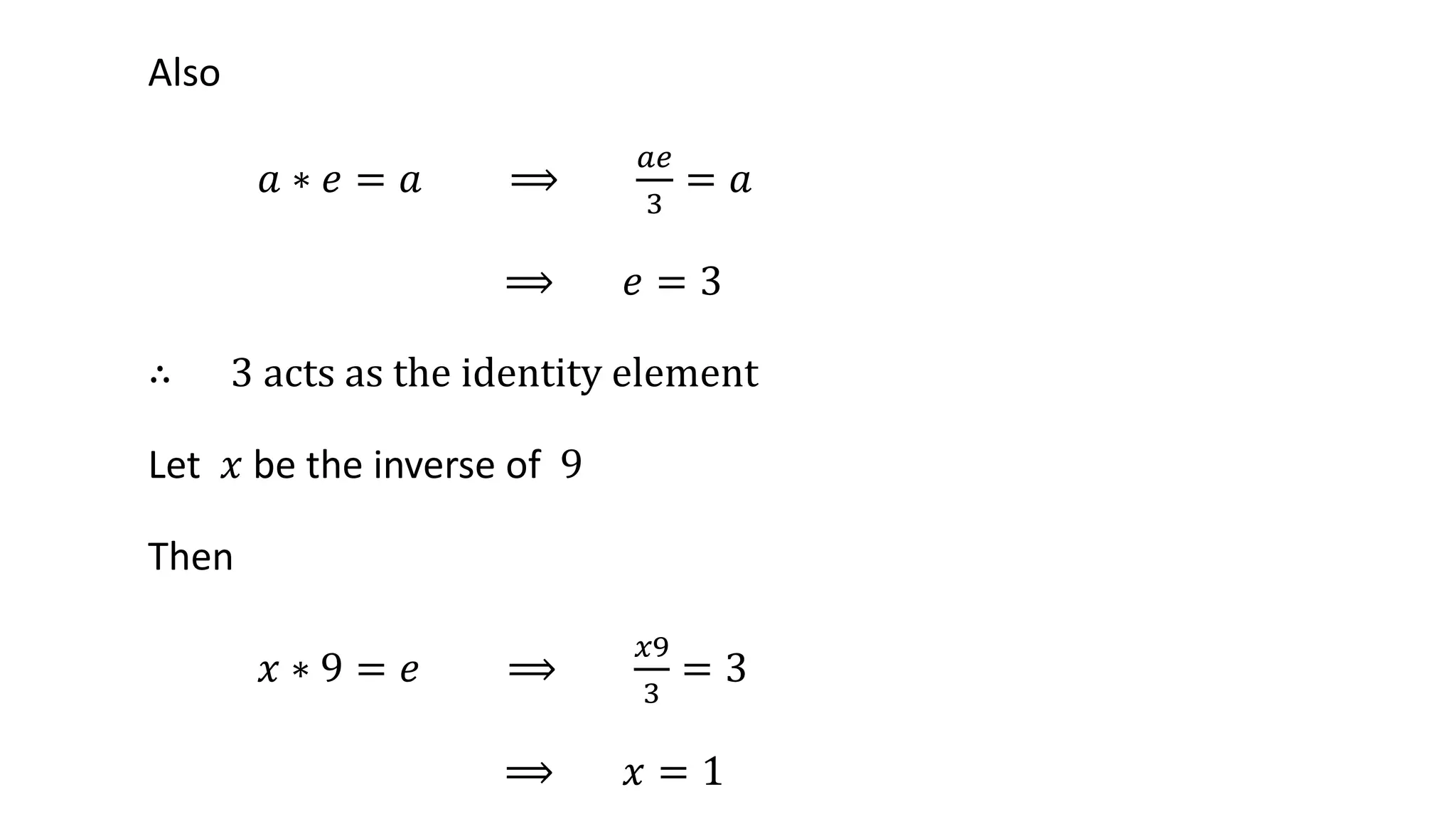
Also
𝑎 ∗ 𝑒 = 𝑎 ⟹
𝑎𝑒
3
= 𝑎
⟹ 𝑒 = 3
∴ 3 acts as the identity element
Let 𝑥 be the inverse of 9
Then
𝑥 ∗ 9 = 𝑒 ⟹
𝑥9
3
= 3
⟹ 𝑥 = 1
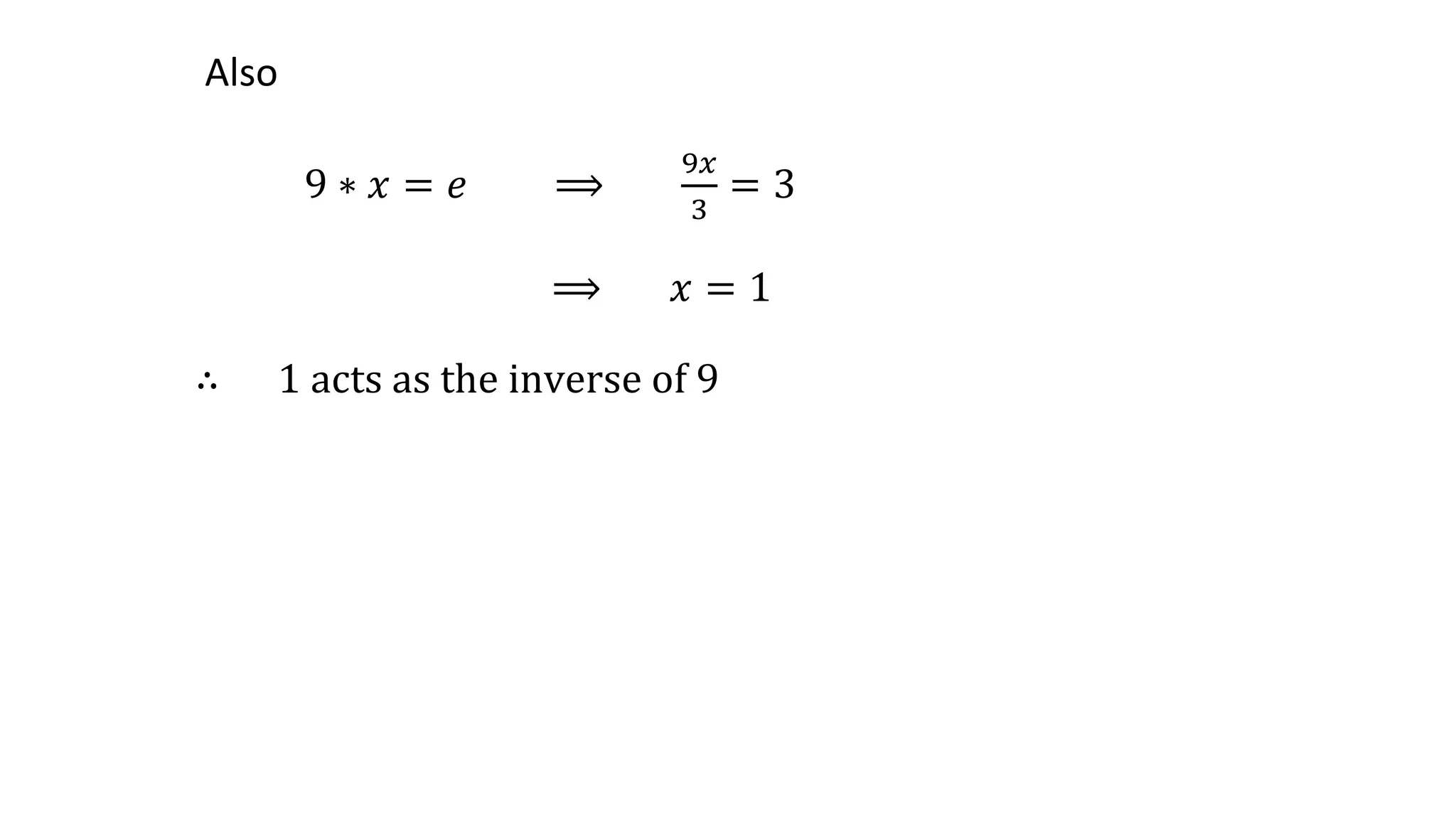
Also
9 ∗ 𝑥 = 𝑒 ⟹
9𝑥
3
= 3
⟹ 𝑥 = 1
∴ 1 acts as the inverse of 9
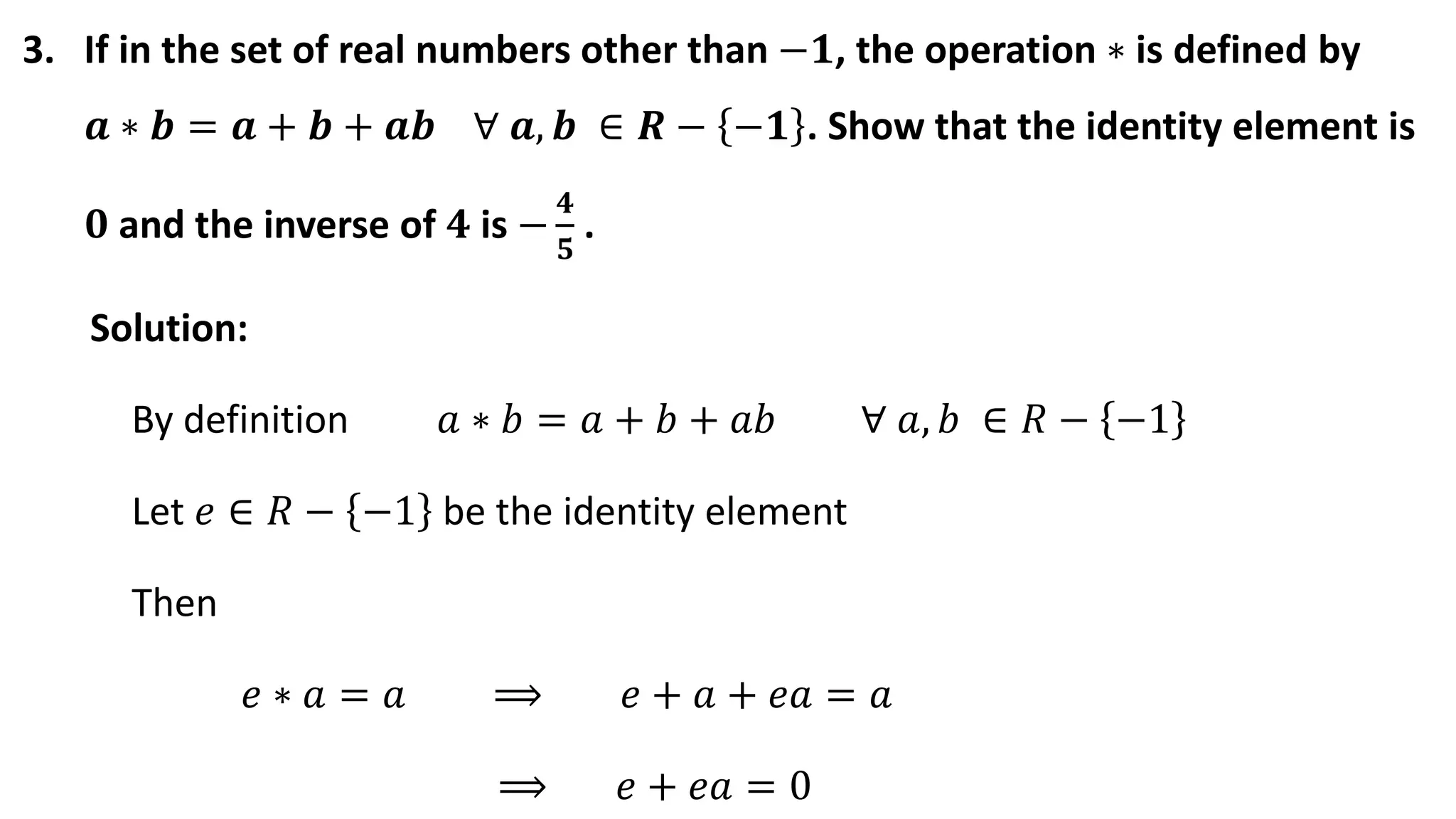
3. If in the set of real numbers other than −𝟏, the operation ∗ is defined by
𝒂 ∗ 𝒃 = 𝒂 + 𝒃 + 𝒂𝒃 ∀ 𝒂, 𝒃 ∈ 𝑹 − −𝟏 . Show that the identity element is
𝟎 and the inverse of 𝟒 is −
𝟒
𝟓
.
Solution:
By definition 𝑎 ∗ 𝑏 = 𝑎 + 𝑏 + 𝑎𝑏 ∀ 𝑎, 𝑏 ∈ 𝑅 − −1
Let 𝑒 ∈ 𝑅 − −1 be the identity element
Then
𝑒 ∗ 𝑎 = 𝑎 ⟹ 𝑒 + 𝑎 + 𝑒𝑎 = 𝑎
⟹ 𝑒 + 𝑒𝑎 = 0
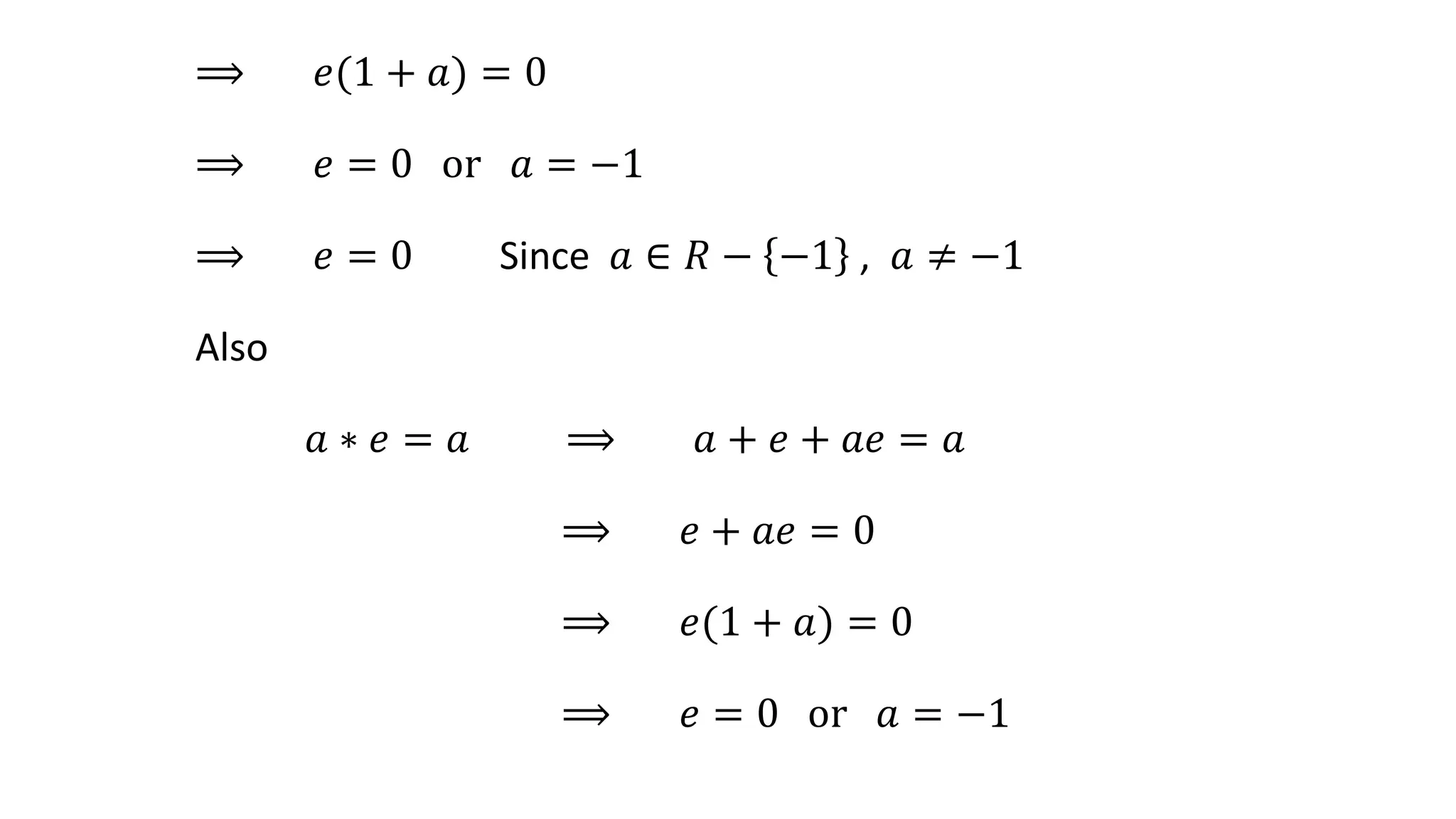
⟹ 𝑒(1 + 𝑎) = 0
⟹ 𝑒 = 0 or 𝑎 = −1
⟹ 𝑒 = 0 Since 𝑎 ∈ 𝑅 − −1 , 𝑎 ≠ −1
Also
𝑎 ∗ 𝑒 = 𝑎 ⟹ 𝑎 + 𝑒 + 𝑎𝑒 = 𝑎
⟹ 𝑒 + 𝑎𝑒 = 0
⟹ 𝑒(1 + 𝑎) = 0
⟹ 𝑒 = 0 or 𝑎 = −1
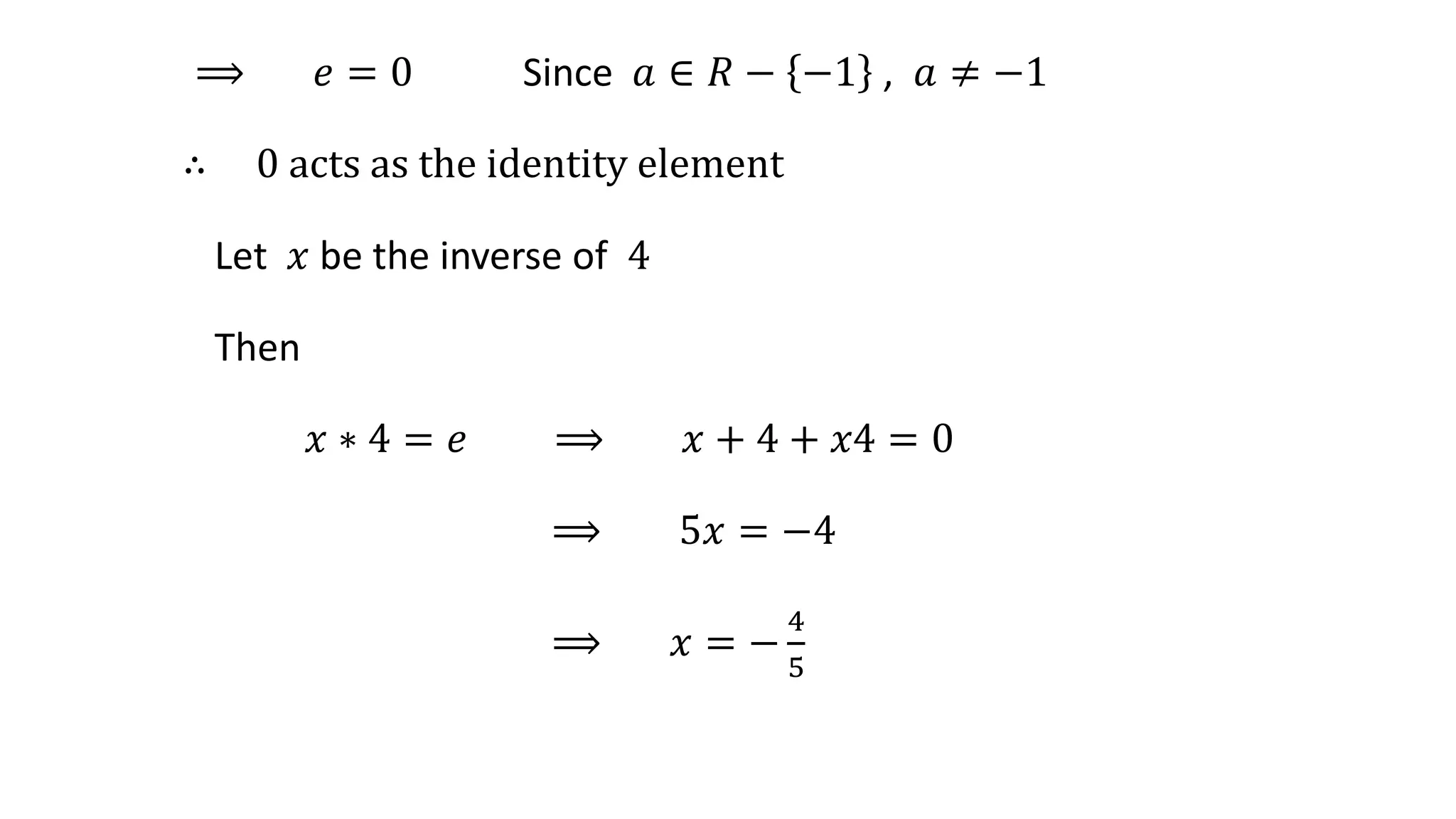
⟹ 𝑒 = 0 Since 𝑎 ∈ 𝑅 − −1 , 𝑎 ≠ −1
∴ 0 acts as the identity element
Let 𝑥 be the inverse of 4
Then
𝑥 ∗ 4 = 𝑒 ⟹ 𝑥 + 4 + 𝑥4 = 0
⟹ 5𝑥 = −4
⟹ 𝑥 = −
4
5
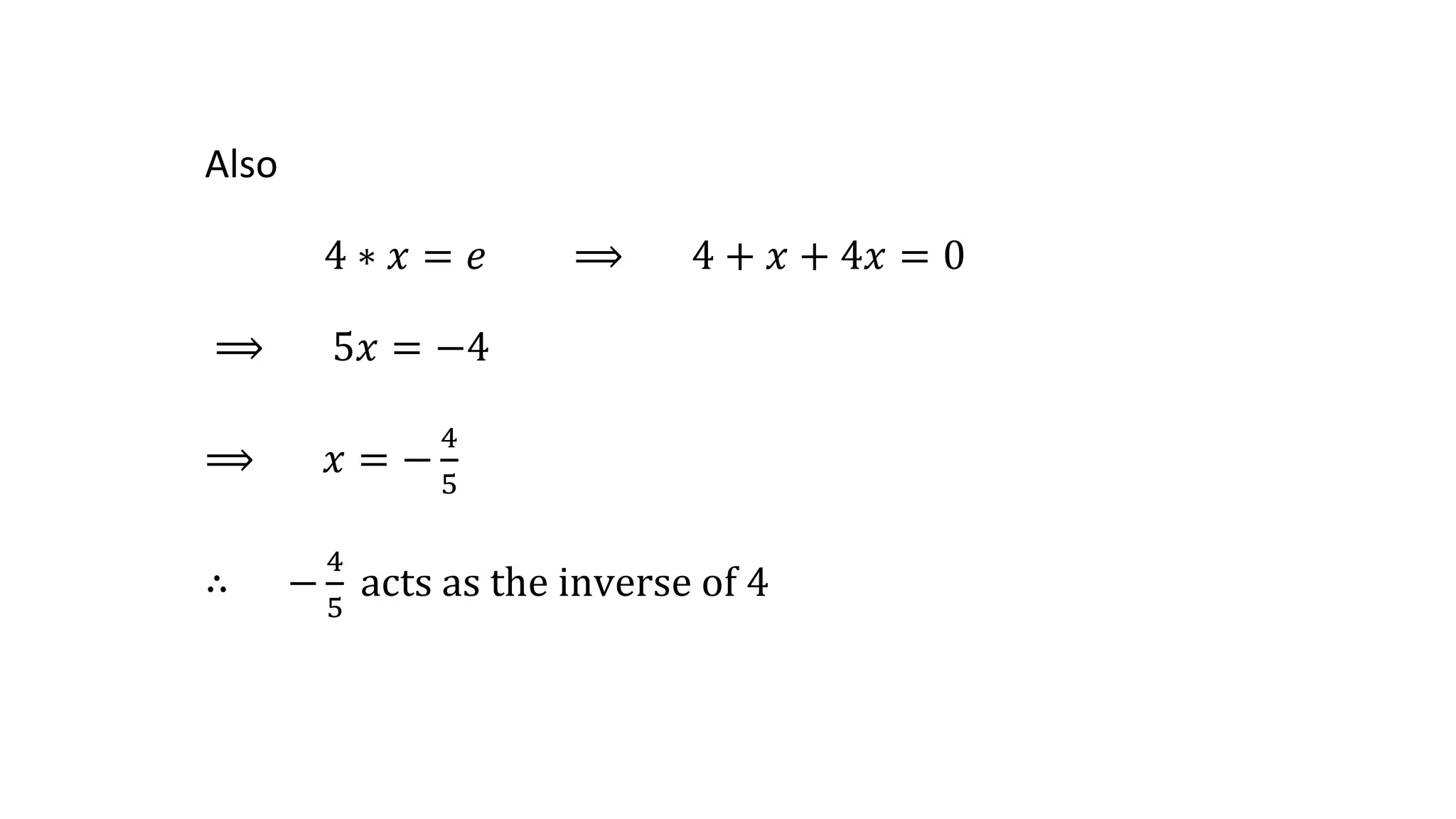
Also
4 ∗ 𝑥 = 𝑒 ⟹ 4 + 𝑥 + 4𝑥 = 0
⟹ 5𝑥 = −4
⟹ 𝑥 = −
4
5
∴ −
4
5
acts as the inverse of 4
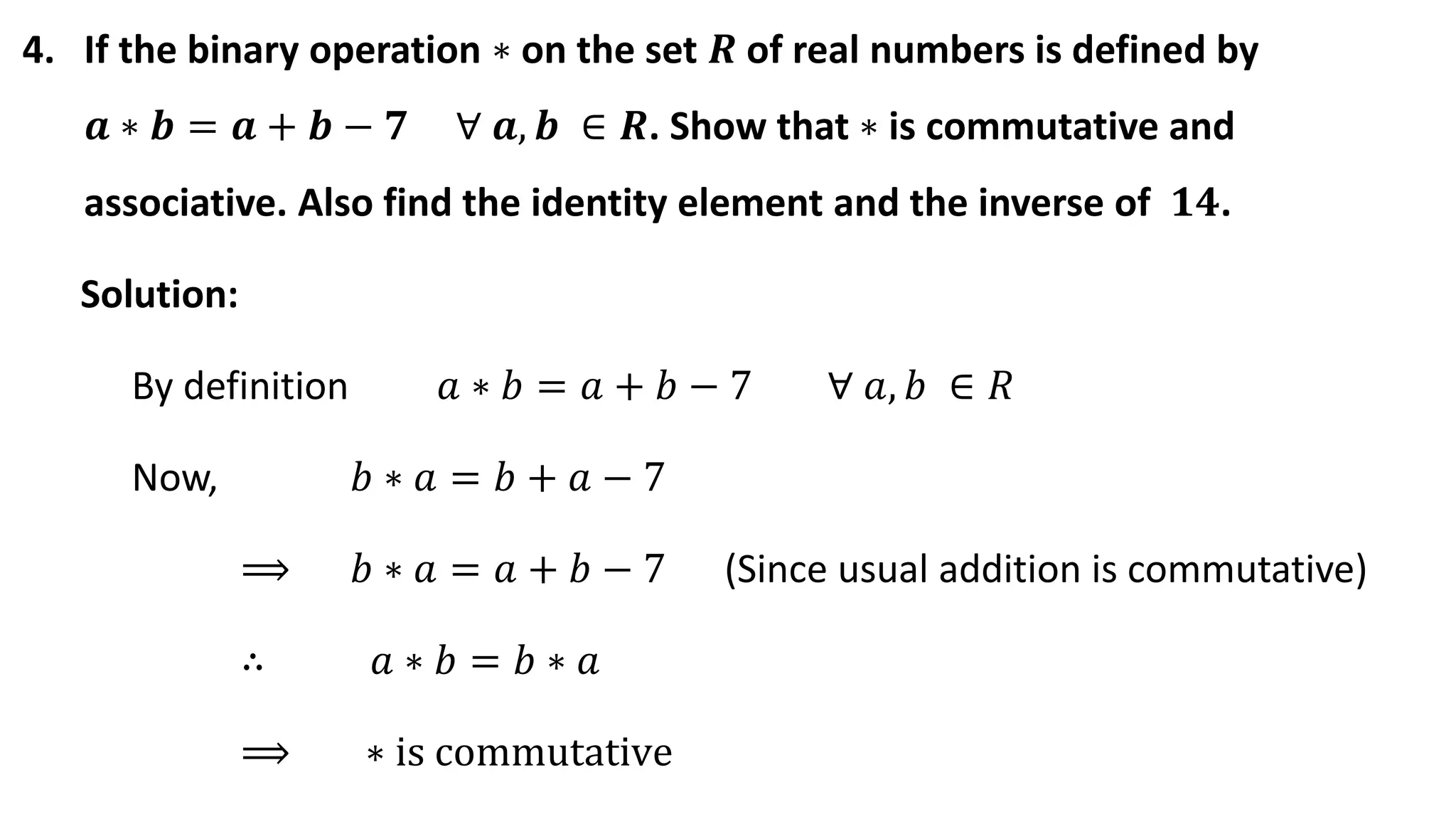
4. If the binary operation ∗ on the set 𝑹 of real numbers is defined by
𝒂 ∗ 𝒃 = 𝒂 + 𝒃 − 𝟕 ∀ 𝒂, 𝒃 ∈ 𝑹. Show that ∗ is commutative and
associative. Also find the identity element and the inverse of 𝟏𝟒.
Solution:
By definition 𝑎 ∗ 𝑏 = 𝑎 + 𝑏 − 7 ∀ 𝑎, 𝑏 ∈ 𝑅
Now, 𝑏 ∗ 𝑎 = 𝑏 + 𝑎 − 7
⟹ 𝑏 ∗ 𝑎 = 𝑎 + 𝑏 − 7 (Since usual addition is commutative)
∴ 𝑎 ∗ 𝑏 = 𝑏 ∗ 𝑎
⟹ ∗ is commutative
Let 𝑎, 𝑏, 𝑐 be any three elements of 𝑅
Now, 𝑎 ∗ 𝑏 ∗ 𝑐 = 𝑎 ∗ 𝑏 + 𝑐 − 7
⟹ 𝑎 ∗ 𝑏 ∗ 𝑐 = 𝑎 + 𝑏 + 𝑐 − 7 − 7
⟹ 𝑎 ∗ 𝑏 ∗ 𝑐 = 𝑎 + 𝑏 + 𝑐 − 14
Next, 𝑎 ∗ 𝑏 ∗ 𝑐 = 𝑎 + 𝑏 − 7 ∗ 𝑐
⟹ 𝑎 ∗ 𝑏 ∗ 𝑐 = 𝑎 + 𝑏 − 7 + 𝑐 − 7
⟹ 𝑎 ∗ 𝑏 ∗ 𝑐 = 𝑎 + 𝑏 + 𝑐 − 14
∴ 𝑎 ∗ 𝑏 ∗ 𝑐 = 𝑎 ∗ 𝑏 ∗ 𝑐
⟹ ∗ is associative
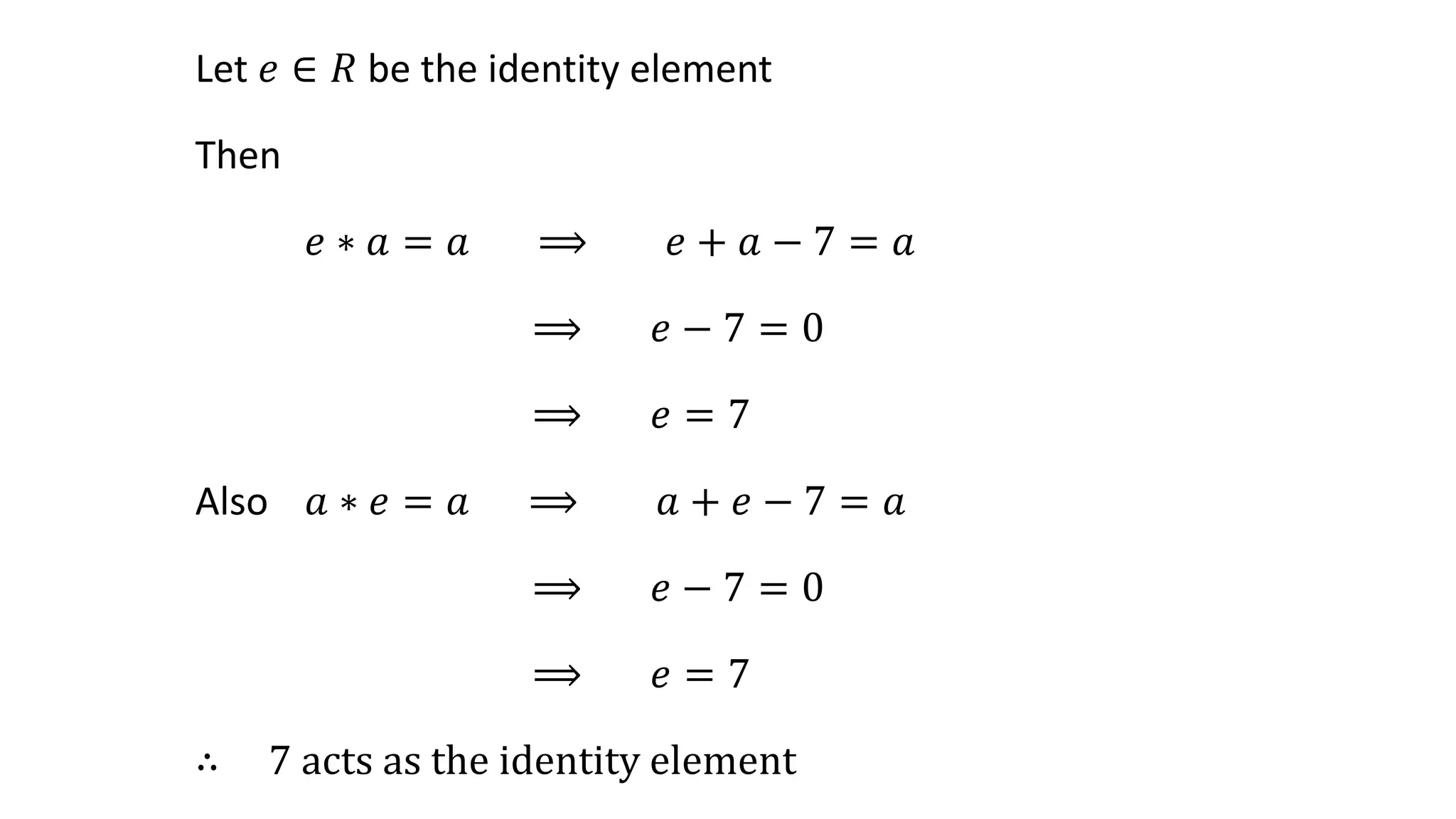
Let 𝑒 ∈ 𝑅 be the identity element
Then
𝑒 ∗ 𝑎 = 𝑎 ⟹ 𝑒 + 𝑎 − 7 = 𝑎
⟹ 𝑒 − 7 = 0
⟹ 𝑒 = 7
Also 𝑎 ∗ 𝑒 = 𝑎 ⟹ 𝑎 + 𝑒 − 7 = 𝑎
⟹ 𝑒 − 7 = 0
⟹ 𝑒 = 7
∴ 7 acts as the identity element
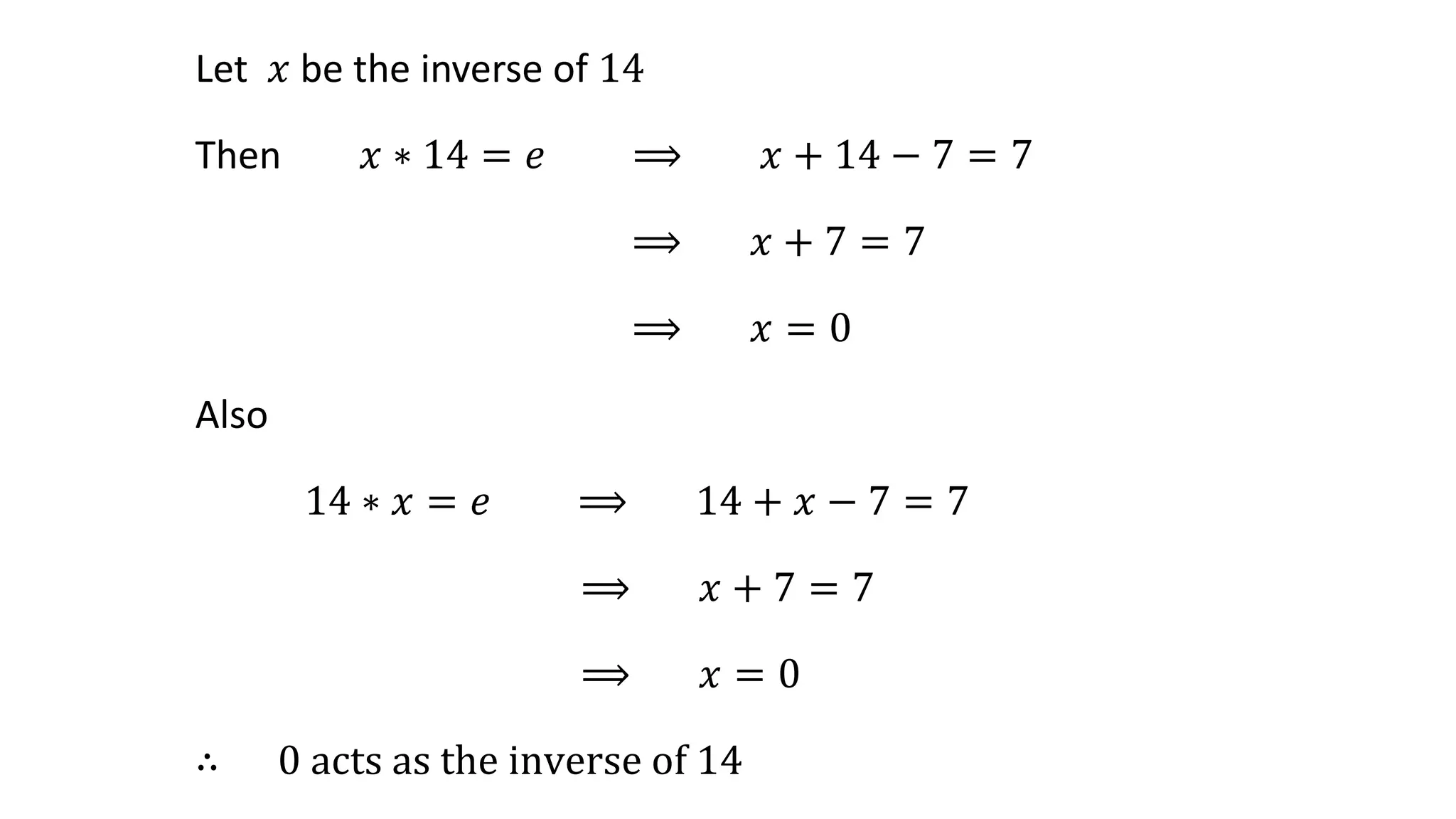
Let 𝑥 be the inverse of 14
Then 𝑥 ∗ 14 = 𝑒 ⟹ 𝑥 + 14 − 7 = 7
⟹ 𝑥 + 7 = 7
⟹ 𝑥 = 0
Also
14 ∗ 𝑥 = 𝑒 ⟹ 14 + 𝑥 − 7 = 7
⟹ 𝑥 + 7 = 7
⟹ 𝑥 = 0
∴ 0 acts as the inverse of 14
Binary Operations.pptx

Binary Operations.pptx

  • 1.
  • 2.
    Following are thenotations and definitions to represent the set of numbers: 𝑅 = Set of all real numbers 𝑅∗ = Set of all non zero real numbers 𝑄 = Set of all rational numbers ⟹ 𝑄 = 𝑝 𝑞 : 𝑝 and 𝑞 are integers and 𝑞 ≠ 0 𝑄∗ = Set of all non zero rational numbers
  • 3.
    𝑄′ = Setof all irrational numbers ⟹ 𝑄′ = 2, 𝜋, … … … … . 𝑁 = Set of all natural numbers ⟹ 𝑁 = 1, 2, 3, 4, 5 … … … 𝑍 𝑜𝑟 𝐼 = Set of all integers ⟹ 𝑍 𝑜𝑟 𝐼 = … , −3, −2, −1, 0, 1, 2, 3, … 𝐶 = Set of all complex numbers ⟹ 𝐶 = 𝑎 + 𝑖𝑏 ∶ 𝑎, 𝑏 ∈ 𝑅 and 𝑖 = −1 𝐶∗ = Set of all non zero complex numbers
  • 4.
    Binary Operations (Compositions) LetS be a non-empty set. The mapping ∗∶ 𝑆 × 𝑆 → 𝑆 which associates each ordered pair 𝑎, 𝑏 of the elements of S to a unique element of S, denoted by 𝑎 ∗ 𝑏 is called a binary operation or a binary composition on S. That is, An operation ∗ on a non-empty set S is a binary operation if and only if ∀ 𝑎 ∈ 𝑆, 𝑏 ∈ 𝑆 ⟹ 𝑎 ∗ 𝑏 ∈ 𝑆 (S is closed under binary operation ∗ )
  • 5.
    Examples: 1. The usualaddition (+) and multiplication (×) are binary operations on the set of (a) N of Natural Numbers (b) Z of integers (c) Q of Rational Numbers (d) R of Real numbers (e) C of Complex Numbers. 2. The usual subtraction – is not a binary operation on the set N of natural numbers. For, 3 ∈ 𝑁, 5 ∈ 𝑁 ⟹ 3 − 5 = −2 ∉ 𝑁
  • 6.
    Laws of BinaryOperation A binary operation ∗ on a non – empty set S  is said to be commutative if 𝑎 ∗ 𝑏 = 𝑏 ∗ 𝑎 ∀ 𝑎, 𝑏 ∈ 𝑆  is said to be associative if 𝑎 ∗ 𝑏 ∗ 𝑐 = 𝑎 ∗ 𝑏 ∗ 𝑐 ∀ 𝑎, 𝑏, 𝑐 ∈ 𝑆  is said to have an identity element if ∃ 𝑒 ∈ 𝑆 such that 𝑒 ∗ 𝑎 = 𝑎 ∗ 𝑒 = 𝑎 ∀ 𝑎 ∈ 𝑆  is said to have an inverse element if ∃ 𝑏 ∈ 𝑆 such that 𝑎 ∗ 𝑏 = 𝑏 ∗ 𝑎 = 𝑒 ∀ 𝑎 ∈ 𝑆 , 𝑒 ∈ 𝑆
  • 7.
    Problems 1. A binaryoperation ∗ is defined on the set Z of integers by 𝒂 ∗ 𝒃 = 𝟏 + 𝒂𝒃 ∀ 𝒂, 𝒃 ∈ 𝒁. Show that ∗ is commutative but not associative. Solution: By definition, 𝑎 ∗ 𝑏 = 1 + 𝑎𝑏 ∀ 𝑎, 𝑏 ∈ 𝑍 Now, 𝑏 ∗ 𝑎 = 1 + 𝑏𝑎 ⟹ 𝑏 ∗ 𝑎 = 1 + 𝑎𝑏 (Since usual multiplication is commutative)
  • 8.
    ∴ 𝑎 ∗𝑏 = 𝑏 ∗ 𝑎 ⟹ ∗ is commutative Next Let 𝑎, 𝑏, 𝑐 be any three elements of Z Consider, 𝑎 ∗ 𝑏 ∗ 𝑐 = 𝑎 ∗ (1 + 𝑏𝑐) ⟹ 𝑎 ∗ 𝑏 ∗ 𝑐 = 1 + 𝑎(1 + 𝑏𝑐) ⟹ 𝑎 ∗ 𝑏 ∗ 𝑐 = 1 + 𝑎 + 𝑎𝑏𝑐
  • 9.
    And, 𝑎 ∗ 𝑏∗ 𝑐 = 1 + 𝑎𝑏 ∗ 𝑐 ⟹ 𝑎 ∗ 𝑏 ∗ 𝑐 = 1 + (1 + 𝑎𝑏)𝑐 ⟹ 𝑎 ∗ 𝑏 ∗ 𝑐 = 1 + 𝑐 + 𝑎𝑏𝑐 ∴ 𝑎 ∗ 𝑏 ∗ 𝑐 ≠ 𝑎 ∗ 𝑏 ∗ 𝑐 ⟹ ∗ is not associative
  • 10.
    2. In theset 𝑹∗of non-zero real numbers the binary operations ∗ is defined by 𝒂 ∗ 𝒃 = 𝒂𝒃 𝟑 ∀ 𝒂, 𝒃 ∈ 𝑹∗. Show that the inverse of 9 is 1. Solution: By definition 𝑎 ∗ 𝑏 = 𝑎𝑏 3 ∀ 𝑎, 𝑏 ∈ 𝑅∗ Let 𝑒 ∈ 𝑅∗ be the identity element Then 𝑒 ∗ 𝑎 = 𝑎 ⟹ 𝑒𝑎 3 = 𝑎 ⟹ 𝑒 = 3
  • 11.
    Also 𝑎 ∗ 𝑒= 𝑎 ⟹ 𝑎𝑒 3 = 𝑎 ⟹ 𝑒 = 3 ∴ 3 acts as the identity element Let 𝑥 be the inverse of 9 Then 𝑥 ∗ 9 = 𝑒 ⟹ 𝑥9 3 = 3 ⟹ 𝑥 = 1
  • 12.
    Also 9 ∗ 𝑥= 𝑒 ⟹ 9𝑥 3 = 3 ⟹ 𝑥 = 1 ∴ 1 acts as the inverse of 9
  • 13.
    3. If inthe set of real numbers other than −𝟏, the operation ∗ is defined by 𝒂 ∗ 𝒃 = 𝒂 + 𝒃 + 𝒂𝒃 ∀ 𝒂, 𝒃 ∈ 𝑹 − −𝟏 . Show that the identity element is 𝟎 and the inverse of 𝟒 is − 𝟒 𝟓 . Solution: By definition 𝑎 ∗ 𝑏 = 𝑎 + 𝑏 + 𝑎𝑏 ∀ 𝑎, 𝑏 ∈ 𝑅 − −1 Let 𝑒 ∈ 𝑅 − −1 be the identity element Then 𝑒 ∗ 𝑎 = 𝑎 ⟹ 𝑒 + 𝑎 + 𝑒𝑎 = 𝑎 ⟹ 𝑒 + 𝑒𝑎 = 0
  • 14.
    ⟹ 𝑒(1 +𝑎) = 0 ⟹ 𝑒 = 0 or 𝑎 = −1 ⟹ 𝑒 = 0 Since 𝑎 ∈ 𝑅 − −1 , 𝑎 ≠ −1 Also 𝑎 ∗ 𝑒 = 𝑎 ⟹ 𝑎 + 𝑒 + 𝑎𝑒 = 𝑎 ⟹ 𝑒 + 𝑎𝑒 = 0 ⟹ 𝑒(1 + 𝑎) = 0 ⟹ 𝑒 = 0 or 𝑎 = −1
  • 15.
    ⟹ 𝑒 =0 Since 𝑎 ∈ 𝑅 − −1 , 𝑎 ≠ −1 ∴ 0 acts as the identity element Let 𝑥 be the inverse of 4 Then 𝑥 ∗ 4 = 𝑒 ⟹ 𝑥 + 4 + 𝑥4 = 0 ⟹ 5𝑥 = −4 ⟹ 𝑥 = − 4 5
  • 16.
    Also 4 ∗ 𝑥= 𝑒 ⟹ 4 + 𝑥 + 4𝑥 = 0 ⟹ 5𝑥 = −4 ⟹ 𝑥 = − 4 5 ∴ − 4 5 acts as the inverse of 4
  • 17.
    4. If thebinary operation ∗ on the set 𝑹 of real numbers is defined by 𝒂 ∗ 𝒃 = 𝒂 + 𝒃 − 𝟕 ∀ 𝒂, 𝒃 ∈ 𝑹. Show that ∗ is commutative and associative. Also find the identity element and the inverse of 𝟏𝟒. Solution: By definition 𝑎 ∗ 𝑏 = 𝑎 + 𝑏 − 7 ∀ 𝑎, 𝑏 ∈ 𝑅 Now, 𝑏 ∗ 𝑎 = 𝑏 + 𝑎 − 7 ⟹ 𝑏 ∗ 𝑎 = 𝑎 + 𝑏 − 7 (Since usual addition is commutative) ∴ 𝑎 ∗ 𝑏 = 𝑏 ∗ 𝑎 ⟹ ∗ is commutative
  • 18.
    Let 𝑎, 𝑏,𝑐 be any three elements of 𝑅 Now, 𝑎 ∗ 𝑏 ∗ 𝑐 = 𝑎 ∗ 𝑏 + 𝑐 − 7 ⟹ 𝑎 ∗ 𝑏 ∗ 𝑐 = 𝑎 + 𝑏 + 𝑐 − 7 − 7 ⟹ 𝑎 ∗ 𝑏 ∗ 𝑐 = 𝑎 + 𝑏 + 𝑐 − 14 Next, 𝑎 ∗ 𝑏 ∗ 𝑐 = 𝑎 + 𝑏 − 7 ∗ 𝑐 ⟹ 𝑎 ∗ 𝑏 ∗ 𝑐 = 𝑎 + 𝑏 − 7 + 𝑐 − 7 ⟹ 𝑎 ∗ 𝑏 ∗ 𝑐 = 𝑎 + 𝑏 + 𝑐 − 14 ∴ 𝑎 ∗ 𝑏 ∗ 𝑐 = 𝑎 ∗ 𝑏 ∗ 𝑐 ⟹ ∗ is associative
  • 19.
    Let 𝑒 ∈𝑅 be the identity element Then 𝑒 ∗ 𝑎 = 𝑎 ⟹ 𝑒 + 𝑎 − 7 = 𝑎 ⟹ 𝑒 − 7 = 0 ⟹ 𝑒 = 7 Also 𝑎 ∗ 𝑒 = 𝑎 ⟹ 𝑎 + 𝑒 − 7 = 𝑎 ⟹ 𝑒 − 7 = 0 ⟹ 𝑒 = 7 ∴ 7 acts as the identity element
  • 20.
    Let 𝑥 bethe inverse of 14 Then 𝑥 ∗ 14 = 𝑒 ⟹ 𝑥 + 14 − 7 = 7 ⟹ 𝑥 + 7 = 7 ⟹ 𝑥 = 0 Also 14 ∗ 𝑥 = 𝑒 ⟹ 14 + 𝑥 − 7 = 7 ⟹ 𝑥 + 7 = 7 ⟹ 𝑥 = 0 ∴ 0 acts as the inverse of 14