GROUP
AND
SUBGROUP
What is Binary
Operation?
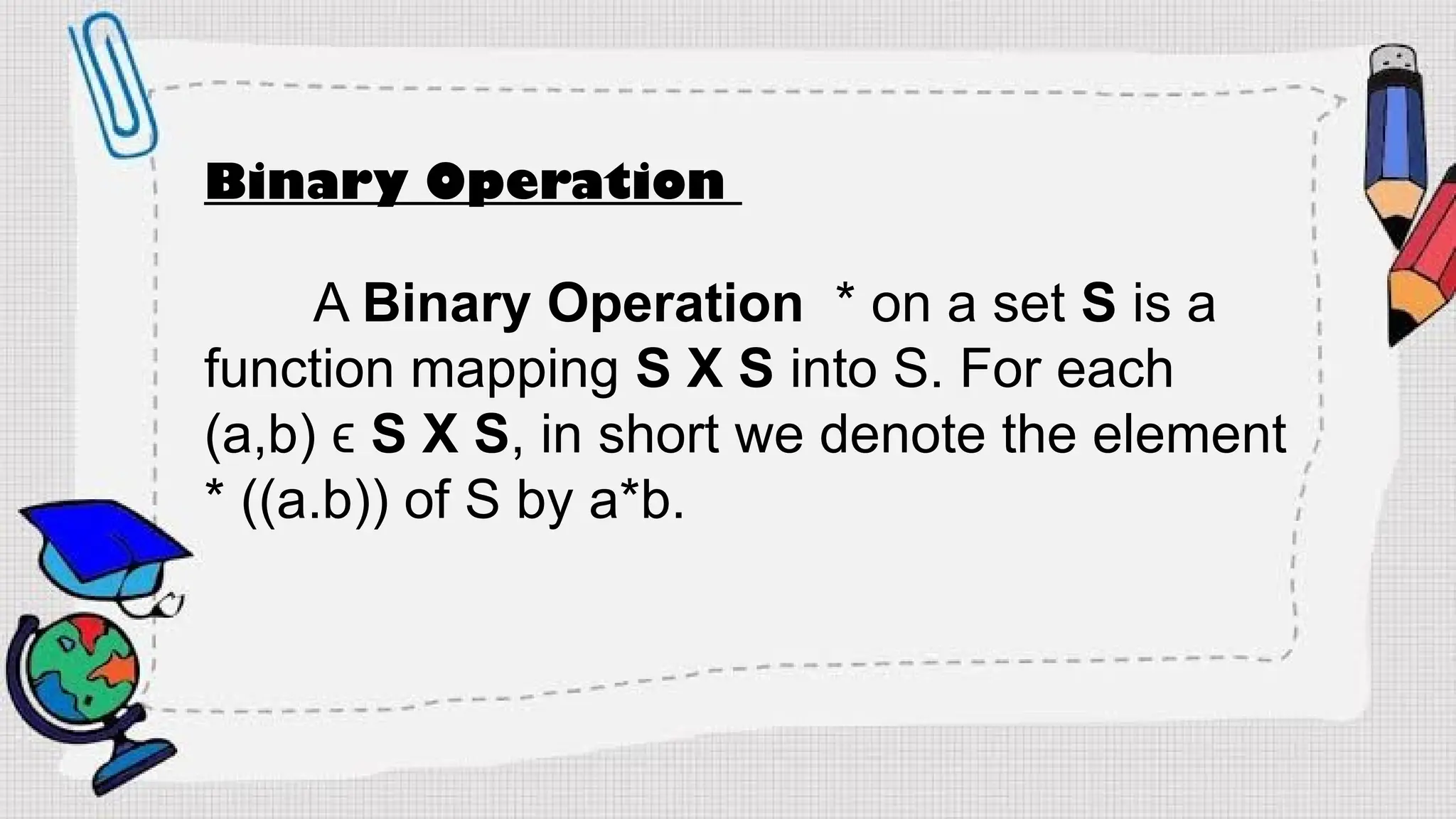
Binary Operation
A Binary Operation * on a set S is a
function mapping S X S into S. For each
(a,b) ϵ S X S, in short we denote the element
* ((a.b)) of S by a*b.
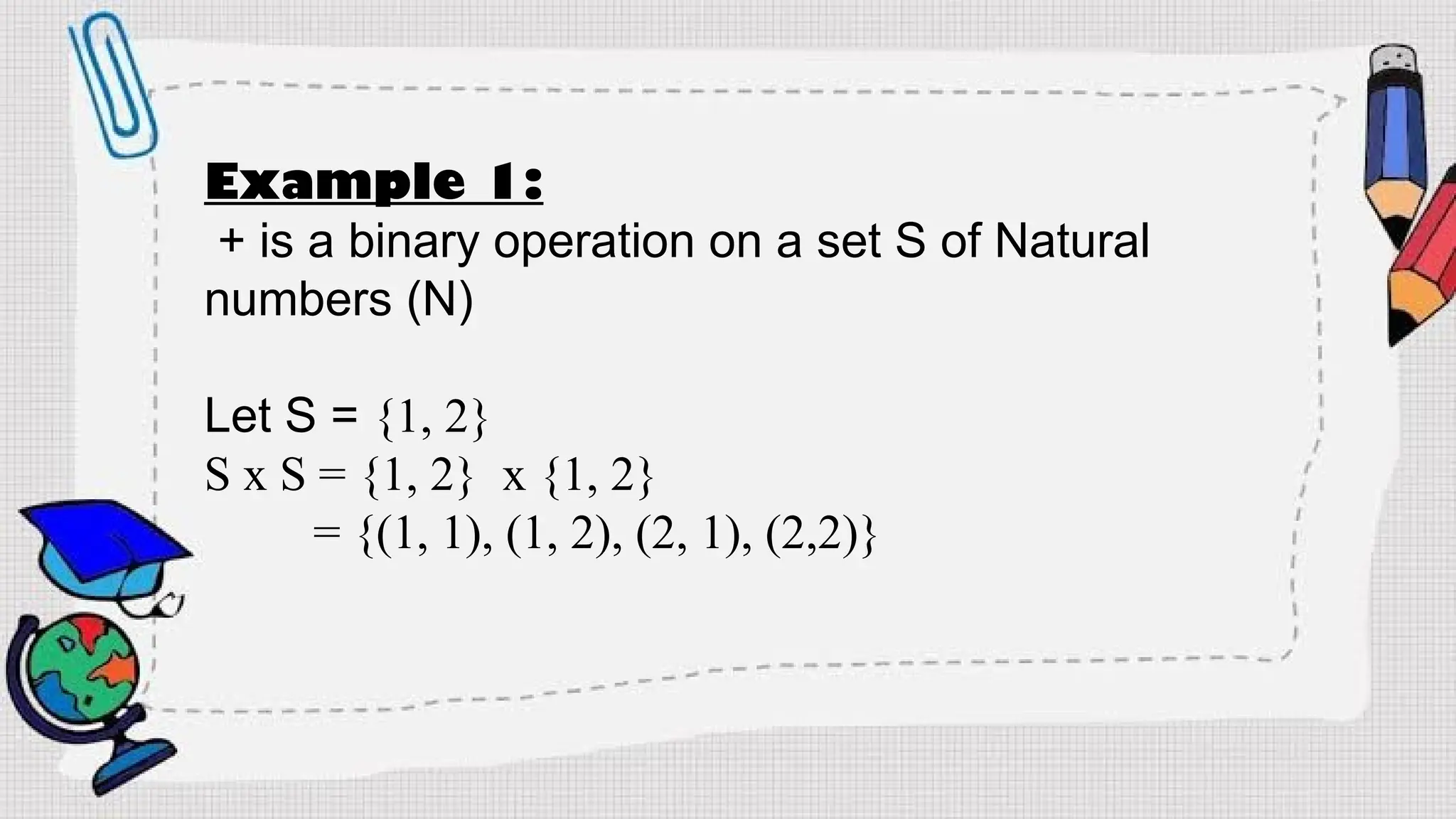
Example 1:
+ is a binary operation on a set S of Natural
numbers (N)
Let S = {1, 2}
S x S = {1, 2} x {1, 2}
= {(1, 1), (1, 2), (2, 1), (2,2)}
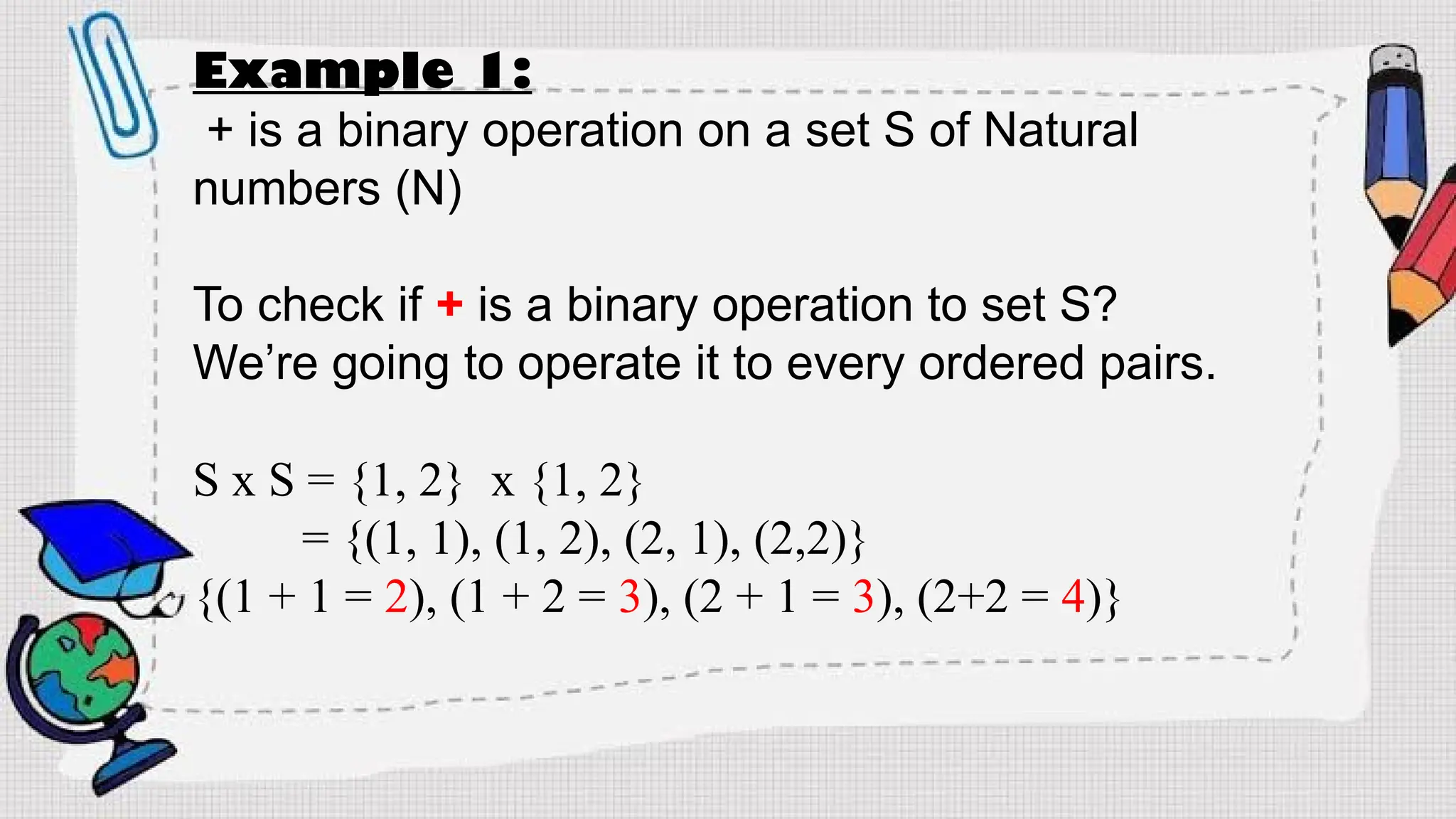
Example 1:
+ is a binary operation on a set S of Natural
numbers (N)
To check if + is a binary operation to set S?
We’re going to operate it to every ordered pairs.
S x S = {1, 2} x {1, 2}
= {(1, 1), (1, 2), (2, 1), (2,2)}
{(1 + 1 = 2), (1 + 2 = 3), (2 + 1 = 3), (2+2 = 4)}
Example 1:
+ is a binary operation on a set S of Natural
numbers (N)
> Since 2, 3, and 4 are natural numbers, our
⸫ + is
a Binary operation.
 Same process in -, x, /.
As long as it these operation satisfies the condition of
binary operation it will be a binary operation.
Binary Operation
Another thing about Binary Operation is
a way of combining two quantities/values
using any operation to create new one.
Common Binary operation:
+, -, x, /.
Example 2:
For every real numbers a and b:
a & b = 5a – 2b + 1.
Supposed the value for a = 3; b = 5
3 & 5 = 5(3) – 2(5) + 1
= 15 – 10 + 1
3 & 5= 6
Example 3 :
For every real numbers a and b:
a # b = a2 + b.
Supposed the value for
a = 1/2; b = (-2)
a # b = (½)2 + (-2)
= ¼ - 2
= -7/4
Closure or Induced
Operation/Method
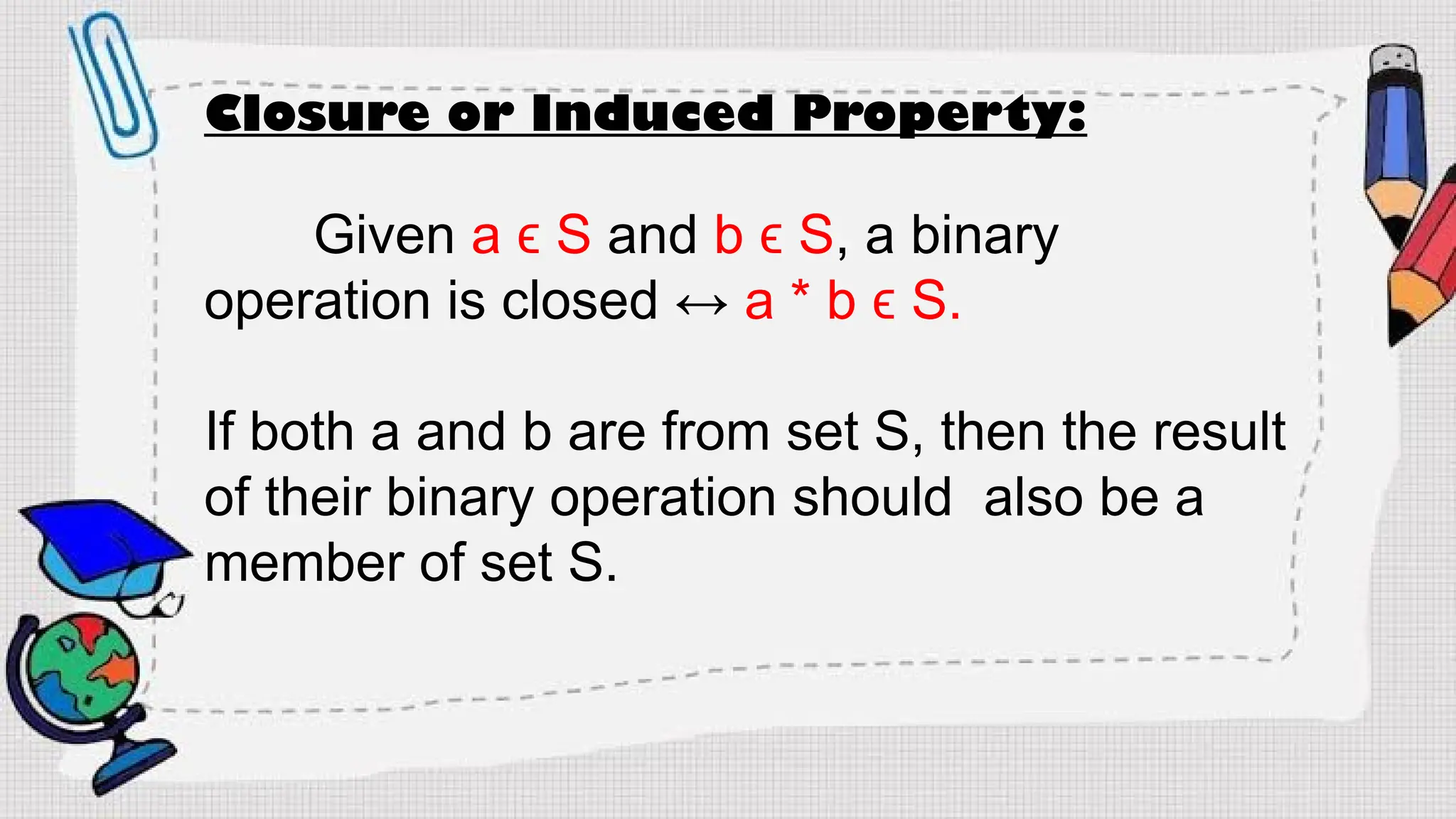
Closure or Induced Property:
Given a ϵ S and b ϵ S, a binary
operation is closed ↔ a * b ϵ S.
If both a and b are from set S, then the result
of their binary operation should also be a
member of set S.
Example 1:
For every real numbers a and b, a binary
operation ~ is defined a ~ b = 2a + b. Is close
under real numbers?
Supposed the value of a = 4; b = (-3).
a ~ b = 2a + b
4 ~ (-3) = 2(4) + (-3)
= 8 – 3
= 5 ϵ R
⸫ a ~ b is closed under R.
Example 2:
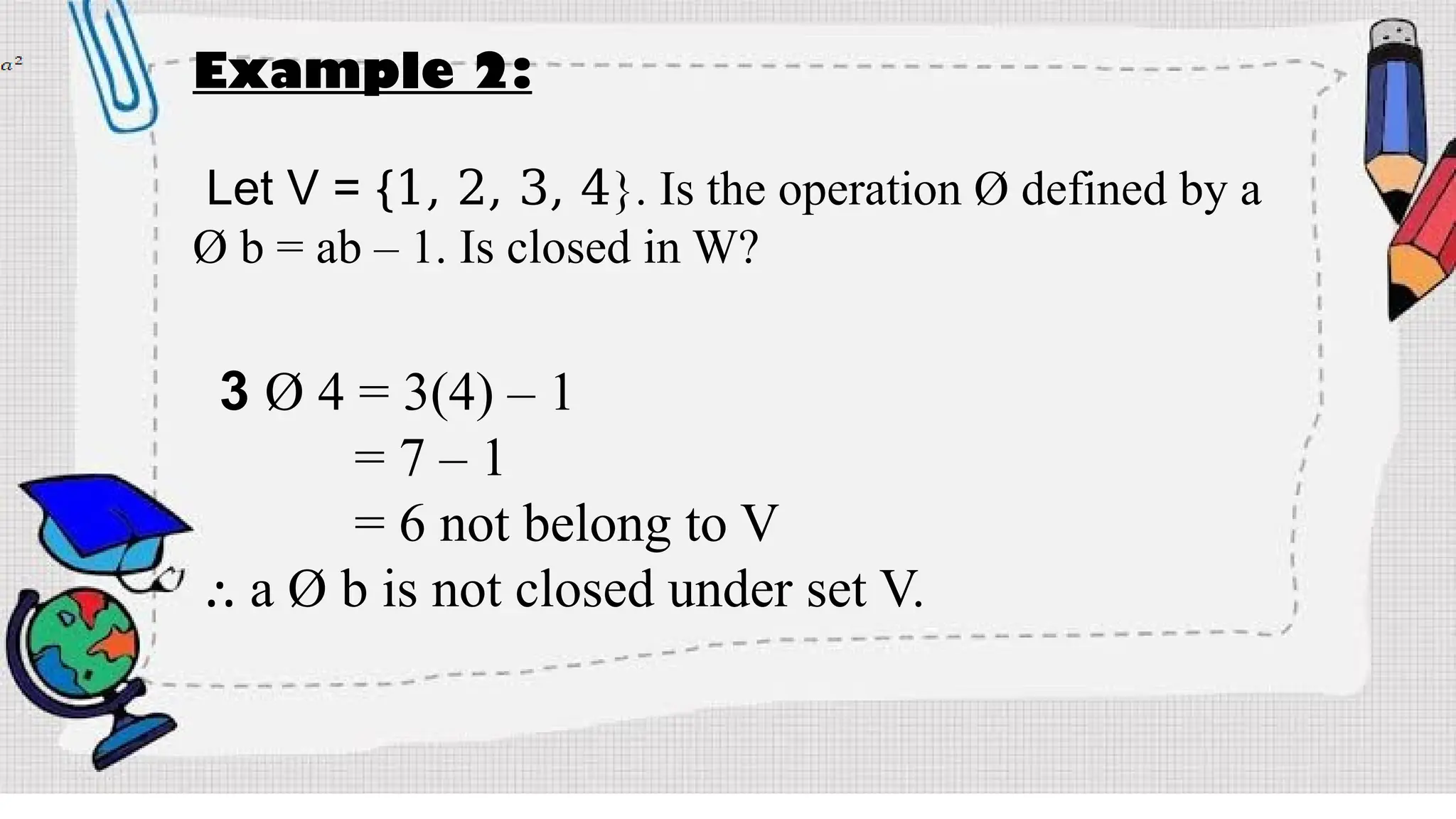
Let V = {1, 2, 3, 4}. Is the operation Ø defined by a
Ø b = ab – 1. Is closed in W?
3 Ø 4 = 3(4) – 1
= 7 – 1
= 6 not belong to V
⸫ a Ø b is not closed under set V.
Example 2:
Let V = {1, 2, 3, 4}. Is the operation Ø defined by a
Ø b = ab – 1. Is closed in W?
1 Ø 3 = 1(3) – 1
= 3 – 1
= 2 ϵ V
⸫ a Ø b is closed under set V.
Closure or Induced Property:
REMEMBER
If a, b ϵ S, then a*b ϵ S.
Let’s try!
+ is a binary operation on the set of Real
Numbers (R*). {n|n > 0, is a set of R}. Is under
closure method?
Note: We all know that n > 0 means a
nonzero real numbers.
Proving this, knowing that 2 ϵ R* as well as -
2 ϵ R*, using the condition of Closure
method that a,b ϵ R* we can draw or operate
this situation “ 2 + (-2) = 0 is not
Let’s try!
an element of R* (non zero real numbers)., we
⸫
can say that closure method for this binary operation is
NOT SATISFIED.
Let’s try!
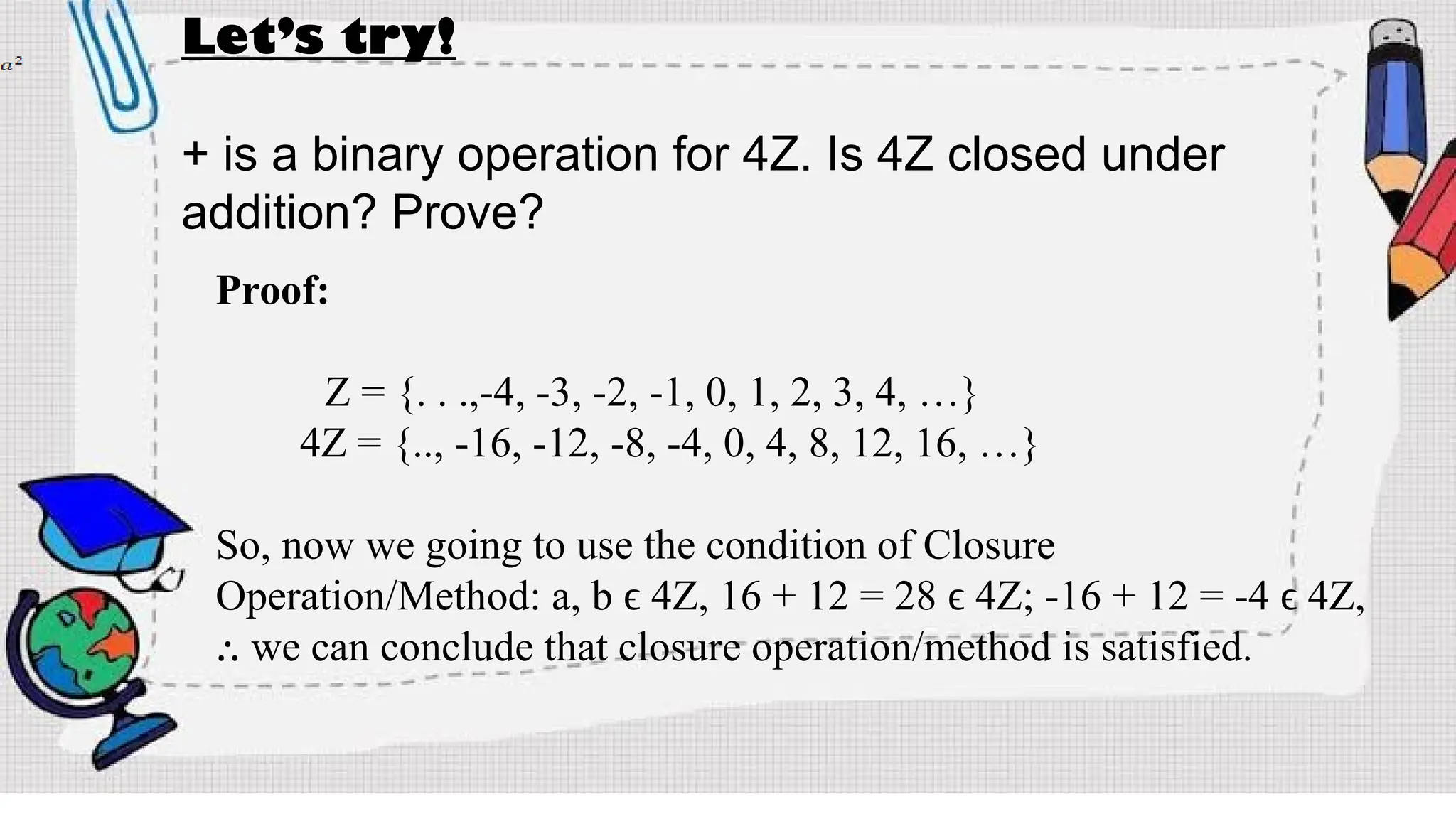
+ is a binary operation for 4Z. Is 4Z closed under
addition? Prove?
Proof:
Z = {. . .,-4, -3, -2, -1, 0, 1, 2, 3, 4, …}
4Z = {.., -16, -12, -8, -4, 0, 4, 8, 12, 16, …}
So, now we going to use the condition of Closure
Operation/Method: a, b ϵ 4Z, 16 + 12 = 28 ϵ 4Z; -16 + 12 = -4 ϵ 4Z,
we can conclude that closure operation/method is satisfied.
⸫
Associative
Operation/Method
Associative Property/Method:
A binary operation * is associative if and
only if (a * b) * c = a * (b * c)
∀a, b, c ϵ S
Example 1:
For every real number a and b is the operation Ω
(omega) defined by a Ω b = (2a)(3b) associative?
(a Ω b) Ω c = a Ω (b Ω c)
Take note that c is also a real number
Example 1:
(a Ω b) Ω c = a Ω (b Ω c)
(2a) (3b) Ω c = a Ω (2b)(3c)
(6ab) Ω c = a Ω (6bc)
[2 (6ab)] (3c) = (2)(a) [3(6bc)]
(12ab) (3c) = 2a (18bc)
36abc = 36abc
⸫ a Ω b is associative.
This becomes your first
term.
This becom
es your 2nd
term
.
These things are based on the definition of
binary operations a,b ϵ S
Example 2:
For every real number a and b is the operation ♠
(spade) defined by a ♠ b = a b
ꜛ + b associative?
(a ♠ b) ♠ c = a ♠ (b ♠ c)
(a b
ꜛ + b) ♠ c = a ♠ (b c
ꜛ ♠ c)
(a b
ꜛ + b) c
ꜛ + c = a b vc
ꜛ + b c + c
ꜛ
⸫,♠ is not an associative.
Let’s try!
+ is a binary operation for 4Z. Is 4Z an associative
under addition? Prove?
Proof:
Z = {. . .,-4, -3, -2, -1, 0, 1, 2, 3, 4, …}
4Z = {.., -16, -12, -8, -4, 0, 4, 8, 12, 16, …}
So, now we going to use the condition of Associative
Operation/Method: a, b, c ϵ 4Z, a + b + c ϵ 4Z, 16 + (4 +8) = (16 +
4) + 8 = we can conclude that associative operation/method is
⸫
satisfied.
Associative Property:
REMEMBER
∀ a, b, c ϵ S, we have
a*(b*c) = (a*b)*c.
Identity Element Property:
A binary operation * is if there exists just
one element e such that: e*a = a*e = a,
where a,e ϵ R (S)
Example :
For common identity elements
For addition + e = 0
3 + 0 = 0 + 3 = 3
For multiplication x e = 1
3 x 1 = 1 x 3 = 3
Example :
Identity elements in tables
* a b c d
a c a d b
b a b c d
c d c d a
d b d a c
Identity = b
a*b=b*a = a
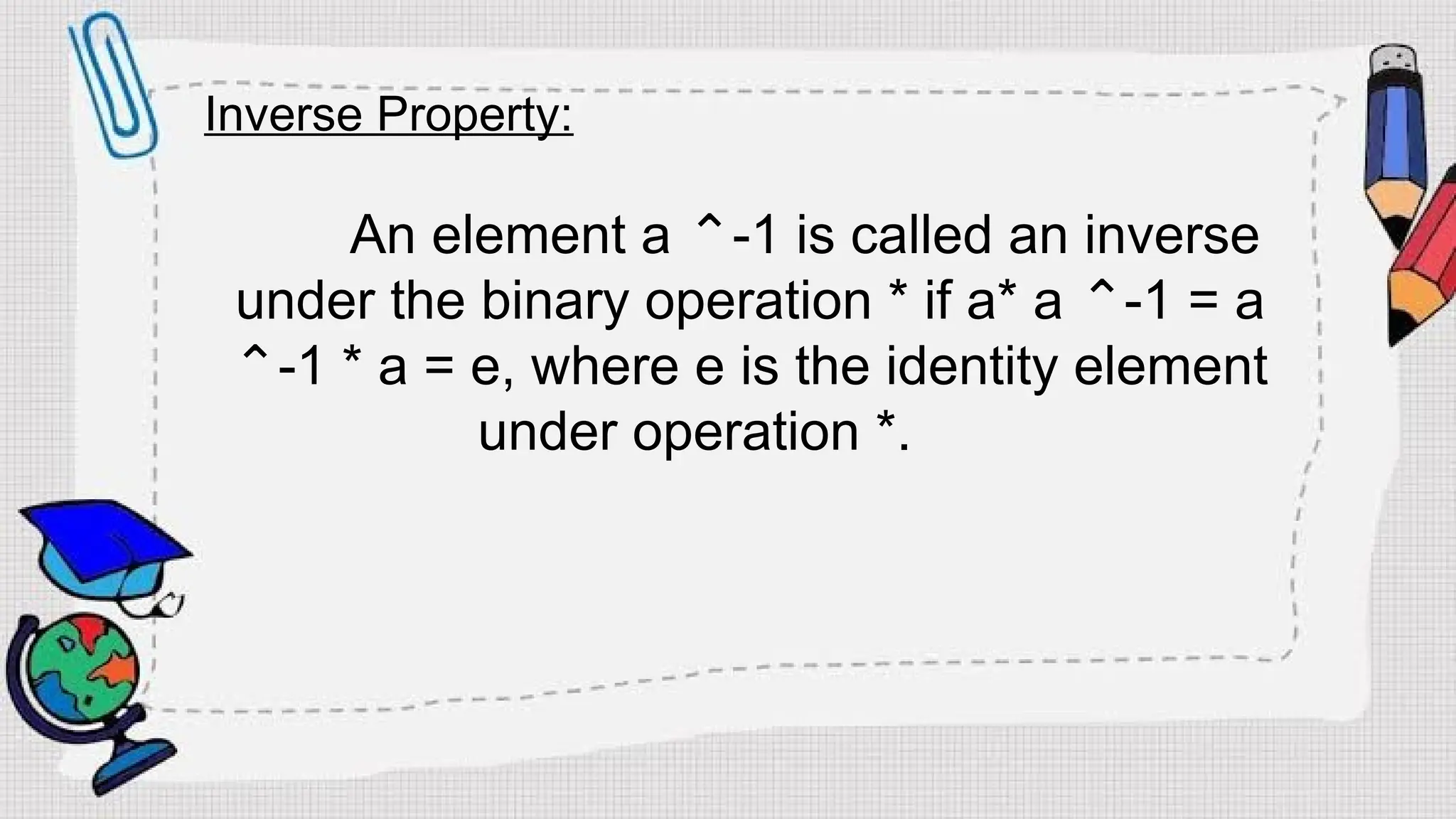
Inverse Property:
An element a -1 is called an inverse
⌃
under the binary operation * if a* a -1 = a
⌃
-1 * a = e, where e is the identity element
⌃
under operation *.
Example :
For inverse elements
For addition + e = 0
3 + ? = ? + 3 = 0 ? = Inverse ? = -3
⸫
element
For multiplication x e = 1
3 x ? = ? x 3 = 1
⸫ ? = 1/3
Example :
Find the inverse of each element in the table
* a b c d
a c a d b
b a b c d
c d c d a
d b d a c
Identity = b
a*b=b*a = a
Example :
* a b c d
a c a d b
b a b c d
c d c d a
d b d a c
Identity = b
a*b=b*a = a
So, a* a -1 = a -1 = b
⌃ ⌃
⸫ a -1 = d
⌃
b -1 = b inverse itself, c -1 = c, d -1 = a
⌃ ⌃ ⌃
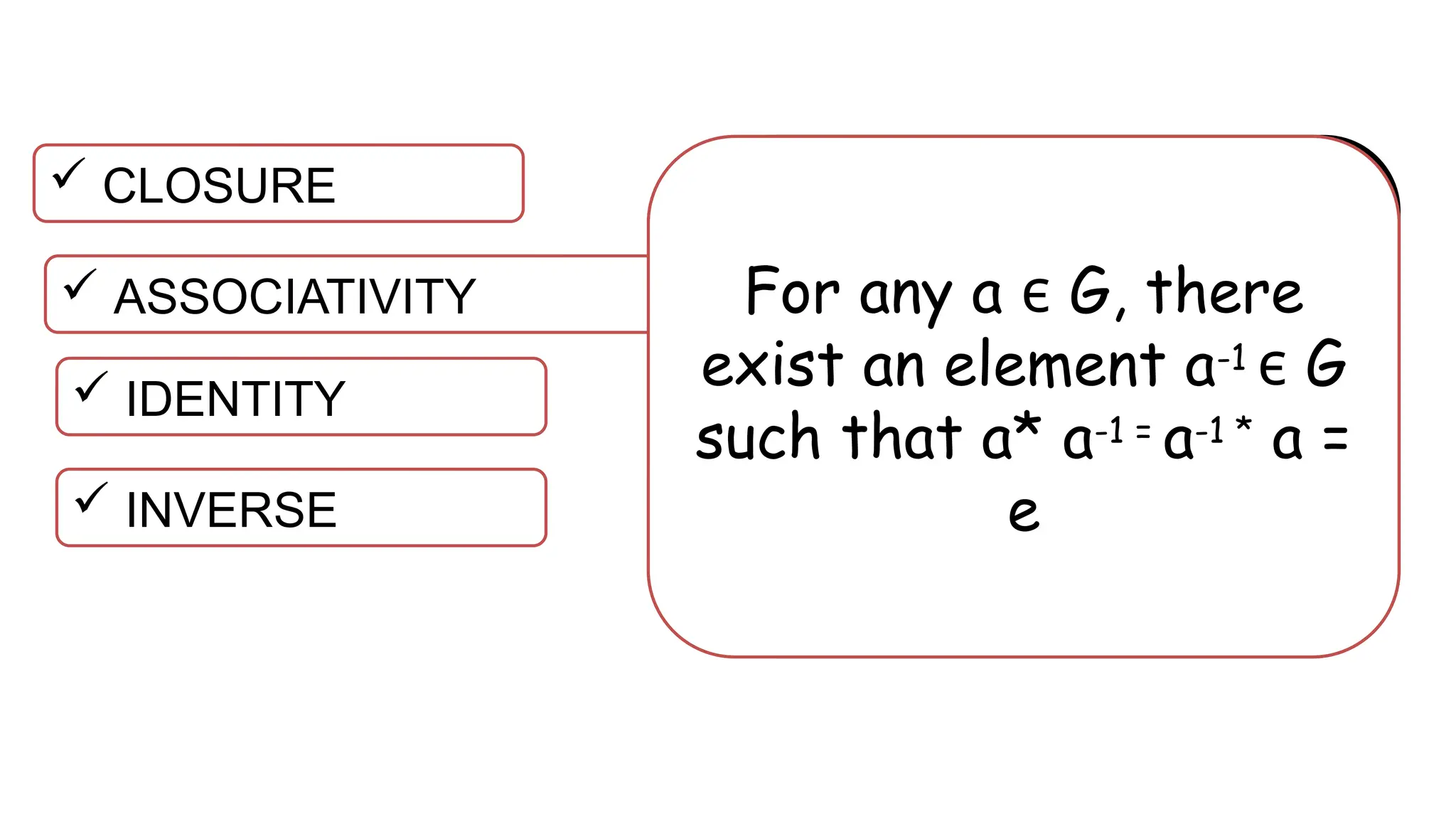
Definition of a Group
A group consist of a nonempty set G
together with a binary operation *, such that
the following properties hold:
 CLOSURE
 ASSOCIATIVITY
 IDENTITY
 INVERSE
If a, b ϵ G, then a * b ϵ
G.
INSHORT, the sum, or
product, or result of a
and b must be an
element of G.
For all a,b,c ϵ G, we
have (a*b)*c = a*
(b*c), where a, b, and
c ϵ G.
There exist an element e
ϵ G such that, for any a ϵ
G, a*e = e*a = a.
For any a ϵ G, there
exist an element a-1 ϵ G
such that a* a-1 = a-1 * a =
e
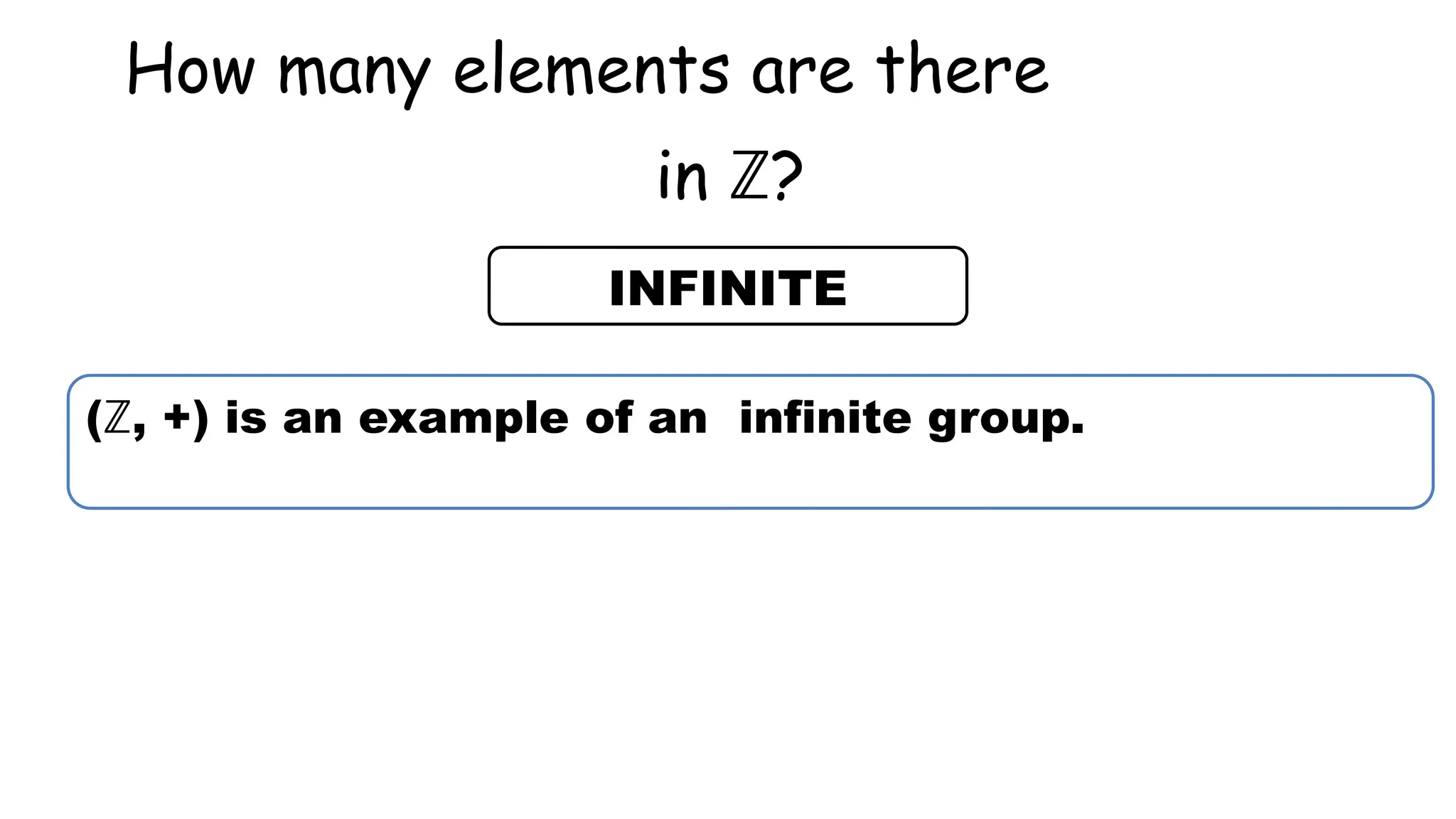
How many elements are there
in ℤ?
INFINITE
(ℤ, +) is an example of an infinite group.
How many elements are there
in ℤ3?
3
Hence, (ℤ3, +3) is an example of finite group.
ORDER OF A GROUP
The order of a group G,
denoted by |G| is the number
of elements present in the
group or it’s cardinality.
The order of |ℤ| is infinite
thus the group ( , +)
ℤ has
an infinite order.
|ℤ3| = 3
(ℤ3, +3) could also generate 3
elements so its order is 3. this is an
example of finite order.
EXERCISE
Determine the order of the group:
1. ( ,
ℝ +)
2. (ℤ5
#
, ∙)
3. ( ,
ℚ ∙)
QUESTIONS?
SOME GROUPS OF
ORDER 4
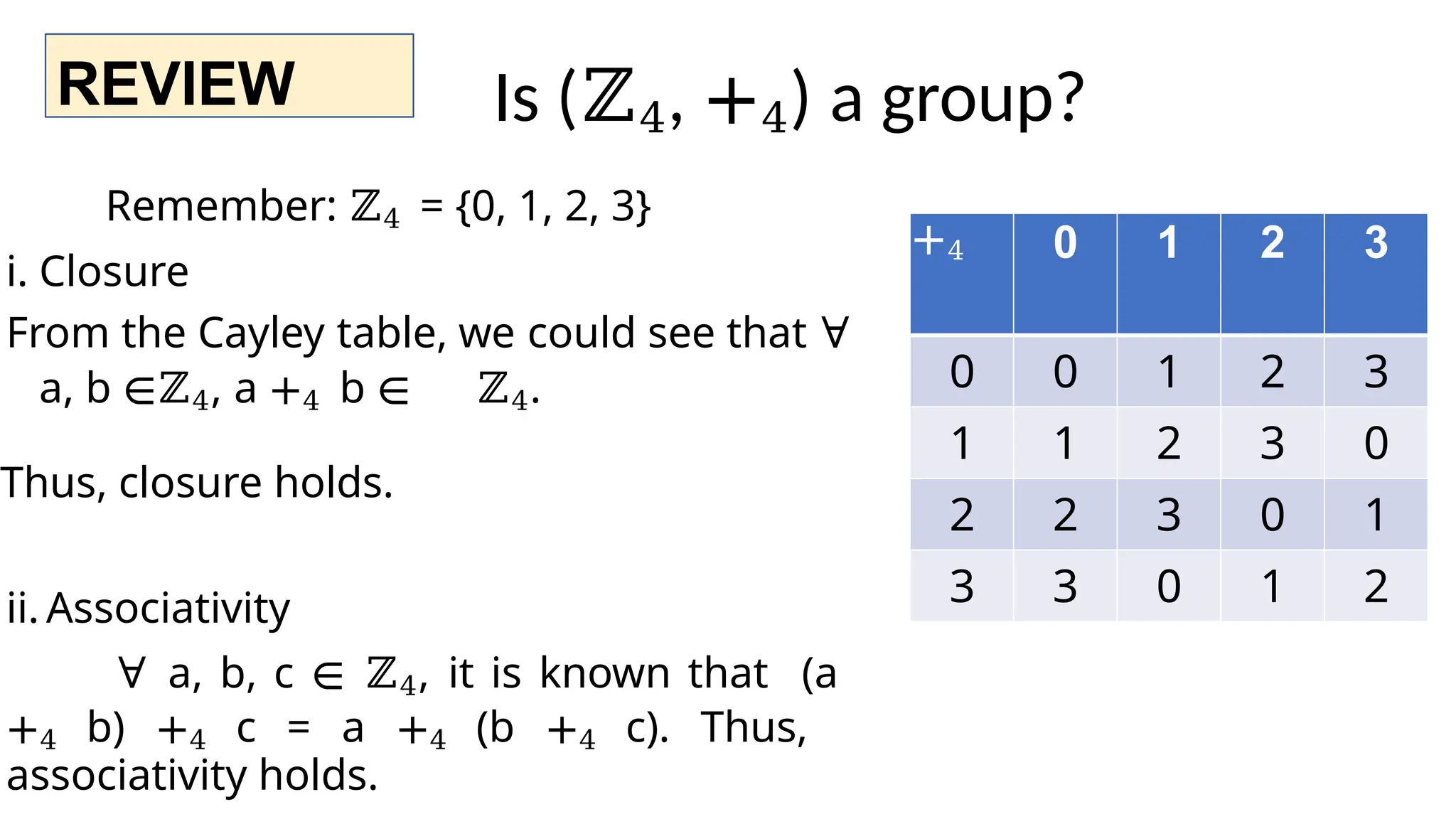
REVIEW Is (ℤ4, +4) a group?
+4 0 1 2 3
0 0 1 2 3
1 1 2 3 0
2 2 3 0 1
3 3 0 1 2
Remember: ℤ4 = {0, 1, 2, 3}
i. Closure
From the Cayley table, we could see that ∀
a, b ∈ℤ4, a +4 b ∈ ℤ4.
Thus, closure holds.
ii. Associativity
∀ a, b, c ∈ ℤ4, it is known that (a
+4 b) +4 c = a +4 (b +4 c). Thus,
associativity holds.
REVIEW Is (ℤ4, +4) a group?
+4 0 1 2 3
0 0 1 2 3
1 1 2 3 0
2 2 3 0 1
3 3 0 1 2
Remember: ℤ4 = {0, 1, 2, 3}
iii. Identity
We could see that 0 ∈ ℤ4 and for any
a ∈ ℤ4, we could see that a +4 0 = 0 +4 a
=a. hence, identity property is satisfied.
iv. Inverse
We could see that each element in ℤ4
has an inverse. Thus, inverse property is
satisfied.
REVIEW
+4 0 1 2 3
0 0 1 2 3
1 1 2 3 0
2 2 3 0 1
3 3 0 1 2
Since all 4 properties
of a group are satisfied,
hence (ℤ4, +4) is a
group.
EXERCISE
Determine the following set if it’s a group or not:
1. ( ,
ℝ +)
2. (ℤ7
#
, +7 )
3. (ℝ+
, ∙)
KLEIN V
- read as “KLEIN 4”
- It was named Vierergruppe
(meaning four-group) by Felix
Klein in 1884.
- It is also called the Klein
group and is often symbolized
by letter V.
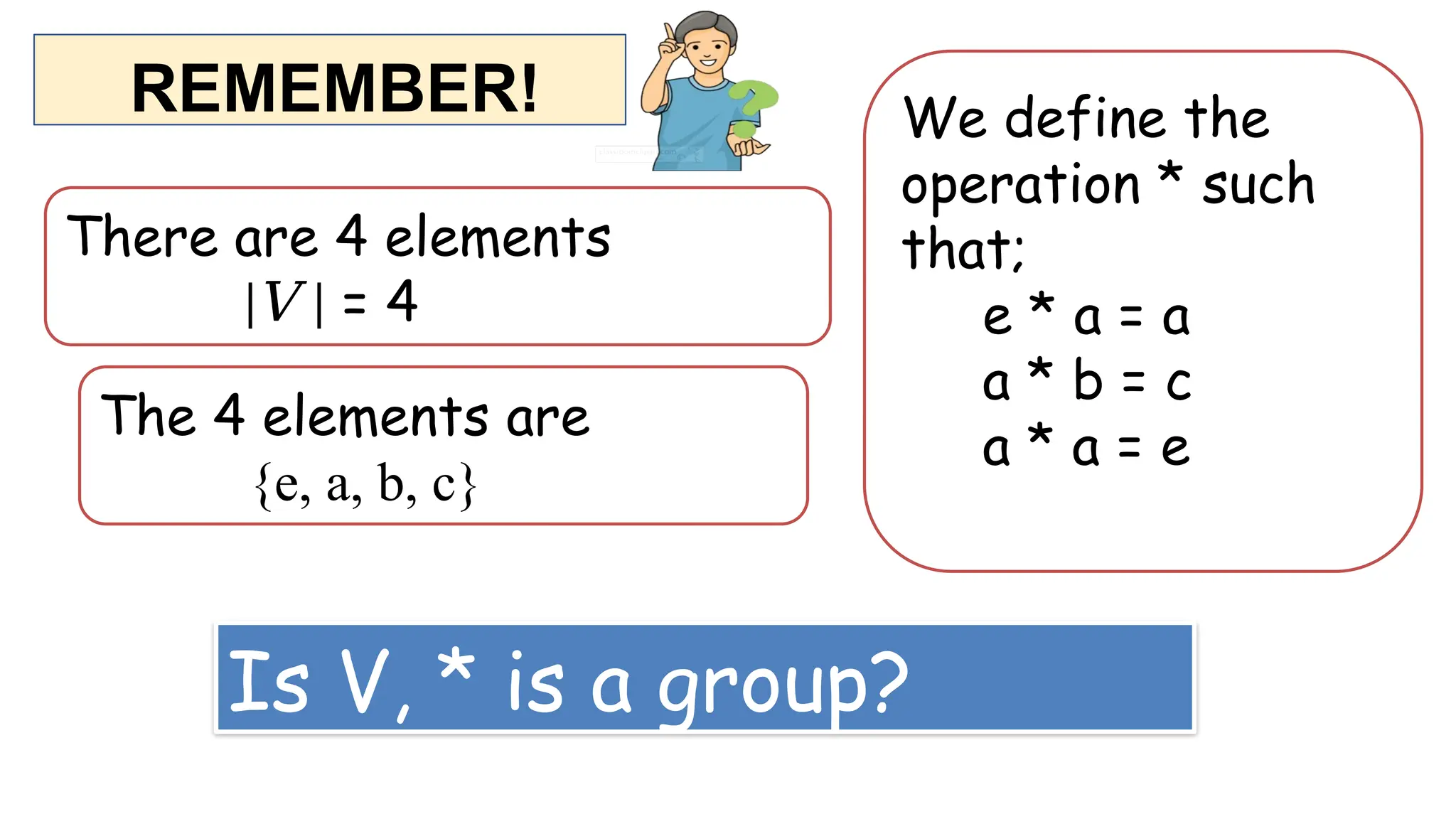
There are 4 elements
|V | = 4
The 4 elements are
{e, a, b, c}
We define the
operation * such
that;
e * a = a
a * b = c
a * a = e
REMEMBER!
Is V, * is a group?
* e a b c
e e a b c
a a e c b
b b c e a
c c b a e
Let V = {e, a, b, c} with
operation * defined earlier.
Is (V, *) a group?
KLEIN V
i. Closure
Let x, y ∈ V. We
could see that x * y
∈
V. Hence,
* e a b c
e e a b c
a a e c b
b b c e a
c c b a e
Let V = {e, a, b, c} with
operation * defined earlier.
Is (V, *) a group?
KLEIN V
ii. Associativity
Let x, y, z ∈ V. We
could see that
(x * y) * z = x * (y * z).
Hence, associativity holds.
* e a b c
e e a b c
a a e c b
b b c e a
c c b a e
Let V = {e, a, b, c} with
operation * defined earlier.
Is (V, *) a group?
KLEIN V
iii. Identity
We could see that e is
the identity element of V
and e ∈ V. Thus, identity
property is satisfied.
* e a b c
e e a b c
a a e c b
b b c e a
c c b a e
Let V = {e, a, b, c} with
operation * defined earlier. Is (V,
*) a group?
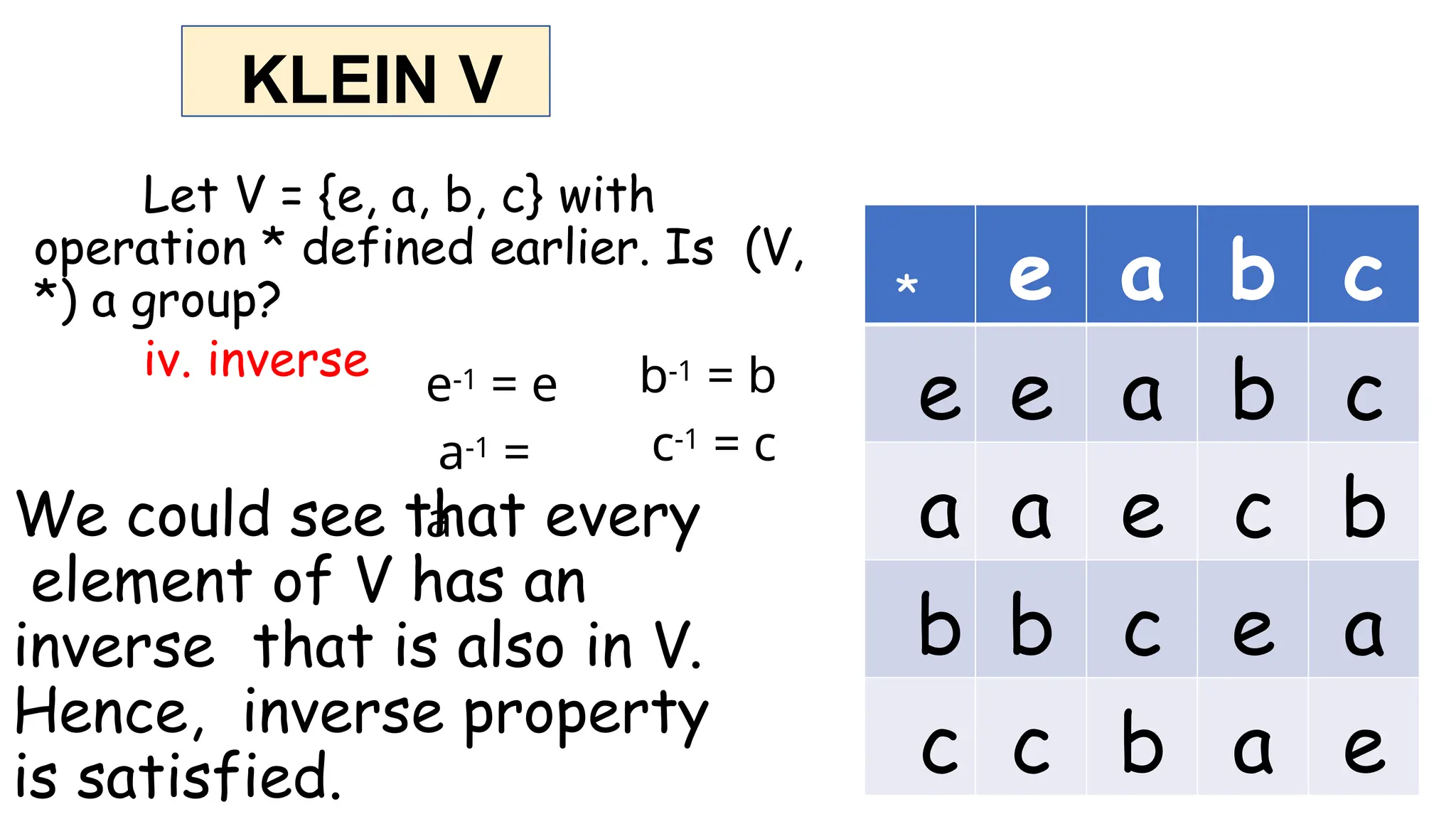
iv. inverse
KLEIN V
e-1 = e
a-1 =
a
b-1 = b
c-1 = c
We could see that every
element of V has an
inverse that is also in V.
Hence, inverse property
is satisfied.
* e a b c
e e a b c
a a e c b
b b c e a
c c b a e
KLEIN V
Since all 4 properties of
a group are satisfied, hence
(V, *) with V = {e, a, b, c} and
operation * as defined is a
group.
QUESTIONS?
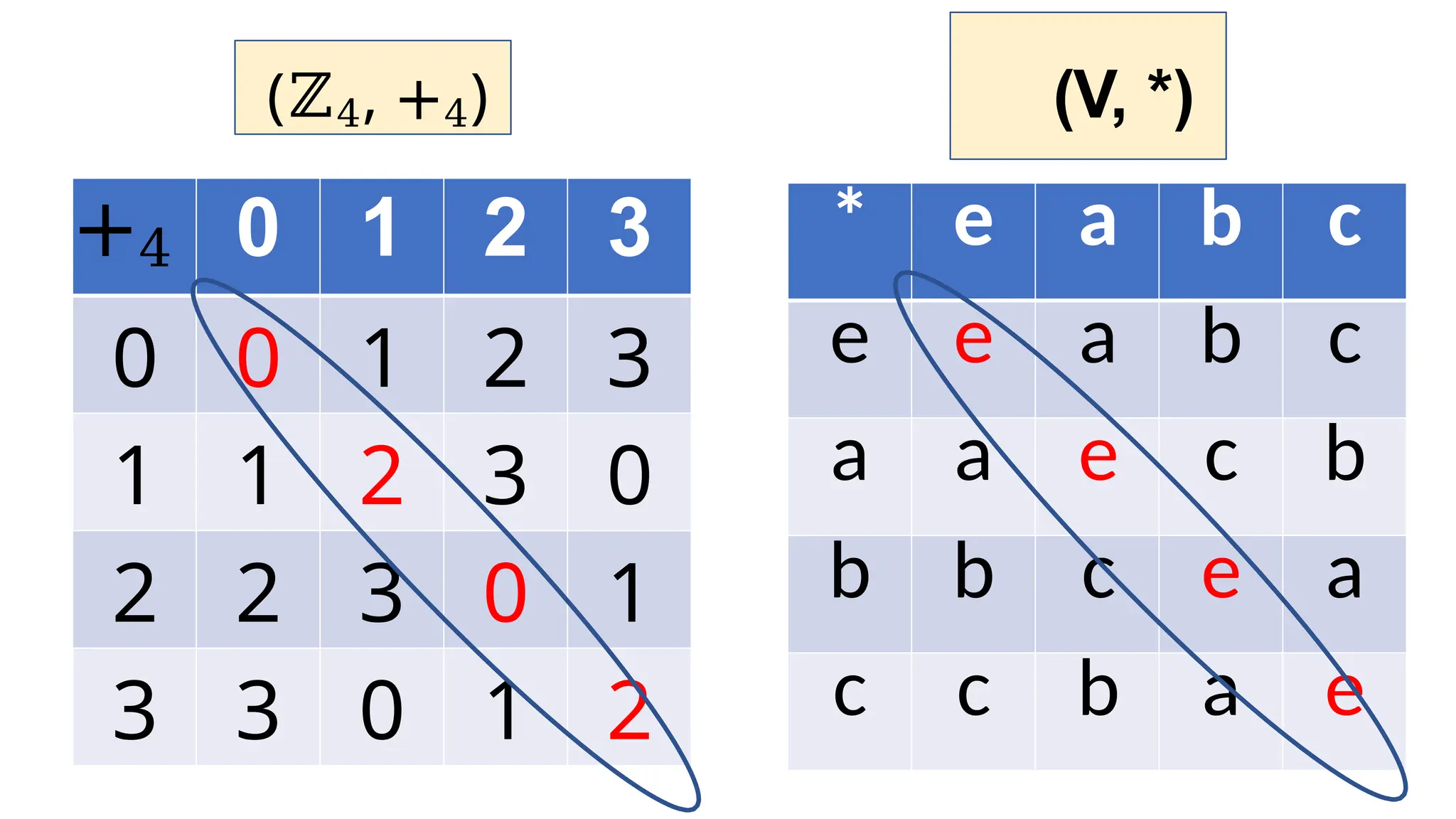
(V, *)
* e a b c
e e a b c
a a e c b
b b c e a
c c b a e
+4 0 1 2 3
0 0 1 2 3
1 1 2 3 0
2 2 3 0 1
3 3 0 1 2
(ℤ4, +4)
GENERAL
LINEAR GROUP
REVIEW
Consider the matrix A
=
1
4
5
3
. Compute for det
(A).
det (A) = 1(5) – 4(3) = -7
Does the matrix have an inverse?
YES
How do we know?
det (A) ≠ 0
A =
1
3
4
∈
GL2(ℝ)
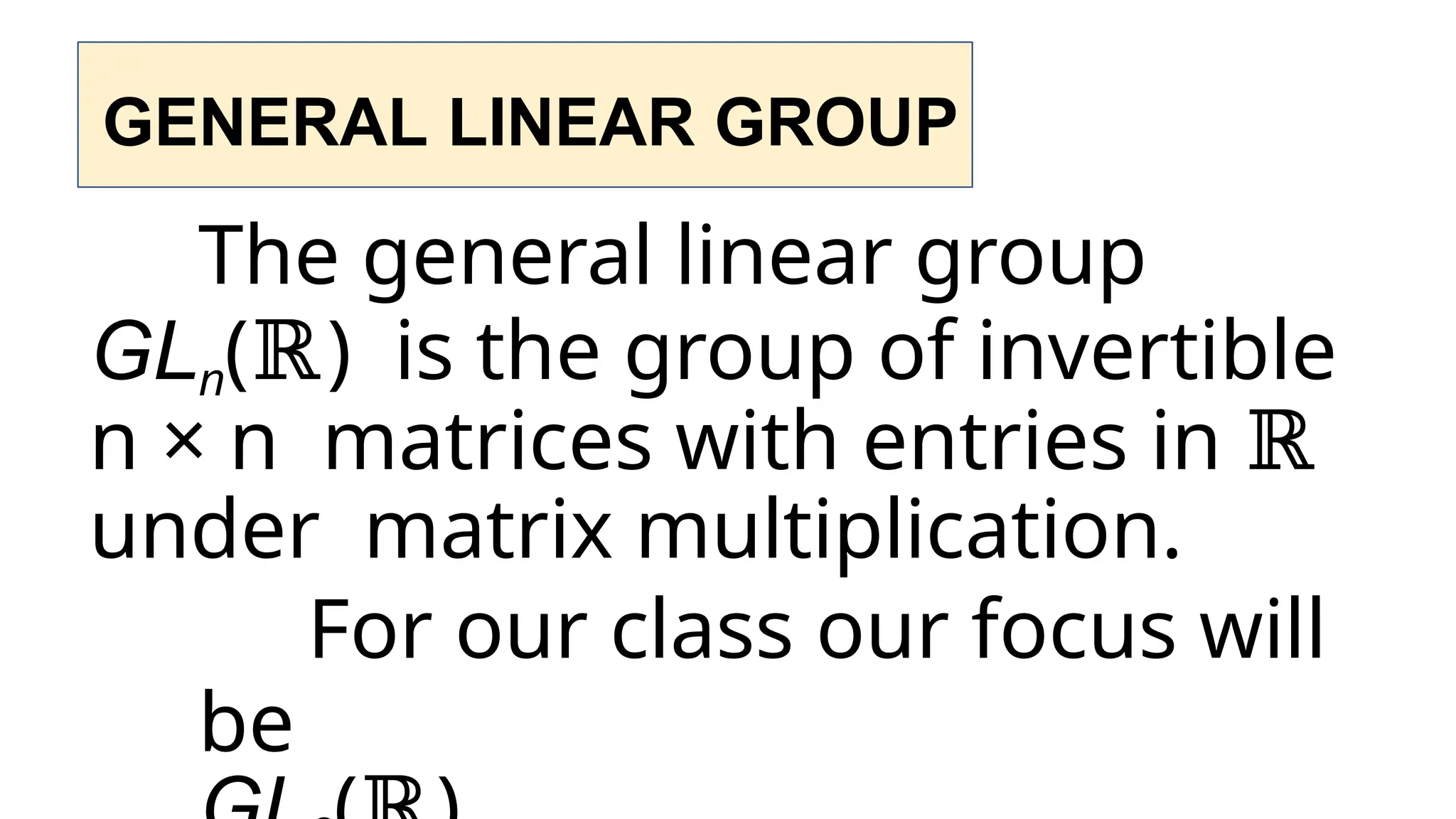
GENERAL LINEAR GROUP
The general linear group
GLn(ℝ) is the group of invertible
n × n matrices with entries in ℝ
under matrix multiplication.
For our class our focus will
be
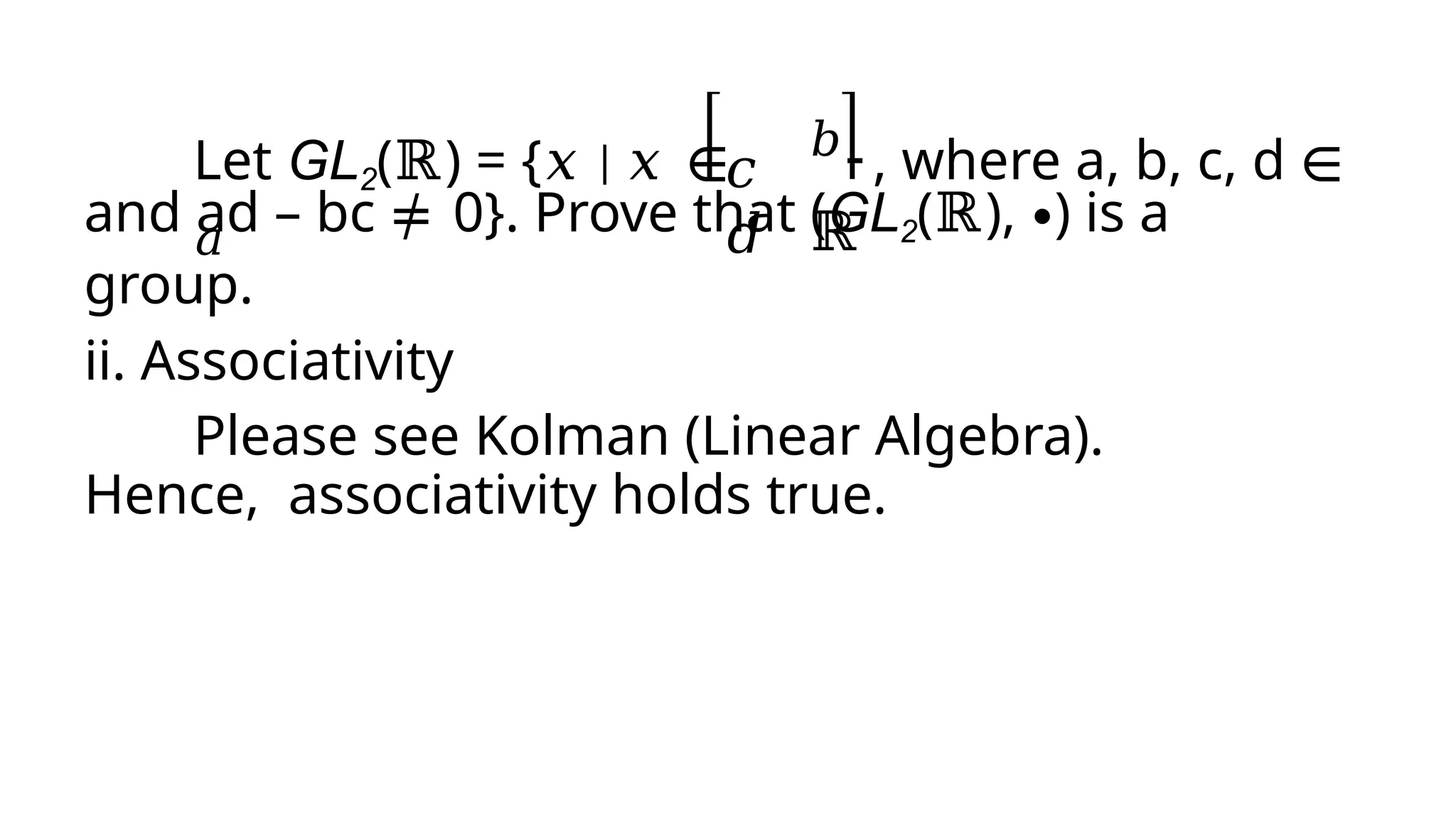
Let GL2(ℝ) = {𝑥 | 𝑥 ∈𝑎
𝑐
𝑑
𝑏 , where a, b, c, d ∈
ℝ
and ad – bc ≠ 0}. Prove that (GL2(ℝ), ∙) is a
group.
i. Closure
Let 𝑥
∈
𝑎
𝑏
𝑐
𝑑
and 𝑦
∈
𝑒
𝑓
𝑔 h
wher
e
𝑎, 𝑏, 𝑐, … , 𝑕 ∈ ℝ. Multiplying
them yields
𝑎
𝑏
𝑐
𝑑
𝑒
𝑓
𝑔 h
=
𝑎𝑒 + 𝑏𝑔 𝑎𝑓
+ 𝑏h
𝑐𝑒 + 𝑑𝑔 𝑐𝑓 +
𝑑h
2
∈ GL (ℝ). Since all entries
of
the resulting matrix are real numbers, then
closure holds.
Let GL2(ℝ) = {𝑥 | 𝑥 ∈
𝑎
𝑐
𝑑
𝑏 , where a, b, c, d ∈
ℝ
and ad – bc ≠ 0}. Prove that (GL2(ℝ), ∙) is a
group.
ii. Associativity
Please see Kolman (Linear Algebra).
Hence, associativity holds true.
Let GL2(ℝ) = {𝑥 | 𝑥
∈
�
�
𝑐
𝑑
𝑏 , where a, b, c, d ∈
ℝ
and ad – bc ≠ 0}. Prove that (GL2(ℝ), ∙) is a
group.
iii. Existence of an Identity Element
= =
𝑎 𝑏 1
0
𝑐 𝑑 0
1
1 0 𝑎
𝑏
0 1 𝑐
=
𝑎 1 +
𝑏(0)
𝑐 1 +
𝑑(0) 1
𝑎
+
0(𝑐)
𝑎 0 +
𝑏(1)
𝑐 0
+ 𝑑(1) 1
𝑏
+
0(𝑑)
=
𝑎
𝑏
𝑐
𝑑
𝑎
𝑏
𝑐
We could see that e
=
1
0
0
∈ GL2(ℝ).
Hence,
identity property is
satisfied.
Let GL2(ℝ) = {𝑥 | 𝑥
∈
�
�
𝑐
𝑑
𝑏 , where a, b, c, d ∈ ℝ
and
ad – bc ≠ 0}. Prove that (GL2(ℝ), ∙) is a
group.
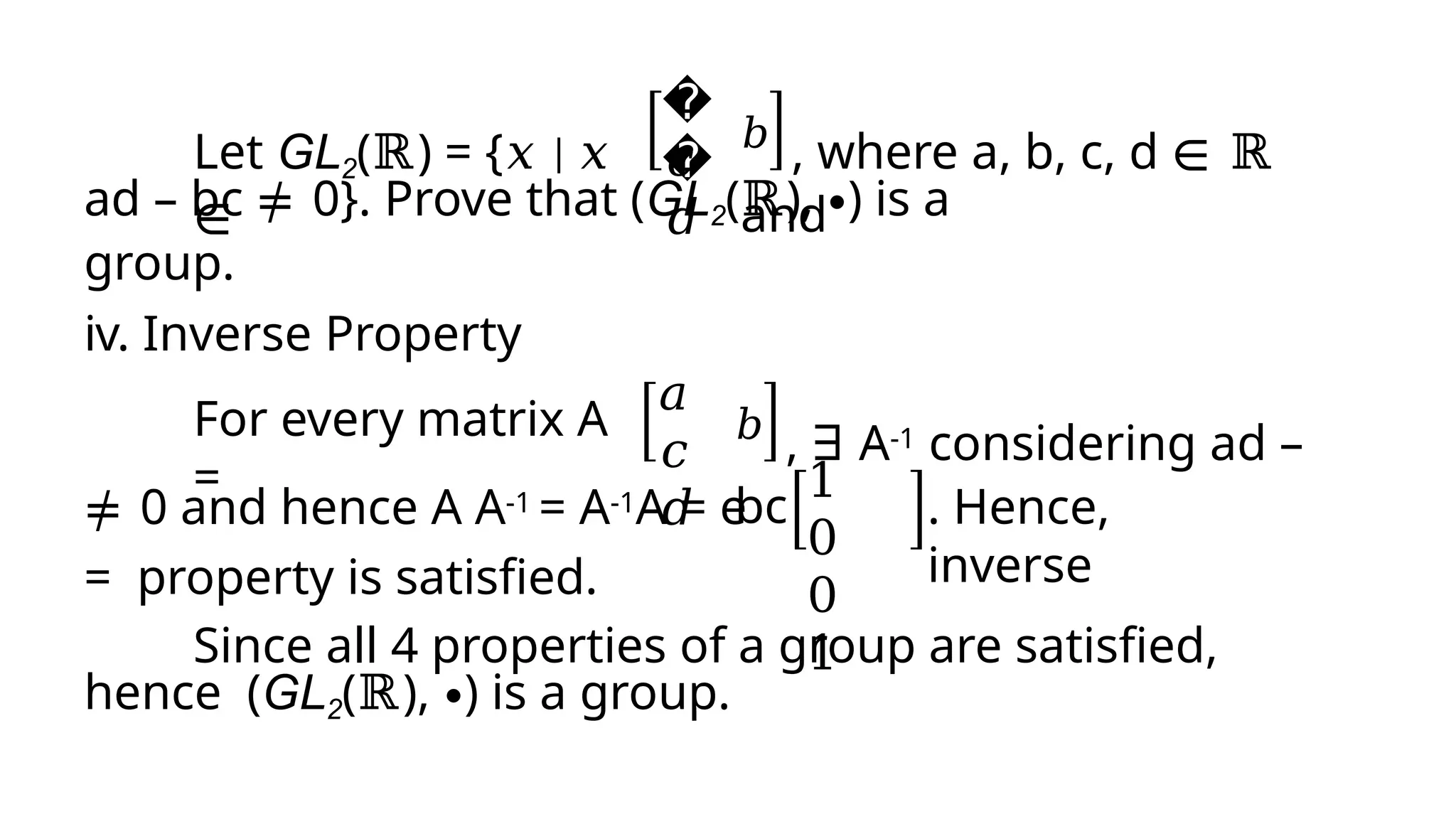
iv. Inverse Property
For every matrix A
=
𝑎
𝑐
𝑑
𝑏
, ∃ A-1 considering ad –
bc
≠ 0 and hence A A-1 = A-1A = e
= property is satisfied.
1
0
0
1
. Hence,
inverse
Since all 4 properties of a group are satisfied,
hence (GL2(ℝ), ∙) is a group.
GENERAL LINEAR GROUP
What is the order of
GL2(ℝ)?
GL2(ℝ) is infinite
QUESTIONS?
CHECK THIS OUT
It is known that (ℤ, +)
is a group. Let us pick any
2 elements, say 4 and 7
What is 4 + 7?
11
How about 7 + 4?
11
What have you
noticed?
4 + 7 = 7 + 4
Such a group is an
example of an
ABELIAN GROUP.
ABELIAN GROUP
Let (G, *) be a group. If a, b ∈ G such
that a * b = b * a, then (G, *) is an ABELIAN
GROUP.
It is also called COMMUTATIVE
GROUP.
NON-ABELIAN GROUP
Let (G, *) be a group. If a, b ∈ G such
that a * b ≠ b * a, then (G, *) is a NON-
ABELIAN GROUP.
It is also called
NONCOMMUTATIVE GROUP.
EXERCISE
Classify the following groups as Abelian or Non-
Abelian: 1. (ℝ, +)
2. (ℤ5
#
, ∙5)
3. (ℚ#, ∙)
4. (GL2(ℝ), ∙)
QUESTIONS?
ABELIAN
ABELIAN
ABELIAN
NON ABELIAN
DEFINITION: ORDER OF AN ELEMENT OF A FINITE GROUP
It is the smallest positive power of the
element which gives you the identity
element.
Let (G, *) be a finite group and a ∈ G.
The order of an element <a> is n given
that an = e.
EXAMPLE
Let us consider
ℤ4 = {0, 1, 2, 3}. We
know that (ℤ4, +4) is
a finite group.
EXAMPLE
Let us consider
ℤ4= {0, 1, 2, 3}. We
know that (ℤ4, +4) is a
finite group.
<0> = {0}
<1> = {1, 2, 3, 0}
<2> = {2, 0}
<3> = {3, 2, 1, 0}
Let us determine
the order of each
element:
<0>= 1
<1>= 4
<2>= 2
<3>= 4
QUESTIONS?
DEFINITION: GENERATOR OF A FINITE GROUP
It is a set of group elements such that
possibly repeated application of the
generators on themselves and each other
is capable of producing all the elements in
the group.
Let (G, *) be a finite group and a ∈ G.
It could be said that <a> is a generator
of G iff
<a> = G.
EXAMPLE
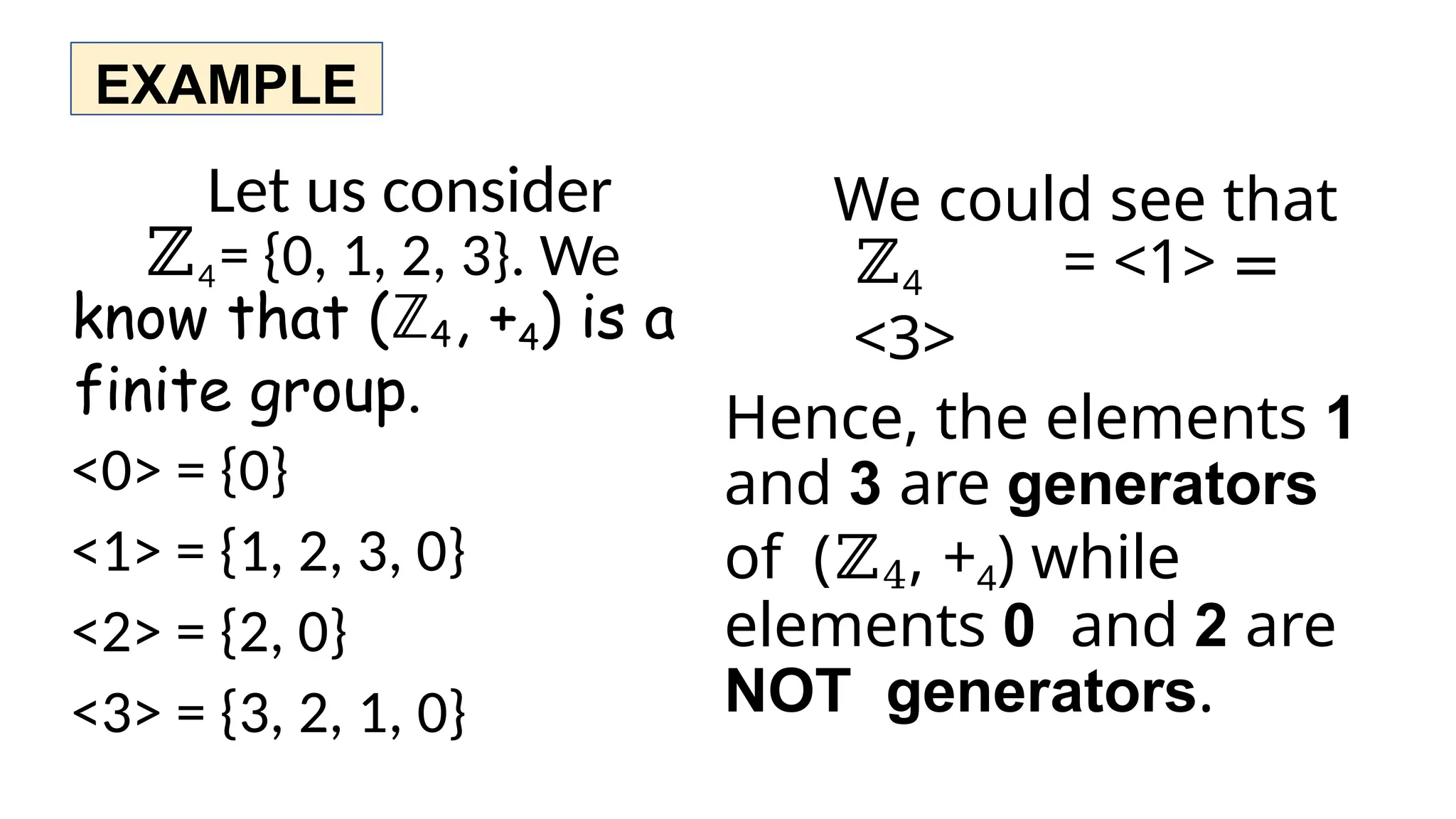
Let us consider
ℤ4= {0, 1, 2, 3}. We
know that (ℤ4, +4) is a
finite group.
<0> = {0}
<1> = {1, 2, 3, 0}
<2> = {2, 0}
<3> = {3, 2, 1, 0}
We could see that
ℤ4 = <1> =
<3>
Hence, the elements 1
and 3 are generators
of (ℤ4, +4) while
elements 0 and 2 are
NOT generators.
ADDITIONAL NOTE:
Speaking of a
finite group (G, *)
with G = n and if a
∈ G is a generator,
then
G = <a>
DEFINITION: FINITE CYCLIC GROUP
A certain finite group is
CYCLIC if it has at least 1
generator. If it has no
generator, then the group is
NOT CYCLIC.
Is (ℤ4, +4) a cyclic
group?
QUESTIONS?
Yes, because it has
generators 1 and 3.
EXERCISE
Determine the orders of the
elements of (ℤ8, +8), identify generators
if they exist, and if the group is cyclic or
not.
Solution:
EXERCISE
Determine the orders of the elements of (ℤ8, +8),
identify generators if they exist, and if the group is cyclic
or not.
Solution:
ℤ8 = {0, 1, 2, 3, 4, 5, 6, 7}
<0> = {0}
<1> = {1, 2, 3, 4, 5, 6, 7, 0}
<2> = {2, 4, 6, 0}
<3> = {3, 6, 1, 4, 7, 2, 5, 0}
<4> = {4, 0}
<5> = {5, 2, 7, 4, 1, 6, 3, 0}
<6> = {6, 4, 2, 0}
<7> = {7, 6, 5, 4, 3, 2, 1, 0}
We could see that ℤ8 = <1> = <3> = <5> = <7>
Generators: 1, 3, 5, 7
Since there is at least 1
generator, then (ℤ8, +8) is a
cyclic group.
EXERCISE
Determine the orders of the
elements of (ℤ5
#
, ∙5), identify
generators if they exist, and if
the group is cyclic or not.
EXERCISE
Determine the orders of the elements of (ℤ5
#
, ∙5),
identify generators if they exist, and if the group is
cyclic or not.
ℤ5
#
= {1, 2,
3, 4, 5}
<1> = {1}
<2> = {2, 4, 3, 1}
<3> = {3, 4, 2, 1}
<4> = {4, 1}
<5> = {0}
We could see that ℤ5
#
= <2>
= <3> Generators: 2, 3
Since there is at least 1
generator, then (ℤ5
#
, ∙5) is a cyclic
group.
EXERCISE
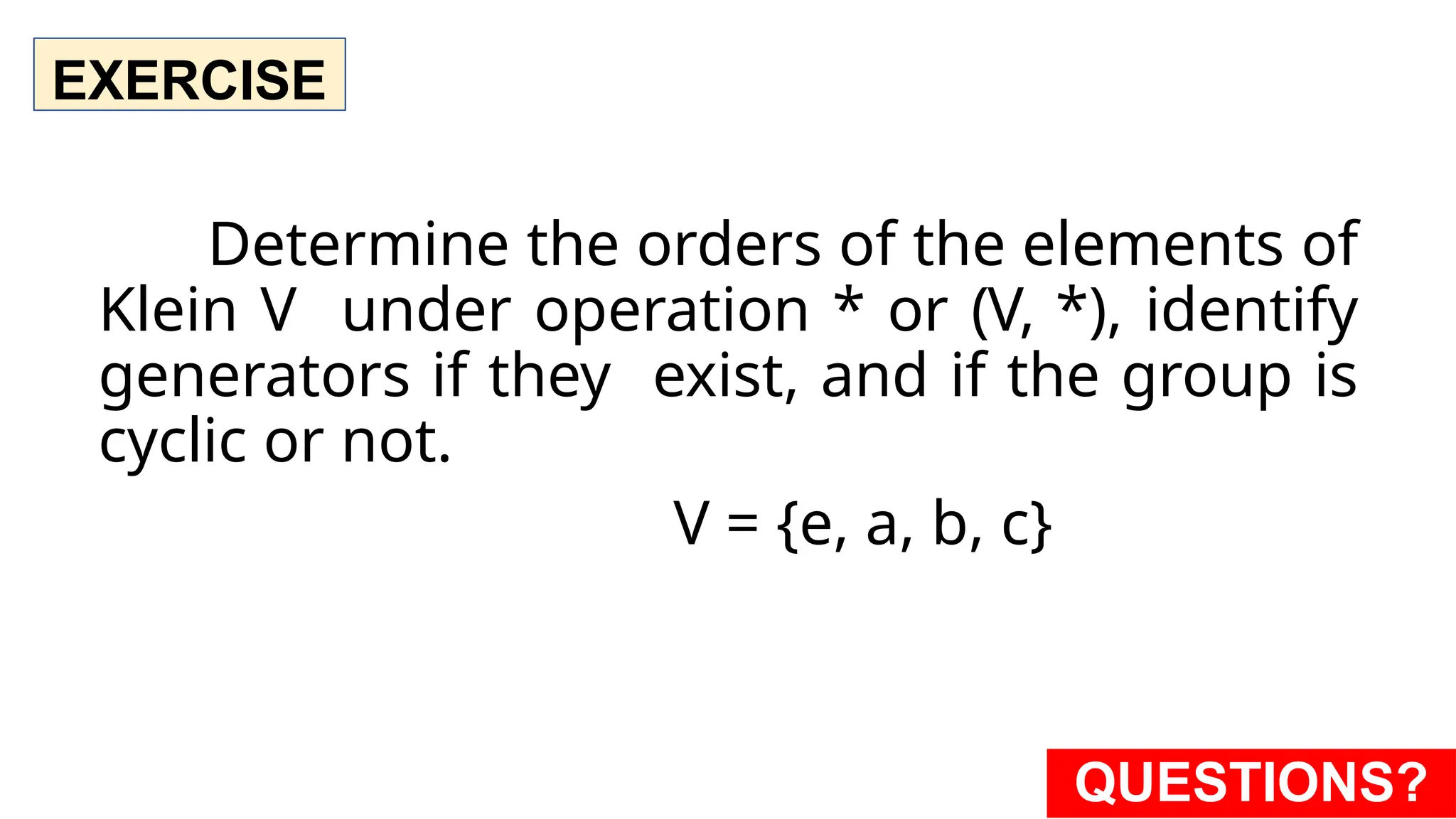
Determine the orders of the elements of
Klein V under operation * or (V, *), identify
generators if they exist, and if the group is
cyclic or not.
V = {e, a, b, c}
QUESTIONS?
EXERCISE
Determine the orders of the elements of
Klein V under operation * or (V, *), identify
generators if they exist, and if the group is cyclic
or not.
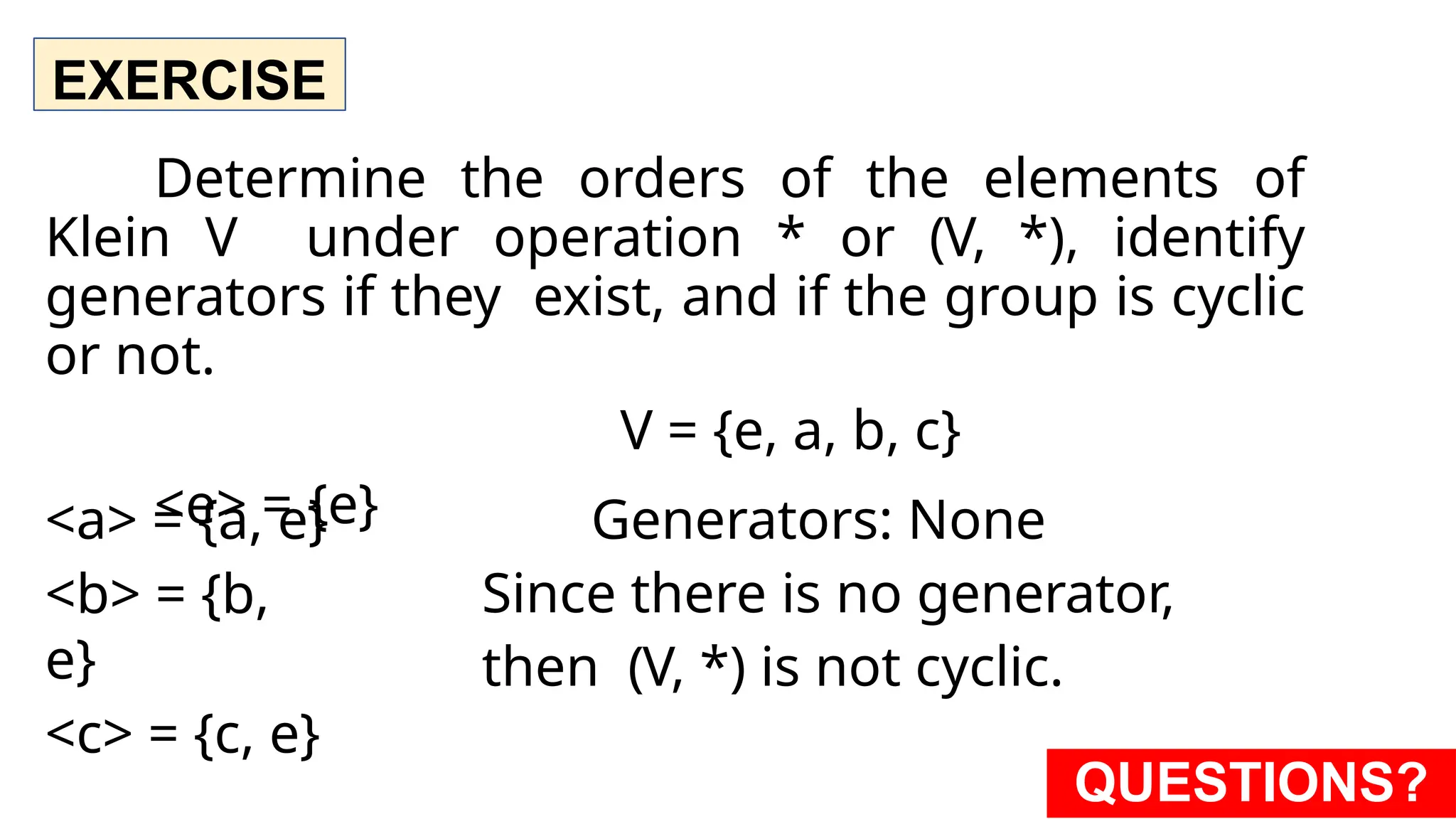
V = {e, a, b, c}
<e> = {e}
<a> = {a, e}
<b> = {b,
e}
<c> = {c, e}
Generators: None
Since there is no generator,
then (V, *) is not cyclic.
QUESTIONS?
ORDER OF AN INFINITE CYCLIC
GROUP
An infinite group has an infinite order.
An infinite group is CYCLIC if it has at
least 1 generator. If it has no generator,
then the group is NOT CYCLIC.
If G is an infinite cyclic group
generated by a ∈ G, then a is an
element of infinite order, and all the
powers of a are different.
ORDER OF AN INFINITE CYCLIC GROUP
Is (ℤ, +) an infinite cyclic
group?
Is/Are there
generator(s)?
YES
-1 AND 1
ORDER OF AN INFINITE CYCLIC
GROUP
Are there generators in (ℝ, +)?
No
Is (ℝ, +) an infinite cyclic
group?
No
TRUE OR FALSE
If a group is cyclic, then it is Abelian.
If a group is Abelian, then it is cyclic.
TRUE
FALSE
EXERCISE
Categorize (ℤ, +),
(V, *), GL2(ℝ), (ℤ5
#
,
∙5)
(ℝ, +), (ℚ#,
∙), (ℤ4, ∙4), (10ℤ, +).
Finite
Group
Infinite
Group
Abelian (V, *) (ℤ, +)
Group
(ℤ5
#
,∙5) (ℝ, +)
(ℚ#, ∙)
(10ℤ, +)
Non-
Abelia
n
GL2(ℝ)
PERMUTATIONS
PERMUTATION
Given a finite set S, a permutation
of A is a function f : S → S which is
a BIJECTIVE FUNCTION- that is
both 1-1 (injective) and onto
(surjective).
Remember a set with finite
number of
PERMUTATION
We will focus specifically on the case
when S = {1, 2, 3, ... , n} for some fixed
integer n.
This means each group element will
permute this set. For example if A = {1, 2, 3}
then a permutation α might have α (1) = 2,
α (2) = 1, and α(3) = 3. We can write this as:
α
1 2
3
2 1
=
PERMUTATION
The first row is the domain (pre-
image) and the second row is your
codomain (image).
α
=
1 2
3
2 1
3
If we say α(1) = 2, we mean that
the element 1 (in the domain) is
mapped to 2 (in the codomain).
EXERCISE
Consider f
= 1. f(1)
2.
f(2)
3.
1 2 3 4
3 2 5 1
4
5 . What
is
4. f-1(1)
5. f-1(4)
PERMUTATION GROUP
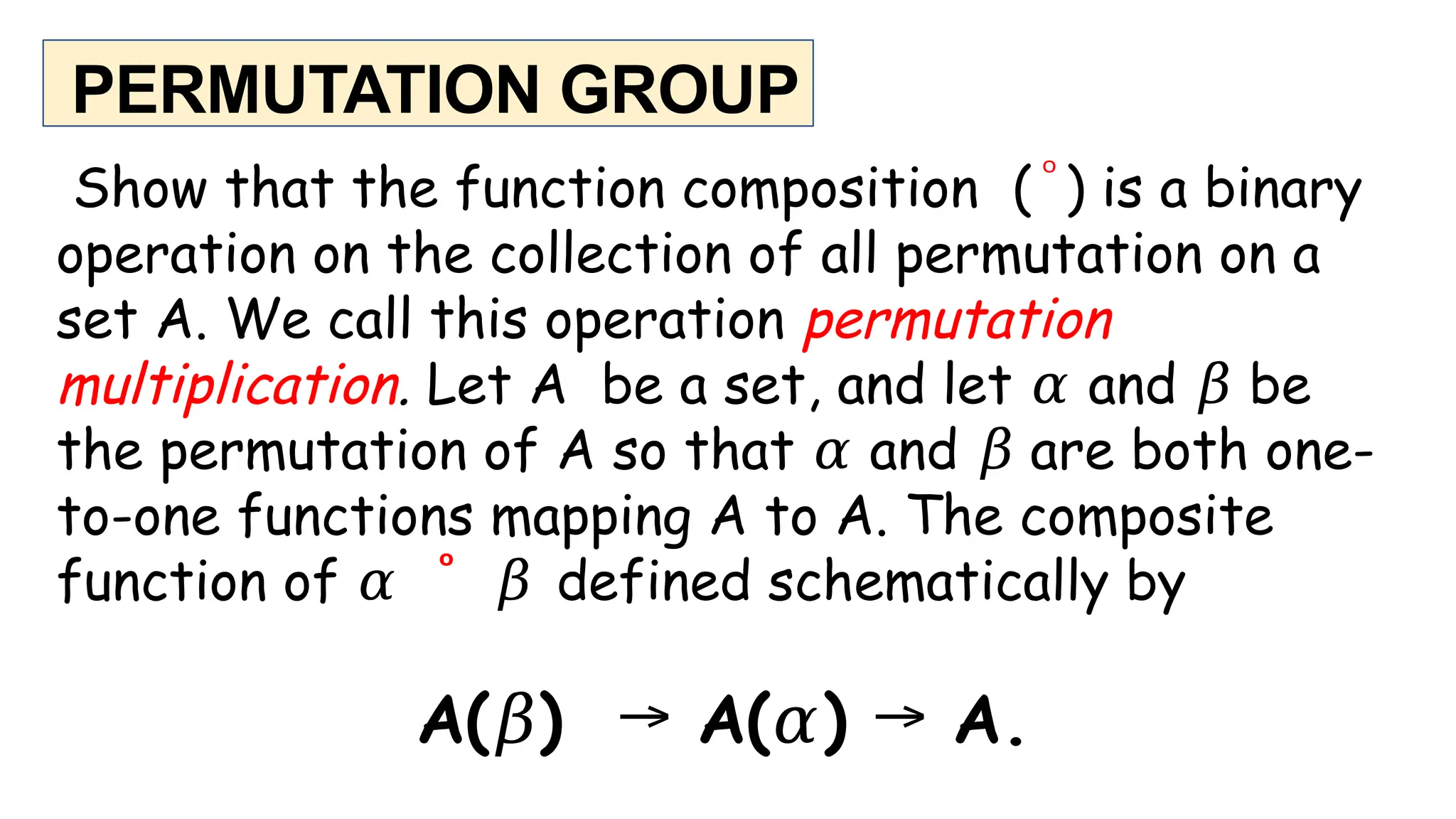
Show that the function composition ( ͦ ) is a binary
operation on the collection of all permutation on a
set A. We call this operation permutation
multiplication. Let A be a set, and let and be
𝛼 𝛽
the permutation of A so that and are both one-
𝛼 𝛽
to-one functions mapping A to A. The composite
function of 𝛼 ͦ 𝛽 defined schematically by
A( )
𝛽 A(
→ )
𝛼 A.
→
PERMUTATION GROUP
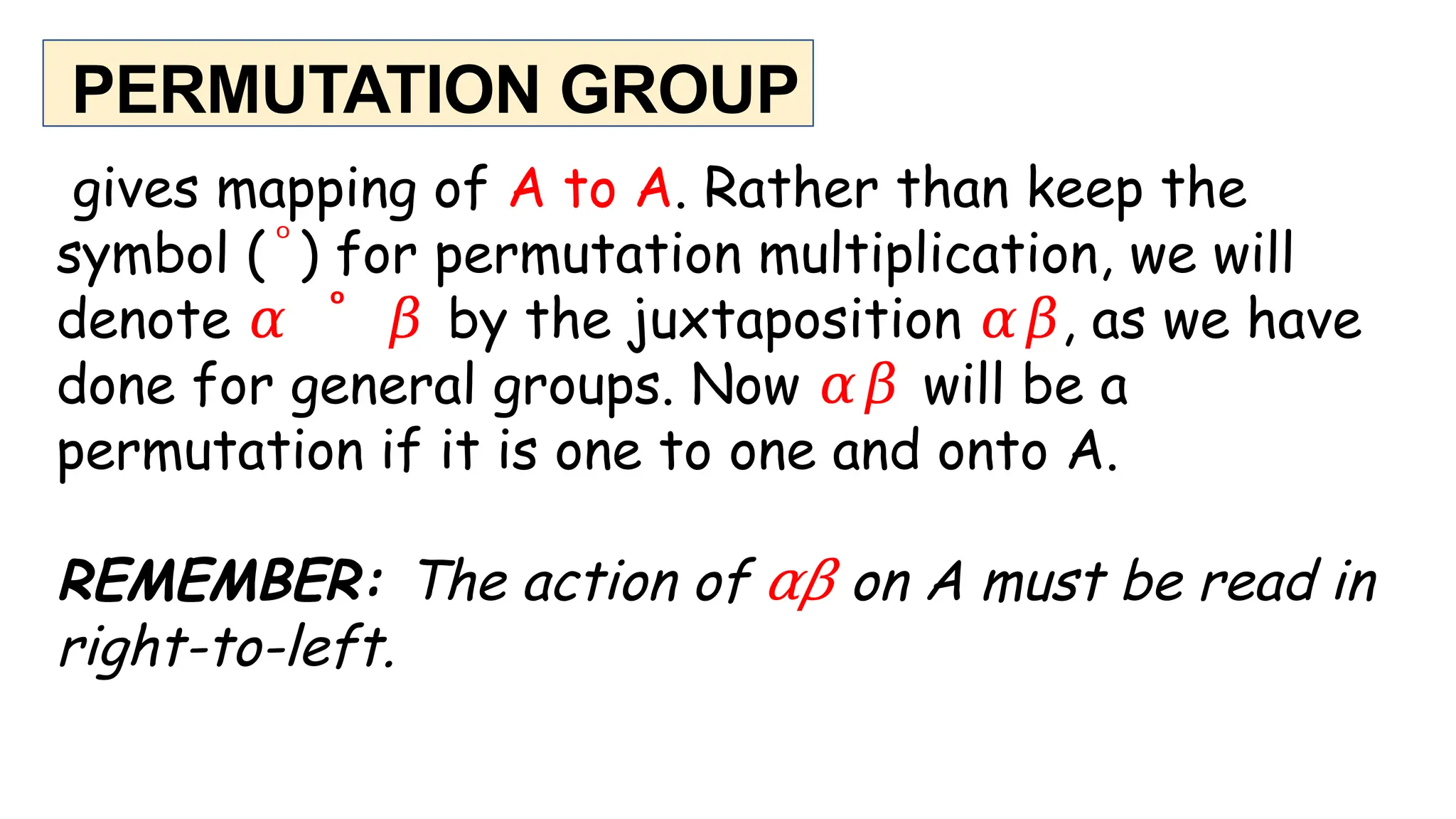
gives mapping of A to A. Rather than keep the
symbol ( ͦ ) for permutation multiplication, we will
denote 𝛼 ͦ 𝛽 by the juxtaposition 𝛼𝛽, as we have
done for general groups. Now 𝛼𝛽 will be a
permutation if it is one to one and onto A.
REMEMBER: The action of 𝛼𝛽 on A must be read in
right-to-left.
EXERCISE
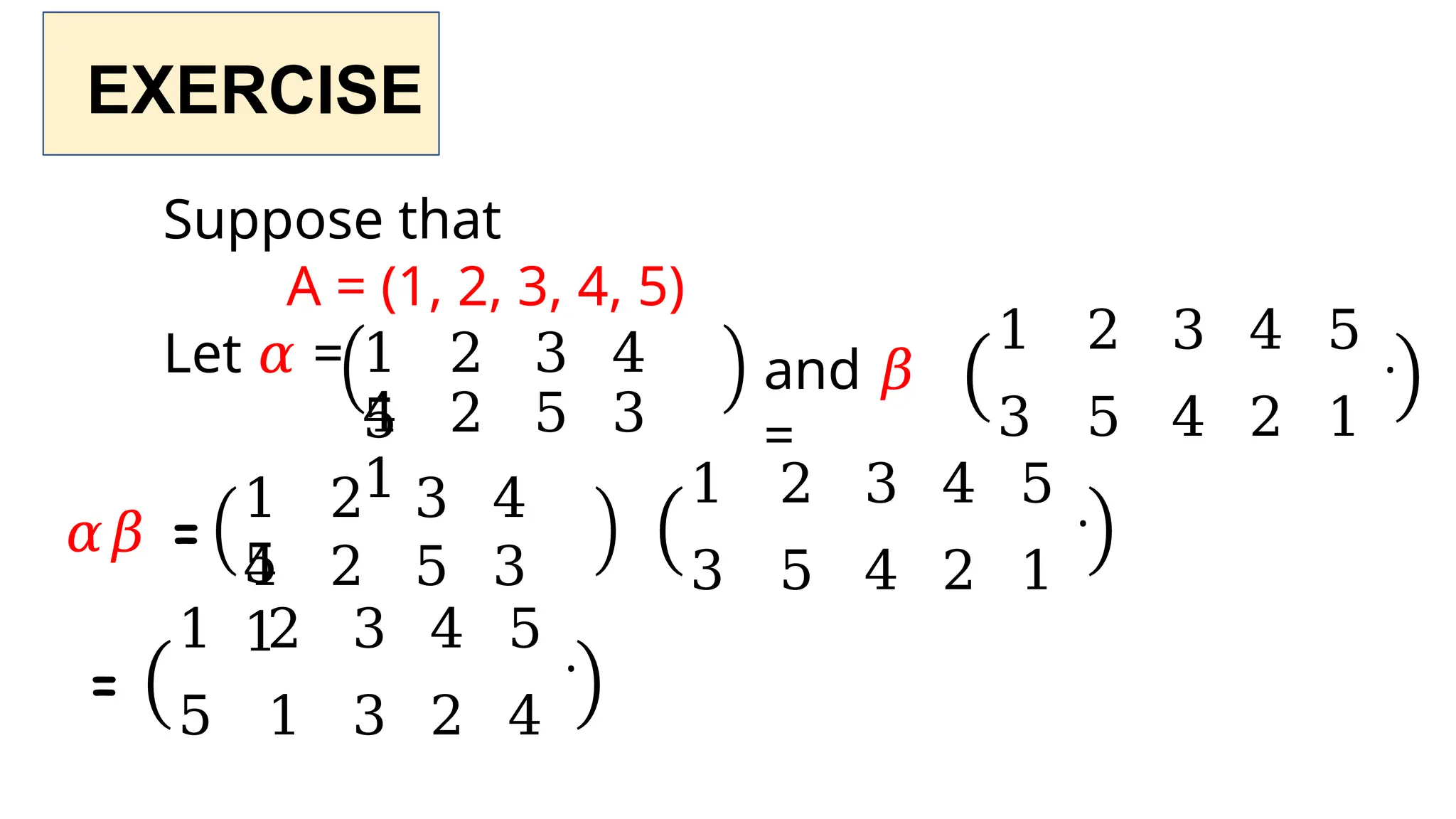
Suppose that
A = (1, 2, 3, 4, 5)
Let 𝛼 = 1 2 3 4
5
4 2 5 3
1
and 𝛽
=
1 2 3 4 5 .
3 5 4 2 1
𝛼𝛽 =
=
1 2 3 4
5
4 2 5 3
1
1 2 3 4 5 .
3 5 4 2 1
1 2 3 4 5 .
5 1 3 2 4
EXERCISE
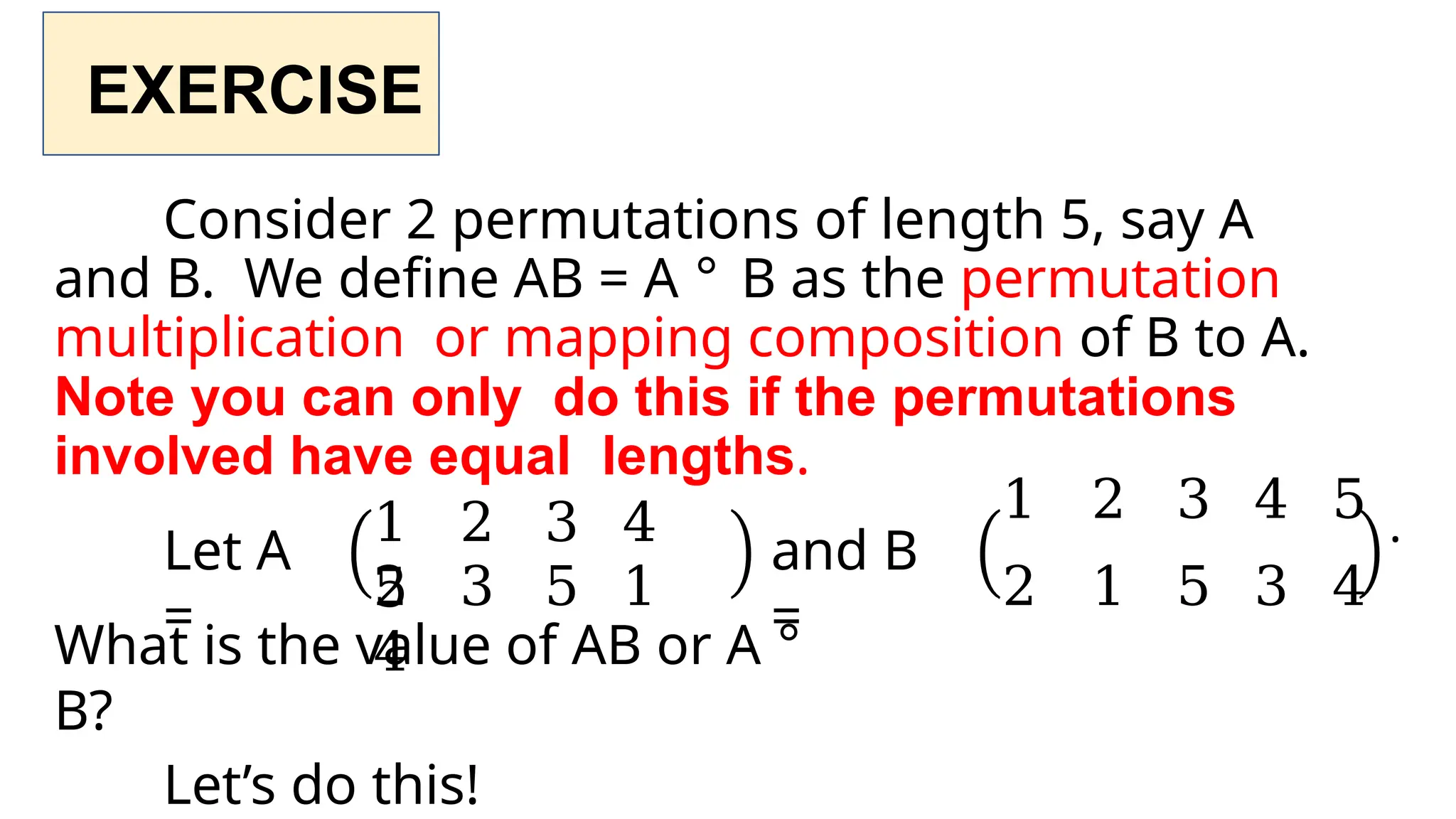
Consider 2 permutations of length 5, say A
and B. We define AB = A ° B as the permutation
multiplication or mapping composition of B to A.
Note you can only do this if the permutations
involved have equal lengths.
Let A
=
1 2 3 4
5
2 3 5 1
4
and B
=
1 2 3 4 5 .
2 1 5 3 4
What is the value of AB or A °
B?
Let’s do this!
EXAMPLE
A =
1 2 3 4
5
2 3 5 1
4
and B
=
1 2 3 4
5
2 1 5 3
4
What is the value of AB or A °
B?
AB = A ° B
=
1 2 3
4
3 2 4
5
5
1
EXAMPLE
A =
1 2 3 4
5
2 3 5 1
4
and B
=
1 2 3 4
5
2 1 5 3
4
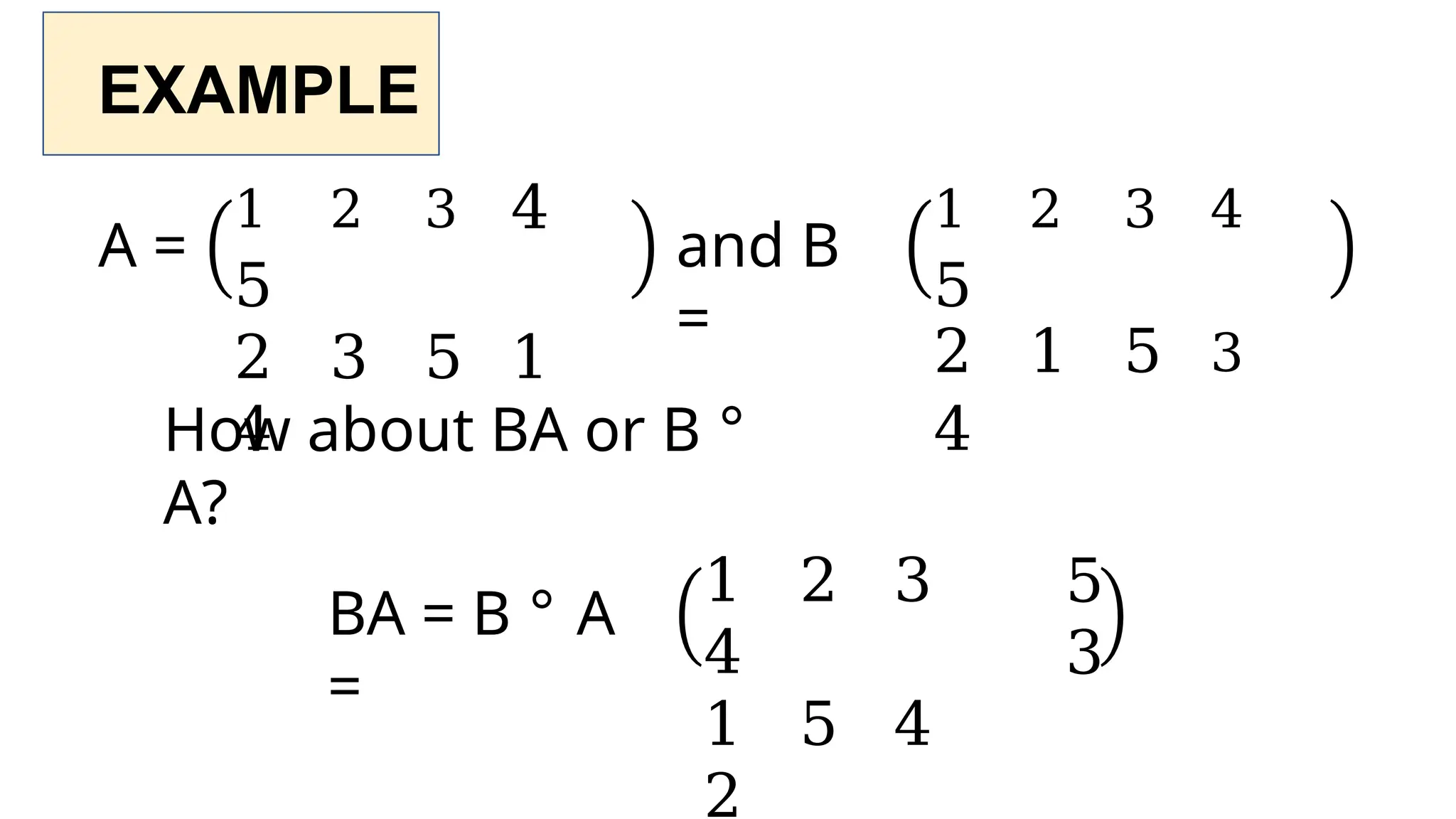
How about BA or B °
A?
BA = B ° A
=
1 2 3
4
1 5 4
2
5
3
REMEMBER:
Based on what we did, is AB = BA?
NO
Thus, mapping composition of
permutations is NOT COMMUTATIVE.
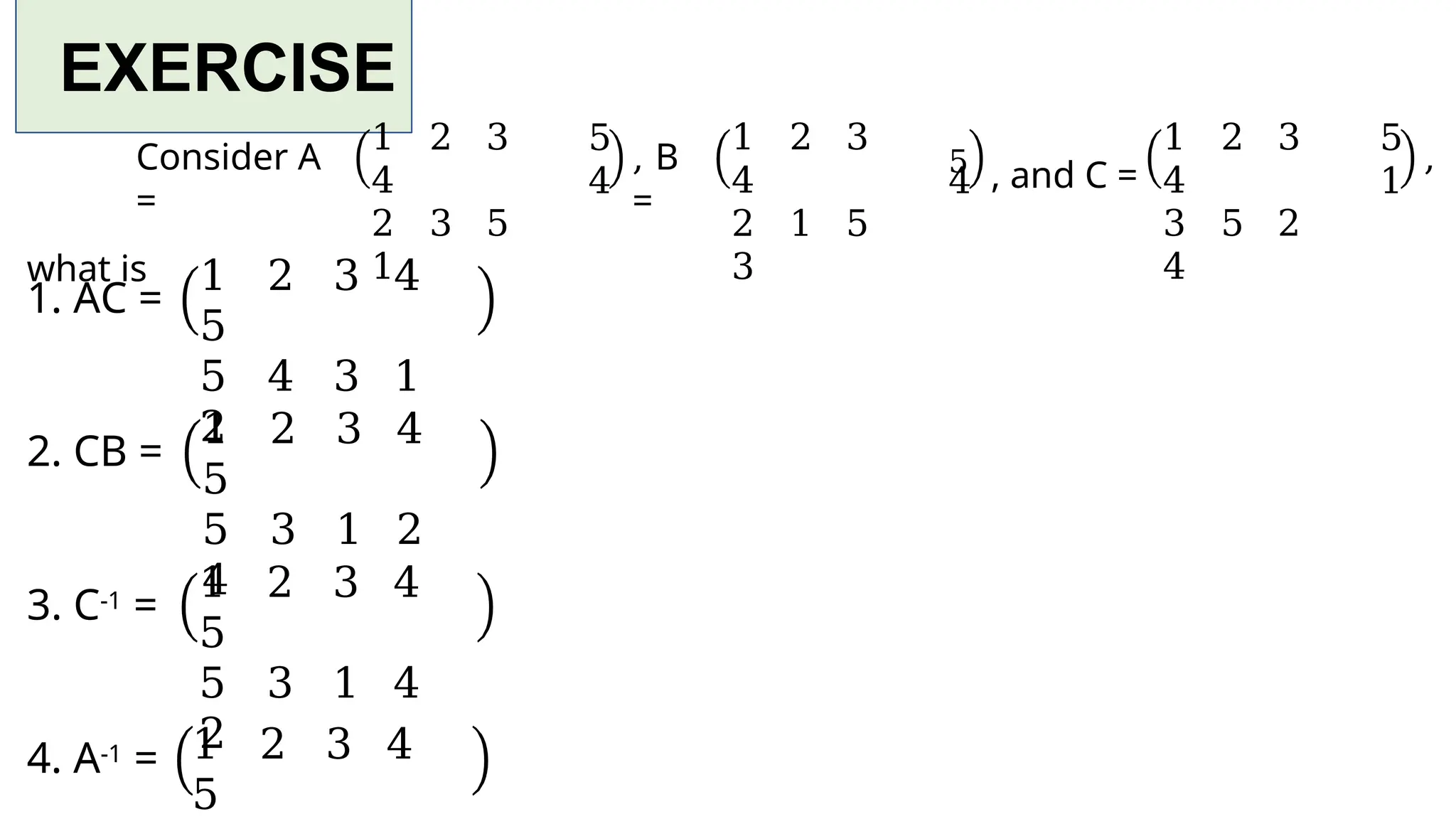
EXERCISE
1 2 3
4
2 3 5
1
5
4
Consider A
=
what is
, B
=
1 2 3
4
2 1 5
3
4
5 , and C =
1 2 3
4
3 5 2
4
5
1
,
1. AC =
1 2 3 4
5
5 4 3 1
2
2. CB =
1 2 3 4
5
5 3 1 2
4
3. C-1 =
1 2 3 4
5
5 3 1 4
2
4. A-1 = 1 2 3 4
5
EXERCISE
Consider A
=
1 2 3 4
5
2 3 5 1
4
, B
=
1 2 3 4
2 1 5 3
4
5
, and C =
1 2 3 4
5
3 5 2 4
1
,
what is
5. ABC = A ° B ° C
=
1 2 3 4 5 1 2 3 4 5 1 2 3 4 5
2 3 5 1 4 2 1 5 3 4 3 5 2 4 1
=
1 2 3 4 5
4 1 2 5 3
6. BCA = B ° C ° A
=
7. A2 = AA = A ° A
=
1 2 3 4 5 1 2 3 4 5 =
1 2 3 4 5
2 3 5 1 4 2 3 5 1 4 3 5 4 2 1
8. B3 =
1 2 3 4 5
2 1 3 4 5
1 2 3 4 5
4 1 2 5 3
EXERCISE
Consider A
=
what is
1 2 3 4
5
2 3 5 1
4
, B = 1
2 3 4
2 1 5 3 4
5 , and C =
1 2 3 4
5
3 5 2 4
1
,
9. AB-3 =
10. A-1CB =
1 2 3 4
5
3 2 4 1
5
1 2 3 4
5
3 2 5 1
4
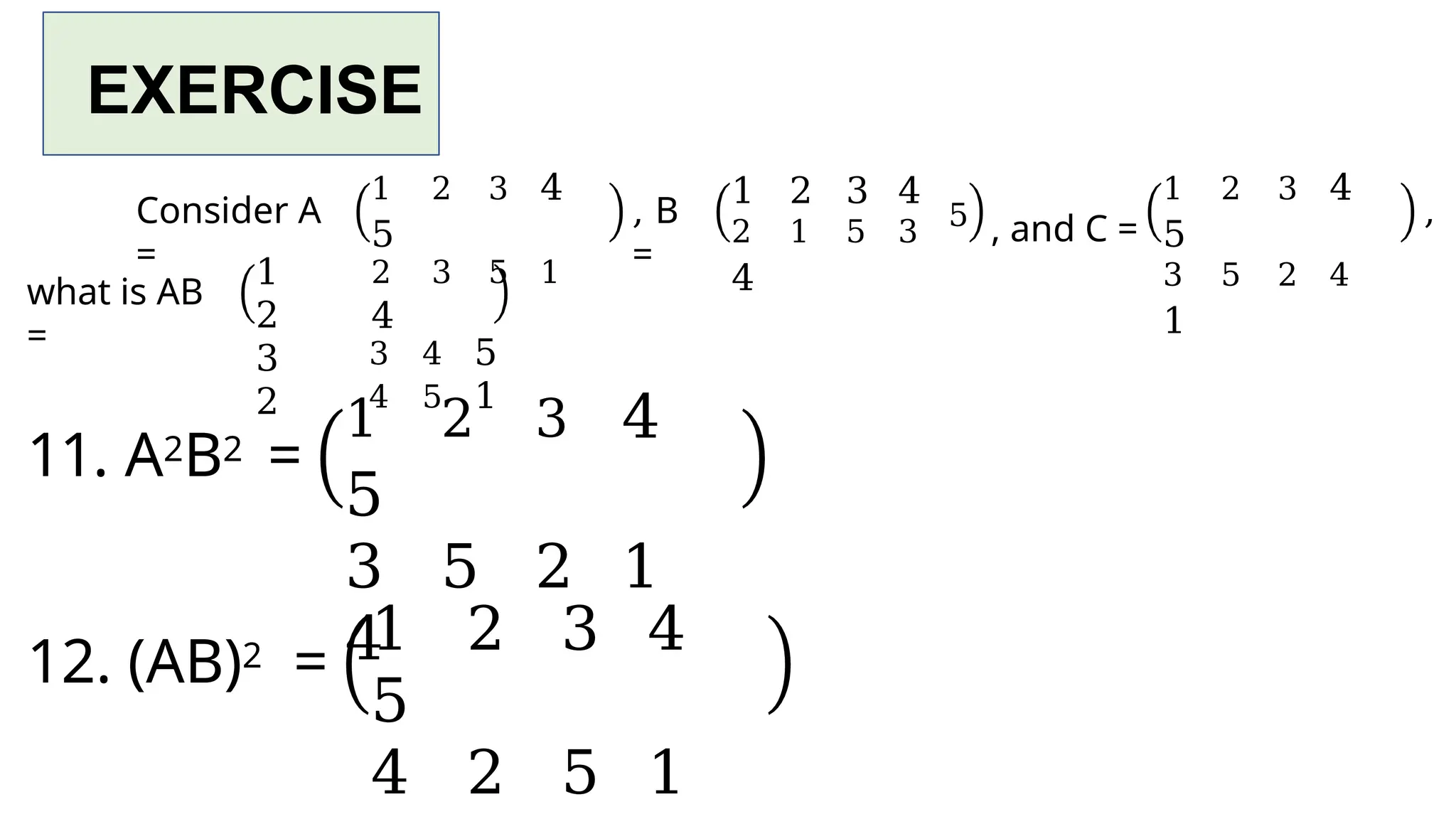
EXERCISE
Consider A
=
, B
=
1 2 3 4
2 1 5 3
4
5 , and C =
1 2 3 4
5
3 5 2 4
1
,
what is AB
=
1
2
3
2
1 2 3 4
5
2 3 5 1
4
3 4 5
4 5 1
11. A2B2 =
1 2 3 4
5
3 5 2 1
4
12. (AB)2 =
1 2 3 4
5
4 2 5 1
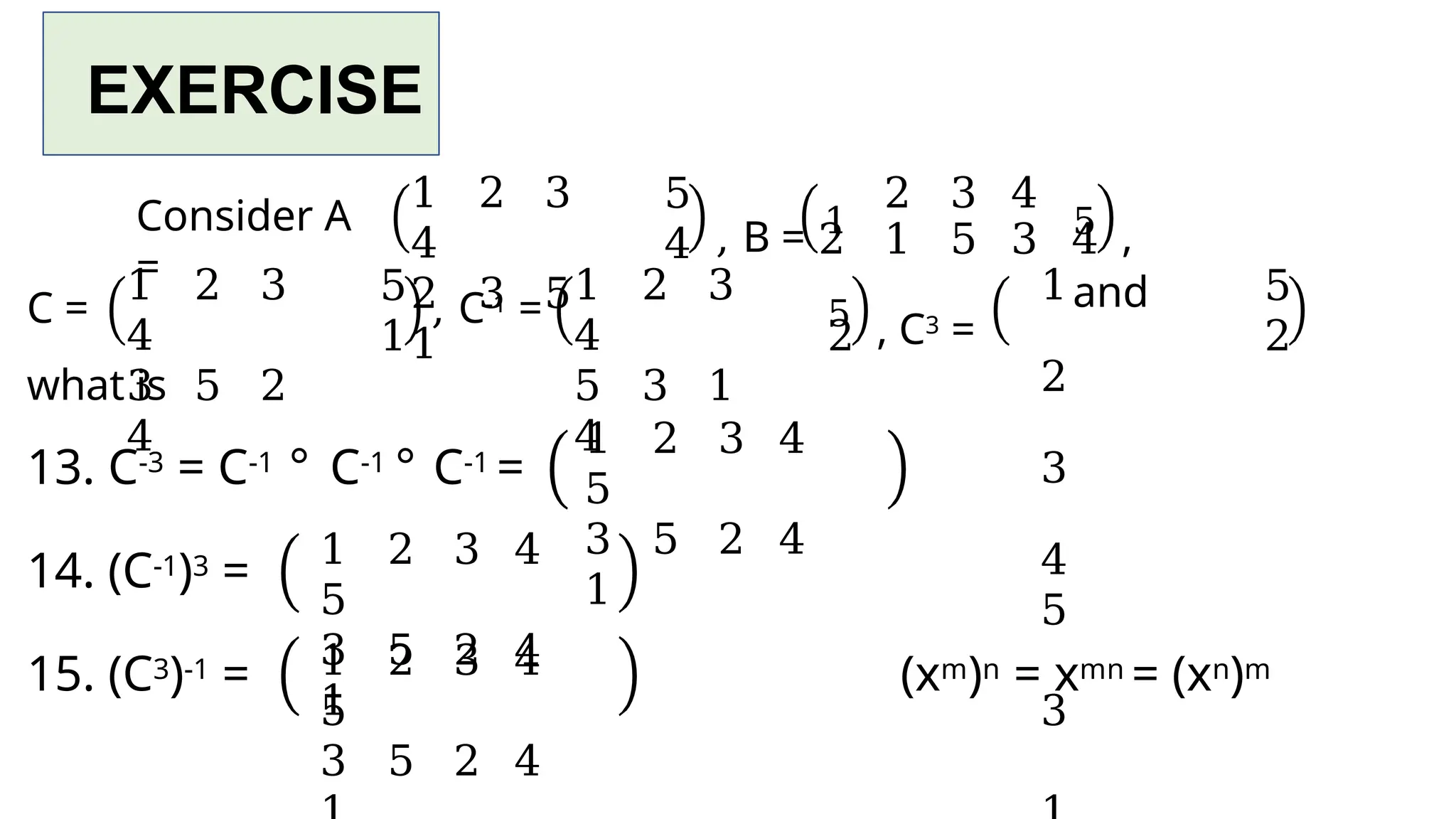
EXERCISE
Consider A
=
1 2 3
4
2 3 5
1
5
4 , B = 1 5 ,
and
C =
1 2 3
4
3 5 2
4
5
1
, C-1 =
1 2 3
4
5 3 1
4
2
5 , C3 =
2 3 4
2 1 5 3 4
1
2
3
4
5
3
5
2
what is
13. C-3 = C-1 ° C-1 ° C-1 =
14. (C-1)3 =
15. (C3)-1 = (xm)n = xmn = (xn)m
1 2 3 4
5
3 5 2 4
1
1 2 3 4
5
3 5 2 4
1
1 2 3 4
5
3 5 2 4
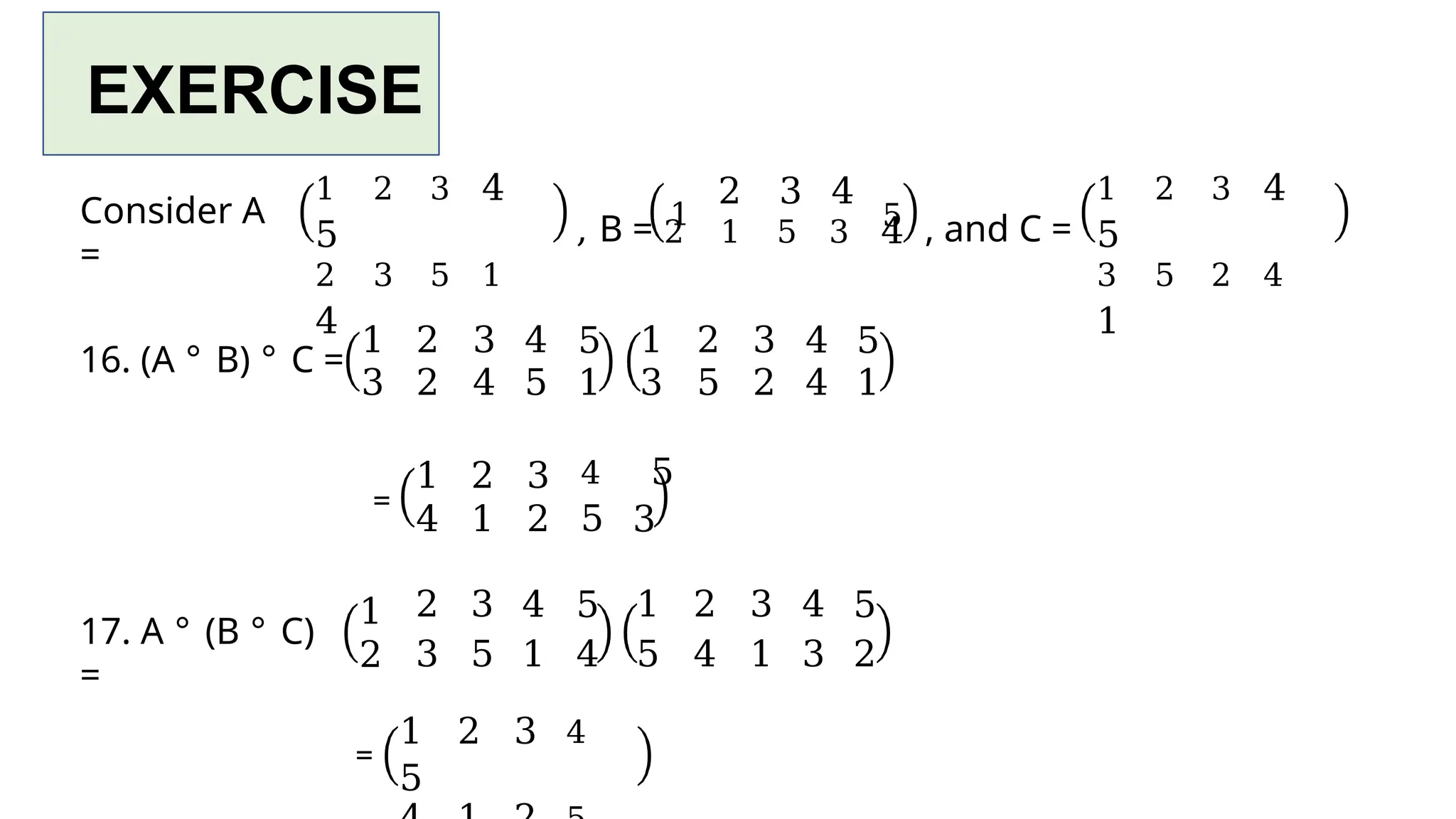
EXERCISE
Consider A
=
1 2 3 4
5
2 3 5 1
4
, B = 1
2 3 4
2 1 5 3 4
5 , and C =
1 2 3 4
5
3 5 2 4
1
1 2 3 4 5 1 2 3 4 5
3 2 4 5 1 3 5 2 4 1
16. (A ° B) ° C =
=
17. A ° (B ° C)
=
1
2
1 2 3 4 5
4 1 2 5 3
2 3 4 5 1 2 3 4 5
3 5 1 4 5 4 1 3 2
=
1 2 3 4
5
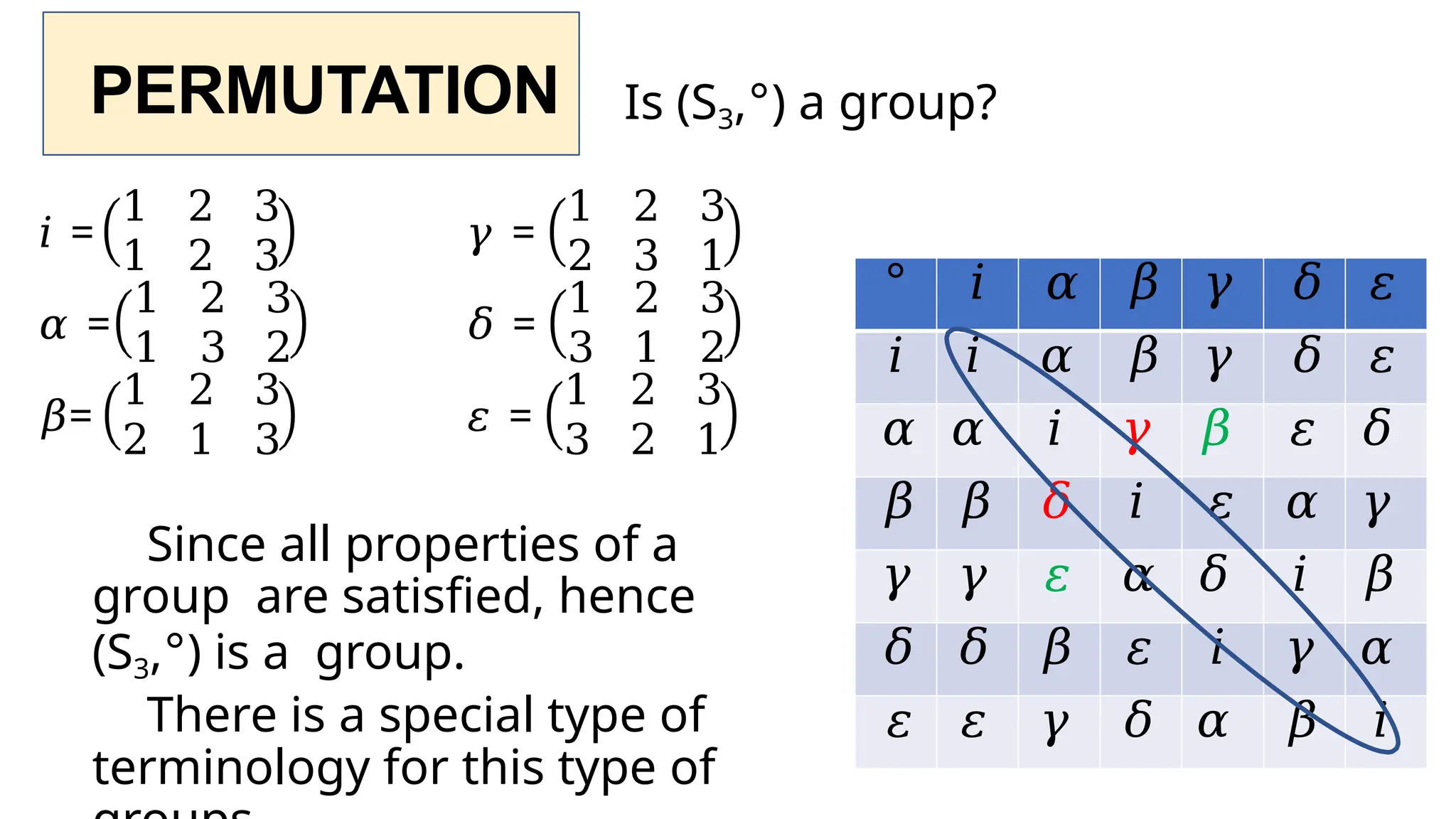
PERMUTATION
𝑖 =
1
1
2
2
3
3
𝛾 =
1
2
2
3
3
1
𝛼 =
1
1
2
3
3
2
𝛿 =
1
3
2
1
3
2
𝛽=
1
2
2
1
3
3
𝜀 =
1
3
2
2
3
1
i. Closure
∀𝑥, 𝑦 ∈ 𝑆3, it could be seen
that
𝑥 ° 𝑦 ∈ 𝑆3. Hence, closure holds.
Is (S3,°) a group?
° 𝑖 𝛼 𝛽 𝛾 𝛿 𝜀
𝑖 𝑖 𝛼 𝛽 𝛾 𝛿 𝜀
𝛼 𝛼 𝑖 𝛾 𝛽 𝜀 𝛿
𝛽 𝛽 𝛿 𝑖 𝜀 𝛼 𝛾
𝛾 𝛾 𝜀 𝛼 𝛿 𝑖 𝛽
𝛿 𝛿 𝛽 𝜀 𝑖 𝛾 𝛼
𝜀 𝜀 𝛾 𝛿 𝛼 𝛽 𝑖
PERMUTATION
𝑖 =
1
1
2
2
3
3
𝛾 =
1
2
2
3
3
1
𝛼 =
1
1
2
3
3
2
𝛿 =
1
3
2
1
3
2
𝛽=
1
2
2
1
3
3
𝜀 =
1
3
2
2
3
1
iii. Existence of an Identity Element
∀𝑥 ∈ 𝑆3, ∃𝑒 = 𝑖 such that 𝑥
° 𝑒 =
𝑒 ° 𝑥 = 𝑥. Hence, identity
property is satisfied.
Is (S3,°) a group?
° 𝑖 𝛼 𝛽 𝛾 𝛿 𝜀
𝑖 𝑖 𝛼 𝛽 𝛾 𝛿 𝜀
𝛼 𝛼 𝑖 𝛾 𝛽 𝜀 𝛿
𝛽 𝛽 𝛿 𝑖 𝜀 𝛼 𝛾
𝛾 𝛾 𝜀 𝛼 𝛿 𝑖 𝛽
𝛿 𝛿 𝛽 𝜀 𝑖 𝛾 𝛼
𝜀 𝜀 𝛾 𝛿 𝛼 𝛽 𝑖
PERMUTATION
𝑖 =
1
1
2
2
3
3
𝛾 =
1
2
2
3
3
1
𝛼 =
1
1
2
3
3
2
𝛿 =
1
3
2
1
3
2
𝛽=
1
2
2
1
3
3
𝜀 =
1
3
2
2
3
1
ii. Associativity
∀𝑥, 𝑦, 𝑧 ∈ 𝑆3, it is known
that (x ° y) ° z = x ° (y ° z). Thus,
associativity holds.
Is (S3,°) a group?
° 𝑖 𝛼 𝛽 𝛾 𝛿 𝜀
𝑖 𝑖 𝛼 𝛽 𝛾 𝛿 𝜀
𝛼 𝛼 𝑖 𝛾 𝛽 𝜀 𝛿
𝛽 𝛽 𝛿 𝑖 𝜀 𝛼 𝛾
𝛾 𝛾 𝜀 𝛼 𝛿 𝑖 𝛽
𝛿 𝛿 𝛽 𝜀 𝑖 𝛾 𝛼
𝜀 𝜀 𝛾 𝛿 𝛼 𝛽 𝑖
PERMUTATION
𝑖 =
1
1
2
2
3
3
𝛾 =
1
2
2
3
3
1
𝛼 =
1
1
2
3
3
2
𝛿 =
1
3
2
1
3
2
𝛽=
1
2
2
1
3
3
𝜀 =
1
3
2
2
3
1
iv. Inverse
Property
𝑖-1 =
𝛼-1=
𝛽 -1 =
𝛾-1 =
𝛿-1=
𝜀-1=
Is (S3,°) a group?
° 𝑖 𝛼 𝛽 𝛾 𝛿 𝜀
𝑖 𝑖 𝛼 𝛽 𝛾 𝛿 𝜀
𝛼 𝛼 𝑖 𝛾 𝛽 𝜀 𝛿
𝛽 𝛽 𝛿 𝑖 𝜀 𝛼 𝛾
𝛾 𝛾 𝜀 𝛼 𝛿 𝑖 𝛽
𝛿 𝛿 𝛽 𝜀 𝑖 𝛾 𝛼
𝜀 𝜀 𝛾 𝛿 𝛼 𝛽 𝑖
PERMUTATION
𝑖 =
1
1
2
2
3
3
𝛾 =
1
2
2
3
3
1
𝛼 =
1
1
2
3
3
2
𝛿 =
1
3
2
1
3
2
𝛽=
1
2
2
1
3
3
𝜀 =
1
3
2
2
3
1
iv. Inverse
Property
𝑖-1 = 𝑖
𝛼-1= 𝛼
𝛽 -1 = 𝛽
𝛾-1
= 𝛿
𝛿-1= 𝛾
𝜀-1= 𝜀
Since ∀ 𝑥 ∈ S3, ∃ 𝑥 -1 ∈ S3 such
that 𝑥°𝑥 -1 = 𝑥 -1°𝑥 = e = 𝑖, thus,
inverse property is satisfied.
Is (S3,°) a group?
° 𝑖 𝛼 𝛽 𝛾 𝛿 𝜀
𝑖 𝑖 𝛼 𝛽 𝛾 𝛿 𝜀
𝛼 𝛼 𝑖 𝛾 𝛽 𝜀 𝛿
𝛽 𝛽 𝛿 𝑖 𝜀 𝛼 𝛾
𝛾 𝛾 𝜀 𝛼 𝛿 𝑖 𝛽
𝛿 𝛿 𝛽 𝜀 𝑖 𝛾 𝛼
𝜀 𝜀 𝛾 𝛿 𝛼 𝛽 𝑖
PERMUTATION
𝑖 =
1
1
2
2
3
3
𝛾 =
1
2
2
3
3
1
𝛼 =
1
1
2
3
3
2
𝛿 =
1
3
2
1
3
2
𝛽=
1
2
2
1
3
3
𝜀 =
1
3
2
2
3
1
Since all properties of a
group are satisfied, hence
(S3,°) is a group.
There is a special type of
terminology for this type of
Is (S3,°) a group?
° 𝑖 𝛼 𝛽 𝛾 𝛿 𝜀
𝑖 𝑖 𝛼 𝛽 𝛾 𝛿 𝜀
𝛼 𝛼 𝑖 𝛾 𝛽 𝜀 𝛿
𝛽 𝛽 𝛿 𝑖 𝜀 𝛼 𝛾
𝛾 𝛾 𝜀 𝛼 𝛿 𝑖 𝛽
𝛿 𝛿 𝛽 𝜀 𝑖 𝛾 𝛼
𝜀 𝜀 𝛾 𝛿 𝛼 𝛽 𝑖
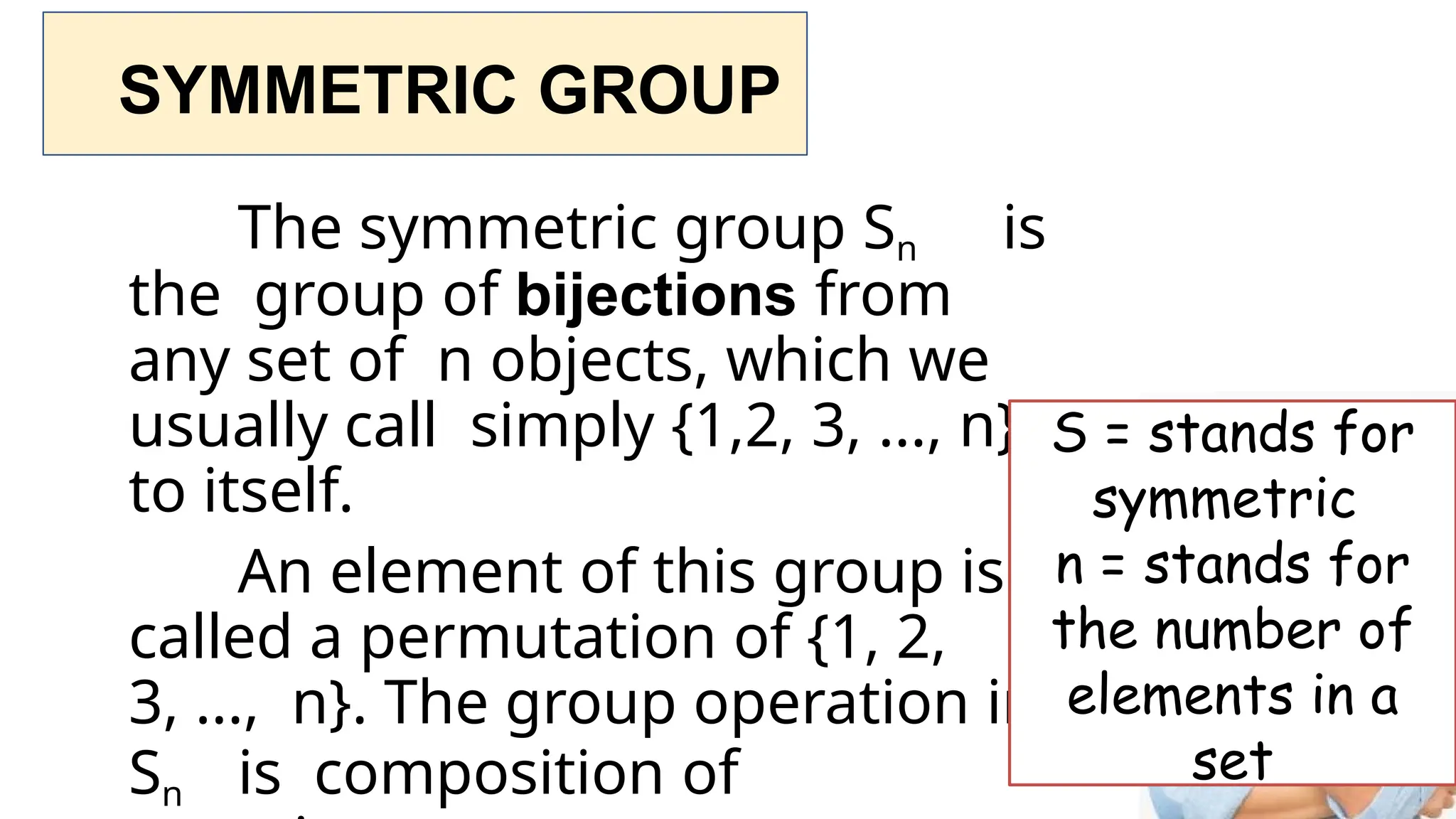
SYMMETRIC GROUP
The symmetric group Sn is
the group of bijections from
any set of n objects, which we
usually call simply {1,2, 3, ..., n},
to itself.
An element of this group is
called a permutation of {1, 2,
3, ..., n}. The group operation in
Sn is composition of
S = stands for
symmetric
n = stands for
the number of
elements in a
set
SYMMETRIC GROUP
The symmetric group Sn is
the group of bijections from
any set of n objects, which we
usually call simply {1,2, 3, ..., n},
to itself.
An element of this group is
called a permutation of {1, 2,
3, ..., n}. The group operation in
Sn is composition of
S = stands for
symmetric
n = stands for
the number of
elements in a
set
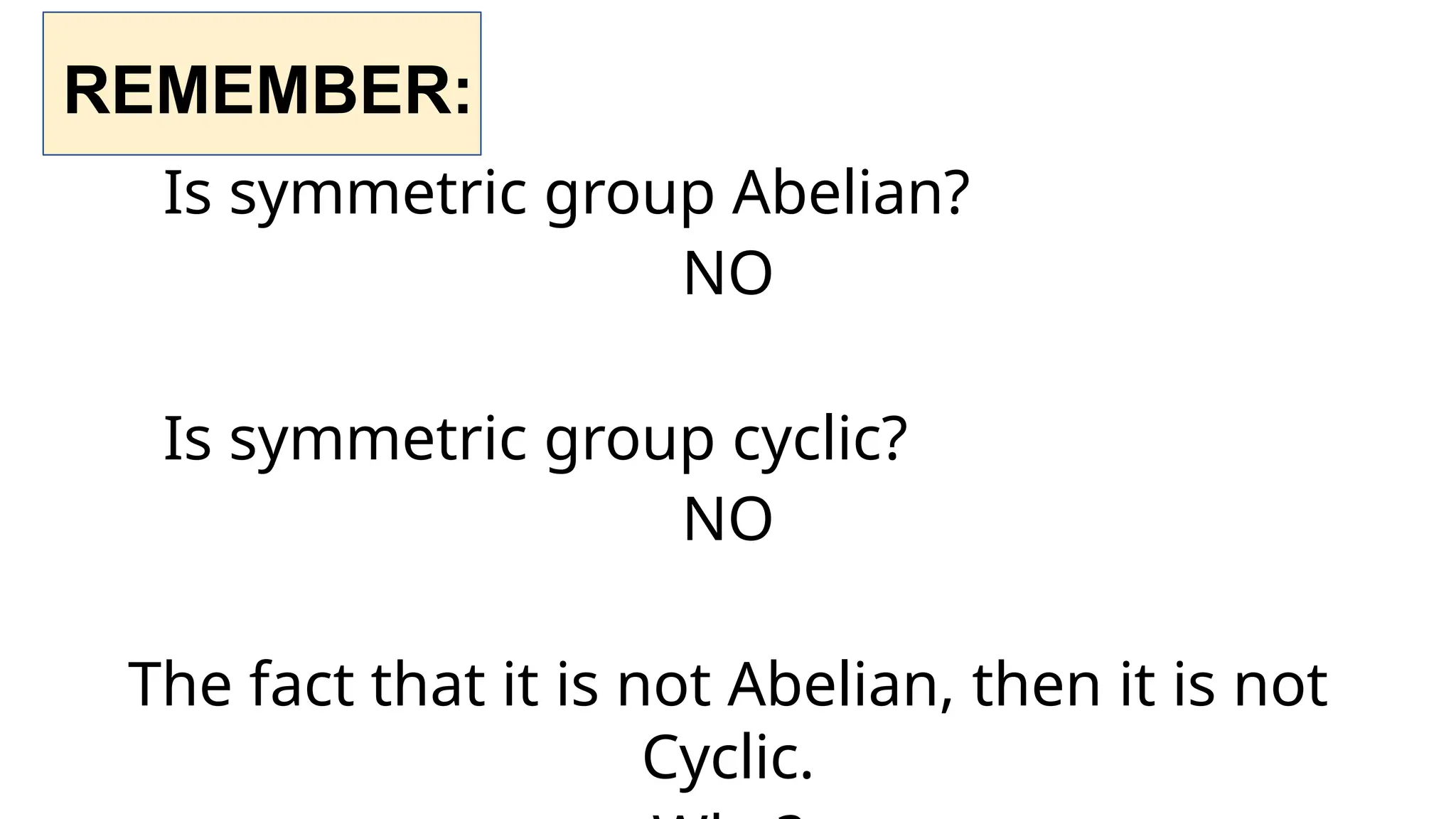
REMEMBER:
Is symmetric group Abelian?
NO
Is symmetric group cyclic?
NO
The fact that it is not Abelian, then it is not
Cyclic.
p → q
If a group is cyclic, then it is Abelian.
~𝑞 → ~ p
If a group is not Abelian, then it is not
cyclic.
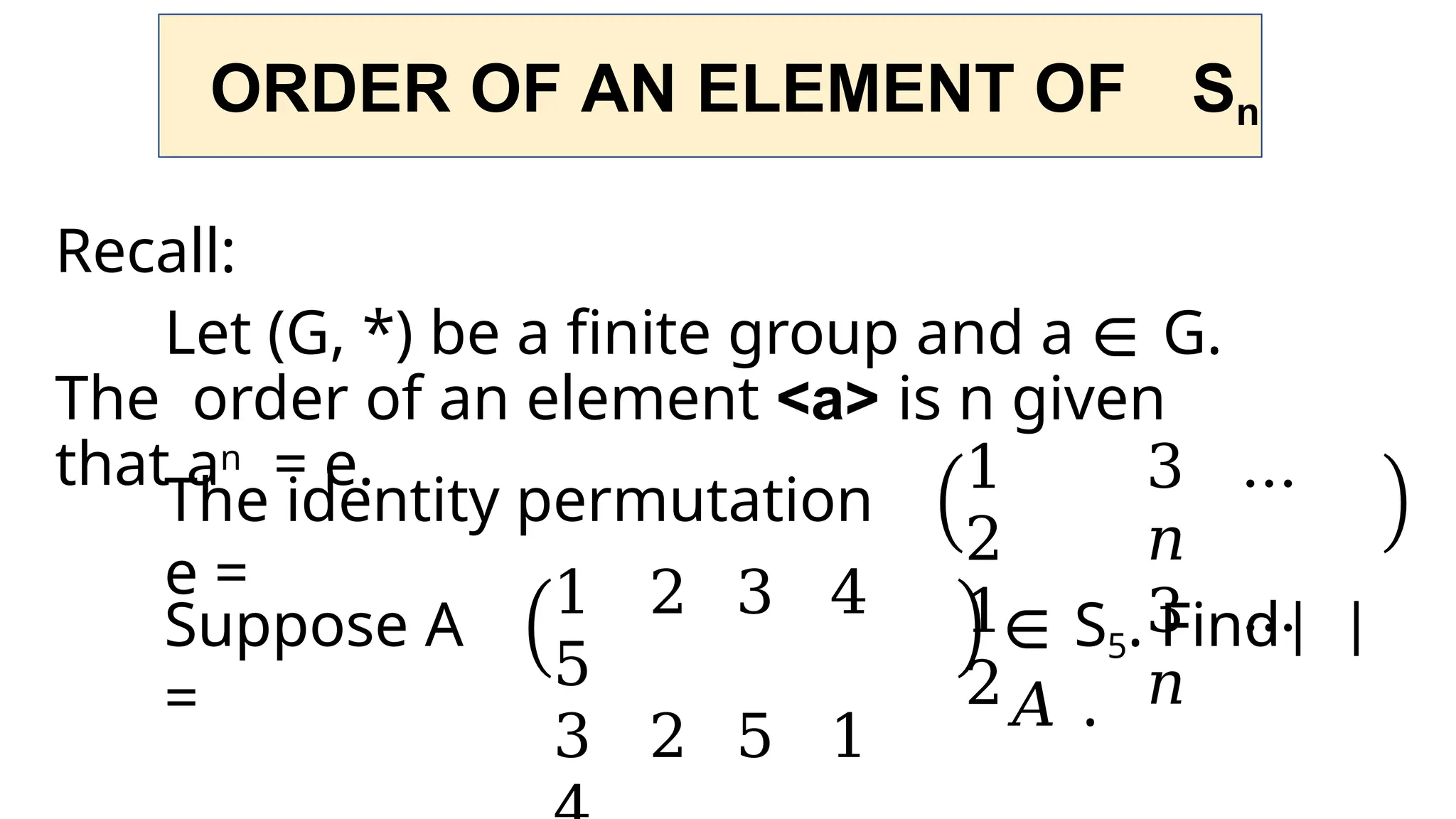
ORDER OF AN ELEMENT OF Sn
Recall:
Let (G, *) be a finite group and a ∈ G.
The order of an element <a> is n given
that an = e.
The identity permutation
e =
1
2
1
2
3 …
𝑛
3 …
𝑛
Suppose A
=
1 2 3 4
5
3 2 5 1
∈ S5. Find
𝐴 .
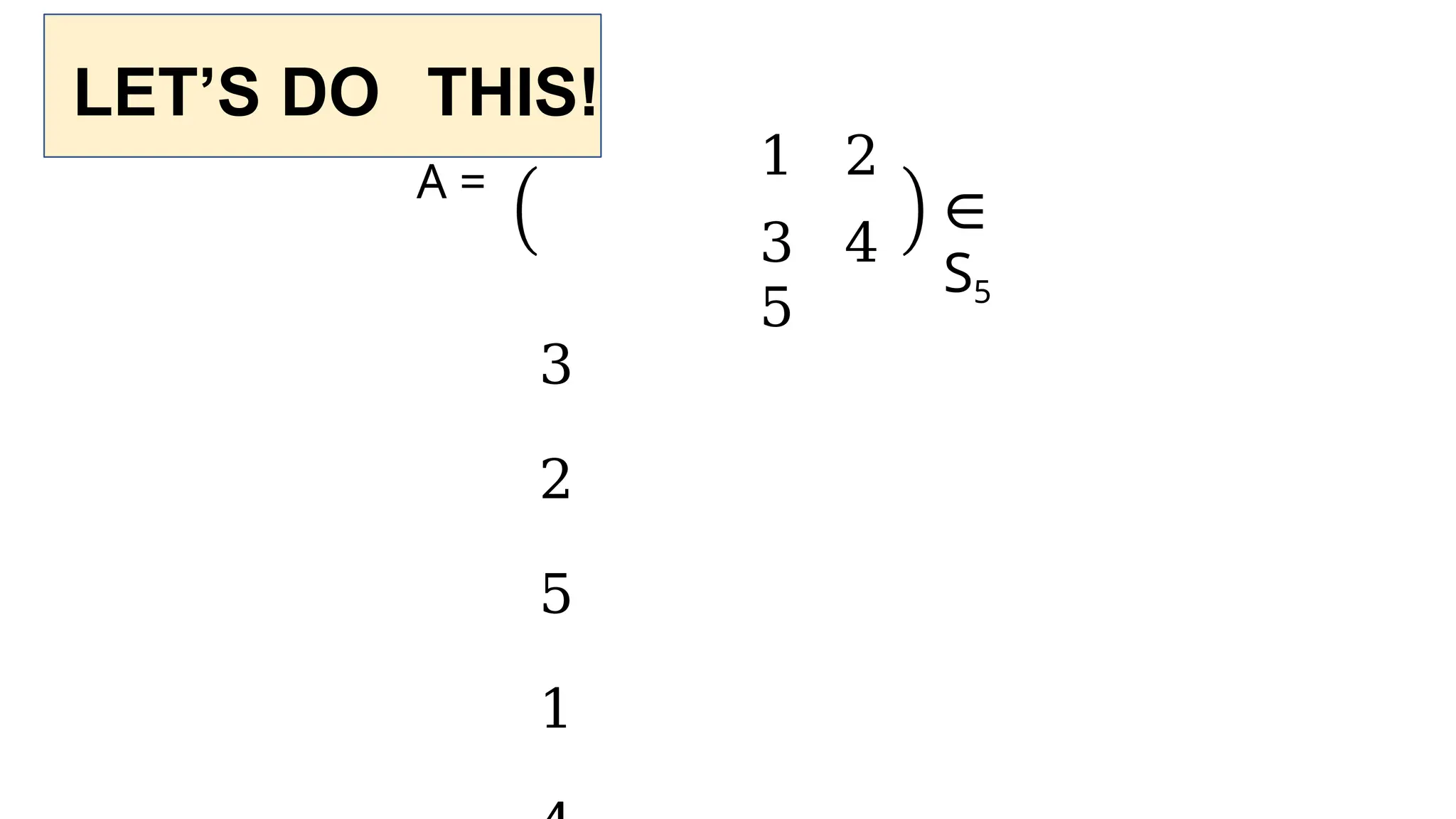
LET’S DO THIS!
∈
S5
A = 1 2
3 4
5
3
2
5
1
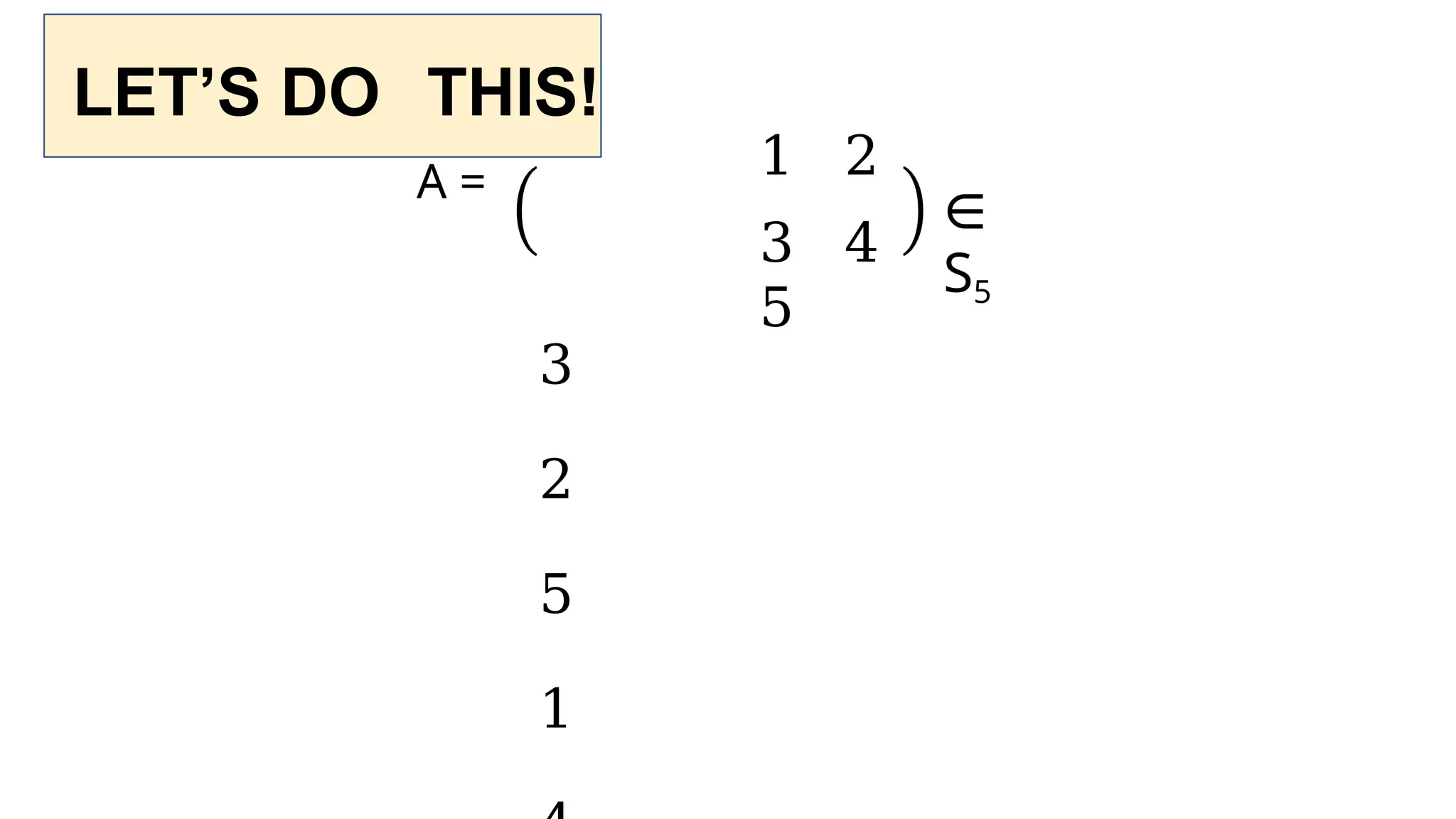
LET’S DO THIS!
∈
S5
A = 1 2
3 4
5
3
2
5
1
LET’S DO THIS!
∈
S5
A1 = A
=
A2 =
A =
1 2
3 4
5
3
2
5
1
5 2 4 3 1
1 2 3 4 5
4 2 1 5 3
1 2 3 4 5
1 2 3 4 5
A3 =
A4 =
Thus, 𝐴
EXERCISE
Find the order of each element of a group in
Sn:
2. B = ∈
S5
1 2 3 4 5
5 3 4 2 1
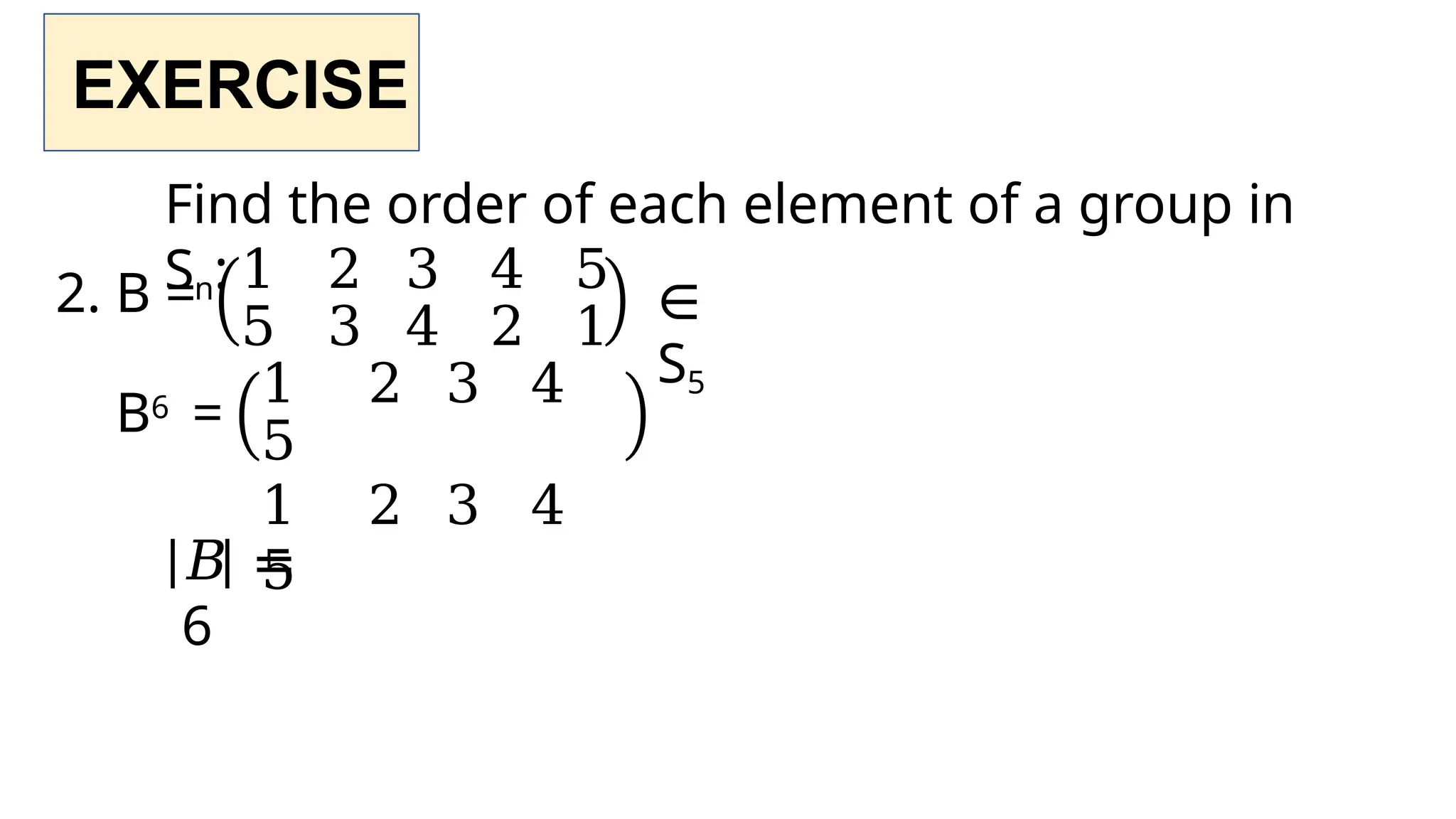
EXERCISE
Find the order of each element of a group in
Sn:
2. B = ∈
S5
B6 =
1 2 3 4 5
5 3 4 2 1
1 2 3 4
5
1 2 3 4
5
𝐵 =
6
NOTE:
Finding the order of a
particular element of Sn
sometimes would take a lot
of time!
Sige lang deserve
ninyo ina!
QUESTIONS?
ORBITS, AND CYCLE,
GROUPS
ORBITS, AND CYCLE, GROUPS
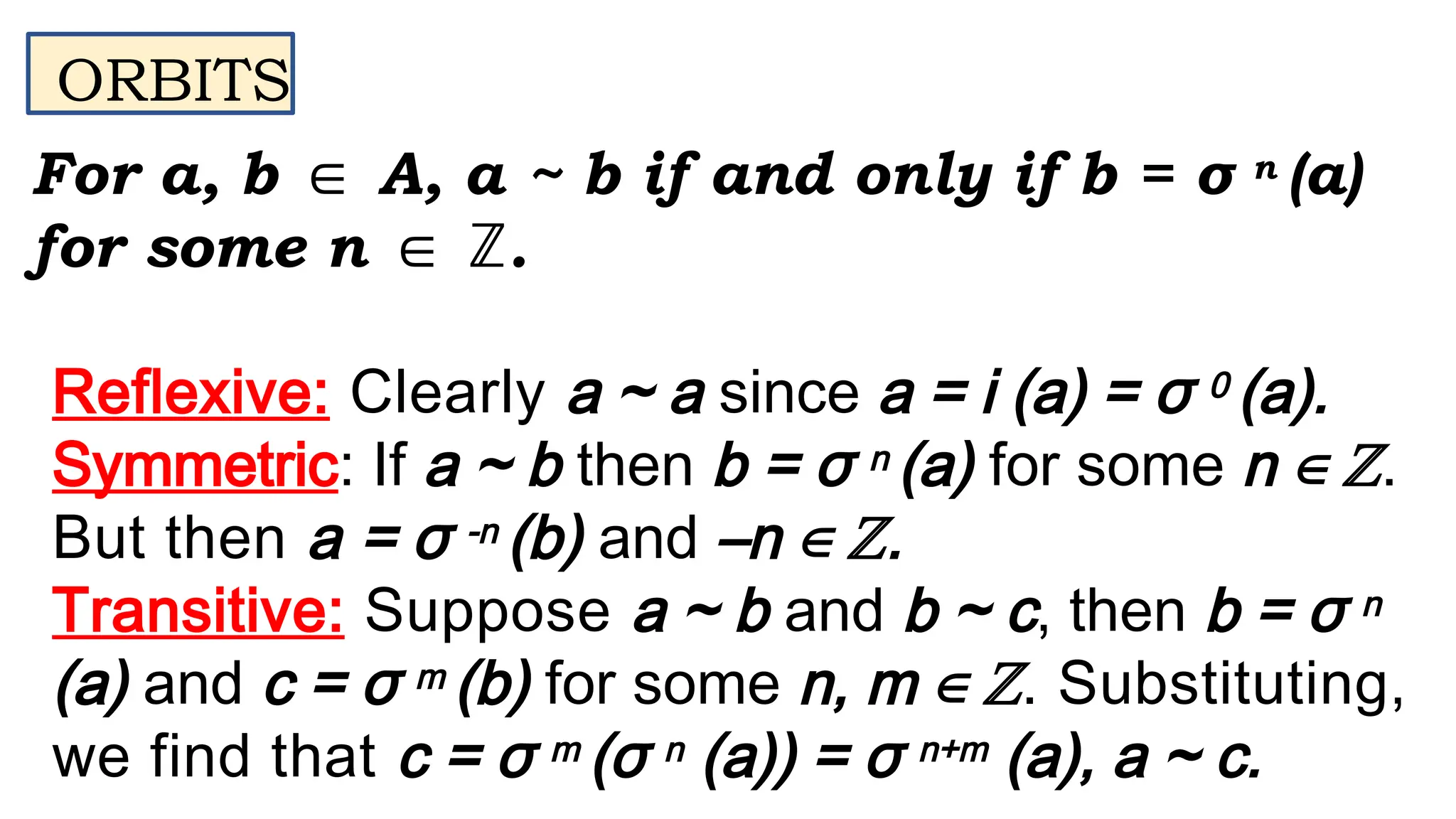
Each permutation σ of a set A determines a natural
partition of A into cells with the property that a, b ∈
A are in the same cell if and only if b = σ n (a) for
some n ∈ ℤ. We can establish a partition using an
appropriate equivalence relation:
ORBITS
For a, b A, a ~ b if and only if b =
∈ σ n (a)
for some n ∈ .
ℤ
Reflexive: Clearly a ~ a since a = i (a) = σ 0 (a).
Symmetric: If a ~ b then b = σ n (a) for some n ∈ ℤ.
But then a = σ -n (b) and –n ∈ ℤ.
Transitive: Suppose a ~ b and b ~ c, then b = σ n
(a) and c = σ m (b) for some n, m ∈ ℤ. Substituting,
we find that c = σ m (σ n (a)) = σ n+m (a), a ~ c.
ORBITS
Let σ be a permutation of a set A.
The equivalence classes in A determine
by the equivalence relation.
DEFINITION OF ORBITS OF σ.
Example:
Find the orbit of the permutation:
1 2 3 4 5 6 7
8
3 8 6 7 4 1 5
σ = ∈
S8
ORBITS OF σ.
Example:
Find the orbit of the permutation:
1 2 3 4 5 6 7
8
3 8 6 7 4 1 5
2
σ = ∈
S8
Solution:
To find the orbit containing 1, we
apply σ repeatedly, obtaining symbolically
1 → 3 → 6 → 1 → 3 → 6 → 1 → 3 → . . .
ORBITS OF σ.
Solution:
To find the orbit containing 1, we
apply σ repeatedly, obtaining symbolically
1 → 3 → 6 → 1 → 3 → 6 → 1 → 3 → . . .
Since σ -1 would simply reverse the direction of
arrows in this chain, we can see that that the
orbit containing 1 is {1, 3, 6}. We now choose
an integer from 1 to 8 not in {1, 3, 6}, say 2,
and similarly find that the orbit containing 2
ORBITS OF σ.
Solution:
is {2, 8}. Finally , we find the orbit that
containing 4 is {4, 7, 5}. Since these three
orbits include all the integer from 1 to 8, we
can see that the complete list of orbits of σ is;
{1, 3, 6} {2, 8} {4, 7, 5}
ORBITS OF σ.
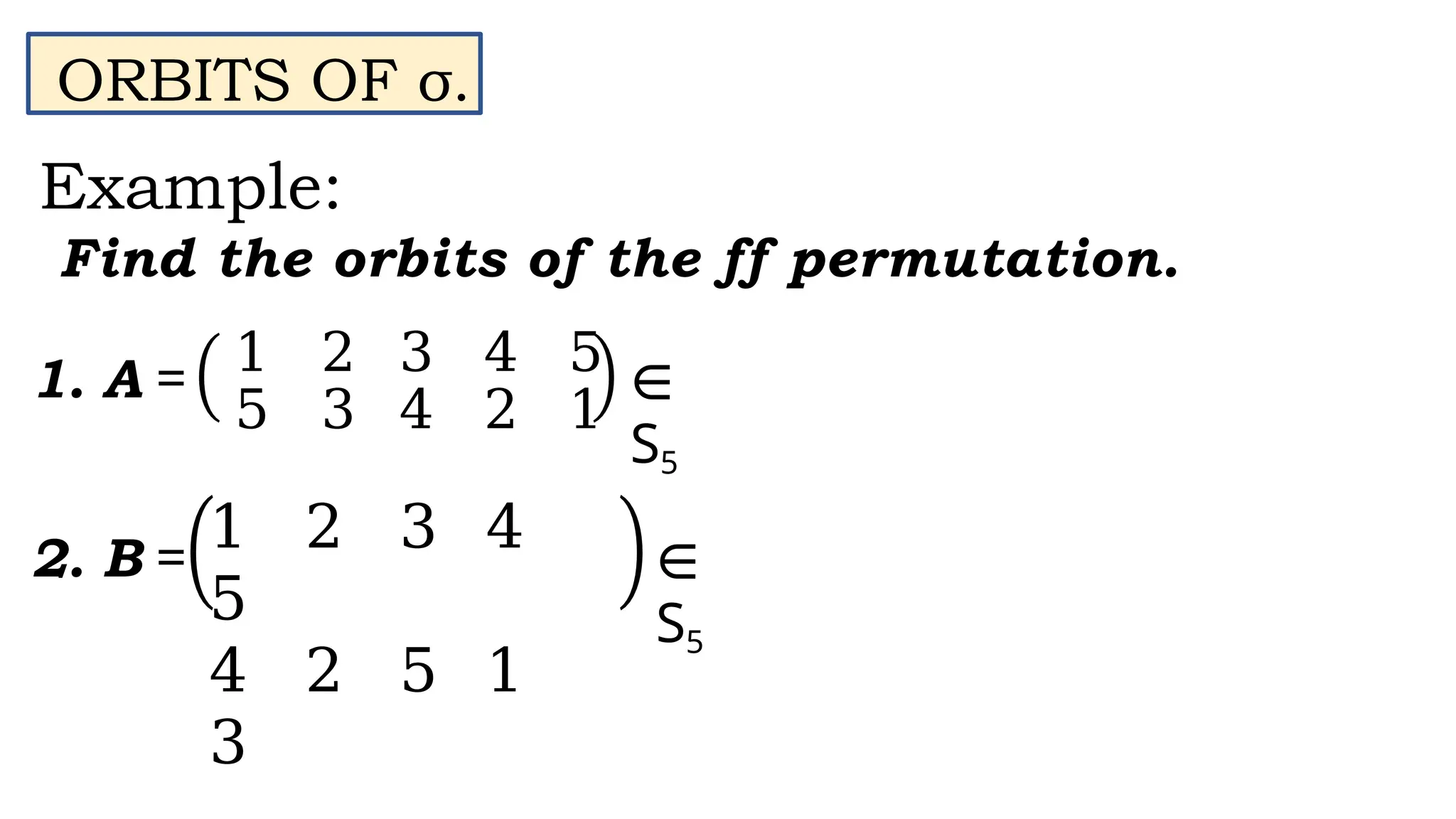
Example:
Find the orbits of the ff permutation.
1 2 3 4 5
5 3 4 2 1
1. A = ∈
S5
1 2 3 4
5
4 2 5 1
3
∈
S5
2. B =
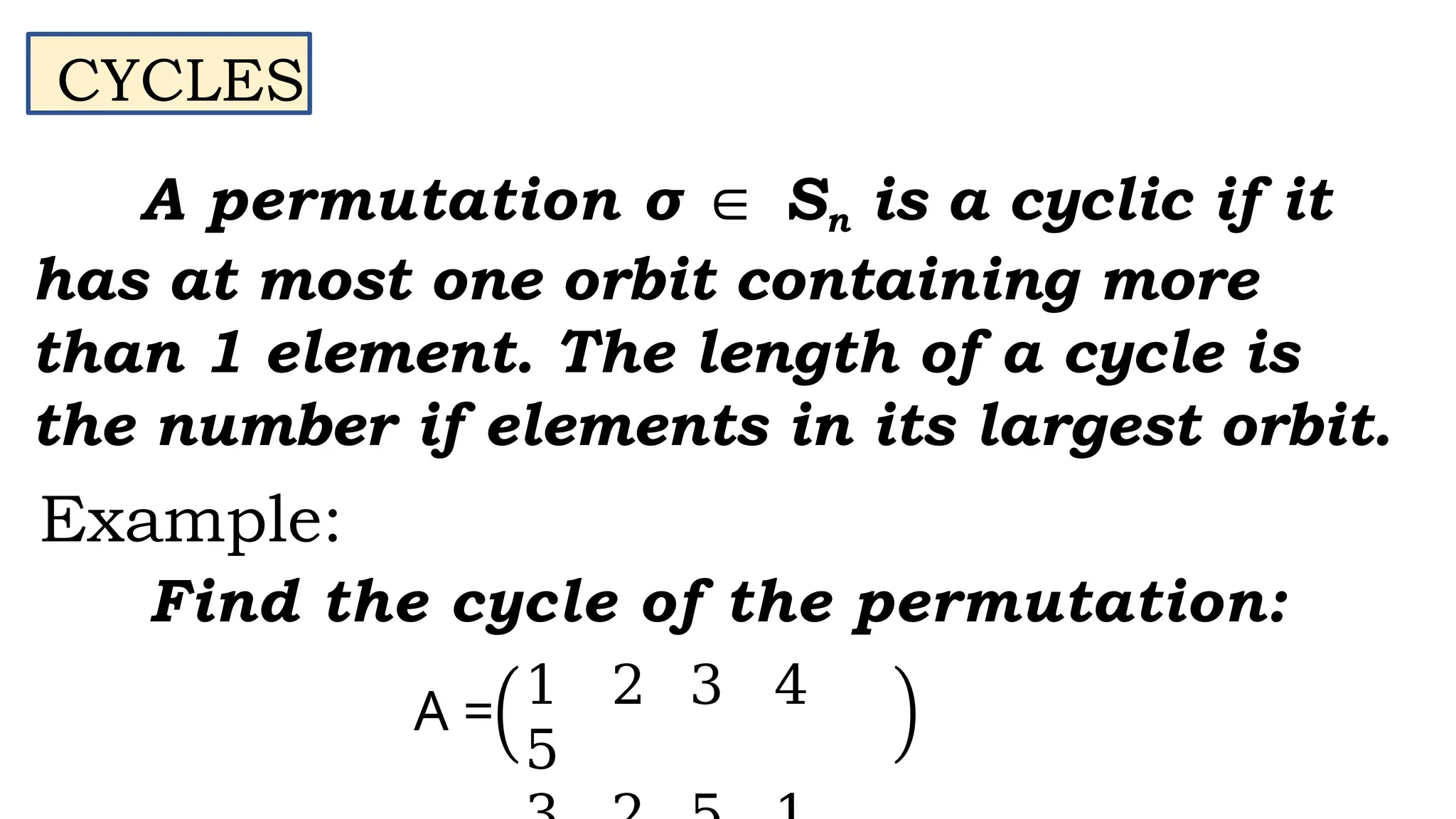
A permutation σ ∈ Sn is a cyclic if it
has at most one orbit containing more
than 1 element. The length of a cycle is
the number if elements in its largest orbit.
CYCLES
Example:
Find the cycle of the permutation:
1 2 3 4
5
A =
CYCLE NOTATION
We now write down
a more compact
notation for Sn.
Consider the following
element in S5:
A =
1 2 3 4
5
3 2 5 1
4
You could
see 1 → 3 → 5 → 4
→ 1
2 → 2
1
3
5
4
2
CYCLE NOTATION
We now write down
a more compact
notation for Sn.
Consider the following
element in S5:
A =
1 2 3 4
5
3 2 5 1
4
You could
see
1 → 3
→ 5 →
A = (1 3 5 4) (2)
or
A = (1 3 5 4)
Note: (2) was no longer
written because it is
understood that it is
mapped to itself. Also,
writing cycle form of a
permutation is NOT
unique.
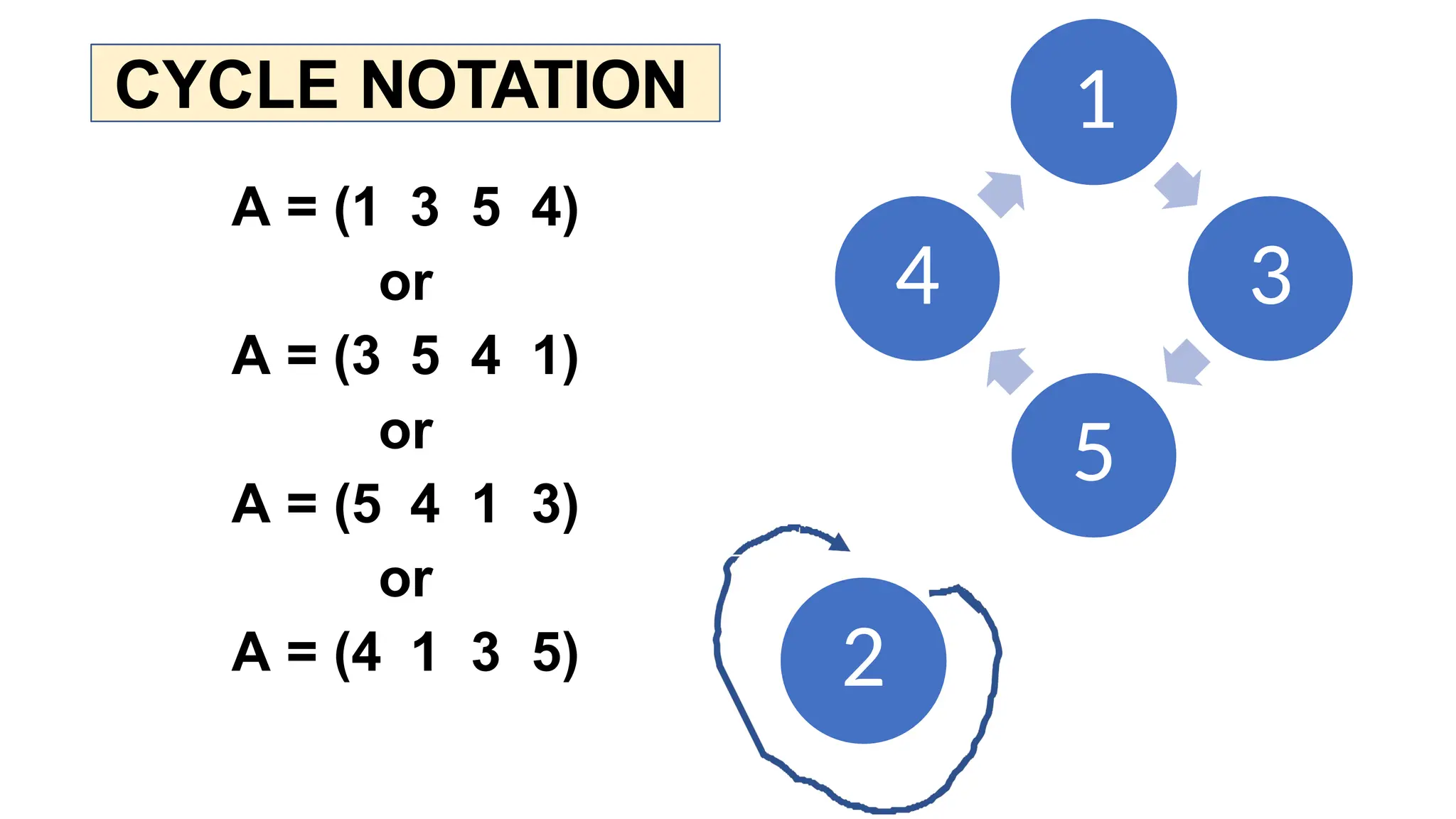
CYCLE NOTATION
A = (1 3 5 4)
or
A = (3 5 4 1)
or
A = (5 4 1 3)
or
A = (4 1 3 5)
1
3
5
4
2
EXERCISE
Write the following in cycle
notation:
1. A
=
1 2 3 4
5
2 4 5 1
3
A = (1 2 4) (3 5)
2. B =
1 2 3 4 5 6 7
1 3 7 6 4 5 2
B = (1) (2 3 7) (4 6 5)
B = (2 3 7) (4 6 5)
CYCLE NOTATION to 2-ROW FORM
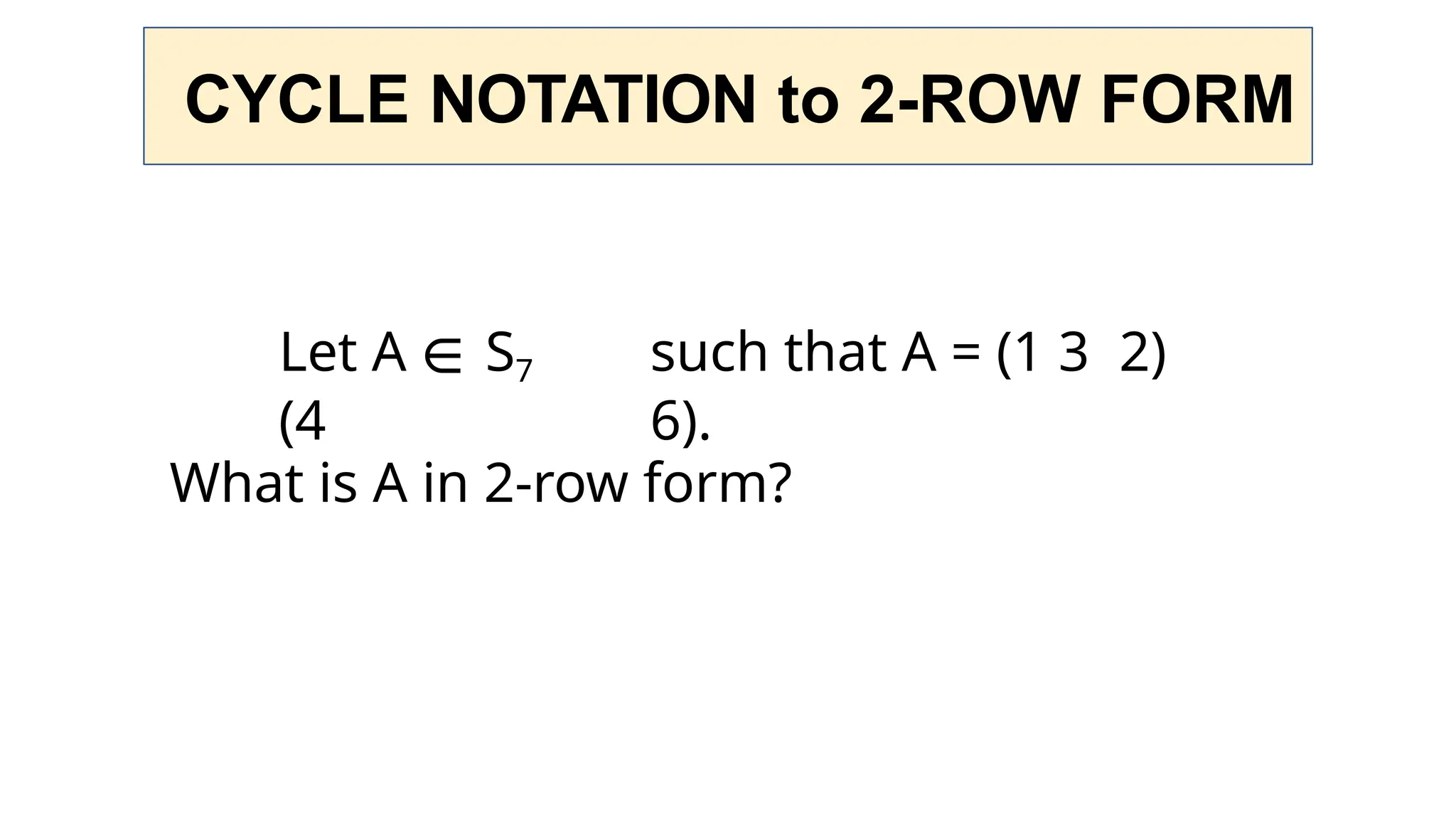
Let A ∈ S7 such that A = (1 3 2)
(4 6).
What is A in 2-row form?
CYCLE NOTATION to 2-ROW FORM
Let A ∈ S7 such that A = (1 3 2)
(4 6).
What is A in 2-row form?
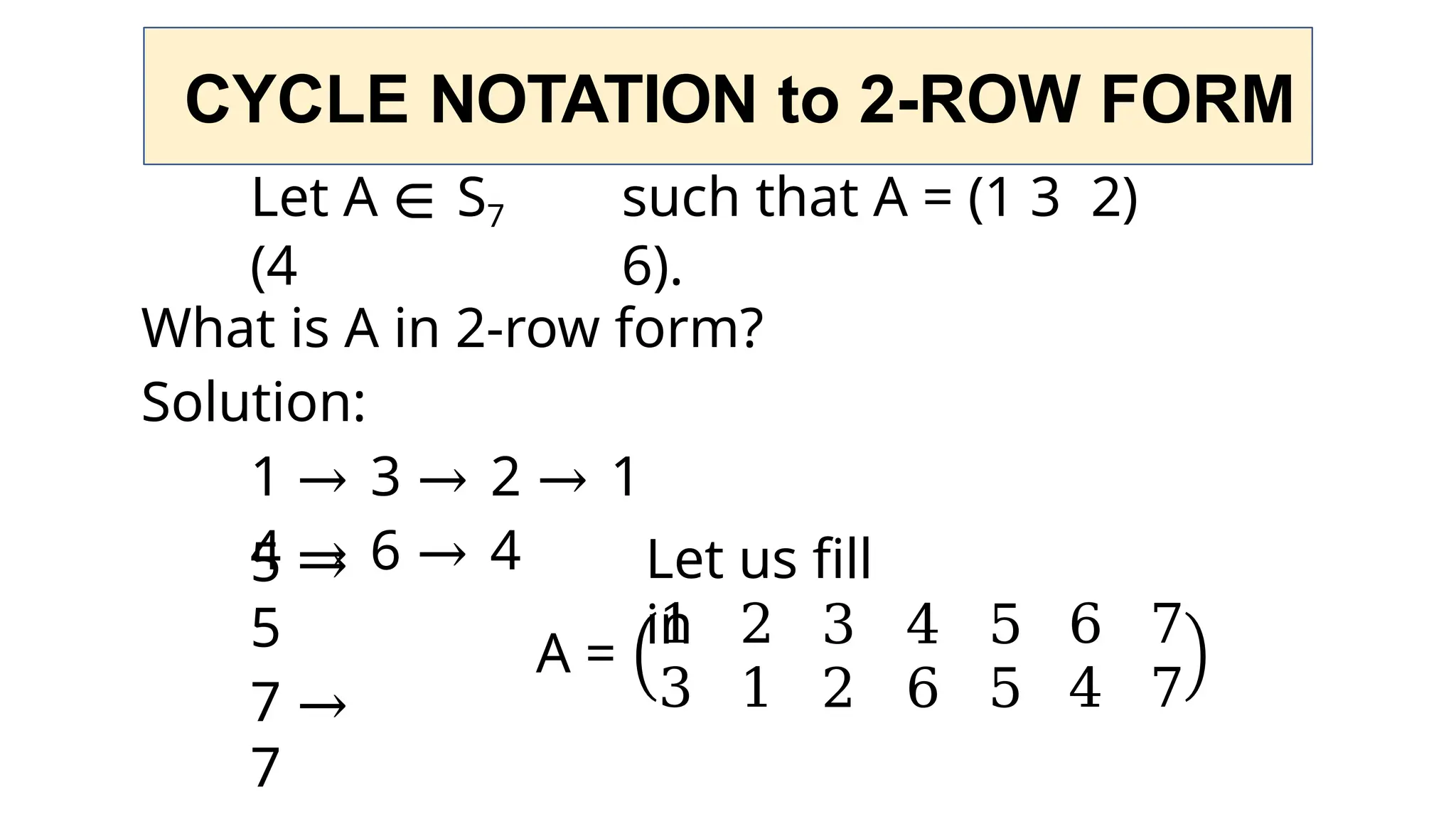
Solution:
1 → 3 → 2 → 1
4 → 6 → 4
5 →
5
7 →
7
Let us fill
in
A =
1 2 3 4 5 6 7
3 1 2 6 5 4 7
EXERCISE
Write the following in 2-row
form:
1. If length of A = 6 and A = (2 4)
(1 6)
Answer:
A =
1 2 3 4 5
6
EXERCISE
Write the following in 2-row form:
2. If length of B = 7 and B = (14 2 6) (3 7 5)
Answer:
B =
1 2 3 4 5 6 7
4 6 7 2 3 1 5
JOINT AND DISJOINT CYCLES
Two or more cycles
are DISJOINT if they do
not have any common
element.
Example:
A = (1 2)
B = (3 5)
A and B are disjoint
Two or more cycles
are JOINT if they have
at least 1 common
element.
Example:
C = (3 1)
D = (3 4 5)
C and D are joint cycles.
LET’S DO THIS
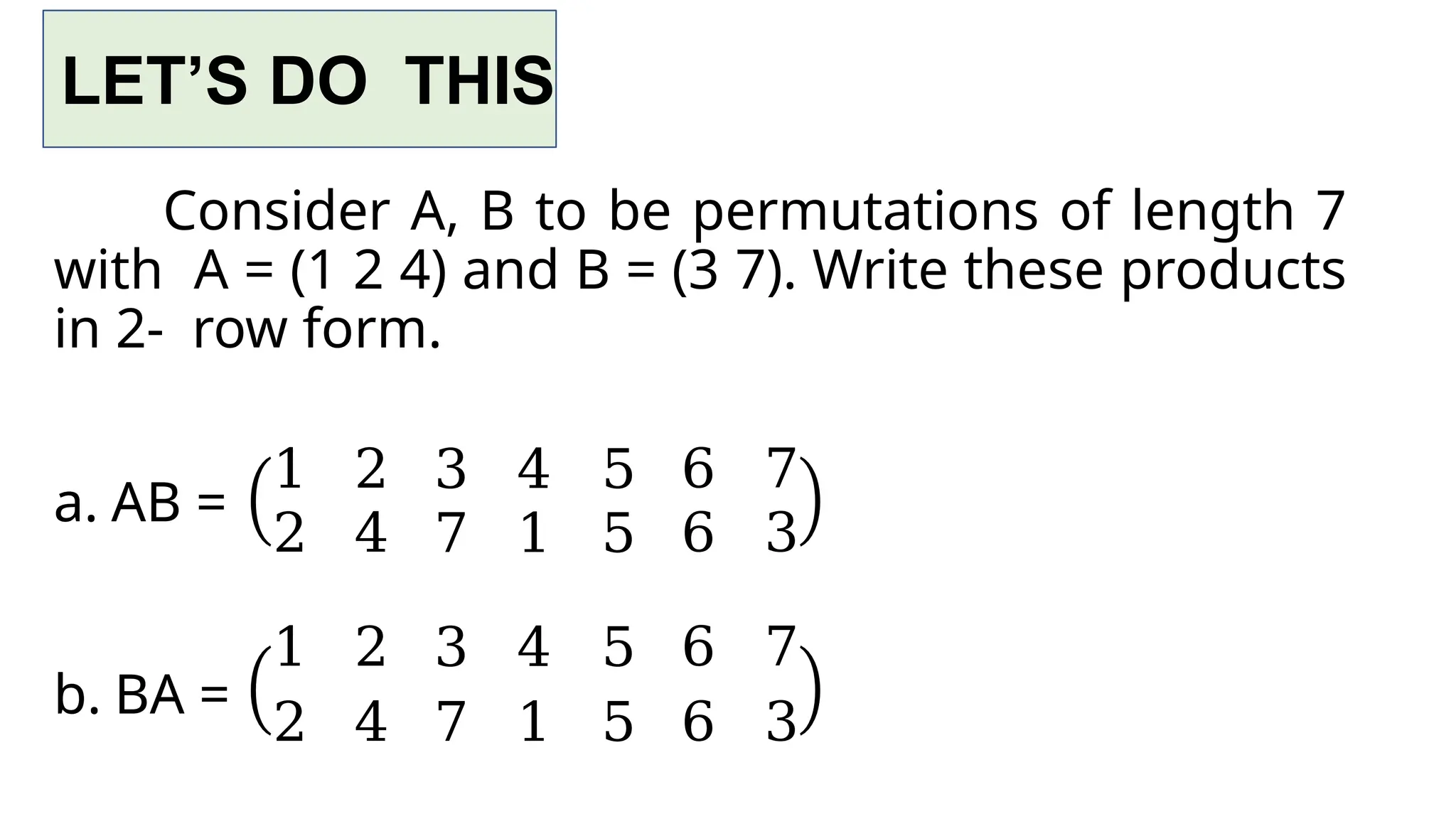
Consider A, B to be permutations of length 7
with A = (1 2 4) and B = (3 7). Write these products
in 2- row form.
a. AB =
b. BA =
1 2 3 4 5 6 7
2 4 7 1 5 6 3
1 2 3 4 5 6 7
2 4 7 1 5 6 3
WHAT HAVE YOU NOTICED?
A = (1 2 4) and B = (3 7)
What have you noticed with AB and
BA?
AB = BA =
1 2 3 4 5 6
7
2 4 7 1 5 6
3
What kind of cycles are A and B in relation
to each other?
Disjoint
Remember: Disjoint cycles
commute.
REMEMBER:
An ORBIT is a set, while a CYCLE is a
permutation of a set ( which permutes
its elements cyclically.

GROUP AND SUBGROUP SET - ABSTRACT ALGEBRA ( TOPIC 5)

  • 1.
  • 2.
  • 3.
    Binary Operation A BinaryOperation * on a set S is a function mapping S X S into S. For each (a,b) ϵ S X S, in short we denote the element * ((a.b)) of S by a*b.
  • 4.
    Example 1: + isa binary operation on a set S of Natural numbers (N) Let S = {1, 2} S x S = {1, 2} x {1, 2} = {(1, 1), (1, 2), (2, 1), (2,2)}
  • 5.
    Example 1: + isa binary operation on a set S of Natural numbers (N) To check if + is a binary operation to set S? We’re going to operate it to every ordered pairs. S x S = {1, 2} x {1, 2} = {(1, 1), (1, 2), (2, 1), (2,2)} {(1 + 1 = 2), (1 + 2 = 3), (2 + 1 = 3), (2+2 = 4)}
  • 6.
    Example 1: + isa binary operation on a set S of Natural numbers (N) > Since 2, 3, and 4 are natural numbers, our ⸫ + is a Binary operation.  Same process in -, x, /. As long as it these operation satisfies the condition of binary operation it will be a binary operation.
  • 7.
    Binary Operation Another thingabout Binary Operation is a way of combining two quantities/values using any operation to create new one. Common Binary operation: +, -, x, /.
  • 8.
    Example 2: For everyreal numbers a and b: a & b = 5a – 2b + 1. Supposed the value for a = 3; b = 5 3 & 5 = 5(3) – 2(5) + 1 = 15 – 10 + 1 3 & 5= 6
  • 9.
    Example 3 : Forevery real numbers a and b: a # b = a2 + b. Supposed the value for a = 1/2; b = (-2) a # b = (½)2 + (-2) = ¼ - 2 = -7/4
  • 10.
  • 11.
    Closure or InducedProperty: Given a ϵ S and b ϵ S, a binary operation is closed ↔ a * b ϵ S. If both a and b are from set S, then the result of their binary operation should also be a member of set S.
  • 12.
    Example 1: For everyreal numbers a and b, a binary operation ~ is defined a ~ b = 2a + b. Is close under real numbers? Supposed the value of a = 4; b = (-3). a ~ b = 2a + b 4 ~ (-3) = 2(4) + (-3) = 8 – 3 = 5 ϵ R ⸫ a ~ b is closed under R.
  • 13.
    Example 2: Let V= {1, 2, 3, 4}. Is the operation Ø defined by a Ø b = ab – 1. Is closed in W? 3 Ø 4 = 3(4) – 1 = 7 – 1 = 6 not belong to V ⸫ a Ø b is not closed under set V.
  • 14.
    Example 2: Let V= {1, 2, 3, 4}. Is the operation Ø defined by a Ø b = ab – 1. Is closed in W? 1 Ø 3 = 1(3) – 1 = 3 – 1 = 2 ϵ V ⸫ a Ø b is closed under set V.
  • 15.
    Closure or InducedProperty: REMEMBER If a, b ϵ S, then a*b ϵ S.
  • 16.
    Let’s try! + isa binary operation on the set of Real Numbers (R*). {n|n > 0, is a set of R}. Is under closure method? Note: We all know that n > 0 means a nonzero real numbers. Proving this, knowing that 2 ϵ R* as well as - 2 ϵ R*, using the condition of Closure method that a,b ϵ R* we can draw or operate this situation “ 2 + (-2) = 0 is not
  • 17.
    Let’s try! an elementof R* (non zero real numbers)., we ⸫ can say that closure method for this binary operation is NOT SATISFIED.
  • 18.
    Let’s try! + isa binary operation for 4Z. Is 4Z closed under addition? Prove? Proof: Z = {. . .,-4, -3, -2, -1, 0, 1, 2, 3, 4, …} 4Z = {.., -16, -12, -8, -4, 0, 4, 8, 12, 16, …} So, now we going to use the condition of Closure Operation/Method: a, b ϵ 4Z, 16 + 12 = 28 ϵ 4Z; -16 + 12 = -4 ϵ 4Z, we can conclude that closure operation/method is satisfied. ⸫
  • 19.
  • 20.
    Associative Property/Method: A binaryoperation * is associative if and only if (a * b) * c = a * (b * c) ∀a, b, c ϵ S
  • 21.
    Example 1: For everyreal number a and b is the operation Ω (omega) defined by a Ω b = (2a)(3b) associative? (a Ω b) Ω c = a Ω (b Ω c) Take note that c is also a real number
  • 22.
    Example 1: (a Ωb) Ω c = a Ω (b Ω c) (2a) (3b) Ω c = a Ω (2b)(3c) (6ab) Ω c = a Ω (6bc) [2 (6ab)] (3c) = (2)(a) [3(6bc)] (12ab) (3c) = 2a (18bc) 36abc = 36abc ⸫ a Ω b is associative. This becomes your first term. This becom es your 2nd term . These things are based on the definition of binary operations a,b ϵ S
  • 23.
    Example 2: For everyreal number a and b is the operation ♠ (spade) defined by a ♠ b = a b ꜛ + b associative? (a ♠ b) ♠ c = a ♠ (b ♠ c) (a b ꜛ + b) ♠ c = a ♠ (b c ꜛ ♠ c) (a b ꜛ + b) c ꜛ + c = a b vc ꜛ + b c + c ꜛ ⸫,♠ is not an associative.
  • 24.
    Let’s try! + isa binary operation for 4Z. Is 4Z an associative under addition? Prove? Proof: Z = {. . .,-4, -3, -2, -1, 0, 1, 2, 3, 4, …} 4Z = {.., -16, -12, -8, -4, 0, 4, 8, 12, 16, …} So, now we going to use the condition of Associative Operation/Method: a, b, c ϵ 4Z, a + b + c ϵ 4Z, 16 + (4 +8) = (16 + 4) + 8 = we can conclude that associative operation/method is ⸫ satisfied.
  • 25.
    Associative Property: REMEMBER ∀ a,b, c ϵ S, we have a*(b*c) = (a*b)*c.
  • 26.
    Identity Element Property: Abinary operation * is if there exists just one element e such that: e*a = a*e = a, where a,e ϵ R (S)
  • 27.
    Example : For commonidentity elements For addition + e = 0 3 + 0 = 0 + 3 = 3 For multiplication x e = 1 3 x 1 = 1 x 3 = 3
  • 28.
    Example : Identity elementsin tables * a b c d a c a d b b a b c d c d c d a d b d a c Identity = b a*b=b*a = a
  • 29.
    Inverse Property: An elementa -1 is called an inverse ⌃ under the binary operation * if a* a -1 = a ⌃ -1 * a = e, where e is the identity element ⌃ under operation *.
  • 30.
    Example : For inverseelements For addition + e = 0 3 + ? = ? + 3 = 0 ? = Inverse ? = -3 ⸫ element For multiplication x e = 1 3 x ? = ? x 3 = 1 ⸫ ? = 1/3
  • 31.
    Example : Find theinverse of each element in the table * a b c d a c a d b b a b c d c d c d a d b d a c Identity = b a*b=b*a = a
  • 32.
    Example : * ab c d a c a d b b a b c d c d c d a d b d a c Identity = b a*b=b*a = a So, a* a -1 = a -1 = b ⌃ ⌃ ⸫ a -1 = d ⌃ b -1 = b inverse itself, c -1 = c, d -1 = a ⌃ ⌃ ⌃
  • 33.
    Definition of aGroup A group consist of a nonempty set G together with a binary operation *, such that the following properties hold:
  • 34.
     CLOSURE  ASSOCIATIVITY IDENTITY  INVERSE If a, b ϵ G, then a * b ϵ G. INSHORT, the sum, or product, or result of a and b must be an element of G. For all a,b,c ϵ G, we have (a*b)*c = a* (b*c), where a, b, and c ϵ G. There exist an element e ϵ G such that, for any a ϵ G, a*e = e*a = a. For any a ϵ G, there exist an element a-1 ϵ G such that a* a-1 = a-1 * a = e
  • 35.
    How many elementsare there in ℤ? INFINITE (ℤ, +) is an example of an infinite group.
  • 36.
    How many elementsare there in ℤ3? 3 Hence, (ℤ3, +3) is an example of finite group.
  • 37.
    ORDER OF AGROUP The order of a group G, denoted by |G| is the number of elements present in the group or it’s cardinality. The order of |ℤ| is infinite thus the group ( , +) ℤ has an infinite order. |ℤ3| = 3 (ℤ3, +3) could also generate 3 elements so its order is 3. this is an example of finite order.
  • 38.
    EXERCISE Determine the orderof the group: 1. ( , ℝ +) 2. (ℤ5 # , ∙) 3. ( , ℚ ∙) QUESTIONS?
  • 39.
  • 40.
    REVIEW Is (ℤ4,+4) a group? +4 0 1 2 3 0 0 1 2 3 1 1 2 3 0 2 2 3 0 1 3 3 0 1 2 Remember: ℤ4 = {0, 1, 2, 3} i. Closure From the Cayley table, we could see that ∀ a, b ∈ℤ4, a +4 b ∈ ℤ4. Thus, closure holds. ii. Associativity ∀ a, b, c ∈ ℤ4, it is known that (a +4 b) +4 c = a +4 (b +4 c). Thus, associativity holds.
  • 41.
    REVIEW Is (ℤ4,+4) a group? +4 0 1 2 3 0 0 1 2 3 1 1 2 3 0 2 2 3 0 1 3 3 0 1 2 Remember: ℤ4 = {0, 1, 2, 3} iii. Identity We could see that 0 ∈ ℤ4 and for any a ∈ ℤ4, we could see that a +4 0 = 0 +4 a =a. hence, identity property is satisfied. iv. Inverse We could see that each element in ℤ4 has an inverse. Thus, inverse property is satisfied.
  • 42.
    REVIEW +4 0 12 3 0 0 1 2 3 1 1 2 3 0 2 2 3 0 1 3 3 0 1 2 Since all 4 properties of a group are satisfied, hence (ℤ4, +4) is a group.
  • 43.
    EXERCISE Determine the followingset if it’s a group or not: 1. ( , ℝ +) 2. (ℤ7 # , +7 ) 3. (ℝ+ , ∙)
  • 44.
    KLEIN V - readas “KLEIN 4” - It was named Vierergruppe (meaning four-group) by Felix Klein in 1884. - It is also called the Klein group and is often symbolized by letter V.
  • 45.
    There are 4elements |V | = 4 The 4 elements are {e, a, b, c} We define the operation * such that; e * a = a a * b = c a * a = e REMEMBER! Is V, * is a group?
  • 46.
    * e ab c e e a b c a a e c b b b c e a c c b a e Let V = {e, a, b, c} with operation * defined earlier. Is (V, *) a group? KLEIN V i. Closure Let x, y ∈ V. We could see that x * y ∈ V. Hence,
  • 47.
    * e ab c e e a b c a a e c b b b c e a c c b a e Let V = {e, a, b, c} with operation * defined earlier. Is (V, *) a group? KLEIN V ii. Associativity Let x, y, z ∈ V. We could see that (x * y) * z = x * (y * z). Hence, associativity holds.
  • 48.
    * e ab c e e a b c a a e c b b b c e a c c b a e Let V = {e, a, b, c} with operation * defined earlier. Is (V, *) a group? KLEIN V iii. Identity We could see that e is the identity element of V and e ∈ V. Thus, identity property is satisfied.
  • 49.
    * e ab c e e a b c a a e c b b b c e a c c b a e Let V = {e, a, b, c} with operation * defined earlier. Is (V, *) a group? iv. inverse KLEIN V e-1 = e a-1 = a b-1 = b c-1 = c We could see that every element of V has an inverse that is also in V. Hence, inverse property is satisfied.
  • 50.
    * e ab c e e a b c a a e c b b b c e a c c b a e KLEIN V Since all 4 properties of a group are satisfied, hence (V, *) with V = {e, a, b, c} and operation * as defined is a group. QUESTIONS?
  • 51.
    (V, *) * ea b c e e a b c a a e c b b b c e a c c b a e +4 0 1 2 3 0 0 1 2 3 1 1 2 3 0 2 2 3 0 1 3 3 0 1 2 (ℤ4, +4)
  • 52.
  • 53.
    REVIEW Consider the matrixA = 1 4 5 3 . Compute for det (A). det (A) = 1(5) – 4(3) = -7 Does the matrix have an inverse? YES How do we know? det (A) ≠ 0 A = 1 3 4 ∈ GL2(ℝ)
  • 54.
    GENERAL LINEAR GROUP Thegeneral linear group GLn(ℝ) is the group of invertible n × n matrices with entries in ℝ under matrix multiplication. For our class our focus will be
  • 55.
    Let GL2(ℝ) ={𝑥 | 𝑥 ∈𝑎 𝑐 𝑑 𝑏 , where a, b, c, d ∈ ℝ and ad – bc ≠ 0}. Prove that (GL2(ℝ), ∙) is a group. i. Closure Let 𝑥 ∈ 𝑎 𝑏 𝑐 𝑑 and 𝑦 ∈ 𝑒 𝑓 𝑔 h wher e 𝑎, 𝑏, 𝑐, … , 𝑕 ∈ ℝ. Multiplying them yields 𝑎 𝑏 𝑐 𝑑 𝑒 𝑓 𝑔 h = 𝑎𝑒 + 𝑏𝑔 𝑎𝑓 + 𝑏h 𝑐𝑒 + 𝑑𝑔 𝑐𝑓 + 𝑑h 2 ∈ GL (ℝ). Since all entries of the resulting matrix are real numbers, then closure holds.
  • 56.
    Let GL2(ℝ) ={𝑥 | 𝑥 ∈ 𝑎 𝑐 𝑑 𝑏 , where a, b, c, d ∈ ℝ and ad – bc ≠ 0}. Prove that (GL2(ℝ), ∙) is a group. ii. Associativity Please see Kolman (Linear Algebra). Hence, associativity holds true.
  • 57.
    Let GL2(ℝ) ={𝑥 | 𝑥 ∈ � � 𝑐 𝑑 𝑏 , where a, b, c, d ∈ ℝ and ad – bc ≠ 0}. Prove that (GL2(ℝ), ∙) is a group. iii. Existence of an Identity Element = = 𝑎 𝑏 1 0 𝑐 𝑑 0 1 1 0 𝑎 𝑏 0 1 𝑐 = 𝑎 1 + 𝑏(0) 𝑐 1 + 𝑑(0) 1 𝑎 + 0(𝑐) 𝑎 0 + 𝑏(1) 𝑐 0 + 𝑑(1) 1 𝑏 + 0(𝑑) = 𝑎 𝑏 𝑐 𝑑 𝑎 𝑏 𝑐 We could see that e = 1 0 0 ∈ GL2(ℝ). Hence, identity property is satisfied.
  • 58.
    Let GL2(ℝ) ={𝑥 | 𝑥 ∈ � � 𝑐 𝑑 𝑏 , where a, b, c, d ∈ ℝ and ad – bc ≠ 0}. Prove that (GL2(ℝ), ∙) is a group. iv. Inverse Property For every matrix A = 𝑎 𝑐 𝑑 𝑏 , ∃ A-1 considering ad – bc ≠ 0 and hence A A-1 = A-1A = e = property is satisfied. 1 0 0 1 . Hence, inverse Since all 4 properties of a group are satisfied, hence (GL2(ℝ), ∙) is a group.
  • 59.
    GENERAL LINEAR GROUP Whatis the order of GL2(ℝ)? GL2(ℝ) is infinite QUESTIONS?
  • 60.
    CHECK THIS OUT Itis known that (ℤ, +) is a group. Let us pick any 2 elements, say 4 and 7 What is 4 + 7? 11 How about 7 + 4? 11 What have you noticed? 4 + 7 = 7 + 4 Such a group is an example of an ABELIAN GROUP.
  • 61.
    ABELIAN GROUP Let (G,*) be a group. If a, b ∈ G such that a * b = b * a, then (G, *) is an ABELIAN GROUP. It is also called COMMUTATIVE GROUP. NON-ABELIAN GROUP Let (G, *) be a group. If a, b ∈ G such that a * b ≠ b * a, then (G, *) is a NON- ABELIAN GROUP. It is also called NONCOMMUTATIVE GROUP.
  • 62.
    EXERCISE Classify the followinggroups as Abelian or Non- Abelian: 1. (ℝ, +) 2. (ℤ5 # , ∙5) 3. (ℚ#, ∙) 4. (GL2(ℝ), ∙) QUESTIONS? ABELIAN ABELIAN ABELIAN NON ABELIAN
  • 63.
    DEFINITION: ORDER OFAN ELEMENT OF A FINITE GROUP It is the smallest positive power of the element which gives you the identity element. Let (G, *) be a finite group and a ∈ G. The order of an element <a> is n given that an = e.
  • 64.
    EXAMPLE Let us consider ℤ4= {0, 1, 2, 3}. We know that (ℤ4, +4) is a finite group.
  • 65.
    EXAMPLE Let us consider ℤ4={0, 1, 2, 3}. We know that (ℤ4, +4) is a finite group. <0> = {0} <1> = {1, 2, 3, 0} <2> = {2, 0} <3> = {3, 2, 1, 0} Let us determine the order of each element: <0>= 1 <1>= 4 <2>= 2 <3>= 4 QUESTIONS?
  • 66.
    DEFINITION: GENERATOR OFA FINITE GROUP It is a set of group elements such that possibly repeated application of the generators on themselves and each other is capable of producing all the elements in the group. Let (G, *) be a finite group and a ∈ G. It could be said that <a> is a generator of G iff <a> = G.
  • 67.
    EXAMPLE Let us consider ℤ4={0, 1, 2, 3}. We know that (ℤ4, +4) is a finite group. <0> = {0} <1> = {1, 2, 3, 0} <2> = {2, 0} <3> = {3, 2, 1, 0} We could see that ℤ4 = <1> = <3> Hence, the elements 1 and 3 are generators of (ℤ4, +4) while elements 0 and 2 are NOT generators.
  • 68.
    ADDITIONAL NOTE: Speaking ofa finite group (G, *) with G = n and if a ∈ G is a generator, then G = <a>
  • 69.
    DEFINITION: FINITE CYCLICGROUP A certain finite group is CYCLIC if it has at least 1 generator. If it has no generator, then the group is NOT CYCLIC. Is (ℤ4, +4) a cyclic group? QUESTIONS? Yes, because it has generators 1 and 3.
  • 70.
    EXERCISE Determine the ordersof the elements of (ℤ8, +8), identify generators if they exist, and if the group is cyclic or not. Solution:
  • 71.
    EXERCISE Determine the ordersof the elements of (ℤ8, +8), identify generators if they exist, and if the group is cyclic or not. Solution: ℤ8 = {0, 1, 2, 3, 4, 5, 6, 7} <0> = {0} <1> = {1, 2, 3, 4, 5, 6, 7, 0} <2> = {2, 4, 6, 0} <3> = {3, 6, 1, 4, 7, 2, 5, 0} <4> = {4, 0} <5> = {5, 2, 7, 4, 1, 6, 3, 0} <6> = {6, 4, 2, 0} <7> = {7, 6, 5, 4, 3, 2, 1, 0} We could see that ℤ8 = <1> = <3> = <5> = <7> Generators: 1, 3, 5, 7 Since there is at least 1 generator, then (ℤ8, +8) is a cyclic group.
  • 72.
    EXERCISE Determine the ordersof the elements of (ℤ5 # , ∙5), identify generators if they exist, and if the group is cyclic or not.
  • 73.
    EXERCISE Determine the ordersof the elements of (ℤ5 # , ∙5), identify generators if they exist, and if the group is cyclic or not. ℤ5 # = {1, 2, 3, 4, 5} <1> = {1} <2> = {2, 4, 3, 1} <3> = {3, 4, 2, 1} <4> = {4, 1} <5> = {0} We could see that ℤ5 # = <2> = <3> Generators: 2, 3 Since there is at least 1 generator, then (ℤ5 # , ∙5) is a cyclic group.
  • 74.
    EXERCISE Determine the ordersof the elements of Klein V under operation * or (V, *), identify generators if they exist, and if the group is cyclic or not. V = {e, a, b, c} QUESTIONS?
  • 75.
    EXERCISE Determine the ordersof the elements of Klein V under operation * or (V, *), identify generators if they exist, and if the group is cyclic or not. V = {e, a, b, c} <e> = {e} <a> = {a, e} <b> = {b, e} <c> = {c, e} Generators: None Since there is no generator, then (V, *) is not cyclic. QUESTIONS?
  • 76.
    ORDER OF ANINFINITE CYCLIC GROUP An infinite group has an infinite order. An infinite group is CYCLIC if it has at least 1 generator. If it has no generator, then the group is NOT CYCLIC. If G is an infinite cyclic group generated by a ∈ G, then a is an element of infinite order, and all the powers of a are different.
  • 77.
    ORDER OF ANINFINITE CYCLIC GROUP Is (ℤ, +) an infinite cyclic group? Is/Are there generator(s)? YES -1 AND 1
  • 78.
    ORDER OF ANINFINITE CYCLIC GROUP Are there generators in (ℝ, +)? No Is (ℝ, +) an infinite cyclic group? No
  • 79.
    TRUE OR FALSE Ifa group is cyclic, then it is Abelian. If a group is Abelian, then it is cyclic. TRUE FALSE
  • 80.
    EXERCISE Categorize (ℤ, +), (V,*), GL2(ℝ), (ℤ5 # , ∙5) (ℝ, +), (ℚ#, ∙), (ℤ4, ∙4), (10ℤ, +). Finite Group Infinite Group Abelian (V, *) (ℤ, +) Group (ℤ5 # ,∙5) (ℝ, +) (ℚ#, ∙) (10ℤ, +) Non- Abelia n GL2(ℝ)
  • 81.
  • 82.
    PERMUTATION Given a finiteset S, a permutation of A is a function f : S → S which is a BIJECTIVE FUNCTION- that is both 1-1 (injective) and onto (surjective). Remember a set with finite number of
  • 83.
    PERMUTATION We will focusspecifically on the case when S = {1, 2, 3, ... , n} for some fixed integer n. This means each group element will permute this set. For example if A = {1, 2, 3} then a permutation α might have α (1) = 2, α (2) = 1, and α(3) = 3. We can write this as: α 1 2 3 2 1 =
  • 84.
    PERMUTATION The first rowis the domain (pre- image) and the second row is your codomain (image). α = 1 2 3 2 1 3 If we say α(1) = 2, we mean that the element 1 (in the domain) is mapped to 2 (in the codomain).
  • 85.
    EXERCISE Consider f = 1.f(1) 2. f(2) 3. 1 2 3 4 3 2 5 1 4 5 . What is 4. f-1(1) 5. f-1(4)
  • 86.
    PERMUTATION GROUP Show thatthe function composition ( ͦ ) is a binary operation on the collection of all permutation on a set A. We call this operation permutation multiplication. Let A be a set, and let and be 𝛼 𝛽 the permutation of A so that and are both one- 𝛼 𝛽 to-one functions mapping A to A. The composite function of 𝛼 ͦ 𝛽 defined schematically by A( ) 𝛽 A( → ) 𝛼 A. →
  • 87.
    PERMUTATION GROUP gives mappingof A to A. Rather than keep the symbol ( ͦ ) for permutation multiplication, we will denote 𝛼 ͦ 𝛽 by the juxtaposition 𝛼𝛽, as we have done for general groups. Now 𝛼𝛽 will be a permutation if it is one to one and onto A. REMEMBER: The action of 𝛼𝛽 on A must be read in right-to-left.
  • 88.
    EXERCISE Suppose that A =(1, 2, 3, 4, 5) Let 𝛼 = 1 2 3 4 5 4 2 5 3 1 and 𝛽 = 1 2 3 4 5 . 3 5 4 2 1 𝛼𝛽 = = 1 2 3 4 5 4 2 5 3 1 1 2 3 4 5 . 3 5 4 2 1 1 2 3 4 5 . 5 1 3 2 4
  • 89.
    EXERCISE Consider 2 permutationsof length 5, say A and B. We define AB = A ° B as the permutation multiplication or mapping composition of B to A. Note you can only do this if the permutations involved have equal lengths. Let A = 1 2 3 4 5 2 3 5 1 4 and B = 1 2 3 4 5 . 2 1 5 3 4 What is the value of AB or A ° B? Let’s do this!
  • 90.
    EXAMPLE A = 1 23 4 5 2 3 5 1 4 and B = 1 2 3 4 5 2 1 5 3 4 What is the value of AB or A ° B? AB = A ° B = 1 2 3 4 3 2 4 5 5 1
  • 91.
    EXAMPLE A = 1 23 4 5 2 3 5 1 4 and B = 1 2 3 4 5 2 1 5 3 4 How about BA or B ° A? BA = B ° A = 1 2 3 4 1 5 4 2 5 3
  • 92.
    REMEMBER: Based on whatwe did, is AB = BA? NO Thus, mapping composition of permutations is NOT COMMUTATIVE.
  • 93.
    EXERCISE 1 2 3 4 23 5 1 5 4 Consider A = what is , B = 1 2 3 4 2 1 5 3 4 5 , and C = 1 2 3 4 3 5 2 4 5 1 , 1. AC = 1 2 3 4 5 5 4 3 1 2 2. CB = 1 2 3 4 5 5 3 1 2 4 3. C-1 = 1 2 3 4 5 5 3 1 4 2 4. A-1 = 1 2 3 4 5
  • 94.
    EXERCISE Consider A = 1 23 4 5 2 3 5 1 4 , B = 1 2 3 4 2 1 5 3 4 5 , and C = 1 2 3 4 5 3 5 2 4 1 , what is 5. ABC = A ° B ° C = 1 2 3 4 5 1 2 3 4 5 1 2 3 4 5 2 3 5 1 4 2 1 5 3 4 3 5 2 4 1 = 1 2 3 4 5 4 1 2 5 3 6. BCA = B ° C ° A = 7. A2 = AA = A ° A = 1 2 3 4 5 1 2 3 4 5 = 1 2 3 4 5 2 3 5 1 4 2 3 5 1 4 3 5 4 2 1 8. B3 = 1 2 3 4 5 2 1 3 4 5 1 2 3 4 5 4 1 2 5 3
  • 95.
    EXERCISE Consider A = what is 12 3 4 5 2 3 5 1 4 , B = 1 2 3 4 2 1 5 3 4 5 , and C = 1 2 3 4 5 3 5 2 4 1 , 9. AB-3 = 10. A-1CB = 1 2 3 4 5 3 2 4 1 5 1 2 3 4 5 3 2 5 1 4
  • 96.
    EXERCISE Consider A = , B = 12 3 4 2 1 5 3 4 5 , and C = 1 2 3 4 5 3 5 2 4 1 , what is AB = 1 2 3 2 1 2 3 4 5 2 3 5 1 4 3 4 5 4 5 1 11. A2B2 = 1 2 3 4 5 3 5 2 1 4 12. (AB)2 = 1 2 3 4 5 4 2 5 1
  • 97.
    EXERCISE Consider A = 1 23 4 2 3 5 1 5 4 , B = 1 5 , and C = 1 2 3 4 3 5 2 4 5 1 , C-1 = 1 2 3 4 5 3 1 4 2 5 , C3 = 2 3 4 2 1 5 3 4 1 2 3 4 5 3 5 2 what is 13. C-3 = C-1 ° C-1 ° C-1 = 14. (C-1)3 = 15. (C3)-1 = (xm)n = xmn = (xn)m 1 2 3 4 5 3 5 2 4 1 1 2 3 4 5 3 5 2 4 1 1 2 3 4 5 3 5 2 4
  • 98.
    EXERCISE Consider A = 1 23 4 5 2 3 5 1 4 , B = 1 2 3 4 2 1 5 3 4 5 , and C = 1 2 3 4 5 3 5 2 4 1 1 2 3 4 5 1 2 3 4 5 3 2 4 5 1 3 5 2 4 1 16. (A ° B) ° C = = 17. A ° (B ° C) = 1 2 1 2 3 4 5 4 1 2 5 3 2 3 4 5 1 2 3 4 5 3 5 1 4 5 4 1 3 2 = 1 2 3 4 5
  • 99.
    PERMUTATION 𝑖 = 1 1 2 2 3 3 𝛾 = 1 2 2 3 3 1 𝛼= 1 1 2 3 3 2 𝛿 = 1 3 2 1 3 2 𝛽= 1 2 2 1 3 3 𝜀 = 1 3 2 2 3 1 i. Closure ∀𝑥, 𝑦 ∈ 𝑆3, it could be seen that 𝑥 ° 𝑦 ∈ 𝑆3. Hence, closure holds. Is (S3,°) a group? ° 𝑖 𝛼 𝛽 𝛾 𝛿 𝜀 𝑖 𝑖 𝛼 𝛽 𝛾 𝛿 𝜀 𝛼 𝛼 𝑖 𝛾 𝛽 𝜀 𝛿 𝛽 𝛽 𝛿 𝑖 𝜀 𝛼 𝛾 𝛾 𝛾 𝜀 𝛼 𝛿 𝑖 𝛽 𝛿 𝛿 𝛽 𝜀 𝑖 𝛾 𝛼 𝜀 𝜀 𝛾 𝛿 𝛼 𝛽 𝑖
  • 100.
    PERMUTATION 𝑖 = 1 1 2 2 3 3 𝛾 = 1 2 2 3 3 1 𝛼= 1 1 2 3 3 2 𝛿 = 1 3 2 1 3 2 𝛽= 1 2 2 1 3 3 𝜀 = 1 3 2 2 3 1 iii. Existence of an Identity Element ∀𝑥 ∈ 𝑆3, ∃𝑒 = 𝑖 such that 𝑥 ° 𝑒 = 𝑒 ° 𝑥 = 𝑥. Hence, identity property is satisfied. Is (S3,°) a group? ° 𝑖 𝛼 𝛽 𝛾 𝛿 𝜀 𝑖 𝑖 𝛼 𝛽 𝛾 𝛿 𝜀 𝛼 𝛼 𝑖 𝛾 𝛽 𝜀 𝛿 𝛽 𝛽 𝛿 𝑖 𝜀 𝛼 𝛾 𝛾 𝛾 𝜀 𝛼 𝛿 𝑖 𝛽 𝛿 𝛿 𝛽 𝜀 𝑖 𝛾 𝛼 𝜀 𝜀 𝛾 𝛿 𝛼 𝛽 𝑖
  • 101.
    PERMUTATION 𝑖 = 1 1 2 2 3 3 𝛾 = 1 2 2 3 3 1 𝛼= 1 1 2 3 3 2 𝛿 = 1 3 2 1 3 2 𝛽= 1 2 2 1 3 3 𝜀 = 1 3 2 2 3 1 ii. Associativity ∀𝑥, 𝑦, 𝑧 ∈ 𝑆3, it is known that (x ° y) ° z = x ° (y ° z). Thus, associativity holds. Is (S3,°) a group? ° 𝑖 𝛼 𝛽 𝛾 𝛿 𝜀 𝑖 𝑖 𝛼 𝛽 𝛾 𝛿 𝜀 𝛼 𝛼 𝑖 𝛾 𝛽 𝜀 𝛿 𝛽 𝛽 𝛿 𝑖 𝜀 𝛼 𝛾 𝛾 𝛾 𝜀 𝛼 𝛿 𝑖 𝛽 𝛿 𝛿 𝛽 𝜀 𝑖 𝛾 𝛼 𝜀 𝜀 𝛾 𝛿 𝛼 𝛽 𝑖
  • 102.
    PERMUTATION 𝑖 = 1 1 2 2 3 3 𝛾 = 1 2 2 3 3 1 𝛼= 1 1 2 3 3 2 𝛿 = 1 3 2 1 3 2 𝛽= 1 2 2 1 3 3 𝜀 = 1 3 2 2 3 1 iv. Inverse Property 𝑖-1 = 𝛼-1= 𝛽 -1 = 𝛾-1 = 𝛿-1= 𝜀-1= Is (S3,°) a group? ° 𝑖 𝛼 𝛽 𝛾 𝛿 𝜀 𝑖 𝑖 𝛼 𝛽 𝛾 𝛿 𝜀 𝛼 𝛼 𝑖 𝛾 𝛽 𝜀 𝛿 𝛽 𝛽 𝛿 𝑖 𝜀 𝛼 𝛾 𝛾 𝛾 𝜀 𝛼 𝛿 𝑖 𝛽 𝛿 𝛿 𝛽 𝜀 𝑖 𝛾 𝛼 𝜀 𝜀 𝛾 𝛿 𝛼 𝛽 𝑖
  • 103.
    PERMUTATION 𝑖 = 1 1 2 2 3 3 𝛾 = 1 2 2 3 3 1 𝛼= 1 1 2 3 3 2 𝛿 = 1 3 2 1 3 2 𝛽= 1 2 2 1 3 3 𝜀 = 1 3 2 2 3 1 iv. Inverse Property 𝑖-1 = 𝑖 𝛼-1= 𝛼 𝛽 -1 = 𝛽 𝛾-1 = 𝛿 𝛿-1= 𝛾 𝜀-1= 𝜀 Since ∀ 𝑥 ∈ S3, ∃ 𝑥 -1 ∈ S3 such that 𝑥°𝑥 -1 = 𝑥 -1°𝑥 = e = 𝑖, thus, inverse property is satisfied. Is (S3,°) a group? ° 𝑖 𝛼 𝛽 𝛾 𝛿 𝜀 𝑖 𝑖 𝛼 𝛽 𝛾 𝛿 𝜀 𝛼 𝛼 𝑖 𝛾 𝛽 𝜀 𝛿 𝛽 𝛽 𝛿 𝑖 𝜀 𝛼 𝛾 𝛾 𝛾 𝜀 𝛼 𝛿 𝑖 𝛽 𝛿 𝛿 𝛽 𝜀 𝑖 𝛾 𝛼 𝜀 𝜀 𝛾 𝛿 𝛼 𝛽 𝑖
  • 104.
    PERMUTATION 𝑖 = 1 1 2 2 3 3 𝛾 = 1 2 2 3 3 1 𝛼= 1 1 2 3 3 2 𝛿 = 1 3 2 1 3 2 𝛽= 1 2 2 1 3 3 𝜀 = 1 3 2 2 3 1 Since all properties of a group are satisfied, hence (S3,°) is a group. There is a special type of terminology for this type of Is (S3,°) a group? ° 𝑖 𝛼 𝛽 𝛾 𝛿 𝜀 𝑖 𝑖 𝛼 𝛽 𝛾 𝛿 𝜀 𝛼 𝛼 𝑖 𝛾 𝛽 𝜀 𝛿 𝛽 𝛽 𝛿 𝑖 𝜀 𝛼 𝛾 𝛾 𝛾 𝜀 𝛼 𝛿 𝑖 𝛽 𝛿 𝛿 𝛽 𝜀 𝑖 𝛾 𝛼 𝜀 𝜀 𝛾 𝛿 𝛼 𝛽 𝑖
  • 105.
    SYMMETRIC GROUP The symmetricgroup Sn is the group of bijections from any set of n objects, which we usually call simply {1,2, 3, ..., n}, to itself. An element of this group is called a permutation of {1, 2, 3, ..., n}. The group operation in Sn is composition of S = stands for symmetric n = stands for the number of elements in a set
  • 106.
    SYMMETRIC GROUP The symmetricgroup Sn is the group of bijections from any set of n objects, which we usually call simply {1,2, 3, ..., n}, to itself. An element of this group is called a permutation of {1, 2, 3, ..., n}. The group operation in Sn is composition of S = stands for symmetric n = stands for the number of elements in a set
  • 107.
    REMEMBER: Is symmetric groupAbelian? NO Is symmetric group cyclic? NO The fact that it is not Abelian, then it is not Cyclic.
  • 108.
    p → q Ifa group is cyclic, then it is Abelian. ~𝑞 → ~ p If a group is not Abelian, then it is not cyclic.
  • 109.
    ORDER OF ANELEMENT OF Sn Recall: Let (G, *) be a finite group and a ∈ G. The order of an element <a> is n given that an = e. The identity permutation e = 1 2 1 2 3 … 𝑛 3 … 𝑛 Suppose A = 1 2 3 4 5 3 2 5 1 ∈ S5. Find 𝐴 .
  • 110.
    LET’S DO THIS! ∈ S5 A= 1 2 3 4 5 3 2 5 1
  • 111.
    LET’S DO THIS! ∈ S5 A= 1 2 3 4 5 3 2 5 1
  • 112.
    LET’S DO THIS! ∈ S5 A1= A = A2 = A = 1 2 3 4 5 3 2 5 1 5 2 4 3 1 1 2 3 4 5 4 2 1 5 3 1 2 3 4 5 1 2 3 4 5 A3 = A4 = Thus, 𝐴
  • 113.
    EXERCISE Find the orderof each element of a group in Sn: 2. B = ∈ S5 1 2 3 4 5 5 3 4 2 1
  • 114.
    EXERCISE Find the orderof each element of a group in Sn: 2. B = ∈ S5 B6 = 1 2 3 4 5 5 3 4 2 1 1 2 3 4 5 1 2 3 4 5 𝐵 = 6
  • 115.
    NOTE: Finding the orderof a particular element of Sn sometimes would take a lot of time! Sige lang deserve ninyo ina! QUESTIONS?
  • 116.
  • 117.
    ORBITS, AND CYCLE,GROUPS Each permutation σ of a set A determines a natural partition of A into cells with the property that a, b ∈ A are in the same cell if and only if b = σ n (a) for some n ∈ ℤ. We can establish a partition using an appropriate equivalence relation: ORBITS
  • 118.
    For a, bA, a ~ b if and only if b = ∈ σ n (a) for some n ∈ . ℤ Reflexive: Clearly a ~ a since a = i (a) = σ 0 (a). Symmetric: If a ~ b then b = σ n (a) for some n ∈ ℤ. But then a = σ -n (b) and –n ∈ ℤ. Transitive: Suppose a ~ b and b ~ c, then b = σ n (a) and c = σ m (b) for some n, m ∈ ℤ. Substituting, we find that c = σ m (σ n (a)) = σ n+m (a), a ~ c. ORBITS
  • 119.
    Let σ bea permutation of a set A. The equivalence classes in A determine by the equivalence relation. DEFINITION OF ORBITS OF σ. Example: Find the orbit of the permutation: 1 2 3 4 5 6 7 8 3 8 6 7 4 1 5 σ = ∈ S8
  • 120.
    ORBITS OF σ. Example: Findthe orbit of the permutation: 1 2 3 4 5 6 7 8 3 8 6 7 4 1 5 2 σ = ∈ S8 Solution: To find the orbit containing 1, we apply σ repeatedly, obtaining symbolically 1 → 3 → 6 → 1 → 3 → 6 → 1 → 3 → . . .
  • 121.
    ORBITS OF σ. Solution: Tofind the orbit containing 1, we apply σ repeatedly, obtaining symbolically 1 → 3 → 6 → 1 → 3 → 6 → 1 → 3 → . . . Since σ -1 would simply reverse the direction of arrows in this chain, we can see that that the orbit containing 1 is {1, 3, 6}. We now choose an integer from 1 to 8 not in {1, 3, 6}, say 2, and similarly find that the orbit containing 2
  • 122.
    ORBITS OF σ. Solution: is{2, 8}. Finally , we find the orbit that containing 4 is {4, 7, 5}. Since these three orbits include all the integer from 1 to 8, we can see that the complete list of orbits of σ is; {1, 3, 6} {2, 8} {4, 7, 5}
  • 123.
    ORBITS OF σ. Example: Findthe orbits of the ff permutation. 1 2 3 4 5 5 3 4 2 1 1. A = ∈ S5 1 2 3 4 5 4 2 5 1 3 ∈ S5 2. B =
  • 124.
    A permutation σ∈ Sn is a cyclic if it has at most one orbit containing more than 1 element. The length of a cycle is the number if elements in its largest orbit. CYCLES Example: Find the cycle of the permutation: 1 2 3 4 5 A =
  • 125.
    CYCLE NOTATION We nowwrite down a more compact notation for Sn. Consider the following element in S5: A = 1 2 3 4 5 3 2 5 1 4 You could see 1 → 3 → 5 → 4 → 1 2 → 2 1 3 5 4 2
  • 126.
    CYCLE NOTATION We nowwrite down a more compact notation for Sn. Consider the following element in S5: A = 1 2 3 4 5 3 2 5 1 4 You could see 1 → 3 → 5 → A = (1 3 5 4) (2) or A = (1 3 5 4) Note: (2) was no longer written because it is understood that it is mapped to itself. Also, writing cycle form of a permutation is NOT unique.
  • 127.
    CYCLE NOTATION A =(1 3 5 4) or A = (3 5 4 1) or A = (5 4 1 3) or A = (4 1 3 5) 1 3 5 4 2
  • 128.
    EXERCISE Write the followingin cycle notation: 1. A = 1 2 3 4 5 2 4 5 1 3 A = (1 2 4) (3 5) 2. B = 1 2 3 4 5 6 7 1 3 7 6 4 5 2 B = (1) (2 3 7) (4 6 5) B = (2 3 7) (4 6 5)
  • 129.
    CYCLE NOTATION to2-ROW FORM Let A ∈ S7 such that A = (1 3 2) (4 6). What is A in 2-row form?
  • 130.
    CYCLE NOTATION to2-ROW FORM Let A ∈ S7 such that A = (1 3 2) (4 6). What is A in 2-row form? Solution: 1 → 3 → 2 → 1 4 → 6 → 4 5 → 5 7 → 7 Let us fill in A = 1 2 3 4 5 6 7 3 1 2 6 5 4 7
  • 131.
    EXERCISE Write the followingin 2-row form: 1. If length of A = 6 and A = (2 4) (1 6) Answer: A = 1 2 3 4 5 6
  • 132.
    EXERCISE Write the followingin 2-row form: 2. If length of B = 7 and B = (14 2 6) (3 7 5) Answer: B = 1 2 3 4 5 6 7 4 6 7 2 3 1 5
  • 133.
    JOINT AND DISJOINTCYCLES Two or more cycles are DISJOINT if they do not have any common element. Example: A = (1 2) B = (3 5) A and B are disjoint Two or more cycles are JOINT if they have at least 1 common element. Example: C = (3 1) D = (3 4 5) C and D are joint cycles.
  • 134.
    LET’S DO THIS ConsiderA, B to be permutations of length 7 with A = (1 2 4) and B = (3 7). Write these products in 2- row form. a. AB = b. BA = 1 2 3 4 5 6 7 2 4 7 1 5 6 3 1 2 3 4 5 6 7 2 4 7 1 5 6 3
  • 135.
    WHAT HAVE YOUNOTICED? A = (1 2 4) and B = (3 7) What have you noticed with AB and BA? AB = BA = 1 2 3 4 5 6 7 2 4 7 1 5 6 3 What kind of cycles are A and B in relation to each other? Disjoint Remember: Disjoint cycles commute.
  • 136.
    REMEMBER: An ORBIT isa set, while a CYCLE is a permutation of a set ( which permutes its elements cyclically.