Linear Congruences, reduced
residue systems
Name of the unit: Congruences
Semester - 5, paper -7 , unit-4
Sri. B.Seethannaidu
Lecturer in Mathematics
SVLNS Government Degree College,
Bheemunipatnam
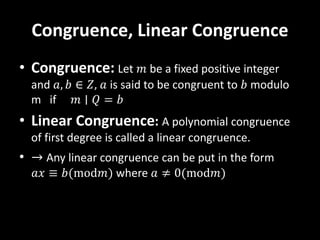
Congruence, Linear Congruence
• Congruence: Let 𝑚 be a fixed positive integer
and 𝑎, 𝑏 ∈ 𝑍, 𝑎 is said to be congruent to 𝑏 modulo
m if 𝑚 ∣ 𝑄 = 𝑏
• Linear Congruence: A polynomial congruence
of first degree is called a linear congruence.
• → Any linear congruence can be put in the form
𝑎𝑥 ≡ 𝑏(mod𝑚) where 𝑎 ≠ 0(mod𝑚)
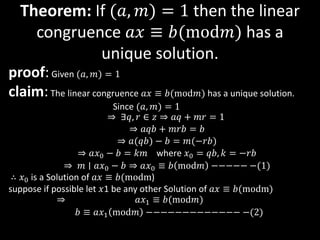
Theorem: If (𝑎, 𝑚) = 1 then the linear
congruence 𝑎𝑥 ≡ 𝑏(mod𝑚) has a
unique solution.
proof:Given (𝑎, 𝑚) = 1
claim:The linear congruence 𝑎𝑥 ≡ 𝑏(mod𝑚) has a unique solution.
Since (𝑎, 𝑚) = 1
⇒ ∃𝑞, 𝑟 ∈ 𝑧 ⇒ 𝑎𝑞 + 𝑚𝑟 = 1
⇒ 𝑎𝑞𝑏 + 𝑚𝑟𝑏 = 𝑏
⇒ 𝑎(𝑞𝑏) − 𝑏 = 𝑚(−𝑟𝑏)
⇒ 𝑎𝑥0 − 𝑏 = 𝑘𝑚 where 𝑥0 = 𝑞𝑏, 𝑘 = −𝑟𝑏
⇒ 𝑚 ∣ 𝑎𝑥0 − 𝑏 ⇒ 𝑎𝑥0 ≡ 𝑏 mod𝑚 −−−−− −(1)
∴ 𝑥0 is a Solution of 𝑎𝑥 ≡ 𝑏(modm)
suppose if possible let 𝑥1 be any other Solution of 𝑎𝑥 ≡ 𝑏(modm)
⇒ 𝑎𝑥1 ≡ 𝑏(mod𝑚)
𝑏 ≡ 𝑎𝑥1 mod𝑚 −−−−−−−−−−−−− −(2)
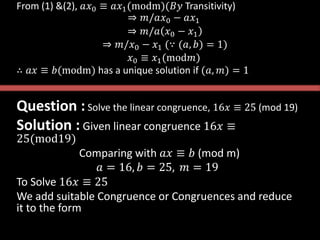
From (1) &(2), 𝑎𝑥0 ≡ 𝑎𝑥1(modm)(𝐵𝑦 Transitivity)
⇒ 𝑚/𝑎𝑥0 − 𝑎𝑥1
⇒ 𝑚/𝑎 𝑥0 − 𝑥1
⇒ 𝑚/𝑥0 − 𝑥1 (∵ (𝑎, 𝑏) = 1)
𝑥0 ≡ 𝑥1(mod𝑚)
∴ 𝑎𝑥 ≡ 𝑏(modm) has a unique solution if (𝑎, 𝑚) = 1
Question :Solve the linear congruence, 16𝑥 ≡ 25 (mod 19)
Solution : Given linear congruence 16𝑥 ≡
25(mod19)
Comparing with 𝑎𝑥 ≡ 𝑏 (mod m)
𝑎 = 16, 𝑏 = 25, 𝑚 = 19
To Solve 16𝑥 ≡ 25
We add suitable Congruence or Congruences and reduce
it to the form
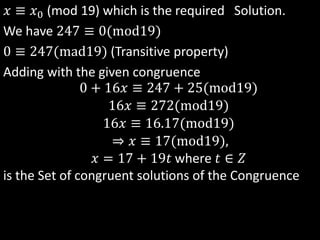
𝑥 ≡ 𝑥0 (mod 19) which is the required Solution.
We have 247 ≡ 0(mod19)
0 ≡ 247(mad19) (Transitive property)
Adding with the given congruence
0 + 16𝑥 ≡ 247 + 25(mod19)
16𝑥 ≡ 272(mod19)
16𝑥 ≡ 16.17(mod19)
⇒ 𝑥 ≡ 17(mod19),
𝑥 = 17 + 19𝑡 where 𝑡 ∈ 𝑍
is the Set of congruent solutions of the Congruence
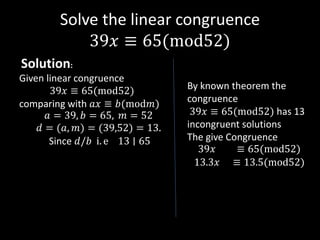
Solve the linear congruence
39𝑥 ≡ 65(mod52)
Solution:
Given linear congruence
39𝑥 ≡ 65(mod52)
comparing with 𝑎𝑥 ≡ 𝑏(mod𝑚)
𝑎 = 39, 𝑏 = 65, 𝑚 = 52
𝑑 = (𝑎, 𝑚) = (39,52) = 13.
Since 𝑑/𝑏 i. e 13 ∣ 65
By known theorem the
congruence
39𝑥 ≡ 65(mod52) has 13
incongruent solutions
The give Congruence
39𝑥 ≡ 65(mod52)
13.3𝑥 ≡ 13.5(mod52)
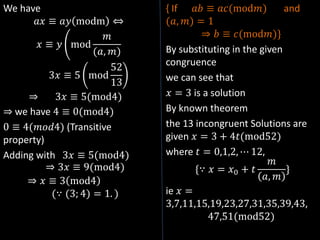
We have
𝑎𝑥 ≡ 𝑎𝑦 modm ⇔
𝑥 ≡ 𝑦 mod
𝑚
(𝑎, 𝑚)
3𝑥 ≡ 5 mod
52
13
⇒ 3𝑥 ≡ 5(mod4)
⇒ we have 4 ≡ 0(mod4)
0 ≡ 4(𝑚𝑜𝑑4) (Transitive
property)
Adding with 3𝑥 ≡ 5(mod4)
⇒ 3𝑥 ≡ 9(mod4)
⇒ 𝑥 ≡ 3 mod4
(∵ (3; 4) = 1. )
{ If 𝑎𝑏 ≡ 𝑎𝑐(mod𝑚) and
(𝑎, 𝑚) = 1
⇒ 𝑏 ≡ 𝑐(mod𝑚)}
By substituting in the given
congruence
we can see that
𝑥 = 3 is a solution
By known theorem
the 13 incongruent Solutions are
given 𝑥 = 3 + 4𝑡(mod52)
where 𝑡 = 0,1,2, ⋯ 12,
{∵ 𝑥 = 𝑥0 + 𝑡
𝑚
𝑎, 𝑚
}
ie 𝑥 =
3,7,11,15,19,23,27,31,35,39,43,
47,51(mod52)
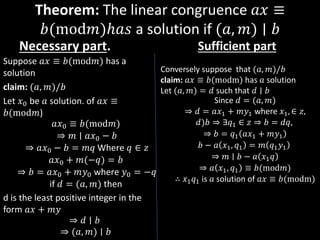
Theorem: The linear congruence 𝑎𝑥 ≡
𝑏(mod𝑚)ℎ𝑎𝑠 a solution if (𝑎, 𝑚) ∣ 𝑏
Necessary part.
Suppose 𝑎𝑥 ≡ 𝑏(mod𝑚) has a
solution
claim: (𝑎, 𝑚)/𝑏
Let 𝑥0 be 𝑎 solution. of 𝑎𝑥 ≡
𝑏(mod𝑚)
𝑎𝑥0 ≡ 𝑏(mod𝑚)
⇒ 𝑚 ∣ 𝑎𝑥0 − 𝑏
⇒ 𝑎𝑥0 − 𝑏 = 𝑚𝑞 Where 𝑞 ∈ 𝑧
𝑎𝑥0 + 𝑚(−𝑞) = 𝑏
⇒ 𝑏 = 𝑎𝑥0 + 𝑚𝑦0 where 𝑦0 = −𝑞
if 𝑑 = (𝑎, 𝑚) then
d is the least positive integer in the
form 𝑎𝑥 + 𝑚𝑦
⇒ 𝑑 ∣ 𝑏
⇒ (𝑎, 𝑚) ∣ 𝑏
Sufficient part
Conversely suppose that (𝑎, 𝑚)/𝑏
claim: 𝑎𝑥 ≡ 𝑏(modm) has 𝑎 solution
Let (𝑎, 𝑚) = 𝑑 such that 𝑑 ∣ 𝑏
Since 𝑑 = (𝑎, 𝑚)
⇒ 𝑑 = 𝑎𝑥1 + 𝑚𝑦1 where 𝑥1, ∈ 𝑧,
𝑑)𝑏 ⇒ ∃𝑞1 ∈ 𝑧 ⇒ 𝑏 = 𝑑𝑞,
⇒ 𝑏 = 𝑞1 𝑎𝑥1 + 𝑚𝑦1
𝑏 − 𝑎 𝑥1, 𝑞1 = 𝑚 𝑞1𝑦1
⇒ 𝑚 ∣ 𝑏 − 𝑎 𝑥1𝑞
⇒ 𝑎 𝑥1, 𝑞1 ≡ 𝑏(mod𝑚)
∴ 𝑥1𝑞1 is 𝑎 solution of 𝑎𝑥 ≡ 𝑏(modm)
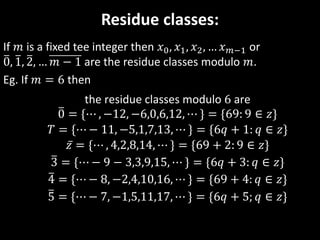
Residue classes:
If 𝑚 is a fixed tee integer then 𝑥0, 𝑥1, 𝑥2, … 𝑥𝑚−1 or
0, 1, 2, … 𝑚 − 1 are the residue classes modulo 𝑚.
Eg. If 𝑚 = 6 then
the residue classes modulo 6 are
0 = {⋯ , −12, −6,0,6,12, ⋯ } = {69: 9 ∈ 𝑧}
𝑇 = {⋯ − 11, −5,1,7,13, ⋯ } = {6𝑞 + 1: 𝑞 ∈ 𝑧}
𝑧 = {⋯ , 4,2,8,14, ⋯ } = {69 + 2: 9 ∈ 𝑧}
3 = {⋯ − 9 − 3,3,9,15, ⋯ } = {6𝑞 + 3: 𝑞 ∈ 𝑧}
4 = {⋯ − 8, −2,4,10,16, ⋯ } = {69 + 4: 𝑞 ∈ 𝑧}
5 = {⋯ − 7, −1,5,11,17, ⋯ } = {6𝑞 + 5; 𝑞 ∈ 𝑧}
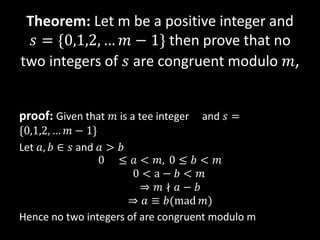
Theorem: Let m be a positive integer and
𝑠 = {0,1,2, … 𝑚 − 1} then prove that no
two integers of 𝑠 are congruent modulo 𝑚,
proof: Given that 𝑚 is a tee integer and 𝑠 =
{0,1,2, … 𝑚 − 1}
Let 𝑎, 𝑏 ∈ 𝑠 and 𝑎 > 𝑏
0 ≤ 𝑎 < 𝑚, 0 ≤ 𝑏 < 𝑚
0 < a − 𝑏 < 𝑚
⇒ 𝑚 ∤ 𝑎 − 𝑏
⇒ 𝑎 ≡ 𝑏(mad 𝑚)
Hence no two integers of are congruent modulo m
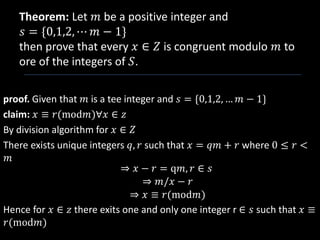
Theorem: Let 𝑚 be a positive integer and
𝑠 = {0,1,2, ⋯ 𝑚 − 1}
then prove that every 𝑥 ∈ 𝑍 is congruent modulo 𝑚 to
ore of the integers of 𝑆.
proof. Given that 𝑚 is a tee integer and 𝑠 = {0,1,2, … 𝑚 − 1}
claim: 𝑥 ≡ 𝑟(mod𝑚)∀𝑥 ∈ 𝑧
By division algorithm for 𝑥 ∈ 𝑍
There exists unique integers 𝑞, 𝑟 such that 𝑥 = 𝑞𝑚 + 𝑟 where 0 ≤ 𝑟 <
𝑚
⇒ 𝑥 − 𝑟 = q𝑚, 𝑟 ∈ 𝑠
⇒ 𝑚/𝑥 − 𝑟
⇒ 𝑥 ≡ 𝑟(mod𝑚)
Hence for 𝑥 ∈ 𝑧 there exits one and only one integer r ∈ 𝑠 such that 𝑥 ≡
𝑟(mod𝑚)
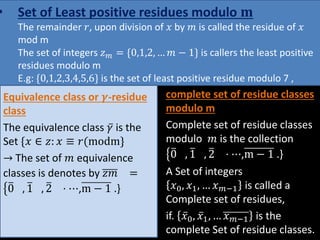
• Set of Least positive residues modulo 𝐦
The remainder 𝑟, upon division of 𝑥 by 𝑚 is called the residue of 𝑥
mod m
The set of integers 𝑧𝑚 = {0,1,2, … 𝑚 − 1} is callers the least positive
residues modulo m
E.g: {0,1,2,3,4,5,6} is the set of least positive residue modulo 7 ,
Equivalence class or 𝜸-residue
class
The equivalence class 𝛾 is the
Set {𝑥 ∈ 𝑧: 𝑥 ≡ 𝑟(modm}
→ The set of 𝑚 equivalence
classes is denotes by 𝑧𝑚 =
0 , 1 , 2 ⋅ ⋯,m − 1 .}
complete set of residue classes
modulo m
Complete set of residue classes
modulo 𝑚 is the collection
0 , 1 , 2 ⋅ ⋯,m − 1 .}
A Set of integers
𝑥0, 𝑥1, … 𝑥𝑚−1 is called a
Complete set of residues,
if. 𝑥0, 𝑥1, … 𝑥𝑚−1 is the
complete Set of residue classes.
THANK YOU

Linear Congruences, reduced residue systems.pptx

  • 1.
    Linear Congruences, reduced residuesystems Name of the unit: Congruences Semester - 5, paper -7 , unit-4 Sri. B.Seethannaidu Lecturer in Mathematics SVLNS Government Degree College, Bheemunipatnam
  • 2.
    Congruence, Linear Congruence •Congruence: Let 𝑚 be a fixed positive integer and 𝑎, 𝑏 ∈ 𝑍, 𝑎 is said to be congruent to 𝑏 modulo m if 𝑚 ∣ 𝑄 = 𝑏 • Linear Congruence: A polynomial congruence of first degree is called a linear congruence. • → Any linear congruence can be put in the form 𝑎𝑥 ≡ 𝑏(mod𝑚) where 𝑎 ≠ 0(mod𝑚)
  • 3.
    Theorem: If (𝑎,𝑚) = 1 then the linear congruence 𝑎𝑥 ≡ 𝑏(mod𝑚) has a unique solution. proof:Given (𝑎, 𝑚) = 1 claim:The linear congruence 𝑎𝑥 ≡ 𝑏(mod𝑚) has a unique solution. Since (𝑎, 𝑚) = 1 ⇒ ∃𝑞, 𝑟 ∈ 𝑧 ⇒ 𝑎𝑞 + 𝑚𝑟 = 1 ⇒ 𝑎𝑞𝑏 + 𝑚𝑟𝑏 = 𝑏 ⇒ 𝑎(𝑞𝑏) − 𝑏 = 𝑚(−𝑟𝑏) ⇒ 𝑎𝑥0 − 𝑏 = 𝑘𝑚 where 𝑥0 = 𝑞𝑏, 𝑘 = −𝑟𝑏 ⇒ 𝑚 ∣ 𝑎𝑥0 − 𝑏 ⇒ 𝑎𝑥0 ≡ 𝑏 mod𝑚 −−−−− −(1) ∴ 𝑥0 is a Solution of 𝑎𝑥 ≡ 𝑏(modm) suppose if possible let 𝑥1 be any other Solution of 𝑎𝑥 ≡ 𝑏(modm) ⇒ 𝑎𝑥1 ≡ 𝑏(mod𝑚) 𝑏 ≡ 𝑎𝑥1 mod𝑚 −−−−−−−−−−−−− −(2)
  • 4.
    From (1) &(2),𝑎𝑥0 ≡ 𝑎𝑥1(modm)(𝐵𝑦 Transitivity) ⇒ 𝑚/𝑎𝑥0 − 𝑎𝑥1 ⇒ 𝑚/𝑎 𝑥0 − 𝑥1 ⇒ 𝑚/𝑥0 − 𝑥1 (∵ (𝑎, 𝑏) = 1) 𝑥0 ≡ 𝑥1(mod𝑚) ∴ 𝑎𝑥 ≡ 𝑏(modm) has a unique solution if (𝑎, 𝑚) = 1 Question :Solve the linear congruence, 16𝑥 ≡ 25 (mod 19) Solution : Given linear congruence 16𝑥 ≡ 25(mod19) Comparing with 𝑎𝑥 ≡ 𝑏 (mod m) 𝑎 = 16, 𝑏 = 25, 𝑚 = 19 To Solve 16𝑥 ≡ 25 We add suitable Congruence or Congruences and reduce it to the form
  • 5.
    𝑥 ≡ 𝑥0(mod 19) which is the required Solution. We have 247 ≡ 0(mod19) 0 ≡ 247(mad19) (Transitive property) Adding with the given congruence 0 + 16𝑥 ≡ 247 + 25(mod19) 16𝑥 ≡ 272(mod19) 16𝑥 ≡ 16.17(mod19) ⇒ 𝑥 ≡ 17(mod19), 𝑥 = 17 + 19𝑡 where 𝑡 ∈ 𝑍 is the Set of congruent solutions of the Congruence
  • 6.
    Solve the linearcongruence 39𝑥 ≡ 65(mod52) Solution: Given linear congruence 39𝑥 ≡ 65(mod52) comparing with 𝑎𝑥 ≡ 𝑏(mod𝑚) 𝑎 = 39, 𝑏 = 65, 𝑚 = 52 𝑑 = (𝑎, 𝑚) = (39,52) = 13. Since 𝑑/𝑏 i. e 13 ∣ 65 By known theorem the congruence 39𝑥 ≡ 65(mod52) has 13 incongruent solutions The give Congruence 39𝑥 ≡ 65(mod52) 13.3𝑥 ≡ 13.5(mod52)
  • 7.
    We have 𝑎𝑥 ≡𝑎𝑦 modm ⇔ 𝑥 ≡ 𝑦 mod 𝑚 (𝑎, 𝑚) 3𝑥 ≡ 5 mod 52 13 ⇒ 3𝑥 ≡ 5(mod4) ⇒ we have 4 ≡ 0(mod4) 0 ≡ 4(𝑚𝑜𝑑4) (Transitive property) Adding with 3𝑥 ≡ 5(mod4) ⇒ 3𝑥 ≡ 9(mod4) ⇒ 𝑥 ≡ 3 mod4 (∵ (3; 4) = 1. ) { If 𝑎𝑏 ≡ 𝑎𝑐(mod𝑚) and (𝑎, 𝑚) = 1 ⇒ 𝑏 ≡ 𝑐(mod𝑚)} By substituting in the given congruence we can see that 𝑥 = 3 is a solution By known theorem the 13 incongruent Solutions are given 𝑥 = 3 + 4𝑡(mod52) where 𝑡 = 0,1,2, ⋯ 12, {∵ 𝑥 = 𝑥0 + 𝑡 𝑚 𝑎, 𝑚 } ie 𝑥 = 3,7,11,15,19,23,27,31,35,39,43, 47,51(mod52)
  • 8.
    Theorem: The linearcongruence 𝑎𝑥 ≡ 𝑏(mod𝑚)ℎ𝑎𝑠 a solution if (𝑎, 𝑚) ∣ 𝑏 Necessary part. Suppose 𝑎𝑥 ≡ 𝑏(mod𝑚) has a solution claim: (𝑎, 𝑚)/𝑏 Let 𝑥0 be 𝑎 solution. of 𝑎𝑥 ≡ 𝑏(mod𝑚) 𝑎𝑥0 ≡ 𝑏(mod𝑚) ⇒ 𝑚 ∣ 𝑎𝑥0 − 𝑏 ⇒ 𝑎𝑥0 − 𝑏 = 𝑚𝑞 Where 𝑞 ∈ 𝑧 𝑎𝑥0 + 𝑚(−𝑞) = 𝑏 ⇒ 𝑏 = 𝑎𝑥0 + 𝑚𝑦0 where 𝑦0 = −𝑞 if 𝑑 = (𝑎, 𝑚) then d is the least positive integer in the form 𝑎𝑥 + 𝑚𝑦 ⇒ 𝑑 ∣ 𝑏 ⇒ (𝑎, 𝑚) ∣ 𝑏 Sufficient part Conversely suppose that (𝑎, 𝑚)/𝑏 claim: 𝑎𝑥 ≡ 𝑏(modm) has 𝑎 solution Let (𝑎, 𝑚) = 𝑑 such that 𝑑 ∣ 𝑏 Since 𝑑 = (𝑎, 𝑚) ⇒ 𝑑 = 𝑎𝑥1 + 𝑚𝑦1 where 𝑥1, ∈ 𝑧, 𝑑)𝑏 ⇒ ∃𝑞1 ∈ 𝑧 ⇒ 𝑏 = 𝑑𝑞, ⇒ 𝑏 = 𝑞1 𝑎𝑥1 + 𝑚𝑦1 𝑏 − 𝑎 𝑥1, 𝑞1 = 𝑚 𝑞1𝑦1 ⇒ 𝑚 ∣ 𝑏 − 𝑎 𝑥1𝑞 ⇒ 𝑎 𝑥1, 𝑞1 ≡ 𝑏(mod𝑚) ∴ 𝑥1𝑞1 is 𝑎 solution of 𝑎𝑥 ≡ 𝑏(modm)
  • 9.
    Residue classes: If 𝑚is a fixed tee integer then 𝑥0, 𝑥1, 𝑥2, … 𝑥𝑚−1 or 0, 1, 2, … 𝑚 − 1 are the residue classes modulo 𝑚. Eg. If 𝑚 = 6 then the residue classes modulo 6 are 0 = {⋯ , −12, −6,0,6,12, ⋯ } = {69: 9 ∈ 𝑧} 𝑇 = {⋯ − 11, −5,1,7,13, ⋯ } = {6𝑞 + 1: 𝑞 ∈ 𝑧} 𝑧 = {⋯ , 4,2,8,14, ⋯ } = {69 + 2: 9 ∈ 𝑧} 3 = {⋯ − 9 − 3,3,9,15, ⋯ } = {6𝑞 + 3: 𝑞 ∈ 𝑧} 4 = {⋯ − 8, −2,4,10,16, ⋯ } = {69 + 4: 𝑞 ∈ 𝑧} 5 = {⋯ − 7, −1,5,11,17, ⋯ } = {6𝑞 + 5; 𝑞 ∈ 𝑧}
  • 10.
    Theorem: Let mbe a positive integer and 𝑠 = {0,1,2, … 𝑚 − 1} then prove that no two integers of 𝑠 are congruent modulo 𝑚, proof: Given that 𝑚 is a tee integer and 𝑠 = {0,1,2, … 𝑚 − 1} Let 𝑎, 𝑏 ∈ 𝑠 and 𝑎 > 𝑏 0 ≤ 𝑎 < 𝑚, 0 ≤ 𝑏 < 𝑚 0 < a − 𝑏 < 𝑚 ⇒ 𝑚 ∤ 𝑎 − 𝑏 ⇒ 𝑎 ≡ 𝑏(mad 𝑚) Hence no two integers of are congruent modulo m
  • 11.
    Theorem: Let 𝑚be a positive integer and 𝑠 = {0,1,2, ⋯ 𝑚 − 1} then prove that every 𝑥 ∈ 𝑍 is congruent modulo 𝑚 to ore of the integers of 𝑆. proof. Given that 𝑚 is a tee integer and 𝑠 = {0,1,2, … 𝑚 − 1} claim: 𝑥 ≡ 𝑟(mod𝑚)∀𝑥 ∈ 𝑧 By division algorithm for 𝑥 ∈ 𝑍 There exists unique integers 𝑞, 𝑟 such that 𝑥 = 𝑞𝑚 + 𝑟 where 0 ≤ 𝑟 < 𝑚 ⇒ 𝑥 − 𝑟 = q𝑚, 𝑟 ∈ 𝑠 ⇒ 𝑚/𝑥 − 𝑟 ⇒ 𝑥 ≡ 𝑟(mod𝑚) Hence for 𝑥 ∈ 𝑧 there exits one and only one integer r ∈ 𝑠 such that 𝑥 ≡ 𝑟(mod𝑚)
  • 12.
    • Set ofLeast positive residues modulo 𝐦 The remainder 𝑟, upon division of 𝑥 by 𝑚 is called the residue of 𝑥 mod m The set of integers 𝑧𝑚 = {0,1,2, … 𝑚 − 1} is callers the least positive residues modulo m E.g: {0,1,2,3,4,5,6} is the set of least positive residue modulo 7 , Equivalence class or 𝜸-residue class The equivalence class 𝛾 is the Set {𝑥 ∈ 𝑧: 𝑥 ≡ 𝑟(modm} → The set of 𝑚 equivalence classes is denotes by 𝑧𝑚 = 0 , 1 , 2 ⋅ ⋯,m − 1 .} complete set of residue classes modulo m Complete set of residue classes modulo 𝑚 is the collection 0 , 1 , 2 ⋅ ⋯,m − 1 .} A Set of integers 𝑥0, 𝑥1, … 𝑥𝑚−1 is called a Complete set of residues, if. 𝑥0, 𝑥1, … 𝑥𝑚−1 is the complete Set of residue classes.
  • 13.