Statistics
and
Probability
Objectives:
 Counts the number of occurrences of an
outcome in an experiment: (a) table; (b)
tree diagram; (c) systematic listing; and
(d) fundamental counting
principle.(M8GE-IVf-g-1)
Activity1
Directions: Read each statement or
questions below carefully and choose the
correct answer provided inside the box.
Write your answer on a separate sheet.
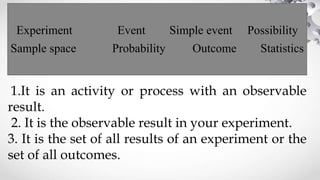
Experiment Event Simple event Possibility
Sample space Probability Outcome Statistics
1.It is an activity or process with an observable
result.
2. It is the observable result in your experiment.
3. It is the set of all results of an experiment or the
set of all outcomes.
4. It is a subset (a part) of your sample space.
5. It is a specific outcome, just one of the
possible outcomes of the experiment.
6. It is the measure of the likelihood that an
event will occur.
Activity 2
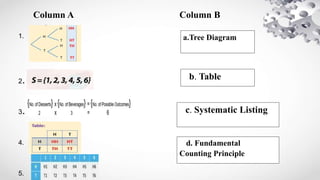
Directions: Match column A with the
corresponding item in column B.
Answer only.
Column A
1.
2.
3.
4.
5.
Column B
a.Tree Diagram
b. Table
c. Systematic Listing
d. Fundamental
Counting Principle
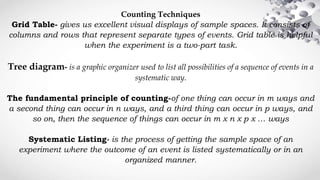
Counting Techniques
Grid Table- gives us excellent visual displays of sample spaces. It consists of
columns and rows that represent separate types of events. Grid table is helpful
when the experiment is a two-part task.
Tree diagram- is a graphic organizer used to list all possibilities of a sequence of events in a
systematic way.
The fundamental principle of counting-of one thing can occur in m ways and
a second thing can occur in n ways, and a third thing can occur in p ways, and
so on, then the sequence of things can occur in m x n x p x … ways
Systematic Listing- is the process of getting the sample space of an
experiment where the outcome of an event is listed systematically or in an
organized manner.
Activity 3
Directions: For 10 minutes analyze
and complete the table following the
given example below. Copy and
answer in a ½ sheet of paper.
A. Using a table
1 2 3 4 5
A
Pants A
Shirt 1
Pants A
Shirt 3
B
Pants B
Shirt 1
Total number of possible outcomes: 10
B. Using a tree diagram
Pants Shirts Combinations
Pants A, Shirt 1
Pants B, Shirt 1
Total number of possible outcomes: 10
C.Using systematic listing
S = {Pants A, Pants B, _____, _____,
______, _____, _____ }
Activity 4
1. How did you complete the table and tree diagram depicting
the effects of a combination of pants and shirts based on the
exercise you did earlier?
2.After completing the table, how did you determine the
number of occurrences of an outcome in a combination using a
table and a tree diagram?
3.What did you do to arrive on your answer in systematic
listing?
4. Why did you come up with the number filled in the blank?
5.In your own opinion, what is the importance of knowing the
Counting Techniques-Systematic Listing
Systematic Listing- is the process of getting the sample space of an experiment
where the outcome of an event is listed systematically or in an organized manner.
Example 1: Consider a Club N with five members:
N= [ Andy, Bill, Cathy, David, Evelyn] or as a shortcut,
N= [ A, B,C,D,E]
In how many ways can this group select a president (assuming all members are
eligible)?
The task in this case is to select one of the five members as president. It is a One-part
task.
Example 2:
For tossing a single six-sided die, the typical
sample space is {1,2,3,4,5, and 6} (in which the result
of interest is the number of pips facing up). This
method is one-part tasks; the results for simple tasks
consisting of one part can often be listed easily.
Counting Techniques-Grid Table
Grid Table- gives us excellent visual displays of
sample spaces. It consists of columns and rows that
represent separate types of events. Grid table is
helpful when the experiment is a two-part task.
Example 1: Determine the number of two-digit
numbers that can be written using digits from the set
(1,2, and 3). This task consists of two parts: choose a
first digit and choose a second digit. The results for a
two-part task can be pictures in a product table such as
Table 1. From the table we obtain our list of possible
results: 11, 12, 13, 21, 22, 23, 31, 32, and 33. There are
nine possibilities.
Table 1
Second
digit
1 2 3
First
digit
1 11 12 13
2 21 22 23
3 31 32 33
Counting Techniques-Tree Diagram
Tree diagram- is a graphic organizer used to list all
possibilities of a sequence of events in a systematic way.
Example: The number of three-digit numbers that
can be written using digits from the set {1, 2, 3},
assuming that repeated digits are allowed. The task of
constructing such a number has three parts: select the
first digit, select the second digit, and select the third
digit.
As we move from
left to right through
the tree diagram in
Figure 1, the tree
branches at the first
stage to all
possibilities for the
first digit.
Then each first-
stage branch
again branches, or
splits, at the
second stage, to
all possibilities
for the second
digit.
Finally, the
third-stage
branching
shows the
third-digit
possibilities.
The list of possible results (27 of them) is shown in Figure 1.
The Fundamental Counting
The Fundamental Principle of Counting
If one thing can occur in m ways and a second thing can
occur in n ways, and a third thing can occur in p ways,
and so on, then the sequence of things can occur in m x n
x p x … ways
Example 1: In how many ways can a boy and a girl be
selected from a group of 5 boys and 4 girls?
Solution: The boys can be selected in 5 ways while the girls can be selected in 4
ways. Hence: 5 times 4 = 20 ways
Example 2: A and E Bakery serves two desserts; a cake and a pie. They also serve
three beverages: coffee, tea, and juice. Suppose you choose one dessert and one
beverage. How many possible outcomes are there?
Solution:
There are six possible outcomes.
Using the Fundamental Principle of Counting, we have:
{No. of Desserts} x {No. of Beverages} = {No. of Possible Outcomes}
2 x 3 = 6
1.Based on the discussion, what is systematic
listing, Grid Table, Tree diagram, and counting
principle?
2.When can we use a tree diagram?
3.For you what is the use of knowing these
counting techniques?
Activity
Directions: Read each statement carefully and choose the letter that
corresponds to the correct answer.
1.Is the process of getting the sample space of an experiment where the
outcome of an event is listed systematically or in an organized manner.
A. Table
B. Tree Diagram
C. Systematic Listing
D. Fundamental Counting Principle
2.Is a mathematical tool used to count the size of the
sample space and event space. There are four types of
sample techniques.
A. Table
B. Tree Diagram
C. Systematic Listing
D. Fundamental Counting Principle
3.Gives us excellent visual displays of sample spaces. It
consists of columns and rows
that represent separate types of events. The table is
helpful when the experiment is a
two-part task.
A. Table
B. Tree Diagram
C. Systematic Listing
D. Fundamental Counting Principle
4.If one thing can occur in m ways and a second thing can
occur in n ways, and a third thing can occur in p ways, and
so on, then the sequence of things can occur in m x n x p
x …ways
A. Table
B. Tree Diagram
C. Systematic Listing
D. Fundamental Counting Principle
5.Is a graphic organizer used to list all possibilities of a
sequence of events in a systematic way.
A. Table
B. Tree Diagram
C. Systematic Listing
D. Fundamental Counting Principle
6.The letter of the word CAT can be arranged in:
A.3 ways
B. 4 ways
C. 5 ways
D. 6 ways
7.An ice cream shop offers 3 types of cones and 5 different flavours of
ice cream. How many possible ice-cream cone combinations are there?
A.15 possible ice-cream cone combinations
B.20 possible ice-cream cone combinations
C.25 possible ice-cream cone combinations
D.30 possible ice-cream cone combinations
8.In a restaurant, you have a dinner choice of line main dish,
one vegetable and one drink. The choices for main dish are
pork and chicken meat. The vegetable choices are broccoli
and cabbage. The drink choices are juice and water. How
many choices are
possible?
A.8
B.10
C.12
D.14
Assignment.
Directions: Complete the graphic organizer by writing the different
counting techniques and its definitions based on what you have learned
from this module.
Graphic Organizer Rubric
Criteria 4Exceeding 3Meeting 2 1
Organizations Extremely well
organized. Order and
structure of
information is
compelling and flows
smoothly.
Organized. Structure
allows reader to
move through
content without
confusion. Flows
smoothly.
Somewhat organized
structure allows
reader to move
through some of the
content without
confusion. Flow is
sometimes
interrupted.
Poorly organized. A
clear sense of
direction is not
evident. Flow is
frequently
interrupted.
Content Thorough and
insightful
understanding of
content.
Complete
understanding of
content.
Shows some
understanding of
content.
Shows incomplete
understanding of
material.
Creativity Enthusiastically uses
materials and ideas for
enhancement.
Use of materials and
ideas for
enhancement.
Shows some use of
materials and ideas.
Shows minimal effort
for enhancement of
materials and ideas.
Ideas Insightful and well
considered ideas
making multiple
connections.
Ideas are considered,
more than one
thoughtful
connection is made.
Ideas are somewhat
on topic; makes some
connections.
Ideas are unclear, few
connections.

cheyene ppt.pptx

  • 2.
  • 3.
    Objectives:  Counts thenumber of occurrences of an outcome in an experiment: (a) table; (b) tree diagram; (c) systematic listing; and (d) fundamental counting principle.(M8GE-IVf-g-1)
  • 4.
    Activity1 Directions: Read eachstatement or questions below carefully and choose the correct answer provided inside the box. Write your answer on a separate sheet.
  • 5.
    Experiment Event Simpleevent Possibility Sample space Probability Outcome Statistics 1.It is an activity or process with an observable result. 2. It is the observable result in your experiment. 3. It is the set of all results of an experiment or the set of all outcomes.
  • 6.
    4. It isa subset (a part) of your sample space. 5. It is a specific outcome, just one of the possible outcomes of the experiment. 6. It is the measure of the likelihood that an event will occur.
  • 7.
    Activity 2 Directions: Matchcolumn A with the corresponding item in column B. Answer only.
  • 8.
    Column A 1. 2. 3. 4. 5. Column B a.TreeDiagram b. Table c. Systematic Listing d. Fundamental Counting Principle
  • 9.
    Counting Techniques Grid Table-gives us excellent visual displays of sample spaces. It consists of columns and rows that represent separate types of events. Grid table is helpful when the experiment is a two-part task. Tree diagram- is a graphic organizer used to list all possibilities of a sequence of events in a systematic way. The fundamental principle of counting-of one thing can occur in m ways and a second thing can occur in n ways, and a third thing can occur in p ways, and so on, then the sequence of things can occur in m x n x p x … ways Systematic Listing- is the process of getting the sample space of an experiment where the outcome of an event is listed systematically or in an organized manner.
  • 10.
    Activity 3 Directions: For10 minutes analyze and complete the table following the given example below. Copy and answer in a ½ sheet of paper.
  • 11.
    A. Using atable 1 2 3 4 5 A Pants A Shirt 1 Pants A Shirt 3 B Pants B Shirt 1 Total number of possible outcomes: 10
  • 12.
    B. Using atree diagram Pants Shirts Combinations Pants A, Shirt 1 Pants B, Shirt 1 Total number of possible outcomes: 10
  • 13.
    C.Using systematic listing S= {Pants A, Pants B, _____, _____, ______, _____, _____ }
  • 14.
    Activity 4 1. Howdid you complete the table and tree diagram depicting the effects of a combination of pants and shirts based on the exercise you did earlier? 2.After completing the table, how did you determine the number of occurrences of an outcome in a combination using a table and a tree diagram? 3.What did you do to arrive on your answer in systematic listing? 4. Why did you come up with the number filled in the blank? 5.In your own opinion, what is the importance of knowing the
  • 15.
    Counting Techniques-Systematic Listing SystematicListing- is the process of getting the sample space of an experiment where the outcome of an event is listed systematically or in an organized manner. Example 1: Consider a Club N with five members: N= [ Andy, Bill, Cathy, David, Evelyn] or as a shortcut, N= [ A, B,C,D,E] In how many ways can this group select a president (assuming all members are eligible)? The task in this case is to select one of the five members as president. It is a One-part task.
  • 16.
    Example 2: For tossinga single six-sided die, the typical sample space is {1,2,3,4,5, and 6} (in which the result of interest is the number of pips facing up). This method is one-part tasks; the results for simple tasks consisting of one part can often be listed easily.
  • 17.
    Counting Techniques-Grid Table GridTable- gives us excellent visual displays of sample spaces. It consists of columns and rows that represent separate types of events. Grid table is helpful when the experiment is a two-part task.
  • 18.
    Example 1: Determinethe number of two-digit numbers that can be written using digits from the set (1,2, and 3). This task consists of two parts: choose a first digit and choose a second digit. The results for a two-part task can be pictures in a product table such as Table 1. From the table we obtain our list of possible results: 11, 12, 13, 21, 22, 23, 31, 32, and 33. There are nine possibilities.
  • 19.
    Table 1 Second digit 1 23 First digit 1 11 12 13 2 21 22 23 3 31 32 33
  • 20.
    Counting Techniques-Tree Diagram Treediagram- is a graphic organizer used to list all possibilities of a sequence of events in a systematic way. Example: The number of three-digit numbers that can be written using digits from the set {1, 2, 3}, assuming that repeated digits are allowed. The task of constructing such a number has three parts: select the first digit, select the second digit, and select the third digit.
  • 21.
    As we movefrom left to right through the tree diagram in Figure 1, the tree branches at the first stage to all possibilities for the first digit. Then each first- stage branch again branches, or splits, at the second stage, to all possibilities for the second digit. Finally, the third-stage branching shows the third-digit possibilities. The list of possible results (27 of them) is shown in Figure 1.
  • 22.
    The Fundamental Counting TheFundamental Principle of Counting If one thing can occur in m ways and a second thing can occur in n ways, and a third thing can occur in p ways, and so on, then the sequence of things can occur in m x n x p x … ways Example 1: In how many ways can a boy and a girl be selected from a group of 5 boys and 4 girls?
  • 23.
    Solution: The boyscan be selected in 5 ways while the girls can be selected in 4 ways. Hence: 5 times 4 = 20 ways Example 2: A and E Bakery serves two desserts; a cake and a pie. They also serve three beverages: coffee, tea, and juice. Suppose you choose one dessert and one beverage. How many possible outcomes are there? Solution: There are six possible outcomes. Using the Fundamental Principle of Counting, we have: {No. of Desserts} x {No. of Beverages} = {No. of Possible Outcomes} 2 x 3 = 6
  • 24.
    1.Based on thediscussion, what is systematic listing, Grid Table, Tree diagram, and counting principle? 2.When can we use a tree diagram? 3.For you what is the use of knowing these counting techniques?
  • 25.
    Activity Directions: Read eachstatement carefully and choose the letter that corresponds to the correct answer. 1.Is the process of getting the sample space of an experiment where the outcome of an event is listed systematically or in an organized manner. A. Table B. Tree Diagram C. Systematic Listing D. Fundamental Counting Principle
  • 26.
    2.Is a mathematicaltool used to count the size of the sample space and event space. There are four types of sample techniques. A. Table B. Tree Diagram C. Systematic Listing D. Fundamental Counting Principle
  • 27.
    3.Gives us excellentvisual displays of sample spaces. It consists of columns and rows that represent separate types of events. The table is helpful when the experiment is a two-part task. A. Table B. Tree Diagram C. Systematic Listing D. Fundamental Counting Principle
  • 28.
    4.If one thingcan occur in m ways and a second thing can occur in n ways, and a third thing can occur in p ways, and so on, then the sequence of things can occur in m x n x p x …ways A. Table B. Tree Diagram C. Systematic Listing D. Fundamental Counting Principle
  • 29.
    5.Is a graphicorganizer used to list all possibilities of a sequence of events in a systematic way. A. Table B. Tree Diagram C. Systematic Listing D. Fundamental Counting Principle
  • 30.
    6.The letter ofthe word CAT can be arranged in: A.3 ways B. 4 ways C. 5 ways D. 6 ways 7.An ice cream shop offers 3 types of cones and 5 different flavours of ice cream. How many possible ice-cream cone combinations are there? A.15 possible ice-cream cone combinations B.20 possible ice-cream cone combinations C.25 possible ice-cream cone combinations D.30 possible ice-cream cone combinations
  • 31.
    8.In a restaurant,you have a dinner choice of line main dish, one vegetable and one drink. The choices for main dish are pork and chicken meat. The vegetable choices are broccoli and cabbage. The drink choices are juice and water. How many choices are possible? A.8 B.10 C.12 D.14
  • 32.
    Assignment. Directions: Complete thegraphic organizer by writing the different counting techniques and its definitions based on what you have learned from this module.
  • 33.
    Graphic Organizer Rubric Criteria4Exceeding 3Meeting 2 1 Organizations Extremely well organized. Order and structure of information is compelling and flows smoothly. Organized. Structure allows reader to move through content without confusion. Flows smoothly. Somewhat organized structure allows reader to move through some of the content without confusion. Flow is sometimes interrupted. Poorly organized. A clear sense of direction is not evident. Flow is frequently interrupted. Content Thorough and insightful understanding of content. Complete understanding of content. Shows some understanding of content. Shows incomplete understanding of material. Creativity Enthusiastically uses materials and ideas for enhancement. Use of materials and ideas for enhancement. Shows some use of materials and ideas. Shows minimal effort for enhancement of materials and ideas. Ideas Insightful and well considered ideas making multiple connections. Ideas are considered, more than one thoughtful connection is made. Ideas are somewhat on topic; makes some connections. Ideas are unclear, few connections.