FOUR BASIC
CONCEPTS
Week 4
1. Sets
2. Functions
3. Relations
4. Binary Operations
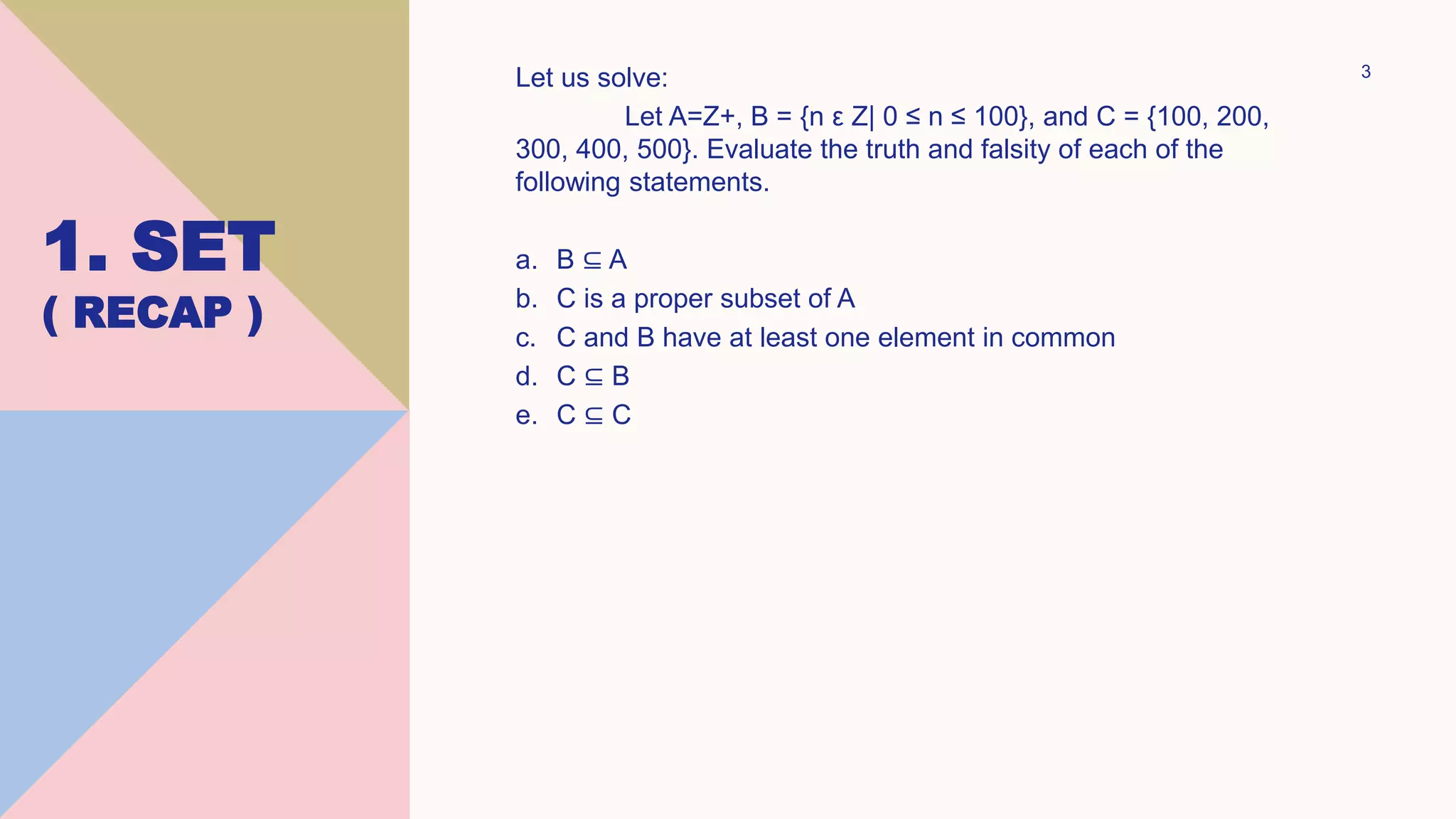
1. SET
( RECAP )
Let us solve:
Let A=Z+, B = {n ε Z| 0 ≤ n ≤ 100}, and C = {100, 200,
300, 400, 500}. Evaluate the truth and falsity of each of the
following statements.
a. B ⊆ A
b. C is a proper subset of A
c. C and B have at least one element in common
d. C ⊆ B
e. C ⊆ C
3
2. FUNCTIONS
Function, in mathematics, an expression, rule, or law that
defines a relationship between one variable (the
independent variable) and another variable (the dependent
variable). Functions are ubiquitous in mathematics and are
essential for formulating physical relationships in the sciences.
• A function F from a set A to a set B is a relation with
domain A and co-domain B that satisfies the following
two properties:
1. For every element x in A, there is an element y in B
such that (x, y) ε F.
2. For all elements x in A and y and z in B. if (x, y) ε F, then
y=z.
• Notation
if A and B are sets and F is a function from A to B,
then given any element x in A, the unique element in B
that is related to x by F is denoted F(x), which is read “ F of
x”.
6
Define a relation from R to R as follows:
For all (x, y) ε R x R, (x, y) ε L means that y = x
– 1.
Is L a function? If it is, find L(0) and L(1).
7
EXAMPLE
3. RELATIONS
The relation defines the relation between two given sets. If
there are two sets available, then to check if there is any
connection between the two sets, we use relations. For
example, an empty relation denotes none of the elements in
the two sets is same.
• Let A and B be sets. A relation R from A to B is
a subset of A x B. Given an ordered pair (x, y) in
A x B, x is related to y by R, written x R y, if, and
only if, (x, y) is in R. The set A is called the
domain of R and the set B is called its co-
domain.
10
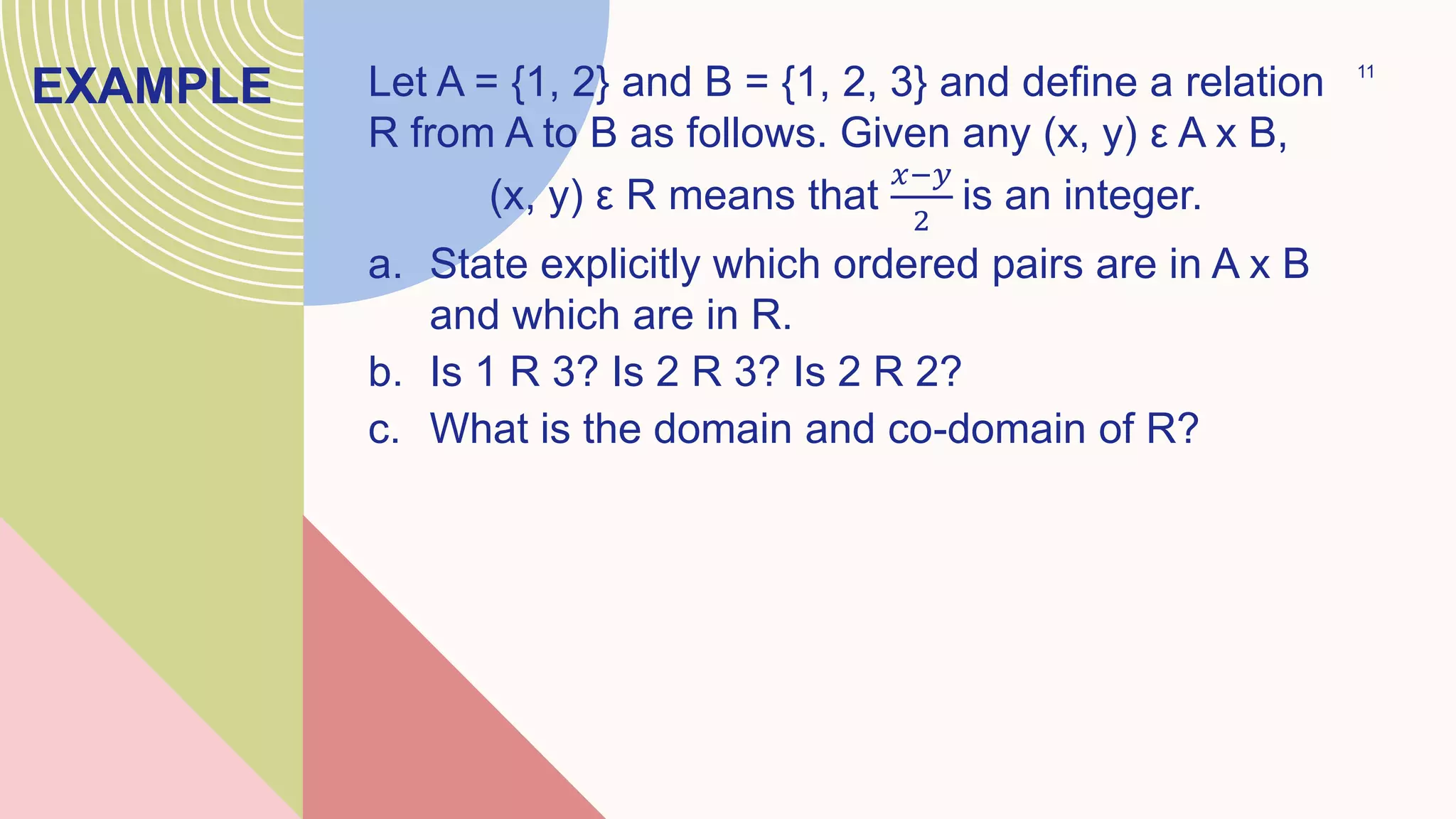
Let A = {1, 2} and B = {1, 2, 3} and define a relation
R from A to B as follows. Given any (x, y) ε A x B,
(x, y) ε R means that
𝑥−𝑦
2
is an integer.
a. State explicitly which ordered pairs are in A x B
and which are in R.
b. Is 1 R 3? Is 2 R 3? Is 2 R 2?
c. What is the domain and co-domain of R?
11
EXAMPLE
4. BINARY
OPERATIONS
CLOSURE PROPERTY
Addition
• The sum of any two real numbers is also a real
number
• Examples:
12 + 30 = 42
-23 + 40 = 17
Multiplication
• The product of any two real numbers is also a
real number.
• Examples:
6 x 25 = 150
12 x 4 = 48
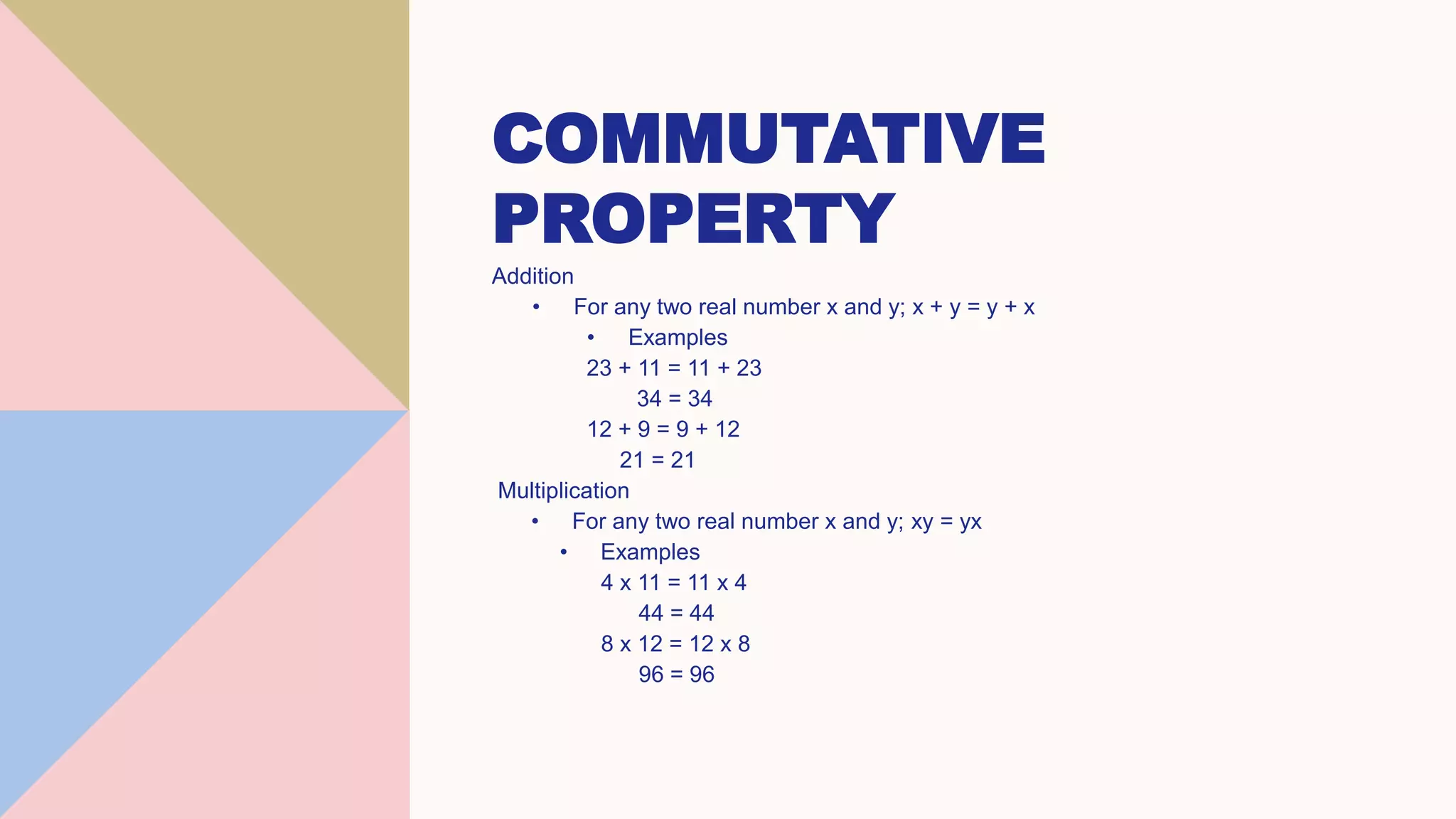
COMMUTATIVE
PROPERTY
Addition
• For any two real number x and y; x + y = y + x
• Examples
23 + 11 = 11 + 23
34 = 34
12 + 9 = 9 + 12
21 = 21
Multiplication
• For any two real number x and y; xy = yx
• Examples
4 x 11 = 11 x 4
44 = 44
8 x 12 = 12 x 8
96 = 96
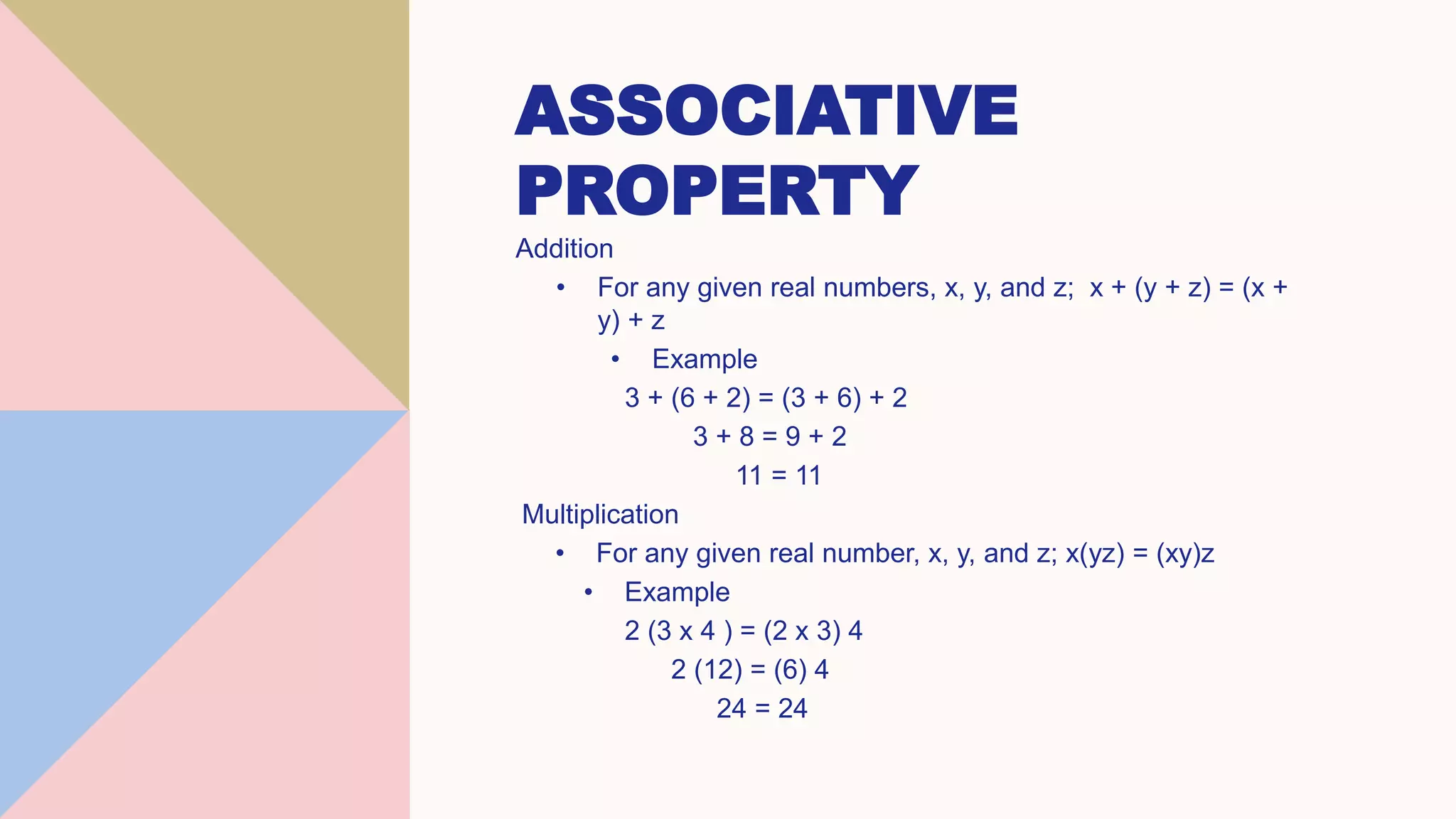
ASSOCIATIVE
PROPERTY
Addition
• For any given real numbers, x, y, and z; x + (y + z) = (x +
y) + z
• Example
3 + (6 + 2) = (3 + 6) + 2
3 + 8 = 9 + 2
11 = 11
Multiplication
• For any given real number, x, y, and z; x(yz) = (xy)z
• Example
2 (3 x 4 ) = (2 x 3) 4
2 (12) = (6) 4
24 = 24
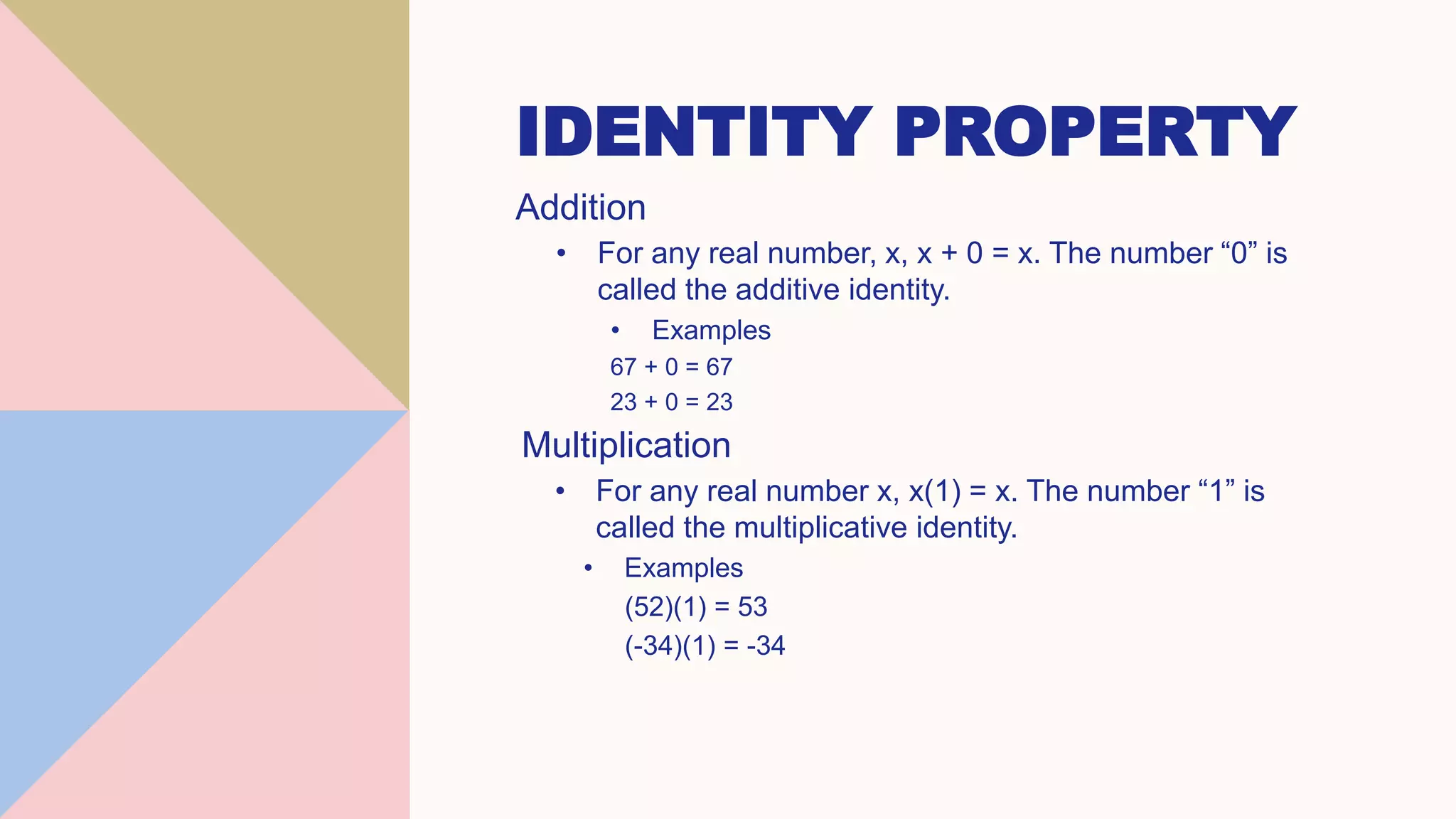
IDENTITY PROPERTY
Addition
• For any real number, x, x + 0 = x. The number “0” is
called the additive identity.
• Examples
67 + 0 = 67
23 + 0 = 23
Multiplication
• For any real number x, x(1) = x. The number “1” is
called the multiplicative identity.
• Examples
(52)(1) = 53
(-34)(1) = -34
DISTRIBUTIVE PROPERTY OF
MULTIPLICATION OVER
ADDITION
For any two real number x, y, and z, x(y
+ z) = xy + xz
• Examples
a(b + c – d) = ab + ac – ad
3(2 + x + y) = 6 + 3xy + 3y
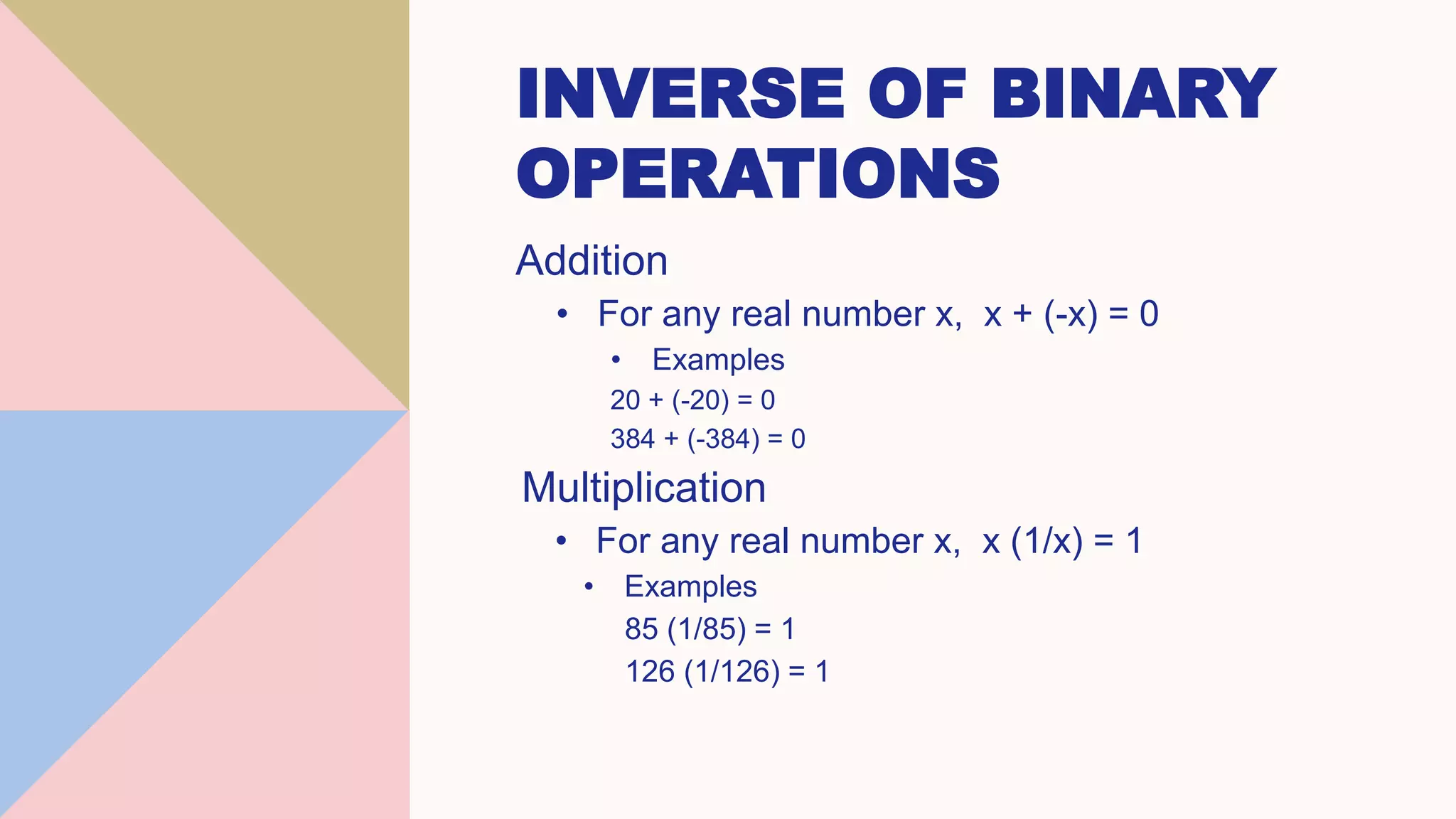
INVERSE OF BINARY
OPERATIONS
Addition
• For any real number x, x + (-x) = 0
• Examples
20 + (-20) = 0
384 + (-384) = 0
Multiplication
• For any real number x, x (1/x) = 1
• Examples
85 (1/85) = 1
126 (1/126) = 1
THANK YOU!

Four basic concepts.pptx

  • 1.
  • 2.
    1. Sets 2. Functions 3.Relations 4. Binary Operations
  • 3.
    1. SET ( RECAP) Let us solve: Let A=Z+, B = {n ε Z| 0 ≤ n ≤ 100}, and C = {100, 200, 300, 400, 500}. Evaluate the truth and falsity of each of the following statements. a. B ⊆ A b. C is a proper subset of A c. C and B have at least one element in common d. C ⊆ B e. C ⊆ C 3
  • 4.
  • 5.
    Function, in mathematics,an expression, rule, or law that defines a relationship between one variable (the independent variable) and another variable (the dependent variable). Functions are ubiquitous in mathematics and are essential for formulating physical relationships in the sciences.
  • 6.
    • A functionF from a set A to a set B is a relation with domain A and co-domain B that satisfies the following two properties: 1. For every element x in A, there is an element y in B such that (x, y) ε F. 2. For all elements x in A and y and z in B. if (x, y) ε F, then y=z. • Notation if A and B are sets and F is a function from A to B, then given any element x in A, the unique element in B that is related to x by F is denoted F(x), which is read “ F of x”. 6
  • 7.
    Define a relationfrom R to R as follows: For all (x, y) ε R x R, (x, y) ε L means that y = x – 1. Is L a function? If it is, find L(0) and L(1). 7 EXAMPLE
  • 8.
  • 9.
    The relation definesthe relation between two given sets. If there are two sets available, then to check if there is any connection between the two sets, we use relations. For example, an empty relation denotes none of the elements in the two sets is same.
  • 10.
    • Let Aand B be sets. A relation R from A to B is a subset of A x B. Given an ordered pair (x, y) in A x B, x is related to y by R, written x R y, if, and only if, (x, y) is in R. The set A is called the domain of R and the set B is called its co- domain. 10
  • 11.
    Let A ={1, 2} and B = {1, 2, 3} and define a relation R from A to B as follows. Given any (x, y) ε A x B, (x, y) ε R means that 𝑥−𝑦 2 is an integer. a. State explicitly which ordered pairs are in A x B and which are in R. b. Is 1 R 3? Is 2 R 3? Is 2 R 2? c. What is the domain and co-domain of R? 11 EXAMPLE
  • 12.
  • 13.
    CLOSURE PROPERTY Addition • Thesum of any two real numbers is also a real number • Examples: 12 + 30 = 42 -23 + 40 = 17 Multiplication • The product of any two real numbers is also a real number. • Examples: 6 x 25 = 150 12 x 4 = 48
  • 14.
    COMMUTATIVE PROPERTY Addition • For anytwo real number x and y; x + y = y + x • Examples 23 + 11 = 11 + 23 34 = 34 12 + 9 = 9 + 12 21 = 21 Multiplication • For any two real number x and y; xy = yx • Examples 4 x 11 = 11 x 4 44 = 44 8 x 12 = 12 x 8 96 = 96
  • 15.
    ASSOCIATIVE PROPERTY Addition • For anygiven real numbers, x, y, and z; x + (y + z) = (x + y) + z • Example 3 + (6 + 2) = (3 + 6) + 2 3 + 8 = 9 + 2 11 = 11 Multiplication • For any given real number, x, y, and z; x(yz) = (xy)z • Example 2 (3 x 4 ) = (2 x 3) 4 2 (12) = (6) 4 24 = 24
  • 16.
    IDENTITY PROPERTY Addition • Forany real number, x, x + 0 = x. The number “0” is called the additive identity. • Examples 67 + 0 = 67 23 + 0 = 23 Multiplication • For any real number x, x(1) = x. The number “1” is called the multiplicative identity. • Examples (52)(1) = 53 (-34)(1) = -34
  • 17.
    DISTRIBUTIVE PROPERTY OF MULTIPLICATIONOVER ADDITION For any two real number x, y, and z, x(y + z) = xy + xz • Examples a(b + c – d) = ab + ac – ad 3(2 + x + y) = 6 + 3xy + 3y
  • 18.
    INVERSE OF BINARY OPERATIONS Addition •For any real number x, x + (-x) = 0 • Examples 20 + (-20) = 0 384 + (-384) = 0 Multiplication • For any real number x, x (1/x) = 1 • Examples 85 (1/85) = 1 126 (1/126) = 1
  • 19.