15-251
Great Theoretical Ideas
in Computer Science
Algebraic Structures:
Group Theory
Lecture 16, October 14, 2009
Today we are going to
study the abstract
properties of binary
operations
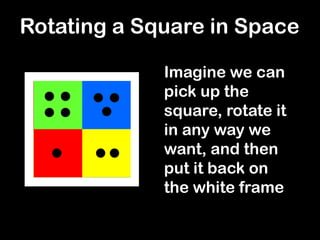
Rotating a Square in Space
Imagine we can
pick up the
square, rotate it
in any way we
want, and then
put it back on
the white frame
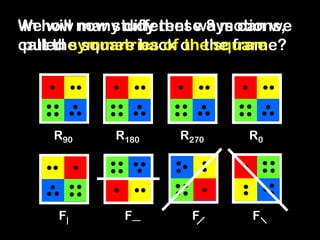
In how many different ways can we
put the square back on the frame?
R90 R180 R270 R0
F| F— F F
We will now study these 8 motions,
called symmetries of the square
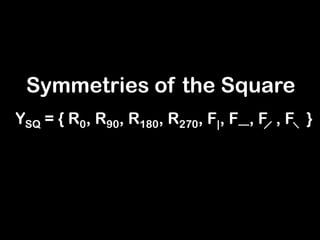
Symmetries of the Square
YSQ = { R0, R90, R180, R270, F|, F—, F , F }
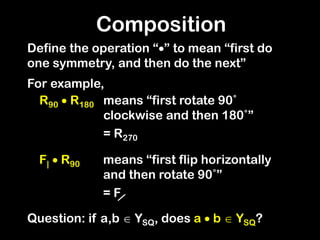
Composition
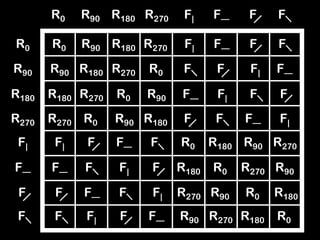
Define the operation “” to mean “first do
one symmetry, and then do the next”
For example,
R90  R180
Question: if a,b  YSQ, does a  b  YSQ?
means “first rotate 90˚
clockwise and then 180˚”
= R270
F|  R90 means “first flip horizontally
and then rotate 90˚”
= F
R90 R180 R270
R0 F| F— F F
R0
R90
R180
R270
F|
F—
F
F
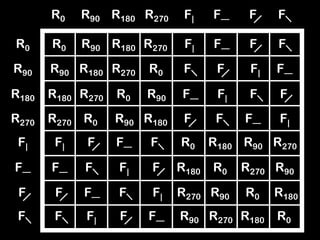
R0 R90 R180 R270 F| F— F F
R90
R180
R270
F|
F—
F
F
R180 R270 R0
R270 R0 R90
R0 R90 R180
F F F| F—
F— F| F F
F F F— F|
F F— F
F F| F
F— F F|
F| F F—
R0
R0
R0
R0
R180 R90 R270
R180 R270 R90
R270 R90 R180
R90 R270 R180
Some Formalism
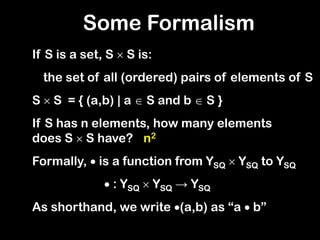
If S is a set, S  S is:
the set of all (ordered) pairs of elements of S
S  S = { (a,b) | a  S and b  S }
If S has n elements, how many elements
does S  S have? n2
Formally,  is a function from YSQ  YSQ to YSQ
 : YSQ  YSQ → YSQ
As shorthand, we write (a,b) as “a  b”
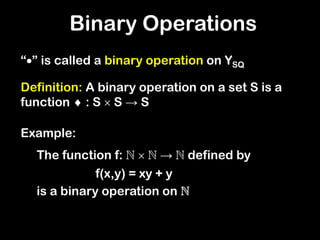
“” is called a binary operation on YSQ
Definition: A binary operation on a set S is a
function  : S  S → S
Example:
The function f:    →  defined by
is a binary operation on 
f(x,y) = xy + y
Binary Operations
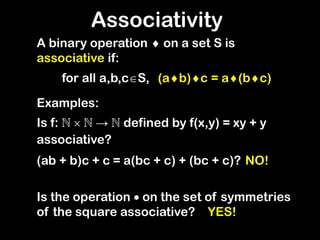
Is the operation  on the set of symmetries
of the square associative?
A binary operation  on a set S is
associative if:
for all a,b,cS, (ab)c = a(bc)
Associativity
Examples:
Is f:    →  defined by f(x,y) = xy + y
associative?
(ab + b)c + c = a(bc + c) + (bc + c)? NO!
YES!
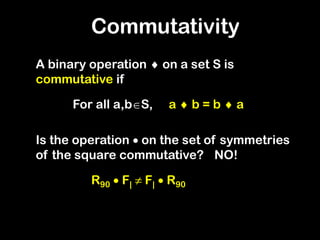
A binary operation  on a set S is
commutative if
For all a,bS, a  b = b  a
Commutativity
Is the operation  on the set of symmetries
of the square commutative? NO!
R90  F| ≠ F|  R90
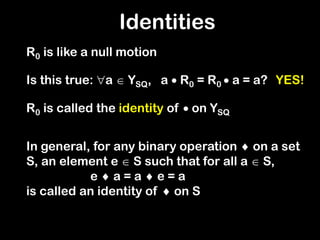
R0 is like a null motion
Is this true: a  YSQ, a  R0 = R0  a = a?
R0 is called the identity of  on YSQ
In general, for any binary operation  on a set
S, an element e  S such that for all a  S,
e  a = a  e = a
is called an identity of  on S
Identities
YES!
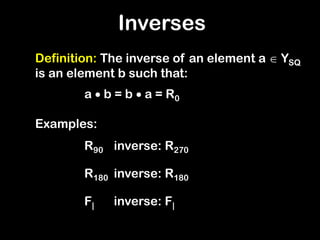
Inverses
Definition: The inverse of an element a  YSQ
is an element b such that:
a  b = b  a = R0
Examples:
R90 inverse: R270
R180 inverse: R180
F| inverse: F|
Every element in YSQ
has a unique inverse
R90 R180 R270
R0 F| F— F F
R0
R90
R180
R270
F|
F—
F
F
R0 R90 R180 R270 F| F— F F
R90
R180
R270
F|
F—
F
F
R180 R270 R0
R270 R0 R90
R0 R90 R180
F F F| F—
F— F| F F
F F F— F|
F F— F
F F| F
F— F F|
F| F F—
R0
R0
R0
R0
R180 R90 R270
R180 R270 R90
R270 R90 R180
R90 R270 R180
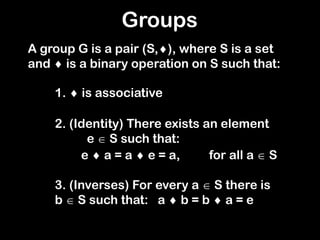
3. (Inverses) For every a  S there is
b  S such that:
Groups
A group G is a pair (S,), where S is a set
and  is a binary operation on S such that:
1.  is associative
2. (Identity) There exists an element
e  S such that:
e  a = a  e = a, for all a  S
a  b = b  a = e
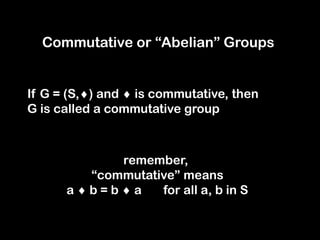
Commutative or “Abelian” Groups
remember,
“commutative” means
a  b = b  a for all a, b in S
If G = (S,) and  is commutative, then
G is called a commutative group
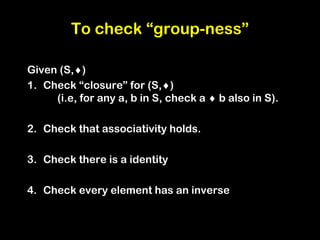
To check “group-ness”
Given (S,)
1. Check “closure” for (S,)
(i.e, for any a, b in S, check a  b also in S).
2. Check that associativity holds.
3. Check there is a identity
4. Check every element has an inverse
Some examples…
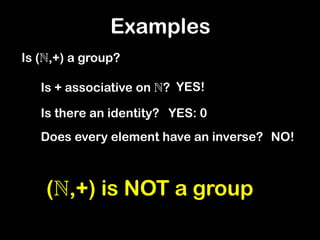
Examples
Is (,+) a group?
Is + associative on ? YES!
Is there an identity? YES: 0
Does every element have an inverse? NO!
(,+) is NOT a group
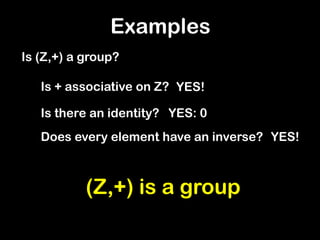
Examples
Is (Z,+) a group?
Is + associative on Z? YES!
Is there an identity? YES: 0
Does every element have an inverse? YES!
(Z,+) is a group
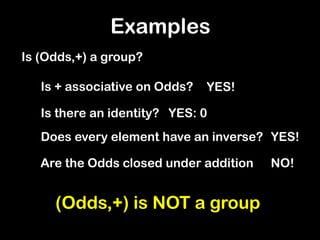
Examples
Is (Odds,+) a group?
(Odds,+) is NOT a group
Is + associative on Odds? YES!
Is there an identity? YES: 0
Does every element have an inverse? YES!
Are the Odds closed under addition NO!
Examples
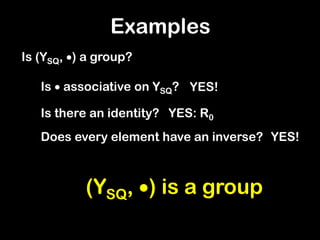
Is (YSQ, ) a group?
Is  associative on YSQ? YES!
Is there an identity? YES: R0
Does every element have an inverse? YES!
(YSQ, ) is a group
Examples
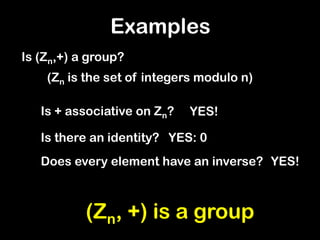
Is (Zn,+) a group?
Is + associative on Zn? YES!
Is there an identity? YES: 0
Does every element have an inverse? YES!
(Zn, +) is a group
(Zn is the set of integers modulo n)
Examples
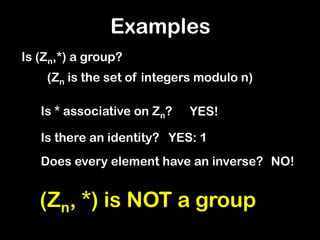
Is (Zn,*) a group?
Is * associative on Zn? YES!
Is there an identity? YES: 1
Does every element have an inverse? NO!
(Zn, *) is NOT a group
(Zn is the set of integers modulo n)
Examples
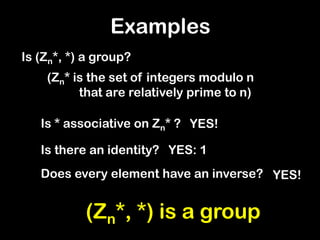
Is (Zn*, *) a group?
Is * associative on Zn* ? YES!
Is there an identity? YES: 1
Does every element have an inverse? YES!
(Zn*, *) is a group
(Zn* is the set of integers modulo n
that are relatively prime to n)
And some properties…
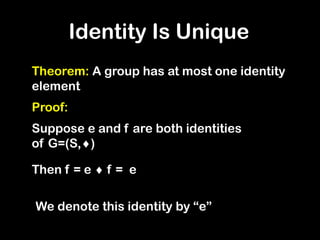
Theorem: A group has at most one identity
element
Proof:
Suppose e and f are both identities
of G=(S,)
Then f = e  f = e
Identity Is Unique
We denote this identity by “e”
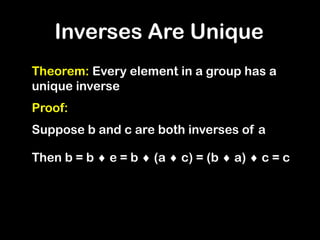
Theorem: Every element in a group has a
unique inverse
Proof:
Inverses Are Unique
Suppose b and c are both inverses of a
Then b = b  e = b  (a  c) = (b  a)  c = c
Orders and generators
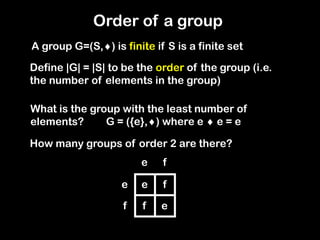
A group G=(S,) is finite if S is a finite set
Define |G| = |S| to be the order of the group (i.e.
the number of elements in the group)
What is the group with the least number of
elements?
How many groups of order 2 are there?
G = ({e},) where e  e = e
e
f
e f
e
f
f
e
Order of a group
Generators
A set T  S is said to generate the group
G = (S,) if every element of S can be expressed as a
finite product of elements in T
Question: Does {R90} generate YSQ?
Question: Does {F|, R90} generate YSQ?
An element g  S is called a generator of G=(S,) if
{g} generates G
Does YSQ have a generator?
NO!
YES!
NO!
Generators For (Zn,+)
Any a  Zn such that GCD(a,n)=1 generates (Zn,+)
Claim: If GCD(a,n) =1, then the numbers
a, 2a, …, (n-1)a, na are all distinct modulo n
Proof (by contradiction):
Suppose xa = ya (mod n) for x,y  {1,…,n} and x ≠ y
Then n | a(x-y)
Since GCD(a,n) = 1, then n | (x-y), which cannot
happen
If G = (S,), we use an denote (a  a  …  a)
n times
Definition: The order of an element a of G is the
smallest positive integer n such that an = e
The order of an element can be infinite!
Example: The order of 1 in the group (Z,+) is
infinite
What is the order of F| in YSQ? 2
What is the order of R90 in YSQ? 4
Order of an element
Theorem: If G is a finite group, then for g
in G, order(g) is finite.
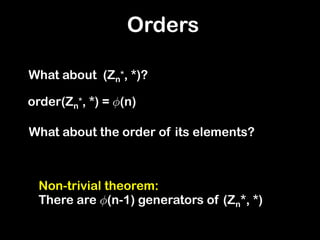
Orders
For (Zn, +), recall that
order(g) = n/GCD(n,g)
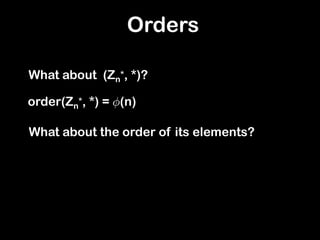
What about (Zn
*, *)?
Orders
order(Zn
*, *) = Á(n)
What about the order of its elements?
What about (Zn
*, *)?
Orders
order(Zn
*, *) = Á(n)
What about the order of its elements?
Non-trivial theorem:
There are Á(n-1) generators of (Zn*, *)
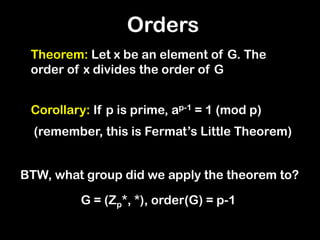
Theorem: Let x be an element of G. The
order of x divides the order of G
Orders
Corollary: If p is prime, ap-1 = 1 (mod p)
(remember, this is Fermat’s Little Theorem)
BTW, what group did we apply the theorem to?
G = (Zp*, *), order(G) = p-1
Groups and Subgroups
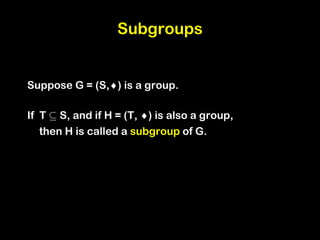
Subgroups
Suppose G = (S,) is a group.
If T µ S, and if H = (T, ) is also a group,
then H is called a subgroup of G.
Examples
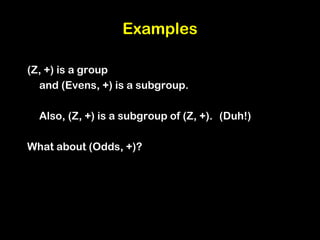
(Z, +) is a group
and (Evens, +) is a subgroup.
Also, (Z, +) is a subgroup of (Z, +). (Duh!)
What about (Odds, +)?
Examples
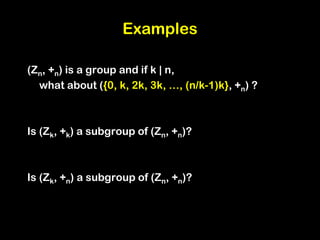
(Zn, +n) is a group and if k | n,
what about ({0, k, 2k, 3k, …, (n/k-1)k}, +n) ?
Is (Zk, +k) a subgroup of (Zn, +n)?
Is (Zk, +n) a subgroup of (Zn, +n)?
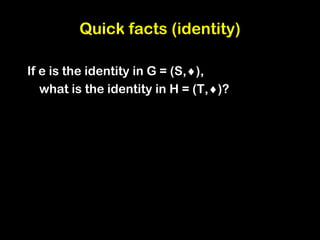
Quick facts (identity)
If e is the identity in G = (S,),
what is the identity in H = (T,)?
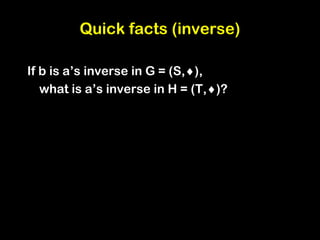
Quick facts (inverse)
If b is a’s inverse in G = (S,),
what is a’s inverse in H = (T,)?
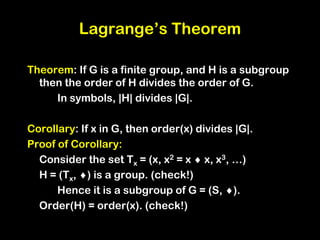
Lagrange’s Theorem
Theorem: If G is a finite group, and H is a subgroup
then the order of H divides the order of G.
In symbols, |H| divides |G|.
Corollary: If x in G, then order(x) divides |G|.
Proof of Corollary:
Consider the set Tx = (x, x2 = x  x, x3, …)
H = (Tx, ) is a group. (check!)
Hence it is a subgroup of G = (S, ).
Order(H) = order(x). (check!)
On to other algebraic definitions
We often define more than one operation
on a set
For example, in Zn we can do both
addition and multiplication modulo n
A ring is a set together with two operations
Lord Of The Rings
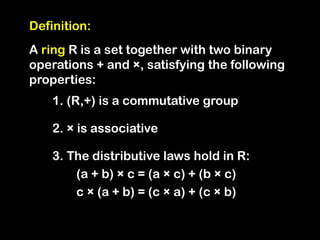
Definition:
A ring R is a set together with two binary
operations + and ×, satisfying the following
properties:
1. (R,+) is a commutative group
2. × is associative
3. The distributive laws hold in R:
(a + b) × c = (a × c) + (b × c)
c × (a + b) = (c × a) + (c × b)
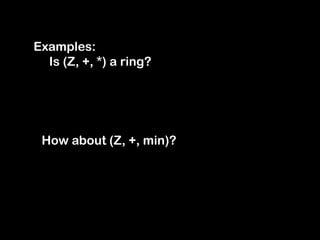
Examples:
Is (Z, +, *) a ring?
How about (Z, +, min)?
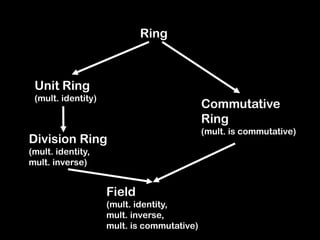
Ring
Unit Ring
(mult. identity)
Division Ring
(mult. identity,
mult. inverse)
Commutative
Ring
(mult. is commutative)
Field
(mult. identity,
mult. inverse,
mult. is commutative)
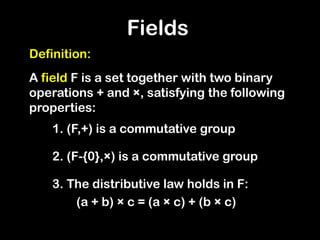
Definition:
A field F is a set together with two binary
operations + and ×, satisfying the following
properties:
1. (F,+) is a commutative group
2. (F-{0},×) is a commutative group
3. The distributive law holds in F:
(a + b) × c = (a × c) + (b × c)
Fields
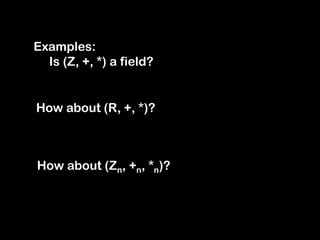
Examples:
Is (Z, +, *) a field?
How about (R, +, *)?
How about (Zn, +n, *n)?
Why should I care about any of this?
Groups, Rings and Fields are examples of
the principle of abstraction: the particulars
of the objects are abstracted into a few
simple properties
If you prove results from some group,
check if the results carry over to any group
In The End…
Symmetries of the Square
Compositions
Groups
Binary Operation
Identity and Inverses
Basic Facts: Inverses Are Unique
Generators
Rings and Fields
Definition
Here’s What
You Need to
Know…

lecture16.ppt

  • 1.
  • 2.
  • 3.
    Today we aregoing to study the abstract properties of binary operations
  • 4.
    Rotating a Squarein Space Imagine we can pick up the square, rotate it in any way we want, and then put it back on the white frame
  • 5.
    In how manydifferent ways can we put the square back on the frame? R90 R180 R270 R0 F| F— F F We will now study these 8 motions, called symmetries of the square
  • 6.
    Symmetries of theSquare YSQ = { R0, R90, R180, R270, F|, F—, F , F }
  • 7.
    Composition Define the operation“” to mean “first do one symmetry, and then do the next” For example, R90  R180 Question: if a,b  YSQ, does a  b  YSQ? means “first rotate 90˚ clockwise and then 180˚” = R270 F|  R90 means “first flip horizontally and then rotate 90˚” = F
  • 8.
    R90 R180 R270 R0F| F— F F R0 R90 R180 R270 F| F— F F R0 R90 R180 R270 F| F— F F R90 R180 R270 F| F— F F R180 R270 R0 R270 R0 R90 R0 R90 R180 F F F| F— F— F| F F F F F— F| F F— F F F| F F— F F| F| F F— R0 R0 R0 R0 R180 R90 R270 R180 R270 R90 R270 R90 R180 R90 R270 R180
  • 9.
    Some Formalism If Sis a set, S  S is: the set of all (ordered) pairs of elements of S S  S = { (a,b) | a  S and b  S } If S has n elements, how many elements does S  S have? n2 Formally,  is a function from YSQ  YSQ to YSQ  : YSQ  YSQ → YSQ As shorthand, we write (a,b) as “a  b”
  • 10.
    “” is calleda binary operation on YSQ Definition: A binary operation on a set S is a function  : S  S → S Example: The function f:    →  defined by is a binary operation on  f(x,y) = xy + y Binary Operations
  • 11.
    Is the operation on the set of symmetries of the square associative? A binary operation  on a set S is associative if: for all a,b,cS, (ab)c = a(bc) Associativity Examples: Is f:    →  defined by f(x,y) = xy + y associative? (ab + b)c + c = a(bc + c) + (bc + c)? NO! YES!
  • 12.
    A binary operation on a set S is commutative if For all a,bS, a  b = b  a Commutativity Is the operation  on the set of symmetries of the square commutative? NO! R90  F| ≠ F|  R90
  • 13.
    R0 is likea null motion Is this true: a  YSQ, a  R0 = R0  a = a? R0 is called the identity of  on YSQ In general, for any binary operation  on a set S, an element e  S such that for all a  S, e  a = a  e = a is called an identity of  on S Identities YES!
  • 14.
    Inverses Definition: The inverseof an element a  YSQ is an element b such that: a  b = b  a = R0 Examples: R90 inverse: R270 R180 inverse: R180 F| inverse: F|
  • 15.
    Every element inYSQ has a unique inverse
  • 16.
    R90 R180 R270 R0F| F— F F R0 R90 R180 R270 F| F— F F R0 R90 R180 R270 F| F— F F R90 R180 R270 F| F— F F R180 R270 R0 R270 R0 R90 R0 R90 R180 F F F| F— F— F| F F F F F— F| F F— F F F| F F— F F| F| F F— R0 R0 R0 R0 R180 R90 R270 R180 R270 R90 R270 R90 R180 R90 R270 R180
  • 17.
    3. (Inverses) Forevery a  S there is b  S such that: Groups A group G is a pair (S,), where S is a set and  is a binary operation on S such that: 1.  is associative 2. (Identity) There exists an element e  S such that: e  a = a  e = a, for all a  S a  b = b  a = e
  • 18.
    Commutative or “Abelian”Groups remember, “commutative” means a  b = b  a for all a, b in S If G = (S,) and  is commutative, then G is called a commutative group
  • 19.
    To check “group-ness” Given(S,) 1. Check “closure” for (S,) (i.e, for any a, b in S, check a  b also in S). 2. Check that associativity holds. 3. Check there is a identity 4. Check every element has an inverse
  • 20.
  • 21.
    Examples Is (,+) agroup? Is + associative on ? YES! Is there an identity? YES: 0 Does every element have an inverse? NO! (,+) is NOT a group
  • 22.
    Examples Is (Z,+) agroup? Is + associative on Z? YES! Is there an identity? YES: 0 Does every element have an inverse? YES! (Z,+) is a group
  • 23.
    Examples Is (Odds,+) agroup? (Odds,+) is NOT a group Is + associative on Odds? YES! Is there an identity? YES: 0 Does every element have an inverse? YES! Are the Odds closed under addition NO!
  • 24.
    Examples Is (YSQ, )a group? Is  associative on YSQ? YES! Is there an identity? YES: R0 Does every element have an inverse? YES! (YSQ, ) is a group
  • 25.
    Examples Is (Zn,+) agroup? Is + associative on Zn? YES! Is there an identity? YES: 0 Does every element have an inverse? YES! (Zn, +) is a group (Zn is the set of integers modulo n)
  • 26.
    Examples Is (Zn,*) agroup? Is * associative on Zn? YES! Is there an identity? YES: 1 Does every element have an inverse? NO! (Zn, *) is NOT a group (Zn is the set of integers modulo n)
  • 27.
    Examples Is (Zn*, *)a group? Is * associative on Zn* ? YES! Is there an identity? YES: 1 Does every element have an inverse? YES! (Zn*, *) is a group (Zn* is the set of integers modulo n that are relatively prime to n)
  • 28.
  • 29.
    Theorem: A grouphas at most one identity element Proof: Suppose e and f are both identities of G=(S,) Then f = e  f = e Identity Is Unique We denote this identity by “e”
  • 30.
    Theorem: Every elementin a group has a unique inverse Proof: Inverses Are Unique Suppose b and c are both inverses of a Then b = b  e = b  (a  c) = (b  a)  c = c
  • 31.
  • 32.
    A group G=(S,)is finite if S is a finite set Define |G| = |S| to be the order of the group (i.e. the number of elements in the group) What is the group with the least number of elements? How many groups of order 2 are there? G = ({e},) where e  e = e e f e f e f f e Order of a group
  • 33.
    Generators A set T S is said to generate the group G = (S,) if every element of S can be expressed as a finite product of elements in T Question: Does {R90} generate YSQ? Question: Does {F|, R90} generate YSQ? An element g  S is called a generator of G=(S,) if {g} generates G Does YSQ have a generator? NO! YES! NO!
  • 34.
    Generators For (Zn,+) Anya  Zn such that GCD(a,n)=1 generates (Zn,+) Claim: If GCD(a,n) =1, then the numbers a, 2a, …, (n-1)a, na are all distinct modulo n Proof (by contradiction): Suppose xa = ya (mod n) for x,y  {1,…,n} and x ≠ y Then n | a(x-y) Since GCD(a,n) = 1, then n | (x-y), which cannot happen
  • 35.
    If G =(S,), we use an denote (a  a  …  a) n times Definition: The order of an element a of G is the smallest positive integer n such that an = e The order of an element can be infinite! Example: The order of 1 in the group (Z,+) is infinite What is the order of F| in YSQ? 2 What is the order of R90 in YSQ? 4 Order of an element
  • 36.
    Theorem: If Gis a finite group, then for g in G, order(g) is finite. Orders For (Zn, +), recall that order(g) = n/GCD(n,g)
  • 37.
    What about (Zn *,*)? Orders order(Zn *, *) = Á(n) What about the order of its elements?
  • 38.
    What about (Zn *,*)? Orders order(Zn *, *) = Á(n) What about the order of its elements? Non-trivial theorem: There are Á(n-1) generators of (Zn*, *)
  • 39.
    Theorem: Let xbe an element of G. The order of x divides the order of G Orders Corollary: If p is prime, ap-1 = 1 (mod p) (remember, this is Fermat’s Little Theorem) BTW, what group did we apply the theorem to? G = (Zp*, *), order(G) = p-1
  • 40.
  • 41.
    Subgroups Suppose G =(S,) is a group. If T µ S, and if H = (T, ) is also a group, then H is called a subgroup of G.
  • 42.
    Examples (Z, +) isa group and (Evens, +) is a subgroup. Also, (Z, +) is a subgroup of (Z, +). (Duh!) What about (Odds, +)?
  • 43.
    Examples (Zn, +n) isa group and if k | n, what about ({0, k, 2k, 3k, …, (n/k-1)k}, +n) ? Is (Zk, +k) a subgroup of (Zn, +n)? Is (Zk, +n) a subgroup of (Zn, +n)?
  • 44.
    Quick facts (identity) Ife is the identity in G = (S,), what is the identity in H = (T,)?
  • 45.
    Quick facts (inverse) Ifb is a’s inverse in G = (S,), what is a’s inverse in H = (T,)?
  • 46.
    Lagrange’s Theorem Theorem: IfG is a finite group, and H is a subgroup then the order of H divides the order of G. In symbols, |H| divides |G|. Corollary: If x in G, then order(x) divides |G|. Proof of Corollary: Consider the set Tx = (x, x2 = x  x, x3, …) H = (Tx, ) is a group. (check!) Hence it is a subgroup of G = (S, ). Order(H) = order(x). (check!)
  • 47.
    On to otheralgebraic definitions
  • 48.
    We often definemore than one operation on a set For example, in Zn we can do both addition and multiplication modulo n A ring is a set together with two operations Lord Of The Rings
  • 49.
    Definition: A ring Ris a set together with two binary operations + and ×, satisfying the following properties: 1. (R,+) is a commutative group 2. × is associative 3. The distributive laws hold in R: (a + b) × c = (a × c) + (b × c) c × (a + b) = (c × a) + (c × b)
  • 50.
    Examples: Is (Z, +,*) a ring? How about (Z, +, min)?
  • 51.
    Ring Unit Ring (mult. identity) DivisionRing (mult. identity, mult. inverse) Commutative Ring (mult. is commutative) Field (mult. identity, mult. inverse, mult. is commutative)
  • 52.
    Definition: A field Fis a set together with two binary operations + and ×, satisfying the following properties: 1. (F,+) is a commutative group 2. (F-{0},×) is a commutative group 3. The distributive law holds in F: (a + b) × c = (a × c) + (b × c) Fields
  • 53.
    Examples: Is (Z, +,*) a field? How about (R, +, *)? How about (Zn, +n, *n)?
  • 54.
    Why should Icare about any of this? Groups, Rings and Fields are examples of the principle of abstraction: the particulars of the objects are abstracted into a few simple properties If you prove results from some group, check if the results carry over to any group In The End…
  • 55.
    Symmetries of theSquare Compositions Groups Binary Operation Identity and Inverses Basic Facts: Inverses Are Unique Generators Rings and Fields Definition Here’s What You Need to Know…