Downloaded 21 times











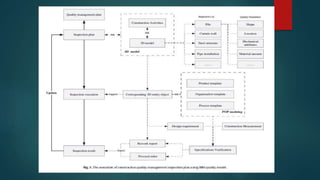





This document discusses Building Information Modeling (BIM) and its applications in quality management. It begins by defining BIM as a digital representation of physical and functional characteristics of a building that can be shared and used to support decision making throughout the building's lifecycle. The document then outlines several benefits of using BIM, such as improved collaboration, clash detection, and leveraging of data. It proposes using BIM to integrate quality management by including quality information in the model's layers. The document concludes by describing a methodology for a 4D BIM-based quality management application and its validation through a case study.


