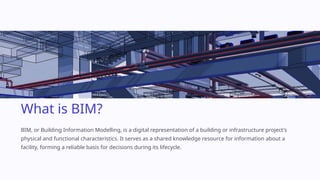
What is BIM?
BIM,or Building Information Modelling, is a digital representation of a building or infrastructure project's
physical and functional characteristics. It serves as a shared knowledge resource for information about a
facility, forming a reliable basis for decisions during its lifecycle.
3.
Key BIM Benefits
ImprovedCollaboration
BIM enables seamless
information sharing and
coordination among architects,
engineers, contractors, and
owners throughout the project
lifecycle.
Cost Savings
BIM helps identify and resolve
design conflicts early, reducing
costly changes and rework
during construction.
Enhanced Visualization
Highly detailed 3D models
provide a clear, realistic
representation of the final
project, aiding in decision-
making.
4.
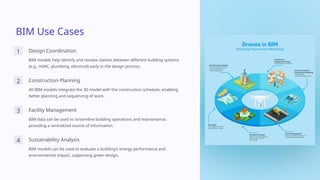
BIM Use Cases
1Design Coordination
BIM models help identify and resolve clashes between different building systems
(e.g., HVAC, plumbing, electrical) early in the design process.
2 Construction Planning
4D BIM models integrate the 3D model with the construction schedule, enabling
better planning and sequencing of work.
3 Facility Management
BIM data can be used to streamline building operations and maintenance,
providing a centralized source of information.
4 Sustainability Analysis
BIM models can be used to evaluate a building's energy performance and
environmental impact, supporting green design.
5.
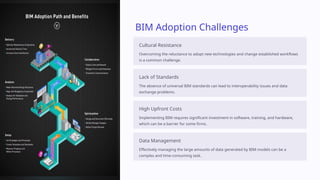
BIM Adoption Challenges
CulturalResistance
Overcoming the reluctance to adopt new technologies and change established workflows
is a common challenge.
Lack of Standards
The absence of universal BIM standards can lead to interoperability issues and data
exchange problems.
High Upfront Costs
Implementing BIM requires significant investment in software, training, and hardware,
which can be a barrier for some firms.
Data Management
Effectively managing the large amounts of data generated by BIM models can be a
complex and time-consuming task.
6.
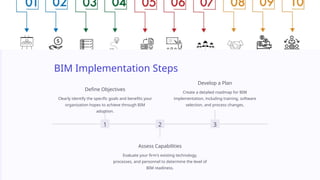
BIM Implementation Steps
1
DefineObjectives
Clearly identify the specific goals and benefits your
organization hopes to achieve through BIM
adoption.
2
Assess Capabilities
Evaluate your firm's existing technology,
processes, and personnel to determine the level of
BIM readiness.
3
Develop a Plan
Create a detailed roadmap for BIM
implementation, including training, software
selection, and process changes.
7.
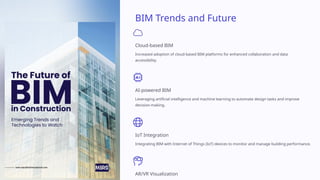
BIM Trends andFuture
Cloud-based BIM
Increased adoption of cloud-based BIM platforms for enhanced collaboration and data
accessibility.
AI-powered BIM
Leveraging artificial intelligence and machine learning to automate design tasks and improve
decision-making.
IoT Integration
Integrating BIM with Internet of Things (IoT) devices to monitor and manage building performance.
AR/VR Visualization
8.
Conclusion
Building Information Modellinghas become an essential tool
in the civil engineering and construction industries, offering
significant benefits in terms of collaboration, cost savings, and
project delivery. As BIM continues to evolve, its widespread
adoption and integration with emerging technologies will
shape the future of the built environment.