MINI PROJECT
Building Information
Modelling
Submitted by.
PRATHAMESH ULHAS BOMMEWAR
DIKSHA A. PATIL
NIKITA G. BAKARWALE
RESHMA S. LONARE
AAKANSHA K. HASTE
Guided by :-
SANDEEP AJMIRE
What is BIM ? • BIM (Building Information Modelling) is an
intelligent 3D model-based process that gives
architecture, engineering, and construction (AEC)
professionals the insight and tools to more
efficiently plan, design. construct, and manage
buildings and infrastructure.
• It is Parametric.
• Contains Graphical and Non Graphical
Information.
• It is the coordinated model.
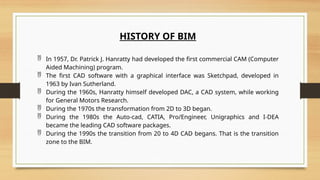
HISTORY OF BIM
 In 1957, Dr. Patrick J. Hanratty had developed the first commercial CAM (Computer
Aided Machining) program.
 The first CAD software with a graphical interface was Sketchpad, developed in
1963 by Ivan Sutherland.
 During the 1960s, Hanratty himself developed DAC, a CAD system, while working
for General Motors Research.
 During the 1970s the transformation from 2D to 3D began.
 During the 1980s the Auto-cad, CATIA, Pro/Engineer, Unigraphics and I-DEA
became the leading CAD software packages.
 During the 1990s the transition from 20 to 4D CAD begans. That is the transition
zone to the BIM.
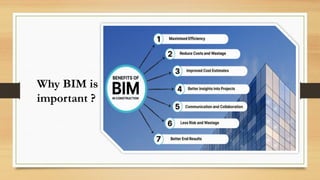
Why BIM is
important ?
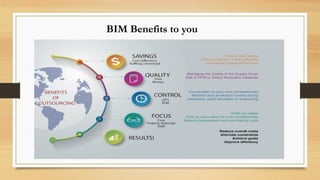
BIM Benefits to you
NEED OF BIM
 BIM provides a way to work concurrently on most aspects of building life cycle
process
 Provides a way to change traditional architectural phases and data sharing.
 The modeling process integrates actual construction pieces and parts
 BIM can be used as a tool to estimate and complete construction cost forecasting
 Used to monitor actual building performance data
 The software can be used to collect data on warranty, aging, defects, and
installation time
 Determine whether a temporary construction set up is needed
 Can be used to sequencing planning or determining how the phases of a project
should he scheduled.
 Detect or avoid construction and design issues early in the game preventing
change orders and unforeseen conditions
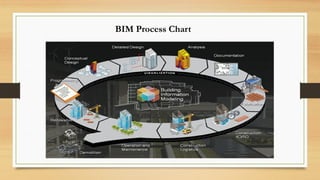
BIM Process Chart
BIM APPLICATIONS
The BIM application process can be used during design and architecture process creating
a clear picture used for better and more integrated designs. There are multiple
applications for BIM so it can be used by the following groups:
 Architecture
 Sustainability
 Structures
o Detailed design
o Design Analysis
 MEP
 Construction Management
o Time Management (PERT & CPM)
 Utilities
 Road Construction
 Scheduling
o Cost Analysis & Quantity schedule
 Property Management
 Documentation
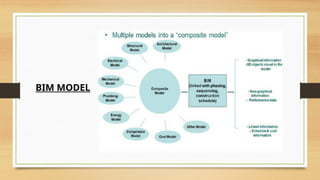
BIM MODEL
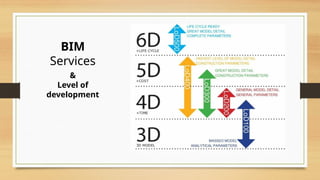
BIM
Services
&
Level of
development
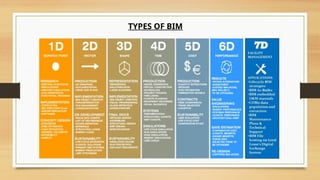
TYPES OF BIM
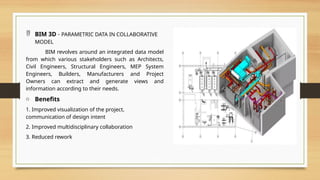
 BIM 3D - PARAMETRIC DATA IN COLLABORATIVE
MODEL
BIM revolves around an integrated data model
from which various stakeholders such as Architects,
Civil Engineers, Structural Engineers, MEP System
Engineers, Builders, Manufacturers and Project
Owners can extract and generate views and
information according to their needs.
o Benefits
1. Improved visualization of the project,
communication of design intent
2. Improved multidisciplinary collaboration
3. Reduced rework
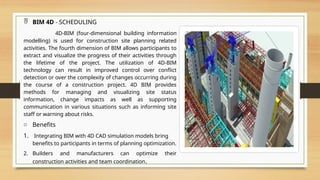
 BIM 4D - SCHEDULING
4D-BIM (four-dimensional building information
modelling) is used for construction site planning related
activities. The fourth dimension of BIM allows participants to
extract and visualize the progress of their activities through
the lifetime of the project. The utilization of 4D-BIM
technology can result in improved control over conflict
detection or over the complexity of changes occurring during
the course of a construction project. 4D BIM provides
methods for managing and visualizing site status
information, change impacts as well as supporting
communication in various situations such as informing site
staff or warning about risks.
o Benefits
1. Integrating BIM with 4D CAD simulation models bring
benefits to participants in terms of planning optimization.
2. Builders and manufacturers can optimize their
construction activities and team coordination.
 BIM 5D - ESTIMATING
5D-BIM (fifth-dimensional building information modelling) is used for budget
tracking and cost analysis related activities. The fifth dimension of BIM associated with
3D and 4D (Time) allows participants to visualize the progress of their activities and
related costs over time. The utilization of 5D-BIM technology can result in a greater
accuracy and predictability of project's estimates, scope changes and materials,
equipment or manpower changes. 5D BIM provides methods for extracting and
analysing costs, evaluating scenarios and changes impacts.
o Benefits
1. Integrating BIM with SD CAD simulation models enables the development of more
efficient, cost-effective and sustainable constructions,
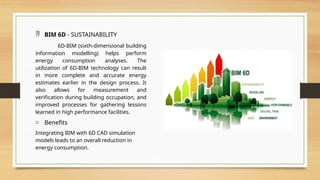
 BIM 6D - SUSTAINABILITY
6D-BIM (sixth-dimensional building
information modelling) helps perform
energy consumption analyses. The
utilization of 6D-BIM technology can result
in more complete and accurate energy
estimates earlier in the design process. It
also allows for measurement and
verification during building occupation, and
improved processes for gathering lessons
learned in high performance facilities.
o Benefits
Integrating BIM with 6D CAD simulation
models leads to an overall reduction in
energy consumption.
 BIM 7D - FACILITY MANAGEMENT
7D-BIM (seventh-dimensional building information modelling) is used by
managers in the operation and maintenance of the facility throughout its life cycle.
The seventh dimension of BIM allows participants to extract and track relevant
asset data such as component status, specifications, maintenance/operation
manuals, warranty data etc. The utilization of 7D-BIM technology can result in
easier and quicker parts replacements, optimized compliance and a streamlined
asset life cycle management over time. 7D BIM provides processes for managing
subcontractor/supplier data and facility component through the entire facility life
cycle.
o Benefits
Integrating BIM with 7D CAD simulation models optimizes asset management
from design to demolition.
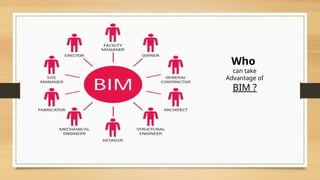
Who
can take
Advantage of
BIM ?
OBJECTIVES
 To explore the process of Building Information
Modelling.
 To study about the various BIM software
 To study about Industry Foundation Classes (IFC).
THANK YOU

Building Information Modelling ppt.pptx

  • 1.
    MINI PROJECT Building Information Modelling Submittedby. PRATHAMESH ULHAS BOMMEWAR DIKSHA A. PATIL NIKITA G. BAKARWALE RESHMA S. LONARE AAKANSHA K. HASTE Guided by :- SANDEEP AJMIRE
  • 2.
    What is BIM? • BIM (Building Information Modelling) is an intelligent 3D model-based process that gives architecture, engineering, and construction (AEC) professionals the insight and tools to more efficiently plan, design. construct, and manage buildings and infrastructure. • It is Parametric. • Contains Graphical and Non Graphical Information. • It is the coordinated model.
  • 3.
    HISTORY OF BIM In 1957, Dr. Patrick J. Hanratty had developed the first commercial CAM (Computer Aided Machining) program.  The first CAD software with a graphical interface was Sketchpad, developed in 1963 by Ivan Sutherland.  During the 1960s, Hanratty himself developed DAC, a CAD system, while working for General Motors Research.  During the 1970s the transformation from 2D to 3D began.  During the 1980s the Auto-cad, CATIA, Pro/Engineer, Unigraphics and I-DEA became the leading CAD software packages.  During the 1990s the transition from 20 to 4D CAD begans. That is the transition zone to the BIM.
  • 4.
  • 5.
  • 6.
    NEED OF BIM BIM provides a way to work concurrently on most aspects of building life cycle process  Provides a way to change traditional architectural phases and data sharing.  The modeling process integrates actual construction pieces and parts  BIM can be used as a tool to estimate and complete construction cost forecasting  Used to monitor actual building performance data  The software can be used to collect data on warranty, aging, defects, and installation time  Determine whether a temporary construction set up is needed  Can be used to sequencing planning or determining how the phases of a project should he scheduled.  Detect or avoid construction and design issues early in the game preventing change orders and unforeseen conditions
  • 7.
  • 8.
    BIM APPLICATIONS The BIMapplication process can be used during design and architecture process creating a clear picture used for better and more integrated designs. There are multiple applications for BIM so it can be used by the following groups:  Architecture  Sustainability  Structures o Detailed design o Design Analysis  MEP  Construction Management o Time Management (PERT & CPM)  Utilities  Road Construction  Scheduling o Cost Analysis & Quantity schedule  Property Management  Documentation
  • 9.
  • 10.
  • 11.
  • 12.
     BIM 3D- PARAMETRIC DATA IN COLLABORATIVE MODEL BIM revolves around an integrated data model from which various stakeholders such as Architects, Civil Engineers, Structural Engineers, MEP System Engineers, Builders, Manufacturers and Project Owners can extract and generate views and information according to their needs. o Benefits 1. Improved visualization of the project, communication of design intent 2. Improved multidisciplinary collaboration 3. Reduced rework
  • 13.
     BIM 4D- SCHEDULING 4D-BIM (four-dimensional building information modelling) is used for construction site planning related activities. The fourth dimension of BIM allows participants to extract and visualize the progress of their activities through the lifetime of the project. The utilization of 4D-BIM technology can result in improved control over conflict detection or over the complexity of changes occurring during the course of a construction project. 4D BIM provides methods for managing and visualizing site status information, change impacts as well as supporting communication in various situations such as informing site staff or warning about risks. o Benefits 1. Integrating BIM with 4D CAD simulation models bring benefits to participants in terms of planning optimization. 2. Builders and manufacturers can optimize their construction activities and team coordination.
  • 14.
     BIM 5D- ESTIMATING 5D-BIM (fifth-dimensional building information modelling) is used for budget tracking and cost analysis related activities. The fifth dimension of BIM associated with 3D and 4D (Time) allows participants to visualize the progress of their activities and related costs over time. The utilization of 5D-BIM technology can result in a greater accuracy and predictability of project's estimates, scope changes and materials, equipment or manpower changes. 5D BIM provides methods for extracting and analysing costs, evaluating scenarios and changes impacts. o Benefits 1. Integrating BIM with SD CAD simulation models enables the development of more efficient, cost-effective and sustainable constructions,
  • 15.
     BIM 6D- SUSTAINABILITY 6D-BIM (sixth-dimensional building information modelling) helps perform energy consumption analyses. The utilization of 6D-BIM technology can result in more complete and accurate energy estimates earlier in the design process. It also allows for measurement and verification during building occupation, and improved processes for gathering lessons learned in high performance facilities. o Benefits Integrating BIM with 6D CAD simulation models leads to an overall reduction in energy consumption.
  • 16.
     BIM 7D- FACILITY MANAGEMENT 7D-BIM (seventh-dimensional building information modelling) is used by managers in the operation and maintenance of the facility throughout its life cycle. The seventh dimension of BIM allows participants to extract and track relevant asset data such as component status, specifications, maintenance/operation manuals, warranty data etc. The utilization of 7D-BIM technology can result in easier and quicker parts replacements, optimized compliance and a streamlined asset life cycle management over time. 7D BIM provides processes for managing subcontractor/supplier data and facility component through the entire facility life cycle. o Benefits Integrating BIM with 7D CAD simulation models optimizes asset management from design to demolition.
  • 17.
  • 19.
    OBJECTIVES  To explorethe process of Building Information Modelling.  To study about the various BIM software  To study about Industry Foundation Classes (IFC).
  • 20.