BLDG 4051 | George Brown College| Omer Syed -
100777134
Capstone Report:
The integration of BIM in Construction
Organizations & it’s impacts on Productivity
April 21, 2016
Intensions & Assumptions
 To explain the concept of BIM and its impacts on productivity in
the Construction Industry.
 To help educate the reader in understanding what BIM is and
how BIM can be implemented in the workforce.
 Due to conflicting schedules, only 3 in-person interviews could
be used as primary sources of information
Introduction
 The Construction Industry accounts for 6% of Canada's GDP
(Statistics Canada, 2016).
 Currently, programs like AutoCAD is the popular choice to use
when designing and documenting architectural & construction
drawings
 However the process can be slow and most of the time is used
up in coordination and correcting discrepancies.
 Which is why increase the productivity and output of
construction drawings and documents is a crucial part in a
project orientated industry such as the Construction Industry.
Thesis Statement
 “BIM programs & practices are not only used
to help with communication and visual
understandings of a project, but also have a
great impact on accelerating productivity and
achieving a higher project turnover rate.
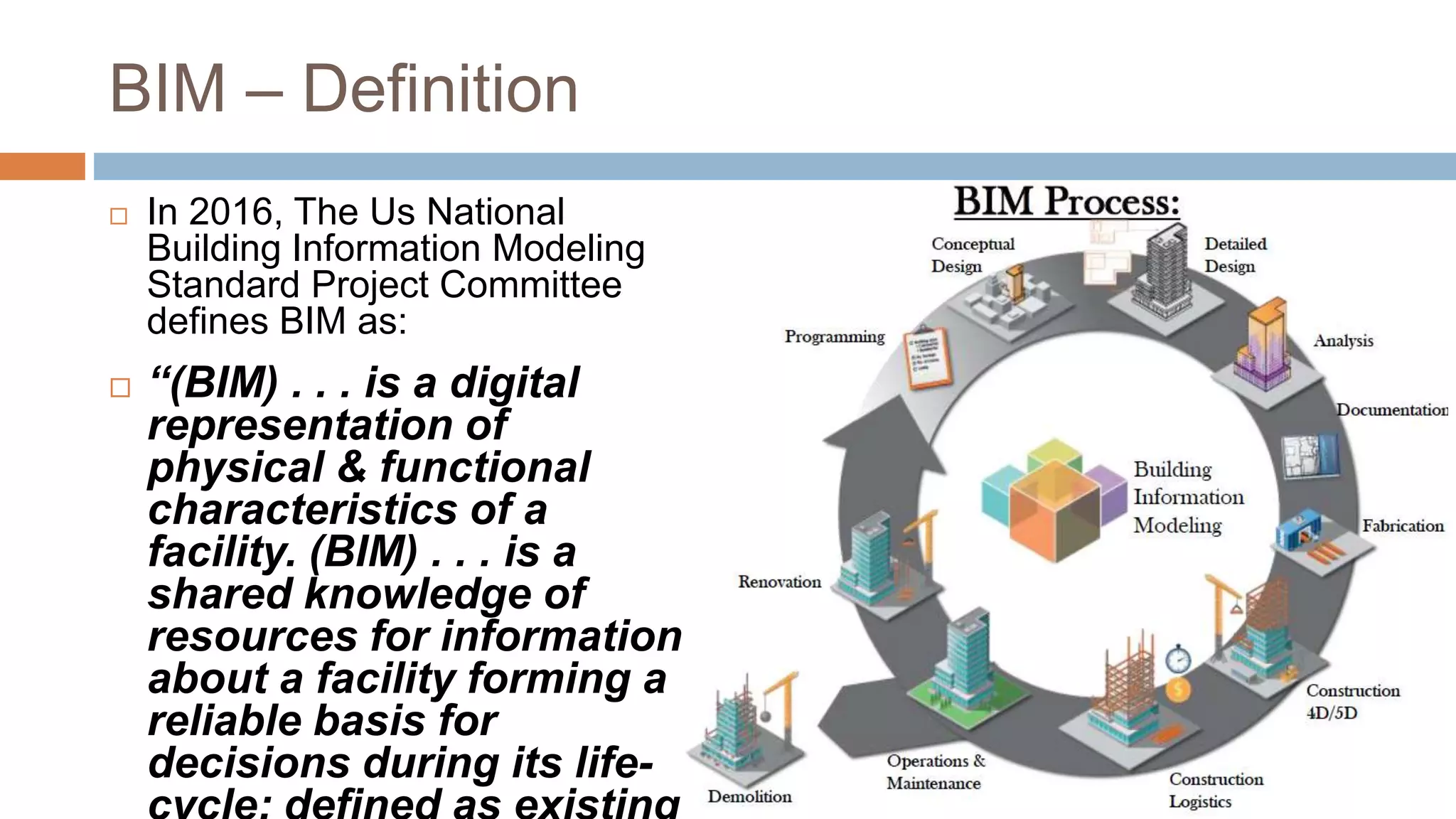
BIM – Definition
 In 2016, The Us National
Building Information Modeling
Standard Project Committee
defines BIM as:
 “(BIM) . . . is a digital
representation of
physical & functional
characteristics of a
facility. (BIM) . . . is a
shared knowledge of
resources for information
about a facility forming a
reliable basis for
decisions during its life-
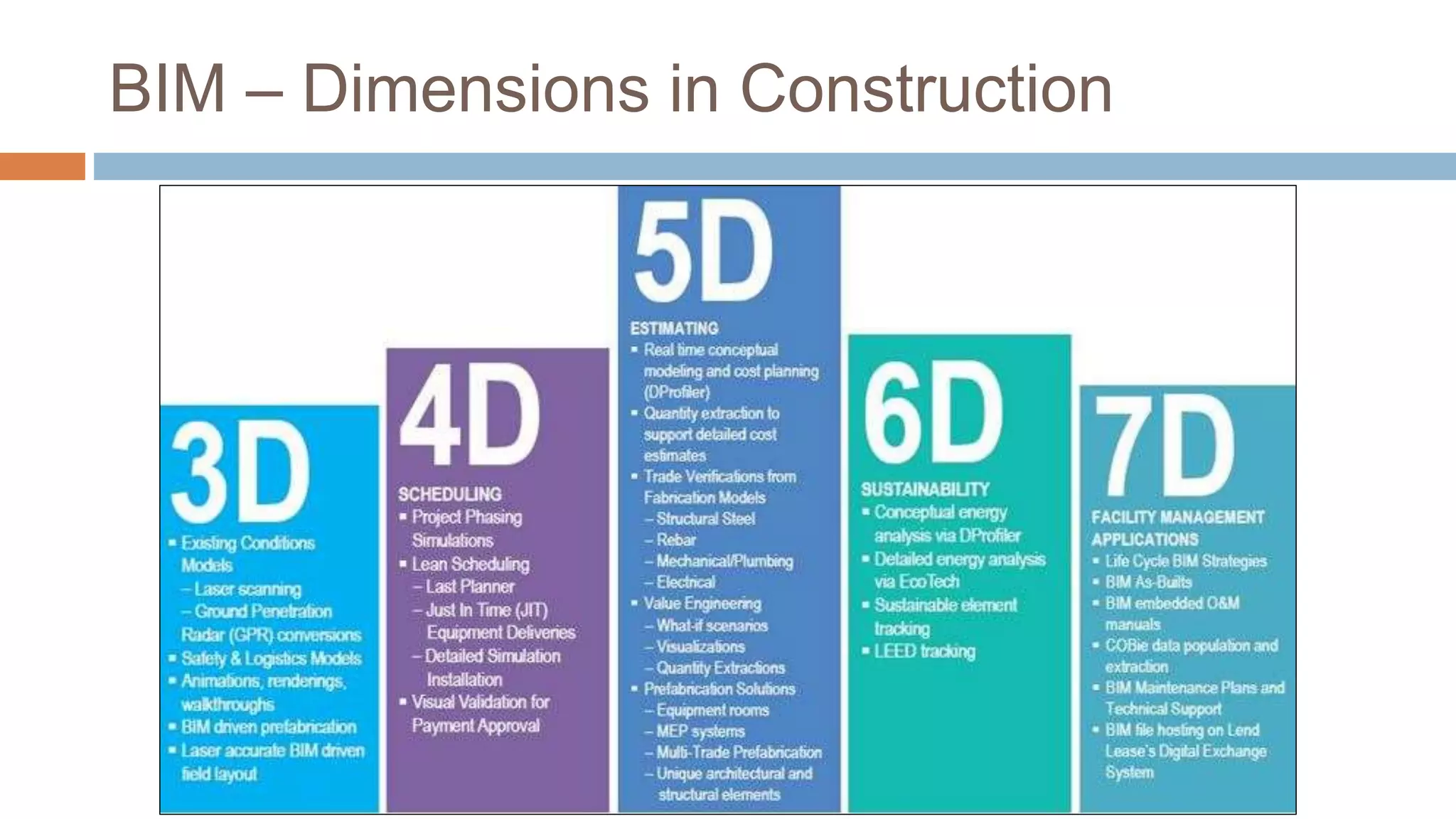
BIM – Dimensions in Construction
BIM – History
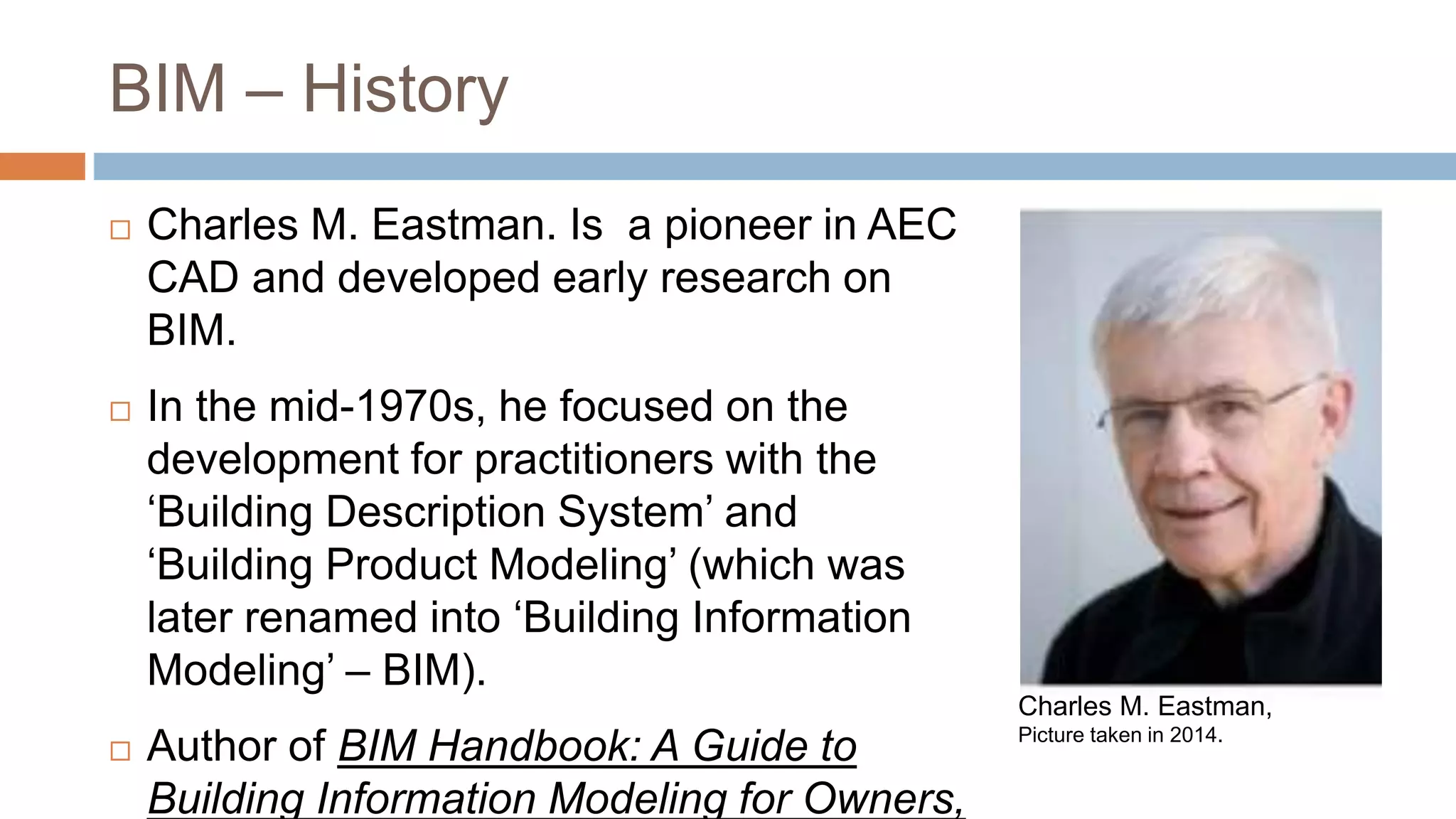
 Charles M. Eastman. Is a pioneer in AEC
CAD and developed early research on
BIM.
 In the mid-1970s, he focused on the
development for practitioners with the
‘Building Description System’ and
‘Building Product Modeling’ (which was
later renamed into ‘Building Information
Modeling’ – BIM).
 Author of BIM Handbook: A Guide to
Building Information Modeling for Owners,
Charles M. Eastman,
Picture taken in 2014.
BIM – Off-Site Applications
 BIM is mainly used in offices of Construction & Design
companies.
 There are 5 main purposes when working with BIM:
 Gather – Collect & organize Information
 Generate – Create & design with the information gathered
 Analyze – Review the design and it properties
 Communicate – Present & document the design & information
 Realize – Follow through with the design & implement it in the
construction phase
BIM – On-Site Applications
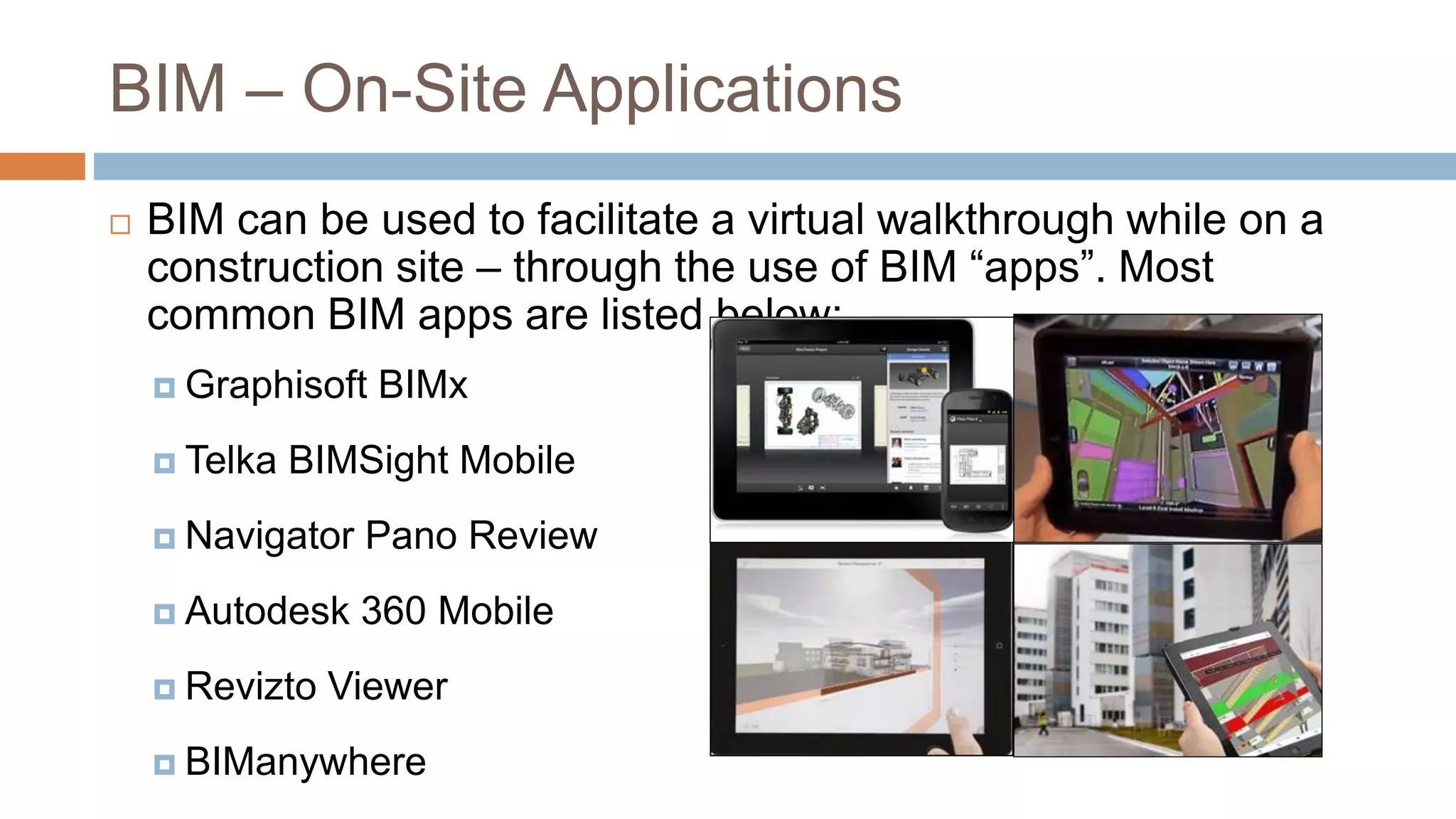
 BIM can be used to facilitate a virtual walkthrough while on a
construction site – through the use of BIM “apps”. Most
common BIM apps are listed below:
 Graphisoft BIMx
 Telka BIMSight Mobile
 Navigator Pano Review
 Autodesk 360 Mobile
 Revizto Viewer
 BIManywhere
BIM – Programs
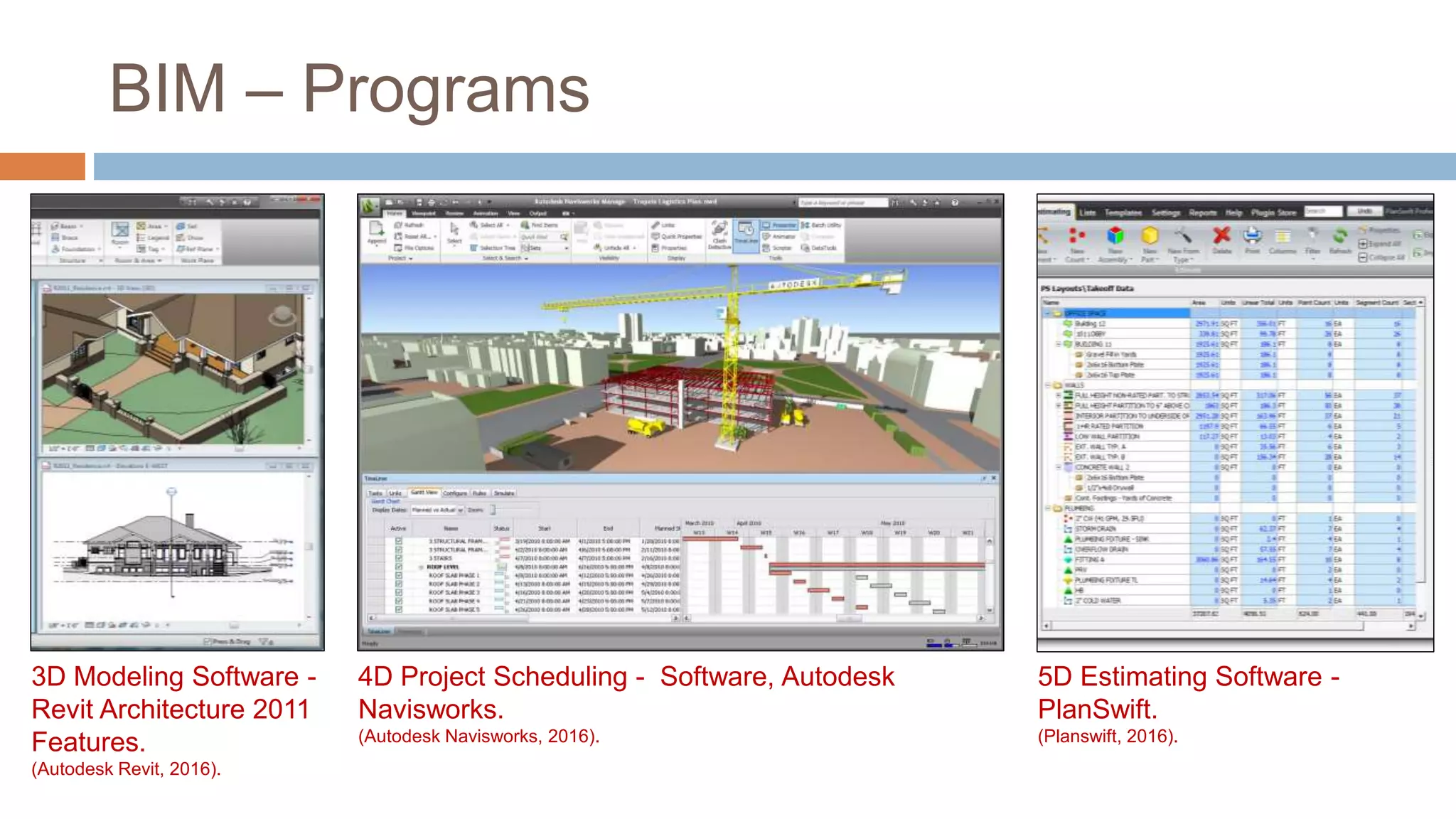
3D Modeling Software -
Revit Architecture 2011
Features.
(Autodesk Revit, 2016).
4D Project Scheduling - Software, Autodesk
Navisworks.
(Autodesk Navisworks, 2016).
5D Estimating Software -
PlanSwift.
(Planswift, 2016).
BIM – Productivity Rates
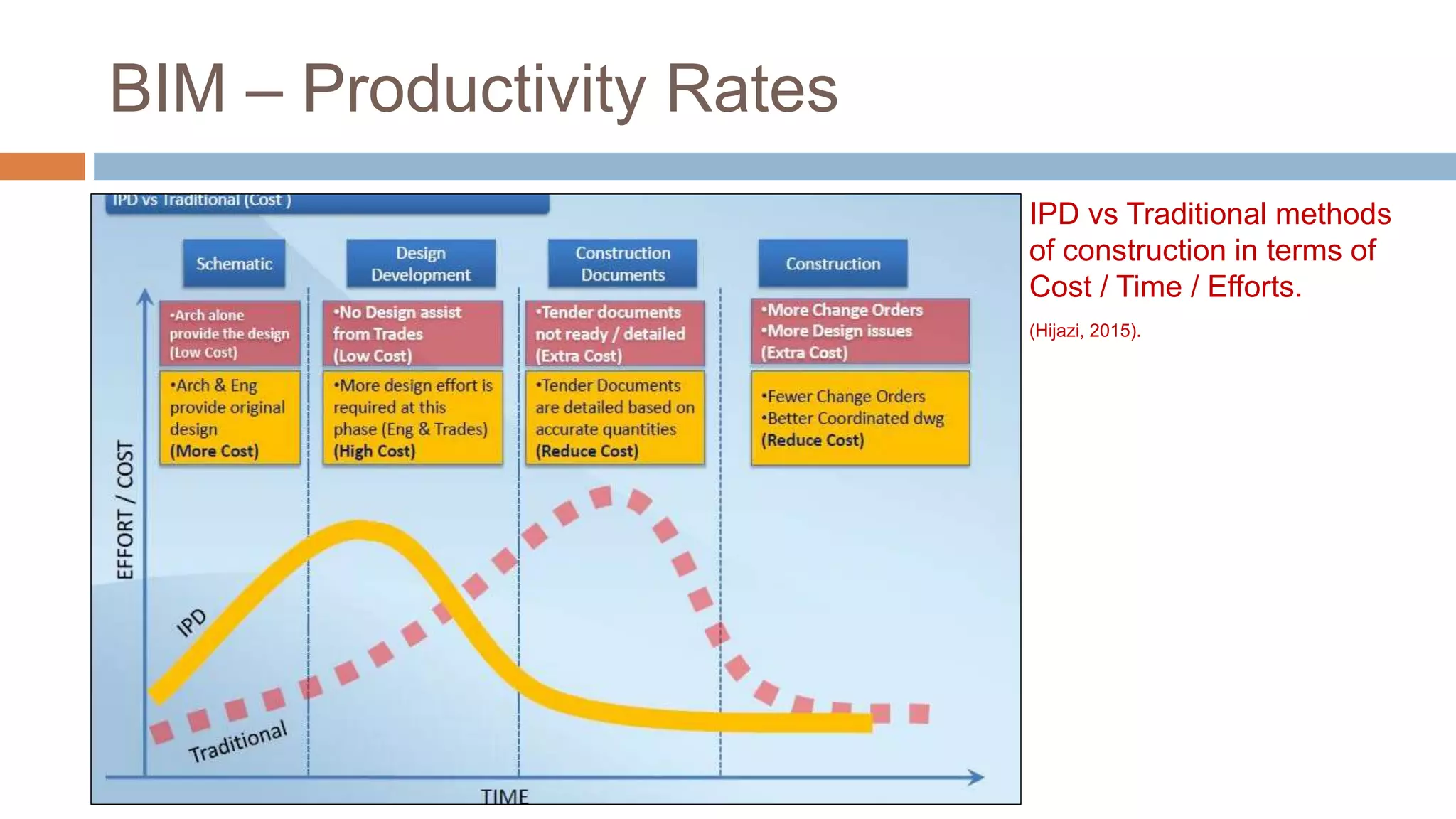
IPD vs Traditional methods
of construction in terms of
Cost / Time / Efforts.
(Hijazi, 2015).
BIM – Productivity Rates
This graph depicts the total time it takes to
complete a project, by using BIM & CAD
separately.
(Graphisoft, 2015).
Additionally, BIM enabled projects have
reduced the number of RFI’s to 10% of the
project.
(Chelson, 2010).
This reduction of rework and idle time, due
to site conflicts savings for trade
contractors, have been reduced to 9% of
BIM – Productivity Rates
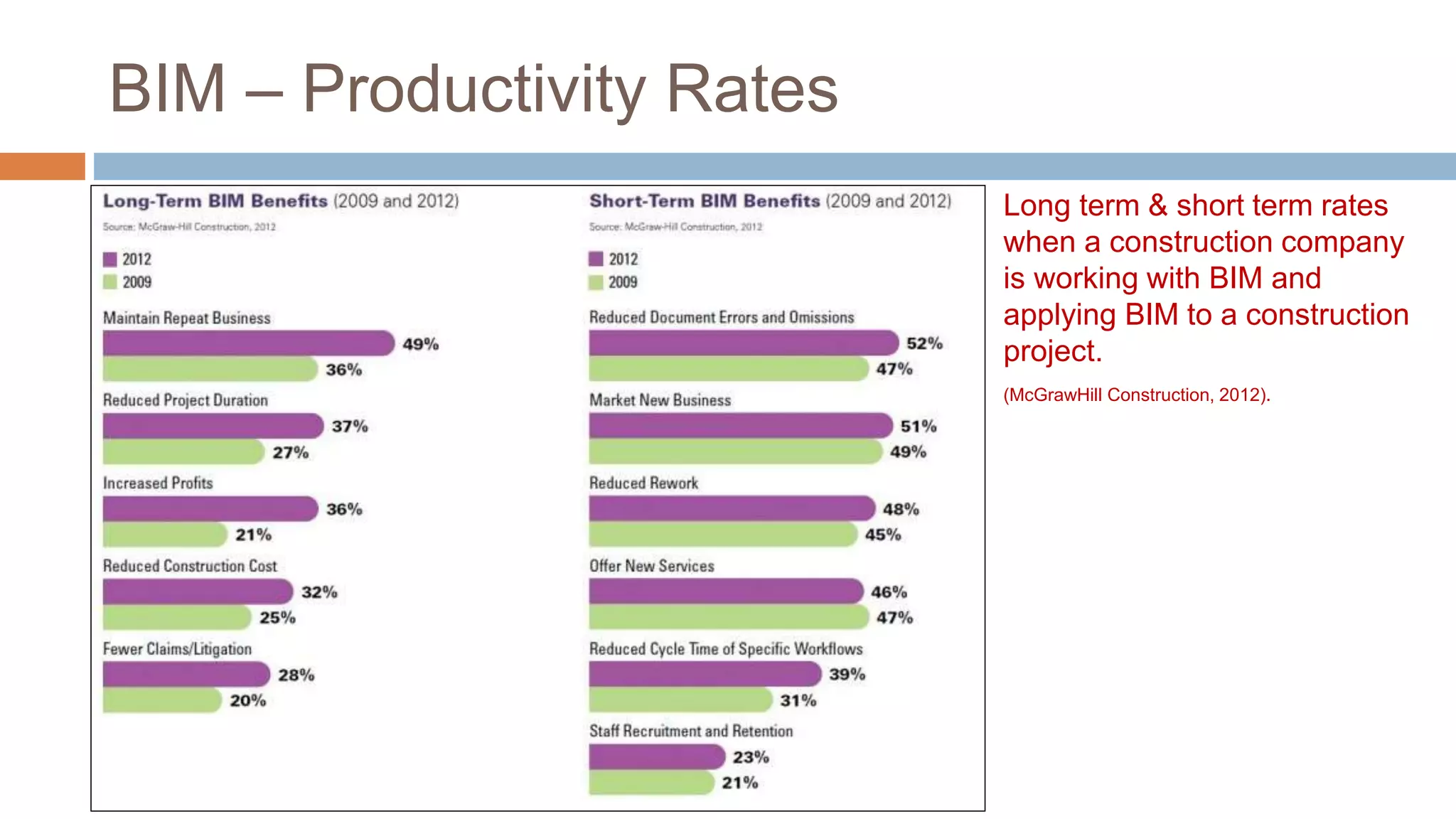
Long term & short term rates
when a construction company
is working with BIM and
applying BIM to a construction
project.
(McGrawHill Construction, 2012).
BIM – Productivity Rates
Tangible benefits for contractors &
sub-trades working with BIM related
programs and implementing BIM
practices.
(Turner, 2015).
BIM – Productivity Rates: Facts from
Studies
 75% of BIM users reported better multi-party
communication.
 57% of Designers state BIM reduces errors during the
design phase.
 Average project duration reduced by 37%.
 65% of contractors report BIM reduces rework and cost
BIM – Project Turnover Rates
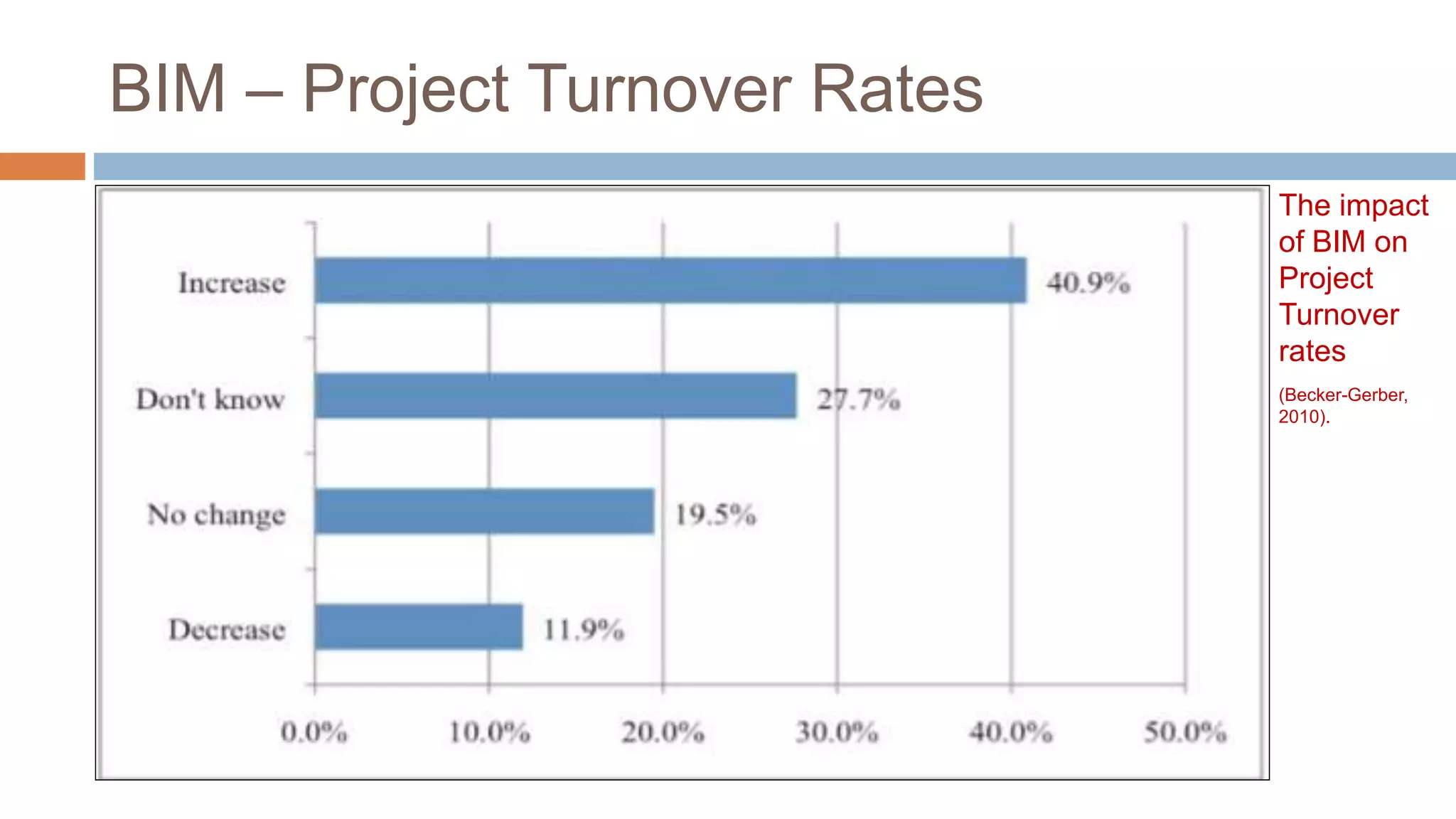
The impact
of BIM on
Project
Turnover
rates
(Becker-Gerber,
2010).
BIM – Implementation
 Software / Hardware Requirements:
 CPU Types:
 Multi-Core Intel Pentium, Xeon, or i-Series Porcessor or an AMD equivalent
 Memory
 4 – 8 GB of RAM
 Video Graphics Card
 Direct X11 with Shader Model 3 (As recommended by Autodesk)
 Staff Training Requirements:
 Sufficient Human Capitol to complete the project in a Team Based
environment
 A diploma in Architectural Technology (or equivalent diploma) is
usually required.
BIM – Challenges
 IPD concept education & “Know how”
 Understanding each other’s role &
responsibility
 Set up communication protocols
 Understanding that increase in cost at
early stages can substantially reduce
construction process costs, change
orders and requests for information.
 Contractors & sub-contractors need to
revise their construction management &
process.
A typical IPD system.
Primary Sources – Jacek Gorka
 Jacek Gorka Dipl. Ing., ARCH., M.Arch, OAA, MRAIC - Project Manager
at GorkaArchitects.
 Mr.Gorka has been working with CAD & BIM software for the
past 20 years and also has his own practice at GorkaArchitects
 “Being a designer and Project Manager, I have noticed that
‘Element Redundancies’ have dropped, which has improved
project productivities. I have also noticed that over the years,
with using BIM practices and the Revit Program, is that
coordination errors have dropped 90% - which has greatly
improved productivity”– (J. Gorka, personal communication, December 2, 2015)
Primary Sources – Kaite Kuzan
 Katie Kuzan B. AS, M.Arch - Project Manager at Kohn Partnership
Architects Inc.
 “The growing trend is that a number of trades have requested
the Architect/Client release the BIM model to perform Quantity
Take-offs at a much faster rate and with ease.”
- (K. Kuzan, personal communication, December 3, 2015).
 Ms.Kuzan has also stated that this trend has increased by as
much as 20% within the past years.
 She has also stated that this trend is most common within the
Steel Sub-Trade.
Primary Sources – Nay Calderon
 Ney Calderon, Dipl. Arch. Tech. - Research and Innovation Lab
Technician Coordinator - CCET
 “BIM is a great tool to optimize project results, increase project
value for the owner, reduce waste and maximize efficiency
throughout all aspects of the project.” - (N. Calderon, personal communication, December 4, 2015)
 Mr. Calderon has stated that the best way utilize BIM to its
fullest potential is to have everyone on board with the process
and for everyone to understand it.
BIM – Conclusion & Recommendations
 In conclusion BIM can help Construction Companies
 Improve visualization of construction projects
 Improves productivity due to easy retrieval of information
 Increase coordination of construction documents
 Embedding and linking of vital information such as vendors for specific
materials, location of details and quantities required for estimation and
tendering
 Increased speed of delivery
Thank you for Listening!

BIM Presentation

  • 1.
    BLDG 4051 |George Brown College| Omer Syed - 100777134 Capstone Report: The integration of BIM in Construction Organizations & it’s impacts on Productivity April 21, 2016
  • 2.
    Intensions & Assumptions To explain the concept of BIM and its impacts on productivity in the Construction Industry.  To help educate the reader in understanding what BIM is and how BIM can be implemented in the workforce.  Due to conflicting schedules, only 3 in-person interviews could be used as primary sources of information
  • 3.
    Introduction  The ConstructionIndustry accounts for 6% of Canada's GDP (Statistics Canada, 2016).  Currently, programs like AutoCAD is the popular choice to use when designing and documenting architectural & construction drawings  However the process can be slow and most of the time is used up in coordination and correcting discrepancies.  Which is why increase the productivity and output of construction drawings and documents is a crucial part in a project orientated industry such as the Construction Industry.
  • 4.
    Thesis Statement  “BIMprograms & practices are not only used to help with communication and visual understandings of a project, but also have a great impact on accelerating productivity and achieving a higher project turnover rate.
  • 5.
    BIM – Definition In 2016, The Us National Building Information Modeling Standard Project Committee defines BIM as:  “(BIM) . . . is a digital representation of physical & functional characteristics of a facility. (BIM) . . . is a shared knowledge of resources for information about a facility forming a reliable basis for decisions during its life-
  • 6.
    BIM – Dimensionsin Construction
  • 7.
    BIM – History Charles M. Eastman. Is a pioneer in AEC CAD and developed early research on BIM.  In the mid-1970s, he focused on the development for practitioners with the ‘Building Description System’ and ‘Building Product Modeling’ (which was later renamed into ‘Building Information Modeling’ – BIM).  Author of BIM Handbook: A Guide to Building Information Modeling for Owners, Charles M. Eastman, Picture taken in 2014.
  • 8.
    BIM – Off-SiteApplications  BIM is mainly used in offices of Construction & Design companies.  There are 5 main purposes when working with BIM:  Gather – Collect & organize Information  Generate – Create & design with the information gathered  Analyze – Review the design and it properties  Communicate – Present & document the design & information  Realize – Follow through with the design & implement it in the construction phase
  • 9.
    BIM – On-SiteApplications  BIM can be used to facilitate a virtual walkthrough while on a construction site – through the use of BIM “apps”. Most common BIM apps are listed below:  Graphisoft BIMx  Telka BIMSight Mobile  Navigator Pano Review  Autodesk 360 Mobile  Revizto Viewer  BIManywhere
  • 10.
    BIM – Programs 3DModeling Software - Revit Architecture 2011 Features. (Autodesk Revit, 2016). 4D Project Scheduling - Software, Autodesk Navisworks. (Autodesk Navisworks, 2016). 5D Estimating Software - PlanSwift. (Planswift, 2016).
  • 11.
    BIM – ProductivityRates IPD vs Traditional methods of construction in terms of Cost / Time / Efforts. (Hijazi, 2015).
  • 12.
    BIM – ProductivityRates This graph depicts the total time it takes to complete a project, by using BIM & CAD separately. (Graphisoft, 2015). Additionally, BIM enabled projects have reduced the number of RFI’s to 10% of the project. (Chelson, 2010). This reduction of rework and idle time, due to site conflicts savings for trade contractors, have been reduced to 9% of
  • 13.
    BIM – ProductivityRates Long term & short term rates when a construction company is working with BIM and applying BIM to a construction project. (McGrawHill Construction, 2012).
  • 14.
    BIM – ProductivityRates Tangible benefits for contractors & sub-trades working with BIM related programs and implementing BIM practices. (Turner, 2015).
  • 15.
    BIM – ProductivityRates: Facts from Studies  75% of BIM users reported better multi-party communication.  57% of Designers state BIM reduces errors during the design phase.  Average project duration reduced by 37%.  65% of contractors report BIM reduces rework and cost
  • 16.
    BIM – ProjectTurnover Rates The impact of BIM on Project Turnover rates (Becker-Gerber, 2010).
  • 17.
    BIM – Implementation Software / Hardware Requirements:  CPU Types:  Multi-Core Intel Pentium, Xeon, or i-Series Porcessor or an AMD equivalent  Memory  4 – 8 GB of RAM  Video Graphics Card  Direct X11 with Shader Model 3 (As recommended by Autodesk)  Staff Training Requirements:  Sufficient Human Capitol to complete the project in a Team Based environment  A diploma in Architectural Technology (or equivalent diploma) is usually required.
  • 18.
    BIM – Challenges IPD concept education & “Know how”  Understanding each other’s role & responsibility  Set up communication protocols  Understanding that increase in cost at early stages can substantially reduce construction process costs, change orders and requests for information.  Contractors & sub-contractors need to revise their construction management & process. A typical IPD system.
  • 19.
    Primary Sources –Jacek Gorka  Jacek Gorka Dipl. Ing., ARCH., M.Arch, OAA, MRAIC - Project Manager at GorkaArchitects.  Mr.Gorka has been working with CAD & BIM software for the past 20 years and also has his own practice at GorkaArchitects  “Being a designer and Project Manager, I have noticed that ‘Element Redundancies’ have dropped, which has improved project productivities. I have also noticed that over the years, with using BIM practices and the Revit Program, is that coordination errors have dropped 90% - which has greatly improved productivity”– (J. Gorka, personal communication, December 2, 2015)
  • 20.
    Primary Sources –Kaite Kuzan  Katie Kuzan B. AS, M.Arch - Project Manager at Kohn Partnership Architects Inc.  “The growing trend is that a number of trades have requested the Architect/Client release the BIM model to perform Quantity Take-offs at a much faster rate and with ease.” - (K. Kuzan, personal communication, December 3, 2015).  Ms.Kuzan has also stated that this trend has increased by as much as 20% within the past years.  She has also stated that this trend is most common within the Steel Sub-Trade.
  • 21.
    Primary Sources –Nay Calderon  Ney Calderon, Dipl. Arch. Tech. - Research and Innovation Lab Technician Coordinator - CCET  “BIM is a great tool to optimize project results, increase project value for the owner, reduce waste and maximize efficiency throughout all aspects of the project.” - (N. Calderon, personal communication, December 4, 2015)  Mr. Calderon has stated that the best way utilize BIM to its fullest potential is to have everyone on board with the process and for everyone to understand it.
  • 22.
    BIM – Conclusion& Recommendations  In conclusion BIM can help Construction Companies  Improve visualization of construction projects  Improves productivity due to easy retrieval of information  Increase coordination of construction documents  Embedding and linking of vital information such as vendors for specific materials, location of details and quantities required for estimation and tendering  Increased speed of delivery
  • 23.
    Thank you forListening!