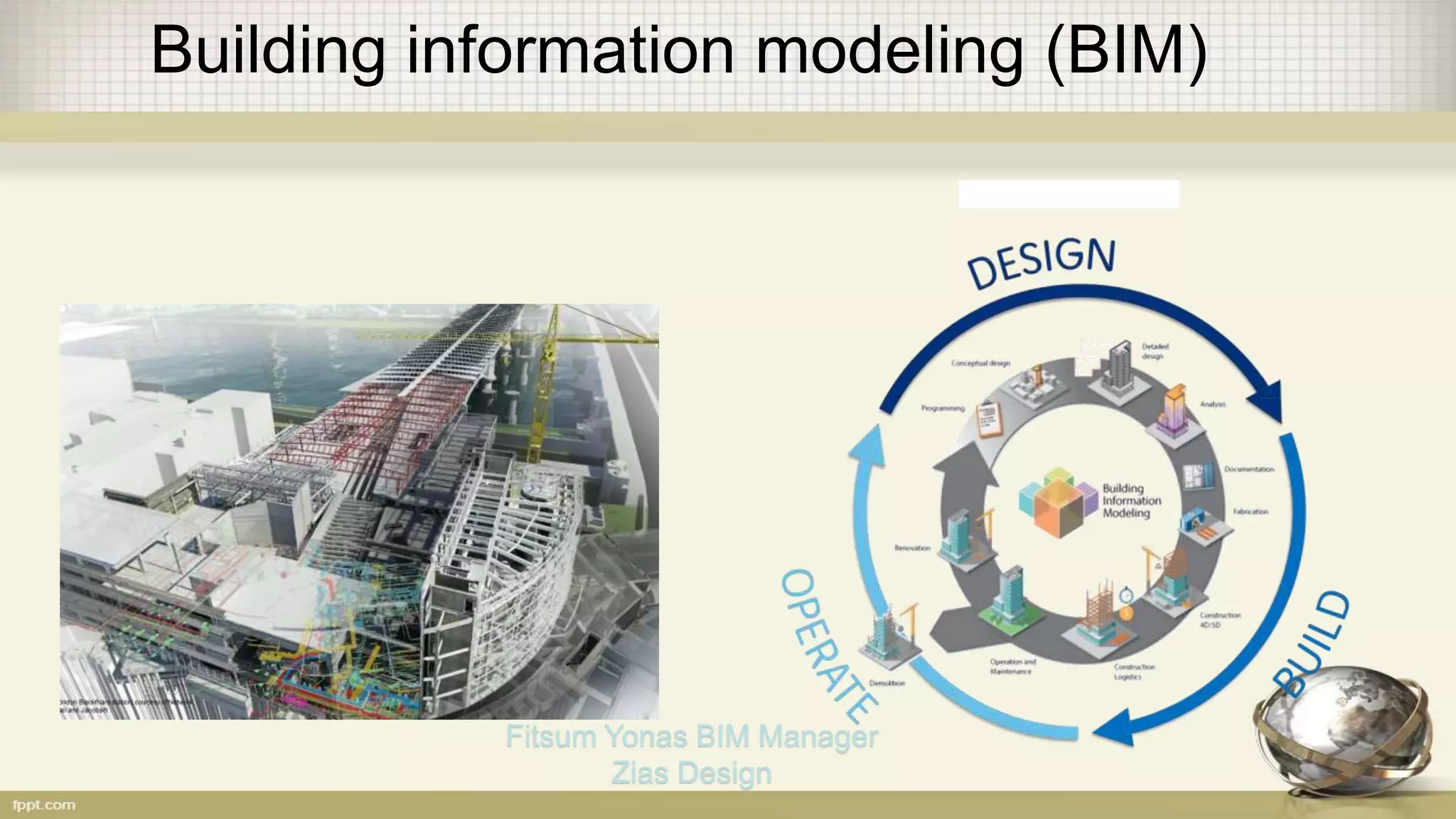
Building information modeling (BIM)
Fitsum Yonas BIM Manager
Zias Design
WHAT IS BIM ?
• A digital model, created at the start of the project and used by project stakeholders
• Linked to a database
• On a collaborative platform which allows each user access to BIM data with his
own tools / software
WHAT IS BIM ?
Building Information Modelling is Digital representation of
physical and functional characteristics of a facility. A BIM is
a shared knowledge resource for information about a facility
forming a reliable basis for decisions during its life-cycle;
defined as existing from earliest conception to demolition.
WHAT IS BIM ?
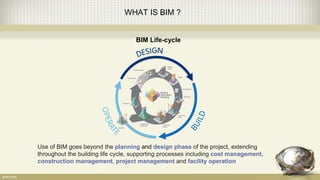
Use of BIM goes beyond the planning and design phase of the project, extending
throughout the building life cycle, supporting processes including cost management,
construction management, project management and facility operation
BIM Life-cycle
WHY IS BIM IMPORTANT NOW ?
• PRODUCTIVITY
• INTEROPERABILITY
• BUILDING ENERGY EFFICIENCY
WHY IS BIM IMPORTANT NOW ?
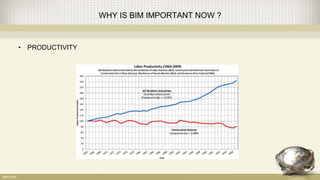
• PRODUCTIVITY
WHY IS BIM IMPORTANT NOW ?
• INTEROPERABILITY
– The cost of not addressing interoperability in US is $15bn p.a.
– Probably more
– Perhaps equivalent to £10/m2 in the UK
• 2/3 on Owners,
• 1/3 on Design and Construction
WHY IS BIM IMPORTANT NOW ?
• BUILDING ENERGY EFFICIENCY
– In certain regions highly dependent on traditional biomass, energy use in buildings
represents as much as 80% of total final energy use.
– 64% in US
– 55% in EU
– 48% world wide
– If no action is taken to improve energy efficiency in the buildings sector, energy demand
is expected to rise by 50% by 2050.
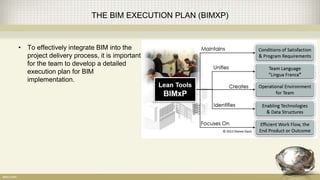
THE BIM EXECUTION PLAN (BIMXP)
• To effectively integrate BIM into the
project delivery process, it is important
for the team to develop a detailed
execution plan for BIM
implementation.
THE BIM EXECUTION PLAN (BIMXP)
• By developing a BIM Plan, the project and project team members can achieve the
following value
1. All parties will clearly understand and communicate the strategic goals for
implementing BIM on the project
2. Organizations will understand their roles and responsibilities
3. The team will be able to design an execution process which is well suited for each
team member’s business practices and typical organizational workflows
4. The plan will outline additional resources,
5. The plan will provide a benchmark for describing the process to future participants who
join the project
6. The purchasing divisions will be able to define contract language to ensure that all
project participants fulfill their obligations
7. The baseline plan will provide a goal for measuring progress throughout the project
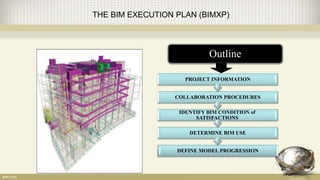
THE BIM EXECUTION PLAN (BIMXP)
Outline
DEFINE MODEL PROGRESSION
DETERMINE BIM USE
IDENTIFY BIM CONDITION of
SATISFACTIONS
COLLABORATION PROCEDURES
PROJECT INFORMATION
PROJECT INFORMATION
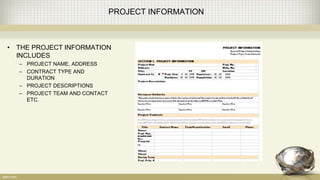
• THE PROJECT INFORMATION
INCLUDES
– PROJECT NAME, ADDRESS
– CONTRACT TYPE AND
DURATION
– PROJECT DESCRIPTIONS
– PROJECT TEAM AND CONTACT
ETC.
COLLABORATION PROCEDURES
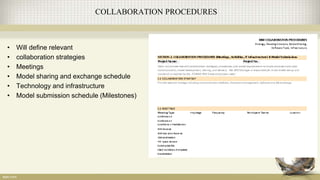
• Will define relevant
• collaboration strategies
• Meetings
• Model sharing and exchange schedule
• Technology and infrastructure
• Model submission schedule (Milestones)
BIM CONDITIONS of SATISFACTION (CoS)
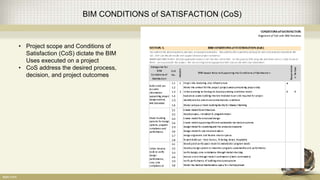
• Project scope and Conditions of
Satisfaction (CoS) dictate the BIM
Uses executed on a project
• CoS address the desired process,
decision, and project outcomes
BIM Uses Matrix
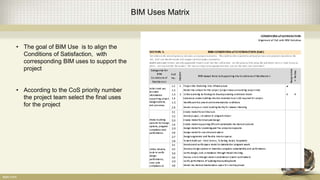
• The goal of BIM Use is to align the
Conditions of Satisfaction, with
corresponding BIM uses to support the
project
• According to the CoS priority number
the project team select the final uses
for the project
BIM Uses
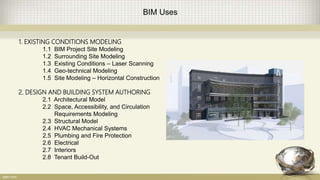
1. EXISTING CONDITIONS MODELING
1.1 BIM Project Site Modeling
1.2 Surrounding Site Modeling
1.3 Existing Conditions – Laser Scanning
1.4 Geo-technical Modeling
1.5 Site Modeling – Horizontal Construction
2. DESIGN AND BUILDING SYSTEM AUTHORING
2.1 Architectural Model
2.2 Space, Accessibility, and Circulation
Requirements Modeling
2.3 Structural Model
2.4 HVAC Mechanical Systems
2.5 Plumbing and Fire Protection
2.6 Electrical
2.7 Interiors
2.8 Tenant Build-Out
BIM Uses
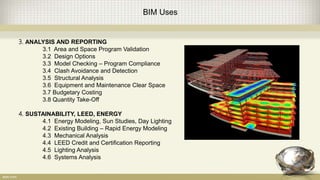
3. ANALYSIS AND REPORTING
3.1 Area and Space Program Validation
3.2 Design Options
3.3 Model Checking – Program Compliance
3.4 Clash Avoidance and Detection
3.5 Structural Analysis
3.6 Equipment and Maintenance Clear Space
3.7 Budgetary Costing
3.8 Quantity Take-Off
4. SUSTAINABILITY, LEED, ENERGY
4.1 Energy Modeling, Sun Studies, Day Lighting
4.2 Existing Building – Rapid Energy Modeling
4.3 Mechanical Analysis
4.4 LEED Credit and Certification Reporting
4.5 Lighting Analysis
4.6 Systems Analysis
BIM Uses
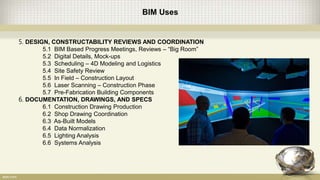
5. DESIGN, CONSTRUCTABILITY REVIEWS AND COORDINATION
5.1 BIM Based Progress Meetings, Reviews – “Big Room”
5.2 Digital Details, Mock-ups
5.3 Scheduling – 4D Modeling and Logistics
5.4 Site Safety Review
5.5 In Field – Construction Layout
5.6 Laser Scanning – Construction Phase
5.7 Pre-Fabrication Building Components
6. DOCUMENTATION, DRAWINGS, AND SPECS
6.1 Construction Drawing Production
6.2 Shop Drawing Coordination
6.3 As-Built Models
6.4 Data Normalization
6.5 Lighting Analysis
6.6 Systems Analysis
BIM Uses
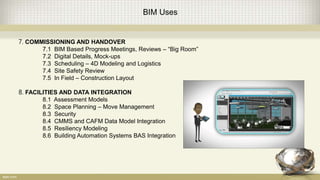
7. COMMISSIONING AND HANDOVER
7.1 BIM Based Progress Meetings, Reviews – “Big Room”
7.2 Digital Details, Mock-ups
7.3 Scheduling – 4D Modeling and Logistics
7.4 Site Safety Review
7.5 In Field – Construction Layout
8. FACILITIES AND DATA INTEGRATION
8.1 Assessment Models
8.2 Space Planning – Move Management
8.3 Security
8.4 CMMS and CAFM Data Model Integration
8.5 Resiliency Modeling
8.6 Building Automation Systems BAS Integration
Model progression matrix
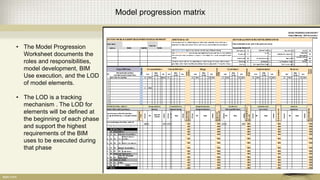
• The Model Progression
Worksheet documents the
roles and responsibilities,
model development, BIM
Use execution, and the LOD
of model elements.
• The LOD is a tracking
mechanism . The LOD for

elements will be defined at
the beginning of each phase
and support the highest
requirements of the BIM
uses to be executed during
that phase
Model progression matrix
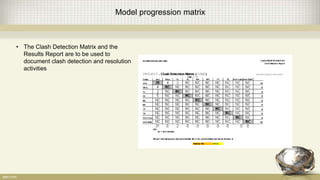
• The Clash Detection Matrix and the
Results Report are to be used to
document clash detection and resolution
activities
To wrap-up
BIM PLATFORM
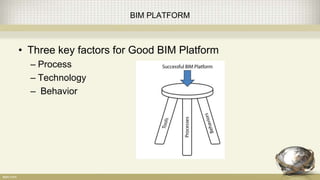
• Three key factors for Good BIM Platform
– Process
– Technology
– Behavior
BIM PLATFORM
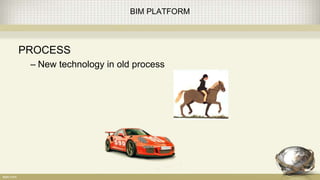
PROCESS
– New technology in old process
TECHNOLOGY
• Best tool that work and improve our organization
• Align with firm vision
BIM PLATFORM
BEHAVIOR
“BIM is10 percent technology and 90 percent sociology.”
Collaboration vs Closed-minded
“In times of change, learners inherit the Earth, while the
learned find themselves beautifully equipped to deal with a
world that no longer exists.” Eric Hoffer
What can we deliver with BIM?
• “... reducing capital cost and the carbon burden from the construction and
operation of the built environment by 20% ...
• the adoption of … technologies, process and collaborative behaviors that will
unlock new more efficient ways of working at all stages of the project life-
cycle
What can we deliver with BIM?
• Higher quality, more reliable design information
• greater client certainty/predictability (time, cost, quality) earlier
• better visualization
• better multi-disciplinary collaboration
• quicker, more consistent and easier coordination of design documentation
• earlier, accurate, complete procurement data ('smart' BoQs); elimination of
waste and rework
• better construction and project management ('build it once virtually, then build
it for real')
• better 'as-built', whole-life information for O&M
What can we deliver with BIM?
Fully computable, reliable information
– no checking or re-keying of data
– automated compliance checking
“The end-to-end stream of BIM data will help unify the
industry's supply chains, freeing construction from its
craft origins, transforming it into a modern,
sophisticated branch of the manufacturing industry.”
BEWARE BIM WASH
• BIM Wash is a term describing the inflated, and/or deceptive,
claim of using or delivering Building Information Modeling services
or products
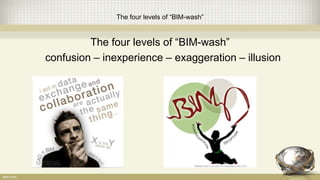
The four levels of “BIM-wash”
confusion – inexperience – exaggeration – illusion
BIM Wash
• Level 1: CONFUSION or Unintentional BIMwash
This is when BIM processes and protocols are not understood or are perceived to be
similar to CAD. It is when basic model exchanges are confused with model-based
collaboration. It is when a Model Server is confused with a File Server or a Document
Management System.
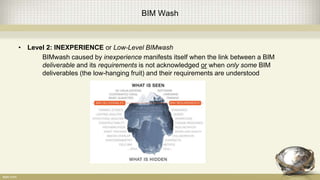
• Level 2: INEXPERIENCE or Low-Level BIMwash
BIMwash caused by inexperience manifests itself when the link between a BIM
deliverable and its requirements is not acknowledged or when only some BIM
deliverables (the low-hanging fruit) and their requirements are understood
BIM Wash
• Level 2: INEXPERIENCE or Low-Level BIMwash
BIMwash caused by inexperience manifests itself when the link between a BIM
deliverable and its requirements is not acknowledged or when only some BIM
deliverables (the low-hanging fruit) and their requirements are understood
BIM Wash
• Level 3: EXAGGERATION or Mid-Level BIMwash
This is when actual BIM Competencies exist but are intentionally promoted far beyond their
actual level. This is similar to telling a true story yet adding several Hollywood special
effects on top
• Level 4: ILLUSION or Severe BIMwash
This is when the BIM Competency story amounts to pure fiction. This is similar to a Bollywood
movie plot - all song and dance, colourful, and possibly amusing - but the actual story was
never, and may never be, true!
BIM is not
• CAD
“CAD helps people to draw. BIM helps people to
construct.” (Richard Saxon, Ecobuild, February 2009)
“BIM is not CAD. BIM was never meant to be CAD. CAD is a
replacement for pen and paper, a documentation tool. By
comparison, BIM programs are design applications in
which the documentation flows from and is a derivative of the
process, from schematic design to construction to facility
management.” (Pete Zyskowski, Cadalyst)
BIM is not
• ------Software
• ------new
• ------just an IT issue... or just software
• ------3D modeling
• ------something designers do
• ------just about project delivery
• ------a short-lived fad
• ------irrelevant to small projects
• ------“the silver bullet” or “Holy Grail”
• ------optional?
Thank you

Building information modeling BIM

  • 1.
    Building information modeling(BIM) Fitsum Yonas BIM Manager Zias Design
  • 2.
    WHAT IS BIM? • A digital model, created at the start of the project and used by project stakeholders • Linked to a database • On a collaborative platform which allows each user access to BIM data with his own tools / software
  • 3.
    WHAT IS BIM? Building Information Modelling is Digital representation of physical and functional characteristics of a facility. A BIM is a shared knowledge resource for information about a facility forming a reliable basis for decisions during its life-cycle; defined as existing from earliest conception to demolition.
  • 4.
    WHAT IS BIM? Use of BIM goes beyond the planning and design phase of the project, extending throughout the building life cycle, supporting processes including cost management, construction management, project management and facility operation BIM Life-cycle
  • 5.
    WHY IS BIMIMPORTANT NOW ? • PRODUCTIVITY • INTEROPERABILITY • BUILDING ENERGY EFFICIENCY
  • 6.
    WHY IS BIMIMPORTANT NOW ? • PRODUCTIVITY
  • 7.
    WHY IS BIMIMPORTANT NOW ? • INTEROPERABILITY – The cost of not addressing interoperability in US is $15bn p.a. – Probably more – Perhaps equivalent to £10/m2 in the UK • 2/3 on Owners, • 1/3 on Design and Construction
  • 8.
    WHY IS BIMIMPORTANT NOW ? • BUILDING ENERGY EFFICIENCY – In certain regions highly dependent on traditional biomass, energy use in buildings represents as much as 80% of total final energy use. – 64% in US – 55% in EU – 48% world wide – If no action is taken to improve energy efficiency in the buildings sector, energy demand is expected to rise by 50% by 2050.
  • 9.
    THE BIM EXECUTIONPLAN (BIMXP) • To effectively integrate BIM into the project delivery process, it is important for the team to develop a detailed execution plan for BIM implementation.
  • 10.
    THE BIM EXECUTIONPLAN (BIMXP) • By developing a BIM Plan, the project and project team members can achieve the following value 1. All parties will clearly understand and communicate the strategic goals for implementing BIM on the project 2. Organizations will understand their roles and responsibilities 3. The team will be able to design an execution process which is well suited for each team member’s business practices and typical organizational workflows 4. The plan will outline additional resources, 5. The plan will provide a benchmark for describing the process to future participants who join the project 6. The purchasing divisions will be able to define contract language to ensure that all project participants fulfill their obligations 7. The baseline plan will provide a goal for measuring progress throughout the project
  • 11.
    THE BIM EXECUTIONPLAN (BIMXP) Outline DEFINE MODEL PROGRESSION DETERMINE BIM USE IDENTIFY BIM CONDITION of SATISFACTIONS COLLABORATION PROCEDURES PROJECT INFORMATION
  • 12.
    PROJECT INFORMATION • THEPROJECT INFORMATION INCLUDES – PROJECT NAME, ADDRESS – CONTRACT TYPE AND DURATION – PROJECT DESCRIPTIONS – PROJECT TEAM AND CONTACT ETC.
  • 13.
    COLLABORATION PROCEDURES • Willdefine relevant • collaboration strategies • Meetings • Model sharing and exchange schedule • Technology and infrastructure • Model submission schedule (Milestones)
  • 14.
    BIM CONDITIONS ofSATISFACTION (CoS) • Project scope and Conditions of Satisfaction (CoS) dictate the BIM Uses executed on a project • CoS address the desired process, decision, and project outcomes
  • 15.
    BIM Uses Matrix •The goal of BIM Use is to align the Conditions of Satisfaction, with corresponding BIM uses to support the project • According to the CoS priority number the project team select the final uses for the project
  • 16.
    BIM Uses 1. EXISTINGCONDITIONS MODELING 1.1 BIM Project Site Modeling 1.2 Surrounding Site Modeling 1.3 Existing Conditions – Laser Scanning 1.4 Geo-technical Modeling 1.5 Site Modeling – Horizontal Construction 2. DESIGN AND BUILDING SYSTEM AUTHORING 2.1 Architectural Model 2.2 Space, Accessibility, and Circulation Requirements Modeling 2.3 Structural Model 2.4 HVAC Mechanical Systems 2.5 Plumbing and Fire Protection 2.6 Electrical 2.7 Interiors 2.8 Tenant Build-Out
  • 17.
    BIM Uses 3. ANALYSISAND REPORTING 3.1 Area and Space Program Validation 3.2 Design Options 3.3 Model Checking – Program Compliance 3.4 Clash Avoidance and Detection 3.5 Structural Analysis 3.6 Equipment and Maintenance Clear Space 3.7 Budgetary Costing 3.8 Quantity Take-Off 4. SUSTAINABILITY, LEED, ENERGY 4.1 Energy Modeling, Sun Studies, Day Lighting 4.2 Existing Building – Rapid Energy Modeling 4.3 Mechanical Analysis 4.4 LEED Credit and Certification Reporting 4.5 Lighting Analysis 4.6 Systems Analysis
  • 18.
    BIM Uses 5. DESIGN,CONSTRUCTABILITY REVIEWS AND COORDINATION 5.1 BIM Based Progress Meetings, Reviews – “Big Room” 5.2 Digital Details, Mock-ups 5.3 Scheduling – 4D Modeling and Logistics 5.4 Site Safety Review 5.5 In Field – Construction Layout 5.6 Laser Scanning – Construction Phase 5.7 Pre-Fabrication Building Components 6. DOCUMENTATION, DRAWINGS, AND SPECS 6.1 Construction Drawing Production 6.2 Shop Drawing Coordination 6.3 As-Built Models 6.4 Data Normalization 6.5 Lighting Analysis 6.6 Systems Analysis
  • 19.
    BIM Uses 7. COMMISSIONINGAND HANDOVER 7.1 BIM Based Progress Meetings, Reviews – “Big Room” 7.2 Digital Details, Mock-ups 7.3 Scheduling – 4D Modeling and Logistics 7.4 Site Safety Review 7.5 In Field – Construction Layout 8. FACILITIES AND DATA INTEGRATION 8.1 Assessment Models 8.2 Space Planning – Move Management 8.3 Security 8.4 CMMS and CAFM Data Model Integration 8.5 Resiliency Modeling 8.6 Building Automation Systems BAS Integration
  • 20.
    Model progression matrix •The Model Progression Worksheet documents the roles and responsibilities, model development, BIM Use execution, and the LOD of model elements. • The LOD is a tracking mechanism . The LOD for elements will be defined at the beginning of each phase and support the highest requirements of the BIM uses to be executed during that phase
  • 21.
    Model progression matrix •The Clash Detection Matrix and the Results Report are to be used to document clash detection and resolution activities
  • 22.
  • 23.
    BIM PLATFORM • Threekey factors for Good BIM Platform – Process – Technology – Behavior
  • 24.
    BIM PLATFORM PROCESS – Newtechnology in old process
  • 25.
    TECHNOLOGY • Best toolthat work and improve our organization • Align with firm vision
  • 26.
    BIM PLATFORM BEHAVIOR “BIM is10percent technology and 90 percent sociology.” Collaboration vs Closed-minded “In times of change, learners inherit the Earth, while the learned find themselves beautifully equipped to deal with a world that no longer exists.” Eric Hoffer
  • 27.
    What can wedeliver with BIM? • “... reducing capital cost and the carbon burden from the construction and operation of the built environment by 20% ... • the adoption of … technologies, process and collaborative behaviors that will unlock new more efficient ways of working at all stages of the project life- cycle
  • 28.
    What can wedeliver with BIM? • Higher quality, more reliable design information • greater client certainty/predictability (time, cost, quality) earlier • better visualization • better multi-disciplinary collaboration • quicker, more consistent and easier coordination of design documentation • earlier, accurate, complete procurement data ('smart' BoQs); elimination of waste and rework • better construction and project management ('build it once virtually, then build it for real') • better 'as-built', whole-life information for O&M
  • 29.
    What can wedeliver with BIM? Fully computable, reliable information – no checking or re-keying of data – automated compliance checking “The end-to-end stream of BIM data will help unify the industry's supply chains, freeing construction from its craft origins, transforming it into a modern, sophisticated branch of the manufacturing industry.”
  • 30.
    BEWARE BIM WASH •BIM Wash is a term describing the inflated, and/or deceptive, claim of using or delivering Building Information Modeling services or products
  • 31.
    The four levelsof “BIM-wash” The four levels of “BIM-wash” confusion – inexperience – exaggeration – illusion
  • 32.
    BIM Wash • Level1: CONFUSION or Unintentional BIMwash This is when BIM processes and protocols are not understood or are perceived to be similar to CAD. It is when basic model exchanges are confused with model-based collaboration. It is when a Model Server is confused with a File Server or a Document Management System. • Level 2: INEXPERIENCE or Low-Level BIMwash BIMwash caused by inexperience manifests itself when the link between a BIM deliverable and its requirements is not acknowledged or when only some BIM deliverables (the low-hanging fruit) and their requirements are understood
  • 33.
    BIM Wash • Level2: INEXPERIENCE or Low-Level BIMwash BIMwash caused by inexperience manifests itself when the link between a BIM deliverable and its requirements is not acknowledged or when only some BIM deliverables (the low-hanging fruit) and their requirements are understood
  • 34.
    BIM Wash • Level3: EXAGGERATION or Mid-Level BIMwash This is when actual BIM Competencies exist but are intentionally promoted far beyond their actual level. This is similar to telling a true story yet adding several Hollywood special effects on top
  • 35.
    • Level 4:ILLUSION or Severe BIMwash This is when the BIM Competency story amounts to pure fiction. This is similar to a Bollywood movie plot - all song and dance, colourful, and possibly amusing - but the actual story was never, and may never be, true!
  • 36.
    BIM is not •CAD “CAD helps people to draw. BIM helps people to construct.” (Richard Saxon, Ecobuild, February 2009) “BIM is not CAD. BIM was never meant to be CAD. CAD is a replacement for pen and paper, a documentation tool. By comparison, BIM programs are design applications in which the documentation flows from and is a derivative of the process, from schematic design to construction to facility management.” (Pete Zyskowski, Cadalyst)
  • 37.
    BIM is not •------Software • ------new • ------just an IT issue... or just software • ------3D modeling • ------something designers do • ------just about project delivery • ------a short-lived fad • ------irrelevant to small projects • ------“the silver bullet” or “Holy Grail” • ------optional?
  • 38.