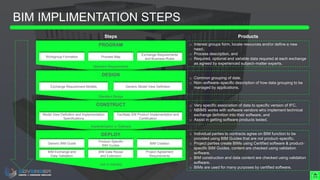
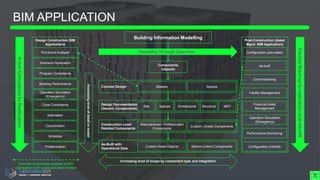
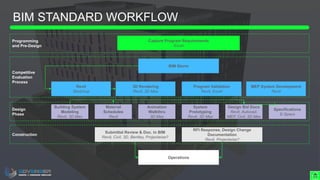
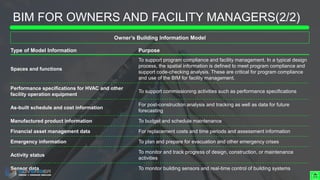
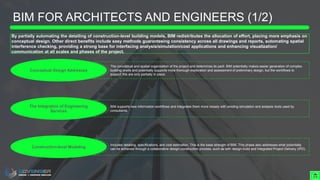
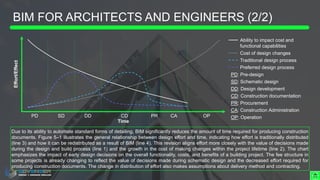
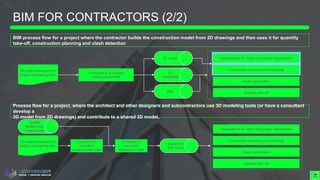
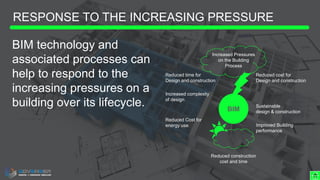
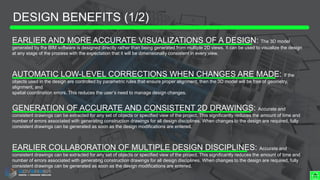
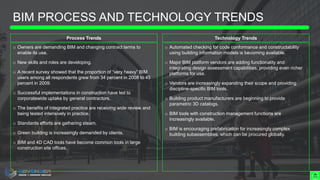
The document discusses Building Information Modeling (BIM) technology, outlining its capabilities in creating digital representations of building components that carry computable attributes and facilitate intelligent manipulation. It details the implementation steps, applications, and benefits of BIM for various stakeholders such as owners, architects, contractors, and subcontractors, emphasizing its role in improving collaboration, reducing errors, and optimizing project delivery. Additionally, it highlights the advantages of BIM in enhancing building performance, cost estimation, and energy efficiency throughout the design and construction processes.