ANA BAKER BRANDON GARRETT
BIM:FOR PROJECT MANAGERS
CSI Southwest Region Conference
BIM Overview
BIM Level of Development
Evolution of the Drawing Process
BIM Workflow
-Internal
-Between Consultants
Model Development
-Programming and Pre-Design
-Schematic Design
-Design Development
-Construction Documents
Case Study
1
2
3
4
5
6
whatwillbecovered

1 BIM:OVERVIEW
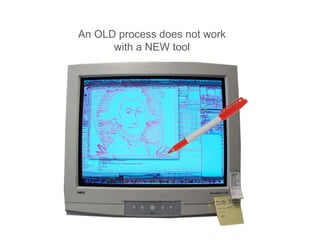
An OLD process does not work
with a NEW tool
1 BIM:
Overview
“A Building Information Model serves as a shared knowledge
resource for information about a facility forming a reliable basis
for decisions during its life cycle from inception onward.” -
BuildingSMART Alliance
“Building Information Modeling, or BIM is a parametric, 3D model
that is used to generate plans, sections, elevations, perspectives,
details, schedules – all of the necessary components to document
the design of a building”
- Mastering Autodesk Revit Architecture 2011
1 BIM:
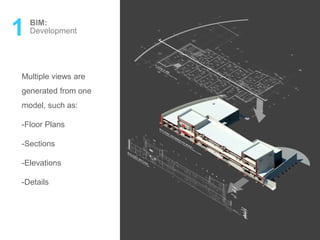
Development
Multiple views are
generated from one
model, such as:
-Floor Plans
-Sections
-Elevations
-Details
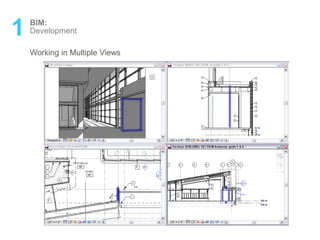
1 BIM:
Working in Multiple Views
Development
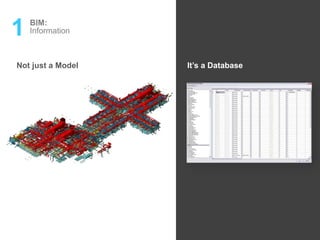
1 BIM:
Information
Not just a Model It’s a Database
1 BIM:
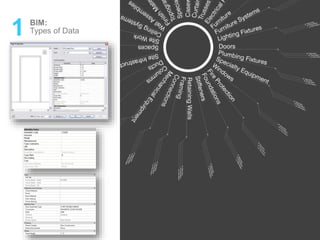
Types of Data
1 BIM:
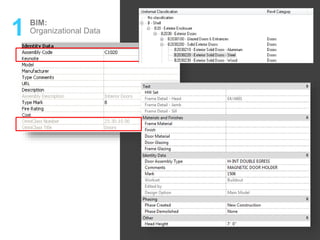
Organizational Data
1 BIM:
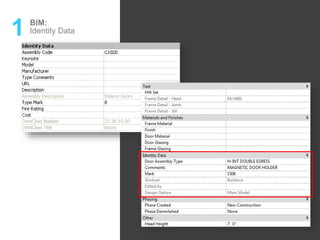
Identity Data
1 BIM:
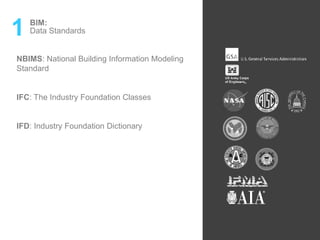
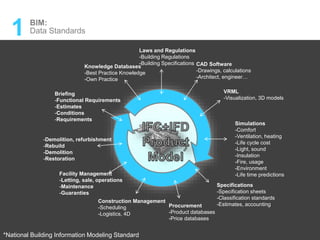
Data Standards
NBIMS: National Building Information Modeling
Standard
IFC: The Industry Foundation Classes
IFD: Industry Foundation Dictionary
1 BIM:
Authoring Programs
AUTODESK REVIT
ARCHICAD
BENTLEY ARCHITECTURE
TEKLA (STRUCTURAL)
1 BIM:
Data Standards
Laws and Regulations
-Building Regulations
-Building Specifications
Knowledge Databases
-Best Practice Knowledge
-Own Practice
Briefing
-Functional Requirements
-Estimates
-Conditions
-Requirements
-Demolition, refurbishment
-Rebuild
-Demolition
-Restoration
Facility Management
-Letting, sale, operations
-Maintenance
-Guaranties
Construction Management
-Scheduling
-Logistics, 4D
Procurement
-Product databases
-Price databases
Specifications
-Specification sheets
-Classification standards
-Estimates, accounting
Simulations
-Comfort
-Ventilation, heating
-Life cycle cost
-Light, sound
-Insulation
-Fire, usage
-Environment
-Life time predictions
VRML
-Visualization, 3D models
CAD Software
-Drawings, calculations
-Architect, engineer

*National Building Information Modeling Standard
1 BIM:
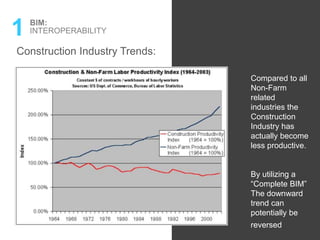
INTEROPERABILITY
Construction Industry Trends:
Compared to all
Non-Farm
related
industries the
Construction
Industry has
actually become
less productive.
By utilizing a
“Complete BIM”
The downward
trend can
potentially be
reversed
1 BIM:
INTEROPERABILITY
According to the National Institute of
Standards and Technology. Owners and
Operators have the largest interoperability
costs of all the stakeholders in the AEC
industry.
Owners/Operators bear 68% of the
estimated $15.8 billion lost due to
inadequate interoperability.
This equates to a loss of over $10.6 billion
*The study also revealed that an inordinate
amount of time is spent locating and
verifying specific facility and project
information from previous activities.
1 BIM:
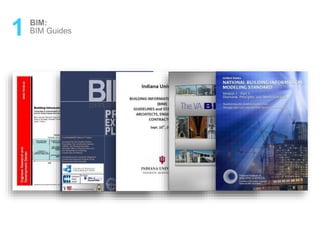
BIM Guides
2 BIM:LEVEL OF DEVELOPMENT
2 LEVEL OF DEVELOPMENT:
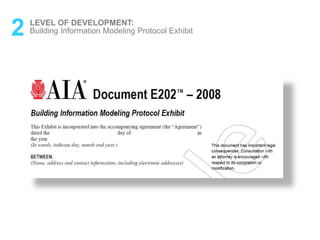
Building Information Modeling Protocol Exhibit
COMMON QUESTIONS:
How detailed should my model be?
How much information should I include in my model?
Who is responsible for modeling “X”?
Should this be considered an additional service?
2 LEVEL OF DEVELOPMENT:
Building Information Modeling Protocol Exhibit
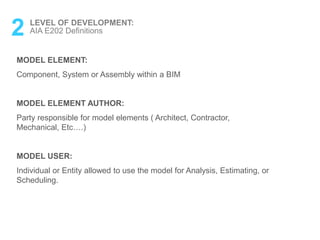
MODEL ELEMENT:
Component, System or Assembly within a BIM
MODEL ELEMENT AUTHOR:
Party responsible for model elements ( Architect, Contractor,
Mechanical, Etc
.)
MODEL USER:
Individual or Entity allowed to use the model for Analysis, Estimating, or
Scheduling.
2 LEVEL OF DEVELOPMENT:
AIA E202 Definitions
LEVEL OF DEVELOPMENT:
Describes the completeness to which a Model Element is developed.
LOD: 100 Conceptual Geometry “Schematic
Design”
LOD: 200 Approximate Geometry “Design
Development”
LOD: 300 Precise Geometry
“Construction Documents”
LOD: 400 Fabrication “Construction
Model”
LOD: 500 “As-Built”
2 LEVEL OF DEVELOPMENT:
LOD
2 LEVEL OF DEVELOPMENT:
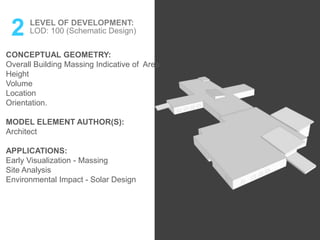
LOD: 100 (Schematic Design)
CONCEPTUAL GEOMETRY:
Overall Building Massing Indicative of Area
Height
Volume
Location
Orientation.
MODEL ELEMENT AUTHOR(S):
Architect
APPLICATIONS:
Early Visualization - Massing
Site Analysis
Environmental Impact - Solar Design
2 LEVEL OF DEVELOPMENT:
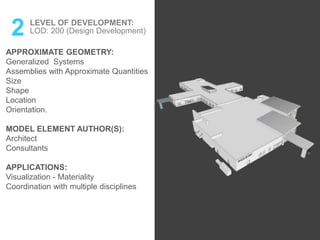
LOD: 200 (Design Development)
APPROXIMATE GEOMETRY:
Generalized Systems
Assemblies with Approximate Quantities
Size
Shape
Location
Orientation.
MODEL ELEMENT AUTHOR(S):
Architect
Consultants
APPLICATIONS:
Visualization - Materiality
Coordination with multiple disciplines
2 LEVEL OF DEVELOPMENT:
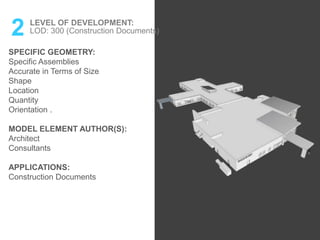
LOD: 300 (Construction Documents)
SPECIFIC GEOMETRY:
Specific Assemblies
Accurate in Terms of Size
Shape
Location
Quantity
Orientation .
MODEL ELEMENT AUTHOR(S):
Architect
Consultants
APPLICATIONS:
Construction Documents
2 LEVEL OF DEVELOPMENT:
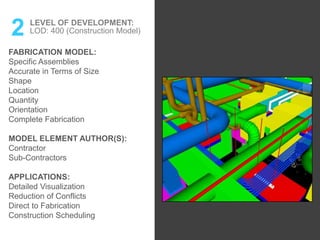
LOD: 400 (Construction Model)
FABRICATION MODEL:
Specific Assemblies
Accurate in Terms of Size
Shape
Location
Quantity
Orientation
Complete Fabrication
MODEL ELEMENT AUTHOR(S):
Contractor
Sub-Contractors
APPLICATIONS:
Detailed Visualization
Reduction of Conflicts
Direct to Fabrication
Construction Scheduling
2 LEVEL OF DEVELOPMENT:
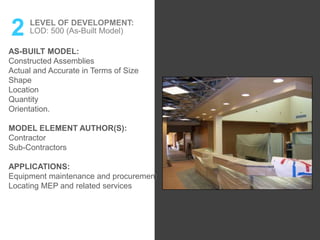
LOD: 500 (As-Built Model)
AS-BUILT MODEL:
Constructed Assemblies
Actual and Accurate in Terms of Size
Shape
Location
Quantity
Orientation.
MODEL ELEMENT AUTHOR(S):
Contractor
Sub-Contractors
APPLICATIONS:
Equipment maintenance and procurement
Locating MEP and related services
2 LEVEL OF DEVELOPMENT:
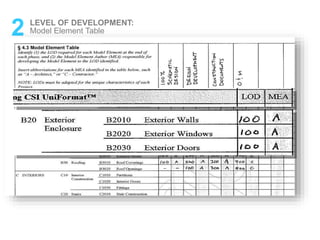
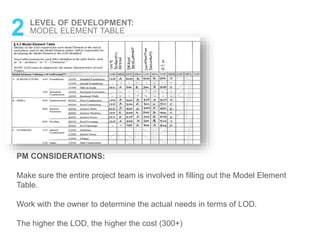
Model Element Table
2 LEVEL OF DEVELOPMENT:
Building Information Modeling Protocol Exhibit
WHAT TYPES OF INFORMATION SHOULD BE INCLUDED
IN A LOD 300 EXTERIOR WALL?
LOD 300 - SPECIFIC GEOMETRY:
Specific Assemblies that are Accurate in
Terms of Size, Shape, Location, Quantity,
and Orientation .
AIA E202
According to
2 LEVEL OF DEVELOPMENT:
Building Information Modeling Protocol Exhibit
VA OBJECT/ ELEMENT MATRIX
SUPPLEMENT THE AIA E202 WITH ANOTHER MORE DETAILED GUIDE
2 LEVEL OF DEVELOPMENT:
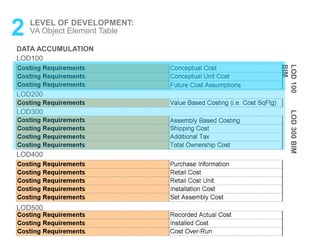
VA Object Element Table
BIM OBJECT/ ELEMENT MATRIX:
Developed by the Department of Veterans Affairs as part of VA BIM Guide.
It depicts Building Information Typologies/Types, when they are relevant, and to
what level of development (LOD) throughout a building lifecycle.
It is an expansion of the E-202 to support a greater level of understanding of BIM
information use.
Highly Detailed list of various requirements as they relate to a BIM’s Level of
Development.
* Free downloadable Excel file from VA website
2 LEVEL OF DEVELOPMENT:
VA Object Element Table
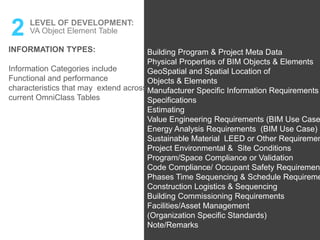
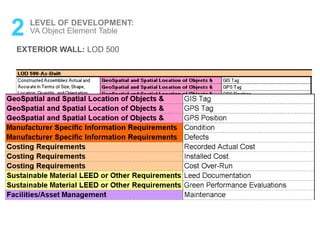
INFORMATION TYPES:
Information Categories include
Functional and performance
characteristics that may extend across
current OmniClass Tables
Building Program & Project Meta Data
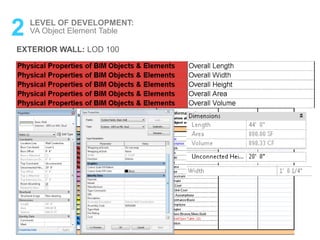
Physical Properties of BIM Objects & Elements
GeoSpatial and Spatial Location of
Objects & Elements
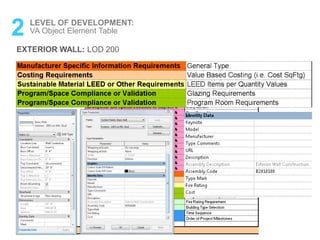
Manufacturer Specific Information Requirements
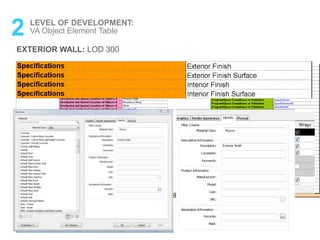
Specifications
Estimating
Value Engineering Requirements (BIM Use Case
Energy Analysis Requirements (BIM Use Case)
Sustainable Material LEED or Other Requiremen
Project Environmental & Site Conditions
Program/Space Compliance or Validation
Code Compliance/ Occupant Safety Requirement
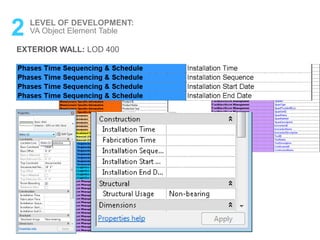
Phases Time Sequencing & Schedule Requireme
Construction Logistics & Sequencing
Building Commissioning Requirements
Facilities/Asset Management
(Organization Specific Standards)
Note/Remarks
2 LEVEL OF DEVELOPMENT:
VA Object Element Table
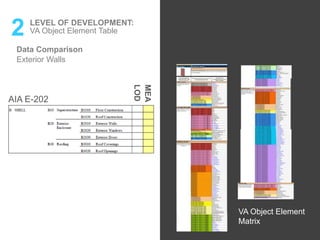
LOD
MEA
AIA E-202
VA Object Element
Matrix
Data Comparison
Exterior Walls
2 LEVEL OF DEVELOPMENT:
VA Object Element Table
EXTERIOR WALL: LOD 100
2 LEVEL OF DEVELOPMENT:
VA Object Element Table
EXTERIOR WALL: LOD 200
2 LEVEL OF DEVELOPMENT:
VA Object Element Table
EXTERIOR WALL: LOD 300
2 LEVEL OF DEVELOPMENT:
VA Object Element Table
EXTERIOR WALL: LOD 400
2 LEVEL OF DEVELOPMENT:
VA Object Element Table
EXTERIOR WALL: LOD 500
2 LEVEL OF DEVELOPMENT:
VA Object Element Table
DATA ACCUMULATION
LOD200
LOD300
LOD400
LOD500
LOD100
LOD100
BIM
LOD300BIM
2 LEVEL OF DEVELOPMENT:
MODEL ELEMENT TABLE
PM CONSIDERATIONS:
Make sure the entire project team is involved in filling out the Model Element
Table.
Work with the owner to determine the actual needs in terms of LOD.
The higher the LOD, the higher the cost (300+)
3 EVOLUTION
OF THE DRAWING PROCESS
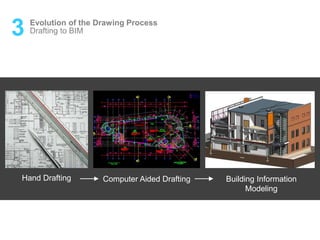
3 Evolution of the Drawing Process
Drafting to BIM
Hand Drafting Computer Aided Drafting Building Information
Modeling
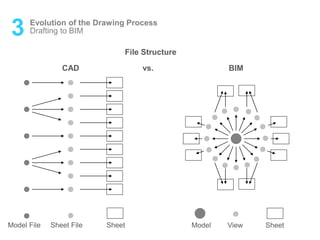
3 Evolution of the Drawing Process
Drafting to BIM
File Structure
CAD BIM
Model View Sheet
vs.
Model File Sheet File Sheet
3 Evolution of the Drawing Process
Drafting to BIM
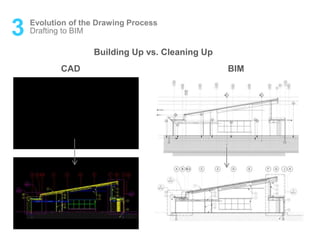
Building Up vs. Cleaning Up
CAD BIM
3 Evolution of the Drawing Process
Drafting to BIM
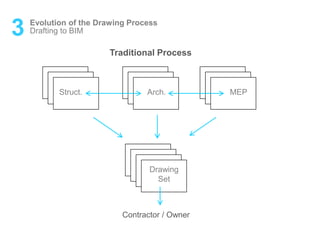
Struct. Arch. MEP
Drawing
Set
Contractor / Owner
Traditional Process
3 Evolution of the Drawing Process
Drafting to BIM
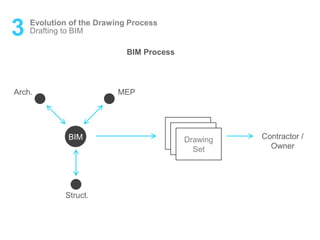
BIM Process
BIM
MEPArch.
Contractor /
Owner
Drawing
Set
Struct.
3 Evolution of the Drawing Process
BIM working with other tools
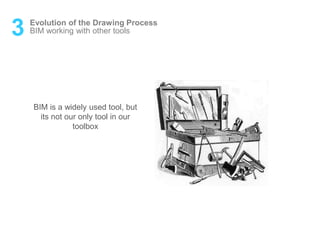
BIM is a widely used tool, but
its not our only tool in our
toolbox
3 Evolution of the Drawing Process
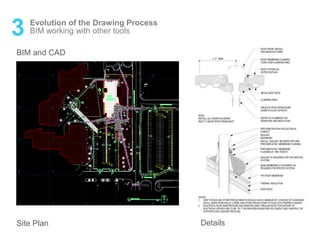
Detail
BIM and CAD
Site Plan Details
BIM working with other tools
3 Evolution of the Drawing Process
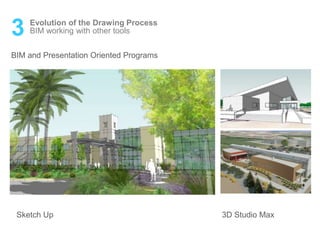
BIM and Presentation Oriented Programs
Sketch Up 3D Studio Max
BIM working with other tools
3 Evolution of the Drawing Process
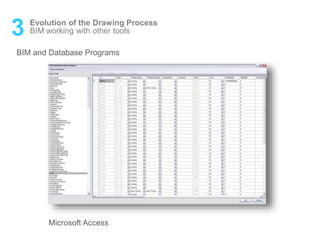
BIM and Database Programs
Microsoft Access
BIM working with other tools
3 Evolution of the Drawing Process
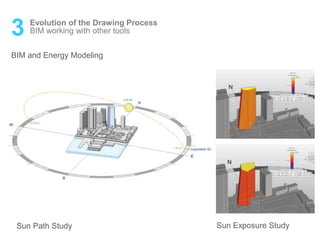
BIM and Energy Modeling
Sun Path Study Sun Exposure Study
BIM working with other tools
3 Evolution of the Drawing Process
Capabilities for 3D
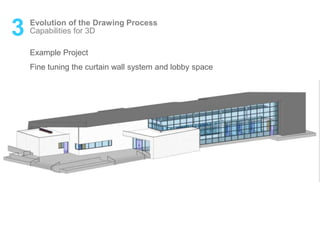
Example Project
Fine tuning the curtain wall system and lobby space
3 Evolution of the Drawing Process
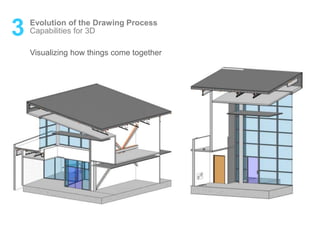
Visualizing how things come together
Capabilities for 3D
3 Evolution of the Drawing Process
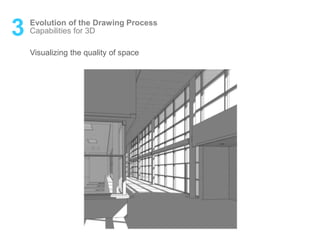
Visualizing the quality of space
Capabilities for 3D
3 Evolution of the Drawing Process
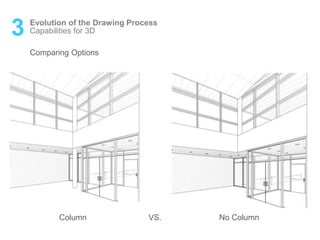
Comparing Options
Column VS. No Column
Capabilities for 3D
4 BIM:WORKFLOW
PM: Considerations
Staffing:
Most experienced modelers should be assigned at the start of the
project.
This person will work directly with the Architect/ Engineer to develop the
model
This is an opportunity to share and strengthen the intellectual resources
of your team by allowing the more experienced Architects to mentor and
provide technical guidance while the modeler shares and teaches
Architect about BIM software and other digital tools.
5 MODEL DEVELOPMENT:
SCHEMATIC DESIGN
4 BIM Workflow
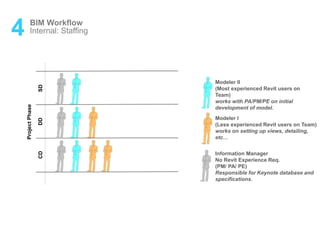
Internal: Staffing
Legend:
SDCD
ProjectPhase
DD
Modeler II
(Most experienced Revit users on
Team)
works with PA/PM/PE on initial
development of model.
Modeler I
(Less experienced Revit users on Team)
works on setting up views, detailing,
etc

Information Manager
No Revit Experience Req.
(PM/ PA/ PE)
Responsible for Keynote database and
specifications.
4 BIM Workflow
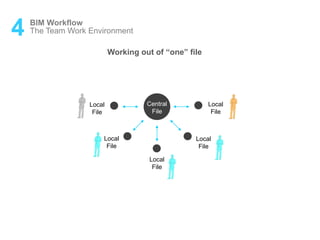
The Team Work Environment
Working out of “one” file
Central
File
Local
File
Local
File
Local
File
Local
File
Local
File
4 BIM Workflow
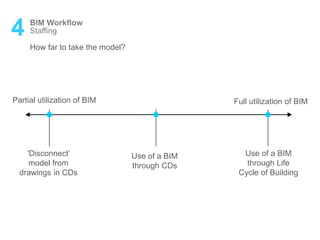
Staffing
How far to take the model?
‘Disconnect’
model from
drawings in CDs
Use of a BIM
through CDs
Use of a BIM
through Life
Cycle of Building
Partial utilization of BIM Full utilization of BIM
4 BIM Workflow
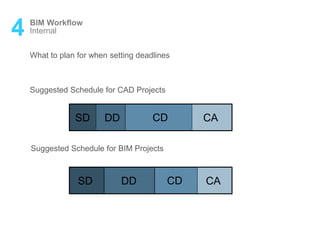
Internal
SD DD CD CA
What to plan for when setting deadlines
Suggested Schedule for CAD Projects
Suggested Schedule for BIM Projects
SD DD CD CA
4 BIM Workflow
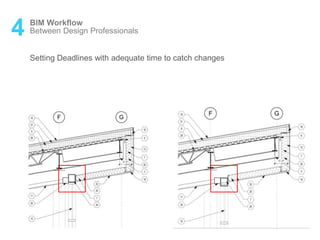
Between Design Professionals
Setting Deadlines with adequate time to catch changes
4 BIM Workflow
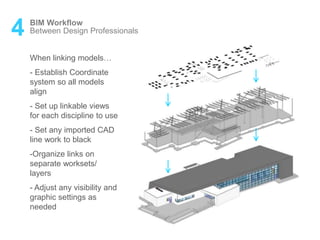
Between Design Professionals
When linking models

- Establish Coordinate
system so all models
align
- Set up linkable views
for each discipline to use
- Set any imported CAD
line work to black
-Organize links on
separate worksets/
layers
- Adjust any visibility and
graphic settings as
needed
4 BIM Workflow
Between Design Professionals
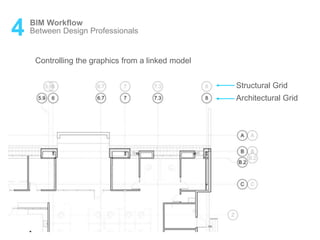
Structural Grid
Controlling the graphics from a linked model
Architectural Grid
5 BIM Workflow
Between Design Professionals
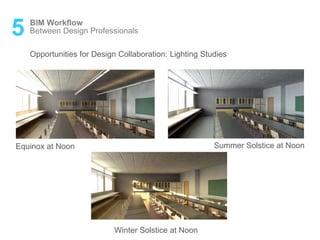
Opportunities for Design Collaboration: Lighting Studies
Equinox at Noon Summer Solstice at Noon
Winter Solstice at Noon
5 BIM:MODEL DEVELOPMENT
5.1 PROGRAMMING
5 MODEL DEVELOPMENT:
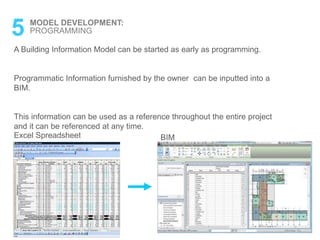
A Building Information Model can be started as early as programming.
Programmatic Information furnished by the owner can be inputted into a
BIM.
This information can be used as a reference throughout the entire project
and it can be referenced at any time.
PROGRAMMING
Excel Spreadsheet BIM
5 MODEL DEVELOPMENT:
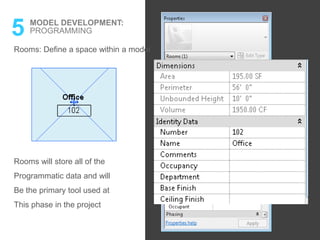
Rooms: Define a space within a model
PROGRAMMING
Rooms will store all of the
Programmatic data and will
Be the primary tool used at
This phase in the project
5 MODEL DEVELOPMENT:
PROGRAMMING
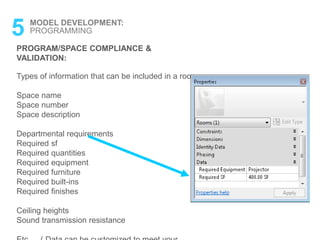
PROGRAM/SPACE COMPLIANCE &
VALIDATION:
Types of information that can be included in a room:
Space name
Space number
Space description
Departmental requirements
Required sf
Required quantities
Required equipment
Required furniture
Required built-ins
Required finishes
Ceiling heights
Sound transmission resistance
5 MODEL DEVELOPMENT:
PROGRAMMING
PROGRAM/SPACE VALIDATION:
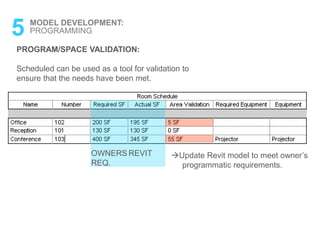
Scheduled can be used as a tool for validation to
ensure that the needs have been met.
Update Revit model to meet owner’s
programmatic requirements.
OWNERS
REQ.
REVIT
5 MODEL DEVELOPMENT:
PROGRAMMING
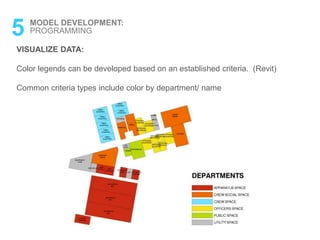
VISUALIZE DATA:
Color legends can be developed based on an established criteria. (Revit)
Common criteria types include color by department/ name
5 MODEL DEVELOPMENT:
PROGRAMMING
PM CONSIDERATIONS:
BIM can be a powerful tool during the earliest stages of a project
Information gathered from this effort will be embedded within the model
throughout all phases of the project. This will help to ensure that all of the
programmatic requirements have been met.
Less experienced users can work at this stage as no actual geometry is created.
5.2 SCHEMATIC DESIGN
5 MODEL DEVELOPMENT:
SCHEMATIC DESIGN
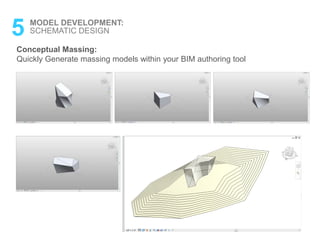
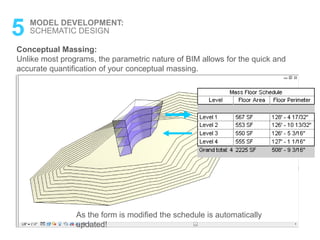
Conceptual Massing:
Quickly Generate massing models within your BIM authoring tool
5 MODEL DEVELOPMENT:
SCHEMATIC DESIGN
Conceptual Massing:
Unlike most programs, the parametric nature of BIM allows for the quick and
accurate quantification of your conceptual massing.
As the form is modified the schedule is automatically
updated!
5 MODEL DEVELOPMENT:
SCHEMATIC DESIGN
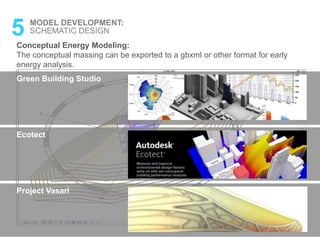
Conceptual Energy Modeling:
The conceptual massing can be exported to a gbxml or other format for early
energy analysis.
Green Building Studio
Ecotect
Project Vasari
5 MODEL DEVELOPMENT:
SCHEMATIC DESIGN
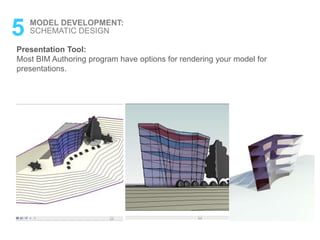
Presentation Tool:
Most BIM Authoring program have options for rendering your model for
presentations.
5 MODEL DEVELOPMENT:
SCHEMATIC DESIGN
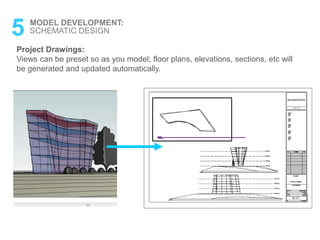
Project Drawings:
Views can be preset so as you model; floor plans, elevations, sections, etc will
be generated and updated automatically.
PM: Considerations
Staffing:
Most experienced modelers should be assigned at the start of the
project.
This person will work directly with the Architect/ Engineer to develop the
model
This is an opportunity to share and strengthen the intellectual resources
of your team by allowing the more experienced Architects to mentor and
provide technical guidance while the modeler shares and teaches
Architect about BIM software and other digital tools.
5 MODEL DEVELOPMENT:
SCHEMATIC DESIGN
5.3 DESIGN DEVELOPMENT
5 MODEL DEVELOPMENT:
DESIGN DEVELOPMENT
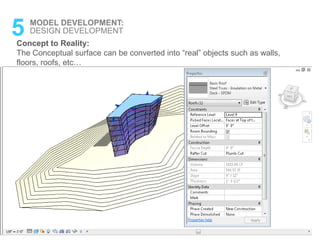
Concept to Reality:
The Conceptual surface can be converted into “real” objects such as walls,
floors, roofs, etc

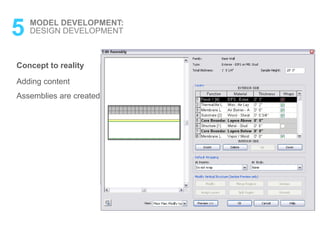
Concept to reality
Adding content
Assemblies are created
5 MODEL DEVELOPMENT:
DESIGN DEVELOPMENT
5 MODEL DEVELOPMENT:
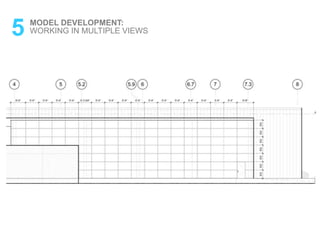
WORKING IN MULTIPLE VIEWS
5 MODEL DEVELOPMENT:
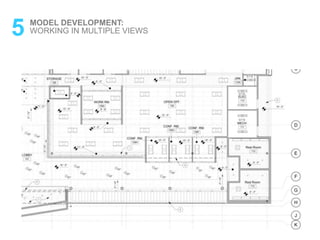
WORKING IN MULTIPLE VIEWS
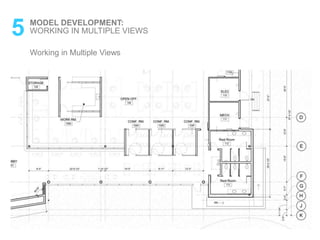
5 MODEL DEVELOPMENT:
Working in Multiple Views
WORKING IN MULTIPLE VIEWS
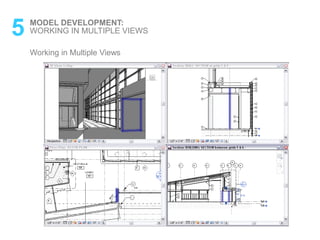
5 MODEL DEVELOPMENT:
Working in Multiple Views
WORKING IN MULTIPLE VIEWS
5 MODEL DEVELOPMENT:
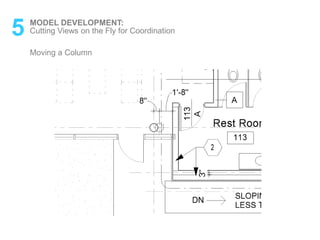
Moving a Column
Cutting Views on the Fly for Coordination
5 MODEL DEVELOPMENT:
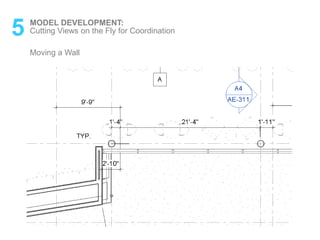
Moving a Wall
Cutting Views on the Fly for Coordination
5 MODEL DEVELOPMENT:
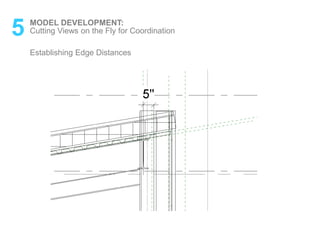
Establishing Edge Distances
Cutting Views on the Fly for Coordination
5 MODEL DEVELOPMENT:
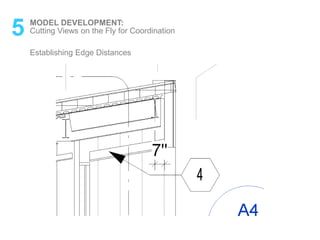
Establishing Edge Distances
Cutting Views on the Fly for Coordination
5 MODEL DEVELOPMENT:
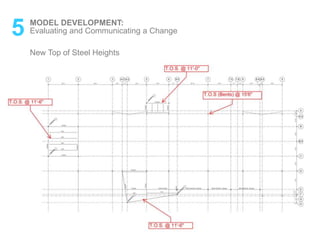
Evaluating and Communicating a Change
New Top of Steel Heights
5 MODEL DEVELOPMENT:
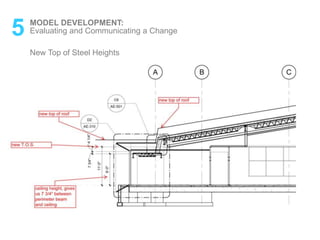
Evaluating and Communicating a Change
New Top of Steel Heights
5 MODEL DEVELOPMENT:
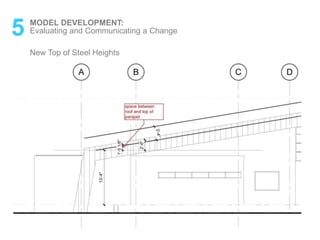
Evaluating and Communicating a Change
New Top of Steel Heights
5 MODEL DEVELOPMENT:
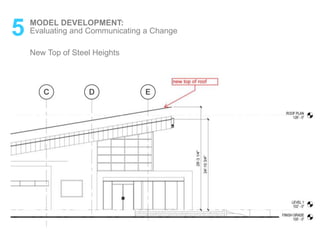
Evaluating and Communicating a Change
New Top of Steel Heights
5.4 CONSTRUCTION
DOCUMENTS
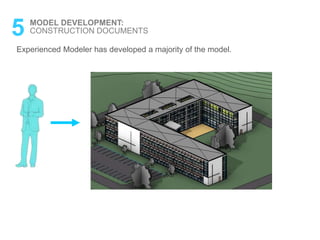
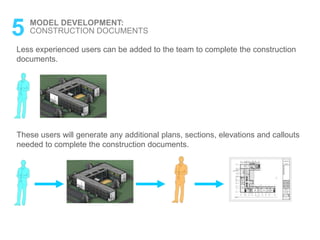
Experienced Modeler has developed a majority of the model.
5 MODEL DEVELOPMENT:
CONSTRUCTION DOCUMENTS
Less experienced users can be added to the team to complete the construction
documents.
5 MODEL DEVELOPMENT:
CONSTRUCTION DOCUMENTS
These users will generate any additional plans, sections, elevations and callouts
needed to complete the construction documents.
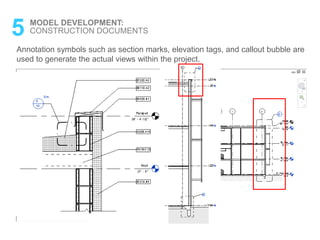
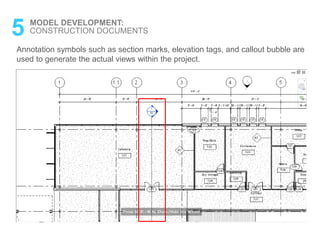
Annotation symbols such as section marks, elevation tags, and callout bubble are
used to generate the actual views within the project.
5 MODEL DEVELOPMENT:
CONSTRUCTION DOCUMENTS
Annotation symbols such as section marks, elevation tags, and callout bubble are
used to generate the actual views within the project.
5 MODEL DEVELOPMENT:
CONSTRUCTION DOCUMENTS
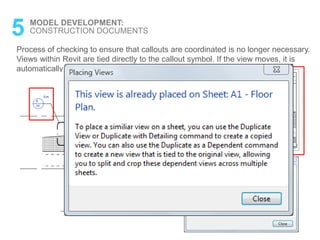
Process of checking to ensure that callouts are coordinated is no longer necessary.
Views within Revit are tied directly to the callout symbol. If the view moves, it is
automatically updated.
5 MODEL DEVELOPMENT:
CONSTRUCTION DOCUMENTS
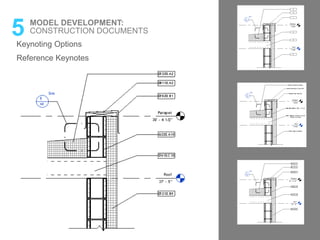
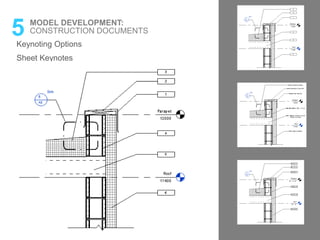
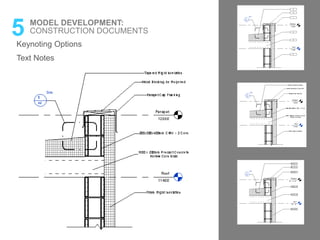
Keynoting Options
5 MODEL DEVELOPMENT:
CONSTRUCTION DOCUMENTS
Reference Keynotes
Keynoting Options
5 MODEL DEVELOPMENT:
CONSTRUCTION DOCUMENTS
Sheet Keynotes
Keynoting Options
5 MODEL DEVELOPMENT:
CONSTRUCTION DOCUMENTS
Text Notes
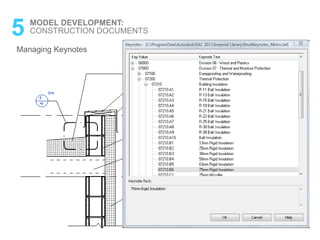
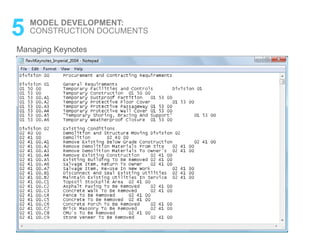
Managing Keynotes
5 MODEL DEVELOPMENT:
CONSTRUCTION DOCUMENTS
Managing Keynotes
5 MODEL DEVELOPMENT:
CONSTRUCTION DOCUMENTS
Generating Specifications
5 MODEL DEVELOPMENT:
CONSTRUCTION DOCUMENTS
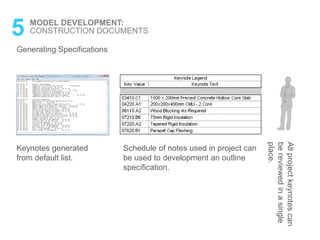
Keynotes generated
from default list.
Schedule of notes used in project can
be used to development an outline
specification.
Allprojectkeynotescan
bereviewedinasingle
place.
Generating Specifications
5 MODEL DEVELOPMENT:
CONSTRUCTION DOCUMENTS
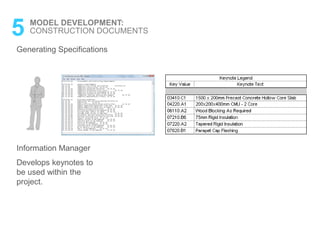
Information Manager
Develops keynotes to
be used within the
project.
5.5 COORDINATION
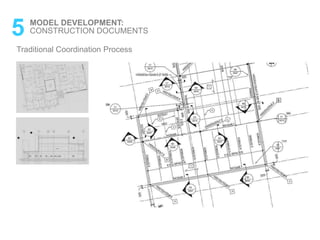
Traditional Coordination Process
5 MODEL DEVELOPMENT:
CONSTRUCTION DOCUMENTS
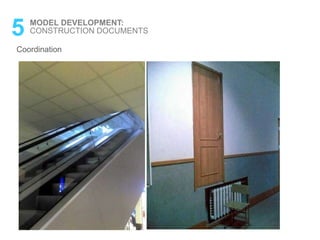
Coordination
5 MODEL DEVELOPMENT:
CONSTRUCTION DOCUMENTS
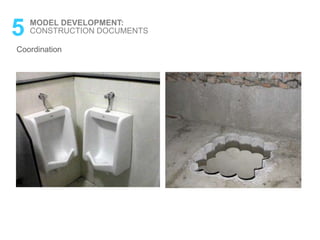
Coordination
5 MODEL DEVELOPMENT:
CONSTRUCTION DOCUMENTS
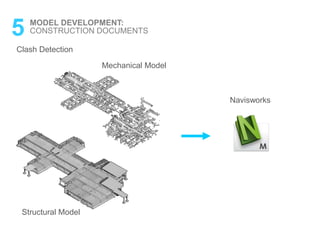
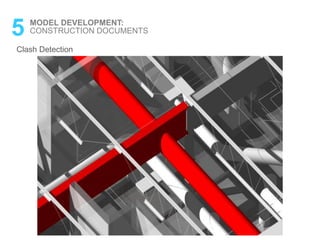
Clash Detection
Navisworks
Structural Model
Mechanical Model
5 MODEL DEVELOPMENT:
CONSTRUCTION DOCUMENTS
Clash Detection
5 MODEL DEVELOPMENT:
CONSTRUCTION DOCUMENTS
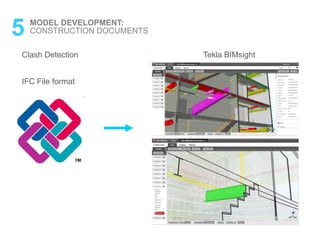
Clash Detection Tekla BIMsight
5 MODEL DEVELOPMENT:
CONSTRUCTION DOCUMENTS
IFC File format
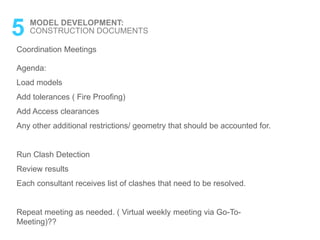
Coordination Meetings
Agenda:
Load models
Add tolerances ( Fire Proofing)
Add Access clearances
Any other additional restrictions/ geometry that should be accounted for.
Run Clash Detection
Review results
Each consultant receives list of clashes that need to be resolved.
Repeat meeting as needed. ( Virtual weekly meeting via Go-To-
Meeting)??
5 MODEL DEVELOPMENT:
CONSTRUCTION DOCUMENTS
5.6 QA/QC PROCESS
QA/QC Process
PM does not need to know how to use the software to review drawings:
Process of exporting to dwg at the end of the day/week/when needed
(batch Export)
Markup tools:
Autodesk Design Review
Blue Beam
Etc
.
5 MODEL DEVELOPMENT:
CONSTRUCTION DOCUMENTS
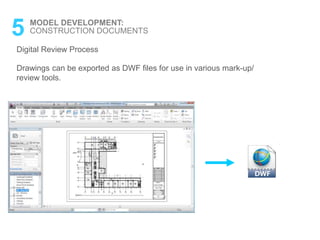
Digital Review Process
Drawings can be exported as DWF files for use in various mark-up/
review tools.
5 MODEL DEVELOPMENT:
CONSTRUCTION DOCUMENTS
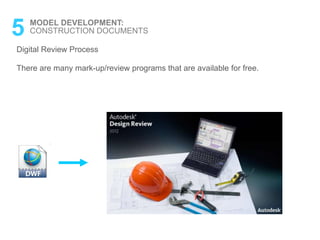
Digital Review Process
There are many mark-up/review programs that are available for free.
5 MODEL DEVELOPMENT:
CONSTRUCTION DOCUMENTS
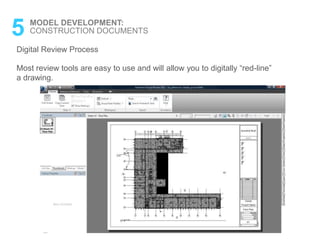
Digital Review Process
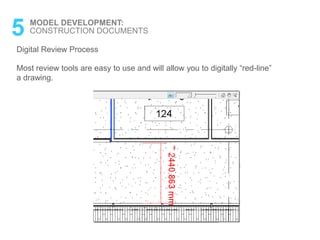
Most review tools are easy to use and will allow you to digitally “red-line”
a drawing.
5 MODEL DEVELOPMENT:
CONSTRUCTION DOCUMENTS
Digital Review Process
Most review tools are easy to use and will allow you to digitally “red-line”
a drawing.
5 MODEL DEVELOPMENT:
CONSTRUCTION DOCUMENTS
Digital Review Process
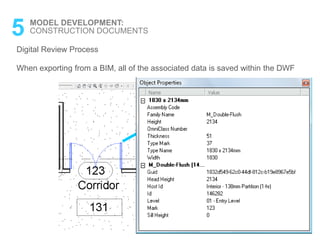
When exporting from a BIM, all of the associated data is saved within the DWF
5 MODEL DEVELOPMENT:
CONSTRUCTION DOCUMENTS
Review drawings from virtually anywhere!
5 MODEL DEVELOPMENT:
CONSTRUCTION DOCUMENTS
Digital Review Process
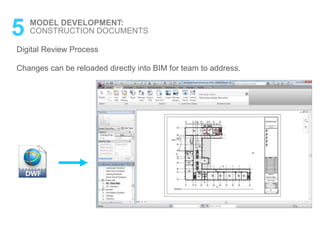
Changes can be reloaded directly into BIM for team to address.
5 MODEL DEVELOPMENT:
CONSTRUCTION DOCUMENTS
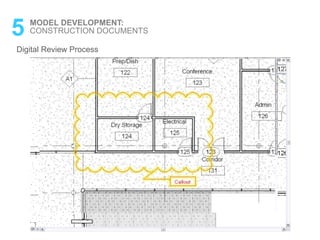
Digital Review Process
5 MODEL DEVELOPMENT:
CONSTRUCTION DOCUMENTS
Digital Review Process
5 MODEL DEVELOPMENT:
CONSTRUCTION DOCUMENTS
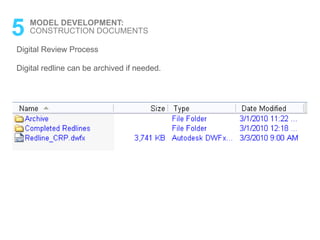
Digital redline can be archived if needed.
6 CASE
STUDY:
PROTOTYPE PROJECT X
6 Case Study
Project X
The new fee structure
Prototype Project
This project was selected due to the fact that less design decisions
where required so that inefficiencies could be filtered out to focus largely
on the new tool “ Revit”
6 Case Study
The new fee structure
Project X
900
800
700
600
500
400
300
200
100
0
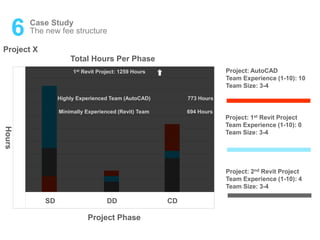
Total Hours Per Phase
Project: AutoCAD
Team Experience (1-10): 10
Team Size: 3-4
Project: 1st Revit Project
Team Experience (1-10): 0
Team Size: 3-4
SD DD CD
Project Phase
Hours
Project: 2nd Revit Project
Team Experience (1-10): 4
Team Size: 3-4
1st Revit Project: 1259 Hours
Highly Experienced Team (AutoCAD) 773 Hours
Minimally Experienced (Revit) Team 694 Hours
6 Case Study
Project X
The new fee structure
900
800
700
600
500
400
300
200
100
0
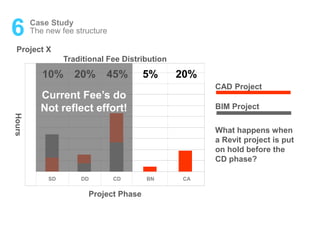
Traditional Fee Distribution
CAD Project
BIM Project
SD CD BN
Project Phase
Hours
CADD
10% 20% 45% 5% 20%
Current Fee’s do
Not reflect effort!
What happens when
a Revit project is put
on hold before the
CD phase?
6 Case Study
Project X
The new fee structure
900
800
700
600
500
400
300
200
100
0
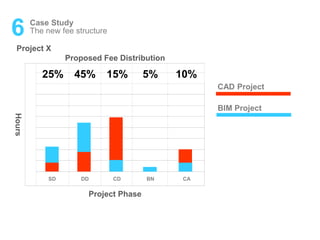
Proposed Fee Distribution
CAD Project
BIM Project
SD CD BN
Project Phase
Hours
CADD
25% 45% 15% 5% 10%
6 Case Study
The new fee structure
1
Thank You

BIM for Project Managers

  • 1.
    ANA BAKER BRANDONGARRETT BIM:FOR PROJECT MANAGERS CSI Southwest Region Conference
  • 2.
    BIM Overview BIM Levelof Development Evolution of the Drawing Process BIM Workflow -Internal -Between Consultants Model Development -Programming and Pre-Design -Schematic Design -Design Development -Construction Documents Case Study 1 2 3 4 5 6 whatwillbecovered

  • 3.
  • 4.
    An OLD processdoes not work with a NEW tool
  • 5.
    1 BIM: Overview “A BuildingInformation Model serves as a shared knowledge resource for information about a facility forming a reliable basis for decisions during its life cycle from inception onward.” - BuildingSMART Alliance “Building Information Modeling, or BIM is a parametric, 3D model that is used to generate plans, sections, elevations, perspectives, details, schedules – all of the necessary components to document the design of a building” - Mastering Autodesk Revit Architecture 2011
  • 6.
    1 BIM: Development Multiple viewsare generated from one model, such as: -Floor Plans -Sections -Elevations -Details
  • 7.
    1 BIM: Working inMultiple Views Development
  • 8.
    1 BIM: Information Not justa Model It’s a Database
  • 9.
  • 10.
  • 11.
  • 12.
    1 BIM: Data Standards NBIMS:National Building Information Modeling Standard IFC: The Industry Foundation Classes IFD: Industry Foundation Dictionary
  • 13.
    1 BIM: Authoring Programs AUTODESKREVIT ARCHICAD BENTLEY ARCHITECTURE TEKLA (STRUCTURAL)
  • 14.
    1 BIM: Data Standards Lawsand Regulations -Building Regulations -Building Specifications Knowledge Databases -Best Practice Knowledge -Own Practice Briefing -Functional Requirements -Estimates -Conditions -Requirements -Demolition, refurbishment -Rebuild -Demolition -Restoration Facility Management -Letting, sale, operations -Maintenance -Guaranties Construction Management -Scheduling -Logistics, 4D Procurement -Product databases -Price databases Specifications -Specification sheets -Classification standards -Estimates, accounting Simulations -Comfort -Ventilation, heating -Life cycle cost -Light, sound -Insulation -Fire, usage -Environment -Life time predictions VRML -Visualization, 3D models CAD Software -Drawings, calculations -Architect, engineer
 *National Building Information Modeling Standard
  • 15.
    1 BIM: INTEROPERABILITY Construction IndustryTrends: Compared to all Non-Farm related industries the Construction Industry has actually become less productive. By utilizing a “Complete BIM” The downward trend can potentially be reversed
  • 16.
    1 BIM: INTEROPERABILITY According tothe National Institute of Standards and Technology. Owners and Operators have the largest interoperability costs of all the stakeholders in the AEC industry. Owners/Operators bear 68% of the estimated $15.8 billion lost due to inadequate interoperability. This equates to a loss of over $10.6 billion *The study also revealed that an inordinate amount of time is spent locating and verifying specific facility and project information from previous activities.
  • 17.
  • 18.
    2 BIM:LEVEL OFDEVELOPMENT
  • 19.
    2 LEVEL OFDEVELOPMENT: Building Information Modeling Protocol Exhibit COMMON QUESTIONS: How detailed should my model be? How much information should I include in my model? Who is responsible for modeling “X”? Should this be considered an additional service?
  • 20.
    2 LEVEL OFDEVELOPMENT: Building Information Modeling Protocol Exhibit
  • 21.
    MODEL ELEMENT: Component, Systemor Assembly within a BIM MODEL ELEMENT AUTHOR: Party responsible for model elements ( Architect, Contractor, Mechanical, Etc
.) MODEL USER: Individual or Entity allowed to use the model for Analysis, Estimating, or Scheduling. 2 LEVEL OF DEVELOPMENT: AIA E202 Definitions
  • 22.
    LEVEL OF DEVELOPMENT: Describesthe completeness to which a Model Element is developed. LOD: 100 Conceptual Geometry “Schematic Design” LOD: 200 Approximate Geometry “Design Development” LOD: 300 Precise Geometry “Construction Documents” LOD: 400 Fabrication “Construction Model” LOD: 500 “As-Built” 2 LEVEL OF DEVELOPMENT: LOD
  • 23.
    2 LEVEL OFDEVELOPMENT: LOD: 100 (Schematic Design) CONCEPTUAL GEOMETRY: Overall Building Massing Indicative of Area Height Volume Location Orientation. MODEL ELEMENT AUTHOR(S): Architect APPLICATIONS: Early Visualization - Massing Site Analysis Environmental Impact - Solar Design
  • 24.
    2 LEVEL OFDEVELOPMENT: LOD: 200 (Design Development) APPROXIMATE GEOMETRY: Generalized Systems Assemblies with Approximate Quantities Size Shape Location Orientation. MODEL ELEMENT AUTHOR(S): Architect Consultants APPLICATIONS: Visualization - Materiality Coordination with multiple disciplines
  • 25.
    2 LEVEL OFDEVELOPMENT: LOD: 300 (Construction Documents) SPECIFIC GEOMETRY: Specific Assemblies Accurate in Terms of Size Shape Location Quantity Orientation . MODEL ELEMENT AUTHOR(S): Architect Consultants APPLICATIONS: Construction Documents
  • 26.
    2 LEVEL OFDEVELOPMENT: LOD: 400 (Construction Model) FABRICATION MODEL: Specific Assemblies Accurate in Terms of Size Shape Location Quantity Orientation Complete Fabrication MODEL ELEMENT AUTHOR(S): Contractor Sub-Contractors APPLICATIONS: Detailed Visualization Reduction of Conflicts Direct to Fabrication Construction Scheduling
  • 27.
    2 LEVEL OFDEVELOPMENT: LOD: 500 (As-Built Model) AS-BUILT MODEL: Constructed Assemblies Actual and Accurate in Terms of Size Shape Location Quantity Orientation. MODEL ELEMENT AUTHOR(S): Contractor Sub-Contractors APPLICATIONS: Equipment maintenance and procurement Locating MEP and related services
  • 28.
    2 LEVEL OFDEVELOPMENT: Model Element Table
  • 29.
    2 LEVEL OFDEVELOPMENT: Building Information Modeling Protocol Exhibit WHAT TYPES OF INFORMATION SHOULD BE INCLUDED IN A LOD 300 EXTERIOR WALL? LOD 300 - SPECIFIC GEOMETRY: Specific Assemblies that are Accurate in Terms of Size, Shape, Location, Quantity, and Orientation . AIA E202 According to
  • 30.
    2 LEVEL OFDEVELOPMENT: Building Information Modeling Protocol Exhibit VA OBJECT/ ELEMENT MATRIX SUPPLEMENT THE AIA E202 WITH ANOTHER MORE DETAILED GUIDE
  • 31.
    2 LEVEL OFDEVELOPMENT: VA Object Element Table BIM OBJECT/ ELEMENT MATRIX: Developed by the Department of Veterans Affairs as part of VA BIM Guide. It depicts Building Information Typologies/Types, when they are relevant, and to what level of development (LOD) throughout a building lifecycle. It is an expansion of the E-202 to support a greater level of understanding of BIM information use. Highly Detailed list of various requirements as they relate to a BIM’s Level of Development. * Free downloadable Excel file from VA website
  • 32.
    2 LEVEL OFDEVELOPMENT: VA Object Element Table INFORMATION TYPES: Information Categories include Functional and performance characteristics that may extend across current OmniClass Tables Building Program & Project Meta Data Physical Properties of BIM Objects & Elements GeoSpatial and Spatial Location of Objects & Elements Manufacturer Specific Information Requirements Specifications Estimating Value Engineering Requirements (BIM Use Case Energy Analysis Requirements (BIM Use Case) Sustainable Material LEED or Other Requiremen Project Environmental & Site Conditions Program/Space Compliance or Validation Code Compliance/ Occupant Safety Requirement Phases Time Sequencing & Schedule Requireme Construction Logistics & Sequencing Building Commissioning Requirements Facilities/Asset Management (Organization Specific Standards) Note/Remarks
  • 33.
    2 LEVEL OFDEVELOPMENT: VA Object Element Table LOD MEA AIA E-202 VA Object Element Matrix Data Comparison Exterior Walls
  • 34.
    2 LEVEL OFDEVELOPMENT: VA Object Element Table EXTERIOR WALL: LOD 100
  • 35.
    2 LEVEL OFDEVELOPMENT: VA Object Element Table EXTERIOR WALL: LOD 200
  • 36.
    2 LEVEL OFDEVELOPMENT: VA Object Element Table EXTERIOR WALL: LOD 300
  • 37.
    2 LEVEL OFDEVELOPMENT: VA Object Element Table EXTERIOR WALL: LOD 400
  • 38.
    2 LEVEL OFDEVELOPMENT: VA Object Element Table EXTERIOR WALL: LOD 500
  • 39.
    2 LEVEL OFDEVELOPMENT: VA Object Element Table DATA ACCUMULATION LOD200 LOD300 LOD400 LOD500 LOD100 LOD100 BIM LOD300BIM
  • 40.
    2 LEVEL OFDEVELOPMENT: MODEL ELEMENT TABLE PM CONSIDERATIONS: Make sure the entire project team is involved in filling out the Model Element Table. Work with the owner to determine the actual needs in terms of LOD. The higher the LOD, the higher the cost (300+)
  • 41.
    3 EVOLUTION OF THEDRAWING PROCESS
  • 42.
    3 Evolution ofthe Drawing Process Drafting to BIM Hand Drafting Computer Aided Drafting Building Information Modeling
  • 43.
    3 Evolution ofthe Drawing Process Drafting to BIM File Structure CAD BIM Model View Sheet vs. Model File Sheet File Sheet
  • 44.
    3 Evolution ofthe Drawing Process Drafting to BIM Building Up vs. Cleaning Up CAD BIM
  • 45.
    3 Evolution ofthe Drawing Process Drafting to BIM Struct. Arch. MEP Drawing Set Contractor / Owner Traditional Process
  • 46.
    3 Evolution ofthe Drawing Process Drafting to BIM BIM Process BIM MEPArch. Contractor / Owner Drawing Set Struct.
  • 47.
    3 Evolution ofthe Drawing Process BIM working with other tools BIM is a widely used tool, but its not our only tool in our toolbox
  • 48.
    3 Evolution ofthe Drawing Process Detail BIM and CAD Site Plan Details BIM working with other tools
  • 49.
    3 Evolution ofthe Drawing Process BIM and Presentation Oriented Programs Sketch Up 3D Studio Max BIM working with other tools
  • 50.
    3 Evolution ofthe Drawing Process BIM and Database Programs Microsoft Access BIM working with other tools
  • 51.
    3 Evolution ofthe Drawing Process BIM and Energy Modeling Sun Path Study Sun Exposure Study BIM working with other tools
  • 52.
    3 Evolution ofthe Drawing Process Capabilities for 3D Example Project Fine tuning the curtain wall system and lobby space
  • 53.
    3 Evolution ofthe Drawing Process Visualizing how things come together Capabilities for 3D
  • 54.
    3 Evolution ofthe Drawing Process Visualizing the quality of space Capabilities for 3D
  • 55.
    3 Evolution ofthe Drawing Process Comparing Options Column VS. No Column Capabilities for 3D
  • 56.
  • 57.
    PM: Considerations Staffing: Most experiencedmodelers should be assigned at the start of the project. This person will work directly with the Architect/ Engineer to develop the model This is an opportunity to share and strengthen the intellectual resources of your team by allowing the more experienced Architects to mentor and provide technical guidance while the modeler shares and teaches Architect about BIM software and other digital tools. 5 MODEL DEVELOPMENT: SCHEMATIC DESIGN
  • 58.
    4 BIM Workflow Internal:Staffing Legend: SDCD ProjectPhase DD Modeler II (Most experienced Revit users on Team) works with PA/PM/PE on initial development of model. Modeler I (Less experienced Revit users on Team) works on setting up views, detailing, etc
 Information Manager No Revit Experience Req. (PM/ PA/ PE) Responsible for Keynote database and specifications.
  • 59.
    4 BIM Workflow TheTeam Work Environment Working out of “one” file Central File Local File Local File Local File Local File Local File
  • 60.
    4 BIM Workflow Staffing Howfar to take the model? ‘Disconnect’ model from drawings in CDs Use of a BIM through CDs Use of a BIM through Life Cycle of Building Partial utilization of BIM Full utilization of BIM
  • 61.
    4 BIM Workflow Internal SDDD CD CA What to plan for when setting deadlines Suggested Schedule for CAD Projects Suggested Schedule for BIM Projects SD DD CD CA
  • 62.
    4 BIM Workflow BetweenDesign Professionals Setting Deadlines with adequate time to catch changes
  • 63.
    4 BIM Workflow BetweenDesign Professionals When linking models
 - Establish Coordinate system so all models align - Set up linkable views for each discipline to use - Set any imported CAD line work to black -Organize links on separate worksets/ layers - Adjust any visibility and graphic settings as needed
  • 64.
    4 BIM Workflow BetweenDesign Professionals Structural Grid Controlling the graphics from a linked model Architectural Grid
  • 65.
    5 BIM Workflow BetweenDesign Professionals Opportunities for Design Collaboration: Lighting Studies Equinox at Noon Summer Solstice at Noon Winter Solstice at Noon
  • 66.
  • 67.
  • 68.
    5 MODEL DEVELOPMENT: ABuilding Information Model can be started as early as programming. Programmatic Information furnished by the owner can be inputted into a BIM. This information can be used as a reference throughout the entire project and it can be referenced at any time. PROGRAMMING Excel Spreadsheet BIM
  • 69.
    5 MODEL DEVELOPMENT: Rooms:Define a space within a model PROGRAMMING Rooms will store all of the Programmatic data and will Be the primary tool used at This phase in the project
  • 70.
    5 MODEL DEVELOPMENT: PROGRAMMING PROGRAM/SPACECOMPLIANCE & VALIDATION: Types of information that can be included in a room: Space name Space number Space description Departmental requirements Required sf Required quantities Required equipment Required furniture Required built-ins Required finishes Ceiling heights Sound transmission resistance
  • 71.
    5 MODEL DEVELOPMENT: PROGRAMMING PROGRAM/SPACEVALIDATION: Scheduled can be used as a tool for validation to ensure that the needs have been met. Update Revit model to meet owner’s programmatic requirements. OWNERS REQ. REVIT
  • 72.
    5 MODEL DEVELOPMENT: PROGRAMMING VISUALIZEDATA: Color legends can be developed based on an established criteria. (Revit) Common criteria types include color by department/ name
  • 73.
    5 MODEL DEVELOPMENT: PROGRAMMING PMCONSIDERATIONS: BIM can be a powerful tool during the earliest stages of a project Information gathered from this effort will be embedded within the model throughout all phases of the project. This will help to ensure that all of the programmatic requirements have been met. Less experienced users can work at this stage as no actual geometry is created.
  • 74.
  • 75.
    5 MODEL DEVELOPMENT: SCHEMATICDESIGN Conceptual Massing: Quickly Generate massing models within your BIM authoring tool
  • 76.
    5 MODEL DEVELOPMENT: SCHEMATICDESIGN Conceptual Massing: Unlike most programs, the parametric nature of BIM allows for the quick and accurate quantification of your conceptual massing. As the form is modified the schedule is automatically updated!
  • 77.
    5 MODEL DEVELOPMENT: SCHEMATICDESIGN Conceptual Energy Modeling: The conceptual massing can be exported to a gbxml or other format for early energy analysis. Green Building Studio Ecotect Project Vasari
  • 78.
    5 MODEL DEVELOPMENT: SCHEMATICDESIGN Presentation Tool: Most BIM Authoring program have options for rendering your model for presentations.
  • 79.
    5 MODEL DEVELOPMENT: SCHEMATICDESIGN Project Drawings: Views can be preset so as you model; floor plans, elevations, sections, etc will be generated and updated automatically.
  • 80.
    PM: Considerations Staffing: Most experiencedmodelers should be assigned at the start of the project. This person will work directly with the Architect/ Engineer to develop the model This is an opportunity to share and strengthen the intellectual resources of your team by allowing the more experienced Architects to mentor and provide technical guidance while the modeler shares and teaches Architect about BIM software and other digital tools. 5 MODEL DEVELOPMENT: SCHEMATIC DESIGN
  • 81.
  • 82.
    5 MODEL DEVELOPMENT: DESIGNDEVELOPMENT Concept to Reality: The Conceptual surface can be converted into “real” objects such as walls, floors, roofs, etc

  • 83.
    Concept to reality Addingcontent Assemblies are created 5 MODEL DEVELOPMENT: DESIGN DEVELOPMENT
  • 84.
  • 85.
  • 86.
    5 MODEL DEVELOPMENT: Workingin Multiple Views WORKING IN MULTIPLE VIEWS
  • 87.
    5 MODEL DEVELOPMENT: Workingin Multiple Views WORKING IN MULTIPLE VIEWS
  • 88.
    5 MODEL DEVELOPMENT: Movinga Column Cutting Views on the Fly for Coordination
  • 89.
    5 MODEL DEVELOPMENT: Movinga Wall Cutting Views on the Fly for Coordination
  • 90.
    5 MODEL DEVELOPMENT: EstablishingEdge Distances Cutting Views on the Fly for Coordination
  • 91.
    5 MODEL DEVELOPMENT: EstablishingEdge Distances Cutting Views on the Fly for Coordination
  • 92.
    5 MODEL DEVELOPMENT: Evaluatingand Communicating a Change New Top of Steel Heights
  • 93.
    5 MODEL DEVELOPMENT: Evaluatingand Communicating a Change New Top of Steel Heights
  • 94.
    5 MODEL DEVELOPMENT: Evaluatingand Communicating a Change New Top of Steel Heights
  • 95.
    5 MODEL DEVELOPMENT: Evaluatingand Communicating a Change New Top of Steel Heights
  • 96.
  • 97.
    Experienced Modeler hasdeveloped a majority of the model. 5 MODEL DEVELOPMENT: CONSTRUCTION DOCUMENTS
  • 98.
    Less experienced userscan be added to the team to complete the construction documents. 5 MODEL DEVELOPMENT: CONSTRUCTION DOCUMENTS These users will generate any additional plans, sections, elevations and callouts needed to complete the construction documents.
  • 99.
    Annotation symbols suchas section marks, elevation tags, and callout bubble are used to generate the actual views within the project. 5 MODEL DEVELOPMENT: CONSTRUCTION DOCUMENTS
  • 100.
    Annotation symbols suchas section marks, elevation tags, and callout bubble are used to generate the actual views within the project. 5 MODEL DEVELOPMENT: CONSTRUCTION DOCUMENTS
  • 101.
    Process of checkingto ensure that callouts are coordinated is no longer necessary. Views within Revit are tied directly to the callout symbol. If the view moves, it is automatically updated. 5 MODEL DEVELOPMENT: CONSTRUCTION DOCUMENTS
  • 102.
    Keynoting Options 5 MODELDEVELOPMENT: CONSTRUCTION DOCUMENTS Reference Keynotes
  • 103.
    Keynoting Options 5 MODELDEVELOPMENT: CONSTRUCTION DOCUMENTS Sheet Keynotes
  • 104.
    Keynoting Options 5 MODELDEVELOPMENT: CONSTRUCTION DOCUMENTS Text Notes
  • 105.
    Managing Keynotes 5 MODELDEVELOPMENT: CONSTRUCTION DOCUMENTS
  • 106.
    Managing Keynotes 5 MODELDEVELOPMENT: CONSTRUCTION DOCUMENTS
  • 107.
    Generating Specifications 5 MODELDEVELOPMENT: CONSTRUCTION DOCUMENTS Keynotes generated from default list. Schedule of notes used in project can be used to development an outline specification. Allprojectkeynotescan bereviewedinasingle place.
  • 108.
    Generating Specifications 5 MODELDEVELOPMENT: CONSTRUCTION DOCUMENTS Information Manager Develops keynotes to be used within the project.
  • 109.
  • 110.
    Traditional Coordination Process 5MODEL DEVELOPMENT: CONSTRUCTION DOCUMENTS
  • 111.
  • 112.
  • 113.
    Clash Detection Navisworks Structural Model MechanicalModel 5 MODEL DEVELOPMENT: CONSTRUCTION DOCUMENTS
  • 114.
    Clash Detection 5 MODELDEVELOPMENT: CONSTRUCTION DOCUMENTS
  • 115.
    Clash Detection TeklaBIMsight 5 MODEL DEVELOPMENT: CONSTRUCTION DOCUMENTS IFC File format
  • 116.
    Coordination Meetings Agenda: Load models Addtolerances ( Fire Proofing) Add Access clearances Any other additional restrictions/ geometry that should be accounted for. Run Clash Detection Review results Each consultant receives list of clashes that need to be resolved. Repeat meeting as needed. ( Virtual weekly meeting via Go-To- Meeting)?? 5 MODEL DEVELOPMENT: CONSTRUCTION DOCUMENTS
  • 117.
  • 118.
    QA/QC Process PM doesnot need to know how to use the software to review drawings: Process of exporting to dwg at the end of the day/week/when needed (batch Export) Markup tools: Autodesk Design Review Blue Beam Etc
. 5 MODEL DEVELOPMENT: CONSTRUCTION DOCUMENTS
  • 119.
    Digital Review Process Drawingscan be exported as DWF files for use in various mark-up/ review tools. 5 MODEL DEVELOPMENT: CONSTRUCTION DOCUMENTS
  • 120.
    Digital Review Process Thereare many mark-up/review programs that are available for free. 5 MODEL DEVELOPMENT: CONSTRUCTION DOCUMENTS
  • 121.
    Digital Review Process Mostreview tools are easy to use and will allow you to digitally “red-line” a drawing. 5 MODEL DEVELOPMENT: CONSTRUCTION DOCUMENTS
  • 122.
    Digital Review Process Mostreview tools are easy to use and will allow you to digitally “red-line” a drawing. 5 MODEL DEVELOPMENT: CONSTRUCTION DOCUMENTS
  • 123.
    Digital Review Process Whenexporting from a BIM, all of the associated data is saved within the DWF 5 MODEL DEVELOPMENT: CONSTRUCTION DOCUMENTS
  • 124.
    Review drawings fromvirtually anywhere! 5 MODEL DEVELOPMENT: CONSTRUCTION DOCUMENTS
  • 125.
    Digital Review Process Changescan be reloaded directly into BIM for team to address. 5 MODEL DEVELOPMENT: CONSTRUCTION DOCUMENTS
  • 126.
    Digital Review Process 5MODEL DEVELOPMENT: CONSTRUCTION DOCUMENTS
  • 127.
    Digital Review Process 5MODEL DEVELOPMENT: CONSTRUCTION DOCUMENTS Digital redline can be archived if needed.
  • 128.
  • 129.
    6 Case Study ProjectX The new fee structure Prototype Project This project was selected due to the fact that less design decisions where required so that inefficiencies could be filtered out to focus largely on the new tool “ Revit”
  • 130.
    6 Case Study Thenew fee structure Project X 900 800 700 600 500 400 300 200 100 0 Total Hours Per Phase Project: AutoCAD Team Experience (1-10): 10 Team Size: 3-4 Project: 1st Revit Project Team Experience (1-10): 0 Team Size: 3-4 SD DD CD Project Phase Hours Project: 2nd Revit Project Team Experience (1-10): 4 Team Size: 3-4 1st Revit Project: 1259 Hours Highly Experienced Team (AutoCAD) 773 Hours Minimally Experienced (Revit) Team 694 Hours
  • 131.
    6 Case Study ProjectX The new fee structure 900 800 700 600 500 400 300 200 100 0 Traditional Fee Distribution CAD Project BIM Project SD CD BN Project Phase Hours CADD 10% 20% 45% 5% 20% Current Fee’s do Not reflect effort! What happens when a Revit project is put on hold before the CD phase?
  • 132.
    6 Case Study ProjectX The new fee structure 900 800 700 600 500 400 300 200 100 0 Proposed Fee Distribution CAD Project BIM Project SD CD BN Project Phase Hours CADD 25% 45% 15% 5% 10%
  • 133.
    6 Case Study Thenew fee structure 1
  • 134.