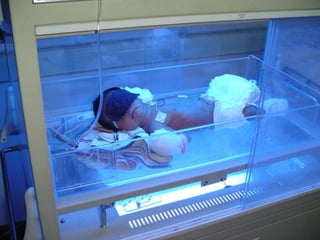
JaundiceBy Bish
ObjectivesDefine hyperbilirubinemia (Jaundice).
Differentiate between physiological and pathological jaundice.
State causes of hyperbilirubinemia.
Describe the most dangerous complication of hyperbilirubinemia.
Discuss the management of hyperbilirubinemiaDefinition: HyperbilirubinemiaHyperbilirubinemia: excessive level bilirubin in the blood characterized by jaundice, a yellowish discoloration of the skin, sclerae, mucous membranes and nailsTypically seen at bili levels of: 85-120Unconjugated bilirubin = Indirect bilirubin.Conjugated bilirubin = Direct bilirubin.
Why am I learning this?Is it important?
Why?Jaundice is quite common Full term infants: at least 60%  Preterm infants: over 80%
Most Importantly…
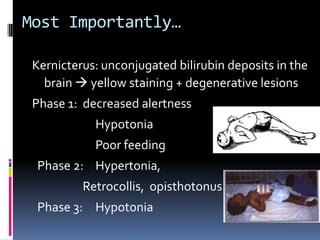
Most Importantly…Kernicterus: unconjugated bilirubin deposits in the brain  yellow staining + degenerative lesionsPhase 1:  decreased alertnessHypotonia		Poor feeding  Phase 2:	Hypertonia,	Retrocollis,  opisthotonus  Phase 3:	Hypotonia
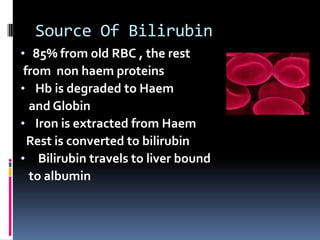
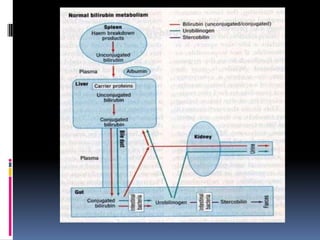
Source Of Bilirubin85% from old RBC , the rest  from  non haem proteins Hb is degraded to Haem   and Globin Iron is extracted from Haem  Rest is converted to bilirubin  Bilirubin travels to liver bound   to albumin
Journey through the liver Bilirubin taken up Conjugated to form water soluble conjugate Conjugate secreted into bile
In The GutBilirubin diglucuronide may be  Deconjugated or Metabolised by bacteria to urobilinogenpartially reabsorbed (remainder makes the stool brown)
So where can things go wrong?
Pathophysiology Of JaundiceHyperbilirubinemia is due to:Excess bilirubin production           Haemolytic
Impaired uptake by hepatocyte    Hep/cellular.
Failure of Conjugation                     Hep/cellular.
Impaired secretion of conj.bil.      Hep/cellular.
Impaired bile flow.                          Obst.JaundiceClassifications
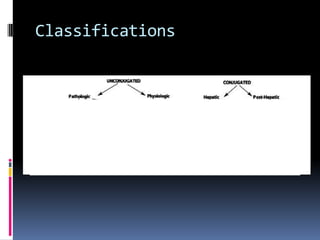
Classifications  Physiological Jaundice   Pathological Jaundice
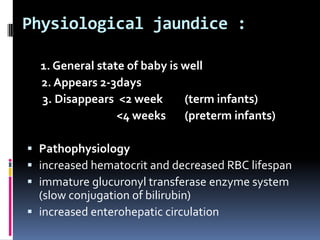
Physiological jaundice :1. General state of baby is well	 2. Appears 2-3days    	 3. Disappears  <2 week      	(term infants)   	        <4 weeks     	(preterm infants)Pathophysiologyincreased hematocrit and decreased RBC lifespan immature glucuronyltransferase enzyme system (slow conjugation of bilirubin) increased enterohepatic circulation
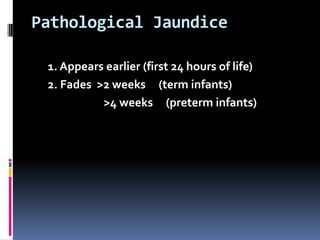
 Pathological Jaundice 		1. Appears earlier (first 24 hours of life)		2. Fades  >2 weeks     (term infants)   >4 weeks     (preterm infants)
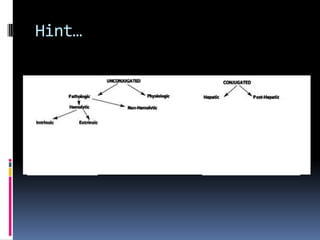
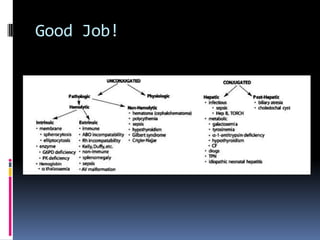
Back to our table..let’s break things down into basics..
Hint…
Good Job!
Now that you’re a pro..You’re called by a nurse for a new admission regarding a baby with elevated bili..what do you want to know
Approach to jaundiced babyGet  age of baby (hours), gestational age, pregnancy hx, septic risk factors, complications with deliveryAssess clinical condition (well or ill)Decide whether jaundice is physiological or pathologicalLook for evidence of kernicterus* in deeply jaundiced NB*review..what do you look for?
Approach to jaundiced babyGet  age of baby (hours), gestational age, pregnancy hx, septic risk factors, complications with deliveryAssess clinical condition (well or ill)Decide whether jaundice is physiological or pathologicalLook for evidence of kernicterus* in deeply jaundiced NB*Lethargy and poor feeding, poor or absent Moro's, opisthotonus or convulsions
Why does the age (hours) of baby matter?
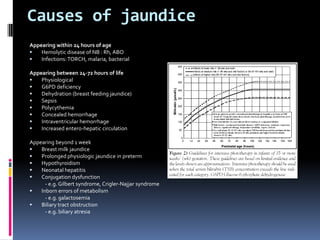
Causes of jaundiceAppearing within 24 hours of ageHemolytic disease of NB : Rh, ABOInfections: TORCH, malaria, bacterialAppearing between 24-72 hours of lifePhysiologicalG6PD deficiencyDehydration (breast feeding jaundice)SepsisPolycythemiaConcealed hemorrhageIntraventricular hemorrhageIncreased entero-hepatic circulationAppearing beyond 1 weekBreast milk jaundiceProlonged physiologic jaundice in pretermHypothyroidismNeonatal hepatitis Conjugation dysfunction   - e.g. Gilbert syndrome, Crigler-NajjarsyndromeInborn errors of metabolism   - e.g. galactosemiaBiliarytract obstruction      - e.g. biliaryatresia
What workup/labs do you order
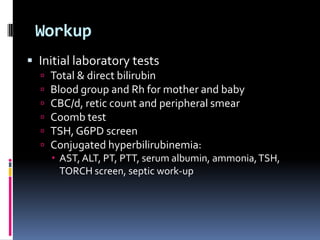
WorkupInitial laboratory tests Total & direct bilirubin Blood group and Rh for mother and baby CBC/d, reticcount and peripheral smear CoombtestTSH, G6PD screen Conjugated hyperbilirubinemia: AST, ALT, PT, PTT, serum albumin, ammonia, TSH, TORCH screen, septic work-up

Jaundice presentation

  • 1.
  • 2.
  • 3.
    Differentiate between physiologicaland pathological jaundice.
  • 4.
    State causes ofhyperbilirubinemia.
  • 5.
    Describe the mostdangerous complication of hyperbilirubinemia.
  • 6.
    Discuss the managementof hyperbilirubinemiaDefinition: HyperbilirubinemiaHyperbilirubinemia: excessive level bilirubin in the blood characterized by jaundice, a yellowish discoloration of the skin, sclerae, mucous membranes and nailsTypically seen at bili levels of: 85-120Unconjugated bilirubin = Indirect bilirubin.Conjugated bilirubin = Direct bilirubin.
  • 7.
    Why am Ilearning this?Is it important?
  • 8.
    Why?Jaundice is quitecommon Full term infants: at least 60% Preterm infants: over 80%
  • 9.
  • 10.
    Most Importantly…Kernicterus: unconjugatedbilirubin deposits in the brain  yellow staining + degenerative lesionsPhase 1: decreased alertnessHypotonia Poor feeding Phase 2: Hypertonia, Retrocollis, opisthotonus Phase 3: Hypotonia
  • 11.
    Source Of Bilirubin85%from old RBC , the rest from non haem proteins Hb is degraded to Haem and Globin Iron is extracted from Haem Rest is converted to bilirubin Bilirubin travels to liver bound to albumin
  • 12.
    Journey through theliver Bilirubin taken up Conjugated to form water soluble conjugate Conjugate secreted into bile
  • 14.
    In The GutBilirubindiglucuronide may be Deconjugated or Metabolised by bacteria to urobilinogenpartially reabsorbed (remainder makes the stool brown)
  • 15.
    So where canthings go wrong?
  • 16.
    Pathophysiology Of JaundiceHyperbilirubinemiais due to:Excess bilirubin production Haemolytic
  • 17.
    Impaired uptake byhepatocyte Hep/cellular.
  • 18.
  • 19.
    Impaired secretion ofconj.bil. Hep/cellular.
  • 20.
    Impaired bile flow. Obst.JaundiceClassifications
  • 21.
    Classifications PhysiologicalJaundice Pathological Jaundice
  • 22.
    Physiological jaundice :1.General state of baby is well 2. Appears 2-3days 3. Disappears <2 week (term infants) <4 weeks (preterm infants)Pathophysiologyincreased hematocrit and decreased RBC lifespan immature glucuronyltransferase enzyme system (slow conjugation of bilirubin) increased enterohepatic circulation
  • 23.
    Pathological Jaundice 1. Appears earlier (first 24 hours of life) 2. Fades >2 weeks (term infants) >4 weeks (preterm infants)
  • 24.
    Back to ourtable..let’s break things down into basics..
  • 25.
  • 26.
  • 27.
    Now that you’rea pro..You’re called by a nurse for a new admission regarding a baby with elevated bili..what do you want to know
  • 28.
    Approach to jaundicedbabyGet age of baby (hours), gestational age, pregnancy hx, septic risk factors, complications with deliveryAssess clinical condition (well or ill)Decide whether jaundice is physiological or pathologicalLook for evidence of kernicterus* in deeply jaundiced NB*review..what do you look for?
  • 29.
    Approach to jaundicedbabyGet age of baby (hours), gestational age, pregnancy hx, septic risk factors, complications with deliveryAssess clinical condition (well or ill)Decide whether jaundice is physiological or pathologicalLook for evidence of kernicterus* in deeply jaundiced NB*Lethargy and poor feeding, poor or absent Moro's, opisthotonus or convulsions
  • 30.
    Why does theage (hours) of baby matter?
  • 31.
    Causes of jaundiceAppearingwithin 24 hours of ageHemolytic disease of NB : Rh, ABOInfections: TORCH, malaria, bacterialAppearing between 24-72 hours of lifePhysiologicalG6PD deficiencyDehydration (breast feeding jaundice)SepsisPolycythemiaConcealed hemorrhageIntraventricular hemorrhageIncreased entero-hepatic circulationAppearing beyond 1 weekBreast milk jaundiceProlonged physiologic jaundice in pretermHypothyroidismNeonatal hepatitis Conjugation dysfunction   - e.g. Gilbert syndrome, Crigler-NajjarsyndromeInborn errors of metabolism   - e.g. galactosemiaBiliarytract obstruction      - e.g. biliaryatresia
  • 32.
  • 33.
    WorkupInitial laboratory testsTotal & direct bilirubin Blood group and Rh for mother and baby CBC/d, reticcount and peripheral smear CoombtestTSH, G6PD screen Conjugated hyperbilirubinemia: AST, ALT, PT, PTT, serum albumin, ammonia, TSH, TORCH screen, septic work-up