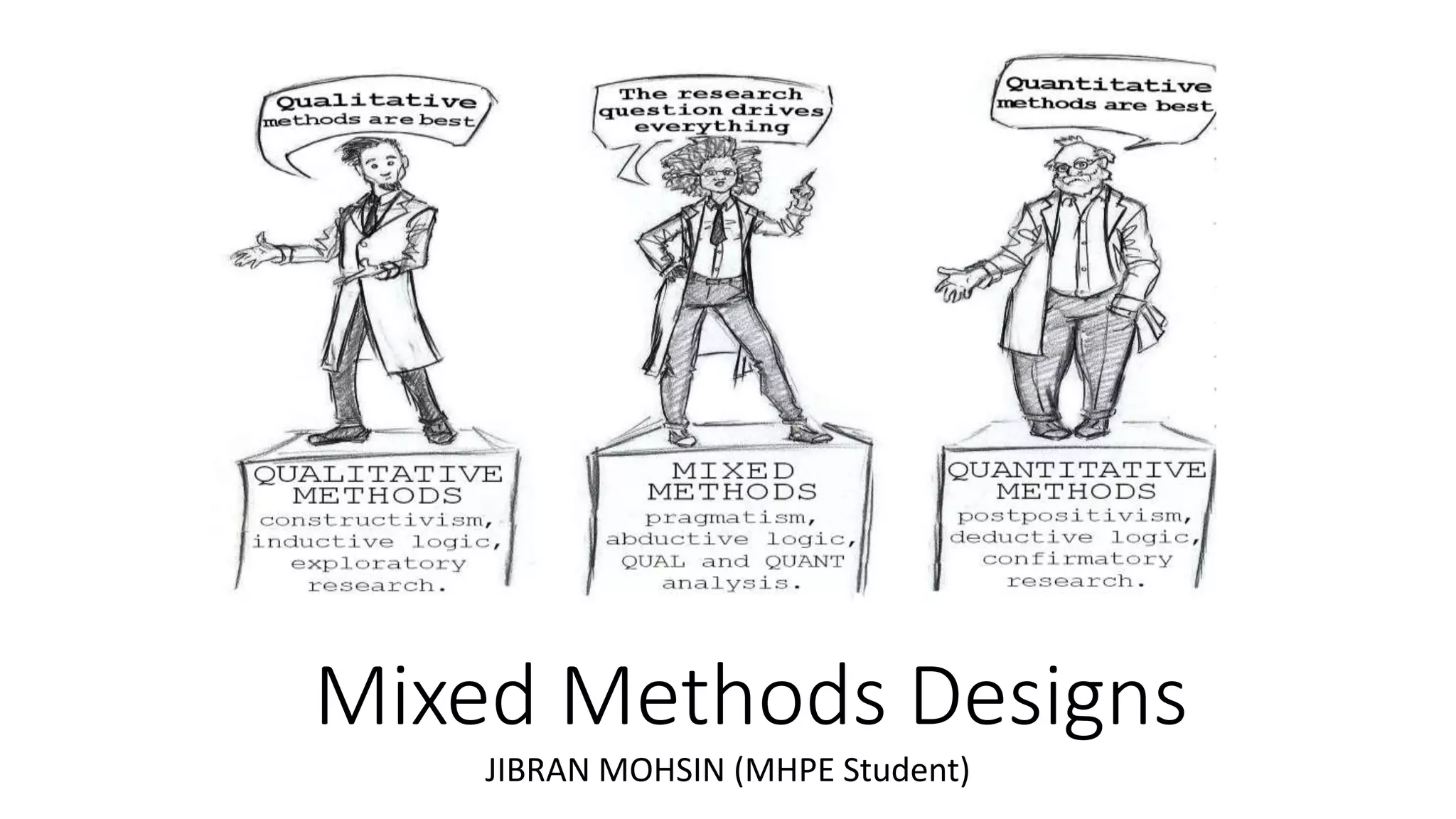
Mixed Methods Designs
JIBRAN MOHSIN (MHPE Student)
Outline
CHAPTER CONTENTS
1. Definition
2. Indications
3. History
4. Types
5. Key Characteristics
6. Ethical Issues
7. Steps in conducting
8. Evaluation
9. Summary
10. Meaningful Critique
11. Application to own practice
12. Evidence of external reading
Definition
A Procedure for collecting, analyzing, and “mixing” both quantitative
and qualitative methods in a single study or a series of studies to
understand a research question
Indications
1. Better understanding – strengths of both – “powerful mix”
1. Outcomes + Process
2. One type of research not enough to address research problem
3. Alternative perspective.
4. More acceptable than “pure” qualitative study.
History
1. Mixing forms of Quantitative Data
2. Combining quantitative and qualitative Data (triangulation of data)
3. Questioning the integration of Worldviews and Method
1. Worldview-method argument (Paradigm Debate)
2. Pragmatism
4. Developing Procedures for Mixed Methods Studies
5. Advocating for a Distinct Design
6. Reflective Period
Notation System for a Mixed Methods Study
Study # 1 QUAL + QUAN
Study # 2 QUAN ------> qual
Notation Used:
+ indicates the simultaneous or concurrent collection of quantitative and qualitative data
----> shows the sequential collection of quantitative collection of quantitative and qualitative data
Uppercase letters indicate a priority or increased weight for either the quantitative or qualitative data
Lowercase letters indicate a lower priority or weight for either the quantitative or qualitative data
Types
Step1: Identify mixed method study
• Title
• Data collection section
• Purpose statement or the research questions
Step2: Identify type of mixed methods design
• Priority or weight (quantitative vs qualitative data collection)
• Sequence of data collection
• Data analyses (combined vs separate)
• Where in study, data is “mixed”?
Types
Basic Designs Complex Designs
1. The convergent parallel (concurrent) design
2. The explanatory sequential design
3. The exploratory sequential design
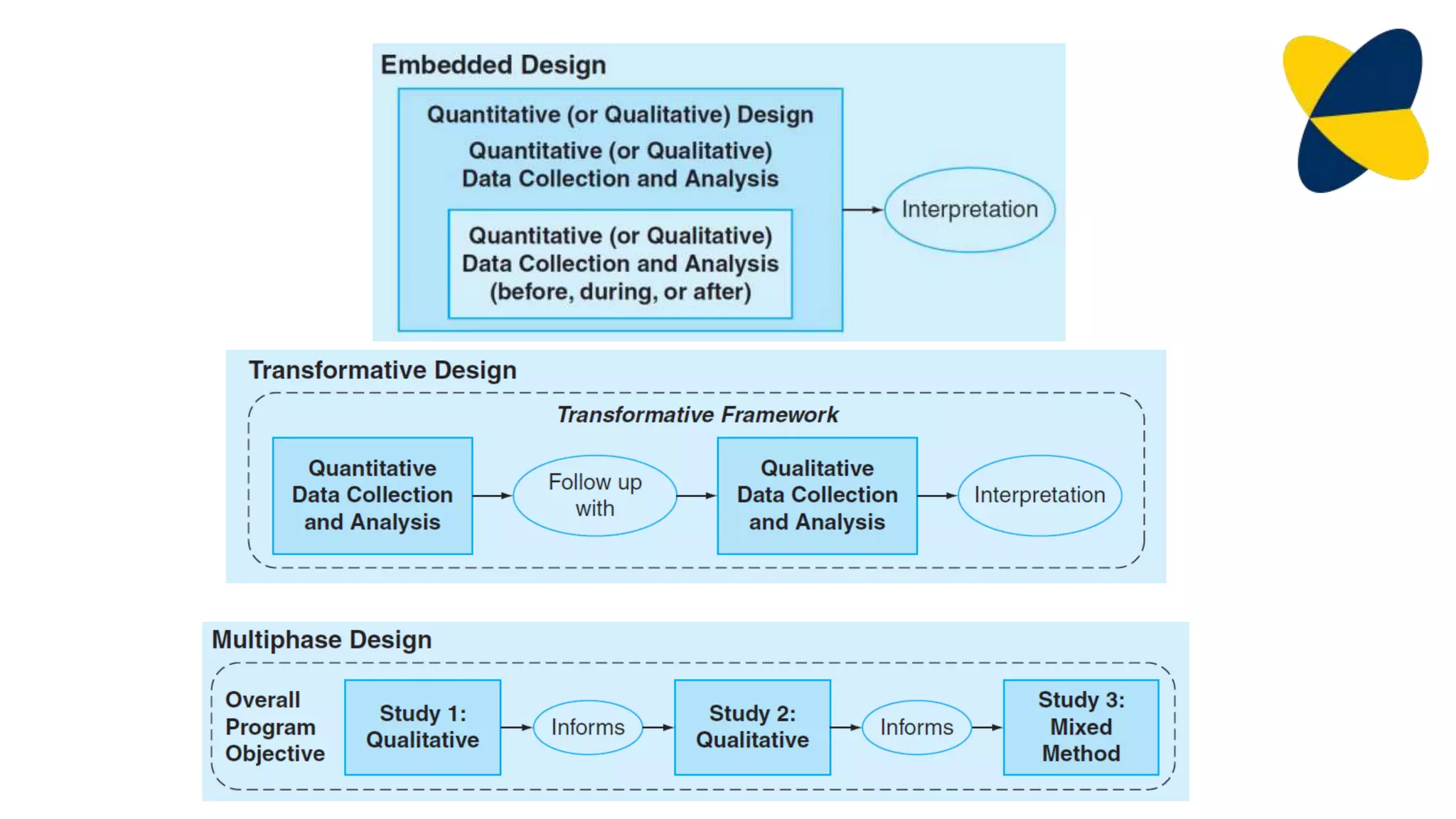
4. The embedded design
1. The transformative design
2. The multiphase design
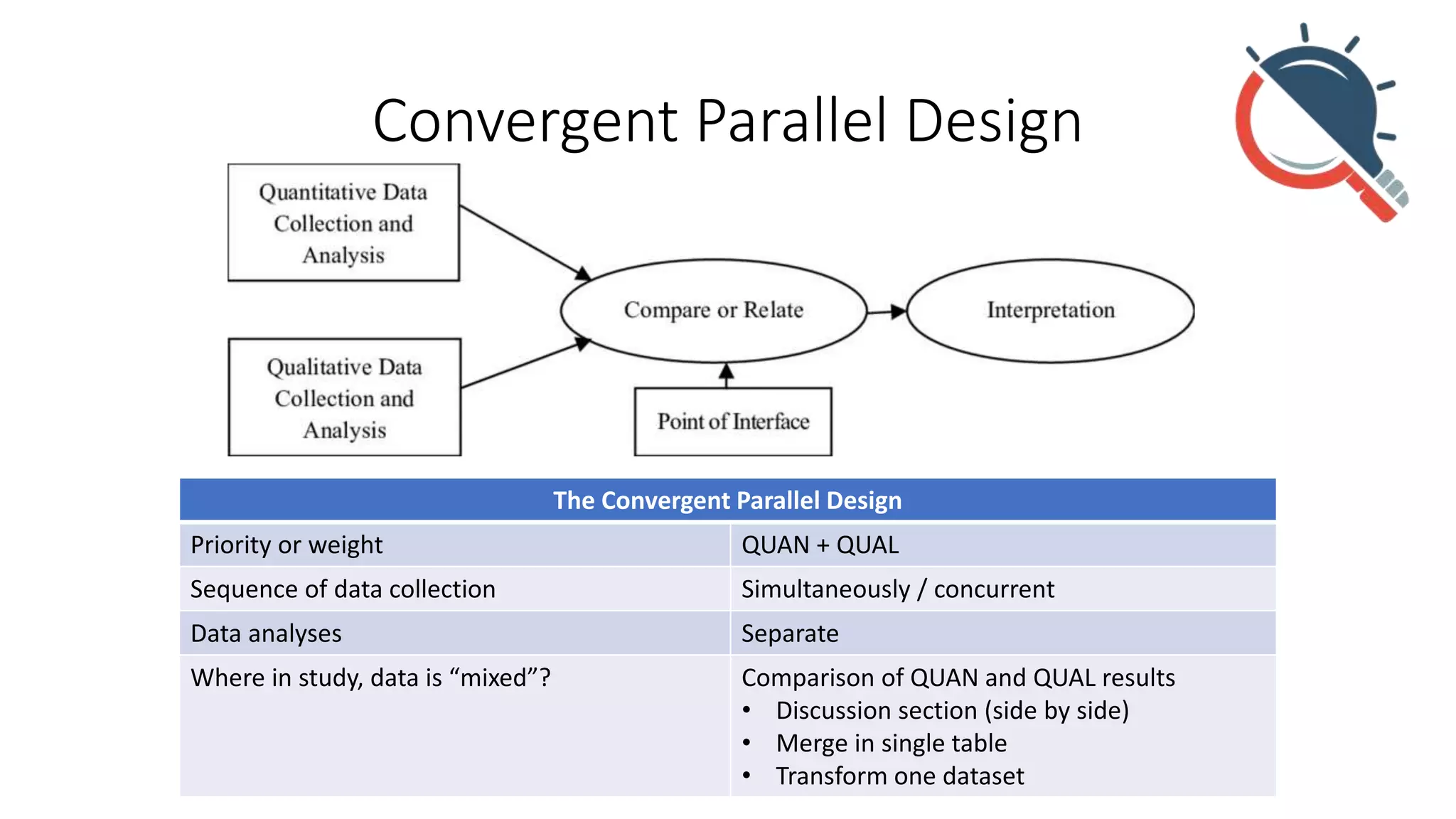
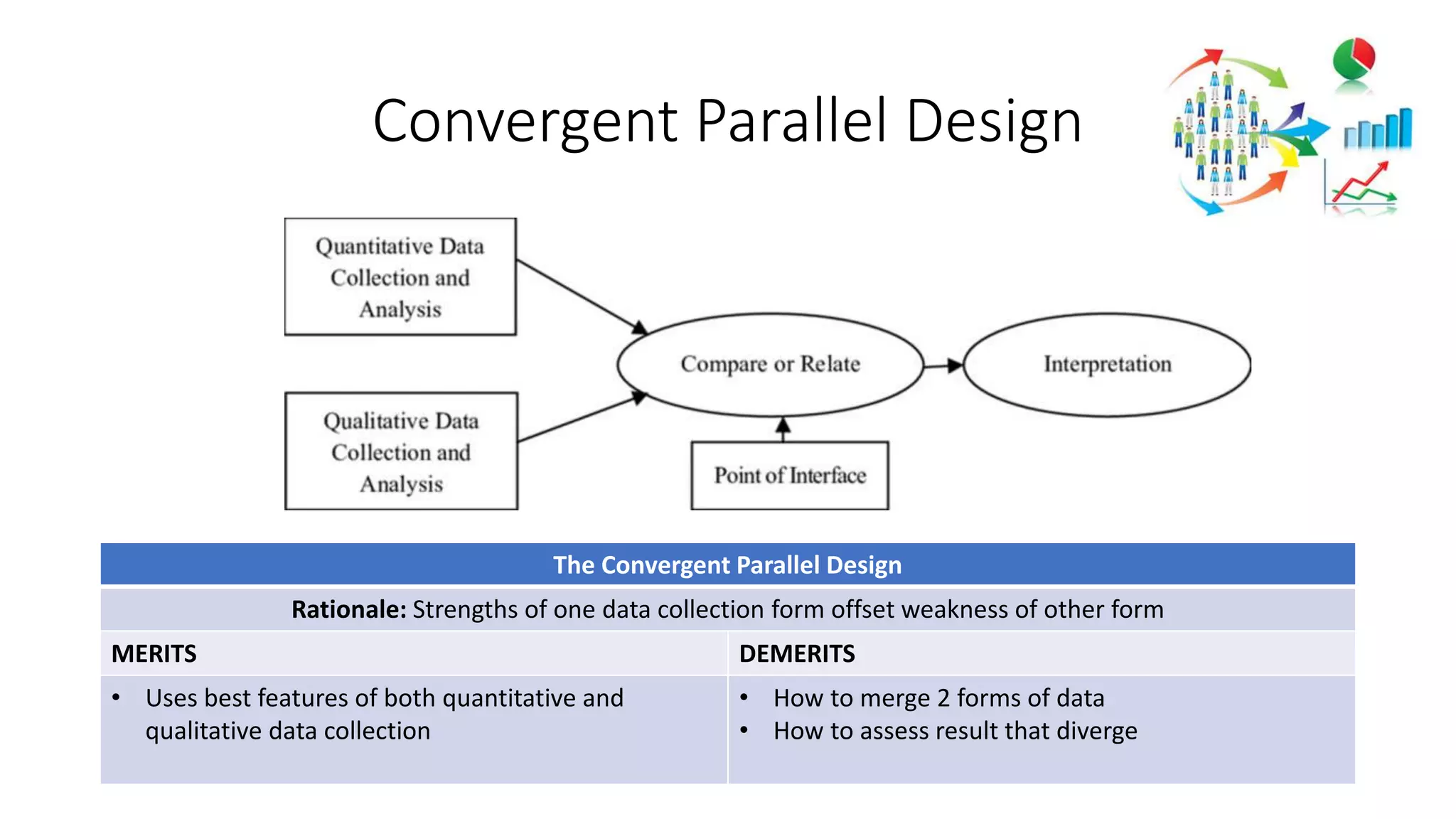
Convergent Parallel Design
The Convergent Parallel Design
Priority or weight QUAN + QUAL
Sequence of data collection Simultaneously / concurrent
Data analyses Separate
Where in study, data is “mixed”? Comparison of QUAN and QUAL results
• Discussion section (side by side)
• Merge in single table
• Transform one dataset
Convergent Parallel Design
The Convergent Parallel Design
Rationale: Strengths of one data collection form offset weakness of other form
MERITS DEMERITS
• Uses best features of both quantitative and
qualitative data collection
• How to merge 2 forms of data
• How to assess result that diverge
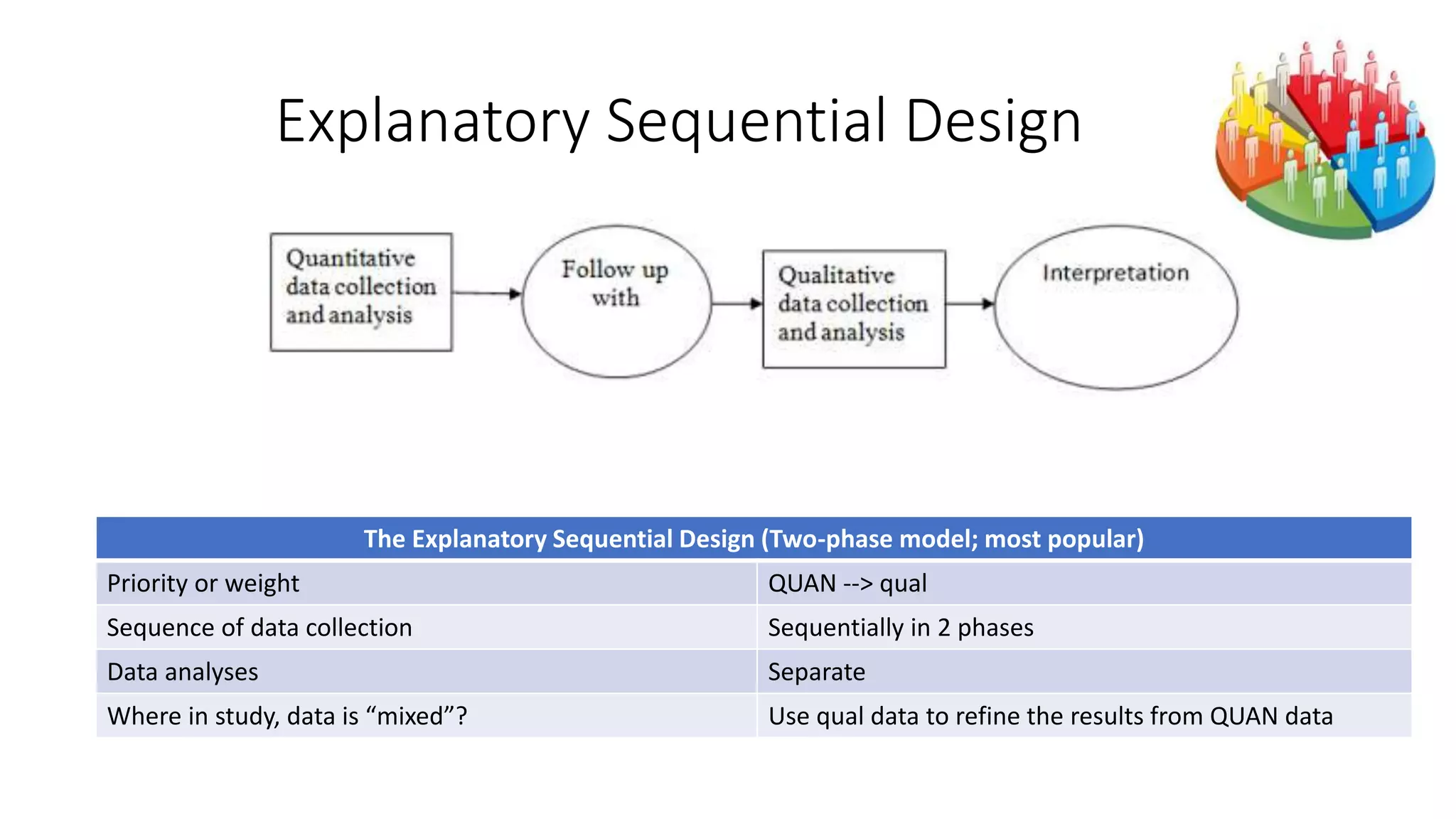
Explanatory Sequential Design
The Explanatory Sequential Design (Two-phase model; most popular)
Priority or weight QUAN --> qual
Sequence of data collection Sequentially in 2 phases
Data analyses Separate
Where in study, data is “mixed”? Use qual data to refine the results from QUAN data
Explanatory Sequential Design
The Explanatory Sequential Design (Two-phase model; most popular)
Rationale:
More analyses required to refine/extend/explain the general picture of research problem created from quantitative data
and results
MERITS DEMERITS
• Best of both
• Clearly identified 2 phases
• No integration or convergence of data
• Difficulty in determining what aspect of quantitative
results to follow up on.
• Labor intensive (expertise and time)
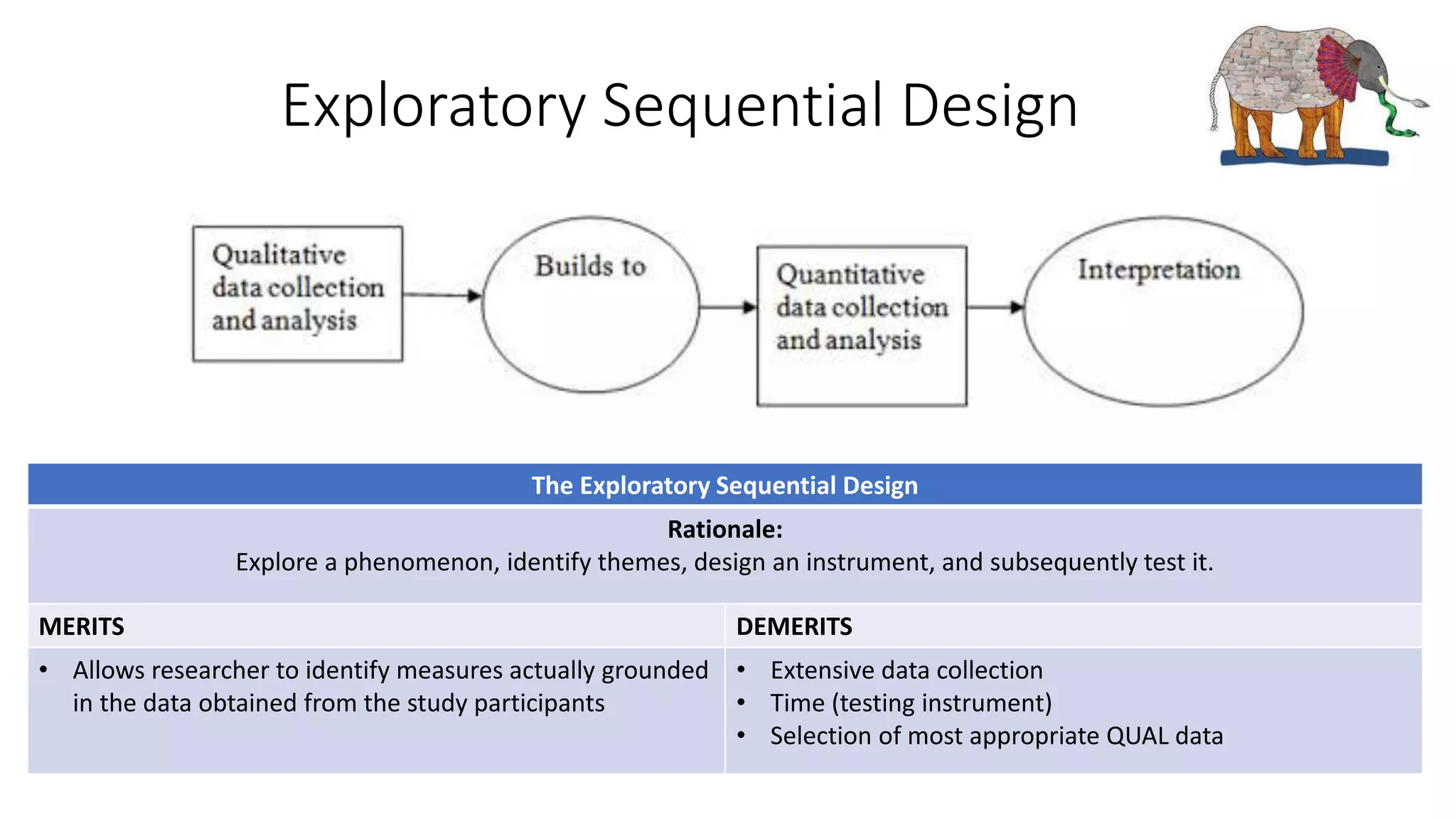
Exploratory Sequential Design
The Exploratory Sequential Design
Priority or weight QUAL  quan
Sequence of data collection Sequentially in 2 phases
Data analyses Separate
Where in study, data is “mixed”? Plans on quan data to build on or explain the
initial QUAL findings
Exploratory Sequential Design
The Exploratory Sequential Design
Rationale:
Explore a phenomenon, identify themes, design an instrument, and subsequently test it.
MERITS DEMERITS
• Allows researcher to identify measures actually grounded
in the data obtained from the study participants
• Extensive data collection
• Time (testing instrument)
• Selection of most appropriate QUAL data
Key Characteristics
• Provide a Rationale for the Design
• Include Collecting Quantitative and Qualitative Data
• Consider Priority
• Consider Sequence
• Match the Data Analysis to a Design
• Diagram the procedures
Match the Data Analysis to a Design
Basic Type of Mixed Methods Designs Examples of Analytic and Interpretive Procedures
Convergent • Quantifying qualitative data
• Qualifying quantitative data
• Comparing results
• Consolidating data
Explanatory • Following up on outliers or extreme cases
• Explaining results
• Developing a topology
• Examining multilevels
Exploratory • Locating an instrument
• Developing an instrument
• Forming categorical data
• Using extreme qualitative cases
Ethical Issues
Quantitative Issues • Obtaining permissions
• Protecting anonymity of respondents
• Not disrupting the sites
• Communicating the purposes for the study
Qualitative Issues • Conveying the purpose of the study
• Avoiding deceptive practices
• Respecting vulnerable populations
• Being aware of potential power issues on data collection
• Respecting indigenous cultures
• Not disclosing sensitive information
• Masking identities of participants
Design – specific issues Convergent Difference in sample size
Explanatory Some individuals may not warrant QUAN data released
Steps in Conducting
Evaluation
1. Mixed methods - best approach to answer research question ?
2. Incorporation of both QUAN and QUAL data collection and analysis ?
3. Explicitly combines 2 datasets ?
4. Use of rigorous quantitative and persuasive qualitative procedures of data collection and analysis ?
5. Study framed within one of mixed methods study designs ?
6. Provide diagram of procedures – timing, priority and mixing within study ?
7. Signals to reader that study is using mixed methods?
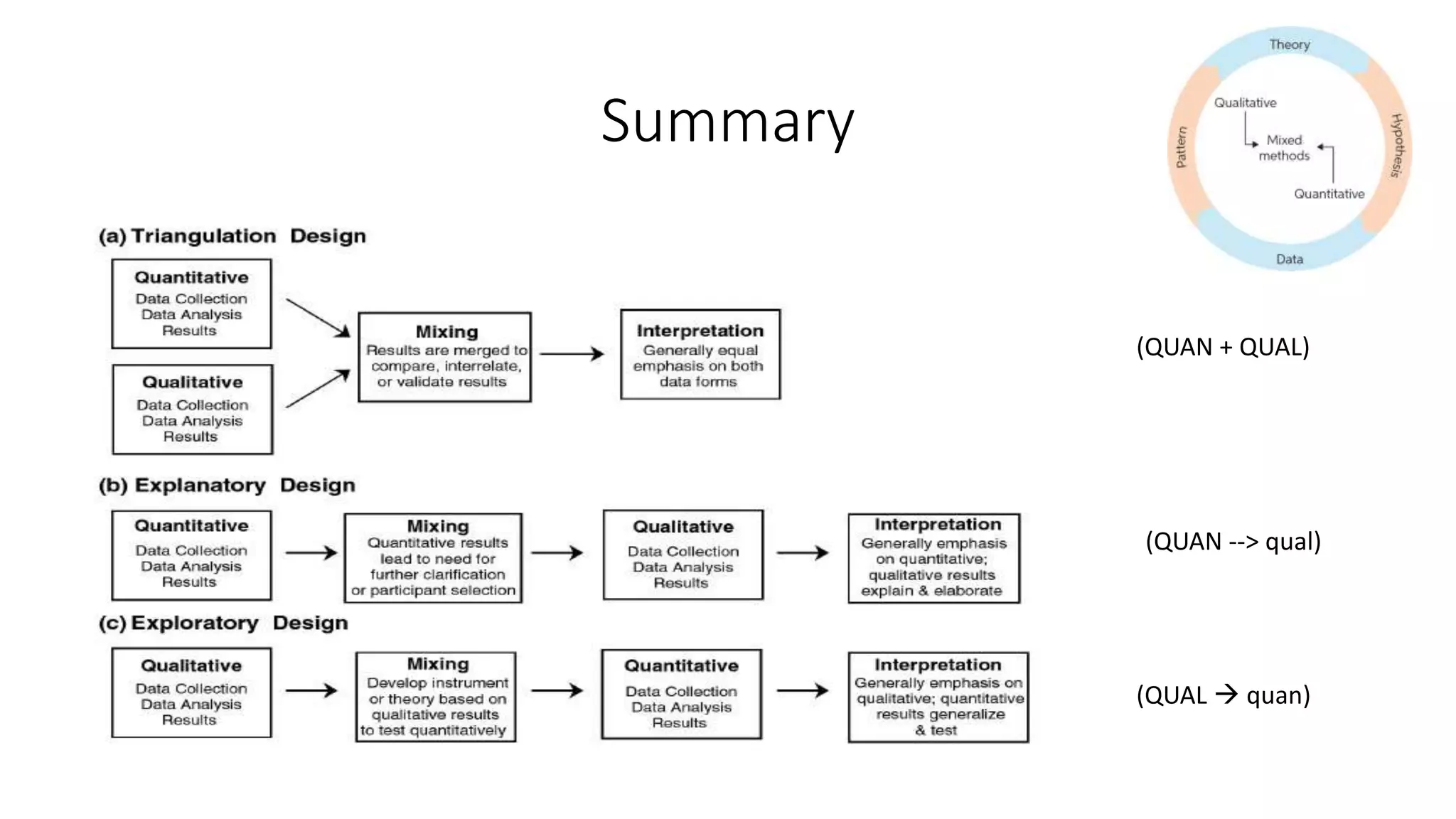
Summary
(QUAL  quan)
(QUAN --> qual)
(QUAN + QUAL)
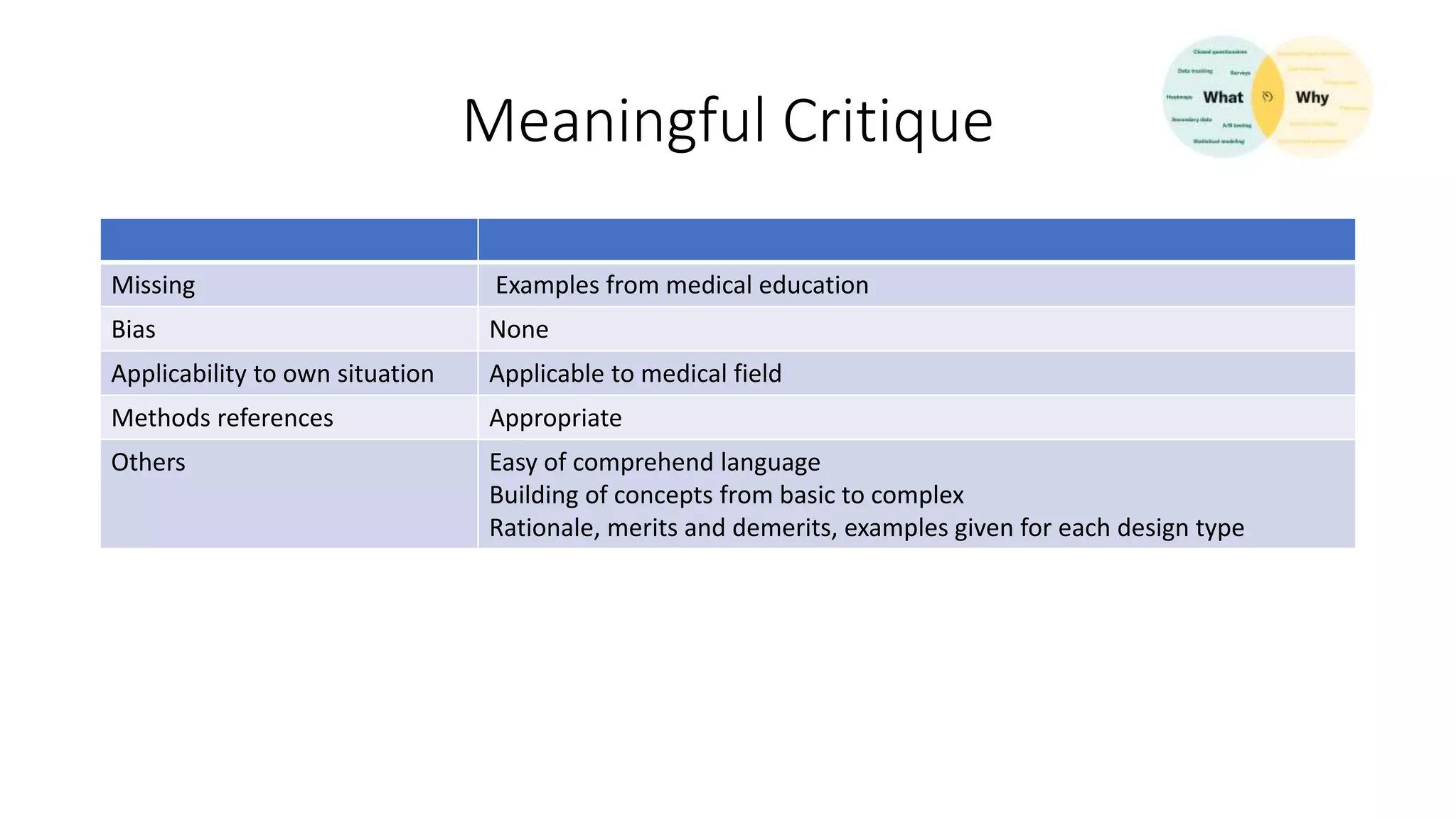
Meaningful Critique
Missing Examples from medical education
Bias None
Applicability to own situation Applicable to medical field
Methods references Appropriate
Others Easy of comprehend language
Building of concepts from basic to complex
Rationale, merits and demerits, examples given for each design type
Application to own practice
• Mixed method study design can be used for Research in medical
education at my parent institute as it will help in explaining the
process as well as outcomes.
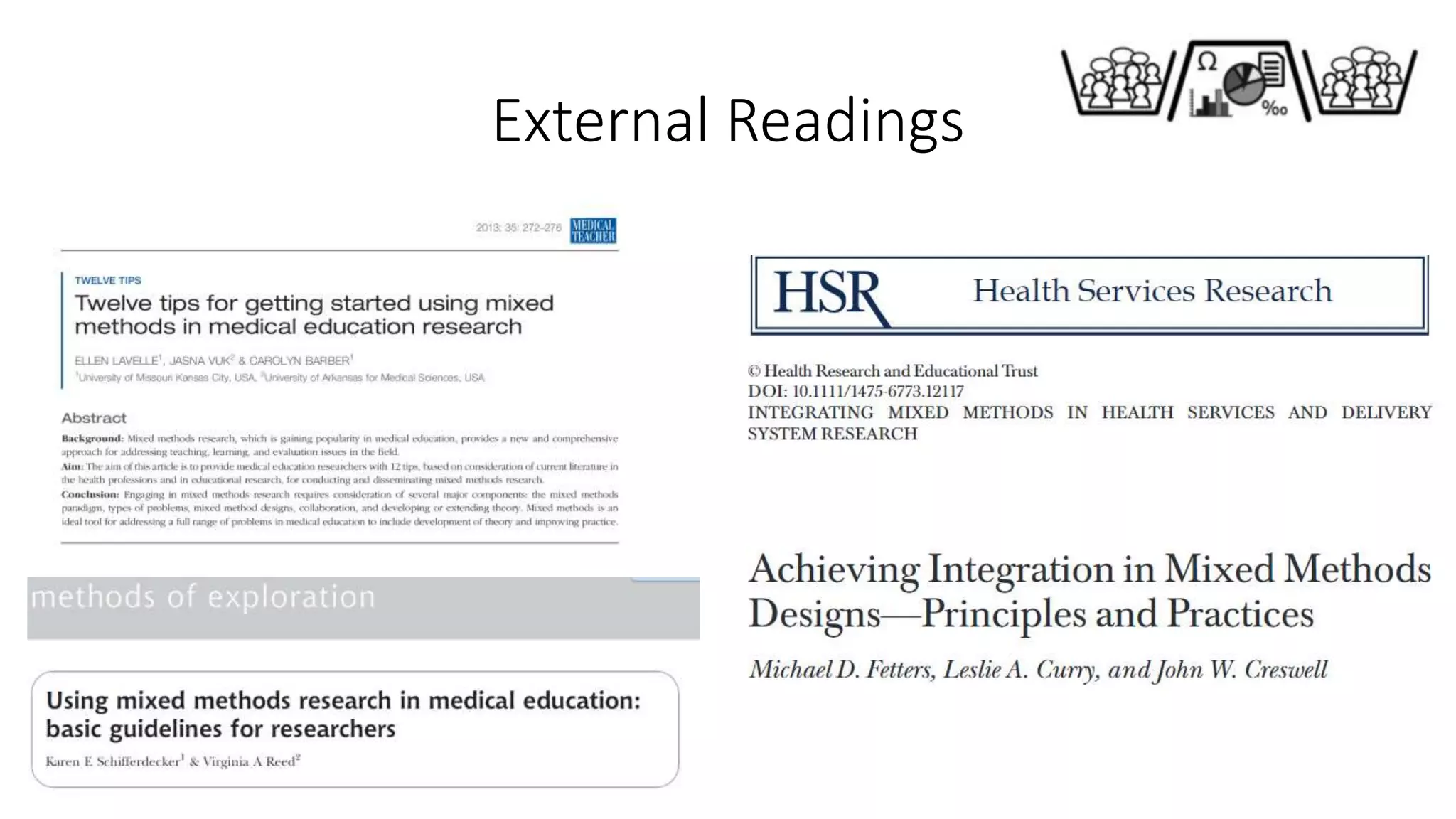
External Readings
THANK YOU

Mixed Methods Designs

  • 1.
    Mixed Methods Designs JIBRANMOHSIN (MHPE Student)
  • 2.
    Outline CHAPTER CONTENTS 1. Definition 2.Indications 3. History 4. Types 5. Key Characteristics 6. Ethical Issues 7. Steps in conducting 8. Evaluation 9. Summary 10. Meaningful Critique 11. Application to own practice 12. Evidence of external reading
  • 3.
    Definition A Procedure forcollecting, analyzing, and “mixing” both quantitative and qualitative methods in a single study or a series of studies to understand a research question
  • 4.
    Indications 1. Better understanding– strengths of both – “powerful mix” 1. Outcomes + Process 2. One type of research not enough to address research problem 3. Alternative perspective. 4. More acceptable than “pure” qualitative study.
  • 5.
    History 1. Mixing formsof Quantitative Data 2. Combining quantitative and qualitative Data (triangulation of data) 3. Questioning the integration of Worldviews and Method 1. Worldview-method argument (Paradigm Debate) 2. Pragmatism 4. Developing Procedures for Mixed Methods Studies 5. Advocating for a Distinct Design 6. Reflective Period
  • 7.
    Notation System fora Mixed Methods Study Study # 1 QUAL + QUAN Study # 2 QUAN ------> qual Notation Used: + indicates the simultaneous or concurrent collection of quantitative and qualitative data ----> shows the sequential collection of quantitative collection of quantitative and qualitative data Uppercase letters indicate a priority or increased weight for either the quantitative or qualitative data Lowercase letters indicate a lower priority or weight for either the quantitative or qualitative data
  • 8.
    Types Step1: Identify mixedmethod study • Title • Data collection section • Purpose statement or the research questions Step2: Identify type of mixed methods design • Priority or weight (quantitative vs qualitative data collection) • Sequence of data collection • Data analyses (combined vs separate) • Where in study, data is “mixed”?
  • 9.
    Types Basic Designs ComplexDesigns 1. The convergent parallel (concurrent) design 2. The explanatory sequential design 3. The exploratory sequential design 4. The embedded design 1. The transformative design 2. The multiphase design
  • 10.
    Convergent Parallel Design TheConvergent Parallel Design Priority or weight QUAN + QUAL Sequence of data collection Simultaneously / concurrent Data analyses Separate Where in study, data is “mixed”? Comparison of QUAN and QUAL results • Discussion section (side by side) • Merge in single table • Transform one dataset
  • 11.
    Convergent Parallel Design TheConvergent Parallel Design Rationale: Strengths of one data collection form offset weakness of other form MERITS DEMERITS • Uses best features of both quantitative and qualitative data collection • How to merge 2 forms of data • How to assess result that diverge
  • 12.
    Explanatory Sequential Design TheExplanatory Sequential Design (Two-phase model; most popular) Priority or weight QUAN --> qual Sequence of data collection Sequentially in 2 phases Data analyses Separate Where in study, data is “mixed”? Use qual data to refine the results from QUAN data
  • 13.
    Explanatory Sequential Design TheExplanatory Sequential Design (Two-phase model; most popular) Rationale: More analyses required to refine/extend/explain the general picture of research problem created from quantitative data and results MERITS DEMERITS • Best of both • Clearly identified 2 phases • No integration or convergence of data • Difficulty in determining what aspect of quantitative results to follow up on. • Labor intensive (expertise and time)
  • 14.
    Exploratory Sequential Design TheExploratory Sequential Design Priority or weight QUAL  quan Sequence of data collection Sequentially in 2 phases Data analyses Separate Where in study, data is “mixed”? Plans on quan data to build on or explain the initial QUAL findings
  • 15.
    Exploratory Sequential Design TheExploratory Sequential Design Rationale: Explore a phenomenon, identify themes, design an instrument, and subsequently test it. MERITS DEMERITS • Allows researcher to identify measures actually grounded in the data obtained from the study participants • Extensive data collection • Time (testing instrument) • Selection of most appropriate QUAL data
  • 17.
    Key Characteristics • Providea Rationale for the Design • Include Collecting Quantitative and Qualitative Data • Consider Priority • Consider Sequence • Match the Data Analysis to a Design • Diagram the procedures
  • 18.
    Match the DataAnalysis to a Design Basic Type of Mixed Methods Designs Examples of Analytic and Interpretive Procedures Convergent • Quantifying qualitative data • Qualifying quantitative data • Comparing results • Consolidating data Explanatory • Following up on outliers or extreme cases • Explaining results • Developing a topology • Examining multilevels Exploratory • Locating an instrument • Developing an instrument • Forming categorical data • Using extreme qualitative cases
  • 19.
    Ethical Issues Quantitative Issues• Obtaining permissions • Protecting anonymity of respondents • Not disrupting the sites • Communicating the purposes for the study Qualitative Issues • Conveying the purpose of the study • Avoiding deceptive practices • Respecting vulnerable populations • Being aware of potential power issues on data collection • Respecting indigenous cultures • Not disclosing sensitive information • Masking identities of participants Design – specific issues Convergent Difference in sample size Explanatory Some individuals may not warrant QUAN data released
  • 20.
  • 21.
    Evaluation 1. Mixed methods- best approach to answer research question ? 2. Incorporation of both QUAN and QUAL data collection and analysis ? 3. Explicitly combines 2 datasets ? 4. Use of rigorous quantitative and persuasive qualitative procedures of data collection and analysis ? 5. Study framed within one of mixed methods study designs ? 6. Provide diagram of procedures – timing, priority and mixing within study ? 7. Signals to reader that study is using mixed methods?
  • 22.
    Summary (QUAL  quan) (QUAN--> qual) (QUAN + QUAL)
  • 23.
    Meaningful Critique Missing Examplesfrom medical education Bias None Applicability to own situation Applicable to medical field Methods references Appropriate Others Easy of comprehend language Building of concepts from basic to complex Rationale, merits and demerits, examples given for each design type
  • 24.
    Application to ownpractice • Mixed method study design can be used for Research in medical education at my parent institute as it will help in explaining the process as well as outcomes.
  • 25.
  • 26.