Beyond Competencies and Milestones:
Adding Meaning Through Context
JIBRAN MOHSIN (MHPE Student)
Advanced Level Course on Curriculum Development in Health Professions Education
Department for Educational Development
The Aga Khan University
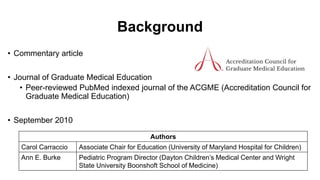
Background
• Commentary article
• Journal of Graduate Medical Education
• Peer-reviewed PubMed indexed journal of the ACGME (Accreditation Council for
Graduate Medical Education)
• September 2010
Authors
Carol Carraccio Associate Chair for Education (University of Maryland Hospital for Children)
Ann E. Burke Pediatric Program Director (Dayton Children’s Medical Center and Wright
State University Boonshoft School of Medicine)
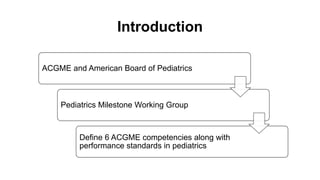
Introduction
ACGME and American Board of Pediatrics
Pediatrics Milestone Working Group
Define 6 ACGME competencies along with
performance standards in pediatrics
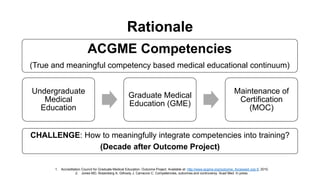
Rationale
Undergraduate
Medical
Education
Graduate Medical
Education (GME)
Maintenance of
Certification
(MOC)
ACGME Competencies
(True and meaningful competency based medical educational continuum)
CHALLENGE: How to meaningfully integrate competencies into training?
(Decade after Outcome Project)
1. Accreditation Council for Graduate Medical Education. Outcome Project. Available at: http://www.acgme.org/outcome. Accessed July 8, 2010.
2. Jones MD, Rosenberg A, Gilhooly J, Carraccio C. Competencies, outcomes and controversy. Acad Med. In press.
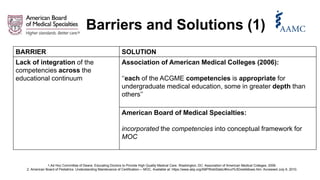
Barriers and Solutions (1)
BARRIER SOLUTION
Lack of integration of the
competencies across the
educational continuum
Association of American Medical Colleges (2006):
‘‘each of the ACGME competencies is appropriate for
undergraduate medical education, some in greater depth than
others’’
American Board of Medical Specialties:
incorporated the competencies into conceptual framework for
MOC
1.Ad Hoc Committee of Deans. Educating Doctors to Provide High Quality Medical Care. Washington, DC: Association of American Medical Colleges; 2006.
2. American Board of Pediatrics. Understanding Maintenance of Certification— MOC. Available at: https://www.abp.org/ABPWebStatic/#murl%3Dresfellows.htm. Accessed July 9, 2010.
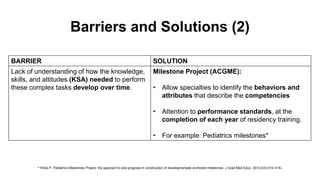
Barriers and Solutions (2)
BARRIER SOLUTION
Lack of understanding of how the knowledge,
skills, and attitudes (KSA) needed to perform
these complex tasks develop over time.
Milestone Project (ACGME):
• Allow specialties to identify the behaviors and
attributes that describe the competencies
• Attention to performance standards, at the
completion of each year of residency training.
• For example: Pediatrics milestones*
* Hicks P. Pediatrics Milestones Project: the approach to and progress in construction of developmentally anchored milestones. J Grad Med Educ. 2010;2(3):410–418.
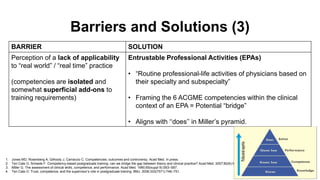
Barriers and Solutions (3)
BARRIER SOLUTION
Perception of a lack of applicability
to “real world” / “real time” practice
(competencies are isolated and
somewhat superficial add-ons to
training requirements)
Entrustable Professional Activities (EPAs)
• “Routine professional-life activities of physicians based on
their specialty and subspecialty”
• Framing the 6 ACGME competencies within the clinical
context of an EPA = Potential “bridge”
• Aligns with ‘‘does’’ in Miller’s pyramid.
1. Jones MD, Rosenberg A, Gilhooly J, Carraccio C. Competencies, outcomes and controversy. Acad Med. In press.
2. Ten Cate O, Scheele F. Competency-based postgraduate training: can we bridge the gap between theory and clinical practice? Acad Med. 2007;82(6):542–547.
3. Miller G. The assessment of clinical skills, competence, and performance. Acad Med. 1990;65(suppl 9):S63–S67.
4. Ten Cate O. Trust, competence, and the supervisor’s role in postgraduate training. BMJ. 2006;333(7571):748–751.
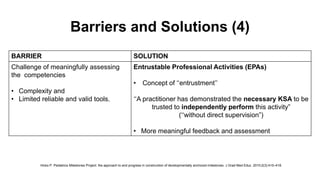
Barriers and Solutions (4)
BARRIER SOLUTION
Challenge of meaningfully assessing
the competencies
• Complexity and
• Limited reliable and valid tools.
Entrustable Professional Activities (EPAs)
• Concept of ‘‘entrustment’’
‘‘A practitioner has demonstrated the necessary KSA to be
trusted to independently perform this activity”
(‘‘without direct supervision”)
• More meaningful feedback and assessment
Hicks P. Pediatrics Milestones Project: the approach to and progress in construction of developmentally anchored milestones. J Grad Med Educ. 2010;2(3):410–418.
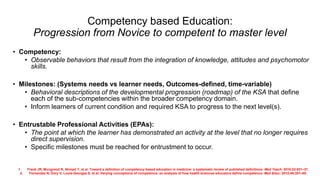
Competency based Education:
Progression from Novice to competent to master level
• Competency:
• Observable behaviors that result from the integration of knowledge, attitudes and psychomotor
skills.
• Milestones: (Systems needs vs learner needs, Outcomes-defined, time-variable)
• Behavioral descriptions of the developmental progression (roadmap) of the KSA that define
each of the sub-competencies within the broader competency domain.
• Inform learners of current condition and required KSA to progress to the next level(s).
• Entrustable Professional Activities (EPAs):
• The point at which the learner has demonstrated an activity at the level that no longer requires
direct supervision.
• Specific milestones must be reached for entrustment to occur.
1. Frank JR, Mungrood R, Ahmad Y, et al. Toward a definition of competency-based education in medicine: a systematic review of published definitions. Med Teach. 2010;32:631–37.
2. Fernandez N, Dory V, Louis-Georges S, et al. Varying conceptions of competence: an analysis of how health sciences educators define competence. Med Educ. 2012;46:357–65.
Competencies
• Six Core Competency domains for residency education in North America (ACGME
Outcome Project 1999) [1,2]
• Patient care
• Medical Knowledge
• Practice-based learning and improvement
• Interpersonal and Communication Skills
• Professionalism
• Systems-Based Care
• 2013 review: [3-5]
• Interprofessionalism (2011)
• Personal and Professional Identity Formation. (2010 Carnegie report)
1. Swing SR. The ACGME outcome project: retrospective and prospective. Med Teach. 2007;29:648–54.
2, ten Cate O, Snell L, Carraccio C. Medical competence: the interplay between individual ability and the health care environment. Med Teach. 2010;32:669–75.
3. Englander R, Cameron T, Ballard AJ, et al. Toward a common taxonomy of competency domains for the health professions and competencies for physicians. Acad Med. 2013;88:1088–94.
4. Interprofessional Education Collaborative Expert Panel. Core Competencies for Interprofessional Collaborative Practice: Report of an Expert Panel. Washington, D.C.: Interprofessional Education Collaborative;
2011.
5. Cooke M, Irby DM, O’Brien BC. Educating Physicians: A Call for Reform of Medical School and Residency. San Francisco: Jossey-Bass; 2010. P. 41.
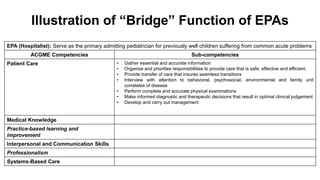
Illustration of “Bridge” Function of EPAs
EPA (Hospitalist): Serve as the primary admitting pediatrician for previously well children suffering from common acute problems
ACGME Competencies Sub-competencies
Patient Care • Gather essential and accurate information
• Organize and priorities responsibilities to provide care that is safe, effective and efficient.
• Provide transfer of care that insures seamless transitions
• Interview with attention to behavioral, psychosocial, environmental and family unit
correlates of disease
• Perform complete and accurate physical examinations
• Make informed diagnostic and therapeutic decisions that result in optimal clinical judgement
• Develop and carry out management
Medical Knowledge
Practice-based learning and
improvement
Interpersonal and Communication Skills
Professionalism
Systems-Based Care
Association of American Medical Colleges (AAMC) : 2013
• Reference List of General Physician Competencies
• All medical schools map their educational program objectives accordingly.
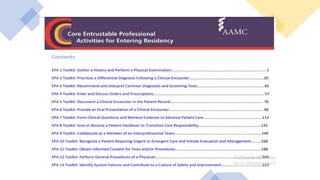
• Core Entrustable Professional Activities
for Entering Residency (CEPEAR)
• For medical students
1. Englander R, Cameron T, Ballard AJ, et al. Toward a common taxonomy of competency domains for the health professions and competencies for physicians. Acad Med. 2013;88:1088–94.
2. Association of American Medical Colleges. Core Entrustable Professional Activities for Entering Residency (CEPEAR) [Internet]. Washington, D.C. March 2014. Available at www
.mededportal.org/icollaborative/resource/887.
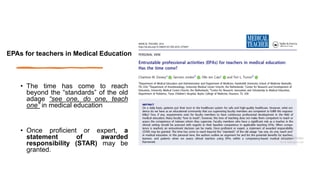
• The time has come to reach
beyond the “standards” of the old
adage “see one, do one, teach
one” in medical education
• Once proficient or expert, a
statement of awarded
responsibility (STAR) may be
granted.
EPAs for teachers in Medical Education
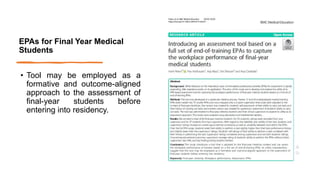
EPAs for Final Year Medical
Students
• Tool may be employed as a
formative and outcome-aligned
approach to the assessment of
final-year students before
entering into residency.
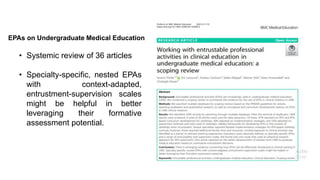
EPAs on Undergraduate Medical Education
• Systemic review of 36 articles
• Specialty-specific, nested EPAs
with context-adapted,
entrustment-supervision scales
might be helpful in better
leveraging their formative
assessment potential.
Analysis
• Commentary article (138 citations)
• Journal of Graduate Medical Education
• h5-index (30), Impact factor (1.056)
• Authors:
• Carol Carraccio (6749 Citations)
• Ann E. Burke (4323 citations, i10-index 29)
• Landmark / Practice changing article
Analysis
• Easy to comprehend (simple language and short)
• Applicable to all specialty and setting.
• Provides practical application of continuum of Competency based medical
education
• Rationale for workplace assessment
Application to own settings
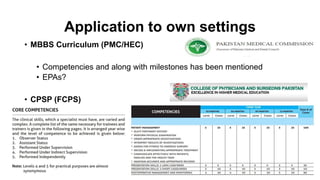
• MBBS Curriculum (PMC/HEC)
• Competencies and along with milestones has been mentioned
• EPAs?
• CPSP (FCPS)
Application to own
settings
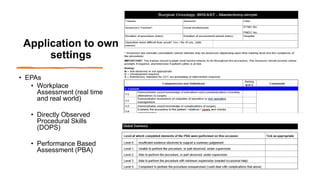
• EPAs
• Workplace
Assessment (real time
and real world)
• Directly Observed
Procedural Skills
(DOPS)
• Performance Based
Assessment (PBA)
Key messages
• Medical Education is clearly moving to standardize the competency
language used across the continuum from medical student to practicing
physician.
• Milestones are developmental roadmap for attaining competencies are
outcome-defined but time variable.
• EPAs are used to demonstrate activities that can be done without direct
supervision by effectively using workplace assessment tools.
References
References mentioned in index article
References of External Readings
Article Screenshot
THANK YOU

Beyond Competencies and Milestones: Adding Meaning Through Context

  • 1.
    Beyond Competencies andMilestones: Adding Meaning Through Context JIBRAN MOHSIN (MHPE Student) Advanced Level Course on Curriculum Development in Health Professions Education Department for Educational Development The Aga Khan University
  • 2.
    Background • Commentary article •Journal of Graduate Medical Education • Peer-reviewed PubMed indexed journal of the ACGME (Accreditation Council for Graduate Medical Education) • September 2010 Authors Carol Carraccio Associate Chair for Education (University of Maryland Hospital for Children) Ann E. Burke Pediatric Program Director (Dayton Children’s Medical Center and Wright State University Boonshoft School of Medicine)
  • 3.
    Introduction ACGME and AmericanBoard of Pediatrics Pediatrics Milestone Working Group Define 6 ACGME competencies along with performance standards in pediatrics
  • 4.
    Rationale Undergraduate Medical Education Graduate Medical Education (GME) Maintenanceof Certification (MOC) ACGME Competencies (True and meaningful competency based medical educational continuum) CHALLENGE: How to meaningfully integrate competencies into training? (Decade after Outcome Project) 1. Accreditation Council for Graduate Medical Education. Outcome Project. Available at: http://www.acgme.org/outcome. Accessed July 8, 2010. 2. Jones MD, Rosenberg A, Gilhooly J, Carraccio C. Competencies, outcomes and controversy. Acad Med. In press.
  • 5.
    Barriers and Solutions(1) BARRIER SOLUTION Lack of integration of the competencies across the educational continuum Association of American Medical Colleges (2006): ‘‘each of the ACGME competencies is appropriate for undergraduate medical education, some in greater depth than others’’ American Board of Medical Specialties: incorporated the competencies into conceptual framework for MOC 1.Ad Hoc Committee of Deans. Educating Doctors to Provide High Quality Medical Care. Washington, DC: Association of American Medical Colleges; 2006. 2. American Board of Pediatrics. Understanding Maintenance of Certification— MOC. Available at: https://www.abp.org/ABPWebStatic/#murl%3Dresfellows.htm. Accessed July 9, 2010.
  • 6.
    Barriers and Solutions(2) BARRIER SOLUTION Lack of understanding of how the knowledge, skills, and attitudes (KSA) needed to perform these complex tasks develop over time. Milestone Project (ACGME): • Allow specialties to identify the behaviors and attributes that describe the competencies • Attention to performance standards, at the completion of each year of residency training. • For example: Pediatrics milestones* * Hicks P. Pediatrics Milestones Project: the approach to and progress in construction of developmentally anchored milestones. J Grad Med Educ. 2010;2(3):410–418.
  • 7.
    Barriers and Solutions(3) BARRIER SOLUTION Perception of a lack of applicability to “real world” / “real time” practice (competencies are isolated and somewhat superficial add-ons to training requirements) Entrustable Professional Activities (EPAs) • “Routine professional-life activities of physicians based on their specialty and subspecialty” • Framing the 6 ACGME competencies within the clinical context of an EPA = Potential “bridge” • Aligns with ‘‘does’’ in Miller’s pyramid. 1. Jones MD, Rosenberg A, Gilhooly J, Carraccio C. Competencies, outcomes and controversy. Acad Med. In press. 2. Ten Cate O, Scheele F. Competency-based postgraduate training: can we bridge the gap between theory and clinical practice? Acad Med. 2007;82(6):542–547. 3. Miller G. The assessment of clinical skills, competence, and performance. Acad Med. 1990;65(suppl 9):S63–S67. 4. Ten Cate O. Trust, competence, and the supervisor’s role in postgraduate training. BMJ. 2006;333(7571):748–751.
  • 8.
    Barriers and Solutions(4) BARRIER SOLUTION Challenge of meaningfully assessing the competencies • Complexity and • Limited reliable and valid tools. Entrustable Professional Activities (EPAs) • Concept of ‘‘entrustment’’ ‘‘A practitioner has demonstrated the necessary KSA to be trusted to independently perform this activity” (‘‘without direct supervision”) • More meaningful feedback and assessment Hicks P. Pediatrics Milestones Project: the approach to and progress in construction of developmentally anchored milestones. J Grad Med Educ. 2010;2(3):410–418.
  • 9.
    Competency based Education: Progressionfrom Novice to competent to master level • Competency: • Observable behaviors that result from the integration of knowledge, attitudes and psychomotor skills. • Milestones: (Systems needs vs learner needs, Outcomes-defined, time-variable) • Behavioral descriptions of the developmental progression (roadmap) of the KSA that define each of the sub-competencies within the broader competency domain. • Inform learners of current condition and required KSA to progress to the next level(s). • Entrustable Professional Activities (EPAs): • The point at which the learner has demonstrated an activity at the level that no longer requires direct supervision. • Specific milestones must be reached for entrustment to occur. 1. Frank JR, Mungrood R, Ahmad Y, et al. Toward a definition of competency-based education in medicine: a systematic review of published definitions. Med Teach. 2010;32:631–37. 2. Fernandez N, Dory V, Louis-Georges S, et al. Varying conceptions of competence: an analysis of how health sciences educators define competence. Med Educ. 2012;46:357–65.
  • 10.
    Competencies • Six CoreCompetency domains for residency education in North America (ACGME Outcome Project 1999) [1,2] • Patient care • Medical Knowledge • Practice-based learning and improvement • Interpersonal and Communication Skills • Professionalism • Systems-Based Care • 2013 review: [3-5] • Interprofessionalism (2011) • Personal and Professional Identity Formation. (2010 Carnegie report) 1. Swing SR. The ACGME outcome project: retrospective and prospective. Med Teach. 2007;29:648–54. 2, ten Cate O, Snell L, Carraccio C. Medical competence: the interplay between individual ability and the health care environment. Med Teach. 2010;32:669–75. 3. Englander R, Cameron T, Ballard AJ, et al. Toward a common taxonomy of competency domains for the health professions and competencies for physicians. Acad Med. 2013;88:1088–94. 4. Interprofessional Education Collaborative Expert Panel. Core Competencies for Interprofessional Collaborative Practice: Report of an Expert Panel. Washington, D.C.: Interprofessional Education Collaborative; 2011. 5. Cooke M, Irby DM, O’Brien BC. Educating Physicians: A Call for Reform of Medical School and Residency. San Francisco: Jossey-Bass; 2010. P. 41.
  • 11.
    Illustration of “Bridge”Function of EPAs EPA (Hospitalist): Serve as the primary admitting pediatrician for previously well children suffering from common acute problems ACGME Competencies Sub-competencies Patient Care • Gather essential and accurate information • Organize and priorities responsibilities to provide care that is safe, effective and efficient. • Provide transfer of care that insures seamless transitions • Interview with attention to behavioral, psychosocial, environmental and family unit correlates of disease • Perform complete and accurate physical examinations • Make informed diagnostic and therapeutic decisions that result in optimal clinical judgement • Develop and carry out management Medical Knowledge Practice-based learning and improvement Interpersonal and Communication Skills Professionalism Systems-Based Care
  • 12.
    Association of AmericanMedical Colleges (AAMC) : 2013 • Reference List of General Physician Competencies • All medical schools map their educational program objectives accordingly. • Core Entrustable Professional Activities for Entering Residency (CEPEAR) • For medical students 1. Englander R, Cameron T, Ballard AJ, et al. Toward a common taxonomy of competency domains for the health professions and competencies for physicians. Acad Med. 2013;88:1088–94. 2. Association of American Medical Colleges. Core Entrustable Professional Activities for Entering Residency (CEPEAR) [Internet]. Washington, D.C. March 2014. Available at www .mededportal.org/icollaborative/resource/887.
  • 14.
    • The timehas come to reach beyond the “standards” of the old adage “see one, do one, teach one” in medical education • Once proficient or expert, a statement of awarded responsibility (STAR) may be granted. EPAs for teachers in Medical Education
  • 15.
    EPAs for FinalYear Medical Students • Tool may be employed as a formative and outcome-aligned approach to the assessment of final-year students before entering into residency.
  • 16.
    EPAs on UndergraduateMedical Education • Systemic review of 36 articles • Specialty-specific, nested EPAs with context-adapted, entrustment-supervision scales might be helpful in better leveraging their formative assessment potential.
  • 17.
    Analysis • Commentary article(138 citations) • Journal of Graduate Medical Education • h5-index (30), Impact factor (1.056) • Authors: • Carol Carraccio (6749 Citations) • Ann E. Burke (4323 citations, i10-index 29) • Landmark / Practice changing article
  • 18.
    Analysis • Easy tocomprehend (simple language and short) • Applicable to all specialty and setting. • Provides practical application of continuum of Competency based medical education • Rationale for workplace assessment
  • 19.
    Application to ownsettings • MBBS Curriculum (PMC/HEC) • Competencies and along with milestones has been mentioned • EPAs? • CPSP (FCPS)
  • 20.
    Application to own settings •EPAs • Workplace Assessment (real time and real world) • Directly Observed Procedural Skills (DOPS) • Performance Based Assessment (PBA)
  • 21.
    Key messages • MedicalEducation is clearly moving to standardize the competency language used across the continuum from medical student to practicing physician. • Milestones are developmental roadmap for attaining competencies are outcome-defined but time variable. • EPAs are used to demonstrate activities that can be done without direct supervision by effectively using workplace assessment tools.
  • 22.
    References References mentioned inindex article References of External Readings Article Screenshot
  • 23.