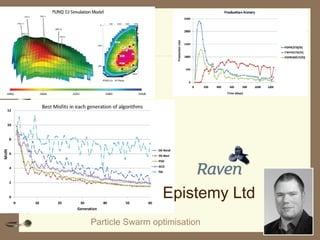
Particle Swarm optimisation
These slides adapted from a presentation
by Maurice.Clerc@WriteMe.com - one of the
main researchers in PSO
PSO invented by Russ Eberhart (engineering
Prof) and James Kennedy (social scientist)
in USA
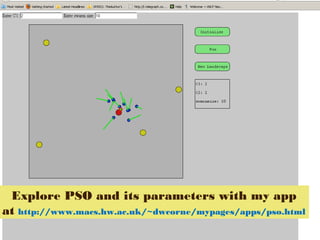
Explore PSO and its parameters with my app
at http://www.macs.hw.ac.uk/~dwcorne/mypages/apps/pso.html
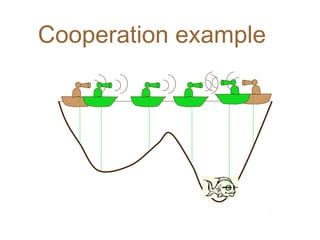
Cooperation example
Particle Swarm optimisation
The basic idea
Each particle is searching for the optimum
Each particle is moving and hence has a
velocity.
Each particle remembers the position it was
in where it had its best result so far (its
personal best)
But this would not be much good on its own; particles need
help in figuring out where to search.
Particle Swarm optimisation
The basic idea II
The particles in the swarm co-operate. They exchange
information about what they’ve discovered in the
places they have visited
The co-operation is very simple. In basic PSO it is
like this:
– A particle has a neighbourhood associated with it.
– A particle knows the fitnesses of those in its
neighbourhood, and uses the position of the one with best
fitness.
– This position is simply used to adjust the particle’s velocity
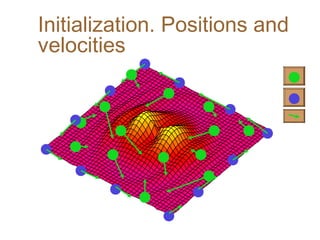
Initialization. Positions and
velocities
Particle Swarm optimisation
What a particle does
In each timestep, a particle has to move to a
new position. It does this by adjusting its
velocity.
– The adjustment is essentially this:
– The current velocity PLUS
– A weighted random portion in the direction of its personal best
PLUS
– A weighted random portion in the direction of the neighbourhood best.
Having worked out a new velocity, its position is simply its old
position plus the new velocity.
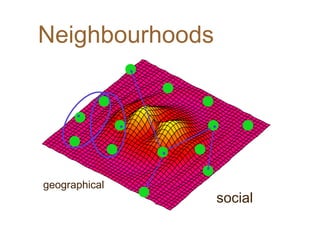
Neighbourhoods
geographical
social
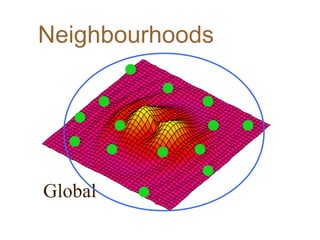
Neighbourhoods
Global
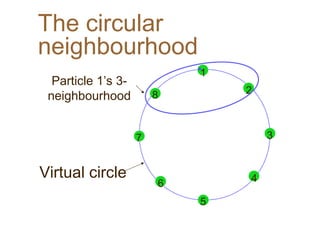
The circular
neighbourhood
Virtual circle
1
5
7
6 4
3
8 2
Particle 1’s 3-
neighbourhood
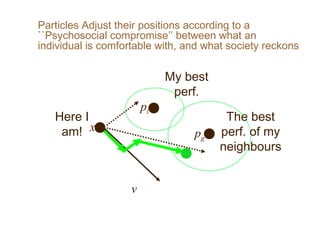
Particles Adjust their positions according to a
``Psychosocial compromise’’ between what an
individual is comfortable with, and what society reckons
Here I
am!
The best
perf. of my
neighbours
My best
perf.
x
pg
pi
v
Particle Swarm optimisation
Pseudocode
http://www.swarmintelligence.org/tutorials.php
Equation (a)
v[] = c0 *v[]
+ c1 * rand() * (pbest[] - present[])
+ c2 * rand() * (gbest[] - present[])
(in the original method, c0=1, but many
researchers now play with this parameter)
Equation (b)
present[] = present[] + v[]
Particle Swarm optimisation
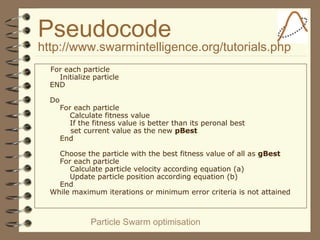
Pseudocode
http://www.swarmintelligence.org/tutorials.php
For each particle
Initialize particle
END
Do
For each particle
Calculate fitness value
If the fitness value is better than its peronal best
set current value as the new pBest
End
Choose the particle with the best fitness value of all as gBest
For each particle
Calculate particle velocity according equation (a)
Update particle position according equation (b)
End
While maximum iterations or minimum error criteria is not attained
Particle Swarm optimisation
Pseudocode
http://www.swarmintelligence.org/tutorials.php
Particles' velocities on each dimension
are clamped to a maximum velocity
Vmax. If the sum of accelerations would
cause the velocity on that dimension to
exceed Vmax, which is a parameter
specified by the user. Then the velocity
on that dimension is limited to Vmax.
Play with DWC’s app for
a while
Particle Swarm optimisation
Parameters
Number of particles (swarmsize)
C1 (importance of personal best)
C2 (importance of neighbourhood best)
Vmax: limit on velocity
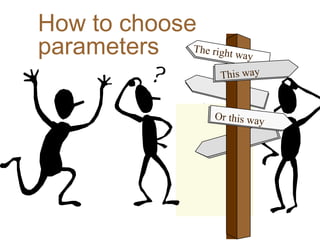
How to choose
parameters The right way
This way
Or this way
Particle Swarm optimisation
Parameters
Number of particles
(10—50) are reported as usually
sufficient.
C1 (importance of personal best)
C2 (importance of neighbourhood best)
Usually C1+C2 = 4. No good reason other
than empiricism
Vmax – too low, too slow; too high, too
unstable.
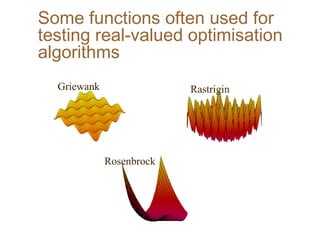
Some functions often used for
testing real-valued optimisation
algorithms
Rosenbrock
Griewank Rastrigin
... and some typical results
30D function PSO Type 1" Evolutionary
algo.(Angeline 98)
Griewank [±300] 0.003944 0.4033
Rastrigin [±5] 82.95618 46.4689
Rosenbrock [±10] 50.193877 1610.359
Optimum=0, dimension=30
Best result after 40 000 evaluations
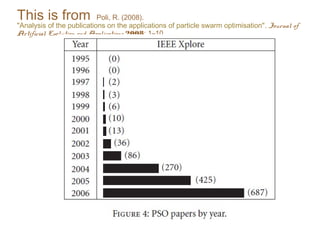
This is from Poli, R. (2008).
"Analysis of the publications on the applications of particle swarm optimisation". Journal of
Artificial Evolution and Applications 2008: 1–10.
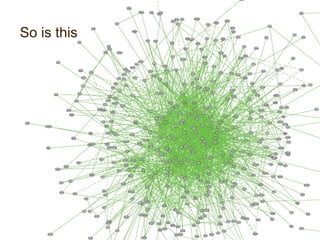
So is this
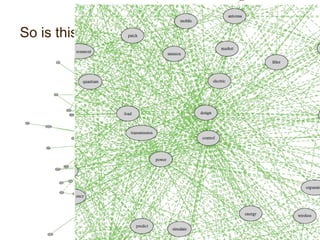
So is this
Particle Swarm optimisation
Epistemy Ltd
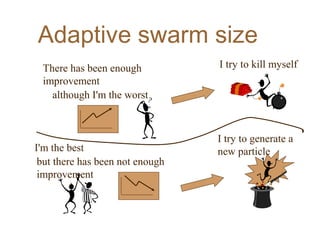
Adaptive swarm size
There has been enough
improvement
but there has been not enough
improvement
although I'm the worst
I'm the best
I try to kill myself
I try to generate a
new particle
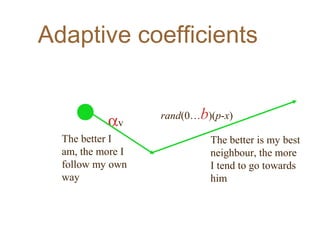
Adaptive coefficients
The better I
am, the more I
follow my own
way
The better is my best
neighbour, the more
I tend to go towards
him
αv
rand(0…b)(p-x)
How and when should
an excellent algorithm
terminate?
How and when should
an excellent algorithm
terminate?
Like this

Bic pso

  • 1.
  • 2.
    These slides adaptedfrom a presentation by Maurice.Clerc@WriteMe.com - one of the main researchers in PSO PSO invented by Russ Eberhart (engineering Prof) and James Kennedy (social scientist) in USA
  • 3.
    Explore PSO andits parameters with my app at http://www.macs.hw.ac.uk/~dwcorne/mypages/apps/pso.html
  • 4.
  • 5.
    Particle Swarm optimisation Thebasic idea Each particle is searching for the optimum Each particle is moving and hence has a velocity. Each particle remembers the position it was in where it had its best result so far (its personal best) But this would not be much good on its own; particles need help in figuring out where to search.
  • 6.
    Particle Swarm optimisation Thebasic idea II The particles in the swarm co-operate. They exchange information about what they’ve discovered in the places they have visited The co-operation is very simple. In basic PSO it is like this: – A particle has a neighbourhood associated with it. – A particle knows the fitnesses of those in its neighbourhood, and uses the position of the one with best fitness. – This position is simply used to adjust the particle’s velocity
  • 7.
  • 8.
    Particle Swarm optimisation Whata particle does In each timestep, a particle has to move to a new position. It does this by adjusting its velocity. – The adjustment is essentially this: – The current velocity PLUS – A weighted random portion in the direction of its personal best PLUS – A weighted random portion in the direction of the neighbourhood best. Having worked out a new velocity, its position is simply its old position plus the new velocity.
  • 9.
  • 10.
  • 11.
    The circular neighbourhood Virtual circle 1 5 7 64 3 8 2 Particle 1’s 3- neighbourhood
  • 12.
    Particles Adjust theirpositions according to a ``Psychosocial compromise’’ between what an individual is comfortable with, and what society reckons Here I am! The best perf. of my neighbours My best perf. x pg pi v
  • 13.
    Particle Swarm optimisation Pseudocode http://www.swarmintelligence.org/tutorials.php Equation(a) v[] = c0 *v[] + c1 * rand() * (pbest[] - present[]) + c2 * rand() * (gbest[] - present[]) (in the original method, c0=1, but many researchers now play with this parameter) Equation (b) present[] = present[] + v[]
  • 14.
    Particle Swarm optimisation Pseudocode http://www.swarmintelligence.org/tutorials.php Foreach particle Initialize particle END Do For each particle Calculate fitness value If the fitness value is better than its peronal best set current value as the new pBest End Choose the particle with the best fitness value of all as gBest For each particle Calculate particle velocity according equation (a) Update particle position according equation (b) End While maximum iterations or minimum error criteria is not attained
  • 15.
    Particle Swarm optimisation Pseudocode http://www.swarmintelligence.org/tutorials.php Particles'velocities on each dimension are clamped to a maximum velocity Vmax. If the sum of accelerations would cause the velocity on that dimension to exceed Vmax, which is a parameter specified by the user. Then the velocity on that dimension is limited to Vmax.
  • 16.
    Play with DWC’sapp for a while
  • 17.
    Particle Swarm optimisation Parameters Numberof particles (swarmsize) C1 (importance of personal best) C2 (importance of neighbourhood best) Vmax: limit on velocity
  • 18.
    How to choose parametersThe right way This way Or this way
  • 19.
    Particle Swarm optimisation Parameters Numberof particles (10—50) are reported as usually sufficient. C1 (importance of personal best) C2 (importance of neighbourhood best) Usually C1+C2 = 4. No good reason other than empiricism Vmax – too low, too slow; too high, too unstable.
  • 20.
    Some functions oftenused for testing real-valued optimisation algorithms Rosenbrock Griewank Rastrigin
  • 21.
    ... and sometypical results 30D function PSO Type 1" Evolutionary algo.(Angeline 98) Griewank [±300] 0.003944 0.4033 Rastrigin [±5] 82.95618 46.4689 Rosenbrock [±10] 50.193877 1610.359 Optimum=0, dimension=30 Best result after 40 000 evaluations
  • 22.
    This is fromPoli, R. (2008). "Analysis of the publications on the applications of particle swarm optimisation". Journal of Artificial Evolution and Applications 2008: 1–10.
  • 23.
  • 24.
  • 25.
  • 26.
    Adaptive swarm size Therehas been enough improvement but there has been not enough improvement although I'm the worst I'm the best I try to kill myself I try to generate a new particle
  • 27.
    Adaptive coefficients The betterI am, the more I follow my own way The better is my best neighbour, the more I tend to go towards him αv rand(0…b)(p-x)
  • 28.
    How and whenshould an excellent algorithm terminate?
  • 29.
    How and whenshould an excellent algorithm terminate? Like this

Editor's Notes

  • #5 To illustrate what “cooperation” means in PSO, here is a simplistic example. As usually, the big fish is difficult to catch, hidden in the deepest part of the pond. At each time step, each fisherman tells to the other how deep the pond is at his place. At the very begininng, as the depths are quite similar, they both follow their own ways. Now, Fisherman 2 seems to be on a better place, so Fisherman 1 tends to go towards him quite rapidly. Now, the decision is a bit more difficult to make. On the one hand Fisherman 2 is still on a better place, but on the other hand, Fisherman 1’s position is worse than before. So Fisherman 1 comes to a compromise: he still goes towards Fisherman 2, but more slowly than before. As we can see, doing that, he escapes from the local minimum. Of course, this example is a caricatural one, but it presents the main features of a particle in basic PSO: a position, a velocity (or, more precisely an operator which can be applied to a position in order to modify it), the ability to exchange information with its neighbours, the ability to memorize a previous position, and the ability to use information to make a decision. Remember, though, all that as to remain simple. Let’s now see more precisely these points.
  • #8 Here you have another nice search space. First step: you put some particles on it. You can do it at random or on a regular way, or both. How many? In practice, for most real problems with dimension between 2 and 100, a swarm size of 20 particles works quite good. There are some mathematical ways to give an estimation, but a bit beyond the scope of this talk. Also, as we will see some variants use an adaptive swarm size. Second step: you define a velocity for each particle, usually at random. You can set all initial velocities to zero but, experimentally, it is usually not the best choice. Remember that what we call “velocity” is in fact a move, just because time is discretized.
  • #10 Now, for each particle, we define what is called a neighbourhood. Although some variants use a “geographical” neighbourhood, that is to say compute distances and take the nearest particles, the most widely used neighbourhood is a “social” one: just a list of neighbours, regardless where they are. So, you do not need to define a distance and that is a great advantage, for in some cases, particularly for discrete spaces, such a definition would be quite arbitrary. Note that it can be proved (and it is intuitively quite obvious) that if the process converges any social neighbourhood tends to be also a geographical one. Usually, in practice, social neighbourhoods are defined just once, at the very beginning, which is consistent with the principle “simple rules for simple agents”. Now, the size of the neighbourhood could be a problem. Fortunately, PSO is not very sensitive to this parameter and most of users just take a value of 3 or 5 with good results. Unlike for the swarm size, there is no mathematical formula, but like for the swarm size, there are some adaptive variants.
  • #11 Now, for each particle, we define what is called a neighbourhood. Although some variants use a “geographical” neighbourhood, that is to say compute distances and take the nearest particles, the most widely used neighbourhood is a “social” one: just a list of neighbours, regardless where they are. So, you do not need to define a distance and that is a great advantage, for in some cases, particularly for discrete spaces, such a definition would be quite arbitrary. Note that it can be proved (and it is intuitively quite obvious) that if the process converges any social neighbourhood tends to be also a geographical one. Usually, in practice, social neighbourhoods are defined just once, at the very beginning, which is consistent with the principle “simple rules for simple agents”. Now, the size of the neighbourhood could be a problem. Fortunately, PSO is not very sensitive to this parameter and most of users just take a value of 3 or 5 with good results. Unlike for the swarm size, there is no mathematical formula, but like for the swarm size, there are some adaptive variants.
  • #12 The most commonly used neighbourhood is the circular one. The picture is almost self explanatory. Each particle is numbered, put on a virtual circle according to its number and the neighbourhood of a given particle is built by taking its neighbours on this circle. An important point for rule simplicity is that each particle belongs to its neighbourhood. For example if a rule says “I have to check all my neighbours”, there is no need to add “and I have to check myself”. We will see that more precisely later.
  • #13 This may be the most important slide of this presentation, for it summarizes the core of the method. Let’s take a bit time to comment it. You are a particle. Sorry, I don’t mean you are quite stupid, but it is just to explain how it works. (By the way, Jim Kennedy has designed a nice game in which you compete with such stupid particles. I have it here, and if we have time, you will see it is almost impossible to beat it.) You can compute how good is your position (that is to say you can compute the objective function at the place you are). You remember the best position you ever found (and the objective function value). You can ask your neighbours for this information they also have memorized, and choose the best one. Now, you have three tendancies, - audacious, following your own way (just using your own velocity) - conservative, going back more or less towards your best previous position - sheeplike, going more or less towards your best neighbour What PSO formalizes is how to combine these tendancies in order to be globally efficient.
  • #17 At the very beginning, particles are randomly put on the search space. There is just one global optimum and several local ones. Let us now run the player. As you can see, the particles are quite rapidly forming some sub swarms around sub optimums. As soon as a particle is quite near of the global optimum, the others go also towards it, so the probability to really find it does increase. Of course, if the run was longer all particles would finally go towards this global optimum
  • #19 I am sorry but in this part we have to do a bit more maths. What I call here “parameters” are in fact just the coefficients in the formula which indicates how to update the velocity of a given particle. Swarm size and neighbourhood size are also parameters but less important. I mean you can perfectly use a swarm size of 20 and a neighbourhood of 3 for a large range of problems with good results. On the contrary, PSO is more sensitive to the parameters we examine now.
  • #21 Let us see now a few examples with some very well known test functions. Of course far more tests have been done and there is now absolutely no doubt that PSO is efficient.
  • #22 For each test the dimension of the search space is 30, and we stop the run after 40000 evaluations. As you can see, PSO is not bad at all, compared to a classical evolutionary algorithm. Of course, this example is quite old, and there is now some better evolutionary or genetic algorithms, but there is also some better PSO versions. As usually, it does not make sense to simply say “PSO is better”, or “GAs are better”, so, please, consider this slide just as an illustration of the fact that PSO is at least as good as some better known methods.
  • #27 This is a more recent and sophisticated attempt. I don’t give here the precise formulas, just the underlying metaphors. On this slide “improvement” means “improvement in the particle’s neighbourhood”, and “I try” means success is depending on the current swarm size, according to a probability rule. The good point is you don’t have anymore to “guess” what could be the best swarm size, or to launch a lot of runs to find it, for you can perfectly begin with a very small swarm, and let it increase and decrease by itself. Note that by using the same kind of metaphor, it is also possible to adapt the neighbourhood size.
  • #28 You can also use adaptive coefficients. The theory gives a range of admissible values, in order to have a non divergent process. Same remark as before: you don’t have anymore to try and try again in order to find a good set of coefficients.