Particle Swarm
Optimization
Guided by:-
Prof. Sambit Ku. Mishra
Prof. Rajesh Ku. Sahoo
Prof. Surya Narayan Mishra
Prof. Hemanta Ku. Sethi
Project by:-
Abhishek Agrawal
CSE, Group – 1
BPUT
Contents
• Origins
• The Idea
• Basics
• Fundamentals
• Parameters
• Cooperation theory
• Applications of PSO
• The Algorithm
• Bibliography
Origins
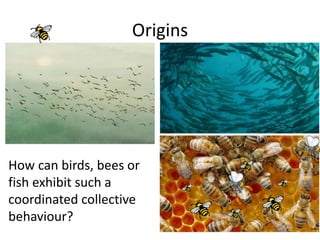
How can birds, bees or
fish exhibit such a
coordinated collective
behaviour?
Origins
• Reynolds proposed a behavioral model in
which each agent follows 3 rules:
o Separation - If too close agents move away
o Alignment - Each agent steers towards the
average heading of its neighbours
o Cohesion - Each agent tries to move towards
the average heading of its neighbours
The Idea
• J. Kennedy and R. Eberhart included a ‘roost’ in a
simplified Reynolds-like simulation so that:
o Each agent was attracted towards the location of
the roost.
o Each agent ‘remembered’ where it was closer to
the roost.
o Each agent shared information with its neighbors
(originally, all other agents) about its closest
location to the roost.
The Idea
• Eventually, all the agents ‘landed’ on the
roost.
• What if the notion of distance to the roost is
changed by an unknown function? Will the
agents ‘land’ in the minimum?
• Eberhart and Kennedy recognized the
suitability of this technique for optimization
and thus developed PSO in 1995.
Basics
Nature Algorithm
Bird or fish Particles
Explore the environment
(3D) in search for food
Explore objective space
(nD) in search for good
function values
Exchange information by
acoustical or optical means
Exchange information by
sharing positions of
promising locations
Main Idea: Mimic bird flocking or fish schooling.
Fundamentals
• PSO is a robust stochastic optimization
technique based on the movement and
intelligence of swarms.
• Each particle is searching for the optimum.
• Each particle is moving and hence has a
velocity.
Parameters
• Each particle keeps track of its coordinates in
the solution space which are associated with
the best solution (fitness) that has been
achieved so far by that particle. This value is
called personal best, pbest.
• But this would not be much good on its own;
particles need help in figuring out where to
search.
Parameters
• Thus, another best value that is tracked by the
PSO is the best value obtained so far by any
particle in the neighborhood of that particle.
This value is called gbest.
• The basic concept of PSO lies in accelerating
each particle toward its pbest and the gbest
locations, with a random weighted
acceleration at each time step.
Cooperation theory
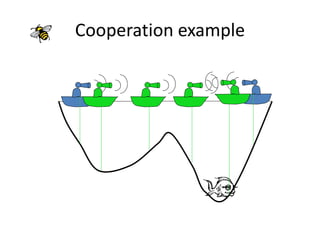
• The particles in the swarm co-operate. They
exchange information about what they’ve
discovered in the places they have visited.
• The co-operation is very simple. In basic PSO
it is like this:
o A particle has a neighborhood associated with it.
o A particle knows the fitnesses of those in its
neighborhood, and uses the position of the one with
best fitness.
o This position is simply used to adjust the particle’s
velocity.
Cooperation example
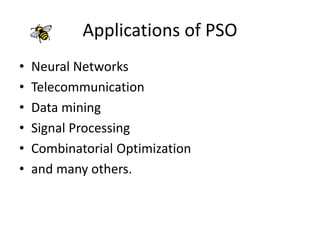
Applications of PSO
• Neural Networks
• Telecommunication
• Data mining
• Signal Processing
• Combinatorial Optimization
• and many others.
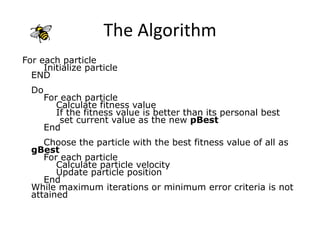
The Algorithm
For each particle
Initialize particle
END
Do
For each particle
Calculate fitness value
If the fitness value is better than its personal best
set current value as the new pBest
End
Choose the particle with the best fitness value of all as
gBest
For each particle
Calculate particle velocity
Update particle position
End
While maximum iterations or minimum error criteria is not
attained
(More) Questions?
Thank You!
References
• Particle Swarm Optimization introduction -
Marco A. Montes de Oca, IRIDIA-CoDE,
Universit´e Libre de Bruxelles (U.L.B.) May 7,
2007
• PSO by Maurice Clerc
• PSO invented by Russ Eberhart (electrical
engineer) and James Kennedy (social
psychologist) in USA
• Wikipedia

Particle swarm optimization

  • 1.
    Particle Swarm Optimization Guided by:- Prof.Sambit Ku. Mishra Prof. Rajesh Ku. Sahoo Prof. Surya Narayan Mishra Prof. Hemanta Ku. Sethi Project by:- Abhishek Agrawal CSE, Group – 1 BPUT
  • 2.
    Contents • Origins • TheIdea • Basics • Fundamentals • Parameters • Cooperation theory • Applications of PSO • The Algorithm • Bibliography
  • 3.
    Origins How can birds,bees or fish exhibit such a coordinated collective behaviour?
  • 4.
    Origins • Reynolds proposeda behavioral model in which each agent follows 3 rules: o Separation - If too close agents move away o Alignment - Each agent steers towards the average heading of its neighbours o Cohesion - Each agent tries to move towards the average heading of its neighbours
  • 5.
    The Idea • J.Kennedy and R. Eberhart included a ‘roost’ in a simplified Reynolds-like simulation so that: o Each agent was attracted towards the location of the roost. o Each agent ‘remembered’ where it was closer to the roost. o Each agent shared information with its neighbors (originally, all other agents) about its closest location to the roost.
  • 6.
    The Idea • Eventually,all the agents ‘landed’ on the roost. • What if the notion of distance to the roost is changed by an unknown function? Will the agents ‘land’ in the minimum? • Eberhart and Kennedy recognized the suitability of this technique for optimization and thus developed PSO in 1995.
  • 7.
    Basics Nature Algorithm Bird orfish Particles Explore the environment (3D) in search for food Explore objective space (nD) in search for good function values Exchange information by acoustical or optical means Exchange information by sharing positions of promising locations Main Idea: Mimic bird flocking or fish schooling.
  • 8.
    Fundamentals • PSO isa robust stochastic optimization technique based on the movement and intelligence of swarms. • Each particle is searching for the optimum. • Each particle is moving and hence has a velocity.
  • 9.
    Parameters • Each particlekeeps track of its coordinates in the solution space which are associated with the best solution (fitness) that has been achieved so far by that particle. This value is called personal best, pbest. • But this would not be much good on its own; particles need help in figuring out where to search.
  • 10.
    Parameters • Thus, anotherbest value that is tracked by the PSO is the best value obtained so far by any particle in the neighborhood of that particle. This value is called gbest. • The basic concept of PSO lies in accelerating each particle toward its pbest and the gbest locations, with a random weighted acceleration at each time step.
  • 11.
    Cooperation theory • Theparticles in the swarm co-operate. They exchange information about what they’ve discovered in the places they have visited. • The co-operation is very simple. In basic PSO it is like this: o A particle has a neighborhood associated with it. o A particle knows the fitnesses of those in its neighborhood, and uses the position of the one with best fitness. o This position is simply used to adjust the particle’s velocity.
  • 12.
  • 13.
    Applications of PSO •Neural Networks • Telecommunication • Data mining • Signal Processing • Combinatorial Optimization • and many others.
  • 14.
    The Algorithm For eachparticle Initialize particle END Do For each particle Calculate fitness value If the fitness value is better than its personal best set current value as the new pBest End Choose the particle with the best fitness value of all as gBest For each particle Calculate particle velocity Update particle position End While maximum iterations or minimum error criteria is not attained
  • 15.
  • 16.
    References • Particle SwarmOptimization introduction - Marco A. Montes de Oca, IRIDIA-CoDE, Universit´e Libre de Bruxelles (U.L.B.) May 7, 2007 • PSO by Maurice Clerc • PSO invented by Russ Eberhart (electrical engineer) and James Kennedy (social psychologist) in USA • Wikipedia