



SOFT COMPUTING
PARTICLE SWAM OPTIMIZATION(PSO)
Most recent multi-agent stochastic parallel
search techniques is:
Particle Swarm Optimization
(PSO; Eberhart & Kennedy,
IEEE Evocomp, 1995)
Inventors (1995)
Russell Eberhart James Kennedy
(electrical engineer) (social-psychologist)
16/03/20073
SWARMS
Particle Swarm Optimization
(PSO)
 PSO is a robust stochastic optimization
technique based on the movement and
intelligence of swarms.
 PSO applies the concept of social interaction
to problem solving.
6
Why do animals swarm?
 Defense against predators
 Enhanced predator detection
 Minimizing chance of capture
 Enhanced foraging success
 Better chances to find a mate
 Decrease of energy consumption
7
Social Insects
Several million years
 Efficient
 Flexible
 Robust
Solve many Problems:
 Find food, feed
 Build a nest …
8
Social Insects
Several million years
 Efficient
 Flexible
 Robust
Solve many Problems:
 Find food, feed
 Build a nest …
9
• Each particle keeps track of its coordinates in the solution
space which are associated with the best solution (fitness)
that has achieved so far by that particle. This value is called
personal best , pbest.
• Another best value that is tracked by the PSO is the best
value obtained so far by any particle in the neighborhood of
that particle. This value is called gbest.
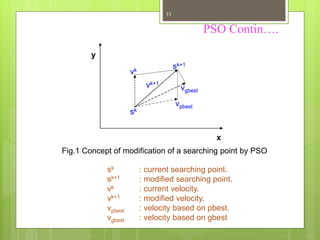
• The basic concept of PSO lies in accelerating each particle
toward its pbest and the gbest locations, with a random
weighted accelaration at each time step as shown in Fig.1
PSO Contin….
16/03/200710
Fig.1 Concept of modification of a searching point by PSO
sk : current searching point.
sk+1 : modified searching point.
vk : current velocity.
vk+1 : modified velocity.
vpbest : velocity based on pbest.
vgbest : velocity based on gbest
PSO Contin….
11
x
y
sk
vk
vpbest
vgbest
sk+1
vk+1
sk
vk
vpbest
vgbest
sk+1
vk+1
PSO Contin….
12
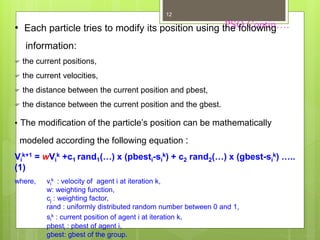
• Each particle tries to modify its position using the following
information:
 the current positions,
 the current velocities,
 the distance between the current position and pbest,
 the distance between the current position and the gbest.
• The modification of the particle’s position can be mathematically
modeled according the following equation :
Vi
k+1 = wVi
k +c1 rand1(…) x (pbesti-si
k) + c2 rand2(…) x (gbest-si
k) …..
(1)
where, vi
k : velocity of agent i at iteration k,
w: weighting function,
cj : weighting factor,
rand : uniformly distributed random number between 0 and 1,
si
k : current position of agent i at iteration k,
pbesti : pbest of agent i,
gbest: gbest of the group.
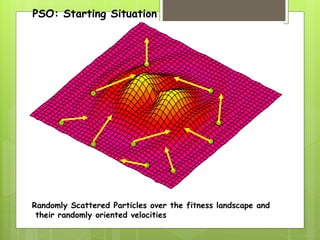
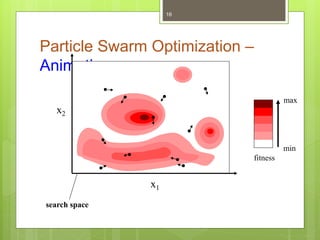
PSO: Starting Situation
Randomly Scattered Particles over the fitness landscape and
their randomly oriented velocities
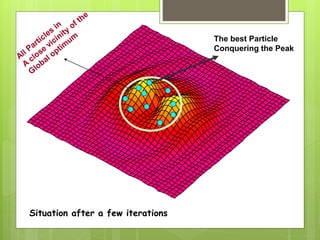
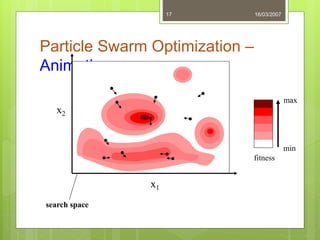
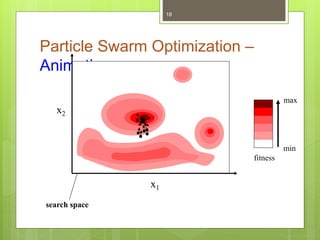
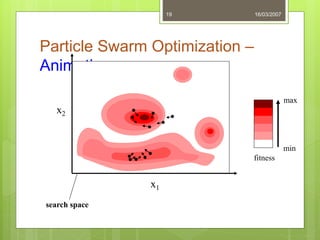
The best Particle
Conquering the Peak
Situation after a few iterations
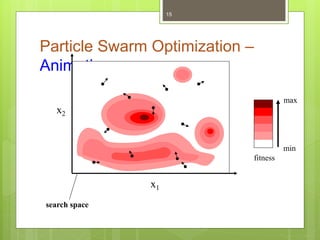
Particle Swarm Optimization –
Animation
15
x1
x2
fitness
min
max
search space
Particle Swarm Optimization –
Animation
16
x1
x2
search space
fitness
min
max
Particle Swarm Optimization –
Animation
16/03/200717
x1
x2
fitness
min
max
search space
Particle Swarm Optimization –
Animation
18
x1
x2
fitness
min
max
search space
Particle Swarm Optimization –
Animation
16/03/200719
x1
x2
fitness
min
max
search space
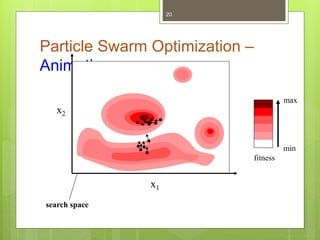
Particle Swarm Optimization –
Animation
20
x1
x2
fitness
min
max
search space
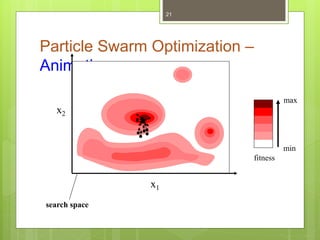
Particle Swarm Optimization –
Animation
21
x1
x2
fitness
min
max
search space
PSO Contin….
16/03/200722
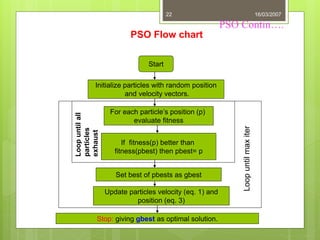
PSO Flow chart
Start
Initialize particles with random position
and velocity vectors.
For each particle’s position (p)
evaluate fitness
If fitness(p) better than
fitness(pbest) then pbest= p
Loopuntilall
particles
exhaust
Set best of pbests as gbest
Update particles velocity (eq. 1) and
position (eq. 3)
Loopuntilmaxiter
Stop: giving gbest as optimal solution.
To know more
THE site:
Particle Swarm Central, http://www.particleswarm.net
Clerc M., Kennedy J., "The Particle Swarm-Explosion,
Stability, and Convergence in a Multidimensional
Complex Space", IEEE Transaction on Evolutionary
Computation, 2002,vol. 6, p. 58-73.

Soft computing

  • 1.
  • 2.
    Most recent multi-agentstochastic parallel search techniques is: Particle Swarm Optimization (PSO; Eberhart & Kennedy, IEEE Evocomp, 1995)
  • 3.
    Inventors (1995) Russell EberhartJames Kennedy (electrical engineer) (social-psychologist) 16/03/20073
  • 5.
  • 6.
    Particle Swarm Optimization (PSO) PSO is a robust stochastic optimization technique based on the movement and intelligence of swarms.  PSO applies the concept of social interaction to problem solving. 6
  • 7.
    Why do animalsswarm?  Defense against predators  Enhanced predator detection  Minimizing chance of capture  Enhanced foraging success  Better chances to find a mate  Decrease of energy consumption 7
  • 8.
    Social Insects Several millionyears  Efficient  Flexible  Robust Solve many Problems:  Find food, feed  Build a nest … 8
  • 9.
    Social Insects Several millionyears  Efficient  Flexible  Robust Solve many Problems:  Find food, feed  Build a nest … 9
  • 10.
    • Each particlekeeps track of its coordinates in the solution space which are associated with the best solution (fitness) that has achieved so far by that particle. This value is called personal best , pbest. • Another best value that is tracked by the PSO is the best value obtained so far by any particle in the neighborhood of that particle. This value is called gbest. • The basic concept of PSO lies in accelerating each particle toward its pbest and the gbest locations, with a random weighted accelaration at each time step as shown in Fig.1 PSO Contin…. 16/03/200710
  • 11.
    Fig.1 Concept ofmodification of a searching point by PSO sk : current searching point. sk+1 : modified searching point. vk : current velocity. vk+1 : modified velocity. vpbest : velocity based on pbest. vgbest : velocity based on gbest PSO Contin…. 11 x y sk vk vpbest vgbest sk+1 vk+1 sk vk vpbest vgbest sk+1 vk+1
  • 12.
    PSO Contin…. 12 • Eachparticle tries to modify its position using the following information:  the current positions,  the current velocities,  the distance between the current position and pbest,  the distance between the current position and the gbest. • The modification of the particle’s position can be mathematically modeled according the following equation : Vi k+1 = wVi k +c1 rand1(…) x (pbesti-si k) + c2 rand2(…) x (gbest-si k) ….. (1) where, vi k : velocity of agent i at iteration k, w: weighting function, cj : weighting factor, rand : uniformly distributed random number between 0 and 1, si k : current position of agent i at iteration k, pbesti : pbest of agent i, gbest: gbest of the group.
  • 13.
    PSO: Starting Situation RandomlyScattered Particles over the fitness landscape and their randomly oriented velocities
  • 14.
    The best Particle Conqueringthe Peak Situation after a few iterations
  • 15.
    Particle Swarm Optimization– Animation 15 x1 x2 fitness min max search space
  • 16.
    Particle Swarm Optimization– Animation 16 x1 x2 search space fitness min max
  • 17.
    Particle Swarm Optimization– Animation 16/03/200717 x1 x2 fitness min max search space
  • 18.
    Particle Swarm Optimization– Animation 18 x1 x2 fitness min max search space
  • 19.
    Particle Swarm Optimization– Animation 16/03/200719 x1 x2 fitness min max search space
  • 20.
    Particle Swarm Optimization– Animation 20 x1 x2 fitness min max search space
  • 21.
    Particle Swarm Optimization– Animation 21 x1 x2 fitness min max search space
  • 22.
    PSO Contin…. 16/03/200722 PSO Flowchart Start Initialize particles with random position and velocity vectors. For each particle’s position (p) evaluate fitness If fitness(p) better than fitness(pbest) then pbest= p Loopuntilall particles exhaust Set best of pbests as gbest Update particles velocity (eq. 1) and position (eq. 3) Loopuntilmaxiter Stop: giving gbest as optimal solution.
  • 23.
    To know more THEsite: Particle Swarm Central, http://www.particleswarm.net Clerc M., Kennedy J., "The Particle Swarm-Explosion, Stability, and Convergence in a Multidimensional Complex Space", IEEE Transaction on Evolutionary Computation, 2002,vol. 6, p. 58-73.