Beta adrenergic receptor
antagonists or beta-blockers

    PROF. DR. SHAH MURAD
      SHAHMURAD65@GMAIL.COM
 Beta blockers are prescription medications used to
 treat many different conditions, such as high blood
 pressure (hypertension) or irregular heart
 rhythms (arrhythmias).

 There are numerous different beta blockers
 available, and there are several important differences
 among the various beta blockers
Beta Blockers By Type


 Usually, beta blockers are categorized in a few different
 ways.

 Some are "cardioselective" (meaning they are more
 likely to affect the heart and blood vessels rather than
 other parts of the body), some have "intrinsic
 sympathomimetic activity" ( slightly stimulate beta
 receptors while also blocking them), and some are
 alpha blockers as well as beta blockers.

 some beta blockers fall into more than one category
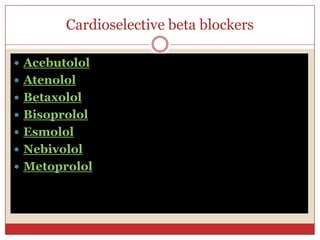
Cardioselective beta blockers

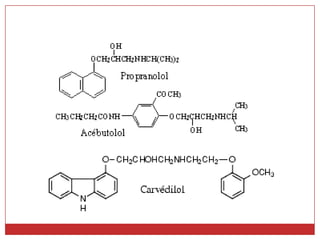
 Acebutolol
 Atenolol
 Betaxolol
 Bisoprolol
 Esmolol
 Nebivolol
 Metoprolol
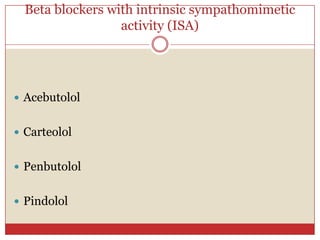
Beta blockers with intrinsic sympathomimetic
                  activity (ISA)


 Acebutolol


 Carteolol


 Penbutolol


 Pindolol
Beta blockrs + alpha-blockade


 CARVEDILOL


 LABETALOL
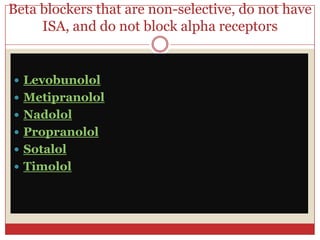
Beta blockers that are non-selective, do not have
     ISA, and do not block alpha receptors


 Levobunolol
 Metipranolol
 Nadolol
 Propranolol
 Sotalol
 Timolol
 Sotalol is unique among beta blockers in that it also
 blocks potassium channels in the heart.
 Drugs which inhibit beta adrenergic receptors are
 called beta -blocking agents and also beta-blockers.


 They inhibit competitively the beta effects of
 endogenous catecholamines.
 To understand the consequences of inhibition of beta
 receptors , it is necessary to keep in mind the effects
 of stimulation of beta receptors.
The stimulation of the postsynaptic beta-1 receptors induces:


    cardiac inotropic, chronotropic, dromotropic and
     bathmotropic positive effects with increase of cardiac output
     and oxygen requirement.


    increase of renin secretion.
The stimulation of the postsynaptic beta-2 receptors
                      induces:

 vasodilation, bronchodilatation, uterine relaxation,
 metabolic effects, cardiac inotropic and chronotropic
 positive effects but less than those which result from
 beta-1 stimulation.


 The stimulation of presynaptic beta-2 receptors
 increases noradrenaline release.
 The inhibition of beta adrenergic receptors elicits a
 decrease or a suppression of the effects of endogenous
 catecholamines.

 The effects are more important when endogenous
 stimulation is there.

 nhibition of beta receptors has beneficial and adverse
 effects
Common effects

 The effects of beta-blockers are primarily
  cardiovascular.
 They slow heart rate by decreasing the slope of slow
  diastolic depolarization and constitute group II of
  antiarrhythmic drugs.

 They decrease heart oxygen requirement, which
 explains their use in the preventive treatment of
 angina pectoris
 They decrease, after a latency period, pathological
 arterial hypertension, by complex mechanisms,
 decrease of cardiac output, inhibition of renin
 secretion, and perhaps inhibition of the sympathetic
 tone by a central effect.
 But they are not true hypotensive agents because
 they do not lower, at therapeutic doses, normal
 arterial pressure.


 Beta-blockers lower intraocular pressure by
 decreasing aqueous humor secretion.
Particular effects

 Some beta-blockers have a slight beta-mimetic
 activity, called intrinsic sympathomimetic activity or
 ISA, whose consequence is that a low beta stimulation
 persists.


 They have a high affinity for beta receptors but no or
 only a low capacity to activate these receptors.
 Being bound to beta receptors, they prevent
 endogenous catecholamines from inducing beta
 effects and are thus true beta-blockers.
 Beta-blockers are classified according their selective
  inhibition of beta-1 and/or beta-2receptors.
 Some beta-blockers inhibit at the same time beta-1
  and beta-2 receptors, others inhibit only beta-1
  receptors.

 The latter are known as cardio-selective.


 It did not appear interesting in therapeutics to
 selectively inhibit beta-2 receptors.
 In addition to their beta-blocking activity, some beta-
 blockers like propranolol and acebutolol, have a
 membrane-stabilizing effect which reduces
 transmembrane ion exchanges.

 This activity, sometimes called local anesthetic or
 antiarrhythmic effect, results from a decrease of the
 rate of depolarization by sodium entry.
 Labetolol and carvedilol have an alpha-1-blocking
 effect, celiprolol a beta-2-agonist effect.

 Propranolol inhibits the transport of iodine in the
 thyroid follicle.

 Carvedilol would have, at least in vitro, antioxydant
 properties.

 Nebivolol has a NO-mimetic vasodilatator effect.
Pharmacokinetic features


 One can distinguish liposoluble and water-soluble
 beta-blockers.


 liposoluble beta-blockers like propranolol and
 oxyprenolol have common features:
   they are quickly and completely absorbed by the digestive
    tract.


   they are metabolized in the liver and can undergo an
    inactivation known as first metabolism.


   Their ingestion with foods can reduce the importance of first-
    pass metabolism and increase their bioavailability.
-they are bound at 90% to plasma proteins.


-they have a very great volume of distribution, i.e. they diffuse
  readily in tissues.


-they have a rather short duration of action and a short plasma
  half-life
 water-soluble beta-blockers like atenolol, nadolol
 and sotalol have the following properties:

    they are less quite absorbed by the digestive tract and in a
     more irregular way


    they are little metabolized by the liver


    they are not very bound to plasma proteins
   they are eliminated primarily by the kidney in unchanged form


   they have a restricted volume of distribution


   they have a long plasma half-life
 Between these two extremes, very liposoluble beta-
 blockers and very water-soluble beta-blockers, there
 are intermediate products such as pindolol and
 celiprolol.
Therapeutic uses


                    Cardiovascular uses
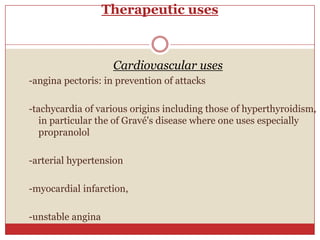
-angina pectoris: in prevention of attacks

-tachycardia of various origins including those of hyperthyroidism,
   in particular the of Gravé's disease where one uses especially
   propranolol

-arterial hypertension

-myocardial infarction,

-unstable angina
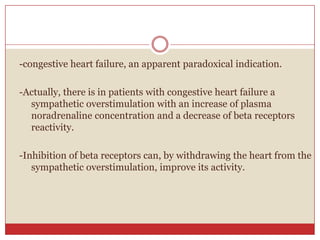
-congestive heart failure, an apparent paradoxical indication.

-Actually, there is in patients with congestive heart failure a
  sympathetic overstimulation with an increase of plasma
  noradrenaline concentration and a decrease of beta receptors
  reactivity.

-Inhibition of beta receptors can, by withdrawing the heart from the
   sympathetic overstimulation, improve its activity.
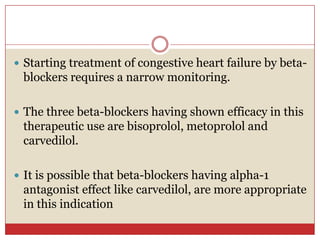
 Starting treatment of congestive heart failure by beta-
 blockers requires a narrow monitoring.

 The three beta-blockers having shown efficacy in this
 therapeutic use are bisoprolol, metoprolol and
 carvedilol.

 It is possible that beta-blockers having alpha-1
 antagonist effect like carvedilol, are more appropriate
 in this indication
Other therapeutic uses


prevention of primary and secondary digestive
bleeding in portal hypertension by rupture of
esophageal varices; propranolol is usually used
-treatment of migraine, tremor, transitory somatic
  symptoms of anxiety, alcohol addiction in which
  there appears a beta overstimulation.

-In this case propranolol is usually prescribed


-treatment of glaucoma by ophthalmic solutions,
  but they can diffuse into the general circulation
  and give adverse effects
 Generally dosage of beta-blockers must be gradually
 increased at the beginning of the treatment and
 gradually decreased at cessation with monitoring
 and rest
Available preparations


 Beta-blockers are presented in
 the form of tablets or of
 capsules, some of them in
 injectable form are intended for
 treatment of acute disorders of
 heart rhythm and acute phase
 of myocardial infarction.
 Beta-blockers, not cardioselective, without Intrinsic
 sympathomimetic activity are propranolol, nadolol,
 sotalol, tertatolol, timolol, labetolol, carvedilol
 Beta-blockers not cardioselective, with ASI.
 oxyprenolol ; carteolol and pindolol
 Beta1-blockers, cardioselective, without A.S.I.
 atenolol ; betaxolol, bisoprolol, metoprolol, esmolol
 and nebivolol
 Bêta1-blockers, cardioselective, with A.S.I.
 Acebutolol, Celiprolol
 Beta-blockers combined with a diuretic.


 Many beta-blockers are combined under proprietary
 names with a diuretic such as hydrochlorothiazide,
 chortalidone, clopamide, amiloride.
Ophthalmic solutions of beta-blockers

 for treatment of glaucoma
 Beta-blockers in ophthalmic solutions are used in
 treatment of glaucoma.

 Beta-blockers presented in ophthalmic formulations
 are betaxolol, befunolol, carteolol, metipranolol,
 timolol and levobunolol.
Adverse effects


 Aggravation of congestive heart failure.


 Congestive heart failure is both an indication and a
 contraindication to the use of beta-blockers.
 In any case, starting a beta-blocking
 treatment cannot be done without a rigorous
 analysis of the state of the patient and
 necessitates a close monitoring.
 Aggravation of bradyarrythmia; bradycardia,
 atrioventricular blocks are contraindications to their
 prescription.


 Coldness of the extremities , possible aggravation of
 arteritis, especially with nonselective beta-blockers
 but sometimes also with beta-1 selective.
 A ggravation of asthmatic disease, especially with
 nonselective beta-blockers - but also sometimes with
 beta-1selective blockers.
 Worsened risk of anaphylactic shock by partial
 inhibition of mechanisms opposed to it
Metabolic disorders


 Increase in triglycerides


 -increase in cholesterol and the VLDL (very low
   density lipoproteins); hypoglycemia in diabetics
 -raised risk of developing a type II diabetes after
   antihypertensive treatment during several years
   by beta-blockers.
Various, rare disorders

 immunological disorders, lupus, fibroses.


 Rebound of symptoms at abrupt discontinuation of
 beta-blockers >>>>>>>>>>>>> tachycardia,
 arterial hypertension, fainting, sweats, nervousness ,
 especially risk of angina, myocardial infarction and
 sudden death.
Diffusion in the body after topical use of ophthalmic
                        solutions.

 Ophthalmic solutions of beta-blockers have few local
 adverse effects, irritation for example, but can have
 general adverse effects after systemic diffusion.

 They frequently elicit bradycardia, asthma, in the
 elderly

 Elimination in milk >>>>>>>>> Beta-blocker use is
 contraindicated during lactation.
 In overdoses, accidental or voluntary, beta-blockers
 cause hypotension, bradycardia, heart rhythm
 disorders and shock.
 A drug likely to reduce disorders caused by beta-
 blockers is glucagon because it stimulates
 adenylcyclase despite the blockade of beta-receptors.
 Poisoning by beta-blockers with membrane
 stabilizing activity appears more difficult to treat
 than that elicited by beta-blockers which do not have
 this activity
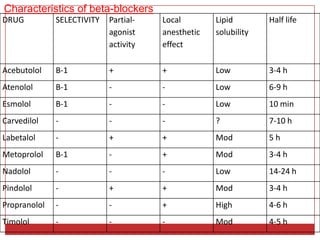
Characteristics of beta-blockers
DRUG          SELECTIVITY   Partial-   Local        Lipid        Half life
                            agonist    anesthetic   solubility
                            activity   effect

Acebutolol    B-1           +          +            Low          3-4 h
Atenolol      B-1           -          -            Low          6-9 h
Esmolol       B-1           -          -            Low          10 min
Carvedilol    -             -          -            ?            7-10 h
Labetalol     -             +          +            Mod          5h
Metoprolol    B-1           -          +            Mod          3-4 h
Nadolol       -             -          -            Low          14-24 h
Pindolol      -             +          +            Mod          3-4 h
Propranolol   -             -          +            High         4-6 h
Timolol       -             -          -            Mod          4-5 h
Therapeutic uses of beta blockers
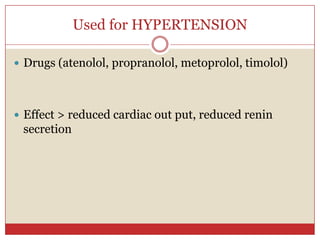
Used for HYPERTENSION

 Drugs (atenolol, propranolol, metoprolol, timolol)


 Effect > reduced cardiac out put, reduced renin
 secretion
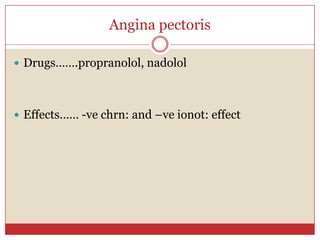
Angina pectoris

 Drugs…….propranolol, nadolol


 Effects…… -ve chrn: and –ve ionot: effect
Arrhythmia prophylaxis after MI

 Propranolol, metoprolol, timolol


 Effects…….reduced automaticity of all cardiac
 pacemakers
Supraventricular tachycardias

 Propranolol, esmolol, acebutolol


 Effects…..slowed AV conduction velocity
Hepertropic cardiomyopathy

 Propranolol


 Effects…..slowed rate of cardiac contraction
Migraine

 Propranolol


 Effects….vasodilation
Thyroid storm, thyrotoxicosis

 Propranolol


 Effects….. Reduced cardiac rate & arrhythmogenesis
Glaucoma

 Timolol


 Effects ……… reduced secretion of aqueous humor
Other drugs used in glaucoma

 PGs
 Cholinomimetics
 Alpha agonists…..adrenaline, dipivefrin
 Alpha-2 selective antagonists…..apraclonidine,
  brimonidine
 Diuretics …acetazolamide, dorzolamide

Beta blockers

  • 1.
    Beta adrenergic receptor antagonistsor beta-blockers PROF. DR. SHAH MURAD SHAHMURAD65@GMAIL.COM
  • 2.
     Beta blockersare prescription medications used to treat many different conditions, such as high blood pressure (hypertension) or irregular heart rhythms (arrhythmias).  There are numerous different beta blockers available, and there are several important differences among the various beta blockers
  • 3.
    Beta Blockers ByType  Usually, beta blockers are categorized in a few different ways.  Some are "cardioselective" (meaning they are more likely to affect the heart and blood vessels rather than other parts of the body), some have "intrinsic sympathomimetic activity" ( slightly stimulate beta receptors while also blocking them), and some are alpha blockers as well as beta blockers.  some beta blockers fall into more than one category
  • 4.
    Cardioselective beta blockers Acebutolol  Atenolol  Betaxolol  Bisoprolol  Esmolol  Nebivolol  Metoprolol
  • 5.
    Beta blockers withintrinsic sympathomimetic activity (ISA)  Acebutolol  Carteolol  Penbutolol  Pindolol
  • 6.
    Beta blockrs +alpha-blockade  CARVEDILOL  LABETALOL
  • 7.
    Beta blockers thatare non-selective, do not have ISA, and do not block alpha receptors  Levobunolol  Metipranolol  Nadolol  Propranolol  Sotalol  Timolol
  • 8.
     Sotalol isunique among beta blockers in that it also blocks potassium channels in the heart.
  • 9.
     Drugs whichinhibit beta adrenergic receptors are called beta -blocking agents and also beta-blockers.  They inhibit competitively the beta effects of endogenous catecholamines.
  • 10.
     To understandthe consequences of inhibition of beta receptors , it is necessary to keep in mind the effects of stimulation of beta receptors.
  • 11.
    The stimulation ofthe postsynaptic beta-1 receptors induces:  cardiac inotropic, chronotropic, dromotropic and bathmotropic positive effects with increase of cardiac output and oxygen requirement.  increase of renin secretion.
  • 12.
    The stimulation ofthe postsynaptic beta-2 receptors induces:  vasodilation, bronchodilatation, uterine relaxation, metabolic effects, cardiac inotropic and chronotropic positive effects but less than those which result from beta-1 stimulation.  The stimulation of presynaptic beta-2 receptors increases noradrenaline release.
  • 13.
     The inhibitionof beta adrenergic receptors elicits a decrease or a suppression of the effects of endogenous catecholamines.  The effects are more important when endogenous stimulation is there.  nhibition of beta receptors has beneficial and adverse effects
  • 14.
    Common effects  Theeffects of beta-blockers are primarily cardiovascular.  They slow heart rate by decreasing the slope of slow diastolic depolarization and constitute group II of antiarrhythmic drugs.  They decrease heart oxygen requirement, which explains their use in the preventive treatment of angina pectoris
  • 15.
     They decrease,after a latency period, pathological arterial hypertension, by complex mechanisms, decrease of cardiac output, inhibition of renin secretion, and perhaps inhibition of the sympathetic tone by a central effect.
  • 16.
     But theyare not true hypotensive agents because they do not lower, at therapeutic doses, normal arterial pressure.  Beta-blockers lower intraocular pressure by decreasing aqueous humor secretion.
  • 17.
    Particular effects  Somebeta-blockers have a slight beta-mimetic activity, called intrinsic sympathomimetic activity or ISA, whose consequence is that a low beta stimulation persists.  They have a high affinity for beta receptors but no or only a low capacity to activate these receptors.
  • 18.
     Being boundto beta receptors, they prevent endogenous catecholamines from inducing beta effects and are thus true beta-blockers.
  • 19.
     Beta-blockers areclassified according their selective inhibition of beta-1 and/or beta-2receptors.  Some beta-blockers inhibit at the same time beta-1 and beta-2 receptors, others inhibit only beta-1 receptors.  The latter are known as cardio-selective.  It did not appear interesting in therapeutics to selectively inhibit beta-2 receptors.
  • 20.
     In additionto their beta-blocking activity, some beta- blockers like propranolol and acebutolol, have a membrane-stabilizing effect which reduces transmembrane ion exchanges.  This activity, sometimes called local anesthetic or antiarrhythmic effect, results from a decrease of the rate of depolarization by sodium entry.
  • 21.
     Labetolol andcarvedilol have an alpha-1-blocking effect, celiprolol a beta-2-agonist effect.  Propranolol inhibits the transport of iodine in the thyroid follicle.  Carvedilol would have, at least in vitro, antioxydant properties.  Nebivolol has a NO-mimetic vasodilatator effect.
  • 22.
    Pharmacokinetic features  Onecan distinguish liposoluble and water-soluble beta-blockers.  liposoluble beta-blockers like propranolol and oxyprenolol have common features:
  • 23.
    they are quickly and completely absorbed by the digestive tract.  they are metabolized in the liver and can undergo an inactivation known as first metabolism.  Their ingestion with foods can reduce the importance of first- pass metabolism and increase their bioavailability.
  • 24.
    -they are boundat 90% to plasma proteins. -they have a very great volume of distribution, i.e. they diffuse readily in tissues. -they have a rather short duration of action and a short plasma half-life
  • 25.
     water-soluble beta-blockerslike atenolol, nadolol and sotalol have the following properties:  they are less quite absorbed by the digestive tract and in a more irregular way  they are little metabolized by the liver  they are not very bound to plasma proteins
  • 26.
    they are eliminated primarily by the kidney in unchanged form  they have a restricted volume of distribution  they have a long plasma half-life
  • 27.
     Between thesetwo extremes, very liposoluble beta- blockers and very water-soluble beta-blockers, there are intermediate products such as pindolol and celiprolol.
  • 29.
    Therapeutic uses Cardiovascular uses -angina pectoris: in prevention of attacks -tachycardia of various origins including those of hyperthyroidism, in particular the of Gravé's disease where one uses especially propranolol -arterial hypertension -myocardial infarction, -unstable angina
  • 30.
    -congestive heart failure,an apparent paradoxical indication. -Actually, there is in patients with congestive heart failure a sympathetic overstimulation with an increase of plasma noradrenaline concentration and a decrease of beta receptors reactivity. -Inhibition of beta receptors can, by withdrawing the heart from the sympathetic overstimulation, improve its activity.
  • 31.
     Starting treatmentof congestive heart failure by beta- blockers requires a narrow monitoring.  The three beta-blockers having shown efficacy in this therapeutic use are bisoprolol, metoprolol and carvedilol.  It is possible that beta-blockers having alpha-1 antagonist effect like carvedilol, are more appropriate in this indication
  • 32.
    Other therapeutic uses preventionof primary and secondary digestive bleeding in portal hypertension by rupture of esophageal varices; propranolol is usually used
  • 33.
    -treatment of migraine,tremor, transitory somatic symptoms of anxiety, alcohol addiction in which there appears a beta overstimulation. -In this case propranolol is usually prescribed -treatment of glaucoma by ophthalmic solutions, but they can diffuse into the general circulation and give adverse effects
  • 34.
     Generally dosageof beta-blockers must be gradually increased at the beginning of the treatment and gradually decreased at cessation with monitoring and rest
  • 35.
    Available preparations  Beta-blockersare presented in the form of tablets or of capsules, some of them in injectable form are intended for treatment of acute disorders of heart rhythm and acute phase of myocardial infarction.
  • 36.
     Beta-blockers, notcardioselective, without Intrinsic sympathomimetic activity are propranolol, nadolol, sotalol, tertatolol, timolol, labetolol, carvedilol
  • 37.
     Beta-blockers notcardioselective, with ASI. oxyprenolol ; carteolol and pindolol
  • 38.
     Beta1-blockers, cardioselective,without A.S.I. atenolol ; betaxolol, bisoprolol, metoprolol, esmolol and nebivolol
  • 39.
     Bêta1-blockers, cardioselective,with A.S.I. Acebutolol, Celiprolol
  • 40.
     Beta-blockers combinedwith a diuretic.  Many beta-blockers are combined under proprietary names with a diuretic such as hydrochlorothiazide, chortalidone, clopamide, amiloride.
  • 41.
    Ophthalmic solutions ofbeta-blockers  for treatment of glaucoma Beta-blockers in ophthalmic solutions are used in treatment of glaucoma.  Beta-blockers presented in ophthalmic formulations are betaxolol, befunolol, carteolol, metipranolol, timolol and levobunolol.
  • 42.
    Adverse effects  Aggravationof congestive heart failure.  Congestive heart failure is both an indication and a contraindication to the use of beta-blockers.
  • 43.
     In anycase, starting a beta-blocking treatment cannot be done without a rigorous analysis of the state of the patient and necessitates a close monitoring.
  • 44.
     Aggravation ofbradyarrythmia; bradycardia, atrioventricular blocks are contraindications to their prescription.  Coldness of the extremities , possible aggravation of arteritis, especially with nonselective beta-blockers but sometimes also with beta-1 selective.
  • 45.
     A ggravationof asthmatic disease, especially with nonselective beta-blockers - but also sometimes with beta-1selective blockers.
  • 46.
     Worsened riskof anaphylactic shock by partial inhibition of mechanisms opposed to it
  • 47.
    Metabolic disorders  Increasein triglycerides -increase in cholesterol and the VLDL (very low density lipoproteins); hypoglycemia in diabetics -raised risk of developing a type II diabetes after antihypertensive treatment during several years by beta-blockers.
  • 48.
    Various, rare disorders immunological disorders, lupus, fibroses.  Rebound of symptoms at abrupt discontinuation of beta-blockers >>>>>>>>>>>>> tachycardia, arterial hypertension, fainting, sweats, nervousness , especially risk of angina, myocardial infarction and sudden death.
  • 49.
    Diffusion in thebody after topical use of ophthalmic solutions.  Ophthalmic solutions of beta-blockers have few local adverse effects, irritation for example, but can have general adverse effects after systemic diffusion.  They frequently elicit bradycardia, asthma, in the elderly  Elimination in milk >>>>>>>>> Beta-blocker use is contraindicated during lactation.
  • 50.
     In overdoses,accidental or voluntary, beta-blockers cause hypotension, bradycardia, heart rhythm disorders and shock.
  • 51.
     A druglikely to reduce disorders caused by beta- blockers is glucagon because it stimulates adenylcyclase despite the blockade of beta-receptors.
  • 52.
     Poisoning bybeta-blockers with membrane stabilizing activity appears more difficult to treat than that elicited by beta-blockers which do not have this activity
  • 53.
    Characteristics of beta-blockers DRUG SELECTIVITY Partial- Local Lipid Half life agonist anesthetic solubility activity effect Acebutolol B-1 + + Low 3-4 h Atenolol B-1 - - Low 6-9 h Esmolol B-1 - - Low 10 min Carvedilol - - - ? 7-10 h Labetalol - + + Mod 5h Metoprolol B-1 - + Mod 3-4 h Nadolol - - - Low 14-24 h Pindolol - + + Mod 3-4 h Propranolol - - + High 4-6 h Timolol - - - Mod 4-5 h
  • 54.
    Therapeutic uses ofbeta blockers
  • 55.
    Used for HYPERTENSION Drugs (atenolol, propranolol, metoprolol, timolol)  Effect > reduced cardiac out put, reduced renin secretion
  • 56.
    Angina pectoris  Drugs…….propranolol,nadolol  Effects…… -ve chrn: and –ve ionot: effect
  • 57.
    Arrhythmia prophylaxis afterMI  Propranolol, metoprolol, timolol  Effects…….reduced automaticity of all cardiac pacemakers
  • 58.
    Supraventricular tachycardias  Propranolol,esmolol, acebutolol  Effects…..slowed AV conduction velocity
  • 59.
    Hepertropic cardiomyopathy  Propranolol Effects…..slowed rate of cardiac contraction
  • 60.
  • 61.
    Thyroid storm, thyrotoxicosis Propranolol  Effects….. Reduced cardiac rate & arrhythmogenesis
  • 62.
    Glaucoma  Timolol  Effects……… reduced secretion of aqueous humor
  • 63.
    Other drugs usedin glaucoma  PGs  Cholinomimetics  Alpha agonists…..adrenaline, dipivefrin  Alpha-2 selective antagonists…..apraclonidine, brimonidine  Diuretics …acetazolamide, dorzolamide