BETA BLOCKERS
Beta blockers
•Drugs which inhibit
adrenergic response
mediated by beta
receptors
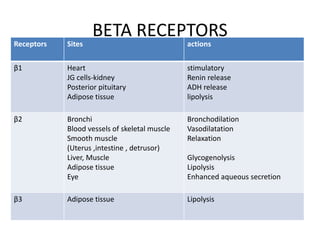
BETA RECEPTORS
Receptors Sites actions
β1 Heart
JG cells-kidney
Posterior pituitary
Adipose tissue
stimulatory
Renin release
ADH release
lipolysis
β2 Bronchi
Blood vessels of skeletal muscle
Smooth muscle
(Uterus ,intestine , detrusor)
Liver, Muscle
Adipose tissue
Eye
Bronchodilation
Vasodilatation
Relaxation
Glycogenolysis
Lipolysis
Enhanced aqueous secretion
β3 Adipose tissue Lipolysis
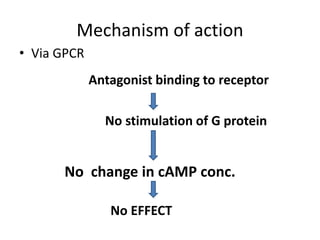
Mechanism of action
• Via GPCR
Antagonist binding to receptor
No stimulation of G protein
No change in cAMP conc.
No EFFECT
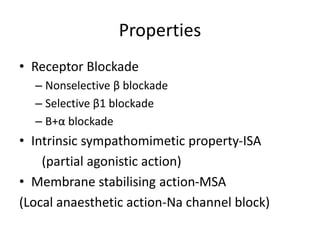
Properties
• Receptor Blockade
– Nonselective β blockade
– Selective β1 blockade
– Β+α blockade
• Intrinsic sympathomimetic property-ISA
(partial agonistic action)
• Membrane stabilising action-MSA
(Local anaesthetic action-Na channel block)
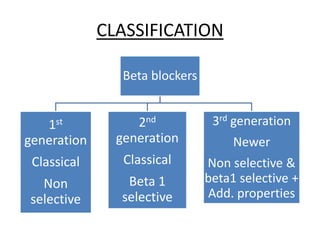
CLASSIFICATION
Beta blockers
1st
generation
Classical
Non
selective
2nd
generation
Classical
Beta 1
selective
3rd generation
Newer
Non selective &
beta1 selective +
Add. properties
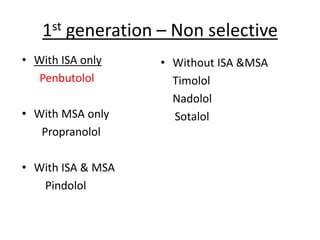
1st generation – Non selective
• Without ISA &MSA
Timolol
Nadolol
Sotalol
• With ISA only
Penbutolol
• With MSA only
Propranolol
• With ISA & MSA
Pindolol
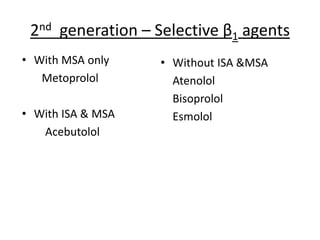
2nd generation – Selective β1 agents
• Without ISA &MSA
Atenolol
Bisoprolol
Esmolol
• With MSA only
Metoprolol
• With ISA & MSA
Acebutolol
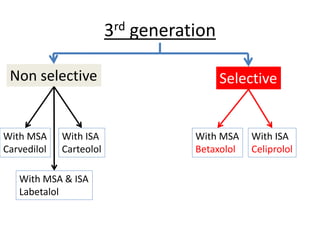
3rd generation
Non selective Selective
With ISA
Carteolol
With ISA
Celiprolol
With MSA
Betaxolol
With MSA
Carvedilol
With MSA & ISA
Labetalol
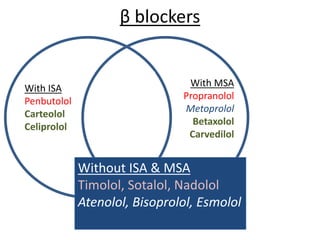
β blockers
With ISA
Penbutolol
Carteolol
Celiprolol
Both
Pindolol
Acebutolol
Labetalol
With MSA
Propranolol
Metoprolol
Betaxolol
Carvedilol
Without ISA & MSA
Timolol, Sotalol, Nadolol
Atenolol, Bisoprolol, Esmolol
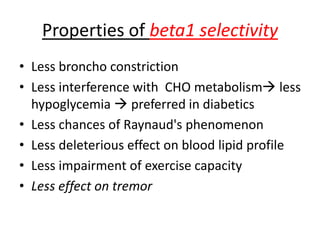
Properties of beta1 selectivity
• Less broncho constriction
• Less interference with CHO metabolism less
hypoglycemia  preferred in diabetics
• Less chances of Raynaud's phenomenon
• Less deleterious effect on blood lipid profile
• Less impairment of exercise capacity
• Less effect on tremor
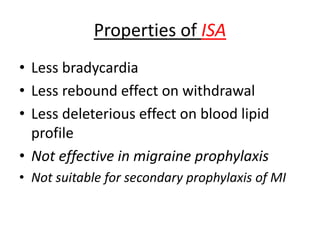
Properties of ISA
• Less bradycardia
• Less rebound effect on withdrawal
• Less deleterious effect on blood lipid
profile
• Not effective in migraine prophylaxis
• Not suitable for secondary prophylaxis of MI
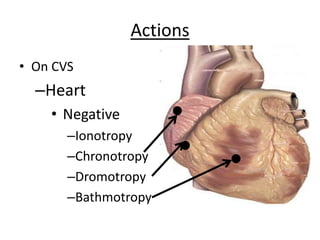
Actions
• On CVS
–Heart
• Negative
–Ionotropy
–Chronotropy
–Dromotropy
–Bathmotropy
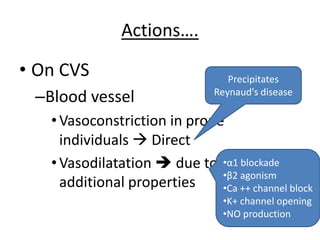
Actions….
• On CVS
–Blood vessel
•Vasoconstriction in prone
individuals  Direct
•Vasodilatation  due to
additional properties
Precipitates
Reynaud's disease
•α1 blockade
•β2 agonism
•Ca ++ channel block
•K+ channel opening
•NO production
Actions….
• On CVS
–Antihypertensive action
• Decreased CO
• Decreased renin release
• Decreased TPR on long term
administration
• Central action – reduction of
sympathetic outflow
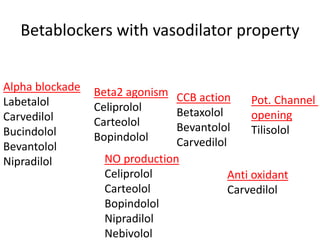
Betablockers with vasodilator property
Alpha blockade
Labetalol
Carvedilol
Bucindolol
Bevantolol
Nipradilol
Beta2 agonism
Celiprolol
Carteolol
Bopindolol
CCB action
Betaxolol
Bevantolol
Carvedilol
Pot. Channel
opening
Tilisolol
NO production
Celiprolol
Carteolol
Bopindolol
Nipradilol
Nebivolol
Anti oxidant
Carvedilol
Actions -CNS
• Anti anxiety
• Behaviour changes
• Forgetfulness
• Night mares
• Increased dreaming
Nonselective
lipid soluble
Actions -Metabolic
• CHO metabolism
– Hypoglycemia
• Inhibits muscle glycogenolysis
– Hypoglycemic unawareness
• Lipid
– Increases VLDL(TG) levels
– Alters HDL/LDL ratio
Less with
β 1 selective
agents
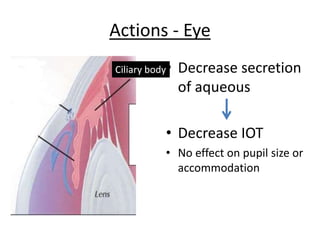
Actions - Eye
• Decrease secretion
of aqueous
• Decrease IOT
• No effect on pupil size or
accommodation
Ciliary body
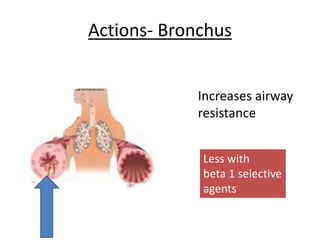
Actions- Bronchus
Increases airway
resistance
Less with
beta 1 selective
agents
SKELETAL muscles
•Decrease exercise capacity
–By decreasing blood flow
–Inhibit glycogenolysis and
lipolysis.
MISCELLANEOUS
• Antagonise catecholamine induced
–Tremor
–Inhibition of mast cell degranulation
• Prevent platelet aggregation and
promote fibrinolysis
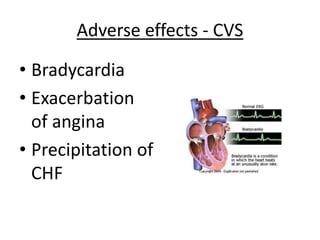
Adverse effects - CVS
• Bradycardia
• Exacerbation
of angina
• Precipitation of
CHF
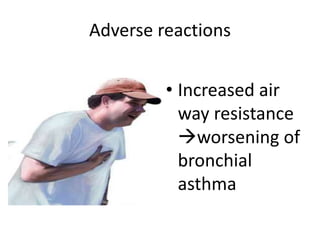
Adverse reactions
• Increased air
way resistance
worsening of
bronchial
asthma
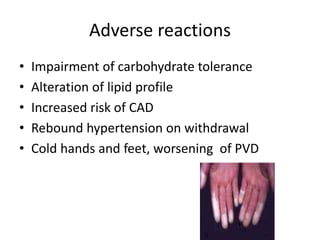
Adverse reactions
• Impairment of carbohydrate tolerance
• Alteration of lipid profile
• Increased risk of CAD
• Rebound hypertension on withdrawal
• Cold hands and feet, worsening of PVD
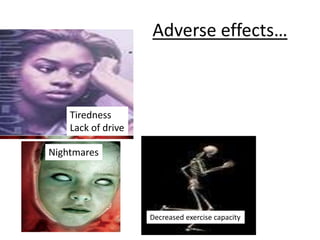
Adverse effects…
Nightmares
Decreased exercise capacity
Tiredness
Lack of drive
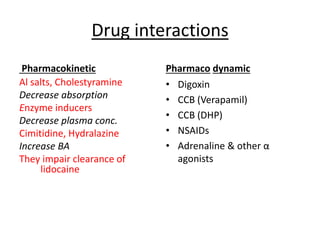
Drug interactions
Pharmacokinetic
Al salts, Cholestyramine
Decrease absorption
Enzyme inducers
Decrease plasma conc.
Cimitidine, Hydralazine
Increase BA
They impair clearance of
lidocaine
Pharmaco dynamic
• Digoxin
• CCB (Verapamil)
• CCB (DHP)
• NSAIDs
• Adrenaline & other α
agonists
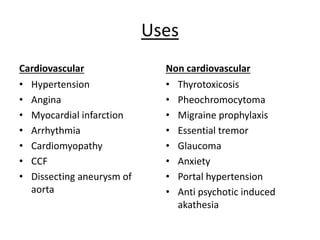
Uses
Cardiovascular
• Hypertension
• Angina
• Myocardial infarction
• Arrhythmia
• Cardiomyopathy
• CCF
• Dissecting aneurysm of
aorta
Non cardiovascular
• Thyrotoxicosis
• Pheochromocytoma
• Migraine prophylaxis
• Essential tremor
• Glaucoma
• Anxiety
• Portal hypertension
• Anti psychotic induced
akathesia
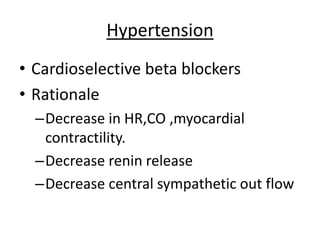
Hypertension
• Cardioselective beta blockers
• Rationale
–Decrease in HR,CO ,myocardial
contractility.
–Decrease renin release
–Decrease central sympathetic out flow
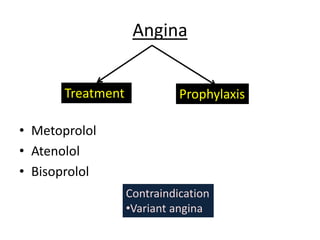
Angina
• Metoprolol
• Atenolol
• Bisoprolol
Prophylaxis
Treatment
Contraindication
•Variant angina
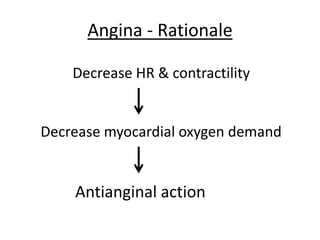
Angina - Rationale
Decrease HR & contractility
Decrease myocardial oxygen demand
Antianginal action
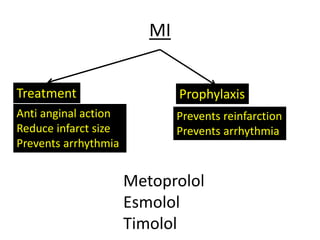
MI
Prophylaxis
Treatment
Anti anginal action
Reduce infarct size
Prevents arrhythmia
Prevents reinfarction
Prevents arrhythmia
Metoprolol
Esmolol
Timolol
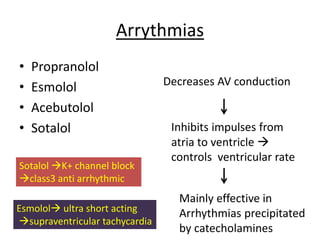
Arrythmias
• Propranolol
• Esmolol
• Acebutolol
• Sotalol
Decreases AV conduction
Inhibits impulses from
atria to ventricle 
controls ventricular rate
Mainly effective in
Arrhythmias precipitated
by catecholamines
Sotalol K+ channel block
class3 anti arrhythmic
Esmolol ultra short acting
supraventricular tachycardia
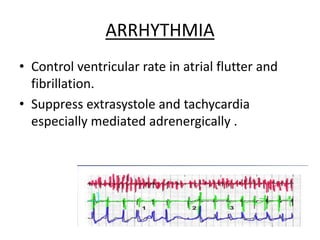
ARRHYTHMIA
• Control ventricular rate in atrial flutter and
fibrillation.
• Suppress extrasystole and tachycardia
especially mediated adrenergically .
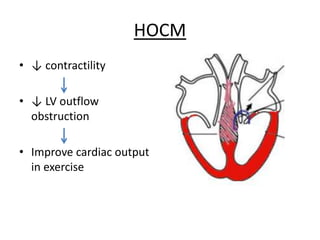
HOCM
• ↓ contractility
• ↓ LV outflow
obstruction
• Improve cardiac output
in exercise
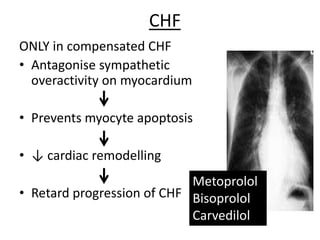
CHF
ONLY in compensated CHF
• Antagonise sympathetic
overactivity on myocardium
• Prevents myocyte apoptosis
• ↓ cardiac remodelling
• Retard progression of CHF
Metoprolol
Bisoprolol
Carvedilol
Dissecting aortic aneurysm
• ↓ cardiac contractility, and aortic pulsation.
Non cardiac uses
• Pheochromocytoma
– Used after an α blocker
– To control tachycardia and arrhythmia
– Suppress cardiomyopathy due to excess
catecholamines
• Thyrotoxicosis
– Control sympathetic symptoms
– Inhibit peripheral conversion of T4 to T3
– Preoperative use
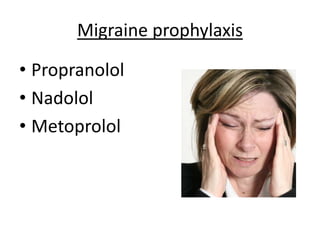
Migraine prophylaxis
• Propranolol
• Nadolol
• Metoprolol
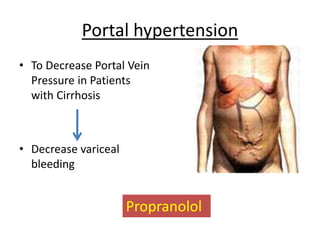
Portal hypertension
• To Decrease Portal Vein
Pressure in Patients
with Cirrhosis
• Decrease variceal
bleeding
Propranolol
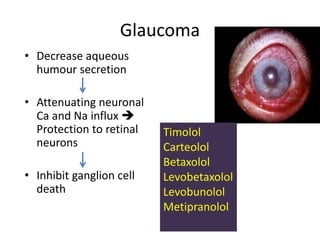
Glaucoma
• Decrease aqueous
humour secretion
• Attenuating neuronal
Ca and Na influx 
Protection to retinal
neurons
• Inhibit ganglion cell
death
Timolol
Carteolol
Betaxolol
Levobetaxolol
Levobunolol
Metipranolol
CNS
• Anxiety
• Essential tremor
• Akathisia induced by
antipsychotics
• Alchohol withdrawal
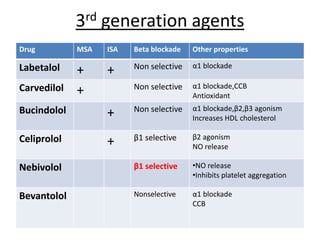
3rd generation agents
Drug MSA ISA Beta blockade Other properties
Labetalol + + Non selective α1 blockade
Carvedilol + Non selective α1 blockade,CCB
Antioxidant
Bucindolol + Non selective α1 blockade,β2,β3 agonism
Increases HDL cholesterol
Celiprolol + β1 selective β2 agonism
NO release
Nebivolol β1 selective •NO release
•Inhibits platelet aggregation
Bevantolol Nonselective α1 blockade
CCB
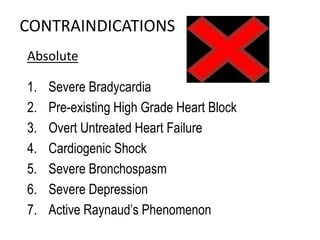
CONTRAINDICATIONS
Absolute
1. Severe Bradycardia
2. Pre-existing High Grade Heart Block
3. Overt Untreated Heart Failure
4. Cardiogenic Shock
5. Severe Bronchospasm
6. Severe Depression
7. Active Raynaud’s Phenomenon
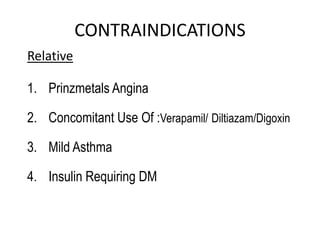
CONTRAINDICATIONS
Relative
1. Prinzmetals Angina
2. Concomitant Use Of :Verapamil/ Diltiazam/Digoxin
3. Mild Asthma
4. Insulin Requiring DM
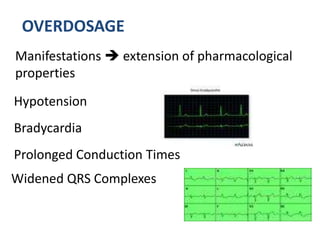
OVERDOSAGE
Manifestations  extension of pharmacological
properties
Hypotension
Bradycardia
Prolonged Conduction Times
Widened QRS Complexes
SIGNS AND SYMPTOMS
• Seizures
• Depression
• Hypoglycemia
• Bronchospasm
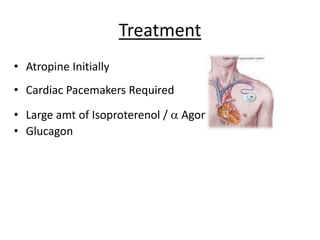
Treatment
• Atropine Initially
• Cardiac Pacemakers Required
• Large amt of Isoproterenol /  Agonist
• Glucagon
α + β ADRENERGIC BLOCKERS
• Labetalol
β1 + β2 + α1 blocking as well as weak β2
agonistic activity
β blocking potency is about 1/3 that of
propranolol
α blocking potency is about 1/10 of
phentolamine
• Fall in BP (both systolic and diastolic) is due to α1
and β1 blockade as well as β2 agonism
(vasodilatation)
• moderately potent antihypertensive
USES
• pheochromocytoma, clonidine withdrawal,
pregnancy induced hypertension (preeclampsia)
and hypertensive emergencies, as well as in
essential hypertension.
• A/E- postural hypotension, Failure of ejaculation
Carvedilol
• β1 + β2 + α1 adrenoceptor blocker which
produces vasodilatation due to α1 blockade as
well as calcium channel blockade
• Antioxidant property has also been
demonstrated
• β blocker especially employed as
cardioprotective in CHF
DRUGS FOR GLAUCOMA
• Open angle (wide angle, chronic simple)
glaucoma
β blockers do not affect pupil size, tone of
ciliary muscle or outflow facility, but lower i.o.t.
by reducing aqueous formation.
Timolol- nonselective (β1 + β2 )
has no local anaesthetic or intrinsic
sympathomimetic activity
• Betaxolol - β1 selective blocker
• Advantage of less bronchopulmonary and
probably less cardiac, central and metabolic
side effects.

b-blockers.pptx is a presentation about beta blockers

  • 1.
  • 2.
    Beta blockers •Drugs whichinhibit adrenergic response mediated by beta receptors
  • 3.
    BETA RECEPTORS Receptors Sitesactions β1 Heart JG cells-kidney Posterior pituitary Adipose tissue stimulatory Renin release ADH release lipolysis β2 Bronchi Blood vessels of skeletal muscle Smooth muscle (Uterus ,intestine , detrusor) Liver, Muscle Adipose tissue Eye Bronchodilation Vasodilatation Relaxation Glycogenolysis Lipolysis Enhanced aqueous secretion β3 Adipose tissue Lipolysis
  • 4.
    Mechanism of action •Via GPCR Antagonist binding to receptor No stimulation of G protein No change in cAMP conc. No EFFECT
  • 5.
    Properties • Receptor Blockade –Nonselective β blockade – Selective β1 blockade – Β+α blockade • Intrinsic sympathomimetic property-ISA (partial agonistic action) • Membrane stabilising action-MSA (Local anaesthetic action-Na channel block)
  • 6.
  • 7.
    1st generation –Non selective • Without ISA &MSA Timolol Nadolol Sotalol • With ISA only Penbutolol • With MSA only Propranolol • With ISA & MSA Pindolol
  • 8.
    2nd generation –Selective β1 agents • Without ISA &MSA Atenolol Bisoprolol Esmolol • With MSA only Metoprolol • With ISA & MSA Acebutolol
  • 9.
    3rd generation Non selectiveSelective With ISA Carteolol With ISA Celiprolol With MSA Betaxolol With MSA Carvedilol With MSA & ISA Labetalol
  • 10.
    β blockers With ISA Penbutolol Carteolol Celiprolol Both Pindolol Acebutolol Labetalol WithMSA Propranolol Metoprolol Betaxolol Carvedilol Without ISA & MSA Timolol, Sotalol, Nadolol Atenolol, Bisoprolol, Esmolol
  • 11.
    Properties of beta1selectivity • Less broncho constriction • Less interference with CHO metabolism less hypoglycemia  preferred in diabetics • Less chances of Raynaud's phenomenon • Less deleterious effect on blood lipid profile • Less impairment of exercise capacity • Less effect on tremor
  • 12.
    Properties of ISA •Less bradycardia • Less rebound effect on withdrawal • Less deleterious effect on blood lipid profile • Not effective in migraine prophylaxis • Not suitable for secondary prophylaxis of MI
  • 13.
    Actions • On CVS –Heart •Negative –Ionotropy –Chronotropy –Dromotropy –Bathmotropy
  • 14.
    Actions…. • On CVS –Bloodvessel •Vasoconstriction in prone individuals  Direct •Vasodilatation  due to additional properties Precipitates Reynaud's disease •α1 blockade •β2 agonism •Ca ++ channel block •K+ channel opening •NO production
  • 15.
    Actions…. • On CVS –Antihypertensiveaction • Decreased CO • Decreased renin release • Decreased TPR on long term administration • Central action – reduction of sympathetic outflow
  • 16.
    Betablockers with vasodilatorproperty Alpha blockade Labetalol Carvedilol Bucindolol Bevantolol Nipradilol Beta2 agonism Celiprolol Carteolol Bopindolol CCB action Betaxolol Bevantolol Carvedilol Pot. Channel opening Tilisolol NO production Celiprolol Carteolol Bopindolol Nipradilol Nebivolol Anti oxidant Carvedilol
  • 17.
    Actions -CNS • Antianxiety • Behaviour changes • Forgetfulness • Night mares • Increased dreaming Nonselective lipid soluble
  • 18.
    Actions -Metabolic • CHOmetabolism – Hypoglycemia • Inhibits muscle glycogenolysis – Hypoglycemic unawareness • Lipid – Increases VLDL(TG) levels – Alters HDL/LDL ratio Less with β 1 selective agents
  • 19.
    Actions - Eye •Decrease secretion of aqueous • Decrease IOT • No effect on pupil size or accommodation Ciliary body
  • 20.
  • 21.
    SKELETAL muscles •Decrease exercisecapacity –By decreasing blood flow –Inhibit glycogenolysis and lipolysis.
  • 22.
    MISCELLANEOUS • Antagonise catecholamineinduced –Tremor –Inhibition of mast cell degranulation • Prevent platelet aggregation and promote fibrinolysis
  • 23.
    Adverse effects -CVS • Bradycardia • Exacerbation of angina • Precipitation of CHF
  • 24.
    Adverse reactions • Increasedair way resistance worsening of bronchial asthma
  • 25.
    Adverse reactions • Impairmentof carbohydrate tolerance • Alteration of lipid profile • Increased risk of CAD • Rebound hypertension on withdrawal • Cold hands and feet, worsening of PVD
  • 26.
    Adverse effects… Nightmares Decreased exercisecapacity Tiredness Lack of drive
  • 27.
    Drug interactions Pharmacokinetic Al salts,Cholestyramine Decrease absorption Enzyme inducers Decrease plasma conc. Cimitidine, Hydralazine Increase BA They impair clearance of lidocaine Pharmaco dynamic • Digoxin • CCB (Verapamil) • CCB (DHP) • NSAIDs • Adrenaline & other α agonists
  • 28.
    Uses Cardiovascular • Hypertension • Angina •Myocardial infarction • Arrhythmia • Cardiomyopathy • CCF • Dissecting aneurysm of aorta Non cardiovascular • Thyrotoxicosis • Pheochromocytoma • Migraine prophylaxis • Essential tremor • Glaucoma • Anxiety • Portal hypertension • Anti psychotic induced akathesia
  • 29.
    Hypertension • Cardioselective betablockers • Rationale –Decrease in HR,CO ,myocardial contractility. –Decrease renin release –Decrease central sympathetic out flow
  • 30.
    Angina • Metoprolol • Atenolol •Bisoprolol Prophylaxis Treatment Contraindication •Variant angina
  • 31.
    Angina - Rationale DecreaseHR & contractility Decrease myocardial oxygen demand Antianginal action
  • 32.
    MI Prophylaxis Treatment Anti anginal action Reduceinfarct size Prevents arrhythmia Prevents reinfarction Prevents arrhythmia Metoprolol Esmolol Timolol
  • 33.
    Arrythmias • Propranolol • Esmolol •Acebutolol • Sotalol Decreases AV conduction Inhibits impulses from atria to ventricle  controls ventricular rate Mainly effective in Arrhythmias precipitated by catecholamines Sotalol K+ channel block class3 anti arrhythmic Esmolol ultra short acting supraventricular tachycardia
  • 34.
    ARRHYTHMIA • Control ventricularrate in atrial flutter and fibrillation. • Suppress extrasystole and tachycardia especially mediated adrenergically .
  • 35.
    HOCM • ↓ contractility •↓ LV outflow obstruction • Improve cardiac output in exercise
  • 36.
    CHF ONLY in compensatedCHF • Antagonise sympathetic overactivity on myocardium • Prevents myocyte apoptosis • ↓ cardiac remodelling • Retard progression of CHF Metoprolol Bisoprolol Carvedilol
  • 37.
    Dissecting aortic aneurysm •↓ cardiac contractility, and aortic pulsation.
  • 38.
    Non cardiac uses •Pheochromocytoma – Used after an α blocker – To control tachycardia and arrhythmia – Suppress cardiomyopathy due to excess catecholamines • Thyrotoxicosis – Control sympathetic symptoms – Inhibit peripheral conversion of T4 to T3 – Preoperative use
  • 39.
  • 40.
    Portal hypertension • ToDecrease Portal Vein Pressure in Patients with Cirrhosis • Decrease variceal bleeding Propranolol
  • 41.
    Glaucoma • Decrease aqueous humoursecretion • Attenuating neuronal Ca and Na influx  Protection to retinal neurons • Inhibit ganglion cell death Timolol Carteolol Betaxolol Levobetaxolol Levobunolol Metipranolol
  • 42.
    CNS • Anxiety • Essentialtremor • Akathisia induced by antipsychotics • Alchohol withdrawal
  • 43.
    3rd generation agents DrugMSA ISA Beta blockade Other properties Labetalol + + Non selective α1 blockade Carvedilol + Non selective α1 blockade,CCB Antioxidant Bucindolol + Non selective α1 blockade,β2,β3 agonism Increases HDL cholesterol Celiprolol + β1 selective β2 agonism NO release Nebivolol β1 selective •NO release •Inhibits platelet aggregation Bevantolol Nonselective α1 blockade CCB
  • 44.
    CONTRAINDICATIONS Absolute 1. Severe Bradycardia 2.Pre-existing High Grade Heart Block 3. Overt Untreated Heart Failure 4. Cardiogenic Shock 5. Severe Bronchospasm 6. Severe Depression 7. Active Raynaud’s Phenomenon
  • 45.
    CONTRAINDICATIONS Relative 1. Prinzmetals Angina 2.Concomitant Use Of :Verapamil/ Diltiazam/Digoxin 3. Mild Asthma 4. Insulin Requiring DM
  • 46.
    OVERDOSAGE Manifestations  extensionof pharmacological properties Hypotension Bradycardia Prolonged Conduction Times Widened QRS Complexes
  • 47.
    SIGNS AND SYMPTOMS •Seizures • Depression • Hypoglycemia • Bronchospasm
  • 48.
    Treatment • Atropine Initially •Cardiac Pacemakers Required • Large amt of Isoproterenol /  Agonist • Glucagon
  • 49.
    α + βADRENERGIC BLOCKERS • Labetalol β1 + β2 + α1 blocking as well as weak β2 agonistic activity β blocking potency is about 1/3 that of propranolol α blocking potency is about 1/10 of phentolamine
  • 50.
    • Fall inBP (both systolic and diastolic) is due to α1 and β1 blockade as well as β2 agonism (vasodilatation) • moderately potent antihypertensive USES • pheochromocytoma, clonidine withdrawal, pregnancy induced hypertension (preeclampsia) and hypertensive emergencies, as well as in essential hypertension. • A/E- postural hypotension, Failure of ejaculation
  • 51.
    Carvedilol • β1 +β2 + α1 adrenoceptor blocker which produces vasodilatation due to α1 blockade as well as calcium channel blockade • Antioxidant property has also been demonstrated • β blocker especially employed as cardioprotective in CHF
  • 52.
    DRUGS FOR GLAUCOMA •Open angle (wide angle, chronic simple) glaucoma β blockers do not affect pupil size, tone of ciliary muscle or outflow facility, but lower i.o.t. by reducing aqueous formation. Timolol- nonselective (β1 + β2 ) has no local anaesthetic or intrinsic sympathomimetic activity
  • 53.
    • Betaxolol -β1 selective blocker • Advantage of less bronchopulmonary and probably less cardiac, central and metabolic side effects.