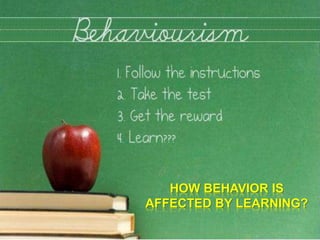
HOW BEHAVIOR IS
AFFECTED BY LEARNING?
OBJECTIVES:
At the end of the discussions, the students
will be able to:
•Explain the basic principles of behaviorism.
•Make a simple plan applying the primary laws of
learning.
•Determine how to use rewards in the learning
process more effectively.
the manner in which one behaves.
anything that an organism does involving
action and response to stimulation.
the response of an individual, group, or
species to its environment.
According to the behaviorists, learning can be
defined as “the relatively permanent change in
behavior brought about as a result of experience or
practice.”
Behaviorists recognize that learning is an internal
event. However, it is not recognized as learning until it
is displayed by overt behavior.
“Learning is
represented by
a change in
behavior”
BEHAVIORISM
 Focuses on one particular view of
learning:
 a change in external behavior
achieved through a large amount
of repetition of desired actions, the
reward of good habits and the
discouragement of bad habits.
BEHAVIORISM
 As we learn, we alter the way we
perceive our environment, the way
we interpret the incoming stimuli,
and therefore the way we interact, or
behave.
HOW BEHAVIORISTS VIEW THE
FUNCTION OF THE BRAIN
The behavioral learning theory is
represented by an S-R paradigm. The organism is
treated as a “black box.” We only know what is
going on inside the box by the organism’s
response.
BEHAVIOURISTS
Ivan Pavlov
Edward Thorndike
John B. Watson
B.F. Skinner
BEHAVIOURISTS
 Ivan Pavlov
 Edward Thorndike
 John B. Watson
 B.F. Skinner
BEHAVIOURISTS
 Ivan Pavlov
 Edward Thorndike
 John B. Watson
 B.F. Skinner
BEHAVIOURISTS
 Ivan Pavlov
 Edward Thorndike
 John B. Watson
 B.F. Skinner
JOHN BROADUS WATSON
 Born Jan 9, 1878
 Died Sept 25, 1958
 Born in Greenville, South
Carolina
 American psychologist
 Established the
psychological school of
behaviourism
 “Little Albert” experiment
“LITTLE ALBERT“
EXPERIMENT
J. WATSON
 The first to study how the process of learning
affects our behavior, and he formed the school of
thought known as BEHAVIORISM.
EDWARD LEE THORNDIKE
 Born August 31, 1874
 Died August 9, 1949
 Born in Williamsburg,
Massachusetts
 Studied animal behaviour and
the learning process
 Led to the theory of
connectionism
 Laying the foundation for
modern educational
psychology.
E. THORNDIKE
 Thorndike specified three
conditions that maximize learning:
 The Law of Effect states that the
likely recurrence of a response
is generally governed by its
consequence or effect generally
in the form of reward or
punishment.
E. THORNDIKE
 Thorndike specified three
conditions that maximize learning:
 The Law of Exercise stated that
stimulus-response associations
are strengthened through
repetition.
E. THORNDIKE
 Thorndike specified three
conditions that maximize learning:
 The Law of Readiness states
that, the more readiness the
learner has to respond to
stimulus, the stronger will the
bond between them.
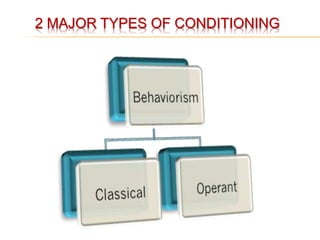
2 MAJOR TYPES OF CONDITIONING
CLASSICAL
CONDITIONING
IVAN PETROVICH PAVLOV
 Born Sept 14, 1849
 Died Feb 27, 1936
 Born in Ryazan,
Russia
 Physiologist,
psychologist, and
physician
 Awarded the Nobel
Prize in Physiology or
Medicine in 1904 for
research on the
digestive system
PAVLOV’S EXPERIMENT
 Pavlov discovered classical conditioning
almost by accident. Originally, he wanted to
study the role of salivation in digestion. He
measured how much saliva dogs produce
when given meat. After a few days in the
experiment, Pavlov noticed that the dogs in
his laboratory started salivating when the lab
attendant entered the room with the meat
dish, before meat was placed in their mouth.
 A STIMULUS is an observable environmental event
that has a potential to exert control over a
behavioral response.
 A RESPONSE is an overt behavior by a learner.
 Put it in a simpler way, a STIMULUS is anything
that can directly influence behavior and the
stimulus produces a RESPONSE.
TYPES OF STIMULUS AND RESPONSE
COMMON PHENOMENA IN
CLASSICAL CONDITIONING
1. Stimulus Generalization
2. Extinction
3. Spontaneous recovery
4. Discrimination
5. Higher order conditioning
OPERANT
CONDITIONING
BURRHUS FREDERIC SKINNER
 Born March 20, 1904
 Died August 18, 1990
 Born in Susquehanna,
Pennsylvania
 American psychologist,
author, inventor, advocate
for social reform and poet.
 Innovated his own
philosophy of science called
Radical Behaviorism
 Operant or instrumental conditioning is a form of
learning in which the consequences of behavior
lead to changes in the probability that the behavior
will occur.
 REINFORCEMENT is a consequence that
increases the probability that a behavior will occur.
 PUNISHMENT is a consequence that decreases
the probability a behavior will occur.
 Put it another way, reinforcement will strengthen a
behavior while punishment will weaken a behavior.
TYPES OF REINFORCEMENT AND PUNISHMENT
SCHEDULE OF REINFORCEMENT
 Reinforces are more effective when they are
given as soon as possible after a student
performs the target behavior. In continuous
reinforcement like this, a student learns very
rapidly but when the reinforcement stops, the
behavior decreases rapidly too. Therefore,
the schedule of reinforcement was
developed. The schedule will determine
when a behavior will be reinforced.
4 TYPES OF SCHEDULE OF REINFORCEMENT
 Fixed-ratio schedule
 Variable-ratio schedule
 Fixed-interval schedule
 Variable-internal schedule
Schedule of
reinforcement
Description Example
Fixed-ratio
schedule
A behavior is reinforced after a set
number of responses have
occurred.
A student may be
given a bar of Kit Kat
chocolate for every
ten mathematical
problems solved.
Variable-ratio
schedule
On a variable-ratio schedule, the
number of responses needed to
gain the reinforcement is not
constant.
Rewards could be
given after 3, 5, 9, and
15 mathematical
problems solved.
Fixed-interval
schedule
A behavior will be reinforced after
a certain period of time. No matter
how often it occurs, the behavior
will not be reinforced until the time
is up.
Students are given a
quiz every
Wednesday.
Variable-interval
schedule
Also based on time passing but
the time period keep changing.
Students are given
pop quizzes.
DANGERS OF PUNISHMENT
 Punishment can be abusive.
 For example, a teacher might become so
aroused when he is punishing a student that he
becomes abusive.
 Punishment may create a new problem, that is
aggression.
 Students commonly react to physical punishment
by learning to dislike the punisher and perhaps
by reacting aggressively toward that person.
Thus, punishment does not convey any
information about what an alternative and more
appropriate behavior might be.
It may suppress one inappropriate behavior
only to be replaced by another one. Punishment
can turn out to be reinforcing.
A student might learn that misbehaving will get
the teacher’s attention.
Behaviorist perspective

Behaviorist perspective

  • 1.
  • 2.
    OBJECTIVES: At the endof the discussions, the students will be able to: •Explain the basic principles of behaviorism. •Make a simple plan applying the primary laws of learning. •Determine how to use rewards in the learning process more effectively.
  • 3.
    the manner inwhich one behaves. anything that an organism does involving action and response to stimulation. the response of an individual, group, or species to its environment.
  • 4.
    According to thebehaviorists, learning can be defined as “the relatively permanent change in behavior brought about as a result of experience or practice.” Behaviorists recognize that learning is an internal event. However, it is not recognized as learning until it is displayed by overt behavior.
  • 5.
    “Learning is represented by achange in behavior”
  • 7.
    BEHAVIORISM  Focuses onone particular view of learning:  a change in external behavior achieved through a large amount of repetition of desired actions, the reward of good habits and the discouragement of bad habits.
  • 8.
    BEHAVIORISM  As welearn, we alter the way we perceive our environment, the way we interpret the incoming stimuli, and therefore the way we interact, or behave.
  • 9.
    HOW BEHAVIORISTS VIEWTHE FUNCTION OF THE BRAIN The behavioral learning theory is represented by an S-R paradigm. The organism is treated as a “black box.” We only know what is going on inside the box by the organism’s response.
  • 10.
  • 11.
    BEHAVIOURISTS  Ivan Pavlov Edward Thorndike  John B. Watson  B.F. Skinner
  • 12.
    BEHAVIOURISTS  Ivan Pavlov Edward Thorndike  John B. Watson  B.F. Skinner
  • 13.
    BEHAVIOURISTS  Ivan Pavlov Edward Thorndike  John B. Watson  B.F. Skinner
  • 14.
    JOHN BROADUS WATSON Born Jan 9, 1878  Died Sept 25, 1958  Born in Greenville, South Carolina  American psychologist  Established the psychological school of behaviourism  “Little Albert” experiment
  • 15.
  • 16.
    J. WATSON  Thefirst to study how the process of learning affects our behavior, and he formed the school of thought known as BEHAVIORISM.
  • 17.
    EDWARD LEE THORNDIKE Born August 31, 1874  Died August 9, 1949  Born in Williamsburg, Massachusetts  Studied animal behaviour and the learning process  Led to the theory of connectionism  Laying the foundation for modern educational psychology.
  • 18.
    E. THORNDIKE  Thorndikespecified three conditions that maximize learning:  The Law of Effect states that the likely recurrence of a response is generally governed by its consequence or effect generally in the form of reward or punishment.
  • 19.
    E. THORNDIKE  Thorndikespecified three conditions that maximize learning:  The Law of Exercise stated that stimulus-response associations are strengthened through repetition.
  • 20.
    E. THORNDIKE  Thorndikespecified three conditions that maximize learning:  The Law of Readiness states that, the more readiness the learner has to respond to stimulus, the stronger will the bond between them.
  • 21.
    2 MAJOR TYPESOF CONDITIONING
  • 22.
  • 23.
    IVAN PETROVICH PAVLOV Born Sept 14, 1849  Died Feb 27, 1936  Born in Ryazan, Russia  Physiologist, psychologist, and physician  Awarded the Nobel Prize in Physiology or Medicine in 1904 for research on the digestive system
  • 24.
    PAVLOV’S EXPERIMENT  Pavlovdiscovered classical conditioning almost by accident. Originally, he wanted to study the role of salivation in digestion. He measured how much saliva dogs produce when given meat. After a few days in the experiment, Pavlov noticed that the dogs in his laboratory started salivating when the lab attendant entered the room with the meat dish, before meat was placed in their mouth.
  • 27.
     A STIMULUSis an observable environmental event that has a potential to exert control over a behavioral response.  A RESPONSE is an overt behavior by a learner.  Put it in a simpler way, a STIMULUS is anything that can directly influence behavior and the stimulus produces a RESPONSE.
  • 28.
    TYPES OF STIMULUSAND RESPONSE
  • 31.
    COMMON PHENOMENA IN CLASSICALCONDITIONING 1. Stimulus Generalization 2. Extinction 3. Spontaneous recovery 4. Discrimination 5. Higher order conditioning
  • 32.
  • 33.
    BURRHUS FREDERIC SKINNER Born March 20, 1904  Died August 18, 1990  Born in Susquehanna, Pennsylvania  American psychologist, author, inventor, advocate for social reform and poet.  Innovated his own philosophy of science called Radical Behaviorism
  • 34.
     Operant orinstrumental conditioning is a form of learning in which the consequences of behavior lead to changes in the probability that the behavior will occur.
  • 35.
     REINFORCEMENT isa consequence that increases the probability that a behavior will occur.  PUNISHMENT is a consequence that decreases the probability a behavior will occur.  Put it another way, reinforcement will strengthen a behavior while punishment will weaken a behavior.
  • 36.
    TYPES OF REINFORCEMENTAND PUNISHMENT
  • 40.
    SCHEDULE OF REINFORCEMENT Reinforces are more effective when they are given as soon as possible after a student performs the target behavior. In continuous reinforcement like this, a student learns very rapidly but when the reinforcement stops, the behavior decreases rapidly too. Therefore, the schedule of reinforcement was developed. The schedule will determine when a behavior will be reinforced.
  • 41.
    4 TYPES OFSCHEDULE OF REINFORCEMENT  Fixed-ratio schedule  Variable-ratio schedule  Fixed-interval schedule  Variable-internal schedule
  • 42.
    Schedule of reinforcement Description Example Fixed-ratio schedule Abehavior is reinforced after a set number of responses have occurred. A student may be given a bar of Kit Kat chocolate for every ten mathematical problems solved. Variable-ratio schedule On a variable-ratio schedule, the number of responses needed to gain the reinforcement is not constant. Rewards could be given after 3, 5, 9, and 15 mathematical problems solved. Fixed-interval schedule A behavior will be reinforced after a certain period of time. No matter how often it occurs, the behavior will not be reinforced until the time is up. Students are given a quiz every Wednesday. Variable-interval schedule Also based on time passing but the time period keep changing. Students are given pop quizzes.
  • 43.
    DANGERS OF PUNISHMENT Punishment can be abusive.  For example, a teacher might become so aroused when he is punishing a student that he becomes abusive.  Punishment may create a new problem, that is aggression.  Students commonly react to physical punishment by learning to dislike the punisher and perhaps by reacting aggressively toward that person.
  • 44.
    Thus, punishment doesnot convey any information about what an alternative and more appropriate behavior might be. It may suppress one inappropriate behavior only to be replaced by another one. Punishment can turn out to be reinforcing. A student might learn that misbehaving will get the teacher’s attention.