Functional Linguistics
VUB-BNU Summer School
“European Languages, culture and educational
systems”
Dr. Kamakshi Rajagopal
Structure of the session
Some theory (45min)
Video (15min)
Break (5min)
Group exercise
Plenary presentation and discussion
Functionalism
• Meaning is the primary driver of form in language
• Language, as an instrument, has features which
can be used to perform certain functions
In Europe, two schools of thought:
• Prague School  Jakobson
• Copenhagen School  Halliday
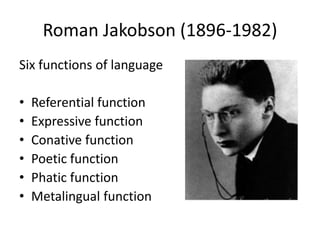
Roman Jakobson (1896-1982)
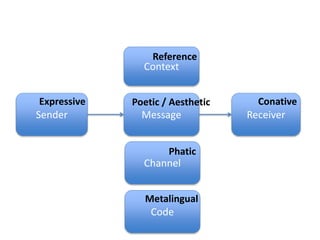
Six functions of language
• Referential function
• Expressive function
• Conative function
• Poetic function
• Phatic function
• Metalingual function
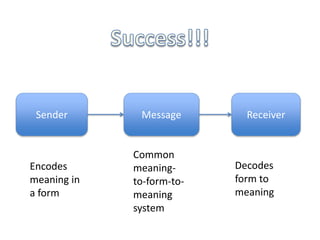
Sender Message Receiver
Encodes
meaning in
a form
Decodes
form to
meaning
Common
meaning-
to-form-to-
meaning
system
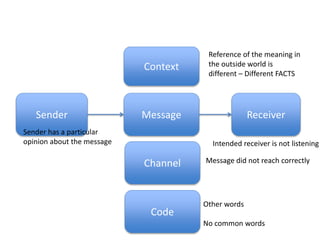
Sender
Channel
Context
Message Receiver
Code
Other words
No common words
Message did not reach correctly
Reference of the meaning in
the outside world is
different – Different FACTS
Intended receiver is not listening
Sender has a particular
opinion about the message
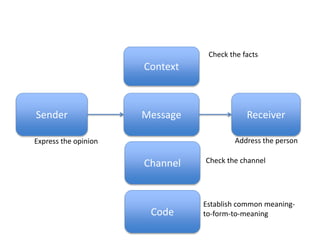
Sender
Channel
Context
Message Receiver
Code
Establish common meaning-
to-form-to-meaning
Check the channel
Check the facts
Address the personExpress the opinion
Sender
Channel
Context
Message Receiver
Code
Reference
Expressive ConativePoetic / Aesthetic
Phatic
Metalingual
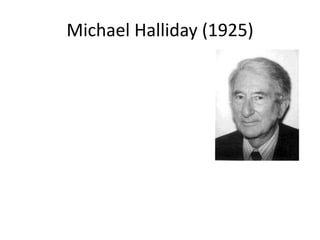
Michael Halliday (1925)
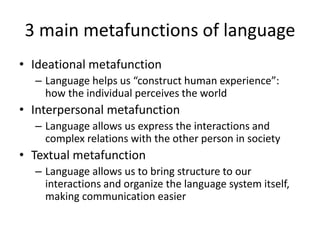
3 main metafunctions of language
• Ideational metafunction
– Language helps us “construct human experience”:
how the individual perceives the world
• Interpersonal metafunction
– Language allows us express the interactions and
complex relations with the other person in society
• Textual metafunction
– Language allows us to bring structure to our
interactions and organize the language system itself,
making communication easier
Interpersonal metafunction
• The society we live in is complex
• Through language, we can bring more clarity
in this social complexity
• On micro-level (e.g. one-to-one dialogues)
• On societal level (e.g. belonging to particular
groups)
Textual metafunction
• Through the multitude of meaning that we want
to express through language, it becomes complex
• Language itself gives tools to bring structure to
the things we express, making communication
clearer
• e.g. in written language:
– firstly, secondly, thirdly
– on the one hand,… on the other hand
– And; But ; Moreover; ….
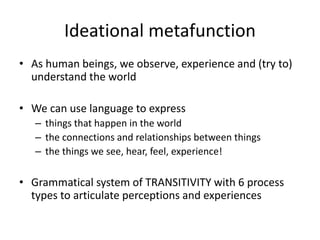
Ideational metafunction
• As human beings, we observe, experience and (try to)
understand the world
• We can use language to express
– things that happen in the world
– the connections and relationships between things
– the things we see, hear, feel, experience!
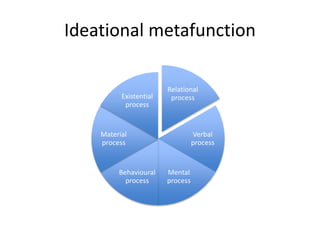
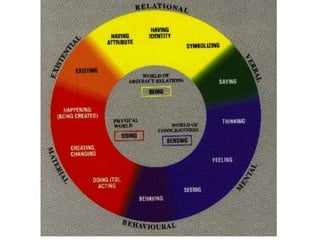
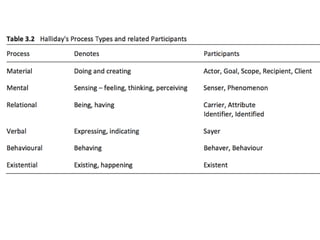
• Grammatical system of TRANSITIVITY with 6 process
types to articulate perceptions and experiences
Ideational metafunction
Relational
process
Verbal
process
Mental
process
Behavioural
process
Material
process
Existential
process
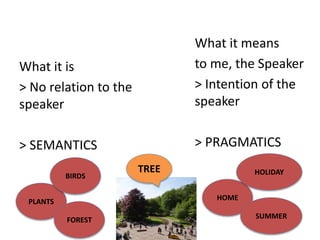
Meaning?
What it is
> No relation to the
speaker
> SEMANTICS
What it means
to me, the Speaker
> Intention of the
speaker
> PRAGMATICS
TREE
PLANTS
BIRDS
FOREST
HOME
HOLIDAY
SUMMER
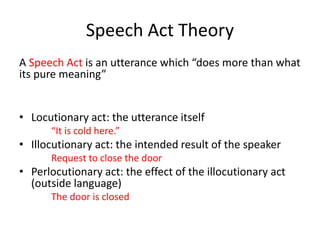
Speech Act Theory
A Speech Act is an utterance which “does more than what
its pure meaning”
• Locutionary act: the utterance itself
“It is cold here.”
• Illocutionary act: the intended result of the speaker
Request to close the door
• Perlocutionary act: the effect of the illocutionary act
(outside language)
The door is closed
Types of illocutionary acts
• Assertives
– e.g. Singing national anthem
• Directives
– e.g. Request, Command
• Commissives
– e.g. Promise
• Expressives
– e.g. Congratulations, Thanks
• Declarations
– e.g. Pronounce, Declare
Exercises: Language in Cartoon
• Communication Act?
• Speech Acts?
• What does it say about the characters?
– How do they feel?
– What do they want?
Discussion
• Material processes deal with Activity
• Behavioural processes often concern functions of the
body
• Existential processes describe things that “exist”
• Relational processes talk about the quality or
characteristics of entities
There is discussion possible about which category is
intended!
• Not every utterance is a speech act!!!
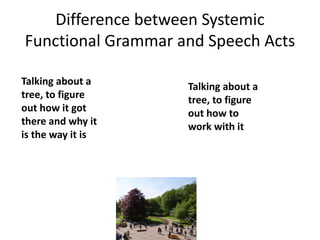
Difference between Systemic
Functional Grammar and Speech Acts
Talking about a
tree, to figure
out how it got
there and why it
is the way it is
Talking about a
tree, to figure
out how to
work with it
References
• Roman Jakobson
Jakobson, J. (1962-1987). The Selected Writings of Roman Jakobson, The
Hague and Berlin: Mouton.
• M.A.K. Halliday
Halliday, M.A.K. (1994). An introduction to functional grammar.
London: E. Arnold.
• Pragmatics
Austin, J. L. (1962) How to Do Things With Words. Oxford University
Press.

Functional Linguistics

  • 1.
    Functional Linguistics VUB-BNU SummerSchool “European Languages, culture and educational systems” Dr. Kamakshi Rajagopal
  • 2.
    Structure of thesession Some theory (45min) Video (15min) Break (5min) Group exercise Plenary presentation and discussion
  • 3.
    Functionalism • Meaning isthe primary driver of form in language • Language, as an instrument, has features which can be used to perform certain functions In Europe, two schools of thought: • Prague School  Jakobson • Copenhagen School  Halliday
  • 4.
    Roman Jakobson (1896-1982) Sixfunctions of language • Referential function • Expressive function • Conative function • Poetic function • Phatic function • Metalingual function
  • 5.
    Sender Message Receiver Encodes meaningin a form Decodes form to meaning Common meaning- to-form-to- meaning system
  • 6.
    Sender Channel Context Message Receiver Code Other words Nocommon words Message did not reach correctly Reference of the meaning in the outside world is different – Different FACTS Intended receiver is not listening Sender has a particular opinion about the message
  • 7.
    Sender Channel Context Message Receiver Code Establish commonmeaning- to-form-to-meaning Check the channel Check the facts Address the personExpress the opinion
  • 8.
  • 9.
  • 10.
    3 main metafunctionsof language • Ideational metafunction – Language helps us “construct human experience”: how the individual perceives the world • Interpersonal metafunction – Language allows us express the interactions and complex relations with the other person in society • Textual metafunction – Language allows us to bring structure to our interactions and organize the language system itself, making communication easier
  • 11.
    Interpersonal metafunction • Thesociety we live in is complex • Through language, we can bring more clarity in this social complexity • On micro-level (e.g. one-to-one dialogues) • On societal level (e.g. belonging to particular groups)
  • 12.
    Textual metafunction • Throughthe multitude of meaning that we want to express through language, it becomes complex • Language itself gives tools to bring structure to the things we express, making communication clearer • e.g. in written language: – firstly, secondly, thirdly – on the one hand,… on the other hand – And; But ; Moreover; ….
  • 13.
    Ideational metafunction • Ashuman beings, we observe, experience and (try to) understand the world • We can use language to express – things that happen in the world – the connections and relationships between things – the things we see, hear, feel, experience! • Grammatical system of TRANSITIVITY with 6 process types to articulate perceptions and experiences
  • 14.
  • 17.
  • 18.
    What it is >No relation to the speaker > SEMANTICS What it means to me, the Speaker > Intention of the speaker > PRAGMATICS TREE PLANTS BIRDS FOREST HOME HOLIDAY SUMMER
  • 19.
    Speech Act Theory ASpeech Act is an utterance which “does more than what its pure meaning” • Locutionary act: the utterance itself “It is cold here.” • Illocutionary act: the intended result of the speaker Request to close the door • Perlocutionary act: the effect of the illocutionary act (outside language) The door is closed
  • 20.
    Types of illocutionaryacts • Assertives – e.g. Singing national anthem • Directives – e.g. Request, Command • Commissives – e.g. Promise • Expressives – e.g. Congratulations, Thanks • Declarations – e.g. Pronounce, Declare
  • 21.
    Exercises: Language inCartoon • Communication Act? • Speech Acts? • What does it say about the characters? – How do they feel? – What do they want?
  • 22.
    Discussion • Material processesdeal with Activity • Behavioural processes often concern functions of the body • Existential processes describe things that “exist” • Relational processes talk about the quality or characteristics of entities There is discussion possible about which category is intended! • Not every utterance is a speech act!!!
  • 23.
    Difference between Systemic FunctionalGrammar and Speech Acts Talking about a tree, to figure out how it got there and why it is the way it is Talking about a tree, to figure out how to work with it
  • 24.
    References • Roman Jakobson Jakobson,J. (1962-1987). The Selected Writings of Roman Jakobson, The Hague and Berlin: Mouton. • M.A.K. Halliday Halliday, M.A.K. (1994). An introduction to functional grammar. London: E. Arnold. • Pragmatics Austin, J. L. (1962) How to Do Things With Words. Oxford University Press.