Motivation
•Motivation is crucialduring exams because it
drives focus, enhances productivity, and
fosters confidence, all of which are essential
for effective preparation and success.
•By staying motivated, we can remain
committed, resilient, and better equipped to
achieve our desired results.
Motivation: Rewards
•A commonreason why people don’t want to do
exams is because they associate exams with
negative experiences, like mental exhaustion,
stress, fear of failure, and pressure.
•I believe one of the most important things a
student can do is change their relationship with
exams, by creating more positive associations with
them. It won’t solve all the issues with exam, but it
will improve the overall experience.
Motivation: Rewards
•The rewardsdon’t have to be extravagant, or
even expense, but they have to be something
you promise yourself you will do after you
complete your exams, or milestones towards
your exams.
•This will create a positive association between
exams and something nicer happening.
10.
Motivation: Rewards
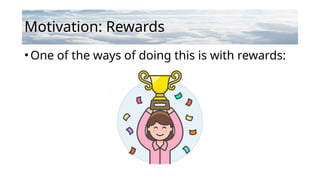
•The kindsof rewards could be:
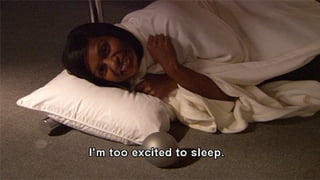
• Give yourself a long, uninterrupted nap.
• Spend an evening binge-watching YouTube.
• Go for a walk in nature or explore a local park.
• Watch the sunset or stargaze.
• Borrow a book from the library.
• Visit a local museum or gallery.
• Watch a new TV show.
12.
Motivation: Rewards
•The kindsof rewards could be:
• Give yourself a long, uninterrupted nap.
• Spend an evening binge-watching YouTube.
• Go for a walk in nature or explore a local park.
• Watch the sunset or stargaze.
• Borrow a book from the library.
• Visit a local museum or gallery.
• Watch a new TV show.
13.
Motivation: Rewards
•The kindsof rewards could be:
• Give yourself a long, uninterrupted nap.
• Spend an evening binge-watching YouTube.
• Go for a walk in nature or explore a local park.
• Watch the sunset or stargaze.
• Borrow a book from the library.
• Visit a local museum or gallery.
• Watch a new TV show.
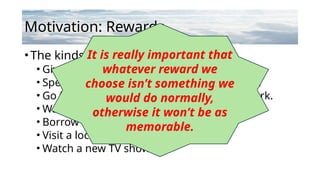
It is really important that
whatever reward we
choose isn’t something we
would do normally,
otherwise it won’t be as
memorable.
Motivation: Rewards
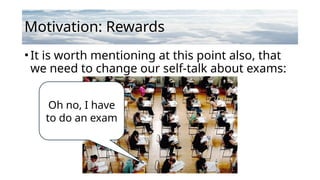
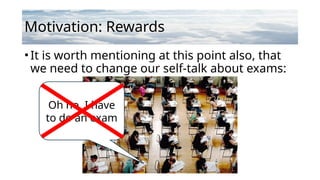
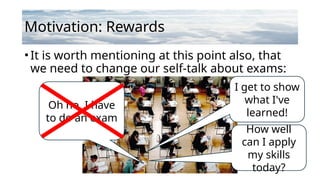
•It isworth mentioning at this point also, that
we need to change our self-talk about exams:
20.
Motivation: Rewards
•It isworth mentioning at this point also, that
we need to change our self-talk about exams:
Oh no, I have
to do an exam
21.
Motivation: Rewards
•It isworth mentioning at this point also, that
we need to change our self-talk about exams:
Oh no, I have
to do an exam
22.
Motivation: Rewards
•It isworth mentioning at this point also, that
we need to change our self-talk about exams:
Oh no, I have
to do an exam
I get to show
what I've
learned!
How well
can I apply
my skills
today?
23.
Motivation: Goals
• Oneapproach to help is to use SMART objectives,
which is structured framework for setting and
achieving goals in a clear, organized, and
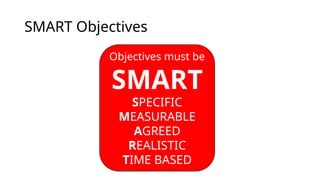
measurable way. The acronym SMART stands for
Specific, Measurable, Achievable, Relevant, and
Time-Bound. The concept of SMART objectives was
first introduced by George T. Doran in a 1981 article
titled "There's a S.M.A.R.T. Way to Write Management’s
Goals and Objectives", published in the journal
Management Review.
• Make theobjective specific
• Break large tasks down into smaller tasks
• [X] Revise a complete module
• [ ]
√ Revise one topic in a module
• [ ]
√ Search for additional information on a specific topic
• Breaking large tasks into smaller ones makes it easier
to assess progress
SPECIFIC
27.
• How doyou know when you have done everything:
• [X] Do some practice exam questions
• [ ]
√ Do 3 practice exam questions in the next week
• [X] Do some practice quizzes
• [ ]
√ Do 3 practice quizzes, and score at least 80% in each
• Make sure they are evidenced based – you should
have a deliverable attached to the objective
MEASURABLE
29.
•Tell other peopleyour goals and ask them to
hold you accountable.
• Especially your classmates!
• [X] I think I will do a bit of revision
• [X] Everyone is telling me the exams will be fine
• [ ]
√ We agreed that I’m going to keep studying for
2 hours every night.
AGREED
31.
•Will you achievethe objective?
• Unrealistic objectives can be very de-motivating
• Challenging objectives which are realistic can be
motivating
• [X] I’ll read over the module content
• [ ]
√ I’ll do some exam questions in the same
duration as I would have to do in a real exam.
REALISTIC
33.
•Set timescales onyour objectives
• Deadlines and Milestones
•Review progress against these deadlines
• [X] Finish covering all topics
• [ ]
√ Finish the current topic by next Monday.
TIME BASED
34.
•Set objectives atmultiple timescales
• This week I will review the next 10 pages
• This month I will produce 30 flash cards
• In the next 2 months I create a detailed MindMap
that is a fully overview of the module, and short
notes on each of the branches on the Map.
TIME SCALES
36.
Motivation: Visualization
•Imagine yourselfsucceeding in the exam,
whether it’s acing a paper or feeling confident
while writing. This positive visualization can
inspire you to work harder toward your goals.
•Create a “vision board” of your future. It could
include a picture of you in graduate robes, it
could be a pile of money, or a house, or a circle
of friends.
Motivation: Visualization
•Maintain apositive mindset by focusing on
your progress rather than dwelling on what’s
left to do. Surround yourself with encouraging
people or affirmations to keep your spirits
high.
42.
Motivation: Health
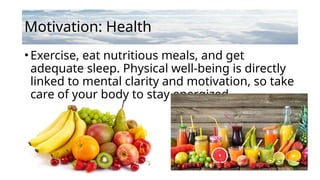
•Exercise, eatnutritious meals, and get
adequate sleep. Physical well-being is directly
linked to mental clarity and motivation, so take
care of your body to stay energized.
43.
Motivation: Health
• Aerobicexercise
• Do something you enjoy
• Walking, running, dancing, swimming
• Strength training
• Find a coach
• Flexibility exercise
• Stretching exercises
44.
Motivation: Health
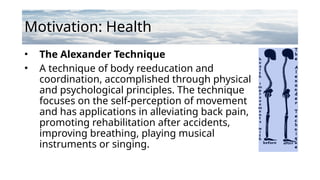
• TheAlexander Technique
• A technique of body reeducation and
coordination, accomplished through physical
and psychological principles. The technique
focuses on the self-perception of movement
and has applications in alleviating back pain,
promoting rehabilitation after accidents,
improving breathing, playing musical
instruments or singing.
45.
Motivation: Health
• CultivateAmbidexterity
• Cross your arms and legs in the opposite to
the normal way you do it
• Use your non-dominant hand to turn on
lights, brush your teeth, etc. record the feeling
• Try writing with your non-dominant hand
• Try drawing with both hands simultaneously
• Experiment with mirror writing
Time Management
• Whyis Time Management important?
• Time management is important
because it allows you to use your
time effectively and efficiently,
helping you achieve your goals and
maintain a balanced life.
49.
Time Management: Createa Schedule
• A well-designed revision schedule serves as a roadmap,
helping you allocate time efficiently, prioritize important
topics, and balance study sessions with breaks to
maximize retention and minimize stress.
• Creating a revision schedule requires thoughtful planning,
realistic goal-setting, and an understanding of your
personal study habits.
• By organizing your revision into manageable chunks and
setting clear objectives, you can improve focus, track your
progress, and approach exams with confidence.
50.
Time Management: Createa Schedule
• For each module, list the topics you need to cover in a TO-
DO LIST. Estimate how much time you have left to revise.
Assign topics as either topics you enjoy or do not enjoy.
Divide out your remaining time better these topics.
Alternating between topics you enjoy, and those you don’t.
• Create a master timetable – BE REALISTIC about you other
life activities to have to fit in, so take into account your
other commitments e.g. work, family, etc.
• Tick off the topics as you complete them. Pat yourself on
the back by looking back on what you have done
51.
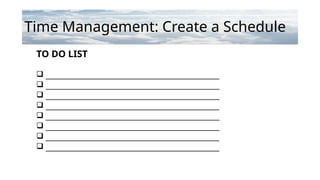
Time Management: Createa Schedule
TO DO LIST
_____________________________________________________
_____________________________________________________
_____________________________________________________
_____________________________________________________
_____________________________________________________
_____________________________________________________
_____________________________________________________
_____________________________________________________
52.
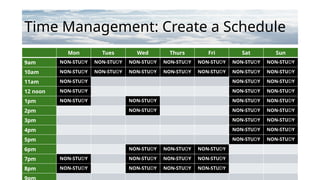
Time Management: Createa Schedule
Mon Tues Wed Thurs Fri Sat Sun
9am
10am
11am
12 noon
1pm
2pm
3pm
4pm
5pm
6pm
7pm
8pm
Time Management: Createa Schedule
Mon Tues Wed Thurs Fri Sat Sun
9am NON-STUDY NON-STUDY NON-STUDY NON-STUDY NON-STUDY NON-STUDY NON-STUDY
10am NON-STUDY NON-STUDY NON-STUDY NON-STUDY NON-STUDY NON-STUDY NON-STUDY
11am NON-STUDY STUDY TIME STUDY TIME STUDY TIME STUDY TIME NON-STUDY NON-STUDY
12 noon NON-STUDY STUDY TIME STUDY TIME STUDY TIME STUDY TIME NON-STUDY NON-STUDY
1pm NON-STUDY STUDY TIME NON-STUDY STUDY TIME STUDY TIME NON-STUDY NON-STUDY
2pm STUDY TIME STUDY TIME NON-STUDY STUDY TIME STUDY TIME NON-STUDY NON-STUDY
3pm STUDY TIME STUDY TIME STUDY TIME STUDY TIME STUDY TIME NON-STUDY NON-STUDY
4pm STUDY TIME STUDY TIME STUDY TIME STUDY TIME STUDY TIME NON-STUDY NON-STUDY
5pm STUDY TIME STUDY TIME STUDY TIME STUDY TIME STUDY TIME NON-STUDY NON-STUDY
6pm STUDY TIME STUDY TIME NON-STUDY NON-STUDY NON-STUDY STUDY TIME STUDY TIME
7pm NON-STUDY STUDY TIME NON-STUDY NON-STUDY NON-STUDY STUDY TIME STUDY TIME
8pm NON-STUDY STUDY TIME NON-STUDY NON-STUDY NON-STUDY STUDY TIME STUDY TIME
STUDY TIME STUDY TIME STUDY TIME STUDY TIME STUDY TIME STUDY TIME STUDY TIME
55.
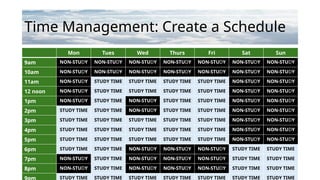
Time Management: Createa Schedule
Mon Tues Wed Thurs Fri Sat Sun
9am NON-STUDY NON-STUDY NON-STUDY NON-STUDY NON-STUDY NON-STUDY NON-STUDY
10am NON-STUDY NON-STUDY NON-STUDY NON-STUDY NON-STUDY NON-STUDY NON-STUDY
11am NON-STUDY STUDY TIME STUDY TIME STUDY TIME STUDY TIME NON-STUDY NON-STUDY
12 noon NON-STUDY STUDY TIME STUDY TIME STUDY TIME STUDY TIME NON-STUDY NON-STUDY
1pm NON-STUDY STUDY TIME NON-STUDY STUDY TIME STUDY TIME NON-STUDY NON-STUDY
2pm STUDY TIME STUDY TIME NON-STUDY STUDY TIME STUDY TIME NON-STUDY NON-STUDY
3pm STUDY TIME STUDY TIME STUDY TIME STUDY TIME STUDY TIME NON-STUDY NON-STUDY
4pm STUDY TIME STUDY TIME STUDY TIME STUDY TIME STUDY TIME NON-STUDY NON-STUDY
5pm STUDY TIME STUDY TIME STUDY TIME STUDY TIME STUDY TIME NON-STUDY NON-STUDY
6pm STUDY TIME STUDY TIME NON-STUDY NON-STUDY NON-STUDY STUDY TIME STUDY TIME
7pm NON-STUDY STUDY TIME NON-STUDY NON-STUDY NON-STUDY STUDY TIME STUDY TIME
8pm NON-STUDY STUDY TIME NON-STUDY NON-STUDY NON-STUDY STUDY TIME STUDY TIME
STUDY TIME STUDY TIME STUDY TIME STUDY TIME STUDY TIME STUDY TIME STUDY TIME
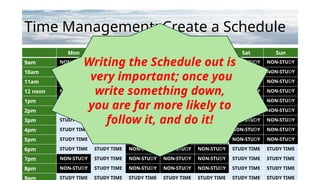
Writing the Schedule out is
very important; once you
write something down,
you are far more likely to
follow it, and do it!
56.
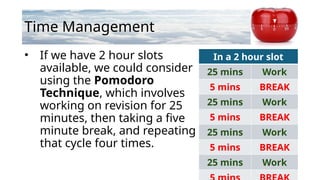
Time Management
• Ifwe have 2 hour slots
available, we could consider
using the Pomodoro
Technique, which involves
working on revision for 25
minutes, then taking a five
minute break, and repeating
that cycle four times.
In a 2 hour slot
25 mins Work
5 mins BREAK
25 mins Work
5 mins BREAK
25 mins Work
5 mins BREAK
25 mins Work
57.
Time Management
• Wealso need to build in time for Stress Management,
and that could include activities such as:
• Practicing deep breathing (for example, spend 4 seconds
inhaling, 4 seconds holding, 4 seconds exhaling)
• Getting enough sleep (7-9 hours usually)
• Practicing mindfulness or guided meditation
• Engage in a Hobby, painting, gardening, or playing music
• Take a walk in a park, hike, or simply sit outside
• Watch a comedy and share jokes
58.
Time Management
• Furthermental health activities could include:
• Journaling: Write down your thoughts, worries, or things
you're grateful for to process emotions and gain
perspective.
• Challenge Negative Thoughts: Replace unhelpful self-talk
with positive affirmations or realistic, supportive thoughts.
• Practice Gratitude: Reflect on things you’re thankful for to
shift your focus from stressors to positives.
• Set Boundaries: Learn to say no and protect your time and
energy.
59.
Time Management
• Also,don’t forget to build in time for past exam papers,
mock exams and time for working with study buddies:
• Past Exam Papers: Review past exams papers to get familiar
with the format of the paper and the type of questions.
• Mock Exams: Treat it like the real exam, use the same time,
and try to replicate the environment, and resources.
Complete your revision for key topics before attempting. Do
the exam, and fill in forgotten facts with another colour pen.
• Study Buddies: Study buddies can improve understanding,
motivation, and test performance. Split complex topics
between each member of the team, and teach each other.
Doing the Exam:BEFORE THE EXAM
• THE NIGHT BEFORE THE EXAM
• Get to bed on time.
• Try not to get in any fights with family and friends
• Pack the following items:
• Some different coloured pens (including a pink/purple pen
for underlining)
• Some pencils
• Pencil pairers and erasers
• A small ruler
• Food and drink
62.
Doing the Exam:BEFORE THE EXAM
• THE MORNING OF THE EXAM
• Start you day as always
• Eat a good breakfast if you can
• Make sure you are hydrated
• Think of what reward you will give yourself after the
exams are over
• Review some of the key concepts
• Visual success and practice calm breathing
• BE POSITIVE
63.
Doing the Exam:DURING THE EXAM
• At the Start of the Exam BREATH:
• Take a deep breath and relax
• Remain calm
• If you are getting nervous, picture a shaft
of warm, blue light coming down from the
sky and warming you
• If that doesn’t work, wiggle your toes in
your shoes
64.
Doing the Exam:DURING THE EXAM
• At the Start of the Exam:
• Now once you turn over the exam
paper, carefully read all instructions on
the exam paper, especially when given
options of questions to answer.
• Now read them again.
65.
Doing the Exam:DURING THE EXAM
• At the Start of the Exam:
• Read all of the questions on the paper
• Choose the questions you wish to
answer carefully
66.
Doing the Exam:DURING THE EXAM
• During the Exam:
• WRITING
• Write in clear, concise legible English and give all
necessary details.
• DIAGRAMS
• Make them large
• Label them clearly
• Draw in pencil first
• Use many colours
67.
Doing the Exam:DURING THE EXAM
• During the Exam:
• ROUGH WORK
• If there is content you need to get down on the
paper immediately to help you remember it,
just write down the heading “Rough Work” at
the top of the page, and similarly, if you are
planning a question and need to sketch it out,
write down “Rough Work” and the Question
number.
68.
Doing the Exam:DURING THE EXAM
• During the Exam:
• WHICH QUESTION FIRST?
• You should do the question you are more
confident of answering first.
• This gets you started working immediately,
steadies the nerves and gives you confidence.
• Starting with a harder one first may increase the
amount of time spent on the first essay, causing
you to panic and rush the second.
69.
Doing the Exam:DURING THE EXAM
• During the Exam:
• PLANNING YOUR ANSWER
• When faced with an exam question a good staring
point is to gather ideas.
• Write these down on paper in any order.
• The more ideas you have, the more can select when
you start to write.
• Ideas should occur to as you write and these can be
accepted or rejected according to your answer plan
70.
Doing the Exam:DURING THE EXAM
• During the Exam:
• PLANNING YOUR ANSWER
• The next stage is the rough plan, reorganise your
ideas into a logical order that will answer the question.
• Delete irrelevant initial ideas that will not contribute to
answering the question.
• At this stage don’t worry about a conclusion, you
should be able to do this after you have written the
answer.
71.
Doing the Exam:DURING THE EXAM
• During the Exam:
• “EXPLAIN” Questions
• Provide a definition or simple explanation
• Draw a diagram, if possible
• Provide an example
• Discuss the strengths and weaknesses,
and alternatives.
72.
Doing the Exam:DURING THE EXAM
• During the Exam:
• CODING Questions
• Provide a short pseudocode
explanation
• Draw a diagram, if possible
• Write the code
• Comment it clearly
73.
Doing the Exam:DURING THE EXAM
• During the Exam:
• When answering questions:
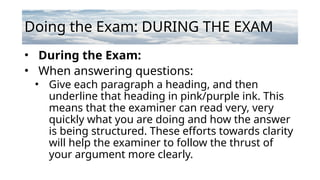
• Give each paragraph a heading, and then
underline that heading in pink/purple ink. This
means that the examiner can read very, very
quickly what you are doing and how the answer
is being structured. These efforts towards clarity
will help the examiner to follow the thrust of
your argument more clearly.
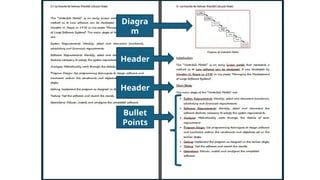
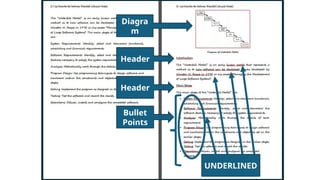
74.
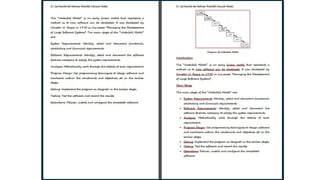
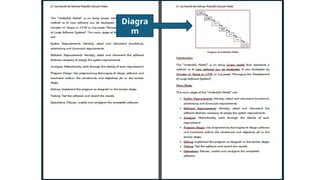
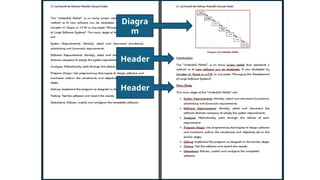
This is
the same
answer,
buton
the left,
it’s just
text, and
on the
right,
there’s a
diagram,
bullet
points,
and
underlin
ed text.
Doing the Exam:DURING THE EXAM
• During the Exam:
• WHITESPACE
• You have paid for the exam booklets, use as
many as you want.
• Each part of each question on a separate page
• Leave a blank page between each question
• Leave two blank lies between each paragraph
81.
Doing the Exam:DURING THE EXAM
• Exam Time Management:
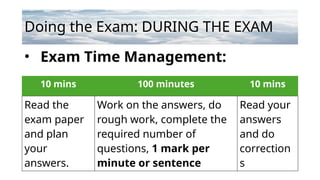
• If you have 2 hours for the exam, that’s 120
minutes. So If we give ourselves 10 minutes
to read the paper at the start, to read the
questions and pick the ones we want to do,
and 10 minutes at the end for any changes
and corrections we need to do, we have
exactly 100 minutes for 100 marks.
82.
Doing the Exam:DURING THE EXAM
• Exam Time Management:
• So if a question is worth 25 marks, and
we have already spent 25 minutes on it,
and we are only halfway through it,
leave a few blank pages, and move onto
another question, and get back to this
one if you have time at the end.
83.
Doing the Exam:DURING THE EXAM
• Exam Time Management:
• In a similar way, if a question is worth 20
marks, the examiner will expect to see a
much longer answer than if it is worth 5
marks. So a rough rule is: a sentence per
mark. So for a 5 mark question, do at least 5
sentences (or work on it for 5 minutes), and
for a 20 mark question, do 20 sentences.
84.
Doing the Exam:DURING THE EXAM
• Exam Time Management:
• THERE ARE TWO GOLDEN RULES
• ONE MARK FOR ONE MINUTE
• ONE MARK FOR ONE SENTENCE
85.
Doing the Exam:DURING THE EXAM
• Exam Time Management:
10 mins 100 minutes 10 mins
Read the
exam paper
and plan
your
answers.
Work on the answers, do
rough work, complete the
required number of
questions, 1 mark per
minute or sentence
Read your
answers
and do
correction
s
86.
Doing the Exam:DURING THE EXAM
• Finishing off the Exam:
• Add instructions for the examiner to make things
clear, so if the current question is continued on the
next page, add a note “Continued on next page”. If
you skipped a few pages for the rest of this
answer, add a note “Continued in 5 pages”, and if
the answer is continued in another booklet, just
note “Continued in Yellow Booklet +1”.
87.
Doing the Exam:DURING THE EXAM
• Finishing off the Exam:
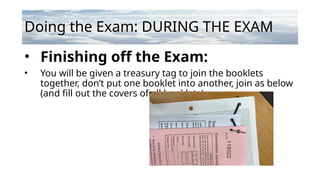
• You will be given a treasury tag to join the booklets
together, don’t put one booklet into another, join as below
(and fill out the covers of all booklets):
88.
Doing the Exam:DURING THE EXAM
• The three most common exam
errors:
1. Answering the wrong number of questions
(i.e. doing too few)
2. Answering the wrong question (i.e. not
answering the question being asked)
3. Badly presented answers (i.e. not following
the guidelines we have just looked at).
89.
Doing the Exam:AFTER THE EXAM
• Reward Yourself
•Whatever reward you promised yourself,
make sure you do it soon after the exam is
over, it doesn’t matter if the exam went well
or badly, if you put in a good effort, reward
yourself.
90.
Doing the Exam:AFTER THE EXAM
• Review Later
•After a few days, review your studying and
revision process, and honestly reflect on
what went well, and what went badly.
•Whether you pass or fail, as long as put in an
honest effort, you did your best.
Editor's Notes
#24 SMART Objectives – very common in industry and are used extensively for appraisals and form a simple test of whether the objective is truly a good objective.
#25 Specific – this ties back to the project management module where work breakdown structures where used to split large tasks into much smaller tasks. The aim of doing this allows the objective to be specific. The classic final year PhD student objective is write my PhD. The question of where to start is a difficult one and therefore splitting the task up can make the objective more specific and also achievable within a sensible time frame can help with motivation. Think of other examples of specific objectives. On the previous slide the aim make myself more employable is not at all specific – what is meant by employable !
#27 Measurable – You need to know when you have finished the objective / completed the task. There is two elements therefore to writing measurable objectives. They should not include words like more – when do you know when you have made more contacts. Is it one or is it a million. The second element relates to actually having something which you can provide as evidence. Therefore deliverables attached to the objective is good (e.g. Short reports) as these can help you prove that you have achieved the objective (this will be important when you start work!).
#29 Agreed – In the project management sessions we talked about stakeholders and involving them in the project. Setting your objectives and agreeing them with your supervisor is important. This might take some negotiation but it worth doing this as everybody will be committed to the plan.
Note that if you ever set objectives for someone else make sure you discuss them with them as setting unachievable objectives for someone can prove a source of conflict.
#31 Realistic Objectives – It is important that the objectives you set are realistic. All too often people will set very unrealistic objectives and the end result is that the project is not delivered on time, resentment develops within the project stakeholders etc. Furthermore if you are being assessed against the objectives which are set, if they are unrealistic you may not achieve any of them! It is however important to set your self challenging objectives which you could achieve if you apply yourself – these are often referred to as stretch targets and are used to motivate staff.
#33 Time Bound – It is important that there is an element of time linked to the objective. Again if the objective is open ended when do you when you have achieved the objective. Therefore set yourself deadlines and review yourself against them – don’t let the deadlines slip as the progress of the project overall could be in jeopardy. These can also be a useful time management tool as often people will work on something when little value is being added (80% of the value is provided by 20% of the effort) and a dealine can be used to force you to move on to the next objective.
#34 Time scales - It is useful to set objectives at multiple levels – one week, one month, 6 months – 1 year. This will let you focus on the big picture as well as on the short-term tasks. A useful technique which can be used to improve your time management is to set weekly SMART objectives to help organise your time. The objectives at a number of timescales can be linked back to the WBS discussed in the project management session – the bottom level tasks may be weekly objectives whilst the higher level tasks are longer term.



![• Make the objective specific
• Break large tasks down into smaller tasks
• [X] Revise a complete module
• [ ]
√ Revise one topic in a module
• [ ]
√ Search for additional information on a specific topic
• Breaking large tasks into smaller ones makes it easier
to assess progress
SPECIFIC](https://image.slidesharecdn.com/2-exampreparation-250402105707-2d4ff225/85/Exam-Preparation-Some-Ideas-and-Suggestions-25-320.jpg)

![• How do you know when you have done everything:
• [X] Do some practice exam questions
• [ ]
√ Do 3 practice exam questions in the next week
• [X] Do some practice quizzes
• [ ]
√ Do 3 practice quizzes, and score at least 80% in each
• Make sure they are evidenced based – you should
have a deliverable attached to the objective
MEASURABLE](https://image.slidesharecdn.com/2-exampreparation-250402105707-2d4ff225/85/Exam-Preparation-Some-Ideas-and-Suggestions-27-320.jpg)
![•Tell other people your goals and ask them to
hold you accountable.
• Especially your classmates!
• [X] I think I will do a bit of revision
• [X] Everyone is telling me the exams will be fine
• [ ]
√ We agreed that I’m going to keep studying for
2 hours every night.
AGREED](https://image.slidesharecdn.com/2-exampreparation-250402105707-2d4ff225/85/Exam-Preparation-Some-Ideas-and-Suggestions-29-320.jpg)
![•Will you achieve the objective?
• Unrealistic objectives can be very de-motivating
• Challenging objectives which are realistic can be
motivating
• [X] I’ll read over the module content
• [ ]
√ I’ll do some exam questions in the same
duration as I would have to do in a real exam.
REALISTIC](https://image.slidesharecdn.com/2-exampreparation-250402105707-2d4ff225/85/Exam-Preparation-Some-Ideas-and-Suggestions-31-320.jpg)

![•Set timescales on your objectives
• Deadlines and Milestones
•Review progress against these deadlines
• [X] Finish covering all topics
• [ ]
√ Finish the current topic by next Monday.
TIME BASED](https://image.slidesharecdn.com/2-exampreparation-250402105707-2d4ff225/85/Exam-Preparation-Some-Ideas-and-Suggestions-33-320.jpg)