Memory
•To understand memory,first we’ll look at the
key components of memory, and how they
relate to each other:
• Sensory Memory (SM)
• Short-Term Memory (STM)
• Working Memory (WM)
• Long-Term Memory
Memory
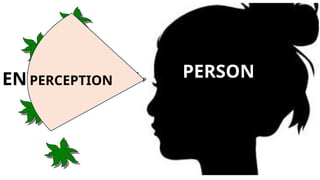
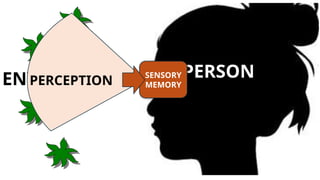
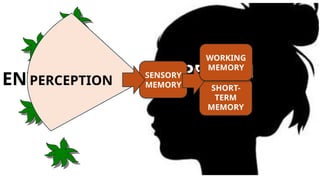
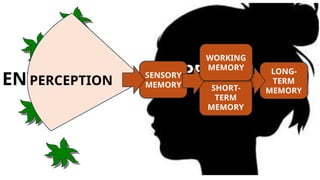
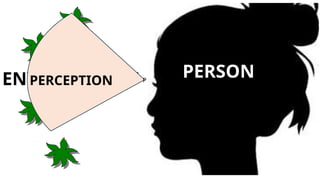
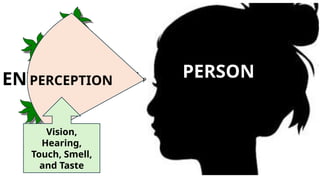
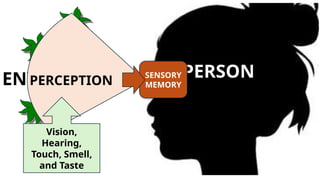
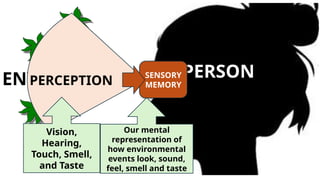
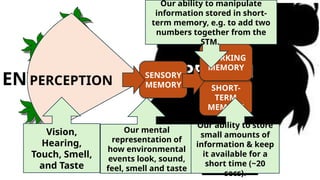
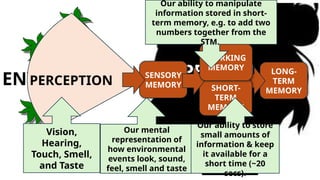
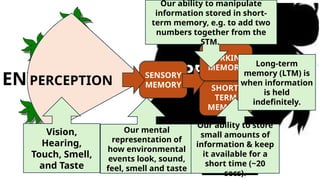
•So, a personuses their perception (sees, hears,
touches, smells or tastes) to capture their
environment, which is taken into their Sensory
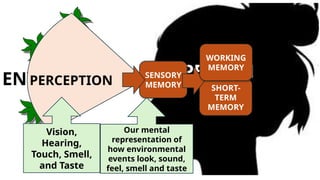
Memory (SM). From there it simultaneously
goes into their Short-Term Memory (STM) and
their Working Memory (WM), and from there
into their Long-Term Memory.
•Let’s look at what each of these does >>>
PERSON
ENVIRONMENT P
PERCEPTION
SENSORY
MEMORY SHORT-
TERM
MEMORY
Vision,
Hearing,
Touch,Smell,
and Taste
Our mental
representation of
how environmental
events look, sound,
feel, smell and taste
WORKING
MEMORY
Our ability to store
small amounts of
information & keep
it available for a
short time (~20
secs).
Our ability to manipulate
information stored in short-
term memory, e.g. to add two
numbers together from the
STM.
18.
PERSON
ENVIRONMENT P
PERCEPTION
SENSORY
MEMORY
LONG-
TERM
MEMORY
SHORT-
TERM
MEMORY
Our mental
representationof
how environmental
events look, sound,
feel, smell and taste
WORKING
MEMORY
Our ability to manipulate
information stored in short-
term memory, e.g. to add two
numbers together from the
STM.
Vision,
Hearing,
Touch, Smell,
and Taste
Our ability to store
small amounts of
information & keep
it available for a
short time (~20
secs).
19.
PERSON
ENVIRONMENT P
PERCEPTION
SENSORY
MEMORY
LONG-
TERM
MEMORY
SHORT-
TERM
MEMORY
Our mental
representationof
how environmental
events look, sound,
feel, smell and taste
WORKING
MEMORY
Our ability to manipulate
information stored in short-
term memory, e.g. to add two
numbers together from the
STM.
Vision,
Hearing,
Touch, Smell,
and Taste
Our ability to store
small amounts of
information & keep
it available for a
short time (~20
secs).
Long-term
memory (LTM) is
when information
is held
indefinitely.
20.
Memory
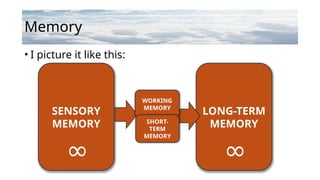
• So, theSensory Memory (SM) has nearly infinite
capacity, as does the Long-Term Memory.
Unfortunately in between those two is a bottleneck,
the Short-Term Memory (STM) / Working Memory
(WM) pair which can only remember small chunks of
information (often between 5 and 9 chunks of
information) for a very short period of time (about
20 seconds).
Memory
• So weneed to look at ways to get information from
our short-term memory into our long-term memory,
some key concepts are:
• Spaced Repetition
• Active Recall
• The Forgetting Curve
23.
Memory
•Spaced Repetition
• Thisinvolves the following steps:
1. Learn a new concept.
2. Revisit the concept after increasingly timed
intervals (e.g. the first time to review it could be a
day or two after we have learned it, then the next
interval is three days, then five days, then 10 days).
3. Revisiting the concept means actively reviewing
the concept by putting it into action.
24.
Memory
•Active Recall
• Thiscould involve any of the following:
1. Trying to write down the key points, concepts,
or definitions without looking at the materials.
2. Speaking it out, say it out loud to reinforce the
memory.
3. Compare your recall to the source material
and identify gaps or errors.
25.
Memory
• Active Recall
•Some techniques could include:
1. Flashcards: Write a question on one side of a card,
and the answer on the other side of the card.
2. Mock Exams: Do some practice questions.
3. Teach someone else: Explain the concept to
someone else, this forces you to clarify and recall
the material.
4. Brain dumps: Take a blank piece of paper and write
everything you know about a topic.
26.
Memory
•Active Recall
• REMEMBER,Mistakes are part of the process.
Check what you have forgotten each time, write it
down in a different coloured pen, and repeat it in
your mind a few times, or speak it out load.
• Also, be consistent in terms of your practice,
because regular practice builds strong neural
connections.
27.
Memory
•The Forgetting Curve
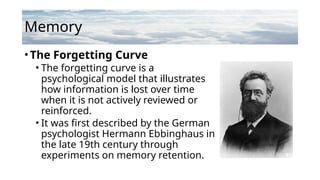
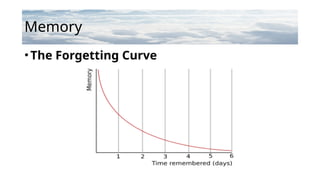
•The forgetting curve is a
psychological model that illustrates
how information is lost over time
when it is not actively reviewed or
reinforced.
• It was first described by the German
psychologist Hermann Ebbinghaus in
the late 19th century through
experiments on memory retention.
Memory
•The Forgetting Curve
•The steepest drop in memory retention occurs
shortly after learning. You can forget up to 50% of
the information within an hour and about 75%
after 24 hours, depending on the material.
• The rate of forgetting slows down after the initial
steep drop, but without reinforcement, the
information will eventually fade completely.
30.
Memory
•The Forgetting Curve
•How to combat it:
• Spaced Repetition (as mentioned above)
• Active Recall (as mentioned above)
• Make Material Meaningful: Relate the information to
what you already know, create stories, or use
mnemonics.
• Use Multiple Modalities: Engage with the material
through different methods (e.g., visual, auditory,
kinesthetic) to strengthen memory connections.
31.
Memory
•Other Memory Techniquesinclude:
• Mnemonics
• Visualization
• Chunking
• Storytelling
• The Method of Loci (Mind Palace)
32.
Memory: Mnemonics
•Mnemonics isa general term for
memorization techniques, including the
following:
•Acronyms
•Acrostics
•Rhymes
33.
Memory: Mnemonics
•Acronyms:
•Taking thefirst letter of a phrase to spell out a
new word, e.g. ASAP – As Soon As Possible or
the colours of the rainbow as ROY G. BIV
34.
Memory: Mnemonics
•Acrostics:
•Acrostic isa series of lines from which particular
letters (such as the first letters of all lines) from a
word or phrase, for example:
Richard of York gave battle in vain
gives the colours of the rainbow:
Red, Orange, Yellow, Green, Blue, Indigo, Violet
35.
Memory: Mnemonics
•Acrostics:
•Another example:
MyVery Educated Mother Just Served Us Nine Pizzas
gives the planets in the Solar System (plus Pluto):
Mercury, Venus, Earth, Mars, Jupiter, Saturn, Uranus,
Neptune, Pluto
36.
Memory: Mnemonics
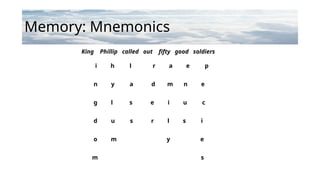
King Phillipcalled out fifty good soldiers
i h l r a e p
n y a d m n e
g l s e i u c
d u s r l s i
o m y e
m s
37.
Memory: Mnemonics
•Rhymes: CProgramming
• Start with “#include” at the top of your file,
• It brings in the tools, like a versatile pile.
• The main function's where programs begin,
• “int main()” opens, let the coding spin!
38.
Memory: Mnemonics
•Rhymes: CProgramming
• Braces “{}” keep your code in a space,
• Each statement ends with a “;” that’s the case.
• Use “printf” to show what you write,
• With double quotes wrapped, it’ll display it right!
39.
Memory: Mnemonics
•Rhymes: CProgramming
• For input, there’s “scanf” to take,
• Variables store it—your program’s awake.
• “int”, “float”, or “char”—types to define,
• Each variable’s role makes the program shine.
40.
Memory: Mnemonics
•Rhymes: CProgramming
• Loops like “for” and “while” repeat,
• When tasks are many, they can't be beat.
• Conditions with “if”, “else” take a stand,
• Decisions in code are at your command.
41.
Memory: Mnemonics
•Rhymes: CProgramming
• Pointers use “*” to point at the spot,
• Memory's treasure—don’t lose the plot!
• Functions break tasks into smaller parts,
• Write them once, reuse the arts.
42.
Memory: Mnemonics
•Rhymes: CProgramming
• In C, the structure is clear as can be,
• Learn these steps, and you'll code with glee!
Memory: Visualizations
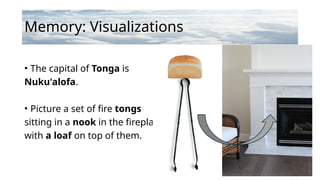
• Thecapital of Tonga is
Nuku'alofa.
• Picture a set of fire tongs
sitting in a nook in the fireplace,
with a loaf on top of them.
47.
Memory: Chunking
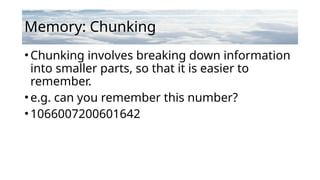
•Chunking involvesbreaking down information
into smaller parts, so that it is easier to
remember.
•e.g. can you remember this number?
•1066007200601642
48.
Memory: Chunking
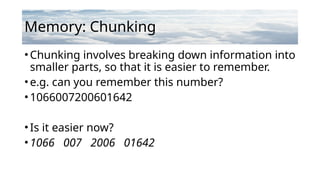
•Chunking involvesbreaking down information into
smaller parts, so that it is easier to remember.
•e.g. can you remember this number?
•1066007200601642
•Is it easier now?
•1066 007 2006 01642
49.
Memory: Storytelling
• Makeup a story to remember a computer concept:
• The Tale of the Magic Mirror
• In a quiet village, a curious child named Riley found an
enchanted magic mirror in an old attic. The mirror had a
peculiar ability: when asked a question, it would call upon a
smaller mirror hidden inside itself to answer the same
question. This process would continue until the smallest
mirror—one so tiny it could barely speak—would finally
provide the answer.
50.
Memory: Storytelling
• Oneday, Riley wanted to find out the total number of
mirrors inside. The big mirror said: “I don’t know, but I’ll ask
the smaller mirror inside me to count.”
• The smaller mirror replied: “I don’t know either, but I’ll ask
the smaller mirror inside me to count.”
• This went on, each mirror delegating the task to the next
smaller mirror, recursively, until the tiniest mirror—the
base case—spoke up:
51.
Memory: Storytelling
• “Thereare no mirrors smaller than me! I am the 1st mirror.”
• Then, the smallest mirror passed the number back: “1
mirror.”
• The next mirror added itself: “2 mirrors.”
• And so on, until the big mirror said proudly: “There are 10
mirrors in total!”
52.
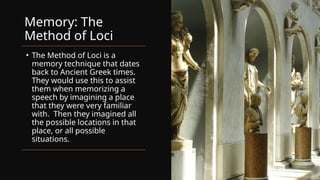
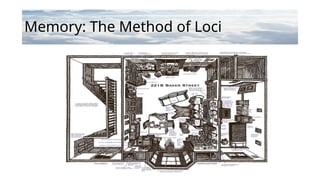
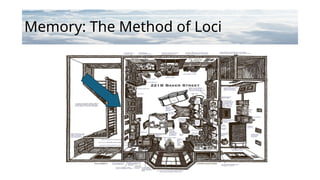
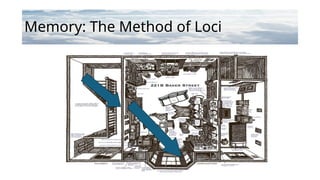
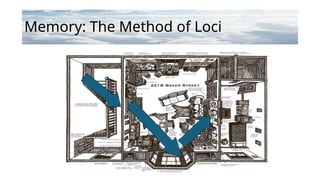
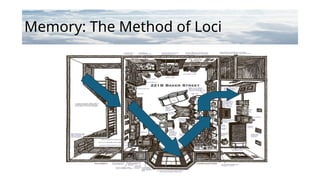
Memory: The
Method ofLoci
• The Method of Loci is a
memory technique that dates
back to Ancient Greek times.
They would use this to assist
them when memorizing a
speech by imagining a place
that they were very familiar
with. Then they imagined all
the possible locations in that
place, or all possible
situations.
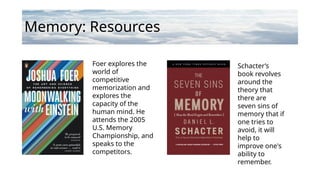
Memory: Resources
Foer exploresthe
world of
competitive
memorization and
explores the
capacity of the
human mind. He
attends the 2005
U.S. Memory
Championship, and
speaks to the
competitors.
Schacter’s
book revolves
around the
theory that
there are
seven sins of
memory that if
one tries to
avoid, it will
help to
improve one's
ability to
remember.
Learning Styles
•Learning dependson a large number of
factors, many of which are specific to the
individual person.
•The individual learning style represents the
particular set of strengths and preferences
that an individual or group of people have in
how they take in and process information
62.
Learning Styles
•The mostcommonly accepted definition is by
Keefe (1979) who defines it as “the composite of
characteristic cognitive, affective, and physiological
factors that serve as relatively stable indicators of
how a learner perceives, interacts with, and
responds to the learning environment.”
• Keefe, J.W. (1979) “Learning Style: An Overview" in NASSP's Student Learning Styles:
Diagonosing and Prescribing Programs” (pp. 1-17), Reston, VA: National Association of
Secondary Schools.
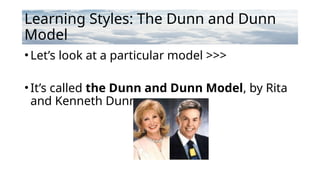
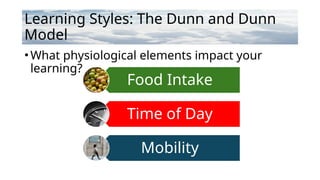
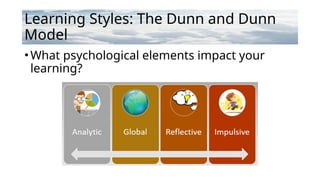
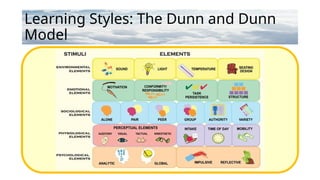
Learning Styles: The
Dunnand Dunn Model
• So which do you prefer
when studying?
• With the radio, TV or
music playing?
• Complete silence?
• Doesn’t matter?
67.
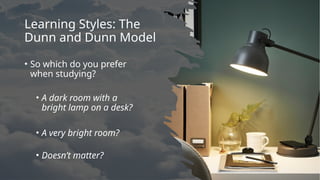
Learning Styles: The
Dunnand Dunn Model
• So which do you prefer
when studying?
• A dark room with a
bright lamp on a desk?
• A very bright room?
• Doesn’t matter?
68.
Learning Styles: The
Dunnand Dunn Model
• So which do you prefer
when studying?
• A warm room?
• A cold room?
• Doesn’t matter?
69.
Learning Styles: The
Dunnand Dunn Model
• So which do you prefer
when studying?
• Comfortable seat?
• Hard furniture?
• Doesn’t matter?
Learning Styles:
The Dunnand
Dunn Model
• So which do you prefer
when studying?
• Individually?
• In a pair?
• With a few people?
• In a group?
• With one person
leading?
• A mixture?
Learning Styles: TheDunn and Dunn
Model
•There are many other models of Learning
styles, but this one is a useful one to reflect on
our own approaches to learning.
Note-Taking Methods
• Note-takingis the process of writing down key
information to help you remember, understand,
and review what you learn.
• Good note-taking isn’t about writing everything
down word-for-word. Instead, it involves capturing
the most important points, examples, and ideas in
a way that makes sense to you.
• Notes are personal tools that support your learning
and help you engage actively with the material.
Note-Taking Methods: CornellMethod
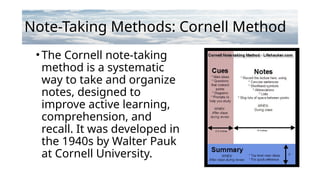
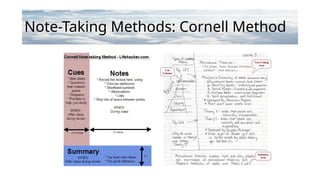
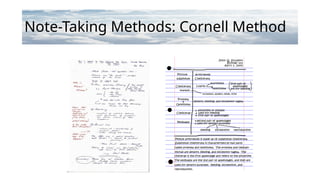
•The Cornell note-taking
method is a systematic
way to take and organize
notes, designed to
improve active learning,
comprehension, and
recall. It was developed in
the 1940s by Walter Pauk
at Cornell University.
82.
Note-Taking Methods: CornellMethod
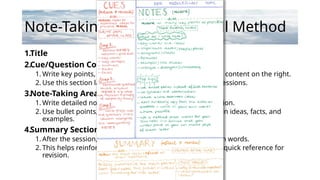
1.Title
2.Cue/Question Column (Left, ~20%)
1. Write key points, questions, or prompts that relate to the content on the right.
2. Use this section later to test your recall or guide review sessions.
3.Note-Taking Area (Right, ~80%)
1. Write detailed notes during a lecture, reading, or discussion.
2. Use bullet points, phrases, or diagrams to record the main ideas, facts, and
examples.
4.Summary Section (Bottom, ~2-3 lines)
1. After the session, summarize the main points in your own words.
2. This helps reinforce what you’ve learned and gives you a quick reference for
revision.
83.
Note-Taking Methods: CornellMethod
1.Title
2.Cue/Question Column (Left, ~20%)
1. Write key points, questions, or prompts that relate to the content on the right.
2. Use this section later to test your recall or guide review sessions.
3.Note-Taking Area (Right, ~80%)
1. Write detailed notes during a lecture, reading, or discussion.
2. Use bullet points, phrases, or diagrams to record the main ideas, facts, and
examples.
4.Summary Section (Bottom, ~2-3 lines)
1. After the session, summarize the main points in your own words.
2. This helps reinforce what you’ve learned and gives you a quick reference for
revision.
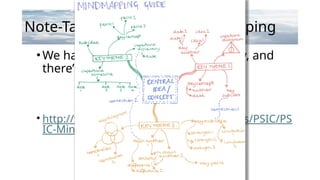
Note-Taking Methods: MindMapping
•Wehave seen MindMapping already, and
there’s a page of information here:
• http://www.damiantgordon.com/Courses/PSIC/PS
IC-Mindmaps.html
87.
Note-Taking Methods: MindMapping
•Wehave seen MindMapping already, and
there’s a page of information here:
• http://www.damiantgordon.com/Courses/PSIC/PS
IC-Mindmaps.html
88.
Note-Taking Methods: Outlining
•Theoutlining method is a structured way
of organizing notes using a hierarchical
format.
•It’s ideal for lectures or readings with a
clear structure, as it helps capture main
ideas and supporting details in a logical
order.
89.
Note-Taking Methods: Outlining
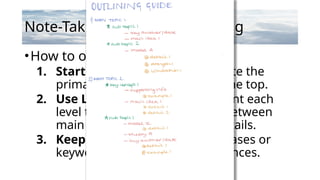
•Howto outline:
1. Start with the Main Topic: Write the
primary subject or concept at the top.
2. Use Levels for Subtopics: Indent each
level to show the relationship between
main points and supporting details.
3. Keep It Concise: Use short phrases or
keywords rather than full sentences.
90.
Note-Taking Methods: Outlining
•Howto outline:
1. Start with the Main Topic: Write the
primary subject or concept at the top.
2. Use Levels for Subtopics: Indent each
level to show the relationship between
main points and supporting details.
3. Keep It Concise: Use short phrases or
keywords rather than full sentences.
Reading Strategies
• Skimmingvs. Deep Reading
• Skimming is a fast-reading technique used to quickly grasp the
main ideas or key points of a text without focusing on details. It
involves scanning headings, subheadings, topic sentences, and
keywords to get a general understanding. This method is ideal
for previewing material, reviewing content, or deciding if a text
is worth a deeper read.
• In contrast, deep reading is a slower, more focused approach
aimed at gaining a thorough understanding of the text. It
requires careful attention to every word and idea, often
involving note-taking, highlighting, and critical analysis.
Reading Strategies
• SQ3RMethod
• Read - at this point the aim is to understand what the
text is saying, so you are deep reading. Try to assess
the writer’s viewpoint, what the main idea is in each
paragraph and how the content is structured. Keep
making connections between the information in the
text and what you have read in other texts or have
heard about in lectures. Take note of all cross-
references that you come across.
97.
Reading Strategies
•SQ3R Method
•Recall- the next stage of the process is
to close the text and try to remember
what you have read and then note the
key points. This is the longest stage.
98.
Reading Strategies
•SQ3R Method
•Review- the final stage involves
checking your notes against the text.
Spend some time filling the gaps and
correcting errors.
99.
Resources
•Apps and Tools:Quizlet for flashcards,
Grammarly for writing, and Anki for spaced
repetition.
•Online Learning Platforms: Coursera, Khan
Academy, or EdX for additional learning.
•AI Tools: ChatGPT for brainstorming,
summarizing, or reviewing
#37 Start with `#include` at the top of your file,
It brings in the tools, like a versatile pile.
The main function's where programs begin,
`int main()` opens, let the coding spin!
Braces `{}` keep your code in a space,
Each statement ends with a `;`—that’s the case.
Use `printf` to show what you write,
With double quotes wrapped, it’ll display it right!
For input, there's `scanf` to take,
Variables store it—your program’s awake.
`int`, `float`, or `char`—types to define,
Each variable’s role makes the program shine.
Loops like `for` and `while` repeat,
When tasks are many, they can't be beat.
Conditions with `if`, `else` take a stand,
Decisions in code are at your command.
Pointers use `*` to point at the spot,
Memory's treasure—don’t lose the plot!
Functions break tasks into smaller parts,
Write them once, reuse the arts.
In C, the structure is clear as can be,
Learn these steps, and you'll code with glee!
#38 Start with `#include` at the top of your file,
It brings in the tools, like a versatile pile.
The main function's where programs begin,
`int main()` opens, let the coding spin!
Braces `{}` keep your code in a space,
Each statement ends with a `;`—that’s the case.
Use `printf` to show what you write,
With double quotes wrapped, it’ll display it right!
For input, there's `scanf` to take,
Variables store it—your program’s awake.
`int`, `float`, or `char`—types to define,
Each variable’s role makes the program shine.
Loops like `for` and `while` repeat,
When tasks are many, they can't be beat.
Conditions with `if`, `else` take a stand,
Decisions in code are at your command.
Pointers use `*` to point at the spot,
Memory's treasure—don’t lose the plot!
Functions break tasks into smaller parts,
Write them once, reuse the arts.
In C, the structure is clear as can be,
Learn these steps, and you'll code with glee!
#39 Start with `#include` at the top of your file,
It brings in the tools, like a versatile pile.
The main function's where programs begin,
`int main()` opens, let the coding spin!
Braces `{}` keep your code in a space,
Each statement ends with a `;`—that’s the case.
Use `printf` to show what you write,
With double quotes wrapped, it’ll display it right!
For input, there's `scanf` to take,
Variables store it—your program’s awake.
`int`, `float`, or `char`—types to define,
Each variable’s role makes the program shine.
Loops like `for` and `while` repeat,
When tasks are many, they can't be beat.
Conditions with `if`, `else` take a stand,
Decisions in code are at your command.
Pointers use `*` to point at the spot,
Memory's treasure—don’t lose the plot!
Functions break tasks into smaller parts,
Write them once, reuse the arts.
In C, the structure is clear as can be,
Learn these steps, and you'll code with glee!
#40 Start with `#include` at the top of your file,
It brings in the tools, like a versatile pile.
The main function's where programs begin,
`int main()` opens, let the coding spin!
Braces `{}` keep your code in a space,
Each statement ends with a `;`—that’s the case.
Use `printf` to show what you write,
With double quotes wrapped, it’ll display it right!
For input, there's `scanf` to take,
Variables store it—your program’s awake.
`int`, `float`, or `char`—types to define,
Each variable’s role makes the program shine.
Loops like `for` and `while` repeat,
When tasks are many, they can't be beat.
Conditions with `if`, `else` take a stand,
Decisions in code are at your command.
Pointers use `*` to point at the spot,
Memory's treasure—don’t lose the plot!
Functions break tasks into smaller parts,
Write them once, reuse the arts.
In C, the structure is clear as can be,
Learn these steps, and you'll code with glee!
#41 Start with `#include` at the top of your file,
It brings in the tools, like a versatile pile.
The main function's where programs begin,
`int main()` opens, let the coding spin!
Braces `{}` keep your code in a space,
Each statement ends with a `;`—that’s the case.
Use `printf` to show what you write,
With double quotes wrapped, it’ll display it right!
For input, there's `scanf` to take,
Variables store it—your program’s awake.
`int`, `float`, or `char`—types to define,
Each variable’s role makes the program shine.
Loops like `for` and `while` repeat,
When tasks are many, they can't be beat.
Conditions with `if`, `else` take a stand,
Decisions in code are at your command.
Pointers use `*` to point at the spot,
Memory's treasure—don’t lose the plot!
Functions break tasks into smaller parts,
Write them once, reuse the arts.
In C, the structure is clear as can be,
Learn these steps, and you'll code with glee!
#42 Start with `#include` at the top of your file,
It brings in the tools, like a versatile pile.
The main function's where programs begin,
`int main()` opens, let the coding spin!
Braces `{}` keep your code in a space,
Each statement ends with a `;`—that’s the case.
Use `printf` to show what you write,
With double quotes wrapped, it’ll display it right!
For input, there's `scanf` to take,
Variables store it—your program’s awake.
`int`, `float`, or `char`—types to define,
Each variable’s role makes the program shine.
Loops like `for` and `while` repeat,
When tasks are many, they can't be beat.
Conditions with `if`, `else` take a stand,
Decisions in code are at your command.
Pointers use `*` to point at the spot,
Memory's treasure—don’t lose the plot!
Functions break tasks into smaller parts,
Write them once, reuse the arts.
In C, the structure is clear as can be,
Learn these steps, and you'll code with glee!