Vibe Coding and
Vibe Engineering
Damian Gordon
Contents
•What is Vibe Coding?
• Developer Workflow
• Vibe Coding Tools
• Best Practices
• Risks and Benefits
•What is Vibe Engineering?
• Principles of VE
• Organisational Implications
What is
Vibe Coding?
What is
Vibe
Coding?
•“Vibe coding” is the use of natural
language to program via
generative AI. So the coding is
done by expressing intent or a
“vibe,” rather than writing logic
line by line.
•“You just say things, run things,
and it mostly works.” - Andrej Karpathy,
OpenAI
What is Vibe Coding?
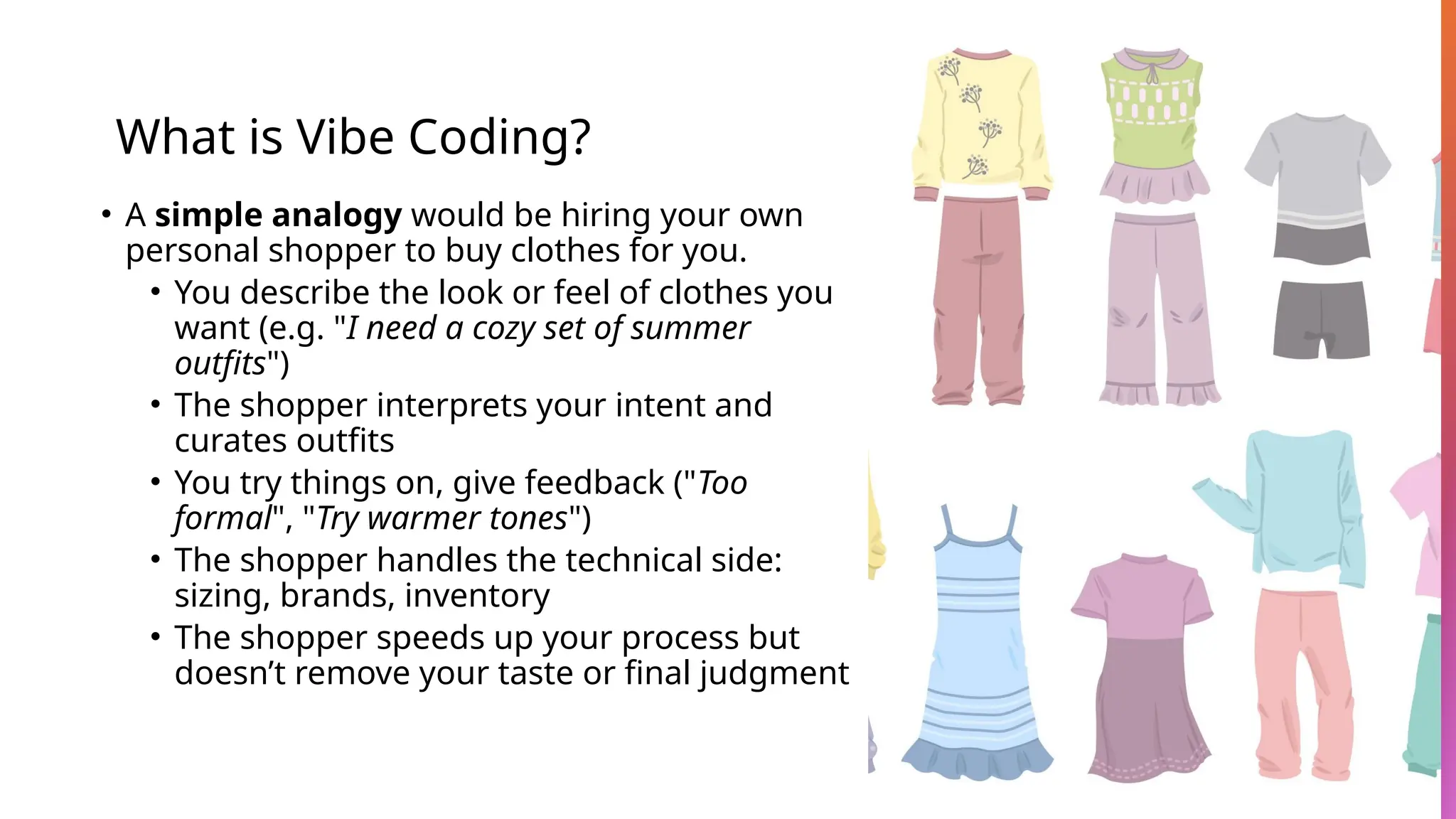
• A simple analogy would be hiring your own
personal shopper to buy clothes for you.
• You describe the look or feel of clothes you
want (e.g. "I need a cozy set of summer
outfits")
• The shopper interprets your intent and
curates outfits
• You try things on, give feedback ("Too
formal", "Try warmer tones")
• The shopper handles the technical side:
sizing, brands, inventory
• The shopper speeds up your process but
doesn’t remove your taste or final judgment
What is Vibe Coding?
• So for Vibe Coding.
• You describe the vibe or function of the
software you want (e,g, "Build a cozy landing
page with soft gradients and gentle
animations")
• The GenAI interprets your prompt and
generates code (UI, copy, layout,
animations)
• You test/refine the output ("Make it simpler",
"Use a pastel palette", "Add spring easing")
• The GenAI handles implementation: syntax,
layout logic, libraries
• The AI accelerates development, but you
still review, edit, and deploy
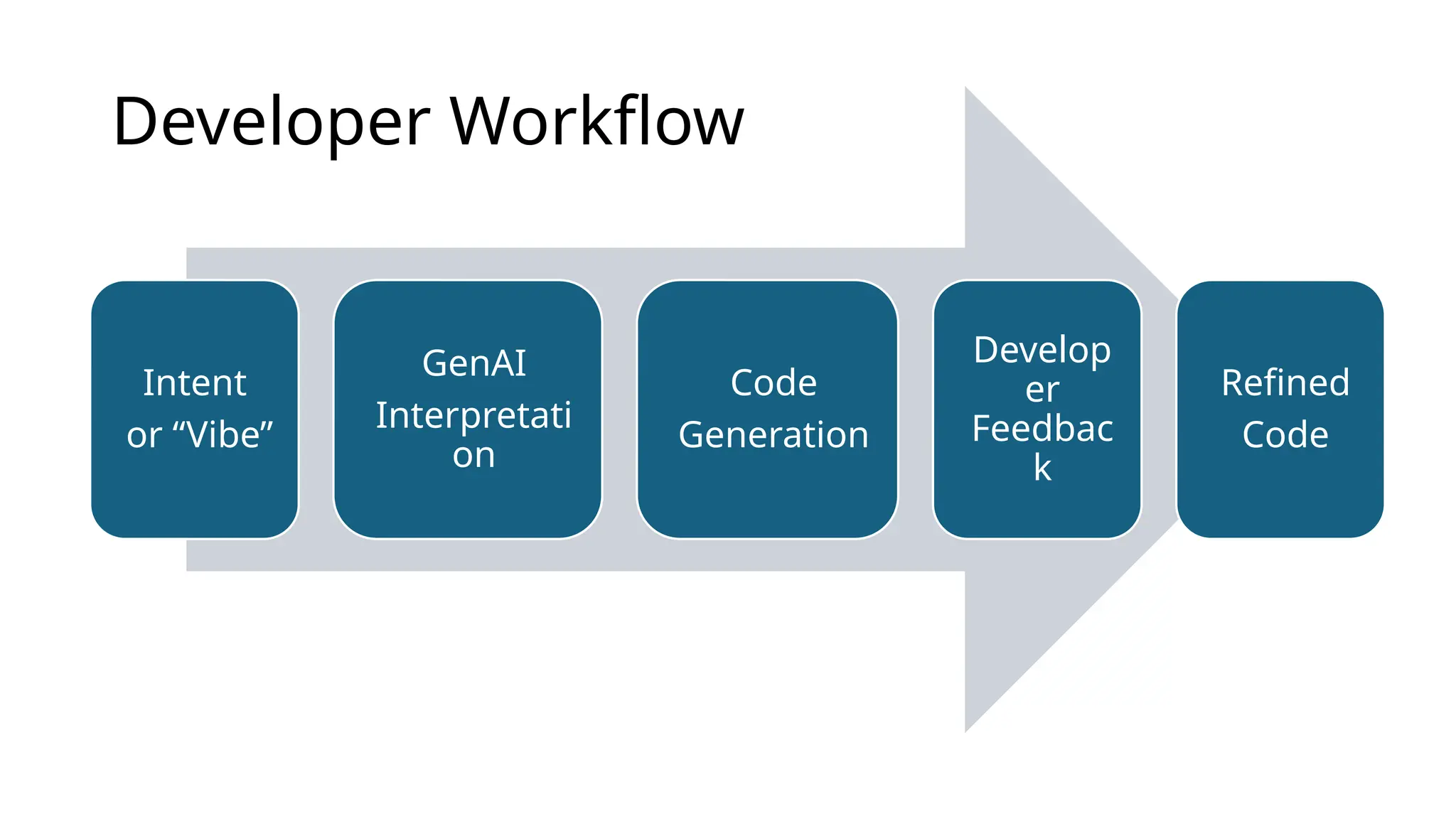
Developer Workflow
Intent
or “Vibe”
GenAI
Interpretati
on
Code
Generation
Develop
er
Feedbac
k
Refined
Code
Vibe Coding
Tools
ChatGPT / Claude / Gemini
– Conversational coding
Cursor
– AI-native code editor
SuperWhisper
– Voice-to-code
Replit Ghostwriter
– In-browser AI dev
Lovable.so / Builder.io
– Natural language UI builders
Vibe Coding: Prompt Guide
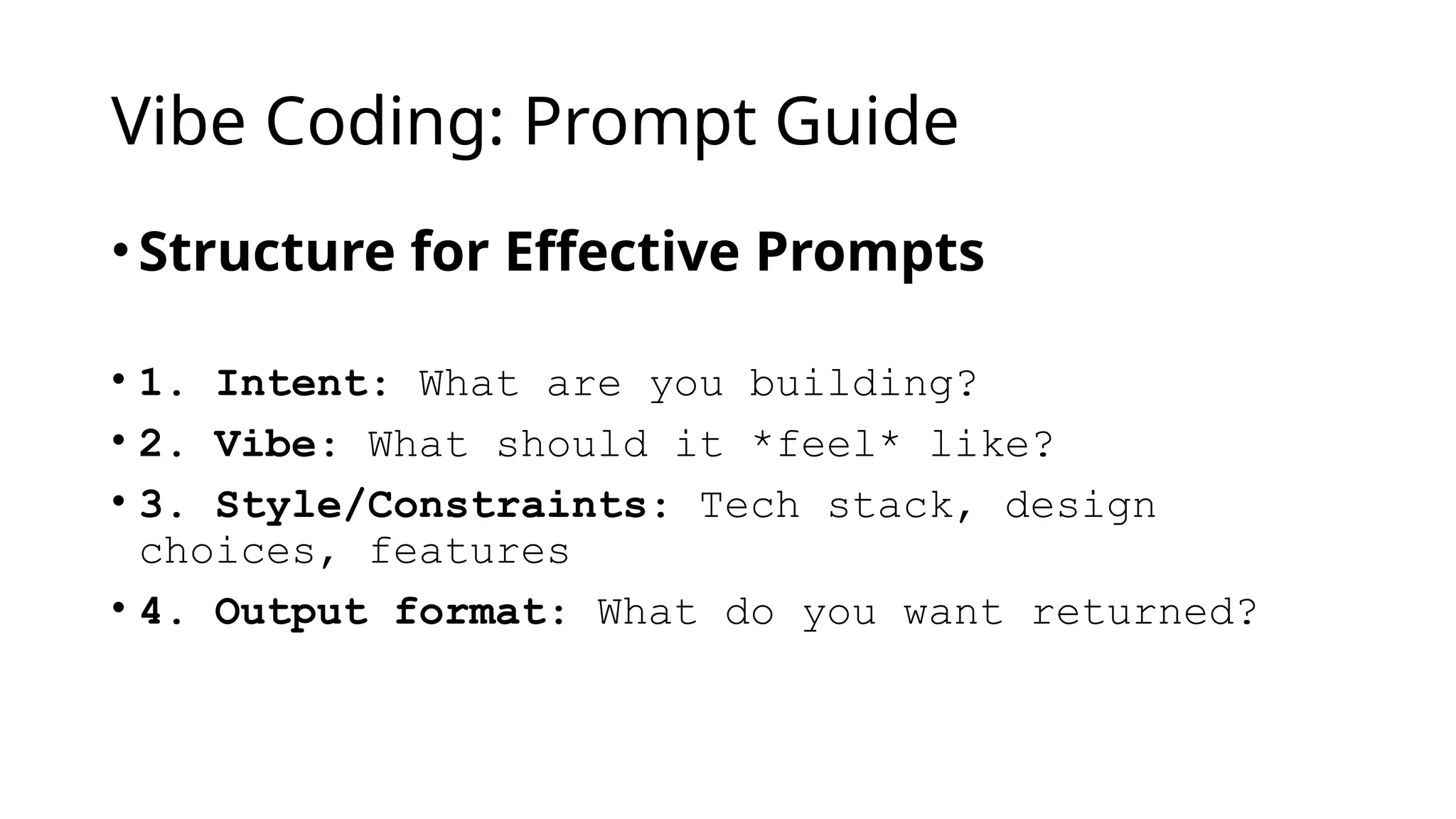
•Structure for Effective Prompts
• 1. Intent: What are you building?
• 2. Vibe: What should it *feel* like?
• 3. Style/Constraints: Tech stack, design
choices, features
• 4. Output format: What do you want returned?
Vibe Coding: Prompt Guide
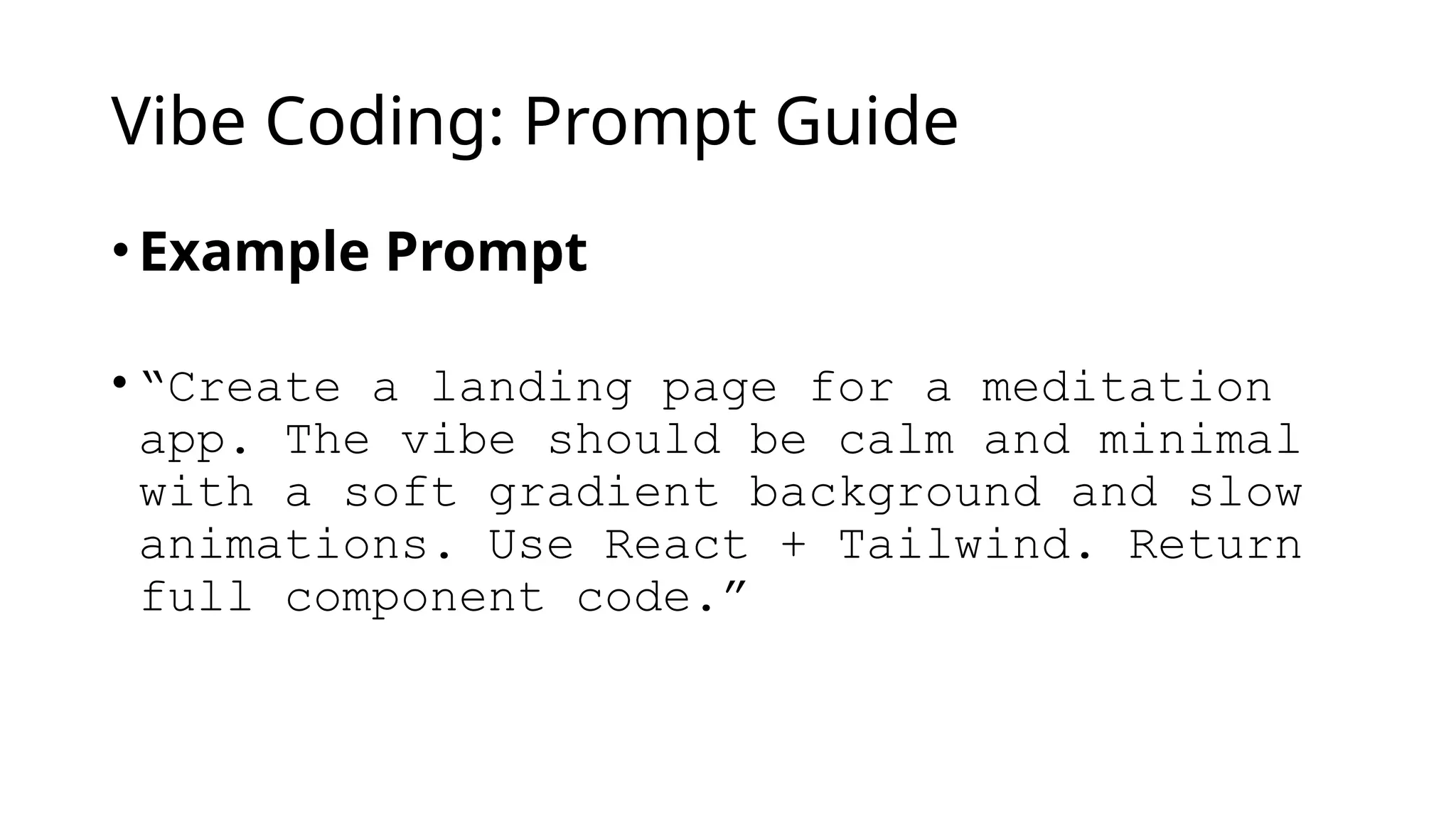
•Example Prompt
• “Create a landing page for a meditation
app. The vibe should be calm and minimal
with a soft gradient background and slow
animations. Use React + Tailwind. Return
full component code.”
Vibe Keywords
Visual Motion Tone Style
soft,
dreamy
smooth,
slow, fluid
playful,
formal
retro,
brutalist
cozy,
warm
springy,
elastic
gentle,
sharp
minimal,
maximal
dark,
moody
quick,
responsive
calming,
bold
glassy,
grainy
Vibe Coding: Prompt Guide
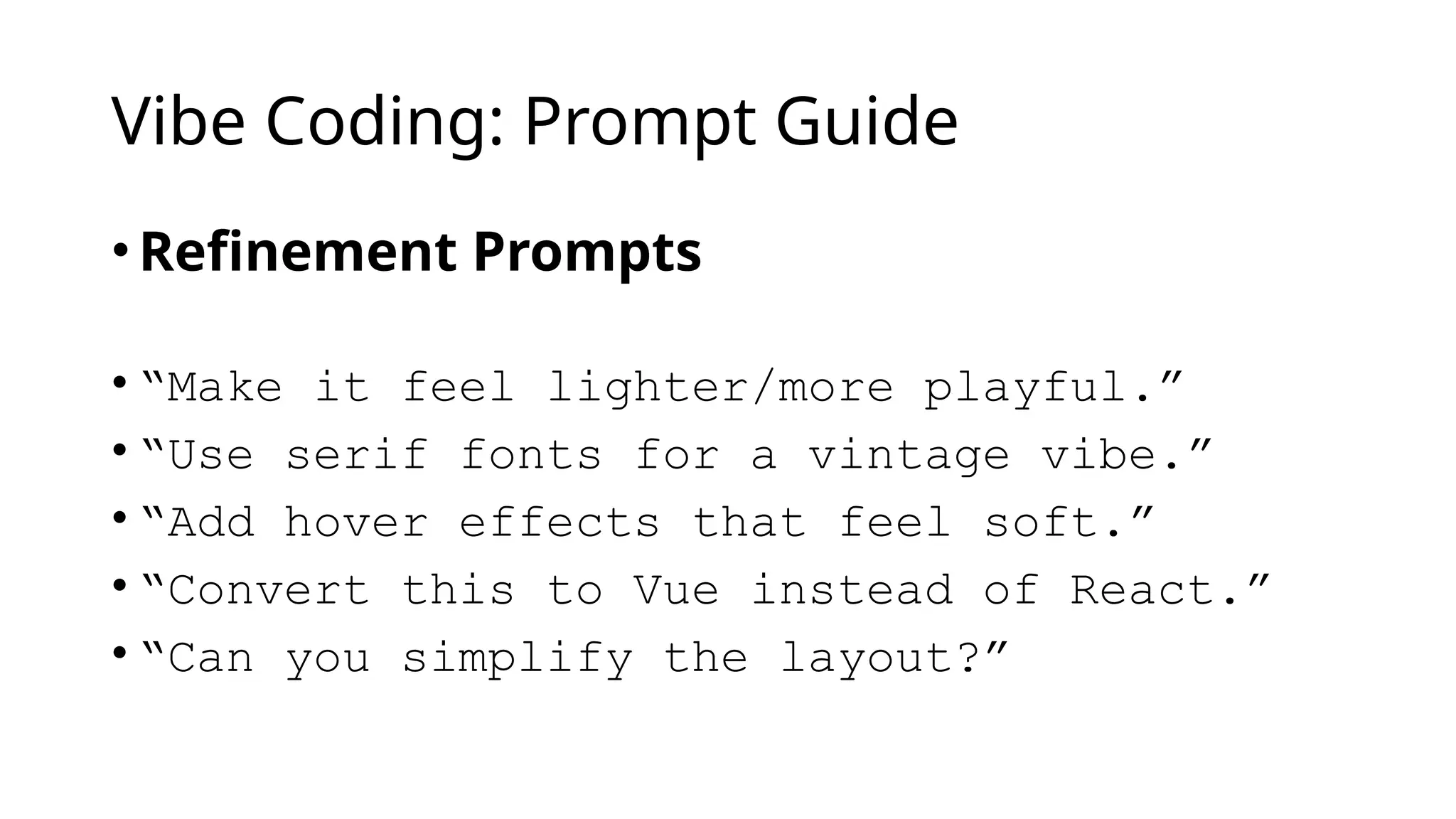
•Refinement Prompts
• “Make it feel lighter/more playful.”
• “Use serif fonts for a vintage vibe.”
• “Add hover effects that feel soft.”
• “Convert this to Vue instead of React.”
• “Can you simplify the layout?”
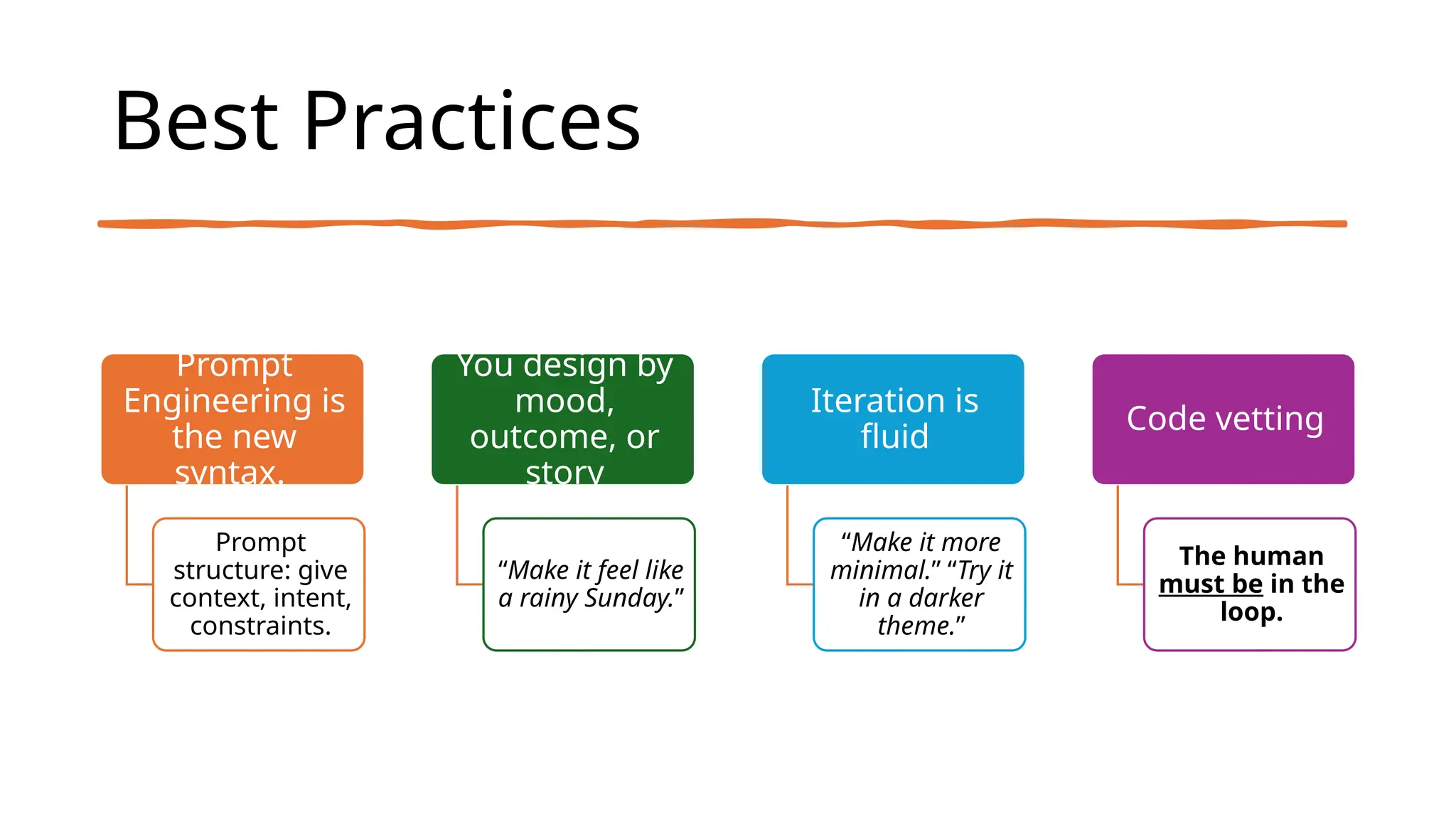
Best Practices
Prompt
Engineering is
the new
syntax.
Prompt
structure: give
context, intent,
constraints.
You design by
mood,
outcome, or
story
“Make it feel like
a rainy Sunday.”
Iteration is
fluid
“Make it more
minimal.” “Try it
in a darker
theme.”
Code vetting
The human
must be in the
loop.
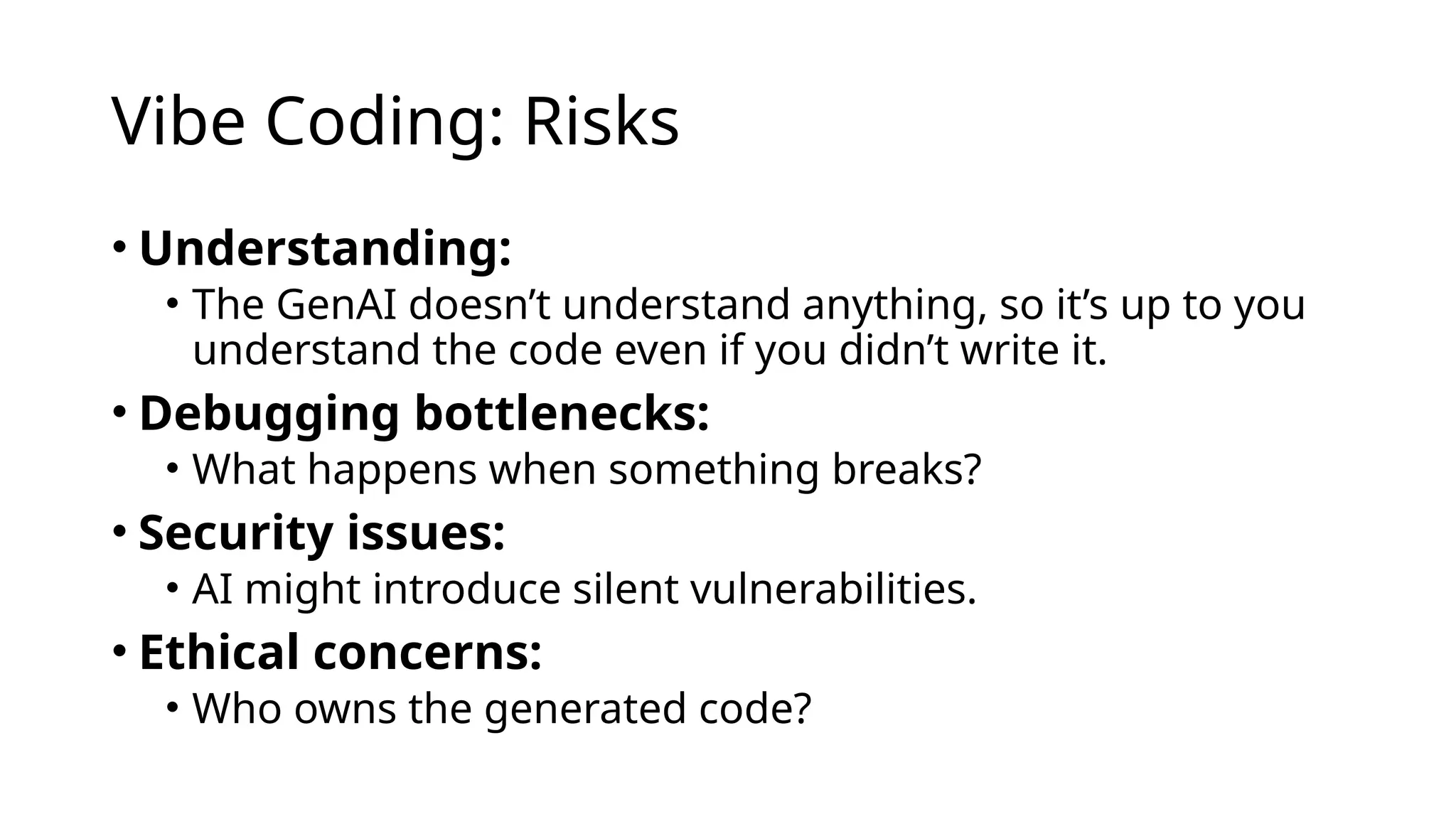
Vibe Coding: Risks
• Understanding:
• The GenAI doesn’t understand anything, so it’s up to you
understand the code even if you didn’t write it.
• Debugging bottlenecks:
• What happens when something breaks?
• Security issues:
• AI might introduce silent vulnerabilities.
• Ethical concerns:
• Who owns the generated code?
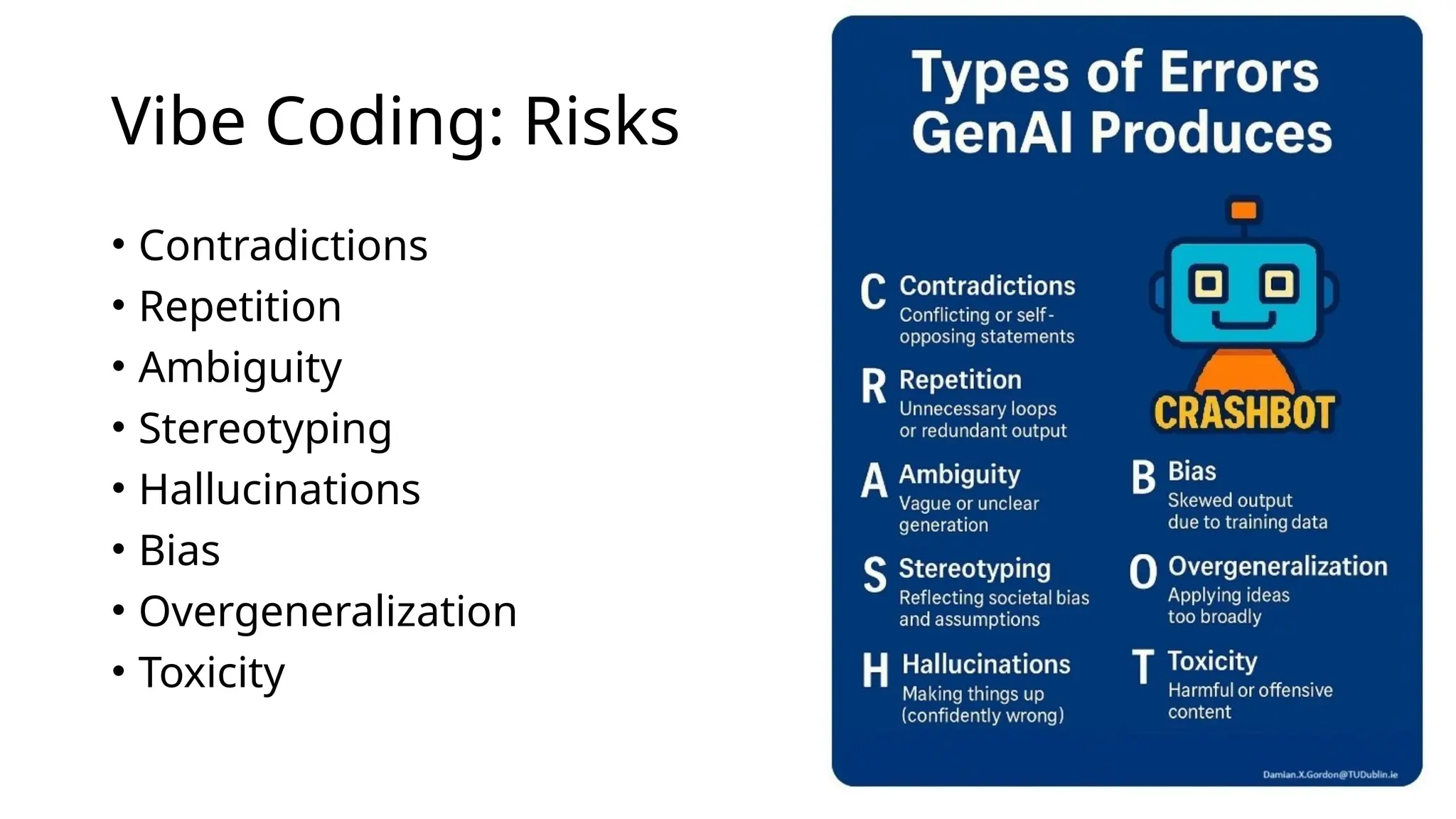
Vibe Coding: Risks
• Contradictions
• Repetition
• Ambiguity
• Stereotyping
• Hallucinations
• Bias
• Overgeneralization
• Toxicity
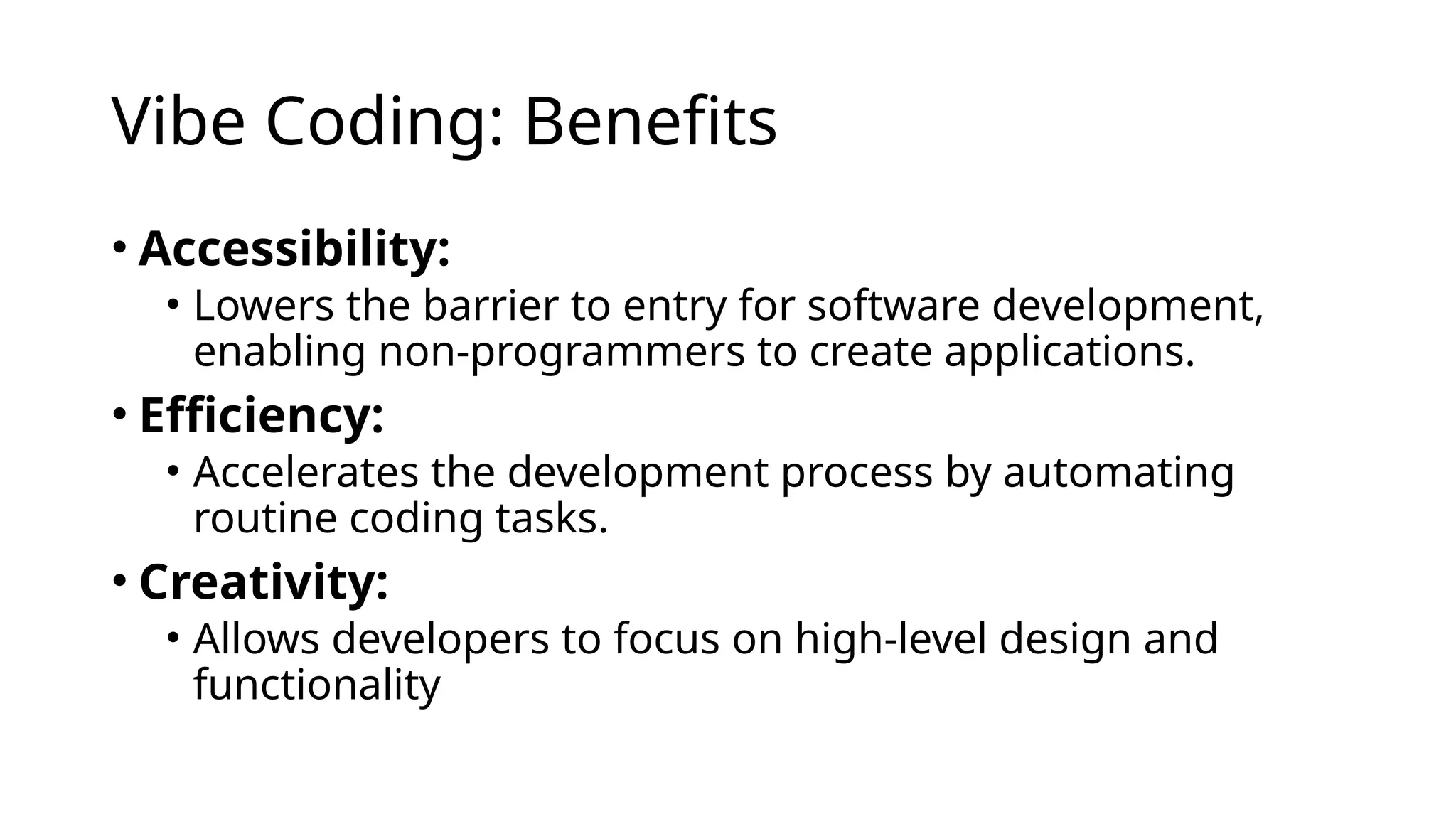
Vibe Coding: Benefits
• Accessibility:
• Lowers the barrier to entry for software development,
enabling non-programmers to create applications.
• Efficiency:
• Accelerates the development process by automating
routine coding tasks.
• Creativity:
• Allows developers to focus on high-level design and
functionality
Summary
•Vibe coding is not the end of
programming - it's the beginning of a
new kind of creative-human/AI
collaboration.
What is
Vibe Engineering?
What is
Vibe
Engineerin
g?
• “Vibe Engineering” is a strategic
approach to software development
that treats AI not merely as a tool but
as a collaborative team member.
• It involves reimagining how software
teams operate by integrating AI into
every facet of the development
lifecycle.
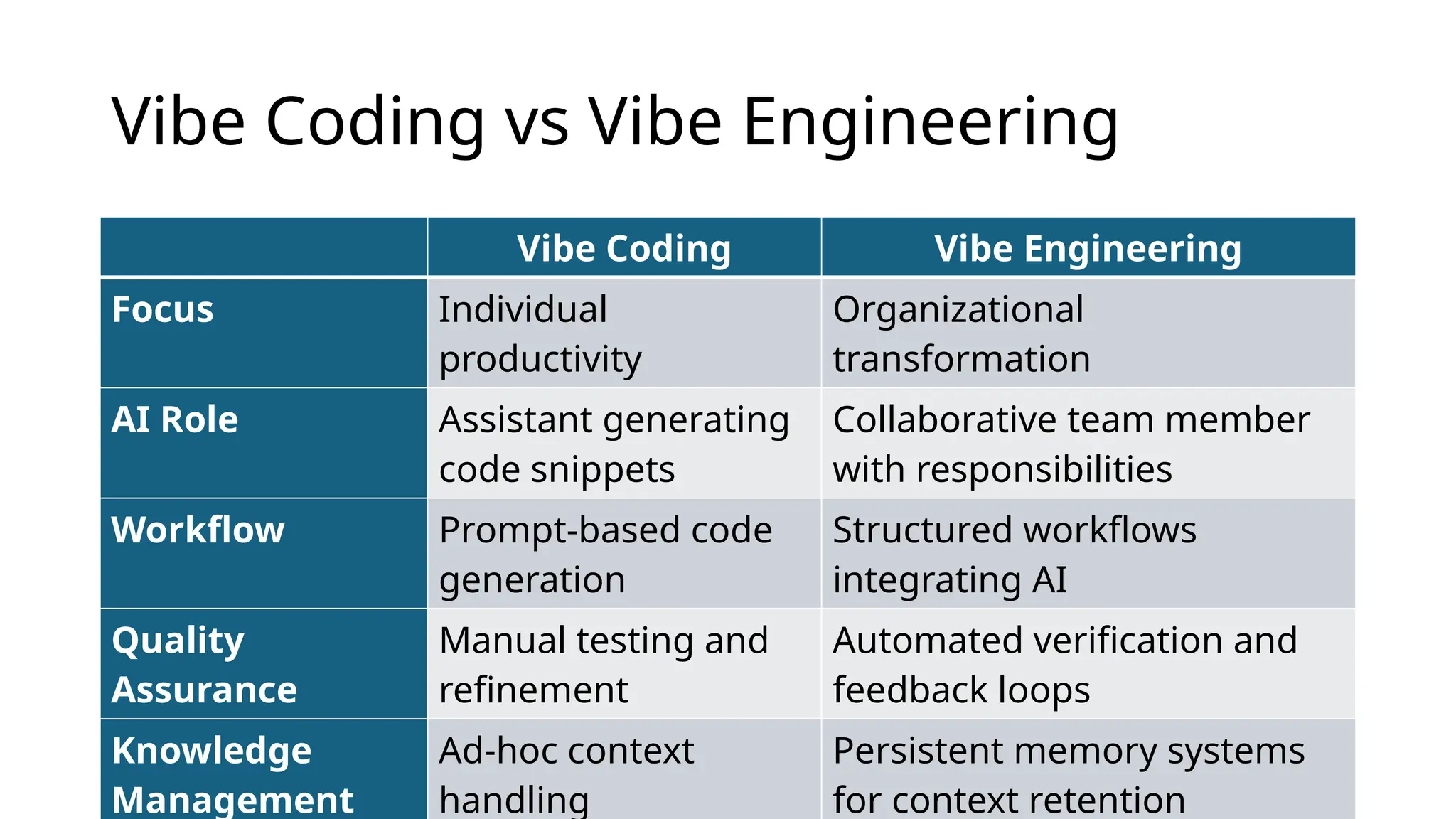
Vibe Coding vs Vibe Engineering
Vibe Coding Vibe Engineering
Focus Individual
productivity
Organizational
transformation
AI Role Assistant generating
code snippets
Collaborative team member
with responsibilities
Workflow Prompt-based code
generation
Structured workflows
integrating AI
Quality
Assurance
Manual testing and
refinement
Automated verification and
feedback loops
Knowledge
Management
Ad-hoc context
handling
Persistent memory systems
for context retention
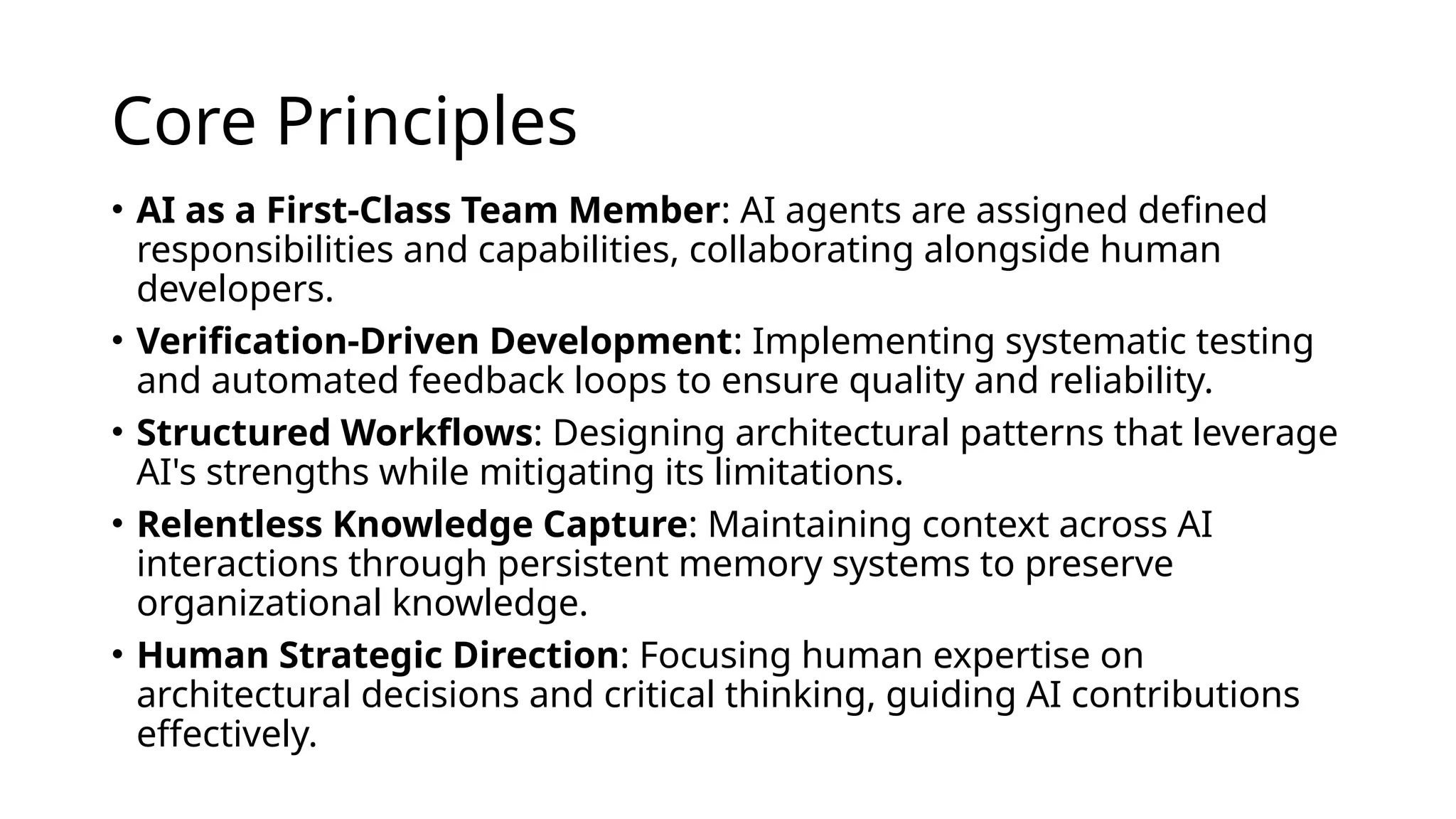
Core Principles
• AI as a First-Class Team Member: AI agents are assigned defined
responsibilities and capabilities, collaborating alongside human
developers.​
• Verification-Driven Development: Implementing systematic testing
and automated feedback loops to ensure quality and reliability.​
• Structured Workflows: Designing architectural patterns that leverage
AI's strengths while mitigating its limitations.​
• Relentless Knowledge Capture: Maintaining context across AI
interactions through persistent memory systems to preserve
organizational knowledge.​
• Human Strategic Direction: Focusing human expertise on
architectural decisions and critical thinking, guiding AI contributions
effectively.
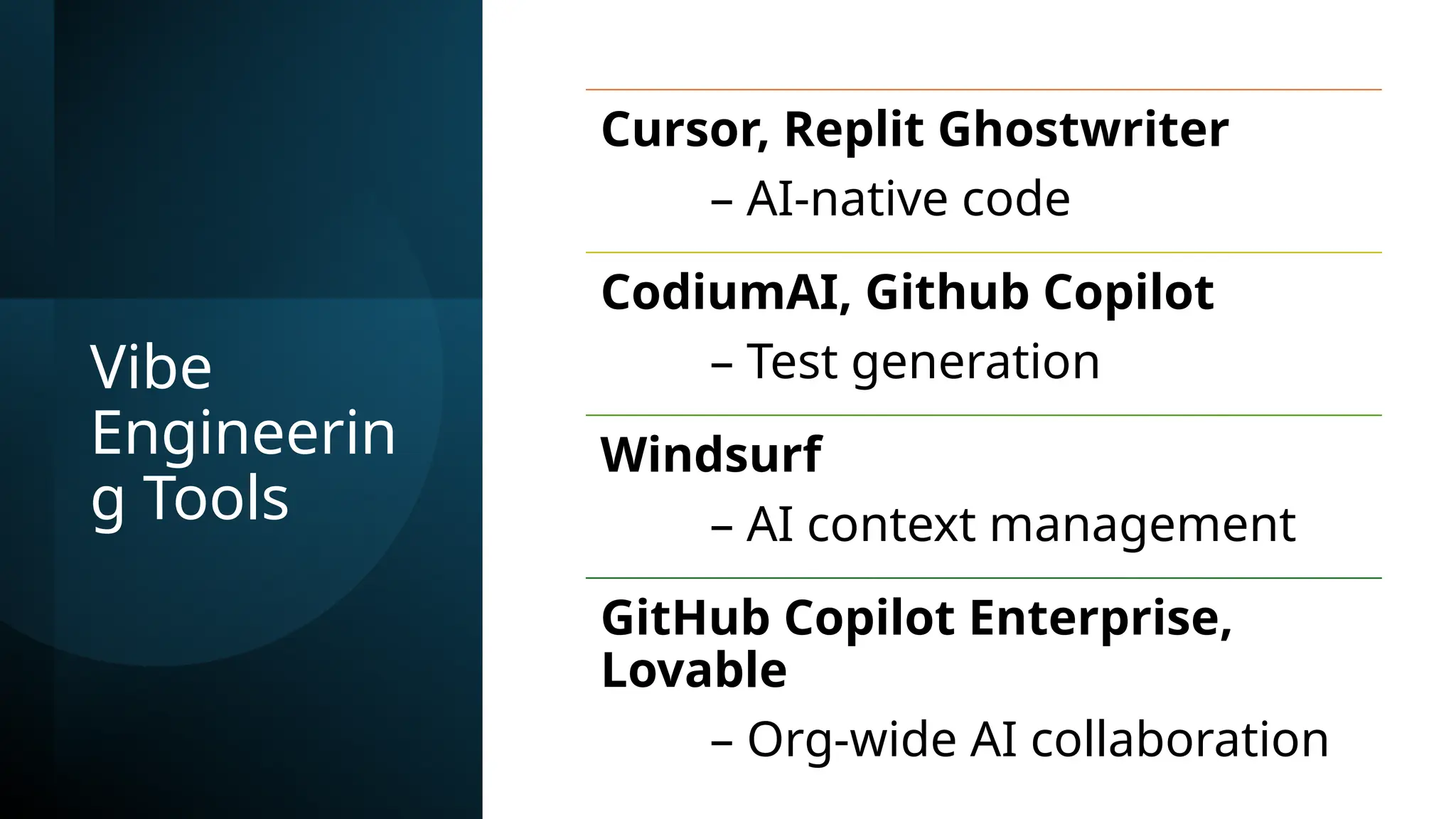
Vibe
Engineerin
g Tools
Cursor, Replit Ghostwriter
– AI-native code
CodiumAI, Github Copilot
– Test generation
Windsurf
– AI context management
GitHub Copilot Enterprise,
Lovable
– Org-wide AI collaboration
Developer Workflow
Team starts
with a
product
spec.
AI agent
drafts
boilerplate,
writes tests,
scaffolds
APIs.
Human
edits high-
level logic.
Verification
pipeline
catches
regressions.
Persistent
memory
tracks
decisions.
Organisation Implications
•How team roles change:
•less boilerplate, more design/strategy.
•Challenges:
•trust, code quality, AI oversight, onboarding.
•What’s emerging:
•AI-augmented org charts, agent-driven
sprints.
Introduction to Vibe Coding and Vibe Engineering

Introduction to Vibe Coding and Vibe Engineering

  • 1.
    Vibe Coding and VibeEngineering Damian Gordon
  • 2.
    Contents •What is VibeCoding? • Developer Workflow • Vibe Coding Tools • Best Practices • Risks and Benefits •What is Vibe Engineering? • Principles of VE • Organisational Implications
  • 3.
  • 4.
    What is Vibe Coding? •“Vibe coding”is the use of natural language to program via generative AI. So the coding is done by expressing intent or a “vibe,” rather than writing logic line by line. •“You just say things, run things, and it mostly works.” - Andrej Karpathy, OpenAI
  • 5.
    What is VibeCoding? • A simple analogy would be hiring your own personal shopper to buy clothes for you. • You describe the look or feel of clothes you want (e.g. "I need a cozy set of summer outfits") • The shopper interprets your intent and curates outfits • You try things on, give feedback ("Too formal", "Try warmer tones") • The shopper handles the technical side: sizing, brands, inventory • The shopper speeds up your process but doesn’t remove your taste or final judgment
  • 6.
    What is VibeCoding? • So for Vibe Coding. • You describe the vibe or function of the software you want (e,g, "Build a cozy landing page with soft gradients and gentle animations") • The GenAI interprets your prompt and generates code (UI, copy, layout, animations) • You test/refine the output ("Make it simpler", "Use a pastel palette", "Add spring easing") • The GenAI handles implementation: syntax, layout logic, libraries • The AI accelerates development, but you still review, edit, and deploy
  • 7.
  • 8.
    Vibe Coding Tools ChatGPT /Claude / Gemini – Conversational coding Cursor – AI-native code editor SuperWhisper – Voice-to-code Replit Ghostwriter – In-browser AI dev Lovable.so / Builder.io – Natural language UI builders
  • 9.
    Vibe Coding: PromptGuide •Structure for Effective Prompts • 1. Intent: What are you building? • 2. Vibe: What should it *feel* like? • 3. Style/Constraints: Tech stack, design choices, features • 4. Output format: What do you want returned?
  • 10.
    Vibe Coding: PromptGuide •Example Prompt • “Create a landing page for a meditation app. The vibe should be calm and minimal with a soft gradient background and slow animations. Use React + Tailwind. Return full component code.”
  • 11.
    Vibe Keywords Visual MotionTone Style soft, dreamy smooth, slow, fluid playful, formal retro, brutalist cozy, warm springy, elastic gentle, sharp minimal, maximal dark, moody quick, responsive calming, bold glassy, grainy
  • 12.
    Vibe Coding: PromptGuide •Refinement Prompts • “Make it feel lighter/more playful.” • “Use serif fonts for a vintage vibe.” • “Add hover effects that feel soft.” • “Convert this to Vue instead of React.” • “Can you simplify the layout?”
  • 13.
    Best Practices Prompt Engineering is thenew syntax. Prompt structure: give context, intent, constraints. You design by mood, outcome, or story “Make it feel like a rainy Sunday.” Iteration is fluid “Make it more minimal.” “Try it in a darker theme.” Code vetting The human must be in the loop.
  • 14.
    Vibe Coding: Risks •Understanding: • The GenAI doesn’t understand anything, so it’s up to you understand the code even if you didn’t write it. • Debugging bottlenecks: • What happens when something breaks? • Security issues: • AI might introduce silent vulnerabilities. • Ethical concerns: • Who owns the generated code?
  • 15.
    Vibe Coding: Risks •Contradictions • Repetition • Ambiguity • Stereotyping • Hallucinations • Bias • Overgeneralization • Toxicity
  • 16.
    Vibe Coding: Benefits •Accessibility: • Lowers the barrier to entry for software development, enabling non-programmers to create applications. • Efficiency: • Accelerates the development process by automating routine coding tasks. • Creativity: • Allows developers to focus on high-level design and functionality
  • 17.
    Summary •Vibe coding isnot the end of programming - it's the beginning of a new kind of creative-human/AI collaboration.
  • 18.
  • 19.
    What is Vibe Engineerin g? • “VibeEngineering” is a strategic approach to software development that treats AI not merely as a tool but as a collaborative team member. • It involves reimagining how software teams operate by integrating AI into every facet of the development lifecycle.
  • 20.
    Vibe Coding vsVibe Engineering Vibe Coding Vibe Engineering Focus Individual productivity Organizational transformation AI Role Assistant generating code snippets Collaborative team member with responsibilities Workflow Prompt-based code generation Structured workflows integrating AI Quality Assurance Manual testing and refinement Automated verification and feedback loops Knowledge Management Ad-hoc context handling Persistent memory systems for context retention
  • 21.
    Core Principles • AIas a First-Class Team Member: AI agents are assigned defined responsibilities and capabilities, collaborating alongside human developers.​ • Verification-Driven Development: Implementing systematic testing and automated feedback loops to ensure quality and reliability.​ • Structured Workflows: Designing architectural patterns that leverage AI's strengths while mitigating its limitations.​ • Relentless Knowledge Capture: Maintaining context across AI interactions through persistent memory systems to preserve organizational knowledge.​ • Human Strategic Direction: Focusing human expertise on architectural decisions and critical thinking, guiding AI contributions effectively.
  • 22.
    Vibe Engineerin g Tools Cursor, ReplitGhostwriter – AI-native code CodiumAI, Github Copilot – Test generation Windsurf – AI context management GitHub Copilot Enterprise, Lovable – Org-wide AI collaboration
  • 23.
    Developer Workflow Team starts witha product spec. AI agent drafts boilerplate, writes tests, scaffolds APIs. Human edits high- level logic. Verification pipeline catches regressions. Persistent memory tracks decisions.
  • 24.
    Organisation Implications •How teamroles change: •less boilerplate, more design/strategy. •Challenges: •trust, code quality, AI oversight, onboarding. •What’s emerging: •AI-augmented org charts, agent-driven sprints.