Before
classification:
PROFILE
DESCRIPTION!!!
The capital letters like H, O, A, E, B, C and R represent the
master horizons and layers of soils.
The capital letters are the base symbols to which other
characters are added to complete the designation (i.e.
2Btg1).
Most are genetic soil horizons, reflecting a qualitative
judgement about the kind of changes which have taken
place.
Genetic horizons are not equivalent to diagnostic
horizons, although they may be identical in soil profiles.
Diagnostic horizons are quantitatively defined features
used in classification.
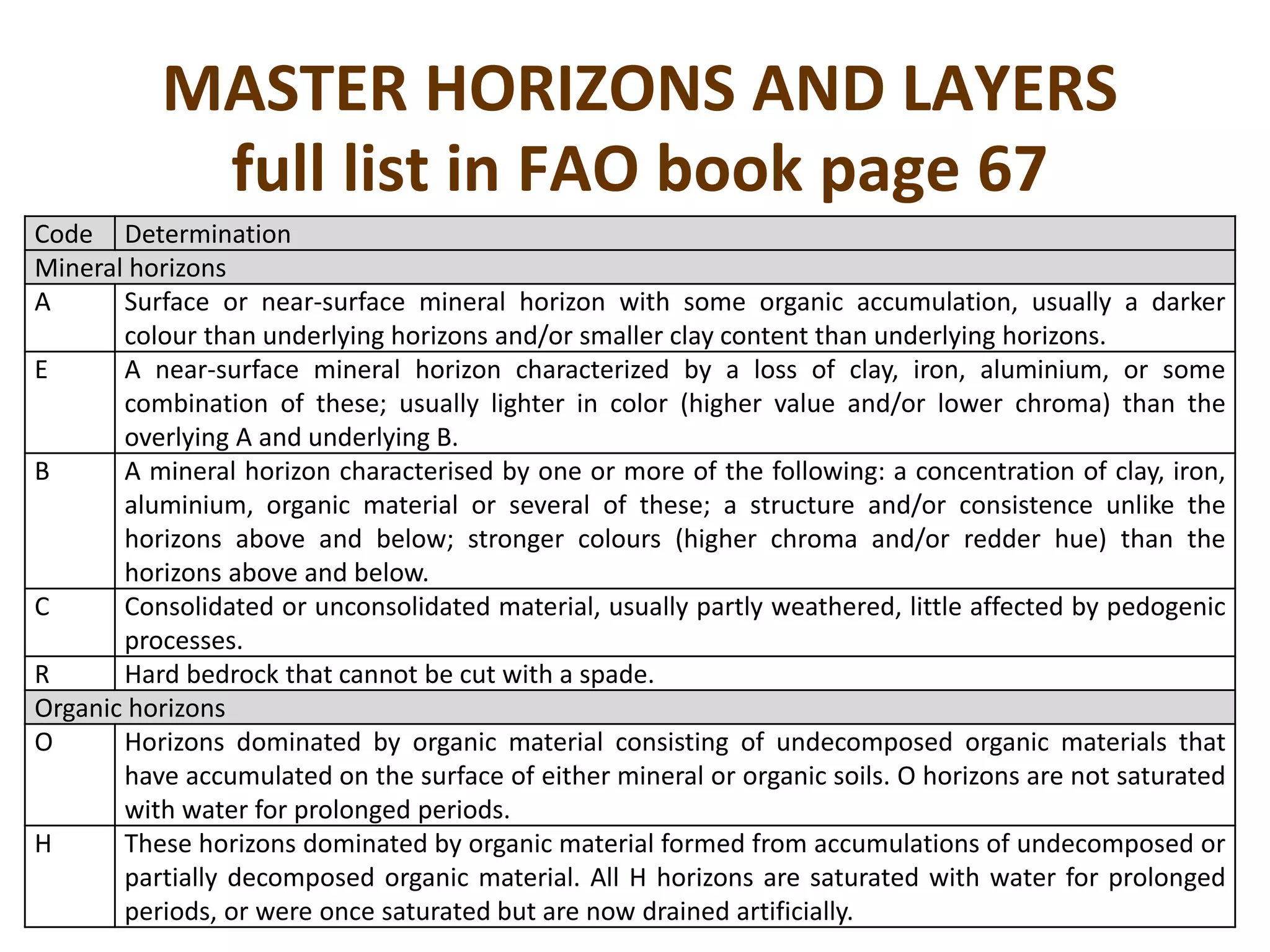
MASTER HORIZONS AND LAYERS
Code Determination
Mineral horizons
A Surface or near-surface mineral horizon with some organic accumulation, usually a darker
colour than underlying horizons and/or smaller clay content than underlying horizons.
E A near-surface mineral horizon characterized by a loss of clay, iron, aluminium, or some
combination of these; usually lighter in color (higher value and/or lower chroma) than the
overlying A and underlying B.
B A mineral horizon characterised by one or more of the following: a concentration of clay, iron,
aluminium, organic material or several of these; a structure and/or consistence unlike the
horizons above and below; stronger colours (higher chroma and/or redder hue) than the
horizons above and below.
C Consolidated or unconsolidated material, usually partly weathered, little affected by pedogenic
processes.
R Hard bedrock that cannot be cut with a spade.
Organic horizons
O Horizons dominated by organic material consisting of undecomposed organic materials that
have accumulated on the surface of either mineral or organic soils. O horizons are not saturated
with water for prolonged periods.
H These horizons dominated by organic material formed from accumulations of undecomposed or
partially decomposed organic material. All H horizons are saturated with water for prolonged
periods, or were once saturated but are now drained artificially.
MASTER HORIZONS AND LAYERS
full list in FAO book page 67
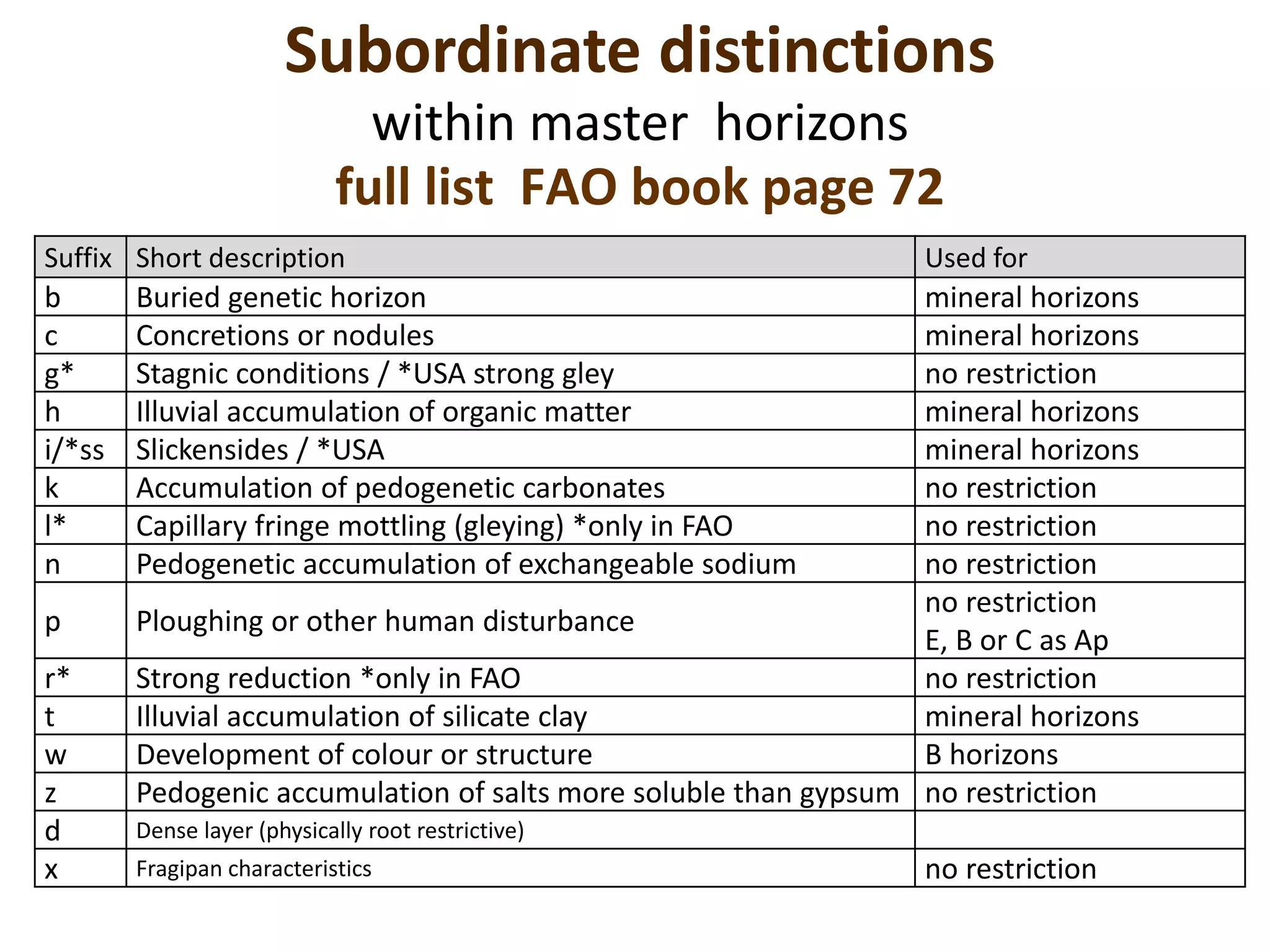
Suffix Short description Used for
b Buried genetic horizon mineral horizons
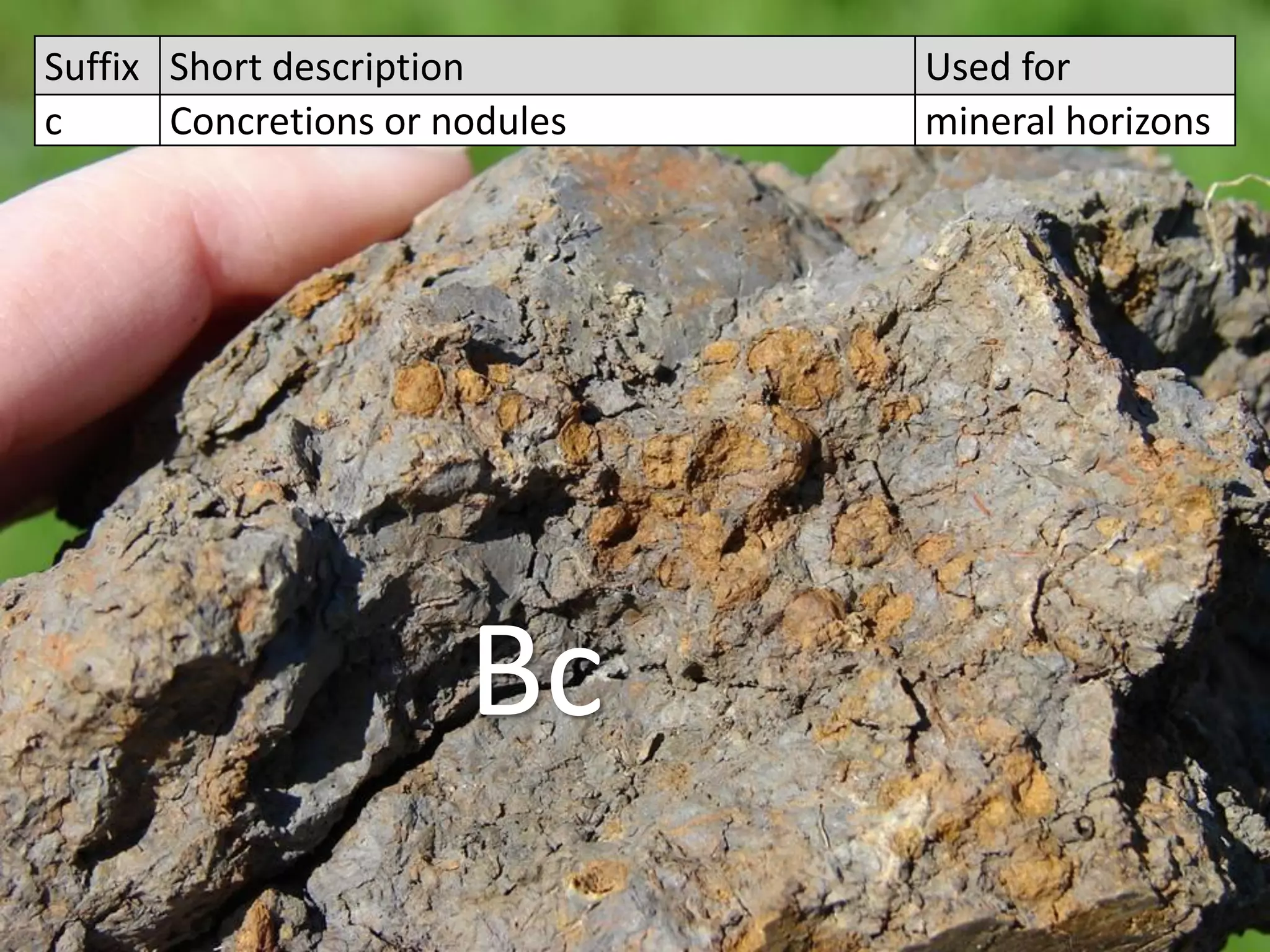
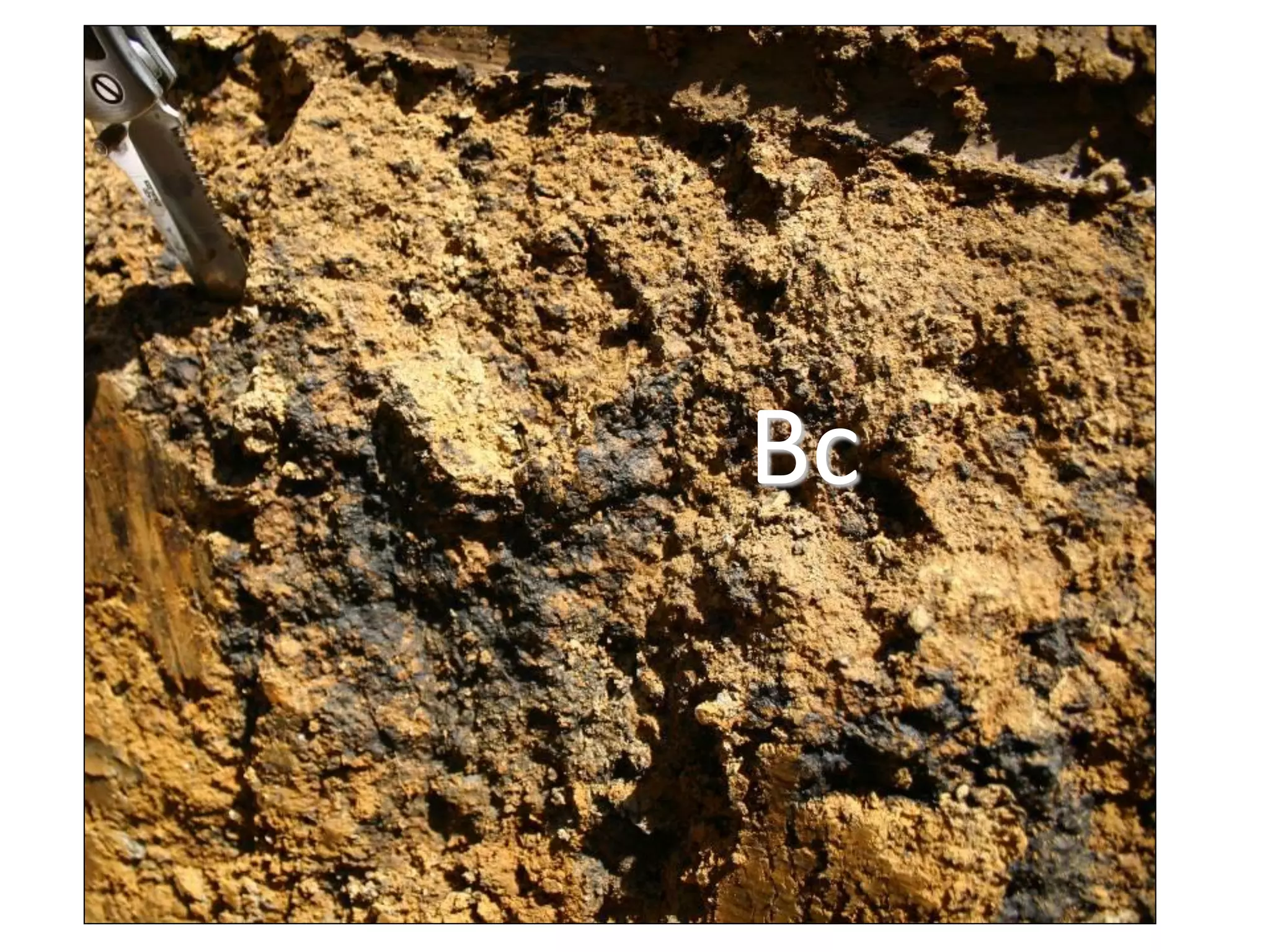
c Concretions or nodules mineral horizons
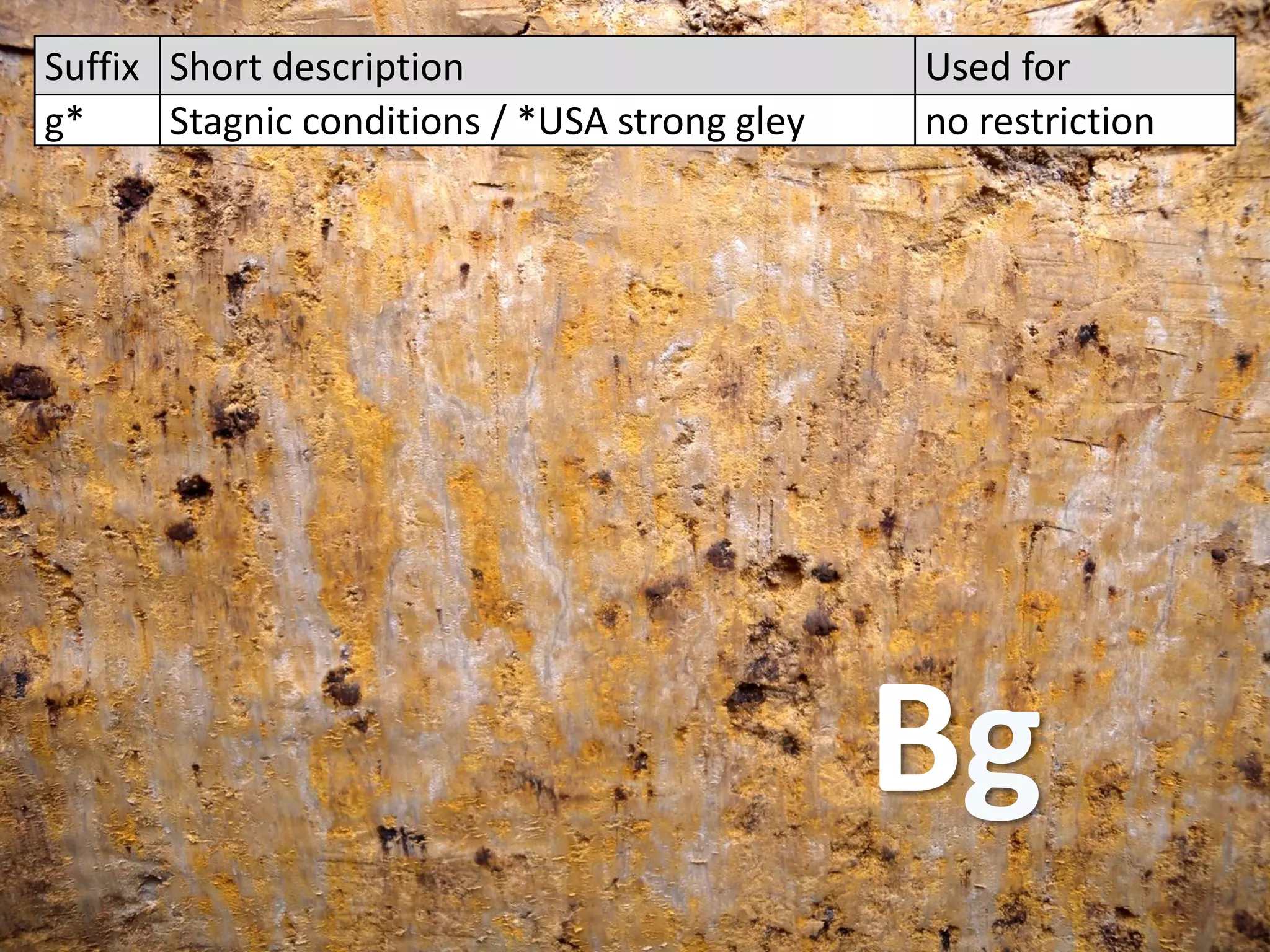
g* Stagnic conditions / *USA strong gley no restriction
h Illuvial accumulation of organic matter mineral horizons
i/*ss Slickensides / *USA mineral horizons
k Accumulation of pedogenetic carbonates no restriction
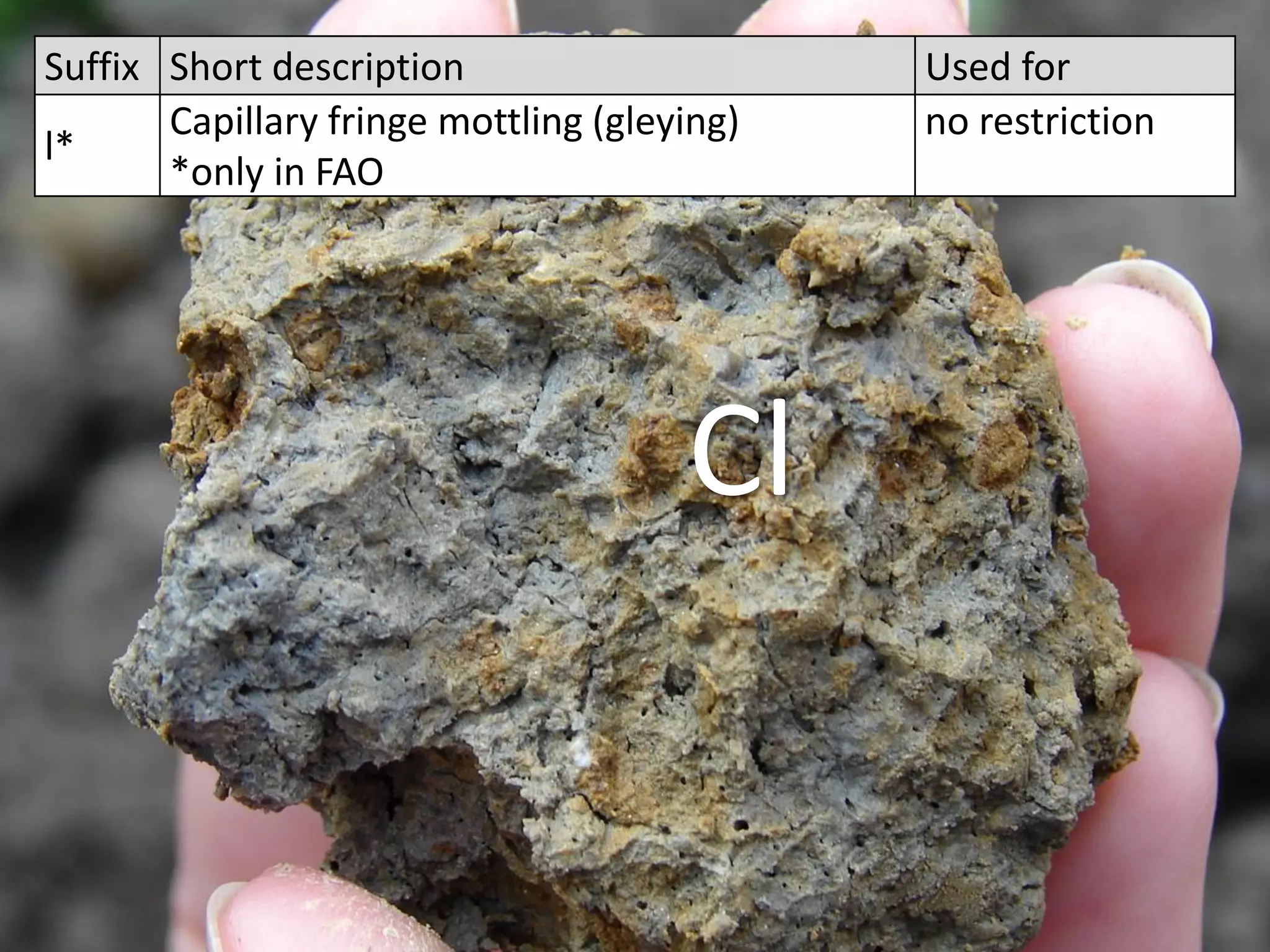
l* Capillary fringe mottling (gleying) *only in FAO no restriction
n Pedogenetic accumulation of exchangeable sodium no restriction
p Ploughing or other human disturbance
no restriction
E, B or C as Ap
r* Strong reduction *only in FAO no restriction
t Illuvial accumulation of silicate clay mineral horizons
w Development of colour or structure B horizons
z Pedogenic accumulation of salts more soluble than gypsum no restriction
d Dense layer (physically root restrictive)
x Fragipan characteristics no restriction
Subordinate distinctions
within master horizons
full list FAO book page 72
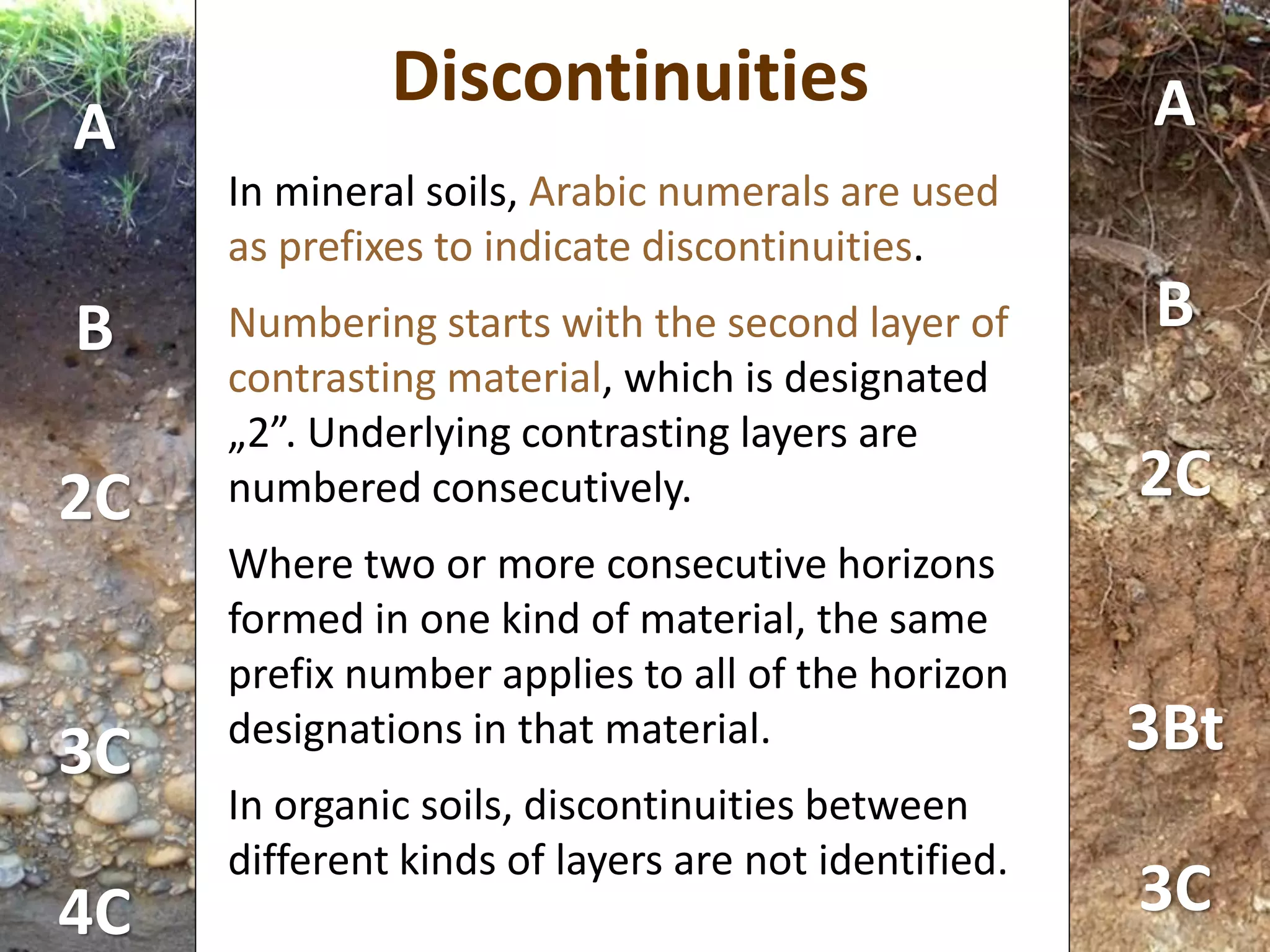
Discontinuities
In mineral soils, Arabic numerals are used
as prefixes to indicate discontinuities.
Numbering starts with the second layer of
contrasting material, which is designated
„2”. Underlying contrasting layers are
numbered consecutively.
Where two or more consecutive horizons
formed in one kind of material, the same
prefix number applies to all of the horizon
designations in that material.
In organic soils, discontinuities between
different kinds of layers are not identified.
A
B
2C
3C
4C
A
B
2C
3Bt
3C
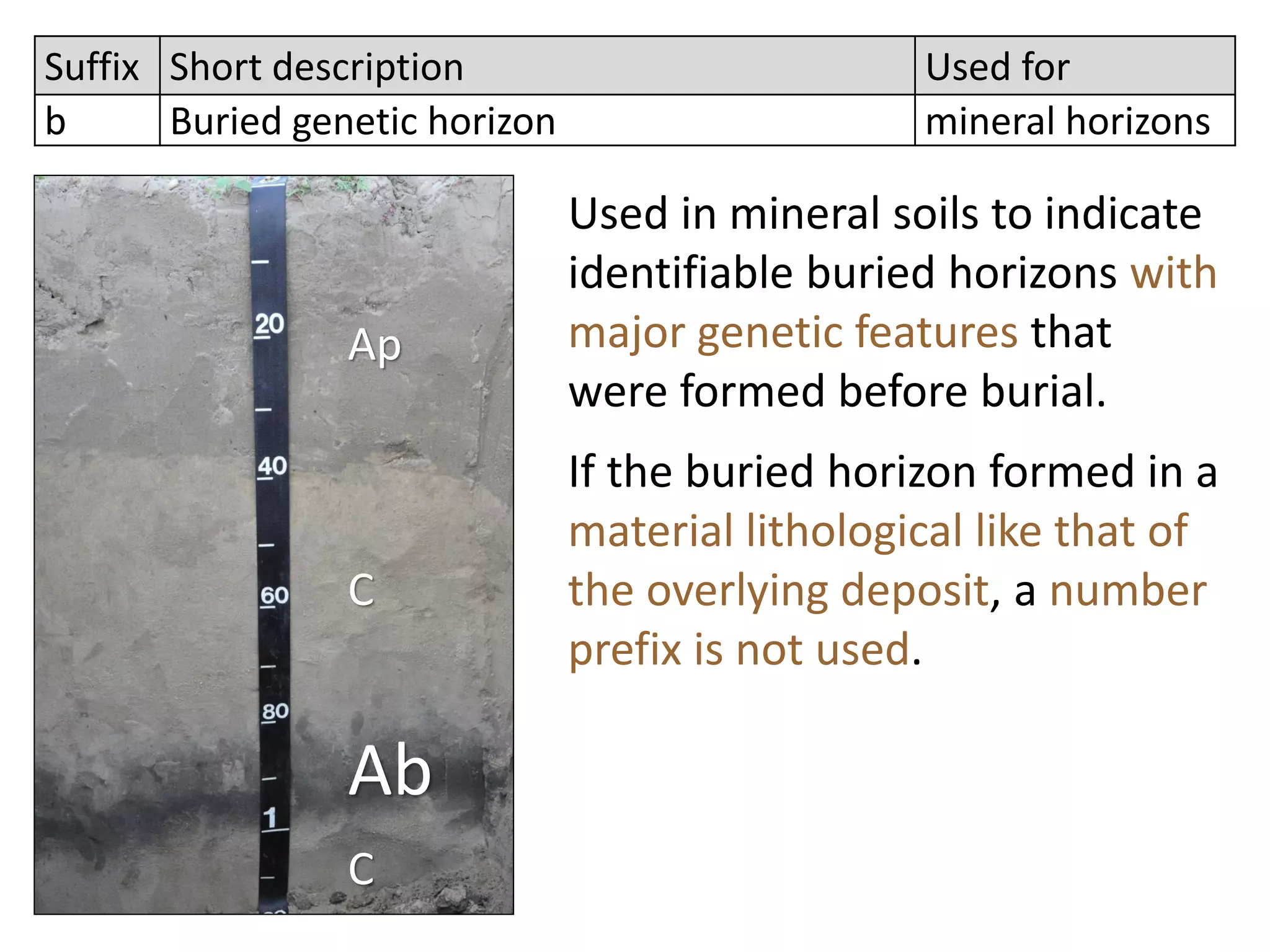
Suffix Short description Used for
b Buried genetic horizon mineral horizons
Ap
C
Ab
C
Used in mineral soils to indicate
identifiable buried horizons with
major genetic features that
were formed before burial.
If the buried horizon formed in a
material lithological like that of
the overlying deposit, a number
prefix is not used.
Suffix Short description Used for
b Buried genetic horizon mineral horizons
Ap
AB
B
2Ab
2Blb
2Cl
Used in mineral soils to indicate
identifiable buried horizons with
major genetic features that
were formed before burial.
If the material in which a
horizon of a buried soil formed
is lithological unlike that of the
overlying material, the
discontinuity is designated by
number prefixes and the „b”
symbol for a buried horizon is
used as well.
Cr
Suffix Short description Used for
r* Strong reduction *only in FAO no restriction
Cr
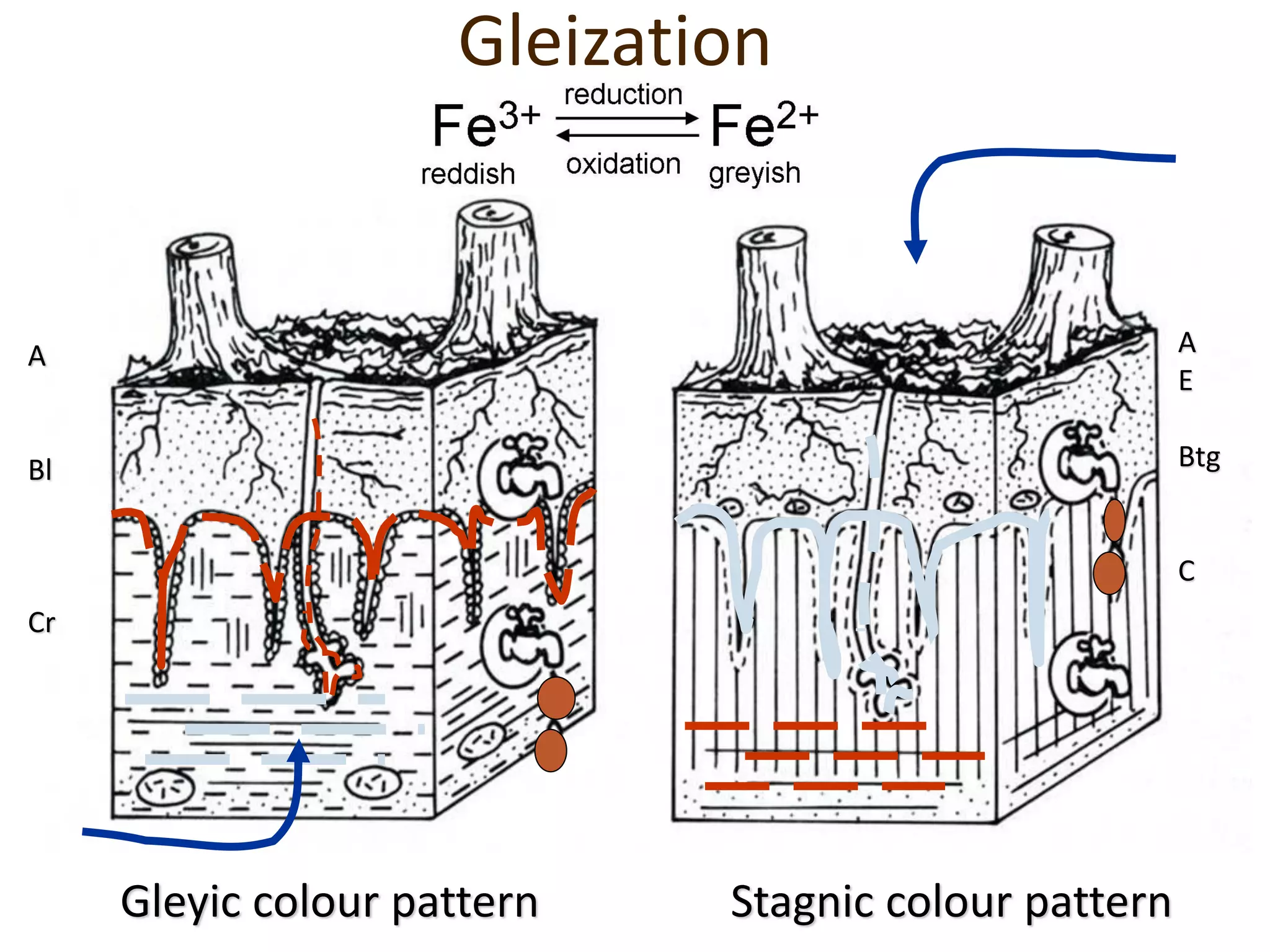
Gleyic colour pattern Stagnic colour pattern
Gleization
A
E
Btg
C
A
Bl
Cr
Suffix Short description Used for
l*
Capillary fringe mottling (gleying)
*only in FAO
no restriction
Cl
Suffix Short description Used for
g* Stagnic conditions / *USA strong gley no restriction
Bg
Bc
Suffix Short description Used for
c Concretions or nodules mineral horizons
Bc
PAGE 79
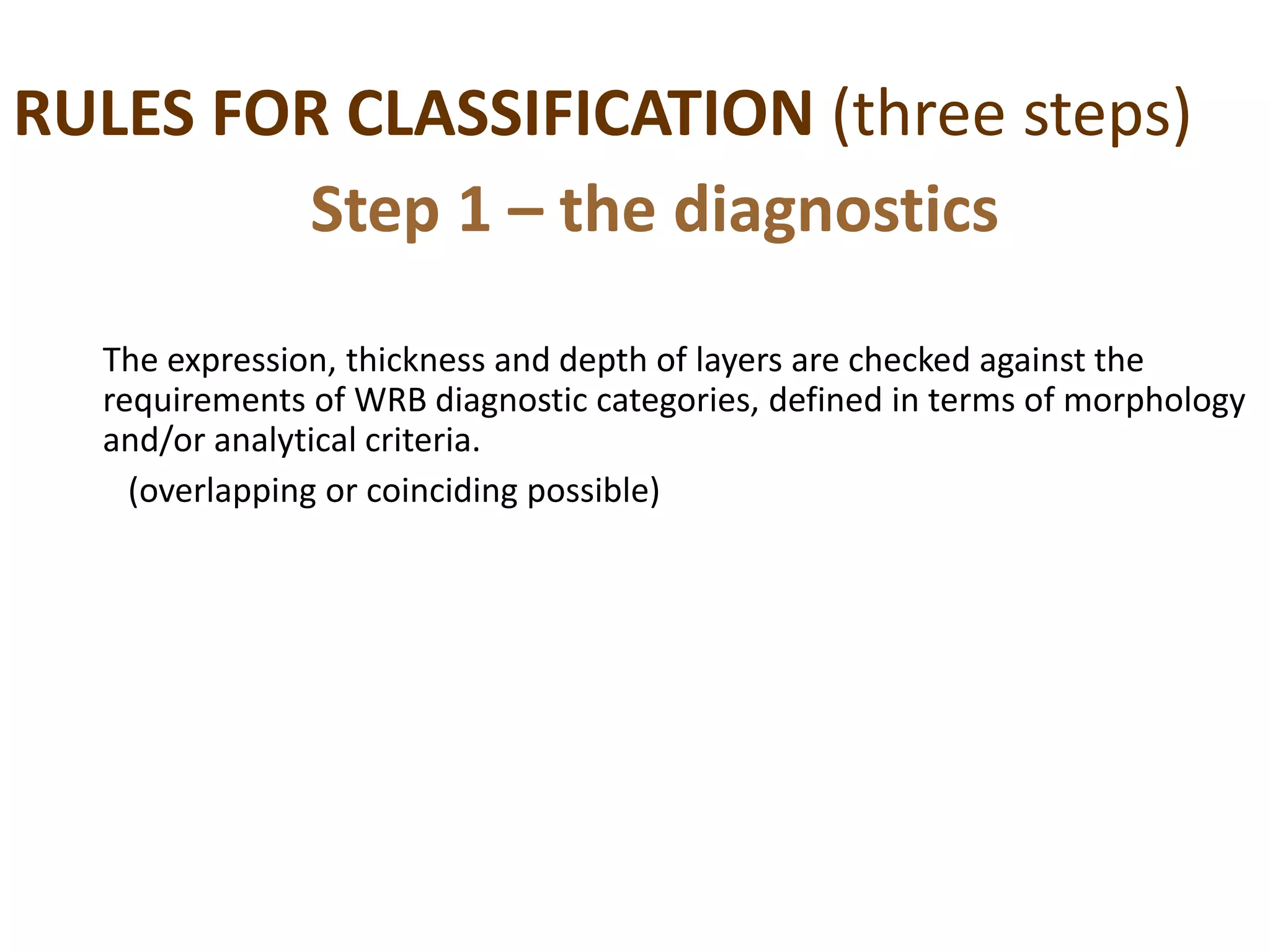
RULES FOR CLASSIFICATION (three steps)
The expression, thickness and depth of layers are checked against the
requirements of WRB diagnostic categories, defined in terms of morphology
and/or analytical criteria.
(overlapping or coinciding possible)
Step 1 – the diagnostics
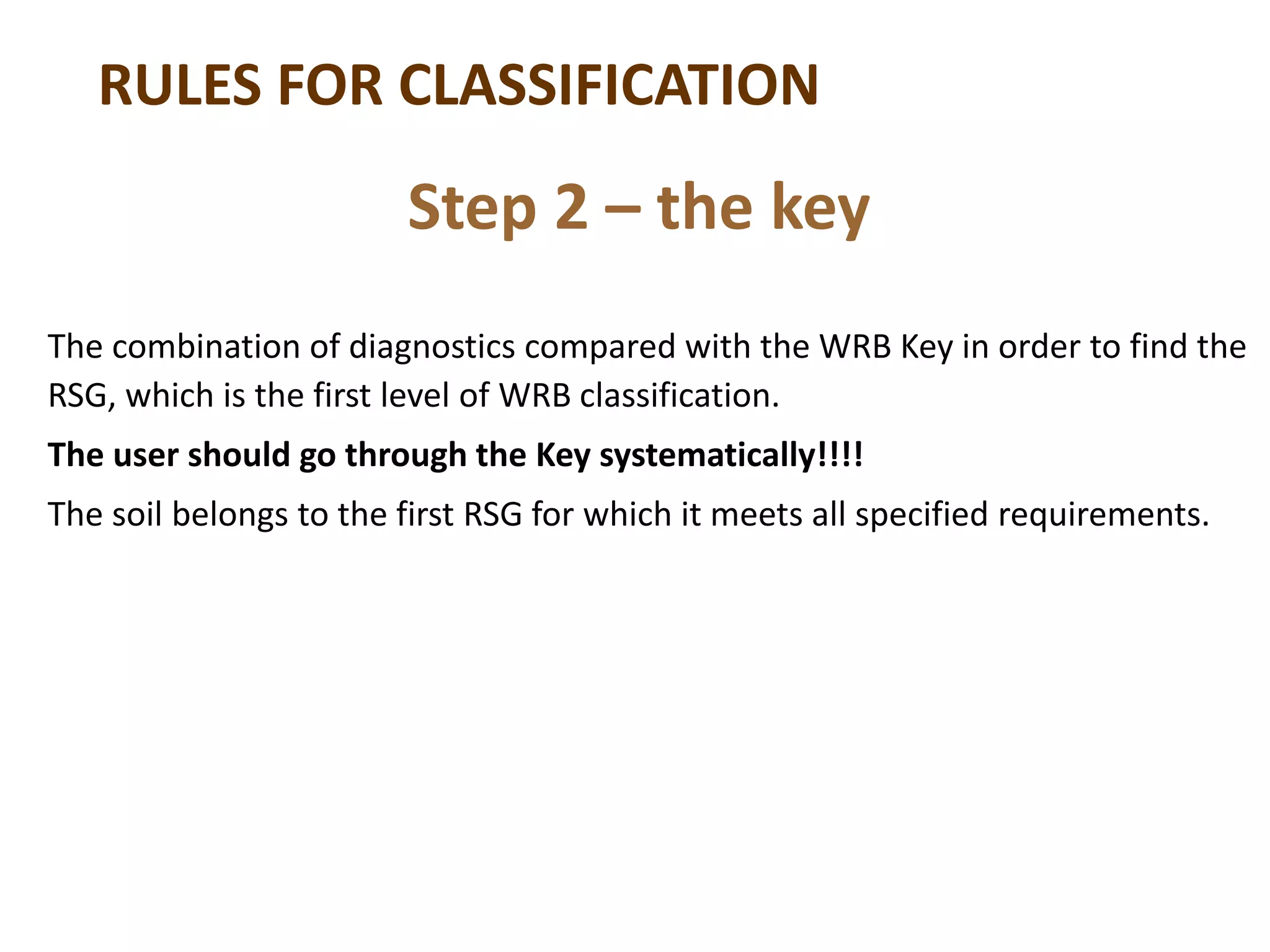
RULES FOR CLASSIFICATION
The combination of diagnostics compared with the WRB Key in order to find the
RSG, which is the first level of WRB classification.
The user should go through the Key systematically!!!!
The soil belongs to the first RSG for which it meets all specified requirements.
Step 2 – the key
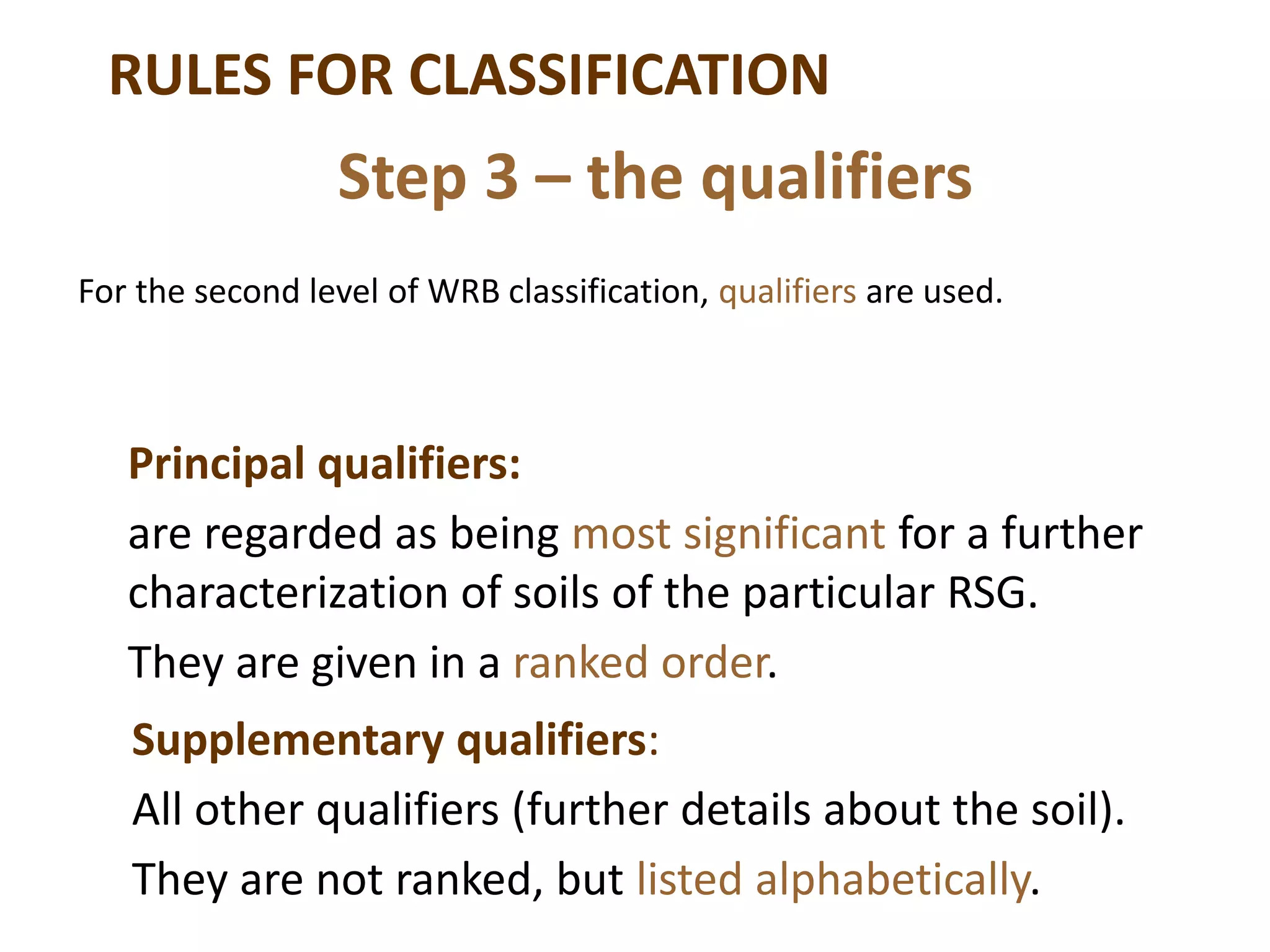
RULES FOR CLASSIFICATION
For the second level of WRB classification, qualifiers are used.
Step 3 – the qualifiers
Principal qualifiers:
are regarded as being most significant for a further
characterization of soils of the particular RSG.
They are given in a ranked order.
Supplementary qualifiers:
All other qualifiers (further details about the soil).
They are not ranked, but listed alphabetically.
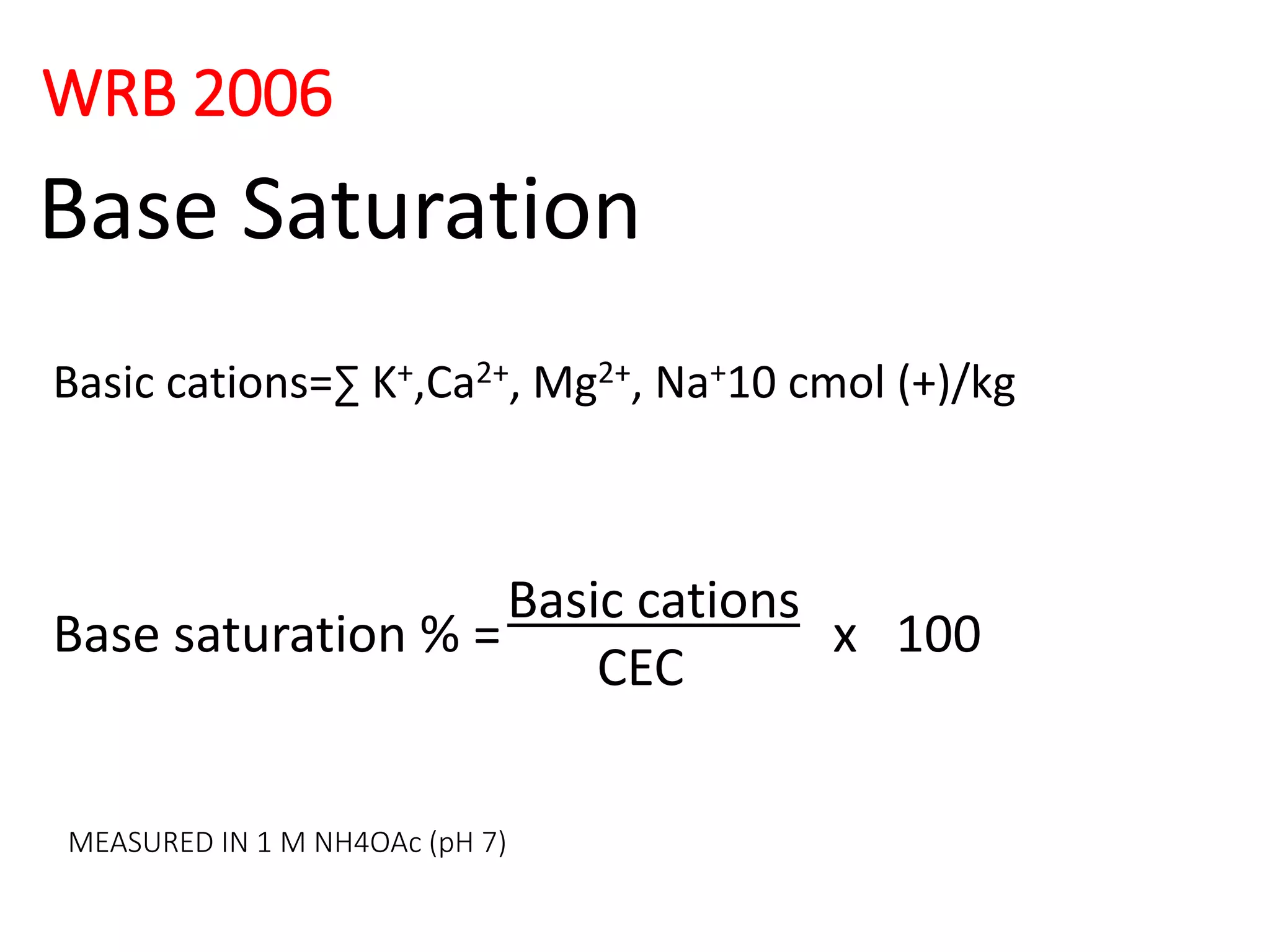
Base Saturation
Basic cations=∑ K+,Ca2+, Mg2+, Na+10 cmol (+)/kg
Basic cations
CEC
Base saturation % = x 100
MEASURED IN 1 M NH4OAc (pH 7)
WRB 2006
WRB2014/2015
Effective base saturation
Exchangeable (Ca+ Mg + K + Na)
Exchangeable (Ca + Mg+ K + Na)+ Al
exchangeable bases by 1 M NH4OAc (pH 7),
exchangeable Al by 1 M KCl (unbuffered)] of < 50%:
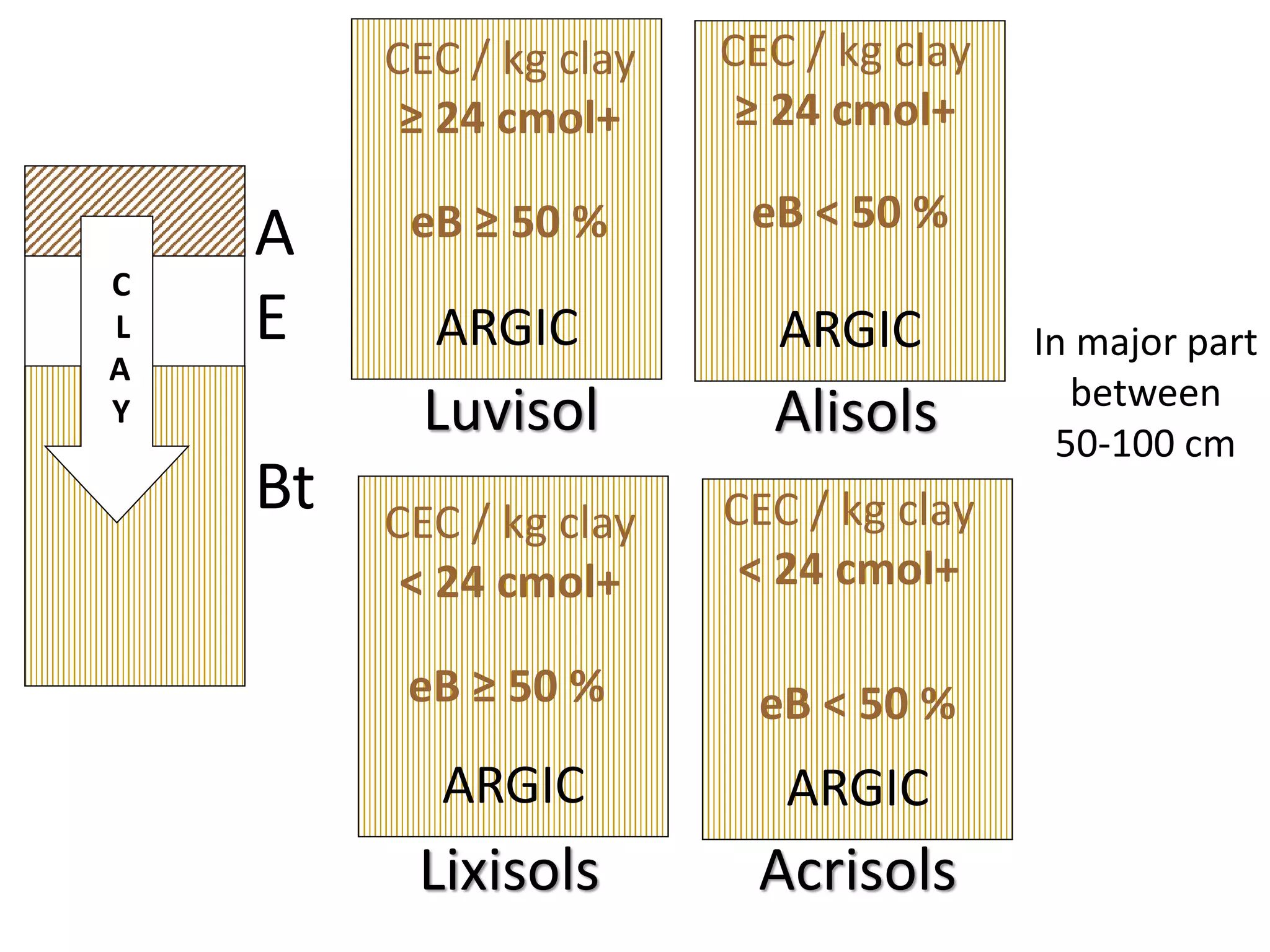
A
E
Bt
C
L
A
Y
ARGIC ARGIC
ARGIC ARGIC
CEC / kg clay
≥ 24 cmol+
CEC / kg clay
≥ 24 cmol+
CEC / kg clay
< 24 cmol+
CEC / kg clay
< 24 cmol+
eB ≥ 50 %
eB ≥ 50 %
eB < 50 %
eB < 50 %
Luvisol Alisols
Lixisols Acrisols
In major part
between
50-100 cm

Before classification: profile description

  • 1.
  • 2.
    The capital letterslike H, O, A, E, B, C and R represent the master horizons and layers of soils. The capital letters are the base symbols to which other characters are added to complete the designation (i.e. 2Btg1). Most are genetic soil horizons, reflecting a qualitative judgement about the kind of changes which have taken place. Genetic horizons are not equivalent to diagnostic horizons, although they may be identical in soil profiles. Diagnostic horizons are quantitatively defined features used in classification. MASTER HORIZONS AND LAYERS
  • 3.
    Code Determination Mineral horizons ASurface or near-surface mineral horizon with some organic accumulation, usually a darker colour than underlying horizons and/or smaller clay content than underlying horizons. E A near-surface mineral horizon characterized by a loss of clay, iron, aluminium, or some combination of these; usually lighter in color (higher value and/or lower chroma) than the overlying A and underlying B. B A mineral horizon characterised by one or more of the following: a concentration of clay, iron, aluminium, organic material or several of these; a structure and/or consistence unlike the horizons above and below; stronger colours (higher chroma and/or redder hue) than the horizons above and below. C Consolidated or unconsolidated material, usually partly weathered, little affected by pedogenic processes. R Hard bedrock that cannot be cut with a spade. Organic horizons O Horizons dominated by organic material consisting of undecomposed organic materials that have accumulated on the surface of either mineral or organic soils. O horizons are not saturated with water for prolonged periods. H These horizons dominated by organic material formed from accumulations of undecomposed or partially decomposed organic material. All H horizons are saturated with water for prolonged periods, or were once saturated but are now drained artificially. MASTER HORIZONS AND LAYERS full list in FAO book page 67
  • 4.
    Suffix Short descriptionUsed for b Buried genetic horizon mineral horizons c Concretions or nodules mineral horizons g* Stagnic conditions / *USA strong gley no restriction h Illuvial accumulation of organic matter mineral horizons i/*ss Slickensides / *USA mineral horizons k Accumulation of pedogenetic carbonates no restriction l* Capillary fringe mottling (gleying) *only in FAO no restriction n Pedogenetic accumulation of exchangeable sodium no restriction p Ploughing or other human disturbance no restriction E, B or C as Ap r* Strong reduction *only in FAO no restriction t Illuvial accumulation of silicate clay mineral horizons w Development of colour or structure B horizons z Pedogenic accumulation of salts more soluble than gypsum no restriction d Dense layer (physically root restrictive) x Fragipan characteristics no restriction Subordinate distinctions within master horizons full list FAO book page 72
  • 5.
    Discontinuities In mineral soils,Arabic numerals are used as prefixes to indicate discontinuities. Numbering starts with the second layer of contrasting material, which is designated „2”. Underlying contrasting layers are numbered consecutively. Where two or more consecutive horizons formed in one kind of material, the same prefix number applies to all of the horizon designations in that material. In organic soils, discontinuities between different kinds of layers are not identified. A B 2C 3C 4C A B 2C 3Bt 3C
  • 6.
    Suffix Short descriptionUsed for b Buried genetic horizon mineral horizons Ap C Ab C Used in mineral soils to indicate identifiable buried horizons with major genetic features that were formed before burial. If the buried horizon formed in a material lithological like that of the overlying deposit, a number prefix is not used.
  • 7.
    Suffix Short descriptionUsed for b Buried genetic horizon mineral horizons Ap AB B 2Ab 2Blb 2Cl Used in mineral soils to indicate identifiable buried horizons with major genetic features that were formed before burial. If the material in which a horizon of a buried soil formed is lithological unlike that of the overlying material, the discontinuity is designated by number prefixes and the „b” symbol for a buried horizon is used as well.
  • 8.
    Cr Suffix Short descriptionUsed for r* Strong reduction *only in FAO no restriction Cr
  • 9.
    Gleyic colour patternStagnic colour pattern Gleization A E Btg C A Bl Cr
  • 10.
    Suffix Short descriptionUsed for l* Capillary fringe mottling (gleying) *only in FAO no restriction Cl
  • 11.
    Suffix Short descriptionUsed for g* Stagnic conditions / *USA strong gley no restriction Bg
  • 12.
    Bc Suffix Short descriptionUsed for c Concretions or nodules mineral horizons
  • 13.
  • 14.
  • 15.
    RULES FOR CLASSIFICATION(three steps) The expression, thickness and depth of layers are checked against the requirements of WRB diagnostic categories, defined in terms of morphology and/or analytical criteria. (overlapping or coinciding possible) Step 1 – the diagnostics
  • 16.
    RULES FOR CLASSIFICATION Thecombination of diagnostics compared with the WRB Key in order to find the RSG, which is the first level of WRB classification. The user should go through the Key systematically!!!! The soil belongs to the first RSG for which it meets all specified requirements. Step 2 – the key
  • 17.
    RULES FOR CLASSIFICATION Forthe second level of WRB classification, qualifiers are used. Step 3 – the qualifiers Principal qualifiers: are regarded as being most significant for a further characterization of soils of the particular RSG. They are given in a ranked order. Supplementary qualifiers: All other qualifiers (further details about the soil). They are not ranked, but listed alphabetically.
  • 18.
    Base Saturation Basic cations=∑K+,Ca2+, Mg2+, Na+10 cmol (+)/kg Basic cations CEC Base saturation % = x 100 MEASURED IN 1 M NH4OAc (pH 7) WRB 2006
  • 19.
    WRB2014/2015 Effective base saturation Exchangeable(Ca+ Mg + K + Na) Exchangeable (Ca + Mg+ K + Na)+ Al exchangeable bases by 1 M NH4OAc (pH 7), exchangeable Al by 1 M KCl (unbuffered)] of < 50%:
  • 20.
    A E Bt C L A Y ARGIC ARGIC ARGIC ARGIC CEC/ kg clay ≥ 24 cmol+ CEC / kg clay ≥ 24 cmol+ CEC / kg clay < 24 cmol+ CEC / kg clay < 24 cmol+ eB ≥ 50 % eB ≥ 50 % eB < 50 % eB < 50 % Luvisol Alisols Lixisols Acrisols In major part between 50-100 cm