1
Objectives
• To discuss the effect of soil crusting on growth and yield
of crops and soil properties
• To know about the suitable management practices to
overcome surface crusting
2
Sequence of presention
• Introduction
• Occurrence & causes of soil crusting
• Assessment & prediction of soil crusting
• Mechanism of crust formation in soil
• Types of soil crust
• Factors affecting soil crusting
• Problems with poor plant function
• Prevention of soil crusting
• Rectification of soil crusting
• Research findings
• Conclusion
3
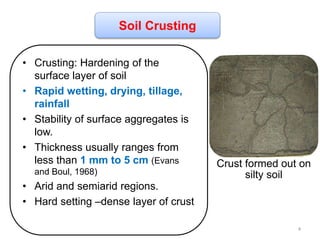
• Crusting: Hardening of the
surface layer of soil
• Rapid wetting, drying, tillage,
rainfall
• Stability of surface aggregates is
low.
• Thickness usually ranges from
less than 1 mm to 5 cm (Evans
and Boul, 1968)
• Arid and semiarid regions.
• Hard setting –dense layer of crust
Soil Crusting
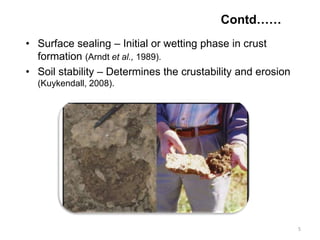
Crust formed out on
silty soil
4
• Surface sealing – Initial or wetting phase in crust
formation (Arndt et al., 1989).
• Soil stability – Determines the crustability and erosion
(Kuykendall, 2008).
Contd……
5
• Colloidal oxides of iron and aluminium in alfisols
• Fine soil texture
• Low organic matter content
• Excessive tillage
• High silt content and salt content
• High exchangeable sodium content
• Puddling of soil
• High clay content
Causes of soil crusting
6
Occurrence of soil Crusting
• Laterite group of soils
• Rainfed agriculture
• In tropical areas → Wider range of soils
• In temperate areas → Unstable loamy soils (Norton and
Scrhoeder, 1987)
Area Distribution Source
India 10.25 m ha Haryana, Punjab,
West Bengal,
Orissa, Gujarat
states
Brajendra and
Bhadana (2014)
Tamil Nadu 4,51,584 ha
(4.5% TGA)
Trichy, Thanjavur,
Pudukottai,
Cuddalore &
Sivaganga districts
Latha and Janaki
(2015)
7
– Greater mechanical strength
– Low porosity
– Higher bulk density
– Higher CEC
– Reduced infiltration rate
– Higher runoff (leads to reduction in soil
moisture)
Characteristics of Soil crust
8
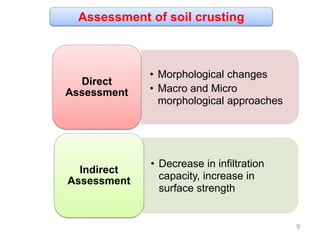
Assessment of soil crusting
• Morphological changes
• Macro and Micro
morphological approaches
Direct
Assessment
• Decrease in infiltration
capacity, increase in
surface strength
Indirect
Assessment
9
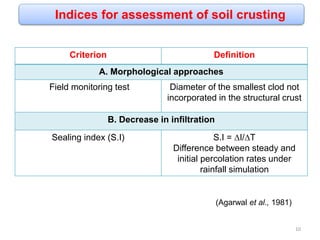
Criterion Definition
A. Morphological approaches
Field monitoring test Diameter of the smallest clod not
incorporated in the structural crust
B. Decrease in infiltration
Sealing index (S.I) S.I = ∆I/∆T
Difference between steady and
initial percolation rates under
rainfall simulation
Indices for assessment of soil crusting
10
(Agarwal et al., 1981)
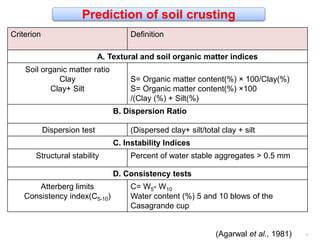
Prediction of soil crusting
11
(Agarwal et al., 1981)
Criterion Definition
A. Textural and soil organic matter indices
Soil organic matter ratio
Clay
Clay+ Silt
S= Organic matter content(%) × 100/Clay(%)
S= Organic matter content(%) ×100
/(Clay (%) + Silt(%)
B. Dispersion Ratio
Dispersion test (Dispersed clay+ silt/total clay + silt
C. Instability Indices
Structural stability Percent of water stable aggregates > 0.5 mm
D. Consistency tests
Atterberg limits
Consistency index(C5-10)
C= W5- W10
Water content (%) 5 and 10 blows of the
Casagrande cup
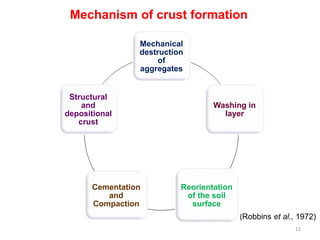
Mechanism of crust formation
Mechanical
destruction
of
aggregates
Washing in
layer
Reorientation
of the soil
surface
Cementation
and
Compaction
Structural
and
depositional
crust
12
(Robbins et al., 1972)
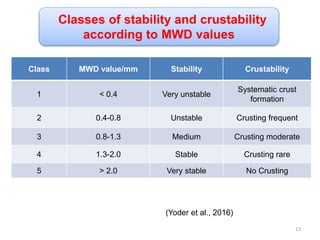
Classes of stability and crustability
according to MWD values
Class MWD value/mm Stability Crustability
1 < 0.4 Very unstable
Systematic crust
formation
2 0.4-0.8 Unstable Crusting frequent
3 0.8-1.3 Medium Crusting moderate
4 1.3-2.0 Stable Crusting rare
5 > 2.0 Very stable No Crusting
13
(Yoder et al., 2016)
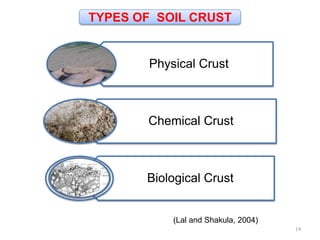
TYPES OF SOIL CRUST
Physical Crust
Chemical Crust
Biological Crust
14
(Lal and Shakula, 2004)
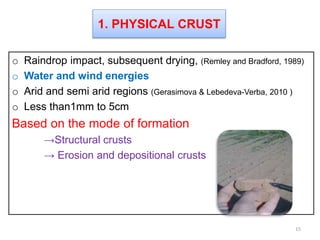
1. PHYSICAL CRUST
o Raindrop impact, subsequent drying, (Remley and Bradford, 1989)
o Water and wind energies
o Arid and semi arid regions (Gerasimova & Lebedeva-Verba, 2010 )
o Less than1mm to 5cm
Based on the mode of formation
→Structural crusts
→ Erosion and depositional crusts
15
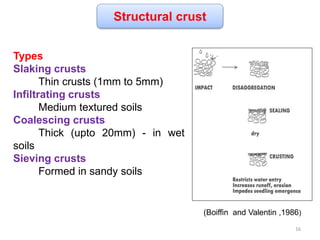
Structural crust
(Boiffin and Valentin ,1986)
16
Types
Slaking crusts
Thin crusts (1mm to 5mm)
Infiltrating crusts
Medium textured soils
Coalescing crusts
Thick (upto 20mm) - in wet
soils
Sieving crusts
Formed in sandy soils
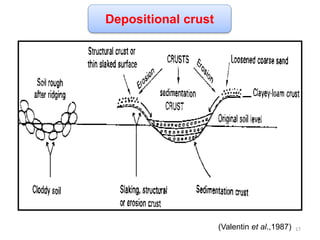
Depositional crust
(Valentin et al.,1987) 17
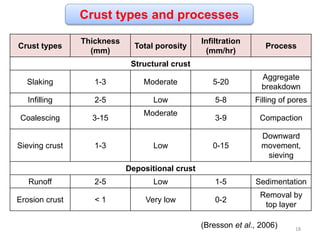
Crust types and processes
Crust types
Thickness
(mm)
Total porosity
Infiltration
(mm/hr)
Process
Structural crust
Slaking 1-3 Moderate 5-20
Aggregate
breakdown
Infilling 2-5 Low 5-8 Filling of pores
Coalescing 3-15
Moderate
3-9 Compaction
Sieving crust 1-3 Low 0-15
Downward
movement,
sieving
Depositional crust
Runoff 2-5 Low 1-5 Sedimentation
Erosion crust < 1 Very low 0-2
Removal by
top layer
(Bresson et al., 2006) 18
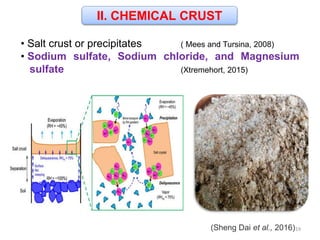
II. CHEMICAL CRUST
• Salt crust or precipitates ( Mees and Tursina, 2008)
• Sodium sulfate, Sodium chloride, and Magnesium
sulfate (Xtremehort, 2015)
(Sheng Dai et al., 2016)19
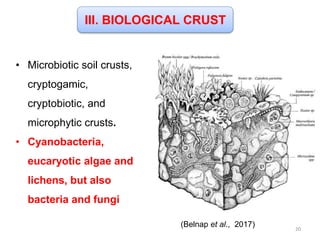
III. BIOLOGICAL CRUST
• Microbiotic soil crusts,
cryptogamic,
cryptobiotic, and
microphytic crusts.
• Cyanobacteria,
eucaryotic algae and
lichens, but also
bacteria and fungi
(Belnap et al., 2017) 20
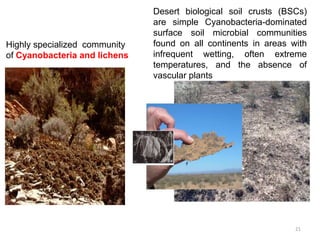
Highly specialized community
of Cyanobacteria and lichens
Desert biological soil crusts (BSCs)
are simple Cyanobacteria-dominated
surface soil microbial communities
found on all continents in areas with
infrequent wetting, often extreme
temperatures, and the absence of
vascular plants
21
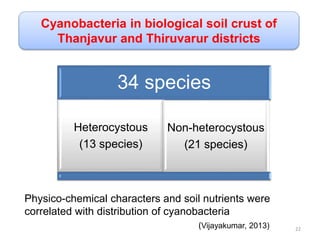
Cyanobacteria in biological soil crust of
Thanjavur and Thiruvarur districts
Physico-chemical characters and soil nutrients were
correlated with distribution of cyanobacteria
34 species
Heterocystous
(13 species)
Non-heterocystous
(21 species)
(Vijayakumar, 2013) 22
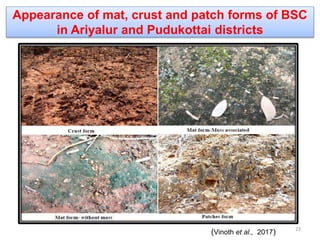
Appearance of mat, crust and patch forms of BSC
in Ariyalur and Pudukottai districts
(Vinoth et al., 2017) 23
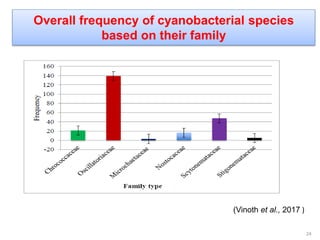
Overall frequency of cyanobacterial species
based on their family
(Vinoth et al., 2017 )
24
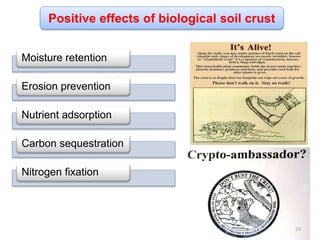
Positive effects of biological soil crust
Moisture retention
Erosion prevention
Nutrient adsorption
Carbon sequestration
Nitrogen fixation
25
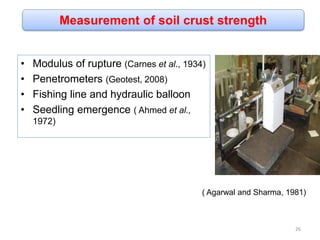
Measurement of soil crust strength
• Modulus of rupture (Carnes et al., 1934)
• Penetrometers (Geotest, 2008)
• Fishing line and hydraulic balloon
• Seedling emergence ( Ahmed et al.,
1972)
( Agarwal and Sharma, 1981)
26
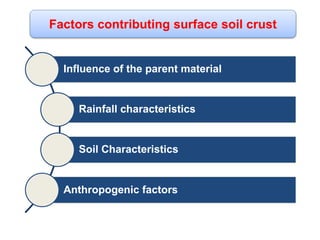
Influence of the parent material
Rainfall characteristics
Soil Characteristics
Anthropogenic factors
Factors contributing surface soil crust
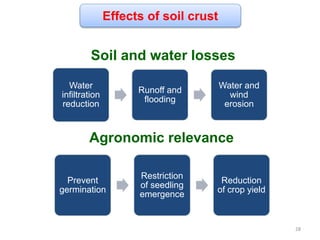
Effects of soil crust
Soil and water losses
Agronomic relevance
Water
infiltration
reduction
Runoff and
flooding
Water and
wind
erosion
Prevent
germination
Restriction
of seedling
emergence
Reduction
of crop yield
28
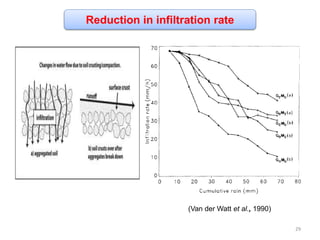
Reduction in infiltration rate
(Van der Watt et al., 1990)
29
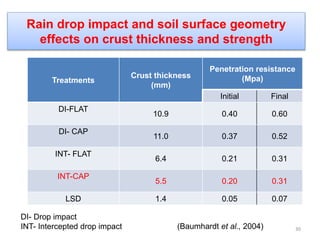
Rain drop impact and soil surface geometry
effects on crust thickness and strength
Treatments
Crust thickness
(mm)
Penetration resistance
(Mpa)
Initial Final
DI-FLAT
10.9 0.40 0.60
DI- CAP
11.0 0.37 0.52
INT- FLAT
6.4 0.21 0.31
INT-CAP
5.5 0.20 0.31
LSD 1.4 0.05 0.07
DI- Drop impact
INT- Intercepted drop impact (Baumhardt et al., 2004) 30
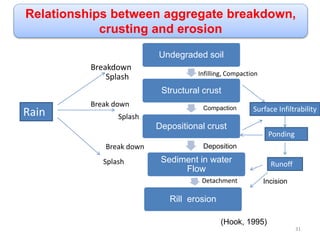
Relationships between aggregate breakdown,
crusting and erosion
(Hook, 1995)
Undegraded soil
Structural crust
Depositional crust
Sediment in water
Flow
Rill erosion
Rain
Breakdown
Splash
Break down
Splash
Compaction
Infilling, Compaction
Deposition
Surface Infiltrability
Ponding
Runoff
Detachment Incision
Break down
Splash
31
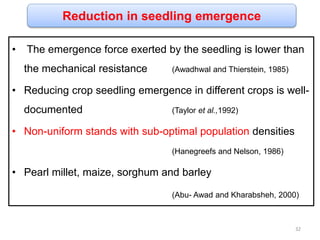
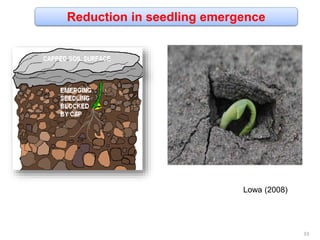
Reduction in seedling emergence
• The emergence force exerted by the seedling is lower than
the mechanical resistance (Awadhwal and Thierstein, 1985)
• Reducing crop seedling emergence in different crops is well-
documented (Taylor et al.,1992)
• Non-uniform stands with sub-optimal population densities
(Hanegreefs and Nelson, 1986)
• Pearl millet, maize, sorghum and barley
(Abu- Awad and Kharabsheh, 2000)
32
Reduction in seedling emergence
Lowa (2008)
33
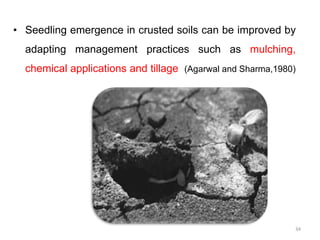
• Seedling emergence in crusted soils can be improved by
adapting management practices such as mulching,
chemical applications and tillage (Agarwal and Sharma,1980)
34
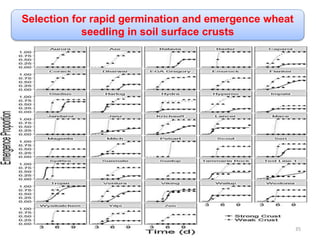
Selection for rapid germination and emergence wheat
seedling in soil surface crusts
35
• Wheat seedling emergence decreased as crust strength
and thickness increased
• For a strong crust, average emergence was 33%,
compared to 87% for a weak crust
(Monia anzoman et al., 2018)
36
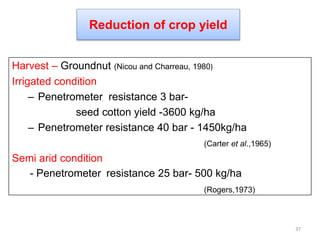
Reduction of crop yield
Harvest – Groundnut (Nicou and Charreau, 1980)
Irrigated condition
– Penetrometer resistance 3 bar-
seed cotton yield -3600 kg/ha
– Penetrometer resistance 40 bar - 1450kg/ha
(Carter et al.,1965)
Semi arid condition
- Penetrometer resistance 25 bar- 500 kg/ha
(Rogers,1973)
37
Problems with poor function
• Crusts restrict seedling emergence, especially in non-
grass crops such as soybeans and alfalfa
• Reduce oxygen diffusion into the soil profile by as much as
50% if the soil crust is wet
• Serious problem to small seeded crops
• Pearl millet, cotton, grain sorghum, soybean, guar, carrot,
mungbean and cowpea.
(Gerard, 1980)
38
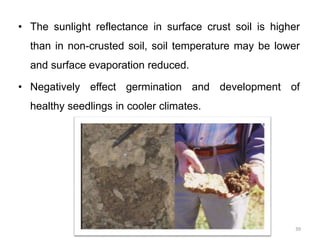
• The sunlight reflectance in surface crust soil is higher
than in non-crusted soil, soil temperature may be lower
and surface evaporation reduced.
• Negatively effect germination and development of
healthy seedlings in cooler climates.
39
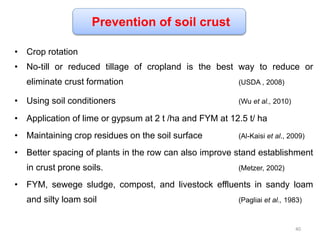
Prevention of soil crust
• Crop rotation
• No-till or reduced tillage of cropland is the best way to reduce or
eliminate crust formation (USDA , 2008)
• Using soil conditioners (Wu et al., 2010)
• Application of lime or gypsum at 2 t /ha and FYM at 12.5 t/ ha
• Maintaining crop residues on the soil surface (Al-Kaisi et al., 2009)
• Better spacing of plants in the row can also improve stand establishment
in crust prone soils. (Metzer, 2002)
• FYM, sewege sludge, compost, and livestock effluents in sandy loam
and silty loam soil (Pagliai et al., 1983)
40
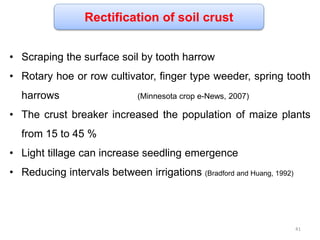
Rectification of soil crust
• Scraping the surface soil by tooth harrow
• Rotary hoe or row cultivator, finger type weeder, spring tooth
harrows (Minnesota crop e-News, 2007)
• The crust breaker increased the population of maize plants
from 15 to 45 %
• Light tillage can increase seedling emergence
• Reducing intervals between irrigations (Bradford and Huang, 1992)
41
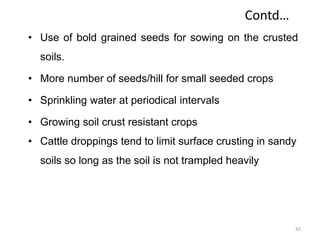
Contd…
• Use of bold grained seeds for sowing on the crusted
soils.
• More number of seeds/hill for small seeded crops
• Sprinkling water at periodical intervals
• Growing soil crust resistant crops
• Cattle droppings tend to limit surface crusting in sandy
soils so long as the soil is not trampled heavily
42
Contd….
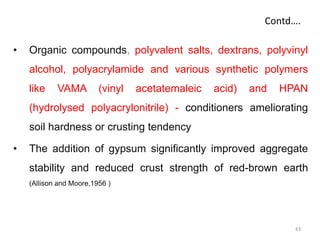
• Organic compounds, polyvalent salts, dextrans, polyvinyl
alcohol, polyacrylamide and various synthetic polymers
like VAMA (vinyl acetatemaleic acid) and HPAN
(hydrolysed polyacrylonitrile) - conditioners ameliorating
soil hardness or crusting tendency
• The addition of gypsum significantly improved aggregate
stability and reduced crust strength of red-brown earth
(Allison and Moore,1956 )
43
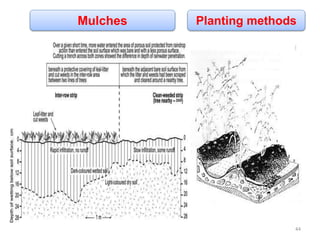
Mulches Planting methods
44
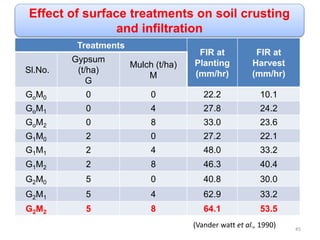
Effect of surface treatments on soil crusting
and infiltration
(Vander watt et al., 1990)
Treatments
FIR at
Planting
(mm/hr)
FIR at
Harvest
(mm/hr)
Sl.No.
Gypsum
(t/ha)
G
Mulch (t/ha)
M
GoM0 0 0 22.2 10.1
GoM1 0 4 27.8 24.2
GoM2 0 8 33.0 23.6
G1M0 2 0 27.2 22.1
G1M1 2 4 48.0 33.2
G1M2 2 8 46.3 40.4
G2M0 5 0 40.8 30.0
G2M1 5 4 62.9 33.2
G2M2 5 8 64.1 53.5
45
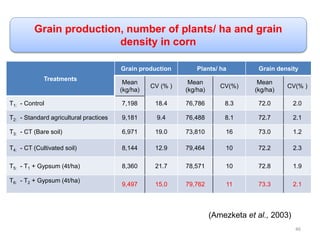
Grain production, number of plants/ ha and grain
density in corn
Treatments
Grain production Plants/ ha Grain density
Mean
(kg/ha)
CV (% )
Mean
(kg/ha)
CV(%)
Mean
(kg/ha)
CV(% )
T1: - Control 7,198 18.4 76,786 8.3 72.0 2.0
T2: - Standard agricultural practices 9,181 9.4 76,488 8.1 72.7 2.1
T3: - CT (Bare soil) 6,971 19.0 73,810 16 73.0 1.2
T4: - CT (Cultivated soil) 8,144 12.9 79,464 10 72.2 2.3
T5: - T1 + Gypsum (4t/ha) 8,360 21.7 78,571 10 72.8 1.9
T6: - T2 + Gypsum (4t/ha)
9,497 15.0 79,762 11 73.3 2.1
(Amezketa et al., 2003)
46
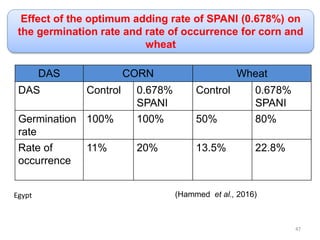
Effect of the optimum adding rate of SPANI (0.678%) on
the germination rate and rate of occurrence for corn and
wheat
(Hammed et al., 2016)
Egypt
47
DAS CORN Wheat
DAS Control 0.678%
SPANI
Control 0.678%
SPANI
Germination
rate
100% 100% 50% 80%
Rate of
occurrence
11% 20% 13.5% 22.8%
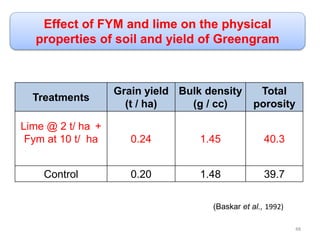
Effect of FYM and lime on the physical
properties of soil and yield of Greengram
Treatments
Grain yield
(t / ha)
Bulk density
(g / cc)
Total
porosity
Lime @ 2 t/ ha +
Fym at 10 t/ ha 0.24 1.45 40.3
Control 0.20 1.48 39.7
(Baskar et al., 1992)
48
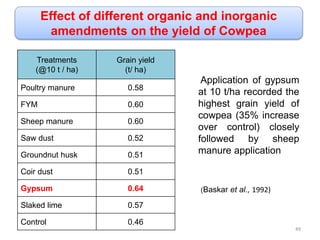
Effect of different organic and inorganic
amendments on the yield of Cowpea
Treatments
(@10 t / ha)
Grain yield
(t/ ha)
Poultry manure 0.58
FYM 0.60
Sheep manure 0.60
Saw dust 0.52
Groundnut husk 0.51
Coir dust 0.51
Gypsum 0.64
Slaked lime 0.57
Control 0.46
Application of gypsum
at 10 t/ha recorded the
highest grain yield of
cowpea (35% increase
over control) closely
followed by sheep
manure application
(Baskar et al., 1992)
49
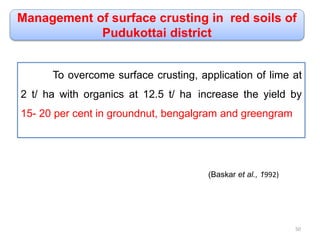
Management of surface crusting in red soils of
Pudukottai district
To overcome surface crusting, application of lime at
2 t/ ha with organics at 12.5 t/ ha increase the yield by
15- 20 per cent in groundnut, bengalgram and greengram
(Baskar et al., 1992)
50
Future Thrust
• Development and evaluation of new soil conditioners
(nanochemicals)
• Development of crust tolerant/ resistant crops
• Design and evaluation of suitable machinery
• Usage of crop residues as mulches instead of burning
51
Summary
• Soil crusting is a tool for land degradation
• Soil crust formation affects the crop growth and yield
• Location specific management should be practiced
The Nation that destroys soil, destroys
itself
– Franklin Roosevelt, 1937
Thank you
52

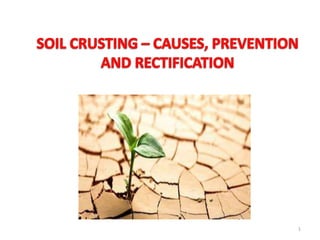
Soil crusting - causes, prevention and rectification

  • 1.
  • 2.
    Objectives • To discussthe effect of soil crusting on growth and yield of crops and soil properties • To know about the suitable management practices to overcome surface crusting 2
  • 3.
    Sequence of presention •Introduction • Occurrence & causes of soil crusting • Assessment & prediction of soil crusting • Mechanism of crust formation in soil • Types of soil crust • Factors affecting soil crusting • Problems with poor plant function • Prevention of soil crusting • Rectification of soil crusting • Research findings • Conclusion 3
  • 4.
    • Crusting: Hardeningof the surface layer of soil • Rapid wetting, drying, tillage, rainfall • Stability of surface aggregates is low. • Thickness usually ranges from less than 1 mm to 5 cm (Evans and Boul, 1968) • Arid and semiarid regions. • Hard setting –dense layer of crust Soil Crusting Crust formed out on silty soil 4
  • 5.
    • Surface sealing– Initial or wetting phase in crust formation (Arndt et al., 1989). • Soil stability – Determines the crustability and erosion (Kuykendall, 2008). Contd…… 5
  • 6.
    • Colloidal oxidesof iron and aluminium in alfisols • Fine soil texture • Low organic matter content • Excessive tillage • High silt content and salt content • High exchangeable sodium content • Puddling of soil • High clay content Causes of soil crusting 6
  • 7.
    Occurrence of soilCrusting • Laterite group of soils • Rainfed agriculture • In tropical areas → Wider range of soils • In temperate areas → Unstable loamy soils (Norton and Scrhoeder, 1987) Area Distribution Source India 10.25 m ha Haryana, Punjab, West Bengal, Orissa, Gujarat states Brajendra and Bhadana (2014) Tamil Nadu 4,51,584 ha (4.5% TGA) Trichy, Thanjavur, Pudukottai, Cuddalore & Sivaganga districts Latha and Janaki (2015) 7
  • 8.
    – Greater mechanicalstrength – Low porosity – Higher bulk density – Higher CEC – Reduced infiltration rate – Higher runoff (leads to reduction in soil moisture) Characteristics of Soil crust 8
  • 9.
    Assessment of soilcrusting • Morphological changes • Macro and Micro morphological approaches Direct Assessment • Decrease in infiltration capacity, increase in surface strength Indirect Assessment 9
  • 10.
    Criterion Definition A. Morphologicalapproaches Field monitoring test Diameter of the smallest clod not incorporated in the structural crust B. Decrease in infiltration Sealing index (S.I) S.I = ∆I/∆T Difference between steady and initial percolation rates under rainfall simulation Indices for assessment of soil crusting 10 (Agarwal et al., 1981)
  • 11.
    Prediction of soilcrusting 11 (Agarwal et al., 1981) Criterion Definition A. Textural and soil organic matter indices Soil organic matter ratio Clay Clay+ Silt S= Organic matter content(%) × 100/Clay(%) S= Organic matter content(%) ×100 /(Clay (%) + Silt(%) B. Dispersion Ratio Dispersion test (Dispersed clay+ silt/total clay + silt C. Instability Indices Structural stability Percent of water stable aggregates > 0.5 mm D. Consistency tests Atterberg limits Consistency index(C5-10) C= W5- W10 Water content (%) 5 and 10 blows of the Casagrande cup
  • 12.
    Mechanism of crustformation Mechanical destruction of aggregates Washing in layer Reorientation of the soil surface Cementation and Compaction Structural and depositional crust 12 (Robbins et al., 1972)
  • 13.
    Classes of stabilityand crustability according to MWD values Class MWD value/mm Stability Crustability 1 < 0.4 Very unstable Systematic crust formation 2 0.4-0.8 Unstable Crusting frequent 3 0.8-1.3 Medium Crusting moderate 4 1.3-2.0 Stable Crusting rare 5 > 2.0 Very stable No Crusting 13 (Yoder et al., 2016)
  • 14.
    TYPES OF SOILCRUST Physical Crust Chemical Crust Biological Crust 14 (Lal and Shakula, 2004)
  • 15.
    1. PHYSICAL CRUST oRaindrop impact, subsequent drying, (Remley and Bradford, 1989) o Water and wind energies o Arid and semi arid regions (Gerasimova & Lebedeva-Verba, 2010 ) o Less than1mm to 5cm Based on the mode of formation →Structural crusts → Erosion and depositional crusts 15
  • 16.
    Structural crust (Boiffin andValentin ,1986) 16 Types Slaking crusts Thin crusts (1mm to 5mm) Infiltrating crusts Medium textured soils Coalescing crusts Thick (upto 20mm) - in wet soils Sieving crusts Formed in sandy soils
  • 17.
  • 18.
    Crust types andprocesses Crust types Thickness (mm) Total porosity Infiltration (mm/hr) Process Structural crust Slaking 1-3 Moderate 5-20 Aggregate breakdown Infilling 2-5 Low 5-8 Filling of pores Coalescing 3-15 Moderate 3-9 Compaction Sieving crust 1-3 Low 0-15 Downward movement, sieving Depositional crust Runoff 2-5 Low 1-5 Sedimentation Erosion crust < 1 Very low 0-2 Removal by top layer (Bresson et al., 2006) 18
  • 19.
    II. CHEMICAL CRUST •Salt crust or precipitates ( Mees and Tursina, 2008) • Sodium sulfate, Sodium chloride, and Magnesium sulfate (Xtremehort, 2015) (Sheng Dai et al., 2016)19
  • 20.
    III. BIOLOGICAL CRUST •Microbiotic soil crusts, cryptogamic, cryptobiotic, and microphytic crusts. • Cyanobacteria, eucaryotic algae and lichens, but also bacteria and fungi (Belnap et al., 2017) 20
  • 21.
    Highly specialized community ofCyanobacteria and lichens Desert biological soil crusts (BSCs) are simple Cyanobacteria-dominated surface soil microbial communities found on all continents in areas with infrequent wetting, often extreme temperatures, and the absence of vascular plants 21
  • 22.
    Cyanobacteria in biologicalsoil crust of Thanjavur and Thiruvarur districts Physico-chemical characters and soil nutrients were correlated with distribution of cyanobacteria 34 species Heterocystous (13 species) Non-heterocystous (21 species) (Vijayakumar, 2013) 22
  • 23.
    Appearance of mat,crust and patch forms of BSC in Ariyalur and Pudukottai districts (Vinoth et al., 2017) 23
  • 24.
    Overall frequency ofcyanobacterial species based on their family (Vinoth et al., 2017 ) 24
  • 25.
    Positive effects ofbiological soil crust Moisture retention Erosion prevention Nutrient adsorption Carbon sequestration Nitrogen fixation 25
  • 26.
    Measurement of soilcrust strength • Modulus of rupture (Carnes et al., 1934) • Penetrometers (Geotest, 2008) • Fishing line and hydraulic balloon • Seedling emergence ( Ahmed et al., 1972) ( Agarwal and Sharma, 1981) 26
  • 27.
    Influence of theparent material Rainfall characteristics Soil Characteristics Anthropogenic factors Factors contributing surface soil crust
  • 28.
    Effects of soilcrust Soil and water losses Agronomic relevance Water infiltration reduction Runoff and flooding Water and wind erosion Prevent germination Restriction of seedling emergence Reduction of crop yield 28
  • 29.
    Reduction in infiltrationrate (Van der Watt et al., 1990) 29
  • 30.
    Rain drop impactand soil surface geometry effects on crust thickness and strength Treatments Crust thickness (mm) Penetration resistance (Mpa) Initial Final DI-FLAT 10.9 0.40 0.60 DI- CAP 11.0 0.37 0.52 INT- FLAT 6.4 0.21 0.31 INT-CAP 5.5 0.20 0.31 LSD 1.4 0.05 0.07 DI- Drop impact INT- Intercepted drop impact (Baumhardt et al., 2004) 30
  • 31.
    Relationships between aggregatebreakdown, crusting and erosion (Hook, 1995) Undegraded soil Structural crust Depositional crust Sediment in water Flow Rill erosion Rain Breakdown Splash Break down Splash Compaction Infilling, Compaction Deposition Surface Infiltrability Ponding Runoff Detachment Incision Break down Splash 31
  • 32.
    Reduction in seedlingemergence • The emergence force exerted by the seedling is lower than the mechanical resistance (Awadhwal and Thierstein, 1985) • Reducing crop seedling emergence in different crops is well- documented (Taylor et al.,1992) • Non-uniform stands with sub-optimal population densities (Hanegreefs and Nelson, 1986) • Pearl millet, maize, sorghum and barley (Abu- Awad and Kharabsheh, 2000) 32
  • 33.
    Reduction in seedlingemergence Lowa (2008) 33
  • 34.
    • Seedling emergencein crusted soils can be improved by adapting management practices such as mulching, chemical applications and tillage (Agarwal and Sharma,1980) 34
  • 35.
    Selection for rapidgermination and emergence wheat seedling in soil surface crusts 35
  • 36.
    • Wheat seedlingemergence decreased as crust strength and thickness increased • For a strong crust, average emergence was 33%, compared to 87% for a weak crust (Monia anzoman et al., 2018) 36
  • 37.
    Reduction of cropyield Harvest – Groundnut (Nicou and Charreau, 1980) Irrigated condition – Penetrometer resistance 3 bar- seed cotton yield -3600 kg/ha – Penetrometer resistance 40 bar - 1450kg/ha (Carter et al.,1965) Semi arid condition - Penetrometer resistance 25 bar- 500 kg/ha (Rogers,1973) 37
  • 38.
    Problems with poorfunction • Crusts restrict seedling emergence, especially in non- grass crops such as soybeans and alfalfa • Reduce oxygen diffusion into the soil profile by as much as 50% if the soil crust is wet • Serious problem to small seeded crops • Pearl millet, cotton, grain sorghum, soybean, guar, carrot, mungbean and cowpea. (Gerard, 1980) 38
  • 39.
    • The sunlightreflectance in surface crust soil is higher than in non-crusted soil, soil temperature may be lower and surface evaporation reduced. • Negatively effect germination and development of healthy seedlings in cooler climates. 39
  • 40.
    Prevention of soilcrust • Crop rotation • No-till or reduced tillage of cropland is the best way to reduce or eliminate crust formation (USDA , 2008) • Using soil conditioners (Wu et al., 2010) • Application of lime or gypsum at 2 t /ha and FYM at 12.5 t/ ha • Maintaining crop residues on the soil surface (Al-Kaisi et al., 2009) • Better spacing of plants in the row can also improve stand establishment in crust prone soils. (Metzer, 2002) • FYM, sewege sludge, compost, and livestock effluents in sandy loam and silty loam soil (Pagliai et al., 1983) 40
  • 41.
    Rectification of soilcrust • Scraping the surface soil by tooth harrow • Rotary hoe or row cultivator, finger type weeder, spring tooth harrows (Minnesota crop e-News, 2007) • The crust breaker increased the population of maize plants from 15 to 45 % • Light tillage can increase seedling emergence • Reducing intervals between irrigations (Bradford and Huang, 1992) 41
  • 42.
    Contd… • Use ofbold grained seeds for sowing on the crusted soils. • More number of seeds/hill for small seeded crops • Sprinkling water at periodical intervals • Growing soil crust resistant crops • Cattle droppings tend to limit surface crusting in sandy soils so long as the soil is not trampled heavily 42
  • 43.
    Contd…. • Organic compounds,polyvalent salts, dextrans, polyvinyl alcohol, polyacrylamide and various synthetic polymers like VAMA (vinyl acetatemaleic acid) and HPAN (hydrolysed polyacrylonitrile) - conditioners ameliorating soil hardness or crusting tendency • The addition of gypsum significantly improved aggregate stability and reduced crust strength of red-brown earth (Allison and Moore,1956 ) 43
  • 44.
  • 45.
    Effect of surfacetreatments on soil crusting and infiltration (Vander watt et al., 1990) Treatments FIR at Planting (mm/hr) FIR at Harvest (mm/hr) Sl.No. Gypsum (t/ha) G Mulch (t/ha) M GoM0 0 0 22.2 10.1 GoM1 0 4 27.8 24.2 GoM2 0 8 33.0 23.6 G1M0 2 0 27.2 22.1 G1M1 2 4 48.0 33.2 G1M2 2 8 46.3 40.4 G2M0 5 0 40.8 30.0 G2M1 5 4 62.9 33.2 G2M2 5 8 64.1 53.5 45
  • 46.
    Grain production, numberof plants/ ha and grain density in corn Treatments Grain production Plants/ ha Grain density Mean (kg/ha) CV (% ) Mean (kg/ha) CV(%) Mean (kg/ha) CV(% ) T1: - Control 7,198 18.4 76,786 8.3 72.0 2.0 T2: - Standard agricultural practices 9,181 9.4 76,488 8.1 72.7 2.1 T3: - CT (Bare soil) 6,971 19.0 73,810 16 73.0 1.2 T4: - CT (Cultivated soil) 8,144 12.9 79,464 10 72.2 2.3 T5: - T1 + Gypsum (4t/ha) 8,360 21.7 78,571 10 72.8 1.9 T6: - T2 + Gypsum (4t/ha) 9,497 15.0 79,762 11 73.3 2.1 (Amezketa et al., 2003) 46
  • 47.
    Effect of theoptimum adding rate of SPANI (0.678%) on the germination rate and rate of occurrence for corn and wheat (Hammed et al., 2016) Egypt 47 DAS CORN Wheat DAS Control 0.678% SPANI Control 0.678% SPANI Germination rate 100% 100% 50% 80% Rate of occurrence 11% 20% 13.5% 22.8%
  • 48.
    Effect of FYMand lime on the physical properties of soil and yield of Greengram Treatments Grain yield (t / ha) Bulk density (g / cc) Total porosity Lime @ 2 t/ ha + Fym at 10 t/ ha 0.24 1.45 40.3 Control 0.20 1.48 39.7 (Baskar et al., 1992) 48
  • 49.
    Effect of differentorganic and inorganic amendments on the yield of Cowpea Treatments (@10 t / ha) Grain yield (t/ ha) Poultry manure 0.58 FYM 0.60 Sheep manure 0.60 Saw dust 0.52 Groundnut husk 0.51 Coir dust 0.51 Gypsum 0.64 Slaked lime 0.57 Control 0.46 Application of gypsum at 10 t/ha recorded the highest grain yield of cowpea (35% increase over control) closely followed by sheep manure application (Baskar et al., 1992) 49
  • 50.
    Management of surfacecrusting in red soils of Pudukottai district To overcome surface crusting, application of lime at 2 t/ ha with organics at 12.5 t/ ha increase the yield by 15- 20 per cent in groundnut, bengalgram and greengram (Baskar et al., 1992) 50
  • 51.
    Future Thrust • Developmentand evaluation of new soil conditioners (nanochemicals) • Development of crust tolerant/ resistant crops • Design and evaluation of suitable machinery • Usage of crop residues as mulches instead of burning 51 Summary • Soil crusting is a tool for land degradation • Soil crust formation affects the crop growth and yield • Location specific management should be practiced
  • 52.
    The Nation thatdestroys soil, destroys itself – Franklin Roosevelt, 1937 Thank you 52