Fundamentals of Agriculture
Extension Education
(Extension Programme Planning)
Dr Surendra Kumar Rai
Assistant Professor (Agriculture Extension)
College of Agriculture, Balaghat,
JNKVV(Jabalpur)
Programme Planning
The first step in any systematic attempt to promote rural
development is to prepare useful programmes based on people
needs.
Programme planning is the process of making decisions
about the direction and intensity of extension-education efforts
of extension-service to bring about social, economic and
technological changes.
Programme planning is a process which involves multiple steps
including the identification of a problem, selection of desired
outcomes, assessment of available resources, implementation and
evaluation of the programme.
An Extension Porgramme is a statement of situation, objective,
problems and solutions. It is relatively permanent but requires constant
revision. Kelsey and Hearne (1967)
Leagans (1961) says that an "extension programme" is a set of
clearly defined, consciously conceived objectives or ends, derived from an
adequate analysis of the situation, which are to be achieved through
extension teaching activity'.
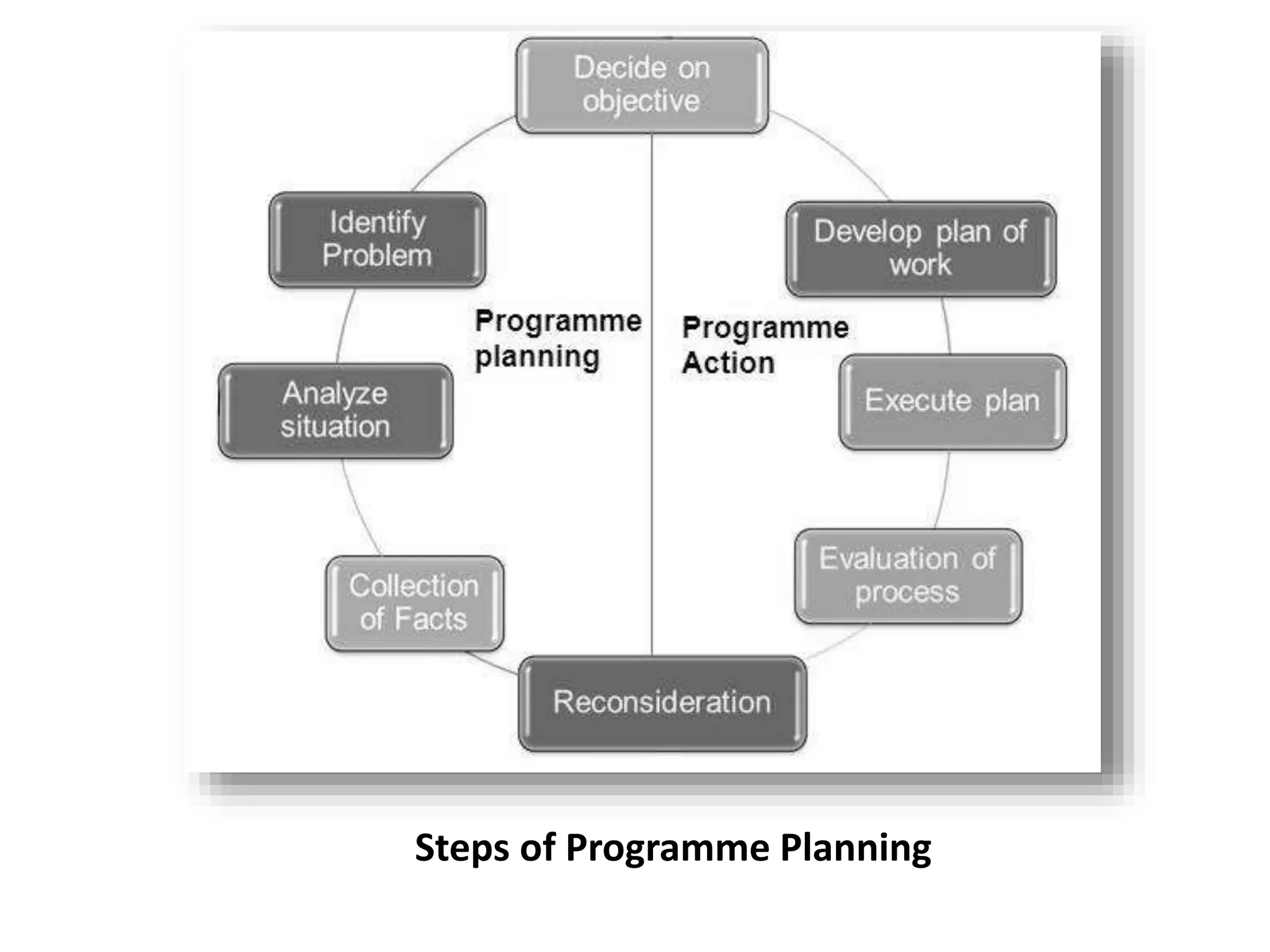
Steps in Extension Programme Planning Process
The process of extension, as applied to development
programmes, involves five essential phases (SOTER) i.e.
Analyzing the Situation, Objectives or Goals to be Accomplished,
Teaching, Evaluating the Teaching, Reconsidering (Leagans,
1961). These steps are intended only to clarify the necessary
actions in carrying out a planned extension educational effort.
Steps of Programme Planning
Thank You

Definitions and steps in Extension Programme Planning

  • 1.
    Fundamentals of Agriculture ExtensionEducation (Extension Programme Planning) Dr Surendra Kumar Rai Assistant Professor (Agriculture Extension) College of Agriculture, Balaghat, JNKVV(Jabalpur)
  • 2.
    Programme Planning The firststep in any systematic attempt to promote rural development is to prepare useful programmes based on people needs. Programme planning is the process of making decisions about the direction and intensity of extension-education efforts of extension-service to bring about social, economic and technological changes.
  • 3.
    Programme planning isa process which involves multiple steps including the identification of a problem, selection of desired outcomes, assessment of available resources, implementation and evaluation of the programme. An Extension Porgramme is a statement of situation, objective, problems and solutions. It is relatively permanent but requires constant revision. Kelsey and Hearne (1967) Leagans (1961) says that an "extension programme" is a set of clearly defined, consciously conceived objectives or ends, derived from an adequate analysis of the situation, which are to be achieved through extension teaching activity'.
  • 4.
    Steps in ExtensionProgramme Planning Process The process of extension, as applied to development programmes, involves five essential phases (SOTER) i.e. Analyzing the Situation, Objectives or Goals to be Accomplished, Teaching, Evaluating the Teaching, Reconsidering (Leagans, 1961). These steps are intended only to clarify the necessary actions in carrying out a planned extension educational effort.
  • 5.
  • 6.