SOIL
RajavardhanGandla
Soil Water
Relations
• Soil-water-plant relationship relates to the
properties of soil and plant that affect the
movement, retention and use of water. Due to
inadequate and/or uneven distribution of
rainfall during the cropping season, it becomes
necessary to apply additional water to the soil
for plant use in the form of irrigation.
Therefore, proper understanding of the soil-
water-plant relationship is a prerequisite for the
sound design of any efficient irrigation system.
Soil
A soil matrix consists of solid, liquid and
gaseous phases (Fig).
The solid phase is the soil matrix
comprising mineral, organic matter and
various chemical compounds.
The liquid phase contains all the dissolved
substances. Liquid phase also referred by
the soil moisture or soil water or soil
solution.
The gaseous portion of the soil consists of
soil air and it occupies those spaces
between the soils particles which are not
filled with water (Fig).
Soil properties influencing soil-
water relations
Soil depth
• Soil depth refers to the thickness of soil cover over
hard rock or hard substratum below which roots cannot
penetrate. The soil depth is directly related to the
development of root system, water storage capacity,
nutrient supply and feasibility for land leveling and
land shaping. Soil Conservation Division, Ministry of
Agriculture, New Delhi, recognizes the following
classes for irrigation purposes:
• A shallow soil has limited moisture
holding capacity, restricted feed zone
and root growth, therefore would
need frequent irrigations with less
water depth. Shallowness of soil is
further unfavorable in areas needing
land leveling and shaping because it
affects soil-water relations besides
nutrient retention & availability. Deep
soil on the other hand, has good
moisture holding capacity, larger
feeding zone and good possibilities
for development of root system. Soil
depth is also important for
interpreting water storage capacity.
Soil depth classification
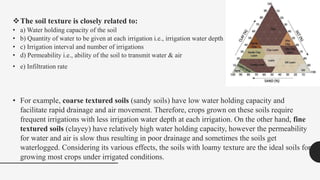
Soil texture • Soil texture is the most important and
fundamental property of the soil that is
most intimately related to soil water
relationship. It refers to the relative
proportion of mineral particles of various
sizes in a given soil i.e., the proportions of
coarse, medium and fine particles, which are
termed sand, silt and clay, respectively.
Various combinations of these fractions are
used to classify soil according to its texture.
Using the name of the predominant size
fraction designates texture. Three broad and
fundamental groups of soil textural classes
are recognized as sandy, loamy and clayey.
Common textural classes encountered in the field
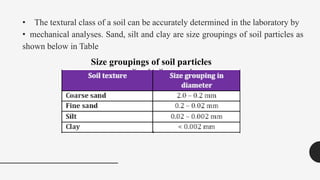
• The textural class of a soil can be accurately determined in the laboratory by
• mechanical analyses. Sand, silt and clay are size groupings of soil particles as
shown below in Table
Size groupings of soil particles
The soil texture is closely related to:
• a) Water holding capacity of the soil
• b) Quantity of water to be given at each irrigation i.e., irrigation water depth
• c) Irrigation interval and number of irrigations
• d) Permeability i.e., ability of the soil to transmit water & air
• e) Infiltration rate
• For example, coarse textured soils (sandy soils) have low water holding capacity and
facilitate rapid drainage and air movement. Therefore, crops grown on these soils require
frequent irrigations with less irrigation water depth at each irrigation. On the other hand, fine
textured soils (clayey) have relatively high water holding capacity, however the permeability
for water and air is slow thus resulting in poor drainage and sometimes the soils get
waterlogged. Considering its various effects, the soils with loamy texture are the ideal soils for
growing most crops under irrigated conditions.
Soil structure
• The structure of a soil refers to the arrangement of the individual soil particles with respect to each other and the
formation of aggregates within the soil mass (Fig.). Soil structure has important role in water movement, plant root
penetration, air movement etc.
• The dominant shape of soil aggregates in a horizon determines their structural type, and it include spheroidal (granular
or crumbly subtypes), platy; prism like (columnar or prismatic subtypes) and block like (cube and sub-angular
subtypes) (Fig.). The soil structure primarily influences root penetration and proliferation, total porosity and
permeability of air and water.
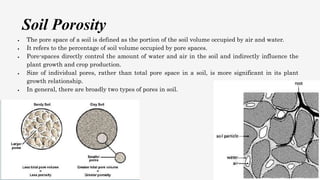
Soil Porosity
 The pore space of a soil is defined as the portion of the soil volume occupied by air and water.
 It refers to the percentage of soil volume occupied by pore spaces.
 Pore-spaces directly control the amount of water and air in the soil and indirectly influence the
plant growth and crop production.
 Size of individual pores, rather than total pore space in a soil, is more significant in its plant
growth relationship.
 In general, there are broadly two types of pores in soil.
 Macro pores:
• The diameter of these pores is larger than 0.06 mm. Macro-pores allow air and
water movement readily. Sands and sandy soils have a large number of macro-pores.
 Micro or Capillary pores:
• The diameter of these pores is less than 0.06 mm. The movement of air and water
is restricted to some extent in micro or capillary pores. Clays and clayey soils have a
greater number of micro or capillary pores. It has got more importance in the plant
growth relationship.
• For optimum growth of the plant, the existence of approximately equal amount of
macro and micro-pores which influence aeration, permeability, drainage and water
retention favorably is essential.
Water Movements in Soil
• Infiltration
• The process of entry of water into the soil is called infiltration, and the time rate
at which water percolates into the soil is known as infiltration rate.
• Hydraulic conductivity
• The hydraulic conductivity of a soil is a measure of the soil's ability to transmit
water when submitted to a hydraulic gradient. Hydraulic conductivity is defined by
Darcy's law.
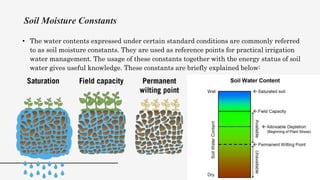
Soil Moisture Constants
• The water contents expressed under certain standard conditions are commonly referred
to as soil moisture constants. They are used as reference points for practical irrigation
water management. The usage of these constants together with the energy status of soil
water gives useful knowledge. These constants are briefly explained below:
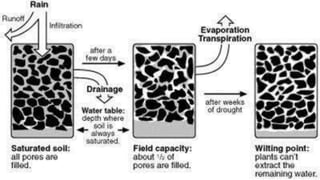
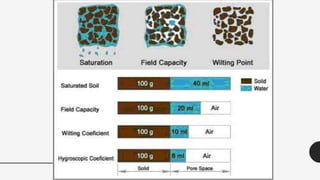
Saturation capacity • Saturation capacity refers to the
condition of soil at which all the macro
and micro pores are filled with water
and the soil is at maximum water
retention capacity”. The matric suction
at this condition is essentially zero as
the water is in equilibrium with free
water. Excess water above saturation
capacity of soil is lost from root zone as
gravitational water.
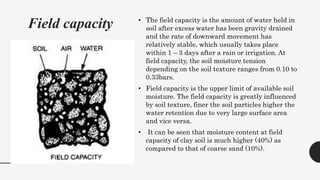
Field capacity • The field capacity is the amount of water held in
soil after excess water has been gravity drained
and the rate of downward movement has
relatively stable, which usually takes place
within 1 – 3 days after a rain or irrigation. At
field capacity, the soil moisture tension
depending on the soil texture ranges from 0.10 to
0.33bars.
• Field capacity is the upper limit of available soil
moisture. The field capacity is greatly influenced
by soil texture, finer the soil particles higher the
water retention due to very large surface area
and vice versa.
• It can be seen that moisture content at field
capacity of clay soil is much higher (40%) as
compared to that of coarse sand (10%).
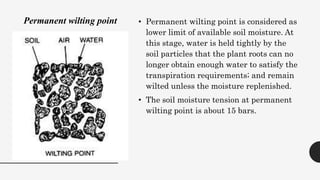
Permanent wilting point • Permanent wilting point is considered as
lower limit of available soil moisture. At
this stage, water is held tightly by the
soil particles that the plant roots can no
longer obtain enough water to satisfy the
transpiration requirements; and remain
wilted unless the moisture replenished.
• The soil moisture tension at permanent
wilting point is about 15 bars.
Available Soil
Moisture
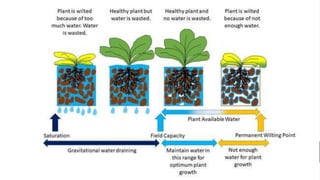
• Available soil moisture is the moisture between
field capacity (0.33 bars) and permanent wilting
point (15 bars) which is referred as readily
available water (TAW) for plant growth.
• The water present above the field capacity and
below the permanent wilting point is not
available to the plant.
Measurement of soil moisture tension by tensiometer.

Soil water relations

  • 1.
  • 2.
    Soil Water Relations • Soil-water-plantrelationship relates to the properties of soil and plant that affect the movement, retention and use of water. Due to inadequate and/or uneven distribution of rainfall during the cropping season, it becomes necessary to apply additional water to the soil for plant use in the form of irrigation. Therefore, proper understanding of the soil- water-plant relationship is a prerequisite for the sound design of any efficient irrigation system.
  • 3.
    Soil A soil matrixconsists of solid, liquid and gaseous phases (Fig). The solid phase is the soil matrix comprising mineral, organic matter and various chemical compounds. The liquid phase contains all the dissolved substances. Liquid phase also referred by the soil moisture or soil water or soil solution. The gaseous portion of the soil consists of soil air and it occupies those spaces between the soils particles which are not filled with water (Fig).
  • 4.
    Soil properties influencingsoil- water relations Soil depth • Soil depth refers to the thickness of soil cover over hard rock or hard substratum below which roots cannot penetrate. The soil depth is directly related to the development of root system, water storage capacity, nutrient supply and feasibility for land leveling and land shaping. Soil Conservation Division, Ministry of Agriculture, New Delhi, recognizes the following classes for irrigation purposes:
  • 5.
    • A shallowsoil has limited moisture holding capacity, restricted feed zone and root growth, therefore would need frequent irrigations with less water depth. Shallowness of soil is further unfavorable in areas needing land leveling and shaping because it affects soil-water relations besides nutrient retention & availability. Deep soil on the other hand, has good moisture holding capacity, larger feeding zone and good possibilities for development of root system. Soil depth is also important for interpreting water storage capacity. Soil depth classification
  • 6.
    Soil texture •Soil texture is the most important and fundamental property of the soil that is most intimately related to soil water relationship. It refers to the relative proportion of mineral particles of various sizes in a given soil i.e., the proportions of coarse, medium and fine particles, which are termed sand, silt and clay, respectively. Various combinations of these fractions are used to classify soil according to its texture. Using the name of the predominant size fraction designates texture. Three broad and fundamental groups of soil textural classes are recognized as sandy, loamy and clayey. Common textural classes encountered in the field
  • 7.
    • The texturalclass of a soil can be accurately determined in the laboratory by • mechanical analyses. Sand, silt and clay are size groupings of soil particles as shown below in Table Size groupings of soil particles
  • 8.
    The soil textureis closely related to: • a) Water holding capacity of the soil • b) Quantity of water to be given at each irrigation i.e., irrigation water depth • c) Irrigation interval and number of irrigations • d) Permeability i.e., ability of the soil to transmit water & air • e) Infiltration rate • For example, coarse textured soils (sandy soils) have low water holding capacity and facilitate rapid drainage and air movement. Therefore, crops grown on these soils require frequent irrigations with less irrigation water depth at each irrigation. On the other hand, fine textured soils (clayey) have relatively high water holding capacity, however the permeability for water and air is slow thus resulting in poor drainage and sometimes the soils get waterlogged. Considering its various effects, the soils with loamy texture are the ideal soils for growing most crops under irrigated conditions.
  • 9.
    Soil structure • Thestructure of a soil refers to the arrangement of the individual soil particles with respect to each other and the formation of aggregates within the soil mass (Fig.). Soil structure has important role in water movement, plant root penetration, air movement etc. • The dominant shape of soil aggregates in a horizon determines their structural type, and it include spheroidal (granular or crumbly subtypes), platy; prism like (columnar or prismatic subtypes) and block like (cube and sub-angular subtypes) (Fig.). The soil structure primarily influences root penetration and proliferation, total porosity and permeability of air and water.
  • 10.
    Soil Porosity  Thepore space of a soil is defined as the portion of the soil volume occupied by air and water.  It refers to the percentage of soil volume occupied by pore spaces.  Pore-spaces directly control the amount of water and air in the soil and indirectly influence the plant growth and crop production.  Size of individual pores, rather than total pore space in a soil, is more significant in its plant growth relationship.  In general, there are broadly two types of pores in soil.
  • 11.
     Macro pores: •The diameter of these pores is larger than 0.06 mm. Macro-pores allow air and water movement readily. Sands and sandy soils have a large number of macro-pores.  Micro or Capillary pores: • The diameter of these pores is less than 0.06 mm. The movement of air and water is restricted to some extent in micro or capillary pores. Clays and clayey soils have a greater number of micro or capillary pores. It has got more importance in the plant growth relationship. • For optimum growth of the plant, the existence of approximately equal amount of macro and micro-pores which influence aeration, permeability, drainage and water retention favorably is essential.
  • 12.
    Water Movements inSoil • Infiltration • The process of entry of water into the soil is called infiltration, and the time rate at which water percolates into the soil is known as infiltration rate. • Hydraulic conductivity • The hydraulic conductivity of a soil is a measure of the soil's ability to transmit water when submitted to a hydraulic gradient. Hydraulic conductivity is defined by Darcy's law.
  • 13.
    Soil Moisture Constants •The water contents expressed under certain standard conditions are commonly referred to as soil moisture constants. They are used as reference points for practical irrigation water management. The usage of these constants together with the energy status of soil water gives useful knowledge. These constants are briefly explained below:
  • 14.
    Saturation capacity •Saturation capacity refers to the condition of soil at which all the macro and micro pores are filled with water and the soil is at maximum water retention capacity”. The matric suction at this condition is essentially zero as the water is in equilibrium with free water. Excess water above saturation capacity of soil is lost from root zone as gravitational water.
  • 15.
    Field capacity •The field capacity is the amount of water held in soil after excess water has been gravity drained and the rate of downward movement has relatively stable, which usually takes place within 1 – 3 days after a rain or irrigation. At field capacity, the soil moisture tension depending on the soil texture ranges from 0.10 to 0.33bars. • Field capacity is the upper limit of available soil moisture. The field capacity is greatly influenced by soil texture, finer the soil particles higher the water retention due to very large surface area and vice versa. • It can be seen that moisture content at field capacity of clay soil is much higher (40%) as compared to that of coarse sand (10%).
  • 16.
    Permanent wilting point• Permanent wilting point is considered as lower limit of available soil moisture. At this stage, water is held tightly by the soil particles that the plant roots can no longer obtain enough water to satisfy the transpiration requirements; and remain wilted unless the moisture replenished. • The soil moisture tension at permanent wilting point is about 15 bars.
  • 17.
    Available Soil Moisture • Availablesoil moisture is the moisture between field capacity (0.33 bars) and permanent wilting point (15 bars) which is referred as readily available water (TAW) for plant growth. • The water present above the field capacity and below the permanent wilting point is not available to the plant.
  • 21.
    Measurement of soilmoisture tension by tensiometer.