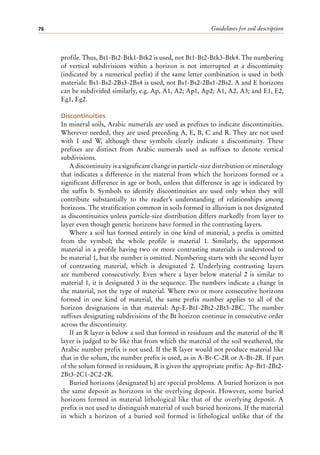
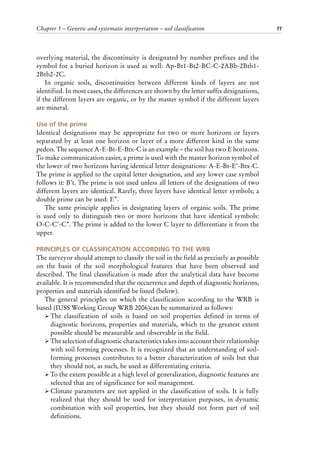
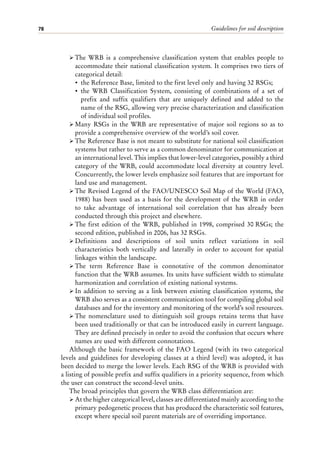
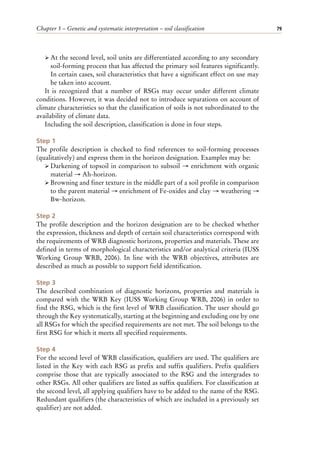
GUIDELINES FOR
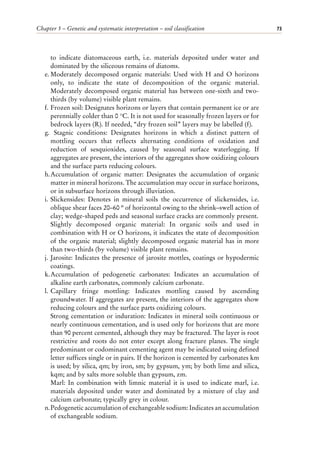
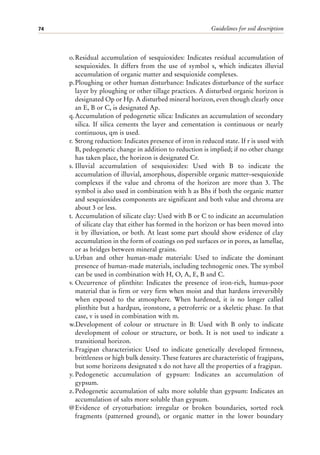
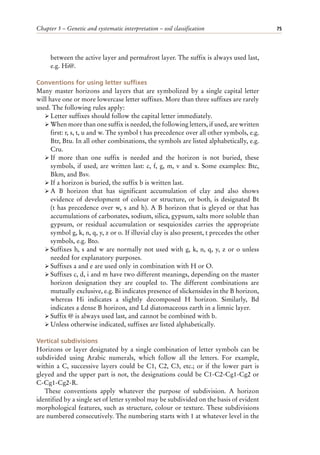
SOIL DESCRIPTION
Universität Halle-Wittenberg,
Germany
Technische Universität München,
Germany
ISRIC – World Soil Information,
The Netherlands
Leyte State University,
The Philippines
Universität Kiel,
Germany
GUIDELINES
FOR
SOIL
DESCRIPTION
FAO
� � � � � � � � � � � � �
������������������������
������������������
Guidelines for
soil description
Fourth edition
FOOD AND AGRICULTURE ORGANIZATION OF THE UNITED NATIONS
Rome, 2006
The designations employed and the presentation of material in this information
product do not imply the expression of any opinion whatsoever on the part
of the Food and Agriculture Organization of the United Nations concerning the
legal or development status of any country, territory, city or area or of its authorities,
or concerning the delimitation of its frontiers or boundaries.
ISBN 92-5-105521-1
All rights reserved. Reproduction and dissemination of material in this information
product for educational or other non-commercial purposes are authorized without
any prior written permission from the copyright holders provided the source is fully
acknowledged. Reproduction of material in this information product for resale or other
commercial purposes is prohibited without written permission of the copyright holders.
Applications for such permission should be addressed to:
Chief
Publishing Management Service
Information Division
FAO
Viale delle Terme di Caracalla, 00100 Rome, Italy
or by e-mail to:
copyright@fao.org
© FAO 2006
iii
Contents
Acknowledgements ix
List of acronyms x
1. Introduction 1
2. General site information, registration and location 5
Profile number 5
Soil profile description status 5
Date of description 5
Authors 5
Location 6
Elevation 6
Map sheet number and grid reference (coordinates) 7
3. Soil formation factors 9
Atmospheric climate and weather conditions 9
Soil climate 9
Landform and topography (relief) 10
Major landform 10
Position 10
Slope form 12
Slope gradient and orientation 12
Land use and vegetation 13
Land use 13
Crops 13
Human influence 13
Vegetation 16
Parent material 16
Age of the land surface 17
4. Soil description 21
Surface characteristics 21
Rock outcrops 21
Coarse surface fragments 21
Erosion 22
Surface sealing 23
Surface cracks 23
iv
Horizon boundary 24
Depth 24
Distinctness and topography 25
Primary constituents 25
Texture of the fine earth fraction 25
Rock fragments and artefacts 29
Degree of decomposition and humification of peat 32
Aeromorphic organic layers on forest floors 32
Soil colour (matrix) 33
Mottling 35
Colour of mottles 35
Abundance of mottles 35
Size of mottles 35
Contrast of mottles 36
Boundary of mottles 36
Soil redox potential and reducing conditions 36
Determination of redox potential by field method 36
Reducing conditions 37
Carbonates 38
Content 38
Forms 38
Gypsum 39
Content of gypsum 39
Forms of secondary gypsum 39
Readily soluble salts 40
Procedure 40
Field soil pH 41
Soil odour 42
Andic characteristics and volcanic glasses 42
Procedure 42
Organic matter content 43
Organization of soil constituents 44
Soil structure 44
Consistence 48
Soil-water status 50
Bulk density 50
Voids (porosity) 52
Porosity 52
Type 52
Size 53
Abundance 53
v
Concentrations 53
Coatings 54
Cementation and compaction 56
Mineral concentrations 58
Biological activity 59
Roots 59
Other biological features 60
Human-made materials 60
Artefacts 60
Human-transported material (HTM) 61
Geomembranes and technic hard rock 62
Description of artefacts 63
Description and determination of human-transported material 64
Sampling 64
5. Genetic and systematic interpretation – soil classification 67
Soil horizon designation 67
Master horizons and layers 67
Transitional horizons 71
Subordinate characteristics within master horizons and layers 71
Conventions for using letter suffixes 75
Vertical subdivisions 75
Discontinuities 76
Use of the prime 77
Principles of classification according to the WRB 77
Step 1 79
Step 2 79
Step 3 79
Step 4 79
Principles and use of the qualifiers in the WRB 80
Checklist of WRB diagnostic horizons, properties and materials 81
Appending texture and parent material information to the
reference soil group 82
References 85
Annexes
1. Explanation of soil temperature regimes 87
2. Explanation of soil moisture regimes 91
3. Equipment necessary for field work 97
vi
List of tables
1. Soil profile description status 6
2. Codes for weather conditions 9
3. Soil temperature and moisture regime codes 10
4. Hierarchy of major landforms 11
5. Subdivisions for complex landforms 11
6. Classification of slope forms 12
7. Slope gradient classes 12
8. Land-use classification 14
9. Crop codes 15
10. Recommended codes for human influence 15
11. Vegetation classification 16
12. Hierarchy of lithology 18
13. Provisional coding for age of land surface 19
14. Recommended classification of rock outcrops 21
15. Classification of coarse surface fragments 22
16. Classification of erosion, by category 22
17. Classification of total area affected by erosion and deposition 22
18. Classification of erosion, by degree 22
19. Classification of erosion, by activity 23
20. Classification of attributes of surface sealing 23
21. Classification of surface cracks 24
22. Classification of salt characteristics 24
23. Classification of bleached sand characteristics 24
24. Classification of horizon boundaries, by distinctness and
topography 25
25. Key to the soil textural classes 28
26. Abundance of rock fragments and artefacts, by volume 29
27. Classification of rock fragments and artefacts 30
28. Classification of shape of rock fragments 31
29. Classification of weathering of coarse fragments 31
30. Codes for primary mineral fragments 31
31. Field estimation and coding of the degree of decomposition and
humification of peat 32
32. Classification of the abundance of mottles 35
33. Classification of the size of mottles 35
34. Classification of the contrast of mottles 36
35. Classification of boundary between mottle and matrix 36
vii
36. Redoximorphic soil characteristics and their relation to rH values
and soil processes 36
37. Reductimorphic colour pattern and occurrence of Fe compounds 37
38. Classification of carbonate reaction in the soil matrix 38
39. Classification of forms of secondary carbonates 38
40. Classification of gypsum content 39
41. Classification of forms of secondary gypsum 39
42. Classification of salt content of soil 40
43. Dependency of water content of saturation extract on texture
and content of humus for mineral soils and on decomposition
for peat soils 41
44. Classification of pH value 41
45. Classification of soil odour 42
46. Estimation of organic matter content based on Munsell soil colour 43
47. Classification of structure of pedal soil materials 45
48. Classification of types of soil structure 46
49. Codes for types of soil structure 46
50. Size classes for soil structure types 47
51. Combined size classes for soil structure types 47
52. Combinations of soil structures 47
53. Consistence of soil mass when dry 48
54. Consistence of soil mass when moist 49
55. Classification of soil stickiness 49
56. Classification of soil plasticity 49
57. Classification of moisture status of soil 50
58. Field estimation of bulk density for mineral soils 51
59. Field estimation of volume of solids and bulk density of peat soils 52
60. Classification of porosity 52
61. Classification of voids 53
62. Classification of diameter of voids 53
63. Classification of abundance of pores 53
64. Classification of abundance of coatings 55
65. Classification of the contrast of coatings 55
66. Classification of the nature of coatings 55
67. Classification of the form of coatings 56
68. Classification of the location of coatings and clay accumulation 56
69. Classification of the continuity of cementation/compaction 56
70. Classification of the fabric of the cemented/compacted layer 56
71. Classification of the nature of cementation/compaction 57
72. Classification of the degree of cementation/compaction 57
73. Classification of the abundance of mineral concentrations, by volume 58
viii
List of figures
1. The process of soil description, classification, site quality and
suitability evaluation 1
2. Slope positions in undulating and mountainous terrain 11
3. Slope forms and surface pathways 12
4. Relation of constituents of fine earth by size, defining textural
classes and sand subclasses 27
5. Charts for estimating proportions of coarse fragments and
mottles 30
6. Soil structure types and their formation 45
7. Qualification of bulk density 51
8. Charts for estimating size and abundance of pores 54
74. Classification of the kinds of mineral concentrations 58
75. Classification of the size and shape of mineral concentrations 58
76. Classification of the hardness of mineral concentrations 58
77. Examples of the nature of mineral concentrations 59
78. Colour names of mineral concentrations 59
79. Classification of the diameter of roots 60
80. Classification of the abundance of roots 60
81. Classification of the abundance of biological activity 60
82. Examples of biological features 60
83. Classification of kinds of artefacts 63
84. Determination table and codes for human-made deposits 64
85. Subordinate characteristics within master horizons 72
86. Checklist of WRB diagnostic horizons, properties and materials 81
ix
Acknowledgements
This revision was prepared by R. Jahn (University of Halle-Wittenberg), H.-P.
Blume (University of Kiel), V.B. Asio (Leyte State University), O. Spaargaren
(ISRIC) and P. Schad (Technische Universität München), with contributions
and suggestions from R. Langohr (University Gent), R. Brinkman (FAO), F.O.
Nachtergaele (FAO) and R. Pavel Krasilnikov (Universidad Nacional Autónoma
de México).
x
List of acronyms
EC Electrical conductivity
GPS Global Positioning System
HDPE High-density polyethylene
HTM Human-transported material
ISO International Organization for Standardization
PVC Polyvinyl chloride
RSG Reference Soil Group
USDA United States Department of Agriculture
UTM Universal Transverse Mercator
WRB World Reference Base for Soil Resources
1
Chapter 1
Introduction
The main objective of research in soil science is the understanding of the
nature, properties, dynamics and functions of the soil as part of landscapes and
ecosystems. A basic requirement for attaining that objective is the availability
of reliable information on soil morphology and other characteristics obtained
through examination and description of the soil in the field.
It is important that soil description be done thoroughly; it serves as the basis
for soil classification and site evaluation as well as interpretations on the genesis
and environmental functions of the soil. A good soil description and the derived
knowledge on the genesis of the soil are also powerful tools to guide, help explain
and regulate costly laboratory work. It can also prevent errors in soil sampling.
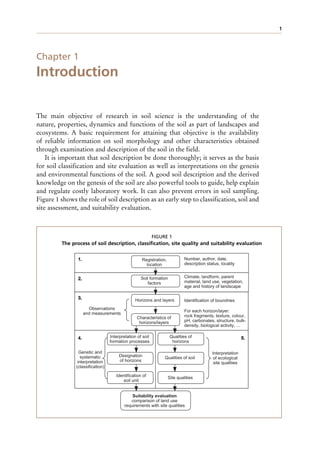
Figure 1 shows the role of soil description as an early step to classification, soil and
site assessment, and suitability evaluation.
1.
1.
2.
2.
3.
3.
4.
4. 5.
5.
Registration,
location
Soil formation
factors
Horizons and layers
Characteristics of
horizons/layers
Observations
and measurements
Genetic and
systematic
interpretation
(classification)
Interpretation
of ecological
site qualities
Climate, landform, parent
material, land use, vegetation,
age and history of landscape
Number, author, date,
description status, locality
Identification of boundries
For each horizon/layer:
rock fragments, texture, colour,
pH, carbonates, structure, bulk-
density, biological activity, ...
Interpretation of soil
formation processes
Qualities of
horizons
Designation
of horizons
Identification of
soil unit
Suitability evaluation
comparison of land use
requirements with site qualities
Site qualities
Qualities of soil
FIGURE 1
The process of soil description, classification, site quality and suitability evaluation
Guidelines for soil description
2
Soils are affected by human activities, such as industrial, municipal and
agriculture, that often result in soil degradation and loss or reduction in soil
functions. In order to prevent soil degradation and to rehabilitate the potentials of
degraded soils, reliable soil data are the most important prerequisite for the design
of appropriate land-use systems and soil management practices as well as for a
better understanding of the environment.
With the present internationalization, the use of a common language is of prime
importance, also in soil science. The increasing need for internationally accepted
rules and systems of soil description and soil classification led to the development
of various soil classification concepts, e.g. the FAO–UNESCO Legend for the
Soil Map of the World (FAO–UNESCO, 1974, 1988) and Soil Taxonomy (USDA
Soil Survey Staff 1975, 1999), and soil maps, e.g. the Soil Map of the World (FAO–
UNESCO, 1970–1981; FAO, 2002), Soil Map of the European Communities
(ECSC–EEC–EAEC, 1985), and Soil Atlas of Europe (EC, 2005).
These guidelines are based on the internationally accepted Guidelines for Soil
Description (FAO, 1990). Some new international developments in soil information
systems and soil classification, such as the Field Book for Describing and Sampling
Soils (Schoeneberger et al., 2002) and Keys to Soil Taxonomy (USDA Soil Survey Staff,
2003), Updated Global and National Soils and Terrain Digital Databases (ISRIC,
2005) and the second edition of the World Reference Base for Soil Resources (IUSS
Working Group WRB, 2006) are taken into consideration. For practical reasons, the
contents of the major sources were modified, shortened and rearranged.
Specifically, the various chapters of this field guide were based on the following
sources:
ÿChapter 2 on general site description – Guidelines for Soil Description
(FAO, 1990).
ÿChapter 3 on the description of soil forming factors – Guidelines for Soil
Description (FAO, 1990); updated SOTER (ISRIC, 2005); Field Book for
Describing and Sampling Soils (Schoeneberger et al., 2002); and Keys to
Soil Taxonomy (USDA Soil Survey Staff, 2003).
ÿChapter 4 on soil description – Guidelines for Soil Description (FAO,
1990) and partly the German Mapping Guide 5 (Kartieranleitung 5; Ad-
hoc-AG-Boden, 2005), the material of DVWK (1995), Field Book for
Describing and Sampling Soils (Schoeneberger et al., 2002), as well as the
personal experiences of the authors.
ÿChapter 5 on horizon designation and soil classification – Guidelines for
Soil Description (FAO, 1990), Field Book for Describing and Sampling
Soils (Schoeneberger et al., 2002), Keys to Soil Taxonomy (USDA Soil
Survey Staff, 2003) and the second edition of the World Reference Base
for Soil Resources (IUSS Working Group WRB, 2006).
To help beginners, some explanatory notes are included as well as keys based
on simple tests and observations for the determination of soil characteristics.
The guidelines provide a complete procedure for soil description and for
collecting field data necessary for classification according to second edition of the
Chapter 1 – Introduction 3
World Reference Base for Soil Resources (WRB) (IUSS Working Group WRB,
2006). Notes for classification purposes are added to each chapter and explain
the relevance of the described feature for classification according to the WRB. In
order to avoid being excessively lengthy, it is not stated whether the described
feature is a required one or is one of two or more options.
5
Chapter 2
General site information,
registration and location
Before any actual soil description should be done, it is necessary to take note of
some relevant information related to the registration and identification of the soil
to be described, such as profile number, description status, date of description,
author, location, elevation, map sheet number, and grid reference. This information
is necessary for easy referencing and retrieval of the soil description from data
storage systems.
PROFILE NUMBER
The profile number or profile identification code should be constructed in such a
way that it meets local needs and also allows easy and simple retrieval of profile
descriptions from computerized data storage systems. The profile identification
code should be constructed from a combination of a location letter code and a
profile number code. The letter code should consist of a practical selection of
codes referring to a country, preferably the internationally accepted International
Organization for Standardization (ISO) code, a topographic map reference or any
other defined area or town. Example: DE/ST/HAL -0381 = Halle in Saxony-
Anhalt in Germany, profile 381.
SOIL PROFILE DESCRIPTION STATUS
The status of the soil profile description refers to the quality of the soil description
and the analytical data. The status is allocated after completion of the analyses and
is indicative of the reliability of soil profile information entered into a database.
Table 1 lists the possible descriptions.
DATE OF DESCRIPTION
It is important to always indicate the date of description in order to inform future
users of the soil data as to how old the data are. The date of description is given as:
yymmdd (six digits). For example, 8 January 2006 would be coded 060108.
AUTHORS
The persons who perform the description need to be acknowledged properly in
future uses of the soil data. In addition, they hold responsibility for the quality of
the data. The names or initials of the authors are given.
Guidelines for soil description
6
LOCATION
A description of the soil location should be given. It should be as precise as possible
in terms of the distance (in metres or kilometres) and direction to the site from
permanent features that are recognizable in the field and on the topographic map.
Distances along roads or traverses relate to a marked reference point (0.0 km). The
description of the location should be such that readers who are unfamiliar with
the area are able to locate the approximate position of the site. The administrative
units, such as region, province, district, country or locality, are given in the profile
number section (above). Example: Agricultural research station Bad Lauchstädt,
Sachsen-Anhalt.
ELEVATION
The elevation of the site relative to sea level should be obtained as accurately
as possible, preferably from detailed contour or topographic maps. Where such
information is not available, the best possible estimate is made from general maps
or by altimeter readings. At present, determination of elevation by the Global
Positioning System (GPS) unit is inaccurate and unacceptable. Elevation is given
in metres (1 foot = 0.3048 m).
TABLE 1
Soil profile description status
Note: Descriptions from soil augerings or from other observations made for routine soil mapping are either kept on
ordinary field data sheets or included in the database, with an appropriate indication of status.
Status
1 Reference profile description No essential elements or details are missing from the description, sampling or
analysis. The accuracy and reliability of the description and analytical results
permit the full characterization of all soil horizons to a depth of 125 cm, or
more if required for classification, or down to a C or R horizon or layer, which
may be shallower.
1.1 If soil description is done without sampling.
2 Routine profile description No essential elements are missing from the description, sampling or analysis.
The number of samples collected is sufficient to characterize all major soil
horizons, but may not allow precise definition of all subhorizons, especially in
the deeper soil. The profile depth is 80 cm or more, or down to a C or R horizon
or layer, which may be shallower. Additional augering and sampling may be
required for lower level classification.
2.1 If soil description is done without sampling.
3 Incomplete description Certain relevant elements are missing from the description, an insufficient
number of samples was collected, or the reliability of the analytical data does
not permit a complete characterization of the soil. However, the description is
useful for specific purposes and provides a satisfactory indication of the nature
of the soil at high levels of soil taxonomic classification.
3.1 If soil description is done without sampling.
4 Soil augering description Soil augerings do no permit a comprehensive soil profile description. Augerings
are made for routine soil observation and identification in soil mapping,
and for that purpose normally provide a satisfactory indication of the soil
characteristics. Soil samples may be collected from augerings.
4.1 If soil description is done without sampling.
5 Other descriptions Essential elements are missing from the description, preventing a satisfactory
soil characterization and classification.
Chapter 2 – General site information, registration and location 7
MAP SHEET NUMBER AND GRID REFERENCE (COORDINATES)
The number of the topographic map sheet, preferably at 1:25 000 or 1:50 000 scale,
on which the soil observation occurs is given. Example: TK50 L4536 Halle (Saale)
= Topographic map 1:50 000 Number L4536 of Halle.
The grid reference number, Universal Transverse Mercator (UTM) or the
established local system, can be read directly from the topographic map. The
latitude and longitude of the site are given as accurately as possible (in degrees,
minutes, seconds and decimal seconds); they can be derived directly from
topographic maps or a GPS unit. Example: H: 56.95.250 or latitude: 51° 23´ 30.84´´
N; R: 44.91.600 or longitude: 11° 52´ 40.16´´ E.
Some countries use their own zero longitude, e.g. Italian topographic maps
show the Monte Mario meridian at Rome as zero. For international use, these
should be converted to the zero meridian of the Greenwich system.
9
Chapter 3
Soil formation factors
This chapter provides the guidelines for the description of factors that define the
kind and intensity of soil formation processes. These factors are also part of the
important site qualities.
The information may be derived from a combination of field measurements,
climate records, field observations and evaluation of climate, topographical,
geological and geomorphological maps and documents. For land use and
vegetation, the present conditions are reported.
ATMOSPHERIC CLIMATE AND WEATHER CONDITIONS
The climate conditions of a site are important site properties that influence
plant growth and soil formation. As minimum climate data, the monthly
mean temperature (in degrees Celsius) and the monthly mean precipitation (in
millimetres) can be taken from the nearest meteorological station.
Where available, the length of the growing period (in days) should be specified.
The length of the growing period is defined as the period with humid conditions
(excess of precipitation over potential evapotranspiration) during the time with
temperature ≥ 5 °C (FAO, 1978).
The present as well as the weather conditions days or weeks before the description
influence soil moisture and structure, hence these should be noted. In addition,
the prevailing general weather
conditions and the air temperature
at the time of observation as well
as that of the near past should be
documented (Table 2).
SOIL CLIMATE
Where applicable, the soil climate
classification should be indicated.
The soil moisture and temperature
regimes according to Keys to Soil
Taxonomy (USDA Soil Survey
Staff, 2003) may be mentioned
(Table 3; explanations in Annexes 1
and 2). Where such information is
not available or cannot be derived
from representative climate data
with confidence, it is preferable to
Note: For example: SU, 25 °C; WC 2 (= sunny, temperature 25 °C, no
rain in the last week).
TABLE 2
Codes for weather conditions
Present weather conditions (Schoeneberger et al., 2002)
SU sunny/clear
PC partly cloudy
OV overcast
RA rain
SL sleet
SN snow
Former weather conditions (Ad-hoc-AG-Boden, 2005)
WC 1 no rain in the last month
WC 2 no rain in the last week
WC 3 no rain in the last 24 hours
WC 4 rainy without heavy rain in the last 24 hours
WC 5 heavier rain for some days or rainstorm in the
last 24 hours
WC 6 extremely rainy time or snow melting
Guidelines for soil description
10
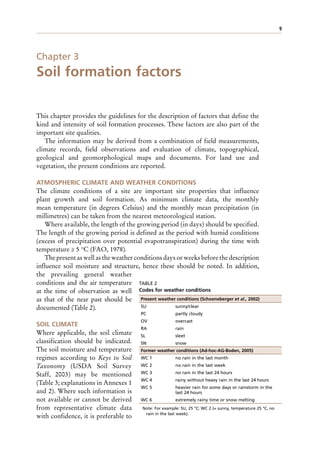
leave the space blank. Other agroclimate parameters worth mentioning would be
a local climate class, the agroclimate zone, length of growing period, etc.
Note for classification purposes
¸ Soil temperature < 0 °C (pergelic soil temperature regime) → cryic horizon and
Gelic qualifier.
LANDFORM AND TOPOGRAPHY (RELIEF)
Landform refers to any physical feature on the earth’s surface that has been
formed by natural processes and has a distinct shape. Topography refers to the
configuration of the land surface described in four categories:
ÿ the major landform, which refers to the morphology of the whole landscape;
ÿ the position of the site within the landscape;
ÿ the slope form;
ÿ the slope angle.
Major landform
Landforms are described foremost by their morphology and not by their genetic
origin or processes responsible for their shape. The dominant slope is the most
important differentiating criterion, followed by the relief intensity (Table 4). The
relief intensity is the median difference between the highest and lowest point
within the terrain per specified distance. The specified distance can be variable.
The relief intensity is normally given in metres per kilometre.
With complex landforms, the protruding landform should be at least 25 m
high (if not it is to be considered mesorelief) except for terraced land, where
the main terraces should have elevation differences of at least 10 m. In areas, the
major terraces may be very close to each other – particularly towards the lower
part of the plain. Finally, the older levels may become buried by down wash. For
complex landforms, subdivisions can be used (Table 5). These subdivisions are
mainly applicable to level landforms, to some extent to sloping landforms and, in
the case of mountains, to intermontane plains.
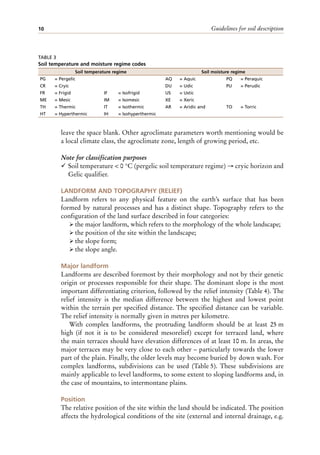
Position
The relative position of the site within the land should be indicated. The position
affects the hydrological conditions of the site (external and internal drainage, e.g.
TABLE 3
Soil temperature and moisture regime codes
Soil temperature regime Soil moisture regime
PG = Pergelic AQ = Aquic PQ = Peraquic
CR = Cryic DU = Udic PU = Perudic
FR = Frigid IF = Isofrigid US = Ustic
ME = Mesic IM = Isomesic XE = Xeric
TH = Thermic IT = Isothermic AR = Aridic and TO = Torric
HT = Hyperthermic IH = Isohyperthermic
Chapter 3 – Soil formation factors 11
TABLE 4
Hierarchy of major landforms
1st level 2nd level Gradient Relief intensity Potential
drainage density
(%) (m km-1)
L level land LP plain < 10 < 50 0–25
LL plateau < 10 < 50 0–25
LD depression < 10 < 50 16–25
LV valley floor < 10 < 50 6–15
S sloping land SE medium-gradient escarpment zone 10–30 50–100 < 6
SH medium-gradient hill 10–30 100–150 0–15
SM medium-gradient mountain 15–30 150–300 0–15
SP dissected plain 10–30 50–100 0–15
SV medium-gradient valley 10–30 100–150 6–15
T steep land TE high-gradient escarpment zone > 30 150–300 < 6
TH high-gradient hill > 30 150–300 0–15
TM high-gradient mountain > 30 > 300 0–15
TV high-gradient valley > 30 > 150 6–15
Notes:
Changes proposed at the SOTER meeting at Ispra, October 2004.
Potential drainage density is given in number of “receiving” pixels within a 10 × 10 pixels window.
Source: Updated SOTER, ISRIC, 2005.
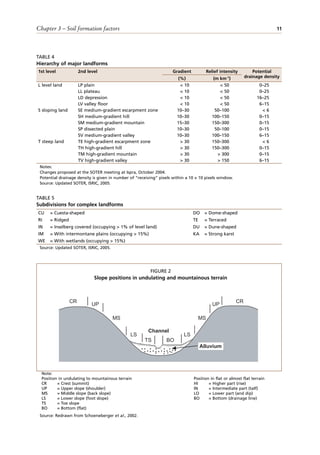
Note:
Position in undulating to mountainous terrain Position in flat or almost flat terrain
CR = Crest (summit) HI = Higher part (rise)
UP = Upper slope (shoulder) IN = Intermediate part (talf)
MS = Middle slope (back slope) LO = Lower part (and dip)
LS = Lower slope (foot slope) BO = Bottom (drainage line)
TS = Toe slope
BO = Bottom (flat)
CR
UP
MS
LS
TS BO
LS
MS
UP
CR
Channel
Alluvium
FIGURE 2
Slope positions in undulating and mountainous terrain
Source: Redrawn from Schoeneberger et al., 2002.
TABLE 5
Subdivisions for complex landforms
CU = Cuesta-shaped DO = Dome-shaped
RI = Ridged TE = Terraced
IN = Inselberg covered (occupying > 1% of level land) DU = Dune-shaped
IM = With intermontane plains (occupying > 15%) KA = Strong karst
WE = With wetlands (occupying > 15%)
Source: Updated SOTER, ISRIC, 2005.
Guidelines for soil description
12
subsurface runoff), which may be
interpreted as being predominantly
water receiving, water shedding or
neither of these.
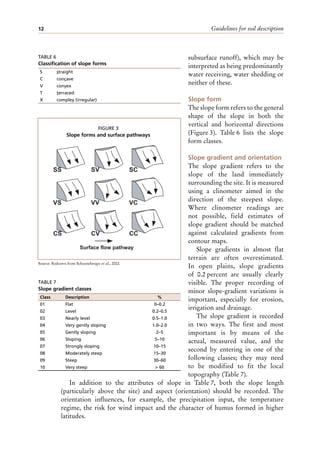
Slope form
The slope form refers to the general
shape of the slope in both the
vertical and horizontal directions
(Figure 3). Table 6 lists the slope
form classes.
Slope gradient and orientation
The slope gradient refers to the
slope of the land immediately
surrounding the site. It is measured
using a clinometer aimed in the
direction of the steepest slope.
Where clinometer readings are
not possible, field estimates of
slope gradient should be matched
against calculated gradients from
contour maps.
Slope gradients in almost flat
terrain are often overestimated.
In open plains, slope gradients
of 0.2 percent are usually clearly
visible. The proper recording of
minor slope-gradient variations is
important, especially for erosion,
irrigation and drainage.
The slope gradient is recorded
in two ways. The first and most
important is by means of the
actual, measured value, and the
second by entering in one of the
following classes; they may need
to be modified to fit the local
topography (Table 7).
In addition to the attributes of slope in Table 7, both the slope length
(particularly above the site) and aspect (orientation) should be recorded. The
orientation influences, for example, the precipitation input, the temperature
regime, the risk for wind impact and the character of humus formed in higher
latitudes.
TABLE 6
Classification of slope forms
S straight
C concave
V convex
T terraced
X complex (irregular)
SS
VS
CS
SV
VV
CV
SC
VC
CC
Surface flow pathway
FIGURE 3
Slope forms and surface pathways
Source: Redrawn from Schoeneberger et al., 2002.
TABLE 7
Slope gradient classes
Class Description %
01 Flat 0–0.2
02 Level 0.2–0.5
03 Nearly level 0.5–1.0
04 Very gently sloping 1.0–2.0
05 Gently sloping 2–5
06 Sloping 5–10
07 Strongly sloping 10–15
08 Moderately steep 15–30
09 Steep 30–60
10 Very steep > 60
Chapter 3 – Soil formation factors 13
The orientation that a slope is facing is coded N for north, E for east, S for
south and W for west; for example, SSW means south-southwest.
LAND USE AND VEGETATION
Land use
Land use applies to the current use of the land, whether agricultural or non-
agricultural, in which the soil is located. Land use has a major influence on the
direction and rate of soil formation; its recording enhances the interpretative value
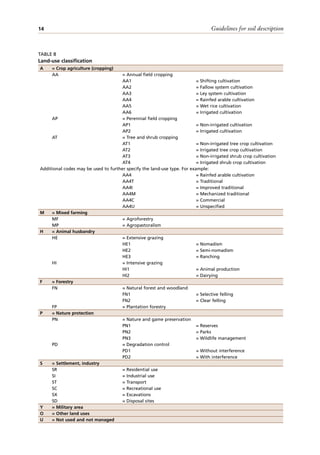
of the soil data considerably (Table 8).
For arable land use, the dominant crops grown should be mentioned (section
on crops [below]), and as much information as possible given on soil management,
use of fertilizers, duration of fallow period, rotation systems and yields.
Crops
Crops are plants that are cultivated for their economic value. Information on
crops is important because it gives an idea of the nature of soil disturbance as a
result of crop management practices as well as the nutrient and soil management
requirements of the crop. Information on crops can be given in a general or detailed
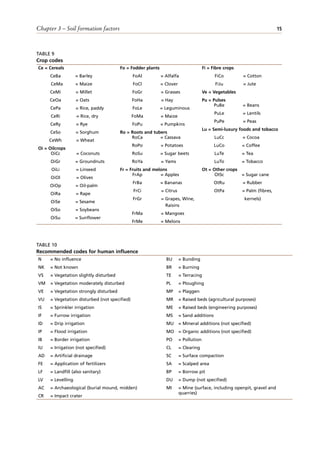
way as required. Examples for the most common crops with their recommended
codes are given in Table 9.
Human influence
This item refers to any evidence of human activity that is likely to have affected
the landscape or the physical and chemical properties of the soil. Erosion is dealt
with separately in Chapter 4. For various environments, it is useful to indicate
the degree of disturbance of the natural vegetation. The existing vegetation is
described in the section on vegetation (below).
Examples of human influences with their recommended codes are given in
Table 10.
Note for classification purposes
¸ Constructed terraces → Escalic qualifier.
¸ Raised land surfaces → plaggic and terric horizons.
¸ Ploughing → anthraquic and anthric horizons and Aric qualifier.
¸ Special depth limits if plough layers are present → Fluvisols, Chernozems and
Cambisols.
¸ Special requirements if an eluvial horizon is part of a plough layer → argic and
natric horizons.
¸ Does not form part of a plough layer → cambic horizon.
¸ Mixing or soil layers or lumps of applied lime → anthric horizon.
¸ Spade marks → plaggic horizon.
Guidelines for soil description
14
A = Crop agriculture (cropping)
AA = Annual field cropping
AA1 = Shifting cultivation
AA2 = Fallow system cultivation
AA3 = Ley system cultivation
AA4 = Rainfed arable cultivation
AA5 = Wet rice cultivation
AA6 = Irrigated cultivation
AP = Perennial field cropping
AP1 = Non-irrigated cultivation
AP2 = Irrigated cultivation
AT = Tree and shrub cropping
AT1 = Non-irrigated tree crop cultivation
AT2 = Irrigated tree crop cultivation
AT3 = Non-irrigated shrub crop cultivation
AT4 = Irrigated shrub crop cultivation
Additional codes may be used to further specify the land-use type. For example:
AA4 = Rainfed arable cultivation
AA4T = Traditional
AA4I = Improved traditional
AA4M = Mechanized traditional
AA4C = Commercial
AA4U = Unspecified
M = Mixed farming
MF = Agroforestry
MP = Agropastoralism
H = Animal husbandry
HE = Extensive grazing
HE1 = Nomadism
HE2 = Semi-nomadism
HE3 = Ranching
HI = Intensive grazing
HI1 = Animal production
HI2 = Dairying
F = Forestry
FN = Natural forest and woodland
FN1 = Selective felling
FN2 = Clear felling
FP = Plantation forestry
P = Nature protection
PN = Nature and game preservation
PN1 = Reserves
PN2 = Parks
PN3 = Wildlife management
PD = Degradation control
PD1 = Without interference
PD2 = With interference
S = Settlement, industry
SR = Residential use
SI = Industrial use
ST = Transport
SC = Recreational use
SX = Excavations
SD = Disposal sites
Y = Military area
O = Other land uses
U = Not used and not managed
TABLE 8
Land-use classification
Chapter 3 – Soil formation factors 15
TABLE 9
Crop codes
Ce = Cereals
CeBa = Barley
CeMa = Maize
CeMi = Millet
CeOa = Oats
CePa = Rice, paddy
CeRi = Rice, dry
CeRy = Rye
CeSo = Sorghum
CeWh = Wheat
Oi = Oilcrops
OiCc = Coconuts
OiGr = Groundnuts
OiLi = Linseed
OiOl = Olives
OiOp = Oil-palm
OiRa = Rape
OiSe = Sesame
OiSo = Soybeans
OiSu = Sunflower
Fo = Fodder plants
FoAl = Alfalfa
FoCl = Clover
FoGr = Grasses
FoHa = Hay
FoLe = Leguminous
FoMa = Maize
FoPu = Pumpkins
Ro = Roots and tubers
RoCa = Cassava
RoPo = Potatoes
RoSu = Sugar beets
RoYa = Yams
Fr = Fruits and melons
FrAp = Apples
FrBa = Bananas
FrCi = Citrus
FrGr = Grapes, Wine,
Raisins
FrMa = Mangoes
FrMe = Melons
Fi = Fibre crops
FiCo = Cotton
FiJu = Jute
Ve = Vegetables
Pu = Pulses
PuBe = Beans
PuLe = Lentils
PuPe = Peas
Lu = Semi-luxury foods and tobacco
LuCc = Cocoa
LuCo = Coffee
LuTe = Tea
LuTo = Tobacco
Ot = Other crops
OtSc = Sugar cane
OtRu = Rubber
OtPa = Palm (fibres,
kernels)
TABLE 10
Recommended codes for human influence
N = No influence
NK = Not known
VS = Vegetation slightly disturbed
VM = Vegetation moderately disturbed
VE = Vegetation strongly disturbed
VU = Vegetation disturbed (not specified)
IS = Sprinkler irrigation
IF = Furrow irrigation
ID = Drip irrigation
IP = Flood irrigation
IB = Border irrigation
IU = Irrigation (not specified)
AD = Artificial drainage
FE = Application of fertilizers
LF = Landfill (also sanitary)
LV = Levelling
AC = Archaeological (burial mound, midden)
CR = Impact crater
BU = Bunding
BR = Burning
TE = Terracing
PL = Ploughing
MP = Plaggen
MR = Raised beds (agricultural purposes)
ME = Raised beds (engineering purposes)
MS = Sand additions
MU = Mineral additions (not specified)
MO = Organic additions (not specified)
PO = Pollution
CL = Clearing
SC = Surface compaction
SA = Scalped area
BP = Borrow pit
DU = Dump (not specified)
MI = Mine (surface, including openpit, gravel and
quarries)
Guidelines for soil description
16
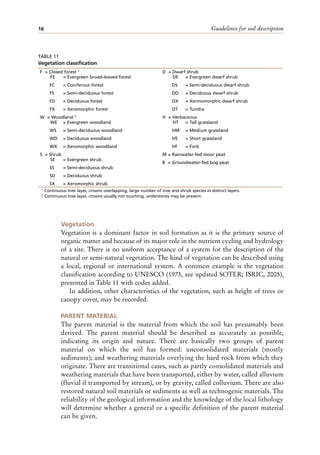
Vegetation
Vegetation is a dominant factor in soil formation as it is the primary source of
organic matter and because of its major role in the nutrient cycling and hydrology
of a site. There is no uniform acceptance of a system for the description of the
natural or semi-natural vegetation. The kind of vegetation can be described using
a local, regional or international system. A common example is the vegetation
classification according to UNESCO (1973, see updated SOTER; ISRIC, 2005),
presented in Table 11 with codes added.
In addition, other characteristics of the vegetation, such as height of trees or
canopy cover, may be recorded.
PARENT MATERIAL
The parent material is the material from which the soil has presumably been
derived. The parent material should be described as accurately as possible,
indicating its origin and nature. There are basically two groups of parent
material on which the soil has formed: unconsolidated materials (mostly
sediments); and weathering materials overlying the hard rock from which they
originate. There are transitional cases, such as partly consolidated materials and
weathering materials that have been transported, either by water, called alluvium
(fluvial if transported by stream), or by gravity, called colluvium. There are also
restored natural soil materials or sediments as well as technogenic materials. The
reliability of the geological information and the knowledge of the local lithology
will determine whether a general or a specific definition of the parent material
can be given.
TABLE 11
Vegetation classification
F = Closed forest 1
FE = Evergreen broad-leaved forest
FC = Coniferous forest
FS = Semi-deciduous forest
FD = Deciduous forest
FX = Xeromorphic forest
W = Woodland 2
WE = Evergreen woodland
WS = Semi-deciduous woodland
WD = Deciduous woodland
WX = Xeromorphic woodland
S = Shrub
SE = Evergreen shrub
SS = Semi-deciduous shrub
SD = Deciduous shrub
SX = Xeromorphic shrub
D = Dwarf shrub
DE = Evergreen dwarf shrub
DS = Semi-deciduous dwarf shrub
DD = Deciduous dwarf shrub
DX = Xermomorphic dwarf shrub
DT = Tundra
H = Herbaceous
HT = Tall grassland
HM = Medium grassland
HS = Short grassland
HF = Forb
M = Rainwater-fed moor peat
B = Groundwater-fed bog peat
1 Continuous tree layer, crowns overlapping, large number of tree and shrub species in distinct layers.
2 Continuous tree layer, crowns usually not touching, understorey may be present.
Chapter 3 – Soil formation factors 17
For weathered rock, the code WE is first entered, followed by the rock-type code.
The code SA for saprolite is recommended where the in situ weathered material is
thoroughly decomposed, clay-rich but still showing rock structure. Alluvial deposits
and colluvium derived from a single rock type may be further specified by that rock
type. Where one parent material overlies another, both are indicated.
The parent material is coded according to updated SOTER (ISRIC, 2005) at
the lowest level of hierarchy as possible. As SOTER was developed to work with
maps on a scale of 1:1 000 000, it was a requirement to have not too many rock
types. In order to be able to work in smaller scales, some additional natural and
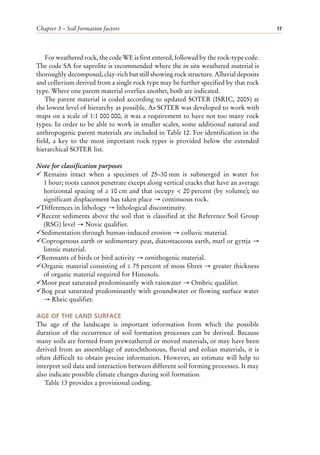
anthropogenic parent materials are included in Table 12. For identification in the
field, a key to the most important rock types is provided below the extended
hierarchical SOTER list.
Note for classification purposes
¸ Remains intact when a specimen of 25–30 mm is submerged in water for
1 hour; roots cannot penetrate except along vertical cracks that have an average
horizontal spacing of ≥ 10 cm and that occupy < 20 percent (by volume); no
significant displacement has taken place → continuous rock.
¸Differences in lithology → lithological discontinuity.
¸Recent sediments above the soil that is classified at the Reference Soil Group
(RSG) level → Novic qualifier.
¸Sedimentation through human-induced erosion → colluvic material.
¸Coprogenous earth or sedimentary peat, diatomaceous earth, marl or gyttja →
limnic material.
¸Remnants of birds or bird activity → ornithogenic material.
¸Organic material consisting of ≥ 75 percent of moss fibres → greater thickness
of organic material required for Histosols.
¸Moor peat saturated predominantly with rainwater → Ombric qualifier.
¸Bog peat saturated predominantly with groundwater or flowing surface water
→ Rheic qualifier.
AGE OF THE LAND SURFACE
The age of the landscape is important information from which the possible
duration of the occurrence of soil formation processes can be derived. Because
many soils are formed from preweathered or moved materials, or may have been
derived from an assemblage of autochthonous, fluvial and eolian materials, it is
often difficult to obtain precise information. However, an estimate will help to
interpret soil data and interaction between different soil forming processes. It may
also indicate possible climate changes during soil formation.
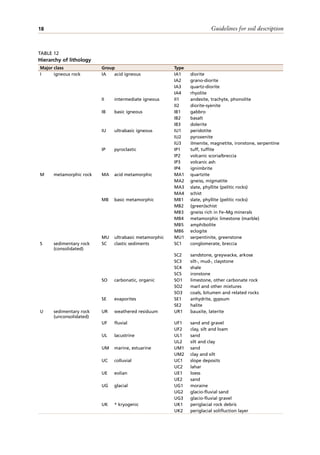
Table 13 provides a provisional coding.
Guidelines for soil description
18
Major class Group Type
I igneous rock IA acid igneous IA1 diorite
IA2 grano-diorite
IA3 quartz-diorite
IA4 rhyolite
II intermediate igneous II1 andesite, trachyte, phonolite
II2 diorite-syenite
IB basic igneous IB1 gabbro
IB2 basalt
IB3 dolerite
IU ultrabasic igneous IU1 peridotite
IU2 pyroxenite
IU3 ilmenite, magnetite, ironstone, serpentine
IP pyroclastic IP1 tuff, tuffite
IP2 volcanic scoria/breccia
IP3 volcanic ash
IP4 ignimbrite
M metamorphic rock MA acid metamorphic MA1 quartzite
MA2 gneiss, migmatite
MA3 slate, phyllite (pelitic rocks)
MA4 schist
MB basic metamorphic MB1 slate, phyllite (pelitic rocks)
MB2 (green)schist
MB3 gneiss rich in Fe–Mg minerals
MB4 metamorphic limestone (marble)
MB5 amphibolite
MB6 eclogite
MU ultrabasic metamorphic MU1 serpentinite, greenstone
S sedimentary rock
(consolidated)
SC clastic sediments SC1 conglomerate, breccia
SC2 sandstone, greywacke, arkose
SC3 silt-, mud-, claystone
SC4 shale
SC5 ironstone
SO carbonatic, organic SO1 limestone, other carbonate rock
SO2 marl and other mixtures
SO3 coals, bitumen and related rocks
SE evaporites SE1 anhydrite, gypsum
SE2 halite
U sedimentary rock
(unconsolidated)
UR weathered residuum UR1 bauxite, laterite
UF fluvial UF1 sand and gravel
UF2 clay, silt and loam
UL lacustrine UL1 sand
UL2 silt and clay
UM marine, estuarine UM1 sand
UM2 clay and silt
UC colluvial UC1 slope deposits
UC2 lahar
UE eolian UE1 loess
UE2 sand
UG glacial UG1 moraine
UG2 glacio-fluvial sand
UG3 glacio-fluvial gravel
UK * kryogenic UK1 periglacial rock debris
UK2 periglacial solifluction layer
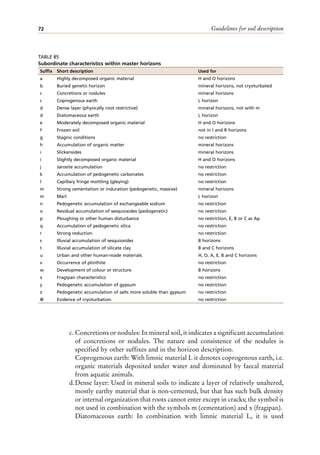
TABLE 12
Hierarchy of lithology
Chapter 3 – Soil formation factors 19
Major class Group Type
UO organic UO1 rainwater-fed moor peat
UO2 groundwater-fed bog peat
UA anthropogenic/
technogenic
UA1 redeposited natural material
UA2 industrial/artisanal deposits
UU * unspecified deposits UU1 clay
UU2 loam and silt
UU3 sand
UU4 gravelly sand
UU5 gravel, broken rock
* Extended.
Source: Updated SOTER; ISRIC, 2005.
TABLE 13
Provisional coding for age of land surface
vYn Very young (1–10 years) natural: with loss by erosion or deposition of materials such as on tidal flats, of
coastal dunes, in river valleys, landslides or desert areas.
vYa Very young (1–10 years) anthropogeomorphic: with complete disturbance of natural surfaces (and soils)
such as in urban, industrial and mining areas with very early soil development from fresh natural or
technogenic or mixed materials.
Yn Young (10–100 years) natural: with loss by erosion or deposition of materials such as on tidal flats, of
coastal dunes, river valleys, landslides or desert areas.
Ya Young (10–100 years) anthropogeomorphic: with complete disturbance of any natural surfaces (and
soils) such as in urban, industrial and mining areas with early soil development from fresh natural,
technogenic or a mixture of materials, or restriction of flooding by dykes.
Hn Holocene (100–10 000 years) natural: with loss by erosion or deposition of materials such as on tidal
flats, of coastal dunes, in river valleys, landslides or desert areas.
Ha Holocene (100–10 000 years) anthropogeomorphic: human-made relief modifications, such as terracing
of forming hills or walls by early civilizations or during the Middle Ages or earlier, restriction of
flooding by dykes, or surface raising.
lPi Late Pleistocene, ice covered, commonly recent soil formation on fresh materials.
lPp Late Pleistocene, periglacial, commonly recent soil formation on preweathered materials.
lPf Late Pleistocene, without periglacial influence.
oPi Older Pleistocene, ice covered, commonly the recent soil formation on younger over older,
preweathered materials.
oPp Older Pleistocene, with periglacial influence, commonly the recent soil formation on younger over
older, preweathered materials.
oPf Older Pleistocene, without periglacial influence.
T Tertiary land surfaces, commonly high planes, terraces or peneplains, except incised valleys, frequent
occurrence of palaeosoils.
O Older, pre-Tertiary land surfaces, commonly high planes, terraces or peneplains, except incised valleys,
frequent occurrence of palaeosoils.
TABLE 12
Hierarchy of lithology (Continued)
Materials (natural and anthropogenic/technogenic) deposited by humans are
coded:
ÿ d... = dumped,
ÿ s... = spoiled.
Chapter 4 provides more details on human-made materials.
21
Chapter 4
Soil description
This chapter presents the procedure to describe the different morphological and
other characteristics of the soil. This is best done using a recently dug pit large
enough to allow sufficient examination and description of the different horizons.
Old exposures such as road cuts and ditches may be used, but only after scraping
off sufficient material to expose the fresh soil. First, the surface characteristics are
recorded. Then, the soil description is done horizon by horizon, starting with the
uppermost one.
The rules of soil description and the coding of attributes are generally based
on the guidelines for soil description according to FAO (1990). Additions have a
citation.
SURFACE CHARACTERISTICS
Where present, surface characteristics, such as rock outcrops, coarse rock
fragments, human-induced erosion, surface sealing and surface cracks, should be
recorded. A number of other surface characteristics, such as the occurrence of
salts, bleached sands, litter, worm casts, ant paths, cloddiness, and puddling, may
be also be recorded.
Rock outcrops
Exposures of bedrock may limit the use of modern mechanized agricultural
equipment. Rock outcrops should be described in terms of percentage surface
cover, together with additional relevant information on the size, spacing and
hardness of the individual outcrops.
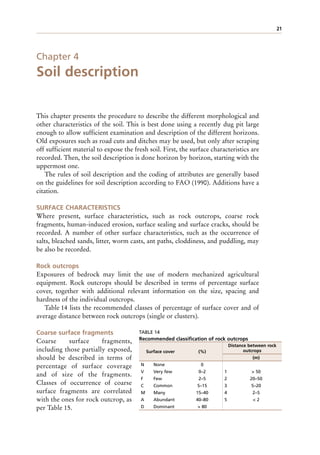
Table 14 lists the recommended classes of percentage of surface cover and of
average distance between rock outcrops (single or clusters).
Coarse surface fragments
Coarse surface fragments,
including those partially exposed,
should be described in terms of
percentage of surface coverage
and of size of the fragments.
Classes of occurrence of coarse
surface fragments are correlated
with the ones for rock outcrop, as
per Table 15.
Surface cover (%)
Distance between rock
outcrops
(m)
N None 0
V Very few 0–2 1 > 50
F Few 2–5 2 20–50
C Common 5–15 3 5–20
M Many 15–40 4 2–5
A Abundant 40–80 5 < 2
D Dominant > 80
TABLE 14
Recommended classification of rock outcrops
Guidelines for soil description
22
Note for classification purposes
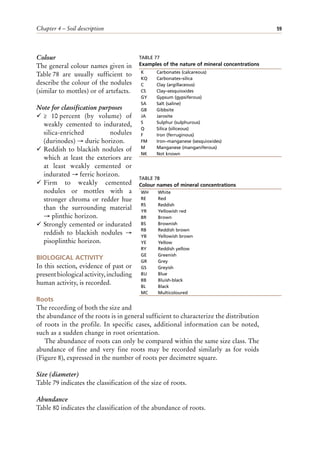
¸ Pavement (consisting of rock
outcrops or surface coarse
fragments) that is varnished or
includes wind-shaped gravel or
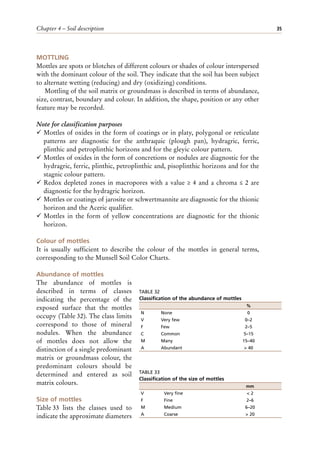
stones or is associated with a
vesicular layer → yermic horizon.
Erosion
In describing soil erosion, emphasis
should be given to accelerated or
human-induced erosion. It is not
always easy to distinguish between
natural and accelerated erosion
as they are often closely related.
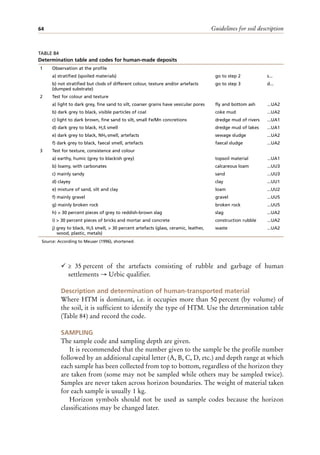
Human-induced erosion is the
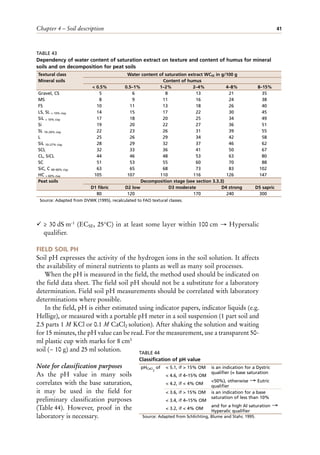
result of irrational use and poor
management, such as inappropriate
agricultural practices, overgrazing
and removal or overexploitation of
the natural vegetation.
Main categories
Erosion can be classified as water
or wind erosion (Table 16), and
include off-site effects such as
deposition; a third major category
is mass movements (landslides and
related phenomena).
Area affected
The total area affected by erosion
and deposition is estimated follow-
ing the classes defined by SOTER
(FAO, 1995) as per Table 17.
Degree
It is difficult to define classes of
the degree of erosion that would
be equally appropriate for all soils
and environments and that would
also fit the various types of water
and wind erosion. Four classes are
recommended (Table 18), which
TABLE 15
Classification of coarse surface fragments
Surface cover (%)
Size classes (indicating the
greatest dimension)
(cm)
N None 0 F Fine gravel 0.2–0.6
V Very few 0–2 M Medium gravel 0.6–2.0
F Few 2–5 C Coarse gravel 2–6
C Common 5–15 S Stones 6–20
M Many 15–40 B Boulders 20–60
A Abundant 40–80 L Large boulders 60–200
D Dominant > 80
TABLE 17
Classification of total area affected by erosion and
deposition
%
0 0
1 0–5
2 5–10
3 10–25
4 25–50
5 > 50
N No evidence of erosion
W Water erosion or
deposition
A Wind (aeolian) erosion or
deposition
WS Sheet erosion AD Wind deposition
WR Rill erosion AM Wind erosion and
deposition
WG Gully erosion AS Shifting sands
WT Tunnel erosion AZ Salt deposition
WD Deposition by water
WA Water and wind erosion
M Mass movement (landslides
and similar phenomena)
NK Not known
TABLE 16
Classification of erosion, by category
TABLE 18
Classification of erosion, by degree
S Slight Some evidence of damage to surface horizons.
Original biotic functions largely intact.
M Moderate Clear evidence of removal of surface horizons.
Original biotic functions partly destroyed.
V Severe Surface horizons completely removed and
subsurface horizons exposed. Original biotic
functions largely destroyed.
E Extreme Substantial removal of deeper subsurface
horizons (badlands). Original biotic functions
fully destroyed.
Chapter 4 – Soil description 23
may have to be further defined
for each type or combination of
erosion and deposition and specific
environment. For example, in the
case of gully and rill erosion, the
depth and spacing may need to be
recorded; for sheet erosion, the
loss of topsoil; for dunes, the height; and for deposition, the thickness of the
layer.
Activity
The period of activity of accelerated erosion or deposition is described using the
recommended classes in Table 19.
Note for classification purposes
¸ Evidence of aeolian activity: rounded or subangular sand particles showing
a matt surface; wind-shaped rock fragments; aeroturbation; wind erosion or
sedimentation → aridic properties.
Surface sealing
Surface sealing is used to describe crusts that develop at the soil surface after
the topsoil dries out. These crusts may inhibit seed germination, reduce water
infiltration and increase runoff. The attributes of surface sealing are the consistence,
when dry, and thickness of the crust as per Table 20.
Note for classification purposes
¸ Surface crust that does not curl entirely upon drying → takyric horizon.
¸ Surface crust → Hyperochric qualifier.
Surface cracks
Surface cracks develop in shrink–swell clay-rich soils after they dry out. The
width (average, or average width and maximum width) of the cracks at the surface
is indicated in centimetres. The average distance between cracks may also be
indicated in centimetres. Table 21 lists the suggested classes.
Note for classification purposes
¸ Cracks that open and close
periodically → Vertisols.
¸ Cracks that open and close
periodically, ≥ 1 cm wide →
vertic properties.
¸ Polygonal cracks extending ≥
2 cm deep when the soil is dry
→ takyric horizon.
A Active at present
R Active in recent past (previous 50–100 years)
H Active in historical times
N Period of activity not known
X Accelerated and natural erosion not distinguished
TABLE 19
Classification of erosion, by activity
TABLE 20
Classification of attributes of surface sealing
Thickness Consistence
(mm)
N None S Slightly hard
F Thin < 2 H Hard
M Medium 2–5 V Very hard
C Thick 5–20 E Extremely hard
V Very thick > 20
Guidelines for soil description
24
Other surface characteristics
A number of other surface
characteristics, such as the
occurrence of salts, bleached
sands, litter, worm casts, ant paths,
cloddiness and puddling, may be
recorded.
Salt
The occurrence of salt at the
surface may be described in terms
of cover, appearance and type of
salt. Table 22 lists the classes for
the percentage of surface cover and
thickness.
Note for classification purposes
¸ Crust pushed up by salt crystals
→ Puffic qualifier.
Bleached sand
The presence of bleached, loose
sand grains on the surface is typical
for certain soils and influences the
reflection characteristics of the area
and, hence, the image obtained
through remote sensing. Table 23
lists the classes based on the
percentage of surface covered.
HORIZON BOUNDARY
Horizon boundaries provide information on the dominant soil-forming processes
that have formed the soil. In certain cases, they reflect past anthropogenic impacts
on the landscape. Horizon boundaries are described in terms of depth, distinctness
and topography.
Depth
Most soil boundaries are zones of transition rather than sharp lines of division.
The depth of the upper and lower boundaries of each horizon is given in
centimetres, measured from the surface (including organic and mineral covers) of
the soil downwards.
Precise notations in centimetres are used where boundaries are abrupt or
clear. Rounded-off figures (to the nearest 5 cm) are entered where the boundaries
are gradual or diffuse, avoiding the suggestion of spurious levels of accuracy.
TABLE 21
Classification of surface cracks
Width Distance between cracks
(cm) (m)
F Fine < 1 C Very closely spaced < 0.2
M Medium 1–2 D Closely spaced 0.2–0.5
W Wide 2–5 M Moderately widely
spaced
0.5–2
V Very wide 5–10 W Widely spaced 2–5
E Extremely wide > 10 V Very widely spaced > 5
Depth
S Surface < 2
M Medium 2–10
D Deep 10–20
V Very deep > 20
TABLE 22
Classification of salt characteristics
Cover Thickness
(%) (mm)
0 None 0–2 N None
1 Low 2–15 F Thin < 2
2 Moderate 15–40 M Medium 2–5
3 High 40–80 C Thick 5–20
4 Dominant > 80 V Very thick > 20
TABLE 23
Classification of bleached sand characteristics
%
0 None 0–2
1 Low 2–15
2 Moderate 15–40
3 High 40–80
4 Dominant > 80
Chapter 4 – Soil description 25
However, if boundary depths are
near diagnostic limits, rounded-
off figures should not be used. In
this case, the depth is indicated as
a medium value for the transitional
zone (if it starts at 16 cm and
terminates at 23 cm, the depth
should be 19.5 cm).
Most horizons do not have a
constant depth. The variation or
irregularity of the surface of the
boundary is described by the topography in terms of smooth, wavy, irregular and
broken. If required, ranges in depth should be given in addition to the average
depth, for example 28 (25–31) cm to 45 (39–51) cm.
Note for classification purposes
¸ Many diagnostic horizons and properties are found at a certain depth. Important
boundary depths are 10, 20, 25, 40, 50, 100 and 120 cm.
Distinctness and topography
The distinctness of the boundary refers to the thickness of the zone in which the
horizon boundary can be located without being in one of the adjacent horizons
(Table 24).
The topography of the boundary indicates the smoothness of depth variation
of the boundary.
Note for classification purposes
¸ Cryoturbation → cryic horizon, Cryosols and Turbic qualifier.
¸ Tonguing of a mollic or umbric horizon into an underlying layer → Glossic
qualifier.
¸ Tonguing of an eluvial albic horizon into an argic horizon → albeluvic tonguing
and Glossalbic qualifier.
¸ Diffuse horizon boundaries → Nitisols.
PRIMARY CONSTITUENTS
This section presents the procedure on the description of soil texture and the
nature of the primary rock and mineral fragments, which are subdivided into: (i)
the fine earth fraction; and (ii) the coarse fragments fraction.
Texture of the fine earth fraction
Soil texture refers to the proportion of the various particle-size classes (or soil
separates, or fractions) in a given soil volume and is described as soil textural
class (Figure 4). The names for the particle-size classes correspond closely with
commonly used standard terminology, including that of the system used by the
TABLE 24
Classification of horizon boundaries, by distinctness and
topography
Distinctness Topography
(cm)
A Abrupt 0–2 S Smooth Nearly plane surface
C Clear 2–5 W Wavy Pockets less deep than
wide
G Gradual 5–15 I Irregular Pockets more deep than
wide
D Diffuse > 15 B Broken Discontinuous
Guidelines for soil description
26
United States Department of Agriculture (USDA). However, many national
systems describing particle-size and textural classes use more or less the same
names but different grain fractions of sand, silt and clay, and textural classes. This
publication uses the 2000–63–2-µm system for particle-size fractions.
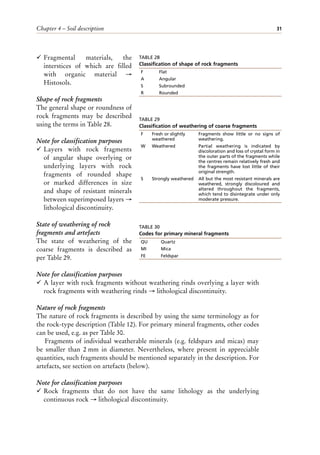
Soil textural classes
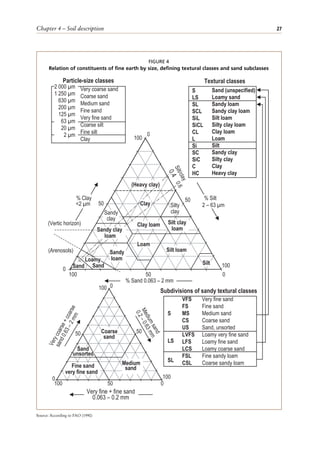
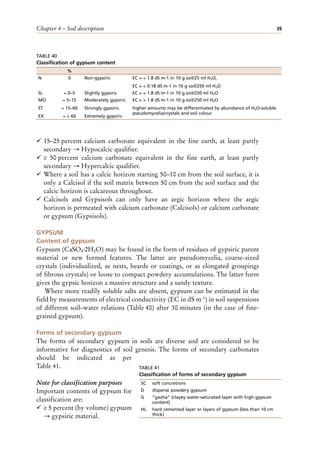
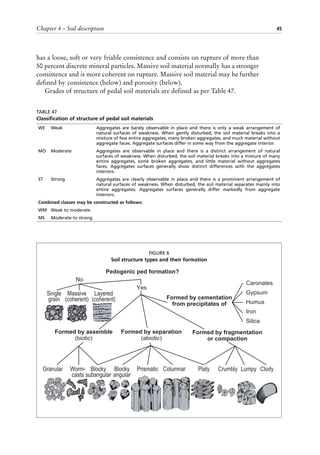
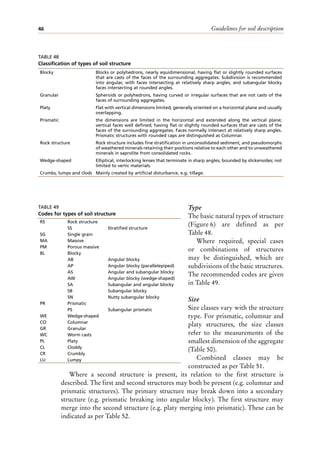
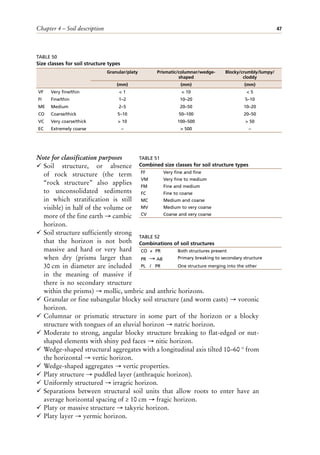
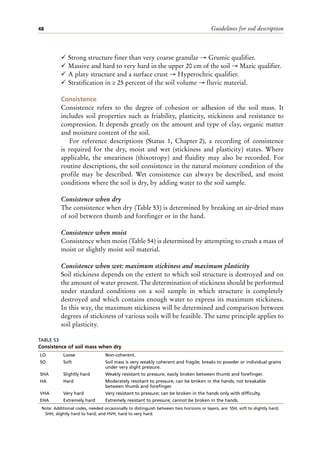
The names of the textural classes (which describe combined particle-size classes)
of the described soil material are coded as in Figure 4.
In addition to the textural class, a field estimate of the percentage of clay is
given. This estimate is useful for indicating increases or decreases in clay content
within textural classes, and for comparing field estimates with analytical results.
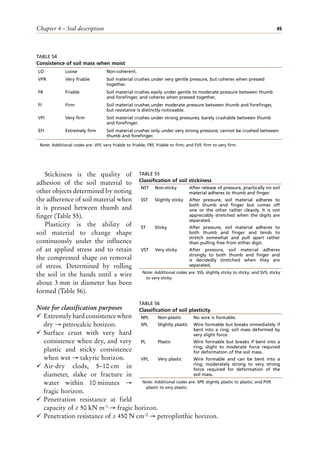
The relationship between the basic textural classes and the percentages of clay, silt
and sand is indicated in a triangular form in Figure 4.
Subdivision of the sand fraction
Sands, loamy sands and sandy loams are subdivided according to the proportions
of very coarse to coarse, medium, fine and very fine sands in the sand fraction. The
proportions are calculated from the particle-size distribution, taking the total of
the sand fraction as being 100 percent (Figure 4).
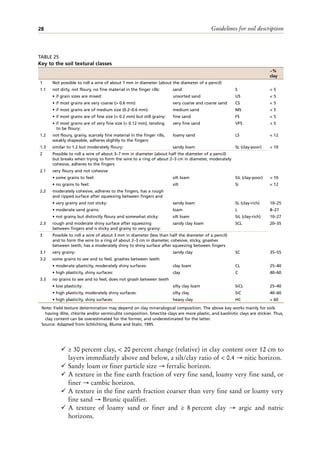
Field estimation of textural classes
The textural class can be estimated in the field by simple field tests and feeling the
constituents of the soil (Table 25). For this, the soil sample must be in a moist to
weak wet state. Gravel and other constituents > 2 mm must be removed.
The constituents have the following feel:
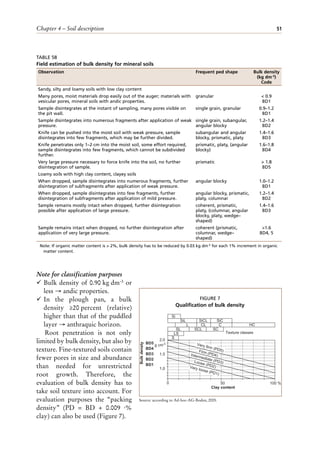
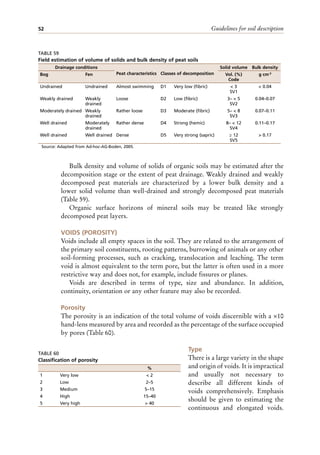
ÿClay: soils fingers, is cohesive (sticky), is formable, has a high plasticity and
has a shiny surface after squeezing between fingers.
ÿSilt: soils fingers, is non-sticky, only weakly formable, has a rough and ripped
surface after squeezing between fingers and feels very floury (like talcum
powder).
ÿSand: cannot be formed, does not soil fingers and feels very grainy.
Note for classification purposes
Important diagnostic characteristics derived from the textural class are:
¸ A texture that is loamy sand or coarser to a depth of ≥ 100 cm → Arenosol.
¸ A texture of loamy fine sand or coarser in a layer ≥ 30 cm thick within 100 cm
of the soil surface → Arenic qualifier.
¸ A texture of silt, silt loam, silty clay loam or silty clay in a layer ≥ 30 cm thick,
within 100 cm of the soil surface → Siltic qualifier.
¸ A texture of clay in a layer ≥ 30 cm thick within 100 cm of the soil surface →
Clayic qualifier.
¸ ≥ 30 percent clay throughout a thickness of 25 cm → vertic horizon.
¸ ≥ 30 percent clay throughout a thickness of 15 cm → vertic properties.
¸ ≥ 30 percent clay between the soil surface and a vertic horizon → Vertisol.
Chapter 4 – Soil description 27
Source: According to FAO (1990)
(Arenosols)
(Vertic horizon)
SL
S
LS
VFS
FS
MS
CS
US
LVFS
LFS
LCS
FSL
CSL
2 000 µm
1 250 µm
630 µm
200 µm
125 µm
63 µm
20 µm
2 µm
Subdivisions of sandy textural classes
Textural classes
Particle-size classes
% Clay
<2 µm
% Silt
2 – 63 µm
% Sand 0.063 – 2 mm
Clay
Clay loam Silt clay
loam
Sandy
clay
Sandy clay
loam
Loam
Silt loam
Silt
Sandy
loam
Sand
Silty
clay
(Heavy clay)
0
50
100
0
50
100
0
50
100
S
i
l
t
/
c
l
a
y
0
.
4
0
.
6
Fine sand
very fine sand
Medium
sand
Coarse
sand
V
e
r
y
c
o
a
r
s
e
+
c
o
a
r
s
e
s
a
n
d
0
.
6
3
–
2
m
m
M
e
d
i
u
m
s
a
n
d
0
.
2
–
0
.
6
3
m
m
Very fine + fine sand
0.063 – 0.2 mm
0
50
100
0
50
100
0
50
100
Loamy
Sand
unsorted
Very coarse sand
Coarse sand
Medium sand
Fine sand
Very fine sand
Coarse silt
Fine silt
Clay
S
LS
SL
SCL
SiL
SiCL
CL
L
Si
SC
SiC
C
HC
Sand (unspecified)
Loamy sand
Sandy loam
Sandy clay loam
Silt loam
Silty clay loam
Clay loam
Loam
Silt
Sandy clay
Silty clay
Clay
Heavy clay
Sand
Very fine sand
Fine sand
Medium sand
Coarse sand
Sand, unsorted
Loamy very fine sand
Loamy fine sand
Loamy coarse sand
Fine sandy loam
Coarse sandy loam
FIGURE 4
Relation of constituents of fine earth by size, defining textural classes and sand subclasses
Guidelines for soil description
28
¸ ≥ 30 percent clay, < 20 percent change (relative) in clay content over 12 cm to
layers immediately above and below, a silt/clay ratio of < 0.4 → nitic horizon.
¸ Sandy loam or finer particle size → ferralic horizon.
¸ A texture in the fine earth fraction of very fine sand, loamy very fine sand, or
finer → cambic horizon.
¸ A texture in the fine earth fraction coarser than very fine sand or loamy very
fine sand → Brunic qualifier.
¸ A texture of loamy sand or finer and ≥ 8 percent clay → argic and natric
horizons.
TABLE 25
Key to the soil textural classes
Note: Field texture determination may depend on clay mineralogical composition. The above key works mainly for soils
having illite, chlorite and/or vermiculite composition. Smectite clays are more plastic, and kaolinitic clays are stickier. Thus,
clay content can be overestimated for the former, and underestimated for the latter.
Source: Adapted from Schlichting, Blume and Stahr, 1995.
~%
clay
1 Not possible to roll a wire of about 7 mm in diameter (about the diameter of a pencil)
1.1 not dirty, not floury, no fine material in the finger rills: sand S < 5
• if grain sizes are mixed: unsorted sand US < 5
• if most grains are very coarse (> 0.6 mm): very coarse and coarse sand CS < 5
• if most grains are of medium size (0.2–0.6 mm): medium sand MS < 5
• if most grains are of fine size (< 0.2 mm) but still grainy: fine sand FS < 5
• if most grains are of very fine size (< 0.12 mm), tending
to be floury:
very fine sand VFS < 5
1.2 not floury, grainy, scarcely fine material in the finger rills,
weakly shapeable, adheres slightly to the fingers:
loamy sand LS < 12
1.3 similar to 1.2 but moderately floury: sandy loam SL (clay-poor) < 10
2 Possible to roll a wire of about 3–7 mm in diameter (about half the diameter of a pencil)
but breaks when trying to form the wire to a ring of about 2–3 cm in diameter, moderately
cohesive, adheres to the fingers
2.1 very floury and not cohesive
• some grains to feel: silt loam SiL (clay-poor) < 10
• no grains to feel: silt Si < 12
2.2 moderately cohesive, adheres to the fingers, has a rough
and ripped surface after squeezing between fingers and
• very grainy and not sticky: sandy loam SL (clay-rich) 10–25
• moderate sand grains: loam L 8–27
• not grainy but distinctly floury and somewhat sticky: silt loam SiL (clay-rich) 10–27
2.3 rough and moderate shiny surface after squeezing
between fingers and is sticky and grainy to very grainy:
sandy clay loam SCL 20–35
3 Possible to roll a wire of about 3 mm in diameter (less than half the diameter of a pencil)
and to form the wire to a ring of about 2–3 cm in diameter, cohesive, sticky, gnashes
between teeth, has a moderately shiny to shiny surface after squeezing between fingers
3.1 very grainy: sandy clay SC 35–55
3.2 some grains to see and to feel, gnashes between teeth
• moderate plasticity, moderately shiny surfaces: clay loam CL 25–40
• high plasticity, shiny surfaces: clay C 40–60
3.3 no grains to see and to feel, does not gnash between teeth
• low plasticity: silty clay loam SiCL 25–40
• high plasticity, moderately shiny surfaces: silty clay SiC 40–60
• high plasticity, shiny surfaces: heavy clay HC > 60
Chapter 4 – Soil description 29
¸ A texture of sand, loamy sand, sandy loam or silt loam or a combination of
them → plaggic horizon.
¸ A higher clay content than the underlying soil and relative differences among
medium, fine and very fine sand and clay < 20 percent → irragric horizon.
¸ A texture of sandy clay loam, clay loam, silty clay loam or finer → takyric
horizon.
¸ ≥ 8 percent clay in the underlying layer and within 7.5 cm either doubling of
the clay content if the overlying layer has less then 20 percent or 20 percent
(absolute) more clay → abrupt textural change.
¸ An abrupt change in particle-size distribution that is not solely associated with
a change in clay content resulting from pedogenesis or a relative change of
≥ 20 percent in the ratios between coarse sand, medium sand, and fine sand →
lithological discontinuity.
¸ The required amount of organic carbon depends on the clay content, if the layer
is saturated with water for ≥ 30 consecutive days in most years → organic and
mineral materials.
¸ The required amount of organic carbon depends on the texture → aridic
properties.
¸ The depth where an argic horizon starts depends on the texture → Alisols,
Acrisols, Luvisols and Lixisols, and Alic, Acric, Luvic and Lixic qualifiers.
¸ An argic horizon in which the clay content does not decrease by 20 percent of
more (relative) from its maximum within 150 cm → Profondic qualifier.
¸ An absolute clay increase of ≥ 3 percent → Hypoluvic qualifier.
¸ A silt/clay ratio < 0.6 → Hyperalic qualifier.
Rock fragments and artefacts
The presence of rock fragments influences the nutrient status, water movement,
use and management of the soil. It also reflects the origin and stage of development
of the soil.
Artefacts (sections on artefacts and description of artefacts [below]) are useful
for identifying colluviation, human occupation, and industrial processes.
Large rock and mineral fragments (> 2 mm) and artefacts are described
according to abundance, size, shape, state of weathering, and nature of the
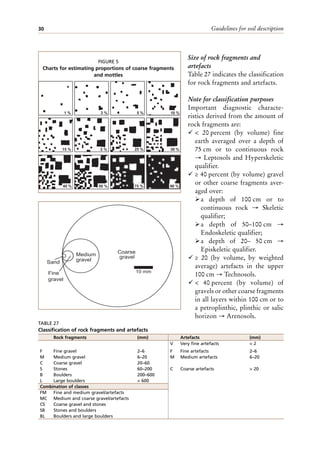
fragments. The abundance class
limits correspond with the ones
for surface coarse fragments and
mineral nodules, and the 40-
percent boundary coincides with
the requirement for the skeletic
phase (Table 26 and Figure 5).
Where rock fragments are not
distributed regularly within a
horizon but form a “stone line”,
this should be indicated clearly.
TABLE 26
Abundance of rock fragments and artefacts, by volume
%
N None 0
V Very few 0–2
F Few 2–5
C Common 5–15
M Many 15–40
A Abundant 40–80
D Dominant > 80
S Stone line any content, but concentrated at a distinct
depth of a horizon
Guidelines for soil description
30
Size of rock fragments and
artefacts
Table 27 indicates the classification
for rock fragments and artefacts.
Note for classification purposes
Important diagnostic characte-
ristics derived from the amount of
rock fragments are:
¸ < 20 percent (by volume) fine
earth averaged over a depth of
75 cm or to continuous rock
→ Leptosols and Hyperskeletic
qualifier.
¸ ≥ 40 percent (by volume) gravel
or other coarse fragments aver-
aged over:
ÿa depth of 100 cm or to
continuous rock → Skeletic
qualifier;
ÿa depth of 50–100 cm →
Endoskeletic qualifier;
ÿa depth of 20– 50 cm →
Episkeletic qualifier.
¸ ≥ 20 (by volume, by weighted
average) artefacts in the upper
100 cm → Technosols.
¸ < 40 percent (by volume) of
gravels or other coarse fragments
in all layers within 100 cm or to
a petroplinthic, plinthic or salic
horizon → Arenosols.
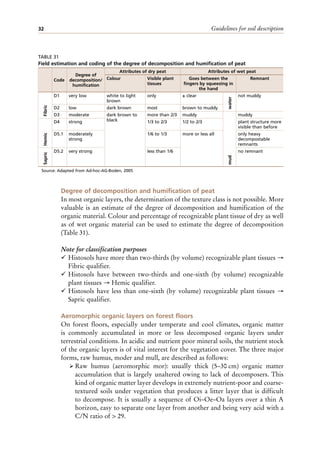
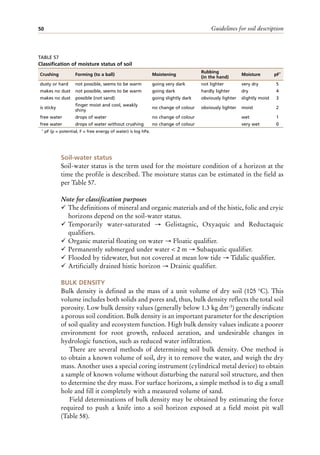
25 % 30 %
40 % 50 % 75 % 90 %
1 % 3 % 5 % 10 %
15 % 2 %
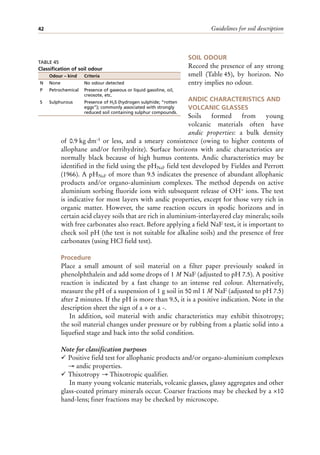
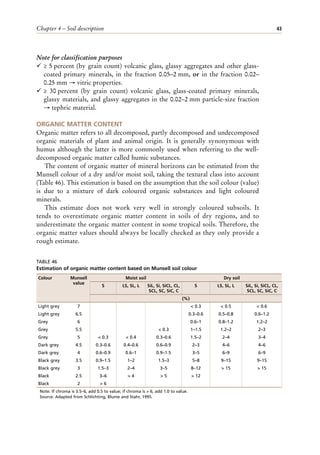
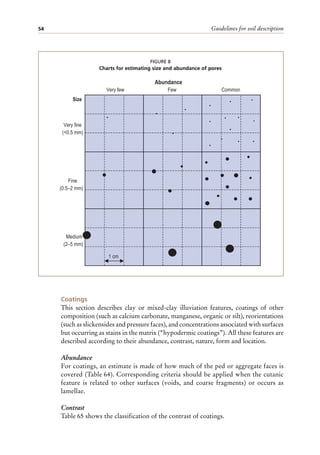
FIGURE 5
Charts for estimating proportions of coarse fragments
and mottles
TABLE 27
Classification of rock fragments and artefacts
Rock fragments (mm) Artefacts (mm)
V Very fine artefacts < 2
F Fine gravel 2–6 F Fine artefacts 2–6
M Medium gravel 6–20 M Medium artefacts 6–20
C Coarse gravel 20–60
S Stones 60–200 C Coarse artefacts > 20
B Boulders 200–600
L Large boulders > 600
Combination of classes
FM Fine and medium gravel/artefacts
MC Medium and coarse gravel/artefacts
CS Coarse gravel and stones
SB Stones and boulders
BL Boulders and large boulders
Coarse
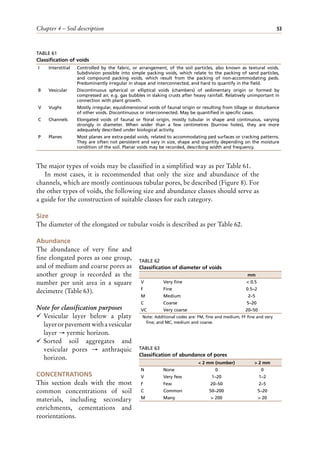
gravel
Medium
gravel
Sand
Fine
gravel
10 mm
Chapter 4 – Soil description 31
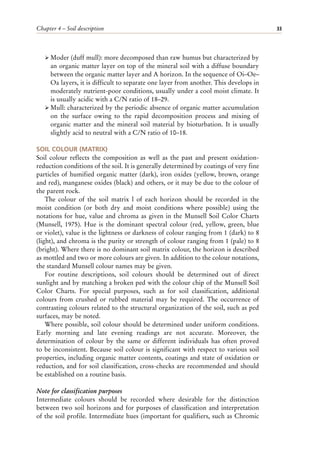
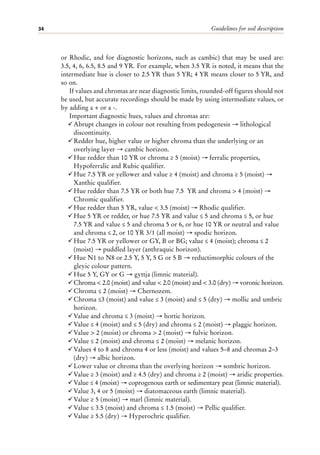
¸ Fragmental materials, the
interstices of which are filled
with organic material →
Histosols.
Shape of rock fragments
The general shape or roundness of
rock fragments may be described
using the terms in Table 28.
Note for classification purposes
¸ Layers with rock fragments
of angular shape overlying or
underlying layers with rock
fragments of rounded shape
or marked differences in size
and shape of resistant minerals
between superimposed layers →
lithological discontinuity.
State of weathering of rock
fragments and artefacts
The state of weathering of the
coarse fragments is described as
per Table 29.
Note for classification purposes
¸ A layer with rock fragments without weathering rinds overlying a layer with
rock fragments with weathering rinds → lithological discontinuity.
Nature of rock fragments
The nature of rock fragments is described by using the same terminology as for
the rock-type description (Table 12). For primary mineral fragments, other codes
can be used, e.g. as per Table 30.
Fragments of individual weatherable minerals (e.g. feldspars and micas) may
be smaller than 2 mm in diameter. Nevertheless, where present in appreciable
quantities, such fragments should be mentioned separately in the description. For
artefacts, see section on artefacts (below).
Note for classification purposes
¸ Rock fragments that do not have the same lithology as the underlying
continuous rock → lithological discontinuity.
TABLE 28
Classification of shape of rock fragments
F Flat
A Angular
S Subrounded
R Rounded
TABLE 29
Classification of weathering of coarse fragments
F Fresh or slightly
weathered
Fragments show little or no signs of
weathering.
W Weathered Partial weathering is indicated by
discoloration and loss of crystal form in
the outer parts of the fragments while
the centres remain relatively fresh and
the fragments have lost little of their
original strength.
S Strongly weathered All but the most resistant minerals are
weathered, strongly discoloured and
altered throughout the fragments,
which tend to disintegrate under only
moderate pressure.
TABLE 30
Codes for primary mineral fragments
QU Quartz
MI Mica
FE Feldspar
Guidelines for soil description
32
Degree of decomposition and humification of peat
In most organic layers, the determination of the texture class is not possible. More
valuable is an estimate of the degree of decomposition and humification of the
organic material. Colour and percentage of recognizable plant tissue of dry as well
as of wet organic material can be used to estimate the degree of decomposition
(Table 31).
Note for classification purposes
¸ Histosols have more than two-thirds (by volume) recognizable plant tissues →
Fibric qualifier.
¸ Histosols have between two-thirds and one-sixth (by volume) recognizable
plant tissues → Hemic qualifier.
¸ Histosols have less than one-sixth (by volume) recognizable plant tissues →
Sapric qualifier.
Aeromorphic organic layers on forest floors
On forest floors, especially under temperate and cool climates, organic matter
is commonly accumulated in more or less decomposed organic layers under
terrestrial conditions. In acidic and nutrient poor mineral soils, the nutrient stock
of the organic layers is of vital interest for the vegetation cover. The three major
forms, raw humus, moder and mull, are described as follows:
ÿ Raw humus (aeromorphic mor): usually thick (5–30 cm) organic matter
accumulation that is largely unaltered owing to lack of decomposers. This
kind of organic matter layer develops in extremely nutrient-poor and coarse-
textured soils under vegetation that produces a litter layer that is difficult
to decompose. It is usually a sequence of Oi–Oe–Oa layers over a thin A
horizon, easy to separate one layer from another and being very acid with a
C/N ratio of > 29.
TABLE 31
Field estimation and coding of the degree of decomposition and humification of peat
Code
Degree of
decomposition/
humification
Attributes of dry peat Attributes of wet peat
Colour Visible plant
tissues
Goes between the
fingers by squeezing in
the hand
Remnant
Fibric
D1 very low white to light
brown
only ± clear
water
not muddy
D2 low dark brown most brown to muddy
D3 moderate dark brown to
black
more than 2/3 muddy
mud
muddy
Hemic
D4 strong 1/3 to 2/3 1/2 to 2/3 plant structure more
visible than before
D5.1 moderately
strong
1/6 to 1/3 more or less all only heavy
decompostable
remnants
Sapric
D5.2 very strong less than 1/6 no remnant
Source: Adapted from Ad-hoc-AG-Boden, 2005
Chapter 4 – Soil description 33
ÿ Moder (duff mull): more decomposed than raw humus but characterized by
an organic matter layer on top of the mineral soil with a diffuse boundary
between the organic matter layer and A horizon. In the sequence of Oi–Oe–
Oa layers, it is difficult to separate one layer from another. This develops in
moderately nutrient-poor conditions, usually under a cool moist climate. It
is usually acidic with a C/N ratio of 18–29.
ÿ Mull: characterized by the periodic absence of organic matter accumulation
on the surface owing to the rapid decomposition process and mixing of
organic matter and the mineral soil material by bioturbation. It is usually
slightly acid to neutral with a C/N ratio of 10–18.
SOIL COLOUR (MATRIX)
Soil colour reflects the composition as well as the past and present oxidation-
reduction conditions of the soil. It is generally determined by coatings of very fine
particles of humified organic matter (dark), iron oxides (yellow, brown, orange
and red), manganese oxides (black) and others, or it may be due to the colour of
the parent rock.
The colour of the soil matrix l of each horizon should be recorded in the
moist condition (or both dry and moist conditions where possible) using the
notations for hue, value and chroma as given in the Munsell Soil Color Charts
(Munsell, 1975). Hue is the dominant spectral colour (red, yellow, green, blue
or violet), value is the lightness or darkness of colour ranging from 1 (dark) to 8
(light), and chroma is the purity or strength of colour ranging from 1 (pale) to 8
(bright). Where there is no dominant soil matrix colour, the horizon is described
as mottled and two or more colours are given. In addition to the colour notations,
the standard Munsell colour names may be given.
For routine descriptions, soil colours should be determined out of direct
sunlight and by matching a broken ped with the colour chip of the Munsell Soil
Color Charts. For special purposes, such as for soil classification, additional
colours from crushed or rubbed material may be required. The occurrence of
contrasting colours related to the structural organization of the soil, such as ped
surfaces, may be noted.
Where possible, soil colour should be determined under uniform conditions.
Early morning and late evening readings are not accurate. Moreover, the
determination of colour by the same or different individuals has often proved
to be inconsistent. Because soil colour is significant with respect to various soil
properties, including organic matter contents, coatings and state of oxidation or
reduction, and for soil classification, cross-checks are recommended and should
be established on a routine basis.
Note for classification purposes
Intermediate colours should be recorded where desirable for the distinction
between two soil horizons and for purposes of classification and interpretation
of the soil profile. Intermediate hues (important for qualifiers, such as Chromic
Guidelines for soil description
34
or Rhodic, and for diagnostic horizons, such as cambic) that may be used are:
3.5, 4, 6, 6.5, 8.5 and 9 YR. For example, when 3.5 YR is noted, it means that the
intermediate hue is closer to 2.5 YR than 5 YR; 4 YR means closer to 5 YR, and
so on.
If values and chromas are near diagnostic limits, rounded-off figures should not
be used, but accurate recordings should be made by using intermediate values, or
by adding a + or a -.
Important diagnostic hues, values and chromas are:
¸Abrupt changes in colour not resulting from pedogenesis → lithological
discontinuity.
¸Redder hue, higher value or higher chroma than the underlying or an
overlying layer → cambic horizon.
¸Hue redder than 10 YR or chroma ≥ 5 (moist) → ferralic properties,
Hypoferralic and Rubic qualifier.
¸Hue 7.5 YR or yellower and value ≥ 4 (moist) and chroma ≥ 5 (moist) →
Xanthic qualifier.
¸Hue redder than 7.5 YR or both hue 7.5 YR and chroma > 4 (moist) →
Chromic qualifier.
¸Hue redder than 5 YR, value < 3.5 (moist) → Rhodic qualifier.
¸Hue 5 YR or redder, or hue 7.5 YR and value ≤ 5 and chroma ≤ 5, or hue
7.5 YR and value ≤ 5 and chroma 5 or 6, or hue 10 YR or neutral and value
and chroma ≤ 2, or 10 YR 3/1 (all moist) → spodic horizon.
¸Hue 7.5 YR or yellower or GY, B or BG; value ≤ 4 (moist); chroma ≤ 2
(moist) → puddled layer (anthraquic horizon).
¸Hue N1 to N8 or 2.5 Y, 5 Y, 5 G or 5 B → reductimorphic colours of the
gleyic colour pattern.
¸Hue 5 Y, GY or G → gyttja (limnic material).
¸Chroma < 2.0 (moist) and value < 2.0 (moist) and < 3.0 (dry) → voronic horizon.
¸Chroma ≤ 2 (moist) → Chernozem.
¸Chroma ≤3 (moist) and value ≤ 3 (moist) and ≤ 5 (dry) → mollic and umbric
horizon.
¸Value and chroma ≤ 3 (moist) → hortic horizon.
¸Value ≤ 4 (moist) and ≤ 5 (dry) and chroma ≤ 2 (moist) → plaggic horizon.
¸Value > 2 (moist) or chroma > 2 (moist) → fulvic horizon.
¸Value ≤ 2 (moist) and chroma ≤ 2 (moist) → melanic horizon.
¸Values 4 to 8 and chroma 4 or less (moist) and values 5–8 and chromas 2–3
(dry) → albic horizon.
¸Lower value or chroma than the overlying horizon → sombric horizon.
¸Value ≥ 3 (moist) and ≥ 4.5 (dry) and chroma ≥ 2 (moist) → aridic properties.
¸Value ≤ 4 (moist) → coprogenous earth or sedimentary peat (limnic material).
¸Value 3, 4 or 5 (moist) → diatomaceous earth (limnic material).
¸Value ≥ 5 (moist) → marl (limnic material).
¸Value ≤ 3.5 (moist) and chroma ≤ 1.5 (moist) → Pellic qualifier.
¸Value ≥ 5.5 (dry) → Hyperochric qualifier.
Chapter 4 – Soil description 35
MOTTLING
Mottles are spots or blotches of different colours or shades of colour interspersed
with the dominant colour of the soil. They indicate that the soil has been subject
to alternate wetting (reducing) and dry (oxidizing) conditions.
Mottling of the soil matrix or groundmass is described in terms of abundance,
size, contrast, boundary and colour. In addition, the shape, position or any other
feature may be recorded.
Note for classification purposes
¸ Mottles of oxides in the form of coatings or in platy, polygonal or reticulate
patterns are diagnostic for the anthraquic (plough pan), hydragric, ferric,
plinthic and petroplinthic horizons and for the gleyic colour pattern.
¸ Mottles of oxides in the form of concretions or nodules are diagnostic for the
hydragric, ferric, plinthic, petroplinthic and, pisoplinthic horizons and for the
stagnic colour pattern.
¸ Redox depleted zones in macropores with a value ≥ 4 and a chroma ≤ 2 are
diagnostic for the hydragric horizon.
¸ Mottles or coatings of jarosite or schwertmannite are diagnostic for the thionic
horizon and the Aceric qualifier.
¸ Mottles in the form of yellow concentrations are diagnostic for the thionic
horizon.
Colour of mottles
It is usually sufficient to describe the colour of the mottles in general terms,
corresponding to the Munsell Soil Color Charts.
Abundance of mottles
The abundance of mottles is
described in terms of classes
indicating the percentage of the
exposed surface that the mottles
occupy (Table 32). The class limits
correspond to those of mineral
nodules. When the abundance
of mottles does not allow the
distinction of a single predominant
matrix or groundmass colour, the
predominant colours should be
determined and entered as soil
matrix colours.
Size of mottles
Table 33 lists the classes used to
indicate the approximate diameters
TABLE 32
Classification of the abundance of mottles
%
N None 0
V Very few 0–2
F Few 2–5
C Common 5–15
M Many 15–40
A Abundant > 40
TABLE 33
Classification of the size of mottles
mm
V Very fine < 2
F Fine 2–6
M Medium 6–20
A Coarse > 20
Guidelines for soil description
36
of individual mottles. They
correspond to the size classes of
mineral nodules.
Contrast of mottles
The colour contrast between
mottles and soil matrix can be
described as per Table 34.
Boundary of mottles
The boundary between mottle and
matrix is described as the thickness
of the zone within which the
colour transition can be located
without being in either the mottle
or matrix (Table 35).
SOIL REDOX POTENTIAL AND REDUCING CONDITIONS
Determination of redox potential by field method
Soil redox potential is an important physico-chemical parameter used to
characterize soil aeration status and availability of some nutrients (Table 36). The
redox potential is also used in the WRB classification to classify redoximorphic
soils.
To measure redox potential (DIN/ISO Draft, DVWK, 1995), drive a hole
into the soil using a rigid rod (stainless steel, 20–100 cm long, with a diameter
that is 2 mm greater than the redox electrodes) to a depth about 1–2 cm less than
the desired depth to be measured. Immediately clean the platinum surface of the
redox electrode with sandpaper and insert the electrode about 1 cm deeper than
the prepared hole. At least two electrodes should be installed for each depth
TABLE 34
Classification of the contrast of mottles
F Faint The mottles are evident only on close examina-
tion. Soil colours in both the matrix and mottles
have closely related hues, chromas and values.
D Distinct Although not striking, the mottles are readily
seen. The hue, chroma and value of the matrix
are easily distinguished from those of the
mottles. They may vary by as much as 2.5 units of
hue or several units in chroma or value.
P Prominent The mottles are conspicuous and mottling is one
of the outstanding features of the horizon. Hue,
chroma and value alone or in combination are at
least several units apart.
TABLE 35
Classification of boundary between mottle and matrix
mm
S Sharp < 0.5
C Clear 0.5–2
D Diffuse > 2
* For field test, see section on reducing conditions (below).
TABLE 36
Redoximorphic soil characteristics and their relation to rH values and soil processes
Redoximorphic characteristics rH values and status Processes
No redoximorphic characteristics at
permanently high potentials
permanently > 35
< 33
strongly aerated
NO3 reduction
Black Mn concretions temporary < 29 MnII formation
Fe mottles and/or brown Fe concretions, in
wet conditions
temporary < 20 FeII formation*
Blue-green to grey colour; Fe2+ ions always
present
permanently 13–19 formation of FeII/FeIII oxides (green rust)*
Black colour due to metal sulphides,
flammable methane present
permanently < 13 sulphide formation
methane formation
permanently < 10
-
Chapter 4 – Soil description 37
being measured. After at least 30 minutes, measure the redox potential with a
millivoltmeter against a reference electrode (e.g. Ag/AgCl in KCl of the glass
electrode of pH measurements, installed in a small hole on the topsoil that has
been filled with 1-M KCl solution). For dry topsoil, a salt bridge (plastic tube
2 cm in diameter and with open ends, filled with 0.5 percent (M/M) agar in KCl
solution) should be installed in a hole beside and at the depth of the platinum
electrodes. In this tube, the reference electrode should be installed.
The measured voltage (Em) is related to the voltage of the standard hydrogen
electrode by adding the potential of the reference electrode (e.g. +244 millivolt at
10 °C of Ag/AgCl in 1 M KCl, +287 of Calomel electrode).
For interpretation, the results should be transformed to rH values using the
formula: rH = 2pH + 2Eh/59 (Eh in mV at 25 °C).
Note the rH value on the description sheet.
Reducing conditions
Reductimorphic properties of the soil matrix reflect permanently wet or at least
reduced conditions (Table 37). They are expressed by neutral (white to black:
Munsell N1 to N) or bluish to greenish colours (Munsell 2.5 Y, 5 Y, 5 G, 5 B). The
colour pattern will often change by aeration in minutes to days owing to oxidation
processes.
The presence of FeII ions can be tested by spraying the freshly exposed soil
surface with a 0.2-percent (M/V) α,α dipyridyl solution in 10-percent (V/V) acetic
acid solution. The test yields a striking reddish-orange colour in the presence of
Fe2+ ions but may not give the strong red colour in soil materials with a neutral or
alkaline soil reaction. Care is necessary as the chemical is slightly toxic.
Note for classification purposes
¸ An rH value of < 20 is diagnostic for reducing conditions in Gleysols, Planosols
and Stagnosols, and stagnic and gleyic lower level units of other RSGs. Gaseous
emissions (methane, carbon dioxide, etc.) are diagnostic for the Reductic
qualifier.
TABLE 37
Reductimorphic colour pattern and occurrence of Fe compounds
Colour Munsell colour Formula Mineral
Greyish green, light blue 5–GY–5–B2–3/1–3 FeII/FeIII Fe-mix compounds (blue-green rust)
White, after oxidation brown N7–8 → 10 YR4/5 FeIICO3 siderite
White, after oxidation blue N7–8 → 5–B FeII
3(PO4)2 · 8 H2O vivianite
Bluish black
(with 10% HCl; H2S- smell)
5–10–B1–2/1–3
FeS, FeS2
(or Fe3S4)
Fe sulphides
White, after oxidation white N8 → N8 - - Complete loss of Fe compounds
Source: Schlichting et al., 1995
Guidelines for soil description
38
CARBONATES
Content
Carbonates in soils are either
residues of the parent material
or the result of neo-formation
(secondary carbonates). The latter
are concentrated mainly in the form
of soft powdery lime, coatings
on peds, concretions, surface or
subsoil crusts, or hard banks. The
presence of calcium carbonate
(CaCO3) is established by adding
some drops of 10-percent HCl to
the soil. The degree of effervescence
of carbon dioxide gas is indicative
for the amount of calcium
carbonate present. In many soils, it
is difficult to distinguish in the field
between primary and secondary
carbonates. Classes for the reaction
of carbonates in the soil matrix are
defined as per Table 38.
The reaction to acid depends
upon soil texture and is usually
more vigorous in sandy material
than in fine-textured material with the same carbonate content. Other materials,
such as roots, may also give an audible reaction. Dolomite commonly reacts more
slowly and less vigorously than calcite. Secondary carbonates should be tested
separately; they normally react much more intensely with HCl.
Forms
The forms of secondary carbonates in soils are diverse and are considered to
be informative for diagnostics of soil genesis. Soft carbonate concentrations are
considered to be illuvial, and hard concretions are generally believed to be of
hydrogenic nature. The forms of secondary carbonates should be indicated as per
Table 39.
Note for classification purposes
Important carbonate contents for classification are:
¸ ≥ 2 percent calcium carbonate equivalent → calcaric material.
¸ ≥ 15 percent calcium carbonate equivalent in the fine earth, at least partly
secondary → calcic horizon.
¸ Indurated layer with calcium carbonate, at least partly secondary → petrocalcic
horizon.
TABLE 38
Classification of carbonate reaction in the soil matrix
%
N 0 Non-calcareous No detectable visible or
audible effervescence.
SL ≈ 0–2 Slightly calcareous Audible effervescence
but not visible.
MO ≈ 2–10 Moderately calcareous Visible effervescence.
ST ≈ 10–25 Strongly calcareous Strong visible
effervescence. Bubbles
form a low foam.
EX ≈ > 25 Extremely calcareous Extremely strong
reaction. Thick foam
forms quickly.
TABLE 39
Classification of forms of secondary carbonates
* Pseudomycelia carbonates are not regarded as “secondary
carbonates” if they migrate seasonally and have no permanent
depth.
SC soft concretions
HC hard concretions
HHC hard hollow concretions
D disperse powdery lime
PM pseudomycelia* (carbonate infillings in pores, resembling
mycelia)
M marl layer
HL hard cemented layer or layers of carbonates (less than
10 cm thick)
Chapter 4 – Soil description 39
¸ 15–25 percent calcium carbonate equivalent in the fine earth, at least partly
secondary → Hypocalcic qualifier.
¸ ≥ 50 percent calcium carbonate equivalent in the fine earth, at least partly
secondary → Hypercalcic qualifier.
¸ Where a soil has a calcic horizon starting 50–10 cm from the soil surface, it is
only a Calcisol if the soil matrix between 50 cm from the soil surface and the
calcic horizon is calcareous throughout.
¸ Calcisols and Gypsisols can only have an argic horizon where the argic
horizon is permeated with calcium carbonate (Calcisols) or calcium carbonate
or gypsum (Gypsisols).
GYPSUM
Content of gypsum
Gypsum (CaSO4·2H2O) may be found in the form of residues of gypsiric parent
material or new formed features. The latter are pseudomycelia, coarse-sized
crystals (individualized, as nests, beards or coatings, or as elongated groupings
of fibrous crystals) or loose to compact powdery accumulations. The latter form
gives the gypsic horizon a massive structure and a sandy texture.
Where more readily soluble salts are absent, gypsum can be estimated in the
field by measurements of electrical conductivity (EC in dS m-1) in soil suspensions
of different soil–water relations (Table 40) after 30 minutes (in the case of fine-
grained gypsum).
Forms of secondary gypsum
The forms of secondary gypsum in soils are diverse and are considered to be
informative for diagnostics of soil genesis. The forms of secondary carbonates
should be indicated as per
Table 41.
Note for classification purposes
Important contents of gypsum for
classification are:
¸ ≥ 5 percent (by volume) gypsum
→ gypsiric material.
TABLE 40
Classification of gypsum content
%
N 0 Non-gypsiric EC = < 1.8 dS m-1 in 10 g soil/25 ml H2O,
EC = < 0.18 dS m-1 in 10 g soil/250 ml H2O
SL ≈ 0–5 Slightly gypsiric EC = < 1.8 dS m-1 in 10 g soil/250 ml H2O
MO
ST
EX
≈ 5–15
≈ 15–60
≈ > 60
Moderately gypsiric
Strongly gypsiric
Extremely gypsiric
EC = > 1.8 dS m-1 in 10 g soil/250 ml H2O
higher amounts may be differentiated by abundance of H2O-soluble
pseudomycelia/crystals and soil colour
TABLE 41
Classification of forms of secondary gypsum
SC soft concretions
D disperse powdery gypsum
G “gazha” (clayey water-saturated layer with high gypsum
content)
HL hard cemented layer or layers of gypsum (less than 10 cm
thick)
Guidelines for soil description
40
¸ ≥ 5 percent (by mass) gypsum
and ≥ 1 percent (by volume)
secondary gypsum → gypsic
horizon.
¸ Indurated layer with ≥
5 percent (by mass) gypsum
and ≥ 1 percent (by volume)
secondary gypsum →
petrogypsic horizon.
¸ 15–25 percent (by mass)
gypsum and ≥ 1 percent (by
volume) secondary gypsum →
Hypogypsic qualifier.
¸ ≥ 50 percent (by mass) gypsum and ≥ 1 percent (by volume) secondary gypsum
→ Hypergypsic qualifier.
¸ Gypsisols can only have an argic horizon if the argic horizon is permeated with
calcium carbonate or gypsum.
READILY SOLUBLE SALTS
Coastal or desert soils can be especially enriched with water-soluble salts or salts
more soluble than gypsum (CaSO4·2H2O; log Ks = -4.85 at 25 °C). The salt content
of the soil can be estimated roughly from an EC (in dS m-1 = mS cm-1) measured in
a saturated soil paste or a more diluted suspension of soil in water (Richards, 1954).
Conventionally, EC is measured in the laboratory in the saturation extract (ECSE).
Most classification values and data about salt sensitivity of crops refer to ECSE.
An easier and more comfortable method of determining EC in the field is to
use a 20 g soil/50 ml H2O (aqua dest) suspension (EC2.5) and to calculate ECSE
depending on the texture and content of organic matter (Table 43).
Procedure
Use a transparent plastic cup with marks for 8 cm3 soil (~ 10 g) and 25 ml water and
mix carefully with a plastic stick. The EC is measured with a field conductometer
after 30 minutes in the clear solution. Use water with an EC < 0.01 dS m-1.
The salt content (NaCl equivalent) can be estimated from EC2.5 by:
salt [%] = EC2.5 [mS cm-1] · 0.067 · 2.5.
The EC2.5 can be converted to ECSE depending on the texture and content of
humus according to the formula below and Table 43.
Note for classification purposes
¸ Threshold values of ≥ 8 and ≥ 15 dS m-1 (ECSE, 25 °C) → salic horizon.
¸ ≥ 4 dS m-1 (ECSE, 25°C) in at least some layer within 100 cm → Hyposalic
qualifier.
TABLE 42
Classification of salt content of soil
ECSE = dS m-1 (25 ºC)
N (nearly)Not salty < 0.75
SL Slightly salty 0.75–2
MO Moderately salty 2–4
ST Strongly salty 4–8
VST Very strongly salty 8–15
EX Extremely salty > 15
Source: DVWK, 1995.
Chapter 4 – Soil description 41
¸ ≥ 30 dS m-1 (ECSE, 25°C) in at least some layer within 100 cm → Hypersalic
qualifier.
FIELD SOIL PH
Soil pH expresses the activity of the hydrogen ions in the soil solution. It affects
the availability of mineral nutrients to plants as well as many soil processes.
When the pH is measured in the field, the method used should be indicated on
the field data sheet. The field soil pH should not be a substitute for a laboratory
determination. Field soil pH measurements should be correlated with laboratory
determinations where possible.
In the field, pH is either estimated using indicator papers, indicator liquids (e.g.
Hellige), or measured with a portable pH meter in a soil suspension (1 part soil and
2.5 parts 1 M KCl or 0.1 M CaCl2 solution). After shaking the solution and waiting
for 15 minutes, the pH value can be read. For the measurement, use a transparent 50-
ml plastic cup with marks for 8 cm3
soil (~ 10 g) and 25 ml solution.
Note for classification purposes
As the pH value in many soils
correlates with the base saturation,
it may be used in the field for
preliminary classification purposes
(Table 44). However, proof in the
laboratory is necessary.
TABLE 43
Dependency of water content of saturation extract on texture and content of humus for mineral
soils and on decomposition for peat soils
Source: Adapted from DVWK (1995), recalculated to FAO textural classes.
Textural class Water content of saturation extract WCSE in g/100 g
Mineral soils Content of humus
< 0.5% 0.5–1% 1–2% 2–4% 4–8% 8–15%
Gravel, CS 5 6 8 13 21 35
MS 8 9 11 16 24 38
FS 10 11 13 18 26 40
LS, SL < 10% clay 14 15 17 22 30 45
SiL < 10% clay 17 18 20 25 34 49
Si 19 20 22 27 36 51
SL 10–20% clay 22 23 26 31 39 55
L 25 26 29 34 42 58
SiL 10–27% clay 28 29 32 37 46 62
SCL 32 33 36 41 50 67
CL, SiCL 44 46 48 53 63 80
SC 51 53 55 60 70 88
SiC, C 40–60% clay 63 65 68 73 83 102
HC > 60% clay 105 107 110 116 126 147
Peat soils Decomposition stage (see section 3.3.3)
D1 fibric D2 low D3 moderate D4 strong D5 sapric
80 120 170 240 300
TABLE 44
Classification of pH value
Source: Adapted from Schlichting, Blume and Stahr, 1995.
pHCaCl
2
of < 5.1, if > 15% OM
< 4.6, if 4–15% OM
< 4.2, if < 4% OM
is an indication for a Dystric
qualifier (= base saturation
<50%), otherwise → Eutric
qualifier
< 3.6, if > 15% OM
< 3.4, if 4–15% OM
< 3.2, if < 4% OM
is an indication for a base
saturation of less than 10%
and for a high Al saturation →
Hyperalic qualifier
Guidelines for soil description
42
SOIL ODOUR
Record the presence of any strong
smell (Table 45), by horizon. No
entry implies no odour.
ANDIC CHARACTERISTICS AND
VOLCANIC GLASSES
Soils formed from young
volcanic materials often have
andic properties: a bulk density
of 0.9 kg dm-3 or less, and a smeary consistence (owing to higher contents of
allophane and/or ferrihydrite). Surface horizons with andic characteristics are
normally black because of high humus contents. Andic characteristics may be
identified in the field using the pHNaF field test developed by Fieldes and Perrott
(1966). A pHNaF of more than 9.5 indicates the presence of abundant allophanic
products and/or organo-aluminium complexes. The method depends on active
aluminium sorbing fluoride ions with subsequent release of OH+ ions. The test
is indicative for most layers with andic properties, except for those very rich in
organic matter. However, the same reaction occurs in spodic horizons and in
certain acid clayey soils that are rich in aluminium-interlayered clay minerals; soils
with free carbonates also react. Before applying a field NaF test, it is important to
check soil pH (the test is not suitable for alkaline soils) and the presence of free
carbonates (using HCl field test).
Procedure
Place a small amount of soil material on a filter paper previously soaked in
phenolphthalein and add some drops of 1 M NaF (adjusted to pH 7.5). A positive
reaction is indicated by a fast change to an intense red colour. Alternatively,
measure the pH of a suspension of 1 g soil in 50 ml 1 M NaF (adjusted to pH 7.5)
after 2 minutes. If the pH is more than 9.5, it is a positive indication. Note in the
description sheet the sign of a + or a -.
In addition, soil material with andic characteristics may exhibit thixotropy;
the soil material changes under pressure or by rubbing from a plastic solid into a
liquefied stage and back into the solid condition.
Note for classification purposes
¸ Positive field test for allophanic products and/or organo-aluminium complexes
→ andic properties.
¸ Thixotropy → Thixotropic qualifier.
In many young volcanic materials, volcanic glasses, glassy aggregates and other
glass-coated primary minerals occur. Coarser fractions may be checked by a ×10
hand-lens; finer fractions may be checked by microscope.
TABLE 45
Classification of soil odour
Odour – kind Criteria
N None No odour detected
P Petrochemical Presence of gaseous or liquid gasoline, oil,
creosote, etc.
S Sulphurous Presence of H2S (hydrogen sulphide; “rotten
eggs”); commonly associated with strongly
reduced soil containing sulphur compounds.
Chapter 4 – Soil description 43
Note for classification purposes
¸ ≥ 5 percent (by grain count) volcanic glass, glassy aggregates and other glass-
coated primary minerals, in the fraction 0.05–2 mm, or in the fraction 0.02–
0.25 mm → vitric properties.
¸ ≥ 30 percent (by grain count) volcanic glass, glass-coated primary minerals,
glassy materials, and glassy aggregates in the 0.02–2 mm particle-size fraction
→ tephric material.
ORGANIC MATTER CONTENT
Organic matter refers to all decomposed, partly decomposed and undecomposed
organic materials of plant and animal origin. It is generally synonymous with
humus although the latter is more commonly used when referring to the well-
decomposed organic matter called humic substances.
The content of organic matter of mineral horizons can be estimated from the
Munsell colour of a dry and/or moist soil, taking the textural class into account
(Table 46). This estimation is based on the assumption that the soil colour (value)
is due to a mixture of dark coloured organic substances and light coloured
minerals.
This estimate does not work very well in strongly coloured subsoils. It
tends to overestimate organic matter content in soils of dry regions, and to
underestimate the organic matter content in some tropical soils. Therefore, the
organic matter values should always be locally checked as they only provide a
rough estimate.
Note: If chroma is 3.5–6, add 0.5 to value; if chroma is > 6, add 1.0 to value.
Source: Adapted from Schlichting, Blume and Stahr, 1995.
TABLE 46
Estimation of organic matter content based on Munsell soil colour
Colour Munsell
value
Moist soil Dry soil
S LS, SL, L SiL, Si, SiCL, CL,
SCL, SC, SiC, C
S LS, SL, L SiL, Si, SiCL, CL,
SCL, SC, SiC, C
(%)
Light grey 7 < 0.3 < 0.5 < 0.6
Light grey 6.5 0.3–0.6 0.5–0.8 0.6–1.2
Grey 6 0.6–1 0.8–1.2 1.2–2
Grey 5.5 < 0.3 1–1.5 1.2–2 2–3
Grey 5 < 0.3 < 0.4 0.3–0.6 1.5–2 2–4 3–4
Dark grey 4.5 0.3–0.6 0.4–0.6 0.6–0.9 2–3 4–6 4–6
Dark grey 4 0.6–0.9 0.6–1 0.9–1.5 3–5 6–9 6–9
Black grey 3.5 0.9–1.5 1–2 1.5–3 5–8 9–15 9–15
Black grey 3 1.5–3 2–4 3–5 8–12 > 15 > 15
Black 2.5 3–6 > 4 > 5 > 12
Black 2 > 6
Guidelines for soil description
44
Note for classification purposes
¸ If saturated with water for ≥ 30 consecutive days in most years (unless drained):
≥ [12 + (clay percentage of the mineral fraction × 0.1)]% organic carbon or
≥ 18 percent organic carbon, else ≥ 20 percent organic carbon → organic
material.
¸ Organic material saturated with water for ≥ 30 consecutive days in most years
(unless drained) → histic horizon.
¸ Organic material saturated with water for < 30 consecutive days in most years
→ folic horizon.
¸ Weighted average of ≥ 6 percent organic carbon, and ≥ 4 percent organic carbon
in all parts → fulvic and melanic horizon.
¸ Organic carbon content of ≥ 0.6 percent → mollic and umbric horizon.
¸ Organic carbon content of ≥ 1.5 percent → voronic horizon.
(Note: the ratio of organic carbon to organic matter is about 1:1.7–2.)
Write the range or average value in the description sheet.
ORGANIZATION OF SOIL CONSTITUENTS
This section describes the primary physical organization of arrangement of the
soil constituents, together with the consistence of the constituents. Primary
organization is considered as being the overall arrangement of the soil mass
without concentrations, reorientations and biological additions. It will not always
be possible to make clear distinctions between primary and secondary elements of
the organization. Voids (pores), which relate to the structural organization of soil,
are described in a later section.
Soil structure
Soil structure refers to the natural organization of soil particles into discrete soil
units (aggregates or peds) that result from pedogenic processes. The aggregates
are separated from each other by pores or voids. It is preferred to describe the
structure when the soil is dry or slightly moist. In moist or wet conditions, it is
advisable to leave the description of structure to a later time when the soil has
dried out. For the description of soil structure, a large lump of the soil should be
taken from the profile, from various parts of the horizon if necessary, rather than
observing the soil structure in situ.
Soil structure is described in terms of grade, size and type of aggregates. Where a
soil horizon contains aggregates of more than one grade, size or type, the different
kinds of aggregates should be described separately and their relationship indicated.
Grade
In describing the grade or development of the structure, the first division is into
apedal soils (lacking soil structure) and pedal soils (showing soil structure).
In apedal or structureless soil, no aggregates are observable in place and there
is no definite arrangement of natural surfaces of weakness. Structureless soils are
subdivided into single grain and massive (see below). Single-grain soil material
Chapter 4 – Soil description 45
has a loose, soft or very friable consistence and consists on rupture of more than
50 percent discrete mineral particles. Massive soil material normally has a stronger
consistence and is more coherent on rupture. Massive soil material may be further
defined by consistence (below) and porosity (below).
Grades of structure of pedal soil materials are defined as per Table 47.
TABLE 47
Classification of structure of pedal soil materials
WE Weak Aggregates are barely observable in place and there is only a weak arrangement of
natural surfaces of weakness. When gently disturbed, the soil material breaks into a
mixture of few entire aggregates, many broken aggregates, and much material without
aggregate faces. Aggregate surfaces differ in some way from the aggregate interior.
MO Moderate Aggregates are observable in place and there is a distinct arrangement of natural
surfaces of weakness. When disturbed, the soil material breaks into a mixture of many
entire aggregates, some broken aggregates, and little material without aggregates
faces. Aggregates surfaces generally show distinct differences with the aggregates
interiors.
ST Strong Aggregates are clearly observable in place and there is a prominent arrangement of
natural surfaces of weakness. When disturbed, the soil material separates mainly into
entire aggregates. Aggregates surfaces generally differ markedly from aggregate
interiors.
Combined classes may be constructed as follows:
WM Weak to moderate
MS Moderate to strong
No
Yes
Caronates
Gypsum
Humus
Iron
Silica
Formed by fragmentation
or compaction
Formed by cementation
from precipitates of
Pedogenic ped formation?
Formed by separation
(abiotic)
Formed by assemble
(biotic)
Granular Worm-
casts
Single
grain
Massive
(coherent)
Layered
(coherent)
Blocky
subangular
Blocky
angular
Prismatic Columnar Platy Crumbly Lumpy Clody
FIGURE 6
Soil structure types and their formation
Guidelines for soil description
46
Type
The basic natural types of structure
(Figure 6) are defined as per
Table 48.
Where required, special cases
or combinations of structures
may be distinguished, which are
subdivisions of the basic structures.
The recommended codes are given
in Table 49.
Size
Size classes vary with the structure
type. For prismatic, columnar and
platy structures, the size classes
refer to the measurements of the
smallest dimension of the aggregate
(Table 50).
Combined classes may be
constructed as per Table 51.
Where a second structure is present, its relation to the first structure is
described. The first and second structures may both be present (e.g. columnar and
prismatic structures). The primary structure may break down into a secondary
structure (e.g. prismatic breaking into angular blocky). The first structure may
merge into the second structure (e.g. platy merging into prismatic). These can be
indicated as per Table 52.
RS Rock structure
SS Stratified structure
SG Single grain
MA Massive
PM Porous massive
BL Blocky
AB Angular blocky
AP Angular blocky (parallelepiped)
AS Angular and subangular blocky
AW Angular blocky (wedge-shaped)
SA Subangular and angular blocky
SB Subangular blocky
SN Nutty subangular blocky
PR Prismatic
PS Subangular prismatic
WE Wedge-shaped
CO Columnar
GR Granular
WC Worm casts
PL Platy
CL Cloddy
CR Crumbly
LU Lumpy
TABLE 49
Codes for types of soil structure
TABLE 48
Classification of types of soil structure
Blocky Blocks or polyhedrons, nearly equidimensional, having flat or slightly rounded surfaces
that are casts of the faces of the surrounding aggregates. Subdivision is recommended
into angular, with faces intersecting at relatively sharp angles, and subangular blocky
faces intersecting at rounded angles.
Granular Spheroids or polyhedrons, having curved or irregular surfaces that are not casts of the
faces of surrounding aggregates.
Platy Flat with vertical dimensions limited; generally oriented on a horizontal plane and usually
overlapping.
Prismatic the dimensions are limited in the horizontal and extended along the vertical plane;
vertical faces well defined; having flat or slightly rounded surfaces that are casts of the
faces of the surrounding aggregates. Faces normally intersect at relatively sharp angles.
Prismatic structures with rounded caps are distinguished as Columnar.
Rock structure Rock structure includes fine stratification in unconsolidated sediment, and pseudomorphs
of weathered minerals retaining their positions relative to each other and to unweathered
minerals in saprolite from consolidated rocks.
Wedge-shaped Elliptical, interlocking lenses that terminate in sharp angles, bounded by slickensides; not
limited to vertic materials.
Crumbs, lumps and clods Mainly created by artificial disturbance, e.g. tillage.
Chapter 4 – Soil description 47
Note for classification purposes
¸ Soil structure, or absence
of rock structure (the term
“rock structure” also applies
to unconsolidated sediments
in which stratification is still
visible) in half of the volume or
more of the fine earth → cambic
horizon.
¸ Soil structure sufficiently strong
that the horizon is not both
massive and hard or very hard
when dry (prisms larger than
30 cm in diameter are included
in the meaning of massive if
there is no secondary structure
within the prisms) → mollic, umbric and anthric horizons.
¸ Granular or fine subangular blocky soil structure (and worm casts) → voronic
horizon.
¸ Columnar or prismatic structure in some part of the horizon or a blocky
structure with tongues of an eluvial horizon → natric horizon.
¸ Moderate to strong, angular blocky structure breaking to flat-edged or nut-
shaped elements with shiny ped faces → nitic horizon.
¸ Wedge-shaped structural aggregates with a longitudinal axis tilted 10–60 ° from
the horizontal → vertic horizon.
¸ Wedge-shaped aggregates → vertic properties.
¸ Platy structure → puddled layer (anthraquic horizon).
¸ Uniformly structured → irragric horizon.
¸ Separations between structural soil units that allow roots to enter have an
average horizontal spacing of ≥ 10 cm → fragic horizon.
¸ Platy or massive structure → takyric horizon.
¸ Platy layer → yermic horizon.
TABLE 50
Size classes for soil structure types
Granular/platy Prismatic/columnar/wedge-
shaped
Blocky/crumbly/lumpy/
cloddy
(mm) (mm) (mm)
VF Very fine/thin < 1 < 10 < 5
FI Fine/thin 1–2 10–20 5–10
ME Medium 2–5 20–50 10–20
CO Coarse/thick 5–10 50–100 20–50
VC Very coarse/thick > 10 100–500 > 50
EC Extremely coarse – > 500 –
TABLE 51
Combined size classes for soil structure types
FF Very fine and fine
VM Very fine to medium
FM Fine and medium
FC Fine to coarse
MC Medium and coarse
MV Medium to very coarse
CV Coarse and very coarse
TABLE 52
Combinations of soil structures
CO + PR Both structures present
PR → AB Primary breaking to secondary structure
PL / PR One structure merging into the other
Guidelines for soil description
48
¸ Strong structure finer than very coarse granular → Grumic qualifier.
¸ Massive and hard to very hard in the upper 20 cm of the soil → Mazic qualifier.
¸ A platy structure and a surface crust → Hyperochric qualifier.
¸ Stratification in ≥ 25 percent of the soil volume → fluvic material.
Consistence
Consistence refers to the degree of cohesion or adhesion of the soil mass. It
includes soil properties such as friability, plasticity, stickiness and resistance to
compression. It depends greatly on the amount and type of clay, organic matter
and moisture content of the soil.
For reference descriptions (Status 1, Chapter 2), a recording of consistence
is required for the dry, moist and wet (stickiness and plasticity) states. Where
applicable, the smeariness (thixotropy) and fluidity may also be recorded. For
routine descriptions, the soil consistence in the natural moisture condition of the
profile may be described. Wet consistence can always be described, and moist
conditions where the soil is dry, by adding water to the soil sample.
Consistence when dry
The consistence when dry (Table 53) is determined by breaking an air-dried mass
of soil between thumb and forefinger or in the hand.
Consistence when moist
Consistence when moist (Table 54) is determined by attempting to crush a mass of
moist or slightly moist soil material.
Consistence when wet: maximum stickiness and maximum plasticity
Soil stickiness depends on the extent to which soil structure is destroyed and on
the amount of water present. The determination of stickiness should be performed
under standard conditions on a soil sample in which structure is completely
destroyed and which contains enough water to express its maximum stickiness.
In this way, the maximum stickiness will be determined and comparison between
degrees of stickiness of various soils will be feasible. The same principle applies to
soil plasticity.
TABLE 53
Consistence of soil mass when dry
Note: Additional codes, needed occasionally to distinguish between two horizons or layers, are: SSH, soft to slightly hard;
SHH, slightly hard to hard; and HVH, hard to very hard.
LO Loose Non-coherent.
SO Soft Soil mass is very weakly coherent and fragile; breaks to powder or individual grains
under very slight pressure.
SHA Slightly hard Weakly resistant to pressure; easily broken between thumb and forefinger.
HA Hard Moderately resistant to pressure; can be broken in the hands; not breakable
between thumb and forefinger.
VHA Very hard Very resistant to pressure; can be broken in the hands only with difficulty.
EHA Extremely hard Extremely resistant to pressure; cannot be broken in the hands.
Chapter 4 – Soil description 49
Stickiness is the quality of
adhesion of the soil material to
other objects determined by noting
the adherence of soil material when
it is pressed between thumb and
finger (Table 55).
Plasticity is the ability of
soil material to change shape
continuously under the influence
of an applied stress and to retain
the compressed shape on removal
of stress. Determined by rolling
the soil in the hands until a wire
about 3 mm in diameter has been
formed (Table 56).
Note for classification purposes
¸ Extremelyhardconsistencewhen
dry → petrocalcic horizon.
¸ Surface crust with very hard
consistence when dry, and very
plastic and sticky consistence
when wet → takyric horizon.
¸ Air-dry clods, 5–10 cm in
diameter, slake or fracture in
water within 10 minutes →
fragic horizon.
¸ Penetration resistance at field
capacity of ≥ 50 kN m-1 → fragic horizon.
¸ Penetration resistance of ≥ 450 N cm-2 → petroplinthic horizon.
TABLE 55
Classification of soil stickiness
Note: Additional codes are: SSS, slightly sticky to sticky; and SVS, sticky
to very sticky.
NST Non-sticky After release of pressure, practically no soil
material adheres to thumb and finger.
SST Slightly sticky After pressure, soil material adheres to
both thumb and finger but comes off
one or the other rather cleanly. It is not
appreciably stretched when the digits are
separated.
ST Sticky After pressure, soil material adheres to
both thumb and finger and tends to
stretch somewhat and pull apart rather
than pulling free from either digit.
VST Very sticky After pressure, soil material adheres
strongly to both thumb and finger and
is decidedly stretched when they are
separated.
TABLE 56
Classification of soil plasticity
Note: Additional codes are: SPP, slightly plastic to plastic; and PVP,
plastic to very plastic.
NPL Non-plastic No wire is formable.
SPL Slightly plastic Wire formable but breaks immediately if
bent into a ring; soil mass deformed by
very slight force.
PL Plastic Wire formable but breaks if bent into a
ring; slight to moderate force required
for deformation of the soil mass.
VPL Very plastic Wire formable and can be bent into a
ring; moderately strong to very strong
force required for deformation of the
soil mass.
TABLE 54
Consistence of soil mass when moist
Note: Additional codes are: VFF, very friable to friable; FRF, friable to firm; and FVF, firm to very firm.
LO Loose Non-coherent.
VFR Very friable Soil material crushes under very gentle pressure, but coheres when pressed
together.
FR Friable Soil material crushes easily under gentle to moderate pressure between thumb
and forefinger, and coheres when pressed together.
FI Firm Soil material crushes under moderate pressure between thumb and forefinger,
but resistance is distinctly noticeable.
VFI Very firm Soil material crushes under strong pressures; barely crushable between thumb
and forefinger.
EFI Extremely firm Soil material crushes only under very strong pressure; cannot be crushed between
thumb and forefinger.
Guidelines for soil description
50
Soil-water status
Soil-water status is the term used for the moisture condition of a horizon at the
time the profile is described. The moisture status can be estimated in the field as
per Table 57.
Note for classification purposes
¸ The definitions of mineral and organic materials and of the histic, folic and cryic
horizons depend on the soil-water status.
¸ Temporarily water-saturated → Gelistagnic, Oxyaquic and Reductaquic
qualifiers.
¸ Organic material floating on water → Floatic qualifier.
¸ Permanently submerged under water < 2 m → Subaquatic qualifier.
¸ Flooded by tidewater, but not covered at mean low tide → Tidalic qualifier.
¸ Artificially drained histic horizon → Drainic qualifier.
BULK DENSITY
Bulk density is defined as the mass of a unit volume of dry soil (105 °C). This
volume includes both solids and pores and, thus, bulk density reflects the total soil
porosity. Low bulk density values (generally below 1.3 kg dm-3) generally indicate
a porous soil condition. Bulk density is an important parameter for the description
of soil quality and ecosystem function. High bulk density values indicate a poorer
environment for root growth, reduced aeration, and undesirable changes in
hydrologic function, such as reduced water infiltration.
There are several methods of determining soil bulk density. One method is
to obtain a known volume of soil, dry it to remove the water, and weigh the dry
mass. Another uses a special coring instrument (cylindrical metal device) to obtain
a sample of known volume without disturbing the natural soil structure, and then
to determine the dry mass. For surface horizons, a simple method is to dig a small
hole and fill it completely with a measured volume of sand.
Field determinations of bulk density may be obtained by estimating the force
required to push a knife into a soil horizon exposed at a field moist pit wall
(Table 58).
TABLE 57
Classification of moisture status of soil
Crushing Forming (to a ball) Moistening
Rubbing
(in the hand)
Moisture pF*
dusty or hard not possible, seems to be warm going very dark not lighter very dry 5
makes no dust not possible, seems to be warm going dark hardly lighter dry 4
makes no dust possible (not sand) going slightly dark obviously lighter slightly moist 3
is sticky
finger moist and cool, weakly
shiny
no change of colour obviously lighter moist 2
free water drops of water no change of colour wet 1
free water drops of water without crushing no change of colour very wet 0
* pF (p = potential, F = free energy of water) is log hPa.
Chapter 4 – Soil description 51
Note for classification purposes
¸ Bulk density of 0.90 kg dm-3 or
less → andic properties.
¸ In the plough pan, a bulk
density ≥20 percent (relative)
higher than that of the puddled
layer → anthraquic horizon.
Root penetration is not only
limited by bulk density, but also by
texture. Fine-textured soils contain
fewer pores in size and abundance
than needed for unrestricted
root growth. Therefore, the
evaluation of bulk density has to
take soil texture into account. For
evaluation purposes the “packing
density” (PD = BD + 0.009 ·%
clay) can also be used (Figure 7).
TABLE 58
Field estimation of bulk density for mineral soils
Note: If organic matter content is > 2%, bulk density has to be reduced by 0.03 kg dm-3 for each 1% increment in organic
matter content.
Observation Frequent ped shape Bulk density
(kg dm-3)
Code
Sandy, silty and loamy soils with low clay content
Many pores, moist materials drop easily out of the auger; materials with
vesicular pores, mineral soils with andic properties.
granular < 0.9
BD1
Sample disintegrates at the instant of sampling, many pores visible on
the pit wall.
single grain, granular 0.9–1.2
BD1
Sample disintegrates into numerous fragments after application of weak
pressure.
single grain, subangular,
angular blocky
1.2–1.4
BD2
Knife can be pushed into the moist soil with weak pressure, sample
disintegrates into few fragments, which may be further divided.
subangular and angular
blocky, prismatic, platy
1.4–1.6
BD3
Knife penetrates only 1–2 cm into the moist soil, some effort required,
sample disintegrates into few fragments, which cannot be subdivided
further.
prismatic, platy, (angular
blocky)
1.6–1.8
BD4
Very large pressure necessary to force knife into the soil, no further
disintegration of sample.
prismatic > 1.8
BD5
Loamy soils with high clay content, clayey soils
When dropped, sample disintegrates into numerous fragments, further
disintegration of subfragments after application of weak pressure.
angular blocky 1.0–1.2
BD1
When dropped, sample disintegrates into few fragments, further
disintegration of subfragments after application of mild pressure.
angular blocky, prismatic,
platy, columnar
1.2–1.4
BD2
Sample remains mostly intact when dropped, further disintegration
possible after application of large pressure.
coherent, prismatic,
platy, (columnar, angular
blocky, platy, wedge–
shaped)
1.4–1.6
BD3
Sample remains intact when dropped, no further disintegration after
application of very large pressure.
coherent (prismatic,
columnar, wedge–
shaped)
>1.6
BD4, 5
Source: according to Ad-hoc-AG-Boden, 2005.
Very firm (PD5)
Firm (PD4)
Intermediate (PD3)
Loose (PD2)
Very loose (PD1)
S
LS
SL SCL SC
Si
L CL C HC
SiL SiCL SiC
Texture classes
2.0
1.5
1.0
0 50 100 %
Clay content
g cm
BD5
BD4
BD3
BD2
BD1
Bulk
densty
-3
FIGURE 7
Qualification of bulk density
Guidelines for soil description
52
Bulk density and volume of solids of organic soils may be estimated after the
decomposition stage or the extent of peat drainage. Weakly drained and weakly
decomposed peat materials are characterized by a lower bulk density and a
lower solid volume than well-drained and strongly decomposed peat materials
(Table 59).
Organic surface horizons of mineral soils may be treated like strongly
decomposed peat layers.
VOIDS (POROSITY)
Voids include all empty spaces in the soil. They are related to the arrangement of
the primary soil constituents, rooting patterns, burrowing of animals or any other
soil-forming processes, such as cracking, translocation and leaching. The term
void is almost equivalent to the term pore, but the latter is often used in a more
restrictive way and does not, for example, include fissures or planes.
Voids are described in terms of type, size and abundance. In addition,
continuity, orientation or any other feature may also be recorded.
Porosity
The porosity is an indication of the total volume of voids discernible with a ×10
hand-lens measured by area and recorded as the percentage of the surface occupied
by pores (Table 60).
Type
There is a large variety in the shape
and origin of voids. It is impractical
and usually not necessary to
describe all different kinds of
voids comprehensively. Emphasis
should be given to estimating the
continuous and elongated voids.
TABLE 59
Field estimation of volume of solids and bulk density of peat soils
Source: Adapted from Ad-hoc-AG-Boden, 2005.
Drainage conditions
Peat characteristics Classes of decomposition
Solid volume Bulk density
Bog Fen Vol. (%)
Code
g cm-3
Undrained Undrained Almost swimming D1 Very low (fibric) < 3
SV1
< 0.04
Weakly drained Weakly
drained
Loose D2 Low (fibric) 3– < 5
SV2
0.04–0.07
Moderately drained Weakly
drained
Rather loose D3 Moderate (fibric) 5– < 8
SV3
0.07–0.11
Well drained Moderately
drained
Rather dense D4 Strong (hemic) 8– < 12
SV4
0.11–0.17
Well drained Well drained Dense D5 Very strong (sapric) ≥ 12
SV5
> 0.17
TABLE 60
Classification of porosity
%
1 Very low < 2
2 Low 2–5
3 Medium 5–15
4 High 15–40
5 Very high > 40
Chapter 4 – Soil description 53
The major types of voids may be classified in a simplified way as per Table 61.
In most cases, it is recommended that only the size and abundance of the
channels, which are mostly continuous tubular pores, be described (Figure 8). For
the other types of voids, the following size and abundance classes should serve as
a guide for the construction of suitable classes for each category.
Size
The diameter of the elongated or tubular voids is described as per Table 62.
Abundance
The abundance of very fine and
fine elongated pores as one group,
and of medium and coarse pores as
another group is recorded as the
number per unit area in a square
decimetre (Table 63).
Note for classification purposes
¸ Vesicular layer below a platy
layerorpavementwithavesicular
layer → yermic horizon.
¸ Sorted soil aggregates and
vesicular pores → anthraquic
horizon.
CONCENTRATIONS
This section deals with the most
common concentrations of soil
materials, including secondary
enrichments, cementations and
reorientations.
TABLE 61
Classification of voids
I Interstitial Controlled by the fabric, or arrangement, of the soil particles, also known as textural voids.
Subdivision possible into simple packing voids, which relate to the packing of sand particles,
and compound packing voids, which result from the packing of non-accommodating peds.
Predominantly irregular in shape and interconnected, and hard to quantify in the field.
B Vesicular Discontinuous spherical or elliptical voids (chambers) of sedimentary origin or formed by
compressed air, e.g. gas bubbles in slaking crusts after heavy rainfall. Relatively unimportant in
connection with plant growth.
V Vughs Mostly irregular, equidimensional voids of faunal origin or resulting from tillage or disturbance
of other voids. Discontinuous or interconnected. May be quantified in specific cases.
C Channels Elongated voids of faunal or floral origin, mostly tubular in shape and continuous, varying
strongly in diameter. When wider than a few centimetres (burrow holes), they are more
adequately described under biological activity.
P Planes Most planes are extra-pedal voids, related to accommodating ped surfaces or cracking patterns.
They are often not persistent and vary in size, shape and quantity depending on the moisture
condition of the soil. Planar voids may be recorded, describing width and frequency.
TABLE 62
Classification of diameter of voids
Note: Additional codes are: FM, fine and medium; FF fine and very
fine; and MC, medium and coarse.
mm
V Very fine < 0.5
F Fine 0.5–2
M Medium 2–5
C Coarse 5–20
VC Very coarse 20–50
TABLE 63
Classification of abundance of pores
< 2 mm (number) > 2 mm
N None 0 0
V Very few 1–20 1–2
F Few 20–50 2–5
C Common 50–200 5–20
M Many > 200 > 20
Guidelines for soil description
54
Coatings
This section describes clay or mixed-clay illuviation features, coatings of other
composition (such as calcium carbonate, manganese, organic or silt), reorientations
(such as slickensides and pressure faces), and concentrations associated with surfaces
but occurring as stains in the matrix (“hypodermic coatings”). All these features are
described according to their abundance, contrast, nature, form and location.
Abundance
For coatings, an estimate is made of how much of the ped or aggregate faces is
covered (Table 64). Corresponding criteria should be applied when the cutanic
feature is related to other surfaces (voids, and coarse fragments) or occurs as
lamellae.
Contrast
Table 65 shows the classification of the contrast of coatings.
Abundance
Size
Very few Few Common
Very fine
(<0.5 mm)
Fine
(0.5–2 mm)
Medium
(2–5 mm)
1 cm
FIGURE 8
Charts for estimating size and abundance of pores
Chapter 4 – Soil description 55
TABLE 64
Classification of abundance of coatings
%
N None 0
V Very few 0–2
F Few 2–5
C Common 5–15
M Many 15–40
A Abundant 40–80
D Dominant > 80
TABLE 65
Classification of the contrast of coatings
F Faint Surface of coating shows only little contrast in
colour, smoothness or any other property to the
adjacent surface. Fine sand grains are readily
apparent in the cutan. Lamellae are less than
2 mm thick.
D Distinct Surface of coating is distinctly smoother or
different in colour from the adjacent surface.
Fine sand grains are enveloped in the coating
but their outlines are still visible. Lamellae are
2–5 mm thick.
P Prominent Surface of coatings contrasts strongly in
smoothness or colour with the adjacent surfaces.
Outlines of fine sand grains are not visible.
Lamellae are more than 5 mm thick.
Nature
The nature of coatings may be
described as per Table 66.
Form
For some coatings, the form
may be informative for their
genesis (Table 67). For example,
manganese and iron–manganese
coatings of dendroidal form
indicate their formation owing to
poor infiltration and periodically
reductive conditions because of
percolating water.
Location
The location of the coatings or
clay accumulation is indicated
(Table 68). For pressure faces and
slickensides, no location is given
because they are by definition
located on pedfaces.
TABLE 66
Classification of the nature of coatings
C Clay
S Sesquioxides
H Humus
CS Clay and sesquioxides
CH Clay and humus (organic matter)
CC Calcium carbonate
GB Gibbsite
HC Hypodermic coatings (Hypodermic coatings, as used here, are field-scale features, commonly only expressed
as hydromorphic features. Micromorphological hypodermic coatings include non-redox features [Bullock et
al., 1985].)
JA Jarosite
MN Manganese
SL Silica (opal)
SA Sand coatings
ST Silt coatings
SF Shiny faces (as in nitic horizon)
PF Pressure faces
SI Slickensides, predominantly intersecting (Slickensides are polished and grooved ped surfaces that are
produced by aggregates sliding one past another.)
SP Slickensides, partly intersecting
SN Slickensides, non intersecting
Source: Adapted from Schoeneberger et al, 2002.
Guidelines for soil description
56
Note for classification purposes
¸ Evidence of silica accumulation,
e.g. as coatings → petroduric
horizon.
¸ Slickensides → vertic horizon
and vertic properties.
¸ Evidence of clay illuviation →
argic and natric horizons.
¸ Cracked coatings on sand grains
→ spodic horizon.
¸ Uncoated sand and silt grains →
Greyic qualifier.
¸ Clay coatings in the argic
horizon → Cutanic qualifier.
¸ Illuviation in the form of
lamellae in the argic, natric and
spodic horizon → Lamellic
qualifier.
¸ Coatings that have a different
colour from the matrix (section
on mottling [above]).
Cementation and compaction
The occurrence of cementation or
compaction in pans or otherwise is
described according to its nature,
continuity, structure, agent and
degree.
Compacted material has a firm
or stronger consistence when
moist and a close packing of
particles. Cemented material does
not slake after 1 hour of immersion
in water.
Continuity
Table 69 indicates the classification
of the continuity of cementation/
compaction.
Structure
The fabric or structure of the
cemented or compacted layer may
be described as per Table 70.
TABLE 67
Classification of the form of coatings
C Continuous
CI Continuous irregular (non-uniform, heterogeneous)
DI Discontinuous irregular
DE Dendroidal
DC Discontinuous circular
O Other
TABLE 68
Classification of the location of coatings and clay
accumulation
P Pedfaces
PV Vertical pedfaces
PH Horizontal pedfaces
CF Coarse fragments
LA Lamellae (clay bands)
VO Voids
BR Bridges between sand grains
NS No specific location
TABLE 69
Classification of the continuity of cementation/compaction
B Broken The layer is less than 50 percent cemented
or compacted, and shows a rather irregular
appearance.
D Discontinuous The layer is 50–90 percent cemented or
compacted, and in general shows a regular
appearance.
C Continuous The layer is more than 90 percent
cemented or compacted, and is only
interrupted in places by cracks or fissures.
TABLE 70
Classification of the fabric of the cemented/compacted
layer
P Platy The compacted or cemented parts are plate-
like and have a horizontal or subhorizontal
orientation.
V Vesicular The layer has large, equidimensional voids
that may be filled with uncemented material.
P Pisolithic The layer is largely constructed from
cemented spherical nodules.
D Nodular The layer is largely constructed from
cemented nodules or concretions of irregular
shape.
Chapter 4 – Soil description 57
Nature
The nature of cementation or
compaction is described according
to the cementing agent or
compacting activity, as indicated in
Table 71.
Degree
Table 72 indicates the classification
of the degree of cementation/
compaction.
Note for classification purposes
¸ Ice overlain by organic material
→ Histosols.
¸ Cementation by ice or readily
visible ice crystals → cryic horizon.
¸ ≥ 75 percent ice (by volume) → Glacic qualifier.
¸ Cementation by organic matter and aluminium → spodic horizon.
¸ Cemented spodic horizon → Ortsteinic qualifier.
¸ Iron pan that is 1–25 mm thick and is continuously cemented by a combination
of organic matter, iron and/or aluminium → Placic qualifier.
¸ Strongly cemented or indurated → petrocalcic, duric, gypsic and plinthic
horizons, Petric, Petrogleyic and Petrosalic qualifiers.
¸ Cementation on repeated wetting and drying → plinthic horizon.
¸ Roots cannot penetrate except along vertical fractures that have an average
horizontal spacing of ≥ 10 cm and occupy < 20 percent (by volume) of the layer
→ petrocalcic, petroduric and petrogypsic horizons.
¸ Strongly cemented or indurated horizon consisting of clods with an average
horizontal length of < 10 cm → Fractipetric and Fractiplinthic qualifiers.
¸ Natural or artificial compaction → Densic qualifier.
TABLE 71
Classification of the nature of cementation/compaction
K Carbonates
Q Silica
KQ Carbonates–silica
F Iron
FM Iron–manganese (sesquioxides)
FO Iron–organic matter
I Ice
GY Gypsum
C Clay
CS Clay–sesquioxides
M Mechanical
P Ploughing
NK Not known
TABLE 72
Classification of the degree of cementation/compaction
N Non-cemented and non-compacted Neither cementation nor compaction observed (slakes in water).
Y Compacted but non-cemented Compacted mass is appreciably harder or more brittle than other
comparable soil mass (slakes in water).
W Weakly cemented Cemented mass is brittle and hard, but can be broken in the hands.
M Moderately cemented Cemented mass cannot be broken in the hands but is discontinuous (less
than 90 percent of soil mass).
C Cemented Cemented mass cannot be broken in the hands and is continuous (more
than 90 percent of soil mass).
I Indurated Cemented mass cannot be broken by body weight (75-kg standard soil
scientist) (more than 90 percent of soil mass).
Guidelines for soil description
58
Mineral concentrations
Mineral concentrations cover
a large variety of secondary
crystalline, microcrystalline and
amorphous concentrations of non-
organic substances as infillings,
soft concretions, irregular
concentrations (mottles), nodules
of mainly pedogenetically formed
materials. Gradual transitions
exist with mottles (above), some
of which may be considered as
weak expressions of nodules.
The mineral concentrations are
described according to their
abundance, kind, size, shape,
hardness, nature and colour.
Abundance (by volume)
Table 73 describes the classification
of the abundance of mineral
concentrations.
Kind
Table 74 describes the classification
of the kinds of mineral concen-
trations.
Size and shape
Table 75 describes the classification
of the size and shape of mineral
concentrations.
Hardness
Table 76 describes the classification
of the hardness of mineral concen-
trations.
Nature
Mineralconcentrationsaredescribed
according to the composition or
impregnating substance. Table 77
provides some examples.
TABLE 73
Classification of the abundance of mineral concentrations,
by volume
%
N None 0
V Very few 0–2
F Few 2–5
C Common 2–15
M Many 15–40
A Abundant 40–80
D Dominant > 80
TABLE 75
Classification of the size and shape of mineral
concentrations
Size (mm) Shape
V Very fine < 2 R Rounded (spherical)
F Fine 2–6 E Elongated
M Medium 6–20 F Flat
C Coarse > 20 I Irregular
A Angular
TABLE 76
Classification of the hardness of mineral concentrations
H Hard Cannot be broken in the fingers.
S Soft Can be broken between forefinger
and thumb nail
B Both hard and soft.
TABLE 74
Classification of the kinds of mineral concentrations
T Crystal
C Concretion A discrete body with a concentric
internal structure, generally cemented.
SC Soft concretion
S Soft segregation
(or soft
accumulation)
Differs from the surrounding soil mass
in colour and composition but is not
easily separated as a discrete body.
N Nodule Discrete body without an internal
organization.
IP Pore infillings Including pseudomycelium of
carbonates or opal.
IC Crack infillings
R Residual rock
fragment
Discrete impregnated body still
showing rock structure.
O Other
Chapter 4 – Soil description 59
Colour
The general colour names given in
Table 78 are usually sufficient to
describe the colour of the nodules
(similar to mottles) or of artefacts.
Note for classification purposes
¸ ≥ 10 percent (by volume) of
weakly cemented to indurated,
silica-enriched nodules
(durinodes) → duric horizon.
¸ Reddish to blackish nodules of
which at least the exteriors are
at least weakly cemented or
indurated → ferric horizon.
¸ Firm to weakly cemented
nodules or mottles with a
stronger chroma or redder hue
than the surrounding material
→ plinthic horizon.
¸ Strongly cemented or indurated
reddish to blackish nodules →
pisoplinthic horizon.
BIOLOGICAL ACTIVITY
In this section, evidence of past or
presentbiologicalactivity,including
human activity, is recorded.
Roots
The recording of both the size and
the abundance of the roots is in general sufficient to characterize the distribution
of roots in the profile. In specific cases, additional information can be noted,
such as a sudden change in root orientation.
The abundance of roots can only be compared within the same size class. The
abundance of fine and very fine roots may be recorded similarly as for voids
(Figure 8), expressed in the number of roots per decimetre square.
Size (diameter)
Table 79 indicates the classification of the size of roots.
Abundance
Table 80 indicates the classification of the abundance of roots.
TABLE 77
Examples of the nature of mineral concentrations
K Carbonates (calcareous)
KQ Carbonates–silica
C Clay (argillaceous)
CS Clay–sesquioxides
GY Gypsum (gypsiferous)
SA Salt (saline)
GB Gibbsite
JA Jarosite
S Sulphur (sulphurous)
Q Silica (siliceous)
F Iron (ferruginous)
FM Iron–manganese (sesquioxides)
M Manganese (manganiferous)
NK Not known
TABLE 78
Colour names of mineral concentrations
WH White
RE Red
RS Reddish
YR Yellowish red
BR Brown
BS Brownish
RB Reddish brown
YB Yellowish brown
YE Yellow
RY Reddish yellow
GE Greenish
GR Grey
GS Greyish
BU Blue
BB Bluish-black
BL Black
MC Multicoloured
Guidelines for soil description
60
Other biological features
Biological features, such as
krotovinas, termite burrows, insect
nests, worm casts and burrows of
larger animals, are described in
terms of abundance and kind.
In addition, specific locations,
patterns, size, composition or
any other characteristic may be
recorded.
Abundance
Abundance of biological activity is
recorded in the general descriptive
terms indicated in Table 81.
Kind
Examples of biological features are
given in Table 82.
Note for classification purposes
¸ ≥ 50 percent (by volume) of
wormholes, casts or filled animal
burrows → voronic horizon and
Vermic qualifier.
¸ ≥ 25 percent (by volume) of
animal pores, coprolites or
other traces of animal activity
→ hortic and irragric horizons.
HUMAN-MADE MATERIALS
With the growing human influence
in the world, especially in urban
and mining areas, it becomes
increasingly important to
document the type and degree of
influence. Of particular importance are the human-made materials found in soils.
Their age, amount, state and composition determine to a large extent the duration
of human influence and the environmental impact.
Artefacts
Artefacts (IUSS Working Group WRB, 2006) are solid or liquid substances that
are: (i) created or modified substantially by humans as part of an industrial or
artisanal manufacturing process; or (ii) brought to the surface by human activity
TABLE 80
Classification of the abundance of roots
< 2 mm > 2 mm
N None 0 0
V Very few 1–20 1–2
F Few 20–50 2–5
C Common 50–200 5–20
M Many > 200 > 20
TABLE 82
Examples of biological features
A Artefacts
B Burrows (unspecified)
BO Open large burrows
BI Infilled large burrows
C Charcoal
E Earthworm channels
P Pedotubules
T Termite or ant channels and nests
I Other insect activity
TABLE 81
Classification of the abundance of biological activity
N None
F Few
C Common
M Many
TABLE 79
Classification of the diameter of roots
mm
VF Very fine < 0.5
F Fine 0.5–2
M Medium 2–5
C Coarse > 5
Note: Additional codes are: FF, very fine and fine; FM, fine and
medium; and MC, medium and coarse.
Chapter 4 – Soil description 61
from a depth where they were not influenced by surface processes. They have
properties substantially different from the environment where they are placed, and
they have substantially the same properties as when first manufactured, modified
or excavated.
This definition has several implications:
ÿ “Liquid” includes chemicals of industrial origin.
ÿ It does not include mining overburden that has been influenced by surface
processes or transported soil.
ÿ It includes excavated natural solids and liquids, such as coal, spilled crude oil
and bitumen.
ÿ The human origin must be evident in the material itself, not from written
records or inference.
ÿ If it has been transformed so that its origin is no longer identifiable, it is no
longer an artefact.
Some examples of artefacts are:
ÿ synthetic solids (compounds not found in nature): slag and plastic;
ÿ synthetic liquids: creosote and refined hydrocarbons;
ÿ waste liquids: sludges (e.g. brewery and municipal);
ÿ natural materials recognizably reworked by humans: flint knives and
arrowheads;
ÿ natural materials processed by humans into a form or composition not found
in nature: pottery, bricks, concrete, asphalt and lead shot;
ÿ mixed materials: building rubble;
ÿ industrial dusts (both natural and synthetic);
ÿ pavements and paving stones;
ÿ natural materials minimally processed but mixed in a way not found in
nature: organic garbage.
ÿ mine spoil or crude oil
Note for classification purposes
¸ ≥ 20 percent (by volume, by weighted average) artefacts → Technosols.
Human-transported material (HTM)
Human-transported material (HTM) is any material in the soil to be classified
brought from “outside”, often by machinery. This can be for agricultural purposes
(e.g. large-scale terracing, mine spoil re-vegetation), for human settlement,
or simply to dispose of material that is unwanted in its original location (e.g.
dredgings). It is a parent material for pedogenesis, by analogy to fluvial sediments
and colluvium.
It has been defined as: “Human-transported material (abbreviation ‘HTM’):
Any solid or liquid material moved into the soil from a source area outside of
its immediate vicinity by intentional human activity, usually with the aid of
machinery, without substantial reworking or displacement by natural forces”
(Rossiter, 2004).
Guidelines for soil description
62
The definition has several implications:
ÿ The restriction to “intentional” excludes dusts from wind erosion or mass
movement (e.g. slumps) caused by human activity. The intention must be
inferred from the type of material and manner of deposition, not from
historical records.
ÿ “Liquids” can be of any viscosity and include slurries, liquid manures,
hydrocarbons and other industrial chemicals transported by humans.
ÿ If material originally transported by humans has been further moved by
natural forces, such as erosion (water or wind) or flooding, the human
influence is reduced, and it is no longer HTM. It is a different substrate and
could be referred to as e.g. “colluvium from HTM”.
ÿ Similarly, if the material is substantially reworked in situ (e.g. by frost), the
human influence is reduced, and so it is no longer HTM. It could be referred
to as “cyroturbated soil material originally human-transported”.
ÿ The requirement that materials be moved farther than from the “immediate
vicinity” excludes materials from ditching, terracing, etc. where the
transported material is placed as close as possible to the source; the
“transportation” is too local.
HTM may be mixed with non-transported material, e.g. spoil that is partially
ploughed into underlying natural soil. Thus, a soil layer may consist of part
HTM and part non-transported (but reworked in situ) material. HTM may have
substantial pedogenesis and still be identified as such.
HTMs may be identified in several ways:
ÿ by evidence of deposition processes after transportation (e.g. voids,
compaction, and disorganized fragments of diagnostic horizons);
ÿ by artefacts (not always present), although isolated artefacts may be mixed
into non-transported soil by ploughing or bioturbation;
ÿ by absence of evidence of transportation by natural forces (e.g. layering from
flooding) or reworking in situ (e.g. cryoturbation);
ÿ by absence of pedogenesis that masks evidence of deposition.
In each case, the classifier must state the specific evidence for HTM. Historical
evidence, e.g. site plans, may be used as an indication of where to find HTM but it
is not diagnostic; this is the same as for fluvic sediments, which must be identified
only from morphology, not from records of flooding.
Note for classification purposes
¸ HTM → Transportic qualifier.
Geomembranes and technic hard rock
A geomembrane (IUSS Working Group WRB, 2006) is a synthetic membrane laid
on the surface or into the soil or any other substrate. Many geomembranes are
made of polyvinyl chloride (PVC) or high-density polyethylene (HDPE). Technic
hard rock (IUSS Working Group WRB, 2006) is consolidated material resulting
Chapter 4 – Soil description 63
from an industrial process, with properties substantially different from those of
natural materials.
Note for classification purposes
¸ A continuous, very slowly permeable to impermeable, constructed
geomembrane starting within 100 cm of the soil surface → Technosols with the
Linic qualifier.
¸ Technic hard rock starting within 5 cm of the soil surface and covering ≥
95 percent of the horizontal extent of the soil → Technosols with the Ekranic
qualifier.
Description of artefacts
Artefacts are described according to their abundance, kind, size, hardness,
weathering stage, and colour, if applicable.
Abundance
Abundance is described with the same rules as for rock fragments (above).
Kind
Table 83 lists the kinds of artefacts classified.
Size
Size is described with the same rules as for rock fragments (above) or mineral
nodules (above).
Hardness
Hardness is described with the same rules as for mineral nodules (above).
Weathering
State of weathering of the material is described with the same rules as for rock
fragments (above).
Colour
Colour is described with the same rules as for mineral nodules (above).
Note for classification purposes
¸ ≥ 35 percent of the artefacts
consisting of organic waste
materials → Garbic qualifier.
¸ ≥ 35 percent of the artefacts
consisting of industrial
waste materials (mine spoil,
dredgings, rubble, etc.) →
Spolic qualifier.
TABLE 83
Classification of kinds of artefacts
AN Artesanal natural material
ID Industrial dust
MM Mixed material
OG Organic garbage
PS Pavements and paving stones
SL Synthetic liquid
SS Synthetic solid
WL Waste liquid
Guidelines for soil description
64
¸ ≥ 35 percent of the artefacts consisting of rubble and garbage of human
settlements → Urbic qualifier.
Description and determination of human-transported material
Where HTM is dominant, i.e. it occupies more than 50 percent (by volume) of
the soil, it is sufficient to identify the type of HTM. Use the determination table
(Table 84) and record the code.
SAMPLING
The sample code and sampling depth are given.
It is recommended that the number given to the sample be the profile number
followed by an additional capital letter (A, B, C, D, etc.) and depth range at which
each sample has been collected from top to bottom, regardless of the horizon they
are taken from (some may not be sampled while others may be sampled twice).
Samples are never taken across horizon boundaries. The weight of material taken
for each sample is usually 1 kg.
Horizon symbols should not be used as sample codes because the horizon
classifications may be changed later.
TABLE 84
Determination table and codes for human-made deposits
Source: According to Meuser (1996), shortened.
1 Observation at the profile
a) stratified (spoiled materials) go to step 2 s...
b) not stratified but clods of different colour, texture and/or artefacts
(dumped substrate)
go to step 3 d...
2 Test for colour and texture
a) light to dark grey, fine sand to silt, coarser grains have vesicular pores fly and bottom ash ...UA2
b) dark grey to black, visible particles of coal coke mud ...UA2
c) light to dark brown, fine sand to silt, small Fe/Mn concretions dredge mud of rivers ...UA1
d) dark grey to black, H2S smell dredge mud of lakes ...UA1
e) dark grey to black, NH3 smell, artefacts sewage sludge ...UA2
f) dark grey to black, faecal smell, artefacts faecal sludge ...UA2
3 Test for texture, consistence and colour
a) earthy, humic (grey to blackish grey) topsoil material ...UA1
b) loamy, with carbonates calcareous loam ...UU3
c) mainly sandy sand ...UU3
d) clayey clay ...UU1
e) mixture of sand, silt and clay loam ...UU2
f) mainly gravel gravel ...UU5
g) mainly broken rock broken rock ...UU5
h) > 30 percent pieces of grey to reddish-brown slag slag ...UA2
i) > 30 percent pieces of bricks and mortar and concrete construction rubble ...UA2
j) grey to black, H2S smell, > 30 percent artefacts (glass, ceramic, leather,
wood, plastic, metals)
waste ...UA2
Chapter 4 – Soil description 65
There are basically two methods of collecting samples:
ÿ To collect the sample in equal proportions over the whole horizon. This
is the recommended method and should be used for reference (Status 1)
descriptions where a dense sampling is required.
ÿ To take the sample in equal proportions within a depth of 20 cm, either from
the centre (area of maximum expression) of the horizon, or, if more than one
sample is to be taken from the same horizon, at balanced intervals.
In both methods, the boundary area itself should not be sampled. In detailed
descriptions of soils with horizons no more than 30–40 cm thick, there will be
little difference between the two methods in practice.
It is recommended that the topsoil be sampled within the first 20 cm of
the surface, or shallower where the horizon depth is less. This will facilitate
comparison of topsoil characteristics in soil inventories and land evaluation. If the
presence of a mollic horizon is assumed, the sampling depth for a soil with a solum
more than 60 cm thick may be more than 20 cm but not exceeding 30 cm.
Depth criteria of diagnostic horizons and properties should be taken into
account in determining the depth of sampling. To indicate the occurrence of an
argic horizon that is defined as having a specified clay increase over a vertical
distance of 15 or 30 cm, the samples are preferably taken at that depth interval (e.g.
A 0–20 cm, B 20–30 cm or 30–50 cm). Another example is for the classification of
Nitisols: a sample should be taken at a depth of 140–160 cm, in addition to the
one taken from that part of the B horizon where the clay content is assumed to
be highest.
67
Chapter 5
Genetic and systematic
interpretation – soil classification
SOIL HORIZON DESIGNATION
The soil horizon designation summarizes many observations of the soil description
and gives an impression about the genetic processes that have formed the soil
under observation. In this chapter, the soil morphological and other characteristics
are presented as they are described by horizon.
Horizon symbols consist of one or two capital letters for the master horizon
and lower case letter suffixes for subordinate distinctions, with or without a figure
suffix. For the presentation and understanding of the soil profile description, it is
essential that correct horizon symbols be given.
Master horizons and layers
The capital letters H, O, A, E, B, C, R, I, L and W represent the master horizons
or layers in soils or associated with soils. The capital letters are the base symbols
to which other characters are added in order to complete the designation. Most
horizons and layers are given a single capital letter symbol, but some require
two.
Currently, ten master horizons and layers and seven transitional horizons are
recognized.
The master horizons and their subdivisions represent layers that show evidence
of change and some layers that have not been changed. Most are genetic soil
horizons, reflecting a qualitative judgement about the kind of changes that have
taken place. Genetic horizons are not equivalent to diagnostic horizons, although
they may be identical in soil profiles. Diagnostic horizons are quantitatively
defined features used in classification.
Three additional layers associated with some soils are identified, viz. I for ice,
L for limnic materials, and W for water layers.
H horizons or layers
These are layers dominated by organic material formed from accumulations
of undecomposed or partially decomposed organic material at the soil surface,
which may be underwater. All H horizons are saturated with water for prolonged
periods, or were once saturated but are now drained artificially. An H horizon
may be on top of mineral soils or at any depth beneath the surface if it is buried.
Guidelines for soil description
68
O horizons or layers
These are layers dominated by organic material consisting of undecomposed or
partially decomposed litter, such as leaves, needles, twigs, moss and lichens, that
has accumulated on the surface; they may be on top of either mineral or organic
soils. O horizons are not saturated with water for prolonged periods. The mineral
fraction of such material is only a small percentage of the volume of the material
and is generally much less than half of the weight.
An O layer may be at the surface of a mineral soil or at any depth beneath the
surface where it is buried. A horizon formed by illuviation of organic material
into mineral subsoil is not an O horizon, although some horizons formed in this
manner contain much organic matter.
A horizons
These are mineral horizons that formed at the surface or below an O horizon, in
which all or much of the original rock structure has been obliterated and which
are characterized by one or more of the following:
ÿ an accumulation of humified organic matter intimately mixed with the
mineral fraction and not displaying properties characteristic of E or B
horizons (see below);
ÿ properties resulting from cultivation, pasturing, or similar kinds of
disturbance;
ÿ a morphology that is different from the underlying B or C horizon, resulting
from processes related to the surface.
If a surface horizon (or epipedon) has properties of both A and E horizons
but the dominant feature is an accumulation of humified organic matter, it is
designated an A horizon. In some places, where warm and arid climates prevail,
the undisturbed surface horizon is less dark than the underlying horizon and
contains only small amounts of organic matter. It has a morphology distinct
from the C layer, although the mineral fraction may be unaltered or only slightly
altered by weathering. Such a horizon is designated A because it is at the surface.
Examples of epipedons that may have a different structure or morphology owing
to surface processes are Vertisols, soils in pans or playas with little vegetation, and
soils in deserts.
However, recent alluvial or aeolian deposits that retain fine stratification are
not considered to be an A horizon unless cultivated.
E horizons
These are mineral horizons in which the main feature is loss of silicate clay, iron,
aluminium, or some combination of these, leaving a concentration of sand and
silt particles, and in which all or much of the original rock structure has been
obliterated.
An E horizon is usually, but not necessarily, lighter in colour than an underlying
B horizon. In some soils, the colour is that of the sand and silt particles, but in
many soils coatings of iron oxides or other compounds mask the colour of
Chapter 5 – Genetic and systematic interpretation – soil classification 69
the primary particles. An E horizon is most commonly differentiated from an
underlying B horizon in the same soil profile: by colour of higher value or lower
chroma, or both; by coarser texture; or by a combination of these properties. An
E horizon is commonly near the surface, below an O or A horizon and above a B
horizon. However, the symbol E may be used without regard to position in the
profile for any horizon that meets the requirements and that has resulted from
soil genesis.
B horizons
These are horizons that formed below an A, E, H or O horizon, and in which the
dominant features are the obliteration of all or much of the original rock structure,
together with one or a combination of the following:
ÿ illuvial concentration, alone or in combination, of silicate clay, iron,
aluminium, humus, carbonates, gypsum or silica;
ÿ evidence of removal of carbonates;
ÿ residual concentration of sesquioxides;
ÿ coatings of sesquioxides that make the horizon conspicuously lower in value,
higher in chroma, or redder in hue than overlying and underlying horizons
without apparent illuviation of iron;
ÿ alteration that forms silicate clay or liberates oxides or both and that forms
a granular, blocky or prismatic structure if volume changes accompany
changes in moisture content;
ÿ brittleness.
All kinds of B horizons are, or were originally, subsurface horizons. Included as
B horizons are layers of illuvial concentration of carbonates, gypsum or silica that
are the result of pedogenetic processes (these layers may or may not be cemented)
and brittle layers that have other evidence of alteration, such as prismatic structure
or illuvial accumulation of clay.
Examples of layers that are not B horizons are: layers in which clay films either
coat rock fragments or are on finely stratified unconsolidated sediments, whether
the films were formed in place or by illuviation; layers into which carbonates have
been illuviated but that are not contiguous to an overlying genetic horizon; and
layers with gleying but no other pedogenetic changes.
C horizons or layers
These are horizons or layers, excluding hard bedrock, that are little affected by
pedogenetic processes and lack properties of H, O, A, E or B horizons. Most are
mineral layers, but some siliceous and calcareous layers, such as shells, coral and
diatomaceous earth, are included. The material of C layers may be either like or
unlike that from which the solum presumably formed. A C horizon may have
been modified even where there is no evidence of pedogenesis. Plant roots can
penetrate C horizons, which provide an important growing medium.
Included as C layers are sediments, saprolite, and unconsolidated bedrock and
other geological materials that commonly slake within 24 hours when air dry or
Guidelines for soil description
70
drier chunks are placed in water and when moist can be dug with a spade. Some
soils form in material that is already highly weathered, and such material that does
not meet the requirements of A, E or B horizons is designated C. Changes not
considered pedogenetic are those not related to overlying horizons. Layers having
accumulations of silica, carbonates or gypsum, even if indurated, may be included
in C horizons unless the layer is obviously affected by pedogenetic processes; then
it is a B horizon.
R layers
These consist of hard bedrock underlying the soil. Granite, basalt, quartzite and
indurated limestone or sandstone are examples of bedrock that are designated R.
Air-dry or drier chunks of an R layer when placed in water will not slake within
24 hours. The R layer is sufficiently coherent when moist to make hand digging
with a spade impractical, although it may be chipped or scraped. Some R layers
can be ripped with heavy power equipment. The bedrock may contain cracks,
but these are so few and so small that few roots can penetrate. The cracks may be
coated or filled with clay or other material.
I layers
These are ice lenses and wedges that contain at least 75 percent ice (by volume) and
that distinctly separate organic or mineral layers in the soil.
Ice comes and goes in soils in areas affected by permafrost. Ice bodies in soils
can grow to such an extent that they form lenses of wedges that separate entire
soil layers. In case such, where ice concentrations occur within the depth of soil
description, they can be designated as an I layer. The I symbol is not used in
transitional horizon designations.
L layers
These are sediments deposited in a body of water (subaqueous) composed of both
organic and inorganic materials, also known as limnic material.
Limnic material is either: (i) deposited by precipitation or through action of
aquatic organisms, such as algae or diatoms; or (ii) derived from underwater and
floating aquatic plants and subsequently modified by aquatic animals (USDA
Soil Survey Staff, 2003). L layers include coprogenous earth or sedimentary
peat (mostly organic), diatomaceous earth (mostly siliceous), and marl (mostly
calcareous). The L symbol is not used in transitional horizon designations.
W layers
These are water layers in soils or water submerging soils, either permanently or
cyclic within the time frame of 24 hours.
Some organic soils float on water. In such cases, the W symbol may be used
at the end of the soil description to indicate the floating character. In other cases,
shallow water (i.e. water not deeper than 1 m) may cover the soil permanently, as
in the case of shallow lakes, or cyclic, as in tidal flats. The symbol W is then used
Chapter 5 – Genetic and systematic interpretation – soil classification 71
to indicate the depth of submergence at the start of the horizon or layer sequence.
The occurrence of tidal water can be indicated by (W).
Transitional horizons
There are two kinds of transitional horizons: those with properties of two
horizons superimposed; and those with the two properties separate.
For horizons dominated by properties of one master horizon but having
subordinate properties of another, two capital letter symbols are used, such as AB,
EB, BE and BC. The master horizon symbol that is given first designates the kind
of horizon whose properties dominate the transitional horizon. For example, an
AB horizon has characteristics of both an overlying A horizon and an underlying
B horizon, but it is more like the A than like the B.
In some cases, a horizon can be designated as transitional even if one of the
master horizons to which it is apparently transitional is not present. A BE horizon
may be recognized in a truncated soil if its properties are similar to those of a
BE horizon in a soil in which the overlying E horizon has not been removed by
erosion. An AB or a BA horizon may be recognized where bedrock underlies the
transitional horizon. A BC horizon may be recognized even if no underlying C
horizon is present; it is transitional to assumed parent material. A CR horizon can
be used for weathered bedrock that can be dug with a spade although roots cannot
penetrate except along fracture planes.
Horizons in which distinct parts have recognizable properties of two kinds of
master horizons are indicated as above, but the two capital letters are separated by
a virgule (/), such as E/B, B/E, B/C and C/R. Commonly, most of the individual
parts of one of the components are surrounded by the other.
The I, L and W symbols are not used in transitional horizon designations.
Subordinate characteristics within master horizons and layers
Designations of subordinate distinctions and features within the master horizons
and layers are based on profile characteristics observable in the field and are
applied during the description of the soil at the site. Lower case letters are used
as suffixes to designate specific kinds of master horizons and layers, and other
features. The list of symbols and terms is shown in Table 85 and explanations of
them are given below:
a. Highly decomposed organic material: Used with H and O horizons only,
to indicate the state of decomposition of the organic material. Highly
decomposed organic material has less than one-sixth (by volume) visible
plant remains.
b.Buried genetic horizon: Used in mineral soils to indicate identifiable buried
horizons with major genetic features that were formed before burial. Genetic
horizons may or may not have formed in the overlying materials, which may
be either like or unlike the assumed parent materials of the buried soil. The
symbol is not used in organic soils or to separate an organic layer from a
mineral layer, in cryoturbated soils, or with C horizons.
Guidelines for soil description
72
c. Concretions or nodules: In mineral soil, it indicates a significant accumulation
of concretions or nodules. The nature and consistence of the nodules is
specified by other suffixes and in the horizon description.
Coprogenous earth: With limnic material L it denotes coprogenous earth, i.e.
organic materials deposited under water and dominated by faecal material
from aquatic animals.
d.Dense layer: Used in mineral soils to indicate a layer of relatively unaltered,
mostly earthy material that is non-cemented, but that has such bulk density
or internal organization that roots cannot enter except in cracks; the symbol is
not used in combination with the symbols m (cementation) and x (fragipan).
Diatomaceous earth: In combination with limnic material L, it is used
TABLE 85
Subordinate characteristics within master horizons
Suffix Short description Used for
a Highly decomposed organic material H and O horizons
b Buried genetic horizon mineral horizons, not cryoturbated
c Concretions or nodules mineral horizons
c Coprogenous earth L horizon
d Dense layer (physically root restrictive) mineral horizons, not with m
d Diatomaceous earth L horizon
e Moderately decomposed organic material H and O horizons
f Frozen soil not in I and R horizons
g Stagnic conditions no restriction
h Accumulation of organic matter mineral horizons
i Slickensides mineral horizons
i Slightly decomposed organic material H and O horizons
j Jarosite accumulation no restriction
k Accumulation of pedogenetic carbonates no restriction
l Capillary fringe mottling (gleying) no restriction
m Strong cementation or induration (pedogenetic, massive) mineral horizons
m Marl L horizon
n Pedogenetic accumulation of exchangeable sodium no restriction
o Residual accumulation of sesquioxides (pedogenetic) no restriction
p Ploughing or other human disturbance no restriction, E, B or C as Ap
q Accumulation of pedogenetic silica no restriction
r Strong reduction no restriction
s Illuvial accumulation of sesquioxides B horizons
t Illuvial accumulation of silicate clay B and C horizons
u Urban and other human-made materials H, O, A, E, B and C horizons
v Occurrence of plinthite no restriction
w Development of colour or structure B horizons
x Fragipan characteristics no restriction
y Pedogenetic accumulation of gypsum no restriction
z Pedogenetic accumulation of salts more soluble than gypsum no restriction
@ Evidence of cryoturbation no restriction
Chapter 5 – Genetic and systematic interpretation – soil classification 73
to indicate diatomaceous earth, i.e. materials deposited under water and
dominated by the siliceous remains of diatoms.
e. Moderately decomposed organic materials: Used with H and O horizons
only, to indicate the state of decomposition of the organic material.
Moderately decomposed organic material has between one-sixth and two-
thirds (by volume) visible plant remains.
f. Frozen soil: Designates horizons or layers that contain permanent ice or are
perennially colder than 0 °C. It is not used for seasonally frozen layers or for
bedrock layers (R). If needed, “dry frozen soil” layers may be labelled (f).
g. Stagnic conditions: Designates horizons in which a distinct pattern of
mottling occurs that reflects alternating conditions of oxidation and
reduction of sesquioxides, caused by seasonal surface waterlogging. If
aggregates are present, the interiors of the aggregates show oxidizing colours
and the surface parts reducing colours.
h.Accumulation of organic matter: Designates the accumulation of organic
matter in mineral horizons. The accumulation may occur in surface horizons,
or in subsurface horizons through illuviation.
i. Slickensides: Denotes in mineral soils the occurrence of slickensides, i.e.
oblique shear faces 20–60 º of horizontal owing to the shrink–swell action of
clay; wedge-shaped peds and seasonal surface cracks are commonly present.
Slightly decomposed organic material: In organic soils and used in
combination with H or O horizons, it indicates the state of decomposition
of the organic material; slightly decomposed organic material has in more
than two-thirds (by volume) visible plant remains.
j. Jarosite: Indicates the presence of jarosite mottles, coatings or hypodermic
coatings.
k.Accumulation of pedogenetic carbonates: Indicates an accumulation of
alkaline earth carbonates, commonly calcium carbonate.
l. Capillary fringe mottling: Indicates mottling caused by ascending
groundwater. If aggregates are present, the interiors of the aggregates show
reducing colours and the surface parts oxidizing colours.
Strong cementation or induration: Indicates in mineral soils continuous or
nearly continuous cementation, and is used only for horizons that are more
than 90 percent cemented, although they may be fractured. The layer is root
restrictive and roots do not enter except along fracture planes. The single
predominant or codominant cementing agent may be indicated using defined
letter suffices single or in pairs. If the horizon is cemented by carbonates km
is used; by silica, qm; by iron, sm; by gypsum, ym; by both lime and silica,
kqm; and by salts more soluble than gypsum, zm.
Marl: In combination with limnic material it is used to indicate marl, i.e.
materials deposited under water and dominated by a mixture of clay and
calcium carbonate; typically grey in colour.
n.Pedogenetic accumulation of exchangeable sodium: Indicates an accumulation
of exchangeable sodium.
Guidelines for soil description
74
o.Residual accumulation of sesquioxides: Indicates residual accumulation of
sesquioxides. It differs from the use of symbol s, which indicates illuvial
accumulation of organic matter and sesquioxide complexes.
p.Ploughing or other human disturbance: Indicates disturbance of the surface
layer by ploughing or other tillage practices. A disturbed organic horizon is
designated Op or Hp. A disturbed mineral horizon, even though clearly once
an E, B or C, is designated Ap.
q.Accumulation of pedogenetic silica: Indicates an accumulation of secondary
silica. If silica cements the layer and cementation is continuous or nearly
continuous, qm is used.
r. Strong reduction: Indicates presence of iron in reduced state. If r is used with
B, pedogenetic change in addition to reduction is implied; if no other change
has taken place, the horizon is designated Cr.
s. Illuvial accumulation of sesquioxides: Used with B to indicate the
accumulation of illuvial, amorphous, dispersible organic matter–sesquioxide
complexes if the value and chroma of the horizon are more than 3. The
symbol is also used in combination with h as Bhs if both the organic matter
and sesquioxides components are significant and both value and chroma are
about 3 or less.
t. Accumulation of silicate clay: Used with B or C to indicate an accumulation
of silicate clay that either has formed in the horizon or has been moved into
it by illuviation, or both. At least some part should show evidence of clay
accumulation in the form of coatings on ped surfaces or in pores, as lamellae,
or as bridges between mineral grains.
u.Urban and other human-made materials: Used to indicate the dominant
presence of human-made materials, including technogenic ones. The symbol
can be used in combination with H, O, A, E, B and C.
v. Occurrence of plinthite: Indicates the presence of iron-rich, humus-poor
material that is firm or very firm when moist and that hardens irreversibly
when exposed to the atmosphere. When hardened, it is no longer called
plinthite but a hardpan, ironstone, a petroferric or a skeletic phase. In that
case, v is used in combination with m.
w.Development of colour or structure in B: Used with B only to indicate
development of colour or structure, or both. It is not used to indicate a
transitional horizon.
x.Fragipan characteristics: Used to indicate genetically developed firmness,
brittleness or high bulk density. These features are characteristic of fragipans,
but some horizons designated x do not have all the properties of a fragipan.
y. Pedogenetic accumulation of gypsum: Indicates an accumulation of
gypsum.
z.Pedogenetic accumulation of salts more soluble than gypsum: Indicates an
accumulation of salts more soluble than gypsum.
@Evidence of cryoturbation: irregular or broken boundaries, sorted rock
fragments (patterned ground), or organic matter in the lower boundary
Chapter 5 – Genetic and systematic interpretation – soil classification 75
between the active layer and permafrost layer. The suffix is always used last,
e.g. Hi@.
Conventions for using letter suffixes
Many master horizons and layers that are symbolized by a single capital letter
will have one or more lowercase letter suffixes. More than three suffixes are rarely
used. The following rules apply:
ÿ Letter suffixes should follow the capital letter immediately.
ÿ When more than one suffix is needed, the following letters, if used, are written
first: r, s, t, u and w. The symbol t has precedence over all other symbols, e.g.
Btr, Btu. In all other combinations, the symbols are listed alphabetically, e.g.
Cru.
ÿ If more than one suffix is needed and the horizon is not buried, these
symbols, if used, are written last: c, f, g, m, v and x. Some examples: Btc,
Bkm, and Bsv.
ÿ If a horizon is buried, the suffix b is written last.
ÿ A B horizon that has significant accumulation of clay and also shows
evidence of development of colour or structure, or both, is designated Bt
(t has precedence over w, s and h). A B horizon that is gleyed or that has
accumulations of carbonates, sodium, silica, gypsum, salts more soluble than
gypsum, or residual accumulation or sesquioxides carries the appropriate
symbol g, k, n, q, y, z or o. If illuvial clay is also present, t precedes the other
symbols, e.g. Bto.
ÿ Suffixes h, s and w are normally not used with g, k, n, q, y, z or o unless
needed for explanatory purposes.
ÿ Suffixes a and e are used only in combination with H or O.
ÿ Suffixes c, d, i and m have two different meanings, depending on the master
horizon designation they are coupled to. The different combinations are
mutually exclusive, e.g. Bi indicates presence of slickensides in the B horizon,
whereas Hi indicates a slightly decomposed H horizon. Similarly, Bd
indicates a dense B horizon, and Ld diatomaceous earth in a limnic layer.
ÿ Suffix @ is always used last, and cannot be combined with b.
ÿ Unless otherwise indicated, suffixes are listed alphabetically.
Vertical subdivisions
Horizons or layer designated by a single combination of letter symbols can be
subdivided using Arabic numerals, which follow all the letters. For example,
within a C, successive layers could be C1, C2, C3, etc.; or if the lower part is
gleyed and the upper part is not, the designations could be C1-C2-Cg1-Cg2 or
C-Cg1-Cg2-R.
These conventions apply whatever the purpose of subdivision. A horizon
identified by a single set of letter symbol may be subdivided on the basis of evident
morphological features, such as structure, colour or texture. These subdivisions
are numbered consecutively. The numbering starts with 1 at whatever level in the
Guidelines for soil description
76
profile. Thus, Bt1-Bt2-Btk1-Btk2 is used, not Bt1-Bt2-Btk3-Btk4. The numbering
of vertical subdivisions within a horizon is not interrupted at a discontinuity
(indicated by a numerical prefix) if the same letter combination is used in both
materials: Bs1-Bs2-2Bs3-2Bs4 is used, not Bs1-Bs2-2Bs1-2Bs2. A and E horizons
can be subdivided similarly, e.g. Ap, A1, A2; Ap1, Ap2; A1, A2, A3; and E1, E2,
Eg1, Eg2.
Discontinuities
In mineral soils, Arabic numerals are used as prefixes to indicate discontinuities.
Wherever needed, they are used preceding A, E, B, C and R. They are not used
with I and W, although these symbols clearly indicate a discontinuity. These
prefixes are distinct from Arabic numerals used as suffixes to denote vertical
subdivisions.
A discontinuity is a significant change in particle-size distribution or mineralogy
that indicates a difference in the material from which the horizons formed or a
significant difference in age or both, unless that difference in age is indicated by
the suffix b. Symbols to identify discontinuities are used only when they will
contribute substantially to the reader’s understanding of relationships among
horizons. The stratification common in soils formed in alluvium is not designated
as discontinuities unless particle-size distribution differs markedly from layer to
layer even though genetic horizons have formed in the contrasting layers.
Where a soil has formed entirely in one kind of material, a prefix is omitted
from the symbol; the whole profile is material 1. Similarly, the uppermost
material in a profile having two or more contrasting materials is understood to
be material 1, but the number is omitted. Numbering starts with the second layer
of contrasting material, which is designated 2. Underlying contrasting layers
are numbered consecutively. Even where a layer below material 2 is similar to
material 1, it is designated 3 in the sequence. The numbers indicate a change in
the material, not the type of material. Where two or more consecutive horizons
formed in one kind of material, the same prefix number applies to all of the
horizon designations in that material: Ap-E-Bt1-2Bt2-2Bt3-2BC. The number
suffixes designating subdivisions of the Bt horizon continue in consecutive order
across the discontinuity.
If an R layer is below a soil that formed in residuum and the material of the R
layer is judged to be like that from which the material of the soil weathered, the
Arabic number prefix is not used. If the R layer would not produce material like
that in the solum, the number prefix is used, as in A-Bt-C-2R or A-Bt-2R. If part
of the solum formed in residuum, R is given the appropriate prefix: Ap-Bt1-2Bt2-
2Bt3-2C1-2C2-2R.
Buried horizons (designated b) are special problems. A buried horizon is not
the same deposit as horizons in the overlying deposit. However, some buried
horizons formed in material lithological like that of the overlying deposit. A
prefix is not used to distinguish material of such buried horizons. If the material
in which a horizon of a buried soil formed is lithological unlike that of the
Chapter 5 – Genetic and systematic interpretation – soil classification 77
overlying material, the discontinuity is designated by number prefixes and the
symbol for a buried horizon is used as well: Ap-Bt1-Bt2-BC-C-2ABb-2Btb1-
2Btb2-2C.
In organic soils, discontinuities between different kinds of layers are not
identified. In most cases, the differences are shown by the letter suffix designations,
if the different layers are organic, or by the master symbol if the different layers
are mineral.
Use of the prime
Identical designations may be appropriate for two or more horizons or layers
separated by at least one horizon or layer of a more different kind in the same
pedon. The sequence A-E-Bt-E-Btx-C is an example – the soil has two E horizons.
To make communication easier, a prime is used with the master horizon symbol of
the lower of two horizons having identical letter designations: A-E-Bt-E’-Btx-C.
The prime is applied to the capital letter designation, and any lower case symbol
follows it: B’t. The prime is not used unless all letters of the designations of two
different layers are identical. Rarely, three layers have identical letter symbols; a
double prime can be used: E’’.
The same principle applies in designating layers of organic soils. The prime
is used only to distinguish two or more horizons that have identical symbols:
O-C-C’-C’’. The prime is added to the lower C layer to differentiate it from the
upper.
PRINCIPLES OF CLASSIFICATION ACCORDING TO THE WRB
The surveyor should attempt to classify the soil in the field as precisely as possible
on the basis of the soil morphological features that have been observed and
described. The final classification is made after the analytical data have become
available. It is recommended that the occurrence and depth of diagnostic horizons,
properties and materials identified be listed (below).
The general principles on which the classification according to the WRB is
based (IUSS Working Group WRB 2006)can be summarized as follows:
ÿ The classification of soils is based on soil properties defined in terms of
diagnostic horizons, properties and materials, which to the greatest extent
possible should be measurable and observable in the field.
ÿ The selection of diagnostic characteristics takes into account their relationship
with soil forming processes. It is recognized that an understanding of soil-
forming processes contributes to a better characterization of soils but that
they should not, as such, be used as differentiating criteria.
ÿ To the extent possible at a high level of generalization, diagnostic features are
selected that are of significance for soil management.
ÿ Climate parameters are not applied in the classification of soils. It is fully
realized that they should be used for interpretation purposes, in dynamic
combination with soil properties, but they should not form part of soil
definitions.
Guidelines for soil description
78
ÿ The WRB is a comprehensive classification system that enables people to
accommodate their national classification system. It comprises two tiers of
categorical detail:
• the Reference Base, limited to the first level only and having 32 RSGs;
• the WRB Classification System, consisting of combinations of a set of
prefix and suffix qualifiers that are uniquely defined and added to the
name of the RSG, allowing very precise characterization and classification
of individual soil profiles.
ÿ Many RSGs in the WRB are representative of major soil regions so as to
provide a comprehensive overview of the world’s soil cover.
ÿ The Reference Base is not meant to substitute for national soil classification
systems but rather to serve as a common denominator for communication at
an international level. This implies that lower-level categories, possibly a third
category of the WRB, could accommodate local diversity at country level.
Concurrently, the lower levels emphasize soil features that are important for
land use and management.
ÿ The Revised Legend of the FAO/UNESCO Soil Map of the World (FAO,
1988) has been used as a basis for the development of the WRB in order
to take advantage of international soil correlation that has already been
conducted through this project and elsewhere.
ÿ The first edition of the WRB, published in 1998, comprised 30 RSGs; the
second edition, published in 2006, has 32 RSGs.
ÿ Definitions and descriptions of soil units reflect variations in soil
characteristics both vertically and laterally in order to account for spatial
linkages within the landscape.
ÿ The term Reference Base is connotative of the common denominator
function that the WRB assumes. Its units have sufficient width to stimulate
harmonization and correlation of existing national systems.
ÿ In addition to serving as a link between existing classification systems, the
WRB also serves as a consistent communication tool for compiling global soil
databases and for the inventory and monitoring of the world’s soil resources.
ÿ The nomenclature used to distinguish soil groups retains terms that have
been used traditionally or that can be introduced easily in current language.
They are defined precisely in order to avoid the confusion that occurs where
names are used with different connotations.
Although the basic framework of the FAO Legend (with its two categorical
levels and guidelines for developing classes at a third level) was adopted, it has
been decided to merge the lower levels. Each RSG of the WRB is provided with
a listing of possible prefix and suffix qualifiers in a priority sequence, from which
the user can construct the second-level units.
The broad principles that govern the WRB class differentiation are:
ÿ At the higher categorical level, classes are differentiated mainly according to the
primary pedogenetic process that has produced the characteristic soil features,
except where special soil parent materials are of overriding importance.
Chapter 5 – Genetic and systematic interpretation – soil classification 79
ÿ At the second level, soil units are differentiated according to any secondary
soil-forming process that has affected the primary soil features significantly.
In certain cases, soil characteristics that have a significant effect on use may
be taken into account.
It is recognized that a number of RSGs may occur under different climate
conditions. However, it was decided not to introduce separations on account of
climate characteristics so that the classification of soils is not subordinated to the
availability of climate data.
Including the soil description, classification is done in four steps.
Step 1
The profile description is checked to find references to soil-forming processes
(qualitatively) and express them in the horizon designation. Examples may be:
ÿ Darkening of topsoil in comparison to subsoil → enrichment with organic
material → Ah-horizon.
ÿ Browning and finer texture in the middle part of a soil profile in comparison
to the parent material → enrichment of Fe-oxides and clay → weathering →
Bw-horizon.
Step 2
The profile description and the horizon designation are to be checked whether
the expression, thickness and depth of certain soil characteristics correspond with
the requirements of WRB diagnostic horizons, properties and materials. These are
defined in terms of morphological characteristics and/or analytical criteria (IUSS
Working Group WRB, 2006). In line with the WRB objectives, attributes are
described as much as possible to support field identification.
Step 3
The described combination of diagnostic horizons, properties and materials is
compared with the WRB Key (IUSS Working Group WRB, 2006) in order to
find the RSG, which is the first level of WRB classification. The user should go
through the Key systematically, starting at the beginning and excluding one by one
all RSGs for which the specified requirements are not met. The soil belongs to the
first RSG for which it meets all specified requirements.
Step 4
For the second level of WRB classification, qualifiers are used. The qualifiers are
listed in the Key with each RSG as prefix and suffix qualifiers. Prefix qualifiers
comprise those that are typically associated to the RSG and the intergrades to
other RSGs. All other qualifiers are listed as suffix qualifiers. For classification at
the second level, all applying qualifiers have to be added to the name of the RSG.
Redundant qualifiers (the characteristics of which are included in a previously set
qualifier) are not added.
Guidelines for soil description
80
Specifiers can be used to indicate the degree of expression of qualifiers. Buried
layers can be indicated by the Thapto- specifier, which can be used with any
qualifier, listed in IUSS Working Group WRB (2006).
Where a soil is buried under new material, the following rules apply:
1.The overlying new material and the buried soil are classified as one soil if
both together qualify as Histosol, Technosol, Cryosol, Leptosol, Vertisol,
Fluvisol, Gleysol, Andosol, Planosol, Stagnosol or Arenosol.
2.Otherwise, the new material is classified at the first level if the new material
is 50 cm or more thick or if the new material, if it stood alone, fits the
requirements of a RSG other than a Regosol.
3.In all other cases, the buried soil is classified at the first level.
4.If the overlying soil is classified at the first level, the buried soil is recognized
with the Thapto- specifier and -ic added to the RSG name of the buried soil.
The whole is placed in brackets after the name of the overlying soil, e.g.
Technic Umbrisol (Greyic) (Thapto-Podzolic). If the buried soil is classified
at the first level, the overlying material is indicated with the Novic qualifier.
Principles and use of the qualifiers in the WRB
A two-tier system is used for the qualifier level, comprising:
ÿ Prefix qualifiers: typically associated qualifiers and intergrade qualifiers; the
sequence of the intergrade qualifiers follows that of the RSGs in the WRB
Key, with the exception of Arenosols; this intergrade is ranked with the
textural suffix qualifiers (see below). Haplic closes the prefix qualifier list
indicating that neither typically associated nor intergrade qualifiers apply.
ÿ Suffix qualifiers: other qualifiers, sequenced as follows: (1) qualifiers related
to diagnostic horizons, properties or materials; (2) qualifiers related to
chemical characteristics; (3) qualifiers related to physical characteristics;
(4) qualifiers related to mineralogical characteristics; (5) qualifiers related
to surface characteristics; (6) qualifiers related to textural characteristics,
including coarse fragments; (7) qualifiers related to colour; and (8) remaining
qualifiers.
Prefix qualifier names are always put before the RSG; suffix qualifier names
are always placed between brackets following the RSG name. Combinations of
qualifiers that indicate a similar status or duplicate each other are not permitted,
such as combinations of Thionic and Dystric, Calcaric and Eutric, or Rhodic and
Chromic.
Specifiers such as Epi-, Endo-, Hyper-, Hypo-, Thapto-, Bathy-, Para-, Proto-,
Cumuli- and Ortho- are used to indicate a certain expression of the qualifier.
When classifying a soil profile, all applying qualifiers of the listing must be
recorded. For mapping purposes, the scale will determine the number of qualifiers
used. In that case, prefix qualifiers have priority over the suffix qualifiers.
The qualifier listing for each RSG accommodates most cases. Where not listed
qualifiers are needed, the cases should be documented and reported to the WRB
Working Group.
Chapter 5 – Genetic and systematic interpretation – soil classification 81
The field classification provides a preliminary assessment using all observable
or easily measurable properties and features of the soil and associated terrain. The
final classification is made when analytical data are available. It is recommended
that Procedures for Soil Analysis (Van Reeuwijk, 2006) be followed in determining
chemical and physical characteristics.
Example of WRB soil classification
A soil has a ferralic horizon; texture in the upper part of the ferralic horizon
changes from sandy loam to sandy clay within 15 cm. The pH is between 5.5
and 6, indicating moderate to high base saturation. The B horizon is dark red;
below 50 cm, mottling occurs. The field classification of this soil is: Lixic Ferralsol
(Ferric, Rhodic). If subsequent laboratory analysis reveals that the cation exchange
capacity of the ferralic horizon is less than 4 cmolc kg-1 clay, the soil finally
classifies as: Lixic Vetic Ferralsol (Ferric, Rhodic).
CHECKLIST OF WRB DIAGNOSTIC HORIZONS, PROPERTIES AND
MATERIALS
While still in the field, it is advisable to determine or estimate, for each horizon,
the diagnostic characteristics that apply to the classification system used. Table 86
provides a checklist of diagnostic horizons, properties and materials in the order
as they appear in the WRB (IUSS Working Group WRB, 2006).
TABLE 86
Checklist of WRB diagnostic horizons, properties and materials
Diagnostic horizons Diagnostic properties Diagnostic materials
Albic horizon
Anthraquic horizon
Anthric horizon
Argic horizon
Calcic horizon
Cambic horizon
Cryic horizon
Duric horizon
Ferralic horizon
Ferric horizon
Folic horizon
Fragic horizon
Fulvic horizon
Gypsic horizon
Histic horizon
Hortic horizon
Hydragric horizon
Irragric horizon
Melanic horizon
Mollic horizon
Natric horizon
Nitic horizon
Petrocalcic horizon
Petroduric horizon
Petrogypsic horizon
Petroplinthic horizon
Pisoplinthic horizon
Plaggic horizon
Plinthic horizon
Salic horizon.
Sombric horizon
Spodic horizon
Takyric horizon
Terric horizon
Thionic horizon
Umbric horizon
Vertic horizon
Voronic horizon
Yermic horizon
Abrupt textural change
Albeluvic tonguing
Andic properties
Aridic properties
Continuous rock
Ferralic properties
Geric properties
Gleyic colour pattern
Lithological discontinuity
Reducing conditions
Secondary carbonates
Stagnic colour pattern
Vertic properties
Vitric properties
Artefacts
Calcaric material
Colluvic material
Fluvic material
Gypsiric material
Limnic material
Mineral material
Organic material
Ornithogenic material
Sulphidic material
Technic hard rock
Tephric material
Guidelines for soil description
82
APPENDING TEXTURE AND PARENT MATERIAL INFORMATION TO THE
REFERENCE SOIL GROUP
In its present state, the WRB (IUSS Working Group WRB, 2006) is, by history
and practical purposes, mixing information about soil genesis (e.g. podzolization
– Podzol, gleysation – Gleysol), texture (e.g. Arenosol, skeletic, arenic, siltic,
and clayic subunits), parent materials (e.g. Anthrosols, Fluvisols, calcaric, and
gypsiric subunits) and others. The system distinguishes second-level units only
in a generalized manner by texture and only in the parent material of some RSGs.
In order to overcome this problem and to provide users with more systematic
and precise information about texture, parent material and layering, the following
framework for a reference soil series is recommended (Jahn, 2004).
Example
A Cambisol to which only the Dystric qualifier applies and which has variations
in texture and in which the upper part has developed from loess with some fluvial
gravelly sand and the lower part has developed from glacio-fluvial gravelly sand.
The full description is:
Haplic Cambisol (Dystric); silt loam from loess with glacio-fluvial gravelly
sand over sandy skeleton from glacio-fluvial gravel
It is coded: CMdy; SiL(UE2, UG2)/SSK(UG3)
1 2 3 4 5
1 = Coding of soil unit according to the WRB (IUSS Working Group WRB,
2006).
2 = Coding of texture class for the upper part of the soil body. The texture
class for the fine earth is used according to Chapter 4 and combined with
four classes of coarse fragments, e.g.:
SiL = silt loam with coarse fragments < 10 percent (by volume);
skSiL= skeletal silt loam with coarse fragments of from 10 to <
40 percent (by volume);
silSK = silt loamy skeleton with coarse fragments of from 40 to
<80 percent (by volume);
SK = skeleton with coarse fragments of 80 percent or more (by
volume).
3 = The parent material is given in descending order of importance from left
to right within brackets. For coding, an extended hierarchical lithology
list, based on updated SOTER (ISRIC, 2005) is used.
4 = A change of material with depth (either by texture or by parent material
or by both is coded with:
...... as “shallow … over …” where occurring at a depth of 0–3 dm;
.../... as “… over …” where occurring at a depth of 3–7 dm;
(the intermediate of 5 dm is corresponding with the WRB-epi and
-endo);
...//... as “… over deep …” where occurring at a depth of 7–12 dm.
5 = The lower part of the soil body is described according to 2 and 3.
Chapter 5 – Genetic and systematic interpretation – soil classification 83
Further rules in describing texture and parent material are:
ÿ e.g.: skSiL(UE2, UG2/UG3) where no change in texture but in parent
material;
ÿ e.g.: SiL/skSiL(UE2, UG3) where no change in parent material but in
texture;
ÿ e.g.: .../R(and lithology) means: over massive rock;
ÿ Horizons are combined to one complex and described with the average
where not more than one of the three parameters: (1) texture (fine
earth); (2) coarse fragments; and (3) lithology differs for one class. Thin
(extension < 2 cm ) horizons are neglected.
85
References
Ad-hoc-AG-Boden. 2005. Bodenkundliche Kartieranleitung – 5. Auflage. Hannover,
Germany. 438 pp.
Bullock, P., Federoff, N., Jongerius, A., Stoops, G., Tursina, T. & Babel, U. 1985.
Handbook for soil thin section description. Waine publications. 152 pp.
DVWK. 1995. Bodenkundliche Untersuchungen im Felde zur Ermittlung von Kennwerten
zur Standortscharakterisierung. Teil I: Ansprache von Böden. DVWK Regeln 129.
Bonn, Germany, Wirtschafts- und Verlagsges. Gas und Wasser.
ECSC–EEC–EAEC. 1985. Soil map of the European Communities 1:1 000 000.
Luxembourg. 124 pp. and paper maps.
European Commission Joint Research Centre. 2005. Soil atlas of Europe.
FAO. 1978. Report on the agro-ecological zones project. Vol. 1. Methodology and results for
Africa. World Soil Resources Report No. 48/1. Rome.
FAO. 2002. FAO/UNESCO Digital Soil Map of the World and derived soil properties.
Land and Water Digital Media Series #1 rev 1. FAO, Rome.
FAO–ISRIC. 1990. Guidelines for profile description. 3rd Edition. Rome.
FAO–UNESCO. 1970–1981. Soil map of the world 1:5 000 000. Vol. 2–9. Paris.
FAO–UNESCO. 1974. Soil map of the world. Vol. I – legend. Paris. 59 pp.
FAO–UNESCO. 1988. Soil map of the world. Revised legend. World Soil Resources
Report No. 60. Rome.
Fieldes, M. & Perrott, K.W. 1966. The nature of allophane soils: 3. Rapid field and
laboratory test for allophane. N. Z. J. Sci., 9: 623–629.
International Soil Reference and Information Centre (ISRIC). 2005. Updated global and
national soils and terrain digital databases (SOTER).
IUSS Working Group WRB. 2006. World reference base for soil resources 2006. World Soil
Resources Reports No. 103. Rome, FAO.
Jahn, R. 2004. Research needs and new developments in soil classification and mapping:
meeting the changing demands for soil information. Proceedings of International
Conference on Innovative Techniques in Soil Survey, pp. 207–222. Cha-Am, Thailand.
Meuser, H. 1996. Ein Bestimmungsschlüssel für natürliche und technogene Substrate in
Böden städtisch-industrieller Verdichtungsräume. Z. Pflanzenernähr. Bodenk., 159:
305–312.
Munsell. 1975. Standard soil color charts.
Richards, L.A. 1954. Diagnosis and improvement of saline and alkali soils. Agriculture
Handbook No. 60. USDA
Rossiter, D.G. 2004. Proposal: classification of urban and industrial soils in the World
Reference Base for Soil Resources (WRB). In: Abstracts Eurosoil 2004. Freiburg im
Breisgau, Germany.
Guidelines for soil description
86
Schlichting, E., Blume, H.-P. & Stahr, K. 1995. Bodenkundliches Praktikum. 2nd edition.
Berlin, Vienna, Blackwell. 295 pp.
Schoeneberger, P.J. Wysocki, D.A, Benham, E.C. & Broderson, W.D. 2002. Field book for
describing and sampling soils. Version 2.0. Lincoln, USA, National Soil Survey Center,
Natural Resources Conservation Service, USDA.
UNEP–ISSS–ISRIC–FAO. 1995. Global and national soils and terrain digital database
(SOTER). World Soil Resources Report No. 74 Rev. 1. Rome.
United States Department of Agriculture (USDA) Soil Survey Staff. 1975. Soil taxonomy.
Agricultural Handbook No. 436. Washington, DC. 754 pp.
United States Department of Agriculture (USDA) Soil Survey Staff. 1999. Soil taxonomy,
a basic system of soil classification for making and interpreting soil surveys. 2nd edition.
Agricultural Handbook No. 436. Washington, DC. 869 pp.
United States Department of Agriculture (USDA) Soil Survey Staff. 2003. Keys to soil
taxonomy. 9th edition. Washington, DC, Natural Resources Conservation Service,
USDA. 332 pp.
Van Reeuwijk, L.P. 2006. Procedures for soil analysis. 7th edition. Technical Report 9.
Wageningen, Netherlands, ISRIC – World Soil Information.
87
Annex 1
Explanation of soil temperature
regimes1
The temperature of a soil is one of its important properties. Within limits,
temperature controls the possibilities for plant growth and for soil formation.
Below freezing point, there is no biotic activity, water no longer moves as a liquid,
and, unless there is frost heaving, time stands still for the soil. Between 0 and 5 °C,
root growth of most plant species and germination of most seeds are impossible.
A horizon as cold as 5 °C is a thermal pan to the roots of most plants.
Each pedon has a characteristic temperature regime that can be measured and
described. For most practical purposes, the temperature regime can be described
by: the mean annual soil temperature; the average seasonal fluctuations from that
mean; and the mean warm or cold seasonal temperature gradient within the main
rootzone, which is the zone from a depth of 5 to 100 cm.
MEAN ANNUAL SOIL TEMPERATURE
Each pedon has a mean annual temperature that is essentially the same in all
horizons at all depths in the soil and at depths considerably below the soil. The
measured mean annual soil temperature is seldom the same in successive depths
at a given location. However, the differences are so small that it seems valid and
useful to take a single value as the mean annual temperature of a soil.
The mean annual soil temperature is related most closely to the mean annual
air temperature, but this relationship is affected to some extent by: the amount
and distribution of rain; the amount of snow; the protection provided by shade
and by O horizons in forests; the slope aspect and gradient; and irrigation. Other
factors, such as soil colour, texture, and content of organic matter, have negligible
effects.
FLUCTUATIONS IN SOIL TEMPERATURE
The mean annual temperature of a soil is not a single reading but the average
of a series of readings. Near the surface, the readings may fluctuate from the
mean fully as much as those of the air temperature, especially where there is
no insulating cover. The fluctuations occur as daily and annual cycles, which
weather events make somewhat irregular in most places. The fluctuations
decrease with increasing depth and are ultimately damped out in the substrata
1 Adapted from USDA, 1999.
Guidelines for soil description
88
in a zone where the temperature is constant and is the same as the mean annual
soil temperature.
ESTIMATION OF SOIL TEMPERATURE
Soil temperature can often be estimated from climatological data with a precision
that is adequate for the present needs of soil surveys. Where it is not possible to
make reasonably precise estimates, the measurement of soil temperature need not
be a difficult or a time-consuming task.
Frequently, the mean annual soil temperature for much of the United States of
America is estimated by adding 1 °C to the mean annual air temperature.
The mean summer soil temperature at a specific depth can also be estimated.
To make this estimate, it is possible to take the average summer temperatures of
the upper 100 cm and correct for the temperature-depth gradient by adding or
subtracting 0.6 °C for each 10 cm above or below a depth of 50 cm. The mean
winter temperature of many mid-latitude soils can be estimated from the difference
between the mean annual temperatures and the mean summer temperatures
because the differences are of the same magnitude but have opposite signs.
CLASSES OF SOIL TEMPERATURE REGIMES
The following is a description of the soil temperature regimes used in defining
classes at various categoric levels in the soil taxonomy of the United States of
America.
PG – Pergelic (Latin per, throughout in time and space, and gelare, to freeze;
meaning permanent frost). Soils with a pergelic temperature regime have a mean
annual temperature lower than 0 °C. These are soils that have permafrost if they
are moist, or dry frost if there is no excess water.
CR – Cryic (Greek kryos, coldness; meaning very cold soils). Soils in this
temperature regime have a mean annual temperature lower than 8 °C but do not
have permafrost.
1. In mineral soils, the mean summer soil temperature (June, July and August
in the Northern Hemisphere, and December, January, and February in the
Southern Hemisphere) either at a depth of 50 cm from the soil surface or at a
densic, lithic or paralithic contact, whichever is shallower, is as follows:
a. if the soil is not saturated with water during some part of the summer
and:
(1) If there is no O horizon: lower than 15 °C; or
(2) If there is an O horizon: lower than 8 °C; or
b. if the soil is saturated with water during some part of the summer and:
(1) If there is no O horizon: lower than 13 °C; or
(2) If there is an O horizon or a histic epipedon: lower than 6 °C.
2. In organic soils, the mean annual soil temperature is lower than 6 °C.
Cryic soils that have an aquic moisture regime are commonly churned by
frost.
Annex 1 – Explanation of soil temperature regimes 89
Isofrigid soils could also have a cryic temperature regime. A few with
organic materials in the upper part are exceptions. The concepts of the soil
temperature regimes described below are used in defining classes of soils in the
low categories.
FR – Frigid
A soil with a frigid temperature regime is warmer in summer than a soil with
a cryic regime. However, its mean annual temperature is lower than 8 °C and
the difference between mean summer (June, July and August) and mean winter
(December, January and February) soil temperatures is more than 6 °C either at
a depth of 50 cm from the soil surface or at a densic, lithic or paralithic contact,
whichever is shallower.
IF – Isofrigid
The mean annual soil temperature is lower than 8 °C and the mean summer and
mean winter soil temperatures differ by less than 6 °C at a depth of 50 cm or at a
densic, lithic or paralithic contact, whichever is shallower.
ME – Mesic
The mean annual soil temperature is 8 °C or higher but lower than 15 °C, and
the difference between mean summer and mean winter soil temperatures is more
than 6 °C either at a depth of 50 cm from the soil surface or at a densic, lithic or
paralithic contact, whichever is shallower.
IM – Isomesic
The mean annual soil temperature is 8 °C or higher but lower than 15 °C and the
mean summer and mean winter soil temperatures differ by less than 6 °C at a depth
of 50 cm or at a densic, lithic or paralithic contact, whichever is shallower.
TH – Thermic
The mean annual soil temperature is 15 °C or higher but lower than 22 °C, and
the difference between mean summer and mean winter soil temperatures is more
than 6 °C either at a depth of 50 cm from the soil surface or at a densic, lithic or
paralithic contact, whichever is shallower.
IT – Isothermic
The mean annual soil temperature is 15 °C or higher but lower than 22 °C and
the mean summer and mean winter soil temperatures differ by less than 6 °C
at a depth of 50 cm or at a densic, lithic or paralithic contact, whichever is
shallower.
HT – Hyperthermic
The mean annual soil temperature is 22 °C or higher, and the difference between
mean summer and mean winter soil temperatures is more than 6 °C at a depth of
Guidelines for soil description
90
50 cm from the soil surface or at a densic, lithic or paralithic contact, whichever
is shallower.
IH – Isohyperthermic
The mean annual soil temperature is 22 °C or higher and the mean summer and
mean winter soil temperatures differ by less than 6 °C at a depth of 50 cm or at a
densic, lithic or paralithic contact, whichever is shallower.
91
Annex 2
Explanation of soil moisture
regimes1
The term “soil moisture regime” refers to the presence or absence either of
groundwater or of water held at a tension of less than 1 500 kPa (pF 4.2) in the
soil or in specific horizons during periods of the year. Water held at a tension
of 1 500 kPa or more is not available to keep most mesophytic plants alive. The
availability of water is also affected by dissolved salts. Where a soil is saturated
with water that is too salty to be available to most plants, it is considered salty
rather than dry. Consequently, a horizon is considered dry when the moisture
tension is 1 500 kPa or more, and it is considered moist when water is held at a
tension of less than 1 500 kPa but more than zero. A soil may be continuously
moist in some or all horizons either throughout the year or for some part of the
year. It may be either moist in winter and dry in summer or the reverse. In the
Northern Hemisphere, summer refers to June, July and August, and winter refers
to December, January and February.
SIGNIFICANCE TO SOIL CLASSIFICATION
The moisture regime of a soil is an important property of the soil as well as a
determinant of processes that can occur in the soil. During geological time, there
have been significant changes in climate. Soils that could have formed only in
a humid climate are now preserved in an arid climate in some areas. Such soils
have relict features that reflect the former moisture regime and other features that
reflect the present moisture regime.
Each of the moisture regimes in the history of a soil is a factor in the genesis
of that soil and is the cause of many accessory characteristics. However, most
of the accessory characteristics and those most important for interpretations are
associated with the present moisture regime, even if the present regime differs
widely from some of the earlier.
More importantly, the present climate determines use and management of the
soil. It is a property of the soil. Furthermore, the moisture regimes of most soils
are inferred from the present climate, and small-scale maps can be interpreted in
terms of the many accessory characteristics that are common to most of the soils
that have a common climate. These characteristics include: the amount, nature
and distribution of organic matter; the base status of the soil; and the presence or
absence of salts.
1 Adapted from USDA, 1999.
Guidelines for soil description
92
NORMAL YEARS
In the discussions that follow and throughout the keys, the term “normal years”
is used. A normal year is defined as a year that has plus or minus one standard
deviation of the long-term mean annual precipitation (long term refers to 30 years
or more). In addition, the mean monthly precipitation in a normal year must be
plus or minus one standard deviation of the long-term monthly precipitation
for 8 of the 12 months. Normal years can usually be calculated from the mean
annual precipitation. However, when catastrophic events occur during a year, the
standard deviations of the monthly means should also be calculated.
ESTIMATION
The landscape position of every soil is subject to extremes in climate. While no
two years have exactly the same weather conditions, the moisture status of the
soil must be characterized by probability. Weather probabilities can be determined
from long-term weather records and observations of how each soil responds to
weather conditions as modified by its landscape position.
A number of methods have been devised to relate soil moisture to meteorological
records. To date, all these methods have some shortcomings, even for gently
sloping soils that depend primarily on precipitation for their moisture. Dew and
fog can add appreciable amounts of moisture to some soils, but quantitative data
are rare.
SOIL MOISTURE CONTROL SECTION
The intention in defining the soil moisture control section is to facilitate
estimation of soil moisture regimes from climate data. The upper boundary of this
control section is the depth to which a dry (tension of more than 1 500 kPa, but
not air-dry) soil will be moistened by 2.5 cm of water within 24 hours. The lower
boundary is the depth to which a dry soil will be moistened by 7.5 cm of water
within 48 hours. These depths do not include the depth of moistening along any
cracks or animal burrows that are open to the surface.
The boundaries for the soil moisture control section correspond to the rooting
depths for many crops. However, there are natural plant communities that have
their roots either above or below the control section. Attempts are currently being
made to improve the parameters of the soil moisture control section.
If 7.5 cm of water moistens the soil to a densic, lithic, paralithic or petroferric
contact or to a petrocalcic or petrogypsic horizon or a duripan, the contact or the
upper boundary of the cemented horizon constitutes the lower boundary of the
soil moisture control section.
The concept of the soil moisture control section does not apply well to the
cracking clays, because these clays remoisten from both the surface and the bases
of the cracks. The soil moisture patterns of these soils are defined in terms of the
pattern of cracking over time.
If moistening occurs unevenly, the weighted average depth of moistening in a
pedon is used for the limits of the moisture control section.
Annex 2 – Explanation of soil moisture regimes 93
The moisture control section of a soil extends approximately:
ÿfrom 10 to 30 cm below the soil surface if the particle-size class of the soil
is fine-loamy (> 15 percent particles 0.1–75 mm and 18–35 percent clay),
coarse-silty (< 15 percent particles 0.1–75 mm and < 18 percent clay in fine
earth), fine-silty (< 15 percent particles 0.1–75 mm and 18–35 percent clay in
fine earth), or clayey (> 35 percent clay);
ÿfrom 20 to 60 cm if the particle-size class is coarse-loamy silty (>15 percent
particles 0.1–75 mm and < 18 percent clay in fine earth);
ÿfrom 30 to 90 cm if the particle-size class is sandy (texture of sand or loamy
sand).
If the soil contains rock and pararock fragments that do not absorb and release
water, the limits of the moisture control section are deeper. The limits of the soil
moisture control section are affected not only by the particle-size class but also
by differences in soil structure or pore-size distribution or by other factors that
influence the movement and retention of water in the soil.
CLASSES OF SOIL MOISTURE REGIMES
The soil moisture regimes are defined in terms of the level of groundwater and in
terms of the seasonal presence or absence of water held at a tension of less than
1 500 kPa in the moisture control section. It is assumed in the definitions that the
soil supports whatever vegetation it is capable of supporting, i.e., crops, grass or
native vegetation, and that the amount of stored moisture is not being increased by
irrigation or fallowing. These cultural practices affect the soil moisture conditions
as long as they continued.
AQ – Aquic moisture regime
The aquic (Latin aqua, water) moisture regime is a reducing regime in a soil that is
virtually free of dissolved oxygen because it is saturated by water. Some soils are
saturated with water at times while dissolved oxygen is present, either because the
water is moving or because the environment is unfavourable for micro-organisms
(e.g. where the temperature is less than 1 °C); such a regime is not considered
aquic.
It is not known how long a soil must be saturated before it is said to have an
aquic moisture regime. However, the duration must be at least a few days, because
it is implicit in the concept that dissolved oxygen is virtually absent.
PQ – Peraquic moisture regime
Very commonly, the level of groundwater fluctuates with the seasons. However,
there are soils in which the groundwater is always at or very close to the surface.
Examples are soils in tidal marshes or in closed, landlocked depressions fed by
perennial streams. Such soils are considered to have a peraquic moisture regime.
Guidelines for soil description
94
AR – Aridic and TO – torric (Latin aridus, dry, and torridus, hot and dry)
moisture regimes
These terms are used for the same moisture regime but in different categories of
the taxonomy.
In the aridic (torric) moisture regime, the moisture control section in normal
years is both:
ÿdry in all parts for more than half on the cumulative days per year when the
soil temperature at a depth of 50 cm from the soil surface is above 5 °C;
ÿmoist in some or all parts for less than 90 consecutive days when the soil
temperature at a depth of 50 cm is above 8 °C.
Soils that have an aridic (torric) moisture regime normally occur in areas of arid
climates. A few are in areas of semi-arid climates and either have physical properties
that keep them dry, such as a crusty surface that virtually precludes the infiltration
of water, or are on steep slopes where runoff is high. There is little or no leaching in
this moisture regime, and soluble salts accumulate in the soils if there is a source.
UD – Udic moisture regime
The udic (Latin udus, humid) moisture regime is one in which the soil moisture
control section is not dry in any part for as long as 90 cumulative days in normal
years. Where the mean annual soil temperature is lower than 22 °C and where the
mean winter and mean summer soil temperatures at depth of 50 cm from the soil
surface differ by 6 °C or more, the soil moisture control section in normal years is
dry in all parts for less than 45 consecutive in the 4 months following the summer
solstice. In addition, the udic moisture regime requires, except for short periods,
a three-phase system, solid–liquid–gas, in part or all of the soil moisture control
section when the soil temperature is above 5 °C.
The udic moisture regime is common to the soils of humid climates that:
have well-distributed rainfall; have enough rain in summer so that the amount of
stored moisture plus rainfall is approximately equal to, or exceeds, the amount of
evapotranspiration; or have adequate winter rains to recharge the soils and cool,
foggy summers, as in coastal areas. Water moves downwards though the soils at
some time in normal years.
PU – Perudic moisture regime (Latin per, throughout in time, and udus,
humid)
In climates where precipitation exceeds evapotranspiration in all months of
normal years, the moisture tension rarely reaches 100 kPa (pF 3) in the soil
moisture control section, although there are occasional brief periods when some
stored moisture is used. The water moves through the soil in all months when it is
not frozen. Such an extremely wet moisture regime is called perudic.
US – Ustic moisture regime
The ustic (Latin ustus, burnt; implying dryness) moisture regime is intermediate
between the aridic regime and the udic regime. Its concept is one of moisture
Annex 2 – Explanation of soil moisture regimes 95
that is limited but is present at a time when conditions are suitable for plant
growth. The concept of the ustic moisture regime is not applied to soils that have
permafrost or a cryic soil temperature regime (defined above).
If the mean annual soil temperature is 22 °C or higher or if the mean summer
and winter soil temperatures differ by less than 6 °C at a depth of 50 cm below
the soil surface, the soil moisture control section in areas of the ustic moisture
regime is dry in some or all parts for 90 or more cumulative days in normal years.
However, it is moist in some part either for more than 180 cumulative days per
year or for 90 or more consecutive days.
If the mean annual soil temperature is lower than 22 °C and if the mean summer
and winter soil temperatures differ by 6 °C or more at a depth of 50 cm from
the soil surface, the soil moisture control section in areas of the ustic moisture
regime is dry in some or all parts for 90 or more cumulative days in normal years,
but it is not dry in all parts for more than half of the cumulative days when the
soil temperature at a depth of 50 cm is higher than 5 °C. If in normal years the
moisture control section is moist in all parts for 45 or more consecutive days in
the 4 months following the winter solstice, the moisture control section is dry in
all parts for less than 45 consecutive days in the 4 months following the summer
solstice.
In tropical and subtropical regions that have a monsoon climate with either
one or two dry seasons, summer and winter seasons have little meaning. In such
regions, the moisture regime is ustic if there is at least one rainy season of three
months or more. In temperate regions of subhumid or semi-arid climates, the
rainy seasons are usually spring and summer or spring and autumn, but never
winter. Native plants are mainly annuals or plants that have a dormant period
while the soil is dry.
XE – Xeric moisture regime
The xeric (Greek xeros, dry) moisture regime is the typical moisture regime in
areas of Mediterranean climates, where winters are moist and cool and summers
are warm and dry. The moisture, which falls during the winter, when potential
evapotranspiration is at a minimum, is particularly effective for leaching.
In areas of a xeric moisture regime, the soil moisture control section, in normal
years, is dry in all parts for 45 or more consecutive days in the 4 months following
the summer solstice and moist in all parts for 45 or more consecutive days in the
4 months following the winter solstice. Moreover, in normal years, the moisture
control section is moist in some part for more than half of the cumulative days
per year when the soil temperature at a depth of 50 cm from the soil surface is
higher than 6 °C or for 90 or more consecutive days when the soil temperature at
a depth of 50 cm is higher than 8 °C. The mean annual soil temperature is lower
than 22 °C, and the mean summer and mean winter soil temperatures differ by
6 °C or more either at a depth of 50 cm from the soil surface or at a densic, lithic
or paralithic contact if shallower.
97
Annex 3
Equipment necessary for field
work
Map of topography (at least 1:25 000), geology (geomorphology, land use,
vegetation where available)
Global positioning system unit, compass
Guideline for soil description
Guideline for soil classification
Field book, reading form
Munsell soil color charts
Shovel, spade, pick-axe, auger and hammer
Field pH-/conductometer, standard solutions
Box with:
ÿ pocket rule
ÿ knife, palette-knife
ÿ hand lens (×10)
ÿ platinum electrodes (redox measurement)
ÿ bottle with tap water
ÿ bottle with aqua dest
ÿ bottle with 1 M KCl or 0.01 M CaCl2 solution (25 ml per pH measurement)
ÿ five transparent plastic cups with marks for 8 cm3 soil (~ 10 g) and 25 ml
water, per pH or EC measurement
ÿ drop flask with 10 percent HCl (~ 50 ml)
ÿ drop flask with phenolphthalein pH indicator (8.2...9.8) solution (~ 30 ml)
ÿ drop flask with 1 M NaF adjusted to pH 7.5 (~ 30 ml)
ÿ drop flask with 0.2 percent (M/V) α,α-dipyridyl solution in 10 percent
(V/V) acetic acid solution (~ 50 ml).
15
0
cm
1
2
3
4
5
6
7
8
9
10
11
12
13
14
GUIDELINES FOR
SOIL DESCRIPTION
Universität Halle-Wittenberg,
Germany
Technische Universität München,
Germany
ISRIC – World Soil Information,
The Netherlands
Leyte State University,
The Philippines
Universität Kiel,
Germany
GUIDELINES
FOR
SOIL
DESCRIPTION
FAO
� � � � � � � � � � � � �
������������������������
������������������

Guidelines for soil description

  • 1.
    GUIDELINES FOR SOIL DESCRIPTION UniversitätHalle-Wittenberg, Germany Technische Universität München, Germany ISRIC – World Soil Information, The Netherlands Leyte State University, The Philippines Universität Kiel, Germany GUIDELINES FOR SOIL DESCRIPTION FAO � � � � � � � � � � � � � ������������������������ ������������������
  • 2.
    Guidelines for soil description Fourthedition FOOD AND AGRICULTURE ORGANIZATION OF THE UNITED NATIONS Rome, 2006
  • 3.
    The designations employedand the presentation of material in this information product do not imply the expression of any opinion whatsoever on the part of the Food and Agriculture Organization of the United Nations concerning the legal or development status of any country, territory, city or area or of its authorities, or concerning the delimitation of its frontiers or boundaries. ISBN 92-5-105521-1 All rights reserved. Reproduction and dissemination of material in this information product for educational or other non-commercial purposes are authorized without any prior written permission from the copyright holders provided the source is fully acknowledged. Reproduction of material in this information product for resale or other commercial purposes is prohibited without written permission of the copyright holders. Applications for such permission should be addressed to: Chief Publishing Management Service Information Division FAO Viale delle Terme di Caracalla, 00100 Rome, Italy or by e-mail to: copyright@fao.org © FAO 2006
  • 4.
    iii Contents Acknowledgements ix List ofacronyms x 1. Introduction 1 2. General site information, registration and location 5 Profile number 5 Soil profile description status 5 Date of description 5 Authors 5 Location 6 Elevation 6 Map sheet number and grid reference (coordinates) 7 3. Soil formation factors 9 Atmospheric climate and weather conditions 9 Soil climate 9 Landform and topography (relief) 10 Major landform 10 Position 10 Slope form 12 Slope gradient and orientation 12 Land use and vegetation 13 Land use 13 Crops 13 Human influence 13 Vegetation 16 Parent material 16 Age of the land surface 17 4. Soil description 21 Surface characteristics 21 Rock outcrops 21 Coarse surface fragments 21 Erosion 22 Surface sealing 23 Surface cracks 23
  • 5.
    iv Horizon boundary 24 Depth24 Distinctness and topography 25 Primary constituents 25 Texture of the fine earth fraction 25 Rock fragments and artefacts 29 Degree of decomposition and humification of peat 32 Aeromorphic organic layers on forest floors 32 Soil colour (matrix) 33 Mottling 35 Colour of mottles 35 Abundance of mottles 35 Size of mottles 35 Contrast of mottles 36 Boundary of mottles 36 Soil redox potential and reducing conditions 36 Determination of redox potential by field method 36 Reducing conditions 37 Carbonates 38 Content 38 Forms 38 Gypsum 39 Content of gypsum 39 Forms of secondary gypsum 39 Readily soluble salts 40 Procedure 40 Field soil pH 41 Soil odour 42 Andic characteristics and volcanic glasses 42 Procedure 42 Organic matter content 43 Organization of soil constituents 44 Soil structure 44 Consistence 48 Soil-water status 50 Bulk density 50 Voids (porosity) 52 Porosity 52 Type 52 Size 53 Abundance 53
  • 6.
    v Concentrations 53 Coatings 54 Cementationand compaction 56 Mineral concentrations 58 Biological activity 59 Roots 59 Other biological features 60 Human-made materials 60 Artefacts 60 Human-transported material (HTM) 61 Geomembranes and technic hard rock 62 Description of artefacts 63 Description and determination of human-transported material 64 Sampling 64 5. Genetic and systematic interpretation – soil classification 67 Soil horizon designation 67 Master horizons and layers 67 Transitional horizons 71 Subordinate characteristics within master horizons and layers 71 Conventions for using letter suffixes 75 Vertical subdivisions 75 Discontinuities 76 Use of the prime 77 Principles of classification according to the WRB 77 Step 1 79 Step 2 79 Step 3 79 Step 4 79 Principles and use of the qualifiers in the WRB 80 Checklist of WRB diagnostic horizons, properties and materials 81 Appending texture and parent material information to the reference soil group 82 References 85 Annexes 1. Explanation of soil temperature regimes 87 2. Explanation of soil moisture regimes 91 3. Equipment necessary for field work 97
  • 7.
    vi List of tables 1.Soil profile description status 6 2. Codes for weather conditions 9 3. Soil temperature and moisture regime codes 10 4. Hierarchy of major landforms 11 5. Subdivisions for complex landforms 11 6. Classification of slope forms 12 7. Slope gradient classes 12 8. Land-use classification 14 9. Crop codes 15 10. Recommended codes for human influence 15 11. Vegetation classification 16 12. Hierarchy of lithology 18 13. Provisional coding for age of land surface 19 14. Recommended classification of rock outcrops 21 15. Classification of coarse surface fragments 22 16. Classification of erosion, by category 22 17. Classification of total area affected by erosion and deposition 22 18. Classification of erosion, by degree 22 19. Classification of erosion, by activity 23 20. Classification of attributes of surface sealing 23 21. Classification of surface cracks 24 22. Classification of salt characteristics 24 23. Classification of bleached sand characteristics 24 24. Classification of horizon boundaries, by distinctness and topography 25 25. Key to the soil textural classes 28 26. Abundance of rock fragments and artefacts, by volume 29 27. Classification of rock fragments and artefacts 30 28. Classification of shape of rock fragments 31 29. Classification of weathering of coarse fragments 31 30. Codes for primary mineral fragments 31 31. Field estimation and coding of the degree of decomposition and humification of peat 32 32. Classification of the abundance of mottles 35 33. Classification of the size of mottles 35 34. Classification of the contrast of mottles 36 35. Classification of boundary between mottle and matrix 36
  • 8.
    vii 36. Redoximorphic soilcharacteristics and their relation to rH values and soil processes 36 37. Reductimorphic colour pattern and occurrence of Fe compounds 37 38. Classification of carbonate reaction in the soil matrix 38 39. Classification of forms of secondary carbonates 38 40. Classification of gypsum content 39 41. Classification of forms of secondary gypsum 39 42. Classification of salt content of soil 40 43. Dependency of water content of saturation extract on texture and content of humus for mineral soils and on decomposition for peat soils 41 44. Classification of pH value 41 45. Classification of soil odour 42 46. Estimation of organic matter content based on Munsell soil colour 43 47. Classification of structure of pedal soil materials 45 48. Classification of types of soil structure 46 49. Codes for types of soil structure 46 50. Size classes for soil structure types 47 51. Combined size classes for soil structure types 47 52. Combinations of soil structures 47 53. Consistence of soil mass when dry 48 54. Consistence of soil mass when moist 49 55. Classification of soil stickiness 49 56. Classification of soil plasticity 49 57. Classification of moisture status of soil 50 58. Field estimation of bulk density for mineral soils 51 59. Field estimation of volume of solids and bulk density of peat soils 52 60. Classification of porosity 52 61. Classification of voids 53 62. Classification of diameter of voids 53 63. Classification of abundance of pores 53 64. Classification of abundance of coatings 55 65. Classification of the contrast of coatings 55 66. Classification of the nature of coatings 55 67. Classification of the form of coatings 56 68. Classification of the location of coatings and clay accumulation 56 69. Classification of the continuity of cementation/compaction 56 70. Classification of the fabric of the cemented/compacted layer 56 71. Classification of the nature of cementation/compaction 57 72. Classification of the degree of cementation/compaction 57 73. Classification of the abundance of mineral concentrations, by volume 58
  • 9.
    viii List of figures 1.The process of soil description, classification, site quality and suitability evaluation 1 2. Slope positions in undulating and mountainous terrain 11 3. Slope forms and surface pathways 12 4. Relation of constituents of fine earth by size, defining textural classes and sand subclasses 27 5. Charts for estimating proportions of coarse fragments and mottles 30 6. Soil structure types and their formation 45 7. Qualification of bulk density 51 8. Charts for estimating size and abundance of pores 54 74. Classification of the kinds of mineral concentrations 58 75. Classification of the size and shape of mineral concentrations 58 76. Classification of the hardness of mineral concentrations 58 77. Examples of the nature of mineral concentrations 59 78. Colour names of mineral concentrations 59 79. Classification of the diameter of roots 60 80. Classification of the abundance of roots 60 81. Classification of the abundance of biological activity 60 82. Examples of biological features 60 83. Classification of kinds of artefacts 63 84. Determination table and codes for human-made deposits 64 85. Subordinate characteristics within master horizons 72 86. Checklist of WRB diagnostic horizons, properties and materials 81
  • 10.
    ix Acknowledgements This revision wasprepared by R. Jahn (University of Halle-Wittenberg), H.-P. Blume (University of Kiel), V.B. Asio (Leyte State University), O. Spaargaren (ISRIC) and P. Schad (Technische Universität München), with contributions and suggestions from R. Langohr (University Gent), R. Brinkman (FAO), F.O. Nachtergaele (FAO) and R. Pavel Krasilnikov (Universidad Nacional Autónoma de México).
  • 11.
    x List of acronyms ECElectrical conductivity GPS Global Positioning System HDPE High-density polyethylene HTM Human-transported material ISO International Organization for Standardization PVC Polyvinyl chloride RSG Reference Soil Group USDA United States Department of Agriculture UTM Universal Transverse Mercator WRB World Reference Base for Soil Resources
  • 12.
    1 Chapter 1 Introduction The mainobjective of research in soil science is the understanding of the nature, properties, dynamics and functions of the soil as part of landscapes and ecosystems. A basic requirement for attaining that objective is the availability of reliable information on soil morphology and other characteristics obtained through examination and description of the soil in the field. It is important that soil description be done thoroughly; it serves as the basis for soil classification and site evaluation as well as interpretations on the genesis and environmental functions of the soil. A good soil description and the derived knowledge on the genesis of the soil are also powerful tools to guide, help explain and regulate costly laboratory work. It can also prevent errors in soil sampling. Figure 1 shows the role of soil description as an early step to classification, soil and site assessment, and suitability evaluation. 1. 1. 2. 2. 3. 3. 4. 4. 5. 5. Registration, location Soil formation factors Horizons and layers Characteristics of horizons/layers Observations and measurements Genetic and systematic interpretation (classification) Interpretation of ecological site qualities Climate, landform, parent material, land use, vegetation, age and history of landscape Number, author, date, description status, locality Identification of boundries For each horizon/layer: rock fragments, texture, colour, pH, carbonates, structure, bulk- density, biological activity, ... Interpretation of soil formation processes Qualities of horizons Designation of horizons Identification of soil unit Suitability evaluation comparison of land use requirements with site qualities Site qualities Qualities of soil FIGURE 1 The process of soil description, classification, site quality and suitability evaluation
  • 13.
    Guidelines for soildescription 2 Soils are affected by human activities, such as industrial, municipal and agriculture, that often result in soil degradation and loss or reduction in soil functions. In order to prevent soil degradation and to rehabilitate the potentials of degraded soils, reliable soil data are the most important prerequisite for the design of appropriate land-use systems and soil management practices as well as for a better understanding of the environment. With the present internationalization, the use of a common language is of prime importance, also in soil science. The increasing need for internationally accepted rules and systems of soil description and soil classification led to the development of various soil classification concepts, e.g. the FAO–UNESCO Legend for the Soil Map of the World (FAO–UNESCO, 1974, 1988) and Soil Taxonomy (USDA Soil Survey Staff 1975, 1999), and soil maps, e.g. the Soil Map of the World (FAO– UNESCO, 1970–1981; FAO, 2002), Soil Map of the European Communities (ECSC–EEC–EAEC, 1985), and Soil Atlas of Europe (EC, 2005). These guidelines are based on the internationally accepted Guidelines for Soil Description (FAO, 1990). Some new international developments in soil information systems and soil classification, such as the Field Book for Describing and Sampling Soils (Schoeneberger et al., 2002) and Keys to Soil Taxonomy (USDA Soil Survey Staff, 2003), Updated Global and National Soils and Terrain Digital Databases (ISRIC, 2005) and the second edition of the World Reference Base for Soil Resources (IUSS Working Group WRB, 2006) are taken into consideration. For practical reasons, the contents of the major sources were modified, shortened and rearranged. Specifically, the various chapters of this field guide were based on the following sources: ÿChapter 2 on general site description – Guidelines for Soil Description (FAO, 1990). ÿChapter 3 on the description of soil forming factors – Guidelines for Soil Description (FAO, 1990); updated SOTER (ISRIC, 2005); Field Book for Describing and Sampling Soils (Schoeneberger et al., 2002); and Keys to Soil Taxonomy (USDA Soil Survey Staff, 2003). ÿChapter 4 on soil description – Guidelines for Soil Description (FAO, 1990) and partly the German Mapping Guide 5 (Kartieranleitung 5; Ad- hoc-AG-Boden, 2005), the material of DVWK (1995), Field Book for Describing and Sampling Soils (Schoeneberger et al., 2002), as well as the personal experiences of the authors. ÿChapter 5 on horizon designation and soil classification – Guidelines for Soil Description (FAO, 1990), Field Book for Describing and Sampling Soils (Schoeneberger et al., 2002), Keys to Soil Taxonomy (USDA Soil Survey Staff, 2003) and the second edition of the World Reference Base for Soil Resources (IUSS Working Group WRB, 2006). To help beginners, some explanatory notes are included as well as keys based on simple tests and observations for the determination of soil characteristics. The guidelines provide a complete procedure for soil description and for collecting field data necessary for classification according to second edition of the
  • 14.
    Chapter 1 –Introduction 3 World Reference Base for Soil Resources (WRB) (IUSS Working Group WRB, 2006). Notes for classification purposes are added to each chapter and explain the relevance of the described feature for classification according to the WRB. In order to avoid being excessively lengthy, it is not stated whether the described feature is a required one or is one of two or more options.
  • 16.
    5 Chapter 2 General siteinformation, registration and location Before any actual soil description should be done, it is necessary to take note of some relevant information related to the registration and identification of the soil to be described, such as profile number, description status, date of description, author, location, elevation, map sheet number, and grid reference. This information is necessary for easy referencing and retrieval of the soil description from data storage systems. PROFILE NUMBER The profile number or profile identification code should be constructed in such a way that it meets local needs and also allows easy and simple retrieval of profile descriptions from computerized data storage systems. The profile identification code should be constructed from a combination of a location letter code and a profile number code. The letter code should consist of a practical selection of codes referring to a country, preferably the internationally accepted International Organization for Standardization (ISO) code, a topographic map reference or any other defined area or town. Example: DE/ST/HAL -0381 = Halle in Saxony- Anhalt in Germany, profile 381. SOIL PROFILE DESCRIPTION STATUS The status of the soil profile description refers to the quality of the soil description and the analytical data. The status is allocated after completion of the analyses and is indicative of the reliability of soil profile information entered into a database. Table 1 lists the possible descriptions. DATE OF DESCRIPTION It is important to always indicate the date of description in order to inform future users of the soil data as to how old the data are. The date of description is given as: yymmdd (six digits). For example, 8 January 2006 would be coded 060108. AUTHORS The persons who perform the description need to be acknowledged properly in future uses of the soil data. In addition, they hold responsibility for the quality of the data. The names or initials of the authors are given.
  • 17.
    Guidelines for soildescription 6 LOCATION A description of the soil location should be given. It should be as precise as possible in terms of the distance (in metres or kilometres) and direction to the site from permanent features that are recognizable in the field and on the topographic map. Distances along roads or traverses relate to a marked reference point (0.0 km). The description of the location should be such that readers who are unfamiliar with the area are able to locate the approximate position of the site. The administrative units, such as region, province, district, country or locality, are given in the profile number section (above). Example: Agricultural research station Bad Lauchstädt, Sachsen-Anhalt. ELEVATION The elevation of the site relative to sea level should be obtained as accurately as possible, preferably from detailed contour or topographic maps. Where such information is not available, the best possible estimate is made from general maps or by altimeter readings. At present, determination of elevation by the Global Positioning System (GPS) unit is inaccurate and unacceptable. Elevation is given in metres (1 foot = 0.3048 m). TABLE 1 Soil profile description status Note: Descriptions from soil augerings or from other observations made for routine soil mapping are either kept on ordinary field data sheets or included in the database, with an appropriate indication of status. Status 1 Reference profile description No essential elements or details are missing from the description, sampling or analysis. The accuracy and reliability of the description and analytical results permit the full characterization of all soil horizons to a depth of 125 cm, or more if required for classification, or down to a C or R horizon or layer, which may be shallower. 1.1 If soil description is done without sampling. 2 Routine profile description No essential elements are missing from the description, sampling or analysis. The number of samples collected is sufficient to characterize all major soil horizons, but may not allow precise definition of all subhorizons, especially in the deeper soil. The profile depth is 80 cm or more, or down to a C or R horizon or layer, which may be shallower. Additional augering and sampling may be required for lower level classification. 2.1 If soil description is done without sampling. 3 Incomplete description Certain relevant elements are missing from the description, an insufficient number of samples was collected, or the reliability of the analytical data does not permit a complete characterization of the soil. However, the description is useful for specific purposes and provides a satisfactory indication of the nature of the soil at high levels of soil taxonomic classification. 3.1 If soil description is done without sampling. 4 Soil augering description Soil augerings do no permit a comprehensive soil profile description. Augerings are made for routine soil observation and identification in soil mapping, and for that purpose normally provide a satisfactory indication of the soil characteristics. Soil samples may be collected from augerings. 4.1 If soil description is done without sampling. 5 Other descriptions Essential elements are missing from the description, preventing a satisfactory soil characterization and classification.
  • 18.
    Chapter 2 –General site information, registration and location 7 MAP SHEET NUMBER AND GRID REFERENCE (COORDINATES) The number of the topographic map sheet, preferably at 1:25 000 or 1:50 000 scale, on which the soil observation occurs is given. Example: TK50 L4536 Halle (Saale) = Topographic map 1:50 000 Number L4536 of Halle. The grid reference number, Universal Transverse Mercator (UTM) or the established local system, can be read directly from the topographic map. The latitude and longitude of the site are given as accurately as possible (in degrees, minutes, seconds and decimal seconds); they can be derived directly from topographic maps or a GPS unit. Example: H: 56.95.250 or latitude: 51° 23´ 30.84´´ N; R: 44.91.600 or longitude: 11° 52´ 40.16´´ E. Some countries use their own zero longitude, e.g. Italian topographic maps show the Monte Mario meridian at Rome as zero. For international use, these should be converted to the zero meridian of the Greenwich system.
  • 20.
    9 Chapter 3 Soil formationfactors This chapter provides the guidelines for the description of factors that define the kind and intensity of soil formation processes. These factors are also part of the important site qualities. The information may be derived from a combination of field measurements, climate records, field observations and evaluation of climate, topographical, geological and geomorphological maps and documents. For land use and vegetation, the present conditions are reported. ATMOSPHERIC CLIMATE AND WEATHER CONDITIONS The climate conditions of a site are important site properties that influence plant growth and soil formation. As minimum climate data, the monthly mean temperature (in degrees Celsius) and the monthly mean precipitation (in millimetres) can be taken from the nearest meteorological station. Where available, the length of the growing period (in days) should be specified. The length of the growing period is defined as the period with humid conditions (excess of precipitation over potential evapotranspiration) during the time with temperature ≥ 5 °C (FAO, 1978). The present as well as the weather conditions days or weeks before the description influence soil moisture and structure, hence these should be noted. In addition, the prevailing general weather conditions and the air temperature at the time of observation as well as that of the near past should be documented (Table 2). SOIL CLIMATE Where applicable, the soil climate classification should be indicated. The soil moisture and temperature regimes according to Keys to Soil Taxonomy (USDA Soil Survey Staff, 2003) may be mentioned (Table 3; explanations in Annexes 1 and 2). Where such information is not available or cannot be derived from representative climate data with confidence, it is preferable to Note: For example: SU, 25 °C; WC 2 (= sunny, temperature 25 °C, no rain in the last week). TABLE 2 Codes for weather conditions Present weather conditions (Schoeneberger et al., 2002) SU sunny/clear PC partly cloudy OV overcast RA rain SL sleet SN snow Former weather conditions (Ad-hoc-AG-Boden, 2005) WC 1 no rain in the last month WC 2 no rain in the last week WC 3 no rain in the last 24 hours WC 4 rainy without heavy rain in the last 24 hours WC 5 heavier rain for some days or rainstorm in the last 24 hours WC 6 extremely rainy time or snow melting
  • 21.
    Guidelines for soildescription 10 leave the space blank. Other agroclimate parameters worth mentioning would be a local climate class, the agroclimate zone, length of growing period, etc. Note for classification purposes ¸ Soil temperature < 0 °C (pergelic soil temperature regime) → cryic horizon and Gelic qualifier. LANDFORM AND TOPOGRAPHY (RELIEF) Landform refers to any physical feature on the earth’s surface that has been formed by natural processes and has a distinct shape. Topography refers to the configuration of the land surface described in four categories: ÿ the major landform, which refers to the morphology of the whole landscape; ÿ the position of the site within the landscape; ÿ the slope form; ÿ the slope angle. Major landform Landforms are described foremost by their morphology and not by their genetic origin or processes responsible for their shape. The dominant slope is the most important differentiating criterion, followed by the relief intensity (Table 4). The relief intensity is the median difference between the highest and lowest point within the terrain per specified distance. The specified distance can be variable. The relief intensity is normally given in metres per kilometre. With complex landforms, the protruding landform should be at least 25 m high (if not it is to be considered mesorelief) except for terraced land, where the main terraces should have elevation differences of at least 10 m. In areas, the major terraces may be very close to each other – particularly towards the lower part of the plain. Finally, the older levels may become buried by down wash. For complex landforms, subdivisions can be used (Table 5). These subdivisions are mainly applicable to level landforms, to some extent to sloping landforms and, in the case of mountains, to intermontane plains. Position The relative position of the site within the land should be indicated. The position affects the hydrological conditions of the site (external and internal drainage, e.g. TABLE 3 Soil temperature and moisture regime codes Soil temperature regime Soil moisture regime PG = Pergelic AQ = Aquic PQ = Peraquic CR = Cryic DU = Udic PU = Perudic FR = Frigid IF = Isofrigid US = Ustic ME = Mesic IM = Isomesic XE = Xeric TH = Thermic IT = Isothermic AR = Aridic and TO = Torric HT = Hyperthermic IH = Isohyperthermic
  • 22.
    Chapter 3 –Soil formation factors 11 TABLE 4 Hierarchy of major landforms 1st level 2nd level Gradient Relief intensity Potential drainage density (%) (m km-1) L level land LP plain < 10 < 50 0–25 LL plateau < 10 < 50 0–25 LD depression < 10 < 50 16–25 LV valley floor < 10 < 50 6–15 S sloping land SE medium-gradient escarpment zone 10–30 50–100 < 6 SH medium-gradient hill 10–30 100–150 0–15 SM medium-gradient mountain 15–30 150–300 0–15 SP dissected plain 10–30 50–100 0–15 SV medium-gradient valley 10–30 100–150 6–15 T steep land TE high-gradient escarpment zone > 30 150–300 < 6 TH high-gradient hill > 30 150–300 0–15 TM high-gradient mountain > 30 > 300 0–15 TV high-gradient valley > 30 > 150 6–15 Notes: Changes proposed at the SOTER meeting at Ispra, October 2004. Potential drainage density is given in number of “receiving” pixels within a 10 × 10 pixels window. Source: Updated SOTER, ISRIC, 2005. Note: Position in undulating to mountainous terrain Position in flat or almost flat terrain CR = Crest (summit) HI = Higher part (rise) UP = Upper slope (shoulder) IN = Intermediate part (talf) MS = Middle slope (back slope) LO = Lower part (and dip) LS = Lower slope (foot slope) BO = Bottom (drainage line) TS = Toe slope BO = Bottom (flat) CR UP MS LS TS BO LS MS UP CR Channel Alluvium FIGURE 2 Slope positions in undulating and mountainous terrain Source: Redrawn from Schoeneberger et al., 2002. TABLE 5 Subdivisions for complex landforms CU = Cuesta-shaped DO = Dome-shaped RI = Ridged TE = Terraced IN = Inselberg covered (occupying > 1% of level land) DU = Dune-shaped IM = With intermontane plains (occupying > 15%) KA = Strong karst WE = With wetlands (occupying > 15%) Source: Updated SOTER, ISRIC, 2005.
  • 23.
    Guidelines for soildescription 12 subsurface runoff), which may be interpreted as being predominantly water receiving, water shedding or neither of these. Slope form The slope form refers to the general shape of the slope in both the vertical and horizontal directions (Figure 3). Table 6 lists the slope form classes. Slope gradient and orientation The slope gradient refers to the slope of the land immediately surrounding the site. It is measured using a clinometer aimed in the direction of the steepest slope. Where clinometer readings are not possible, field estimates of slope gradient should be matched against calculated gradients from contour maps. Slope gradients in almost flat terrain are often overestimated. In open plains, slope gradients of 0.2 percent are usually clearly visible. The proper recording of minor slope-gradient variations is important, especially for erosion, irrigation and drainage. The slope gradient is recorded in two ways. The first and most important is by means of the actual, measured value, and the second by entering in one of the following classes; they may need to be modified to fit the local topography (Table 7). In addition to the attributes of slope in Table 7, both the slope length (particularly above the site) and aspect (orientation) should be recorded. The orientation influences, for example, the precipitation input, the temperature regime, the risk for wind impact and the character of humus formed in higher latitudes. TABLE 6 Classification of slope forms S straight C concave V convex T terraced X complex (irregular) SS VS CS SV VV CV SC VC CC Surface flow pathway FIGURE 3 Slope forms and surface pathways Source: Redrawn from Schoeneberger et al., 2002. TABLE 7 Slope gradient classes Class Description % 01 Flat 0–0.2 02 Level 0.2–0.5 03 Nearly level 0.5–1.0 04 Very gently sloping 1.0–2.0 05 Gently sloping 2–5 06 Sloping 5–10 07 Strongly sloping 10–15 08 Moderately steep 15–30 09 Steep 30–60 10 Very steep > 60
  • 24.
    Chapter 3 –Soil formation factors 13 The orientation that a slope is facing is coded N for north, E for east, S for south and W for west; for example, SSW means south-southwest. LAND USE AND VEGETATION Land use Land use applies to the current use of the land, whether agricultural or non- agricultural, in which the soil is located. Land use has a major influence on the direction and rate of soil formation; its recording enhances the interpretative value of the soil data considerably (Table 8). For arable land use, the dominant crops grown should be mentioned (section on crops [below]), and as much information as possible given on soil management, use of fertilizers, duration of fallow period, rotation systems and yields. Crops Crops are plants that are cultivated for their economic value. Information on crops is important because it gives an idea of the nature of soil disturbance as a result of crop management practices as well as the nutrient and soil management requirements of the crop. Information on crops can be given in a general or detailed way as required. Examples for the most common crops with their recommended codes are given in Table 9. Human influence This item refers to any evidence of human activity that is likely to have affected the landscape or the physical and chemical properties of the soil. Erosion is dealt with separately in Chapter 4. For various environments, it is useful to indicate the degree of disturbance of the natural vegetation. The existing vegetation is described in the section on vegetation (below). Examples of human influences with their recommended codes are given in Table 10. Note for classification purposes ¸ Constructed terraces → Escalic qualifier. ¸ Raised land surfaces → plaggic and terric horizons. ¸ Ploughing → anthraquic and anthric horizons and Aric qualifier. ¸ Special depth limits if plough layers are present → Fluvisols, Chernozems and Cambisols. ¸ Special requirements if an eluvial horizon is part of a plough layer → argic and natric horizons. ¸ Does not form part of a plough layer → cambic horizon. ¸ Mixing or soil layers or lumps of applied lime → anthric horizon. ¸ Spade marks → plaggic horizon.
  • 25.
    Guidelines for soildescription 14 A = Crop agriculture (cropping) AA = Annual field cropping AA1 = Shifting cultivation AA2 = Fallow system cultivation AA3 = Ley system cultivation AA4 = Rainfed arable cultivation AA5 = Wet rice cultivation AA6 = Irrigated cultivation AP = Perennial field cropping AP1 = Non-irrigated cultivation AP2 = Irrigated cultivation AT = Tree and shrub cropping AT1 = Non-irrigated tree crop cultivation AT2 = Irrigated tree crop cultivation AT3 = Non-irrigated shrub crop cultivation AT4 = Irrigated shrub crop cultivation Additional codes may be used to further specify the land-use type. For example: AA4 = Rainfed arable cultivation AA4T = Traditional AA4I = Improved traditional AA4M = Mechanized traditional AA4C = Commercial AA4U = Unspecified M = Mixed farming MF = Agroforestry MP = Agropastoralism H = Animal husbandry HE = Extensive grazing HE1 = Nomadism HE2 = Semi-nomadism HE3 = Ranching HI = Intensive grazing HI1 = Animal production HI2 = Dairying F = Forestry FN = Natural forest and woodland FN1 = Selective felling FN2 = Clear felling FP = Plantation forestry P = Nature protection PN = Nature and game preservation PN1 = Reserves PN2 = Parks PN3 = Wildlife management PD = Degradation control PD1 = Without interference PD2 = With interference S = Settlement, industry SR = Residential use SI = Industrial use ST = Transport SC = Recreational use SX = Excavations SD = Disposal sites Y = Military area O = Other land uses U = Not used and not managed TABLE 8 Land-use classification
  • 26.
    Chapter 3 –Soil formation factors 15 TABLE 9 Crop codes Ce = Cereals CeBa = Barley CeMa = Maize CeMi = Millet CeOa = Oats CePa = Rice, paddy CeRi = Rice, dry CeRy = Rye CeSo = Sorghum CeWh = Wheat Oi = Oilcrops OiCc = Coconuts OiGr = Groundnuts OiLi = Linseed OiOl = Olives OiOp = Oil-palm OiRa = Rape OiSe = Sesame OiSo = Soybeans OiSu = Sunflower Fo = Fodder plants FoAl = Alfalfa FoCl = Clover FoGr = Grasses FoHa = Hay FoLe = Leguminous FoMa = Maize FoPu = Pumpkins Ro = Roots and tubers RoCa = Cassava RoPo = Potatoes RoSu = Sugar beets RoYa = Yams Fr = Fruits and melons FrAp = Apples FrBa = Bananas FrCi = Citrus FrGr = Grapes, Wine, Raisins FrMa = Mangoes FrMe = Melons Fi = Fibre crops FiCo = Cotton FiJu = Jute Ve = Vegetables Pu = Pulses PuBe = Beans PuLe = Lentils PuPe = Peas Lu = Semi-luxury foods and tobacco LuCc = Cocoa LuCo = Coffee LuTe = Tea LuTo = Tobacco Ot = Other crops OtSc = Sugar cane OtRu = Rubber OtPa = Palm (fibres, kernels) TABLE 10 Recommended codes for human influence N = No influence NK = Not known VS = Vegetation slightly disturbed VM = Vegetation moderately disturbed VE = Vegetation strongly disturbed VU = Vegetation disturbed (not specified) IS = Sprinkler irrigation IF = Furrow irrigation ID = Drip irrigation IP = Flood irrigation IB = Border irrigation IU = Irrigation (not specified) AD = Artificial drainage FE = Application of fertilizers LF = Landfill (also sanitary) LV = Levelling AC = Archaeological (burial mound, midden) CR = Impact crater BU = Bunding BR = Burning TE = Terracing PL = Ploughing MP = Plaggen MR = Raised beds (agricultural purposes) ME = Raised beds (engineering purposes) MS = Sand additions MU = Mineral additions (not specified) MO = Organic additions (not specified) PO = Pollution CL = Clearing SC = Surface compaction SA = Scalped area BP = Borrow pit DU = Dump (not specified) MI = Mine (surface, including openpit, gravel and quarries)
  • 27.
    Guidelines for soildescription 16 Vegetation Vegetation is a dominant factor in soil formation as it is the primary source of organic matter and because of its major role in the nutrient cycling and hydrology of a site. There is no uniform acceptance of a system for the description of the natural or semi-natural vegetation. The kind of vegetation can be described using a local, regional or international system. A common example is the vegetation classification according to UNESCO (1973, see updated SOTER; ISRIC, 2005), presented in Table 11 with codes added. In addition, other characteristics of the vegetation, such as height of trees or canopy cover, may be recorded. PARENT MATERIAL The parent material is the material from which the soil has presumably been derived. The parent material should be described as accurately as possible, indicating its origin and nature. There are basically two groups of parent material on which the soil has formed: unconsolidated materials (mostly sediments); and weathering materials overlying the hard rock from which they originate. There are transitional cases, such as partly consolidated materials and weathering materials that have been transported, either by water, called alluvium (fluvial if transported by stream), or by gravity, called colluvium. There are also restored natural soil materials or sediments as well as technogenic materials. The reliability of the geological information and the knowledge of the local lithology will determine whether a general or a specific definition of the parent material can be given. TABLE 11 Vegetation classification F = Closed forest 1 FE = Evergreen broad-leaved forest FC = Coniferous forest FS = Semi-deciduous forest FD = Deciduous forest FX = Xeromorphic forest W = Woodland 2 WE = Evergreen woodland WS = Semi-deciduous woodland WD = Deciduous woodland WX = Xeromorphic woodland S = Shrub SE = Evergreen shrub SS = Semi-deciduous shrub SD = Deciduous shrub SX = Xeromorphic shrub D = Dwarf shrub DE = Evergreen dwarf shrub DS = Semi-deciduous dwarf shrub DD = Deciduous dwarf shrub DX = Xermomorphic dwarf shrub DT = Tundra H = Herbaceous HT = Tall grassland HM = Medium grassland HS = Short grassland HF = Forb M = Rainwater-fed moor peat B = Groundwater-fed bog peat 1 Continuous tree layer, crowns overlapping, large number of tree and shrub species in distinct layers. 2 Continuous tree layer, crowns usually not touching, understorey may be present.
  • 28.
    Chapter 3 –Soil formation factors 17 For weathered rock, the code WE is first entered, followed by the rock-type code. The code SA for saprolite is recommended where the in situ weathered material is thoroughly decomposed, clay-rich but still showing rock structure. Alluvial deposits and colluvium derived from a single rock type may be further specified by that rock type. Where one parent material overlies another, both are indicated. The parent material is coded according to updated SOTER (ISRIC, 2005) at the lowest level of hierarchy as possible. As SOTER was developed to work with maps on a scale of 1:1 000 000, it was a requirement to have not too many rock types. In order to be able to work in smaller scales, some additional natural and anthropogenic parent materials are included in Table 12. For identification in the field, a key to the most important rock types is provided below the extended hierarchical SOTER list. Note for classification purposes ¸ Remains intact when a specimen of 25–30 mm is submerged in water for 1 hour; roots cannot penetrate except along vertical cracks that have an average horizontal spacing of ≥ 10 cm and that occupy < 20 percent (by volume); no significant displacement has taken place → continuous rock. ¸Differences in lithology → lithological discontinuity. ¸Recent sediments above the soil that is classified at the Reference Soil Group (RSG) level → Novic qualifier. ¸Sedimentation through human-induced erosion → colluvic material. ¸Coprogenous earth or sedimentary peat, diatomaceous earth, marl or gyttja → limnic material. ¸Remnants of birds or bird activity → ornithogenic material. ¸Organic material consisting of ≥ 75 percent of moss fibres → greater thickness of organic material required for Histosols. ¸Moor peat saturated predominantly with rainwater → Ombric qualifier. ¸Bog peat saturated predominantly with groundwater or flowing surface water → Rheic qualifier. AGE OF THE LAND SURFACE The age of the landscape is important information from which the possible duration of the occurrence of soil formation processes can be derived. Because many soils are formed from preweathered or moved materials, or may have been derived from an assemblage of autochthonous, fluvial and eolian materials, it is often difficult to obtain precise information. However, an estimate will help to interpret soil data and interaction between different soil forming processes. It may also indicate possible climate changes during soil formation. Table 13 provides a provisional coding.
  • 29.
    Guidelines for soildescription 18 Major class Group Type I igneous rock IA acid igneous IA1 diorite IA2 grano-diorite IA3 quartz-diorite IA4 rhyolite II intermediate igneous II1 andesite, trachyte, phonolite II2 diorite-syenite IB basic igneous IB1 gabbro IB2 basalt IB3 dolerite IU ultrabasic igneous IU1 peridotite IU2 pyroxenite IU3 ilmenite, magnetite, ironstone, serpentine IP pyroclastic IP1 tuff, tuffite IP2 volcanic scoria/breccia IP3 volcanic ash IP4 ignimbrite M metamorphic rock MA acid metamorphic MA1 quartzite MA2 gneiss, migmatite MA3 slate, phyllite (pelitic rocks) MA4 schist MB basic metamorphic MB1 slate, phyllite (pelitic rocks) MB2 (green)schist MB3 gneiss rich in Fe–Mg minerals MB4 metamorphic limestone (marble) MB5 amphibolite MB6 eclogite MU ultrabasic metamorphic MU1 serpentinite, greenstone S sedimentary rock (consolidated) SC clastic sediments SC1 conglomerate, breccia SC2 sandstone, greywacke, arkose SC3 silt-, mud-, claystone SC4 shale SC5 ironstone SO carbonatic, organic SO1 limestone, other carbonate rock SO2 marl and other mixtures SO3 coals, bitumen and related rocks SE evaporites SE1 anhydrite, gypsum SE2 halite U sedimentary rock (unconsolidated) UR weathered residuum UR1 bauxite, laterite UF fluvial UF1 sand and gravel UF2 clay, silt and loam UL lacustrine UL1 sand UL2 silt and clay UM marine, estuarine UM1 sand UM2 clay and silt UC colluvial UC1 slope deposits UC2 lahar UE eolian UE1 loess UE2 sand UG glacial UG1 moraine UG2 glacio-fluvial sand UG3 glacio-fluvial gravel UK * kryogenic UK1 periglacial rock debris UK2 periglacial solifluction layer TABLE 12 Hierarchy of lithology
  • 30.
    Chapter 3 –Soil formation factors 19 Major class Group Type UO organic UO1 rainwater-fed moor peat UO2 groundwater-fed bog peat UA anthropogenic/ technogenic UA1 redeposited natural material UA2 industrial/artisanal deposits UU * unspecified deposits UU1 clay UU2 loam and silt UU3 sand UU4 gravelly sand UU5 gravel, broken rock * Extended. Source: Updated SOTER; ISRIC, 2005. TABLE 13 Provisional coding for age of land surface vYn Very young (1–10 years) natural: with loss by erosion or deposition of materials such as on tidal flats, of coastal dunes, in river valleys, landslides or desert areas. vYa Very young (1–10 years) anthropogeomorphic: with complete disturbance of natural surfaces (and soils) such as in urban, industrial and mining areas with very early soil development from fresh natural or technogenic or mixed materials. Yn Young (10–100 years) natural: with loss by erosion or deposition of materials such as on tidal flats, of coastal dunes, river valleys, landslides or desert areas. Ya Young (10–100 years) anthropogeomorphic: with complete disturbance of any natural surfaces (and soils) such as in urban, industrial and mining areas with early soil development from fresh natural, technogenic or a mixture of materials, or restriction of flooding by dykes. Hn Holocene (100–10 000 years) natural: with loss by erosion or deposition of materials such as on tidal flats, of coastal dunes, in river valleys, landslides or desert areas. Ha Holocene (100–10 000 years) anthropogeomorphic: human-made relief modifications, such as terracing of forming hills or walls by early civilizations or during the Middle Ages or earlier, restriction of flooding by dykes, or surface raising. lPi Late Pleistocene, ice covered, commonly recent soil formation on fresh materials. lPp Late Pleistocene, periglacial, commonly recent soil formation on preweathered materials. lPf Late Pleistocene, without periglacial influence. oPi Older Pleistocene, ice covered, commonly the recent soil formation on younger over older, preweathered materials. oPp Older Pleistocene, with periglacial influence, commonly the recent soil formation on younger over older, preweathered materials. oPf Older Pleistocene, without periglacial influence. T Tertiary land surfaces, commonly high planes, terraces or peneplains, except incised valleys, frequent occurrence of palaeosoils. O Older, pre-Tertiary land surfaces, commonly high planes, terraces or peneplains, except incised valleys, frequent occurrence of palaeosoils. TABLE 12 Hierarchy of lithology (Continued) Materials (natural and anthropogenic/technogenic) deposited by humans are coded: ÿ d... = dumped, ÿ s... = spoiled. Chapter 4 provides more details on human-made materials.
  • 32.
    21 Chapter 4 Soil description Thischapter presents the procedure to describe the different morphological and other characteristics of the soil. This is best done using a recently dug pit large enough to allow sufficient examination and description of the different horizons. Old exposures such as road cuts and ditches may be used, but only after scraping off sufficient material to expose the fresh soil. First, the surface characteristics are recorded. Then, the soil description is done horizon by horizon, starting with the uppermost one. The rules of soil description and the coding of attributes are generally based on the guidelines for soil description according to FAO (1990). Additions have a citation. SURFACE CHARACTERISTICS Where present, surface characteristics, such as rock outcrops, coarse rock fragments, human-induced erosion, surface sealing and surface cracks, should be recorded. A number of other surface characteristics, such as the occurrence of salts, bleached sands, litter, worm casts, ant paths, cloddiness, and puddling, may be also be recorded. Rock outcrops Exposures of bedrock may limit the use of modern mechanized agricultural equipment. Rock outcrops should be described in terms of percentage surface cover, together with additional relevant information on the size, spacing and hardness of the individual outcrops. Table 14 lists the recommended classes of percentage of surface cover and of average distance between rock outcrops (single or clusters). Coarse surface fragments Coarse surface fragments, including those partially exposed, should be described in terms of percentage of surface coverage and of size of the fragments. Classes of occurrence of coarse surface fragments are correlated with the ones for rock outcrop, as per Table 15. Surface cover (%) Distance between rock outcrops (m) N None 0 V Very few 0–2 1 > 50 F Few 2–5 2 20–50 C Common 5–15 3 5–20 M Many 15–40 4 2–5 A Abundant 40–80 5 < 2 D Dominant > 80 TABLE 14 Recommended classification of rock outcrops
  • 33.
    Guidelines for soildescription 22 Note for classification purposes ¸ Pavement (consisting of rock outcrops or surface coarse fragments) that is varnished or includes wind-shaped gravel or stones or is associated with a vesicular layer → yermic horizon. Erosion In describing soil erosion, emphasis should be given to accelerated or human-induced erosion. It is not always easy to distinguish between natural and accelerated erosion as they are often closely related. Human-induced erosion is the result of irrational use and poor management, such as inappropriate agricultural practices, overgrazing and removal or overexploitation of the natural vegetation. Main categories Erosion can be classified as water or wind erosion (Table 16), and include off-site effects such as deposition; a third major category is mass movements (landslides and related phenomena). Area affected The total area affected by erosion and deposition is estimated follow- ing the classes defined by SOTER (FAO, 1995) as per Table 17. Degree It is difficult to define classes of the degree of erosion that would be equally appropriate for all soils and environments and that would also fit the various types of water and wind erosion. Four classes are recommended (Table 18), which TABLE 15 Classification of coarse surface fragments Surface cover (%) Size classes (indicating the greatest dimension) (cm) N None 0 F Fine gravel 0.2–0.6 V Very few 0–2 M Medium gravel 0.6–2.0 F Few 2–5 C Coarse gravel 2–6 C Common 5–15 S Stones 6–20 M Many 15–40 B Boulders 20–60 A Abundant 40–80 L Large boulders 60–200 D Dominant > 80 TABLE 17 Classification of total area affected by erosion and deposition % 0 0 1 0–5 2 5–10 3 10–25 4 25–50 5 > 50 N No evidence of erosion W Water erosion or deposition A Wind (aeolian) erosion or deposition WS Sheet erosion AD Wind deposition WR Rill erosion AM Wind erosion and deposition WG Gully erosion AS Shifting sands WT Tunnel erosion AZ Salt deposition WD Deposition by water WA Water and wind erosion M Mass movement (landslides and similar phenomena) NK Not known TABLE 16 Classification of erosion, by category TABLE 18 Classification of erosion, by degree S Slight Some evidence of damage to surface horizons. Original biotic functions largely intact. M Moderate Clear evidence of removal of surface horizons. Original biotic functions partly destroyed. V Severe Surface horizons completely removed and subsurface horizons exposed. Original biotic functions largely destroyed. E Extreme Substantial removal of deeper subsurface horizons (badlands). Original biotic functions fully destroyed.
  • 34.
    Chapter 4 –Soil description 23 may have to be further defined for each type or combination of erosion and deposition and specific environment. For example, in the case of gully and rill erosion, the depth and spacing may need to be recorded; for sheet erosion, the loss of topsoil; for dunes, the height; and for deposition, the thickness of the layer. Activity The period of activity of accelerated erosion or deposition is described using the recommended classes in Table 19. Note for classification purposes ¸ Evidence of aeolian activity: rounded or subangular sand particles showing a matt surface; wind-shaped rock fragments; aeroturbation; wind erosion or sedimentation → aridic properties. Surface sealing Surface sealing is used to describe crusts that develop at the soil surface after the topsoil dries out. These crusts may inhibit seed germination, reduce water infiltration and increase runoff. The attributes of surface sealing are the consistence, when dry, and thickness of the crust as per Table 20. Note for classification purposes ¸ Surface crust that does not curl entirely upon drying → takyric horizon. ¸ Surface crust → Hyperochric qualifier. Surface cracks Surface cracks develop in shrink–swell clay-rich soils after they dry out. The width (average, or average width and maximum width) of the cracks at the surface is indicated in centimetres. The average distance between cracks may also be indicated in centimetres. Table 21 lists the suggested classes. Note for classification purposes ¸ Cracks that open and close periodically → Vertisols. ¸ Cracks that open and close periodically, ≥ 1 cm wide → vertic properties. ¸ Polygonal cracks extending ≥ 2 cm deep when the soil is dry → takyric horizon. A Active at present R Active in recent past (previous 50–100 years) H Active in historical times N Period of activity not known X Accelerated and natural erosion not distinguished TABLE 19 Classification of erosion, by activity TABLE 20 Classification of attributes of surface sealing Thickness Consistence (mm) N None S Slightly hard F Thin < 2 H Hard M Medium 2–5 V Very hard C Thick 5–20 E Extremely hard V Very thick > 20
  • 35.
    Guidelines for soildescription 24 Other surface characteristics A number of other surface characteristics, such as the occurrence of salts, bleached sands, litter, worm casts, ant paths, cloddiness and puddling, may be recorded. Salt The occurrence of salt at the surface may be described in terms of cover, appearance and type of salt. Table 22 lists the classes for the percentage of surface cover and thickness. Note for classification purposes ¸ Crust pushed up by salt crystals → Puffic qualifier. Bleached sand The presence of bleached, loose sand grains on the surface is typical for certain soils and influences the reflection characteristics of the area and, hence, the image obtained through remote sensing. Table 23 lists the classes based on the percentage of surface covered. HORIZON BOUNDARY Horizon boundaries provide information on the dominant soil-forming processes that have formed the soil. In certain cases, they reflect past anthropogenic impacts on the landscape. Horizon boundaries are described in terms of depth, distinctness and topography. Depth Most soil boundaries are zones of transition rather than sharp lines of division. The depth of the upper and lower boundaries of each horizon is given in centimetres, measured from the surface (including organic and mineral covers) of the soil downwards. Precise notations in centimetres are used where boundaries are abrupt or clear. Rounded-off figures (to the nearest 5 cm) are entered where the boundaries are gradual or diffuse, avoiding the suggestion of spurious levels of accuracy. TABLE 21 Classification of surface cracks Width Distance between cracks (cm) (m) F Fine < 1 C Very closely spaced < 0.2 M Medium 1–2 D Closely spaced 0.2–0.5 W Wide 2–5 M Moderately widely spaced 0.5–2 V Very wide 5–10 W Widely spaced 2–5 E Extremely wide > 10 V Very widely spaced > 5 Depth S Surface < 2 M Medium 2–10 D Deep 10–20 V Very deep > 20 TABLE 22 Classification of salt characteristics Cover Thickness (%) (mm) 0 None 0–2 N None 1 Low 2–15 F Thin < 2 2 Moderate 15–40 M Medium 2–5 3 High 40–80 C Thick 5–20 4 Dominant > 80 V Very thick > 20 TABLE 23 Classification of bleached sand characteristics % 0 None 0–2 1 Low 2–15 2 Moderate 15–40 3 High 40–80 4 Dominant > 80
  • 36.
    Chapter 4 –Soil description 25 However, if boundary depths are near diagnostic limits, rounded- off figures should not be used. In this case, the depth is indicated as a medium value for the transitional zone (if it starts at 16 cm and terminates at 23 cm, the depth should be 19.5 cm). Most horizons do not have a constant depth. The variation or irregularity of the surface of the boundary is described by the topography in terms of smooth, wavy, irregular and broken. If required, ranges in depth should be given in addition to the average depth, for example 28 (25–31) cm to 45 (39–51) cm. Note for classification purposes ¸ Many diagnostic horizons and properties are found at a certain depth. Important boundary depths are 10, 20, 25, 40, 50, 100 and 120 cm. Distinctness and topography The distinctness of the boundary refers to the thickness of the zone in which the horizon boundary can be located without being in one of the adjacent horizons (Table 24). The topography of the boundary indicates the smoothness of depth variation of the boundary. Note for classification purposes ¸ Cryoturbation → cryic horizon, Cryosols and Turbic qualifier. ¸ Tonguing of a mollic or umbric horizon into an underlying layer → Glossic qualifier. ¸ Tonguing of an eluvial albic horizon into an argic horizon → albeluvic tonguing and Glossalbic qualifier. ¸ Diffuse horizon boundaries → Nitisols. PRIMARY CONSTITUENTS This section presents the procedure on the description of soil texture and the nature of the primary rock and mineral fragments, which are subdivided into: (i) the fine earth fraction; and (ii) the coarse fragments fraction. Texture of the fine earth fraction Soil texture refers to the proportion of the various particle-size classes (or soil separates, or fractions) in a given soil volume and is described as soil textural class (Figure 4). The names for the particle-size classes correspond closely with commonly used standard terminology, including that of the system used by the TABLE 24 Classification of horizon boundaries, by distinctness and topography Distinctness Topography (cm) A Abrupt 0–2 S Smooth Nearly plane surface C Clear 2–5 W Wavy Pockets less deep than wide G Gradual 5–15 I Irregular Pockets more deep than wide D Diffuse > 15 B Broken Discontinuous
  • 37.
    Guidelines for soildescription 26 United States Department of Agriculture (USDA). However, many national systems describing particle-size and textural classes use more or less the same names but different grain fractions of sand, silt and clay, and textural classes. This publication uses the 2000–63–2-µm system for particle-size fractions. Soil textural classes The names of the textural classes (which describe combined particle-size classes) of the described soil material are coded as in Figure 4. In addition to the textural class, a field estimate of the percentage of clay is given. This estimate is useful for indicating increases or decreases in clay content within textural classes, and for comparing field estimates with analytical results. The relationship between the basic textural classes and the percentages of clay, silt and sand is indicated in a triangular form in Figure 4. Subdivision of the sand fraction Sands, loamy sands and sandy loams are subdivided according to the proportions of very coarse to coarse, medium, fine and very fine sands in the sand fraction. The proportions are calculated from the particle-size distribution, taking the total of the sand fraction as being 100 percent (Figure 4). Field estimation of textural classes The textural class can be estimated in the field by simple field tests and feeling the constituents of the soil (Table 25). For this, the soil sample must be in a moist to weak wet state. Gravel and other constituents > 2 mm must be removed. The constituents have the following feel: ÿClay: soils fingers, is cohesive (sticky), is formable, has a high plasticity and has a shiny surface after squeezing between fingers. ÿSilt: soils fingers, is non-sticky, only weakly formable, has a rough and ripped surface after squeezing between fingers and feels very floury (like talcum powder). ÿSand: cannot be formed, does not soil fingers and feels very grainy. Note for classification purposes Important diagnostic characteristics derived from the textural class are: ¸ A texture that is loamy sand or coarser to a depth of ≥ 100 cm → Arenosol. ¸ A texture of loamy fine sand or coarser in a layer ≥ 30 cm thick within 100 cm of the soil surface → Arenic qualifier. ¸ A texture of silt, silt loam, silty clay loam or silty clay in a layer ≥ 30 cm thick, within 100 cm of the soil surface → Siltic qualifier. ¸ A texture of clay in a layer ≥ 30 cm thick within 100 cm of the soil surface → Clayic qualifier. ¸ ≥ 30 percent clay throughout a thickness of 25 cm → vertic horizon. ¸ ≥ 30 percent clay throughout a thickness of 15 cm → vertic properties. ¸ ≥ 30 percent clay between the soil surface and a vertic horizon → Vertisol.
  • 38.
    Chapter 4 –Soil description 27 Source: According to FAO (1990) (Arenosols) (Vertic horizon) SL S LS VFS FS MS CS US LVFS LFS LCS FSL CSL 2 000 µm 1 250 µm 630 µm 200 µm 125 µm 63 µm 20 µm 2 µm Subdivisions of sandy textural classes Textural classes Particle-size classes % Clay <2 µm % Silt 2 – 63 µm % Sand 0.063 – 2 mm Clay Clay loam Silt clay loam Sandy clay Sandy clay loam Loam Silt loam Silt Sandy loam Sand Silty clay (Heavy clay) 0 50 100 0 50 100 0 50 100 S i l t / c l a y 0 . 4 0 . 6 Fine sand very fine sand Medium sand Coarse sand V e r y c o a r s e + c o a r s e s a n d 0 . 6 3 – 2 m m M e d i u m s a n d 0 . 2 – 0 . 6 3 m m Very fine + fine sand 0.063 – 0.2 mm 0 50 100 0 50 100 0 50 100 Loamy Sand unsorted Very coarse sand Coarse sand Medium sand Fine sand Very fine sand Coarse silt Fine silt Clay S LS SL SCL SiL SiCL CL L Si SC SiC C HC Sand (unspecified) Loamy sand Sandy loam Sandy clay loam Silt loam Silty clay loam Clay loam Loam Silt Sandy clay Silty clay Clay Heavy clay Sand Very fine sand Fine sand Medium sand Coarse sand Sand, unsorted Loamy very fine sand Loamy fine sand Loamy coarse sand Fine sandy loam Coarse sandy loam FIGURE 4 Relation of constituents of fine earth by size, defining textural classes and sand subclasses
  • 39.
    Guidelines for soildescription 28 ¸ ≥ 30 percent clay, < 20 percent change (relative) in clay content over 12 cm to layers immediately above and below, a silt/clay ratio of < 0.4 → nitic horizon. ¸ Sandy loam or finer particle size → ferralic horizon. ¸ A texture in the fine earth fraction of very fine sand, loamy very fine sand, or finer → cambic horizon. ¸ A texture in the fine earth fraction coarser than very fine sand or loamy very fine sand → Brunic qualifier. ¸ A texture of loamy sand or finer and ≥ 8 percent clay → argic and natric horizons. TABLE 25 Key to the soil textural classes Note: Field texture determination may depend on clay mineralogical composition. The above key works mainly for soils having illite, chlorite and/or vermiculite composition. Smectite clays are more plastic, and kaolinitic clays are stickier. Thus, clay content can be overestimated for the former, and underestimated for the latter. Source: Adapted from Schlichting, Blume and Stahr, 1995. ~% clay 1 Not possible to roll a wire of about 7 mm in diameter (about the diameter of a pencil) 1.1 not dirty, not floury, no fine material in the finger rills: sand S < 5 • if grain sizes are mixed: unsorted sand US < 5 • if most grains are very coarse (> 0.6 mm): very coarse and coarse sand CS < 5 • if most grains are of medium size (0.2–0.6 mm): medium sand MS < 5 • if most grains are of fine size (< 0.2 mm) but still grainy: fine sand FS < 5 • if most grains are of very fine size (< 0.12 mm), tending to be floury: very fine sand VFS < 5 1.2 not floury, grainy, scarcely fine material in the finger rills, weakly shapeable, adheres slightly to the fingers: loamy sand LS < 12 1.3 similar to 1.2 but moderately floury: sandy loam SL (clay-poor) < 10 2 Possible to roll a wire of about 3–7 mm in diameter (about half the diameter of a pencil) but breaks when trying to form the wire to a ring of about 2–3 cm in diameter, moderately cohesive, adheres to the fingers 2.1 very floury and not cohesive • some grains to feel: silt loam SiL (clay-poor) < 10 • no grains to feel: silt Si < 12 2.2 moderately cohesive, adheres to the fingers, has a rough and ripped surface after squeezing between fingers and • very grainy and not sticky: sandy loam SL (clay-rich) 10–25 • moderate sand grains: loam L 8–27 • not grainy but distinctly floury and somewhat sticky: silt loam SiL (clay-rich) 10–27 2.3 rough and moderate shiny surface after squeezing between fingers and is sticky and grainy to very grainy: sandy clay loam SCL 20–35 3 Possible to roll a wire of about 3 mm in diameter (less than half the diameter of a pencil) and to form the wire to a ring of about 2–3 cm in diameter, cohesive, sticky, gnashes between teeth, has a moderately shiny to shiny surface after squeezing between fingers 3.1 very grainy: sandy clay SC 35–55 3.2 some grains to see and to feel, gnashes between teeth • moderate plasticity, moderately shiny surfaces: clay loam CL 25–40 • high plasticity, shiny surfaces: clay C 40–60 3.3 no grains to see and to feel, does not gnash between teeth • low plasticity: silty clay loam SiCL 25–40 • high plasticity, moderately shiny surfaces: silty clay SiC 40–60 • high plasticity, shiny surfaces: heavy clay HC > 60
  • 40.
    Chapter 4 –Soil description 29 ¸ A texture of sand, loamy sand, sandy loam or silt loam or a combination of them → plaggic horizon. ¸ A higher clay content than the underlying soil and relative differences among medium, fine and very fine sand and clay < 20 percent → irragric horizon. ¸ A texture of sandy clay loam, clay loam, silty clay loam or finer → takyric horizon. ¸ ≥ 8 percent clay in the underlying layer and within 7.5 cm either doubling of the clay content if the overlying layer has less then 20 percent or 20 percent (absolute) more clay → abrupt textural change. ¸ An abrupt change in particle-size distribution that is not solely associated with a change in clay content resulting from pedogenesis or a relative change of ≥ 20 percent in the ratios between coarse sand, medium sand, and fine sand → lithological discontinuity. ¸ The required amount of organic carbon depends on the clay content, if the layer is saturated with water for ≥ 30 consecutive days in most years → organic and mineral materials. ¸ The required amount of organic carbon depends on the texture → aridic properties. ¸ The depth where an argic horizon starts depends on the texture → Alisols, Acrisols, Luvisols and Lixisols, and Alic, Acric, Luvic and Lixic qualifiers. ¸ An argic horizon in which the clay content does not decrease by 20 percent of more (relative) from its maximum within 150 cm → Profondic qualifier. ¸ An absolute clay increase of ≥ 3 percent → Hypoluvic qualifier. ¸ A silt/clay ratio < 0.6 → Hyperalic qualifier. Rock fragments and artefacts The presence of rock fragments influences the nutrient status, water movement, use and management of the soil. It also reflects the origin and stage of development of the soil. Artefacts (sections on artefacts and description of artefacts [below]) are useful for identifying colluviation, human occupation, and industrial processes. Large rock and mineral fragments (> 2 mm) and artefacts are described according to abundance, size, shape, state of weathering, and nature of the fragments. The abundance class limits correspond with the ones for surface coarse fragments and mineral nodules, and the 40- percent boundary coincides with the requirement for the skeletic phase (Table 26 and Figure 5). Where rock fragments are not distributed regularly within a horizon but form a “stone line”, this should be indicated clearly. TABLE 26 Abundance of rock fragments and artefacts, by volume % N None 0 V Very few 0–2 F Few 2–5 C Common 5–15 M Many 15–40 A Abundant 40–80 D Dominant > 80 S Stone line any content, but concentrated at a distinct depth of a horizon
  • 41.
    Guidelines for soildescription 30 Size of rock fragments and artefacts Table 27 indicates the classification for rock fragments and artefacts. Note for classification purposes Important diagnostic characte- ristics derived from the amount of rock fragments are: ¸ < 20 percent (by volume) fine earth averaged over a depth of 75 cm or to continuous rock → Leptosols and Hyperskeletic qualifier. ¸ ≥ 40 percent (by volume) gravel or other coarse fragments aver- aged over: ÿa depth of 100 cm or to continuous rock → Skeletic qualifier; ÿa depth of 50–100 cm → Endoskeletic qualifier; ÿa depth of 20– 50 cm → Episkeletic qualifier. ¸ ≥ 20 (by volume, by weighted average) artefacts in the upper 100 cm → Technosols. ¸ < 40 percent (by volume) of gravels or other coarse fragments in all layers within 100 cm or to a petroplinthic, plinthic or salic horizon → Arenosols. 25 % 30 % 40 % 50 % 75 % 90 % 1 % 3 % 5 % 10 % 15 % 2 % FIGURE 5 Charts for estimating proportions of coarse fragments and mottles TABLE 27 Classification of rock fragments and artefacts Rock fragments (mm) Artefacts (mm) V Very fine artefacts < 2 F Fine gravel 2–6 F Fine artefacts 2–6 M Medium gravel 6–20 M Medium artefacts 6–20 C Coarse gravel 20–60 S Stones 60–200 C Coarse artefacts > 20 B Boulders 200–600 L Large boulders > 600 Combination of classes FM Fine and medium gravel/artefacts MC Medium and coarse gravel/artefacts CS Coarse gravel and stones SB Stones and boulders BL Boulders and large boulders Coarse gravel Medium gravel Sand Fine gravel 10 mm
  • 42.
    Chapter 4 –Soil description 31 ¸ Fragmental materials, the interstices of which are filled with organic material → Histosols. Shape of rock fragments The general shape or roundness of rock fragments may be described using the terms in Table 28. Note for classification purposes ¸ Layers with rock fragments of angular shape overlying or underlying layers with rock fragments of rounded shape or marked differences in size and shape of resistant minerals between superimposed layers → lithological discontinuity. State of weathering of rock fragments and artefacts The state of weathering of the coarse fragments is described as per Table 29. Note for classification purposes ¸ A layer with rock fragments without weathering rinds overlying a layer with rock fragments with weathering rinds → lithological discontinuity. Nature of rock fragments The nature of rock fragments is described by using the same terminology as for the rock-type description (Table 12). For primary mineral fragments, other codes can be used, e.g. as per Table 30. Fragments of individual weatherable minerals (e.g. feldspars and micas) may be smaller than 2 mm in diameter. Nevertheless, where present in appreciable quantities, such fragments should be mentioned separately in the description. For artefacts, see section on artefacts (below). Note for classification purposes ¸ Rock fragments that do not have the same lithology as the underlying continuous rock → lithological discontinuity. TABLE 28 Classification of shape of rock fragments F Flat A Angular S Subrounded R Rounded TABLE 29 Classification of weathering of coarse fragments F Fresh or slightly weathered Fragments show little or no signs of weathering. W Weathered Partial weathering is indicated by discoloration and loss of crystal form in the outer parts of the fragments while the centres remain relatively fresh and the fragments have lost little of their original strength. S Strongly weathered All but the most resistant minerals are weathered, strongly discoloured and altered throughout the fragments, which tend to disintegrate under only moderate pressure. TABLE 30 Codes for primary mineral fragments QU Quartz MI Mica FE Feldspar
  • 43.
    Guidelines for soildescription 32 Degree of decomposition and humification of peat In most organic layers, the determination of the texture class is not possible. More valuable is an estimate of the degree of decomposition and humification of the organic material. Colour and percentage of recognizable plant tissue of dry as well as of wet organic material can be used to estimate the degree of decomposition (Table 31). Note for classification purposes ¸ Histosols have more than two-thirds (by volume) recognizable plant tissues → Fibric qualifier. ¸ Histosols have between two-thirds and one-sixth (by volume) recognizable plant tissues → Hemic qualifier. ¸ Histosols have less than one-sixth (by volume) recognizable plant tissues → Sapric qualifier. Aeromorphic organic layers on forest floors On forest floors, especially under temperate and cool climates, organic matter is commonly accumulated in more or less decomposed organic layers under terrestrial conditions. In acidic and nutrient poor mineral soils, the nutrient stock of the organic layers is of vital interest for the vegetation cover. The three major forms, raw humus, moder and mull, are described as follows: ÿ Raw humus (aeromorphic mor): usually thick (5–30 cm) organic matter accumulation that is largely unaltered owing to lack of decomposers. This kind of organic matter layer develops in extremely nutrient-poor and coarse- textured soils under vegetation that produces a litter layer that is difficult to decompose. It is usually a sequence of Oi–Oe–Oa layers over a thin A horizon, easy to separate one layer from another and being very acid with a C/N ratio of > 29. TABLE 31 Field estimation and coding of the degree of decomposition and humification of peat Code Degree of decomposition/ humification Attributes of dry peat Attributes of wet peat Colour Visible plant tissues Goes between the fingers by squeezing in the hand Remnant Fibric D1 very low white to light brown only ± clear water not muddy D2 low dark brown most brown to muddy D3 moderate dark brown to black more than 2/3 muddy mud muddy Hemic D4 strong 1/3 to 2/3 1/2 to 2/3 plant structure more visible than before D5.1 moderately strong 1/6 to 1/3 more or less all only heavy decompostable remnants Sapric D5.2 very strong less than 1/6 no remnant Source: Adapted from Ad-hoc-AG-Boden, 2005
  • 44.
    Chapter 4 –Soil description 33 ÿ Moder (duff mull): more decomposed than raw humus but characterized by an organic matter layer on top of the mineral soil with a diffuse boundary between the organic matter layer and A horizon. In the sequence of Oi–Oe– Oa layers, it is difficult to separate one layer from another. This develops in moderately nutrient-poor conditions, usually under a cool moist climate. It is usually acidic with a C/N ratio of 18–29. ÿ Mull: characterized by the periodic absence of organic matter accumulation on the surface owing to the rapid decomposition process and mixing of organic matter and the mineral soil material by bioturbation. It is usually slightly acid to neutral with a C/N ratio of 10–18. SOIL COLOUR (MATRIX) Soil colour reflects the composition as well as the past and present oxidation- reduction conditions of the soil. It is generally determined by coatings of very fine particles of humified organic matter (dark), iron oxides (yellow, brown, orange and red), manganese oxides (black) and others, or it may be due to the colour of the parent rock. The colour of the soil matrix l of each horizon should be recorded in the moist condition (or both dry and moist conditions where possible) using the notations for hue, value and chroma as given in the Munsell Soil Color Charts (Munsell, 1975). Hue is the dominant spectral colour (red, yellow, green, blue or violet), value is the lightness or darkness of colour ranging from 1 (dark) to 8 (light), and chroma is the purity or strength of colour ranging from 1 (pale) to 8 (bright). Where there is no dominant soil matrix colour, the horizon is described as mottled and two or more colours are given. In addition to the colour notations, the standard Munsell colour names may be given. For routine descriptions, soil colours should be determined out of direct sunlight and by matching a broken ped with the colour chip of the Munsell Soil Color Charts. For special purposes, such as for soil classification, additional colours from crushed or rubbed material may be required. The occurrence of contrasting colours related to the structural organization of the soil, such as ped surfaces, may be noted. Where possible, soil colour should be determined under uniform conditions. Early morning and late evening readings are not accurate. Moreover, the determination of colour by the same or different individuals has often proved to be inconsistent. Because soil colour is significant with respect to various soil properties, including organic matter contents, coatings and state of oxidation or reduction, and for soil classification, cross-checks are recommended and should be established on a routine basis. Note for classification purposes Intermediate colours should be recorded where desirable for the distinction between two soil horizons and for purposes of classification and interpretation of the soil profile. Intermediate hues (important for qualifiers, such as Chromic
  • 45.
    Guidelines for soildescription 34 or Rhodic, and for diagnostic horizons, such as cambic) that may be used are: 3.5, 4, 6, 6.5, 8.5 and 9 YR. For example, when 3.5 YR is noted, it means that the intermediate hue is closer to 2.5 YR than 5 YR; 4 YR means closer to 5 YR, and so on. If values and chromas are near diagnostic limits, rounded-off figures should not be used, but accurate recordings should be made by using intermediate values, or by adding a + or a -. Important diagnostic hues, values and chromas are: ¸Abrupt changes in colour not resulting from pedogenesis → lithological discontinuity. ¸Redder hue, higher value or higher chroma than the underlying or an overlying layer → cambic horizon. ¸Hue redder than 10 YR or chroma ≥ 5 (moist) → ferralic properties, Hypoferralic and Rubic qualifier. ¸Hue 7.5 YR or yellower and value ≥ 4 (moist) and chroma ≥ 5 (moist) → Xanthic qualifier. ¸Hue redder than 7.5 YR or both hue 7.5 YR and chroma > 4 (moist) → Chromic qualifier. ¸Hue redder than 5 YR, value < 3.5 (moist) → Rhodic qualifier. ¸Hue 5 YR or redder, or hue 7.5 YR and value ≤ 5 and chroma ≤ 5, or hue 7.5 YR and value ≤ 5 and chroma 5 or 6, or hue 10 YR or neutral and value and chroma ≤ 2, or 10 YR 3/1 (all moist) → spodic horizon. ¸Hue 7.5 YR or yellower or GY, B or BG; value ≤ 4 (moist); chroma ≤ 2 (moist) → puddled layer (anthraquic horizon). ¸Hue N1 to N8 or 2.5 Y, 5 Y, 5 G or 5 B → reductimorphic colours of the gleyic colour pattern. ¸Hue 5 Y, GY or G → gyttja (limnic material). ¸Chroma < 2.0 (moist) and value < 2.0 (moist) and < 3.0 (dry) → voronic horizon. ¸Chroma ≤ 2 (moist) → Chernozem. ¸Chroma ≤3 (moist) and value ≤ 3 (moist) and ≤ 5 (dry) → mollic and umbric horizon. ¸Value and chroma ≤ 3 (moist) → hortic horizon. ¸Value ≤ 4 (moist) and ≤ 5 (dry) and chroma ≤ 2 (moist) → plaggic horizon. ¸Value > 2 (moist) or chroma > 2 (moist) → fulvic horizon. ¸Value ≤ 2 (moist) and chroma ≤ 2 (moist) → melanic horizon. ¸Values 4 to 8 and chroma 4 or less (moist) and values 5–8 and chromas 2–3 (dry) → albic horizon. ¸Lower value or chroma than the overlying horizon → sombric horizon. ¸Value ≥ 3 (moist) and ≥ 4.5 (dry) and chroma ≥ 2 (moist) → aridic properties. ¸Value ≤ 4 (moist) → coprogenous earth or sedimentary peat (limnic material). ¸Value 3, 4 or 5 (moist) → diatomaceous earth (limnic material). ¸Value ≥ 5 (moist) → marl (limnic material). ¸Value ≤ 3.5 (moist) and chroma ≤ 1.5 (moist) → Pellic qualifier. ¸Value ≥ 5.5 (dry) → Hyperochric qualifier.
  • 46.
    Chapter 4 –Soil description 35 MOTTLING Mottles are spots or blotches of different colours or shades of colour interspersed with the dominant colour of the soil. They indicate that the soil has been subject to alternate wetting (reducing) and dry (oxidizing) conditions. Mottling of the soil matrix or groundmass is described in terms of abundance, size, contrast, boundary and colour. In addition, the shape, position or any other feature may be recorded. Note for classification purposes ¸ Mottles of oxides in the form of coatings or in platy, polygonal or reticulate patterns are diagnostic for the anthraquic (plough pan), hydragric, ferric, plinthic and petroplinthic horizons and for the gleyic colour pattern. ¸ Mottles of oxides in the form of concretions or nodules are diagnostic for the hydragric, ferric, plinthic, petroplinthic and, pisoplinthic horizons and for the stagnic colour pattern. ¸ Redox depleted zones in macropores with a value ≥ 4 and a chroma ≤ 2 are diagnostic for the hydragric horizon. ¸ Mottles or coatings of jarosite or schwertmannite are diagnostic for the thionic horizon and the Aceric qualifier. ¸ Mottles in the form of yellow concentrations are diagnostic for the thionic horizon. Colour of mottles It is usually sufficient to describe the colour of the mottles in general terms, corresponding to the Munsell Soil Color Charts. Abundance of mottles The abundance of mottles is described in terms of classes indicating the percentage of the exposed surface that the mottles occupy (Table 32). The class limits correspond to those of mineral nodules. When the abundance of mottles does not allow the distinction of a single predominant matrix or groundmass colour, the predominant colours should be determined and entered as soil matrix colours. Size of mottles Table 33 lists the classes used to indicate the approximate diameters TABLE 32 Classification of the abundance of mottles % N None 0 V Very few 0–2 F Few 2–5 C Common 5–15 M Many 15–40 A Abundant > 40 TABLE 33 Classification of the size of mottles mm V Very fine < 2 F Fine 2–6 M Medium 6–20 A Coarse > 20
  • 47.
    Guidelines for soildescription 36 of individual mottles. They correspond to the size classes of mineral nodules. Contrast of mottles The colour contrast between mottles and soil matrix can be described as per Table 34. Boundary of mottles The boundary between mottle and matrix is described as the thickness of the zone within which the colour transition can be located without being in either the mottle or matrix (Table 35). SOIL REDOX POTENTIAL AND REDUCING CONDITIONS Determination of redox potential by field method Soil redox potential is an important physico-chemical parameter used to characterize soil aeration status and availability of some nutrients (Table 36). The redox potential is also used in the WRB classification to classify redoximorphic soils. To measure redox potential (DIN/ISO Draft, DVWK, 1995), drive a hole into the soil using a rigid rod (stainless steel, 20–100 cm long, with a diameter that is 2 mm greater than the redox electrodes) to a depth about 1–2 cm less than the desired depth to be measured. Immediately clean the platinum surface of the redox electrode with sandpaper and insert the electrode about 1 cm deeper than the prepared hole. At least two electrodes should be installed for each depth TABLE 34 Classification of the contrast of mottles F Faint The mottles are evident only on close examina- tion. Soil colours in both the matrix and mottles have closely related hues, chromas and values. D Distinct Although not striking, the mottles are readily seen. The hue, chroma and value of the matrix are easily distinguished from those of the mottles. They may vary by as much as 2.5 units of hue or several units in chroma or value. P Prominent The mottles are conspicuous and mottling is one of the outstanding features of the horizon. Hue, chroma and value alone or in combination are at least several units apart. TABLE 35 Classification of boundary between mottle and matrix mm S Sharp < 0.5 C Clear 0.5–2 D Diffuse > 2 * For field test, see section on reducing conditions (below). TABLE 36 Redoximorphic soil characteristics and their relation to rH values and soil processes Redoximorphic characteristics rH values and status Processes No redoximorphic characteristics at permanently high potentials permanently > 35 < 33 strongly aerated NO3 reduction Black Mn concretions temporary < 29 MnII formation Fe mottles and/or brown Fe concretions, in wet conditions temporary < 20 FeII formation* Blue-green to grey colour; Fe2+ ions always present permanently 13–19 formation of FeII/FeIII oxides (green rust)* Black colour due to metal sulphides, flammable methane present permanently < 13 sulphide formation methane formation permanently < 10 -
  • 48.
    Chapter 4 –Soil description 37 being measured. After at least 30 minutes, measure the redox potential with a millivoltmeter against a reference electrode (e.g. Ag/AgCl in KCl of the glass electrode of pH measurements, installed in a small hole on the topsoil that has been filled with 1-M KCl solution). For dry topsoil, a salt bridge (plastic tube 2 cm in diameter and with open ends, filled with 0.5 percent (M/M) agar in KCl solution) should be installed in a hole beside and at the depth of the platinum electrodes. In this tube, the reference electrode should be installed. The measured voltage (Em) is related to the voltage of the standard hydrogen electrode by adding the potential of the reference electrode (e.g. +244 millivolt at 10 °C of Ag/AgCl in 1 M KCl, +287 of Calomel electrode). For interpretation, the results should be transformed to rH values using the formula: rH = 2pH + 2Eh/59 (Eh in mV at 25 °C). Note the rH value on the description sheet. Reducing conditions Reductimorphic properties of the soil matrix reflect permanently wet or at least reduced conditions (Table 37). They are expressed by neutral (white to black: Munsell N1 to N) or bluish to greenish colours (Munsell 2.5 Y, 5 Y, 5 G, 5 B). The colour pattern will often change by aeration in minutes to days owing to oxidation processes. The presence of FeII ions can be tested by spraying the freshly exposed soil surface with a 0.2-percent (M/V) α,α dipyridyl solution in 10-percent (V/V) acetic acid solution. The test yields a striking reddish-orange colour in the presence of Fe2+ ions but may not give the strong red colour in soil materials with a neutral or alkaline soil reaction. Care is necessary as the chemical is slightly toxic. Note for classification purposes ¸ An rH value of < 20 is diagnostic for reducing conditions in Gleysols, Planosols and Stagnosols, and stagnic and gleyic lower level units of other RSGs. Gaseous emissions (methane, carbon dioxide, etc.) are diagnostic for the Reductic qualifier. TABLE 37 Reductimorphic colour pattern and occurrence of Fe compounds Colour Munsell colour Formula Mineral Greyish green, light blue 5–GY–5–B2–3/1–3 FeII/FeIII Fe-mix compounds (blue-green rust) White, after oxidation brown N7–8 → 10 YR4/5 FeIICO3 siderite White, after oxidation blue N7–8 → 5–B FeII 3(PO4)2 · 8 H2O vivianite Bluish black (with 10% HCl; H2S- smell) 5–10–B1–2/1–3 FeS, FeS2 (or Fe3S4) Fe sulphides White, after oxidation white N8 → N8 - - Complete loss of Fe compounds Source: Schlichting et al., 1995
  • 49.
    Guidelines for soildescription 38 CARBONATES Content Carbonates in soils are either residues of the parent material or the result of neo-formation (secondary carbonates). The latter are concentrated mainly in the form of soft powdery lime, coatings on peds, concretions, surface or subsoil crusts, or hard banks. The presence of calcium carbonate (CaCO3) is established by adding some drops of 10-percent HCl to the soil. The degree of effervescence of carbon dioxide gas is indicative for the amount of calcium carbonate present. In many soils, it is difficult to distinguish in the field between primary and secondary carbonates. Classes for the reaction of carbonates in the soil matrix are defined as per Table 38. The reaction to acid depends upon soil texture and is usually more vigorous in sandy material than in fine-textured material with the same carbonate content. Other materials, such as roots, may also give an audible reaction. Dolomite commonly reacts more slowly and less vigorously than calcite. Secondary carbonates should be tested separately; they normally react much more intensely with HCl. Forms The forms of secondary carbonates in soils are diverse and are considered to be informative for diagnostics of soil genesis. Soft carbonate concentrations are considered to be illuvial, and hard concretions are generally believed to be of hydrogenic nature. The forms of secondary carbonates should be indicated as per Table 39. Note for classification purposes Important carbonate contents for classification are: ¸ ≥ 2 percent calcium carbonate equivalent → calcaric material. ¸ ≥ 15 percent calcium carbonate equivalent in the fine earth, at least partly secondary → calcic horizon. ¸ Indurated layer with calcium carbonate, at least partly secondary → petrocalcic horizon. TABLE 38 Classification of carbonate reaction in the soil matrix % N 0 Non-calcareous No detectable visible or audible effervescence. SL ≈ 0–2 Slightly calcareous Audible effervescence but not visible. MO ≈ 2–10 Moderately calcareous Visible effervescence. ST ≈ 10–25 Strongly calcareous Strong visible effervescence. Bubbles form a low foam. EX ≈ > 25 Extremely calcareous Extremely strong reaction. Thick foam forms quickly. TABLE 39 Classification of forms of secondary carbonates * Pseudomycelia carbonates are not regarded as “secondary carbonates” if they migrate seasonally and have no permanent depth. SC soft concretions HC hard concretions HHC hard hollow concretions D disperse powdery lime PM pseudomycelia* (carbonate infillings in pores, resembling mycelia) M marl layer HL hard cemented layer or layers of carbonates (less than 10 cm thick)
  • 50.
    Chapter 4 –Soil description 39 ¸ 15–25 percent calcium carbonate equivalent in the fine earth, at least partly secondary → Hypocalcic qualifier. ¸ ≥ 50 percent calcium carbonate equivalent in the fine earth, at least partly secondary → Hypercalcic qualifier. ¸ Where a soil has a calcic horizon starting 50–10 cm from the soil surface, it is only a Calcisol if the soil matrix between 50 cm from the soil surface and the calcic horizon is calcareous throughout. ¸ Calcisols and Gypsisols can only have an argic horizon where the argic horizon is permeated with calcium carbonate (Calcisols) or calcium carbonate or gypsum (Gypsisols). GYPSUM Content of gypsum Gypsum (CaSO4·2H2O) may be found in the form of residues of gypsiric parent material or new formed features. The latter are pseudomycelia, coarse-sized crystals (individualized, as nests, beards or coatings, or as elongated groupings of fibrous crystals) or loose to compact powdery accumulations. The latter form gives the gypsic horizon a massive structure and a sandy texture. Where more readily soluble salts are absent, gypsum can be estimated in the field by measurements of electrical conductivity (EC in dS m-1) in soil suspensions of different soil–water relations (Table 40) after 30 minutes (in the case of fine- grained gypsum). Forms of secondary gypsum The forms of secondary gypsum in soils are diverse and are considered to be informative for diagnostics of soil genesis. The forms of secondary carbonates should be indicated as per Table 41. Note for classification purposes Important contents of gypsum for classification are: ¸ ≥ 5 percent (by volume) gypsum → gypsiric material. TABLE 40 Classification of gypsum content % N 0 Non-gypsiric EC = < 1.8 dS m-1 in 10 g soil/25 ml H2O, EC = < 0.18 dS m-1 in 10 g soil/250 ml H2O SL ≈ 0–5 Slightly gypsiric EC = < 1.8 dS m-1 in 10 g soil/250 ml H2O MO ST EX ≈ 5–15 ≈ 15–60 ≈ > 60 Moderately gypsiric Strongly gypsiric Extremely gypsiric EC = > 1.8 dS m-1 in 10 g soil/250 ml H2O higher amounts may be differentiated by abundance of H2O-soluble pseudomycelia/crystals and soil colour TABLE 41 Classification of forms of secondary gypsum SC soft concretions D disperse powdery gypsum G “gazha” (clayey water-saturated layer with high gypsum content) HL hard cemented layer or layers of gypsum (less than 10 cm thick)
  • 51.
    Guidelines for soildescription 40 ¸ ≥ 5 percent (by mass) gypsum and ≥ 1 percent (by volume) secondary gypsum → gypsic horizon. ¸ Indurated layer with ≥ 5 percent (by mass) gypsum and ≥ 1 percent (by volume) secondary gypsum → petrogypsic horizon. ¸ 15–25 percent (by mass) gypsum and ≥ 1 percent (by volume) secondary gypsum → Hypogypsic qualifier. ¸ ≥ 50 percent (by mass) gypsum and ≥ 1 percent (by volume) secondary gypsum → Hypergypsic qualifier. ¸ Gypsisols can only have an argic horizon if the argic horizon is permeated with calcium carbonate or gypsum. READILY SOLUBLE SALTS Coastal or desert soils can be especially enriched with water-soluble salts or salts more soluble than gypsum (CaSO4·2H2O; log Ks = -4.85 at 25 °C). The salt content of the soil can be estimated roughly from an EC (in dS m-1 = mS cm-1) measured in a saturated soil paste or a more diluted suspension of soil in water (Richards, 1954). Conventionally, EC is measured in the laboratory in the saturation extract (ECSE). Most classification values and data about salt sensitivity of crops refer to ECSE. An easier and more comfortable method of determining EC in the field is to use a 20 g soil/50 ml H2O (aqua dest) suspension (EC2.5) and to calculate ECSE depending on the texture and content of organic matter (Table 43). Procedure Use a transparent plastic cup with marks for 8 cm3 soil (~ 10 g) and 25 ml water and mix carefully with a plastic stick. The EC is measured with a field conductometer after 30 minutes in the clear solution. Use water with an EC < 0.01 dS m-1. The salt content (NaCl equivalent) can be estimated from EC2.5 by: salt [%] = EC2.5 [mS cm-1] · 0.067 · 2.5. The EC2.5 can be converted to ECSE depending on the texture and content of humus according to the formula below and Table 43. Note for classification purposes ¸ Threshold values of ≥ 8 and ≥ 15 dS m-1 (ECSE, 25 °C) → salic horizon. ¸ ≥ 4 dS m-1 (ECSE, 25°C) in at least some layer within 100 cm → Hyposalic qualifier. TABLE 42 Classification of salt content of soil ECSE = dS m-1 (25 ºC) N (nearly)Not salty < 0.75 SL Slightly salty 0.75–2 MO Moderately salty 2–4 ST Strongly salty 4–8 VST Very strongly salty 8–15 EX Extremely salty > 15 Source: DVWK, 1995.
  • 52.
    Chapter 4 –Soil description 41 ¸ ≥ 30 dS m-1 (ECSE, 25°C) in at least some layer within 100 cm → Hypersalic qualifier. FIELD SOIL PH Soil pH expresses the activity of the hydrogen ions in the soil solution. It affects the availability of mineral nutrients to plants as well as many soil processes. When the pH is measured in the field, the method used should be indicated on the field data sheet. The field soil pH should not be a substitute for a laboratory determination. Field soil pH measurements should be correlated with laboratory determinations where possible. In the field, pH is either estimated using indicator papers, indicator liquids (e.g. Hellige), or measured with a portable pH meter in a soil suspension (1 part soil and 2.5 parts 1 M KCl or 0.1 M CaCl2 solution). After shaking the solution and waiting for 15 minutes, the pH value can be read. For the measurement, use a transparent 50- ml plastic cup with marks for 8 cm3 soil (~ 10 g) and 25 ml solution. Note for classification purposes As the pH value in many soils correlates with the base saturation, it may be used in the field for preliminary classification purposes (Table 44). However, proof in the laboratory is necessary. TABLE 43 Dependency of water content of saturation extract on texture and content of humus for mineral soils and on decomposition for peat soils Source: Adapted from DVWK (1995), recalculated to FAO textural classes. Textural class Water content of saturation extract WCSE in g/100 g Mineral soils Content of humus < 0.5% 0.5–1% 1–2% 2–4% 4–8% 8–15% Gravel, CS 5 6 8 13 21 35 MS 8 9 11 16 24 38 FS 10 11 13 18 26 40 LS, SL < 10% clay 14 15 17 22 30 45 SiL < 10% clay 17 18 20 25 34 49 Si 19 20 22 27 36 51 SL 10–20% clay 22 23 26 31 39 55 L 25 26 29 34 42 58 SiL 10–27% clay 28 29 32 37 46 62 SCL 32 33 36 41 50 67 CL, SiCL 44 46 48 53 63 80 SC 51 53 55 60 70 88 SiC, C 40–60% clay 63 65 68 73 83 102 HC > 60% clay 105 107 110 116 126 147 Peat soils Decomposition stage (see section 3.3.3) D1 fibric D2 low D3 moderate D4 strong D5 sapric 80 120 170 240 300 TABLE 44 Classification of pH value Source: Adapted from Schlichting, Blume and Stahr, 1995. pHCaCl 2 of < 5.1, if > 15% OM < 4.6, if 4–15% OM < 4.2, if < 4% OM is an indication for a Dystric qualifier (= base saturation <50%), otherwise → Eutric qualifier < 3.6, if > 15% OM < 3.4, if 4–15% OM < 3.2, if < 4% OM is an indication for a base saturation of less than 10% and for a high Al saturation → Hyperalic qualifier
  • 53.
    Guidelines for soildescription 42 SOIL ODOUR Record the presence of any strong smell (Table 45), by horizon. No entry implies no odour. ANDIC CHARACTERISTICS AND VOLCANIC GLASSES Soils formed from young volcanic materials often have andic properties: a bulk density of 0.9 kg dm-3 or less, and a smeary consistence (owing to higher contents of allophane and/or ferrihydrite). Surface horizons with andic characteristics are normally black because of high humus contents. Andic characteristics may be identified in the field using the pHNaF field test developed by Fieldes and Perrott (1966). A pHNaF of more than 9.5 indicates the presence of abundant allophanic products and/or organo-aluminium complexes. The method depends on active aluminium sorbing fluoride ions with subsequent release of OH+ ions. The test is indicative for most layers with andic properties, except for those very rich in organic matter. However, the same reaction occurs in spodic horizons and in certain acid clayey soils that are rich in aluminium-interlayered clay minerals; soils with free carbonates also react. Before applying a field NaF test, it is important to check soil pH (the test is not suitable for alkaline soils) and the presence of free carbonates (using HCl field test). Procedure Place a small amount of soil material on a filter paper previously soaked in phenolphthalein and add some drops of 1 M NaF (adjusted to pH 7.5). A positive reaction is indicated by a fast change to an intense red colour. Alternatively, measure the pH of a suspension of 1 g soil in 50 ml 1 M NaF (adjusted to pH 7.5) after 2 minutes. If the pH is more than 9.5, it is a positive indication. Note in the description sheet the sign of a + or a -. In addition, soil material with andic characteristics may exhibit thixotropy; the soil material changes under pressure or by rubbing from a plastic solid into a liquefied stage and back into the solid condition. Note for classification purposes ¸ Positive field test for allophanic products and/or organo-aluminium complexes → andic properties. ¸ Thixotropy → Thixotropic qualifier. In many young volcanic materials, volcanic glasses, glassy aggregates and other glass-coated primary minerals occur. Coarser fractions may be checked by a ×10 hand-lens; finer fractions may be checked by microscope. TABLE 45 Classification of soil odour Odour – kind Criteria N None No odour detected P Petrochemical Presence of gaseous or liquid gasoline, oil, creosote, etc. S Sulphurous Presence of H2S (hydrogen sulphide; “rotten eggs”); commonly associated with strongly reduced soil containing sulphur compounds.
  • 54.
    Chapter 4 –Soil description 43 Note for classification purposes ¸ ≥ 5 percent (by grain count) volcanic glass, glassy aggregates and other glass- coated primary minerals, in the fraction 0.05–2 mm, or in the fraction 0.02– 0.25 mm → vitric properties. ¸ ≥ 30 percent (by grain count) volcanic glass, glass-coated primary minerals, glassy materials, and glassy aggregates in the 0.02–2 mm particle-size fraction → tephric material. ORGANIC MATTER CONTENT Organic matter refers to all decomposed, partly decomposed and undecomposed organic materials of plant and animal origin. It is generally synonymous with humus although the latter is more commonly used when referring to the well- decomposed organic matter called humic substances. The content of organic matter of mineral horizons can be estimated from the Munsell colour of a dry and/or moist soil, taking the textural class into account (Table 46). This estimation is based on the assumption that the soil colour (value) is due to a mixture of dark coloured organic substances and light coloured minerals. This estimate does not work very well in strongly coloured subsoils. It tends to overestimate organic matter content in soils of dry regions, and to underestimate the organic matter content in some tropical soils. Therefore, the organic matter values should always be locally checked as they only provide a rough estimate. Note: If chroma is 3.5–6, add 0.5 to value; if chroma is > 6, add 1.0 to value. Source: Adapted from Schlichting, Blume and Stahr, 1995. TABLE 46 Estimation of organic matter content based on Munsell soil colour Colour Munsell value Moist soil Dry soil S LS, SL, L SiL, Si, SiCL, CL, SCL, SC, SiC, C S LS, SL, L SiL, Si, SiCL, CL, SCL, SC, SiC, C (%) Light grey 7 < 0.3 < 0.5 < 0.6 Light grey 6.5 0.3–0.6 0.5–0.8 0.6–1.2 Grey 6 0.6–1 0.8–1.2 1.2–2 Grey 5.5 < 0.3 1–1.5 1.2–2 2–3 Grey 5 < 0.3 < 0.4 0.3–0.6 1.5–2 2–4 3–4 Dark grey 4.5 0.3–0.6 0.4–0.6 0.6–0.9 2–3 4–6 4–6 Dark grey 4 0.6–0.9 0.6–1 0.9–1.5 3–5 6–9 6–9 Black grey 3.5 0.9–1.5 1–2 1.5–3 5–8 9–15 9–15 Black grey 3 1.5–3 2–4 3–5 8–12 > 15 > 15 Black 2.5 3–6 > 4 > 5 > 12 Black 2 > 6
  • 55.
    Guidelines for soildescription 44 Note for classification purposes ¸ If saturated with water for ≥ 30 consecutive days in most years (unless drained): ≥ [12 + (clay percentage of the mineral fraction × 0.1)]% organic carbon or ≥ 18 percent organic carbon, else ≥ 20 percent organic carbon → organic material. ¸ Organic material saturated with water for ≥ 30 consecutive days in most years (unless drained) → histic horizon. ¸ Organic material saturated with water for < 30 consecutive days in most years → folic horizon. ¸ Weighted average of ≥ 6 percent organic carbon, and ≥ 4 percent organic carbon in all parts → fulvic and melanic horizon. ¸ Organic carbon content of ≥ 0.6 percent → mollic and umbric horizon. ¸ Organic carbon content of ≥ 1.5 percent → voronic horizon. (Note: the ratio of organic carbon to organic matter is about 1:1.7–2.) Write the range or average value in the description sheet. ORGANIZATION OF SOIL CONSTITUENTS This section describes the primary physical organization of arrangement of the soil constituents, together with the consistence of the constituents. Primary organization is considered as being the overall arrangement of the soil mass without concentrations, reorientations and biological additions. It will not always be possible to make clear distinctions between primary and secondary elements of the organization. Voids (pores), which relate to the structural organization of soil, are described in a later section. Soil structure Soil structure refers to the natural organization of soil particles into discrete soil units (aggregates or peds) that result from pedogenic processes. The aggregates are separated from each other by pores or voids. It is preferred to describe the structure when the soil is dry or slightly moist. In moist or wet conditions, it is advisable to leave the description of structure to a later time when the soil has dried out. For the description of soil structure, a large lump of the soil should be taken from the profile, from various parts of the horizon if necessary, rather than observing the soil structure in situ. Soil structure is described in terms of grade, size and type of aggregates. Where a soil horizon contains aggregates of more than one grade, size or type, the different kinds of aggregates should be described separately and their relationship indicated. Grade In describing the grade or development of the structure, the first division is into apedal soils (lacking soil structure) and pedal soils (showing soil structure). In apedal or structureless soil, no aggregates are observable in place and there is no definite arrangement of natural surfaces of weakness. Structureless soils are subdivided into single grain and massive (see below). Single-grain soil material
  • 56.
    Chapter 4 –Soil description 45 has a loose, soft or very friable consistence and consists on rupture of more than 50 percent discrete mineral particles. Massive soil material normally has a stronger consistence and is more coherent on rupture. Massive soil material may be further defined by consistence (below) and porosity (below). Grades of structure of pedal soil materials are defined as per Table 47. TABLE 47 Classification of structure of pedal soil materials WE Weak Aggregates are barely observable in place and there is only a weak arrangement of natural surfaces of weakness. When gently disturbed, the soil material breaks into a mixture of few entire aggregates, many broken aggregates, and much material without aggregate faces. Aggregate surfaces differ in some way from the aggregate interior. MO Moderate Aggregates are observable in place and there is a distinct arrangement of natural surfaces of weakness. When disturbed, the soil material breaks into a mixture of many entire aggregates, some broken aggregates, and little material without aggregates faces. Aggregates surfaces generally show distinct differences with the aggregates interiors. ST Strong Aggregates are clearly observable in place and there is a prominent arrangement of natural surfaces of weakness. When disturbed, the soil material separates mainly into entire aggregates. Aggregates surfaces generally differ markedly from aggregate interiors. Combined classes may be constructed as follows: WM Weak to moderate MS Moderate to strong No Yes Caronates Gypsum Humus Iron Silica Formed by fragmentation or compaction Formed by cementation from precipitates of Pedogenic ped formation? Formed by separation (abiotic) Formed by assemble (biotic) Granular Worm- casts Single grain Massive (coherent) Layered (coherent) Blocky subangular Blocky angular Prismatic Columnar Platy Crumbly Lumpy Clody FIGURE 6 Soil structure types and their formation
  • 57.
    Guidelines for soildescription 46 Type The basic natural types of structure (Figure 6) are defined as per Table 48. Where required, special cases or combinations of structures may be distinguished, which are subdivisions of the basic structures. The recommended codes are given in Table 49. Size Size classes vary with the structure type. For prismatic, columnar and platy structures, the size classes refer to the measurements of the smallest dimension of the aggregate (Table 50). Combined classes may be constructed as per Table 51. Where a second structure is present, its relation to the first structure is described. The first and second structures may both be present (e.g. columnar and prismatic structures). The primary structure may break down into a secondary structure (e.g. prismatic breaking into angular blocky). The first structure may merge into the second structure (e.g. platy merging into prismatic). These can be indicated as per Table 52. RS Rock structure SS Stratified structure SG Single grain MA Massive PM Porous massive BL Blocky AB Angular blocky AP Angular blocky (parallelepiped) AS Angular and subangular blocky AW Angular blocky (wedge-shaped) SA Subangular and angular blocky SB Subangular blocky SN Nutty subangular blocky PR Prismatic PS Subangular prismatic WE Wedge-shaped CO Columnar GR Granular WC Worm casts PL Platy CL Cloddy CR Crumbly LU Lumpy TABLE 49 Codes for types of soil structure TABLE 48 Classification of types of soil structure Blocky Blocks or polyhedrons, nearly equidimensional, having flat or slightly rounded surfaces that are casts of the faces of the surrounding aggregates. Subdivision is recommended into angular, with faces intersecting at relatively sharp angles, and subangular blocky faces intersecting at rounded angles. Granular Spheroids or polyhedrons, having curved or irregular surfaces that are not casts of the faces of surrounding aggregates. Platy Flat with vertical dimensions limited; generally oriented on a horizontal plane and usually overlapping. Prismatic the dimensions are limited in the horizontal and extended along the vertical plane; vertical faces well defined; having flat or slightly rounded surfaces that are casts of the faces of the surrounding aggregates. Faces normally intersect at relatively sharp angles. Prismatic structures with rounded caps are distinguished as Columnar. Rock structure Rock structure includes fine stratification in unconsolidated sediment, and pseudomorphs of weathered minerals retaining their positions relative to each other and to unweathered minerals in saprolite from consolidated rocks. Wedge-shaped Elliptical, interlocking lenses that terminate in sharp angles, bounded by slickensides; not limited to vertic materials. Crumbs, lumps and clods Mainly created by artificial disturbance, e.g. tillage.
  • 58.
    Chapter 4 –Soil description 47 Note for classification purposes ¸ Soil structure, or absence of rock structure (the term “rock structure” also applies to unconsolidated sediments in which stratification is still visible) in half of the volume or more of the fine earth → cambic horizon. ¸ Soil structure sufficiently strong that the horizon is not both massive and hard or very hard when dry (prisms larger than 30 cm in diameter are included in the meaning of massive if there is no secondary structure within the prisms) → mollic, umbric and anthric horizons. ¸ Granular or fine subangular blocky soil structure (and worm casts) → voronic horizon. ¸ Columnar or prismatic structure in some part of the horizon or a blocky structure with tongues of an eluvial horizon → natric horizon. ¸ Moderate to strong, angular blocky structure breaking to flat-edged or nut- shaped elements with shiny ped faces → nitic horizon. ¸ Wedge-shaped structural aggregates with a longitudinal axis tilted 10–60 ° from the horizontal → vertic horizon. ¸ Wedge-shaped aggregates → vertic properties. ¸ Platy structure → puddled layer (anthraquic horizon). ¸ Uniformly structured → irragric horizon. ¸ Separations between structural soil units that allow roots to enter have an average horizontal spacing of ≥ 10 cm → fragic horizon. ¸ Platy or massive structure → takyric horizon. ¸ Platy layer → yermic horizon. TABLE 50 Size classes for soil structure types Granular/platy Prismatic/columnar/wedge- shaped Blocky/crumbly/lumpy/ cloddy (mm) (mm) (mm) VF Very fine/thin < 1 < 10 < 5 FI Fine/thin 1–2 10–20 5–10 ME Medium 2–5 20–50 10–20 CO Coarse/thick 5–10 50–100 20–50 VC Very coarse/thick > 10 100–500 > 50 EC Extremely coarse – > 500 – TABLE 51 Combined size classes for soil structure types FF Very fine and fine VM Very fine to medium FM Fine and medium FC Fine to coarse MC Medium and coarse MV Medium to very coarse CV Coarse and very coarse TABLE 52 Combinations of soil structures CO + PR Both structures present PR → AB Primary breaking to secondary structure PL / PR One structure merging into the other
  • 59.
    Guidelines for soildescription 48 ¸ Strong structure finer than very coarse granular → Grumic qualifier. ¸ Massive and hard to very hard in the upper 20 cm of the soil → Mazic qualifier. ¸ A platy structure and a surface crust → Hyperochric qualifier. ¸ Stratification in ≥ 25 percent of the soil volume → fluvic material. Consistence Consistence refers to the degree of cohesion or adhesion of the soil mass. It includes soil properties such as friability, plasticity, stickiness and resistance to compression. It depends greatly on the amount and type of clay, organic matter and moisture content of the soil. For reference descriptions (Status 1, Chapter 2), a recording of consistence is required for the dry, moist and wet (stickiness and plasticity) states. Where applicable, the smeariness (thixotropy) and fluidity may also be recorded. For routine descriptions, the soil consistence in the natural moisture condition of the profile may be described. Wet consistence can always be described, and moist conditions where the soil is dry, by adding water to the soil sample. Consistence when dry The consistence when dry (Table 53) is determined by breaking an air-dried mass of soil between thumb and forefinger or in the hand. Consistence when moist Consistence when moist (Table 54) is determined by attempting to crush a mass of moist or slightly moist soil material. Consistence when wet: maximum stickiness and maximum plasticity Soil stickiness depends on the extent to which soil structure is destroyed and on the amount of water present. The determination of stickiness should be performed under standard conditions on a soil sample in which structure is completely destroyed and which contains enough water to express its maximum stickiness. In this way, the maximum stickiness will be determined and comparison between degrees of stickiness of various soils will be feasible. The same principle applies to soil plasticity. TABLE 53 Consistence of soil mass when dry Note: Additional codes, needed occasionally to distinguish between two horizons or layers, are: SSH, soft to slightly hard; SHH, slightly hard to hard; and HVH, hard to very hard. LO Loose Non-coherent. SO Soft Soil mass is very weakly coherent and fragile; breaks to powder or individual grains under very slight pressure. SHA Slightly hard Weakly resistant to pressure; easily broken between thumb and forefinger. HA Hard Moderately resistant to pressure; can be broken in the hands; not breakable between thumb and forefinger. VHA Very hard Very resistant to pressure; can be broken in the hands only with difficulty. EHA Extremely hard Extremely resistant to pressure; cannot be broken in the hands.
  • 60.
    Chapter 4 –Soil description 49 Stickiness is the quality of adhesion of the soil material to other objects determined by noting the adherence of soil material when it is pressed between thumb and finger (Table 55). Plasticity is the ability of soil material to change shape continuously under the influence of an applied stress and to retain the compressed shape on removal of stress. Determined by rolling the soil in the hands until a wire about 3 mm in diameter has been formed (Table 56). Note for classification purposes ¸ Extremelyhardconsistencewhen dry → petrocalcic horizon. ¸ Surface crust with very hard consistence when dry, and very plastic and sticky consistence when wet → takyric horizon. ¸ Air-dry clods, 5–10 cm in diameter, slake or fracture in water within 10 minutes → fragic horizon. ¸ Penetration resistance at field capacity of ≥ 50 kN m-1 → fragic horizon. ¸ Penetration resistance of ≥ 450 N cm-2 → petroplinthic horizon. TABLE 55 Classification of soil stickiness Note: Additional codes are: SSS, slightly sticky to sticky; and SVS, sticky to very sticky. NST Non-sticky After release of pressure, practically no soil material adheres to thumb and finger. SST Slightly sticky After pressure, soil material adheres to both thumb and finger but comes off one or the other rather cleanly. It is not appreciably stretched when the digits are separated. ST Sticky After pressure, soil material adheres to both thumb and finger and tends to stretch somewhat and pull apart rather than pulling free from either digit. VST Very sticky After pressure, soil material adheres strongly to both thumb and finger and is decidedly stretched when they are separated. TABLE 56 Classification of soil plasticity Note: Additional codes are: SPP, slightly plastic to plastic; and PVP, plastic to very plastic. NPL Non-plastic No wire is formable. SPL Slightly plastic Wire formable but breaks immediately if bent into a ring; soil mass deformed by very slight force. PL Plastic Wire formable but breaks if bent into a ring; slight to moderate force required for deformation of the soil mass. VPL Very plastic Wire formable and can be bent into a ring; moderately strong to very strong force required for deformation of the soil mass. TABLE 54 Consistence of soil mass when moist Note: Additional codes are: VFF, very friable to friable; FRF, friable to firm; and FVF, firm to very firm. LO Loose Non-coherent. VFR Very friable Soil material crushes under very gentle pressure, but coheres when pressed together. FR Friable Soil material crushes easily under gentle to moderate pressure between thumb and forefinger, and coheres when pressed together. FI Firm Soil material crushes under moderate pressure between thumb and forefinger, but resistance is distinctly noticeable. VFI Very firm Soil material crushes under strong pressures; barely crushable between thumb and forefinger. EFI Extremely firm Soil material crushes only under very strong pressure; cannot be crushed between thumb and forefinger.
  • 61.
    Guidelines for soildescription 50 Soil-water status Soil-water status is the term used for the moisture condition of a horizon at the time the profile is described. The moisture status can be estimated in the field as per Table 57. Note for classification purposes ¸ The definitions of mineral and organic materials and of the histic, folic and cryic horizons depend on the soil-water status. ¸ Temporarily water-saturated → Gelistagnic, Oxyaquic and Reductaquic qualifiers. ¸ Organic material floating on water → Floatic qualifier. ¸ Permanently submerged under water < 2 m → Subaquatic qualifier. ¸ Flooded by tidewater, but not covered at mean low tide → Tidalic qualifier. ¸ Artificially drained histic horizon → Drainic qualifier. BULK DENSITY Bulk density is defined as the mass of a unit volume of dry soil (105 °C). This volume includes both solids and pores and, thus, bulk density reflects the total soil porosity. Low bulk density values (generally below 1.3 kg dm-3) generally indicate a porous soil condition. Bulk density is an important parameter for the description of soil quality and ecosystem function. High bulk density values indicate a poorer environment for root growth, reduced aeration, and undesirable changes in hydrologic function, such as reduced water infiltration. There are several methods of determining soil bulk density. One method is to obtain a known volume of soil, dry it to remove the water, and weigh the dry mass. Another uses a special coring instrument (cylindrical metal device) to obtain a sample of known volume without disturbing the natural soil structure, and then to determine the dry mass. For surface horizons, a simple method is to dig a small hole and fill it completely with a measured volume of sand. Field determinations of bulk density may be obtained by estimating the force required to push a knife into a soil horizon exposed at a field moist pit wall (Table 58). TABLE 57 Classification of moisture status of soil Crushing Forming (to a ball) Moistening Rubbing (in the hand) Moisture pF* dusty or hard not possible, seems to be warm going very dark not lighter very dry 5 makes no dust not possible, seems to be warm going dark hardly lighter dry 4 makes no dust possible (not sand) going slightly dark obviously lighter slightly moist 3 is sticky finger moist and cool, weakly shiny no change of colour obviously lighter moist 2 free water drops of water no change of colour wet 1 free water drops of water without crushing no change of colour very wet 0 * pF (p = potential, F = free energy of water) is log hPa.
  • 62.
    Chapter 4 –Soil description 51 Note for classification purposes ¸ Bulk density of 0.90 kg dm-3 or less → andic properties. ¸ In the plough pan, a bulk density ≥20 percent (relative) higher than that of the puddled layer → anthraquic horizon. Root penetration is not only limited by bulk density, but also by texture. Fine-textured soils contain fewer pores in size and abundance than needed for unrestricted root growth. Therefore, the evaluation of bulk density has to take soil texture into account. For evaluation purposes the “packing density” (PD = BD + 0.009 ·% clay) can also be used (Figure 7). TABLE 58 Field estimation of bulk density for mineral soils Note: If organic matter content is > 2%, bulk density has to be reduced by 0.03 kg dm-3 for each 1% increment in organic matter content. Observation Frequent ped shape Bulk density (kg dm-3) Code Sandy, silty and loamy soils with low clay content Many pores, moist materials drop easily out of the auger; materials with vesicular pores, mineral soils with andic properties. granular < 0.9 BD1 Sample disintegrates at the instant of sampling, many pores visible on the pit wall. single grain, granular 0.9–1.2 BD1 Sample disintegrates into numerous fragments after application of weak pressure. single grain, subangular, angular blocky 1.2–1.4 BD2 Knife can be pushed into the moist soil with weak pressure, sample disintegrates into few fragments, which may be further divided. subangular and angular blocky, prismatic, platy 1.4–1.6 BD3 Knife penetrates only 1–2 cm into the moist soil, some effort required, sample disintegrates into few fragments, which cannot be subdivided further. prismatic, platy, (angular blocky) 1.6–1.8 BD4 Very large pressure necessary to force knife into the soil, no further disintegration of sample. prismatic > 1.8 BD5 Loamy soils with high clay content, clayey soils When dropped, sample disintegrates into numerous fragments, further disintegration of subfragments after application of weak pressure. angular blocky 1.0–1.2 BD1 When dropped, sample disintegrates into few fragments, further disintegration of subfragments after application of mild pressure. angular blocky, prismatic, platy, columnar 1.2–1.4 BD2 Sample remains mostly intact when dropped, further disintegration possible after application of large pressure. coherent, prismatic, platy, (columnar, angular blocky, platy, wedge– shaped) 1.4–1.6 BD3 Sample remains intact when dropped, no further disintegration after application of very large pressure. coherent (prismatic, columnar, wedge– shaped) >1.6 BD4, 5 Source: according to Ad-hoc-AG-Boden, 2005. Very firm (PD5) Firm (PD4) Intermediate (PD3) Loose (PD2) Very loose (PD1) S LS SL SCL SC Si L CL C HC SiL SiCL SiC Texture classes 2.0 1.5 1.0 0 50 100 % Clay content g cm BD5 BD4 BD3 BD2 BD1 Bulk densty -3 FIGURE 7 Qualification of bulk density
  • 63.
    Guidelines for soildescription 52 Bulk density and volume of solids of organic soils may be estimated after the decomposition stage or the extent of peat drainage. Weakly drained and weakly decomposed peat materials are characterized by a lower bulk density and a lower solid volume than well-drained and strongly decomposed peat materials (Table 59). Organic surface horizons of mineral soils may be treated like strongly decomposed peat layers. VOIDS (POROSITY) Voids include all empty spaces in the soil. They are related to the arrangement of the primary soil constituents, rooting patterns, burrowing of animals or any other soil-forming processes, such as cracking, translocation and leaching. The term void is almost equivalent to the term pore, but the latter is often used in a more restrictive way and does not, for example, include fissures or planes. Voids are described in terms of type, size and abundance. In addition, continuity, orientation or any other feature may also be recorded. Porosity The porosity is an indication of the total volume of voids discernible with a ×10 hand-lens measured by area and recorded as the percentage of the surface occupied by pores (Table 60). Type There is a large variety in the shape and origin of voids. It is impractical and usually not necessary to describe all different kinds of voids comprehensively. Emphasis should be given to estimating the continuous and elongated voids. TABLE 59 Field estimation of volume of solids and bulk density of peat soils Source: Adapted from Ad-hoc-AG-Boden, 2005. Drainage conditions Peat characteristics Classes of decomposition Solid volume Bulk density Bog Fen Vol. (%) Code g cm-3 Undrained Undrained Almost swimming D1 Very low (fibric) < 3 SV1 < 0.04 Weakly drained Weakly drained Loose D2 Low (fibric) 3– < 5 SV2 0.04–0.07 Moderately drained Weakly drained Rather loose D3 Moderate (fibric) 5– < 8 SV3 0.07–0.11 Well drained Moderately drained Rather dense D4 Strong (hemic) 8– < 12 SV4 0.11–0.17 Well drained Well drained Dense D5 Very strong (sapric) ≥ 12 SV5 > 0.17 TABLE 60 Classification of porosity % 1 Very low < 2 2 Low 2–5 3 Medium 5–15 4 High 15–40 5 Very high > 40
  • 64.
    Chapter 4 –Soil description 53 The major types of voids may be classified in a simplified way as per Table 61. In most cases, it is recommended that only the size and abundance of the channels, which are mostly continuous tubular pores, be described (Figure 8). For the other types of voids, the following size and abundance classes should serve as a guide for the construction of suitable classes for each category. Size The diameter of the elongated or tubular voids is described as per Table 62. Abundance The abundance of very fine and fine elongated pores as one group, and of medium and coarse pores as another group is recorded as the number per unit area in a square decimetre (Table 63). Note for classification purposes ¸ Vesicular layer below a platy layerorpavementwithavesicular layer → yermic horizon. ¸ Sorted soil aggregates and vesicular pores → anthraquic horizon. CONCENTRATIONS This section deals with the most common concentrations of soil materials, including secondary enrichments, cementations and reorientations. TABLE 61 Classification of voids I Interstitial Controlled by the fabric, or arrangement, of the soil particles, also known as textural voids. Subdivision possible into simple packing voids, which relate to the packing of sand particles, and compound packing voids, which result from the packing of non-accommodating peds. Predominantly irregular in shape and interconnected, and hard to quantify in the field. B Vesicular Discontinuous spherical or elliptical voids (chambers) of sedimentary origin or formed by compressed air, e.g. gas bubbles in slaking crusts after heavy rainfall. Relatively unimportant in connection with plant growth. V Vughs Mostly irregular, equidimensional voids of faunal origin or resulting from tillage or disturbance of other voids. Discontinuous or interconnected. May be quantified in specific cases. C Channels Elongated voids of faunal or floral origin, mostly tubular in shape and continuous, varying strongly in diameter. When wider than a few centimetres (burrow holes), they are more adequately described under biological activity. P Planes Most planes are extra-pedal voids, related to accommodating ped surfaces or cracking patterns. They are often not persistent and vary in size, shape and quantity depending on the moisture condition of the soil. Planar voids may be recorded, describing width and frequency. TABLE 62 Classification of diameter of voids Note: Additional codes are: FM, fine and medium; FF fine and very fine; and MC, medium and coarse. mm V Very fine < 0.5 F Fine 0.5–2 M Medium 2–5 C Coarse 5–20 VC Very coarse 20–50 TABLE 63 Classification of abundance of pores < 2 mm (number) > 2 mm N None 0 0 V Very few 1–20 1–2 F Few 20–50 2–5 C Common 50–200 5–20 M Many > 200 > 20
  • 65.
    Guidelines for soildescription 54 Coatings This section describes clay or mixed-clay illuviation features, coatings of other composition (such as calcium carbonate, manganese, organic or silt), reorientations (such as slickensides and pressure faces), and concentrations associated with surfaces but occurring as stains in the matrix (“hypodermic coatings”). All these features are described according to their abundance, contrast, nature, form and location. Abundance For coatings, an estimate is made of how much of the ped or aggregate faces is covered (Table 64). Corresponding criteria should be applied when the cutanic feature is related to other surfaces (voids, and coarse fragments) or occurs as lamellae. Contrast Table 65 shows the classification of the contrast of coatings. Abundance Size Very few Few Common Very fine (<0.5 mm) Fine (0.5–2 mm) Medium (2–5 mm) 1 cm FIGURE 8 Charts for estimating size and abundance of pores
  • 66.
    Chapter 4 –Soil description 55 TABLE 64 Classification of abundance of coatings % N None 0 V Very few 0–2 F Few 2–5 C Common 5–15 M Many 15–40 A Abundant 40–80 D Dominant > 80 TABLE 65 Classification of the contrast of coatings F Faint Surface of coating shows only little contrast in colour, smoothness or any other property to the adjacent surface. Fine sand grains are readily apparent in the cutan. Lamellae are less than 2 mm thick. D Distinct Surface of coating is distinctly smoother or different in colour from the adjacent surface. Fine sand grains are enveloped in the coating but their outlines are still visible. Lamellae are 2–5 mm thick. P Prominent Surface of coatings contrasts strongly in smoothness or colour with the adjacent surfaces. Outlines of fine sand grains are not visible. Lamellae are more than 5 mm thick. Nature The nature of coatings may be described as per Table 66. Form For some coatings, the form may be informative for their genesis (Table 67). For example, manganese and iron–manganese coatings of dendroidal form indicate their formation owing to poor infiltration and periodically reductive conditions because of percolating water. Location The location of the coatings or clay accumulation is indicated (Table 68). For pressure faces and slickensides, no location is given because they are by definition located on pedfaces. TABLE 66 Classification of the nature of coatings C Clay S Sesquioxides H Humus CS Clay and sesquioxides CH Clay and humus (organic matter) CC Calcium carbonate GB Gibbsite HC Hypodermic coatings (Hypodermic coatings, as used here, are field-scale features, commonly only expressed as hydromorphic features. Micromorphological hypodermic coatings include non-redox features [Bullock et al., 1985].) JA Jarosite MN Manganese SL Silica (opal) SA Sand coatings ST Silt coatings SF Shiny faces (as in nitic horizon) PF Pressure faces SI Slickensides, predominantly intersecting (Slickensides are polished and grooved ped surfaces that are produced by aggregates sliding one past another.) SP Slickensides, partly intersecting SN Slickensides, non intersecting Source: Adapted from Schoeneberger et al, 2002.
  • 67.
    Guidelines for soildescription 56 Note for classification purposes ¸ Evidence of silica accumulation, e.g. as coatings → petroduric horizon. ¸ Slickensides → vertic horizon and vertic properties. ¸ Evidence of clay illuviation → argic and natric horizons. ¸ Cracked coatings on sand grains → spodic horizon. ¸ Uncoated sand and silt grains → Greyic qualifier. ¸ Clay coatings in the argic horizon → Cutanic qualifier. ¸ Illuviation in the form of lamellae in the argic, natric and spodic horizon → Lamellic qualifier. ¸ Coatings that have a different colour from the matrix (section on mottling [above]). Cementation and compaction The occurrence of cementation or compaction in pans or otherwise is described according to its nature, continuity, structure, agent and degree. Compacted material has a firm or stronger consistence when moist and a close packing of particles. Cemented material does not slake after 1 hour of immersion in water. Continuity Table 69 indicates the classification of the continuity of cementation/ compaction. Structure The fabric or structure of the cemented or compacted layer may be described as per Table 70. TABLE 67 Classification of the form of coatings C Continuous CI Continuous irregular (non-uniform, heterogeneous) DI Discontinuous irregular DE Dendroidal DC Discontinuous circular O Other TABLE 68 Classification of the location of coatings and clay accumulation P Pedfaces PV Vertical pedfaces PH Horizontal pedfaces CF Coarse fragments LA Lamellae (clay bands) VO Voids BR Bridges between sand grains NS No specific location TABLE 69 Classification of the continuity of cementation/compaction B Broken The layer is less than 50 percent cemented or compacted, and shows a rather irregular appearance. D Discontinuous The layer is 50–90 percent cemented or compacted, and in general shows a regular appearance. C Continuous The layer is more than 90 percent cemented or compacted, and is only interrupted in places by cracks or fissures. TABLE 70 Classification of the fabric of the cemented/compacted layer P Platy The compacted or cemented parts are plate- like and have a horizontal or subhorizontal orientation. V Vesicular The layer has large, equidimensional voids that may be filled with uncemented material. P Pisolithic The layer is largely constructed from cemented spherical nodules. D Nodular The layer is largely constructed from cemented nodules or concretions of irregular shape.
  • 68.
    Chapter 4 –Soil description 57 Nature The nature of cementation or compaction is described according to the cementing agent or compacting activity, as indicated in Table 71. Degree Table 72 indicates the classification of the degree of cementation/ compaction. Note for classification purposes ¸ Ice overlain by organic material → Histosols. ¸ Cementation by ice or readily visible ice crystals → cryic horizon. ¸ ≥ 75 percent ice (by volume) → Glacic qualifier. ¸ Cementation by organic matter and aluminium → spodic horizon. ¸ Cemented spodic horizon → Ortsteinic qualifier. ¸ Iron pan that is 1–25 mm thick and is continuously cemented by a combination of organic matter, iron and/or aluminium → Placic qualifier. ¸ Strongly cemented or indurated → petrocalcic, duric, gypsic and plinthic horizons, Petric, Petrogleyic and Petrosalic qualifiers. ¸ Cementation on repeated wetting and drying → plinthic horizon. ¸ Roots cannot penetrate except along vertical fractures that have an average horizontal spacing of ≥ 10 cm and occupy < 20 percent (by volume) of the layer → petrocalcic, petroduric and petrogypsic horizons. ¸ Strongly cemented or indurated horizon consisting of clods with an average horizontal length of < 10 cm → Fractipetric and Fractiplinthic qualifiers. ¸ Natural or artificial compaction → Densic qualifier. TABLE 71 Classification of the nature of cementation/compaction K Carbonates Q Silica KQ Carbonates–silica F Iron FM Iron–manganese (sesquioxides) FO Iron–organic matter I Ice GY Gypsum C Clay CS Clay–sesquioxides M Mechanical P Ploughing NK Not known TABLE 72 Classification of the degree of cementation/compaction N Non-cemented and non-compacted Neither cementation nor compaction observed (slakes in water). Y Compacted but non-cemented Compacted mass is appreciably harder or more brittle than other comparable soil mass (slakes in water). W Weakly cemented Cemented mass is brittle and hard, but can be broken in the hands. M Moderately cemented Cemented mass cannot be broken in the hands but is discontinuous (less than 90 percent of soil mass). C Cemented Cemented mass cannot be broken in the hands and is continuous (more than 90 percent of soil mass). I Indurated Cemented mass cannot be broken by body weight (75-kg standard soil scientist) (more than 90 percent of soil mass).
  • 69.
    Guidelines for soildescription 58 Mineral concentrations Mineral concentrations cover a large variety of secondary crystalline, microcrystalline and amorphous concentrations of non- organic substances as infillings, soft concretions, irregular concentrations (mottles), nodules of mainly pedogenetically formed materials. Gradual transitions exist with mottles (above), some of which may be considered as weak expressions of nodules. The mineral concentrations are described according to their abundance, kind, size, shape, hardness, nature and colour. Abundance (by volume) Table 73 describes the classification of the abundance of mineral concentrations. Kind Table 74 describes the classification of the kinds of mineral concen- trations. Size and shape Table 75 describes the classification of the size and shape of mineral concentrations. Hardness Table 76 describes the classification of the hardness of mineral concen- trations. Nature Mineralconcentrationsaredescribed according to the composition or impregnating substance. Table 77 provides some examples. TABLE 73 Classification of the abundance of mineral concentrations, by volume % N None 0 V Very few 0–2 F Few 2–5 C Common 2–15 M Many 15–40 A Abundant 40–80 D Dominant > 80 TABLE 75 Classification of the size and shape of mineral concentrations Size (mm) Shape V Very fine < 2 R Rounded (spherical) F Fine 2–6 E Elongated M Medium 6–20 F Flat C Coarse > 20 I Irregular A Angular TABLE 76 Classification of the hardness of mineral concentrations H Hard Cannot be broken in the fingers. S Soft Can be broken between forefinger and thumb nail B Both hard and soft. TABLE 74 Classification of the kinds of mineral concentrations T Crystal C Concretion A discrete body with a concentric internal structure, generally cemented. SC Soft concretion S Soft segregation (or soft accumulation) Differs from the surrounding soil mass in colour and composition but is not easily separated as a discrete body. N Nodule Discrete body without an internal organization. IP Pore infillings Including pseudomycelium of carbonates or opal. IC Crack infillings R Residual rock fragment Discrete impregnated body still showing rock structure. O Other
  • 70.
    Chapter 4 –Soil description 59 Colour The general colour names given in Table 78 are usually sufficient to describe the colour of the nodules (similar to mottles) or of artefacts. Note for classification purposes ¸ ≥ 10 percent (by volume) of weakly cemented to indurated, silica-enriched nodules (durinodes) → duric horizon. ¸ Reddish to blackish nodules of which at least the exteriors are at least weakly cemented or indurated → ferric horizon. ¸ Firm to weakly cemented nodules or mottles with a stronger chroma or redder hue than the surrounding material → plinthic horizon. ¸ Strongly cemented or indurated reddish to blackish nodules → pisoplinthic horizon. BIOLOGICAL ACTIVITY In this section, evidence of past or presentbiologicalactivity,including human activity, is recorded. Roots The recording of both the size and the abundance of the roots is in general sufficient to characterize the distribution of roots in the profile. In specific cases, additional information can be noted, such as a sudden change in root orientation. The abundance of roots can only be compared within the same size class. The abundance of fine and very fine roots may be recorded similarly as for voids (Figure 8), expressed in the number of roots per decimetre square. Size (diameter) Table 79 indicates the classification of the size of roots. Abundance Table 80 indicates the classification of the abundance of roots. TABLE 77 Examples of the nature of mineral concentrations K Carbonates (calcareous) KQ Carbonates–silica C Clay (argillaceous) CS Clay–sesquioxides GY Gypsum (gypsiferous) SA Salt (saline) GB Gibbsite JA Jarosite S Sulphur (sulphurous) Q Silica (siliceous) F Iron (ferruginous) FM Iron–manganese (sesquioxides) M Manganese (manganiferous) NK Not known TABLE 78 Colour names of mineral concentrations WH White RE Red RS Reddish YR Yellowish red BR Brown BS Brownish RB Reddish brown YB Yellowish brown YE Yellow RY Reddish yellow GE Greenish GR Grey GS Greyish BU Blue BB Bluish-black BL Black MC Multicoloured
  • 71.
    Guidelines for soildescription 60 Other biological features Biological features, such as krotovinas, termite burrows, insect nests, worm casts and burrows of larger animals, are described in terms of abundance and kind. In addition, specific locations, patterns, size, composition or any other characteristic may be recorded. Abundance Abundance of biological activity is recorded in the general descriptive terms indicated in Table 81. Kind Examples of biological features are given in Table 82. Note for classification purposes ¸ ≥ 50 percent (by volume) of wormholes, casts or filled animal burrows → voronic horizon and Vermic qualifier. ¸ ≥ 25 percent (by volume) of animal pores, coprolites or other traces of animal activity → hortic and irragric horizons. HUMAN-MADE MATERIALS With the growing human influence in the world, especially in urban and mining areas, it becomes increasingly important to document the type and degree of influence. Of particular importance are the human-made materials found in soils. Their age, amount, state and composition determine to a large extent the duration of human influence and the environmental impact. Artefacts Artefacts (IUSS Working Group WRB, 2006) are solid or liquid substances that are: (i) created or modified substantially by humans as part of an industrial or artisanal manufacturing process; or (ii) brought to the surface by human activity TABLE 80 Classification of the abundance of roots < 2 mm > 2 mm N None 0 0 V Very few 1–20 1–2 F Few 20–50 2–5 C Common 50–200 5–20 M Many > 200 > 20 TABLE 82 Examples of biological features A Artefacts B Burrows (unspecified) BO Open large burrows BI Infilled large burrows C Charcoal E Earthworm channels P Pedotubules T Termite or ant channels and nests I Other insect activity TABLE 81 Classification of the abundance of biological activity N None F Few C Common M Many TABLE 79 Classification of the diameter of roots mm VF Very fine < 0.5 F Fine 0.5–2 M Medium 2–5 C Coarse > 5 Note: Additional codes are: FF, very fine and fine; FM, fine and medium; and MC, medium and coarse.
  • 72.
    Chapter 4 –Soil description 61 from a depth where they were not influenced by surface processes. They have properties substantially different from the environment where they are placed, and they have substantially the same properties as when first manufactured, modified or excavated. This definition has several implications: ÿ “Liquid” includes chemicals of industrial origin. ÿ It does not include mining overburden that has been influenced by surface processes or transported soil. ÿ It includes excavated natural solids and liquids, such as coal, spilled crude oil and bitumen. ÿ The human origin must be evident in the material itself, not from written records or inference. ÿ If it has been transformed so that its origin is no longer identifiable, it is no longer an artefact. Some examples of artefacts are: ÿ synthetic solids (compounds not found in nature): slag and plastic; ÿ synthetic liquids: creosote and refined hydrocarbons; ÿ waste liquids: sludges (e.g. brewery and municipal); ÿ natural materials recognizably reworked by humans: flint knives and arrowheads; ÿ natural materials processed by humans into a form or composition not found in nature: pottery, bricks, concrete, asphalt and lead shot; ÿ mixed materials: building rubble; ÿ industrial dusts (both natural and synthetic); ÿ pavements and paving stones; ÿ natural materials minimally processed but mixed in a way not found in nature: organic garbage. ÿ mine spoil or crude oil Note for classification purposes ¸ ≥ 20 percent (by volume, by weighted average) artefacts → Technosols. Human-transported material (HTM) Human-transported material (HTM) is any material in the soil to be classified brought from “outside”, often by machinery. This can be for agricultural purposes (e.g. large-scale terracing, mine spoil re-vegetation), for human settlement, or simply to dispose of material that is unwanted in its original location (e.g. dredgings). It is a parent material for pedogenesis, by analogy to fluvial sediments and colluvium. It has been defined as: “Human-transported material (abbreviation ‘HTM’): Any solid or liquid material moved into the soil from a source area outside of its immediate vicinity by intentional human activity, usually with the aid of machinery, without substantial reworking or displacement by natural forces” (Rossiter, 2004).
  • 73.
    Guidelines for soildescription 62 The definition has several implications: ÿ The restriction to “intentional” excludes dusts from wind erosion or mass movement (e.g. slumps) caused by human activity. The intention must be inferred from the type of material and manner of deposition, not from historical records. ÿ “Liquids” can be of any viscosity and include slurries, liquid manures, hydrocarbons and other industrial chemicals transported by humans. ÿ If material originally transported by humans has been further moved by natural forces, such as erosion (water or wind) or flooding, the human influence is reduced, and it is no longer HTM. It is a different substrate and could be referred to as e.g. “colluvium from HTM”. ÿ Similarly, if the material is substantially reworked in situ (e.g. by frost), the human influence is reduced, and so it is no longer HTM. It could be referred to as “cyroturbated soil material originally human-transported”. ÿ The requirement that materials be moved farther than from the “immediate vicinity” excludes materials from ditching, terracing, etc. where the transported material is placed as close as possible to the source; the “transportation” is too local. HTM may be mixed with non-transported material, e.g. spoil that is partially ploughed into underlying natural soil. Thus, a soil layer may consist of part HTM and part non-transported (but reworked in situ) material. HTM may have substantial pedogenesis and still be identified as such. HTMs may be identified in several ways: ÿ by evidence of deposition processes after transportation (e.g. voids, compaction, and disorganized fragments of diagnostic horizons); ÿ by artefacts (not always present), although isolated artefacts may be mixed into non-transported soil by ploughing or bioturbation; ÿ by absence of evidence of transportation by natural forces (e.g. layering from flooding) or reworking in situ (e.g. cryoturbation); ÿ by absence of pedogenesis that masks evidence of deposition. In each case, the classifier must state the specific evidence for HTM. Historical evidence, e.g. site plans, may be used as an indication of where to find HTM but it is not diagnostic; this is the same as for fluvic sediments, which must be identified only from morphology, not from records of flooding. Note for classification purposes ¸ HTM → Transportic qualifier. Geomembranes and technic hard rock A geomembrane (IUSS Working Group WRB, 2006) is a synthetic membrane laid on the surface or into the soil or any other substrate. Many geomembranes are made of polyvinyl chloride (PVC) or high-density polyethylene (HDPE). Technic hard rock (IUSS Working Group WRB, 2006) is consolidated material resulting
  • 74.
    Chapter 4 –Soil description 63 from an industrial process, with properties substantially different from those of natural materials. Note for classification purposes ¸ A continuous, very slowly permeable to impermeable, constructed geomembrane starting within 100 cm of the soil surface → Technosols with the Linic qualifier. ¸ Technic hard rock starting within 5 cm of the soil surface and covering ≥ 95 percent of the horizontal extent of the soil → Technosols with the Ekranic qualifier. Description of artefacts Artefacts are described according to their abundance, kind, size, hardness, weathering stage, and colour, if applicable. Abundance Abundance is described with the same rules as for rock fragments (above). Kind Table 83 lists the kinds of artefacts classified. Size Size is described with the same rules as for rock fragments (above) or mineral nodules (above). Hardness Hardness is described with the same rules as for mineral nodules (above). Weathering State of weathering of the material is described with the same rules as for rock fragments (above). Colour Colour is described with the same rules as for mineral nodules (above). Note for classification purposes ¸ ≥ 35 percent of the artefacts consisting of organic waste materials → Garbic qualifier. ¸ ≥ 35 percent of the artefacts consisting of industrial waste materials (mine spoil, dredgings, rubble, etc.) → Spolic qualifier. TABLE 83 Classification of kinds of artefacts AN Artesanal natural material ID Industrial dust MM Mixed material OG Organic garbage PS Pavements and paving stones SL Synthetic liquid SS Synthetic solid WL Waste liquid
  • 75.
    Guidelines for soildescription 64 ¸ ≥ 35 percent of the artefacts consisting of rubble and garbage of human settlements → Urbic qualifier. Description and determination of human-transported material Where HTM is dominant, i.e. it occupies more than 50 percent (by volume) of the soil, it is sufficient to identify the type of HTM. Use the determination table (Table 84) and record the code. SAMPLING The sample code and sampling depth are given. It is recommended that the number given to the sample be the profile number followed by an additional capital letter (A, B, C, D, etc.) and depth range at which each sample has been collected from top to bottom, regardless of the horizon they are taken from (some may not be sampled while others may be sampled twice). Samples are never taken across horizon boundaries. The weight of material taken for each sample is usually 1 kg. Horizon symbols should not be used as sample codes because the horizon classifications may be changed later. TABLE 84 Determination table and codes for human-made deposits Source: According to Meuser (1996), shortened. 1 Observation at the profile a) stratified (spoiled materials) go to step 2 s... b) not stratified but clods of different colour, texture and/or artefacts (dumped substrate) go to step 3 d... 2 Test for colour and texture a) light to dark grey, fine sand to silt, coarser grains have vesicular pores fly and bottom ash ...UA2 b) dark grey to black, visible particles of coal coke mud ...UA2 c) light to dark brown, fine sand to silt, small Fe/Mn concretions dredge mud of rivers ...UA1 d) dark grey to black, H2S smell dredge mud of lakes ...UA1 e) dark grey to black, NH3 smell, artefacts sewage sludge ...UA2 f) dark grey to black, faecal smell, artefacts faecal sludge ...UA2 3 Test for texture, consistence and colour a) earthy, humic (grey to blackish grey) topsoil material ...UA1 b) loamy, with carbonates calcareous loam ...UU3 c) mainly sandy sand ...UU3 d) clayey clay ...UU1 e) mixture of sand, silt and clay loam ...UU2 f) mainly gravel gravel ...UU5 g) mainly broken rock broken rock ...UU5 h) > 30 percent pieces of grey to reddish-brown slag slag ...UA2 i) > 30 percent pieces of bricks and mortar and concrete construction rubble ...UA2 j) grey to black, H2S smell, > 30 percent artefacts (glass, ceramic, leather, wood, plastic, metals) waste ...UA2
  • 76.
    Chapter 4 –Soil description 65 There are basically two methods of collecting samples: ÿ To collect the sample in equal proportions over the whole horizon. This is the recommended method and should be used for reference (Status 1) descriptions where a dense sampling is required. ÿ To take the sample in equal proportions within a depth of 20 cm, either from the centre (area of maximum expression) of the horizon, or, if more than one sample is to be taken from the same horizon, at balanced intervals. In both methods, the boundary area itself should not be sampled. In detailed descriptions of soils with horizons no more than 30–40 cm thick, there will be little difference between the two methods in practice. It is recommended that the topsoil be sampled within the first 20 cm of the surface, or shallower where the horizon depth is less. This will facilitate comparison of topsoil characteristics in soil inventories and land evaluation. If the presence of a mollic horizon is assumed, the sampling depth for a soil with a solum more than 60 cm thick may be more than 20 cm but not exceeding 30 cm. Depth criteria of diagnostic horizons and properties should be taken into account in determining the depth of sampling. To indicate the occurrence of an argic horizon that is defined as having a specified clay increase over a vertical distance of 15 or 30 cm, the samples are preferably taken at that depth interval (e.g. A 0–20 cm, B 20–30 cm or 30–50 cm). Another example is for the classification of Nitisols: a sample should be taken at a depth of 140–160 cm, in addition to the one taken from that part of the B horizon where the clay content is assumed to be highest.
  • 78.
    67 Chapter 5 Genetic andsystematic interpretation – soil classification SOIL HORIZON DESIGNATION The soil horizon designation summarizes many observations of the soil description and gives an impression about the genetic processes that have formed the soil under observation. In this chapter, the soil morphological and other characteristics are presented as they are described by horizon. Horizon symbols consist of one or two capital letters for the master horizon and lower case letter suffixes for subordinate distinctions, with or without a figure suffix. For the presentation and understanding of the soil profile description, it is essential that correct horizon symbols be given. Master horizons and layers The capital letters H, O, A, E, B, C, R, I, L and W represent the master horizons or layers in soils or associated with soils. The capital letters are the base symbols to which other characters are added in order to complete the designation. Most horizons and layers are given a single capital letter symbol, but some require two. Currently, ten master horizons and layers and seven transitional horizons are recognized. The master horizons and their subdivisions represent layers that show evidence of change and some layers that have not been changed. Most are genetic soil horizons, reflecting a qualitative judgement about the kind of changes that have taken place. Genetic horizons are not equivalent to diagnostic horizons, although they may be identical in soil profiles. Diagnostic horizons are quantitatively defined features used in classification. Three additional layers associated with some soils are identified, viz. I for ice, L for limnic materials, and W for water layers. H horizons or layers These are layers dominated by organic material formed from accumulations of undecomposed or partially decomposed organic material at the soil surface, which may be underwater. All H horizons are saturated with water for prolonged periods, or were once saturated but are now drained artificially. An H horizon may be on top of mineral soils or at any depth beneath the surface if it is buried.
  • 79.
    Guidelines for soildescription 68 O horizons or layers These are layers dominated by organic material consisting of undecomposed or partially decomposed litter, such as leaves, needles, twigs, moss and lichens, that has accumulated on the surface; they may be on top of either mineral or organic soils. O horizons are not saturated with water for prolonged periods. The mineral fraction of such material is only a small percentage of the volume of the material and is generally much less than half of the weight. An O layer may be at the surface of a mineral soil or at any depth beneath the surface where it is buried. A horizon formed by illuviation of organic material into mineral subsoil is not an O horizon, although some horizons formed in this manner contain much organic matter. A horizons These are mineral horizons that formed at the surface or below an O horizon, in which all or much of the original rock structure has been obliterated and which are characterized by one or more of the following: ÿ an accumulation of humified organic matter intimately mixed with the mineral fraction and not displaying properties characteristic of E or B horizons (see below); ÿ properties resulting from cultivation, pasturing, or similar kinds of disturbance; ÿ a morphology that is different from the underlying B or C horizon, resulting from processes related to the surface. If a surface horizon (or epipedon) has properties of both A and E horizons but the dominant feature is an accumulation of humified organic matter, it is designated an A horizon. In some places, where warm and arid climates prevail, the undisturbed surface horizon is less dark than the underlying horizon and contains only small amounts of organic matter. It has a morphology distinct from the C layer, although the mineral fraction may be unaltered or only slightly altered by weathering. Such a horizon is designated A because it is at the surface. Examples of epipedons that may have a different structure or morphology owing to surface processes are Vertisols, soils in pans or playas with little vegetation, and soils in deserts. However, recent alluvial or aeolian deposits that retain fine stratification are not considered to be an A horizon unless cultivated. E horizons These are mineral horizons in which the main feature is loss of silicate clay, iron, aluminium, or some combination of these, leaving a concentration of sand and silt particles, and in which all or much of the original rock structure has been obliterated. An E horizon is usually, but not necessarily, lighter in colour than an underlying B horizon. In some soils, the colour is that of the sand and silt particles, but in many soils coatings of iron oxides or other compounds mask the colour of
  • 80.
    Chapter 5 –Genetic and systematic interpretation – soil classification 69 the primary particles. An E horizon is most commonly differentiated from an underlying B horizon in the same soil profile: by colour of higher value or lower chroma, or both; by coarser texture; or by a combination of these properties. An E horizon is commonly near the surface, below an O or A horizon and above a B horizon. However, the symbol E may be used without regard to position in the profile for any horizon that meets the requirements and that has resulted from soil genesis. B horizons These are horizons that formed below an A, E, H or O horizon, and in which the dominant features are the obliteration of all or much of the original rock structure, together with one or a combination of the following: ÿ illuvial concentration, alone or in combination, of silicate clay, iron, aluminium, humus, carbonates, gypsum or silica; ÿ evidence of removal of carbonates; ÿ residual concentration of sesquioxides; ÿ coatings of sesquioxides that make the horizon conspicuously lower in value, higher in chroma, or redder in hue than overlying and underlying horizons without apparent illuviation of iron; ÿ alteration that forms silicate clay or liberates oxides or both and that forms a granular, blocky or prismatic structure if volume changes accompany changes in moisture content; ÿ brittleness. All kinds of B horizons are, or were originally, subsurface horizons. Included as B horizons are layers of illuvial concentration of carbonates, gypsum or silica that are the result of pedogenetic processes (these layers may or may not be cemented) and brittle layers that have other evidence of alteration, such as prismatic structure or illuvial accumulation of clay. Examples of layers that are not B horizons are: layers in which clay films either coat rock fragments or are on finely stratified unconsolidated sediments, whether the films were formed in place or by illuviation; layers into which carbonates have been illuviated but that are not contiguous to an overlying genetic horizon; and layers with gleying but no other pedogenetic changes. C horizons or layers These are horizons or layers, excluding hard bedrock, that are little affected by pedogenetic processes and lack properties of H, O, A, E or B horizons. Most are mineral layers, but some siliceous and calcareous layers, such as shells, coral and diatomaceous earth, are included. The material of C layers may be either like or unlike that from which the solum presumably formed. A C horizon may have been modified even where there is no evidence of pedogenesis. Plant roots can penetrate C horizons, which provide an important growing medium. Included as C layers are sediments, saprolite, and unconsolidated bedrock and other geological materials that commonly slake within 24 hours when air dry or
  • 81.
    Guidelines for soildescription 70 drier chunks are placed in water and when moist can be dug with a spade. Some soils form in material that is already highly weathered, and such material that does not meet the requirements of A, E or B horizons is designated C. Changes not considered pedogenetic are those not related to overlying horizons. Layers having accumulations of silica, carbonates or gypsum, even if indurated, may be included in C horizons unless the layer is obviously affected by pedogenetic processes; then it is a B horizon. R layers These consist of hard bedrock underlying the soil. Granite, basalt, quartzite and indurated limestone or sandstone are examples of bedrock that are designated R. Air-dry or drier chunks of an R layer when placed in water will not slake within 24 hours. The R layer is sufficiently coherent when moist to make hand digging with a spade impractical, although it may be chipped or scraped. Some R layers can be ripped with heavy power equipment. The bedrock may contain cracks, but these are so few and so small that few roots can penetrate. The cracks may be coated or filled with clay or other material. I layers These are ice lenses and wedges that contain at least 75 percent ice (by volume) and that distinctly separate organic or mineral layers in the soil. Ice comes and goes in soils in areas affected by permafrost. Ice bodies in soils can grow to such an extent that they form lenses of wedges that separate entire soil layers. In case such, where ice concentrations occur within the depth of soil description, they can be designated as an I layer. The I symbol is not used in transitional horizon designations. L layers These are sediments deposited in a body of water (subaqueous) composed of both organic and inorganic materials, also known as limnic material. Limnic material is either: (i) deposited by precipitation or through action of aquatic organisms, such as algae or diatoms; or (ii) derived from underwater and floating aquatic plants and subsequently modified by aquatic animals (USDA Soil Survey Staff, 2003). L layers include coprogenous earth or sedimentary peat (mostly organic), diatomaceous earth (mostly siliceous), and marl (mostly calcareous). The L symbol is not used in transitional horizon designations. W layers These are water layers in soils or water submerging soils, either permanently or cyclic within the time frame of 24 hours. Some organic soils float on water. In such cases, the W symbol may be used at the end of the soil description to indicate the floating character. In other cases, shallow water (i.e. water not deeper than 1 m) may cover the soil permanently, as in the case of shallow lakes, or cyclic, as in tidal flats. The symbol W is then used
  • 82.
    Chapter 5 –Genetic and systematic interpretation – soil classification 71 to indicate the depth of submergence at the start of the horizon or layer sequence. The occurrence of tidal water can be indicated by (W). Transitional horizons There are two kinds of transitional horizons: those with properties of two horizons superimposed; and those with the two properties separate. For horizons dominated by properties of one master horizon but having subordinate properties of another, two capital letter symbols are used, such as AB, EB, BE and BC. The master horizon symbol that is given first designates the kind of horizon whose properties dominate the transitional horizon. For example, an AB horizon has characteristics of both an overlying A horizon and an underlying B horizon, but it is more like the A than like the B. In some cases, a horizon can be designated as transitional even if one of the master horizons to which it is apparently transitional is not present. A BE horizon may be recognized in a truncated soil if its properties are similar to those of a BE horizon in a soil in which the overlying E horizon has not been removed by erosion. An AB or a BA horizon may be recognized where bedrock underlies the transitional horizon. A BC horizon may be recognized even if no underlying C horizon is present; it is transitional to assumed parent material. A CR horizon can be used for weathered bedrock that can be dug with a spade although roots cannot penetrate except along fracture planes. Horizons in which distinct parts have recognizable properties of two kinds of master horizons are indicated as above, but the two capital letters are separated by a virgule (/), such as E/B, B/E, B/C and C/R. Commonly, most of the individual parts of one of the components are surrounded by the other. The I, L and W symbols are not used in transitional horizon designations. Subordinate characteristics within master horizons and layers Designations of subordinate distinctions and features within the master horizons and layers are based on profile characteristics observable in the field and are applied during the description of the soil at the site. Lower case letters are used as suffixes to designate specific kinds of master horizons and layers, and other features. The list of symbols and terms is shown in Table 85 and explanations of them are given below: a. Highly decomposed organic material: Used with H and O horizons only, to indicate the state of decomposition of the organic material. Highly decomposed organic material has less than one-sixth (by volume) visible plant remains. b.Buried genetic horizon: Used in mineral soils to indicate identifiable buried horizons with major genetic features that were formed before burial. Genetic horizons may or may not have formed in the overlying materials, which may be either like or unlike the assumed parent materials of the buried soil. The symbol is not used in organic soils or to separate an organic layer from a mineral layer, in cryoturbated soils, or with C horizons.
  • 83.
    Guidelines for soildescription 72 c. Concretions or nodules: In mineral soil, it indicates a significant accumulation of concretions or nodules. The nature and consistence of the nodules is specified by other suffixes and in the horizon description. Coprogenous earth: With limnic material L it denotes coprogenous earth, i.e. organic materials deposited under water and dominated by faecal material from aquatic animals. d.Dense layer: Used in mineral soils to indicate a layer of relatively unaltered, mostly earthy material that is non-cemented, but that has such bulk density or internal organization that roots cannot enter except in cracks; the symbol is not used in combination with the symbols m (cementation) and x (fragipan). Diatomaceous earth: In combination with limnic material L, it is used TABLE 85 Subordinate characteristics within master horizons Suffix Short description Used for a Highly decomposed organic material H and O horizons b Buried genetic horizon mineral horizons, not cryoturbated c Concretions or nodules mineral horizons c Coprogenous earth L horizon d Dense layer (physically root restrictive) mineral horizons, not with m d Diatomaceous earth L horizon e Moderately decomposed organic material H and O horizons f Frozen soil not in I and R horizons g Stagnic conditions no restriction h Accumulation of organic matter mineral horizons i Slickensides mineral horizons i Slightly decomposed organic material H and O horizons j Jarosite accumulation no restriction k Accumulation of pedogenetic carbonates no restriction l Capillary fringe mottling (gleying) no restriction m Strong cementation or induration (pedogenetic, massive) mineral horizons m Marl L horizon n Pedogenetic accumulation of exchangeable sodium no restriction o Residual accumulation of sesquioxides (pedogenetic) no restriction p Ploughing or other human disturbance no restriction, E, B or C as Ap q Accumulation of pedogenetic silica no restriction r Strong reduction no restriction s Illuvial accumulation of sesquioxides B horizons t Illuvial accumulation of silicate clay B and C horizons u Urban and other human-made materials H, O, A, E, B and C horizons v Occurrence of plinthite no restriction w Development of colour or structure B horizons x Fragipan characteristics no restriction y Pedogenetic accumulation of gypsum no restriction z Pedogenetic accumulation of salts more soluble than gypsum no restriction @ Evidence of cryoturbation no restriction
  • 84.
    Chapter 5 –Genetic and systematic interpretation – soil classification 73 to indicate diatomaceous earth, i.e. materials deposited under water and dominated by the siliceous remains of diatoms. e. Moderately decomposed organic materials: Used with H and O horizons only, to indicate the state of decomposition of the organic material. Moderately decomposed organic material has between one-sixth and two- thirds (by volume) visible plant remains. f. Frozen soil: Designates horizons or layers that contain permanent ice or are perennially colder than 0 °C. It is not used for seasonally frozen layers or for bedrock layers (R). If needed, “dry frozen soil” layers may be labelled (f). g. Stagnic conditions: Designates horizons in which a distinct pattern of mottling occurs that reflects alternating conditions of oxidation and reduction of sesquioxides, caused by seasonal surface waterlogging. If aggregates are present, the interiors of the aggregates show oxidizing colours and the surface parts reducing colours. h.Accumulation of organic matter: Designates the accumulation of organic matter in mineral horizons. The accumulation may occur in surface horizons, or in subsurface horizons through illuviation. i. Slickensides: Denotes in mineral soils the occurrence of slickensides, i.e. oblique shear faces 20–60 º of horizontal owing to the shrink–swell action of clay; wedge-shaped peds and seasonal surface cracks are commonly present. Slightly decomposed organic material: In organic soils and used in combination with H or O horizons, it indicates the state of decomposition of the organic material; slightly decomposed organic material has in more than two-thirds (by volume) visible plant remains. j. Jarosite: Indicates the presence of jarosite mottles, coatings or hypodermic coatings. k.Accumulation of pedogenetic carbonates: Indicates an accumulation of alkaline earth carbonates, commonly calcium carbonate. l. Capillary fringe mottling: Indicates mottling caused by ascending groundwater. If aggregates are present, the interiors of the aggregates show reducing colours and the surface parts oxidizing colours. Strong cementation or induration: Indicates in mineral soils continuous or nearly continuous cementation, and is used only for horizons that are more than 90 percent cemented, although they may be fractured. The layer is root restrictive and roots do not enter except along fracture planes. The single predominant or codominant cementing agent may be indicated using defined letter suffices single or in pairs. If the horizon is cemented by carbonates km is used; by silica, qm; by iron, sm; by gypsum, ym; by both lime and silica, kqm; and by salts more soluble than gypsum, zm. Marl: In combination with limnic material it is used to indicate marl, i.e. materials deposited under water and dominated by a mixture of clay and calcium carbonate; typically grey in colour. n.Pedogenetic accumulation of exchangeable sodium: Indicates an accumulation of exchangeable sodium.
  • 85.
    Guidelines for soildescription 74 o.Residual accumulation of sesquioxides: Indicates residual accumulation of sesquioxides. It differs from the use of symbol s, which indicates illuvial accumulation of organic matter and sesquioxide complexes. p.Ploughing or other human disturbance: Indicates disturbance of the surface layer by ploughing or other tillage practices. A disturbed organic horizon is designated Op or Hp. A disturbed mineral horizon, even though clearly once an E, B or C, is designated Ap. q.Accumulation of pedogenetic silica: Indicates an accumulation of secondary silica. If silica cements the layer and cementation is continuous or nearly continuous, qm is used. r. Strong reduction: Indicates presence of iron in reduced state. If r is used with B, pedogenetic change in addition to reduction is implied; if no other change has taken place, the horizon is designated Cr. s. Illuvial accumulation of sesquioxides: Used with B to indicate the accumulation of illuvial, amorphous, dispersible organic matter–sesquioxide complexes if the value and chroma of the horizon are more than 3. The symbol is also used in combination with h as Bhs if both the organic matter and sesquioxides components are significant and both value and chroma are about 3 or less. t. Accumulation of silicate clay: Used with B or C to indicate an accumulation of silicate clay that either has formed in the horizon or has been moved into it by illuviation, or both. At least some part should show evidence of clay accumulation in the form of coatings on ped surfaces or in pores, as lamellae, or as bridges between mineral grains. u.Urban and other human-made materials: Used to indicate the dominant presence of human-made materials, including technogenic ones. The symbol can be used in combination with H, O, A, E, B and C. v. Occurrence of plinthite: Indicates the presence of iron-rich, humus-poor material that is firm or very firm when moist and that hardens irreversibly when exposed to the atmosphere. When hardened, it is no longer called plinthite but a hardpan, ironstone, a petroferric or a skeletic phase. In that case, v is used in combination with m. w.Development of colour or structure in B: Used with B only to indicate development of colour or structure, or both. It is not used to indicate a transitional horizon. x.Fragipan characteristics: Used to indicate genetically developed firmness, brittleness or high bulk density. These features are characteristic of fragipans, but some horizons designated x do not have all the properties of a fragipan. y. Pedogenetic accumulation of gypsum: Indicates an accumulation of gypsum. z.Pedogenetic accumulation of salts more soluble than gypsum: Indicates an accumulation of salts more soluble than gypsum. @Evidence of cryoturbation: irregular or broken boundaries, sorted rock fragments (patterned ground), or organic matter in the lower boundary
  • 86.
    Chapter 5 –Genetic and systematic interpretation – soil classification 75 between the active layer and permafrost layer. The suffix is always used last, e.g. Hi@. Conventions for using letter suffixes Many master horizons and layers that are symbolized by a single capital letter will have one or more lowercase letter suffixes. More than three suffixes are rarely used. The following rules apply: ÿ Letter suffixes should follow the capital letter immediately. ÿ When more than one suffix is needed, the following letters, if used, are written first: r, s, t, u and w. The symbol t has precedence over all other symbols, e.g. Btr, Btu. In all other combinations, the symbols are listed alphabetically, e.g. Cru. ÿ If more than one suffix is needed and the horizon is not buried, these symbols, if used, are written last: c, f, g, m, v and x. Some examples: Btc, Bkm, and Bsv. ÿ If a horizon is buried, the suffix b is written last. ÿ A B horizon that has significant accumulation of clay and also shows evidence of development of colour or structure, or both, is designated Bt (t has precedence over w, s and h). A B horizon that is gleyed or that has accumulations of carbonates, sodium, silica, gypsum, salts more soluble than gypsum, or residual accumulation or sesquioxides carries the appropriate symbol g, k, n, q, y, z or o. If illuvial clay is also present, t precedes the other symbols, e.g. Bto. ÿ Suffixes h, s and w are normally not used with g, k, n, q, y, z or o unless needed for explanatory purposes. ÿ Suffixes a and e are used only in combination with H or O. ÿ Suffixes c, d, i and m have two different meanings, depending on the master horizon designation they are coupled to. The different combinations are mutually exclusive, e.g. Bi indicates presence of slickensides in the B horizon, whereas Hi indicates a slightly decomposed H horizon. Similarly, Bd indicates a dense B horizon, and Ld diatomaceous earth in a limnic layer. ÿ Suffix @ is always used last, and cannot be combined with b. ÿ Unless otherwise indicated, suffixes are listed alphabetically. Vertical subdivisions Horizons or layer designated by a single combination of letter symbols can be subdivided using Arabic numerals, which follow all the letters. For example, within a C, successive layers could be C1, C2, C3, etc.; or if the lower part is gleyed and the upper part is not, the designations could be C1-C2-Cg1-Cg2 or C-Cg1-Cg2-R. These conventions apply whatever the purpose of subdivision. A horizon identified by a single set of letter symbol may be subdivided on the basis of evident morphological features, such as structure, colour or texture. These subdivisions are numbered consecutively. The numbering starts with 1 at whatever level in the
  • 87.
    Guidelines for soildescription 76 profile. Thus, Bt1-Bt2-Btk1-Btk2 is used, not Bt1-Bt2-Btk3-Btk4. The numbering of vertical subdivisions within a horizon is not interrupted at a discontinuity (indicated by a numerical prefix) if the same letter combination is used in both materials: Bs1-Bs2-2Bs3-2Bs4 is used, not Bs1-Bs2-2Bs1-2Bs2. A and E horizons can be subdivided similarly, e.g. Ap, A1, A2; Ap1, Ap2; A1, A2, A3; and E1, E2, Eg1, Eg2. Discontinuities In mineral soils, Arabic numerals are used as prefixes to indicate discontinuities. Wherever needed, they are used preceding A, E, B, C and R. They are not used with I and W, although these symbols clearly indicate a discontinuity. These prefixes are distinct from Arabic numerals used as suffixes to denote vertical subdivisions. A discontinuity is a significant change in particle-size distribution or mineralogy that indicates a difference in the material from which the horizons formed or a significant difference in age or both, unless that difference in age is indicated by the suffix b. Symbols to identify discontinuities are used only when they will contribute substantially to the reader’s understanding of relationships among horizons. The stratification common in soils formed in alluvium is not designated as discontinuities unless particle-size distribution differs markedly from layer to layer even though genetic horizons have formed in the contrasting layers. Where a soil has formed entirely in one kind of material, a prefix is omitted from the symbol; the whole profile is material 1. Similarly, the uppermost material in a profile having two or more contrasting materials is understood to be material 1, but the number is omitted. Numbering starts with the second layer of contrasting material, which is designated 2. Underlying contrasting layers are numbered consecutively. Even where a layer below material 2 is similar to material 1, it is designated 3 in the sequence. The numbers indicate a change in the material, not the type of material. Where two or more consecutive horizons formed in one kind of material, the same prefix number applies to all of the horizon designations in that material: Ap-E-Bt1-2Bt2-2Bt3-2BC. The number suffixes designating subdivisions of the Bt horizon continue in consecutive order across the discontinuity. If an R layer is below a soil that formed in residuum and the material of the R layer is judged to be like that from which the material of the soil weathered, the Arabic number prefix is not used. If the R layer would not produce material like that in the solum, the number prefix is used, as in A-Bt-C-2R or A-Bt-2R. If part of the solum formed in residuum, R is given the appropriate prefix: Ap-Bt1-2Bt2- 2Bt3-2C1-2C2-2R. Buried horizons (designated b) are special problems. A buried horizon is not the same deposit as horizons in the overlying deposit. However, some buried horizons formed in material lithological like that of the overlying deposit. A prefix is not used to distinguish material of such buried horizons. If the material in which a horizon of a buried soil formed is lithological unlike that of the
  • 88.
    Chapter 5 –Genetic and systematic interpretation – soil classification 77 overlying material, the discontinuity is designated by number prefixes and the symbol for a buried horizon is used as well: Ap-Bt1-Bt2-BC-C-2ABb-2Btb1- 2Btb2-2C. In organic soils, discontinuities between different kinds of layers are not identified. In most cases, the differences are shown by the letter suffix designations, if the different layers are organic, or by the master symbol if the different layers are mineral. Use of the prime Identical designations may be appropriate for two or more horizons or layers separated by at least one horizon or layer of a more different kind in the same pedon. The sequence A-E-Bt-E-Btx-C is an example – the soil has two E horizons. To make communication easier, a prime is used with the master horizon symbol of the lower of two horizons having identical letter designations: A-E-Bt-E’-Btx-C. The prime is applied to the capital letter designation, and any lower case symbol follows it: B’t. The prime is not used unless all letters of the designations of two different layers are identical. Rarely, three layers have identical letter symbols; a double prime can be used: E’’. The same principle applies in designating layers of organic soils. The prime is used only to distinguish two or more horizons that have identical symbols: O-C-C’-C’’. The prime is added to the lower C layer to differentiate it from the upper. PRINCIPLES OF CLASSIFICATION ACCORDING TO THE WRB The surveyor should attempt to classify the soil in the field as precisely as possible on the basis of the soil morphological features that have been observed and described. The final classification is made after the analytical data have become available. It is recommended that the occurrence and depth of diagnostic horizons, properties and materials identified be listed (below). The general principles on which the classification according to the WRB is based (IUSS Working Group WRB 2006)can be summarized as follows: ÿ The classification of soils is based on soil properties defined in terms of diagnostic horizons, properties and materials, which to the greatest extent possible should be measurable and observable in the field. ÿ The selection of diagnostic characteristics takes into account their relationship with soil forming processes. It is recognized that an understanding of soil- forming processes contributes to a better characterization of soils but that they should not, as such, be used as differentiating criteria. ÿ To the extent possible at a high level of generalization, diagnostic features are selected that are of significance for soil management. ÿ Climate parameters are not applied in the classification of soils. It is fully realized that they should be used for interpretation purposes, in dynamic combination with soil properties, but they should not form part of soil definitions.
  • 89.
    Guidelines for soildescription 78 ÿ The WRB is a comprehensive classification system that enables people to accommodate their national classification system. It comprises two tiers of categorical detail: • the Reference Base, limited to the first level only and having 32 RSGs; • the WRB Classification System, consisting of combinations of a set of prefix and suffix qualifiers that are uniquely defined and added to the name of the RSG, allowing very precise characterization and classification of individual soil profiles. ÿ Many RSGs in the WRB are representative of major soil regions so as to provide a comprehensive overview of the world’s soil cover. ÿ The Reference Base is not meant to substitute for national soil classification systems but rather to serve as a common denominator for communication at an international level. This implies that lower-level categories, possibly a third category of the WRB, could accommodate local diversity at country level. Concurrently, the lower levels emphasize soil features that are important for land use and management. ÿ The Revised Legend of the FAO/UNESCO Soil Map of the World (FAO, 1988) has been used as a basis for the development of the WRB in order to take advantage of international soil correlation that has already been conducted through this project and elsewhere. ÿ The first edition of the WRB, published in 1998, comprised 30 RSGs; the second edition, published in 2006, has 32 RSGs. ÿ Definitions and descriptions of soil units reflect variations in soil characteristics both vertically and laterally in order to account for spatial linkages within the landscape. ÿ The term Reference Base is connotative of the common denominator function that the WRB assumes. Its units have sufficient width to stimulate harmonization and correlation of existing national systems. ÿ In addition to serving as a link between existing classification systems, the WRB also serves as a consistent communication tool for compiling global soil databases and for the inventory and monitoring of the world’s soil resources. ÿ The nomenclature used to distinguish soil groups retains terms that have been used traditionally or that can be introduced easily in current language. They are defined precisely in order to avoid the confusion that occurs where names are used with different connotations. Although the basic framework of the FAO Legend (with its two categorical levels and guidelines for developing classes at a third level) was adopted, it has been decided to merge the lower levels. Each RSG of the WRB is provided with a listing of possible prefix and suffix qualifiers in a priority sequence, from which the user can construct the second-level units. The broad principles that govern the WRB class differentiation are: ÿ At the higher categorical level, classes are differentiated mainly according to the primary pedogenetic process that has produced the characteristic soil features, except where special soil parent materials are of overriding importance.
  • 90.
    Chapter 5 –Genetic and systematic interpretation – soil classification 79 ÿ At the second level, soil units are differentiated according to any secondary soil-forming process that has affected the primary soil features significantly. In certain cases, soil characteristics that have a significant effect on use may be taken into account. It is recognized that a number of RSGs may occur under different climate conditions. However, it was decided not to introduce separations on account of climate characteristics so that the classification of soils is not subordinated to the availability of climate data. Including the soil description, classification is done in four steps. Step 1 The profile description is checked to find references to soil-forming processes (qualitatively) and express them in the horizon designation. Examples may be: ÿ Darkening of topsoil in comparison to subsoil → enrichment with organic material → Ah-horizon. ÿ Browning and finer texture in the middle part of a soil profile in comparison to the parent material → enrichment of Fe-oxides and clay → weathering → Bw-horizon. Step 2 The profile description and the horizon designation are to be checked whether the expression, thickness and depth of certain soil characteristics correspond with the requirements of WRB diagnostic horizons, properties and materials. These are defined in terms of morphological characteristics and/or analytical criteria (IUSS Working Group WRB, 2006). In line with the WRB objectives, attributes are described as much as possible to support field identification. Step 3 The described combination of diagnostic horizons, properties and materials is compared with the WRB Key (IUSS Working Group WRB, 2006) in order to find the RSG, which is the first level of WRB classification. The user should go through the Key systematically, starting at the beginning and excluding one by one all RSGs for which the specified requirements are not met. The soil belongs to the first RSG for which it meets all specified requirements. Step 4 For the second level of WRB classification, qualifiers are used. The qualifiers are listed in the Key with each RSG as prefix and suffix qualifiers. Prefix qualifiers comprise those that are typically associated to the RSG and the intergrades to other RSGs. All other qualifiers are listed as suffix qualifiers. For classification at the second level, all applying qualifiers have to be added to the name of the RSG. Redundant qualifiers (the characteristics of which are included in a previously set qualifier) are not added.
  • 91.
    Guidelines for soildescription 80 Specifiers can be used to indicate the degree of expression of qualifiers. Buried layers can be indicated by the Thapto- specifier, which can be used with any qualifier, listed in IUSS Working Group WRB (2006). Where a soil is buried under new material, the following rules apply: 1.The overlying new material and the buried soil are classified as one soil if both together qualify as Histosol, Technosol, Cryosol, Leptosol, Vertisol, Fluvisol, Gleysol, Andosol, Planosol, Stagnosol or Arenosol. 2.Otherwise, the new material is classified at the first level if the new material is 50 cm or more thick or if the new material, if it stood alone, fits the requirements of a RSG other than a Regosol. 3.In all other cases, the buried soil is classified at the first level. 4.If the overlying soil is classified at the first level, the buried soil is recognized with the Thapto- specifier and -ic added to the RSG name of the buried soil. The whole is placed in brackets after the name of the overlying soil, e.g. Technic Umbrisol (Greyic) (Thapto-Podzolic). If the buried soil is classified at the first level, the overlying material is indicated with the Novic qualifier. Principles and use of the qualifiers in the WRB A two-tier system is used for the qualifier level, comprising: ÿ Prefix qualifiers: typically associated qualifiers and intergrade qualifiers; the sequence of the intergrade qualifiers follows that of the RSGs in the WRB Key, with the exception of Arenosols; this intergrade is ranked with the textural suffix qualifiers (see below). Haplic closes the prefix qualifier list indicating that neither typically associated nor intergrade qualifiers apply. ÿ Suffix qualifiers: other qualifiers, sequenced as follows: (1) qualifiers related to diagnostic horizons, properties or materials; (2) qualifiers related to chemical characteristics; (3) qualifiers related to physical characteristics; (4) qualifiers related to mineralogical characteristics; (5) qualifiers related to surface characteristics; (6) qualifiers related to textural characteristics, including coarse fragments; (7) qualifiers related to colour; and (8) remaining qualifiers. Prefix qualifier names are always put before the RSG; suffix qualifier names are always placed between brackets following the RSG name. Combinations of qualifiers that indicate a similar status or duplicate each other are not permitted, such as combinations of Thionic and Dystric, Calcaric and Eutric, or Rhodic and Chromic. Specifiers such as Epi-, Endo-, Hyper-, Hypo-, Thapto-, Bathy-, Para-, Proto-, Cumuli- and Ortho- are used to indicate a certain expression of the qualifier. When classifying a soil profile, all applying qualifiers of the listing must be recorded. For mapping purposes, the scale will determine the number of qualifiers used. In that case, prefix qualifiers have priority over the suffix qualifiers. The qualifier listing for each RSG accommodates most cases. Where not listed qualifiers are needed, the cases should be documented and reported to the WRB Working Group.
  • 92.
    Chapter 5 –Genetic and systematic interpretation – soil classification 81 The field classification provides a preliminary assessment using all observable or easily measurable properties and features of the soil and associated terrain. The final classification is made when analytical data are available. It is recommended that Procedures for Soil Analysis (Van Reeuwijk, 2006) be followed in determining chemical and physical characteristics. Example of WRB soil classification A soil has a ferralic horizon; texture in the upper part of the ferralic horizon changes from sandy loam to sandy clay within 15 cm. The pH is between 5.5 and 6, indicating moderate to high base saturation. The B horizon is dark red; below 50 cm, mottling occurs. The field classification of this soil is: Lixic Ferralsol (Ferric, Rhodic). If subsequent laboratory analysis reveals that the cation exchange capacity of the ferralic horizon is less than 4 cmolc kg-1 clay, the soil finally classifies as: Lixic Vetic Ferralsol (Ferric, Rhodic). CHECKLIST OF WRB DIAGNOSTIC HORIZONS, PROPERTIES AND MATERIALS While still in the field, it is advisable to determine or estimate, for each horizon, the diagnostic characteristics that apply to the classification system used. Table 86 provides a checklist of diagnostic horizons, properties and materials in the order as they appear in the WRB (IUSS Working Group WRB, 2006). TABLE 86 Checklist of WRB diagnostic horizons, properties and materials Diagnostic horizons Diagnostic properties Diagnostic materials Albic horizon Anthraquic horizon Anthric horizon Argic horizon Calcic horizon Cambic horizon Cryic horizon Duric horizon Ferralic horizon Ferric horizon Folic horizon Fragic horizon Fulvic horizon Gypsic horizon Histic horizon Hortic horizon Hydragric horizon Irragric horizon Melanic horizon Mollic horizon Natric horizon Nitic horizon Petrocalcic horizon Petroduric horizon Petrogypsic horizon Petroplinthic horizon Pisoplinthic horizon Plaggic horizon Plinthic horizon Salic horizon. Sombric horizon Spodic horizon Takyric horizon Terric horizon Thionic horizon Umbric horizon Vertic horizon Voronic horizon Yermic horizon Abrupt textural change Albeluvic tonguing Andic properties Aridic properties Continuous rock Ferralic properties Geric properties Gleyic colour pattern Lithological discontinuity Reducing conditions Secondary carbonates Stagnic colour pattern Vertic properties Vitric properties Artefacts Calcaric material Colluvic material Fluvic material Gypsiric material Limnic material Mineral material Organic material Ornithogenic material Sulphidic material Technic hard rock Tephric material
  • 93.
    Guidelines for soildescription 82 APPENDING TEXTURE AND PARENT MATERIAL INFORMATION TO THE REFERENCE SOIL GROUP In its present state, the WRB (IUSS Working Group WRB, 2006) is, by history and practical purposes, mixing information about soil genesis (e.g. podzolization – Podzol, gleysation – Gleysol), texture (e.g. Arenosol, skeletic, arenic, siltic, and clayic subunits), parent materials (e.g. Anthrosols, Fluvisols, calcaric, and gypsiric subunits) and others. The system distinguishes second-level units only in a generalized manner by texture and only in the parent material of some RSGs. In order to overcome this problem and to provide users with more systematic and precise information about texture, parent material and layering, the following framework for a reference soil series is recommended (Jahn, 2004). Example A Cambisol to which only the Dystric qualifier applies and which has variations in texture and in which the upper part has developed from loess with some fluvial gravelly sand and the lower part has developed from glacio-fluvial gravelly sand. The full description is: Haplic Cambisol (Dystric); silt loam from loess with glacio-fluvial gravelly sand over sandy skeleton from glacio-fluvial gravel It is coded: CMdy; SiL(UE2, UG2)/SSK(UG3) 1 2 3 4 5 1 = Coding of soil unit according to the WRB (IUSS Working Group WRB, 2006). 2 = Coding of texture class for the upper part of the soil body. The texture class for the fine earth is used according to Chapter 4 and combined with four classes of coarse fragments, e.g.: SiL = silt loam with coarse fragments < 10 percent (by volume); skSiL= skeletal silt loam with coarse fragments of from 10 to < 40 percent (by volume); silSK = silt loamy skeleton with coarse fragments of from 40 to <80 percent (by volume); SK = skeleton with coarse fragments of 80 percent or more (by volume). 3 = The parent material is given in descending order of importance from left to right within brackets. For coding, an extended hierarchical lithology list, based on updated SOTER (ISRIC, 2005) is used. 4 = A change of material with depth (either by texture or by parent material or by both is coded with: ...... as “shallow … over …” where occurring at a depth of 0–3 dm; .../... as “… over …” where occurring at a depth of 3–7 dm; (the intermediate of 5 dm is corresponding with the WRB-epi and -endo); ...//... as “… over deep …” where occurring at a depth of 7–12 dm. 5 = The lower part of the soil body is described according to 2 and 3.
  • 94.
    Chapter 5 –Genetic and systematic interpretation – soil classification 83 Further rules in describing texture and parent material are: ÿ e.g.: skSiL(UE2, UG2/UG3) where no change in texture but in parent material; ÿ e.g.: SiL/skSiL(UE2, UG3) where no change in parent material but in texture; ÿ e.g.: .../R(and lithology) means: over massive rock; ÿ Horizons are combined to one complex and described with the average where not more than one of the three parameters: (1) texture (fine earth); (2) coarse fragments; and (3) lithology differs for one class. Thin (extension < 2 cm ) horizons are neglected.
  • 96.
    85 References Ad-hoc-AG-Boden. 2005. BodenkundlicheKartieranleitung – 5. Auflage. Hannover, Germany. 438 pp. Bullock, P., Federoff, N., Jongerius, A., Stoops, G., Tursina, T. & Babel, U. 1985. Handbook for soil thin section description. Waine publications. 152 pp. DVWK. 1995. Bodenkundliche Untersuchungen im Felde zur Ermittlung von Kennwerten zur Standortscharakterisierung. Teil I: Ansprache von Böden. DVWK Regeln 129. Bonn, Germany, Wirtschafts- und Verlagsges. Gas und Wasser. ECSC–EEC–EAEC. 1985. Soil map of the European Communities 1:1 000 000. Luxembourg. 124 pp. and paper maps. European Commission Joint Research Centre. 2005. Soil atlas of Europe. FAO. 1978. Report on the agro-ecological zones project. Vol. 1. Methodology and results for Africa. World Soil Resources Report No. 48/1. Rome. FAO. 2002. FAO/UNESCO Digital Soil Map of the World and derived soil properties. Land and Water Digital Media Series #1 rev 1. FAO, Rome. FAO–ISRIC. 1990. Guidelines for profile description. 3rd Edition. Rome. FAO–UNESCO. 1970–1981. Soil map of the world 1:5 000 000. Vol. 2–9. Paris. FAO–UNESCO. 1974. Soil map of the world. Vol. I – legend. Paris. 59 pp. FAO–UNESCO. 1988. Soil map of the world. Revised legend. World Soil Resources Report No. 60. Rome. Fieldes, M. & Perrott, K.W. 1966. The nature of allophane soils: 3. Rapid field and laboratory test for allophane. N. Z. J. Sci., 9: 623–629. International Soil Reference and Information Centre (ISRIC). 2005. Updated global and national soils and terrain digital databases (SOTER). IUSS Working Group WRB. 2006. World reference base for soil resources 2006. World Soil Resources Reports No. 103. Rome, FAO. Jahn, R. 2004. Research needs and new developments in soil classification and mapping: meeting the changing demands for soil information. Proceedings of International Conference on Innovative Techniques in Soil Survey, pp. 207–222. Cha-Am, Thailand. Meuser, H. 1996. Ein Bestimmungsschlüssel für natürliche und technogene Substrate in Böden städtisch-industrieller Verdichtungsräume. Z. Pflanzenernähr. Bodenk., 159: 305–312. Munsell. 1975. Standard soil color charts. Richards, L.A. 1954. Diagnosis and improvement of saline and alkali soils. Agriculture Handbook No. 60. USDA Rossiter, D.G. 2004. Proposal: classification of urban and industrial soils in the World Reference Base for Soil Resources (WRB). In: Abstracts Eurosoil 2004. Freiburg im Breisgau, Germany.
  • 97.
    Guidelines for soildescription 86 Schlichting, E., Blume, H.-P. & Stahr, K. 1995. Bodenkundliches Praktikum. 2nd edition. Berlin, Vienna, Blackwell. 295 pp. Schoeneberger, P.J. Wysocki, D.A, Benham, E.C. & Broderson, W.D. 2002. Field book for describing and sampling soils. Version 2.0. Lincoln, USA, National Soil Survey Center, Natural Resources Conservation Service, USDA. UNEP–ISSS–ISRIC–FAO. 1995. Global and national soils and terrain digital database (SOTER). World Soil Resources Report No. 74 Rev. 1. Rome. United States Department of Agriculture (USDA) Soil Survey Staff. 1975. Soil taxonomy. Agricultural Handbook No. 436. Washington, DC. 754 pp. United States Department of Agriculture (USDA) Soil Survey Staff. 1999. Soil taxonomy, a basic system of soil classification for making and interpreting soil surveys. 2nd edition. Agricultural Handbook No. 436. Washington, DC. 869 pp. United States Department of Agriculture (USDA) Soil Survey Staff. 2003. Keys to soil taxonomy. 9th edition. Washington, DC, Natural Resources Conservation Service, USDA. 332 pp. Van Reeuwijk, L.P. 2006. Procedures for soil analysis. 7th edition. Technical Report 9. Wageningen, Netherlands, ISRIC – World Soil Information.
  • 98.
    87 Annex 1 Explanation ofsoil temperature regimes1 The temperature of a soil is one of its important properties. Within limits, temperature controls the possibilities for plant growth and for soil formation. Below freezing point, there is no biotic activity, water no longer moves as a liquid, and, unless there is frost heaving, time stands still for the soil. Between 0 and 5 °C, root growth of most plant species and germination of most seeds are impossible. A horizon as cold as 5 °C is a thermal pan to the roots of most plants. Each pedon has a characteristic temperature regime that can be measured and described. For most practical purposes, the temperature regime can be described by: the mean annual soil temperature; the average seasonal fluctuations from that mean; and the mean warm or cold seasonal temperature gradient within the main rootzone, which is the zone from a depth of 5 to 100 cm. MEAN ANNUAL SOIL TEMPERATURE Each pedon has a mean annual temperature that is essentially the same in all horizons at all depths in the soil and at depths considerably below the soil. The measured mean annual soil temperature is seldom the same in successive depths at a given location. However, the differences are so small that it seems valid and useful to take a single value as the mean annual temperature of a soil. The mean annual soil temperature is related most closely to the mean annual air temperature, but this relationship is affected to some extent by: the amount and distribution of rain; the amount of snow; the protection provided by shade and by O horizons in forests; the slope aspect and gradient; and irrigation. Other factors, such as soil colour, texture, and content of organic matter, have negligible effects. FLUCTUATIONS IN SOIL TEMPERATURE The mean annual temperature of a soil is not a single reading but the average of a series of readings. Near the surface, the readings may fluctuate from the mean fully as much as those of the air temperature, especially where there is no insulating cover. The fluctuations occur as daily and annual cycles, which weather events make somewhat irregular in most places. The fluctuations decrease with increasing depth and are ultimately damped out in the substrata 1 Adapted from USDA, 1999.
  • 99.
    Guidelines for soildescription 88 in a zone where the temperature is constant and is the same as the mean annual soil temperature. ESTIMATION OF SOIL TEMPERATURE Soil temperature can often be estimated from climatological data with a precision that is adequate for the present needs of soil surveys. Where it is not possible to make reasonably precise estimates, the measurement of soil temperature need not be a difficult or a time-consuming task. Frequently, the mean annual soil temperature for much of the United States of America is estimated by adding 1 °C to the mean annual air temperature. The mean summer soil temperature at a specific depth can also be estimated. To make this estimate, it is possible to take the average summer temperatures of the upper 100 cm and correct for the temperature-depth gradient by adding or subtracting 0.6 °C for each 10 cm above or below a depth of 50 cm. The mean winter temperature of many mid-latitude soils can be estimated from the difference between the mean annual temperatures and the mean summer temperatures because the differences are of the same magnitude but have opposite signs. CLASSES OF SOIL TEMPERATURE REGIMES The following is a description of the soil temperature regimes used in defining classes at various categoric levels in the soil taxonomy of the United States of America. PG – Pergelic (Latin per, throughout in time and space, and gelare, to freeze; meaning permanent frost). Soils with a pergelic temperature regime have a mean annual temperature lower than 0 °C. These are soils that have permafrost if they are moist, or dry frost if there is no excess water. CR – Cryic (Greek kryos, coldness; meaning very cold soils). Soils in this temperature regime have a mean annual temperature lower than 8 °C but do not have permafrost. 1. In mineral soils, the mean summer soil temperature (June, July and August in the Northern Hemisphere, and December, January, and February in the Southern Hemisphere) either at a depth of 50 cm from the soil surface or at a densic, lithic or paralithic contact, whichever is shallower, is as follows: a. if the soil is not saturated with water during some part of the summer and: (1) If there is no O horizon: lower than 15 °C; or (2) If there is an O horizon: lower than 8 °C; or b. if the soil is saturated with water during some part of the summer and: (1) If there is no O horizon: lower than 13 °C; or (2) If there is an O horizon or a histic epipedon: lower than 6 °C. 2. In organic soils, the mean annual soil temperature is lower than 6 °C. Cryic soils that have an aquic moisture regime are commonly churned by frost.
  • 100.
    Annex 1 –Explanation of soil temperature regimes 89 Isofrigid soils could also have a cryic temperature regime. A few with organic materials in the upper part are exceptions. The concepts of the soil temperature regimes described below are used in defining classes of soils in the low categories. FR – Frigid A soil with a frigid temperature regime is warmer in summer than a soil with a cryic regime. However, its mean annual temperature is lower than 8 °C and the difference between mean summer (June, July and August) and mean winter (December, January and February) soil temperatures is more than 6 °C either at a depth of 50 cm from the soil surface or at a densic, lithic or paralithic contact, whichever is shallower. IF – Isofrigid The mean annual soil temperature is lower than 8 °C and the mean summer and mean winter soil temperatures differ by less than 6 °C at a depth of 50 cm or at a densic, lithic or paralithic contact, whichever is shallower. ME – Mesic The mean annual soil temperature is 8 °C or higher but lower than 15 °C, and the difference between mean summer and mean winter soil temperatures is more than 6 °C either at a depth of 50 cm from the soil surface or at a densic, lithic or paralithic contact, whichever is shallower. IM – Isomesic The mean annual soil temperature is 8 °C or higher but lower than 15 °C and the mean summer and mean winter soil temperatures differ by less than 6 °C at a depth of 50 cm or at a densic, lithic or paralithic contact, whichever is shallower. TH – Thermic The mean annual soil temperature is 15 °C or higher but lower than 22 °C, and the difference between mean summer and mean winter soil temperatures is more than 6 °C either at a depth of 50 cm from the soil surface or at a densic, lithic or paralithic contact, whichever is shallower. IT – Isothermic The mean annual soil temperature is 15 °C or higher but lower than 22 °C and the mean summer and mean winter soil temperatures differ by less than 6 °C at a depth of 50 cm or at a densic, lithic or paralithic contact, whichever is shallower. HT – Hyperthermic The mean annual soil temperature is 22 °C or higher, and the difference between mean summer and mean winter soil temperatures is more than 6 °C at a depth of
  • 101.
    Guidelines for soildescription 90 50 cm from the soil surface or at a densic, lithic or paralithic contact, whichever is shallower. IH – Isohyperthermic The mean annual soil temperature is 22 °C or higher and the mean summer and mean winter soil temperatures differ by less than 6 °C at a depth of 50 cm or at a densic, lithic or paralithic contact, whichever is shallower.
  • 102.
    91 Annex 2 Explanation ofsoil moisture regimes1 The term “soil moisture regime” refers to the presence or absence either of groundwater or of water held at a tension of less than 1 500 kPa (pF 4.2) in the soil or in specific horizons during periods of the year. Water held at a tension of 1 500 kPa or more is not available to keep most mesophytic plants alive. The availability of water is also affected by dissolved salts. Where a soil is saturated with water that is too salty to be available to most plants, it is considered salty rather than dry. Consequently, a horizon is considered dry when the moisture tension is 1 500 kPa or more, and it is considered moist when water is held at a tension of less than 1 500 kPa but more than zero. A soil may be continuously moist in some or all horizons either throughout the year or for some part of the year. It may be either moist in winter and dry in summer or the reverse. In the Northern Hemisphere, summer refers to June, July and August, and winter refers to December, January and February. SIGNIFICANCE TO SOIL CLASSIFICATION The moisture regime of a soil is an important property of the soil as well as a determinant of processes that can occur in the soil. During geological time, there have been significant changes in climate. Soils that could have formed only in a humid climate are now preserved in an arid climate in some areas. Such soils have relict features that reflect the former moisture regime and other features that reflect the present moisture regime. Each of the moisture regimes in the history of a soil is a factor in the genesis of that soil and is the cause of many accessory characteristics. However, most of the accessory characteristics and those most important for interpretations are associated with the present moisture regime, even if the present regime differs widely from some of the earlier. More importantly, the present climate determines use and management of the soil. It is a property of the soil. Furthermore, the moisture regimes of most soils are inferred from the present climate, and small-scale maps can be interpreted in terms of the many accessory characteristics that are common to most of the soils that have a common climate. These characteristics include: the amount, nature and distribution of organic matter; the base status of the soil; and the presence or absence of salts. 1 Adapted from USDA, 1999.
  • 103.
    Guidelines for soildescription 92 NORMAL YEARS In the discussions that follow and throughout the keys, the term “normal years” is used. A normal year is defined as a year that has plus or minus one standard deviation of the long-term mean annual precipitation (long term refers to 30 years or more). In addition, the mean monthly precipitation in a normal year must be plus or minus one standard deviation of the long-term monthly precipitation for 8 of the 12 months. Normal years can usually be calculated from the mean annual precipitation. However, when catastrophic events occur during a year, the standard deviations of the monthly means should also be calculated. ESTIMATION The landscape position of every soil is subject to extremes in climate. While no two years have exactly the same weather conditions, the moisture status of the soil must be characterized by probability. Weather probabilities can be determined from long-term weather records and observations of how each soil responds to weather conditions as modified by its landscape position. A number of methods have been devised to relate soil moisture to meteorological records. To date, all these methods have some shortcomings, even for gently sloping soils that depend primarily on precipitation for their moisture. Dew and fog can add appreciable amounts of moisture to some soils, but quantitative data are rare. SOIL MOISTURE CONTROL SECTION The intention in defining the soil moisture control section is to facilitate estimation of soil moisture regimes from climate data. The upper boundary of this control section is the depth to which a dry (tension of more than 1 500 kPa, but not air-dry) soil will be moistened by 2.5 cm of water within 24 hours. The lower boundary is the depth to which a dry soil will be moistened by 7.5 cm of water within 48 hours. These depths do not include the depth of moistening along any cracks or animal burrows that are open to the surface. The boundaries for the soil moisture control section correspond to the rooting depths for many crops. However, there are natural plant communities that have their roots either above or below the control section. Attempts are currently being made to improve the parameters of the soil moisture control section. If 7.5 cm of water moistens the soil to a densic, lithic, paralithic or petroferric contact or to a petrocalcic or petrogypsic horizon or a duripan, the contact or the upper boundary of the cemented horizon constitutes the lower boundary of the soil moisture control section. The concept of the soil moisture control section does not apply well to the cracking clays, because these clays remoisten from both the surface and the bases of the cracks. The soil moisture patterns of these soils are defined in terms of the pattern of cracking over time. If moistening occurs unevenly, the weighted average depth of moistening in a pedon is used for the limits of the moisture control section.
  • 104.
    Annex 2 –Explanation of soil moisture regimes 93 The moisture control section of a soil extends approximately: ÿfrom 10 to 30 cm below the soil surface if the particle-size class of the soil is fine-loamy (> 15 percent particles 0.1–75 mm and 18–35 percent clay), coarse-silty (< 15 percent particles 0.1–75 mm and < 18 percent clay in fine earth), fine-silty (< 15 percent particles 0.1–75 mm and 18–35 percent clay in fine earth), or clayey (> 35 percent clay); ÿfrom 20 to 60 cm if the particle-size class is coarse-loamy silty (>15 percent particles 0.1–75 mm and < 18 percent clay in fine earth); ÿfrom 30 to 90 cm if the particle-size class is sandy (texture of sand or loamy sand). If the soil contains rock and pararock fragments that do not absorb and release water, the limits of the moisture control section are deeper. The limits of the soil moisture control section are affected not only by the particle-size class but also by differences in soil structure or pore-size distribution or by other factors that influence the movement and retention of water in the soil. CLASSES OF SOIL MOISTURE REGIMES The soil moisture regimes are defined in terms of the level of groundwater and in terms of the seasonal presence or absence of water held at a tension of less than 1 500 kPa in the moisture control section. It is assumed in the definitions that the soil supports whatever vegetation it is capable of supporting, i.e., crops, grass or native vegetation, and that the amount of stored moisture is not being increased by irrigation or fallowing. These cultural practices affect the soil moisture conditions as long as they continued. AQ – Aquic moisture regime The aquic (Latin aqua, water) moisture regime is a reducing regime in a soil that is virtually free of dissolved oxygen because it is saturated by water. Some soils are saturated with water at times while dissolved oxygen is present, either because the water is moving or because the environment is unfavourable for micro-organisms (e.g. where the temperature is less than 1 °C); such a regime is not considered aquic. It is not known how long a soil must be saturated before it is said to have an aquic moisture regime. However, the duration must be at least a few days, because it is implicit in the concept that dissolved oxygen is virtually absent. PQ – Peraquic moisture regime Very commonly, the level of groundwater fluctuates with the seasons. However, there are soils in which the groundwater is always at or very close to the surface. Examples are soils in tidal marshes or in closed, landlocked depressions fed by perennial streams. Such soils are considered to have a peraquic moisture regime.
  • 105.
    Guidelines for soildescription 94 AR – Aridic and TO – torric (Latin aridus, dry, and torridus, hot and dry) moisture regimes These terms are used for the same moisture regime but in different categories of the taxonomy. In the aridic (torric) moisture regime, the moisture control section in normal years is both: ÿdry in all parts for more than half on the cumulative days per year when the soil temperature at a depth of 50 cm from the soil surface is above 5 °C; ÿmoist in some or all parts for less than 90 consecutive days when the soil temperature at a depth of 50 cm is above 8 °C. Soils that have an aridic (torric) moisture regime normally occur in areas of arid climates. A few are in areas of semi-arid climates and either have physical properties that keep them dry, such as a crusty surface that virtually precludes the infiltration of water, or are on steep slopes where runoff is high. There is little or no leaching in this moisture regime, and soluble salts accumulate in the soils if there is a source. UD – Udic moisture regime The udic (Latin udus, humid) moisture regime is one in which the soil moisture control section is not dry in any part for as long as 90 cumulative days in normal years. Where the mean annual soil temperature is lower than 22 °C and where the mean winter and mean summer soil temperatures at depth of 50 cm from the soil surface differ by 6 °C or more, the soil moisture control section in normal years is dry in all parts for less than 45 consecutive in the 4 months following the summer solstice. In addition, the udic moisture regime requires, except for short periods, a three-phase system, solid–liquid–gas, in part or all of the soil moisture control section when the soil temperature is above 5 °C. The udic moisture regime is common to the soils of humid climates that: have well-distributed rainfall; have enough rain in summer so that the amount of stored moisture plus rainfall is approximately equal to, or exceeds, the amount of evapotranspiration; or have adequate winter rains to recharge the soils and cool, foggy summers, as in coastal areas. Water moves downwards though the soils at some time in normal years. PU – Perudic moisture regime (Latin per, throughout in time, and udus, humid) In climates where precipitation exceeds evapotranspiration in all months of normal years, the moisture tension rarely reaches 100 kPa (pF 3) in the soil moisture control section, although there are occasional brief periods when some stored moisture is used. The water moves through the soil in all months when it is not frozen. Such an extremely wet moisture regime is called perudic. US – Ustic moisture regime The ustic (Latin ustus, burnt; implying dryness) moisture regime is intermediate between the aridic regime and the udic regime. Its concept is one of moisture
  • 106.
    Annex 2 –Explanation of soil moisture regimes 95 that is limited but is present at a time when conditions are suitable for plant growth. The concept of the ustic moisture regime is not applied to soils that have permafrost or a cryic soil temperature regime (defined above). If the mean annual soil temperature is 22 °C or higher or if the mean summer and winter soil temperatures differ by less than 6 °C at a depth of 50 cm below the soil surface, the soil moisture control section in areas of the ustic moisture regime is dry in some or all parts for 90 or more cumulative days in normal years. However, it is moist in some part either for more than 180 cumulative days per year or for 90 or more consecutive days. If the mean annual soil temperature is lower than 22 °C and if the mean summer and winter soil temperatures differ by 6 °C or more at a depth of 50 cm from the soil surface, the soil moisture control section in areas of the ustic moisture regime is dry in some or all parts for 90 or more cumulative days in normal years, but it is not dry in all parts for more than half of the cumulative days when the soil temperature at a depth of 50 cm is higher than 5 °C. If in normal years the moisture control section is moist in all parts for 45 or more consecutive days in the 4 months following the winter solstice, the moisture control section is dry in all parts for less than 45 consecutive days in the 4 months following the summer solstice. In tropical and subtropical regions that have a monsoon climate with either one or two dry seasons, summer and winter seasons have little meaning. In such regions, the moisture regime is ustic if there is at least one rainy season of three months or more. In temperate regions of subhumid or semi-arid climates, the rainy seasons are usually spring and summer or spring and autumn, but never winter. Native plants are mainly annuals or plants that have a dormant period while the soil is dry. XE – Xeric moisture regime The xeric (Greek xeros, dry) moisture regime is the typical moisture regime in areas of Mediterranean climates, where winters are moist and cool and summers are warm and dry. The moisture, which falls during the winter, when potential evapotranspiration is at a minimum, is particularly effective for leaching. In areas of a xeric moisture regime, the soil moisture control section, in normal years, is dry in all parts for 45 or more consecutive days in the 4 months following the summer solstice and moist in all parts for 45 or more consecutive days in the 4 months following the winter solstice. Moreover, in normal years, the moisture control section is moist in some part for more than half of the cumulative days per year when the soil temperature at a depth of 50 cm from the soil surface is higher than 6 °C or for 90 or more consecutive days when the soil temperature at a depth of 50 cm is higher than 8 °C. The mean annual soil temperature is lower than 22 °C, and the mean summer and mean winter soil temperatures differ by 6 °C or more either at a depth of 50 cm from the soil surface or at a densic, lithic or paralithic contact if shallower.
  • 108.
    97 Annex 3 Equipment necessaryfor field work Map of topography (at least 1:25 000), geology (geomorphology, land use, vegetation where available) Global positioning system unit, compass Guideline for soil description Guideline for soil classification Field book, reading form Munsell soil color charts Shovel, spade, pick-axe, auger and hammer Field pH-/conductometer, standard solutions Box with: ÿ pocket rule ÿ knife, palette-knife ÿ hand lens (×10) ÿ platinum electrodes (redox measurement) ÿ bottle with tap water ÿ bottle with aqua dest ÿ bottle with 1 M KCl or 0.01 M CaCl2 solution (25 ml per pH measurement) ÿ five transparent plastic cups with marks for 8 cm3 soil (~ 10 g) and 25 ml water, per pH or EC measurement ÿ drop flask with 10 percent HCl (~ 50 ml) ÿ drop flask with phenolphthalein pH indicator (8.2...9.8) solution (~ 30 ml) ÿ drop flask with 1 M NaF adjusted to pH 7.5 (~ 30 ml) ÿ drop flask with 0.2 percent (M/V) α,α-dipyridyl solution in 10 percent (V/V) acetic acid solution (~ 50 ml). 15 0 cm 1 2 3 4 5 6 7 8 9 10 11 12 13 14
  • 109.
    GUIDELINES FOR SOIL DESCRIPTION UniversitätHalle-Wittenberg, Germany Technische Universität München, Germany ISRIC – World Soil Information, The Netherlands Leyte State University, The Philippines Universität Kiel, Germany GUIDELINES FOR SOIL DESCRIPTION FAO � � � � � � � � � � � � � ������������������������ ������������������