
FINANCING
MARINE CONSERVATION
A Menu of Options
January 2004
Barry Spergel and Melissa Moye
Center for Conservation Finance
BUILDING CONSERVATION CAPITAL FOR THE FUTURE
World Wildlife Fund
Copyright: © 2004 WWF. All rights reserved by World Wildlife Fund, Inc.
Citation: Spergel, Barry and Melissa Moye. 2004. Washington, D.C.: WWF Center for
Conservation Finance.
Cover photo: Amphiprion ocellaris © Wolcott Henry 2003.
Acknowledgements
The authors are grateful to Sarah Koteen for her many contributions to the guide and would like
to acknowledge contributions by WWF colleagues: Luz Baskinas, Esteban Brenes, Bruce
Bunting, Scott Burns, Thomas V. Grasso, Ken Kassem, Ghislaine Llewellyn, Kate Newman,
Jean-Paul Paddack, Paul Siegel, Meagan Smith, Tony Sherman, Allard Stapel, Kathrein
Tallowitz, Ed Tongson, and Anita Van Breda.
Center for Conservation Finance
World Wildlife Fund
1250 24th
Street, NW
Washington, D.C. 20037-1124
Tel: +1 (202) 778-9676
Fax: +1 (202) 293-9211
http://www.worldwildlife.org/conservationfinance
Contents
1. Introduction…………………………………………………………….….. 1
1.1. Protecting Marine Resources…………………………………………… 1
1.2. Financing Marine Conservation…………………………………………2
1.3. Business Planning Approach…………………………………………….4
1.4. Feasibility Analysis……………………………………………………...5
2. Government Revenue Allocations………………………………………… 9
2.1. Direct Allocations from Government Budgets…………………………. 9
2.2. Government Bonds and Taxes Earmarked for Conservation…………... 10
2.3. Lottery Revenues……………………………………………………….. 11
2.4. Premium-Priced Motor Vehicle License Plates…………………………13
2.5. Wildlife Stamps………………………………………………………… 14
2.6. Debt Relief……………………………………………………………… 16
3. Grants and Donations………………………………………………………22
3.1 Bilateral and Multilateral Donors………………………………………. 22
3.2 Foundations……………………………………………………………...23
3.3. Nongovernmental Organizations……………………………………….. 24
3.4. Private Sector…………………………………………………………… 25
3.5. Conservation Trust Funds………………………………………………. 26
4. Tourism Revenues ………………………………………………………… 31
4.1. Protected Area Entry Fees……………………………………………… 31
4.2. Diving and Yachting Fees……………………………………………… 33
4.3. Tourism-Related Operations of Protected Area Agencies………………35
4.4. Airport Passenger Fees and Cruise Ship Fees, Taxes and Fines……….. 35
4.5. Hotel Taxes……………………………………………………………... 36
4.6. Voluntary Contributions by Tourists and Tourism Operators………….. 37
5. Real Estate and Development Rights …………………………………….. 42
5.1. Purchases or Donations of Land and/or Underwater Property…………. 42
5.2. Conservation Easements………………………………………………... 44
5.3. Real Estate Tax Surcharges for Conservation………………………….. 45
5.4. Tradable Development Rights and Wetland Banking………………….. 45
5.5. Conservation Concessions……………………………………………… 46
6. Fishing Industry Revenues ……………………………………………….. 49
6.1. Tradable Fishing Quotas……………………………………………….. 49
6.2. Fish Catch and Services Levies……………………………………….... 51
6.3. Eco-Labeling and Product Certification………………………………... 52
6.4. Fishing Access Payments………………………………………………. 53
6.5. Recreational Fishing License Fees and Excise Taxes………………….. 54
6.6. Fines for Illegal Fishing………………………………………………… 54
7. Energy and Mining Revenues …………………………………………….. 58
7.1. Oil Spill Fines and Funds....................................................................…..58
7.2. Royalties and Fees from Offshore Mining and Oil and Gas………….....59
7.3. Right-of-Way Fees for Oil and Gas Pipelines and Telecommunications
Infrastructure………………………………………………………..60
7.4. Hydroelectric Power Revenues………………………………………….60
7.5. Voluntary Contributions by Energy Companies………………………...60
8. For-Profit Investments Linked to Marine Conservation…………………63
8.1. Private Sector Investments Promoting Biodiversity Conservation……...63
8.2. Biodiversity Prospecting………………………………………………...65
9. Conclusion …………………………………………………………………..68
Boxes
1. U.K. National Lottery Funding for Coastal and Marine Projects………….... 12
2. German Bundespost Conservation Themes…………………………………. 14
3. Debt Relief Funding for Marine Conservation……………………………… 16
4. Debt-for-Nature Swap: Philippines…………………………………………. 17
5. Allocation of Galápagos National Park Entry Fees…………………………. 32
Figures
1. WWF Global 200 Marine Ecoregions………………………………………..1
2. State of North Carolina Protect Wild Dolphins License Plate……………..14
3. Centennial Duck Stamp………………………………………………………15
4. Mabini Dive Fee……………………………………………………………...34
5. Marine Stewardship Council…………………………………………………52
6. Marine Aquarium Council…………………………………………………... 53
7. Asian Conservation Company………………………………………………..64
Tables
1. Financing Mechanisms for Marine Conservation…………………………… 3
Acronyms and Abbreviations
ACC Asian Conservation Company
ANGAP Association Nationale pour la Gestion des Aires Protégées/National Association
for Protected Areas Management (Madagascar)
CHICOP Chumbe Island Coral Park Ltd.
COTCO Cameroon Oil Transport Company
CCIF Conservation and Community Investment Forum
CI Conservation International
CFA Conservation Finance Alliance
EAI Enterprise for the Americas Initiative
EPA Environmental Protection Agency
EEZ Exclusive Economic Zone
EFJ Environmental Foundation of Jamaica
EU European Union
FAO Food and Agricultural Organization (United Nations)
FAN Fondo Ambiental Naciónal/National Environmental Fund (Ecuador)
FANP Fondo para Areas Naturales Protegidas/Fund for Natural Protected Areas
FEDEC Foundation for Environment and Development in Cameroon
FMCN Fondo Mexicano para la Conservación de la Naturaleza/Mexican Fund for Nature
Conservation
FPE Foundation for the Philippine Environment
GDP Gross Domestic Product
GEF Global Environment Facility
GTZ German Technical Cooperation
HIPC Heavily Indebted Poor Countries
HSBC HSBC Holdings plc
IAATO International Association of Antarctic Tour Operators
ICRAN International Coral Reef Action Network
IFC International Finance Corporation
IFQ Individual Fishing Quota
ITQ Individual Transferable Quota
IUCN World Conservation Union
KEHATI Indonesian Biodiversity Foundation
KfW German Development Bank
MAC Marine Aquarium Council
MAR Meso-American Reef Fund
MSC Marine Stewardship Council
MPA Marine Protected Area
NGO Nongovernmental organization
NORAD Norwegian Agency for Development Cooperation
OECD Organization for Economic Cooperation and Development
PACT Protected Areas Conservation Trust (Belize)
PNBA Parc National du Banc d'Arguin/Banc d’Arguin National Park (Mauritania)
PRSP Poverty Reduction Strategy Paper
RedLac Network of Latin American and Caribbean Environmental Funds
SEATrust Seashores of Eastern Africa Trust
SIDR Strathclyde Institute of Drug Research
SIF Seychelles Island Foundation
TNC The Nature Conservancy
TFCA Tropical Forest Conservation Act
UNEP United Nations Environment Programme
UK United Kingdom
UN United Nations
UNDP United Nations Development Programme
UNESCO United Nations Educational, Scientific and Cultural Organization
USAID United States Agency for International Development
USP University of the South Pacific
WCPA World Commission on Protected Areas
WWF World Wide Fund for Nature/World Wildlife Fund
¼ (XUR
$ = U.S. dollars unless otherwise indicated
Financing Marine Conservation 1
1. Introduction
1.1. Protecting Marine Resources
Oceans cover 70 percent of the earth’s surface, and more than one-half of the world’s population
lives within 60 kilometers of the coast. (Oceans, Coasts and Islands Web Service) The seas
have been regarded as a global commons whose resources are inexhaustible and therefore free
for the taking. But many species of marine life have become depleted or even threatened with
extinction due to rapidly increasing human populations, pollution and runoff from industry and
agriculture, and industrial-scale exploitation of fisheries.
Less than half a percent of the seas lie within marine protected areas (MPAs). (Chape et al.
2003) MPAs can offer varying degrees of protection from the impact of human activities, and
can serve as a genetic reservoir for restocking much larger surrounding areas where fish and
other marine life have become depleted (the spill-over effect).
In addition to MPAs, large areas of the world’s oceans are subject to some form of resource
management based on international fishing agreements, or based on national laws and
regulations within offshore exclusive economic zones (EEZs) now claimed by most countries.
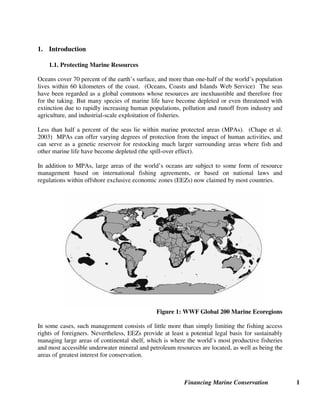
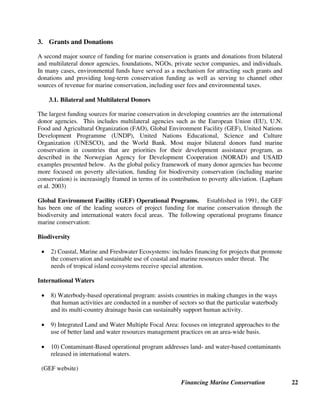
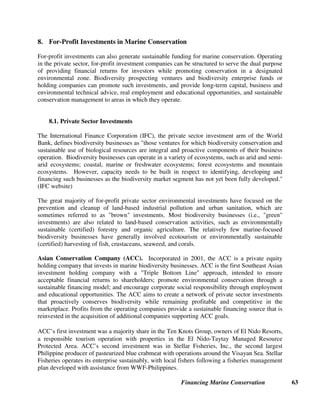
Figure 1: WWF Global 200 Marine Ecoregions
In some cases, such management consists of little more than simply limiting the fishing access
rights of foreigners. Nevertheless, EEZs provide at least a potential legal basis for sustainably
managing large areas of continental shelf, which is where the world’s most productive fisheries
and most accessible underwater mineral and petroleum resources are located, as well as being the
areas of greatest interest for conservation.
Financing Marine Conservation 2
Substantial amounts of money are required to manage and protect MPAs and EEZs, and to
implement and enforce international agreements on fisheries, shipping, and migratory species. A
recent survey of over 80 MPAs found that a global MPA network covering 30 percent of the
world's seas might cost between $7 billion and $19 billion annually to run. (Balmford et al.
2003) In addition, it is often necessary to provide economic alternatives (or even, in some cases,
monetary compensation) to people whose traditional or future use of marine resources may be
limited by new systems for the conservation and sustainable management of those resources.
Without sufficient funding to finance effective management, there is a great risk that many
MPAs may become little more than paper parks, and that international agreements for managing
marine resources may turn out to be little more than statements of good intentions.
1.2. Financing Marine Conservation
This guide describes over 30 mechanisms for financing the conservation of marine biodiversity,
both within and outside of MPAs. Its main purpose is to familiarize conservation professionals²
i.e., the managers and staff of government conservation agencies, international donors, and
nongovernmental organizations (NGOs)²with a menu of options for financing the conservation
of marine and coastal biodiversity. A number of economic incentive mechanisms for marine
conservation (as contrasted with revenue-raising mechanisms) are also presented in section 5 (on
Real Estate and Development Rights) and section 6 (on Fishing Industry Revenues).
Each section provides a description of the financing mechanism and examples showing how the
mechanism has been used to finance marine conservation. In some cases, even though a
mechanism may have only been used to finance terrestrial conservation, it has been included in
this guide because of its potential to also serve as a new source of funding for marine
conservation. This guide is not intended to provide detailed instructions on how to establish and
implement each of the different conservation financing mechanisms. Instead references are
provided at the end of each section for sources of additional information about each of the
mechanisms described. Citations to specific references are also included in the text in
parentheses.
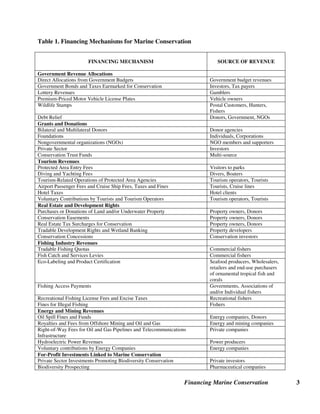
Table 1. categorizes the financing mechanisms described in this guide by their source of revenue.
Government revenue allocations (section one) and grants and donations (section two) primarily
finance public good values of MPAs and marine resources. In contrast, the mechanisms
described in sections three to eight are based on a particular consumptive or non-consumptive
use of marine resources²whether the resource in question is fish, oil and gas, real estate,
scenery and beaches, or the sea’s pollution-absorbing capacity. These financing mechanisms
require the users of a particular marine resource to pay for the conservation of marine
biodiversity. This is not necessarily limited to paying only for conservation or sustainable
management of the particular resource being used, since the use of any particular marine
resource can significantly impact other parts of the same ecosystems.
Financing Marine Conservation 3
Table 1. Financing Mechanisms for Marine Conservation
FINANCING MECHANISM SOURCE OF REVENUE
Government Revenue Allocations
Direct Allocations from Government Budgets Government budget revenues
Government Bonds and Taxes Earmarked for Conservation Investors, Tax payers
Lottery Revenues Gamblers
Premium-Priced Motor Vehicle License Plates Vehicle owners
Wildlife Stamps Postal Customers, Hunters,
Fishers
Debt Relief Donors, Government, NGOs
Grants and Donations
Bilateral and Multilateral Donors Donor agencies
Foundations Individuals, Corporations
Nongovernmental organizations (NGOs) NGO members and supporters
Private Sector Investors
Conservation Trust Funds Multi-source
Tourism Revenues
Protected Area Entry Fees Visitors to parks
Diving and Yachting Fees Divers, Boaters
Tourism-Related Operations of Protected Area Agencies Tourism operators, Tourists
Airport Passenger Fees and Cruise Ship Fees, Taxes and Fines Tourists, Cruise lines
Hotel Taxes Hotel clients
Voluntary Contributions by Tourists and Tourism Operators Tourism operators, Tourists
Real Estate and Development Rights
Purchases or Donations of Land and/or Underwater Property Property owners, Donors
Conservation Easements Property owners, Donors
Real Estate Tax Surcharges for Conservation Property owners, Donors
Tradable Development Rights and Wetland Banking Property developers
Conservation Concessions Conservation investors
Fishing Industry Revenues
Tradable Fishing Quotas Commercial fishers
Fish Catch and Services Levies Commercial fishers
Eco-Labeling and Product Certification Seafood producers, Wholesalers,
retailers and end-use purchasers
of ornamental tropical fish and
corals
Fishing Access Payments Governments, Associations of
and/or Individual fishers
Recreational Fishing License Fees and Excise Taxes Recreational fishers
Fines for Illegal Fishing Fishers
Energy and Mining Revenues
Oil Spill Fines and Funds Energy companies, Donors
Royalties and Fees from Offshore Mining and Oil and Gas Energy and mining companies
Right-of-Way Fees for Oil and Gas Pipelines and Telecommunications
Infrastructure
Private companies
Hydroelectric Power Revenues Power producers
Voluntary contributions by Energy Companies Energy companies
For-Profit Investments Linked to Marine Conservation
Private Sector Investments Promoting Biodiversity Conservation Private investors
Biodiversity Prospecting Pharmaceutical companies
Financing Marine Conservation 4
1.3. Business Planning Approach
Conservation financing mechanisms should be evaluated as part of a business plan that includes
a sustainable financing strategy. The business plan should be based on an evaluation of the costs
of operating MPAs or protecting marine resources. A range of potential customers willing to
pay for goods and services can then be identified as potential financing sources for marine
conservation. Business plans are being developed for single MPAs and networks of MPAs in
diverse locales, as described in the examples below:
Business Planning for MPAs in Africa. Covering 1.2 million hectares, the Banc d'Arguin
National Park (PNBA) in Mauritania constitutes one of the largest MPAs in the Africa region. In
2002, with assistance from German Technical Cooperation (GTZ), PNBA launched a process to
develop a sustainable financing strategy to improve management of existing funds, increase
revenues of PNBA from tourism, fishing, and biodiversity, and to create a conservation trust
fund. The park has called on outside technical assistance to develop the business plan and
conservation trust fund, and included all stakeholders in the planning process. Traditional
donors supporting the PNBA include the French and German government aid agencies, the
European Commission, WWF, and the Fondation Internationale du Banc d'Arguin. (PNBA
website)
Other MPAs in Africa have business planning initiatives underway, including Quirimbas
National Park in Mozambique, where WWF is assisting park management to implement its
newly drafted business plan. For poorer countries, where minimum requirements for park
management are often under-funded by governments, business planning focuses less on cost
reduction and more on developing new sources of sustainable financing to meet funding
shortfalls for operational costs. Substantial donor assistance is typically required in early years
to finance investment priorities. For example, Quirimbas National Park's business plan projects
that tourism-based fees should allow the park to reach financial sustainability within 15 years,
assuming that donors invest in park infrastructure at required levels. (Quirimbas National Park
2003)
In Madagascar, the National Parks Conservation Association and the Wildlife Conservation
Society recently assisted Masoala National Park²ZKLFKLQFOXGHVWKUHH03$V²WRdevelop a
business plan. Masoala National Park's unique relationship with the Zrich Zoo is projected to
provide a stable source of revenues for park management. (Parc National Masoala 2003,)
Network of Southeast Asian MPAs. The World Commission on Protected Areas (WCPA)
Southeast Asian Marine Working Group has appointed a Sustainable Financing Task Force to
develop an innovative portfolio of financing mechanisms to support a network of MPAs in
Southeast Asia. The task force is currently developing a comprehensive business plan to define
the needs and potential financing sources for an MPA network in Indonesia, Malaysia, and the
Philippines. The business plan will be based on:
• a bottom-up analysis of the full economic costs of MPAs;
• a top-down analysis of total network costs;
• an analysis of three types of funding sources:
o local business development (i.e., ecotourism, extractive industries, user fees)
Financing Marine Conservation 5
o traditional donors (bilateral and multilateral agencies, foundations, NGOs)
o new biodiversity investors; and
• an analysis of legal and organizational issues related to funding of the network.
The task force's work so far has resulted in a full costing of 14 MPAs and the development of an
endowment model that calculates the endowment size necessary to operate MPAs at different
levels of park management. An estimated $177.8 million in endowment funds would be needed
to provide start-up and annual funding for 14 MPAs covering 3.8 million hectares.
(Conservation and Community Investment Forum (CCIF) 2002, Merkl et al. 2003)
Gulf of California, Mexico. In collaboration with other partners (see section 3.5 below), WWF
conducted an analysis of conservation finance mechanisms that could be incorporated into the
proposed Escalera Nautica (Nautical Staircase) project in Mexico’s Gulf of California. The
project analyzed the costs of administering existing and proposed coastal and marine protected
areas to estimate the total investment needed to effectively manage MPAs in the Gulf of
California. On the revenue side, the financing model analyzes the revenue-generating potential
of eleven financing mechanisms that are primarily based on tourism, and also analyzes
institutional issues related to implementing those mechanisms. (Delgado Saldívar 2003)
1.4. Feasibility Analysis.
The choice of which financing mechanism(s) to utilize in a particular case should be based on
analyzing the following feasibility issues:
Financial
• How much money will actually be needed each year to support the particular marine
conservation programs and activities that are envisaged?
• How much revenue is likely to be generated each year by the new financing mechanisms?
• Will the revenues generated be worth the cost of setting up the new system of user fees,
taxes, debt-for-nature swaps, or trust funds?
• Could the revenues vary substantially from year to year depending on global and national
economic, political, and natural conditions?
• How will a highly variable revenue flow affect the conservation programs that the financial
mechanism is intended to pay for?
• What other sources of funds might be available, either on a long-term or a one-time basis?
Legal
• Can the proposed financing mechanisms be established under the country’s current legal
system? Some legal systems do not recognize concepts such as easements or development
rights. In other legal systems, there may be a constitutional prohibition against earmarking
tax revenues or fees for specific purposes.
• Will new legislation be required in order to establish the proposed financing mechanism?
• How difficult and time-consuming will it be to pass such legislation?
• Could the new financing mechanism be established under current legislation, by simply
issuing an administrative or executive order?
Financing Marine Conservation 6
Administrative
• In the particular country, how difficult will it be to administer, enforce, collect, or implement
a particular type of user fee, tax, or quota and trading system?
• Will it be too complicated or costly to administer?
• Are there enough trained people (or how difficult will it be to train enough people) to
administer and enforce the system?
• Will implementing the particular user fee, tax, or quota depend too much on the discretion of
individual officials and therefore present too many opportunities for corruption?
• Can safeguards be devised to limit potential problems?
• How difficult will it be to collect, verify and maintain the data upon which a particular user
fee, tax or trading system is based? For example, how difficult will it be to keep track of the
amount of fish that are caught each day or each month by particular individuals,
communities, or commercial fishing vessels; or the number of people who visit an MPA, or
who use particular products or ecological services provided by the MPA?
Social
• What will be the social impacts of implementing a particular system of generating revenues
for conservation?
• Who will pay, and what is their willingness and capacity to pay?
• Will the new financing mechanism be perceived as equitable and legitimate?
Political
• Is there government support for introducing the new financing mechanism?
• Can the government be relied upon to spend the new revenues only for the purposes
intended, or is there a strong likelihood that the money may end up being used for other
purposes?
• Can this be monitored and ensured by the courts or the media or NGO “watch-dog” groups or
particular user groups or an independent board of directors or an international agency?
Environmental
• What will be the environmental impact of implementing the new financing mechanism? For
example, for tourism-based mechanisms, will the desire to increase revenues from tourism
compromise conservation objectives or exceed the carrying capacity of the MPA?
Financing Marine Conservation 7
Further Sources of Information
Marine Conservation Management and Costs
Balmford, Andrew, Pippa Gravestock, Neal Hockley, Colin McClean and Callum Roberts. 2003. The World wide Costs of
Marine Conservation. Available on-line, Conservation Finance Alliance (CFA), Training Guide, see chapter on MPAs:
http://www.conservationfinance.org
Cesar, Herman. 2001. The Biodiversity Benefits of Coral Reef Ecosystems: Values and Markets. Organization for Economic
Cooperation and Development (OECD), International Workshop on Market Creation for Biodiversity Products and Services.
Paris, France: OECD. Revised March 29, 2002. Available on-line, OECD, see publications, case studies:
http://www.oecd.org/env
Chape, Stuart, Simon Blyth, Lucy Fish, Phillip Fox, and Mark Spalding (compilers). 2003. 2003 United Nations List of
Protected Areas. Gland, Switzerland and Cambridge, United Kingdom (U.K.): IUCN and Cambridge, U.K.: United Nations
Environment Programme (UNEP) World Conservation Monitoring Centre.
Emerton, Lucy. 2003. Covering the Economic Costs of Marine Protected Areas: Extending the Concept of Financial Diversity
and Sustainability. Background paper for the Vth World Parks Congress, Durban, South Africa, September. Available on-
line, CFA, see Sustainable Financing Stream at the World Parks Congress: http://www.conservationfinance.org
Oceans, Coasts and Islands Web Service. What is the Coast. Available on-line: http://icm.noaa.gov/story/icm_coast.html
Roberts, Callum M., and Julie P. Hawkins. 2000. Fully Protected Marine Reserves: A Guide. Washington, D.C.: WWF
Endangered Seas Campaign and York, U.K.: University of York.
Salm, Rodney V. and John R. Clark with Erkki Siirila. 2000. Marine and Coastal Protected Areas: a Guide for Planners and
Managers. Washington, D.C.: IUCN.
Business Planning
Banc d'Arguin National Park (PNBA): http://www.mauritania.mr/pnba
Conservation and Community Investment Forum (CCIF). 2002. Financing a Network of Marine Protected Areas in Southeast
Asia. Available on-line: http://www.cciforum.org/pdfs/Sustainable_Financing_Marine_SEAsia.pdf
Merkl, Andreas, John Claussen, Heather Thompson, and Jason Winship. 2003. Analysis on the Sustainable Financing of a
Network of Marine Protected Areas in Southeast Asia. Background paper for Vth World Parks Congress, Durban, South
Africa, September. Available on-line, CFA, see Sustainable Financing Stream at the World Parks Congress:
http://www.conservation finance.org
National Parks Conservation Association, Center for Park Management, Business Plan Initiative:
http://www.npca.org/across_the_nation/americansfornationalparks/learn_more/park_data/business_plan.asp
Parc National Masoala. 2003. Masoala National Park Business Plan. Draft produced in collaboration with Wildlife
Conservation Society and National Parks Conservation Association with funding support from IUCN.
Quirimbas National Park. 2003. Business Plan, Quirimbas National Park. Draft.
Saldívar, Delgado, and Martin Alberto. 2003. Análisis de alternativas de financiamiento para la conservación en el Golfo de
California. Final Project Report. Prepared for WWF with financing provided by the Packard Foundation.
Sustainable Financing Guides and Reports
Boyd, Charlotte, and Amar Inamdar. 2001. Sustainable Financing of Coastal Management Activities in Eastern Africa. Final
Report for the Secretariat for Eastern African Coastal Area Management. Oxford, U.K.: Synergy, Oxford Centre for
Innovation. Available on-line: http://www.synergy-global.net/public/Sustainable-Financing.pdf
CFA. Training Guide. Available on CD or on-line: http://www.conservationfinance.org/
Financing Marine Conservation 8
Environmental Protection Agency (EPA). 1999. A Guidebook of Financial Tools. Environmental Finance Program, April.
Available on-line: http://www.epa.gov/efinpage/guidbkpdf.htm
Financing Protected Areas Task Force of the WCPA of IUCN, in collaboration with the Economics Unit of IUCN. 2000.
Financing Protected Areas. Gland, Switzerland and Cambridge, U.K.: IUCN. Available on-line:
http://www.iucn.org/themes/wcpa/pubs/pdfs/Financing_PAs.pdf
Sherman, Anthony. 2003. E-resources. Washington, D.C.: WWF Center for Conservation Finance. Available on-line:
http://www.worldwildlife.org/conservationfinance/reports.cfm
Spergel, Barry. 2001. Raising Revenues for Protected Areas. Washington, D.C.: WWF Center for Conservation Finance.
Available in Chinese, English, French and Spanish. Available on-line: http://worldwildlife.org/conservationfinance
Financing Marine Conservation 9
2. Government Revenue Allocations
Total government spending worldwide on protected areas has been estimated to be $3.2 billion
per year (James et al. 1999), but there are no statistics available that show how much of this $3.2
billion is specifically for marine and coastal protected areas. Research does show that
government sources are a dominant source of funding for MPAs in developed countries whereas
in developing countries foreign assistance and park entry fees provide relatively more resources.
(Gravestock 2002) Government expenditures for marine conservation and fisheries management
outside of protected areas are even harder to quantify. Such expenditures are commonly spread
among many different government agencies, such as the ministries of fisheries, natural resources,
commerce, national defense (navy and coast guard), and science and environment, in addition to
expenditures by provincial, municipal, and local governments.
2.1. Direct Allocations from Government Budgets
Funding for conservation is often one of the first government budget items to be cut in times of
economic difficulties. Governments, particularly in developing countries, also generally give
higher priority to financing immediate social needs focusing on poverty alleviation and highly
visible economic development projects. Unfortunately, the importance of marine biodiversity
conservation and sustainable resource management is often only recognized after fish stocks
have become depleted, reefs and wetlands have been destroyed, and ecosystems no longer
provide the goods and services that people used to take for granted. Nevertheless, governments
can in many cases be persuaded to increase their annual budget allocations for conservation and
sustainable management of marine ecosystems if they can be shown that marine resources
generate substantial economic benefits in the short-, medium-, or long-term.
Revenues from fisheries and tourism can dramatically decline if coastal wetlands and coral reef
ecosystems are not adequately protected. MPAs serve as the spawning grounds for many species
of fish that can subsequently be commercially harvested. Protected area managers and
conservationists therefore need to be able to demonstrate these economic benefits to officials of
the ministries of finance and planning, members of national and local legislatures, influential
news media, community groups, and private sector operators. Economic valuation techniques
can be utilized to show the values of MPA resources. For example, coral reefs provide an
estimated $30 billion in annual net benefits to the world economy through fisheries, tourism,
coastal protection, and biodiversity conservation and research. (Cesar et al. 2003) Economic
indicators, such as a marine resource's contribution to a country's fiscal revenues or to foreign
exchange earnings, can also help to make a compelling case for marine conservation. For
example, West Africa's fisheries generate some $400 million annually, representing the single
most important source of foreign exchange for the region. (WWF 2003)
In many cases, governments could actually save money by supporting the conservation and
sustainable management of marine resources, rather than providing subsidies for their
unsustainable use, as shown in the example below.
Financing Marine Conservation 10
Gap Between Fisheries Subsidies and Budgets for Marine Conservation. The United
Nations Food and Agriculture Organization (FAO), employing 1989 data, estimated that globally
there appeared to be a $54 billion annual deficit between fishing revenues and costs, most of
which was presumed to be covered by subsidies. (FAO 1992) This is an astounding number, and
as a percentage of landed value (around 75 percent), this is even higher than the rate of support
being provided to the agricultural sector by the most enthusiastic subsidizers. A 1998 study had
brought down the global estimate to $14-20 billion a year worldwide±still a significant sum.
(Milazzo 1998) Governments spend many times more money on subsidies for unsustainable
fishing practices than they spend on marine conservation and sustainable management of marine
resources.
Pew Oceans Commission's Recommendations for U.S. Government. The Pew Oceans
Commission found that federal spending on ocean sciences in the U.S. was close to $755 million
annually, less than 4 percent of U.S. annual expenditure for basic scientific research. Further, the
commission found that the U.S. spent about $3 billion in fiscal year 2001 to manage an area 23
percent larger than the land mass of the U.S. In the same year, the U.S. spent $10 billion to
manage federal public lands and $14 billion on space exploration. In light of this substantial
underinvestment in oceans management, the Commission recommended that the U.S. Congress
at least double funding for basic ocean science and increase funding spent on management of
ocean resources by $2 to $5 billion annually. (Pew Oceans Commission 2003)
2.2. Government Bonds and Taxes Earmarked for Conservation
Besides relying on general tax revenues to fund conservation, some governments have raised
revenues for conservation by imposing earmarked taxes or selling interest-bearing government
bonds. The money raised from tax payers or investors who purchase these particular bonds is
used exclusively to fund conservation programs. In introducing these financing mechanisms,
governments typically recognize the special, often long-term, nature of environmental problems,
and often respond to concerns expressed by voters.
Government bonds have been used in the U.S.A. to finance parks, acquisition of open spaces,
and habitat restoration. These can either be general obligation bonds, which are repaid out of the
government’s future tax revenues; or special revenue bonds, which will be repaid out of charges
and revenues generated by the specific project that is being financed; or bonds that are a hybrid
of these two types. U.S. private investors are willing to buy these bonds, which offer lower than
current market rates of interest, because the interest earned is exempt from U.S. taxes. Issuing
government bonds can be an expensive and time-consuming process because it is subject to
complex legal rules and usually also requires approval by voters, but it can generate large sums
of money. For example, in the U.S.A., tax-exempt state and municipal government bonds are the
largest source of financing (raising more than $25 billion) for pollution prevention and
environmental infrastructure projects, particularly for drinking water and wastewater treatment
facilities. (EPA 1999)
California Clean Water, Clean Air, Safe Neighborhoods and Coastal Protection Act. In
2002, 57 percent of voters in the state of California approved Proposition 40 for the issuance of
Financing Marine Conservation 11
$2.6 billion in general obligation bonds to finance investments in parks, recreational facilities
and the protection of the state's natural and historical resources. Of the $1.275 million available
for land, air, and water conservation, $300 million is specifically earmarked for clean beaches,
watershed protection, and water quality projects to protect beaches, coastal waters, rivers, lakes,
and streams from contaminants, pollution, and other environmental threats. Additional amounts
finance habitat protection through land acquisition and stewardship of land and water resources.
A coalition of state environmental organizations worked to ensure approval of the Act by
California voters after it had passed the state assembly. (California State Parks website, TNC
2002)
Green Fund Levy, Trinidad and Tobago. Recognizing the importance of tourism and fishing
for Trinidad and Tobago's economy, the Minister of Finance of Trinidad and Tobago introduced
a dedicated tax (levy) for the environment to provide a mechanism for businesses to mitigate the
environmental impacts of pollution and inappropriate development. Established by an Act of
Parliament (Miscellaneous Taxes Act of 2000), Trinidad and Tobago's Green Fund levy imposed
a 0.1 percent levy on gross sales or receipts of companies doing business in Trinidad and
Tobago, generating the equivalent of about $10 million per year. As a result of business
lobbying, the levy was subsequently reduced to 0.075 percent. Although the revenues generated
by the levy were originally expected to be administered by an independent Green Fund Agency
to provide resources for communities and NGOs to carry out environmental projects, the Fund's
management was subsequently transferred to the government Treasury and its potential
beneficiaries were expanded to also provide funding for the public sector Environmental
Management Agency. (Smith 2002)
2.3. Lottery Revenues
Some countries use lotteries as a way of raising money for socially beneficial purposes such as
education, health, historic preservation, nature conservation, and even training national Olympic
teams. Lottery sales worldwide totaled $128 billion in 1999 (Lottery Insider website),
representing a huge potential source of social sector funding. There is a strong incentive for
lottery promoters to allocate part of the revenues from lotteries for good public causes such as
nature conservation because lotteries are a government-sanctioned form of gambling and
therefore are regarded by some people as morally and socially objectionable.
Efforts to establish lotteries specifically for charity have sometimes not succeeded because of
legal issues regarding lottery registration in the country or state of establishment, particularly for
internet-based lotteries collecting funds from non-residents. This was the case in Prince Edward
Island, Canada, where a court ruled that the government did not have the authority to issue the
Earth Fund a license to operate the internet-based Earth Future Lottery. (Earth Fund 2002)
Lotteries are administered at the national or state level by government agencies or by private
operators licensed by governments. Since lottery revenues are usually kept separate from the
general budget, spending them is not subject to the same legal restrictions as spending tax
revenues. In contrast to other conservation finance mechanisms such as user fees, environmental
taxes, or pollution fines, in the case of lottery revenues, there is no direct or indirect connection
Financing Marine Conservation 12
between the source of the revenue and the conservation purposes for which the revenue may be
spent. As described below, lotteries in the U.K, the Netherlands, and the U.S. state of Oregon
have all funded marine or coastal conservation projects.
U.K. National Lottery. The U.K.'s National Lottery provides funding for six good causes:
arts, sports, charities, heritage, millennium projects, and education, health and environment,
primarily for projects in the U.K. With 28 percent of lottery revenues reserved for good causes,
the National Lottery has funded 139,000 projects since its creation in 1993. Funding for good
causes is awarded through lottery distributors, including the Community Fund and the Heritage
Lottery Fund. The Community Fund has supported conservation organizations such as Birdlife
International, the Royal Society for the Protection of Nature, and WWF. The Heritage Lottery
Fund aims to safeguard the U.K.'s heritage and has provided funding for land acquisition, natural
resources management, and environmental education. (U.K. Community Fund website, U.K.
Heritage Fund website, U.K. National Lottery website)
Dutch National Postcode Lottery. Over 40 percent of Dutch households participate in the
National Postcode Lottery, a popular charity lottery with ticket numbers based on the Dutch
postal code system. Since it was founded in 1989, the National Postcode Lottery has donated the
equivalent of over $1 billion to charitable organizations. The lottery donates 60 percent of its
gross turnover each year (the equivalent of $156 million for 2001) to about 40 Dutch and
international NGOs for projects dedicated to nature conservation, poverty alleviation, and
defense of human rights. Among international conservation organizations benefiting from the
National Postcode Lottery are Greenpeace, Terre des Hommes, Netherlands Committee for
IUCN, and WWF. (Novamedia website)
For example, through 2002, WWF-Netherlands had received the equivalent of $128 million from
the lottery to fund WWF network activities and biodiversity conservation projects, including
support for marine activities in the Gulf of California in Mexico. WWF-Sweden has also
benefited from the BingoLotto in Sweden. (Stapel 2003)
Oregon Lottery. In 1998, voters in the U.S. state of Oregon approved Ballot Measure 66, a
constitutional amendment earmarking 15 percent of Oregon Lottery net proceeds to be divided
evenly between state parks and statewide restoration and protection of salmon, watersheds, and
habitat. For 2001-2003, Oregon legislators allocated funding of $99 million for Salmon and
Parks, along with almost $500 million in funding for economic development and public
Box 1. U.K. National Lottery Funding for Coastal and Marine Projects
• Marine Conservation Society: Adopt-A-Beach campaign in the U.K.
• Seahorse Trust: training in seahorse identification and mapping near Devon
• The Deep, Hull: world's first submarium
• National Trust and others: land acquisition in coastal areas including Chichester Harbour and the River
Crouch estuary
• Nàdair Trust: 32 heritage projects in the Argyll Islands in Scotland, including a floating classroom for
local schools and species conservation
• Coral Cay Conservation Charitable Trust: developing livelihood opportunities for coastal communities
in the Philippines
Financing Marine Conservation 13
education. Using lottery money, the Oregon Parks and Recreation Department has been able to
purchase coastal lands at three different sites. The first purchase at Whalen Island will preserve
40 hectares of wetlands and salt grass. (Oregon State Lottery website, Oregon Parks and
Recreation Department website)
2.4. Premium-Priced Motor Vehicle License Plates
Motor vehicle agencies sell premium-priced vehicle license plates to raise money and awareness
for special causes. In the case of conservation, the plates are generally decorated with pictures of
wildlife, scenic areas, and/or environmental slogans that show the vehicle owner's support for the
location or species portrayed. The license plates are sold at a premium compared to fees charged
for standard vehicle registration and the difference in price is allocated to the earmarked cause
after deducting part of the fee for the additional cost of producing the special plate. Funding
generated by the plates is typically administered by a government agency, earmarked for projects
of specific NGOs, or awarded by competitive grants.
In the U.S.A., at least 32 states sell special vehicle license plates to fund cleanup and protection
of natural areas, environmental education, and species conservation. By 1999, over 10 million
such license plates had been sold, raising $324 million for environmental causes. For example,
in the U.S. states of Maryland and Virginia, special license plates have generated over $1 million
for Chesapeake Bay conservation. (EPA 1999)
As described below, the most successful license plates have been for charismatic marine species:
Florida Specialty License Plates. Out of 56 specialty license plates issued by the state of
Florida, three marine species²manatees, dolphins, and sea turtles²ranked in the top ten for
sales in 2002 (the manatee was number one until a ferocious panther edged it out). Since its
introduction in 1990, over 500,000 Save the Manatee license plates have been sold with
revenues of over $30 million deposited in the Save the Manatees Trust Fund for Florida Fish and
Wildlife Commission manatee protection programs. Marketing can encourage vehicle owners to
buy a plate for a charismatic species. The Sea Turtle Survival League launched a billboard
advertising campaign for the Help Sea Turtles Survive license plate with free advertising space
donated by the Florida Outdoor Advertising Association. The first $500,000 in annual sales also
goes to the Commission, but sales over that amount are distributed through a competitive grants
program to nonprofit groups, coastal counties, and educational institutions in Florida to support
sea turtle conservation activities. (Caribbean Conservation Corporation 2000, Florida
Department of Highway Safety and Motor Vehicles website)
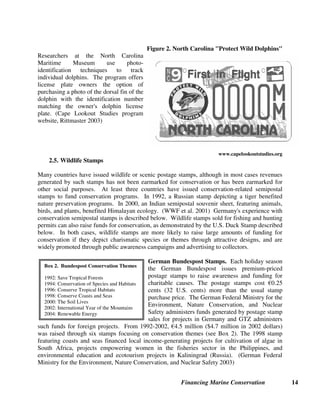
North Carolina Protect Wild Dolphins License Plate. Approved by the state of North
Carolina's General Assembly in 2000, North Carolina's Protect Wild Dolphins license plate
was modeled on similar plates in Florida and Virginia. Vehicle registration in North Carolina
costs $20 or $25 annually (depending on the county of residence). Of the $30 extra charged for
each Protect Wild Dolphins license plate, the Friends of the North Carolina Maritime Museum
receives $20 to support research on bottlenose dolphins and environmental education in coastal
North Carolina.
Financing Marine Conservation 14
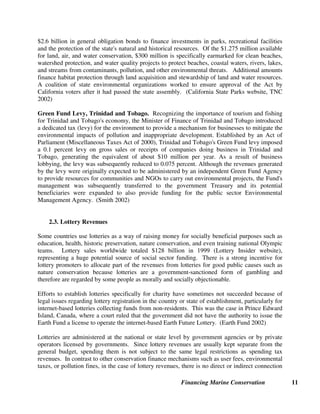
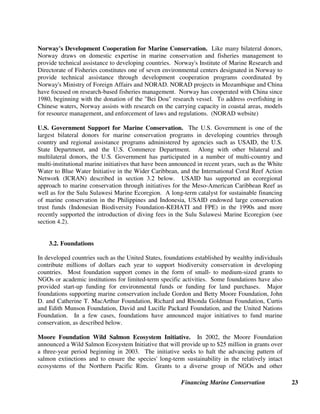
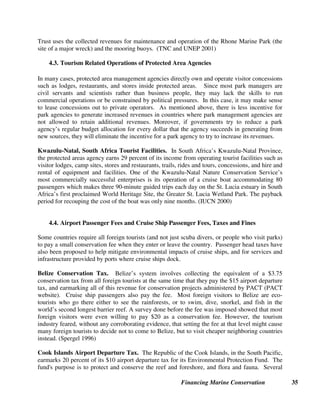
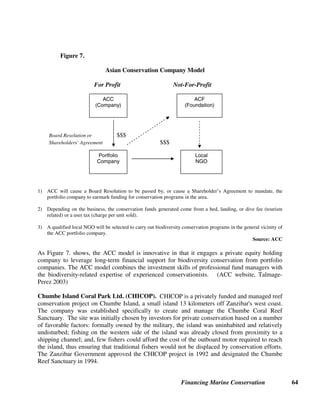
Figure 2. North Carolina Protect Wild Dolphins
Researchers at the North Carolina
Maritime Museum use photo-
identification techniques to track
individual dolphins. The program offers
license plate owners the option of
purchasing a photo of the dorsal fin of the
dolphin with the identification number
matching the owner's dolphin license
plate. (Cape Lookout Studies program
website, Rittmaster 2003)
www.capelookoutstudies.org
2.5. Wildlife Stamps
Many countries have issued wildlife or scenic postage stamps, although in most cases revenues
generated by such stamps has not been earmarked for conservation or has been earmarked for
other social purposes. At least three countries have issued conservation-related semipostal
stamps to fund conservation programs. In 1992, a Russian stamp depicting a tiger benefited
nature preservation programs. In 2000, an Indian semipostal souvenir sheet, featuring animals,
birds, and plants, benefited Himalayan ecology. (WWF et al. 2001) Germany's experience with
conservation semipostal stamps is described below. Wildlife stamps sold for fishing and hunting
permits can also raise funds for conservation, as demonstrated by the U.S. Duck Stamp described
below. In both cases, wildlife stamps are more likely to raise large amounts of funding for
conservation if they depict charismatic species or themes through attractive designs, and are
widely promoted through public awareness campaigns and advertising to collectors.
German Bundespost Stamps. Each holiday season
the German Bundespost issues premium-priced
postage stamps to raise awareness and funding for
charitable causes. The postage stamps cost ¼0.25
cents (32 U.S. cents) more than the usual stamp
purchase price. The German Federal Ministry for the
Environment, Nature Conservation, and Nuclear
Safety administers funds generated by postage stamp
sales for projects in Germany and GTZ administers
such funds for foreign projects. From 1992-2002, ¼4.5 million ($4.7 million in 2002 dollars)
was raised through six stamps focusing on conservation themes (see Box 2). The 1998 stamp
featuring coasts and seas financed local income-generating projects for cultivation of algae in
South Africa, projects empowering women in the fisheries sector in the Philippines, and
environmental education and ecotourism projects in Kaliningrad (Russia). (German Federal
Ministry for the Environment, Nature Conservation, and Nuclear Safety 2003)
Box 2. Bundespost Conservation Themes
1992: Save Tropical Forests
1994: Conservation of Species and Habitats
1996: Conserve Tropical Habitats
1998: Conserve Coasts and Seas
2000: The Soil Lives
2002: International Year of the Mountains
2004: Renewable Energy
Financing Marine Conservation 15
U.S. Postal Service Semipostal Stamps. The U.S. Postal Service has issued three 45 cent
semipostal stamps. The price of a semipostal stamp pays for the First Class single-piece postage
rate in effect at the time of purchase (currently 37 cents) plus an amount to fund causes that the
U.S. Postal Service determines to be in the public interest and appropriate. By law, revenues
from sales (net of postage and costs of the U.S. Postal Service), are transferred to a selected U.S.
federal agency. Since it was introduced in 1998, the Breast Cancer Research stamp has raised
$35.2 million for breast cancer research. The Heroes of 2001 stamp raised $8.6 million for
families of relief personnel killed or permanently disabled in the line of duty in connection with
the terrorist attacks of September 11, 2001. The Stop Family Violence stamp was issued in
October 2003 to raise funds for domestic violence programs. Postal customers purchasing the
stamps may claim a tax deduction on their income taxes based on the charitable donation made
through purchase of the stamps. (U.S. Postal Service website)
A consortium of U.S. conservation NGOs has proposed a Vanishing Wildlife semipostal stamp
to benefit the Multinational Species Conservation Fund which provides grant funding through
sub-accounts for African and Asian elephants, great apes, rhinos, tigers, and neotropical
migratory birds. The Vanishing Wildlife stamp could also fund marine turtle conservation if the
Marine Turtle Conservation Act is enacted by the U.S. Congress (it passed the U.S. Senate in
October 2003). Wildlife stamps have been best sellers for the U.S. Postal Service, both in terms
of print runs and retention rates by collectors. The conservation NGOs supporting the proposal
have extensive membership and visitor bases that could be mobilized to mount national and
international campaigns to promote stamp sales. (Gervers 2003, WWF et al. 2001)
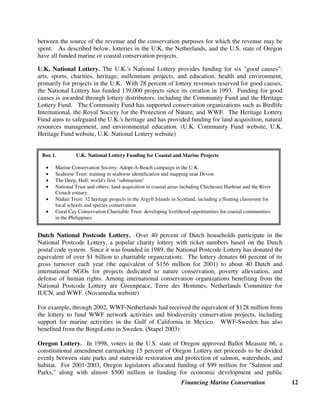
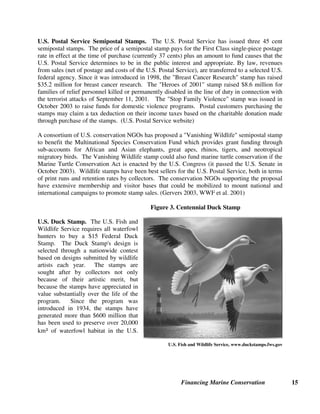
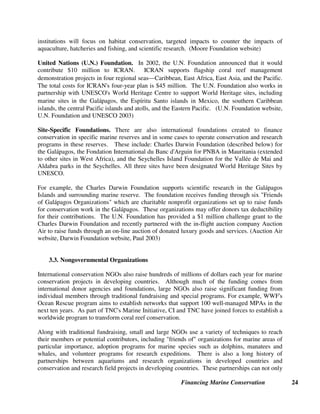
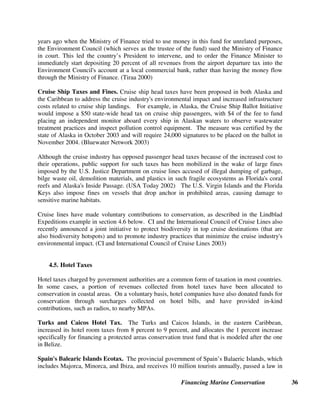
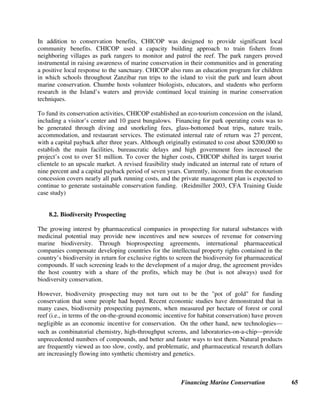
Figure 3. Centennial Duck Stamp
U.S. Duck Stamp. The U.S. Fish and
Wildlife Service requires all waterfowl
hunters to buy a $15 Federal Duck
Stamp. The Duck Stamp's design is
selected through a nationwide contest
based on designs submitted by wildlife
artists each year. The stamps are
sought after by collectors not only
because of their artistic merit, but
because the stamps have appreciated in
value substantially over the life of the
program. Since the program was
introduced in 1934, the stamps have
generated more than $600 million that
has been used to preserve over 20,000
kmð of waterfowl habitat in the U.S.
U.S. Fish and Wildlife Service, www.duckstamps.fws.gov
Financing Marine Conservation 16
The winning entry in 2002 depicts greater snow geese with Chincoteague (Virginia) National
Wildlife Refuge Lighthouse in the background. This Centennial Duck Stamp is expected to
generate $25 million in the 2003-04 hunting season with 98 percent of revenues collected from
sales of the stamp deposited in the Migratory Bird Conservation Fund. The U.S. Fish and
Wildlife Service administers the fund, which is used to purchase wetlands and other wildlife
habitat for inclusion in the National Wildlife Refuge System (which is now 100 years old). (U.S.
Fish and Wildlife Service 2002, U.S. Fish and Wildlife Service website)
2.6. Debt Relief
The Latin American debt crisis of the
1980s led to the invention of the debt-for-
nature swap, a financial mechanism that
has enabled developing countries to
spend money on environmental activities
which they would otherwise have had to
use to repay their foreign debt. Four
types of debt relief mechanisms have
provided funding for the environment:
commercial debt-for-nature swaps,
secondary market sales of commercial
debt donated by commercial banks to
NGOs, bilateral debt reduction programs,
and Heavily Indebted Poor Country
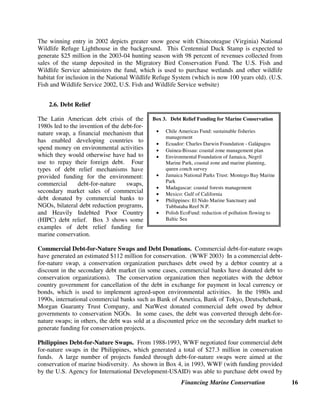
(HIPC) debt relief. Box 3 shows some
examples of debt relief funding for
marine conservation.
Commercial Debt-for-Nature Swaps and Debt Donations. Commercial debt-for-nature swaps
have generated an estimated $112 million for conservation. (WWF 2003) In a commercial debt-
for-nature swap, a conservation organization purchases debt owed by a debtor country at a
discount in the secondary debt market (in some cases, commercial banks have donated debt to
conservation organizations). The conservation organization then negotiates with the debtor
country government for cancellation of the debt in exchange for payment in local currency or
bonds, which is used to implement agreed-upon environmental activities. In the 1980s and
1990s, international commercial banks such as Bank of America, Bank of Tokyo, Deutschebank,
Morgan Guaranty Trust Company, and NatWest donated commercial debt owed by debtor
governments to conservation NGOs. In some cases, the debt was converted through debt-for-
nature swaps; in others, the debt was sold at a discounted price on the secondary debt market to
generate funding for conservation projects.
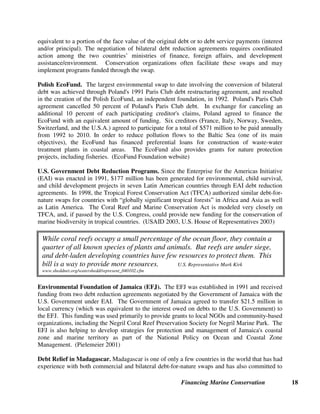
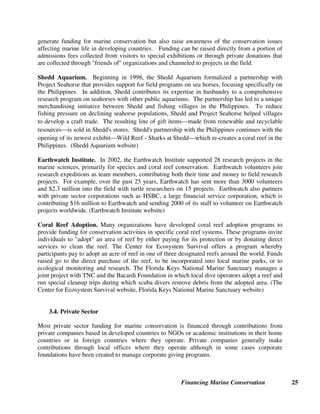
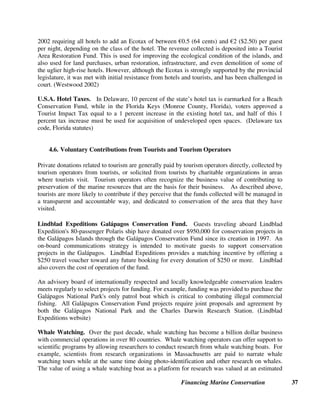
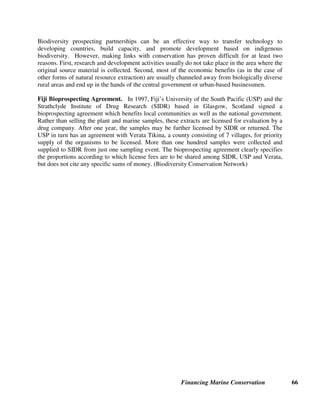
Philippines Debt-for-Nature Swaps. From 1988-1993, WWF negotiated four commercial debt
for-nature swaps in the Philippines, which generated a total of $27.3 million in conservation
funds. A large number of projects funded through debt-for-nature swaps were aimed at the
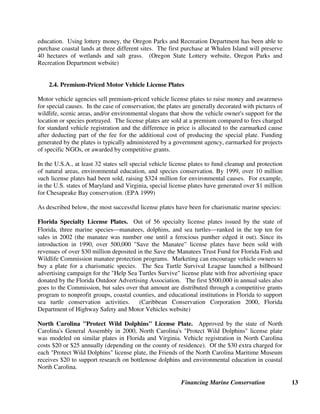
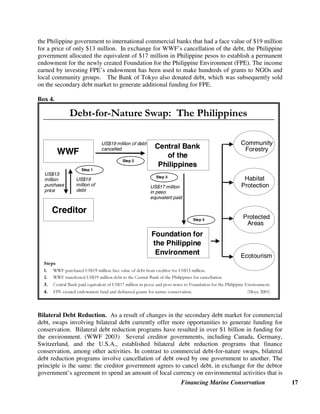
conservation of marine biodiversity. As shown in Box 4, in 1993, WWF (with funding provided
by the U.S. Agency for International Development-USAID) was able to purchase debt owed by
Box 3. Debt Relief Funding for Marine Conservation
• Chile Americas Fund: sustainable fisheries
management
• Ecuador: Charles Darwin Foundation - GalEpagos
• Guinea-Bissau: coastal zone management plan
• Environmental Foundation of Jamaica, Negril
Marine Park, coastal zone and marine planning,
queen conch survey
• Jamaica National Parks Trust: Montego Bay Marine
Park
• Madagascar: coastal forests management
• Mexico: Gulf of California
• Philippines: El Nido Marine Sanctuary and
Tubbataha Reef N.P.
• Polish EcoFund: reduction of pollution flowing to
Baltic Sea
Financing Marine Conservation 17
the Philippine government to international commercial banks that had a face value of $19 million
for a price of only $13 million. In exchange for WWF’s cancellation of the debt, the Philippine
government allocated the equivalent of $17 million in Philippine pesos to establish a permanent
endowment for the newly created Foundation for the Philippine Environment (FPE). The income
earned by investing FPE’s endowment has been used to make hundreds of grants to NGOs and
local community groups. The Bank of Tokyo also donated debt, which was subsequently sold
on the secondary debt market to generate additional funding for FPE.
Box 4.
Bilateral Debt Reduction. As a result of changes in the secondary debt market for commercial
debt, swaps involving bilateral debt currently offer more opportunities to generate funding for
conservation. Bilateral debt reduction programs have resulted in over $1 billion in funding for
the environment. (WWF 2003) Several creditor governments, including Canada, Germany,
Switzerland, and the U.S.A., established bilateral debt reduction programs that finance
conservation, among other activities. In contrast to commercial debt-for-nature swaps, bilateral
debt reduction programs involve cancellation of debt owed by one government to another. The
principle is the same: the creditor government agrees to cancel debt, in exchange for the debtor
government’s agreement to spend an amount of local currency on environmental activities that is
'HEWIRU1DWXUH6ZDS7KH3KLOLSSLQHV
Creditor
US$19
million of
debt
US$13
million
purchase
price
US$19 million of debt
cancelled
US$17 million
in peso
equivalent paid
Central Bank
of the
Philippines
WWF
Foundation for
the Philippine
Environment
Step 3
Step 2
Step 1
Step 4
Community
Forestry
Protected
Areas
Ecotourism
Habitat
Protection
$9058
 ::)SXUFKDVHG86PLOOLRQIDFHYDOXHRIGHEWIURPFUHGLWRUIRU 86PLOOLRQ
 ::)WUDQVIHUUHG86PLOOLRQGHEWWRWKHHQWUDO%DQNRIWKH3KLOLSSLQHVIRUFDQFHOODWLRQ
3. HQWUDO%DQNSDLGHTXLYDOHQWRI86PLOOLRQLQSHVRVDQGSHVRQRWHVWR)RXQGDWLRQIRUWKH3KLOLSSLQH(QYLURQPHQW
4. )3(FUHDWHGHQGRZPHQWIXQGDQGGLVEXUVHGJUDQWVIRUQDWXUHFRQVHUYDWLRQ 0RH
Financing Marine Conservation 18
equivalent to a portion of the face value of the original debt or to debt service payments (interest
and/or principal). The negotiation of bilateral debt reduction agreements requires coordinated
action among the two countries’ ministries of finance, foreign affairs, and development
assistance/environment. Conservation organizations often facilitate these swaps and may
implement programs funded through the swap.
Polish EcoFund. The largest environmental swap to date involving the conversion of bilateral
debt was achieved through Poland's 1991 Paris Club debt restructuring agreement, and resulted
in the creation of the Polish EcoFund, an independent foundation, in 1992. Poland's Paris Club
agreement cancelled 50 percent of Poland's Paris Club debt. In exchange for canceling an
additional 10 percent of each participating creditor's claims, Poland agreed to finance the
EcoFund with an equivalent amount of funding. Six creditors (France, Italy, Norway, Sweden,
Switzerland, and the U.S.A.) agreed to participate for a total of $571 million to be paid annually
from 1992 to 2010. In order to reduce pollution flows to the Baltic Sea (one of its main
objectives), the EcoFund has financed preferential loans for construction of waste-water
treatment plants in coastal areas. The EcoFund also provides grants for nature protection
projects, including fisheries. (EcoFund Foundation website)
U.S. Government Debt Reduction Programs. Since the Enterprise for the Americas Initiative
(EAI) was enacted in 1991, $177 million has been generated for environmental, child survival,
and child development projects in seven Latin American countries through EAI debt reduction
agreements. In 1998, the Tropical Forest Conservation Act (TFCA) authorized similar debt-for-
nature swaps for countries with “globally significant tropical forests” in Africa and Asia as well
as Latin America. The Coral Reef and Marine Conservation Act is modeled very closely on
TFCA, and, if passed by the U.S. Congress, could provide new funding for the conservation of
marine biodiversity in tropical countries. (USAID 2003, U.S. House of Representatives 2003)
Environmental Foundation of Jamaica (EFJ). The EFJ was established in 1991 and received
funding from two debt reduction agreements negotiated by the Government of Jamaica with the
U.S. Government under EAI. The Government of Jamaica agreed to transfer $21.5 million in
local currency (which was equivalent to the interest owed on debts to the U.S. Government) to
the EFJ. This funding was used primarily to provide grants to local NGOs and community-based
organizations, including the Negril Coral Reef Preservation Society for Negril Marine Park. The
EFJ is also helping to develop strategies for protection and management of Jamaica's coastal
zone and marine territory as part of the National Policy on Ocean and Coastal Zone
Management. (Pielemeier 2001)
Debt Relief in Madagascar. Madagascar is one of only a few countries in the world that has had
experience with both commercial and bilateral debt-for-nature swaps and has also committed to
While coral reefs occupy a small percentage of the ocean floor, they contain a
quarter of all known species of plants and animals. But reefs are under siege,
and debt-laden developing countries have few resources to protect them. This
bill is a way to provide more resources. U.S. Representative Mark Kirk
www.sheddnet.org/watershedd/represent_040102.cfm
Financing Marine Conservation 19
allocate a portion of HIPC debt relief savings to the environmental sector (Bolivia and Tanzania
are other such countries). In the 1980s and 1990s, Conservation International (CI), Missouri
Botanical Garden, and WWF negotiated commercial debt-for-nature swaps in Madagascar.
More recently, a bilateral swap concluded with the German Development Bank (KfW) is
expected to capitalize the Madagascar Foundation for Protected Areas and Biodiversity and
provide funding for Madagascar's National Association for Protected Areas Management
(ANGAP).
Madagascar is one of over 40 countries to benefit from the HIPC Initiative. Launched in 1996
by the International Monetary Fund and the World Bank, HIPC is the first comprehensive effort
to eliminate unsustainable debt owed by the world’s poorest, most heavily indebted countries. In
exchange for debt relief, debtor countries commit a portion of debt relief savings to priority
expenditures for poverty alleviation as these are defined in each country's Poverty Reduction
Strategy Paper (PRSP). Madagascar's PRSP priorities provide for the integration of MPAs into
the national network of protected areas and for sustainable management of coastal areas and
marine ecosystems to preserve traditional fishing, which is an important source of income for
poor populations. The PRSP also mainstreams the environment into sector policies, including
tourism, which can have important results for the marine environment. (Moye and Paddack
2003, Republic of Madagascar 2003)
Financing Marine Conservation 20
Sources of Further Information on Government Revenue Allocations
General
Gravestock, Pippa. 2001. Towards a Better Understanding of the Income Requirements of Marine Protected Areas. MsC
research thesis, Cranfield University at Silsoe, U.K. Available on-line:
http://www.biodiversityeconomics.org/finance/topics-230.htm
James, Alexander N., Michael J. B. Green, and James R. Paine. 1999. A Global Review of Protected Area Budgets and Staffing.
Cambridge, U.K.: World Conservation Monitoring Centre, March 21.
Direct Allocations from Government Budgets
Cesar, Herman, Lauretta Burke, and Lida Pet-Soede. 2003. The Economics of Worldwide Coral Reef Degradation. WWF and
International Coral Reef Action Network (ICRAN). Available on-line:
http://www.cciforum.org/pdfs/Cesar_Degradation_Report.pdf
CFA. Training Guide. Available on-line, see chapter on MPAs: http://www.conservationfinance.org
FAO. 1992. The State of Food and Agriculture: World Fisheries and the Laws of the Sea: a Decade of Change. Fisheries
Department.
Milazzo, Matteo. 1998. Re-examining Subsidies in the World Fisheries. World Bank Technical Paper No. 406. Fisheries Series.
Washington DC: World Bank.
Pew Oceans Commission. 2003. Science, Education and Funding. Fact Sheet. Available on-line: http://www.pewoceans.org/
WWF. 2003. Senegalese Artisinal Fishers Weep over Loss of Noble Fish. Western Africa Marine Ecoregion Fact Sheet, May
22. Available on-line: http://www.panda.org/news_facts/newsroom/other_news/news.cfm?uNewsID=7213%20
Government Bonds and Taxes Earmarked for Conservation
California State Parks. Proposition 40. Available on-line: http://parks.ca.gov/
Smith, David C. 2002. The Case of the Green Fund Levy in the Republic of Trinidad and Tobago. In CFA, Training Guide. See
chapter on Fiscal Instruments. Available on-line: http://www.conservationfinance.org
TNC. 2002. California's Clean Water, Clear Air, Safe Neighborhoods and Coastal Protection Act (Proposition 40). Available on-
line: http://nature.org/success/cabond.html
Lottery Revenues
Dutch National Postcode Lottery (in Dutch): http://www.staatloterij.nl/
Earth Fund. 2002. Court of Appeal Ruling Affects Charities across Canada: Earth Fund Remains Committed to Earth Future
Lottery. Press release, April 25. Available on-line: http://www.earthfuturelottery.com/april252002.html
Lottery Insider: http://www.lotteryinsider.com/
Novamedia: http://www.novamedia.nl/
Oregon Parks and Recreation Department: http://www.prd.state.or.us
Oregon State Lottery: http://www.oregonlottery.org/
Stapel, Allard. 2003. WWF-Netherlands. E-mail communication with Melissa Moye, October 1.
U.K. Community Fund: http://www.community-fund.org.uk/
U.K. Heritage Lottery Fund: http://www.hlf.org.uk/
Financing Marine Conservation 21
U.K. National Lottery: http://www.national-lottery.co.uk/
Premium-Priced Vehicle License Plates
Cape Lookout Studies program. 2003. North Carolina's Protect Wild Dolphins` license plate. North Carolina Maritime
Museum. On-line: http://capelookoutstudies.org/licenseplate.shtml
Caribbean Conservation Corporation. 2000. STSL Launches Billboard Campaign to Promote Sea Turtle Tag. Newsletter,
Spring. Available on-line: http://www.cccturtle.org/n_plate-grant.htm
Florida Department of Highway Safety and Motor Vehicles, Specialty Tags: http://www.hsmv.state.fl.us
Rittmaster, Keith. 2003. Cape Lookout Studies Program, North Carolina Maritime Museum. E-mail communication with
Melissa Moye, July 24.
Wildlife Stamps
German Federal Ministry for the Environment, Nature Conservation, and Nuclear Safety. 2003. Table summarizing data on
conservation theme postage stamps. Translated by Kathrein Tallowitz, WWF Germany.
Gervers, John. 2003. Telephone conversation with Melissa Moye, December 11.
U.S. Fish and Wildlife Service, Duck Stamps: http://duckstamps.fws.gov
U.S. Fish and Wildlife Service. 2002. Wildlife Stamps Go Big Time: Assistant Secretary Manson Unveils Wildlife Refuge
Centennial Postage Stamp, Announces Federal Duck Stamp Contest Winners. News Release, October 17.
U.S. Fish and Wildlife Service, Species Programs: http://internationalfws.gov/animals/animals.htm
U.S. Postal Service, Semipostal Stamps: http://www.usps.com/communications/community/semipostals.htm
World Wildlife Fund, Wildlife Conservation Society, Conservation International, The Nature Conservancy, The National
Audubon Society, Defenders of Wildlife, Ringling Brothers Center for Elephant Conservation/Feld Entertainment,
American Zoo and Aquarium Association, African Wildlife Foundation, International Rhino Foundation, International
Elephant Foundation, The Fund for Animals, The Humane Society of the United States and International Fund for Animal
Welfare. 2001. The Vanishing Wildlife Stamp. A Proposal for a Semipostal Postage Stamp to Benefit the Multinational
Species Conservation in the U.S. Department of Interior.
Debt Relief
CFA. Training Guide. Available on-line, see chapter on Debt-for-Nature Swaps: http://www.conservationfinance.org/
EcoFund Foundation (Poland): http://www.ekofundusz.org.pl
Moye, Melissa, and Jean-Paul Paddack. 2003. Madagascar's Experience with Debt-for-Environment Swaps: Debt-for-Nature
Swaps and Heavily Indebted Poor Country (HIPC) Debt Relief. Background Paper for Vth World Parks Congress, Durban,
South Africa, September. Available on-line, see Debt-for-Nature swaps: http://www.worldwildlife.org/conservationfinance
Republic of Madagascar. 2003. Poverty Reduction Strategy Paper. July. Available on-line in English and French:
http://www.worldbank.org/poverty/strategies/index.htm
Pielemeier, John, and Margaret Jones Williams. 2001. Evaluation of the Environmental Foundation of Jamaica. TNC.
USAID. 2003. The Operation of the Enterprise for the Americas Facility and the Tropical Forest Conservation Act. Report to
Congress, March.
U.S. House of Representatives. 2003. Coral Reef and Marine Conservation Act of 2003. Available on-line:
http://frwebgate.access.gpo.gov/cgi-bin/getdoc.cgi?dbname=108_cong_billsdocid=f:h1721ih.txt.pdf
WWF. 2003. Lists of Commercial Debt-for-Nature Swaps and Bilateral Debt-for-Environment Swaps by Creditor. Washington,
D.C.: Center for Conservation Finance. Available on-line, see Debt-for-Nature swaps:
http://www.worldwildlife.org/conservationfinance
Financing Marine Conservation 22
3. Grants and Donations
A second major source of funding for marine conservation is grants and donations from bilateral
and multilateral donor agencies, foundations, NGOs, private sector companies, and individuals.
In many cases, environmental funds have served as a mechanism for attracting such grants and
donations and providing long-term conservation funding as well as serving to channel other
sources of revenue for marine conservation, including user fees and environmental taxes.
3.1. Bilateral and Multilateral Donors
The largest funding sources for marine conservation in developing countries are the international
donor agencies. This includes multilateral agencies such as the European Union (EU), U.N.
Food and Agricultural Organization (FAO), Global Environment Facility (GEF), United Nations
Development Programme (UNDP), United Nations Educational, Science and Culture
Organization (UNESCO), and the World Bank. Most major bilateral donors fund marine
conservation in countries that are priorities for their development assistance program, as
described in the Norwegian Agency for Development Cooperation (NORAD) and USAID
examples presented below. As the global policy framework of many donor agencies has become
more focused on poverty alleviation, funding for biodiversity conservation (including marine
conservation) is increasingly framed in terms of its contribution to poverty alleviation. (Lapham
et al. 2003)
Global Environment Facility (GEF) Operational Programs. Established in 1991, the GEF
has been one of the leading sources of project funding for marine conservation through the
biodiversity and international waters focal areas. The following operational programs finance
marine conservation:
Biodiversity
• 2) Coastal, Marine and Freshwater Ecosystems: includes financing for projects that promote
the conservation and sustainable use of coastal and marine resources under threat. The
needs of tropical island ecosystems receive special attention.
International Waters
• 8) Waterbody-based operational program: assists countries in making changes in the ways
that human activities are conducted in a number of sectors so that the particular waterbody
and its multi-country drainage basin can sustainably support human activity.
• 9) Integrated Land and Water Multiple Focal Area: focuses on integrated approaches to the
use of better land and water resources management practices on an area-wide basis.
• 10) Contaminant-Based operational program addresses land- and water-based contaminants
released in international waters.
(GEF website)
Financing Marine Conservation 23
Norway's Development Cooperation for Marine Conservation. Like many bilateral donors,
Norway draws on domestic expertise in marine conservation and fisheries management to
provide technical assistance to developing countries. Norway's Institute of Marine Research and
Directorate of Fisheries constitutes one of seven environmental centers designated in Norway to
provide technical assistance through development cooperation programs coordinated by
Norway's Ministry of Foreign Affairs and NORAD. NORAD projects in Mozambique and China
have focused on research-based fisheries management. Norway has cooperated with China since
1980, beginning with the donation of the Bei Dou research vessel. To address overfishing in
Chinese waters, Norway assists with research on the carrying capacity in coastal areas, models
for resource management, and enforcement of laws and regulations. (NORAD website)
U.S. Government Support for Marine Conservation. The U.S. Government is one of the
largest bilateral donors for marine conservation programs in developing countries through
country and regional assistance programs administered by agencies such as USAID, the U.S.
State Department, and the U.S. Commerce Department. Along with other bilateral and
multilateral donors, the U.S. Government has participated in a number of multi-country and
multi-institutional marine initiatives that have been announced in recent years, such as the White
Water to Blue Water Initiative in the Wider Caribbean, and the International Coral Reef Action
Network (ICRAN) described in section 3.2 below. USAID has supported an ecoregional
approach to marine conservation through initiatives for the Meso-American Caribbean Reef as
well as for the Sulu Sulawesi Marine Ecoregion. A long-term catalyst for sustainable financing
of marine conservation in the Philippines and Indonesia, USAID endowed large conservation
trust funds (Indonesian Biodiversity Foundation-KEHATI and FPE) in the 1990s and more
recently supported the introduction of diving fees in the Sulu Sulawesi Marine Ecoregion (see
section 4.2).
3.2. Foundations
In developed countries such as the United States, foundations established by wealthy individuals
contribute millions of dollars each year to support biodiversity conservation in developing
countries. Most foundation support comes in the form of small- to medium-sized grants to
NGOs or academic institutions for limited-term specific activities. Some foundations have also
provided start-up funding for environmental funds or funding for land purchases. Major
foundations supporting marine conservation include Gordon and Betty Moore Foundation, John
D. and Catherine T. MacArthur Foundation, Richard and Rhonda Goldman Foundation, Curtis
and Edith Munson Foundation, David and Lucille Packard Foundation, and the United Nations
Foundation. In a few cases, foundations have announced major initiatives to fund marine
conservation, as described below.
Moore Foundation Wild Salmon Ecosystem Initiative. In 2002, the Moore Foundation
announced a Wild Salmon Ecosystem Initiative that will provide up to $25 million in grants over
a three-year period beginning in 2003. The initiative seeks to halt the advancing pattern of
salmon extinctions and to ensure the species' long-term sustainability in the relatively intact
ecosystems of the Northern Pacific Rim. Grants to a diverse group of NGOs and other
Financing Marine Conservation 24
institutions will focus on habitat conservation, targeted impacts to counter the impacts of
aquaculture, hatcheries and fishing, and scientific research. (Moore Foundation website)
United Nations (U.N.) Foundation. In 2002, the U.N. Foundation announced that it would
contribute $10 million to ICRAN. ICRAN supports flagship coral reef management
demonstration projects in four regional seas²Caribbean, East Africa, East Asia, and the Pacific.
The total costs for ICRAN's four-year plan is $45 million. The U.N. Foundation also works in
partnership with UNESCO's World Heritage Centre to support World Heritage sites, including
marine sites in the Galápagos, the Esptritu Santo islands in Mexico, the southern Caribbean
islands, the central Pacific islands and atolls, and the Eastern Pacific. (U.N. Foundation website,
U.N. Foundation and UNESCO 2003)
Site-Specific Foundations. There are also international foundations created to finance
conservation in specific marine reserves and in some cases to operate conservation and research
programs in these reserves. These include: Charles Darwin Foundation (described below) for
the Galápagos, the Fondation International du Banc d'Arguin for PNBA in Mauritania (extended
to other sites in West Africa), and the Seychelles Island Foundation for the Vallée de Mai and
Aldabra parks in the Seychelles. All three sites have been designated World Heritage Sites by
UNESCO.
For example, the Charles Darwin Foundation supports scientific research in the Galápagos
Islands and surrounding marine reserve. The foundation receives funding through six Friends
of Galápagos Organizations which are charitable nonprofit organizations set up to raise funds
for conservation work in the Galápagos. These organizations may offer donors tax deductibility
for their contributions. The U.N. Foundation has provided a $1 million challenge grant to the
Charles Darwin Foundation and recently partnered with the in-flight auction company Auction
Air to raise funds through an on-line auction of donated luxury goods and services. (Auction Air
website, Darwin Foundation website, Paul 2003)
3.3. Nongovernmental Organizations
International conservation NGOs also raise hundreds of millions of dollars each year for marine
conservation projects in developing countries. Although much of the funding comes from
international donor agencies and foundations, large NGOs also raise significant funding from
individual members through traditional fundraising and special programs. For example, WWF's
Ocean Rescue program aims to establish networks that support 100 well-managed MPAs in the
next ten years. As part of TNC's Marine Initiative, CI and TNC have joined forces to establish a
worldwide program to transform coral reef conservation.
Along with traditional fundraising, small and large NGOs use a variety of techniques to reach
their members or potential contributors, including friends of organizations for marine areas of
particular importance, adoption programs for marine species such as dolphins, manatees and
whales, and volunteer programs for research expeditions. There is also a long history of
partnerships between aquariums and research organizations in developed countries and
conservation and research field projects in developing countries. These partnerships can not only
Financing Marine Conservation 25
generate funding for marine conservation but also raise awareness of the conservation issues
affecting marine life in developing countries. Funding can be raised directly from a portion of
admissions fees collected from visitors to special exhibitions or through private donations that
are collected through friends of organizations and channeled to projects in the field.
Shedd Aquarium. Beginning in 1998, the Shedd Aquarium formalized a partnership with
Project Seahorse that provides support for field programs on sea horses, focusing specifically on
the Philippines. In addition, Shedd contributes its expertise in husbandry to a comprehensive
research program on seahorses with other public aquariums. The partnership has led to a unique
merchandising initiative between Shedd and fishing villages in the Philippines. To reduce
fishing pressure on declining seahorse populations, Shedd and Project Seahorse helped villages
to develop a craft trade. The resulting line of gift items²made from renewable and recyclable
resources²is sold in Shedd's stores. Shedd's partnership with the Philippines continues with the
opening of its newest exhibit²Wild Reef - Sharks at Shedd²which re-creates a coral reef in the
Philippines. (Shedd Aquarium website)
Earthwatch Institute. In 2002, the Earthwatch Institute supported 28 research projects in the
marine sciences, primarily for species and coral reef conservation. Earthwatch volunteers join
research expeditions as team members, contributing both their time and money to field research
projects. For example, over the past 25 years, Earthwatch has sent more than 3000 volunteers
and $2.3 million into the field with turtle researchers on 15 projects. Earthwatch also partners
with private sector corporations such as HSBC, a large financial service corporation, which is
contributing $16 million to Earthwatch and sending 2000 of its staff to volunteer on Earthwatch
projects worldwide. (Earthwatch Institute website)
Coral Reef Adoption. Many organizations have developed coral reef adoption programs to
provide funding for conservation activities in specific coral reef systems. These programs invite
individuals to adopt an area of reef by either paying for its protection or by donating direct
services to clean the reef. The Center for Ecosystem Survival offers a program whereby
participants pay to adopt an acre of reef in one of three designated reefs around the world. Funds
raised go to the direct purchase of the reef, to be incorporated into local marine parks, or to
ecological monitoring and research. The Florida Keys National Marine Sanctuary manages a
joint project with TNC and the Bacardi Foundation in which local dive operators adopt a reef and
run special cleanup trips during which scuba divers remove debris from the adopted area. (The
Center for Ecosystem Survival website, Florida Keys National Marine Sanctuary website)
3.4. Private Sector
Most private sector funding for marine conservation is financed through contributions from
private companies based in developed countries to NGOs or academic institutions in their home
countries or in foreign countries where they operate. Private companies generally make
contributions through local offices where they operate although in some cases corporate
foundations have been created to manage corporate giving programs.
Financing Marine Conservation 26
In most developing countries, contributions from private individuals and corporations constitute
a relatively minor source of funding for parks and conservation. Developing countries generally
provide few or no tax incentives for making charitable donations. Most developing countries also
lack a tradition of cause-related charitable giving, other than to religious institutions.
Other sections of this guide provide examples of private companies that have contributed to
marine conservation in specific industries, including the tourism industry (e.g., whale watching,
and travel companies such as Lindblad Expeditions), the seafood industry (e.g., Oyster Bay
Company and EcoFish), and the energy industry (e.g., Shell Foundation). Financial service
companies have also contributed to marine conservation (see Earthwatch Institute example
above) through direct contributions or affinity products. For example, a number of WWF
national organizations raise funds for marine conservation through affinity partnerships with
financial services companies.
Green Trust Partnership with Nedbank. In 1990, WWF-South Africa and NedBank, a South
African bank, established a mutual benefit partnership called the Green Trust. Nedbank
contributed seed money to create the Green Trust and continues to support the Green Trust
through annual donations. Nedbank also donates funding on behalf of clients using Nedbank
green banking products, including credit cards and checking and saving accounts. Green Trust
financing for marine projects includes support for preservation of the Knysna seahorse,
conservation of six estuaries in the Eastern Cape, sustainable harvesting of mussels in Kosi Bay,
and research on coastal fisheries co-management. (Green Trust website)
3.5. Conservation Trust Funds
Over the last fifteen years, environmental funds have been established in over fifty countries,
including conservation trust funds that support marine conservation, among other objectives.
Most of these conservation trust funds provide long-term sustainable funding for conservation,
typically through support for protected areas, species conservation, and/or small grants to local
communities and NGOs for carrying out conservation projects. The funds typically operate at
the national level and function primarily as grant-making institutions.
Conservation trust funds can be legally established as either trust funds or foundations in
common law countries, or as foundations, fideicomisos, or associations in civil law countries. A
trust fund in the broadest sense (including common law trust funds, civil law foundations and
fideicomisos) can be defined as money or other property that, (1) can only be used for a specified
purpose or purposes; (2) must be kept separate from other sources of money, such as a
government agency’s regular budget; and (3) is managed and controlled by an independent board
of directors. Conservation trust funds typically manage one or more of the following three types
of funds:
Endowment fund. The capital of an endowment fund is usually invested in some combination of
commercial bank deposits, government treasury bonds, and corporate stocks and bonds, in order
to generate a steady stream of income (usually averaging 5 to 10 percent annually) over a long
period of time. The capital itself is never spent. Only the interest or investment income is used to
Financing Marine Conservation 27
support conservation activities. Some endowment funds also reinvest a small percentage of their
income in their capital each year, in order to offset for inflation and maintain the same “real”
value of their capital. The Mexican Nature Conservation Fund (FMCN), FPE in the Philippines,
and KEHATI in Indonesia all manage large endowment funds.
Sinking funds not only spend the income earned by investing the fund’s capital, but also spend
down part of their capital each year. The capital of a sinking fund gradually “sinks” to zero over
a predetermined period of time (usually between 10 and 20 years). Then the fund either ceases
to exist or is replenished from other sources. The Americas Fund in Chile, the Environmental
Foundation of Jamaica, and the Polish EcoFund manage sinking funds whose capital derives
from debt-for-nature swaps. Some environmental funds also manage pass-through funds on
behalf of donors for specific projects.
Revolving funds, rather than having a fixed amount of capital, continually receive new revenues
from user fees, earmarked taxes or other sources, and spend these revenues as they are received.
In some cases, a small percentage of each year’s revenues is put into a reserve fund that can be
drawn upon if the income from fees or taxes suddenly drops due to unforeseen economic and
political events. The Protected Areas Conservation Trust (PACT) in Belize (see section 4.4
below) and the Seychelles Island Foundation manage revolving funds.
Mexican Nature Conservation Fund (FMCN). FMCN was created in 1994 as a nonprofit
organization with the legal status of a civil association in Mexico. Its mission is to conserve
Mexico's biodiversity and to ensure the sustainable use of natural resources in Mexico through
financial support and strategic actions. In 1997, the Fund for Natural Protected Areas (FANP)
was established under the umbrella of FMCN to support strategic natural protected areas in
Mexico. To date, FANP has raised over $60 million for protected areas, including a $42 million
endowment. Four MPAs in Mexico²Islands of the Gulf of California, Ría Lagartos Biosphere
Reserve, Sian Ka'an Biosphere Reserve, and Contoy Island National Park²receive support from
revenues generated by FANP's endowment. FANP funds cover the hiring of complementary
personnel and additional operational costs such as telephone expenses and office rent, while
Mexico's federal agency in charge of protected areas covers core salary, operational, and
infrastructure costs. The amount of FANP resources provided to each MPA varies and is
allocated based on criteria such as previous performance, the number of inhabitants, and the area
and the number of localities within a given protected area. Ultimately, FANP seeks to graduate
protected areas from FANP funding by helping them to obtain long-term support from other
sources. Additional funding sources are being developed for the MPAs with FANP's assistance,
including a $2 entrance fee for each tourist entering the MPAs that was introduced in 2002.
(González-Montagut 2003)
Meso-American Reef Fund. The Meso-American Caribbean Reef contains the largest barrier
coral reef system in the Western Atlantic. Four conservation trust funds in Latin America²
PACT-Belize, Fideicomiso para la Conservación de los Recurso Naturales y Ambiente en
Guatemala, Fundación Fondo Biosfera-Honduras, and FMCN-Mexico²have agreed to create
the Meso-American Reef Fund (MAR) as a long-term financing mechanism for priorities
identified in the Meso-American Caribbean Reef ecoregion. The MAR fund, which will be
established as a tax-exempt private corporation in the U.S.A., is intended to provide an
Financing Marine Conservation 28
innovative regional mechanism for joint action on fundraising, priority setting, project selection,
and funding that leads to financial sustainability for key coral reef conservation efforts. (José
Gonzilez 2003)
Indian Ocean. Two island nations in the Indian Ocean are in the process of creating new
conservation trust funds that will provide financing for marine conservation (among other
objectives). The proposed Madagascar Foundation for Protected Areas and Biodiversity is
expected to finance recently established and new MPAs. The Environmental Fund for
Biodiversity Conservation in the Comoros is expected to support the Comoros' first protected
area, the marine park of Mohéli.
Financing Marine Conservation 29
Sources of Further Information on Grants and Donations
Bilateral and Multilateral Donors
GEF, see Operational Programs and Partners: http://www.gefweb.org
GEF. 2003. Review of Financial Arrangements in GEF-Supported Biodiversity Projects. Prepared by Wildlife Conservation
Society, April 10. Available on-line, see Results, Monitoring and Evaluation: http://www.gefweb.org
ICRAN: http://www.icran.org
Lapham, Nicolas P., and Rebecca J. Livermore. 2003. Striking a Balance: Ensuring Biodiversity's Place on the International
Biodiversity Assistance Agenda. Washington, D.C.: Conservation International. Available on-line, CFA, Training Guide,
see chapter on Foundations: http://www.conservationfinance.org
NORAD: http://environment/norad.no
Foundations
Auction Air: http://www.auction-air.com
Charles Darwin Foundation: http://www.darwinfoundation.org
Fondation Internationale du Banc d'Arguin: http://www.tourduvalat.org
Foundation Center: http://www.fdncenter.org
Gordon and Betty Moore Foundation: http://www.moore.org
Paul, Seema. 2003. The Appeal of World Heritage Designation to Funding Agencies: Case of the U.N. Foundation.
Background paper for Vth World Parks Congress, Durban, South Africa, September. Available on-line, CFA, see
Sustainable Financing Stream at the World Parks Congress: http://www.conservationfinance.org/
Seychelles Island Foundation: http://www.sif.org
U.N. Foundation: http://www.unf
U.N. Foundation and UNESCO World Heritage Centre. 2003. Biodiversity Partnerships. Brochure.
Nongovernmental Organizations
The Center for Ecosystem Survival: http://www.savenature.org
Conservation International: http://www.conservation.org/
Earthwatch Institute: http://www.earthwatch.org
Florida Keys National Marine Sanctuary: www.fknms.nos.noaa.gov
Save the Manatees: http://www.savethemanatees.org
Shedd Aquarium: http://www.shedd.org/
The Nature Conservancy: http://www.nature.org/
WWF Endangered Seas: http://www.panda.org/endangered seas
WWF Ocean Rescue: http:///www.worldwildlife.org/oceans
Financing Marine Conservation 30
Private Sector
Green Trust. Available on-line, WWF-South Africa website: http://www.panda.org.za/
Conservation Trust Funds
CFA. Training Guide. Available on-line, see chapter on Environmental Funds: http://www.conservationfinance.org/
GEF. 1998. Evaluation Report 1-99: Experience with Conservation Trust Funds. Washington, D.C.: GEF. Available on-line,
see Monitoring and Evaluation: http://www.gefweb.org/Results
GonzElez-Montagut. 2003. Developing a Diversified Portfolio to Finance Marine Protected Areas in Mexico. Background paper
for Vth World Parks Congress, Durban, South Africa, September. Available on-line, CFA, see Sustainable Financing
Stream at the World Parks Congress: http://www.conservationfinance.org/
José GonzElez, MarJa. 2003. Mesoamerican Reef Fund. Background paper for Vth World Parks Congress, Durban, South
Africa, September. Available on-line, CFA, see Sustainable Financing Stream at the World Parks Congress:
http://www.conservationfinance.org/
Norris, Ruth, ed. 2000. The IPG Handbook on Environmental Funds: A Resource Book for the Design and Operation of
Environmental Funds. New York: Pact Publications. Inter-Agency Planning Group on Environmental Funds. Available on-
line, CFA, see first conference on African Trust Funds: http://www.conservationfinance.org
Winder, David, and A. Scott Dupree, with Cristina Parnetti, Chandni Prasad, and Shari Turitz. Foundation Building Sourcebook:
A Practitioners Guide Based upon Experience from Africa, Asia and Latin America. New York: The Synergos Institute.
Available on-line: http://www.synergos.org/globalphilanthropy/publications/sourcebook.htm
Links and current information about environmental funds in:
Africa: CFA, see link for first conference on African Trust Funds: http://www.conservationfinance.org/
Asia:
Indonesian Biodiversity Foundation-KEHATI: http://www.kehati.or.id/
Foundation for the Philippine Environment: http://www.fpe.ph/pages
Bhutan Trust Fund for Environmental Conservation: http://www.bhutantrustfund.org/
Latin America:
FMCN: http://www.fmcn.org
Network of Latin American and Caribbean Environmental Funds (RedLAC): http://www.redlac.org/
Financing Marine Conservation 31
4. Tourism Revenues
Tourism is the world’s largest industry employing 195 million people and contributing over 10
percent of world Gross Domestic Product (GDP). (World Travel and Tourism Council 2003)
Marine-based tourism²cruises, diving, yachting, whale watching, and sun-sand-sea tourism to
destination beach resorts²generates billions of tourist dollars. Most countries of the Caribbean
depend on marine-based tourism, which contributes one-third to one-half of their GDP. (Dixon
et al. 2001) However, the tourism industry is vulnerable to changing world events and to long-
term decline if beaches or coral reefs become polluted, eroded or destroyed, and marine species
are decimated.
Tourism has the potential to generate sustainable funding for conservation in MPAs through
tourism-based user fees (e.g., protected area entry fees, diving fees, and yachting fees); revenues
from commercial activities of protected area agencies; airport, cruise ship, or hotel taxes; and
voluntary donations of tourism operators or tourists. For tourism-based revenue sources to be
viable, tourism sites need to be both attractive and accessible to tourists. The most successful
revenue generation strategies are built on strong market research and collaboration between
government agencies, conservation organizations, and private operators. Revenue generation
strategies also need to address the additional infrastructure costs and environmental impacts of
increasing numbers of tourists. Environmental impacts can be mitigated through the imposition
of fines and taxes, and voluntary tourism certification programs provide a mechanism for tourism
operators to be recognized for their investment in sustainable operations.
4.1. Protected Area Entry Fees
Entry fees are the most common kind of MPA user fees and have the advantage that only those
who use the protected area need to pay the fee. In some cases, entry fees can generate enough
revenue to pay for most of a protected area’s operating costs, especially in cases where visitor
numbers are high and entry fees are also relatively high. Many protected areas in developing
countries charge entry fees that are far lower than what international visitors would be willing to
pay. The introduction of two-tiered pricing, with substantially higher rates for tourists than for
local residents, can greatly increase the total amount of fees collected.
Many parks and reserves do a poor job of actually collecting entry fees, because they lack
sufficient economic incentives to do so. In many countries, revenues from entry fees simply go
into the national Treasury, and are not necessarily allocated to pay for staff salaries and other
operating costs of the protected areas where the fees are collected. Channeling a portion of the
revenues from entry fees and other types of user fees back into the protected areas where they are
collected can greatly improve management efficiency and conservation effectiveness. In some
cases, it may also make sense to create (or contract with) an independent agency to collect entry
fees, or even to manage certain aspects of park operations.
Gálapagos Islands National Park Entry Fees. Ecuador’s Galápagos Islands National Park
collects a $100 park entry fee from each of the 80,000 foreign tourists who visit the park each
year (children or visitors from Ecuador and Andean or Mercosur countries are only charged
around $6). Yet the number of foreign visitors has continued to steadily increase over time, in
Financing Marine Conservation 32
spite of having to pay such a high fee. These visitors to the park are willing to pay the $100
entry fee, because there are few other places in the world where it is so easy to see such large
numbers of unique marine and terrestrial wildlife species. Moreover, even a $100 entry fee may
only represent around 2 to 3 percent of the cost of an average foreign visitor’s trip to the
Galápagos.
As shown in Box 5 below, the 1998 Special Law for Conservation and Sustainable
Development of the Galápagos designates how the millions of dollars collected each year
through park entry fees are allocated.
However, even the $100/person entry fee is insufficient to cover the costs of managing the
Galápagos Islands National Park and the Galápagos Marine Reserve. Other sources of revenue
include annual operating fees for the 85 boats licensed to operate tours ($273,000 in 1999); fees
for visitation by private yachts ($123,000); and private donations (more than $2 million/year) to
the park, the Charles Darwin Foundation, and other conservation organizations for conservation
projects (see section 4.6.). (Benitez 2001)
Great Barrier Reef Environmental Management Charge. Over 345,000 kmð, Australia's
Great Barrier Reef Marine Park is the largest MPA in the world. Commercial tourism operators
in the park are required to pay Aus$4.50 (about U.S.$3.25) per tourist per day as an
Environmental Management Charge. In 2002/2003, total income of Aus$6.7 million (about
U.S.$5 million) from the charge covered approximately 20 percent of the budget of the Great
Barrier Reef Marine Park Authority. The charge enables the park to have more resources
available for park management at levels corresponding to increasing use of the park for tourism.
(Skeat 2003)
Bunaken National Marine Park, Sulawesi, Indonesia. In 2002, the Bunaken National Marine
Park collected Rp 983,750,500 (about $110,000) from an entrance fee system that charges
foreign visitors Rp 150,000 ($17) per year or Rp 50,000 ($5.50) per day, and Indonesian visitors
Rp 2,500 (28 cents) per visit. Modeled on Bonaire's dive fee system (described below), the
entrance fee system has been successful²with revenues doubling in one year²through user-
friendly design of the system, extensive marketing, and effective enforcement of collection of the
fees. The entrance fee system was enacted at the provincial level, and was developed in
consultation with local stakeholders, including many of the 20 dive operations/resorts in the area.
The Bunaken National Park Management Advisory Board, which includes local villagers,
tourism operators, local NGOs, the local university, and various government agencies, manages
Box 5: Allocation of Galápagos Park Entry Fees
• 40% to Galápagos Park Administration for the maintenance and surveillance of park area
• 5% to Galápagos Park Administration for surveillance of human activities within Marine Reserve
• 5% to Ecuadorian Navy for surveillance of 64-kilometer fishing-free zone
• 5% to cover the recurrent costs of new quarantine system to keep out non-native plants and animals
• 10% to develop a five-year regional development plan and a land zoning plan for lands outside the Park
• 20% to local municipalities for public works approved by the Galápagos Parks Administration
• 5% for general expenses of Ecuador's national protected areas system
Financing Marine Conservation 33
the fee system. Eighty percent of fee revenues are reserved for park management while 20
percent are split among government agencies. (Erdmann et al. 2003)
Bouma Waterfalls, Fiji Entry Fees. In various places around the world, entry fees are charged
for visitors to protected areas that have been voluntarily established by local communities or by
individuals, rather than by governments, and the entry fees go directly to those communities or
individuals who own the land, as in the example below. In Fiji, which receives 360,000 foreign
tourists annually, tourists first started going to Bouma Waterfalls on the island of Taveuni in the
1960s and were asked to make a small donation (usually cigarettes or food) to the village. By
the mid-1980s, a FJ$2 (about U.S.$1) entry fee for all visitors was set. As visitor numbers
increased, and new activities were added (nature hikes, sea kayaking, snorkeling, etc.), the
community began charging tourists separate fees for each activity, in addition to the basic entry
fee. The community's income reached FJ$40,000 (about U.S.$19,000) per year from tourism and
all operating expenses can be easily met within this budget, excluding major capital development
items such as bridges and additional professional expertise. (FAO 1995)
4.2. Diving and Yachting Fees
A number of countries around the world use diving fees as a way of financing conservation of
coral reefs and marine biodiversity. Scuba divers tend to have large incomes, take an average of
one to two diving trips per year lasting an average of 8 days, and spend an average of $3000 per
trip. There are over 9 million scuba divers in the world’s industrialized countries, and a further
600,000 are certified each year. They are constantly on the look out for diving destinations with
high biodiversity and healthy coral reefs. The mere act of designating a site as a reserve increases
its attractiveness to divers. Surveys in different parts of the world have shown that divers are
willing to pay significant sums ($20 to $30 per trip) to protect marine habitats. (Roberts and
Hawkins 2000)
Surveys also revealed that an important factor affecting willingness to pay was where the money
will go. In all cases, tourists have shown much greater willingness to pay higher user fees if they
know that their money will go directly towards running the MPA instead of simply going into the
national Treasury. As a result, the most effective way to collect and manage diving fees has been
to create an independent management body.
Bonaire and Saba, Netherlands Antilles. In the Caribbean islands of Bonaire and Saba, diving
fees that were introduced more than 10 years ago now finance a large share of the costs of
managing the MPAs. Divers in Bonaire are required to pay a flat annual fee of ten dollars, while
divers in Saba pay a fee of three dollars per dive. On both islands, all of the revenue generated by
these fees goes into a nonprofit conservation foundation that manages the protected areas, based
on a long-term contract with the government. The admission fees have enjoyed widespread
support from visiting divers, and the existence of well-managed and maintained parks has
become a strong positive marketing tool for the islands themselves. The system is self-policing
since divers are required to display a plastic tag, which has since become a collectors' item.
(Salm and Clark 2000)
Financing Marine Conservation 34
Cozumel, Mexico. Cozumel, a popular diving destination off Mexico's Yucatin Peninsula,
began charging divers, snorkelers and others participating in water sports a $2 a day fee
beginning in 2002. In the fee system's first year, revenues totaled $600,000, more than three
times the Mexican government's annual operating budget for the park in 2001. The large number
of divers and snorkelers visiting the reef can degrade the reef if not managed effectively. New
revenues from the fee system will enable the park to establish quotas and timetables for dive sites
and purchase more patrol boats to enforce park rules. (Carothers 2003)
Tubbataha, Philippines. In the Philippines, foreign scuba divers at the Tubbataha Reefs
National Marine Park (a World Heritage site) must each pay a $50/person reef conservation fee,
and Filipino divers pay a $25 fee. This revenue goes into a conservation trust fund managed by
an independent board composed of members who represent both governmental and non-
governmental organizations.
Figure 4.
Mabini, Batangas, Philippines. In Mabini, divers must pay a fee of
Philippine peso 50 ($.90) per day to dive in the biodiversity-rich
municipal waters. The conservation fee is collected either as a pre-
paid pass charged on the diver’s resort bill or at the municipal hall.
Frequent divers can obtain an annual diver's pass for 1,000 pesos
($18), and diving instructors and guides who work in the area can
obtain an annual dive professional pass for 700 pesos ($13). Eighty-
five percent of the revenue collected will be deposited in a special
conservation trust fund, with disbursements allocated solely for the
conservation, rehabilitation, protection, and management of the
aquatic and coastal resources of Mabini’s municipal waters. The fund
is managed by a multi-sectoral board that includes members of the
diving, resort, fishing, NGO, and local government communities.
(Tongson 2003)
Palau, South Pacific. In the Republic of Palau in the South Pacific,
the 80,000 foreign divers who come each year must pay a $15 per
person Diving Permit Fee, which generates approximately $1 million
annually to finance 100 percent of the costs of managing Palau’s
MPAs. (Republic of Palau 2000)
Brochure, Mabini dive fee
British Virgin Islands (BVI) Marine Conservation Permits. The British Virgin Islands
National Parks Trust manages a system of about 200 mooring buoys that have been installed in
17 locations around the British Virgin Islands to avoid anchor damage to fragile coral reefs.
Users of the moorings²which include dive operators, charter boats, and private yachts²pay
fees through purchase of a Marine Conservation Permit. The British Virgin Islands National
Parks Trust worked in partnership with the Dive Operators Association to install the moorings,
and both organizations now collect the fees which range from $25 per year for BVI boat owners
to $375 per year for foreign charter vessels. Divers also pay a $1 per day per diver fee. The
Financing Marine Conservation 35
Trust uses the collected revenues for maintenance and operation of the Rhone Marine Park (the
site of a major wreck) and the mooring buoys. (TNC and UNEP 2001)
4.3. Tourism Related Operations of Protected Area Agencies
In many cases, protected area management agencies directly own and operate visitor concessions
such as lodges, restaurants, and stores inside protected areas. Since most park managers are
civil servants and scientists rather than business people, they may lack the skills to run
commercial operations or be constrained by political pressures. In this case, it may make sense
to lease concessions out to private operators. As mentioned above, there is less incentive for
park agencies to generate increased revenues in countries where park management agencies are
not allowed to retain additional revenues. Moreover, if governments try to reduce a park
agency’s regular budget allocation for every dollar that the agency succeeds in generating from
new sources, they will eliminate the incentive for a park agency to try to increase its revenues.
Kwazulu-Natal, South Africa Tourist Facilities. In South Africa’s Kwazulu-Natal Province,
the protected areas agency earns 29 percent of its income from operating tourist facilities such as
visitor lodges, camp sites, stores and restaurants, trails, rides and tours, concessions, and hire and
rental of equipment and facilities. One of the Kwazulu-Natal Nature Conservation Service’s
most commercially successful enterprises is its operation of a cruise boat accommodating 80
passengers which makes three 90-minute guided trips each day on the St. Lucia estuary in South
Africa’s first proclaimed World Heritage Site, the Greater St. Lucia Wetland Park. The payback
period for recouping the cost of the boat was only nine months. (IUCN 2000)
4.4. Airport Passenger Fees and Cruise Ship Passenger Fees, Taxes and Fines
Some countries require all foreign tourists (and not just scuba divers, or people who visit parks)
to pay a small conservation fee when they enter or leave the country. Passenger head taxes have
also been proposed to help mitigate environmental impacts of cruise ships, and for services and
infrastructure provided by ports where cruise ships dock.
Belize Conservation Tax. Belize’s system involves collecting the equivalent of a $3.75
conservation tax from all foreign tourists at the same time that they pay the $15 airport departure
tax, and earmarking all of this revenue for conservation projects administered by PACT (PACT
website). Cruise ship passengers also pay the fee. Most foreign visitors to Belize are eco-
tourists who go there either to see the rainforests, or to swim, dive, snorkel, and fish in the
world’s second longest barrier reef. A survey done before the fee was imposed showed that most
foreign visitors were even willing to pay $20 as a conservation fee. However, the tourism
industry feared, without any corroborating evidence, that setting the fee at that level might cause
many foreign tourists to decide not to come to Belize, but to visit cheaper neighboring countries
instead. (Spergel 1996)
Cook Islands Airport Departure Tax. The Republic of the Cook Islands, in the South Pacific,
earmarks 20 percent of its $10 airport departure tax for its Environmental Protection Fund. The
fund's purpose is to protect and conserve the reef and foreshore, and flora and fauna. Several
Financing Marine Conservation 36
years ago when the Ministry of Finance tried to use money in this fund for unrelated purposes,
the Environment Council (which serves as the trustee of the fund) sued the Ministry of Finance
in court. This led the country’s President to intervene, and to order the Finance Minister to
immediately start depositing 20 percent of all revenues from the airport departure tax into the
Environment Council's account at a local commercial bank, rather than having the money flow
through the Ministry of Finance. (Tiraa 2000)
Cruise Ship Taxes and Fines. Cruise ship head taxes have been proposed in both Alaska and
the Caribbean to address the cruise industry's environmental impact and increased infrastructure
costs related to cruise ship landings. For example, in Alaska, the Cruise Ship Ballot Initiative
would impose a $50 state-wide head tax on cruise ship passengers, with $4 of the fee to fund
placing an independent monitor aboard every ship in Alaskan waters to observe wastewater
treatment practices and inspect pollution control equipment. The measure was certified by the
state of Alaska in October 2003 and will require 24,000 signatures to be placed on the ballot in
November 2004. (Bluewater Network 2003)
Although the cruise industry has opposed passenger head taxes because of the increased cost to
their operations, public support for such taxes has been mobilized in the wake of large fines
imposed by the U.S. Justice Department on cruise lines accused of illegal dumping of garbage,
bilge waste oil, demolition materials, and plastics in such fragile ecosystems as Florida's coral
reefs and Alaska's Inside Passage. (USA Today 2002) The U.S. Virgin Islands and the Florida
Keys also impose fines on vessels that drop anchor in prohibited areas, causing damage to
sensitive marine habitats.
Cruise lines have made voluntary contributions to conservation, as described in the Lindblad
Expeditions example in section 4.6 below. CI and the International Council of Cruise Lines also
recently announced a joint initiative to protect biodiversity in top cruise destinations (that are
also biodiversity hotspots) and to promote industry practices that minimize the cruise industry's
environmental impact. (CI and International Council of Cruise Lines 2003)
4.5. Hotel Taxes
Hotel taxes charged by government authorities are a common form of taxation in most countries.
In some cases, a portion of revenues collected from hotel taxes have been allocated to
conservation in coastal areas. On a voluntary basis, hotel companies have also donated funds for
conservation through surcharges collected on hotel bills, and have provided in-kind
contributions, such as radios, to nearby MPAs.
Turks and Caicos Hotel Tax. The Turks and Caicos Islands, in the eastern Caribbean,
increased its hotel room taxes from 8 percent to 9 percent, and allocates the 1 percent increase
specifically for financing a protected areas conservation trust fund that is modeled after the one
in Belize.
Spain's Balearic Islands Ecotax. The provincial government of Spain’s Balaeric Islands, which
includes Majorca, Minorca, and Ibiza, and receives 10 million tourists annually, passed a law in
Financing Marine Conservation 37
2002 requiring all hotels to add an Ecotax of between ¼0.5 (64 cents) and ¼2 ($2.50) per guest
per night, depending on the class of the hotel. The revenue collected is deposited into a Tourist
Area Restoration Fund. This is used for improving the ecological condition of the islands, and
also used for land purchases, urban restoration, infrastructure, and even demolition of some of
the uglier high-rise hotels. However, although the Ecotax is strongly supported by the provincial
legislature, it was met with initial resistance from hotels and tourists, and has been challenged in
court. (Westwood 2002)
U.S.A. Hotel Taxes. In Delaware, 10 percent of the state’s hotel tax is earmarked for a Beach
Conservation Fund, while in the Florida Keys (Monroe County, Florida), voters approved a
Tourist Impact Tax equal to a 1 percent increase in the existing hotel tax, and half of this 1
percent tax increase must be used for acquisition of undeveloped open spaces. (Delaware tax
code, Florida statutes)
4.6. Voluntary Contributions from Tourists and Tourism Operators
Private donations related to tourism are generally paid by tourism operators directly, collected by
tourism operators from tourists, or solicited from tourists by charitable organizations in areas
where tourists visit. Tourism operators often recognize the business value of contributing to
preservation of the marine resources that are the basis for their business. As described above,
tourists are more likely to contribute if they perceive that the funds collected will be managed in
a transparent and accountable way, and dedicated to conservation of the area that they have
visited.
Lindblad Expeditions Galápagos Conservation Fund. Guests traveling aboard Lindblad
Expedition's 80-passenger Polaris ship have donated over $950,000 for conservation projects in
the Galápagos Islands through the Galápagos Conservation Fund since its creation in 1997. An
on-board communications strategy is intended to motivate guests to support conservation
projects in the Galápagos. Lindblad Expeditions provides a matching incentive by offering a
$250 travel voucher toward any future booking for every donation of $250 or more. Lindblad
also covers the cost of operation of the fund.
An advisory board of internationally respected and locally knowledgeable conservation leaders
meets regularly to select projects for funding. For example, funding was provided to purchase the
Galápagos National Park's only patrol boat which is critical to combating illegal commercial
fishing. All Galápagos Conservation Fund projects require joint proposals and agreement by
both the Galápagos National Park and the Charles Darwin Research Station. (Lindblad
Expeditions website)
Whale Watching. Over the past decade, whale watching has become a billion dollar business
with commercial operations in over 80 countries. Whale watching operators can offer support to
scientific programs by allowing researchers to conduct research from whale watching boats. For
example, scientists from research organizations in Massachusetts are paid to narrate whale
watching tours while at the same time doing photo-identification and other research on whales.
The value of using a whale watching boat as a platform for research was valued at an estimated
Financing Marine Conservation 38
$1,000 per day on Stellwagen Bank off New England. The scientists who work 125 days per
year on the seven main whale watching boats obtain an estimated annual benefit of $875,000.
(Hoyt 2001)
International Association of Antarctica Tour Operators (IAATO) Contributions to Science.
Founded in 1991, IAATO advocates, promotes, and practices safe and environmentally
responsible private sector travel to the Antarctic. Each season Antarctic tour vessels transport
100 or more researchers and station personnel, along with equipment and supplies for stations,
research camps, and conservation projects. Tour operators and passengers also make direct
financial contributions to organizations active in Antarctica, including the Scott Polar Research
Institute, U.K. Antarctic Heritage Trust, Antarctic Heritage Trust, South Georgia Whaling
Museum, and Humpback Whale Identification Project. (IAATO website)
SEA Trust. The Seashores of Eastern Africa (SEA) Trust promotes education and awareness of
coastal and marine environmental issues in the eastern African/western Indian Ocean region.
Registered as a charitable trust in the Channel Islands, the SEA Trust awards small grants for
marine environmental education and research. Funds are raised through sales of the book A
Guide to the Seashores of Eastern Africa and the Western Indian Ocean and SEA Trust
waterproof identification sheets. (SEA Trust website).
Certification of Tourism Operators. Tourism certification and award programs operate at the
regional and international level to certify and recognize hotels, resort destinations, and other
tourism operations. They provide an incentive for tourism operators to invest in environmentally
sustainable operations since consumers undertaking nature-based tourism often seek out certified
or recognized destinations. A few major certification and award programs are described below.
Established by the International Travel and Tourism Council in 1994, Green Globe 21 is an
internationally known benchmarking and certification program which facilitates sustainable
travel and tourism based on Agenda 21 principles. Key performance areas for Green Globe 21
companies include:
• greenhouse gas emissions
• energy efficiency, conservation and management
• management of freshwater resources
• ecosystem conservation and management
• management of social and cultural issues
• land use planning and management
• air quality protection and noise control
• waste water management, and
• waste minimization, re-use and recycling.
(Green Globe 21 website)
First introduced in France in 1985, the Blue Flag program was expanded to other European
countries in the 1980s and is now being established in non-European countries. In 2003, 2,161
beaches and 729 marinas were awarded the Blue Flag (which flies prominently in Blue Flag
sites) in recognition of their adherence to criteria defining standards and programs for water
Financing Marine Conservation 39
quality, environmental education and information, environmental management, and safety and
services. (Blue Flag website)
CI and National Geographic established the World Legacy Awards in 2003 to recognize
companies and organizations representing best practices in ecotourism for nature travel,
destination stewardship, and heritage tourism categories. For example, the Destination
Stewardship Award was awarded to the Responsible Ecological Social Tours project which
helped inhabitants of the Thai island of Koh Yao Noi develop sustainable fishing methods and a
village homestay program. (CI 2003)
Financing Marine Conservation 40
Sources of Further Information on Tourism Revenues
General
Africa Biodiversity Collaborative Group. 2003. Meeting on Private Sector Tourism Involvement in Marine Conservation in
Africa, May 28. Available on-line, see Themes: http://www.abcg.org
Brandon, Katrina. 1996. Ecotourism and Conservation: A Review of Key Issues. Washington, D.C.: World Bank, Environment
Department Paper No. 033.
Dixon, John, Kirk Hamilton, Stefano Pagiola, and Lisa Segnestam. 2001. Tourism and the Environment in the Caribbean: An
Economic Framework. Washington, D.C.: World Bank Environment Department Paper No. 80.
Halpenny, Elizabeth. 2002. Marine Ecotourism: Impacts, International Guidelines and Best Practice Case Studies. Burlington,
Vermont: The International Ecotourism Society.
The International Ecotourism Society: http://www.ecotourism.org
Roberts, Callum, and Julie Hawkins. 2000. Fully-Protected Marine Reserves: A Guide. Washington, DC: WWF Endangered
Seas Campaign and York, U.K.: University of York.
World Travel and Tourism Council. 2003. Travel and Tourism, A World of Opportunity, The 2003 Travel and Tourism
Economic Research. Available on-line: http://www.wttc.org/
User Fees - Protected Area Entry Fees, Diving and Yachting Fees
Benitez, Silvia P. 2001. Visitor Use Fees and Concession Systems in Protected Areas: Galápagos National Park Case Study.
Arlington, Virginia: The Nature Conservancy. Ecotourism Program, Technical Report Series Number 3.
Carothers, Krista. 2003. Stop Press: Coral Comeback. Condé Nast Traveler, July. Available on-line:
http://www.concierge.com/cntraveler/articles/Editorial/Article/data/cntraveler/2003/07jul/StopPress_CoralComeback.xml/
Erdmann, Mark V., Peter R. Merrill, Idham Arsyad, and Meity Mongdong. Developing a Diversified Portfolio of Sustainable
Financing Options for Bunaken National Marine Park. Background Paper for Vth World Parks Congress, Durban, South
Africa, September. Available on-line, CFA, see Sustainable Financing Stream at the World Parks Congress:
http://www.conservationfinance.org/
FAO. 1995. Beyond Timber: Social, Economic, and Cultural Dimensions of Non-Wood Forest Products in Asia and the Pacific.
Republic of Palau. 2000. Country Presentation. Regional Workshop on Financial Mechanisms for Implementing National
Biodiversity Strategies and Action Plans, Suva, Fiji, October.
Salm, Rodney V., and John R. Clark with Erkki Siirila. 2000. Marine and and Coastal Protected Areas: a Guide for Planners
and Managers. Washington, D.C.: IUCN. See case study on Bonaire and Saba: Cost Recovery through User Fees.
Skeat, Andrew, and Hilary Skeat. 2003. Systems to Make Tourism and Others Contribute to Protected Areas - the Great Barrier
Reef. Background paper for Vth World Parks Congress, Durban, South Africa, September. Available on-line, CFA, see
Sustainable Financing Stream at the World Parks Congress: http://www.conservationfinance.org
TNC and UNEP-Caribbean Environment Programme. 2001. Funding Protected Areas in the Wider Caribbean, A Guide for
Managers and Conservation Organizations. Arlington, Virginia: TNC. Available on-line, CFA, Training Guide, see
chapter on Foundations: http://www.conservationfinance.org/
Tongson, Ed. 2003. QA on the Conservation Fee in Mabini and Tingloy, Batangas.
Tourism Related Operations of Protected Area Agencies
Fearnhead, Peter. 2003. Commercial Tourism Concessions: a Means of Generating Income for South African National Parks.
Background paper for Vth World Parks Congress, Durban, South Africa, September. Available on-line, CFA, see
Sustainable Financing Stream at the World Parks Congress: http://www.conservationfinance.org
Financing Marine Conservation 41
Financing Protected Areas Task Force of the WCPA of IUCN, in collaboration with the Economics Unit of IUCN. 2000.
Financing Protected Areas. Gland, Switzerland and Cambridge, U.K.: IUCN. Available on-line:
http://www.iucn.org/themes/wcpa/pubs/pdfs/Financing_PAs.pdf
Taxes: Airport, Cruise Ship and Hotel Fees and Taxes
Adams, Marilyn. 2002. U.S. Keeps Wary Eye on Cruise Ships for More Pollution. USA Today, November 8. Available on-line:
http://www.usatoday.com/travel/news/2002/2002-11-08-cruise-dumping.htm
Bluewater Network. 2003. New Alaska Cruise Ship Initiative Certified for Signature Gathering. Press Release, October 9.
CI and International Council of Cruise Lines. 2003. Ocean Conservation and Tourism Alliance. Press Release, December 10.
Delaware Tax Code. Title 30, State Taxes Part V. Public Accommodation Taxes, Chapter 61 Lodging Tax Subchapter I, Lodging
Tax Collection, 6102, Levy of Tax and Disposition of Proceeds.
Florida Statutes. Section 125.0108, State of Florida Department of Revenue
PACT: http://www.pactbelize.org
Spergel, Barry. 1996. Belize’s Protected Areas Conservation Trust: A Case Study. Regional Consultation on National
Environmental Funds in Latin America and the Caribbean, ECOFONDO(Colombia) and TNC. Available on-line at:
http://www.ecotourism.org/
Tiraa, Anna. 2000. The Environment Protection Fund: The Cook Islands Experience 1994-1999. Paper for Regional Workshop
on Financial Mechanisms for Implementing National Biodiversity Strategies and Action Plans, Suva, Fiji, October.
Westwood, Ben. 2002. Drinks Ease Pain of Eco-tax. London Daily Telegraph, May 4. Available on-line:
http://traveltax.msu.edu/news/Stories/dailytelegraph13.htm
Voluntary Contributions from Tourists and Tourism Operators
Blue Flag: http://www.blueflag.org
CI. 2003. Awards Showcase Ecotourism's Finest. Frontlines, Spring.
Green Globe 21: http://www.greenglobe21.com
Hoyt, Erich. 2001. Whale Watching 2001: Worldwide Tourism Numbers, Expenditures, and Expanding Socioeconomic Benefits.
Yarmouth Port, Massachusetts, U.S.A.: International Fund for Animal Welfare. Available on-line: http://www.ifaw.org/
IAATO. Available on-line, see IATTO Contributions to Science and Antarctic Tourism Briefing: http://www.iaato.org
Lindblad Expeditions: http://www.expeditions.com/environment.html
Seashores of Eastern Africa (Sea) Trust: http://www.seatrust.org/
WWF. 2003. Whale Watching: A Future for Whales? Fact Sheet, June. Available on-line:
http://www.panda.org/downloads/species/iwcwhalewatching.pdf
Financing Marine Conservation 42
5. Real Estate and Development Rights
The protection of land in coastal areas, of islands, and even of offshore underwater property (in
countries whose legal systems permit this) can be effective ways of protecting marine
biodiversity against land-based threats such as:
• industrial and urban pollution and sewage
• agricultural runoff from fertilizer and pesticides
• construction and development of docks, marinas, coastal roads, hotels, and housing near the
shore or in ecologically sensitive areas, and
• other human activities that disturb nesting birds, turtles and other wildlife along the shore and
in the ocean.
This section describes mechanisms that have been used to protect private lands or expand public
lands such as land purchases, conservation easements, and conservation concessions. In some
cases, private companies or individuals have donated land or rights to make these deals happen.
Governments have used a variety of mechanisms to finance purchases of private lands to expand
public lands including bonds (section 2.2), lottery revenues (section 2.3), wildlife stamps (section
2.5), donations from foundations and NGOs, and real estate surcharges. Finally, tradable
development rights use market mechanisms to mitigate land development in sensitive areas.
5.1. Purchases or Donations of Land or Underwater Property
Purchasing private land can sometimes be an expensive or politically controversial option,
particularly if current residents or businesses need to be relocated and compensated. Yet, often, it
can be relatively cost effective, particularly in areas where land prices are low, where funding is
available from donors, and where there is strong local support for protecting the resource by
restricting its use or access. As the examples below show, effective protection of lands means not
only purchasing the land, but also financing management costs and developing plans for
management of the land. The Nature Conservancy (TNC) has been a leader in protecting lands
of high conservation value in both the U.S.A. and Latin America.
Palmyra Atoll Purchase. In 2000, TNC purchased the Palmyra Atoll, the last intact marine
wilderness in the U.S. tropics, for $37 million (including endowment and infrastructure costs)
from the family that had been its owners and sole inhabitants for many years. The U.S. Fish and
Wildlife Service subsequently approved the establishment of a National Wildlife Refuge for the
waters off Palmyra Atoll. The atoll, located 1,693 kilometers south of Hawaii, consists of 275
hectares of land and 6,277 hectares of pristine coral reefs. (TNC 2000, TNC 2001)
Great South Bay Purchase of Submerged Land. Every coastal state in the U.S.A. has
submerged lands available for lease or acquisition. In the past, most leases or purchases of
underwater coastal property have been by oil and aquaculture businesses. However, purchasing
such property for marine conservation purposes has the potential to restore marine habitat,
improve water quality, and protect many critical plant and animal species. Acquisition of
Financing Marine Conservation 43
We’ll be able to boast that our famous Bluepoints Long Island oysters are
being raised in the middle of a nature preserve.
http://www.nature.org/files/lease_sublands.pdf Robert Nimkoff, First Republic Corporation
underwater property for conservation need not necessarily result in closure of the protected area
to local people and businesses.
TNC was involved in the largest acquisition of underwater property in the U.S.A. for
conservation purposes. In 2002, the Bluepoints Oyster Company donated 4,654 hectares along
the bottom of the Great South Bay of New York’s Long Island, valued at approximately $2
million, to TNC. The project, which covers 30 percent of the Great South Bay, is being
developed and run by an interdisciplinary team of experts from many outside agencies and
organizations that are intent upon developing a more sustainable model for managing marine
resources. Four conservation components are under development: restoration, research and
education, sustainable aquaculture, and the creation of a nature sanctuary. (Marsh et al. 2002,
TNC 2002)
Pez Maya Land Purchase. In the first major private land acquisition by a conservation
organization in Mexico, in 2002, a Mexican conservation group called the Amigos de Sian Ka'an
bought Pez Maya for $1.8 million, a price that included a $325,000 contribution from the Maine
chapter of TNC. Pez Maya, a coastal strip of land just south of Cancun, serves as critical
wintering habitat for Maine birds. This 26-hectare band of prime beachfront property is the
gateway to Mexico's Sian Ka'an Biosphere Reserve. Developers had been seeking to subdivide
this property into as many as 60 parcels for hotels and vacation homes. (TNC 2002)
Isla EspJritu Santo Purchase. In 2003, an alliance of Mexican and U.S. groups, including
Fundación Mexicana para la Educación Ambiental, TNC, WWF, the Walton Family Foundation,
and the International Community Foundation, donated $3.3 million to the Government of
Mexico to purchase a 9,308-hectare island complex in the Gulf of California known as the Isla
Esptritu Santo. Unlike most of the 900 islands in the Gulf of California, the island complex is
one of eleven designated as protected areas that was not under federal control, and is the first to
be purchased from a local community that owned the island complex. Isla Esptritu Santo will
be managed as part of Mexico's MPA program. The David and Lucille Packard Foundation also
provided $1.5 million for an endowment fund for long-term stewardship that will be
supplemented by park entry fees in the future. The U.N. Foundation is supporting efforts to
obtain formal World Heritage status for the islands by 2005. (MPA News 2003, TNC 2003)
Monte Léon, Patagonia Purchase. In 2002, Monte Léon was officially donated to the
Argentine National Parks by Fundación Vida Silvestre, an Argentine conservation organization
affiliated with WWF. The Patagonia Land Trust (founded by former Patagonia chief executive
Kristine Tompkins) provided $1.7 million to Fundación Vida Silvestre for the acquisition of
about 62,730 hectares. The former sheep ranch bordering the Atlantic Ocean in Patagonia will
be Argentina's first coastal national park. A master plan for the park was developed prior to the
Financing Marine Conservation 44
donation to Argentine National Parks. Additional funding for the project will be provided
through a World Bank loan to the Government of Argentina. (Patagonia 2003, Patagonia Land
Trust website)
Government agencies also play an important role in financing acquisition of public lands,
including the U.S. Land and Water Conservation Fund (see section 7.2) and the Conservatoire du
Littoral in France.
Conservatoire du Littoral, France. The Conservatoire du Littoral is a public administrative
body in France that is charged with protecting outstanding natural areas on the coast, banks of
lakes, and stretches of water of 1000 hectares or more. Since it was created in 1975, the
Conservatoire has acquired 66,597 hectares of land at 495 sites along 861 kilometers of
shoreline, including sites along the North Sea, the Channel, the Atlantic Coast in Brittany, the
Mediterranean, Corsica and shorelines in French territories in the Americas and the Indian
Ocean.
The Conservatoire primarily acquires land by private agreement, although it may expropriate
land for public interest reasons. Conservatoire sites are primarily managed by local authorities,
with the participation of conservation organizations in certain cases. As soon as a site is
acquired, an ecological audit is performed, followed by restoration work to stabilize dunes,
restore forests, prepare trails and manage water, etc. Public access is kept within limits
compatible with species and site conservation.
Since 1996, the Conservatoire has benefited from donations of land in lieu of death duties.
Individual donations to the Conservatoire are tax deductible, in France, up to a limit of 50
percent of the total donation, with a limit of 6 percent of taxable income. (Conservatoire du
Littoral website)
5.2. Conservation Easements
Conservation easements are another technique for conserving biodiversity on private lands. A
conservation easement is a voluntary agreement that allows a property owner to limit the type or
amount of development (such as logging, mining, construction, commercial fishing, etc.) that can
occur on his property in perpetuity, without giving up private ownership or current uses of the
property. A property owner may give or sell an easement on his property to an NGO, a Land
Trust, or a government agency, which then becomes obligated to enforce the terms of the
easement against anyone who might try to violate its terms. In the U.S.A, the donation of an
easement may result in significant tax savings to the donor.
Although conservation easements are primarily used as a way of conserving terrestrial
biodiversity, they can also be used as a way of conserving marine biodiversity. This can be done
through an easement on land adjacent to seas or rivers (to protect against land-based pollution,
sedimentation, agricultural runoff, etc.). It can also be done through an easement on property
rights to underwater land, if local law permits underwater land to be privately owned.
Financing Marine Conservation 45
Virginia Coast Reserve. On Virginia's Eastern Shore, TNC holds 18 conservation easements on
14 farms bordering the coast, totaling more than 2,000 hectares. The easements are part of
TNC's 15,400 hectare Virginia Coast Reserve which consists of barrier islands and coastal farms.
The terms of the easements are different depending on a scientific evaluation of the land and the
landowners' wishes. (TNC Conservation Easements)
5.3. Real Estate Tax Surcharges for Conservation
Land along the seacoast is often much more expensive than land elsewhere (particularly in areas
that attract large numbers of tourists, such as the Mediterranean, the Caribbean, or Hawaii), and
is often owned by wealthy individuals or tourism-related businesses. Consequently, adding even
a small fraction of 1 percent to existing real estate taxes has the potential to generate large
amounts of money for biodiversity conservation and/or the acquisition of remaining open spaces
to protect them from development.
San Juan County Land Bank Tax. Many U.S. states impose a surcharge on property taxes to
generate money for acquiring privately owned land as parks and permanent open spaces. For
example, residents of San Juan County on Puget Sound in the state of Washington voted to
require all purchasers of real estate in the county to pay an additional 1 percent real estate
transfer tax. The revenue raised by the tax is used to purchase conservation easements and to
purchase land, in order to preserve shoreline, including beach and tidelands, from being
developed, to protect habitat for birds and coastal marine wildlife, and to control erosion. (San
Juan County website)
5.4. Tradable Development Rights and Wetland Banking
Systems for trading development rights or pollution rights are another way of conserving
biodiversity on private lands. They are based on permitting environmentally destructive
development (such as construction of new housing, industry, or roads) in certain specific areas in
exchange for restoring or protecting the natural environment in other areas. This is the same
rationale that underlies markets for trading greenhouse gas emissions.
U.S. Wetland Mitigation. In the 1970s, the U.S. Federal Government established a no net
loss wetlands policy that requires that if a wetland is unavoidably destroyed or degraded as a
result of construction or development, then whoever is responsible must mitigate the damage by
restoring, enhancing, or creating a wetland that serves similar ecological functions within a
certain geographical distance. Based on U.S. Federal regulations, a wetland mitigation bank
creates a bank of wetlands that can be drawn on to provide compensatory mitigation in advance
of project impacts. The creation of wetland mitigation banks led to the creation of conservation
banks which acquire land upfront for management in a regional preserve system in perpetuity.
These banks may sell marketable credits to parties needing mitigation. (Environmental Financial
Assistance Board 2003)
Financing Marine Conservation 46
A company called Wildlands Inc. manages 1,065 hectares in eight parcels in northern California
for which it sells a variety of types of credits, including vernal pools, emergent marshes and
riparian habitat. One parcel, an island in the Sacramento/San Joaquin river delta, cost $2 million
in investments to make the region hospitable for several endangered fish species, but has earned
Wildlands $9 million in credits. (Wates 2002)
5.5. Conservation Concessions
The concept of a conservation concession has been introduced as an alternative to traditional
forms of protection through the establishment of national parks or other protected areas. In a
conservation concession, the government or local resource users agree to protect an area in
exchange for a steady stream of structured compensation from conservation organizations or
other investors. A conservation concession can be modeled after a timber concession or other
resource-based concession, with a limited term where the conservation investor pays the
government or other parties for the right to preserve the resource rather than exploit it for
commercial purposes. Conservation concessions typically require some form of compensation
for local communities in the area and also require a financial commitment to fund the
management costs of the concession area.
Conservation Concessions in Indonesia. Conservation concessions have so far been
introduced primarily in forest areas, but in Indonesia, conservation organizations such as the
CCIF and TNC are testing the concept in the marine environment. For example, in partnership
with CI, a pioneer in developing conservation concessions, CCIF has analyzed the potential for a
conservation concession in the Togean Islands in Central Sulawesi, whereby communities would
acquire the rights from the government to manage an area for conservation. Conservation
organizations would provide compensation to the villagers for enforcement costs and for
reduction in income experienced by villages substituting conservation for exploitation of marine
species (e.g., live-fish harvesting). TNC is developing an ecotourism concession through a joint
venture with an Indonesian company, Putri Naga Komodo, which will operate in and around
Komodo National Park. Although the park authority will retain its mandate over management
and enforcement in the park, the joint venture will be responsible for marketing the park, setting
entry fees, collecting revenues, investing in park infrastructure, licensing dive operations, and
investing in local business development. (CCIF 2003, Komodo National Park Collaborative
Management Initiative)
Financing Marine Conservation 47
Sources of Further Information on Real Estate and Development Rights
General
Environmental Financial Advisory Board. 2003. Protecting America's Land Legacy: Stewardship Policies, Tools and Incentives
to Protect and Restore America's Land Legacy. Washington, D.C.: Environmental Protection Agency, Environmental
Finance Program, February. Available on-line: http://www.epa.gov/efinpage/efab/stewardship_2003.pdf
Piskulich, Zdanka. 2001. Incentives for the Conservation of Private Lands in Latin America. Arlington, VA: TNC.
Trust for Public Lands: http://www.tpl.org/
Purchases or Donations of Land or Underwater Property
Conservatoire du Littoral: http://www.conservatoire-du-littoral.fr
Marsh, T.D., M.W. Beck and, S.E. Reisewitz. 2002. Leasing and Restoration of Submerged Lands: Strategies for Community-
based Watershed-scale Conservation. Arlington, VA: TNC. Available on-line: http://nature.org/files/lease_sub_lands.pdf
MPA News. 2003. NGOs Enable Mexico to Purchase Islands for Conservation. Vol. 4, No. 9, April. Available on-line:
http://depts.washington.edu/mpanews
Patagonia. 2003. A Wild Success: Patagonia Land Trust Report. Available on-line:
http://www.patagonia.com/enviro/reports/wild_success.shtml
Patagonia Land Trust, Estancia Monte Léon: http://www.patagonialandtrust.org/monteleon.html
TNC. 2000. The Nature Conservancy Announces Intent to Purchase Palmyra. Press Release, May 4.
TNC. 2001. Waters Surrounding Palmyra Receives Federal Protection. Press Release, January 18.
Available on-line: http://nature.org/wherewework/asiapacific/palmyra
TNC. 2002. Nature Conservancy Protects 11,500 Acres of Bay Bottom in Innovative Marine Conservation Deal. Press Release,
October 22. Available on-line: http://nature.org/pressroom/press/press811.html
TNC. 2003. Conservationists Buy Pez Maya Property on Yucatan Peninsula. Press Release, January 22. Available on-line:
http://nature.org/wherewework/northamerica/mexico/press/press609.html
TNC. 2003. The Nature Conservancy Announces Unprecedented Move to Protect Island in the Sea of Cortez. Press Release,
January 22. Available on-line: http://nature.org/pressroom/press/press910.html
Conservation Easements
TNC. 2003. Conservation Easements: Helping Landowners Do the Right Thing. Fact Sheet. Available on-line:
http://nature.org/wherewework/northamerica/states/virginia/preserves/art9567.html
Real Estate Tax Surcharge
San Juan County, Washington, Land Bank Tax: http://www.co.san-juan.wa.us/treasurer/landbank.html
Wetland Banking
Wates, Tracy. 2002. Banking in Endangered Species. The Independent Institute. September 23. Available on-line:
http://www.independent.org/TII/news/020923wates.html
Conservation Concessions
Komodo National Park. Collaborative Management Initiative. Undated Power point presentation.
Financing Marine Conservation 48
Merkl, Andreas, John Claussen, and Heather Thompson. 2003. A Role for Effective, Efficient, and Equitable Conservation
Concessions in Conserving Natural Resources in Indonesia. Background paper for World Parks Congress, Durban, South
Africa, September. Available on-line, CFA, see Sustainable Financing Stream at the World Parks Congress:
http://www.conservationfinance.org
Financing Marine Conservation 49
6. Fishing Industry Revenues
In the 1960s and 1970s, world fisheries production increased by an average of 6 percent per year.
In the 1980s, the production growth rate began to slow down until around 1990, when global fish
production leveled off at about 100 million tons annually. Since then, global fish production has
stagnated. (Somma 2003) This stagnation is widely recognized as resulting from the chronic
practice of severe overfishing at the global level.
The FAO estimates that of the major marine fish stocks for which information is available, 47-50
percent are fully exploited, 15-18 percent are over-exploited, and 9-10 percent have been
depleted or are recovering from depletion. (FAO 2000) Overharvesting by the fishing industry
has led to dramatic population declines of targeted fish, unintentional harvest of non-targeted and
undersized fish, major damage to large ecosystems, and estimated annual operating losses of
between $14-20 billion for the world’s fishing fleet. (Milazzo 1998)
By implementing mechanisms such as tradable fishing quotas, levies, and product certification,
fisheries managers can provide economic incentives for sustainable fishing practices, thereby
improving both the environmental and economic conditions of the industry. Governments can
raise revenues to manage fisheries by charging fishing access payments, license fees, excise
taxes and fines.
6.1. Tradable Fishing Quotas
Individual Fishing Quotas (IFQs), which are also referred to as Individual Transferable Quotas
(ITQs), can be used to promote conservation and sustainable use by privatizing heavily exploited
fisheries. Traditionally, when fish catches dramatically decline due to overfishing, many
national marine fisheries agencies have reacted by simply imposing limits on the total number of
tons of each species that can be harvested within a period of time. This often results in a race
for fish called derby fishing, in which too many fishers chase too few fish, thereby
compromising the fisher's safety as well as conservation goals. (Gimbel ed. 1994)
Under a system of IFQs, a government fisheries agency or an industry-wide association of
fishers allocates specific shares of the total allowable catch of a given fish species within a
defined area to specific individuals, groups, or companies. This is often done on the basis of their
current or historical shares of a particular fishery, although lotteries and auctions have also been
used as the basis for allocating quotas. Because fishers have the property right to secure future
benefit from the resource, they are prepared to wait, and practice conservation, in order to
optimize their long-term return.
Under a system of ITQs, these shares or quotas are made freely transferable and divisible, and
can be bought and sold to other fishers or fishing companies. ITQs can also be leased or
mortgaged, like other types of property rights. Without any expenditure of public funds (other
than for administrative costs), the private sector thereby ends up achieving the same result as
expensive government programs designed to buy out excess fishing capacity, either by scrapping
excess fishing vessels or by paying individual fishers not to fish.
Financing Marine Conservation 50
The most common objections to ITQs are that they often lead to a concentration of ownership of
fishing quotas. However, this issue can be addressed by placing limits on the total quota that can
be owned by any single company or group of related companies (based on the same principles as
the anti-monopoly or antitrust laws in many countries). Another objection to ITQs is that they
can result in unearned windfall profits when the original quota holders sell their quotas. This can
be addressed by taxing the profits of the quota holders who have paid nothing for their original
quotas.
Effective enforcement of fisheries quotas is also an issue. The most common sanctions for
violating (i.e., exceeding) quota limits are to impose a fine or to reduce the violator’s quotas for
the following year(s). In cases of repeated violations, an individual’s or company’s fishing
license(s) can be revoked or criminal penalties can be imposed. ITQ systems may work best in
places where the total number of fishing operators is relatively small (e.g., New Zealand), and
where there is a tradition of respect for the law and effective law enforcement. Sometimes even
in countries that are well known for widespread corruption, quota systems may still be able to
work effectively at the municipal or community level. Indeed, some form of IFQs or catch limits
is one of the bases for many traditional systems of customary fishing rights.
In any fishing quota system, the issue of ecological uncertainty also has to be addressed. The
agency administering the quota system must be able to measure the current stocks of particular
fish species, which vary from year to year based on ecological factors; and then calculate the
total allowable (i.e., environmentally sustainable) catch for each target species. The agency must
also determine the most appropriate size and geographical boundaries of whatever fisheries
management units serve as the basis for allocating quotas.
New Zealand ITQs. In New Zealand, an ITQ system has been operating successfully since
1986 for almost all species of fish that are commercially harvested. No quota holder may own
more than 20 percent for any inshore species or more than 35 percent of the quotas for any deep
sea species. Twenty percent of the total allowable catch is reserved for indigenous Maori fishers,
as part of a settlement of claims by Maori groups under the Treaty of Waitangi (Fisheries
Claims) Settlement Act. (Shallard 1998)
Iceland ITQs. In Iceland, ITQs were introduced in 1990 for a few commercially valuable and
overexploited species. In the cod fishery, fishing effort in 2002 was 30 percent lower than in
1983, and the total amount of capital investment in the fishery, as well as the total number of
fishing vessels, has gone down since 1990. However, harvest quality and profits have improved
steadily. (Runolfsson 1997)
Japan Fishery Cooperative Associations. In Japan, Fishery Cooperative Associations hold
legal rights to many coastal marine resources. The cooperatives have been effective in enforcing
conservation measures, and have even asserted fishing rights to block polluting coastal
developments that may affect the health of the fisheries. (De Alessi 2002)
Financing Marine Conservation 51
6.2. Fish Catch and Services Levies
Through levies charged on the commercial fishing industry, fishers pay for the cost of
conserving fish and mitigate the impact of fishing on other marine species. Fish catch and
services levies can be charged on fishers as a way of recovering a portion of the cost of scientific
research on fisheries, fisheries management and marketing, and administration of IFQs.
Conservation services levies help pay for the cost of monitoring and mitigating the impact of
commercial fishing on protected species of marine wildlife. Fisheries and conservation service
levies are typically charged on all fishers for a particular fishery whereas fish catch levies are
charged based on the amount of fish caught.
In some countries, even though payment of the levies is mandatory and is collected by the
government fisheries agency, the revenue from the levies goes to private industry groups and
conservation groups to spend on marine conservation activities, rather than to the government.
New Zealand Fisheries and Conservation Services Levies. In New Zealand, the Ministry of
Fisheries collects a fisheries services levy from all commercial fishers. This levy is used to pay
for the costs of fisheries research, compliance, and the administration of the Fisheries Quota
Management System. The cost of the fisheries services levy, when added to the conservation
services levy described below, represents about 5 percent of the value of the catch in a particular
fishery.
Since 1995, the New Zealand government has been implementing a scheme to protect marine
mammals and reptiles, seabirds, certain species of coral and one species of fish through
conservation services levies on fishers, which are used to pay for
• monitoring of protected species taken as by-catch
• stationing of observers on board approximately 5 percent of all fishing vessels
• development of protected species population management plans, and
• research and development of mitigation methods, including innovative ways of setting
fishing gear.
Once a by-catch problem is successfully addressed, levies are no longer charged for that
particular fishery and by-catch species. The levies are set annually following extensive
consultation between the relevant government agencies and stakeholder groups. The Ministry of
Conservation is responsible for approving the final work program together with the costs to be
levied. The Ministry of Fisheries is responsible for allocating to each fishstock (and therefore to
fishing quota holders) the proportion of the work program costs to be paid. The Ministry of
Fisheries calculates, invoices, and collects the levies, which are then transferred to the Ministry
of Conservation. Approximately $750,000 was collected in 2001.
Another successful example of how a conservation services levy has resulted in improved marine
conservation involves the dolphin bycatch in the mackerel trawl fishery. After government
observers and scientists found that almost all dolphin fatalities occurred at night, the fishing
industry decided to voluntarily adopt a ban on night fishing for mackerel. In other types of
fisheries, bycatch of protected species has been substantially reduced through the development
Financing Marine Conservation 52
and use of Marine Mammal Excluder Devices. Fishers who currently pay the levies have a strong
financial incentive to address their destructive interactions with protected species, and thus
negate the need for levies to be paid. (Conservation Services Levy Programme website)
Namibia Fish Catch Levy. The Government of Namibia collects a fish catch levy from
commercial fishing vessels, based on the number of tons of fish caught (multiplied by different
rates for different fish species). This revenue goes into a special Fisheries Management and
Research Fund, whose board is composed in equal parts of government officials, fishing industry
representatives, and scientists. The money is used to finance scientific management of fishing
stocks, including the enforcement of no catch protected areas. (Namibia Ministry of Fisheries
and Marine Resources website)
6.3. Eco-labeling and Product Certification
Figure 5.
Marine Stewardship Council. The Marine Stewardship
Council (MSC) is an independent, global, nonprofit organization
that has developed an environmental standard for sustainable and
well-managed fisheries. In a bid to reverse the continued decline
in the world’s fisheries, the MSC is seeking to harness consumer
purchasing power to generate change and promote
environmentally responsible stewardship. Consumers who are
concerned about overfishing and its environmental and social
www.msc.org consequences will increasingly be able to choose seafood
products that have been independently assessed against the MSC Standard, and labeled to prove
it. This will assure them that the product has not contributed to the environmental problem of
overfishing.
WWF and Unilever, the world’s largest buyer, processor and distributor of frozen seafood,
established the MSC in 1997. The Council’s supporters now include over 100 companies and
conservation organizations from over 20 countries. Rather than certifying individual companies,
the MSC accredits certification bodies who certify particular fisheries as being environmentally
sustainable (such as the Alaska salmon fishery or the Australian rock lobster fishery). (MSC
website) Logo published with permission of the Marine Stewardship Council. Customer License
Code MSCI0180.
In some cases, processors and retailers of certified fish have voluntarily donated a certain
percentage of their revenues or profits to marine conservation. For example, EcoFish, a small
New England seafood distributor that is the first national distributor of seafood products certified
sustainable by the Marine Stewardship Council, donates 25 percent of its pretax profits to help
organizations and communities worldwide promote sustainable fishing practices. (EcoFish
website)
Financing Marine Conservation 53
Figure 6.
Marine Aquarium Council.
The Marine Aquarium Council
(MAC) is committed to the
creation and promotion of a
set of standards and
certification for all those
engaged in the collection and
care of ornamental marine life.
This set of standards,
formalized in a third party www.aquariumcouncil.org
certification procedure, enhances the position of the international marine ornamental industry to
become a force for reef conservation world-wide by providing an economic incentive to (often
poor) local communities to protect coral reefs as a principal source of their wealth. The
standards cover every step of fish collection, husbandry, importers, and exporters – from reef to
retail. Although MAC, established as an international nonprofit organization, is currently in its
start-up phase, over the next five years MAC expects to become self-sustaining through
collection of industry fees paid by companies in the certification process. (MAC website)
6.4. Fishing Access Payments
Under the 1982 U.N. Convention of the Law of the Sea, coastal countries may seek
compensation from distant water fishing fleets in return for granting access to their waters.
Compensation may take the form of financial payments, development projects, technical
assistance, and research assistance. Compensation for access agreements typically include
payments made by the government of a distant water fishing fleet to the government of a coastal
country (state-to-state payments) or payments made by individual fishers or a fishers' association
to the government of the coastal country (enterprise-to-state payments), often through licensing
arrangements. State-to-state payments offer a stable source of revenue for developing countries
(which is often not used for fisheries management), but represent a form of subsidization for
distant water fishing fleets that may lead to unsustainable fishing. With the adoption of
enterprise-to-state payments, payments may fluctuate widely depending on the state of the
fishery. (Martin et al. 2001)
Tuna Access Fees in the Pacific. An estimated $60.3 million was paid to Pacific island
countries for access to tuna fisheries. Most of the license fees were generated through fees paid
by fishers from countries such as Japan, Korea, China (Taipei), and the U.S.A., most often
through bilateral arrangements. For many countries in the Pacific region, such as the Marshall
Islands, Kiribati, Tuvalu, Palau, and Vanuatu, tuna access fees represent a large share of
government revenues. (Asian Development Bank 2001)
Financing Marine Conservation 54
6.5. Recreational Fishing License Fees and Excise Taxes
Recreational fishing can generate significant revenues for conservation through payment of
fishing license fees and taxes and duties on fishing tackle and equipment and boat fuel, as
described in the example below.
U.S. Sport Fishing Restoration Act. Over 44 million Americans fish for recreation each year.
An estimated $1 billion is raised by U.S. states each year to fund sportfishing restoration,
through revenues collected from state recreational fishing license sales and special taxes and
duties collected by the U.S. Treasury. (American Sportfishing Association 2002) Every U.S.
state requires recreational fishers to purchase a fishing license, and most of the revenues thereby
collected are used for sustainable management of aquatic species and public access and
education programs.
After World War II, it became apparent that existing revenues from state fishing license fees
were inadequate to finance sportfishing restoration. Based on the user pays concept, the
Federal Aid in Sport Fish Restoration Act, which was enacted by the U.S. Congress in 1950 and
later amended, earmarks revenues collected by the U.S. Treasury for programs to improve fish
habitat, public access and aquatic education, and for coastal wetlands conservation and
restoration. The revenue sources include a 10 percent excise tax on fishing rods, reels, creels,
artificial baits, lures, flies, tackle boxes and other types of recreational fishing equipment; a 3
percent excise tax on electric trolling motors and fish finders; import duties on sport fishing
equipment, pleasure boats and yachts; and, a portion of taxes on motorboat fuel sales.
The U.S. Treasury transfers the earmarked revenues to the U.S. Fish and Wildlife Service, which
administers the Aquatic Resources Trust Fund and the Coastal Wetlands Conservation Grant
Program. Most of the funding is returned to the states. U.S. state agencies apply to the U.S. Fish
and Wildlife Service to receive funds from the sportfishing restoration program based on the
state's share of licensed anglers and its land and water area, with up to 75 percent of the costs for
eligible projects reimbursed. (U.S. Fish and Wildlife Service website)
6.6. Fines for Illegal Fishing
In many countries, fines for illegal logging, hunting, and fishing are paid into the national
Treasury, and are not used for conservation purposes. This may also be the case for proceeds
from sales of confiscated timber, fish, and wildlife that were illegally caught or harvested. In
countries that require that money from fines and forfeiture must be paid into the national
Treasury, it would be necessary to pass special new legislation in order to earmark these
revenues exclusively for conservation.
Fisheries Penalties in Asia. Fisheries laws of Fiji, the Philippines, and the Federated States of
Micronesia all authorize the confiscation and sale of any boats, fishing equipment, and fish catch
that are used in, or result from, prohibited fishing methods including the use of dynamite and
Financing Marine Conservation 55
cyanide for fishing. However since there is no requirement in those countries’ fishing laws that
the money must be earmarked for fisheries management and conservation, the proceeds from
sales of confiscated goods simply goes into general government revenues. (Fiji Island Fisheries
Act)
U.S. Penalties. In contrast, the U.S. state of Illinois requires that all fees, fines, income, and
penalties collected under the Illinois Fish and Aquatic Life Code be deposited into the state
Treasury, and set aside in a special fund known as the Wildlife and Fish Fund. (Illinois
Statutes) Similarly, Florida law requires that in all cases of the illegal taking, attempted taking,
sale, possession, or transportation of saltwater fish or other saltwater products, such saltwater
products and fishing devices or equipment, or other means of transportation used in connection
with the taking, may be seized and confiscated. The proceeds of the sales are deposited into the
Marine Resources Conservation Trust Fund to be used for law enforcement purposes. (Florida
Statutes)
Financing Marine Conservation 56
Sources of Further Information on Fishing Industry Revenues
General
FAO. 2000. The State of World Fisheries and Agriculture. Available on-line:
ftp://ftp.fao.org/docrep/FAO/003/X8002E/X8002E00.pdf
FAO. 1992. Marine Fisheries and the Law of the Sea: A Decade of Change. In The State of Food and Agriculture.
Gimbel, Karyn L.., ed. 1994. Limiting Access to Marine Fisheries: Keeping the Focus on Conservation. Washington, D.C.:
Center for Marine Conservation and WWF.
Somma, Angela. 2003. The Environmental Consequences and Economic Costs of Depleting the World’s Oceans, Overfishing: A
Global Challenge. Available on-line: www.usinfo.state.gov/journals/ites/0103/ijee.somma.htm
Tradable Fishing Quotas
De Alessi, Michael. 2002. Sustainable Development and Marine Fisheries. In Morris, Julian (ed.): Sustainable Development:
Promoting Progress or Perpetuating Poverty? Chapter 13, August. Profile Books. Available on-line:
http://www.sdnetwork.net/pdfs/michael_dealessi_chapter13.pdf
Runolfsson, Birgir. 1997. Fencing the Oceans: A Rights-Based Approach to Privatizing Fisheries. Regulation. Volume 20,
Number 3. Cato Institute. Available on-line: http://www.cato.org/pubs/regulation/reg20n3f.html
Shallard, B. 1998. Comparative Approaches to Fisheries Management in New Zealand and Papua New Guinea and the Future of
the ITQ Property Rights Approach. In Eide and Vassdal (eds.): Proceedings of the 9th
International Conference of the
International Institute of Fisheries Economics  Trade, Tromso, Norway.
Fish Catch and Services Levies
Namibia Ministry of Fisheries and Marine Resources: http://www.mfmr.gov.na
New Zealand Department of Conservation, Conservation Services Levy: http://www.csl.org.nz/
Eco-labeling and Product Certification
Bunting, Bruce, and Marshall Meyers. Healthy Reefs and Fish, Healthy Business and Hobby: A Sustainable Future for the
Marine Ornamentals Trade. OFI Journal. Issue 39, May 2002. Available on-line: http://www.ornamental-fish-
int.org/healthyreefs.htm
EcoFish: http://www.ecofish.com
Marine Aquarium Council: http://www.aquariumcouncil.org
Marine Stewardship Council: http://www.msc.org
Fishing Access Payments
Asian Development Bank. 2001. Tuna: A Key Economic Resource in the Pacific. Pacific Studies Series.
Martin, Will, and Michael Lodge, John Caddy, and Kwame Mfodwo. 2001. A Handbook for Negotiating Fishing Access
Agreements. Washington, D.C.: WWF Marine Conservation Program.
Recreational Fishing License Fees and Excise Taxes
American Sportfishing Association. 2002. Sportfishing in America: Values of Our Traditional Pastime. Available on-line:
http://www.asafishing.org/images/fish_eco_impact.pdf
U.S. Fish and Wildlife Service, Federal Aid in Sport Fish Recreation: http://federalaid.fws.gov/sfr/fasfr.html
Financing Marine Conservation 57
U.S. Fish and Wildlife Service. 2002. The National Coastal Wetlands Conservation Grant Program. Fact Sheet, December.
Available on-line: http://www.fws.gov/cep/cwg.dec02.pdf
Fines for Illegal Fishing
Fiji Islands Fisheries Act. Section 10(7).
Florida Statutes. Section 20.2553.
Illinois Consolidated Statutes. 15, Section 1-230.
Philippines Fisheries Code. Section 87.
Financing Marine Conservation 58
7. Energy and Mining Revenues
Financing marine conservation by using revenues collected as (1) fines for marine pollution, and
(2) fees and royalties for extracting offshore oil, gas and minerals, is a way of holding companies
accountable for damage or disturbance to marine ecosystems that results directly from their
activities (the polluter pays principle).
7.1. Oil Spill Fines and Funds
Many U.S. states and Canadian provinces use money collected as pollution fines and damage
awards to finance long-term conservation programs that are not limited to cleaning up the
specific damage caused by a particular polluter. As described below, settlements may also be
reached to mitigate specific pollution damage caused by oil spills, and special funds allocated in
advance to finance cleanup operations.
Exxon Valdez Oil Spill. Exxon Corporation was ordered by a U.S. Federal District Court to pay
a $1 billion fine and settlement for damage claims arising from the huge oil spill caused by
Exxon’s oil tanker Valdez off the coast of Alaska. The court required Exxon to pay
• a $150 million criminal fine, of which $12 million went to the North American Wetlands
Conservation Fund;
• $100 million in criminal restitution for injuries caused to the fish, wildlife, and lands of the
spill region, which was evenly divided into payments to the federal and state governments;
and,
• $900 million to restore resources that suffered a substantial loss or decline as a result of the
oil spill.
The Exxon Valdez Oil Spill Trustee Council was established to administer the last category of
funds. Forty percent of it is being used to provide long-term guaranteed funding for the Gulf of
Alaska Ecosystem Monitoring and Research Program, a long-term scientific effort to better
understand and manage the biological components of one of the world’s most commercially
productive marine ecosystems. Sixty percent is being used for habitat protection in the spill
region, through purchasing a series of conservation easements and real estate in strategically
located habitats along Prince William Sound. (Exxon Valdez Oil Spill Trustee Council website)
Straits of Malacca Oil Spill Revolving Fund. In the Straits of Malacca (near Singapore), a
consortium of Japanese marine insurance companies donated more than $5 million to a revolving
fund for emergency response and cleanup of oil spills. Around 75 percent of Japan’s oil supplies
pass through the narrow Straits of Malacca²one of the busiest and most hazardous channels in
the world for oil tankers²on their way from the Middle East to Japan. The Straits are
considered to be international waters, rather than territorial waters of the three surrounding
countries (Malaysia, Indonesia, and Singapore). Because the damages from a major shipping
accident or oil spill in the Straits would be so great, and because the time-frame for taking action
is limited, and could be bogged down by disagreements between the three countries about their
Financing Marine Conservation 59
respective responsibilities, Japanese insurance companies donated money to the three countries
for the revolving fund. The fund provides a ready source of financial support to implement
emergency actions for control and removal of spilled oil. Following an oil spill, the company or
individual deemed responsible for the spill reimburses the revolving fund for cleanup expenses
incurred. (Ibarahim)
Galápagos Emergency Response Fund. In response to the Jessica oil spill in 2001, the
Government of Belgium donated ¼250,000 ($315,000) to respond to future environmental
emergencies in the Galápagos marine reserve. The fund is managed as a sub-account by
Ecuador's Protected Areas Fund (FAN) and is supervised by a two-person Executive Committee
composed of the Executive Director of FAN and the Executive Director of the Galápagos
Coordination Unit of the Ministry of Environment.
7.2. Royalties and Fees from Offshore Mining and Oil and Gas
Using natural resource rent to finance protected areas has a powerful logic: It compensates for
the extraction of one type of natural resource by conserving another.
U.S. Land and Water Conservation Fund. The U.S. Land and Water Conservation Fund
draws its revenues from fees paid by oil companies to the U.S. government for offshore oil and
gas drilling leases. Since 1964, this fund has provided almost $9 billion for the protection²
through purchases, donations and easements²of 28,000 kmð of land for national parks and
reserves. (U.S. Land and Water Conservation Fund website) Individual U.S. states, such as
Florida, Louisiana (see below), and Michigan, have established similar conservation funds that
are financed by payments for extracting minerals, oil, and gas on state-owned land or coastal
waters.
Louisiana Wetlands Conservation and Restoration Fund. In early 1988, the Coalition to
Restore Coastal Louisiana was established by an informal, ad hoc group of nearly 150
businesses, corporations, trade associations, civic, religious, and environmental groups and
hundreds of individual members. The Coalition advocates for restoration and preservation of the
Mississippi River Delta and the coastal wetlands of Louisiana. In 1989, the Coalition's
advocacy efforts led voters of Louisiana to approve a constitutionally protected Wetlands
Conservation and Restoration Fund. This fund is in the form of trust, funded by a portion of the
oil and gas royalties received by the state. (The Coalition to Restore Coastal Louisiana)
With the decline of oil and gas royalty revenues in the 1990s, other state funding options are
being developed so that Louisiana will be able to match U.S. Federal funding for coastal
restoration and wetlands (see section 6.5). In October 2003, Louisiana's voters approved a
constitutional amendment that authorizes $35 million annually of mineral revenue settlement
funds to be deposited in the fund. Louisiana voters also approved the creation of the Louisiana
Coastal Restoration Fund, which will be used to reduce coastal erosion and to restore areas of the
state affected by coastal erosion. Up to 20% of any future sales of the state's tobacco settlement
(annual payments received as a result of a lawsuit against cigarette makers) can be deposited in
the new fund. (Public Affairs Research Council 2003)
Financing Marine Conservation 60
7.3. Right-of-Way Fees for Oil and Gas Pipelines and Telecommunications Cables
Some countries require utility companies, telecommunications companies, and energy companies
to pay millions of dollars for the right-of-way to construct and maintain electric power
transmission lines, telephone lines, broadcasting towers, or natural gas pipelines inside protected
areas. For example, the companies that own the telecommunications towers near the summit of
Mount Kitanglad pay the Philippines national park in which Mount Kitanglad stands, an annual
fee that is based on the companies' revenues. In addition, Brazil's national protected areas
system law authorizes the country’s environmental agency to collect an environmental
compensation fee equal to one-half of 1 percent of the construction costs or annual maintenance
costs of any pipeline, electric power transmission line, or broadcasting tower that is located in a
national park²the fee must be used to pay for conservation of the protected area in which the
construction or maintenance activity occurs. (Ferraz 2003)
7.4. Hydroelectric Power Revenues
Iceland’s Salmonid Enhancement Fund. The Salmonid Enhancement Fund was established in
Iceland through an amendment of the Freshwater Fisheries Act in 1970. Its income is derived
from three sources:
• A 2 percent levy on the net income from salmonid fishing and angling collected from fishing
association for rivers and lakes;
• A 3 percent levy on the gross earnings from sales of hydroelectric power to the public; and,
• A 3 percent levy on the gross earnings from the sales of hydroelectric power to large-scale
users through special agreements.
The fund has supported construction of fish ladders and rearing stations, and given grants for
quota leases by the North Atlantic Salmon Fund, buy-outs of netting rights in southwestern
Iceland, and basic and applied research projects. (Icelandic Directorate for Freshwater Fisheries
1999)
7.5. Voluntary Contributions by Energy Companies
Energy companies increasingly provide voluntary contributions near areas where they extract
energy resources. In the case of construction of a gas pipeline in Bolivia, this led to a $20 million
commitment by Enron and Shell to contribute to a conservation trust fund for conservation of the
Chiquitano forest. (Justiniano 2003) The Cameroon Oil Transport Company (COTCO)²a
consortium of energy companies (including Exxon) responsible for developing the Chad-
Cameroon oil pipeline²contributed $3.5 million to the Foundation for Environment and
Development in Cameroon (FEDEC) to finance the establishment and management of
Cameroon's Campo-Ma'an National Park and Mbam and Djerem National Park, and to support
Bakola pygmees. (Bisseck 2003)
Financing Marine Conservation 61
As the above examples show, the size and terms for voluntary contributions vary greatly,
although typically funds are managed by an independent conservation trust fund or NGO
dedicated to conserving the environment in the area where the resource extraction is taking
place. In the future, energy companies could consider making voluntary severance donations,
donating a small sum for each barrel of oil (or ton of minerals for mining companies) removed
from the ground. In the context of increased offshore oil drilling and deep sea mining, a case can
be made for voluntary contributions to marine conservation.
Shell Foundation, Gamba Complex Biodiversity Project, Gabon. Situated along the Atlantic
Coast of Gabon, the Gamba Complex is one of the most biologically rich marine areas in Central
Africa. For the past 40 years, Shell has been producing oil in the Rabi oilfield in the Gamba
Complex. In 2000, the Shell Foundation launched the Gamba Complex Biodiversity Project to
assess the impact of petroleum exploration and production activities on biodiversity in the
Gamba Complex. The Shell Foundation awarded the Smithsonian Institution's Monitoring and
Assessment of Biodiversity Program a five-year grant of $2.8 million for the project. Shell
Gabon also provides logistical support for the project and finances sustainable development
activities for local populations in the area. Conservation organizations, including the
Smithsonian Institution, WWF, and the Wildlife Conservation Society, are engaging in an on-
going dialogue with Shell to mitigate the impact of a large oil field in the middle of one of
Central Africa's largest protected areas complex. Shell supports marine conservation in other
parts of the world as well, including the five-year, $5 million Shell Marine Habitat Program in
the Gulf of Mexico. (Shell Foundation website, Smithsonian Institution website)
Financing Marine Conservation 62
Sources of Further Information on Energy and Mining Revenues
General
CFA. Training Guide. Available on-line, see chapter on Extraction of Non-Renewable Resources:
http://www.conservationfinance.org
Rosenfeld, Amy B., Debra L. Gordon, and Marianne Guerin-McManus. 1997. Reinventing the Well: Approaches to Minimizing
the Environmental and Social Impact of Oil Development in the Tropics. Washington, D.C.: CI.
World Bank, Best Practices Dealing with the Social Impact of Oil and Gas Operations: http://www.worldbank.org/ogsimpact
Oil Spill Fines and Funds
Exxon Valdez Oil Spill Trustee Council: http://www.oilspill.state.ak.us
Ibarahim, Rosnani. International/Regional Cooperation to Oil Spill Response in the Straits of Malacca: An Overview.
Department of Environment Malaysia. Undated.
Royalties and Fees from Offshore Mining Oil and Gas
Coalition to Restore Coastal Louisiana: http://www.sustainable.org/casestudies/SIA_PDFs/SIA_louisiana.pdf
Public Affairs Research Council. 2003. October 4, 2003 Election. Available on-line: http://www.la-par.org/conelect.cfm
U.S. Land and Water Conservation Fund: http://www.fs.fed.us/land/staff/LWCF/
Right-of-Way Fees for Oil and Gas Pipelines and Telecommunications Cables
Ferraz, Cecilia Foloni. 2003. Institutional Solutions for the Financing of Protected Areas in Brazil. Paper submitted to the Vth
World Parks Congress, Durban, South Africa, September.
Hydroelectric Power Revenues
Icelandic Directorate of Freshwater Fisheries. 1999. Salmonid Management. Newsletter, January. Available on-line:
http://www.veidimalastjori.is/EnglSuma.htm
Voluntary Contributions by Energy Companies
Bisseck, Paulette. 2003. FEDEC: An Environmental Compensatory Mechanism Set Up within the Framework of a Pipeline
Construction Project, Cameroon. Background paper for the Vth World Parks Congress, Durban, South Africa, September.
Available on-line, CFA, see Sustainable Finance Stream at the World Parks Congress: http://www.conservationfinance.org
Justiniano, Hermes. 2003. The Chiquitano Forest Conservation and Sustainable Development Plan. Background paper for the
Vth World Parks Congress, Durban, South Africa, September. Available on-line, see Sustainable Finance Stream at the
World Parks Congress: http://www.conservationfinance.org
Shell Foundation: http://www.shellfoundation.org
Smithsonian Institution Monitoring and Assessment of Biodiversity Program: http://www.si.edu/simab
Financing Marine Conservation 63
8. For-Profit Investments in Marine Conservation
For-profit investments can also generate sustainable funding for marine conservation. Operating
in the private sector, for-profit investment companies can be structured to serve the dual purpose
of providing financial returns for investors while promoting conservation in a designated
environmental zone. Biodiversity prospecting ventures and biodiversity enterprise funds or
holding companies can promote such investments, and provide long-term capital, business and
environmental technical advice, real employment and educational opportunities, and sustainable
conservation management to areas in which they operate.
8.1. Private Sector Investments
The International Finance Corporation (IFC), the private sector investment arm of the World
Bank, defines biodiversity businesses as those ventures for which biodiversity conservation and
sustainable use of biological resources are integral and proactive components of their business
operation. Biodiversity businesses can operate in a variety of ecosystems, such as arid and semi-
arid ecosystems; coastal, marine or freshwater ecosystems; forest ecosystems and mountain
ecosystems. However, capacity needs to be built in respect to identifying, developing and
financing such businesses as the biodiversity market segment has not yet been fully developed.
(IFC website)
The great majority of for-profit private sector environmental investments have focused on the
prevention and cleanup of land-based industrial pollution and urban sanitation, which are
sometimes referred to as brown investments. Most biodiversity businesses (i.e., green
investments) are also related to land-based conservation activities, such as environmentally
sustainable (certified) forestry and organic agriculture. The relatively few marine-focused
biodiversity businesses have generally involved ecotourism or environmentally sustainable
(certified) harvesting of fish, crustaceans, seaweed, and corals.
Asian Conservation Company (ACC). Incorporated in 2001, the ACC is a private equity
holding company that invests in marine biodiversity businesses. ACC is the first Southeast Asian
investment holding company with a Triple Bottom Line approach, intended to ensure
acceptable financial returns to shareholders; promote environmental conservation through a
sustainable financing model; and encourage corporate social responsibility through employment
and educational opportunities. The ACC aims to create a network of private sector investments
that proactively conserves biodiversity while remaining profitable and competitive in the
marketplace. Profits from the operating companies provide a sustainable financing source that is
reinvested in the acquisition of additional companies supporting ACC goals.
ACC’s first investment was a majority share in the Ten Knots Groupowners of El Nido Resorts,
a responsible tourism operation with properties in the El Nido-Taytay Managed Resource
Protected Area. ACC’s second investment was in Stellar Fisheries, Inc., the second largest
Philippine producer of pasteurized blue crabmeat with operations around the Visayan Sea. Stellar
Fisheries operates its enterprise sustainably, with local fishers following a fisheries management
plan developed with assistance from WWF-Philippines.
Financing Marine Conservation 64
Figure 7.
Asian Conservation Company Model
For Profit Not-For-Profit
Board Resolution or $$$
Shareholders’ Agreement $$$
$$$
1) ACC will cause a Board Resolution to be passed by, or cause a Shareholder’s Agreement to mandate, the
portfolio company to earmark funding for conservation programs in the area.
2) Depending on the business, the conservation funds generated come from a bed, landing, or dive fee (tourism
related) or a user tax (charge per unit sold).
3) A qualified local NGO will be selected to carry out biodiversity conservation programs in the general vicinity of
the ACC portfolio company.
Source: ACC
As Figure 7. shows, the ACC model is innovative in that it engages a private equity holding
company to leverage long-term financial support for biodiversity conservation from portfolio
companies. The ACC model combines the investment skills of professional fund managers with
the biodiversity-related expertise of experienced conservationists. (ACC website, Talmage-
Perez 2003)
Chumbe Island Coral Park Ltd. (CHICOP). CHICOP is a privately funded and managed reef
conservation project on Chumbe Island, a small island 13 kilometers off Zanzibar's west coast.
The company was established specifically to create and manage the Chumbe Coral Reef
Sanctuary. The site was initially chosen by investors for private conservation based on a number
of favorable factors: formally owned by the military, the island was uninhabited and relatively
undisturbed; fishing on the western side of the island was already closed from proximity to a
shipping channel; and, few fishers could afford the cost of the outboard motor required to reach
the island, thus ensuring that traditional fishers would not be displaced by conservation efforts.
The Zanzibar Government approved the CHICOP project in 1992 and designated the Chumbe
Reef Sanctuary in 1994.
ACC
(Company)
Portfolio
Company
ACF
(Foundation)
Local
NGO
Financing Marine Conservation 65
In addition to conservation benefits, CHICOP was designed to provide significant local
community benefits. CHICOP used a capacity building approach to train fishers from
neighboring villages as park rangers to monitor and patrol the reef. The park rangers proved
instrumental in raising awareness of marine conservation in their communities and in generating
a positive local response to the sanctuary. CHICOP also runs an education program for children
in which schools throughout Zanzibar run trips to the island to visit the park and learn about
marine conservation. Chumbe hosts volunteer biologists, educators, and students who perform
research in the Island’s waters and provide continued local training in marine conservation
techniques.
To fund its conservation activities, CHICOP established an eco-tourism concession on the island,
including a visitor’s center and 10 guest bungalows. Financing for park operating costs was to
be generated through diving and snorkeling fees, glass-bottomed boat trips, nature trails,
accommodation, and restaurant services. The estimated internal rate of return was 27 percent,
with a capital payback after three years. Although originally estimated to cost about $200,000 to
establish the main facilities, bureaucratic delays and high government fees increased the
project’s cost to over $1 million. To cover the higher costs, CHICOP shifted its target tourist
clientele to an upscale market. A revised feasibility study indicated an internal rate of return of
nine percent and a capital payback period of seven years. Currently, income from the ecotourism
concession covers nearly all park running costs, and the private management plan is expected to
continue to generate sustainable conservation funding. (Reidmiller 2003, CFA Training Guide
case study)
8.2. Biodiversity Prospecting
The growing interest by pharmaceutical companies in prospecting for natural substances with
medicinal potential may provide new incentives and new sources of revenue for conserving
marine biodiversity. Through bioprospecting agreements, international pharmaceutical
companies compensate developing countries for the intellectual property rights contained in the
country’s biodiversity in return for exclusive rights to screen the biodiversity for pharmaceutical
compounds. If such screening leads to the development of a major drug, the agreement provides
the host country with a share of the profits, which may be (but is not always) used for
biodiversity conservation.
However, biodiversity prospecting may not turn out to be the pot of gold for funding
conservation that some people had hoped. Recent economic studies have demonstrated that in
many cases, biodiversity prospecting payments, when measured per hectare of forest or coral
reef (i.e., in terms of the on-the-ground economic incentive for habitat conservation) have proven
negligible as an economic incentive for conservation. On the other hand, new technologies²
such as combinatorial chemistry, high-throughput screens, and laboratories-on-a-chip²provide
unprecedented numbers of compounds, and better and faster ways to test them. Natural products
are frequently viewed as too slow, costly, and problematic, and pharmaceutical research dollars
are increasingly flowing into synthetic chemistry and genetics.
Financing Marine Conservation 66
Biodiversity prospecting partnerships can be an effective way to transfer technology to
developing countries, build capacity, and promote development based on indigenous
biodiversity. However, making links with conservation has proven difficult for at least two
reasons. First, research and development activities usually do not take place in the area where the
original source material is collected. Second, most of the economic benefits (as in the case of
other forms of natural resource extraction) are usually channeled away from biologically diverse
rural areas and end up in the hands of the central government or urban-based businessmen.
Fiji Bioprospecting Agreement. In 1997, Fiji’s University of the South Pacific (USP) and the
Strathclyde Institute of Drug Research (SIDR) based in Glasgow, Scotland signed a
bioprospecting agreement which benefits local communities as well as the national government.
Rather than selling the plant and marine samples, these extracts are licensed for evaluation by a
drug company. After one year, the samples may be further licensed by SIDR or returned. The
USP in turn has an agreement with Verata Tikina, a county consisting of 7 villages, for priority
supply of the organisms to be licensed. More than one hundred samples were collected and
supplied to SIDR from just one sampling event. The bioprospecting agreement clearly specifies
the proportions according to which license fees are to be shared among SIDR, USP and Verata,
but does not cite any specific sums of money. (Biodiversity Conservation Network)
Financing Marine Conservation 67
Sources of Further Information for For-Profit Investments Linked to Marine
Conservation
Private Sector Investments
Asian Conservation Company: http://www.asianconserve.com
CFA. Training Guide. Available on-line, see chapter on Biodiversity Enterprise Funds and case study on Chumbe Island:
http://www.conservationfinance.org
Chumbe Island Coral Park: http://www.chumbeisland.com
IFC: http://www2.ifc.org/enviro/EFG/Biodiversity/biodiversity.htm
Reidmiller, Sibylle. 2003. Private Sector Investment in Marine Protected Areas – Experiences of the Chumbe Island Coral Park
in Zanzibar/Tanzania. Background paper for the Vth World Parks Congress, Durban, South Africa, September. Available
on-line, see Sustainable Finance Stream at the World Parks Congress: http://www.conservationfinance.org
Rubino, Michael C. with Diana Propper de Callejon, and Tony Lent. 2000. Biodiversity and Business in Latin America.
Washington, D.C.: IFC. Environmental Projects Unit.
Talmage-Pérez, Leigh A. 2003. Asian Conservation Company: Investing for the Environment. Asian Conservation Company.
Talmage-Pérez, Leigh A. 2003. Asian Conservation Company and Ten Knots Group: Private Business in El Nido Taytay
Managed Resource Protected Area. Asian Conservation Company. Background paper for the Vth World Parks Congress,
Durban, South Africa, September. Available on-line, see Sustainable Finance Stream at the World Parks Congress:
http://www.conservationfinance.org
Biodiversity Prospecting
Aalbersberg, William G., Isoa Korovulavula, John E. Parks, and Diane Russell. 1997. The Role of a Fijian Community in a
Bioprospecting Project. Biodiversity Conservation Network.
CFA. Training Guide. Available on-line, see chapter on Biodiversity Prospecting: http://www.conservationfinance.org

Marine conservation

  • 1.
    FINANCING MARINE CONSERVATION A Menuof Options January 2004 Barry Spergel and Melissa Moye Center for Conservation Finance BUILDING CONSERVATION CAPITAL FOR THE FUTURE World Wildlife Fund
  • 2.
    Copyright: © 2004WWF. All rights reserved by World Wildlife Fund, Inc. Citation: Spergel, Barry and Melissa Moye. 2004. Washington, D.C.: WWF Center for Conservation Finance. Cover photo: Amphiprion ocellaris © Wolcott Henry 2003. Acknowledgements The authors are grateful to Sarah Koteen for her many contributions to the guide and would like to acknowledge contributions by WWF colleagues: Luz Baskinas, Esteban Brenes, Bruce Bunting, Scott Burns, Thomas V. Grasso, Ken Kassem, Ghislaine Llewellyn, Kate Newman, Jean-Paul Paddack, Paul Siegel, Meagan Smith, Tony Sherman, Allard Stapel, Kathrein Tallowitz, Ed Tongson, and Anita Van Breda. Center for Conservation Finance World Wildlife Fund 1250 24th Street, NW Washington, D.C. 20037-1124 Tel: +1 (202) 778-9676 Fax: +1 (202) 293-9211 http://www.worldwildlife.org/conservationfinance
  • 3.
    Contents 1. Introduction…………………………………………………………….….. 1 1.1.Protecting Marine Resources…………………………………………… 1 1.2. Financing Marine Conservation…………………………………………2 1.3. Business Planning Approach…………………………………………….4 1.4. Feasibility Analysis……………………………………………………...5 2. Government Revenue Allocations………………………………………… 9 2.1. Direct Allocations from Government Budgets…………………………. 9 2.2. Government Bonds and Taxes Earmarked for Conservation…………... 10 2.3. Lottery Revenues……………………………………………………….. 11 2.4. Premium-Priced Motor Vehicle License Plates…………………………13 2.5. Wildlife Stamps………………………………………………………… 14 2.6. Debt Relief……………………………………………………………… 16 3. Grants and Donations………………………………………………………22 3.1 Bilateral and Multilateral Donors………………………………………. 22 3.2 Foundations……………………………………………………………...23 3.3. Nongovernmental Organizations……………………………………….. 24 3.4. Private Sector…………………………………………………………… 25 3.5. Conservation Trust Funds………………………………………………. 26 4. Tourism Revenues ………………………………………………………… 31 4.1. Protected Area Entry Fees……………………………………………… 31 4.2. Diving and Yachting Fees……………………………………………… 33 4.3. Tourism-Related Operations of Protected Area Agencies………………35 4.4. Airport Passenger Fees and Cruise Ship Fees, Taxes and Fines……….. 35 4.5. Hotel Taxes……………………………………………………………... 36 4.6. Voluntary Contributions by Tourists and Tourism Operators………….. 37 5. Real Estate and Development Rights …………………………………….. 42 5.1. Purchases or Donations of Land and/or Underwater Property…………. 42 5.2. Conservation Easements………………………………………………... 44 5.3. Real Estate Tax Surcharges for Conservation………………………….. 45 5.4. Tradable Development Rights and Wetland Banking………………….. 45 5.5. Conservation Concessions……………………………………………… 46 6. Fishing Industry Revenues ……………………………………………….. 49 6.1. Tradable Fishing Quotas……………………………………………….. 49 6.2. Fish Catch and Services Levies……………………………………….... 51 6.3. Eco-Labeling and Product Certification………………………………... 52 6.4. Fishing Access Payments………………………………………………. 53 6.5. Recreational Fishing License Fees and Excise Taxes………………….. 54 6.6. Fines for Illegal Fishing………………………………………………… 54
  • 4.
    7. Energy andMining Revenues …………………………………………….. 58 7.1. Oil Spill Fines and Funds....................................................................…..58 7.2. Royalties and Fees from Offshore Mining and Oil and Gas………….....59 7.3. Right-of-Way Fees for Oil and Gas Pipelines and Telecommunications Infrastructure………………………………………………………..60 7.4. Hydroelectric Power Revenues………………………………………….60 7.5. Voluntary Contributions by Energy Companies………………………...60 8. For-Profit Investments Linked to Marine Conservation…………………63 8.1. Private Sector Investments Promoting Biodiversity Conservation……...63 8.2. Biodiversity Prospecting………………………………………………...65 9. Conclusion …………………………………………………………………..68 Boxes 1. U.K. National Lottery Funding for Coastal and Marine Projects………….... 12 2. German Bundespost Conservation Themes…………………………………. 14 3. Debt Relief Funding for Marine Conservation……………………………… 16 4. Debt-for-Nature Swap: Philippines…………………………………………. 17 5. Allocation of Galápagos National Park Entry Fees…………………………. 32 Figures 1. WWF Global 200 Marine Ecoregions………………………………………..1 2. State of North Carolina Protect Wild Dolphins License Plate……………..14 3. Centennial Duck Stamp………………………………………………………15 4. Mabini Dive Fee……………………………………………………………...34 5. Marine Stewardship Council…………………………………………………52 6. Marine Aquarium Council…………………………………………………... 53 7. Asian Conservation Company………………………………………………..64 Tables 1. Financing Mechanisms for Marine Conservation…………………………… 3
  • 5.
    Acronyms and Abbreviations ACCAsian Conservation Company ANGAP Association Nationale pour la Gestion des Aires Protégées/National Association for Protected Areas Management (Madagascar) CHICOP Chumbe Island Coral Park Ltd. COTCO Cameroon Oil Transport Company CCIF Conservation and Community Investment Forum CI Conservation International CFA Conservation Finance Alliance EAI Enterprise for the Americas Initiative EPA Environmental Protection Agency EEZ Exclusive Economic Zone EFJ Environmental Foundation of Jamaica EU European Union FAO Food and Agricultural Organization (United Nations) FAN Fondo Ambiental Naciónal/National Environmental Fund (Ecuador) FANP Fondo para Areas Naturales Protegidas/Fund for Natural Protected Areas FEDEC Foundation for Environment and Development in Cameroon FMCN Fondo Mexicano para la Conservación de la Naturaleza/Mexican Fund for Nature Conservation FPE Foundation for the Philippine Environment GDP Gross Domestic Product GEF Global Environment Facility GTZ German Technical Cooperation HIPC Heavily Indebted Poor Countries HSBC HSBC Holdings plc IAATO International Association of Antarctic Tour Operators ICRAN International Coral Reef Action Network IFC International Finance Corporation IFQ Individual Fishing Quota ITQ Individual Transferable Quota IUCN World Conservation Union KEHATI Indonesian Biodiversity Foundation KfW German Development Bank MAC Marine Aquarium Council MAR Meso-American Reef Fund MSC Marine Stewardship Council MPA Marine Protected Area NGO Nongovernmental organization NORAD Norwegian Agency for Development Cooperation OECD Organization for Economic Cooperation and Development PACT Protected Areas Conservation Trust (Belize) PNBA Parc National du Banc d'Arguin/Banc d’Arguin National Park (Mauritania) PRSP Poverty Reduction Strategy Paper
  • 6.
    RedLac Network ofLatin American and Caribbean Environmental Funds SEATrust Seashores of Eastern Africa Trust SIDR Strathclyde Institute of Drug Research SIF Seychelles Island Foundation TNC The Nature Conservancy TFCA Tropical Forest Conservation Act UNEP United Nations Environment Programme UK United Kingdom UN United Nations UNDP United Nations Development Programme UNESCO United Nations Educational, Scientific and Cultural Organization USAID United States Agency for International Development USP University of the South Pacific WCPA World Commission on Protected Areas WWF World Wide Fund for Nature/World Wildlife Fund ¼ (XUR $ = U.S. dollars unless otherwise indicated
  • 7.
    Financing Marine Conservation1 1. Introduction 1.1. Protecting Marine Resources Oceans cover 70 percent of the earth’s surface, and more than one-half of the world’s population lives within 60 kilometers of the coast. (Oceans, Coasts and Islands Web Service) The seas have been regarded as a global commons whose resources are inexhaustible and therefore free for the taking. But many species of marine life have become depleted or even threatened with extinction due to rapidly increasing human populations, pollution and runoff from industry and agriculture, and industrial-scale exploitation of fisheries. Less than half a percent of the seas lie within marine protected areas (MPAs). (Chape et al. 2003) MPAs can offer varying degrees of protection from the impact of human activities, and can serve as a genetic reservoir for restocking much larger surrounding areas where fish and other marine life have become depleted (the spill-over effect). In addition to MPAs, large areas of the world’s oceans are subject to some form of resource management based on international fishing agreements, or based on national laws and regulations within offshore exclusive economic zones (EEZs) now claimed by most countries. Figure 1: WWF Global 200 Marine Ecoregions In some cases, such management consists of little more than simply limiting the fishing access rights of foreigners. Nevertheless, EEZs provide at least a potential legal basis for sustainably managing large areas of continental shelf, which is where the world’s most productive fisheries and most accessible underwater mineral and petroleum resources are located, as well as being the areas of greatest interest for conservation.
  • 8.
    Financing Marine Conservation2 Substantial amounts of money are required to manage and protect MPAs and EEZs, and to implement and enforce international agreements on fisheries, shipping, and migratory species. A recent survey of over 80 MPAs found that a global MPA network covering 30 percent of the world's seas might cost between $7 billion and $19 billion annually to run. (Balmford et al. 2003) In addition, it is often necessary to provide economic alternatives (or even, in some cases, monetary compensation) to people whose traditional or future use of marine resources may be limited by new systems for the conservation and sustainable management of those resources. Without sufficient funding to finance effective management, there is a great risk that many MPAs may become little more than paper parks, and that international agreements for managing marine resources may turn out to be little more than statements of good intentions. 1.2. Financing Marine Conservation This guide describes over 30 mechanisms for financing the conservation of marine biodiversity, both within and outside of MPAs. Its main purpose is to familiarize conservation professionals² i.e., the managers and staff of government conservation agencies, international donors, and nongovernmental organizations (NGOs)²with a menu of options for financing the conservation of marine and coastal biodiversity. A number of economic incentive mechanisms for marine conservation (as contrasted with revenue-raising mechanisms) are also presented in section 5 (on Real Estate and Development Rights) and section 6 (on Fishing Industry Revenues). Each section provides a description of the financing mechanism and examples showing how the mechanism has been used to finance marine conservation. In some cases, even though a mechanism may have only been used to finance terrestrial conservation, it has been included in this guide because of its potential to also serve as a new source of funding for marine conservation. This guide is not intended to provide detailed instructions on how to establish and implement each of the different conservation financing mechanisms. Instead references are provided at the end of each section for sources of additional information about each of the mechanisms described. Citations to specific references are also included in the text in parentheses. Table 1. categorizes the financing mechanisms described in this guide by their source of revenue. Government revenue allocations (section one) and grants and donations (section two) primarily finance public good values of MPAs and marine resources. In contrast, the mechanisms described in sections three to eight are based on a particular consumptive or non-consumptive use of marine resources²whether the resource in question is fish, oil and gas, real estate, scenery and beaches, or the sea’s pollution-absorbing capacity. These financing mechanisms require the users of a particular marine resource to pay for the conservation of marine biodiversity. This is not necessarily limited to paying only for conservation or sustainable management of the particular resource being used, since the use of any particular marine resource can significantly impact other parts of the same ecosystems.
  • 9.
    Financing Marine Conservation3 Table 1. Financing Mechanisms for Marine Conservation FINANCING MECHANISM SOURCE OF REVENUE Government Revenue Allocations Direct Allocations from Government Budgets Government budget revenues Government Bonds and Taxes Earmarked for Conservation Investors, Tax payers Lottery Revenues Gamblers Premium-Priced Motor Vehicle License Plates Vehicle owners Wildlife Stamps Postal Customers, Hunters, Fishers Debt Relief Donors, Government, NGOs Grants and Donations Bilateral and Multilateral Donors Donor agencies Foundations Individuals, Corporations Nongovernmental organizations (NGOs) NGO members and supporters Private Sector Investors Conservation Trust Funds Multi-source Tourism Revenues Protected Area Entry Fees Visitors to parks Diving and Yachting Fees Divers, Boaters Tourism-Related Operations of Protected Area Agencies Tourism operators, Tourists Airport Passenger Fees and Cruise Ship Fees, Taxes and Fines Tourists, Cruise lines Hotel Taxes Hotel clients Voluntary Contributions by Tourists and Tourism Operators Tourism operators, Tourists Real Estate and Development Rights Purchases or Donations of Land and/or Underwater Property Property owners, Donors Conservation Easements Property owners, Donors Real Estate Tax Surcharges for Conservation Property owners, Donors Tradable Development Rights and Wetland Banking Property developers Conservation Concessions Conservation investors Fishing Industry Revenues Tradable Fishing Quotas Commercial fishers Fish Catch and Services Levies Commercial fishers Eco-Labeling and Product Certification Seafood producers, Wholesalers, retailers and end-use purchasers of ornamental tropical fish and corals Fishing Access Payments Governments, Associations of and/or Individual fishers Recreational Fishing License Fees and Excise Taxes Recreational fishers Fines for Illegal Fishing Fishers Energy and Mining Revenues Oil Spill Fines and Funds Energy companies, Donors Royalties and Fees from Offshore Mining and Oil and Gas Energy and mining companies Right-of-Way Fees for Oil and Gas Pipelines and Telecommunications Infrastructure Private companies Hydroelectric Power Revenues Power producers Voluntary contributions by Energy Companies Energy companies For-Profit Investments Linked to Marine Conservation Private Sector Investments Promoting Biodiversity Conservation Private investors Biodiversity Prospecting Pharmaceutical companies
  • 10.
    Financing Marine Conservation4 1.3. Business Planning Approach Conservation financing mechanisms should be evaluated as part of a business plan that includes a sustainable financing strategy. The business plan should be based on an evaluation of the costs of operating MPAs or protecting marine resources. A range of potential customers willing to pay for goods and services can then be identified as potential financing sources for marine conservation. Business plans are being developed for single MPAs and networks of MPAs in diverse locales, as described in the examples below: Business Planning for MPAs in Africa. Covering 1.2 million hectares, the Banc d'Arguin National Park (PNBA) in Mauritania constitutes one of the largest MPAs in the Africa region. In 2002, with assistance from German Technical Cooperation (GTZ), PNBA launched a process to develop a sustainable financing strategy to improve management of existing funds, increase revenues of PNBA from tourism, fishing, and biodiversity, and to create a conservation trust fund. The park has called on outside technical assistance to develop the business plan and conservation trust fund, and included all stakeholders in the planning process. Traditional donors supporting the PNBA include the French and German government aid agencies, the European Commission, WWF, and the Fondation Internationale du Banc d'Arguin. (PNBA website) Other MPAs in Africa have business planning initiatives underway, including Quirimbas National Park in Mozambique, where WWF is assisting park management to implement its newly drafted business plan. For poorer countries, where minimum requirements for park management are often under-funded by governments, business planning focuses less on cost reduction and more on developing new sources of sustainable financing to meet funding shortfalls for operational costs. Substantial donor assistance is typically required in early years to finance investment priorities. For example, Quirimbas National Park's business plan projects that tourism-based fees should allow the park to reach financial sustainability within 15 years, assuming that donors invest in park infrastructure at required levels. (Quirimbas National Park 2003) In Madagascar, the National Parks Conservation Association and the Wildlife Conservation Society recently assisted Masoala National Park²ZKLFKLQFOXGHVWKUHH03$V²WRdevelop a business plan. Masoala National Park's unique relationship with the Zrich Zoo is projected to provide a stable source of revenues for park management. (Parc National Masoala 2003,) Network of Southeast Asian MPAs. The World Commission on Protected Areas (WCPA) Southeast Asian Marine Working Group has appointed a Sustainable Financing Task Force to develop an innovative portfolio of financing mechanisms to support a network of MPAs in Southeast Asia. The task force is currently developing a comprehensive business plan to define the needs and potential financing sources for an MPA network in Indonesia, Malaysia, and the Philippines. The business plan will be based on: • a bottom-up analysis of the full economic costs of MPAs; • a top-down analysis of total network costs; • an analysis of three types of funding sources: o local business development (i.e., ecotourism, extractive industries, user fees)
  • 11.
    Financing Marine Conservation5 o traditional donors (bilateral and multilateral agencies, foundations, NGOs) o new biodiversity investors; and • an analysis of legal and organizational issues related to funding of the network. The task force's work so far has resulted in a full costing of 14 MPAs and the development of an endowment model that calculates the endowment size necessary to operate MPAs at different levels of park management. An estimated $177.8 million in endowment funds would be needed to provide start-up and annual funding for 14 MPAs covering 3.8 million hectares. (Conservation and Community Investment Forum (CCIF) 2002, Merkl et al. 2003) Gulf of California, Mexico. In collaboration with other partners (see section 3.5 below), WWF conducted an analysis of conservation finance mechanisms that could be incorporated into the proposed Escalera Nautica (Nautical Staircase) project in Mexico’s Gulf of California. The project analyzed the costs of administering existing and proposed coastal and marine protected areas to estimate the total investment needed to effectively manage MPAs in the Gulf of California. On the revenue side, the financing model analyzes the revenue-generating potential of eleven financing mechanisms that are primarily based on tourism, and also analyzes institutional issues related to implementing those mechanisms. (Delgado Saldívar 2003) 1.4. Feasibility Analysis. The choice of which financing mechanism(s) to utilize in a particular case should be based on analyzing the following feasibility issues: Financial • How much money will actually be needed each year to support the particular marine conservation programs and activities that are envisaged? • How much revenue is likely to be generated each year by the new financing mechanisms? • Will the revenues generated be worth the cost of setting up the new system of user fees, taxes, debt-for-nature swaps, or trust funds? • Could the revenues vary substantially from year to year depending on global and national economic, political, and natural conditions? • How will a highly variable revenue flow affect the conservation programs that the financial mechanism is intended to pay for? • What other sources of funds might be available, either on a long-term or a one-time basis? Legal • Can the proposed financing mechanisms be established under the country’s current legal system? Some legal systems do not recognize concepts such as easements or development rights. In other legal systems, there may be a constitutional prohibition against earmarking tax revenues or fees for specific purposes. • Will new legislation be required in order to establish the proposed financing mechanism? • How difficult and time-consuming will it be to pass such legislation? • Could the new financing mechanism be established under current legislation, by simply issuing an administrative or executive order?
  • 12.
    Financing Marine Conservation6 Administrative • In the particular country, how difficult will it be to administer, enforce, collect, or implement a particular type of user fee, tax, or quota and trading system? • Will it be too complicated or costly to administer? • Are there enough trained people (or how difficult will it be to train enough people) to administer and enforce the system? • Will implementing the particular user fee, tax, or quota depend too much on the discretion of individual officials and therefore present too many opportunities for corruption? • Can safeguards be devised to limit potential problems? • How difficult will it be to collect, verify and maintain the data upon which a particular user fee, tax or trading system is based? For example, how difficult will it be to keep track of the amount of fish that are caught each day or each month by particular individuals, communities, or commercial fishing vessels; or the number of people who visit an MPA, or who use particular products or ecological services provided by the MPA? Social • What will be the social impacts of implementing a particular system of generating revenues for conservation? • Who will pay, and what is their willingness and capacity to pay? • Will the new financing mechanism be perceived as equitable and legitimate? Political • Is there government support for introducing the new financing mechanism? • Can the government be relied upon to spend the new revenues only for the purposes intended, or is there a strong likelihood that the money may end up being used for other purposes? • Can this be monitored and ensured by the courts or the media or NGO “watch-dog” groups or particular user groups or an independent board of directors or an international agency? Environmental • What will be the environmental impact of implementing the new financing mechanism? For example, for tourism-based mechanisms, will the desire to increase revenues from tourism compromise conservation objectives or exceed the carrying capacity of the MPA?
  • 13.
    Financing Marine Conservation7 Further Sources of Information Marine Conservation Management and Costs Balmford, Andrew, Pippa Gravestock, Neal Hockley, Colin McClean and Callum Roberts. 2003. The World wide Costs of Marine Conservation. Available on-line, Conservation Finance Alliance (CFA), Training Guide, see chapter on MPAs: http://www.conservationfinance.org Cesar, Herman. 2001. The Biodiversity Benefits of Coral Reef Ecosystems: Values and Markets. Organization for Economic Cooperation and Development (OECD), International Workshop on Market Creation for Biodiversity Products and Services. Paris, France: OECD. Revised March 29, 2002. Available on-line, OECD, see publications, case studies: http://www.oecd.org/env Chape, Stuart, Simon Blyth, Lucy Fish, Phillip Fox, and Mark Spalding (compilers). 2003. 2003 United Nations List of Protected Areas. Gland, Switzerland and Cambridge, United Kingdom (U.K.): IUCN and Cambridge, U.K.: United Nations Environment Programme (UNEP) World Conservation Monitoring Centre. Emerton, Lucy. 2003. Covering the Economic Costs of Marine Protected Areas: Extending the Concept of Financial Diversity and Sustainability. Background paper for the Vth World Parks Congress, Durban, South Africa, September. Available on- line, CFA, see Sustainable Financing Stream at the World Parks Congress: http://www.conservationfinance.org Oceans, Coasts and Islands Web Service. What is the Coast. Available on-line: http://icm.noaa.gov/story/icm_coast.html Roberts, Callum M., and Julie P. Hawkins. 2000. Fully Protected Marine Reserves: A Guide. Washington, D.C.: WWF Endangered Seas Campaign and York, U.K.: University of York. Salm, Rodney V. and John R. Clark with Erkki Siirila. 2000. Marine and Coastal Protected Areas: a Guide for Planners and Managers. Washington, D.C.: IUCN. Business Planning Banc d'Arguin National Park (PNBA): http://www.mauritania.mr/pnba Conservation and Community Investment Forum (CCIF). 2002. Financing a Network of Marine Protected Areas in Southeast Asia. Available on-line: http://www.cciforum.org/pdfs/Sustainable_Financing_Marine_SEAsia.pdf Merkl, Andreas, John Claussen, Heather Thompson, and Jason Winship. 2003. Analysis on the Sustainable Financing of a Network of Marine Protected Areas in Southeast Asia. Background paper for Vth World Parks Congress, Durban, South Africa, September. Available on-line, CFA, see Sustainable Financing Stream at the World Parks Congress: http://www.conservation finance.org National Parks Conservation Association, Center for Park Management, Business Plan Initiative: http://www.npca.org/across_the_nation/americansfornationalparks/learn_more/park_data/business_plan.asp Parc National Masoala. 2003. Masoala National Park Business Plan. Draft produced in collaboration with Wildlife Conservation Society and National Parks Conservation Association with funding support from IUCN. Quirimbas National Park. 2003. Business Plan, Quirimbas National Park. Draft. Saldívar, Delgado, and Martin Alberto. 2003. Análisis de alternativas de financiamiento para la conservación en el Golfo de California. Final Project Report. Prepared for WWF with financing provided by the Packard Foundation. Sustainable Financing Guides and Reports Boyd, Charlotte, and Amar Inamdar. 2001. Sustainable Financing of Coastal Management Activities in Eastern Africa. Final Report for the Secretariat for Eastern African Coastal Area Management. Oxford, U.K.: Synergy, Oxford Centre for Innovation. Available on-line: http://www.synergy-global.net/public/Sustainable-Financing.pdf CFA. Training Guide. Available on CD or on-line: http://www.conservationfinance.org/
  • 14.
    Financing Marine Conservation8 Environmental Protection Agency (EPA). 1999. A Guidebook of Financial Tools. Environmental Finance Program, April. Available on-line: http://www.epa.gov/efinpage/guidbkpdf.htm Financing Protected Areas Task Force of the WCPA of IUCN, in collaboration with the Economics Unit of IUCN. 2000. Financing Protected Areas. Gland, Switzerland and Cambridge, U.K.: IUCN. Available on-line: http://www.iucn.org/themes/wcpa/pubs/pdfs/Financing_PAs.pdf Sherman, Anthony. 2003. E-resources. Washington, D.C.: WWF Center for Conservation Finance. Available on-line: http://www.worldwildlife.org/conservationfinance/reports.cfm Spergel, Barry. 2001. Raising Revenues for Protected Areas. Washington, D.C.: WWF Center for Conservation Finance. Available in Chinese, English, French and Spanish. Available on-line: http://worldwildlife.org/conservationfinance
  • 15.
    Financing Marine Conservation9 2. Government Revenue Allocations Total government spending worldwide on protected areas has been estimated to be $3.2 billion per year (James et al. 1999), but there are no statistics available that show how much of this $3.2 billion is specifically for marine and coastal protected areas. Research does show that government sources are a dominant source of funding for MPAs in developed countries whereas in developing countries foreign assistance and park entry fees provide relatively more resources. (Gravestock 2002) Government expenditures for marine conservation and fisheries management outside of protected areas are even harder to quantify. Such expenditures are commonly spread among many different government agencies, such as the ministries of fisheries, natural resources, commerce, national defense (navy and coast guard), and science and environment, in addition to expenditures by provincial, municipal, and local governments. 2.1. Direct Allocations from Government Budgets Funding for conservation is often one of the first government budget items to be cut in times of economic difficulties. Governments, particularly in developing countries, also generally give higher priority to financing immediate social needs focusing on poverty alleviation and highly visible economic development projects. Unfortunately, the importance of marine biodiversity conservation and sustainable resource management is often only recognized after fish stocks have become depleted, reefs and wetlands have been destroyed, and ecosystems no longer provide the goods and services that people used to take for granted. Nevertheless, governments can in many cases be persuaded to increase their annual budget allocations for conservation and sustainable management of marine ecosystems if they can be shown that marine resources generate substantial economic benefits in the short-, medium-, or long-term. Revenues from fisheries and tourism can dramatically decline if coastal wetlands and coral reef ecosystems are not adequately protected. MPAs serve as the spawning grounds for many species of fish that can subsequently be commercially harvested. Protected area managers and conservationists therefore need to be able to demonstrate these economic benefits to officials of the ministries of finance and planning, members of national and local legislatures, influential news media, community groups, and private sector operators. Economic valuation techniques can be utilized to show the values of MPA resources. For example, coral reefs provide an estimated $30 billion in annual net benefits to the world economy through fisheries, tourism, coastal protection, and biodiversity conservation and research. (Cesar et al. 2003) Economic indicators, such as a marine resource's contribution to a country's fiscal revenues or to foreign exchange earnings, can also help to make a compelling case for marine conservation. For example, West Africa's fisheries generate some $400 million annually, representing the single most important source of foreign exchange for the region. (WWF 2003) In many cases, governments could actually save money by supporting the conservation and sustainable management of marine resources, rather than providing subsidies for their unsustainable use, as shown in the example below.
  • 16.
    Financing Marine Conservation10 Gap Between Fisheries Subsidies and Budgets for Marine Conservation. The United Nations Food and Agriculture Organization (FAO), employing 1989 data, estimated that globally there appeared to be a $54 billion annual deficit between fishing revenues and costs, most of which was presumed to be covered by subsidies. (FAO 1992) This is an astounding number, and as a percentage of landed value (around 75 percent), this is even higher than the rate of support being provided to the agricultural sector by the most enthusiastic subsidizers. A 1998 study had brought down the global estimate to $14-20 billion a year worldwide±still a significant sum. (Milazzo 1998) Governments spend many times more money on subsidies for unsustainable fishing practices than they spend on marine conservation and sustainable management of marine resources. Pew Oceans Commission's Recommendations for U.S. Government. The Pew Oceans Commission found that federal spending on ocean sciences in the U.S. was close to $755 million annually, less than 4 percent of U.S. annual expenditure for basic scientific research. Further, the commission found that the U.S. spent about $3 billion in fiscal year 2001 to manage an area 23 percent larger than the land mass of the U.S. In the same year, the U.S. spent $10 billion to manage federal public lands and $14 billion on space exploration. In light of this substantial underinvestment in oceans management, the Commission recommended that the U.S. Congress at least double funding for basic ocean science and increase funding spent on management of ocean resources by $2 to $5 billion annually. (Pew Oceans Commission 2003) 2.2. Government Bonds and Taxes Earmarked for Conservation Besides relying on general tax revenues to fund conservation, some governments have raised revenues for conservation by imposing earmarked taxes or selling interest-bearing government bonds. The money raised from tax payers or investors who purchase these particular bonds is used exclusively to fund conservation programs. In introducing these financing mechanisms, governments typically recognize the special, often long-term, nature of environmental problems, and often respond to concerns expressed by voters. Government bonds have been used in the U.S.A. to finance parks, acquisition of open spaces, and habitat restoration. These can either be general obligation bonds, which are repaid out of the government’s future tax revenues; or special revenue bonds, which will be repaid out of charges and revenues generated by the specific project that is being financed; or bonds that are a hybrid of these two types. U.S. private investors are willing to buy these bonds, which offer lower than current market rates of interest, because the interest earned is exempt from U.S. taxes. Issuing government bonds can be an expensive and time-consuming process because it is subject to complex legal rules and usually also requires approval by voters, but it can generate large sums of money. For example, in the U.S.A., tax-exempt state and municipal government bonds are the largest source of financing (raising more than $25 billion) for pollution prevention and environmental infrastructure projects, particularly for drinking water and wastewater treatment facilities. (EPA 1999) California Clean Water, Clean Air, Safe Neighborhoods and Coastal Protection Act. In 2002, 57 percent of voters in the state of California approved Proposition 40 for the issuance of
  • 17.
    Financing Marine Conservation11 $2.6 billion in general obligation bonds to finance investments in parks, recreational facilities and the protection of the state's natural and historical resources. Of the $1.275 million available for land, air, and water conservation, $300 million is specifically earmarked for clean beaches, watershed protection, and water quality projects to protect beaches, coastal waters, rivers, lakes, and streams from contaminants, pollution, and other environmental threats. Additional amounts finance habitat protection through land acquisition and stewardship of land and water resources. A coalition of state environmental organizations worked to ensure approval of the Act by California voters after it had passed the state assembly. (California State Parks website, TNC 2002) Green Fund Levy, Trinidad and Tobago. Recognizing the importance of tourism and fishing for Trinidad and Tobago's economy, the Minister of Finance of Trinidad and Tobago introduced a dedicated tax (levy) for the environment to provide a mechanism for businesses to mitigate the environmental impacts of pollution and inappropriate development. Established by an Act of Parliament (Miscellaneous Taxes Act of 2000), Trinidad and Tobago's Green Fund levy imposed a 0.1 percent levy on gross sales or receipts of companies doing business in Trinidad and Tobago, generating the equivalent of about $10 million per year. As a result of business lobbying, the levy was subsequently reduced to 0.075 percent. Although the revenues generated by the levy were originally expected to be administered by an independent Green Fund Agency to provide resources for communities and NGOs to carry out environmental projects, the Fund's management was subsequently transferred to the government Treasury and its potential beneficiaries were expanded to also provide funding for the public sector Environmental Management Agency. (Smith 2002) 2.3. Lottery Revenues Some countries use lotteries as a way of raising money for socially beneficial purposes such as education, health, historic preservation, nature conservation, and even training national Olympic teams. Lottery sales worldwide totaled $128 billion in 1999 (Lottery Insider website), representing a huge potential source of social sector funding. There is a strong incentive for lottery promoters to allocate part of the revenues from lotteries for good public causes such as nature conservation because lotteries are a government-sanctioned form of gambling and therefore are regarded by some people as morally and socially objectionable. Efforts to establish lotteries specifically for charity have sometimes not succeeded because of legal issues regarding lottery registration in the country or state of establishment, particularly for internet-based lotteries collecting funds from non-residents. This was the case in Prince Edward Island, Canada, where a court ruled that the government did not have the authority to issue the Earth Fund a license to operate the internet-based Earth Future Lottery. (Earth Fund 2002) Lotteries are administered at the national or state level by government agencies or by private operators licensed by governments. Since lottery revenues are usually kept separate from the general budget, spending them is not subject to the same legal restrictions as spending tax revenues. In contrast to other conservation finance mechanisms such as user fees, environmental taxes, or pollution fines, in the case of lottery revenues, there is no direct or indirect connection
  • 18.
    Financing Marine Conservation12 between the source of the revenue and the conservation purposes for which the revenue may be spent. As described below, lotteries in the U.K, the Netherlands, and the U.S. state of Oregon have all funded marine or coastal conservation projects. U.K. National Lottery. The U.K.'s National Lottery provides funding for six good causes: arts, sports, charities, heritage, millennium projects, and education, health and environment, primarily for projects in the U.K. With 28 percent of lottery revenues reserved for good causes, the National Lottery has funded 139,000 projects since its creation in 1993. Funding for good causes is awarded through lottery distributors, including the Community Fund and the Heritage Lottery Fund. The Community Fund has supported conservation organizations such as Birdlife International, the Royal Society for the Protection of Nature, and WWF. The Heritage Lottery Fund aims to safeguard the U.K.'s heritage and has provided funding for land acquisition, natural resources management, and environmental education. (U.K. Community Fund website, U.K. Heritage Fund website, U.K. National Lottery website) Dutch National Postcode Lottery. Over 40 percent of Dutch households participate in the National Postcode Lottery, a popular charity lottery with ticket numbers based on the Dutch postal code system. Since it was founded in 1989, the National Postcode Lottery has donated the equivalent of over $1 billion to charitable organizations. The lottery donates 60 percent of its gross turnover each year (the equivalent of $156 million for 2001) to about 40 Dutch and international NGOs for projects dedicated to nature conservation, poverty alleviation, and defense of human rights. Among international conservation organizations benefiting from the National Postcode Lottery are Greenpeace, Terre des Hommes, Netherlands Committee for IUCN, and WWF. (Novamedia website) For example, through 2002, WWF-Netherlands had received the equivalent of $128 million from the lottery to fund WWF network activities and biodiversity conservation projects, including support for marine activities in the Gulf of California in Mexico. WWF-Sweden has also benefited from the BingoLotto in Sweden. (Stapel 2003) Oregon Lottery. In 1998, voters in the U.S. state of Oregon approved Ballot Measure 66, a constitutional amendment earmarking 15 percent of Oregon Lottery net proceeds to be divided evenly between state parks and statewide restoration and protection of salmon, watersheds, and habitat. For 2001-2003, Oregon legislators allocated funding of $99 million for Salmon and Parks, along with almost $500 million in funding for economic development and public Box 1. U.K. National Lottery Funding for Coastal and Marine Projects • Marine Conservation Society: Adopt-A-Beach campaign in the U.K. • Seahorse Trust: training in seahorse identification and mapping near Devon • The Deep, Hull: world's first submarium • National Trust and others: land acquisition in coastal areas including Chichester Harbour and the River Crouch estuary • Nàdair Trust: 32 heritage projects in the Argyll Islands in Scotland, including a floating classroom for local schools and species conservation • Coral Cay Conservation Charitable Trust: developing livelihood opportunities for coastal communities in the Philippines
  • 19.
    Financing Marine Conservation13 education. Using lottery money, the Oregon Parks and Recreation Department has been able to purchase coastal lands at three different sites. The first purchase at Whalen Island will preserve 40 hectares of wetlands and salt grass. (Oregon State Lottery website, Oregon Parks and Recreation Department website) 2.4. Premium-Priced Motor Vehicle License Plates Motor vehicle agencies sell premium-priced vehicle license plates to raise money and awareness for special causes. In the case of conservation, the plates are generally decorated with pictures of wildlife, scenic areas, and/or environmental slogans that show the vehicle owner's support for the location or species portrayed. The license plates are sold at a premium compared to fees charged for standard vehicle registration and the difference in price is allocated to the earmarked cause after deducting part of the fee for the additional cost of producing the special plate. Funding generated by the plates is typically administered by a government agency, earmarked for projects of specific NGOs, or awarded by competitive grants. In the U.S.A., at least 32 states sell special vehicle license plates to fund cleanup and protection of natural areas, environmental education, and species conservation. By 1999, over 10 million such license plates had been sold, raising $324 million for environmental causes. For example, in the U.S. states of Maryland and Virginia, special license plates have generated over $1 million for Chesapeake Bay conservation. (EPA 1999) As described below, the most successful license plates have been for charismatic marine species: Florida Specialty License Plates. Out of 56 specialty license plates issued by the state of Florida, three marine species²manatees, dolphins, and sea turtles²ranked in the top ten for sales in 2002 (the manatee was number one until a ferocious panther edged it out). Since its introduction in 1990, over 500,000 Save the Manatee license plates have been sold with revenues of over $30 million deposited in the Save the Manatees Trust Fund for Florida Fish and Wildlife Commission manatee protection programs. Marketing can encourage vehicle owners to buy a plate for a charismatic species. The Sea Turtle Survival League launched a billboard advertising campaign for the Help Sea Turtles Survive license plate with free advertising space donated by the Florida Outdoor Advertising Association. The first $500,000 in annual sales also goes to the Commission, but sales over that amount are distributed through a competitive grants program to nonprofit groups, coastal counties, and educational institutions in Florida to support sea turtle conservation activities. (Caribbean Conservation Corporation 2000, Florida Department of Highway Safety and Motor Vehicles website) North Carolina Protect Wild Dolphins License Plate. Approved by the state of North Carolina's General Assembly in 2000, North Carolina's Protect Wild Dolphins license plate was modeled on similar plates in Florida and Virginia. Vehicle registration in North Carolina costs $20 or $25 annually (depending on the county of residence). Of the $30 extra charged for each Protect Wild Dolphins license plate, the Friends of the North Carolina Maritime Museum receives $20 to support research on bottlenose dolphins and environmental education in coastal North Carolina.
  • 20.
    Financing Marine Conservation14 Figure 2. North Carolina Protect Wild Dolphins Researchers at the North Carolina Maritime Museum use photo- identification techniques to track individual dolphins. The program offers license plate owners the option of purchasing a photo of the dorsal fin of the dolphin with the identification number matching the owner's dolphin license plate. (Cape Lookout Studies program website, Rittmaster 2003) www.capelookoutstudies.org 2.5. Wildlife Stamps Many countries have issued wildlife or scenic postage stamps, although in most cases revenues generated by such stamps has not been earmarked for conservation or has been earmarked for other social purposes. At least three countries have issued conservation-related semipostal stamps to fund conservation programs. In 1992, a Russian stamp depicting a tiger benefited nature preservation programs. In 2000, an Indian semipostal souvenir sheet, featuring animals, birds, and plants, benefited Himalayan ecology. (WWF et al. 2001) Germany's experience with conservation semipostal stamps is described below. Wildlife stamps sold for fishing and hunting permits can also raise funds for conservation, as demonstrated by the U.S. Duck Stamp described below. In both cases, wildlife stamps are more likely to raise large amounts of funding for conservation if they depict charismatic species or themes through attractive designs, and are widely promoted through public awareness campaigns and advertising to collectors. German Bundespost Stamps. Each holiday season the German Bundespost issues premium-priced postage stamps to raise awareness and funding for charitable causes. The postage stamps cost ¼0.25 cents (32 U.S. cents) more than the usual stamp purchase price. The German Federal Ministry for the Environment, Nature Conservation, and Nuclear Safety administers funds generated by postage stamp sales for projects in Germany and GTZ administers such funds for foreign projects. From 1992-2002, ¼4.5 million ($4.7 million in 2002 dollars) was raised through six stamps focusing on conservation themes (see Box 2). The 1998 stamp featuring coasts and seas financed local income-generating projects for cultivation of algae in South Africa, projects empowering women in the fisheries sector in the Philippines, and environmental education and ecotourism projects in Kaliningrad (Russia). (German Federal Ministry for the Environment, Nature Conservation, and Nuclear Safety 2003) Box 2. Bundespost Conservation Themes 1992: Save Tropical Forests 1994: Conservation of Species and Habitats 1996: Conserve Tropical Habitats 1998: Conserve Coasts and Seas 2000: The Soil Lives 2002: International Year of the Mountains 2004: Renewable Energy
  • 21.
    Financing Marine Conservation15 U.S. Postal Service Semipostal Stamps. The U.S. Postal Service has issued three 45 cent semipostal stamps. The price of a semipostal stamp pays for the First Class single-piece postage rate in effect at the time of purchase (currently 37 cents) plus an amount to fund causes that the U.S. Postal Service determines to be in the public interest and appropriate. By law, revenues from sales (net of postage and costs of the U.S. Postal Service), are transferred to a selected U.S. federal agency. Since it was introduced in 1998, the Breast Cancer Research stamp has raised $35.2 million for breast cancer research. The Heroes of 2001 stamp raised $8.6 million for families of relief personnel killed or permanently disabled in the line of duty in connection with the terrorist attacks of September 11, 2001. The Stop Family Violence stamp was issued in October 2003 to raise funds for domestic violence programs. Postal customers purchasing the stamps may claim a tax deduction on their income taxes based on the charitable donation made through purchase of the stamps. (U.S. Postal Service website) A consortium of U.S. conservation NGOs has proposed a Vanishing Wildlife semipostal stamp to benefit the Multinational Species Conservation Fund which provides grant funding through sub-accounts for African and Asian elephants, great apes, rhinos, tigers, and neotropical migratory birds. The Vanishing Wildlife stamp could also fund marine turtle conservation if the Marine Turtle Conservation Act is enacted by the U.S. Congress (it passed the U.S. Senate in October 2003). Wildlife stamps have been best sellers for the U.S. Postal Service, both in terms of print runs and retention rates by collectors. The conservation NGOs supporting the proposal have extensive membership and visitor bases that could be mobilized to mount national and international campaigns to promote stamp sales. (Gervers 2003, WWF et al. 2001) Figure 3. Centennial Duck Stamp U.S. Duck Stamp. The U.S. Fish and Wildlife Service requires all waterfowl hunters to buy a $15 Federal Duck Stamp. The Duck Stamp's design is selected through a nationwide contest based on designs submitted by wildlife artists each year. The stamps are sought after by collectors not only because of their artistic merit, but because the stamps have appreciated in value substantially over the life of the program. Since the program was introduced in 1934, the stamps have generated more than $600 million that has been used to preserve over 20,000 kmð of waterfowl habitat in the U.S. U.S. Fish and Wildlife Service, www.duckstamps.fws.gov
  • 22.
    Financing Marine Conservation16 The winning entry in 2002 depicts greater snow geese with Chincoteague (Virginia) National Wildlife Refuge Lighthouse in the background. This Centennial Duck Stamp is expected to generate $25 million in the 2003-04 hunting season with 98 percent of revenues collected from sales of the stamp deposited in the Migratory Bird Conservation Fund. The U.S. Fish and Wildlife Service administers the fund, which is used to purchase wetlands and other wildlife habitat for inclusion in the National Wildlife Refuge System (which is now 100 years old). (U.S. Fish and Wildlife Service 2002, U.S. Fish and Wildlife Service website) 2.6. Debt Relief The Latin American debt crisis of the 1980s led to the invention of the debt-for- nature swap, a financial mechanism that has enabled developing countries to spend money on environmental activities which they would otherwise have had to use to repay their foreign debt. Four types of debt relief mechanisms have provided funding for the environment: commercial debt-for-nature swaps, secondary market sales of commercial debt donated by commercial banks to NGOs, bilateral debt reduction programs, and Heavily Indebted Poor Country (HIPC) debt relief. Box 3 shows some examples of debt relief funding for marine conservation. Commercial Debt-for-Nature Swaps and Debt Donations. Commercial debt-for-nature swaps have generated an estimated $112 million for conservation. (WWF 2003) In a commercial debt- for-nature swap, a conservation organization purchases debt owed by a debtor country at a discount in the secondary debt market (in some cases, commercial banks have donated debt to conservation organizations). The conservation organization then negotiates with the debtor country government for cancellation of the debt in exchange for payment in local currency or bonds, which is used to implement agreed-upon environmental activities. In the 1980s and 1990s, international commercial banks such as Bank of America, Bank of Tokyo, Deutschebank, Morgan Guaranty Trust Company, and NatWest donated commercial debt owed by debtor governments to conservation NGOs. In some cases, the debt was converted through debt-for- nature swaps; in others, the debt was sold at a discounted price on the secondary debt market to generate funding for conservation projects. Philippines Debt-for-Nature Swaps. From 1988-1993, WWF negotiated four commercial debt for-nature swaps in the Philippines, which generated a total of $27.3 million in conservation funds. A large number of projects funded through debt-for-nature swaps were aimed at the conservation of marine biodiversity. As shown in Box 4, in 1993, WWF (with funding provided by the U.S. Agency for International Development-USAID) was able to purchase debt owed by Box 3. Debt Relief Funding for Marine Conservation • Chile Americas Fund: sustainable fisheries management • Ecuador: Charles Darwin Foundation - GalEpagos • Guinea-Bissau: coastal zone management plan • Environmental Foundation of Jamaica, Negril Marine Park, coastal zone and marine planning, queen conch survey • Jamaica National Parks Trust: Montego Bay Marine Park • Madagascar: coastal forests management • Mexico: Gulf of California • Philippines: El Nido Marine Sanctuary and Tubbataha Reef N.P. • Polish EcoFund: reduction of pollution flowing to Baltic Sea
  • 23.
    Financing Marine Conservation17 the Philippine government to international commercial banks that had a face value of $19 million for a price of only $13 million. In exchange for WWF’s cancellation of the debt, the Philippine government allocated the equivalent of $17 million in Philippine pesos to establish a permanent endowment for the newly created Foundation for the Philippine Environment (FPE). The income earned by investing FPE’s endowment has been used to make hundreds of grants to NGOs and local community groups. The Bank of Tokyo also donated debt, which was subsequently sold on the secondary debt market to generate additional funding for FPE. Box 4. Bilateral Debt Reduction. As a result of changes in the secondary debt market for commercial debt, swaps involving bilateral debt currently offer more opportunities to generate funding for conservation. Bilateral debt reduction programs have resulted in over $1 billion in funding for the environment. (WWF 2003) Several creditor governments, including Canada, Germany, Switzerland, and the U.S.A., established bilateral debt reduction programs that finance conservation, among other activities. In contrast to commercial debt-for-nature swaps, bilateral debt reduction programs involve cancellation of debt owed by one government to another. The principle is the same: the creditor government agrees to cancel debt, in exchange for the debtor government’s agreement to spend an amount of local currency on environmental activities that is 'HEWIRU1DWXUH6ZDS7KH3KLOLSSLQHV Creditor US$19 million of debt US$13 million purchase price US$19 million of debt cancelled US$17 million in peso equivalent paid Central Bank of the Philippines WWF Foundation for the Philippine Environment Step 3 Step 2 Step 1 Step 4 Community Forestry Protected Areas Ecotourism Habitat Protection $9058 ::)SXUFKDVHG86PLOOLRQIDFHYDOXHRIGHEWIURPFUHGLWRUIRU 86PLOOLRQ ::)WUDQVIHUUHG86PLOOLRQGHEWWRWKHHQWUDO%DQNRIWKH3KLOLSSLQHVIRUFDQFHOODWLRQ 3. HQWUDO%DQNSDLGHTXLYDOHQWRI86PLOOLRQLQSHVRVDQGSHVRQRWHVWR)RXQGDWLRQIRUWKH3KLOLSSLQH(QYLURQPHQW 4. )3(FUHDWHGHQGRZPHQWIXQGDQGGLVEXUVHGJUDQWVIRUQDWXUHFRQVHUYDWLRQ 0RH
  • 25.
    Financing Marine Conservation18 equivalent to a portion of the face value of the original debt or to debt service payments (interest and/or principal). The negotiation of bilateral debt reduction agreements requires coordinated action among the two countries’ ministries of finance, foreign affairs, and development assistance/environment. Conservation organizations often facilitate these swaps and may implement programs funded through the swap. Polish EcoFund. The largest environmental swap to date involving the conversion of bilateral debt was achieved through Poland's 1991 Paris Club debt restructuring agreement, and resulted in the creation of the Polish EcoFund, an independent foundation, in 1992. Poland's Paris Club agreement cancelled 50 percent of Poland's Paris Club debt. In exchange for canceling an additional 10 percent of each participating creditor's claims, Poland agreed to finance the EcoFund with an equivalent amount of funding. Six creditors (France, Italy, Norway, Sweden, Switzerland, and the U.S.A.) agreed to participate for a total of $571 million to be paid annually from 1992 to 2010. In order to reduce pollution flows to the Baltic Sea (one of its main objectives), the EcoFund has financed preferential loans for construction of waste-water treatment plants in coastal areas. The EcoFund also provides grants for nature protection projects, including fisheries. (EcoFund Foundation website) U.S. Government Debt Reduction Programs. Since the Enterprise for the Americas Initiative (EAI) was enacted in 1991, $177 million has been generated for environmental, child survival, and child development projects in seven Latin American countries through EAI debt reduction agreements. In 1998, the Tropical Forest Conservation Act (TFCA) authorized similar debt-for- nature swaps for countries with “globally significant tropical forests” in Africa and Asia as well as Latin America. The Coral Reef and Marine Conservation Act is modeled very closely on TFCA, and, if passed by the U.S. Congress, could provide new funding for the conservation of marine biodiversity in tropical countries. (USAID 2003, U.S. House of Representatives 2003) Environmental Foundation of Jamaica (EFJ). The EFJ was established in 1991 and received funding from two debt reduction agreements negotiated by the Government of Jamaica with the U.S. Government under EAI. The Government of Jamaica agreed to transfer $21.5 million in local currency (which was equivalent to the interest owed on debts to the U.S. Government) to the EFJ. This funding was used primarily to provide grants to local NGOs and community-based organizations, including the Negril Coral Reef Preservation Society for Negril Marine Park. The EFJ is also helping to develop strategies for protection and management of Jamaica's coastal zone and marine territory as part of the National Policy on Ocean and Coastal Zone Management. (Pielemeier 2001) Debt Relief in Madagascar. Madagascar is one of only a few countries in the world that has had experience with both commercial and bilateral debt-for-nature swaps and has also committed to While coral reefs occupy a small percentage of the ocean floor, they contain a quarter of all known species of plants and animals. But reefs are under siege, and debt-laden developing countries have few resources to protect them. This bill is a way to provide more resources. U.S. Representative Mark Kirk www.sheddnet.org/watershedd/represent_040102.cfm
  • 26.
    Financing Marine Conservation19 allocate a portion of HIPC debt relief savings to the environmental sector (Bolivia and Tanzania are other such countries). In the 1980s and 1990s, Conservation International (CI), Missouri Botanical Garden, and WWF negotiated commercial debt-for-nature swaps in Madagascar. More recently, a bilateral swap concluded with the German Development Bank (KfW) is expected to capitalize the Madagascar Foundation for Protected Areas and Biodiversity and provide funding for Madagascar's National Association for Protected Areas Management (ANGAP). Madagascar is one of over 40 countries to benefit from the HIPC Initiative. Launched in 1996 by the International Monetary Fund and the World Bank, HIPC is the first comprehensive effort to eliminate unsustainable debt owed by the world’s poorest, most heavily indebted countries. In exchange for debt relief, debtor countries commit a portion of debt relief savings to priority expenditures for poverty alleviation as these are defined in each country's Poverty Reduction Strategy Paper (PRSP). Madagascar's PRSP priorities provide for the integration of MPAs into the national network of protected areas and for sustainable management of coastal areas and marine ecosystems to preserve traditional fishing, which is an important source of income for poor populations. The PRSP also mainstreams the environment into sector policies, including tourism, which can have important results for the marine environment. (Moye and Paddack 2003, Republic of Madagascar 2003)
  • 27.
    Financing Marine Conservation20 Sources of Further Information on Government Revenue Allocations General Gravestock, Pippa. 2001. Towards a Better Understanding of the Income Requirements of Marine Protected Areas. MsC research thesis, Cranfield University at Silsoe, U.K. Available on-line: http://www.biodiversityeconomics.org/finance/topics-230.htm James, Alexander N., Michael J. B. Green, and James R. Paine. 1999. A Global Review of Protected Area Budgets and Staffing. Cambridge, U.K.: World Conservation Monitoring Centre, March 21. Direct Allocations from Government Budgets Cesar, Herman, Lauretta Burke, and Lida Pet-Soede. 2003. The Economics of Worldwide Coral Reef Degradation. WWF and International Coral Reef Action Network (ICRAN). Available on-line: http://www.cciforum.org/pdfs/Cesar_Degradation_Report.pdf CFA. Training Guide. Available on-line, see chapter on MPAs: http://www.conservationfinance.org FAO. 1992. The State of Food and Agriculture: World Fisheries and the Laws of the Sea: a Decade of Change. Fisheries Department. Milazzo, Matteo. 1998. Re-examining Subsidies in the World Fisheries. World Bank Technical Paper No. 406. Fisheries Series. Washington DC: World Bank. Pew Oceans Commission. 2003. Science, Education and Funding. Fact Sheet. Available on-line: http://www.pewoceans.org/ WWF. 2003. Senegalese Artisinal Fishers Weep over Loss of Noble Fish. Western Africa Marine Ecoregion Fact Sheet, May 22. Available on-line: http://www.panda.org/news_facts/newsroom/other_news/news.cfm?uNewsID=7213%20 Government Bonds and Taxes Earmarked for Conservation California State Parks. Proposition 40. Available on-line: http://parks.ca.gov/ Smith, David C. 2002. The Case of the Green Fund Levy in the Republic of Trinidad and Tobago. In CFA, Training Guide. See chapter on Fiscal Instruments. Available on-line: http://www.conservationfinance.org TNC. 2002. California's Clean Water, Clear Air, Safe Neighborhoods and Coastal Protection Act (Proposition 40). Available on- line: http://nature.org/success/cabond.html Lottery Revenues Dutch National Postcode Lottery (in Dutch): http://www.staatloterij.nl/ Earth Fund. 2002. Court of Appeal Ruling Affects Charities across Canada: Earth Fund Remains Committed to Earth Future Lottery. Press release, April 25. Available on-line: http://www.earthfuturelottery.com/april252002.html Lottery Insider: http://www.lotteryinsider.com/ Novamedia: http://www.novamedia.nl/ Oregon Parks and Recreation Department: http://www.prd.state.or.us Oregon State Lottery: http://www.oregonlottery.org/ Stapel, Allard. 2003. WWF-Netherlands. E-mail communication with Melissa Moye, October 1. U.K. Community Fund: http://www.community-fund.org.uk/ U.K. Heritage Lottery Fund: http://www.hlf.org.uk/
  • 28.
    Financing Marine Conservation21 U.K. National Lottery: http://www.national-lottery.co.uk/ Premium-Priced Vehicle License Plates Cape Lookout Studies program. 2003. North Carolina's Protect Wild Dolphins` license plate. North Carolina Maritime Museum. On-line: http://capelookoutstudies.org/licenseplate.shtml Caribbean Conservation Corporation. 2000. STSL Launches Billboard Campaign to Promote Sea Turtle Tag. Newsletter, Spring. Available on-line: http://www.cccturtle.org/n_plate-grant.htm Florida Department of Highway Safety and Motor Vehicles, Specialty Tags: http://www.hsmv.state.fl.us Rittmaster, Keith. 2003. Cape Lookout Studies Program, North Carolina Maritime Museum. E-mail communication with Melissa Moye, July 24. Wildlife Stamps German Federal Ministry for the Environment, Nature Conservation, and Nuclear Safety. 2003. Table summarizing data on conservation theme postage stamps. Translated by Kathrein Tallowitz, WWF Germany. Gervers, John. 2003. Telephone conversation with Melissa Moye, December 11. U.S. Fish and Wildlife Service, Duck Stamps: http://duckstamps.fws.gov U.S. Fish and Wildlife Service. 2002. Wildlife Stamps Go Big Time: Assistant Secretary Manson Unveils Wildlife Refuge Centennial Postage Stamp, Announces Federal Duck Stamp Contest Winners. News Release, October 17. U.S. Fish and Wildlife Service, Species Programs: http://internationalfws.gov/animals/animals.htm U.S. Postal Service, Semipostal Stamps: http://www.usps.com/communications/community/semipostals.htm World Wildlife Fund, Wildlife Conservation Society, Conservation International, The Nature Conservancy, The National Audubon Society, Defenders of Wildlife, Ringling Brothers Center for Elephant Conservation/Feld Entertainment, American Zoo and Aquarium Association, African Wildlife Foundation, International Rhino Foundation, International Elephant Foundation, The Fund for Animals, The Humane Society of the United States and International Fund for Animal Welfare. 2001. The Vanishing Wildlife Stamp. A Proposal for a Semipostal Postage Stamp to Benefit the Multinational Species Conservation in the U.S. Department of Interior. Debt Relief CFA. Training Guide. Available on-line, see chapter on Debt-for-Nature Swaps: http://www.conservationfinance.org/ EcoFund Foundation (Poland): http://www.ekofundusz.org.pl Moye, Melissa, and Jean-Paul Paddack. 2003. Madagascar's Experience with Debt-for-Environment Swaps: Debt-for-Nature Swaps and Heavily Indebted Poor Country (HIPC) Debt Relief. Background Paper for Vth World Parks Congress, Durban, South Africa, September. Available on-line, see Debt-for-Nature swaps: http://www.worldwildlife.org/conservationfinance Republic of Madagascar. 2003. Poverty Reduction Strategy Paper. July. Available on-line in English and French: http://www.worldbank.org/poverty/strategies/index.htm Pielemeier, John, and Margaret Jones Williams. 2001. Evaluation of the Environmental Foundation of Jamaica. TNC. USAID. 2003. The Operation of the Enterprise for the Americas Facility and the Tropical Forest Conservation Act. Report to Congress, March. U.S. House of Representatives. 2003. Coral Reef and Marine Conservation Act of 2003. Available on-line: http://frwebgate.access.gpo.gov/cgi-bin/getdoc.cgi?dbname=108_cong_billsdocid=f:h1721ih.txt.pdf WWF. 2003. Lists of Commercial Debt-for-Nature Swaps and Bilateral Debt-for-Environment Swaps by Creditor. Washington, D.C.: Center for Conservation Finance. Available on-line, see Debt-for-Nature swaps: http://www.worldwildlife.org/conservationfinance
  • 29.
    Financing Marine Conservation22 3. Grants and Donations A second major source of funding for marine conservation is grants and donations from bilateral and multilateral donor agencies, foundations, NGOs, private sector companies, and individuals. In many cases, environmental funds have served as a mechanism for attracting such grants and donations and providing long-term conservation funding as well as serving to channel other sources of revenue for marine conservation, including user fees and environmental taxes. 3.1. Bilateral and Multilateral Donors The largest funding sources for marine conservation in developing countries are the international donor agencies. This includes multilateral agencies such as the European Union (EU), U.N. Food and Agricultural Organization (FAO), Global Environment Facility (GEF), United Nations Development Programme (UNDP), United Nations Educational, Science and Culture Organization (UNESCO), and the World Bank. Most major bilateral donors fund marine conservation in countries that are priorities for their development assistance program, as described in the Norwegian Agency for Development Cooperation (NORAD) and USAID examples presented below. As the global policy framework of many donor agencies has become more focused on poverty alleviation, funding for biodiversity conservation (including marine conservation) is increasingly framed in terms of its contribution to poverty alleviation. (Lapham et al. 2003) Global Environment Facility (GEF) Operational Programs. Established in 1991, the GEF has been one of the leading sources of project funding for marine conservation through the biodiversity and international waters focal areas. The following operational programs finance marine conservation: Biodiversity • 2) Coastal, Marine and Freshwater Ecosystems: includes financing for projects that promote the conservation and sustainable use of coastal and marine resources under threat. The needs of tropical island ecosystems receive special attention. International Waters • 8) Waterbody-based operational program: assists countries in making changes in the ways that human activities are conducted in a number of sectors so that the particular waterbody and its multi-country drainage basin can sustainably support human activity. • 9) Integrated Land and Water Multiple Focal Area: focuses on integrated approaches to the use of better land and water resources management practices on an area-wide basis. • 10) Contaminant-Based operational program addresses land- and water-based contaminants released in international waters. (GEF website)
  • 30.
    Financing Marine Conservation23 Norway's Development Cooperation for Marine Conservation. Like many bilateral donors, Norway draws on domestic expertise in marine conservation and fisheries management to provide technical assistance to developing countries. Norway's Institute of Marine Research and Directorate of Fisheries constitutes one of seven environmental centers designated in Norway to provide technical assistance through development cooperation programs coordinated by Norway's Ministry of Foreign Affairs and NORAD. NORAD projects in Mozambique and China have focused on research-based fisheries management. Norway has cooperated with China since 1980, beginning with the donation of the Bei Dou research vessel. To address overfishing in Chinese waters, Norway assists with research on the carrying capacity in coastal areas, models for resource management, and enforcement of laws and regulations. (NORAD website) U.S. Government Support for Marine Conservation. The U.S. Government is one of the largest bilateral donors for marine conservation programs in developing countries through country and regional assistance programs administered by agencies such as USAID, the U.S. State Department, and the U.S. Commerce Department. Along with other bilateral and multilateral donors, the U.S. Government has participated in a number of multi-country and multi-institutional marine initiatives that have been announced in recent years, such as the White Water to Blue Water Initiative in the Wider Caribbean, and the International Coral Reef Action Network (ICRAN) described in section 3.2 below. USAID has supported an ecoregional approach to marine conservation through initiatives for the Meso-American Caribbean Reef as well as for the Sulu Sulawesi Marine Ecoregion. A long-term catalyst for sustainable financing of marine conservation in the Philippines and Indonesia, USAID endowed large conservation trust funds (Indonesian Biodiversity Foundation-KEHATI and FPE) in the 1990s and more recently supported the introduction of diving fees in the Sulu Sulawesi Marine Ecoregion (see section 4.2). 3.2. Foundations In developed countries such as the United States, foundations established by wealthy individuals contribute millions of dollars each year to support biodiversity conservation in developing countries. Most foundation support comes in the form of small- to medium-sized grants to NGOs or academic institutions for limited-term specific activities. Some foundations have also provided start-up funding for environmental funds or funding for land purchases. Major foundations supporting marine conservation include Gordon and Betty Moore Foundation, John D. and Catherine T. MacArthur Foundation, Richard and Rhonda Goldman Foundation, Curtis and Edith Munson Foundation, David and Lucille Packard Foundation, and the United Nations Foundation. In a few cases, foundations have announced major initiatives to fund marine conservation, as described below. Moore Foundation Wild Salmon Ecosystem Initiative. In 2002, the Moore Foundation announced a Wild Salmon Ecosystem Initiative that will provide up to $25 million in grants over a three-year period beginning in 2003. The initiative seeks to halt the advancing pattern of salmon extinctions and to ensure the species' long-term sustainability in the relatively intact ecosystems of the Northern Pacific Rim. Grants to a diverse group of NGOs and other
  • 31.
    Financing Marine Conservation24 institutions will focus on habitat conservation, targeted impacts to counter the impacts of aquaculture, hatcheries and fishing, and scientific research. (Moore Foundation website) United Nations (U.N.) Foundation. In 2002, the U.N. Foundation announced that it would contribute $10 million to ICRAN. ICRAN supports flagship coral reef management demonstration projects in four regional seas²Caribbean, East Africa, East Asia, and the Pacific. The total costs for ICRAN's four-year plan is $45 million. The U.N. Foundation also works in partnership with UNESCO's World Heritage Centre to support World Heritage sites, including marine sites in the Galápagos, the Esptritu Santo islands in Mexico, the southern Caribbean islands, the central Pacific islands and atolls, and the Eastern Pacific. (U.N. Foundation website, U.N. Foundation and UNESCO 2003) Site-Specific Foundations. There are also international foundations created to finance conservation in specific marine reserves and in some cases to operate conservation and research programs in these reserves. These include: Charles Darwin Foundation (described below) for the Galápagos, the Fondation International du Banc d'Arguin for PNBA in Mauritania (extended to other sites in West Africa), and the Seychelles Island Foundation for the Vallée de Mai and Aldabra parks in the Seychelles. All three sites have been designated World Heritage Sites by UNESCO. For example, the Charles Darwin Foundation supports scientific research in the Galápagos Islands and surrounding marine reserve. The foundation receives funding through six Friends of Galápagos Organizations which are charitable nonprofit organizations set up to raise funds for conservation work in the Galápagos. These organizations may offer donors tax deductibility for their contributions. The U.N. Foundation has provided a $1 million challenge grant to the Charles Darwin Foundation and recently partnered with the in-flight auction company Auction Air to raise funds through an on-line auction of donated luxury goods and services. (Auction Air website, Darwin Foundation website, Paul 2003) 3.3. Nongovernmental Organizations International conservation NGOs also raise hundreds of millions of dollars each year for marine conservation projects in developing countries. Although much of the funding comes from international donor agencies and foundations, large NGOs also raise significant funding from individual members through traditional fundraising and special programs. For example, WWF's Ocean Rescue program aims to establish networks that support 100 well-managed MPAs in the next ten years. As part of TNC's Marine Initiative, CI and TNC have joined forces to establish a worldwide program to transform coral reef conservation. Along with traditional fundraising, small and large NGOs use a variety of techniques to reach their members or potential contributors, including friends of organizations for marine areas of particular importance, adoption programs for marine species such as dolphins, manatees and whales, and volunteer programs for research expeditions. There is also a long history of partnerships between aquariums and research organizations in developed countries and conservation and research field projects in developing countries. These partnerships can not only
  • 32.
    Financing Marine Conservation25 generate funding for marine conservation but also raise awareness of the conservation issues affecting marine life in developing countries. Funding can be raised directly from a portion of admissions fees collected from visitors to special exhibitions or through private donations that are collected through friends of organizations and channeled to projects in the field. Shedd Aquarium. Beginning in 1998, the Shedd Aquarium formalized a partnership with Project Seahorse that provides support for field programs on sea horses, focusing specifically on the Philippines. In addition, Shedd contributes its expertise in husbandry to a comprehensive research program on seahorses with other public aquariums. The partnership has led to a unique merchandising initiative between Shedd and fishing villages in the Philippines. To reduce fishing pressure on declining seahorse populations, Shedd and Project Seahorse helped villages to develop a craft trade. The resulting line of gift items²made from renewable and recyclable resources²is sold in Shedd's stores. Shedd's partnership with the Philippines continues with the opening of its newest exhibit²Wild Reef - Sharks at Shedd²which re-creates a coral reef in the Philippines. (Shedd Aquarium website) Earthwatch Institute. In 2002, the Earthwatch Institute supported 28 research projects in the marine sciences, primarily for species and coral reef conservation. Earthwatch volunteers join research expeditions as team members, contributing both their time and money to field research projects. For example, over the past 25 years, Earthwatch has sent more than 3000 volunteers and $2.3 million into the field with turtle researchers on 15 projects. Earthwatch also partners with private sector corporations such as HSBC, a large financial service corporation, which is contributing $16 million to Earthwatch and sending 2000 of its staff to volunteer on Earthwatch projects worldwide. (Earthwatch Institute website) Coral Reef Adoption. Many organizations have developed coral reef adoption programs to provide funding for conservation activities in specific coral reef systems. These programs invite individuals to adopt an area of reef by either paying for its protection or by donating direct services to clean the reef. The Center for Ecosystem Survival offers a program whereby participants pay to adopt an acre of reef in one of three designated reefs around the world. Funds raised go to the direct purchase of the reef, to be incorporated into local marine parks, or to ecological monitoring and research. The Florida Keys National Marine Sanctuary manages a joint project with TNC and the Bacardi Foundation in which local dive operators adopt a reef and run special cleanup trips during which scuba divers remove debris from the adopted area. (The Center for Ecosystem Survival website, Florida Keys National Marine Sanctuary website) 3.4. Private Sector Most private sector funding for marine conservation is financed through contributions from private companies based in developed countries to NGOs or academic institutions in their home countries or in foreign countries where they operate. Private companies generally make contributions through local offices where they operate although in some cases corporate foundations have been created to manage corporate giving programs.
  • 33.
    Financing Marine Conservation26 In most developing countries, contributions from private individuals and corporations constitute a relatively minor source of funding for parks and conservation. Developing countries generally provide few or no tax incentives for making charitable donations. Most developing countries also lack a tradition of cause-related charitable giving, other than to religious institutions. Other sections of this guide provide examples of private companies that have contributed to marine conservation in specific industries, including the tourism industry (e.g., whale watching, and travel companies such as Lindblad Expeditions), the seafood industry (e.g., Oyster Bay Company and EcoFish), and the energy industry (e.g., Shell Foundation). Financial service companies have also contributed to marine conservation (see Earthwatch Institute example above) through direct contributions or affinity products. For example, a number of WWF national organizations raise funds for marine conservation through affinity partnerships with financial services companies. Green Trust Partnership with Nedbank. In 1990, WWF-South Africa and NedBank, a South African bank, established a mutual benefit partnership called the Green Trust. Nedbank contributed seed money to create the Green Trust and continues to support the Green Trust through annual donations. Nedbank also donates funding on behalf of clients using Nedbank green banking products, including credit cards and checking and saving accounts. Green Trust financing for marine projects includes support for preservation of the Knysna seahorse, conservation of six estuaries in the Eastern Cape, sustainable harvesting of mussels in Kosi Bay, and research on coastal fisheries co-management. (Green Trust website) 3.5. Conservation Trust Funds Over the last fifteen years, environmental funds have been established in over fifty countries, including conservation trust funds that support marine conservation, among other objectives. Most of these conservation trust funds provide long-term sustainable funding for conservation, typically through support for protected areas, species conservation, and/or small grants to local communities and NGOs for carrying out conservation projects. The funds typically operate at the national level and function primarily as grant-making institutions. Conservation trust funds can be legally established as either trust funds or foundations in common law countries, or as foundations, fideicomisos, or associations in civil law countries. A trust fund in the broadest sense (including common law trust funds, civil law foundations and fideicomisos) can be defined as money or other property that, (1) can only be used for a specified purpose or purposes; (2) must be kept separate from other sources of money, such as a government agency’s regular budget; and (3) is managed and controlled by an independent board of directors. Conservation trust funds typically manage one or more of the following three types of funds: Endowment fund. The capital of an endowment fund is usually invested in some combination of commercial bank deposits, government treasury bonds, and corporate stocks and bonds, in order to generate a steady stream of income (usually averaging 5 to 10 percent annually) over a long period of time. The capital itself is never spent. Only the interest or investment income is used to
  • 34.
    Financing Marine Conservation27 support conservation activities. Some endowment funds also reinvest a small percentage of their income in their capital each year, in order to offset for inflation and maintain the same “real” value of their capital. The Mexican Nature Conservation Fund (FMCN), FPE in the Philippines, and KEHATI in Indonesia all manage large endowment funds. Sinking funds not only spend the income earned by investing the fund’s capital, but also spend down part of their capital each year. The capital of a sinking fund gradually “sinks” to zero over a predetermined period of time (usually between 10 and 20 years). Then the fund either ceases to exist or is replenished from other sources. The Americas Fund in Chile, the Environmental Foundation of Jamaica, and the Polish EcoFund manage sinking funds whose capital derives from debt-for-nature swaps. Some environmental funds also manage pass-through funds on behalf of donors for specific projects. Revolving funds, rather than having a fixed amount of capital, continually receive new revenues from user fees, earmarked taxes or other sources, and spend these revenues as they are received. In some cases, a small percentage of each year’s revenues is put into a reserve fund that can be drawn upon if the income from fees or taxes suddenly drops due to unforeseen economic and political events. The Protected Areas Conservation Trust (PACT) in Belize (see section 4.4 below) and the Seychelles Island Foundation manage revolving funds. Mexican Nature Conservation Fund (FMCN). FMCN was created in 1994 as a nonprofit organization with the legal status of a civil association in Mexico. Its mission is to conserve Mexico's biodiversity and to ensure the sustainable use of natural resources in Mexico through financial support and strategic actions. In 1997, the Fund for Natural Protected Areas (FANP) was established under the umbrella of FMCN to support strategic natural protected areas in Mexico. To date, FANP has raised over $60 million for protected areas, including a $42 million endowment. Four MPAs in Mexico²Islands of the Gulf of California, Ría Lagartos Biosphere Reserve, Sian Ka'an Biosphere Reserve, and Contoy Island National Park²receive support from revenues generated by FANP's endowment. FANP funds cover the hiring of complementary personnel and additional operational costs such as telephone expenses and office rent, while Mexico's federal agency in charge of protected areas covers core salary, operational, and infrastructure costs. The amount of FANP resources provided to each MPA varies and is allocated based on criteria such as previous performance, the number of inhabitants, and the area and the number of localities within a given protected area. Ultimately, FANP seeks to graduate protected areas from FANP funding by helping them to obtain long-term support from other sources. Additional funding sources are being developed for the MPAs with FANP's assistance, including a $2 entrance fee for each tourist entering the MPAs that was introduced in 2002. (González-Montagut 2003) Meso-American Reef Fund. The Meso-American Caribbean Reef contains the largest barrier coral reef system in the Western Atlantic. Four conservation trust funds in Latin America² PACT-Belize, Fideicomiso para la Conservación de los Recurso Naturales y Ambiente en Guatemala, Fundación Fondo Biosfera-Honduras, and FMCN-Mexico²have agreed to create the Meso-American Reef Fund (MAR) as a long-term financing mechanism for priorities identified in the Meso-American Caribbean Reef ecoregion. The MAR fund, which will be established as a tax-exempt private corporation in the U.S.A., is intended to provide an
  • 35.
    Financing Marine Conservation28 innovative regional mechanism for joint action on fundraising, priority setting, project selection, and funding that leads to financial sustainability for key coral reef conservation efforts. (José Gonzilez 2003) Indian Ocean. Two island nations in the Indian Ocean are in the process of creating new conservation trust funds that will provide financing for marine conservation (among other objectives). The proposed Madagascar Foundation for Protected Areas and Biodiversity is expected to finance recently established and new MPAs. The Environmental Fund for Biodiversity Conservation in the Comoros is expected to support the Comoros' first protected area, the marine park of Mohéli.
  • 36.
    Financing Marine Conservation29 Sources of Further Information on Grants and Donations Bilateral and Multilateral Donors GEF, see Operational Programs and Partners: http://www.gefweb.org GEF. 2003. Review of Financial Arrangements in GEF-Supported Biodiversity Projects. Prepared by Wildlife Conservation Society, April 10. Available on-line, see Results, Monitoring and Evaluation: http://www.gefweb.org ICRAN: http://www.icran.org Lapham, Nicolas P., and Rebecca J. Livermore. 2003. Striking a Balance: Ensuring Biodiversity's Place on the International Biodiversity Assistance Agenda. Washington, D.C.: Conservation International. Available on-line, CFA, Training Guide, see chapter on Foundations: http://www.conservationfinance.org NORAD: http://environment/norad.no Foundations Auction Air: http://www.auction-air.com Charles Darwin Foundation: http://www.darwinfoundation.org Fondation Internationale du Banc d'Arguin: http://www.tourduvalat.org Foundation Center: http://www.fdncenter.org Gordon and Betty Moore Foundation: http://www.moore.org Paul, Seema. 2003. The Appeal of World Heritage Designation to Funding Agencies: Case of the U.N. Foundation. Background paper for Vth World Parks Congress, Durban, South Africa, September. Available on-line, CFA, see Sustainable Financing Stream at the World Parks Congress: http://www.conservationfinance.org/ Seychelles Island Foundation: http://www.sif.org U.N. Foundation: http://www.unf U.N. Foundation and UNESCO World Heritage Centre. 2003. Biodiversity Partnerships. Brochure. Nongovernmental Organizations The Center for Ecosystem Survival: http://www.savenature.org Conservation International: http://www.conservation.org/ Earthwatch Institute: http://www.earthwatch.org Florida Keys National Marine Sanctuary: www.fknms.nos.noaa.gov Save the Manatees: http://www.savethemanatees.org Shedd Aquarium: http://www.shedd.org/ The Nature Conservancy: http://www.nature.org/ WWF Endangered Seas: http://www.panda.org/endangered seas WWF Ocean Rescue: http:///www.worldwildlife.org/oceans
  • 37.
    Financing Marine Conservation30 Private Sector Green Trust. Available on-line, WWF-South Africa website: http://www.panda.org.za/ Conservation Trust Funds CFA. Training Guide. Available on-line, see chapter on Environmental Funds: http://www.conservationfinance.org/ GEF. 1998. Evaluation Report 1-99: Experience with Conservation Trust Funds. Washington, D.C.: GEF. Available on-line, see Monitoring and Evaluation: http://www.gefweb.org/Results GonzElez-Montagut. 2003. Developing a Diversified Portfolio to Finance Marine Protected Areas in Mexico. Background paper for Vth World Parks Congress, Durban, South Africa, September. Available on-line, CFA, see Sustainable Financing Stream at the World Parks Congress: http://www.conservationfinance.org/ José GonzElez, MarJa. 2003. Mesoamerican Reef Fund. Background paper for Vth World Parks Congress, Durban, South Africa, September. Available on-line, CFA, see Sustainable Financing Stream at the World Parks Congress: http://www.conservationfinance.org/ Norris, Ruth, ed. 2000. The IPG Handbook on Environmental Funds: A Resource Book for the Design and Operation of Environmental Funds. New York: Pact Publications. Inter-Agency Planning Group on Environmental Funds. Available on- line, CFA, see first conference on African Trust Funds: http://www.conservationfinance.org Winder, David, and A. Scott Dupree, with Cristina Parnetti, Chandni Prasad, and Shari Turitz. Foundation Building Sourcebook: A Practitioners Guide Based upon Experience from Africa, Asia and Latin America. New York: The Synergos Institute. Available on-line: http://www.synergos.org/globalphilanthropy/publications/sourcebook.htm Links and current information about environmental funds in: Africa: CFA, see link for first conference on African Trust Funds: http://www.conservationfinance.org/ Asia: Indonesian Biodiversity Foundation-KEHATI: http://www.kehati.or.id/ Foundation for the Philippine Environment: http://www.fpe.ph/pages Bhutan Trust Fund for Environmental Conservation: http://www.bhutantrustfund.org/ Latin America: FMCN: http://www.fmcn.org Network of Latin American and Caribbean Environmental Funds (RedLAC): http://www.redlac.org/
  • 38.
    Financing Marine Conservation31 4. Tourism Revenues Tourism is the world’s largest industry employing 195 million people and contributing over 10 percent of world Gross Domestic Product (GDP). (World Travel and Tourism Council 2003) Marine-based tourism²cruises, diving, yachting, whale watching, and sun-sand-sea tourism to destination beach resorts²generates billions of tourist dollars. Most countries of the Caribbean depend on marine-based tourism, which contributes one-third to one-half of their GDP. (Dixon et al. 2001) However, the tourism industry is vulnerable to changing world events and to long- term decline if beaches or coral reefs become polluted, eroded or destroyed, and marine species are decimated. Tourism has the potential to generate sustainable funding for conservation in MPAs through tourism-based user fees (e.g., protected area entry fees, diving fees, and yachting fees); revenues from commercial activities of protected area agencies; airport, cruise ship, or hotel taxes; and voluntary donations of tourism operators or tourists. For tourism-based revenue sources to be viable, tourism sites need to be both attractive and accessible to tourists. The most successful revenue generation strategies are built on strong market research and collaboration between government agencies, conservation organizations, and private operators. Revenue generation strategies also need to address the additional infrastructure costs and environmental impacts of increasing numbers of tourists. Environmental impacts can be mitigated through the imposition of fines and taxes, and voluntary tourism certification programs provide a mechanism for tourism operators to be recognized for their investment in sustainable operations. 4.1. Protected Area Entry Fees Entry fees are the most common kind of MPA user fees and have the advantage that only those who use the protected area need to pay the fee. In some cases, entry fees can generate enough revenue to pay for most of a protected area’s operating costs, especially in cases where visitor numbers are high and entry fees are also relatively high. Many protected areas in developing countries charge entry fees that are far lower than what international visitors would be willing to pay. The introduction of two-tiered pricing, with substantially higher rates for tourists than for local residents, can greatly increase the total amount of fees collected. Many parks and reserves do a poor job of actually collecting entry fees, because they lack sufficient economic incentives to do so. In many countries, revenues from entry fees simply go into the national Treasury, and are not necessarily allocated to pay for staff salaries and other operating costs of the protected areas where the fees are collected. Channeling a portion of the revenues from entry fees and other types of user fees back into the protected areas where they are collected can greatly improve management efficiency and conservation effectiveness. In some cases, it may also make sense to create (or contract with) an independent agency to collect entry fees, or even to manage certain aspects of park operations. Gálapagos Islands National Park Entry Fees. Ecuador’s Galápagos Islands National Park collects a $100 park entry fee from each of the 80,000 foreign tourists who visit the park each year (children or visitors from Ecuador and Andean or Mercosur countries are only charged around $6). Yet the number of foreign visitors has continued to steadily increase over time, in
  • 39.
    Financing Marine Conservation32 spite of having to pay such a high fee. These visitors to the park are willing to pay the $100 entry fee, because there are few other places in the world where it is so easy to see such large numbers of unique marine and terrestrial wildlife species. Moreover, even a $100 entry fee may only represent around 2 to 3 percent of the cost of an average foreign visitor’s trip to the Galápagos. As shown in Box 5 below, the 1998 Special Law for Conservation and Sustainable Development of the Galápagos designates how the millions of dollars collected each year through park entry fees are allocated. However, even the $100/person entry fee is insufficient to cover the costs of managing the Galápagos Islands National Park and the Galápagos Marine Reserve. Other sources of revenue include annual operating fees for the 85 boats licensed to operate tours ($273,000 in 1999); fees for visitation by private yachts ($123,000); and private donations (more than $2 million/year) to the park, the Charles Darwin Foundation, and other conservation organizations for conservation projects (see section 4.6.). (Benitez 2001) Great Barrier Reef Environmental Management Charge. Over 345,000 kmð, Australia's Great Barrier Reef Marine Park is the largest MPA in the world. Commercial tourism operators in the park are required to pay Aus$4.50 (about U.S.$3.25) per tourist per day as an Environmental Management Charge. In 2002/2003, total income of Aus$6.7 million (about U.S.$5 million) from the charge covered approximately 20 percent of the budget of the Great Barrier Reef Marine Park Authority. The charge enables the park to have more resources available for park management at levels corresponding to increasing use of the park for tourism. (Skeat 2003) Bunaken National Marine Park, Sulawesi, Indonesia. In 2002, the Bunaken National Marine Park collected Rp 983,750,500 (about $110,000) from an entrance fee system that charges foreign visitors Rp 150,000 ($17) per year or Rp 50,000 ($5.50) per day, and Indonesian visitors Rp 2,500 (28 cents) per visit. Modeled on Bonaire's dive fee system (described below), the entrance fee system has been successful²with revenues doubling in one year²through user- friendly design of the system, extensive marketing, and effective enforcement of collection of the fees. The entrance fee system was enacted at the provincial level, and was developed in consultation with local stakeholders, including many of the 20 dive operations/resorts in the area. The Bunaken National Park Management Advisory Board, which includes local villagers, tourism operators, local NGOs, the local university, and various government agencies, manages Box 5: Allocation of Galápagos Park Entry Fees • 40% to Galápagos Park Administration for the maintenance and surveillance of park area • 5% to Galápagos Park Administration for surveillance of human activities within Marine Reserve • 5% to Ecuadorian Navy for surveillance of 64-kilometer fishing-free zone • 5% to cover the recurrent costs of new quarantine system to keep out non-native plants and animals • 10% to develop a five-year regional development plan and a land zoning plan for lands outside the Park • 20% to local municipalities for public works approved by the Galápagos Parks Administration • 5% for general expenses of Ecuador's national protected areas system
  • 40.
    Financing Marine Conservation33 the fee system. Eighty percent of fee revenues are reserved for park management while 20 percent are split among government agencies. (Erdmann et al. 2003) Bouma Waterfalls, Fiji Entry Fees. In various places around the world, entry fees are charged for visitors to protected areas that have been voluntarily established by local communities or by individuals, rather than by governments, and the entry fees go directly to those communities or individuals who own the land, as in the example below. In Fiji, which receives 360,000 foreign tourists annually, tourists first started going to Bouma Waterfalls on the island of Taveuni in the 1960s and were asked to make a small donation (usually cigarettes or food) to the village. By the mid-1980s, a FJ$2 (about U.S.$1) entry fee for all visitors was set. As visitor numbers increased, and new activities were added (nature hikes, sea kayaking, snorkeling, etc.), the community began charging tourists separate fees for each activity, in addition to the basic entry fee. The community's income reached FJ$40,000 (about U.S.$19,000) per year from tourism and all operating expenses can be easily met within this budget, excluding major capital development items such as bridges and additional professional expertise. (FAO 1995) 4.2. Diving and Yachting Fees A number of countries around the world use diving fees as a way of financing conservation of coral reefs and marine biodiversity. Scuba divers tend to have large incomes, take an average of one to two diving trips per year lasting an average of 8 days, and spend an average of $3000 per trip. There are over 9 million scuba divers in the world’s industrialized countries, and a further 600,000 are certified each year. They are constantly on the look out for diving destinations with high biodiversity and healthy coral reefs. The mere act of designating a site as a reserve increases its attractiveness to divers. Surveys in different parts of the world have shown that divers are willing to pay significant sums ($20 to $30 per trip) to protect marine habitats. (Roberts and Hawkins 2000) Surveys also revealed that an important factor affecting willingness to pay was where the money will go. In all cases, tourists have shown much greater willingness to pay higher user fees if they know that their money will go directly towards running the MPA instead of simply going into the national Treasury. As a result, the most effective way to collect and manage diving fees has been to create an independent management body. Bonaire and Saba, Netherlands Antilles. In the Caribbean islands of Bonaire and Saba, diving fees that were introduced more than 10 years ago now finance a large share of the costs of managing the MPAs. Divers in Bonaire are required to pay a flat annual fee of ten dollars, while divers in Saba pay a fee of three dollars per dive. On both islands, all of the revenue generated by these fees goes into a nonprofit conservation foundation that manages the protected areas, based on a long-term contract with the government. The admission fees have enjoyed widespread support from visiting divers, and the existence of well-managed and maintained parks has become a strong positive marketing tool for the islands themselves. The system is self-policing since divers are required to display a plastic tag, which has since become a collectors' item. (Salm and Clark 2000)
  • 41.
    Financing Marine Conservation34 Cozumel, Mexico. Cozumel, a popular diving destination off Mexico's Yucatin Peninsula, began charging divers, snorkelers and others participating in water sports a $2 a day fee beginning in 2002. In the fee system's first year, revenues totaled $600,000, more than three times the Mexican government's annual operating budget for the park in 2001. The large number of divers and snorkelers visiting the reef can degrade the reef if not managed effectively. New revenues from the fee system will enable the park to establish quotas and timetables for dive sites and purchase more patrol boats to enforce park rules. (Carothers 2003) Tubbataha, Philippines. In the Philippines, foreign scuba divers at the Tubbataha Reefs National Marine Park (a World Heritage site) must each pay a $50/person reef conservation fee, and Filipino divers pay a $25 fee. This revenue goes into a conservation trust fund managed by an independent board composed of members who represent both governmental and non- governmental organizations. Figure 4. Mabini, Batangas, Philippines. In Mabini, divers must pay a fee of Philippine peso 50 ($.90) per day to dive in the biodiversity-rich municipal waters. The conservation fee is collected either as a pre- paid pass charged on the diver’s resort bill or at the municipal hall. Frequent divers can obtain an annual diver's pass for 1,000 pesos ($18), and diving instructors and guides who work in the area can obtain an annual dive professional pass for 700 pesos ($13). Eighty- five percent of the revenue collected will be deposited in a special conservation trust fund, with disbursements allocated solely for the conservation, rehabilitation, protection, and management of the aquatic and coastal resources of Mabini’s municipal waters. The fund is managed by a multi-sectoral board that includes members of the diving, resort, fishing, NGO, and local government communities. (Tongson 2003) Palau, South Pacific. In the Republic of Palau in the South Pacific, the 80,000 foreign divers who come each year must pay a $15 per person Diving Permit Fee, which generates approximately $1 million annually to finance 100 percent of the costs of managing Palau’s MPAs. (Republic of Palau 2000) Brochure, Mabini dive fee British Virgin Islands (BVI) Marine Conservation Permits. The British Virgin Islands National Parks Trust manages a system of about 200 mooring buoys that have been installed in 17 locations around the British Virgin Islands to avoid anchor damage to fragile coral reefs. Users of the moorings²which include dive operators, charter boats, and private yachts²pay fees through purchase of a Marine Conservation Permit. The British Virgin Islands National Parks Trust worked in partnership with the Dive Operators Association to install the moorings, and both organizations now collect the fees which range from $25 per year for BVI boat owners to $375 per year for foreign charter vessels. Divers also pay a $1 per day per diver fee. The
  • 42.
    Financing Marine Conservation35 Trust uses the collected revenues for maintenance and operation of the Rhone Marine Park (the site of a major wreck) and the mooring buoys. (TNC and UNEP 2001) 4.3. Tourism Related Operations of Protected Area Agencies In many cases, protected area management agencies directly own and operate visitor concessions such as lodges, restaurants, and stores inside protected areas. Since most park managers are civil servants and scientists rather than business people, they may lack the skills to run commercial operations or be constrained by political pressures. In this case, it may make sense to lease concessions out to private operators. As mentioned above, there is less incentive for park agencies to generate increased revenues in countries where park management agencies are not allowed to retain additional revenues. Moreover, if governments try to reduce a park agency’s regular budget allocation for every dollar that the agency succeeds in generating from new sources, they will eliminate the incentive for a park agency to try to increase its revenues. Kwazulu-Natal, South Africa Tourist Facilities. In South Africa’s Kwazulu-Natal Province, the protected areas agency earns 29 percent of its income from operating tourist facilities such as visitor lodges, camp sites, stores and restaurants, trails, rides and tours, concessions, and hire and rental of equipment and facilities. One of the Kwazulu-Natal Nature Conservation Service’s most commercially successful enterprises is its operation of a cruise boat accommodating 80 passengers which makes three 90-minute guided trips each day on the St. Lucia estuary in South Africa’s first proclaimed World Heritage Site, the Greater St. Lucia Wetland Park. The payback period for recouping the cost of the boat was only nine months. (IUCN 2000) 4.4. Airport Passenger Fees and Cruise Ship Passenger Fees, Taxes and Fines Some countries require all foreign tourists (and not just scuba divers, or people who visit parks) to pay a small conservation fee when they enter or leave the country. Passenger head taxes have also been proposed to help mitigate environmental impacts of cruise ships, and for services and infrastructure provided by ports where cruise ships dock. Belize Conservation Tax. Belize’s system involves collecting the equivalent of a $3.75 conservation tax from all foreign tourists at the same time that they pay the $15 airport departure tax, and earmarking all of this revenue for conservation projects administered by PACT (PACT website). Cruise ship passengers also pay the fee. Most foreign visitors to Belize are eco- tourists who go there either to see the rainforests, or to swim, dive, snorkel, and fish in the world’s second longest barrier reef. A survey done before the fee was imposed showed that most foreign visitors were even willing to pay $20 as a conservation fee. However, the tourism industry feared, without any corroborating evidence, that setting the fee at that level might cause many foreign tourists to decide not to come to Belize, but to visit cheaper neighboring countries instead. (Spergel 1996) Cook Islands Airport Departure Tax. The Republic of the Cook Islands, in the South Pacific, earmarks 20 percent of its $10 airport departure tax for its Environmental Protection Fund. The fund's purpose is to protect and conserve the reef and foreshore, and flora and fauna. Several
  • 43.
    Financing Marine Conservation36 years ago when the Ministry of Finance tried to use money in this fund for unrelated purposes, the Environment Council (which serves as the trustee of the fund) sued the Ministry of Finance in court. This led the country’s President to intervene, and to order the Finance Minister to immediately start depositing 20 percent of all revenues from the airport departure tax into the Environment Council's account at a local commercial bank, rather than having the money flow through the Ministry of Finance. (Tiraa 2000) Cruise Ship Taxes and Fines. Cruise ship head taxes have been proposed in both Alaska and the Caribbean to address the cruise industry's environmental impact and increased infrastructure costs related to cruise ship landings. For example, in Alaska, the Cruise Ship Ballot Initiative would impose a $50 state-wide head tax on cruise ship passengers, with $4 of the fee to fund placing an independent monitor aboard every ship in Alaskan waters to observe wastewater treatment practices and inspect pollution control equipment. The measure was certified by the state of Alaska in October 2003 and will require 24,000 signatures to be placed on the ballot in November 2004. (Bluewater Network 2003) Although the cruise industry has opposed passenger head taxes because of the increased cost to their operations, public support for such taxes has been mobilized in the wake of large fines imposed by the U.S. Justice Department on cruise lines accused of illegal dumping of garbage, bilge waste oil, demolition materials, and plastics in such fragile ecosystems as Florida's coral reefs and Alaska's Inside Passage. (USA Today 2002) The U.S. Virgin Islands and the Florida Keys also impose fines on vessels that drop anchor in prohibited areas, causing damage to sensitive marine habitats. Cruise lines have made voluntary contributions to conservation, as described in the Lindblad Expeditions example in section 4.6 below. CI and the International Council of Cruise Lines also recently announced a joint initiative to protect biodiversity in top cruise destinations (that are also biodiversity hotspots) and to promote industry practices that minimize the cruise industry's environmental impact. (CI and International Council of Cruise Lines 2003) 4.5. Hotel Taxes Hotel taxes charged by government authorities are a common form of taxation in most countries. In some cases, a portion of revenues collected from hotel taxes have been allocated to conservation in coastal areas. On a voluntary basis, hotel companies have also donated funds for conservation through surcharges collected on hotel bills, and have provided in-kind contributions, such as radios, to nearby MPAs. Turks and Caicos Hotel Tax. The Turks and Caicos Islands, in the eastern Caribbean, increased its hotel room taxes from 8 percent to 9 percent, and allocates the 1 percent increase specifically for financing a protected areas conservation trust fund that is modeled after the one in Belize. Spain's Balearic Islands Ecotax. The provincial government of Spain’s Balaeric Islands, which includes Majorca, Minorca, and Ibiza, and receives 10 million tourists annually, passed a law in
  • 44.
    Financing Marine Conservation37 2002 requiring all hotels to add an Ecotax of between ¼0.5 (64 cents) and ¼2 ($2.50) per guest per night, depending on the class of the hotel. The revenue collected is deposited into a Tourist Area Restoration Fund. This is used for improving the ecological condition of the islands, and also used for land purchases, urban restoration, infrastructure, and even demolition of some of the uglier high-rise hotels. However, although the Ecotax is strongly supported by the provincial legislature, it was met with initial resistance from hotels and tourists, and has been challenged in court. (Westwood 2002) U.S.A. Hotel Taxes. In Delaware, 10 percent of the state’s hotel tax is earmarked for a Beach Conservation Fund, while in the Florida Keys (Monroe County, Florida), voters approved a Tourist Impact Tax equal to a 1 percent increase in the existing hotel tax, and half of this 1 percent tax increase must be used for acquisition of undeveloped open spaces. (Delaware tax code, Florida statutes) 4.6. Voluntary Contributions from Tourists and Tourism Operators Private donations related to tourism are generally paid by tourism operators directly, collected by tourism operators from tourists, or solicited from tourists by charitable organizations in areas where tourists visit. Tourism operators often recognize the business value of contributing to preservation of the marine resources that are the basis for their business. As described above, tourists are more likely to contribute if they perceive that the funds collected will be managed in a transparent and accountable way, and dedicated to conservation of the area that they have visited. Lindblad Expeditions Galápagos Conservation Fund. Guests traveling aboard Lindblad Expedition's 80-passenger Polaris ship have donated over $950,000 for conservation projects in the Galápagos Islands through the Galápagos Conservation Fund since its creation in 1997. An on-board communications strategy is intended to motivate guests to support conservation projects in the Galápagos. Lindblad Expeditions provides a matching incentive by offering a $250 travel voucher toward any future booking for every donation of $250 or more. Lindblad also covers the cost of operation of the fund. An advisory board of internationally respected and locally knowledgeable conservation leaders meets regularly to select projects for funding. For example, funding was provided to purchase the Galápagos National Park's only patrol boat which is critical to combating illegal commercial fishing. All Galápagos Conservation Fund projects require joint proposals and agreement by both the Galápagos National Park and the Charles Darwin Research Station. (Lindblad Expeditions website) Whale Watching. Over the past decade, whale watching has become a billion dollar business with commercial operations in over 80 countries. Whale watching operators can offer support to scientific programs by allowing researchers to conduct research from whale watching boats. For example, scientists from research organizations in Massachusetts are paid to narrate whale watching tours while at the same time doing photo-identification and other research on whales. The value of using a whale watching boat as a platform for research was valued at an estimated
  • 45.
    Financing Marine Conservation38 $1,000 per day on Stellwagen Bank off New England. The scientists who work 125 days per year on the seven main whale watching boats obtain an estimated annual benefit of $875,000. (Hoyt 2001) International Association of Antarctica Tour Operators (IAATO) Contributions to Science. Founded in 1991, IAATO advocates, promotes, and practices safe and environmentally responsible private sector travel to the Antarctic. Each season Antarctic tour vessels transport 100 or more researchers and station personnel, along with equipment and supplies for stations, research camps, and conservation projects. Tour operators and passengers also make direct financial contributions to organizations active in Antarctica, including the Scott Polar Research Institute, U.K. Antarctic Heritage Trust, Antarctic Heritage Trust, South Georgia Whaling Museum, and Humpback Whale Identification Project. (IAATO website) SEA Trust. The Seashores of Eastern Africa (SEA) Trust promotes education and awareness of coastal and marine environmental issues in the eastern African/western Indian Ocean region. Registered as a charitable trust in the Channel Islands, the SEA Trust awards small grants for marine environmental education and research. Funds are raised through sales of the book A Guide to the Seashores of Eastern Africa and the Western Indian Ocean and SEA Trust waterproof identification sheets. (SEA Trust website). Certification of Tourism Operators. Tourism certification and award programs operate at the regional and international level to certify and recognize hotels, resort destinations, and other tourism operations. They provide an incentive for tourism operators to invest in environmentally sustainable operations since consumers undertaking nature-based tourism often seek out certified or recognized destinations. A few major certification and award programs are described below. Established by the International Travel and Tourism Council in 1994, Green Globe 21 is an internationally known benchmarking and certification program which facilitates sustainable travel and tourism based on Agenda 21 principles. Key performance areas for Green Globe 21 companies include: • greenhouse gas emissions • energy efficiency, conservation and management • management of freshwater resources • ecosystem conservation and management • management of social and cultural issues • land use planning and management • air quality protection and noise control • waste water management, and • waste minimization, re-use and recycling. (Green Globe 21 website) First introduced in France in 1985, the Blue Flag program was expanded to other European countries in the 1980s and is now being established in non-European countries. In 2003, 2,161 beaches and 729 marinas were awarded the Blue Flag (which flies prominently in Blue Flag sites) in recognition of their adherence to criteria defining standards and programs for water
  • 46.
    Financing Marine Conservation39 quality, environmental education and information, environmental management, and safety and services. (Blue Flag website) CI and National Geographic established the World Legacy Awards in 2003 to recognize companies and organizations representing best practices in ecotourism for nature travel, destination stewardship, and heritage tourism categories. For example, the Destination Stewardship Award was awarded to the Responsible Ecological Social Tours project which helped inhabitants of the Thai island of Koh Yao Noi develop sustainable fishing methods and a village homestay program. (CI 2003)
  • 47.
    Financing Marine Conservation40 Sources of Further Information on Tourism Revenues General Africa Biodiversity Collaborative Group. 2003. Meeting on Private Sector Tourism Involvement in Marine Conservation in Africa, May 28. Available on-line, see Themes: http://www.abcg.org Brandon, Katrina. 1996. Ecotourism and Conservation: A Review of Key Issues. Washington, D.C.: World Bank, Environment Department Paper No. 033. Dixon, John, Kirk Hamilton, Stefano Pagiola, and Lisa Segnestam. 2001. Tourism and the Environment in the Caribbean: An Economic Framework. Washington, D.C.: World Bank Environment Department Paper No. 80. Halpenny, Elizabeth. 2002. Marine Ecotourism: Impacts, International Guidelines and Best Practice Case Studies. Burlington, Vermont: The International Ecotourism Society. The International Ecotourism Society: http://www.ecotourism.org Roberts, Callum, and Julie Hawkins. 2000. Fully-Protected Marine Reserves: A Guide. Washington, DC: WWF Endangered Seas Campaign and York, U.K.: University of York. World Travel and Tourism Council. 2003. Travel and Tourism, A World of Opportunity, The 2003 Travel and Tourism Economic Research. Available on-line: http://www.wttc.org/ User Fees - Protected Area Entry Fees, Diving and Yachting Fees Benitez, Silvia P. 2001. Visitor Use Fees and Concession Systems in Protected Areas: Galápagos National Park Case Study. Arlington, Virginia: The Nature Conservancy. Ecotourism Program, Technical Report Series Number 3. Carothers, Krista. 2003. Stop Press: Coral Comeback. Condé Nast Traveler, July. Available on-line: http://www.concierge.com/cntraveler/articles/Editorial/Article/data/cntraveler/2003/07jul/StopPress_CoralComeback.xml/ Erdmann, Mark V., Peter R. Merrill, Idham Arsyad, and Meity Mongdong. Developing a Diversified Portfolio of Sustainable Financing Options for Bunaken National Marine Park. Background Paper for Vth World Parks Congress, Durban, South Africa, September. Available on-line, CFA, see Sustainable Financing Stream at the World Parks Congress: http://www.conservationfinance.org/ FAO. 1995. Beyond Timber: Social, Economic, and Cultural Dimensions of Non-Wood Forest Products in Asia and the Pacific. Republic of Palau. 2000. Country Presentation. Regional Workshop on Financial Mechanisms for Implementing National Biodiversity Strategies and Action Plans, Suva, Fiji, October. Salm, Rodney V., and John R. Clark with Erkki Siirila. 2000. Marine and and Coastal Protected Areas: a Guide for Planners and Managers. Washington, D.C.: IUCN. See case study on Bonaire and Saba: Cost Recovery through User Fees. Skeat, Andrew, and Hilary Skeat. 2003. Systems to Make Tourism and Others Contribute to Protected Areas - the Great Barrier Reef. Background paper for Vth World Parks Congress, Durban, South Africa, September. Available on-line, CFA, see Sustainable Financing Stream at the World Parks Congress: http://www.conservationfinance.org TNC and UNEP-Caribbean Environment Programme. 2001. Funding Protected Areas in the Wider Caribbean, A Guide for Managers and Conservation Organizations. Arlington, Virginia: TNC. Available on-line, CFA, Training Guide, see chapter on Foundations: http://www.conservationfinance.org/ Tongson, Ed. 2003. QA on the Conservation Fee in Mabini and Tingloy, Batangas. Tourism Related Operations of Protected Area Agencies Fearnhead, Peter. 2003. Commercial Tourism Concessions: a Means of Generating Income for South African National Parks. Background paper for Vth World Parks Congress, Durban, South Africa, September. Available on-line, CFA, see Sustainable Financing Stream at the World Parks Congress: http://www.conservationfinance.org
  • 48.
    Financing Marine Conservation41 Financing Protected Areas Task Force of the WCPA of IUCN, in collaboration with the Economics Unit of IUCN. 2000. Financing Protected Areas. Gland, Switzerland and Cambridge, U.K.: IUCN. Available on-line: http://www.iucn.org/themes/wcpa/pubs/pdfs/Financing_PAs.pdf Taxes: Airport, Cruise Ship and Hotel Fees and Taxes Adams, Marilyn. 2002. U.S. Keeps Wary Eye on Cruise Ships for More Pollution. USA Today, November 8. Available on-line: http://www.usatoday.com/travel/news/2002/2002-11-08-cruise-dumping.htm Bluewater Network. 2003. New Alaska Cruise Ship Initiative Certified for Signature Gathering. Press Release, October 9. CI and International Council of Cruise Lines. 2003. Ocean Conservation and Tourism Alliance. Press Release, December 10. Delaware Tax Code. Title 30, State Taxes Part V. Public Accommodation Taxes, Chapter 61 Lodging Tax Subchapter I, Lodging Tax Collection, 6102, Levy of Tax and Disposition of Proceeds. Florida Statutes. Section 125.0108, State of Florida Department of Revenue PACT: http://www.pactbelize.org Spergel, Barry. 1996. Belize’s Protected Areas Conservation Trust: A Case Study. Regional Consultation on National Environmental Funds in Latin America and the Caribbean, ECOFONDO(Colombia) and TNC. Available on-line at: http://www.ecotourism.org/ Tiraa, Anna. 2000. The Environment Protection Fund: The Cook Islands Experience 1994-1999. Paper for Regional Workshop on Financial Mechanisms for Implementing National Biodiversity Strategies and Action Plans, Suva, Fiji, October. Westwood, Ben. 2002. Drinks Ease Pain of Eco-tax. London Daily Telegraph, May 4. Available on-line: http://traveltax.msu.edu/news/Stories/dailytelegraph13.htm Voluntary Contributions from Tourists and Tourism Operators Blue Flag: http://www.blueflag.org CI. 2003. Awards Showcase Ecotourism's Finest. Frontlines, Spring. Green Globe 21: http://www.greenglobe21.com Hoyt, Erich. 2001. Whale Watching 2001: Worldwide Tourism Numbers, Expenditures, and Expanding Socioeconomic Benefits. Yarmouth Port, Massachusetts, U.S.A.: International Fund for Animal Welfare. Available on-line: http://www.ifaw.org/ IAATO. Available on-line, see IATTO Contributions to Science and Antarctic Tourism Briefing: http://www.iaato.org Lindblad Expeditions: http://www.expeditions.com/environment.html Seashores of Eastern Africa (Sea) Trust: http://www.seatrust.org/ WWF. 2003. Whale Watching: A Future for Whales? Fact Sheet, June. Available on-line: http://www.panda.org/downloads/species/iwcwhalewatching.pdf
  • 49.
    Financing Marine Conservation42 5. Real Estate and Development Rights The protection of land in coastal areas, of islands, and even of offshore underwater property (in countries whose legal systems permit this) can be effective ways of protecting marine biodiversity against land-based threats such as: • industrial and urban pollution and sewage • agricultural runoff from fertilizer and pesticides • construction and development of docks, marinas, coastal roads, hotels, and housing near the shore or in ecologically sensitive areas, and • other human activities that disturb nesting birds, turtles and other wildlife along the shore and in the ocean. This section describes mechanisms that have been used to protect private lands or expand public lands such as land purchases, conservation easements, and conservation concessions. In some cases, private companies or individuals have donated land or rights to make these deals happen. Governments have used a variety of mechanisms to finance purchases of private lands to expand public lands including bonds (section 2.2), lottery revenues (section 2.3), wildlife stamps (section 2.5), donations from foundations and NGOs, and real estate surcharges. Finally, tradable development rights use market mechanisms to mitigate land development in sensitive areas. 5.1. Purchases or Donations of Land or Underwater Property Purchasing private land can sometimes be an expensive or politically controversial option, particularly if current residents or businesses need to be relocated and compensated. Yet, often, it can be relatively cost effective, particularly in areas where land prices are low, where funding is available from donors, and where there is strong local support for protecting the resource by restricting its use or access. As the examples below show, effective protection of lands means not only purchasing the land, but also financing management costs and developing plans for management of the land. The Nature Conservancy (TNC) has been a leader in protecting lands of high conservation value in both the U.S.A. and Latin America. Palmyra Atoll Purchase. In 2000, TNC purchased the Palmyra Atoll, the last intact marine wilderness in the U.S. tropics, for $37 million (including endowment and infrastructure costs) from the family that had been its owners and sole inhabitants for many years. The U.S. Fish and Wildlife Service subsequently approved the establishment of a National Wildlife Refuge for the waters off Palmyra Atoll. The atoll, located 1,693 kilometers south of Hawaii, consists of 275 hectares of land and 6,277 hectares of pristine coral reefs. (TNC 2000, TNC 2001) Great South Bay Purchase of Submerged Land. Every coastal state in the U.S.A. has submerged lands available for lease or acquisition. In the past, most leases or purchases of underwater coastal property have been by oil and aquaculture businesses. However, purchasing such property for marine conservation purposes has the potential to restore marine habitat, improve water quality, and protect many critical plant and animal species. Acquisition of
  • 50.
    Financing Marine Conservation43 We’ll be able to boast that our famous Bluepoints Long Island oysters are being raised in the middle of a nature preserve. http://www.nature.org/files/lease_sublands.pdf Robert Nimkoff, First Republic Corporation underwater property for conservation need not necessarily result in closure of the protected area to local people and businesses. TNC was involved in the largest acquisition of underwater property in the U.S.A. for conservation purposes. In 2002, the Bluepoints Oyster Company donated 4,654 hectares along the bottom of the Great South Bay of New York’s Long Island, valued at approximately $2 million, to TNC. The project, which covers 30 percent of the Great South Bay, is being developed and run by an interdisciplinary team of experts from many outside agencies and organizations that are intent upon developing a more sustainable model for managing marine resources. Four conservation components are under development: restoration, research and education, sustainable aquaculture, and the creation of a nature sanctuary. (Marsh et al. 2002, TNC 2002) Pez Maya Land Purchase. In the first major private land acquisition by a conservation organization in Mexico, in 2002, a Mexican conservation group called the Amigos de Sian Ka'an bought Pez Maya for $1.8 million, a price that included a $325,000 contribution from the Maine chapter of TNC. Pez Maya, a coastal strip of land just south of Cancun, serves as critical wintering habitat for Maine birds. This 26-hectare band of prime beachfront property is the gateway to Mexico's Sian Ka'an Biosphere Reserve. Developers had been seeking to subdivide this property into as many as 60 parcels for hotels and vacation homes. (TNC 2002) Isla EspJritu Santo Purchase. In 2003, an alliance of Mexican and U.S. groups, including Fundación Mexicana para la Educación Ambiental, TNC, WWF, the Walton Family Foundation, and the International Community Foundation, donated $3.3 million to the Government of Mexico to purchase a 9,308-hectare island complex in the Gulf of California known as the Isla Esptritu Santo. Unlike most of the 900 islands in the Gulf of California, the island complex is one of eleven designated as protected areas that was not under federal control, and is the first to be purchased from a local community that owned the island complex. Isla Esptritu Santo will be managed as part of Mexico's MPA program. The David and Lucille Packard Foundation also provided $1.5 million for an endowment fund for long-term stewardship that will be supplemented by park entry fees in the future. The U.N. Foundation is supporting efforts to obtain formal World Heritage status for the islands by 2005. (MPA News 2003, TNC 2003) Monte Léon, Patagonia Purchase. In 2002, Monte Léon was officially donated to the Argentine National Parks by Fundación Vida Silvestre, an Argentine conservation organization affiliated with WWF. The Patagonia Land Trust (founded by former Patagonia chief executive Kristine Tompkins) provided $1.7 million to Fundación Vida Silvestre for the acquisition of about 62,730 hectares. The former sheep ranch bordering the Atlantic Ocean in Patagonia will be Argentina's first coastal national park. A master plan for the park was developed prior to the
  • 51.
    Financing Marine Conservation44 donation to Argentine National Parks. Additional funding for the project will be provided through a World Bank loan to the Government of Argentina. (Patagonia 2003, Patagonia Land Trust website) Government agencies also play an important role in financing acquisition of public lands, including the U.S. Land and Water Conservation Fund (see section 7.2) and the Conservatoire du Littoral in France. Conservatoire du Littoral, France. The Conservatoire du Littoral is a public administrative body in France that is charged with protecting outstanding natural areas on the coast, banks of lakes, and stretches of water of 1000 hectares or more. Since it was created in 1975, the Conservatoire has acquired 66,597 hectares of land at 495 sites along 861 kilometers of shoreline, including sites along the North Sea, the Channel, the Atlantic Coast in Brittany, the Mediterranean, Corsica and shorelines in French territories in the Americas and the Indian Ocean. The Conservatoire primarily acquires land by private agreement, although it may expropriate land for public interest reasons. Conservatoire sites are primarily managed by local authorities, with the participation of conservation organizations in certain cases. As soon as a site is acquired, an ecological audit is performed, followed by restoration work to stabilize dunes, restore forests, prepare trails and manage water, etc. Public access is kept within limits compatible with species and site conservation. Since 1996, the Conservatoire has benefited from donations of land in lieu of death duties. Individual donations to the Conservatoire are tax deductible, in France, up to a limit of 50 percent of the total donation, with a limit of 6 percent of taxable income. (Conservatoire du Littoral website) 5.2. Conservation Easements Conservation easements are another technique for conserving biodiversity on private lands. A conservation easement is a voluntary agreement that allows a property owner to limit the type or amount of development (such as logging, mining, construction, commercial fishing, etc.) that can occur on his property in perpetuity, without giving up private ownership or current uses of the property. A property owner may give or sell an easement on his property to an NGO, a Land Trust, or a government agency, which then becomes obligated to enforce the terms of the easement against anyone who might try to violate its terms. In the U.S.A, the donation of an easement may result in significant tax savings to the donor. Although conservation easements are primarily used as a way of conserving terrestrial biodiversity, they can also be used as a way of conserving marine biodiversity. This can be done through an easement on land adjacent to seas or rivers (to protect against land-based pollution, sedimentation, agricultural runoff, etc.). It can also be done through an easement on property rights to underwater land, if local law permits underwater land to be privately owned.
  • 52.
    Financing Marine Conservation45 Virginia Coast Reserve. On Virginia's Eastern Shore, TNC holds 18 conservation easements on 14 farms bordering the coast, totaling more than 2,000 hectares. The easements are part of TNC's 15,400 hectare Virginia Coast Reserve which consists of barrier islands and coastal farms. The terms of the easements are different depending on a scientific evaluation of the land and the landowners' wishes. (TNC Conservation Easements) 5.3. Real Estate Tax Surcharges for Conservation Land along the seacoast is often much more expensive than land elsewhere (particularly in areas that attract large numbers of tourists, such as the Mediterranean, the Caribbean, or Hawaii), and is often owned by wealthy individuals or tourism-related businesses. Consequently, adding even a small fraction of 1 percent to existing real estate taxes has the potential to generate large amounts of money for biodiversity conservation and/or the acquisition of remaining open spaces to protect them from development. San Juan County Land Bank Tax. Many U.S. states impose a surcharge on property taxes to generate money for acquiring privately owned land as parks and permanent open spaces. For example, residents of San Juan County on Puget Sound in the state of Washington voted to require all purchasers of real estate in the county to pay an additional 1 percent real estate transfer tax. The revenue raised by the tax is used to purchase conservation easements and to purchase land, in order to preserve shoreline, including beach and tidelands, from being developed, to protect habitat for birds and coastal marine wildlife, and to control erosion. (San Juan County website) 5.4. Tradable Development Rights and Wetland Banking Systems for trading development rights or pollution rights are another way of conserving biodiversity on private lands. They are based on permitting environmentally destructive development (such as construction of new housing, industry, or roads) in certain specific areas in exchange for restoring or protecting the natural environment in other areas. This is the same rationale that underlies markets for trading greenhouse gas emissions. U.S. Wetland Mitigation. In the 1970s, the U.S. Federal Government established a no net loss wetlands policy that requires that if a wetland is unavoidably destroyed or degraded as a result of construction or development, then whoever is responsible must mitigate the damage by restoring, enhancing, or creating a wetland that serves similar ecological functions within a certain geographical distance. Based on U.S. Federal regulations, a wetland mitigation bank creates a bank of wetlands that can be drawn on to provide compensatory mitigation in advance of project impacts. The creation of wetland mitigation banks led to the creation of conservation banks which acquire land upfront for management in a regional preserve system in perpetuity. These banks may sell marketable credits to parties needing mitigation. (Environmental Financial Assistance Board 2003)
  • 53.
    Financing Marine Conservation46 A company called Wildlands Inc. manages 1,065 hectares in eight parcels in northern California for which it sells a variety of types of credits, including vernal pools, emergent marshes and riparian habitat. One parcel, an island in the Sacramento/San Joaquin river delta, cost $2 million in investments to make the region hospitable for several endangered fish species, but has earned Wildlands $9 million in credits. (Wates 2002) 5.5. Conservation Concessions The concept of a conservation concession has been introduced as an alternative to traditional forms of protection through the establishment of national parks or other protected areas. In a conservation concession, the government or local resource users agree to protect an area in exchange for a steady stream of structured compensation from conservation organizations or other investors. A conservation concession can be modeled after a timber concession or other resource-based concession, with a limited term where the conservation investor pays the government or other parties for the right to preserve the resource rather than exploit it for commercial purposes. Conservation concessions typically require some form of compensation for local communities in the area and also require a financial commitment to fund the management costs of the concession area. Conservation Concessions in Indonesia. Conservation concessions have so far been introduced primarily in forest areas, but in Indonesia, conservation organizations such as the CCIF and TNC are testing the concept in the marine environment. For example, in partnership with CI, a pioneer in developing conservation concessions, CCIF has analyzed the potential for a conservation concession in the Togean Islands in Central Sulawesi, whereby communities would acquire the rights from the government to manage an area for conservation. Conservation organizations would provide compensation to the villagers for enforcement costs and for reduction in income experienced by villages substituting conservation for exploitation of marine species (e.g., live-fish harvesting). TNC is developing an ecotourism concession through a joint venture with an Indonesian company, Putri Naga Komodo, which will operate in and around Komodo National Park. Although the park authority will retain its mandate over management and enforcement in the park, the joint venture will be responsible for marketing the park, setting entry fees, collecting revenues, investing in park infrastructure, licensing dive operations, and investing in local business development. (CCIF 2003, Komodo National Park Collaborative Management Initiative)
  • 54.
    Financing Marine Conservation47 Sources of Further Information on Real Estate and Development Rights General Environmental Financial Advisory Board. 2003. Protecting America's Land Legacy: Stewardship Policies, Tools and Incentives to Protect and Restore America's Land Legacy. Washington, D.C.: Environmental Protection Agency, Environmental Finance Program, February. Available on-line: http://www.epa.gov/efinpage/efab/stewardship_2003.pdf Piskulich, Zdanka. 2001. Incentives for the Conservation of Private Lands in Latin America. Arlington, VA: TNC. Trust for Public Lands: http://www.tpl.org/ Purchases or Donations of Land or Underwater Property Conservatoire du Littoral: http://www.conservatoire-du-littoral.fr Marsh, T.D., M.W. Beck and, S.E. Reisewitz. 2002. Leasing and Restoration of Submerged Lands: Strategies for Community- based Watershed-scale Conservation. Arlington, VA: TNC. Available on-line: http://nature.org/files/lease_sub_lands.pdf MPA News. 2003. NGOs Enable Mexico to Purchase Islands for Conservation. Vol. 4, No. 9, April. Available on-line: http://depts.washington.edu/mpanews Patagonia. 2003. A Wild Success: Patagonia Land Trust Report. Available on-line: http://www.patagonia.com/enviro/reports/wild_success.shtml Patagonia Land Trust, Estancia Monte Léon: http://www.patagonialandtrust.org/monteleon.html TNC. 2000. The Nature Conservancy Announces Intent to Purchase Palmyra. Press Release, May 4. TNC. 2001. Waters Surrounding Palmyra Receives Federal Protection. Press Release, January 18. Available on-line: http://nature.org/wherewework/asiapacific/palmyra TNC. 2002. Nature Conservancy Protects 11,500 Acres of Bay Bottom in Innovative Marine Conservation Deal. Press Release, October 22. Available on-line: http://nature.org/pressroom/press/press811.html TNC. 2003. Conservationists Buy Pez Maya Property on Yucatan Peninsula. Press Release, January 22. Available on-line: http://nature.org/wherewework/northamerica/mexico/press/press609.html TNC. 2003. The Nature Conservancy Announces Unprecedented Move to Protect Island in the Sea of Cortez. Press Release, January 22. Available on-line: http://nature.org/pressroom/press/press910.html Conservation Easements TNC. 2003. Conservation Easements: Helping Landowners Do the Right Thing. Fact Sheet. Available on-line: http://nature.org/wherewework/northamerica/states/virginia/preserves/art9567.html Real Estate Tax Surcharge San Juan County, Washington, Land Bank Tax: http://www.co.san-juan.wa.us/treasurer/landbank.html Wetland Banking Wates, Tracy. 2002. Banking in Endangered Species. The Independent Institute. September 23. Available on-line: http://www.independent.org/TII/news/020923wates.html Conservation Concessions Komodo National Park. Collaborative Management Initiative. Undated Power point presentation.
  • 55.
    Financing Marine Conservation48 Merkl, Andreas, John Claussen, and Heather Thompson. 2003. A Role for Effective, Efficient, and Equitable Conservation Concessions in Conserving Natural Resources in Indonesia. Background paper for World Parks Congress, Durban, South Africa, September. Available on-line, CFA, see Sustainable Financing Stream at the World Parks Congress: http://www.conservationfinance.org
  • 56.
    Financing Marine Conservation49 6. Fishing Industry Revenues In the 1960s and 1970s, world fisheries production increased by an average of 6 percent per year. In the 1980s, the production growth rate began to slow down until around 1990, when global fish production leveled off at about 100 million tons annually. Since then, global fish production has stagnated. (Somma 2003) This stagnation is widely recognized as resulting from the chronic practice of severe overfishing at the global level. The FAO estimates that of the major marine fish stocks for which information is available, 47-50 percent are fully exploited, 15-18 percent are over-exploited, and 9-10 percent have been depleted or are recovering from depletion. (FAO 2000) Overharvesting by the fishing industry has led to dramatic population declines of targeted fish, unintentional harvest of non-targeted and undersized fish, major damage to large ecosystems, and estimated annual operating losses of between $14-20 billion for the world’s fishing fleet. (Milazzo 1998) By implementing mechanisms such as tradable fishing quotas, levies, and product certification, fisheries managers can provide economic incentives for sustainable fishing practices, thereby improving both the environmental and economic conditions of the industry. Governments can raise revenues to manage fisheries by charging fishing access payments, license fees, excise taxes and fines. 6.1. Tradable Fishing Quotas Individual Fishing Quotas (IFQs), which are also referred to as Individual Transferable Quotas (ITQs), can be used to promote conservation and sustainable use by privatizing heavily exploited fisheries. Traditionally, when fish catches dramatically decline due to overfishing, many national marine fisheries agencies have reacted by simply imposing limits on the total number of tons of each species that can be harvested within a period of time. This often results in a race for fish called derby fishing, in which too many fishers chase too few fish, thereby compromising the fisher's safety as well as conservation goals. (Gimbel ed. 1994) Under a system of IFQs, a government fisheries agency or an industry-wide association of fishers allocates specific shares of the total allowable catch of a given fish species within a defined area to specific individuals, groups, or companies. This is often done on the basis of their current or historical shares of a particular fishery, although lotteries and auctions have also been used as the basis for allocating quotas. Because fishers have the property right to secure future benefit from the resource, they are prepared to wait, and practice conservation, in order to optimize their long-term return. Under a system of ITQs, these shares or quotas are made freely transferable and divisible, and can be bought and sold to other fishers or fishing companies. ITQs can also be leased or mortgaged, like other types of property rights. Without any expenditure of public funds (other than for administrative costs), the private sector thereby ends up achieving the same result as expensive government programs designed to buy out excess fishing capacity, either by scrapping excess fishing vessels or by paying individual fishers not to fish.
  • 57.
    Financing Marine Conservation50 The most common objections to ITQs are that they often lead to a concentration of ownership of fishing quotas. However, this issue can be addressed by placing limits on the total quota that can be owned by any single company or group of related companies (based on the same principles as the anti-monopoly or antitrust laws in many countries). Another objection to ITQs is that they can result in unearned windfall profits when the original quota holders sell their quotas. This can be addressed by taxing the profits of the quota holders who have paid nothing for their original quotas. Effective enforcement of fisheries quotas is also an issue. The most common sanctions for violating (i.e., exceeding) quota limits are to impose a fine or to reduce the violator’s quotas for the following year(s). In cases of repeated violations, an individual’s or company’s fishing license(s) can be revoked or criminal penalties can be imposed. ITQ systems may work best in places where the total number of fishing operators is relatively small (e.g., New Zealand), and where there is a tradition of respect for the law and effective law enforcement. Sometimes even in countries that are well known for widespread corruption, quota systems may still be able to work effectively at the municipal or community level. Indeed, some form of IFQs or catch limits is one of the bases for many traditional systems of customary fishing rights. In any fishing quota system, the issue of ecological uncertainty also has to be addressed. The agency administering the quota system must be able to measure the current stocks of particular fish species, which vary from year to year based on ecological factors; and then calculate the total allowable (i.e., environmentally sustainable) catch for each target species. The agency must also determine the most appropriate size and geographical boundaries of whatever fisheries management units serve as the basis for allocating quotas. New Zealand ITQs. In New Zealand, an ITQ system has been operating successfully since 1986 for almost all species of fish that are commercially harvested. No quota holder may own more than 20 percent for any inshore species or more than 35 percent of the quotas for any deep sea species. Twenty percent of the total allowable catch is reserved for indigenous Maori fishers, as part of a settlement of claims by Maori groups under the Treaty of Waitangi (Fisheries Claims) Settlement Act. (Shallard 1998) Iceland ITQs. In Iceland, ITQs were introduced in 1990 for a few commercially valuable and overexploited species. In the cod fishery, fishing effort in 2002 was 30 percent lower than in 1983, and the total amount of capital investment in the fishery, as well as the total number of fishing vessels, has gone down since 1990. However, harvest quality and profits have improved steadily. (Runolfsson 1997) Japan Fishery Cooperative Associations. In Japan, Fishery Cooperative Associations hold legal rights to many coastal marine resources. The cooperatives have been effective in enforcing conservation measures, and have even asserted fishing rights to block polluting coastal developments that may affect the health of the fisheries. (De Alessi 2002)
  • 58.
    Financing Marine Conservation51 6.2. Fish Catch and Services Levies Through levies charged on the commercial fishing industry, fishers pay for the cost of conserving fish and mitigate the impact of fishing on other marine species. Fish catch and services levies can be charged on fishers as a way of recovering a portion of the cost of scientific research on fisheries, fisheries management and marketing, and administration of IFQs. Conservation services levies help pay for the cost of monitoring and mitigating the impact of commercial fishing on protected species of marine wildlife. Fisheries and conservation service levies are typically charged on all fishers for a particular fishery whereas fish catch levies are charged based on the amount of fish caught. In some countries, even though payment of the levies is mandatory and is collected by the government fisheries agency, the revenue from the levies goes to private industry groups and conservation groups to spend on marine conservation activities, rather than to the government. New Zealand Fisheries and Conservation Services Levies. In New Zealand, the Ministry of Fisheries collects a fisheries services levy from all commercial fishers. This levy is used to pay for the costs of fisheries research, compliance, and the administration of the Fisheries Quota Management System. The cost of the fisheries services levy, when added to the conservation services levy described below, represents about 5 percent of the value of the catch in a particular fishery. Since 1995, the New Zealand government has been implementing a scheme to protect marine mammals and reptiles, seabirds, certain species of coral and one species of fish through conservation services levies on fishers, which are used to pay for • monitoring of protected species taken as by-catch • stationing of observers on board approximately 5 percent of all fishing vessels • development of protected species population management plans, and • research and development of mitigation methods, including innovative ways of setting fishing gear. Once a by-catch problem is successfully addressed, levies are no longer charged for that particular fishery and by-catch species. The levies are set annually following extensive consultation between the relevant government agencies and stakeholder groups. The Ministry of Conservation is responsible for approving the final work program together with the costs to be levied. The Ministry of Fisheries is responsible for allocating to each fishstock (and therefore to fishing quota holders) the proportion of the work program costs to be paid. The Ministry of Fisheries calculates, invoices, and collects the levies, which are then transferred to the Ministry of Conservation. Approximately $750,000 was collected in 2001. Another successful example of how a conservation services levy has resulted in improved marine conservation involves the dolphin bycatch in the mackerel trawl fishery. After government observers and scientists found that almost all dolphin fatalities occurred at night, the fishing industry decided to voluntarily adopt a ban on night fishing for mackerel. In other types of fisheries, bycatch of protected species has been substantially reduced through the development
  • 59.
    Financing Marine Conservation52 and use of Marine Mammal Excluder Devices. Fishers who currently pay the levies have a strong financial incentive to address their destructive interactions with protected species, and thus negate the need for levies to be paid. (Conservation Services Levy Programme website) Namibia Fish Catch Levy. The Government of Namibia collects a fish catch levy from commercial fishing vessels, based on the number of tons of fish caught (multiplied by different rates for different fish species). This revenue goes into a special Fisheries Management and Research Fund, whose board is composed in equal parts of government officials, fishing industry representatives, and scientists. The money is used to finance scientific management of fishing stocks, including the enforcement of no catch protected areas. (Namibia Ministry of Fisheries and Marine Resources website) 6.3. Eco-labeling and Product Certification Figure 5. Marine Stewardship Council. The Marine Stewardship Council (MSC) is an independent, global, nonprofit organization that has developed an environmental standard for sustainable and well-managed fisheries. In a bid to reverse the continued decline in the world’s fisheries, the MSC is seeking to harness consumer purchasing power to generate change and promote environmentally responsible stewardship. Consumers who are concerned about overfishing and its environmental and social www.msc.org consequences will increasingly be able to choose seafood products that have been independently assessed against the MSC Standard, and labeled to prove it. This will assure them that the product has not contributed to the environmental problem of overfishing. WWF and Unilever, the world’s largest buyer, processor and distributor of frozen seafood, established the MSC in 1997. The Council’s supporters now include over 100 companies and conservation organizations from over 20 countries. Rather than certifying individual companies, the MSC accredits certification bodies who certify particular fisheries as being environmentally sustainable (such as the Alaska salmon fishery or the Australian rock lobster fishery). (MSC website) Logo published with permission of the Marine Stewardship Council. Customer License Code MSCI0180. In some cases, processors and retailers of certified fish have voluntarily donated a certain percentage of their revenues or profits to marine conservation. For example, EcoFish, a small New England seafood distributor that is the first national distributor of seafood products certified sustainable by the Marine Stewardship Council, donates 25 percent of its pretax profits to help organizations and communities worldwide promote sustainable fishing practices. (EcoFish website)
  • 60.
    Financing Marine Conservation53 Figure 6. Marine Aquarium Council. The Marine Aquarium Council (MAC) is committed to the creation and promotion of a set of standards and certification for all those engaged in the collection and care of ornamental marine life. This set of standards, formalized in a third party www.aquariumcouncil.org certification procedure, enhances the position of the international marine ornamental industry to become a force for reef conservation world-wide by providing an economic incentive to (often poor) local communities to protect coral reefs as a principal source of their wealth. The standards cover every step of fish collection, husbandry, importers, and exporters – from reef to retail. Although MAC, established as an international nonprofit organization, is currently in its start-up phase, over the next five years MAC expects to become self-sustaining through collection of industry fees paid by companies in the certification process. (MAC website) 6.4. Fishing Access Payments Under the 1982 U.N. Convention of the Law of the Sea, coastal countries may seek compensation from distant water fishing fleets in return for granting access to their waters. Compensation may take the form of financial payments, development projects, technical assistance, and research assistance. Compensation for access agreements typically include payments made by the government of a distant water fishing fleet to the government of a coastal country (state-to-state payments) or payments made by individual fishers or a fishers' association to the government of the coastal country (enterprise-to-state payments), often through licensing arrangements. State-to-state payments offer a stable source of revenue for developing countries (which is often not used for fisheries management), but represent a form of subsidization for distant water fishing fleets that may lead to unsustainable fishing. With the adoption of enterprise-to-state payments, payments may fluctuate widely depending on the state of the fishery. (Martin et al. 2001) Tuna Access Fees in the Pacific. An estimated $60.3 million was paid to Pacific island countries for access to tuna fisheries. Most of the license fees were generated through fees paid by fishers from countries such as Japan, Korea, China (Taipei), and the U.S.A., most often through bilateral arrangements. For many countries in the Pacific region, such as the Marshall Islands, Kiribati, Tuvalu, Palau, and Vanuatu, tuna access fees represent a large share of government revenues. (Asian Development Bank 2001)
  • 61.
    Financing Marine Conservation54 6.5. Recreational Fishing License Fees and Excise Taxes Recreational fishing can generate significant revenues for conservation through payment of fishing license fees and taxes and duties on fishing tackle and equipment and boat fuel, as described in the example below. U.S. Sport Fishing Restoration Act. Over 44 million Americans fish for recreation each year. An estimated $1 billion is raised by U.S. states each year to fund sportfishing restoration, through revenues collected from state recreational fishing license sales and special taxes and duties collected by the U.S. Treasury. (American Sportfishing Association 2002) Every U.S. state requires recreational fishers to purchase a fishing license, and most of the revenues thereby collected are used for sustainable management of aquatic species and public access and education programs. After World War II, it became apparent that existing revenues from state fishing license fees were inadequate to finance sportfishing restoration. Based on the user pays concept, the Federal Aid in Sport Fish Restoration Act, which was enacted by the U.S. Congress in 1950 and later amended, earmarks revenues collected by the U.S. Treasury for programs to improve fish habitat, public access and aquatic education, and for coastal wetlands conservation and restoration. The revenue sources include a 10 percent excise tax on fishing rods, reels, creels, artificial baits, lures, flies, tackle boxes and other types of recreational fishing equipment; a 3 percent excise tax on electric trolling motors and fish finders; import duties on sport fishing equipment, pleasure boats and yachts; and, a portion of taxes on motorboat fuel sales. The U.S. Treasury transfers the earmarked revenues to the U.S. Fish and Wildlife Service, which administers the Aquatic Resources Trust Fund and the Coastal Wetlands Conservation Grant Program. Most of the funding is returned to the states. U.S. state agencies apply to the U.S. Fish and Wildlife Service to receive funds from the sportfishing restoration program based on the state's share of licensed anglers and its land and water area, with up to 75 percent of the costs for eligible projects reimbursed. (U.S. Fish and Wildlife Service website) 6.6. Fines for Illegal Fishing In many countries, fines for illegal logging, hunting, and fishing are paid into the national Treasury, and are not used for conservation purposes. This may also be the case for proceeds from sales of confiscated timber, fish, and wildlife that were illegally caught or harvested. In countries that require that money from fines and forfeiture must be paid into the national Treasury, it would be necessary to pass special new legislation in order to earmark these revenues exclusively for conservation. Fisheries Penalties in Asia. Fisheries laws of Fiji, the Philippines, and the Federated States of Micronesia all authorize the confiscation and sale of any boats, fishing equipment, and fish catch that are used in, or result from, prohibited fishing methods including the use of dynamite and
  • 62.
    Financing Marine Conservation55 cyanide for fishing. However since there is no requirement in those countries’ fishing laws that the money must be earmarked for fisheries management and conservation, the proceeds from sales of confiscated goods simply goes into general government revenues. (Fiji Island Fisheries Act) U.S. Penalties. In contrast, the U.S. state of Illinois requires that all fees, fines, income, and penalties collected under the Illinois Fish and Aquatic Life Code be deposited into the state Treasury, and set aside in a special fund known as the Wildlife and Fish Fund. (Illinois Statutes) Similarly, Florida law requires that in all cases of the illegal taking, attempted taking, sale, possession, or transportation of saltwater fish or other saltwater products, such saltwater products and fishing devices or equipment, or other means of transportation used in connection with the taking, may be seized and confiscated. The proceeds of the sales are deposited into the Marine Resources Conservation Trust Fund to be used for law enforcement purposes. (Florida Statutes)
  • 63.
    Financing Marine Conservation56 Sources of Further Information on Fishing Industry Revenues General FAO. 2000. The State of World Fisheries and Agriculture. Available on-line: ftp://ftp.fao.org/docrep/FAO/003/X8002E/X8002E00.pdf FAO. 1992. Marine Fisheries and the Law of the Sea: A Decade of Change. In The State of Food and Agriculture. Gimbel, Karyn L.., ed. 1994. Limiting Access to Marine Fisheries: Keeping the Focus on Conservation. Washington, D.C.: Center for Marine Conservation and WWF. Somma, Angela. 2003. The Environmental Consequences and Economic Costs of Depleting the World’s Oceans, Overfishing: A Global Challenge. Available on-line: www.usinfo.state.gov/journals/ites/0103/ijee.somma.htm Tradable Fishing Quotas De Alessi, Michael. 2002. Sustainable Development and Marine Fisheries. In Morris, Julian (ed.): Sustainable Development: Promoting Progress or Perpetuating Poverty? Chapter 13, August. Profile Books. Available on-line: http://www.sdnetwork.net/pdfs/michael_dealessi_chapter13.pdf Runolfsson, Birgir. 1997. Fencing the Oceans: A Rights-Based Approach to Privatizing Fisheries. Regulation. Volume 20, Number 3. Cato Institute. Available on-line: http://www.cato.org/pubs/regulation/reg20n3f.html Shallard, B. 1998. Comparative Approaches to Fisheries Management in New Zealand and Papua New Guinea and the Future of the ITQ Property Rights Approach. In Eide and Vassdal (eds.): Proceedings of the 9th International Conference of the International Institute of Fisheries Economics Trade, Tromso, Norway. Fish Catch and Services Levies Namibia Ministry of Fisheries and Marine Resources: http://www.mfmr.gov.na New Zealand Department of Conservation, Conservation Services Levy: http://www.csl.org.nz/ Eco-labeling and Product Certification Bunting, Bruce, and Marshall Meyers. Healthy Reefs and Fish, Healthy Business and Hobby: A Sustainable Future for the Marine Ornamentals Trade. OFI Journal. Issue 39, May 2002. Available on-line: http://www.ornamental-fish- int.org/healthyreefs.htm EcoFish: http://www.ecofish.com Marine Aquarium Council: http://www.aquariumcouncil.org Marine Stewardship Council: http://www.msc.org Fishing Access Payments Asian Development Bank. 2001. Tuna: A Key Economic Resource in the Pacific. Pacific Studies Series. Martin, Will, and Michael Lodge, John Caddy, and Kwame Mfodwo. 2001. A Handbook for Negotiating Fishing Access Agreements. Washington, D.C.: WWF Marine Conservation Program. Recreational Fishing License Fees and Excise Taxes American Sportfishing Association. 2002. Sportfishing in America: Values of Our Traditional Pastime. Available on-line: http://www.asafishing.org/images/fish_eco_impact.pdf U.S. Fish and Wildlife Service, Federal Aid in Sport Fish Recreation: http://federalaid.fws.gov/sfr/fasfr.html
  • 64.
    Financing Marine Conservation57 U.S. Fish and Wildlife Service. 2002. The National Coastal Wetlands Conservation Grant Program. Fact Sheet, December. Available on-line: http://www.fws.gov/cep/cwg.dec02.pdf Fines for Illegal Fishing Fiji Islands Fisheries Act. Section 10(7). Florida Statutes. Section 20.2553. Illinois Consolidated Statutes. 15, Section 1-230. Philippines Fisheries Code. Section 87.
  • 65.
    Financing Marine Conservation58 7. Energy and Mining Revenues Financing marine conservation by using revenues collected as (1) fines for marine pollution, and (2) fees and royalties for extracting offshore oil, gas and minerals, is a way of holding companies accountable for damage or disturbance to marine ecosystems that results directly from their activities (the polluter pays principle). 7.1. Oil Spill Fines and Funds Many U.S. states and Canadian provinces use money collected as pollution fines and damage awards to finance long-term conservation programs that are not limited to cleaning up the specific damage caused by a particular polluter. As described below, settlements may also be reached to mitigate specific pollution damage caused by oil spills, and special funds allocated in advance to finance cleanup operations. Exxon Valdez Oil Spill. Exxon Corporation was ordered by a U.S. Federal District Court to pay a $1 billion fine and settlement for damage claims arising from the huge oil spill caused by Exxon’s oil tanker Valdez off the coast of Alaska. The court required Exxon to pay • a $150 million criminal fine, of which $12 million went to the North American Wetlands Conservation Fund; • $100 million in criminal restitution for injuries caused to the fish, wildlife, and lands of the spill region, which was evenly divided into payments to the federal and state governments; and, • $900 million to restore resources that suffered a substantial loss or decline as a result of the oil spill. The Exxon Valdez Oil Spill Trustee Council was established to administer the last category of funds. Forty percent of it is being used to provide long-term guaranteed funding for the Gulf of Alaska Ecosystem Monitoring and Research Program, a long-term scientific effort to better understand and manage the biological components of one of the world’s most commercially productive marine ecosystems. Sixty percent is being used for habitat protection in the spill region, through purchasing a series of conservation easements and real estate in strategically located habitats along Prince William Sound. (Exxon Valdez Oil Spill Trustee Council website) Straits of Malacca Oil Spill Revolving Fund. In the Straits of Malacca (near Singapore), a consortium of Japanese marine insurance companies donated more than $5 million to a revolving fund for emergency response and cleanup of oil spills. Around 75 percent of Japan’s oil supplies pass through the narrow Straits of Malacca²one of the busiest and most hazardous channels in the world for oil tankers²on their way from the Middle East to Japan. The Straits are considered to be international waters, rather than territorial waters of the three surrounding countries (Malaysia, Indonesia, and Singapore). Because the damages from a major shipping accident or oil spill in the Straits would be so great, and because the time-frame for taking action is limited, and could be bogged down by disagreements between the three countries about their
  • 66.
    Financing Marine Conservation59 respective responsibilities, Japanese insurance companies donated money to the three countries for the revolving fund. The fund provides a ready source of financial support to implement emergency actions for control and removal of spilled oil. Following an oil spill, the company or individual deemed responsible for the spill reimburses the revolving fund for cleanup expenses incurred. (Ibarahim) Galápagos Emergency Response Fund. In response to the Jessica oil spill in 2001, the Government of Belgium donated ¼250,000 ($315,000) to respond to future environmental emergencies in the Galápagos marine reserve. The fund is managed as a sub-account by Ecuador's Protected Areas Fund (FAN) and is supervised by a two-person Executive Committee composed of the Executive Director of FAN and the Executive Director of the Galápagos Coordination Unit of the Ministry of Environment. 7.2. Royalties and Fees from Offshore Mining and Oil and Gas Using natural resource rent to finance protected areas has a powerful logic: It compensates for the extraction of one type of natural resource by conserving another. U.S. Land and Water Conservation Fund. The U.S. Land and Water Conservation Fund draws its revenues from fees paid by oil companies to the U.S. government for offshore oil and gas drilling leases. Since 1964, this fund has provided almost $9 billion for the protection² through purchases, donations and easements²of 28,000 kmð of land for national parks and reserves. (U.S. Land and Water Conservation Fund website) Individual U.S. states, such as Florida, Louisiana (see below), and Michigan, have established similar conservation funds that are financed by payments for extracting minerals, oil, and gas on state-owned land or coastal waters. Louisiana Wetlands Conservation and Restoration Fund. In early 1988, the Coalition to Restore Coastal Louisiana was established by an informal, ad hoc group of nearly 150 businesses, corporations, trade associations, civic, religious, and environmental groups and hundreds of individual members. The Coalition advocates for restoration and preservation of the Mississippi River Delta and the coastal wetlands of Louisiana. In 1989, the Coalition's advocacy efforts led voters of Louisiana to approve a constitutionally protected Wetlands Conservation and Restoration Fund. This fund is in the form of trust, funded by a portion of the oil and gas royalties received by the state. (The Coalition to Restore Coastal Louisiana) With the decline of oil and gas royalty revenues in the 1990s, other state funding options are being developed so that Louisiana will be able to match U.S. Federal funding for coastal restoration and wetlands (see section 6.5). In October 2003, Louisiana's voters approved a constitutional amendment that authorizes $35 million annually of mineral revenue settlement funds to be deposited in the fund. Louisiana voters also approved the creation of the Louisiana Coastal Restoration Fund, which will be used to reduce coastal erosion and to restore areas of the state affected by coastal erosion. Up to 20% of any future sales of the state's tobacco settlement (annual payments received as a result of a lawsuit against cigarette makers) can be deposited in the new fund. (Public Affairs Research Council 2003)
  • 67.
    Financing Marine Conservation60 7.3. Right-of-Way Fees for Oil and Gas Pipelines and Telecommunications Cables Some countries require utility companies, telecommunications companies, and energy companies to pay millions of dollars for the right-of-way to construct and maintain electric power transmission lines, telephone lines, broadcasting towers, or natural gas pipelines inside protected areas. For example, the companies that own the telecommunications towers near the summit of Mount Kitanglad pay the Philippines national park in which Mount Kitanglad stands, an annual fee that is based on the companies' revenues. In addition, Brazil's national protected areas system law authorizes the country’s environmental agency to collect an environmental compensation fee equal to one-half of 1 percent of the construction costs or annual maintenance costs of any pipeline, electric power transmission line, or broadcasting tower that is located in a national park²the fee must be used to pay for conservation of the protected area in which the construction or maintenance activity occurs. (Ferraz 2003) 7.4. Hydroelectric Power Revenues Iceland’s Salmonid Enhancement Fund. The Salmonid Enhancement Fund was established in Iceland through an amendment of the Freshwater Fisheries Act in 1970. Its income is derived from three sources: • A 2 percent levy on the net income from salmonid fishing and angling collected from fishing association for rivers and lakes; • A 3 percent levy on the gross earnings from sales of hydroelectric power to the public; and, • A 3 percent levy on the gross earnings from the sales of hydroelectric power to large-scale users through special agreements. The fund has supported construction of fish ladders and rearing stations, and given grants for quota leases by the North Atlantic Salmon Fund, buy-outs of netting rights in southwestern Iceland, and basic and applied research projects. (Icelandic Directorate for Freshwater Fisheries 1999) 7.5. Voluntary Contributions by Energy Companies Energy companies increasingly provide voluntary contributions near areas where they extract energy resources. In the case of construction of a gas pipeline in Bolivia, this led to a $20 million commitment by Enron and Shell to contribute to a conservation trust fund for conservation of the Chiquitano forest. (Justiniano 2003) The Cameroon Oil Transport Company (COTCO)²a consortium of energy companies (including Exxon) responsible for developing the Chad- Cameroon oil pipeline²contributed $3.5 million to the Foundation for Environment and Development in Cameroon (FEDEC) to finance the establishment and management of Cameroon's Campo-Ma'an National Park and Mbam and Djerem National Park, and to support Bakola pygmees. (Bisseck 2003)
  • 68.
    Financing Marine Conservation61 As the above examples show, the size and terms for voluntary contributions vary greatly, although typically funds are managed by an independent conservation trust fund or NGO dedicated to conserving the environment in the area where the resource extraction is taking place. In the future, energy companies could consider making voluntary severance donations, donating a small sum for each barrel of oil (or ton of minerals for mining companies) removed from the ground. In the context of increased offshore oil drilling and deep sea mining, a case can be made for voluntary contributions to marine conservation. Shell Foundation, Gamba Complex Biodiversity Project, Gabon. Situated along the Atlantic Coast of Gabon, the Gamba Complex is one of the most biologically rich marine areas in Central Africa. For the past 40 years, Shell has been producing oil in the Rabi oilfield in the Gamba Complex. In 2000, the Shell Foundation launched the Gamba Complex Biodiversity Project to assess the impact of petroleum exploration and production activities on biodiversity in the Gamba Complex. The Shell Foundation awarded the Smithsonian Institution's Monitoring and Assessment of Biodiversity Program a five-year grant of $2.8 million for the project. Shell Gabon also provides logistical support for the project and finances sustainable development activities for local populations in the area. Conservation organizations, including the Smithsonian Institution, WWF, and the Wildlife Conservation Society, are engaging in an on- going dialogue with Shell to mitigate the impact of a large oil field in the middle of one of Central Africa's largest protected areas complex. Shell supports marine conservation in other parts of the world as well, including the five-year, $5 million Shell Marine Habitat Program in the Gulf of Mexico. (Shell Foundation website, Smithsonian Institution website)
  • 69.
    Financing Marine Conservation62 Sources of Further Information on Energy and Mining Revenues General CFA. Training Guide. Available on-line, see chapter on Extraction of Non-Renewable Resources: http://www.conservationfinance.org Rosenfeld, Amy B., Debra L. Gordon, and Marianne Guerin-McManus. 1997. Reinventing the Well: Approaches to Minimizing the Environmental and Social Impact of Oil Development in the Tropics. Washington, D.C.: CI. World Bank, Best Practices Dealing with the Social Impact of Oil and Gas Operations: http://www.worldbank.org/ogsimpact Oil Spill Fines and Funds Exxon Valdez Oil Spill Trustee Council: http://www.oilspill.state.ak.us Ibarahim, Rosnani. International/Regional Cooperation to Oil Spill Response in the Straits of Malacca: An Overview. Department of Environment Malaysia. Undated. Royalties and Fees from Offshore Mining Oil and Gas Coalition to Restore Coastal Louisiana: http://www.sustainable.org/casestudies/SIA_PDFs/SIA_louisiana.pdf Public Affairs Research Council. 2003. October 4, 2003 Election. Available on-line: http://www.la-par.org/conelect.cfm U.S. Land and Water Conservation Fund: http://www.fs.fed.us/land/staff/LWCF/ Right-of-Way Fees for Oil and Gas Pipelines and Telecommunications Cables Ferraz, Cecilia Foloni. 2003. Institutional Solutions for the Financing of Protected Areas in Brazil. Paper submitted to the Vth World Parks Congress, Durban, South Africa, September. Hydroelectric Power Revenues Icelandic Directorate of Freshwater Fisheries. 1999. Salmonid Management. Newsletter, January. Available on-line: http://www.veidimalastjori.is/EnglSuma.htm Voluntary Contributions by Energy Companies Bisseck, Paulette. 2003. FEDEC: An Environmental Compensatory Mechanism Set Up within the Framework of a Pipeline Construction Project, Cameroon. Background paper for the Vth World Parks Congress, Durban, South Africa, September. Available on-line, CFA, see Sustainable Finance Stream at the World Parks Congress: http://www.conservationfinance.org Justiniano, Hermes. 2003. The Chiquitano Forest Conservation and Sustainable Development Plan. Background paper for the Vth World Parks Congress, Durban, South Africa, September. Available on-line, see Sustainable Finance Stream at the World Parks Congress: http://www.conservationfinance.org Shell Foundation: http://www.shellfoundation.org Smithsonian Institution Monitoring and Assessment of Biodiversity Program: http://www.si.edu/simab
  • 70.
    Financing Marine Conservation63 8. For-Profit Investments in Marine Conservation For-profit investments can also generate sustainable funding for marine conservation. Operating in the private sector, for-profit investment companies can be structured to serve the dual purpose of providing financial returns for investors while promoting conservation in a designated environmental zone. Biodiversity prospecting ventures and biodiversity enterprise funds or holding companies can promote such investments, and provide long-term capital, business and environmental technical advice, real employment and educational opportunities, and sustainable conservation management to areas in which they operate. 8.1. Private Sector Investments The International Finance Corporation (IFC), the private sector investment arm of the World Bank, defines biodiversity businesses as those ventures for which biodiversity conservation and sustainable use of biological resources are integral and proactive components of their business operation. Biodiversity businesses can operate in a variety of ecosystems, such as arid and semi- arid ecosystems; coastal, marine or freshwater ecosystems; forest ecosystems and mountain ecosystems. However, capacity needs to be built in respect to identifying, developing and financing such businesses as the biodiversity market segment has not yet been fully developed. (IFC website) The great majority of for-profit private sector environmental investments have focused on the prevention and cleanup of land-based industrial pollution and urban sanitation, which are sometimes referred to as brown investments. Most biodiversity businesses (i.e., green investments) are also related to land-based conservation activities, such as environmentally sustainable (certified) forestry and organic agriculture. The relatively few marine-focused biodiversity businesses have generally involved ecotourism or environmentally sustainable (certified) harvesting of fish, crustaceans, seaweed, and corals. Asian Conservation Company (ACC). Incorporated in 2001, the ACC is a private equity holding company that invests in marine biodiversity businesses. ACC is the first Southeast Asian investment holding company with a Triple Bottom Line approach, intended to ensure acceptable financial returns to shareholders; promote environmental conservation through a sustainable financing model; and encourage corporate social responsibility through employment and educational opportunities. The ACC aims to create a network of private sector investments that proactively conserves biodiversity while remaining profitable and competitive in the marketplace. Profits from the operating companies provide a sustainable financing source that is reinvested in the acquisition of additional companies supporting ACC goals. ACC’s first investment was a majority share in the Ten Knots Groupowners of El Nido Resorts, a responsible tourism operation with properties in the El Nido-Taytay Managed Resource Protected Area. ACC’s second investment was in Stellar Fisheries, Inc., the second largest Philippine producer of pasteurized blue crabmeat with operations around the Visayan Sea. Stellar Fisheries operates its enterprise sustainably, with local fishers following a fisheries management plan developed with assistance from WWF-Philippines.
  • 71.
    Financing Marine Conservation64 Figure 7. Asian Conservation Company Model For Profit Not-For-Profit Board Resolution or $$$ Shareholders’ Agreement $$$ $$$ 1) ACC will cause a Board Resolution to be passed by, or cause a Shareholder’s Agreement to mandate, the portfolio company to earmark funding for conservation programs in the area. 2) Depending on the business, the conservation funds generated come from a bed, landing, or dive fee (tourism related) or a user tax (charge per unit sold). 3) A qualified local NGO will be selected to carry out biodiversity conservation programs in the general vicinity of the ACC portfolio company. Source: ACC As Figure 7. shows, the ACC model is innovative in that it engages a private equity holding company to leverage long-term financial support for biodiversity conservation from portfolio companies. The ACC model combines the investment skills of professional fund managers with the biodiversity-related expertise of experienced conservationists. (ACC website, Talmage- Perez 2003) Chumbe Island Coral Park Ltd. (CHICOP). CHICOP is a privately funded and managed reef conservation project on Chumbe Island, a small island 13 kilometers off Zanzibar's west coast. The company was established specifically to create and manage the Chumbe Coral Reef Sanctuary. The site was initially chosen by investors for private conservation based on a number of favorable factors: formally owned by the military, the island was uninhabited and relatively undisturbed; fishing on the western side of the island was already closed from proximity to a shipping channel; and, few fishers could afford the cost of the outboard motor required to reach the island, thus ensuring that traditional fishers would not be displaced by conservation efforts. The Zanzibar Government approved the CHICOP project in 1992 and designated the Chumbe Reef Sanctuary in 1994. ACC (Company) Portfolio Company ACF (Foundation) Local NGO
  • 72.
    Financing Marine Conservation65 In addition to conservation benefits, CHICOP was designed to provide significant local community benefits. CHICOP used a capacity building approach to train fishers from neighboring villages as park rangers to monitor and patrol the reef. The park rangers proved instrumental in raising awareness of marine conservation in their communities and in generating a positive local response to the sanctuary. CHICOP also runs an education program for children in which schools throughout Zanzibar run trips to the island to visit the park and learn about marine conservation. Chumbe hosts volunteer biologists, educators, and students who perform research in the Island’s waters and provide continued local training in marine conservation techniques. To fund its conservation activities, CHICOP established an eco-tourism concession on the island, including a visitor’s center and 10 guest bungalows. Financing for park operating costs was to be generated through diving and snorkeling fees, glass-bottomed boat trips, nature trails, accommodation, and restaurant services. The estimated internal rate of return was 27 percent, with a capital payback after three years. Although originally estimated to cost about $200,000 to establish the main facilities, bureaucratic delays and high government fees increased the project’s cost to over $1 million. To cover the higher costs, CHICOP shifted its target tourist clientele to an upscale market. A revised feasibility study indicated an internal rate of return of nine percent and a capital payback period of seven years. Currently, income from the ecotourism concession covers nearly all park running costs, and the private management plan is expected to continue to generate sustainable conservation funding. (Reidmiller 2003, CFA Training Guide case study) 8.2. Biodiversity Prospecting The growing interest by pharmaceutical companies in prospecting for natural substances with medicinal potential may provide new incentives and new sources of revenue for conserving marine biodiversity. Through bioprospecting agreements, international pharmaceutical companies compensate developing countries for the intellectual property rights contained in the country’s biodiversity in return for exclusive rights to screen the biodiversity for pharmaceutical compounds. If such screening leads to the development of a major drug, the agreement provides the host country with a share of the profits, which may be (but is not always) used for biodiversity conservation. However, biodiversity prospecting may not turn out to be the pot of gold for funding conservation that some people had hoped. Recent economic studies have demonstrated that in many cases, biodiversity prospecting payments, when measured per hectare of forest or coral reef (i.e., in terms of the on-the-ground economic incentive for habitat conservation) have proven negligible as an economic incentive for conservation. On the other hand, new technologies² such as combinatorial chemistry, high-throughput screens, and laboratories-on-a-chip²provide unprecedented numbers of compounds, and better and faster ways to test them. Natural products are frequently viewed as too slow, costly, and problematic, and pharmaceutical research dollars are increasingly flowing into synthetic chemistry and genetics.
  • 73.
    Financing Marine Conservation66 Biodiversity prospecting partnerships can be an effective way to transfer technology to developing countries, build capacity, and promote development based on indigenous biodiversity. However, making links with conservation has proven difficult for at least two reasons. First, research and development activities usually do not take place in the area where the original source material is collected. Second, most of the economic benefits (as in the case of other forms of natural resource extraction) are usually channeled away from biologically diverse rural areas and end up in the hands of the central government or urban-based businessmen. Fiji Bioprospecting Agreement. In 1997, Fiji’s University of the South Pacific (USP) and the Strathclyde Institute of Drug Research (SIDR) based in Glasgow, Scotland signed a bioprospecting agreement which benefits local communities as well as the national government. Rather than selling the plant and marine samples, these extracts are licensed for evaluation by a drug company. After one year, the samples may be further licensed by SIDR or returned. The USP in turn has an agreement with Verata Tikina, a county consisting of 7 villages, for priority supply of the organisms to be licensed. More than one hundred samples were collected and supplied to SIDR from just one sampling event. The bioprospecting agreement clearly specifies the proportions according to which license fees are to be shared among SIDR, USP and Verata, but does not cite any specific sums of money. (Biodiversity Conservation Network)
  • 74.
    Financing Marine Conservation67 Sources of Further Information for For-Profit Investments Linked to Marine Conservation Private Sector Investments Asian Conservation Company: http://www.asianconserve.com CFA. Training Guide. Available on-line, see chapter on Biodiversity Enterprise Funds and case study on Chumbe Island: http://www.conservationfinance.org Chumbe Island Coral Park: http://www.chumbeisland.com IFC: http://www2.ifc.org/enviro/EFG/Biodiversity/biodiversity.htm Reidmiller, Sibylle. 2003. Private Sector Investment in Marine Protected Areas – Experiences of the Chumbe Island Coral Park in Zanzibar/Tanzania. Background paper for the Vth World Parks Congress, Durban, South Africa, September. Available on-line, see Sustainable Finance Stream at the World Parks Congress: http://www.conservationfinance.org Rubino, Michael C. with Diana Propper de Callejon, and Tony Lent. 2000. Biodiversity and Business in Latin America. Washington, D.C.: IFC. Environmental Projects Unit. Talmage-Pérez, Leigh A. 2003. Asian Conservation Company: Investing for the Environment. Asian Conservation Company. Talmage-Pérez, Leigh A. 2003. Asian Conservation Company and Ten Knots Group: Private Business in El Nido Taytay Managed Resource Protected Area. Asian Conservation Company. Background paper for the Vth World Parks Congress, Durban, South Africa, September. Available on-line, see Sustainable Finance Stream at the World Parks Congress: http://www.conservationfinance.org Biodiversity Prospecting Aalbersberg, William G., Isoa Korovulavula, John E. Parks, and Diane Russell. 1997. The Role of a Fijian Community in a Bioprospecting Project. Biodiversity Conservation Network. CFA. Training Guide. Available on-line, see chapter on Biodiversity Prospecting: http://www.conservationfinance.org