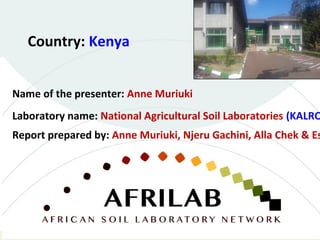
Laboratory name: National Agricultural Soil Laboratories (KALRO
Country: Kenya
Name of the presenter: Anne Muriuki
Report prepared by: Anne Muriuki, Njeru Gachini, Alla Chek & Es
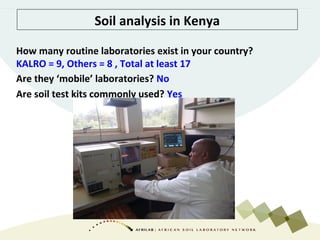
Soil analysis in Kenya
How many routine laboratories exist in your country?
KALRO = 9, Others = 8 , Total at least 17
Are they ‘mobile’ laboratories? No
Are soil test kits commonly used? Yes
Strengths/Weaknesses
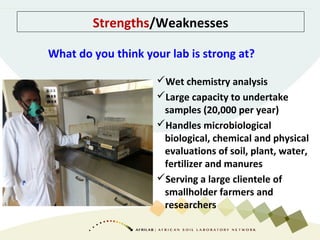
Wet chemistry analysis
Large capacity to undertake
samples (20,000 per year)
Handles microbiological
biological, chemical and physical
evaluations of soil, plant, water,
fertilizer and manures
Serving a large clientele of
smallholder farmers and
researchers
What do you think your lab is strong at?
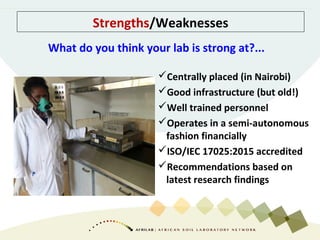
Centrally placed (in Nairobi)
Good infrastructure (but old!)
Well trained personnel
Operates in a semi-autonomous
fashion financially
ISO/IEC 17025:2015 accredited
Recommendations based on
latest research findings
What do you think your lab is strong at?...
Strengths/Weaknesses
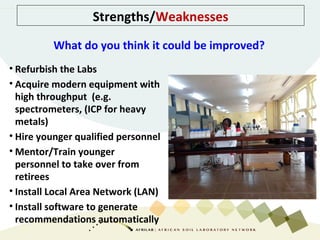
• Refurbish the Labs
• Acquire modern equipment with
high throughput (e.g.
spectrometers, (ICP for heavy
metals)
• Hire younger qualified personnel
• Mentor/Train younger
personnel to take over from
retirees
• Install Local Area Network (LAN)
• Install software to generate
recommendations automatically
What do you think it could be improved?
Expectations out of this meeting and GLOSOLAN?
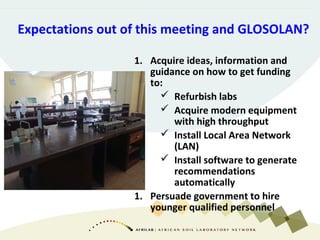
1. Acquire ideas, information and
guidance on how to get funding
to:
 Refurbish labs
 Acquire modern equipment
with high throughput
 Install Local Area Network
(LAN)
 Install software to generate
recommendations
automatically
1. Persuade government to hire
younger qualified personnel
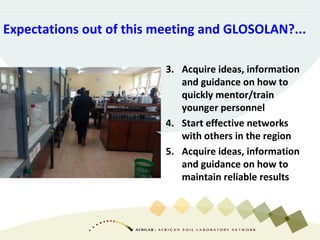
3. Acquire ideas, information
and guidance on how to
quickly mentor/train
younger personnel
4. Start effective networks
with others in the region
5. Acquire ideas, information
and guidance on how to
maintain reliable results
Expectations out of this meeting and GLOSOLAN?...
Thank you for your attention!

Kenya

  • 1.
    Laboratory name: NationalAgricultural Soil Laboratories (KALRO Country: Kenya Name of the presenter: Anne Muriuki Report prepared by: Anne Muriuki, Njeru Gachini, Alla Chek & Es
  • 2.
    Soil analysis inKenya How many routine laboratories exist in your country? KALRO = 9, Others = 8 , Total at least 17 Are they ‘mobile’ laboratories? No Are soil test kits commonly used? Yes
  • 3.
    Strengths/Weaknesses Wet chemistry analysis Largecapacity to undertake samples (20,000 per year) Handles microbiological biological, chemical and physical evaluations of soil, plant, water, fertilizer and manures Serving a large clientele of smallholder farmers and researchers What do you think your lab is strong at?
  • 4.
    Centrally placed (inNairobi) Good infrastructure (but old!) Well trained personnel Operates in a semi-autonomous fashion financially ISO/IEC 17025:2015 accredited Recommendations based on latest research findings What do you think your lab is strong at?... Strengths/Weaknesses
  • 5.
    Strengths/Weaknesses • Refurbish theLabs • Acquire modern equipment with high throughput (e.g. spectrometers, (ICP for heavy metals) • Hire younger qualified personnel • Mentor/Train younger personnel to take over from retirees • Install Local Area Network (LAN) • Install software to generate recommendations automatically What do you think it could be improved?
  • 6.
    Expectations out ofthis meeting and GLOSOLAN? 1. Acquire ideas, information and guidance on how to get funding to:  Refurbish labs  Acquire modern equipment with high throughput  Install Local Area Network (LAN)  Install software to generate recommendations automatically 1. Persuade government to hire younger qualified personnel
  • 7.
    3. Acquire ideas,information and guidance on how to quickly mentor/train younger personnel 4. Start effective networks with others in the region 5. Acquire ideas, information and guidance on how to maintain reliable results Expectations out of this meeting and GLOSOLAN?...
  • 8.
    Thank you foryour attention!