SOIL ATLAS OF ASIA
2nd Editorial Board Meeting
Shree Prasad Vista
Nepal
Progress Made by Nepal
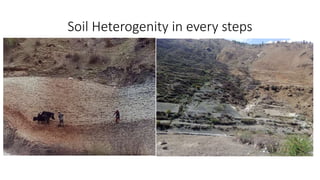
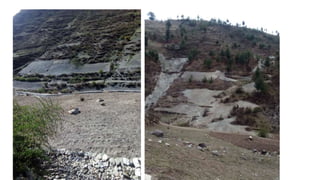
Soil Heterogenity in every steps
Systematic Classification
• Started since 1957
• Completed 55 districts out of 77 in 1983
• High hill districts remain unsurveyed for long time
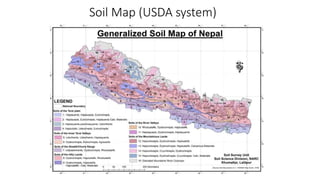
• In 1998, USDA soil map was prepared
• Again in 2014, WRB soil map was prepared
• May need some deeper analysis????
Soil Map (USDA system)
Cont..
The LRMP has followed USDA soil classification system . In each of
the land unit identified dominant soils were shown at Soil Great Group
level.
About 6000 soil profiles studies were done based on the recognized
Land Systems and Land units within each of the five physiographic
regions.
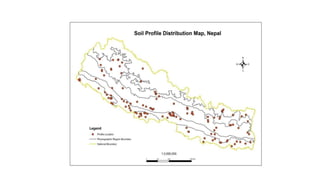
Out of the 6000 profile inspections, records of the coordinates of
about 158 representative soil profiles were analyzed for physico-
chemical properties.
The map presented below shows the distribution of those soil profiles.
Translation of soil types from USDA soil
classification to World Reference Base (WRB)
In the preparation of soil map as well as data base methods on the
Update of the Harmonized World Soil Data Base (HWSD) 2012 has been
followed.
 With regards to the conversion of the USDA classification into the WRB
classes , both the details were thoroughly studied and comparisons were
made based on the profile characteristics.
The original soil profile physico-chemical laboratory data were converted
to suit to the requirement of the HWSD using the standard formula (Batjes
et al 2017)
They were expressed in terms of the Surface soil (0-30 cm) and Subsoil
(30-100cm).
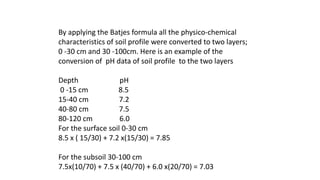
By applying the Batjes formula all the physico-chemical
characteristics of soil profile were converted to two layers;
0 -30 cm and 30 -100cm. Here is an example of the
conversion of pH data of soil profile to the two layers
Depth pH
0 -15 cm 8.5
15-40 cm 7.2
40-80 cm 7.5
80-120 cm 6.0
For the surface soil 0-30 cm
8.5 x ( 15/30) + 7.2 x(15/30) = 7.85
For the subsoil 30-100 cm
7.5x(10/70) + 7.5 x (40/70) + 6.0 x(20/70) = 7.03
Cont..
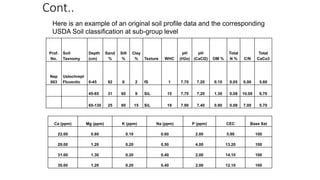
Here is an example of an original soil profile data and the corresponding
USDA Soil classification at sub-group level
Prof.
No.
Soil
Taxnomy
Depth
(cm)
Sand
%
Silt
%
Clay
% Texture WHC
pH
(H2o)
pH
(CaCl2) OM %
Total
N % C/N
Total
CaCo3
Nep
003
Ustochrept
Fluventic 0-45 92 6 2 fS 1 7.70 7.20 0.10 0.05 0.00 5.60
45-65 31 60 9 SiL 15 7.70 7.20 1.30 0.08 10.00 6.70
65-130 25 60 15 SiL 19 7.90 7.40 0.90 0.08 7.00 5.70
Ca (ppm) Mg (ppm) K (ppm) Na (ppm) P (ppm) CEC Base Sat
22.00 0.80 0.10 0.60 2.00 5.90 100
29.00 1.20 0.20 0.50 4.00 13.20 100
31.00 1.30 0.20 0.40 2.00 14.10 100
30.00 1.20 0.20 0.40 2.00 12.10 100
Prof.
No. WRBC depth SAND SILT CLAY
USDA_TEXT_C
LASS
REF_BULK_DE
NSITY
PH_H2
O
CACO
3 TEB
Nep
003
Calcaric
Fluvisol 0-30 92 6 2 Sand 1.60 7.70 5.60 23.50
Calcaric
Fluvisol 30-100 28 60 12 Siltloam 1.46 7.80 6.20 31.90
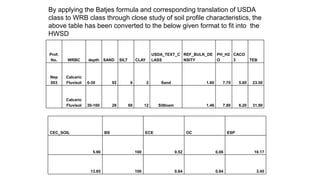
By applying the Batjes formula and corresponding translation of USDA
class to WRB class through close study of soil profile characteristics, the
above table has been converted to the below given format to fit into the
HWSD
CEC_SOIL BS ECE OC ESP
5.90 100 0.52 0.06 10.17
13.65 100 0.64 0.64 3.45
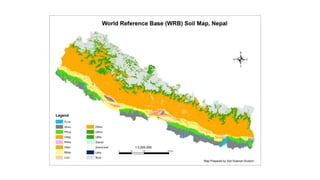
Similar conversion has been done for all the soil
profile data taken into consideration for the present
purpose.
Below shown soil map is the final product of the
present exercise.
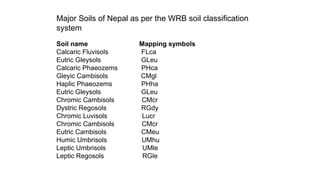
Major Soils of Nepal as per the WRB soil classification
system
Soil name Mapping symbols
Calcaric Fluvisols FLca
Eutric Gleysols GLeu
Calcaric Phaeozems PHca
Gleyic Cambisols CMgl
Haplic Phaeozems PHha
Eutric Gleysols GLeu
Chromic Cambisols CMcr
Dystric Regosols RGdy
Chromic Luvisols Lucr
Chromic Cambisols CMcr
Eutric Cambisols CMeu
Humic Umbrisols UMhu
Leptic Umbrisols UMle
Leptic Regosols RGle
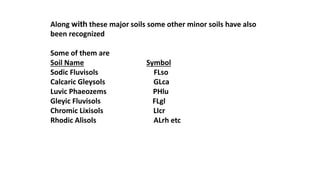
Along with these major soils some other minor soils have also
been recognized
Some of them are
Soil Name Symbol
Sodic Fluvisols FLso
Calcaric Gleysols GLca
Luvic Phaeozems PHlu
Gleyic Fluvisols FLgl
Chromic Lixisols LIcr
Rhodic Alisols ALrh etc
A detail data base of the soils of Nepal has been prepared
in the format that fits into the Harmonized World Soil Data
Base (HWSD)
May need some more consideration about Anthrosol
and Technosols.
Thank You

Item 7: Progress made in Nepal

  • 1.
    SOIL ATLAS OFASIA 2nd Editorial Board Meeting Shree Prasad Vista Nepal Progress Made by Nepal
  • 3.
  • 5.
    Systematic Classification • Startedsince 1957 • Completed 55 districts out of 77 in 1983 • High hill districts remain unsurveyed for long time • In 1998, USDA soil map was prepared • Again in 2014, WRB soil map was prepared • May need some deeper analysis????
  • 6.
  • 7.
    Cont.. The LRMP hasfollowed USDA soil classification system . In each of the land unit identified dominant soils were shown at Soil Great Group level. About 6000 soil profiles studies were done based on the recognized Land Systems and Land units within each of the five physiographic regions. Out of the 6000 profile inspections, records of the coordinates of about 158 representative soil profiles were analyzed for physico- chemical properties. The map presented below shows the distribution of those soil profiles.
  • 9.
    Translation of soiltypes from USDA soil classification to World Reference Base (WRB) In the preparation of soil map as well as data base methods on the Update of the Harmonized World Soil Data Base (HWSD) 2012 has been followed.  With regards to the conversion of the USDA classification into the WRB classes , both the details were thoroughly studied and comparisons were made based on the profile characteristics. The original soil profile physico-chemical laboratory data were converted to suit to the requirement of the HWSD using the standard formula (Batjes et al 2017) They were expressed in terms of the Surface soil (0-30 cm) and Subsoil (30-100cm).
  • 10.
    By applying theBatjes formula all the physico-chemical characteristics of soil profile were converted to two layers; 0 -30 cm and 30 -100cm. Here is an example of the conversion of pH data of soil profile to the two layers Depth pH 0 -15 cm 8.5 15-40 cm 7.2 40-80 cm 7.5 80-120 cm 6.0 For the surface soil 0-30 cm 8.5 x ( 15/30) + 7.2 x(15/30) = 7.85 For the subsoil 30-100 cm 7.5x(10/70) + 7.5 x (40/70) + 6.0 x(20/70) = 7.03
  • 11.
    Cont.. Here is anexample of an original soil profile data and the corresponding USDA Soil classification at sub-group level Prof. No. Soil Taxnomy Depth (cm) Sand % Silt % Clay % Texture WHC pH (H2o) pH (CaCl2) OM % Total N % C/N Total CaCo3 Nep 003 Ustochrept Fluventic 0-45 92 6 2 fS 1 7.70 7.20 0.10 0.05 0.00 5.60 45-65 31 60 9 SiL 15 7.70 7.20 1.30 0.08 10.00 6.70 65-130 25 60 15 SiL 19 7.90 7.40 0.90 0.08 7.00 5.70 Ca (ppm) Mg (ppm) K (ppm) Na (ppm) P (ppm) CEC Base Sat 22.00 0.80 0.10 0.60 2.00 5.90 100 29.00 1.20 0.20 0.50 4.00 13.20 100 31.00 1.30 0.20 0.40 2.00 14.10 100 30.00 1.20 0.20 0.40 2.00 12.10 100
  • 12.
    Prof. No. WRBC depthSAND SILT CLAY USDA_TEXT_C LASS REF_BULK_DE NSITY PH_H2 O CACO 3 TEB Nep 003 Calcaric Fluvisol 0-30 92 6 2 Sand 1.60 7.70 5.60 23.50 Calcaric Fluvisol 30-100 28 60 12 Siltloam 1.46 7.80 6.20 31.90 By applying the Batjes formula and corresponding translation of USDA class to WRB class through close study of soil profile characteristics, the above table has been converted to the below given format to fit into the HWSD CEC_SOIL BS ECE OC ESP 5.90 100 0.52 0.06 10.17 13.65 100 0.64 0.64 3.45
  • 13.
    Similar conversion hasbeen done for all the soil profile data taken into consideration for the present purpose. Below shown soil map is the final product of the present exercise.
  • 15.
    Major Soils ofNepal as per the WRB soil classification system Soil name Mapping symbols Calcaric Fluvisols FLca Eutric Gleysols GLeu Calcaric Phaeozems PHca Gleyic Cambisols CMgl Haplic Phaeozems PHha Eutric Gleysols GLeu Chromic Cambisols CMcr Dystric Regosols RGdy Chromic Luvisols Lucr Chromic Cambisols CMcr Eutric Cambisols CMeu Humic Umbrisols UMhu Leptic Umbrisols UMle Leptic Regosols RGle
  • 16.
    Along with thesemajor soils some other minor soils have also been recognized Some of them are Soil Name Symbol Sodic Fluvisols FLso Calcaric Gleysols GLca Luvic Phaeozems PHlu Gleyic Fluvisols FLgl Chromic Lixisols LIcr Rhodic Alisols ALrh etc
  • 17.
    A detail database of the soils of Nepal has been prepared in the format that fits into the Harmonized World Soil Data Base (HWSD) May need some more consideration about Anthrosol and Technosols.
  • 18.