Why is a Quality Management
System useful?
Prepared by: Odipo Osano
University of Eldoret, Kenya
First Meeting, 21-24 May 2019, Nairobi, Kenya
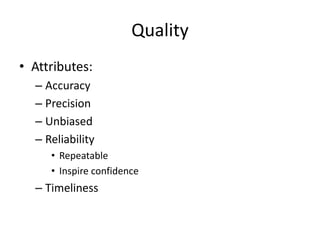
Quality
• Attributes:
– Accuracy
– Precision
– Unbiased
– Reliability
• Repeatable
• Inspire confidence
– Timeliness
Why Quality
RESEARCHER
STUDENT
CLIENTS
FARMER
Satisfy
Retain
-Clients
-Customers
Capture new
customers
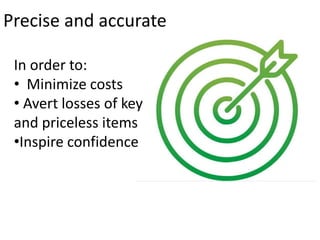
Precise and accurate
In order to:
• Minimize costs
• Avert losses of key
and priceless items
•Inspire confidence
Minimize variability of output
• Provides confidence in your results
• Improves working relations in the lab
• Optimizes use of resources (time, personnel,
equipment)
• Therefore use of SOPs
Profit
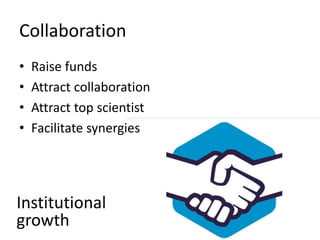
Collaboration
• Raise funds
• Attract collaboration
• Attract top scientist
• Facilitate synergies
Institutional
growth
Safety
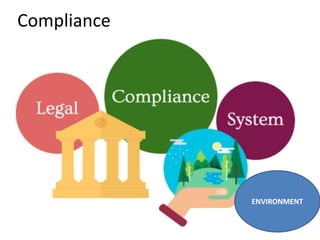
Compliance
ENVIRONMENT
Reputation
High impacts of
• the research
• high impact publications
• laboratory
Job satisfaction
QUALITY MANAGEMENT
SYSTEM
•All aspects (phases)
– Management
– Processes
– Procedures
Detection of errors
• At each phase of operations
–Pre Analytic
–Analytic
–Post analytic
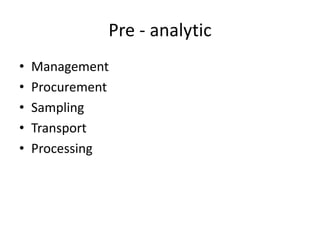
Pre - analytic
• Management
• Procurement
• Sampling
• Transport
• Processing
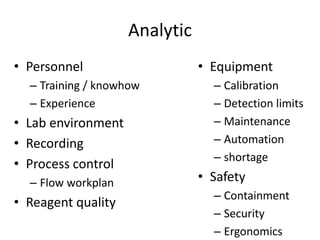
Analytic
• Personnel
– Training / knowhow
– Experience
• Lab environment
• Recording
• Process control
– Flow workplan
• Reagent quality
• Equipment
– Calibration
– Detection limits
– Maintenance
– Automation
– shortage
• Safety
– Containment
– Security
– Ergonomics
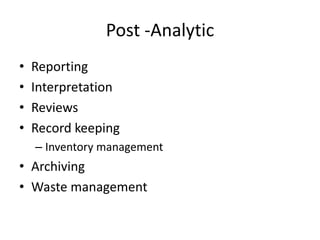
Post -Analytic
• Reporting
• Interpretation
• Reviews
• Record keeping
– Inventory management
• Archiving
• Waste management
Key
challenges in
Africa
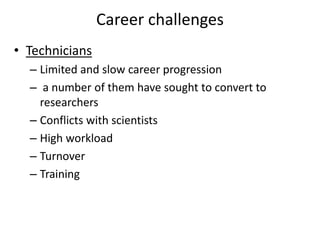
Career challenges
• Technicians
– Limited and slow career progression
– a number of them have sought to convert to
researchers
– Conflicts with scientists
– High workload
– Turnover
– Training
• Researchers (scientists)
– Often too busy with
• administrative duties
• Assignments
• Family and social issues
– Distracted by other opportunities
– Should foster good rapport with technicians
– High workload
– Turnover
– Training
• Public service
– Slow career growth or stagnation
– Output not matched with remuneration
Management
• Management commitment & support
• Relation between cadres
• Motivation
• Quality assurance program
Information Management
• Information management systems
• Communication
• Customer Services
– Satisfaction survey
– Review
– Packaging and shipping
– Perception
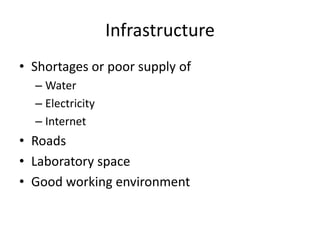
Infrastructure
• Shortages or poor supply of
– Water
– Electricity
– Internet
• Roads
• Laboratory space
• Good working environment
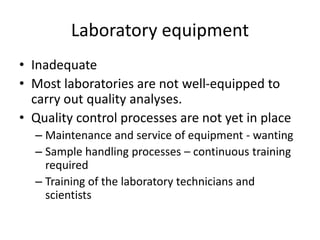
Laboratory equipment
• Inadequate
• Most laboratories are not well-equipped to
carry out quality analyses.
• Quality control processes are not yet in place
– Maintenance and service of equipment - wanting
– Sample handling processes – continuous training
required
– Training of the laboratory technicians and
scientists
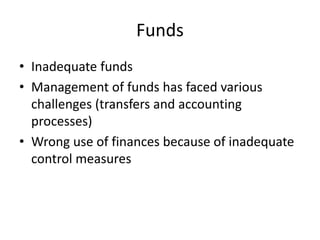
Funds
• Inadequate funds
• Management of funds has faced various
challenges (transfers and accounting
processes)
• Wrong use of finances because of inadequate
control measures
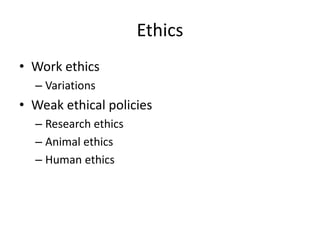
Ethics
• Work ethics
– Variations
• Weak ethical policies
– Research ethics
– Animal ethics
– Human ethics
Consequence of poor quality
• Wrong/incorrect decision
– Harm to the environment
• Costs
– Unnecessary
– Legal and insurance
• Delay
– New tests may be required
– Late response
• Retraction
Opportunities
Opportunities
• Collaborations and networks
– will expose laboratories and researchers to world
standards
– Facilitate benchmarking, validation
– Share of resources
– Improve reputation and impacts of laboratories
– Improve productivity (through synergies …)
– Improve motivations of staff.
• Research impacts metrics
– Most agencies now take into consideration the
impacts of research which depends on quality
• Training and continuous learning
• Accreditations
THANK YOU!