April 8, 2016, Miami FL
Slides: http://slideshare.net/LaBlogga
DNA
Nanotechnology
Applications in
Brain-Computer Interfaces (BCIs) and
Nanoneurosurgery
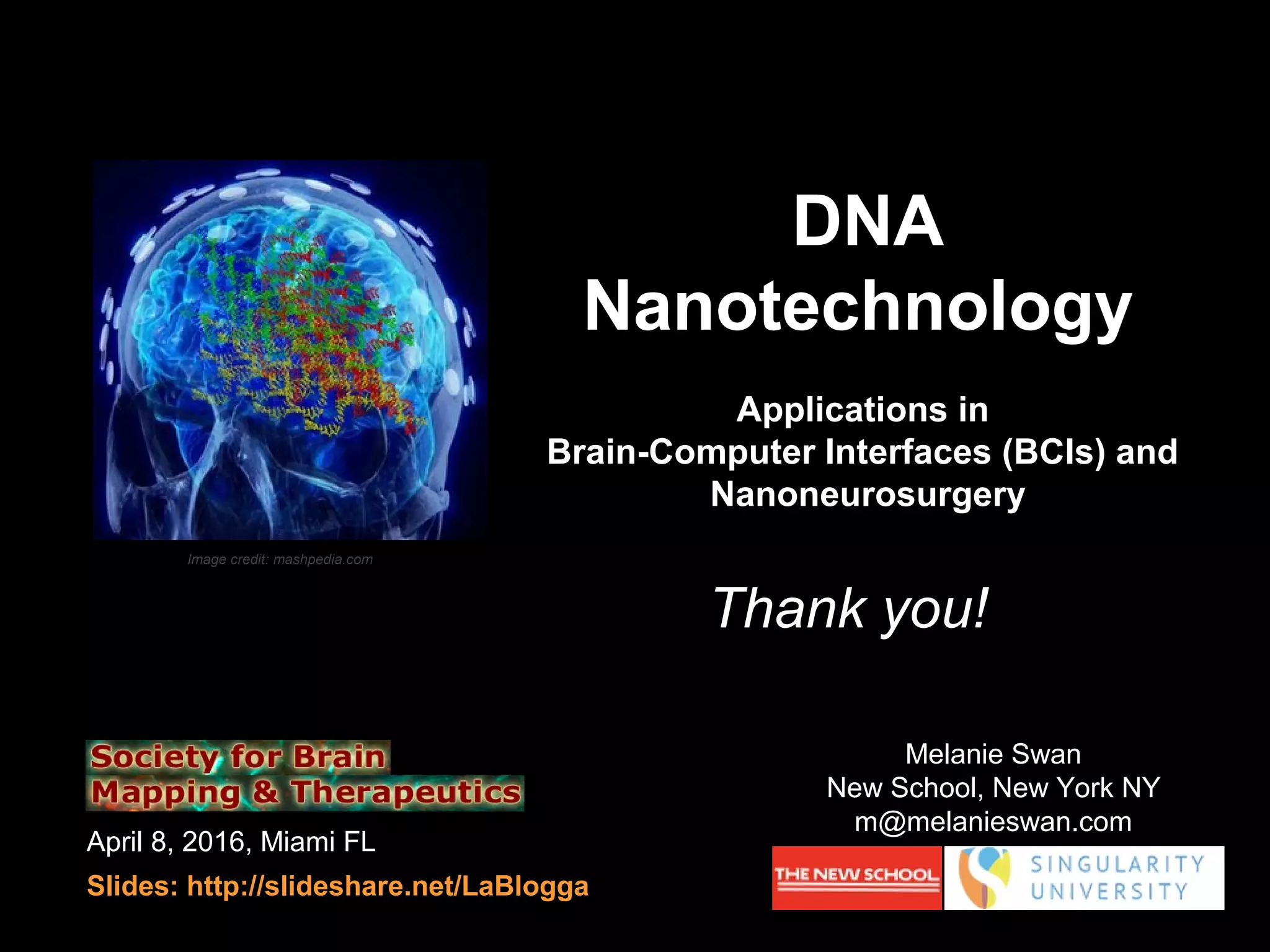
Image credit: mashpedia.com
Melanie Swan
New School, New York NY
m@melanieswan.com
April 2016
DNA Nanotechnology 2
About Melanie Swan
 Founder DIYgenomics, Institute for
Blockchain Studies, GroupPurchase
 New School, Singularity University Instructor,
IEET Affiliate Scholar, EDGE Contributor
 Education: MBA Finance, Wharton; BA
French/Economics, Georgetown Univ
 Work experience: Fidelity, JP Morgan, iPass,
RHK/Ovum, Arthur Andersen
 Sample publications:
Source: http://melanieswan.com/publications.htm
 Kido T, Kawashima M, Nishino S, Swan M, Kamatani N, Butte AJ. Systematic Evaluation of Personal
Genome Services for Japanese Individuals. Nature: Journal of Human Genetics 2013, 58, 734-741.
 Swan, M. The Quantified Self: Fundamental Disruption in Big Data Science and Biological Discovery.
Big Data June 2013, 1(2): 85-99.
 Swan, M. Sensor Mania! The Internet of Things, Wearable Computing, Objective Metrics, and the
Quantified Self 2.0. J Sens Actuator Netw 2012, 1(3), 217-253.
Swan, M. Health 2050: The Realization of Personalized Medicine through Crowdsourcing, the
Quantified Self, and the Participatory Biocitizen. J Pers Med 2012, 2(3), 93-118.
 Swan, M. Steady advance of stem cell therapies. Rejuvenation Res 2011, Dec;14(6):699-704.
 Swan, M. Multigenic Condition Risk Assessment in Direct-to-Consumer Genomic Services. Genet Med 2010,
May;12(5):279-88.
April 2016
DNA Nanotechnology
Thesis
3
DNA Nanotechnology is uniquely suited to
advance the development of Brain-Computer
Interfaces (BCIs) and aid in
Nanoneurosurgery
April 2016
DNA Nanotechnology
BCI market estimated at $1.7 billion in 2022
 Brain-Computer Interface (BCI) market estimated to
grow to USD $1.7 billion by 2022 (doubling in 7 years)
 Sample Vendors: Emotiv System, Mind Solutions Corp., Puzzlebox, Natus
Medical, Interactive Productline, Compumedics Ltd., Neuroelectrics
4
Source: http://www.medgadget.com/2016/03/brain-computer-interface-bci-market-is-expected-to-grow-owing-to-its-increasing-
demand-in-healthcare-industry-till-2022-grand-view-research-inc.html, http://www.grandviewresearch.com/industry-analysis/brain-
computer-interfaces-market
Global brain computer interface market, by application,
2012-2022 (USD Million) – Grand View Research
April 2016
DNA Nanotechnology
What is a Brain-computer Interface (BCI)?
 A brain-computer interface (BCI), brain-
machine interface (BMI), or neural prosthesis
is any technology linking the human brain to a
computer
 A computational system implanted in the brain that
allows a person to control a computer using only
brainwaves; e.g.; electrical signals from the brain
5
April 2016
DNA Nanotechnology
How does a BCI work?
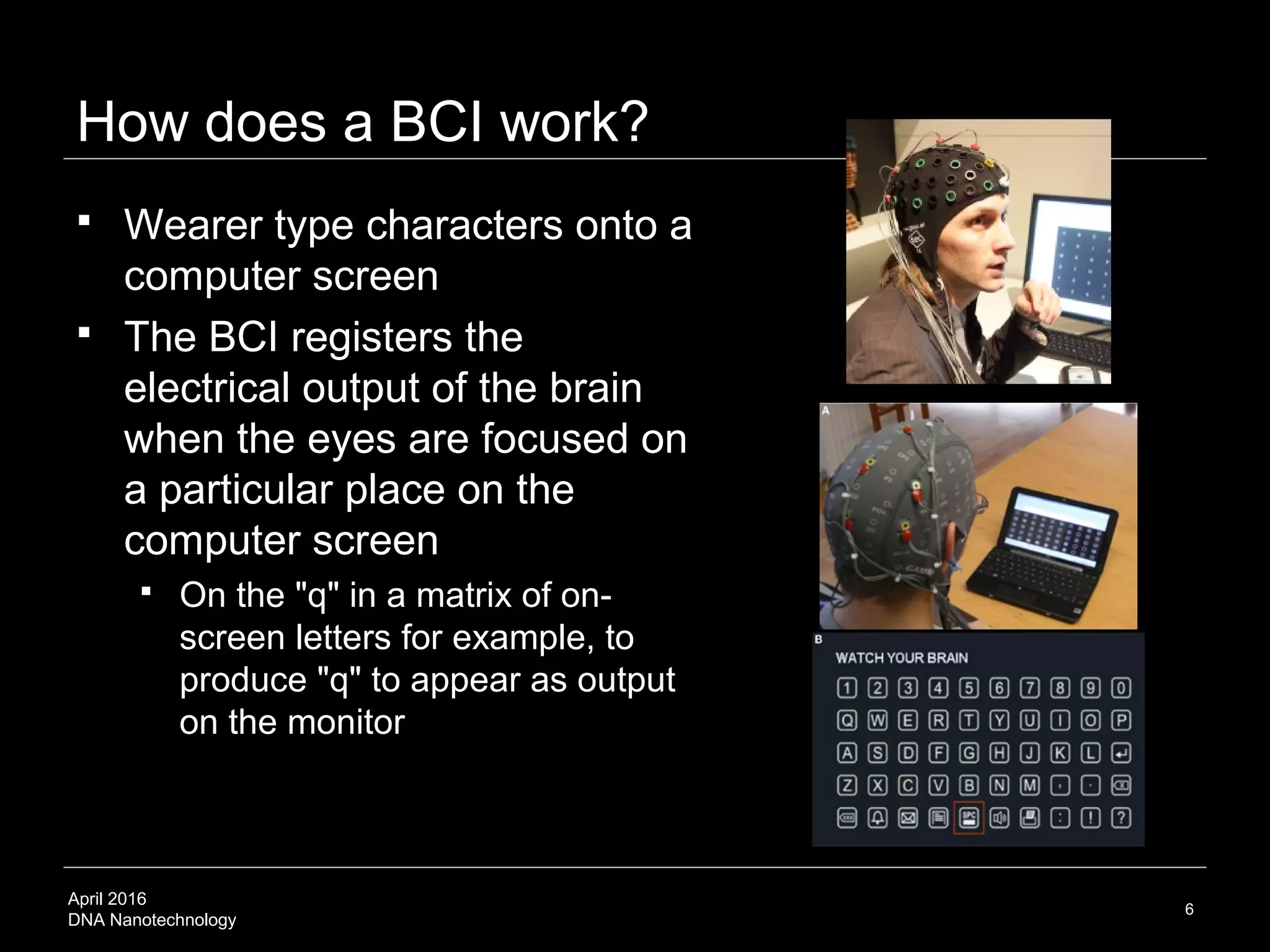
 Wearer type characters onto a
computer screen as…
 …the BCI registers the
electrical output of the brain
when the eyes are focused on
a particular place on the
computer screen
 On the "q" in a matrix of on-
screen letters for example, to
produce "q" to appear as output
on the monitor
6
April 2016
DNA Nanotechnology
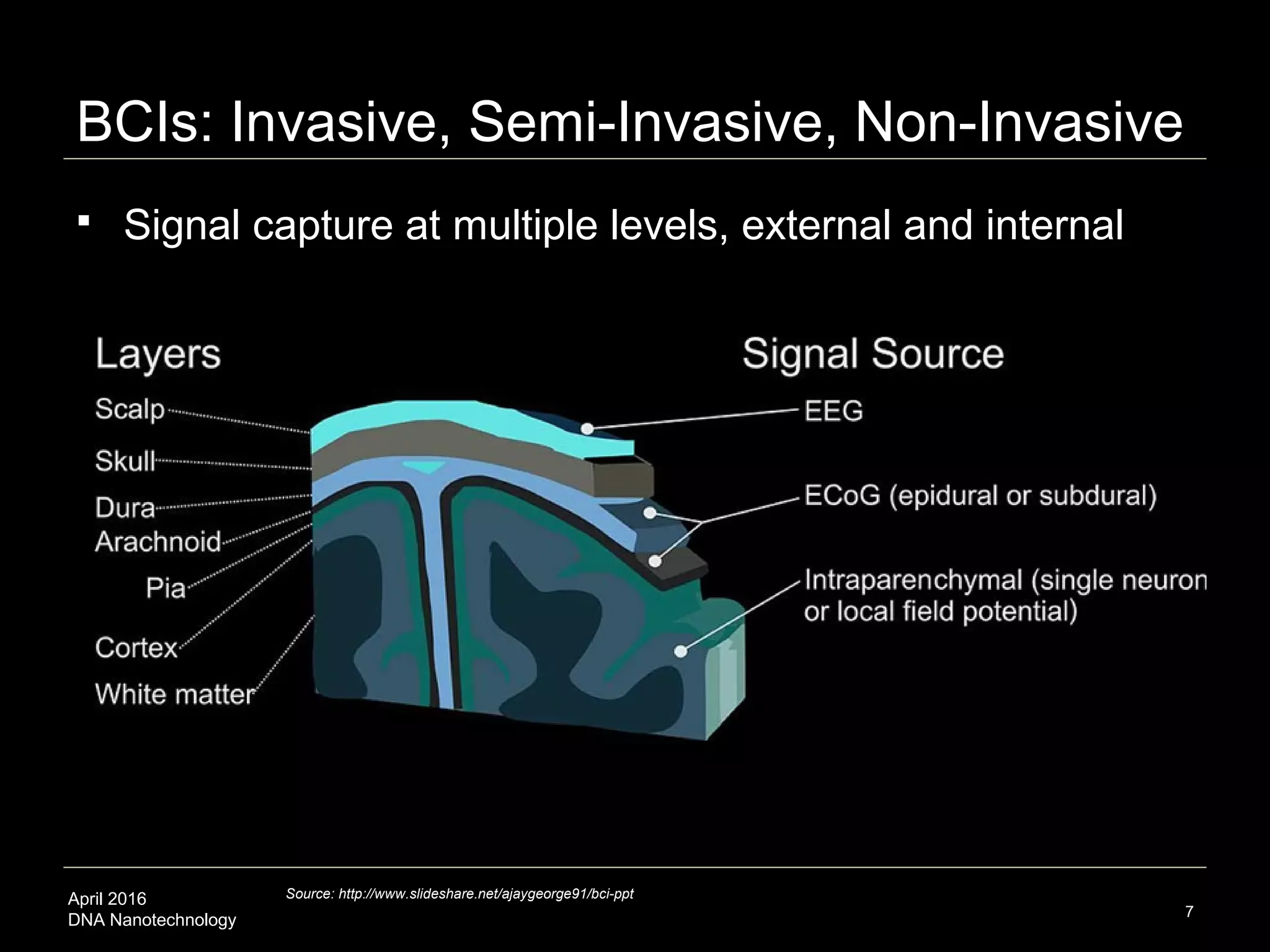
BCIs: Non-Invasive, Semi-Invasive, Invasive
7
Source: http://www.slideshare.net/ajaygeorge91/bci-ppt
 Signal capture at multiple levels, external and internal
April 2016
DNA Nanotechnology
BCIs in Practical Use
 Repair human cognitive and sensory-
motor function
 Cochlear implants: a small computer
chip is substituted for damaged inner
ear control organs, sound waves
transformed into brain-interpretable
electrical signals
 Over 70,000 US (219,000 global); 50% in
children (2010)
 Vision restoration: implantable systems
transmit visual information to the brain
8
Source: http://www.asha.org/public/hearing/Cochlear-Implant-Frequently-Asked-Questions/
April 2016
DNA Nanotechnology
Two-way BCIs: Input/Output
9
Source: R.A. Miranda et al. / Journal of Neuroscience Methods 244 (2015) 52–67
 Input channels use
electrical brain
stimulation to deliver
signals to the brain
 Output channels collect
the action potentials of
single neuron spikes or
scalp electrical signals
into commands that
move robot arms,
wheelchairs, and
cursors
April 2016
DNA Nanotechnology
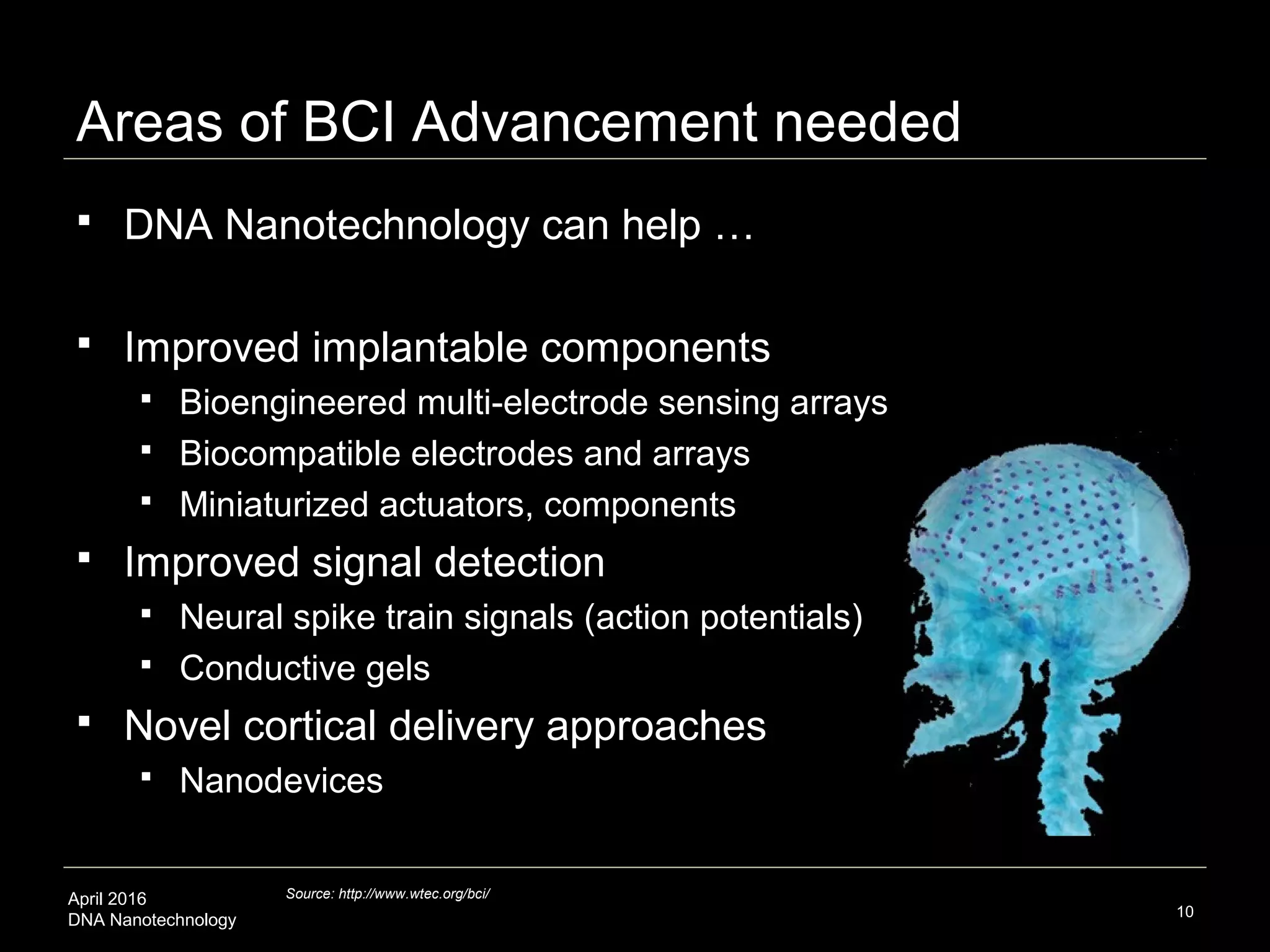
Areas of BCI Advancement needed
 DNA Nanotechnology can help …
 Improved implantable components
 Bioengineered multi-electrode sensing arrays
 Biocompatible electrodes and arrays
 Miniaturized actuators, components
 Improved signal detection
 Neural spike train signals (action potentials)
 Conductive gels
 Novel cortical delivery approaches
 Nanodevices
10
Source: http://www.wtec.org/bci/
April 2016
DNA Nanotechnology
BCI Applications of DNA Nanotechnology
 Pathology Resolution
 Improve control of neuro-prosthetics
and prosthetic limbs
 Smooth the irregular neural electrical
activity in epilepsy, Parkinson’s
Disease
 Amplify neuronal signaling in
neurodegenerative disease
 Environmental Support
 Maintain healthy conductive
environment
 Neuronal repair
 Activate neuronal arrays (optogenetics)
11
April 2016
DNA Nanotechnology 12
DNA Nanotechnology
 Using DNA as a construction
material; nanoscale building blocks
 Specificity of the interactions between
complementary base pairs make DNA
a useful construction material
 DNA ladder framework
 Self-assembles, known properties,
predictable shapes
 Ready availability raw nucleic acids
 Dynamically reprogrammable DNA,
RNA, peptides
 Use DNA as a building block to self-
assemble structures in vivo
April 2016
DNA Nanotechnology
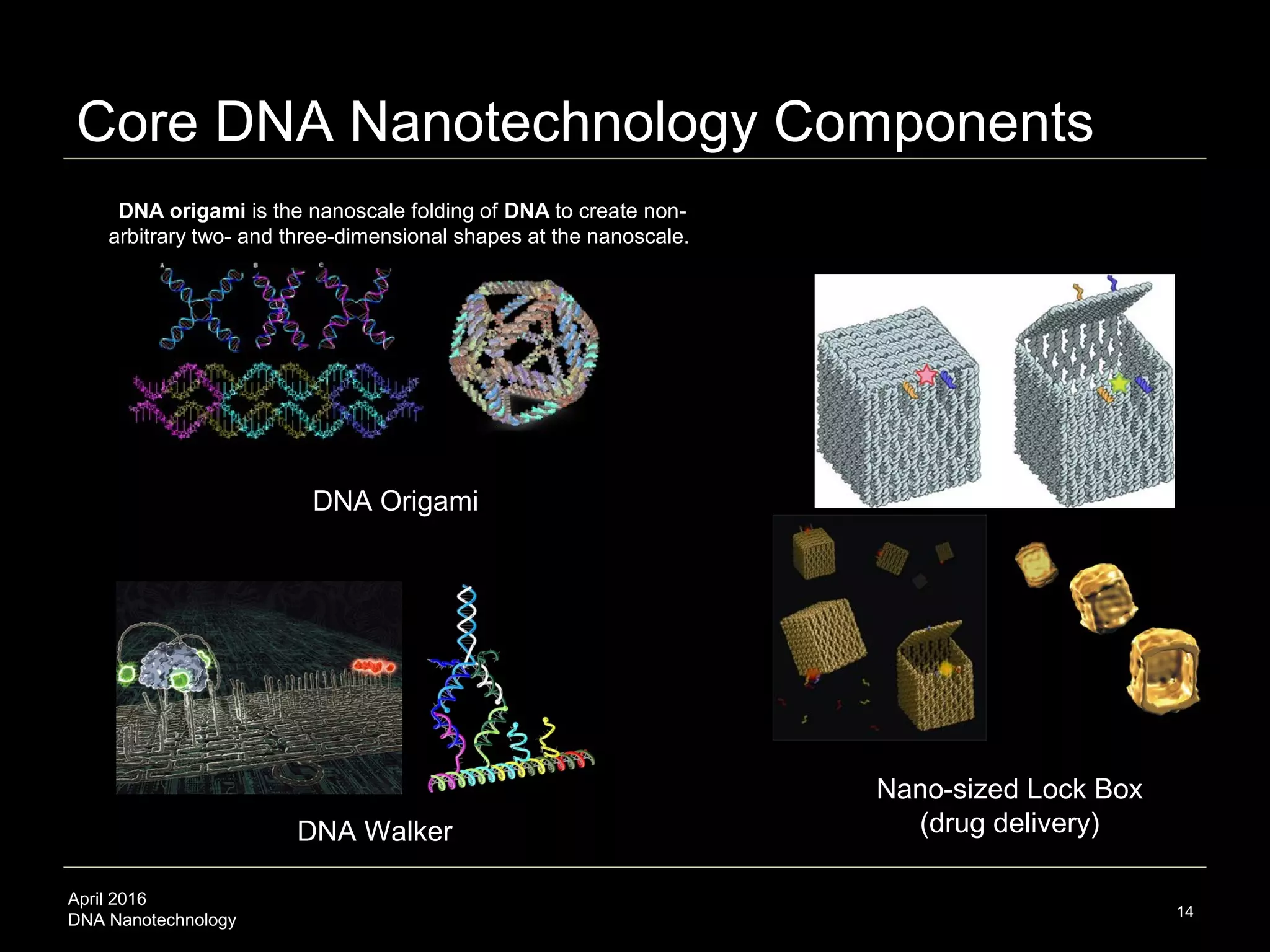
Core DNA Nanotechnology Components
13
Holliday Junction Sticky Ends
DNA Lattice
Sources: Shrishaila, DNA Nanotechnology seminar
April 2016
DNA Nanotechnology
Core DNA Nanotechnology Components
14
DNA Walker
Nano-sized Lock Box
(drug delivery)
DNA origami is the nanoscale folding of DNA to create non-
arbitrary two- and three-dimensional shapes at the nanoscale.
DNA Origami
April 2016
DNA Nanotechnology
Top 8 DNA Nanotechnology Advances for BCIs
 Method: select advances representative of larger field
 Sources: FNANO industry conference, PubMed
searches, high-profile DNA nanotechnology labs (NYU,
Caltech, Harvard, Stanford, Univ of Manchester)
15
April 2016
DNA Nanotechnology
1. Blood clot dissolution
2. Microneedle array
diagnostics/delivery
3. Hydrogel cellular delivery
4. Molecular robot for positional
nanoassembly
5. Nanotechnology-guided neural
regeneration
6. DNA Nanobots in first human trial
7. Graphene electrode-neuron interface
8. Nanobots cargo delivery in mouse
16
Neocortical Neurogenesis in Mammals
lafayette.edu
Top 8 DNA Nanotechnology Advances for BCIs
April 2016
DNA Nanotechnology
DNA Nanotechnology Killer App
Blood Clot Dissolution
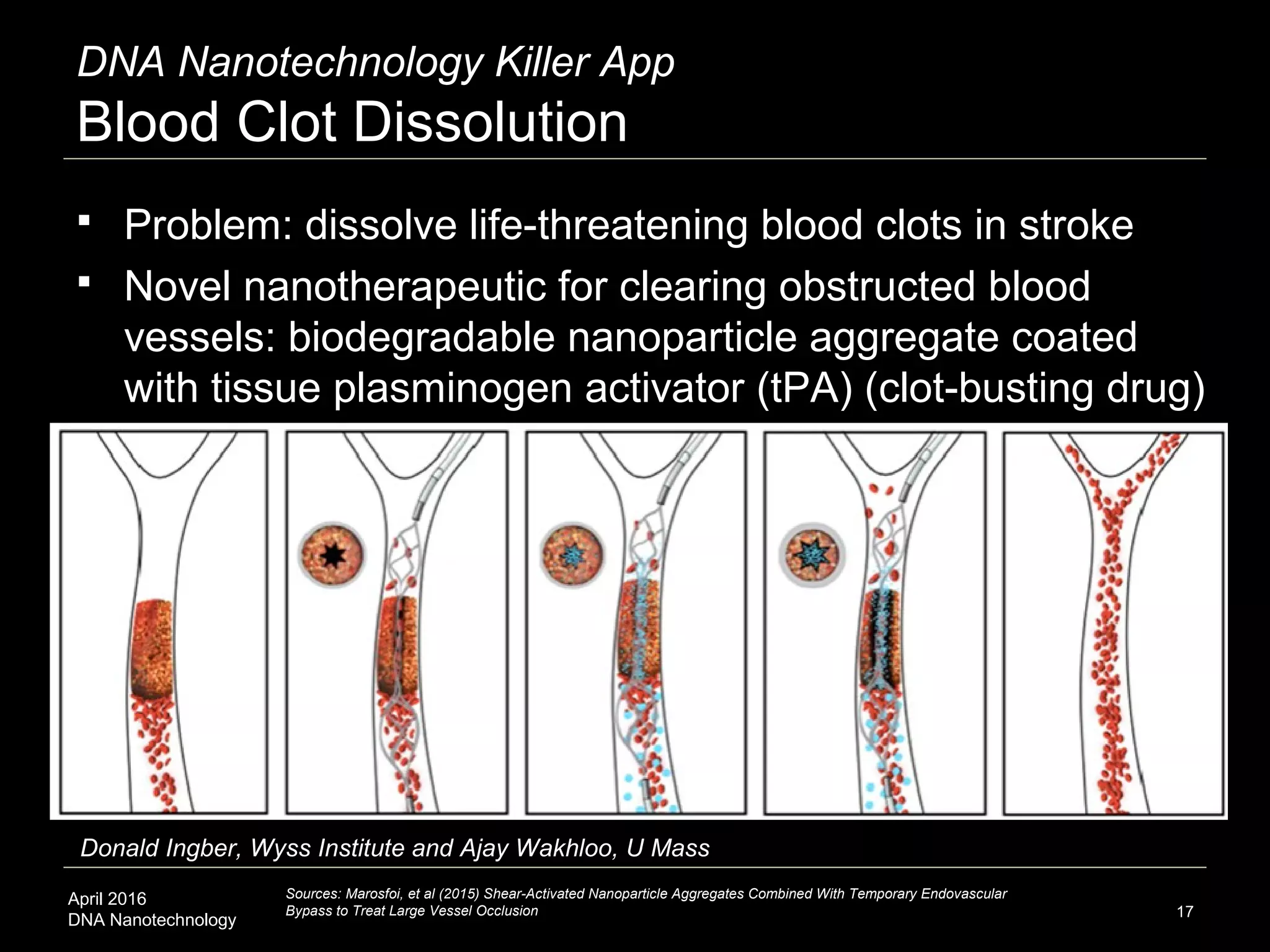
 Problem: dissolve life-threatening blood clots in stroke
 Novel nanotherapeutic for clearing obstructed blood
vessels: biodegradable nanoparticle aggregate coated
with tissue plasminogen activator (tPA) (clot-busting drug)
17
Sources: Marosfoi, et al (2015) Shear-Activated Nanoparticle Aggregates Combined With Temporary Endovascular
Bypass to Treat Large Vessel Occlusion
Donald Ingber, Wyss Institute and Ajay Wakhloo, U Mass
April 2016
DNA Nanotechnology
DNA Nanotechnology Killer App
Blood Clot Dissolution
 Novel approach for complete
vascular blockages where there is no
blood flow (the usual case for stroke)
 The nanotherapeutic reacts to fluid
shear force, releasing tPA-coated
nanoparticles in narrowed regions
where vessels are occluded, binding
to the blood clot and dissolving it
 Application: less-invasive alternative
to existing method (stent-retriever
thrombectomy procedure)
18
Sources: Marosfoi, et al (2015) Shear-Activated Nanoparticle Aggregates Combined With Temporary Endovascular
Bypass to Treat Large Vessel Occlusion
Donald Ingber, Wyss Institute and Ajay Wakhloo, U Mass
April 2016
DNA Nanotechnology
DNA Nanotechnology Killer App
Microneedle Array Diagnostic/Delivery
19
 Problem: less-invasive diagnostic/delivery
 Implantable microneedle array mimics
normal arachnoid granulations surrounding
the brain and spinal cord
 Microfabricated arachnoid granulations
punctured through dura mater membrane
in the brain to provide a conduit for
cerebrospinal fluid flow (porcine tests)
 Application: hydrocephalus treatment
 Communicating Hydrocephalus caused by
deficient arachnoid granulation valves that
poorly regulate cerebrospinal fluid flow
Sources: Oh et al, A novel microneedle array for the treatment of hydrocephalus, 2015.
Jonghyun Oh, Chonbuk National University, Korea and Tim Medina, Drexel University
April 2016
DNA Nanotechnology
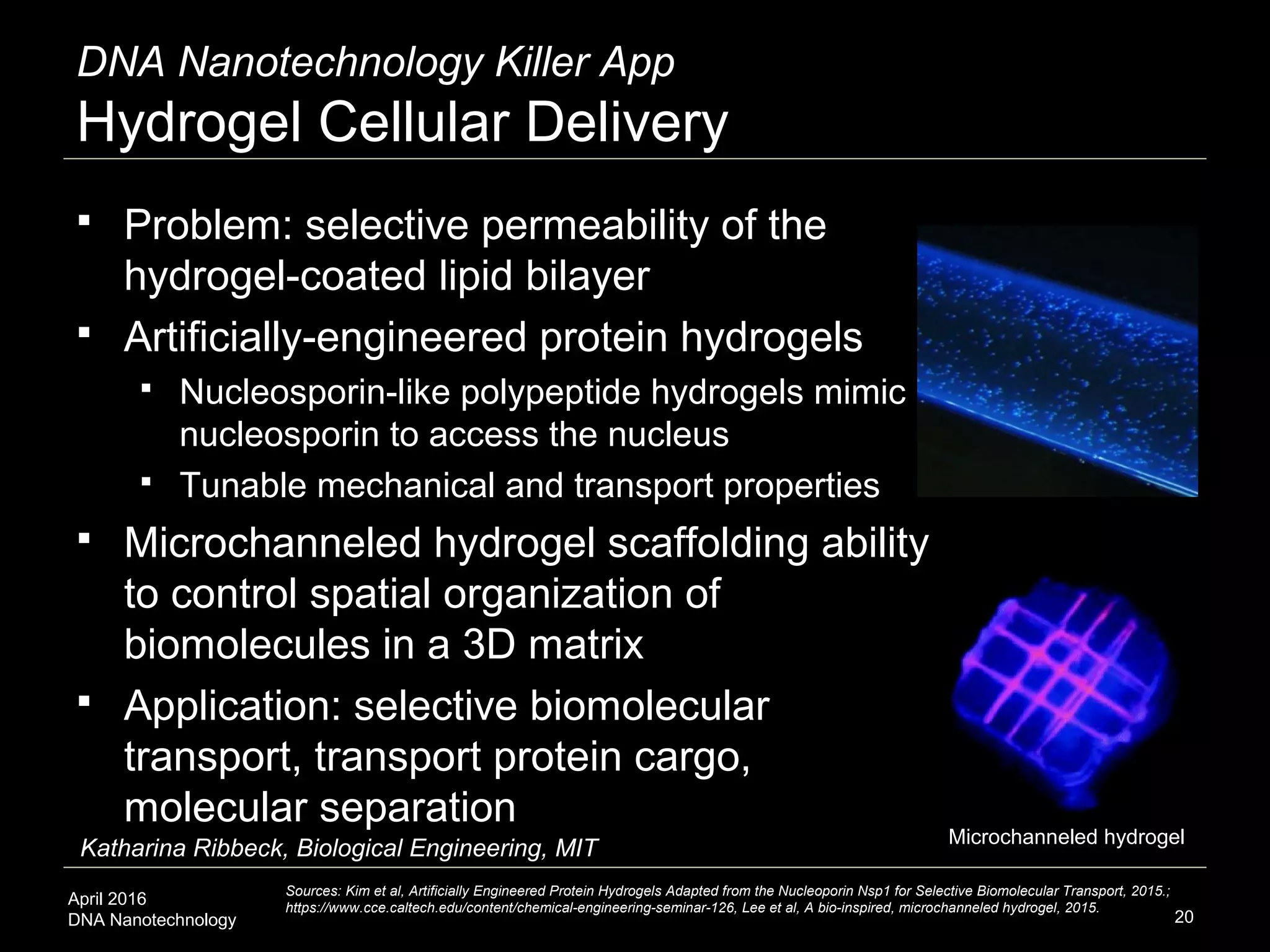
Microchanneled hydrogel
20
DNA Nanotechnology Killer App
Hydrogel Cellular Delivery
Sources: Kim et al, Artificially Engineered Protein Hydrogels Adapted from the Nucleoporin Nsp1 for Selective Biomolecular Transport, 2015.;
https://www.cce.caltech.edu/content/chemical-engineering-seminar-126, Lee et al, A bio-inspired, microchanneled hydrogel, 2015.
 Problem: selective permeability of the
hydrogel-coated lipid bilayer
 Artificially-engineered protein hydrogels
 Nucleosporin-like polypeptide hydrogels mimic
nucleosporin to access the nucleus
 Tunable mechanical and transport properties
 Microchanneled hydrogel scaffolding ability
to control spatial organization of
biomolecules in a 3D matrix
 Application: selective biomolecular
transport, transport protein cargo,
molecular separation
Katharina Ribbeck, Biological Engineering, MIT
April 2016
DNA Nanotechnology 21
DNA Nanotechnology Killer App
Molecular Robot for Positional Nanoassembly
Sources: Kaszemm et al, Pick-up, transport and release of a molecular cargo using a small-molecule robotic arm, 2016.
http://www.nature.com/nchem/journal/v8/n2/pdf/nchem.2410.pdf.
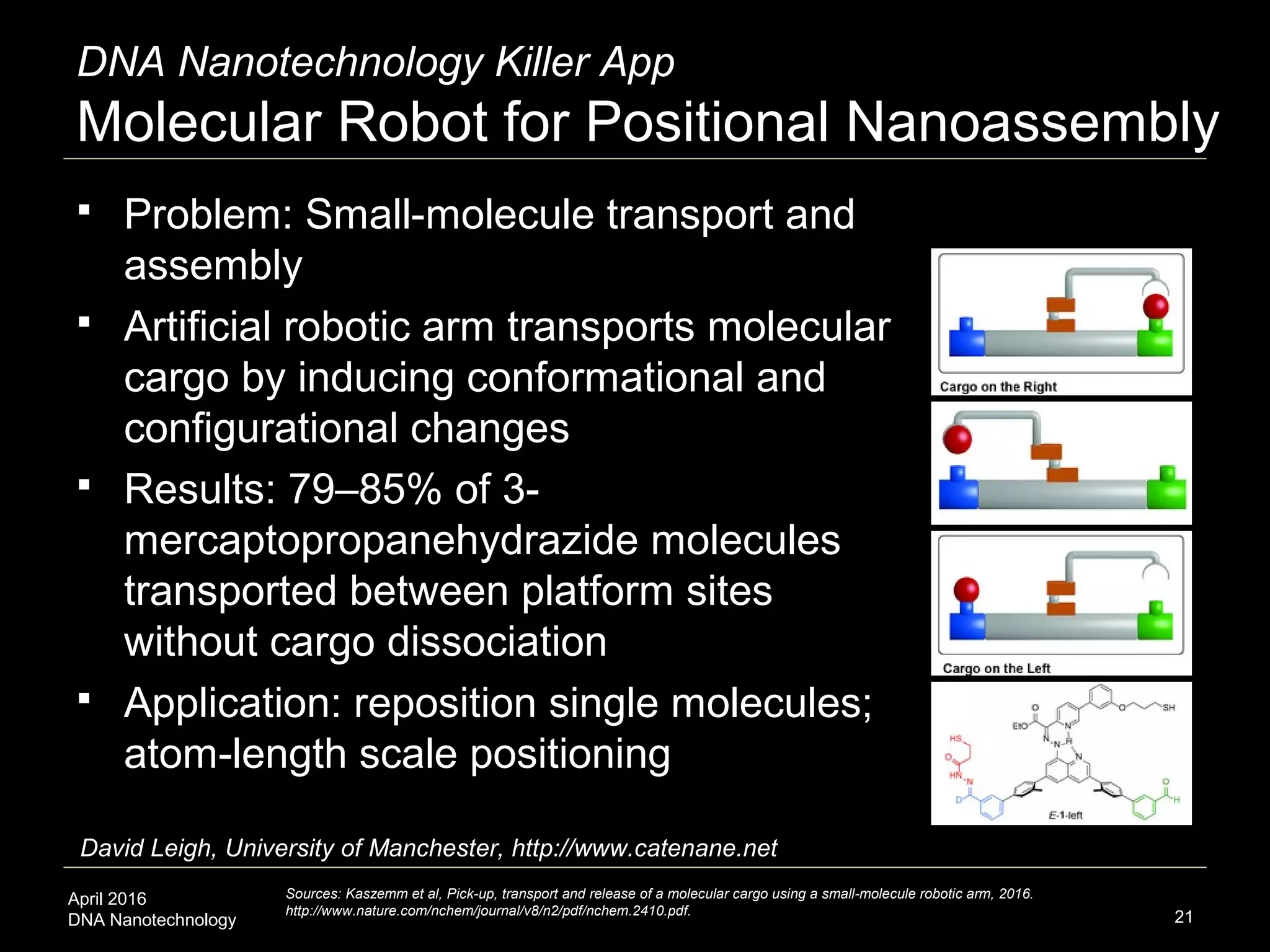
 Problem: Small-molecule transport and
assembly
 Artificial robotic arm transports molecular
cargo by inducing conformational and
configurational changes
 Results: 79–85% of 3-
mercaptopropanehydrazide molecules
transported between platform sites
without cargo dissociation
 Application: reposition single molecules;
atom-length scale positioning
David Leigh, University of Manchester, http://www.catenane.net
April 2016
DNA Nanotechnology
DNA Nanotechnology Killer App
Nanotechnology-guided Neural Regeneration
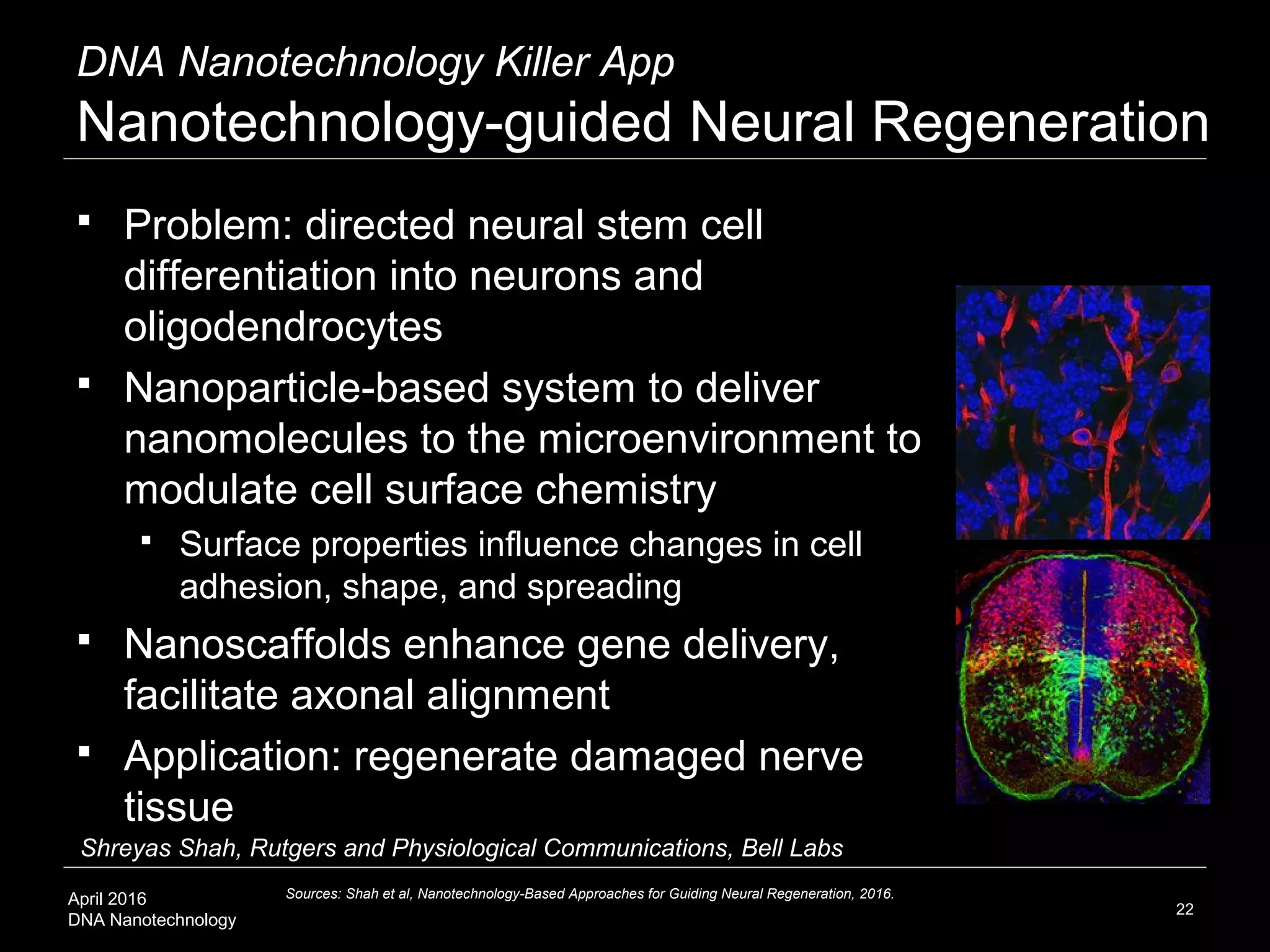
 Problem: directed neural stem cell
differentiation into neurons and
oligodendrocytes
 Nanoparticle-based system to deliver
nanomolecules to the microenvironment to
modulate cell surface chemistry
 Surface properties influence changes in cell
adhesion, shape, and spreading
 Nanoscaffolds enhance gene delivery,
facilitate axonal alignment
 Application: regenerate damaged nerve
tissue
22
Sources: Shah et al, Nanotechnology-Based Approaches for Guiding Neural Regeneration, 2016.
Shreyas Shah, Rutgers and Physiological Communications, Bell Labs
April 2016
DNA Nanotechnology
DNA Nanotechnology Killer App
DNA Nanobots in First Human Trial
23
Sources: Amir et al, Folding and Characterization of a Bio-responsive Robot from DNA Origami, 2015. Hachmon et al, A Non-
Newtonian Fluid Robot, 2016. http://nextbigfuture.com/2015/05/pfizer-partnering-with-ido-bachelet-on.html
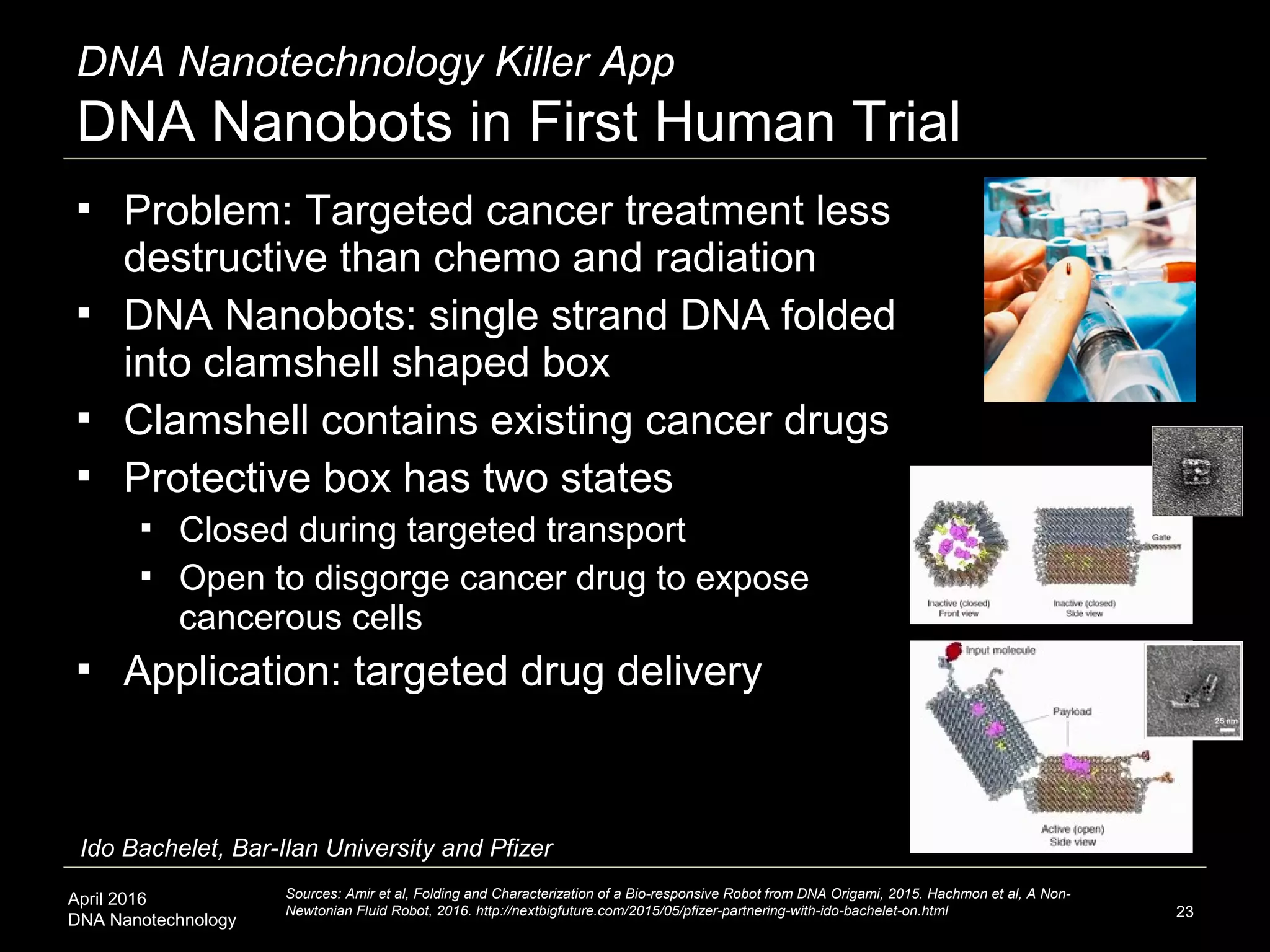
 Problem: Targeted cancer treatment less
destructive than chemo and radiation
 DNA Nanobots: single strand DNA folded
into clamshell shaped box
 Clamshell contains existing cancer drugs
 Protective box has two states
 Closed during targeted transport
 Open to disgorge cancer drug to expose
cancerous cells
 Application: targeted drug delivery
Ido Bachelet, Bar-Ilan University and Pfizer
April 2016
DNA Nanotechnology 24
DNA Nanotechnology Killer App
Graphene Electrode-Neuron Interface
Sources: Fabbro et al, Graphene-Based Interfaces Do Not Alter Target Nerve Cells, 2016. http://www.gizmag.com/graphene-electrode-
brain-disorders/41591/
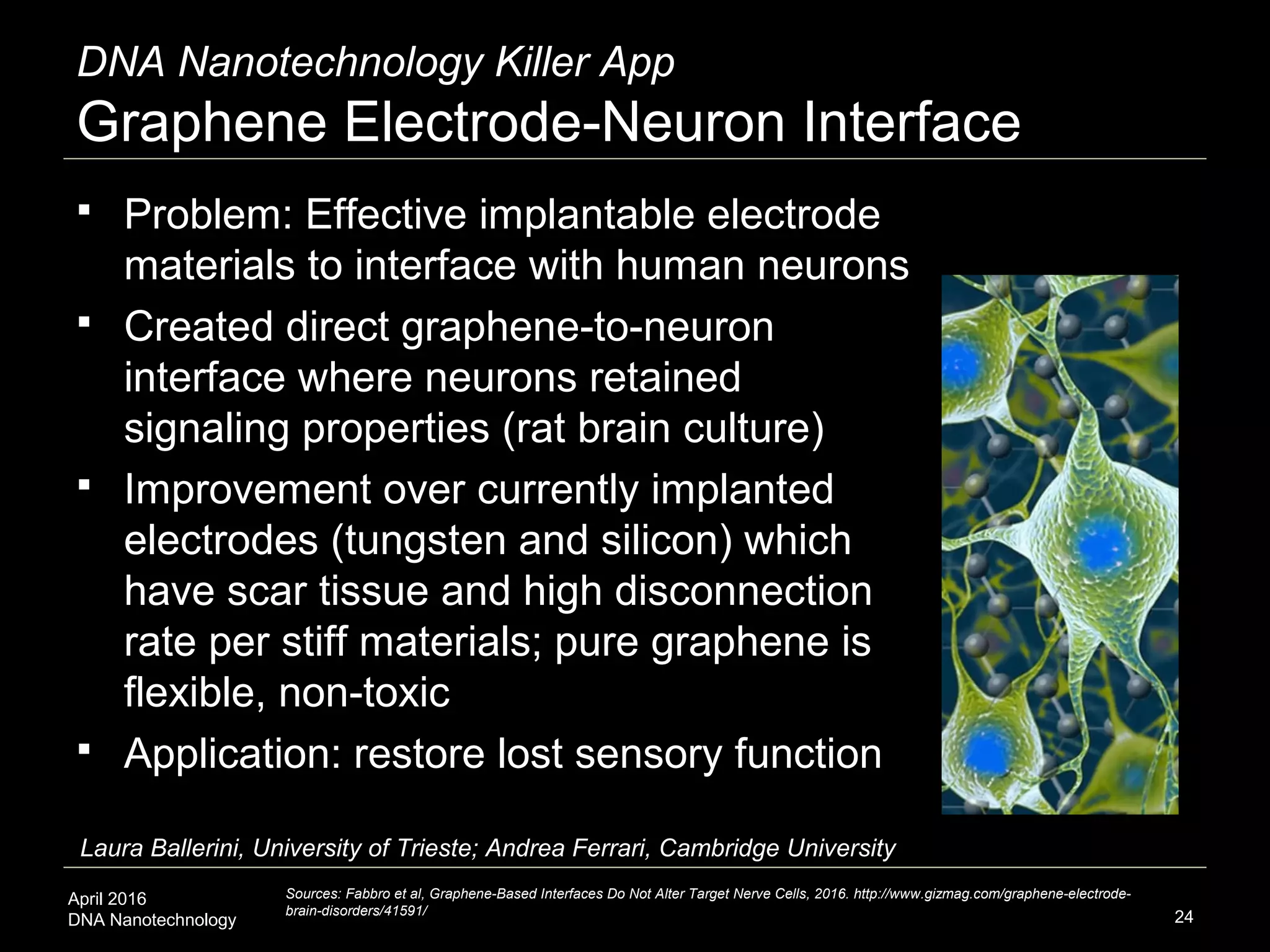
 Problem: Effective implantable electrode
materials to interface with human neurons
 Created direct graphene-to-neuron
interface where neurons retained
signaling properties (rat brain culture)
 Improvement over currently implanted
electrodes (tungsten and silicon) which
have scar tissue and high disconnection
rate per stiff materials; pure graphene is
flexible, non-toxic
 Application: restore lost sensory function
Laura Ballerini, University of Trieste; Andrea Ferrari, Cambridge University
April 2016
DNA Nanotechnology 25
DNA Nanotechnology Killer App
Nanobots Cargo Delivery in Live Mouse
 Problem: Wider range of targeted
in vivo delivery methods
 Nanobot micromotors delivered
first medical payload in living
creature (mouse stomach tissue)
Sources: Gao, Artificial Micromotors in the Mouse's Stomach, 2015. http://pubs.acs.org/doi/ipdf/10.1021/nn507097k
http://www.gizmag.com/nanobot-micromotors-deliver-nanoparticles-living-creature/35700/?li_source=LI&li_medium=default-widget
Joseph Wang, Nanoengineering, UCSD
 Zinc-coated synthetic micromotors used stomach
acid-driven propulsion to install themselves in the
stomach wall
 Micromotor bodies dissolved in gastric acid,
releasing cargo, leaving nothing toxic behind
 Application: Autonomous delivery and release of
therapeutic payloads in vivo, cell manipulation
April 2016
DNA Nanotechnology
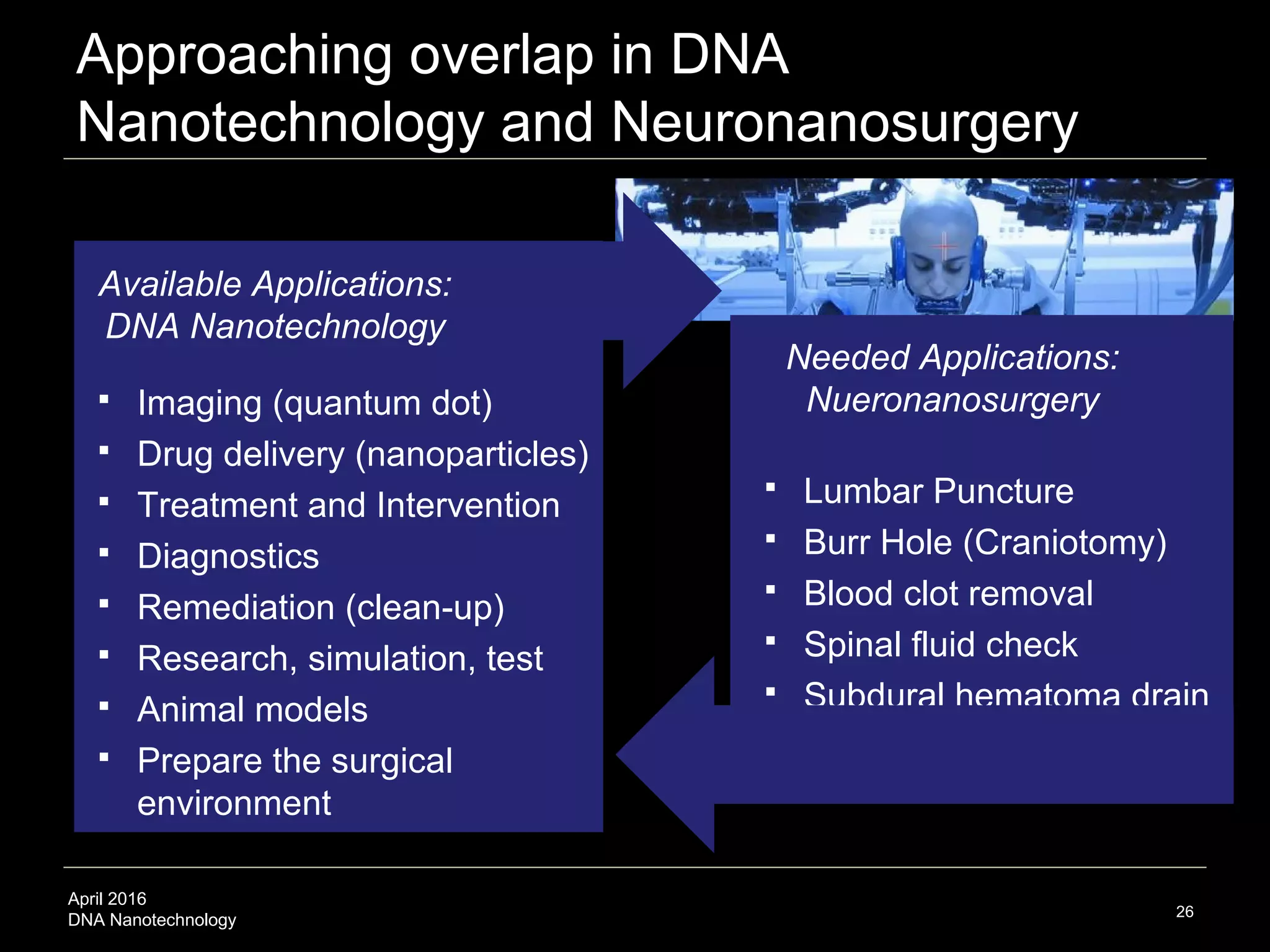
Approaching overlap in DNA
Nanotechnology and Neuronanosurgery
 Imaging (quantum dot)
 Drug delivery (nanoparticles)
 Treatment and Intervention
 Diagnostics
 Remediation (clean-up)
 Research, simulation, test
 Animal models
 Prepare the surgical
environment
26
 Lumbar Puncture
 Burr Hole (Craniotomy)
 Blood clot removal
 Spinal fluid check
 Subdural hematoma drain
Available Applications:
DNA Nanotechnology
Needed Applications:
Nueronanosurgery
April 2016
DNA Nanotechnology
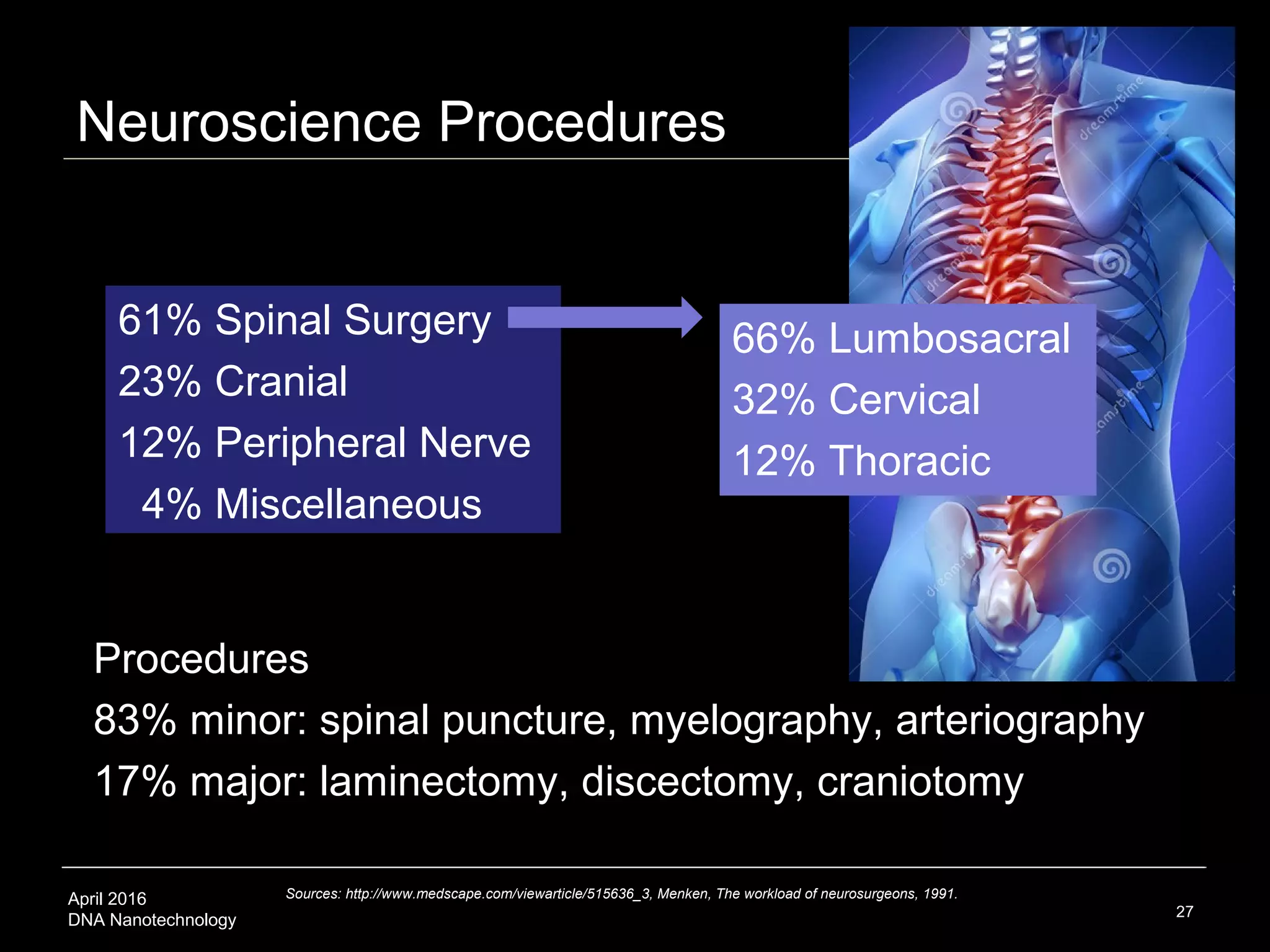
Neuroscience Procedures
61% Spinal Surgery
23% Cranial
12% Peripheral Nerve
4% Miscellaneous
27
Sources: http://www.medscape.com/viewarticle/515636_3, Menken, The workload of neurosurgeons, 1991.
66% Lumbosacral
32% Cervical
12% Thoracic
Procedures
83% minor: spinal puncture, myelography, arteriography
17% major: laminectomy, discectomy, craniotomy
April 2016
DNA Nanotechnology
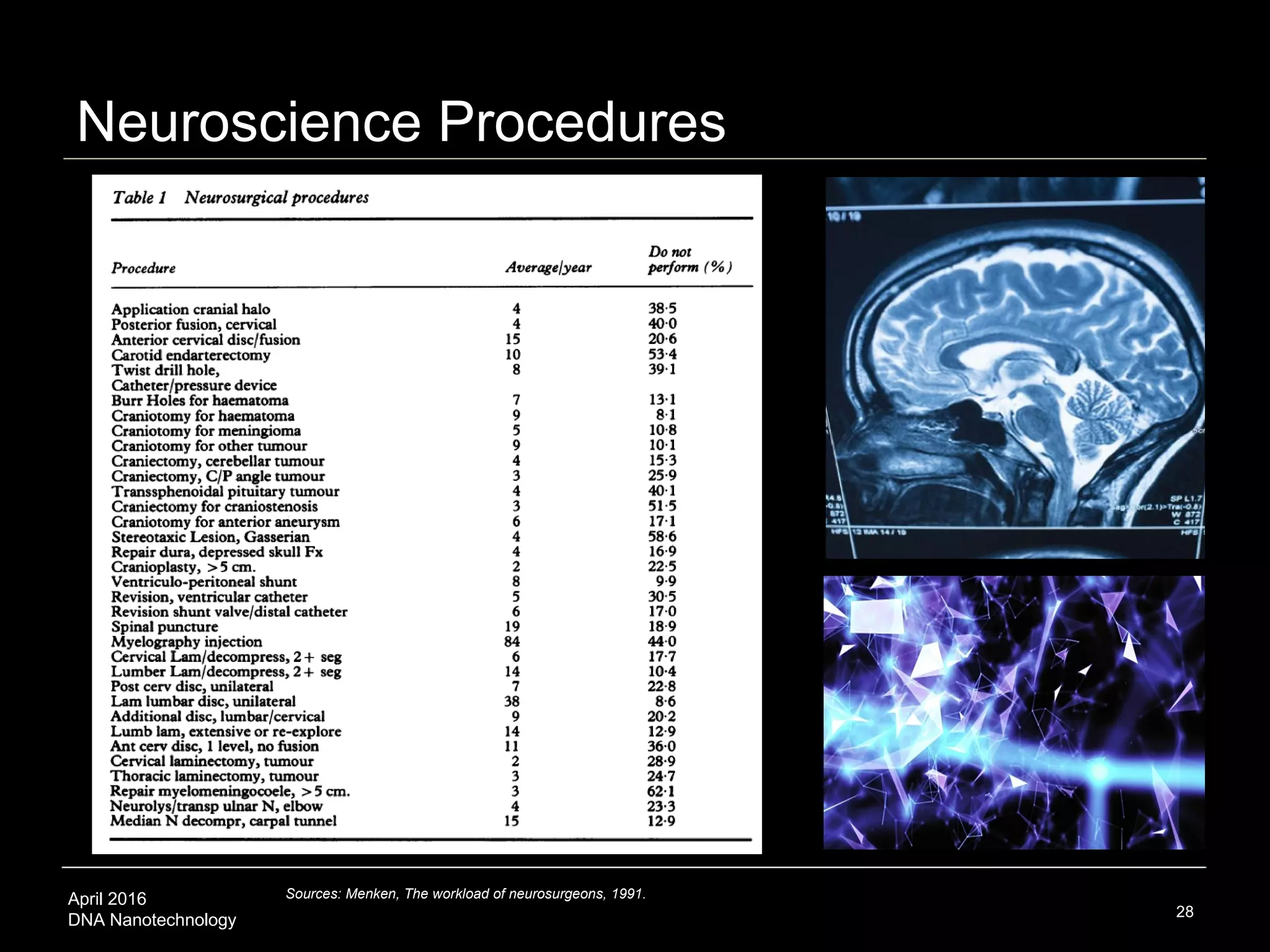
Neuroscience Procedures
28
Sources: Menken, The workload of neurosurgeons, 1991.
April 2016
DNA Nanotechnology
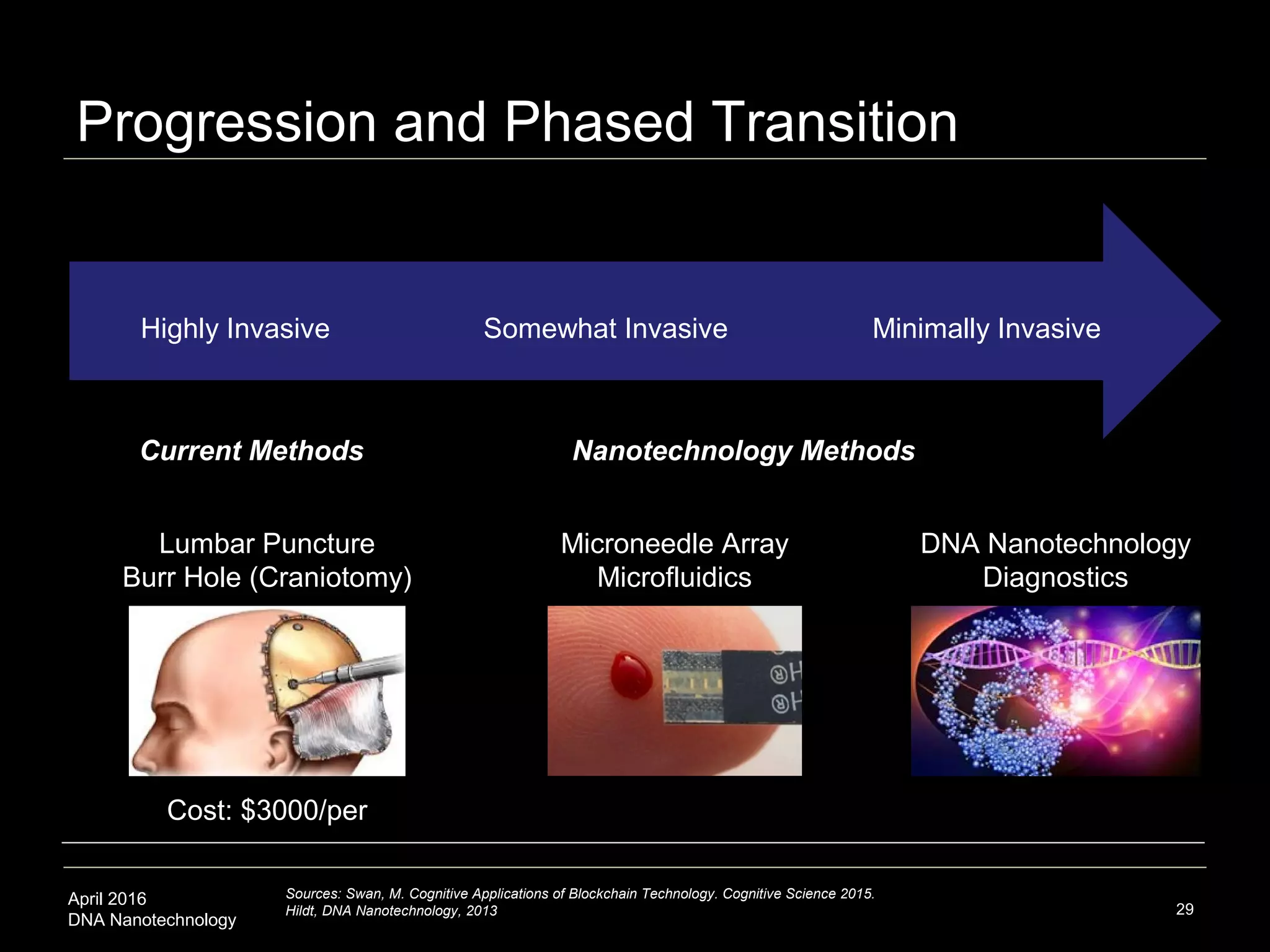
Progression and Phased Transition
29
Sources: Swan, M. Cognitive Applications of Blockchain Technology. Cognitive Science 2015.
Hildt, DNA Nanotechnology, 2013
Highly Invasive
Lumbar Puncture
Burr Hole (Craniotomy)
Somewhat Invasive
Microneedle Array
Microfluidics
Minimally Invasive
DNA Nanotechnology
Diagnostics
Current Methods Nanotechnology Methods
Cost: $3000/per
April 2016
DNA Nanotechnology
Conclusions
 DNA nanotechnology: specifiable
building block for building in-vivo
structures
 Pathology resolution: blood clot
dissolution
 Diagnostics and drug delivery:
microneedle array, hydrogel,
nanorobot drug delivery
 In situ molecular construction:
positional nanoassembly, nano-
guided neural regeneration, electrode
component construction and repair
30
April 2016
DNA Nanotechnology
Future Applications
 DNA nanotechnology might
provide requisite functionality in
the design of next-generation BCIs
 Using self-assembling DNA
nanotechnology to create new forms
of BCIs that are less invasive than
current computer chip-based
hardware solutions
 Deploying DNA nanotechnology in
high-resolution neocortical recording
devices where synthetic molecules
would assemble a DNA signature
every time a neuron was fired
31
April 2016
DNA Nanotechnology
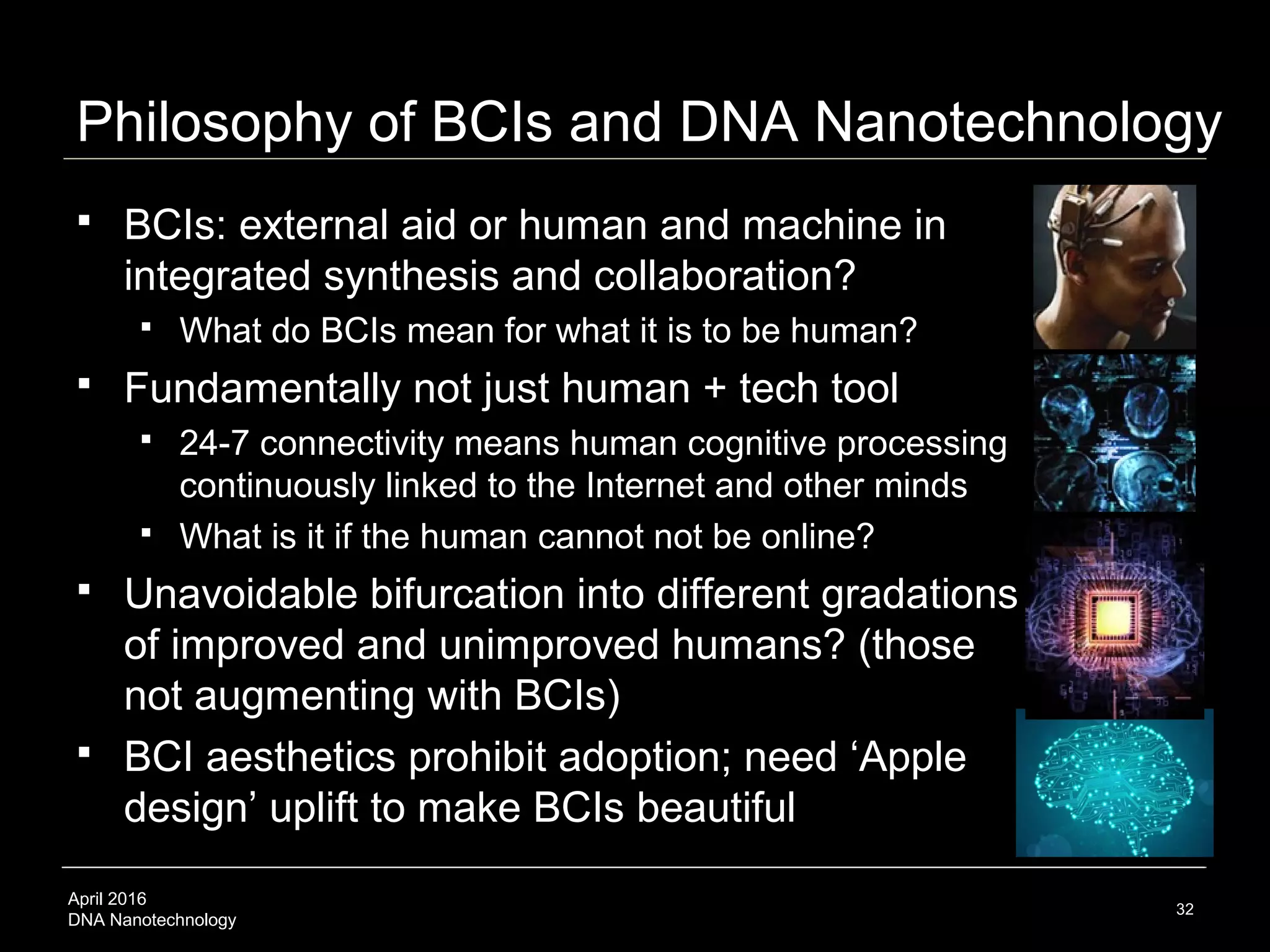
Philosophy of BCIs and DNA Nanotechnology
 BCIs: external aid or human and machine in
integrated synthesis and collaboration?
 What do BCIs mean for what it is to be human?
 Fundamentally not just human + tech tool
 24-7 connectivity means human cognitive processing
continuously linked to the Internet and other minds
 What is it if the human cannot not be online?
 Unavoidable bifurcation into different gradations
of improved and unimproved humans? (those
not augmenting with BCIs)
 BCI aesthetics inhibit adoption; need ‘Apple
design’ uplift to make BCIs beautiful
32
April 2016
DNA Nanotechnology
Thesis
33
DNA Nanotechnology is uniquely suited to
advance the development of Brain-Computer
Interfaces (BCIs) and aid in
Nanoneurosurgery
April 8, 2016, Miami FL
Slides: http://slideshare.net/LaBlogga
Image credit: mashpedia.com
Melanie Swan
New School, New York NY
m@melanieswan.com
Thank you!
DNA
Nanotechnology
Applications in
Brain-Computer Interfaces (BCIs) and
Nanoneurosurgery

BCIs and DNA Nanotechnology

  • 1.
    April 8, 2016,Miami FL Slides: http://slideshare.net/LaBlogga DNA Nanotechnology Applications in Brain-Computer Interfaces (BCIs) and Nanoneurosurgery Image credit: mashpedia.com Melanie Swan New School, New York NY m@melanieswan.com
  • 2.
    April 2016 DNA Nanotechnology2 About Melanie Swan  Founder DIYgenomics, Institute for Blockchain Studies, GroupPurchase  New School, Singularity University Instructor, IEET Affiliate Scholar, EDGE Contributor  Education: MBA Finance, Wharton; BA French/Economics, Georgetown Univ  Work experience: Fidelity, JP Morgan, iPass, RHK/Ovum, Arthur Andersen  Sample publications: Source: http://melanieswan.com/publications.htm  Kido T, Kawashima M, Nishino S, Swan M, Kamatani N, Butte AJ. Systematic Evaluation of Personal Genome Services for Japanese Individuals. Nature: Journal of Human Genetics 2013, 58, 734-741.  Swan, M. The Quantified Self: Fundamental Disruption in Big Data Science and Biological Discovery. Big Data June 2013, 1(2): 85-99.  Swan, M. Sensor Mania! The Internet of Things, Wearable Computing, Objective Metrics, and the Quantified Self 2.0. J Sens Actuator Netw 2012, 1(3), 217-253. Swan, M. Health 2050: The Realization of Personalized Medicine through Crowdsourcing, the Quantified Self, and the Participatory Biocitizen. J Pers Med 2012, 2(3), 93-118.  Swan, M. Steady advance of stem cell therapies. Rejuvenation Res 2011, Dec;14(6):699-704.  Swan, M. Multigenic Condition Risk Assessment in Direct-to-Consumer Genomic Services. Genet Med 2010, May;12(5):279-88.
  • 3.
    April 2016 DNA Nanotechnology Thesis 3 DNANanotechnology is uniquely suited to advance the development of Brain-Computer Interfaces (BCIs) and aid in Nanoneurosurgery
  • 4.
    April 2016 DNA Nanotechnology BCImarket estimated at $1.7 billion in 2022  Brain-Computer Interface (BCI) market estimated to grow to USD $1.7 billion by 2022 (doubling in 7 years)  Sample Vendors: Emotiv System, Mind Solutions Corp., Puzzlebox, Natus Medical, Interactive Productline, Compumedics Ltd., Neuroelectrics 4 Source: http://www.medgadget.com/2016/03/brain-computer-interface-bci-market-is-expected-to-grow-owing-to-its-increasing- demand-in-healthcare-industry-till-2022-grand-view-research-inc.html, http://www.grandviewresearch.com/industry-analysis/brain- computer-interfaces-market Global brain computer interface market, by application, 2012-2022 (USD Million) – Grand View Research
  • 5.
    April 2016 DNA Nanotechnology Whatis a Brain-computer Interface (BCI)?  A brain-computer interface (BCI), brain- machine interface (BMI), or neural prosthesis is any technology linking the human brain to a computer  A computational system implanted in the brain that allows a person to control a computer using only brainwaves; e.g.; electrical signals from the brain 5
  • 6.
    April 2016 DNA Nanotechnology Howdoes a BCI work?  Wearer type characters onto a computer screen as…  …the BCI registers the electrical output of the brain when the eyes are focused on a particular place on the computer screen  On the "q" in a matrix of on- screen letters for example, to produce "q" to appear as output on the monitor 6
  • 7.
    April 2016 DNA Nanotechnology BCIs:Non-Invasive, Semi-Invasive, Invasive 7 Source: http://www.slideshare.net/ajaygeorge91/bci-ppt  Signal capture at multiple levels, external and internal
  • 8.
    April 2016 DNA Nanotechnology BCIsin Practical Use  Repair human cognitive and sensory- motor function  Cochlear implants: a small computer chip is substituted for damaged inner ear control organs, sound waves transformed into brain-interpretable electrical signals  Over 70,000 US (219,000 global); 50% in children (2010)  Vision restoration: implantable systems transmit visual information to the brain 8 Source: http://www.asha.org/public/hearing/Cochlear-Implant-Frequently-Asked-Questions/
  • 9.
    April 2016 DNA Nanotechnology Two-wayBCIs: Input/Output 9 Source: R.A. Miranda et al. / Journal of Neuroscience Methods 244 (2015) 52–67  Input channels use electrical brain stimulation to deliver signals to the brain  Output channels collect the action potentials of single neuron spikes or scalp electrical signals into commands that move robot arms, wheelchairs, and cursors
  • 10.
    April 2016 DNA Nanotechnology Areasof BCI Advancement needed  DNA Nanotechnology can help …  Improved implantable components  Bioengineered multi-electrode sensing arrays  Biocompatible electrodes and arrays  Miniaturized actuators, components  Improved signal detection  Neural spike train signals (action potentials)  Conductive gels  Novel cortical delivery approaches  Nanodevices 10 Source: http://www.wtec.org/bci/
  • 11.
    April 2016 DNA Nanotechnology BCIApplications of DNA Nanotechnology  Pathology Resolution  Improve control of neuro-prosthetics and prosthetic limbs  Smooth the irregular neural electrical activity in epilepsy, Parkinson’s Disease  Amplify neuronal signaling in neurodegenerative disease  Environmental Support  Maintain healthy conductive environment  Neuronal repair  Activate neuronal arrays (optogenetics) 11
  • 12.
    April 2016 DNA Nanotechnology12 DNA Nanotechnology  Using DNA as a construction material; nanoscale building blocks  Specificity of the interactions between complementary base pairs make DNA a useful construction material  DNA ladder framework  Self-assembles, known properties, predictable shapes  Ready availability raw nucleic acids  Dynamically reprogrammable DNA, RNA, peptides  Use DNA as a building block to self- assemble structures in vivo
  • 13.
    April 2016 DNA Nanotechnology CoreDNA Nanotechnology Components 13 Holliday Junction Sticky Ends DNA Lattice Sources: Shrishaila, DNA Nanotechnology seminar
  • 14.
    April 2016 DNA Nanotechnology CoreDNA Nanotechnology Components 14 DNA Walker Nano-sized Lock Box (drug delivery) DNA origami is the nanoscale folding of DNA to create non- arbitrary two- and three-dimensional shapes at the nanoscale. DNA Origami
  • 15.
    April 2016 DNA Nanotechnology Top8 DNA Nanotechnology Advances for BCIs  Method: select advances representative of larger field  Sources: FNANO industry conference, PubMed searches, high-profile DNA nanotechnology labs (NYU, Caltech, Harvard, Stanford, Univ of Manchester) 15
  • 16.
    April 2016 DNA Nanotechnology 1.Blood clot dissolution 2. Microneedle array diagnostics/delivery 3. Hydrogel cellular delivery 4. Molecular robot for positional nanoassembly 5. Nanotechnology-guided neural regeneration 6. DNA Nanobots in first human trial 7. Graphene electrode-neuron interface 8. Nanobots cargo delivery in mouse 16 Neocortical Neurogenesis in Mammals lafayette.edu Top 8 DNA Nanotechnology Advances for BCIs
  • 17.
    April 2016 DNA Nanotechnology DNANanotechnology Killer App Blood Clot Dissolution  Problem: dissolve life-threatening blood clots in stroke  Novel nanotherapeutic for clearing obstructed blood vessels: biodegradable nanoparticle aggregate coated with tissue plasminogen activator (tPA) (clot-busting drug) 17 Sources: Marosfoi, et al (2015) Shear-Activated Nanoparticle Aggregates Combined With Temporary Endovascular Bypass to Treat Large Vessel Occlusion Donald Ingber, Wyss Institute and Ajay Wakhloo, U Mass
  • 18.
    April 2016 DNA Nanotechnology DNANanotechnology Killer App Blood Clot Dissolution  Novel approach for complete vascular blockages where there is no blood flow (the usual case for stroke)  The nanotherapeutic reacts to fluid shear force, releasing tPA-coated nanoparticles in narrowed regions where vessels are occluded, binding to the blood clot and dissolving it  Application: less-invasive alternative to existing method (stent-retriever thrombectomy procedure) 18 Sources: Marosfoi, et al (2015) Shear-Activated Nanoparticle Aggregates Combined With Temporary Endovascular Bypass to Treat Large Vessel Occlusion Donald Ingber, Wyss Institute and Ajay Wakhloo, U Mass
  • 19.
    April 2016 DNA Nanotechnology DNANanotechnology Killer App Microneedle Array Diagnostic/Delivery 19  Problem: less-invasive diagnostic/delivery  Implantable microneedle array mimics normal arachnoid granulations surrounding the brain and spinal cord  Microfabricated arachnoid granulations punctured through dura mater membrane in the brain to provide a conduit for cerebrospinal fluid flow (porcine tests)  Application: hydrocephalus treatment  Communicating Hydrocephalus caused by deficient arachnoid granulation valves that poorly regulate cerebrospinal fluid flow Sources: Oh et al, A novel microneedle array for the treatment of hydrocephalus, 2015. Jonghyun Oh, Chonbuk National University, Korea and Tim Medina, Drexel University
  • 20.
    April 2016 DNA Nanotechnology Microchanneledhydrogel 20 DNA Nanotechnology Killer App Hydrogel Cellular Delivery Sources: Kim et al, Artificially Engineered Protein Hydrogels Adapted from the Nucleoporin Nsp1 for Selective Biomolecular Transport, 2015.; https://www.cce.caltech.edu/content/chemical-engineering-seminar-126, Lee et al, A bio-inspired, microchanneled hydrogel, 2015.  Problem: selective permeability of the hydrogel-coated lipid bilayer  Artificially-engineered protein hydrogels  Nucleosporin-like polypeptide hydrogels mimic nucleosporin to access the nucleus  Tunable mechanical and transport properties  Microchanneled hydrogel scaffolding ability to control spatial organization of biomolecules in a 3D matrix  Application: selective biomolecular transport, transport protein cargo, molecular separation Katharina Ribbeck, Biological Engineering, MIT
  • 21.
    April 2016 DNA Nanotechnology21 DNA Nanotechnology Killer App Molecular Robot for Positional Nanoassembly Sources: Kaszemm et al, Pick-up, transport and release of a molecular cargo using a small-molecule robotic arm, 2016. http://www.nature.com/nchem/journal/v8/n2/pdf/nchem.2410.pdf.  Problem: Small-molecule transport and assembly  Artificial robotic arm transports molecular cargo by inducing conformational and configurational changes  Results: 79–85% of 3- mercaptopropanehydrazide molecules transported between platform sites without cargo dissociation  Application: reposition single molecules; atom-length scale positioning David Leigh, University of Manchester, http://www.catenane.net
  • 22.
    April 2016 DNA Nanotechnology DNANanotechnology Killer App Nanotechnology-guided Neural Regeneration  Problem: directed neural stem cell differentiation into neurons and oligodendrocytes  Nanoparticle-based system to deliver nanomolecules to the microenvironment to modulate cell surface chemistry  Surface properties influence changes in cell adhesion, shape, and spreading  Nanoscaffolds enhance gene delivery, facilitate axonal alignment  Application: regenerate damaged nerve tissue 22 Sources: Shah et al, Nanotechnology-Based Approaches for Guiding Neural Regeneration, 2016. Shreyas Shah, Rutgers and Physiological Communications, Bell Labs
  • 23.
    April 2016 DNA Nanotechnology DNANanotechnology Killer App DNA Nanobots in First Human Trial 23 Sources: Amir et al, Folding and Characterization of a Bio-responsive Robot from DNA Origami, 2015. Hachmon et al, A Non- Newtonian Fluid Robot, 2016. http://nextbigfuture.com/2015/05/pfizer-partnering-with-ido-bachelet-on.html  Problem: Targeted cancer treatment less destructive than chemo and radiation  DNA Nanobots: single strand DNA folded into clamshell shaped box  Clamshell contains existing cancer drugs  Protective box has two states  Closed during targeted transport  Open to disgorge cancer drug to expose cancerous cells  Application: targeted drug delivery Ido Bachelet, Bar-Ilan University and Pfizer
  • 24.
    April 2016 DNA Nanotechnology24 DNA Nanotechnology Killer App Graphene Electrode-Neuron Interface Sources: Fabbro et al, Graphene-Based Interfaces Do Not Alter Target Nerve Cells, 2016. http://www.gizmag.com/graphene-electrode- brain-disorders/41591/  Problem: Effective implantable electrode materials to interface with human neurons  Created direct graphene-to-neuron interface where neurons retained signaling properties (rat brain culture)  Improvement over currently implanted electrodes (tungsten and silicon) which have scar tissue and high disconnection rate per stiff materials; pure graphene is flexible, non-toxic  Application: restore lost sensory function Laura Ballerini, University of Trieste; Andrea Ferrari, Cambridge University
  • 25.
    April 2016 DNA Nanotechnology25 DNA Nanotechnology Killer App Nanobots Cargo Delivery in Live Mouse  Problem: Wider range of targeted in vivo delivery methods  Nanobot micromotors delivered first medical payload in living creature (mouse stomach tissue) Sources: Gao, Artificial Micromotors in the Mouse's Stomach, 2015. http://pubs.acs.org/doi/ipdf/10.1021/nn507097k http://www.gizmag.com/nanobot-micromotors-deliver-nanoparticles-living-creature/35700/?li_source=LI&li_medium=default-widget Joseph Wang, Nanoengineering, UCSD  Zinc-coated synthetic micromotors used stomach acid-driven propulsion to install themselves in the stomach wall  Micromotor bodies dissolved in gastric acid, releasing cargo, leaving nothing toxic behind  Application: Autonomous delivery and release of therapeutic payloads in vivo, cell manipulation
  • 26.
    April 2016 DNA Nanotechnology Approachingoverlap in DNA Nanotechnology and Neuronanosurgery  Imaging (quantum dot)  Drug delivery (nanoparticles)  Treatment and Intervention  Diagnostics  Remediation (clean-up)  Research, simulation, test  Animal models  Prepare the surgical environment 26  Lumbar Puncture  Burr Hole (Craniotomy)  Blood clot removal  Spinal fluid check  Subdural hematoma drain Available Applications: DNA Nanotechnology Needed Applications: Nueronanosurgery
  • 27.
    April 2016 DNA Nanotechnology NeuroscienceProcedures 61% Spinal Surgery 23% Cranial 12% Peripheral Nerve 4% Miscellaneous 27 Sources: http://www.medscape.com/viewarticle/515636_3, Menken, The workload of neurosurgeons, 1991. 66% Lumbosacral 32% Cervical 12% Thoracic Procedures 83% minor: spinal puncture, myelography, arteriography 17% major: laminectomy, discectomy, craniotomy
  • 28.
    April 2016 DNA Nanotechnology NeuroscienceProcedures 28 Sources: Menken, The workload of neurosurgeons, 1991.
  • 29.
    April 2016 DNA Nanotechnology Progressionand Phased Transition 29 Sources: Swan, M. Cognitive Applications of Blockchain Technology. Cognitive Science 2015. Hildt, DNA Nanotechnology, 2013 Highly Invasive Lumbar Puncture Burr Hole (Craniotomy) Somewhat Invasive Microneedle Array Microfluidics Minimally Invasive DNA Nanotechnology Diagnostics Current Methods Nanotechnology Methods Cost: $3000/per
  • 30.
    April 2016 DNA Nanotechnology Conclusions DNA nanotechnology: specifiable building block for building in-vivo structures  Pathology resolution: blood clot dissolution  Diagnostics and drug delivery: microneedle array, hydrogel, nanorobot drug delivery  In situ molecular construction: positional nanoassembly, nano- guided neural regeneration, electrode component construction and repair 30
  • 31.
    April 2016 DNA Nanotechnology FutureApplications  DNA nanotechnology might provide requisite functionality in the design of next-generation BCIs  Using self-assembling DNA nanotechnology to create new forms of BCIs that are less invasive than current computer chip-based hardware solutions  Deploying DNA nanotechnology in high-resolution neocortical recording devices where synthetic molecules would assemble a DNA signature every time a neuron was fired 31
  • 32.
    April 2016 DNA Nanotechnology Philosophyof BCIs and DNA Nanotechnology  BCIs: external aid or human and machine in integrated synthesis and collaboration?  What do BCIs mean for what it is to be human?  Fundamentally not just human + tech tool  24-7 connectivity means human cognitive processing continuously linked to the Internet and other minds  What is it if the human cannot not be online?  Unavoidable bifurcation into different gradations of improved and unimproved humans? (those not augmenting with BCIs)  BCI aesthetics inhibit adoption; need ‘Apple design’ uplift to make BCIs beautiful 32
  • 33.
    April 2016 DNA Nanotechnology Thesis 33 DNANanotechnology is uniquely suited to advance the development of Brain-Computer Interfaces (BCIs) and aid in Nanoneurosurgery
  • 34.
    April 8, 2016,Miami FL Slides: http://slideshare.net/LaBlogga Image credit: mashpedia.com Melanie Swan New School, New York NY m@melanieswan.com Thank you! DNA Nanotechnology Applications in Brain-Computer Interfaces (BCIs) and Nanoneurosurgery