Grammatology and Performativity:
A Critical Theory of Silence
Tacet ad Libitum: Poetics & Politics of Silence
Münster Germany 27 Jul 2022
Slides: http://slideshare.net/LaBlogga
Melanie Swan, PhD
University College London
“Outside there was silence, as there is and has been and
always should be. The perfect silence of the spheres.”
- Elizabeth Bear, Ancestral Night, 2019, p. 384
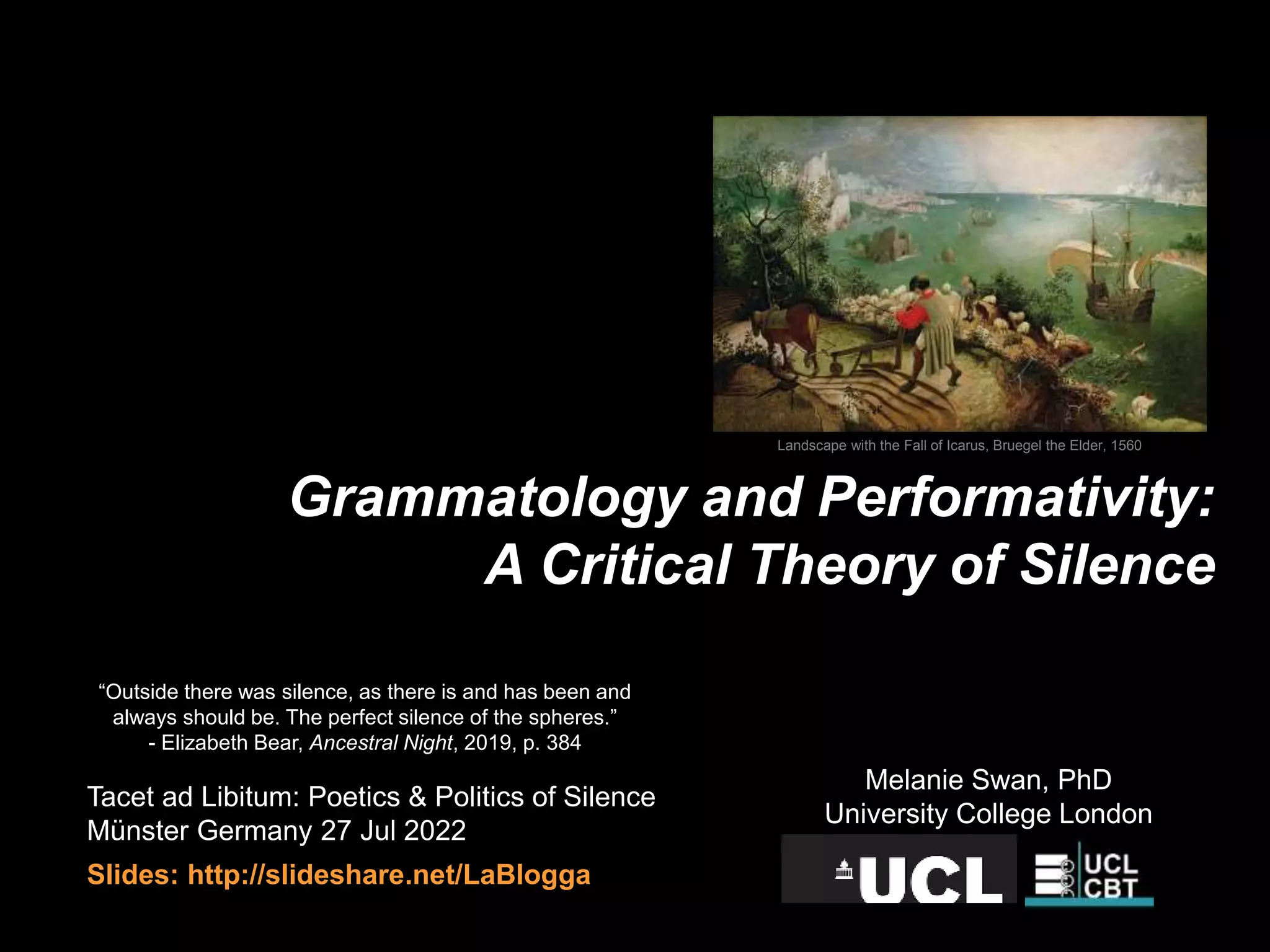
Landscape with the Fall of Icarus, Bruegel the Elder, 1560
27 Jul 2022
Critical Theory of Silence 1
A critical theory of silence is needed to recoup the
ontological status of silence as the condition of thinking,
lost in a world of literal and figurative noise
Thesis: silence is a thinking technology
27 Jul 2022
Critical Theory of Silence
Argument Overview
2
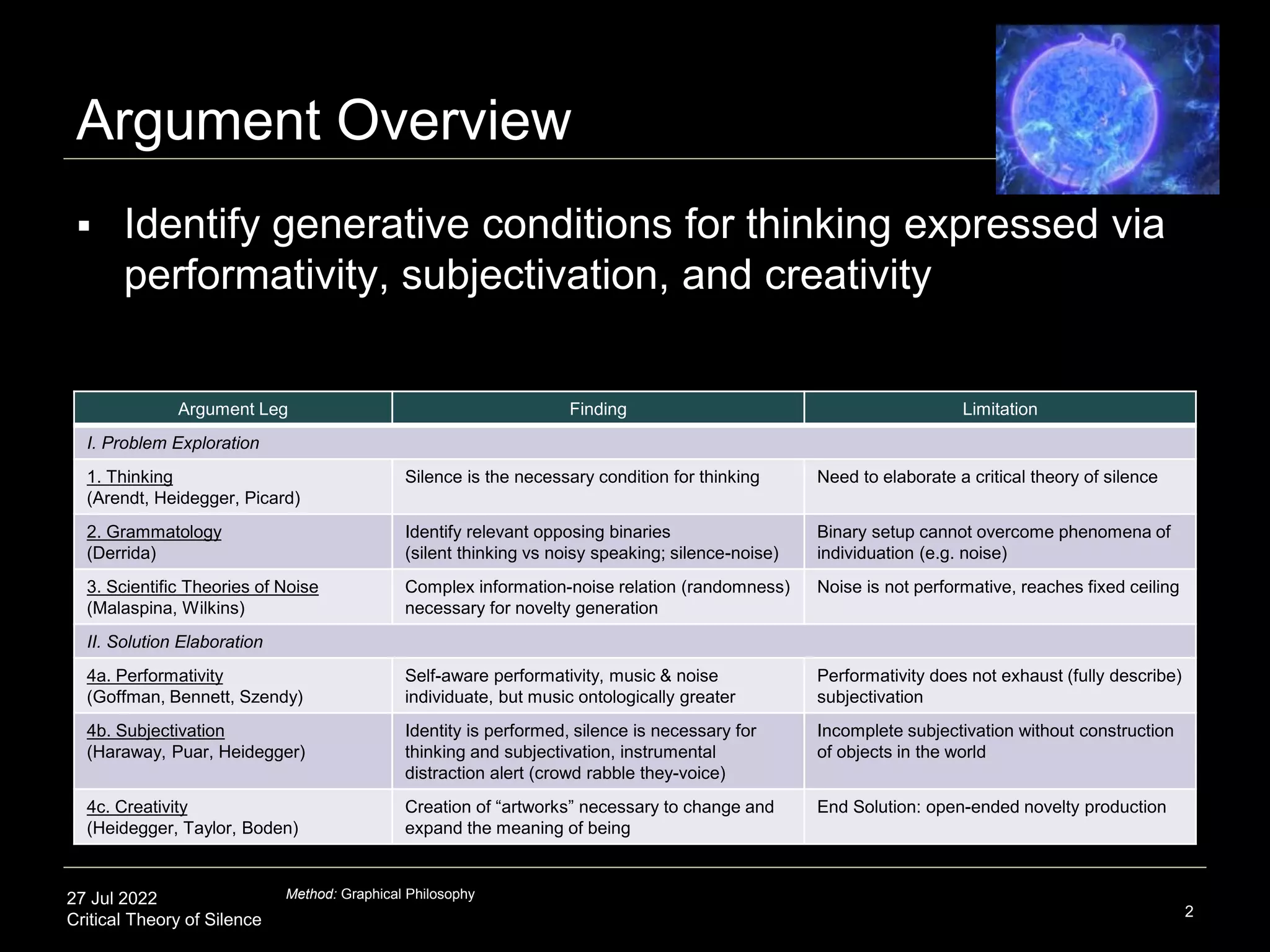
 Identify generative conditions for thinking expressed via
performativity, subjectivation, and creativity
Argument Leg Finding Limitation
I. Problem Exploration
1. Thinking
(Arendt, Heidegger, Picard)
Silence is the necessary condition for thinking Need to elaborate a critical theory of silence
2. Grammatology
(Derrida)
Identify relevant opposing binaries
(silent thinking vs noisy speaking; silence-noise)
Binary setup cannot overcome phenomena of
individuation (e.g. noise)
3. Scientific Theories of Noise
(Malaspina, Wilkins)
Complex information-noise relation (randomness)
necessary for novelty generation
Noise is not performative, reaches fixed ceiling
II. Solution Elaboration
4a. Performativity
(Goffman, Bennett, Szendy)
Self-aware performativity, music & noise
individuate, but music ontologically greater
Performativity does not exhaust (fully describe)
subjectivation
4b. Subjectivation
(Haraway, Puar, Heidegger)
Identity is performed, silence is necessary for
thinking and subjectivation, instrumental
distraction alert (crowd rabble they-voice)
Incomplete subjectivation without construction
of objects in the world
4c. Creativity
(Heidegger, Taylor, Boden)
Creation of “artworks” necessary to change and
expand the meaning of being
End Solution: open-ended novelty production
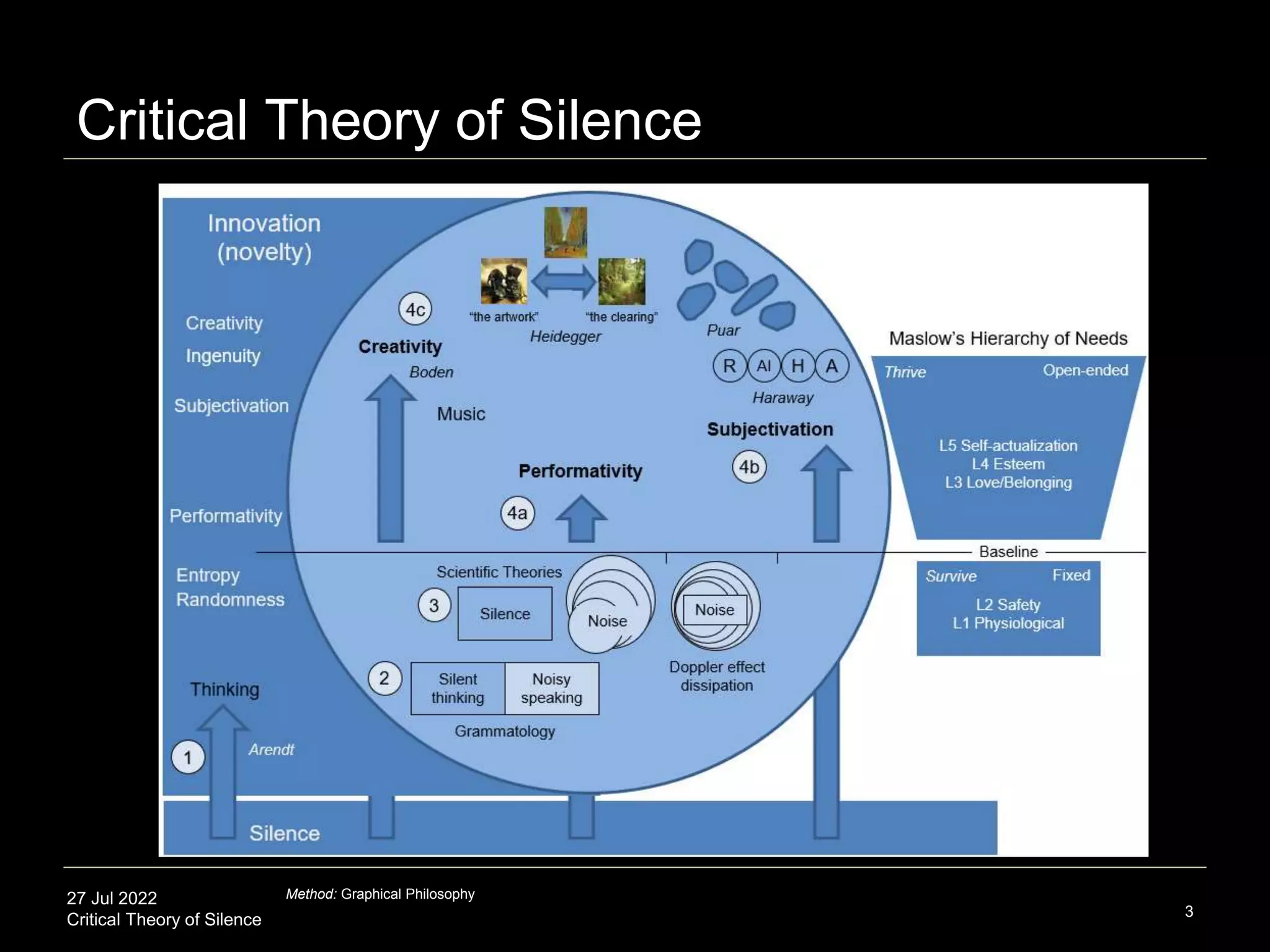
Method: Graphical Philosophy
27 Jul 2022
Critical Theory of Silence
3
Method: Graphical Philosophy
27 Jul 2022
Critical Theory of Silence
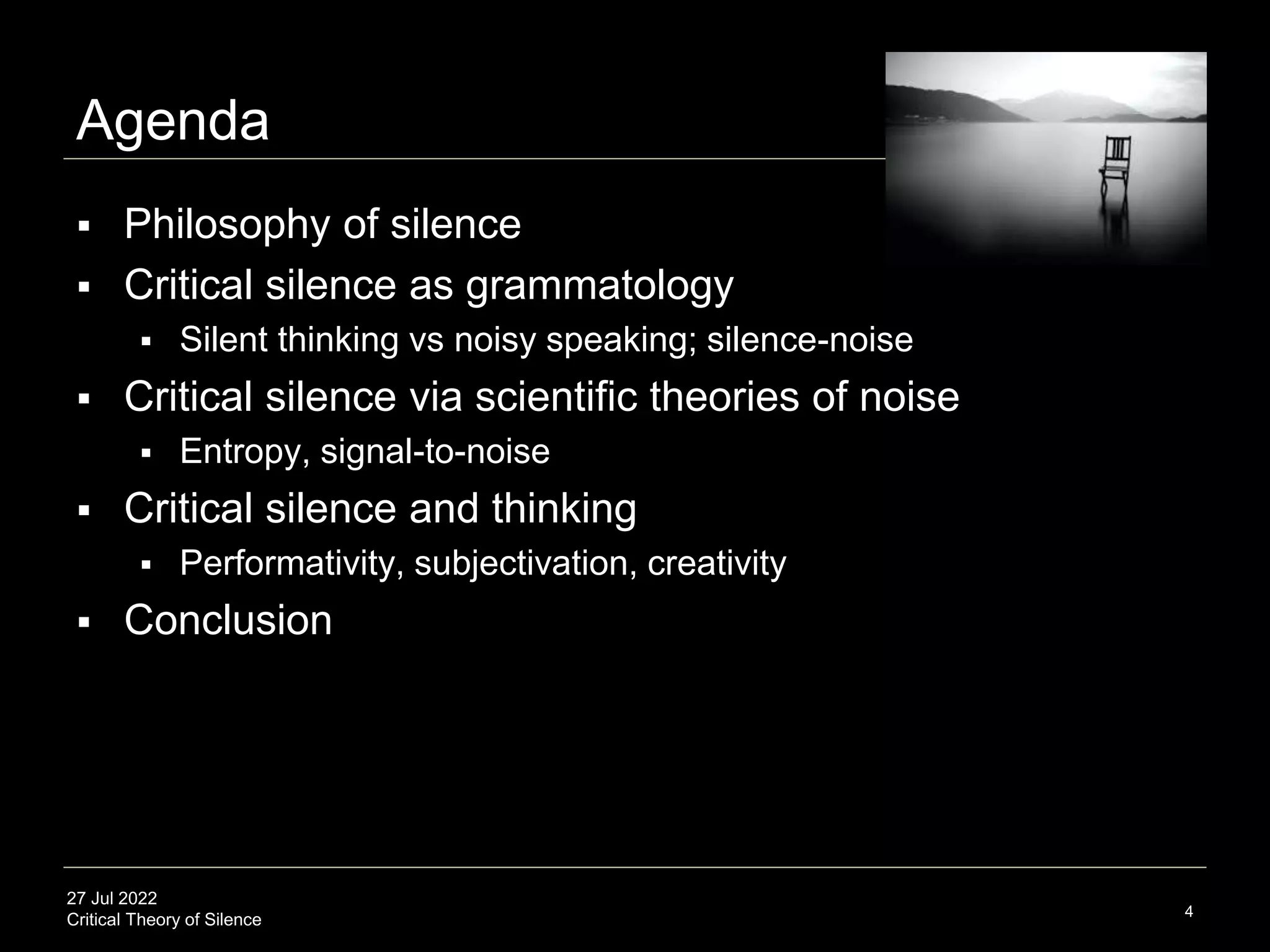
Agenda
 Philosophy of silence
 Critical silence as grammatology
 Silent thinking vs noisy speaking; silence-noise
 Critical silence via scientific theories of noise
 Entropy, signal-to-noise
 Critical silence and thinking
 Performativity, subjectivation, creativity
 Conclusion
4
27 Jul 2022
Critical Theory of Silence
Philosophy of Silence
5
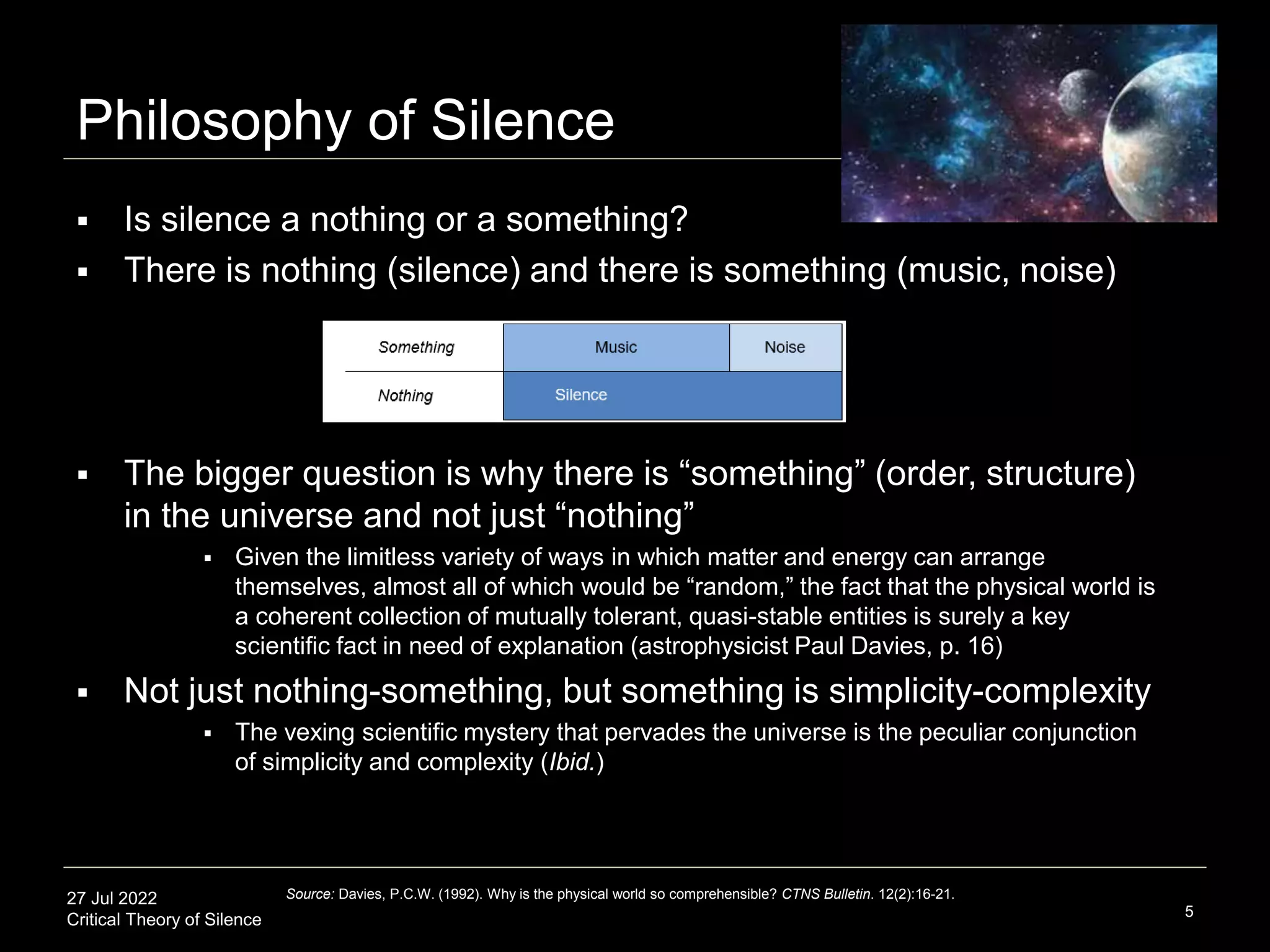
 Is silence a nothing or a something?
 There is nothing (silence) and there is something (music, noise)
 The bigger question is why there is “something” (order, structure)
in the universe and not just “nothing”
 Given the limitless variety of ways in which matter and energy can arrange
themselves, almost all of which would be “random,” the fact that the physical world is
a coherent collection of mutually tolerant, quasi-stable entities is surely a key
scientific fact in need of explanation (astrophysicist Paul Davies, p. 16)
 Not just nothing-something, but something is simplicity-complexity
 The vexing scientific mystery that pervades the universe is the peculiar conjunction
of simplicity and complexity (Ibid.)
Source: Davies, P.C.W. (1992). Why is the physical world so comprehensible? CTNS Bulletin. 12(2):16-21.
27 Jul 2022
Critical Theory of Silence
Philosophy of Silence
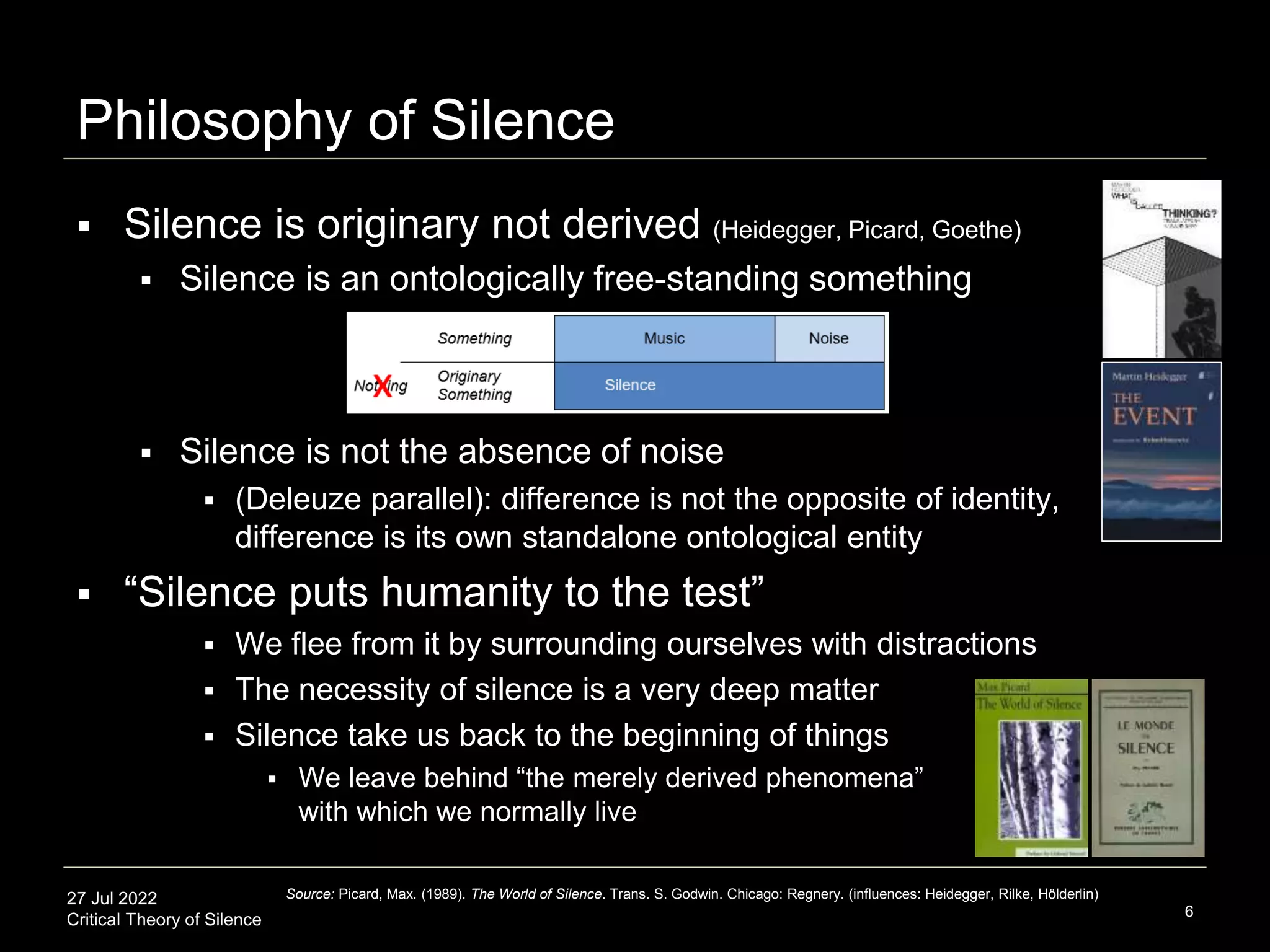
 Silence is originary not derived (Heidegger, Picard, Goethe)
 Silence is an ontologically free-standing something
 Silence is not the absence of noise
 (Deleuze parallel): difference is not the opposite of identity,
difference is its own standalone ontological entity
 “Silence puts humanity to the test”
 We flee from it by surrounding ourselves with distractions
 The necessity of silence is a very deep matter
 Silence take us back to the beginning of things
 We leave behind “the merely derived phenomena”
with which we normally live
6
Source: Picard, Max. (1989). The World of Silence. Trans. S. Godwin. Chicago: Regnery. (influences: Heidegger, Rilke, Hölderlin)
27 Jul 2022
Critical Theory of Silence
Arendt
 Silence is the medium in which thinking takes place
7
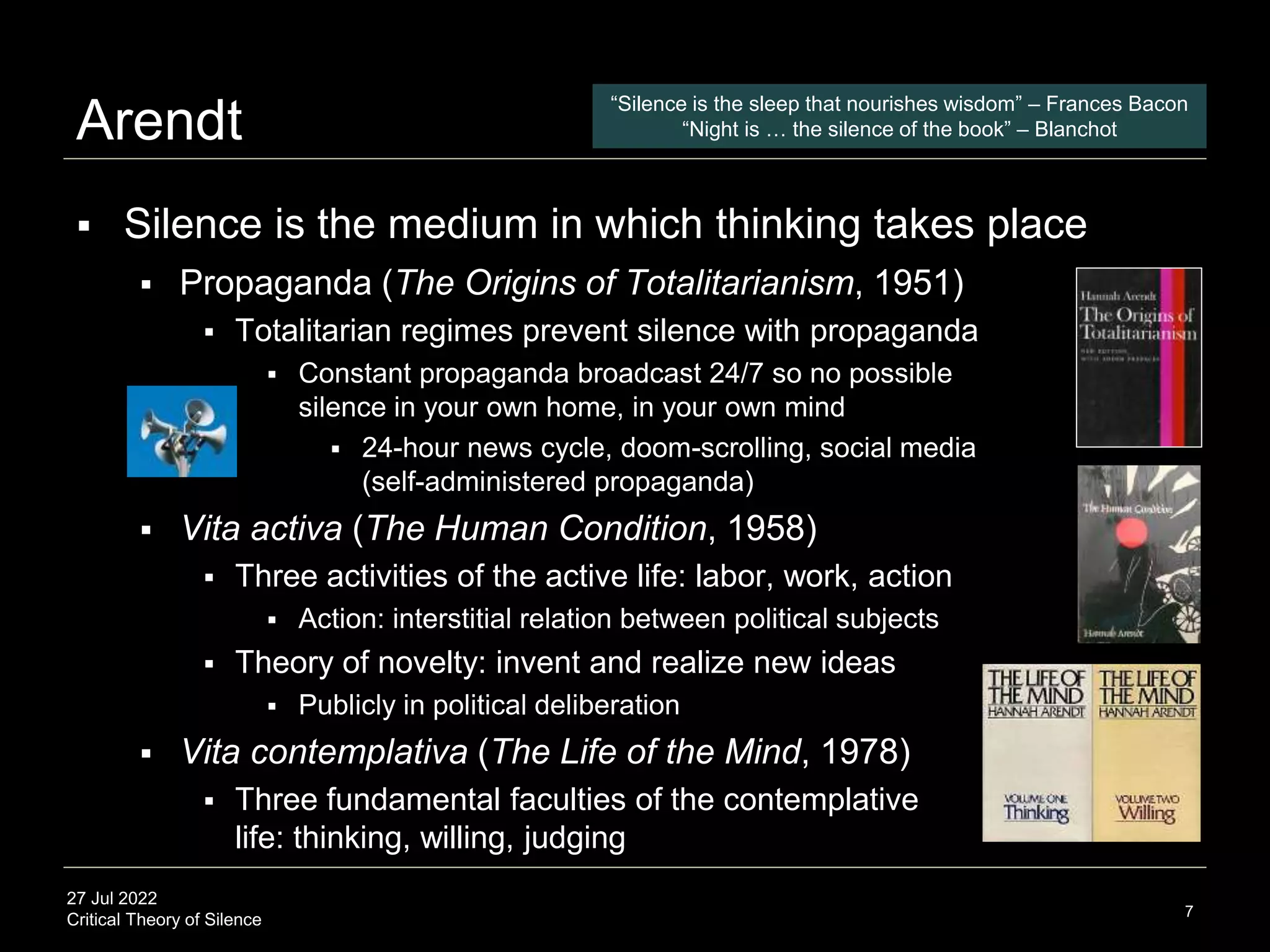
 Propaganda (The Origins of Totalitarianism, 1951)
 Totalitarian regimes prevent silence with propaganda
 Constant propaganda broadcast 24/7 so no possible
silence in your own home, in your own mind
 24-hour news cycle, doom-scrolling, social media
(self-administered propaganda)
 Vita activa (The Human Condition, 1958)
 Three activities of the active life: labor, work, action
 Action: interstitial relation between political subjects
 Theory of novelty: invent and realize new ideas
 Publicly in political deliberation
 Vita contemplativa (The Life of the Mind, 1978)
 Three fundamental faculties of the contemplative
life: thinking, willing, judging
“Silence is the sleep that nourishes wisdom” – Frances Bacon
“Night is … the silence of the book” – Blanchot
27 Jul 2022
Critical Theory of Silence
Grammatology of Silence
8
 Grammatology project: develop a science of writing
 Unclear which began first, speech or writing, so cannot privilege speech
 Speech and writing are part of the larger category of language (thinking)
 Deconstruction: emphasis the opposition in hierarchical binaries
 “divine law/human law, family/city, woman/man, night/day” (Glas, p. 142a)
 Différance: the difference and deferral of meaning
 Meaning is produced in the interstitial relations between terms
 Any “text” (a literary text, artwork, person, or governing state) is always open to
re-reading and re-writing in new assignations of meaning
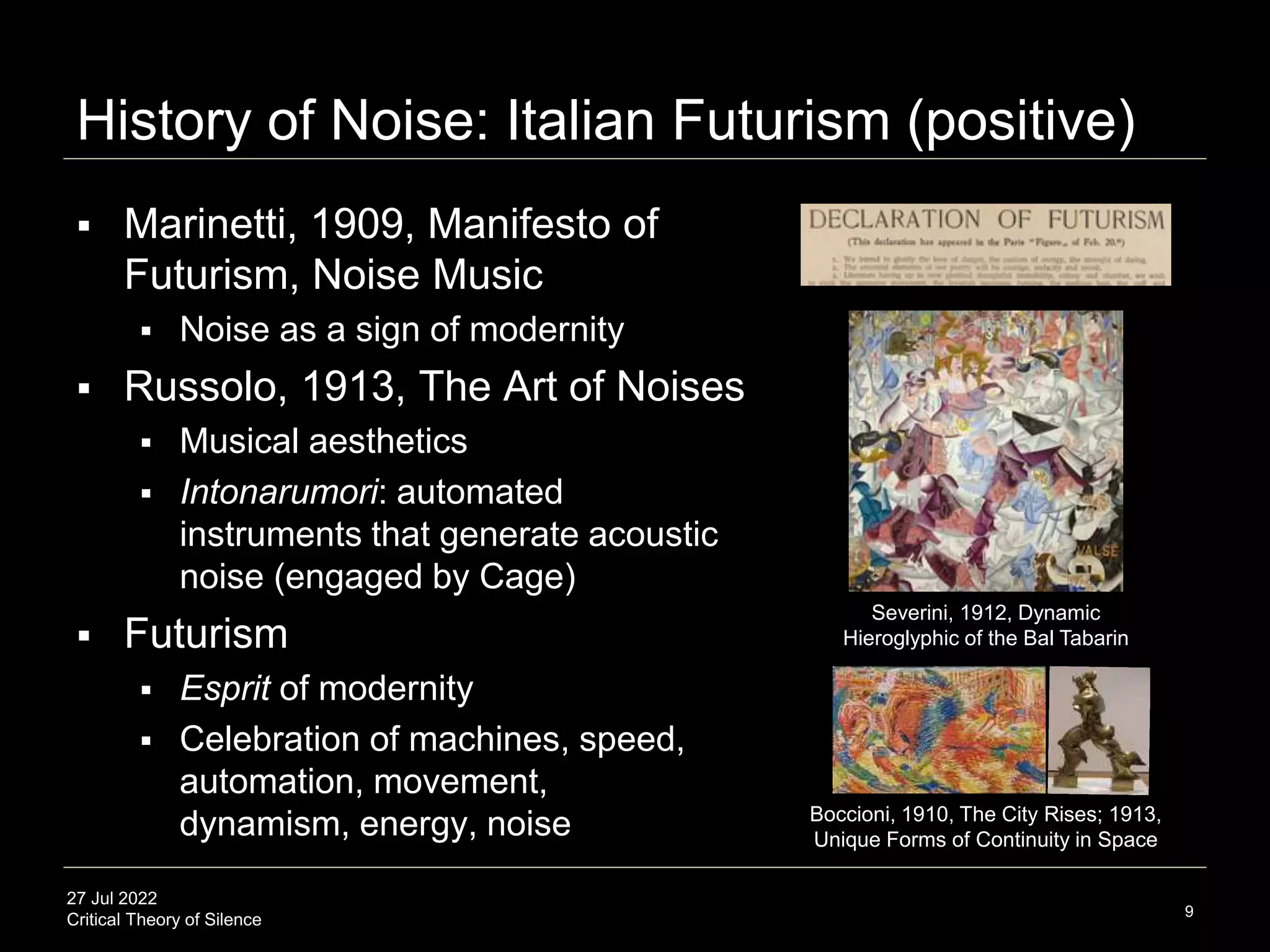
Silent thinking Noisy speaking
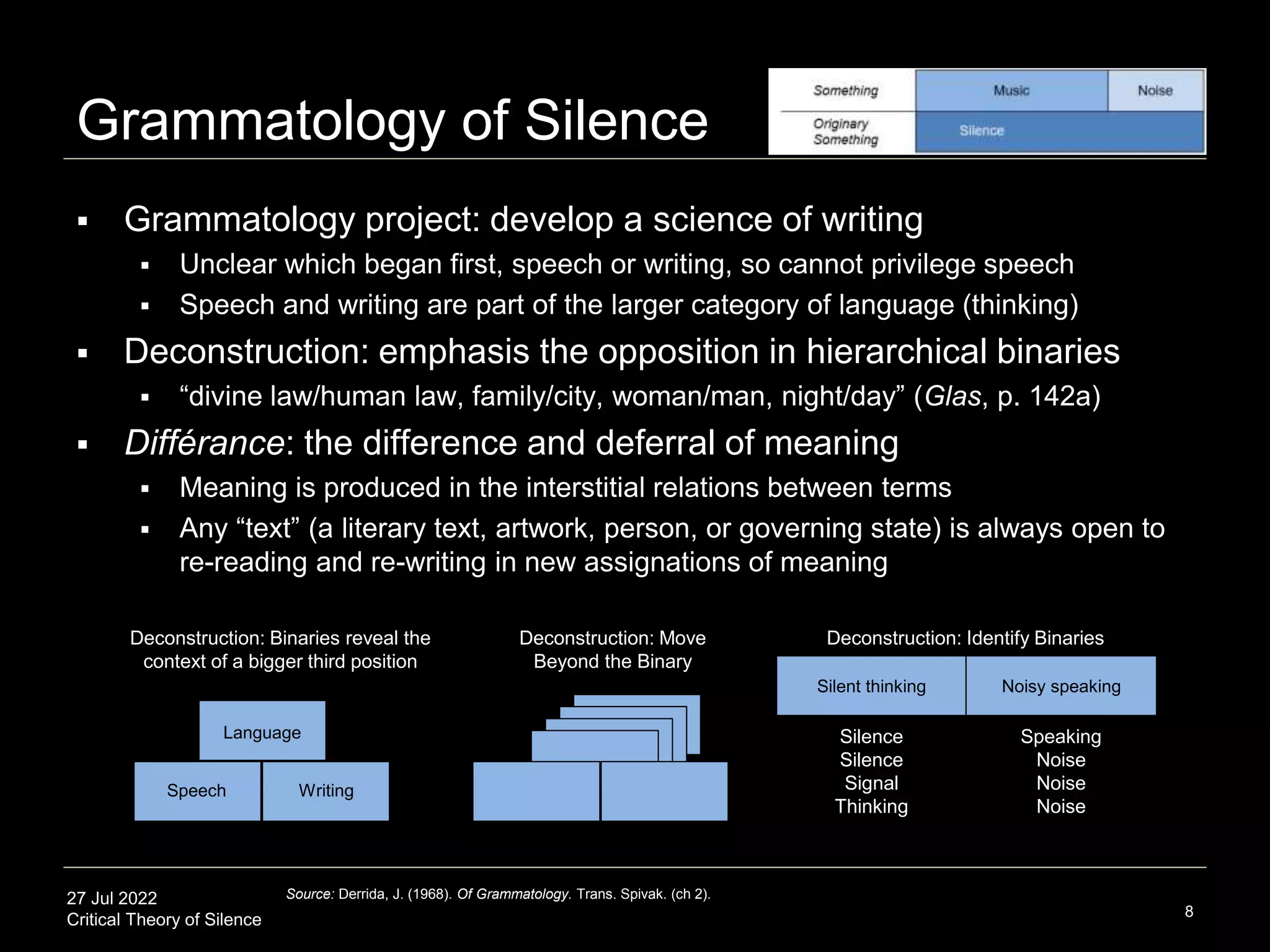
Silence
Silence
Signal
Thinking
Speaking
Noise
Noise
Noise
Speech Writing
Language
Deconstruction: Identify Binaries
Deconstruction: Binaries reveal the
context of a bigger third position
Deconstruction: Move
Beyond the Binary
Source: Derrida, J. (1968). Of Grammatology. Trans. Spivak. (ch 2).
27 Jul 2022
Critical Theory of Silence
History of Noise: Italian Futurism (positive)
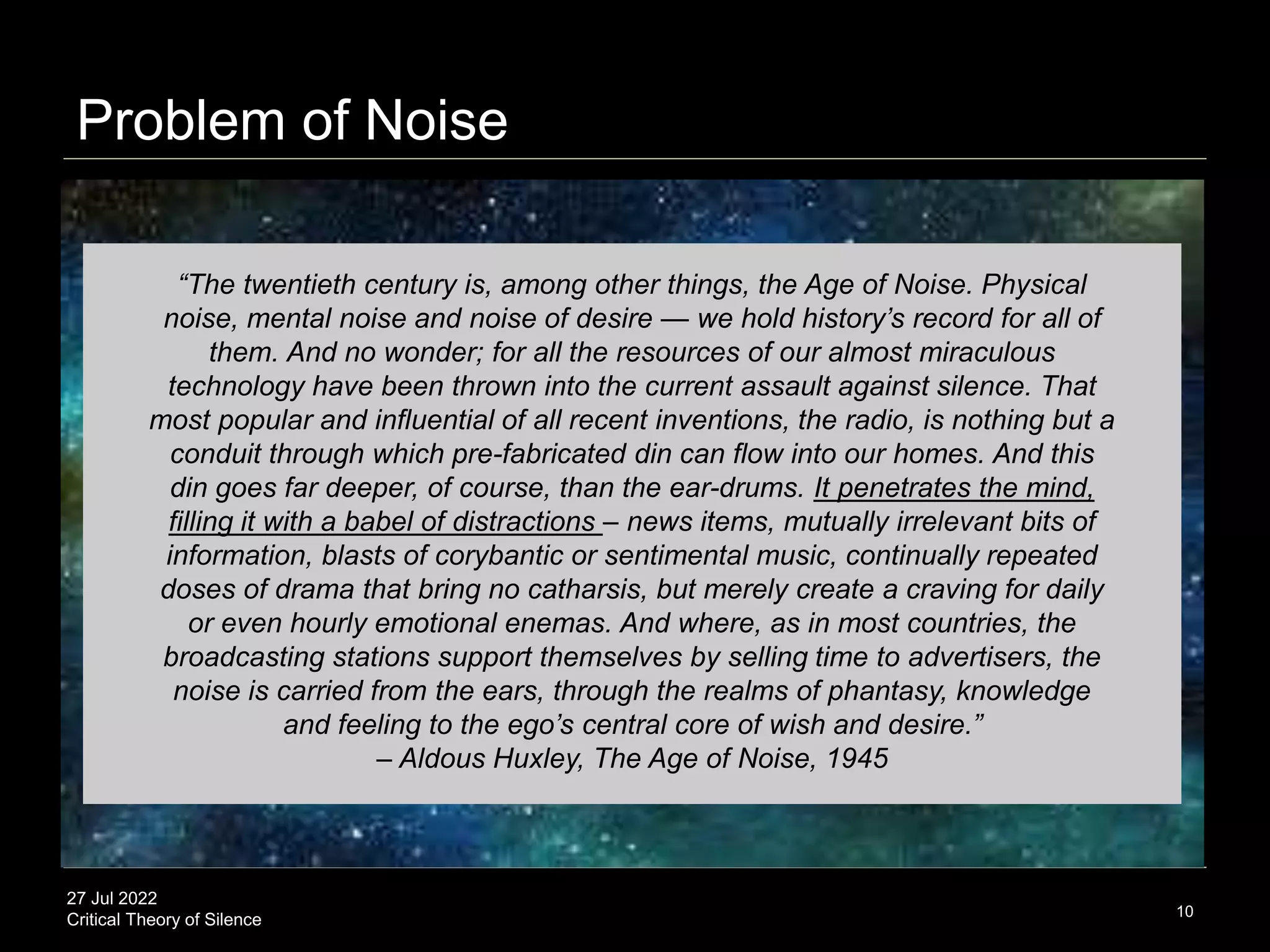
 Marinetti, 1909, Manifesto of
Futurism, Noise Music
 Noise as a sign of modernity
 Russolo, 1913, The Art of Noises
 Musical aesthetics
 Intonarumori: automated
instruments that generate acoustic
noise (engaged by Cage)
 Futurism
 Esprit of modernity
 Celebration of machines, speed,
automation, movement,
dynamism, energy, noise
9
Severini, 1912, Dynamic
Hieroglyphic of the Bal Tabarin
Boccioni, 1910, The City Rises; 1913,
Unique Forms of Continuity in Space
27 Jul 2022
Critical Theory of Silence
Problem of Noise
10
“The twentieth century is, among other things, the Age of Noise. Physical
noise, mental noise and noise of desire — we hold history’s record for all of
them. And no wonder; for all the resources of our almost miraculous
technology have been thrown into the current assault against silence. That
most popular and influential of all recent inventions, the radio, is nothing but a
conduit through which pre-fabricated din can flow into our homes. And this
din goes far deeper, of course, than the ear-drums. It penetrates the mind,
filling it with a babel of distractions – news items, mutually irrelevant bits of
information, blasts of corybantic or sentimental music, continually repeated
doses of drama that bring no catharsis, but merely create a craving for daily
or even hourly emotional enemas. And where, as in most countries, the
broadcasting stations support themselves by selling time to advertisers, the
noise is carried from the ears, through the realms of phantasy, knowledge
and feeling to the ego’s central core of wish and desire.”
– Aldous Huxley, The Age of Noise, 1945
27 Jul 2022
Critical Theory of Silence
Problem of Visual Noise (the image)
11
Source: Szendy interview: https://www.domusweb.it/en/art/gallery/2020/03/13/are-we-producing-way-too-many-images-the-dark-
side-of-the-visible-in-exhibition-in-paris.html
Hawkes, 2020
Today, “noise” is primarily visual
“We live in a world that is increasingly saturated with images. Each
day more than three billion images are shared on social networks.
The space of visibility seems to be literally inundated with a huge
number of images, making any other form of communication
irrelevant. – Savio Interview with Peter Szendy, 2020
The problem is not only the pervasiveness of the image but its
complete lack of an ethics of representation – Hawkes, 2020
27 Jul 2022
Critical Theory of Silence 12
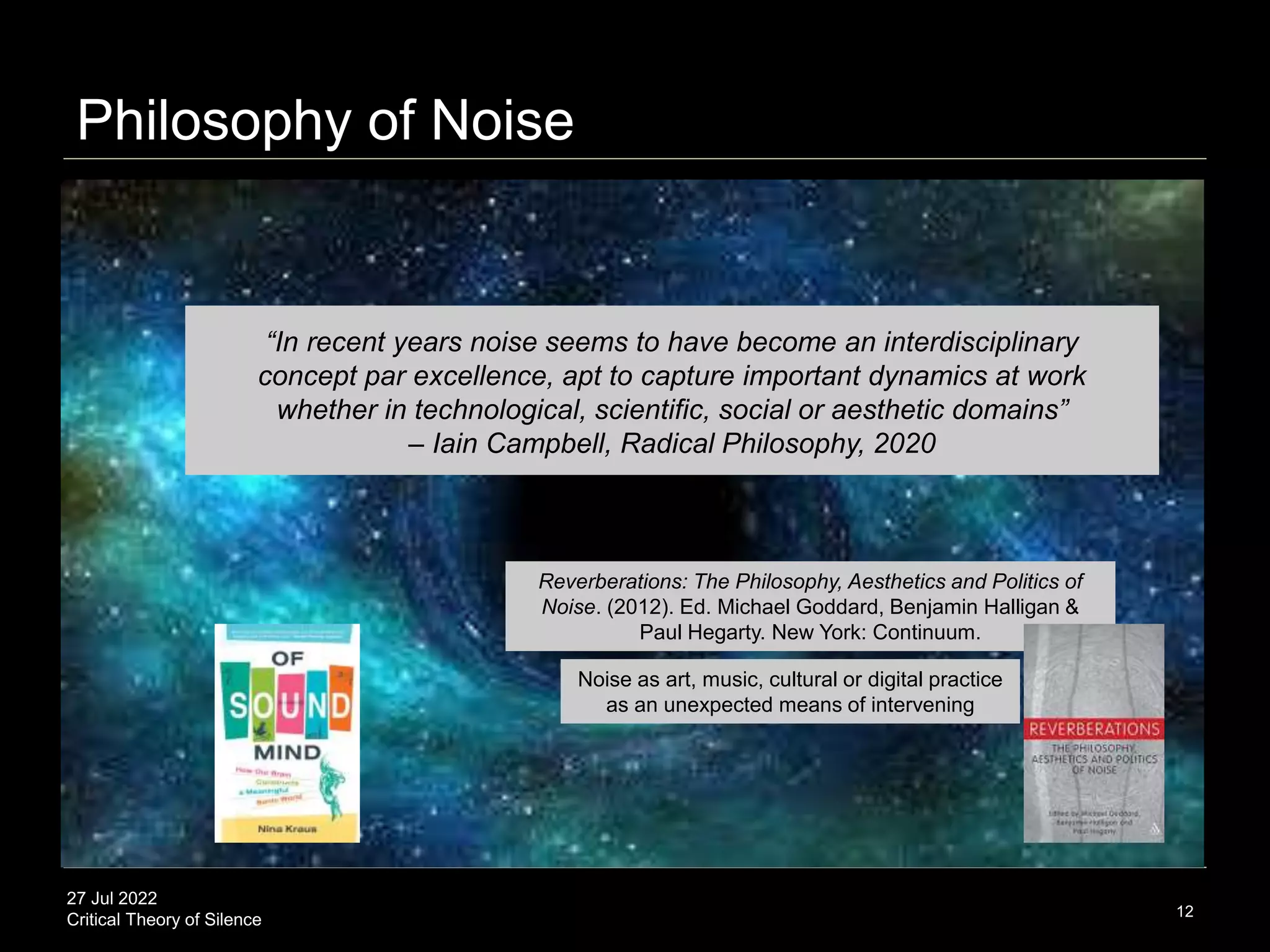
“In recent years noise seems to have become an interdisciplinary
concept par excellence, apt to capture important dynamics at work
whether in technological, scientific, social or aesthetic domains”
– Iain Campbell, Radical Philosophy, 2020
Philosophy of Noise
Noise as art, music, cultural or digital practice
as an unexpected means of intervening
Reverberations: The Philosophy, Aesthetics and Politics of
Noise. (2012). Ed. Michael Goddard, Benjamin Halligan &
Paul Hegarty. New York: Continuum.
27 Jul 2022
Critical Theory of Silence
Philosophy of Silence
13
Source: Hall, Suzi. (2018). Edmond Jabès’s ‘Infinite’, ‘Exploded’ Book. PhD Thesis Flinders University.
 The Book of Questions, Jabès (French-Egyptian philosopher), 1976
 The silence
 What unites us is the silence; the long asides in a
private conversation of the sand with the sand
 The void
 The neutral is, in a way, the nerve at the heart of the problem.
To undo the neutral; to push back to infinity the frontiers of
solitude. […] Unconditional presence, absence. Everywhere,
always the same void
 The pause
 Blanchot distinguishes as more of a disjunct; it is a silence that
introduces waiting, which measures the distance between two
speakers (the irreducible distance, not the reducible distance)
27 Jul 2022
Critical Theory of Silence
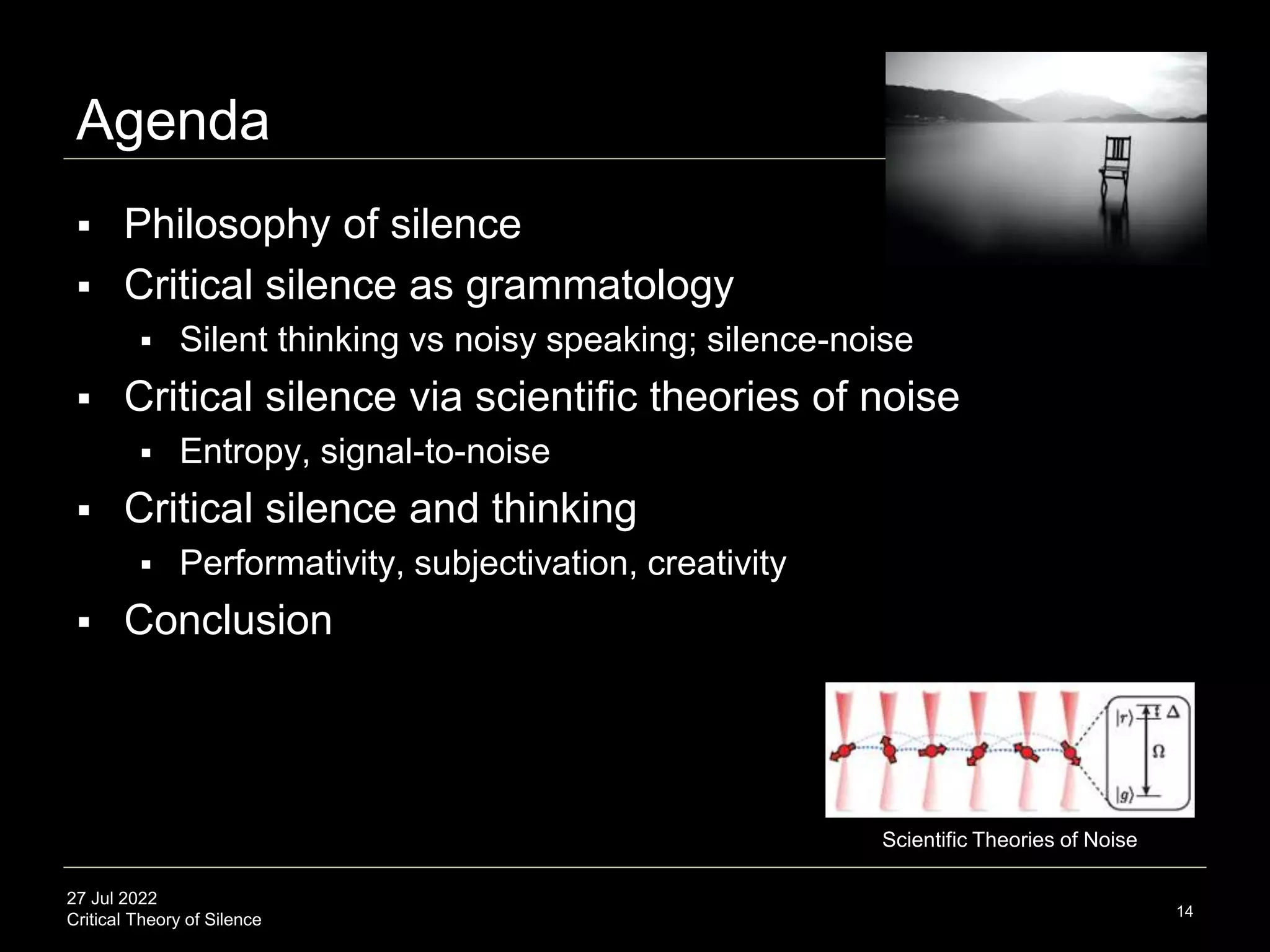
Agenda
 Philosophy of silence
 Critical silence as grammatology
 Silent thinking vs noisy speaking; silence-noise
 Critical silence via scientific theories of noise
 Entropy, signal-to-noise
 Critical silence and thinking
 Performativity, subjectivation, creativity
 Conclusion
14
Scientific Theories of Noise
27 Jul 2022
Critical Theory of Silence
Scientific Conceptualizations of Noise
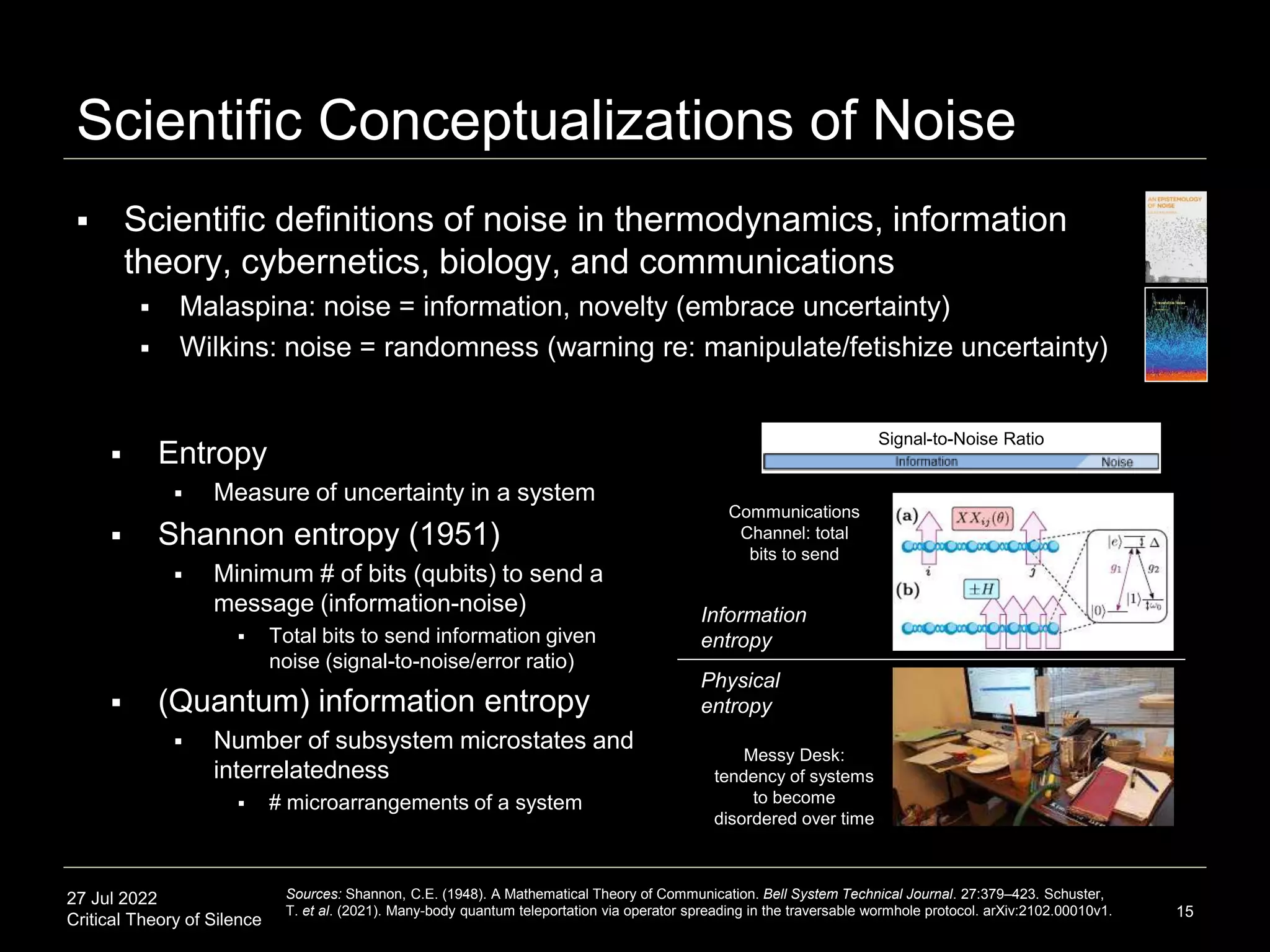
 Scientific definitions of noise in thermodynamics, information
theory, cybernetics, biology, and communications
 Malaspina: noise = information, novelty (embrace uncertainty)
 Wilkins: noise = randomness (warning re: manipulate/fetishize uncertainty)
15
Sources: Shannon, C.E. (1948). A Mathematical Theory of Communication. Bell System Technical Journal. 27:379–423. Schuster,
T. et al. (2021). Many-body quantum teleportation via operator spreading in the traversable wormhole protocol. arXiv:2102.00010v1.
Information
entropy
Physical
entropy
Messy Desk:
tendency of systems
to become
disordered over time
 Entropy
 Measure of uncertainty in a system
 Shannon entropy (1951)
 Minimum # of bits (qubits) to send a
message (information-noise)
 Total bits to send information given
noise (signal-to-noise/error ratio)
 (Quantum) information entropy
 Number of subsystem microstates and
interrelatedness
 # microarrangements of a system
Communications
Channel: total
bits to send
Signal-to-Noise Ratio
27 Jul 2022
Critical Theory of Silence
Epistemology of Noise
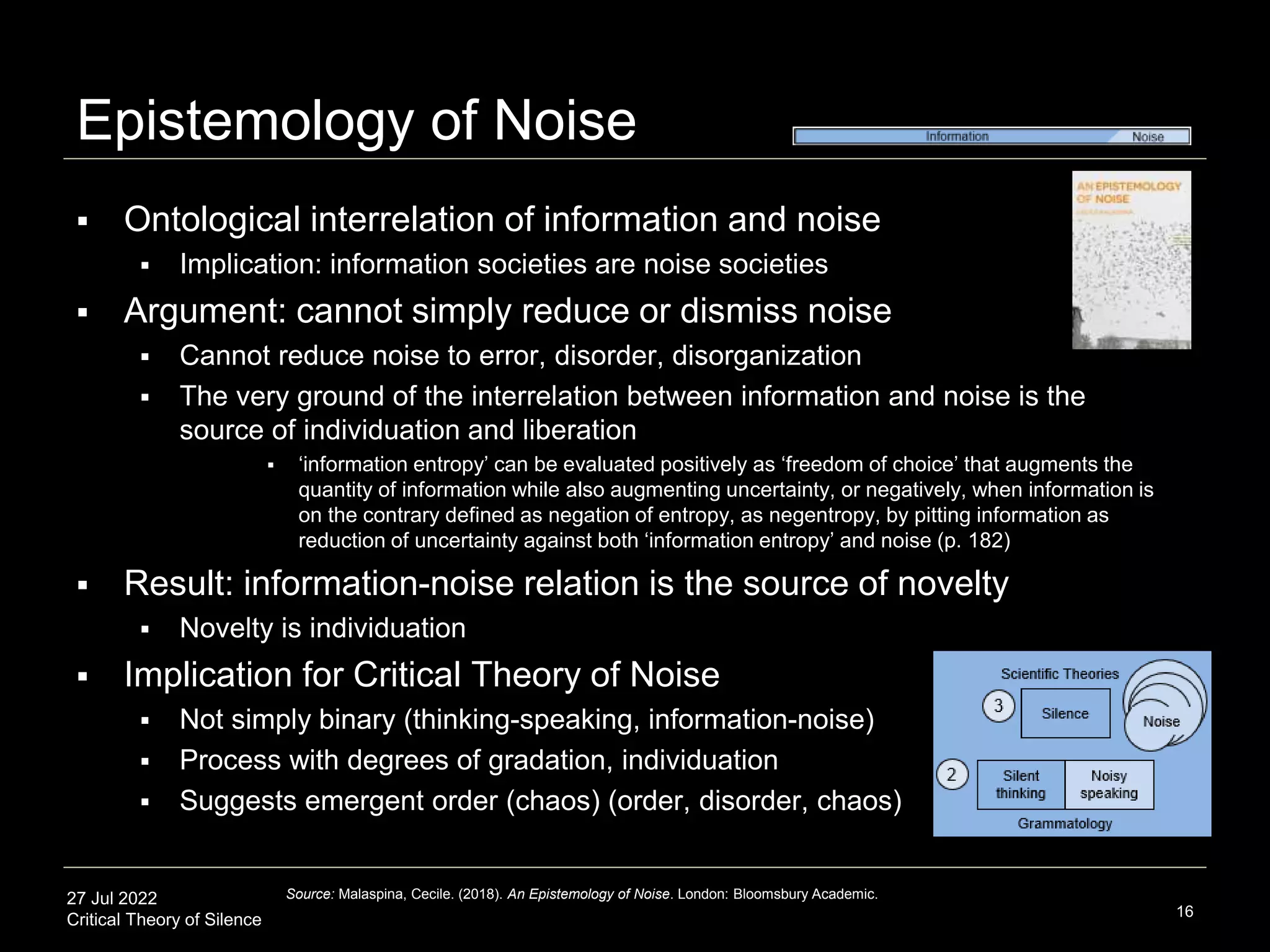
 Ontological interrelation of information and noise
 Implication: information societies are noise societies
 Argument: cannot simply reduce or dismiss noise
 Cannot reduce noise to error, disorder, disorganization
 The very ground of the interrelation between information and noise is the
source of individuation and liberation
 ‘information entropy’ can be evaluated positively as ‘freedom of choice’ that augments the
quantity of information while also augmenting uncertainty, or negatively, when information is
on the contrary defined as negation of entropy, as negentropy, by pitting information as
reduction of uncertainty against both ‘information entropy’ and noise (p. 182)
 Result: information-noise relation is the source of novelty
 Novelty is individuation
 Implication for Critical Theory of Noise
 Not simply binary (thinking-speaking, information-noise)
 Process with degrees of gradation, individuation
 Suggests emergent order (chaos) (order, disorder, chaos)
16
Source: Malaspina, Cecile. (2018). An Epistemology of Noise. London: Bloomsbury Academic.
27 Jul 2022
Critical Theory of Silence
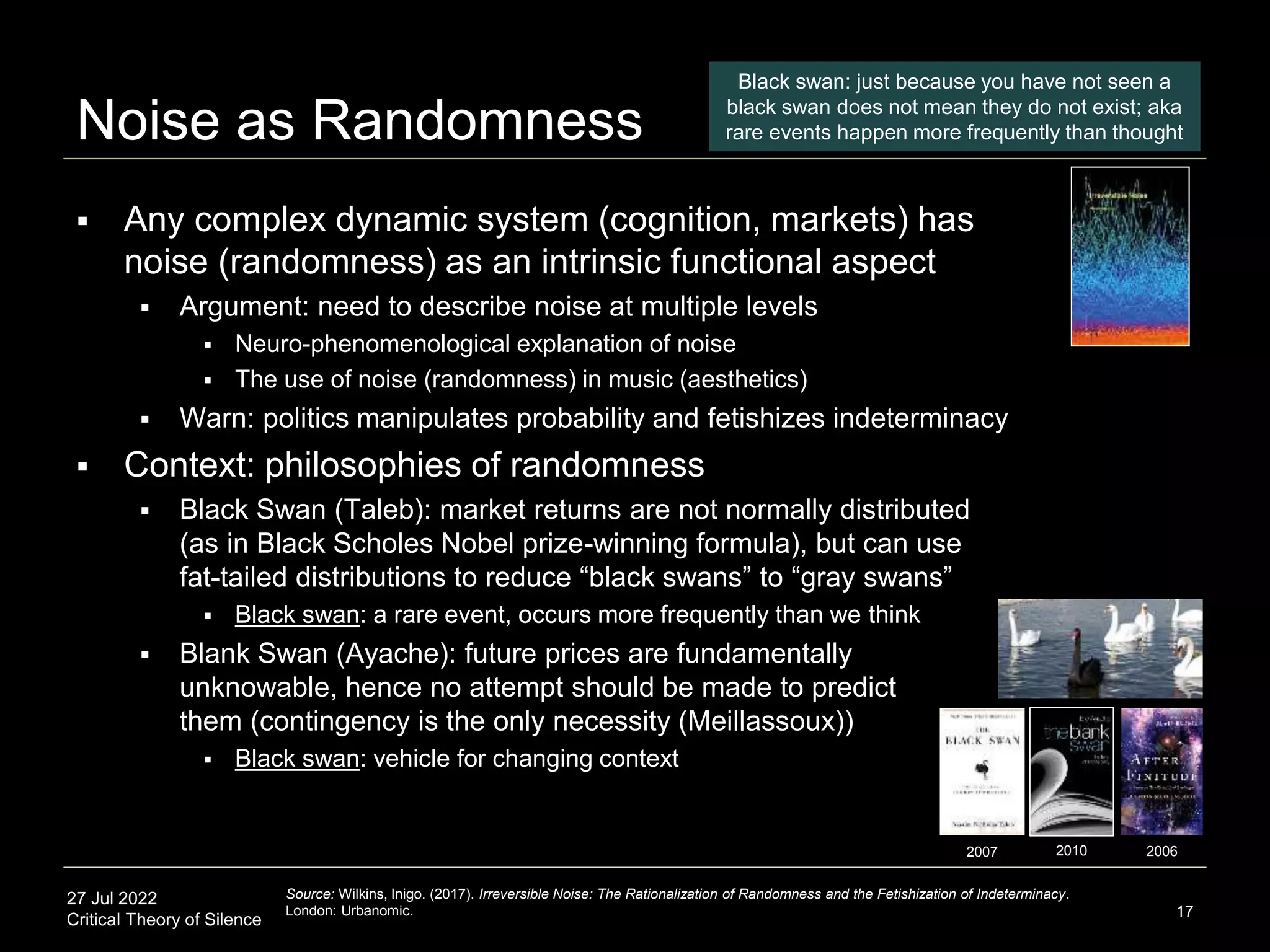
Noise as Randomness
 Any complex dynamic system (cognition, markets) has
noise (randomness) as an intrinsic functional aspect
 Argument: need to describe noise at multiple levels
 Neuro-phenomenological explanation of noise
 The use of noise (randomness) in music (aesthetics)
 Warn: politics manipulates probability and fetishizes indeterminacy
 Context: philosophies of randomness
 Black Swan (Taleb): market returns are not normally distributed
(as in Black Scholes Nobel prize-winning formula), but can use
fat-tailed distributions to reduce “black swans” to “gray swans”
 Black swan: a rare event, occurs more frequently than we think
 Blank Swan (Ayache): future prices are fundamentally
unknowable, hence no attempt should be made to predict
them (contingency is the only necessity (Meillassoux))
 Black swan: vehicle for changing context
17
Source: Wilkins, Inigo. (2017). Irreversible Noise: The Rationalization of Randomness and the Fetishization of Indeterminacy.
London: Urbanomic.
2007 2006
2010
Black swan: just because you have not seen a
black swan does not mean they do not exist; aka
rare events happen more frequently than thought
27 Jul 2022
Critical Theory of Silence
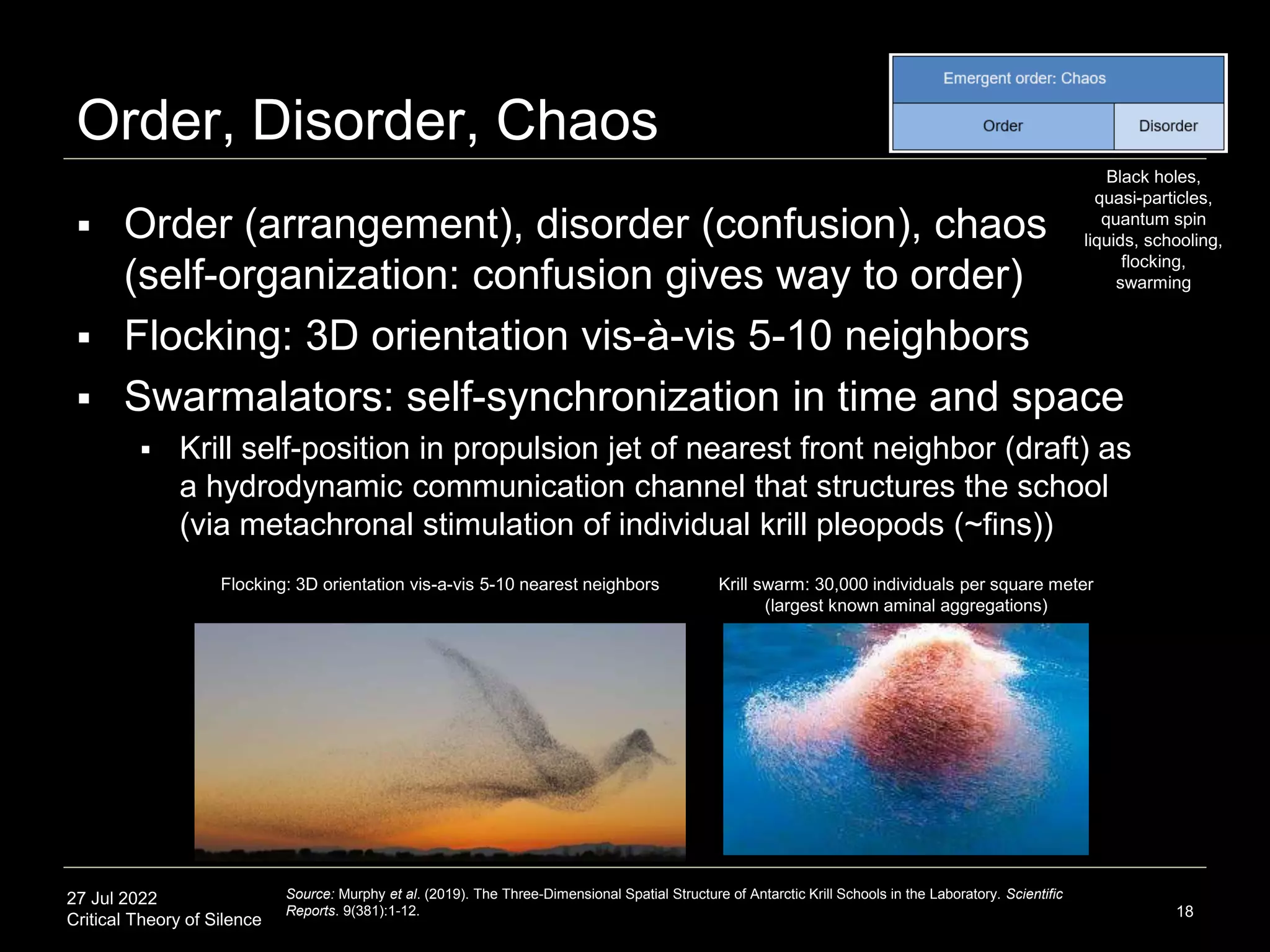
Order, Disorder, Chaos
 Order (arrangement), disorder (confusion), chaos
(self-organization: confusion gives way to order)
 Flocking: 3D orientation vis-à-vis 5-10 neighbors
 Swarmalators: self-synchronization in time and space
 Krill self-position in propulsion jet of nearest front neighbor (draft) as
a hydrodynamic communication channel that structures the school
(via metachronal stimulation of individual krill pleopods (~fins))
18
Source: Murphy et al. (2019). The Three-Dimensional Spatial Structure of Antarctic Krill Schools in the Laboratory. Scientific
Reports. 9(381):1-12.
Krill swarm: 30,000 individuals per square meter
(largest known aminal aggregations)
Flocking: 3D orientation vis-a-vis 5-10 nearest neighbors
Black holes,
quasi-particles,
quantum spin
liquids, schooling,
flocking,
swarming
27 Jul 2022
Critical Theory of Silence
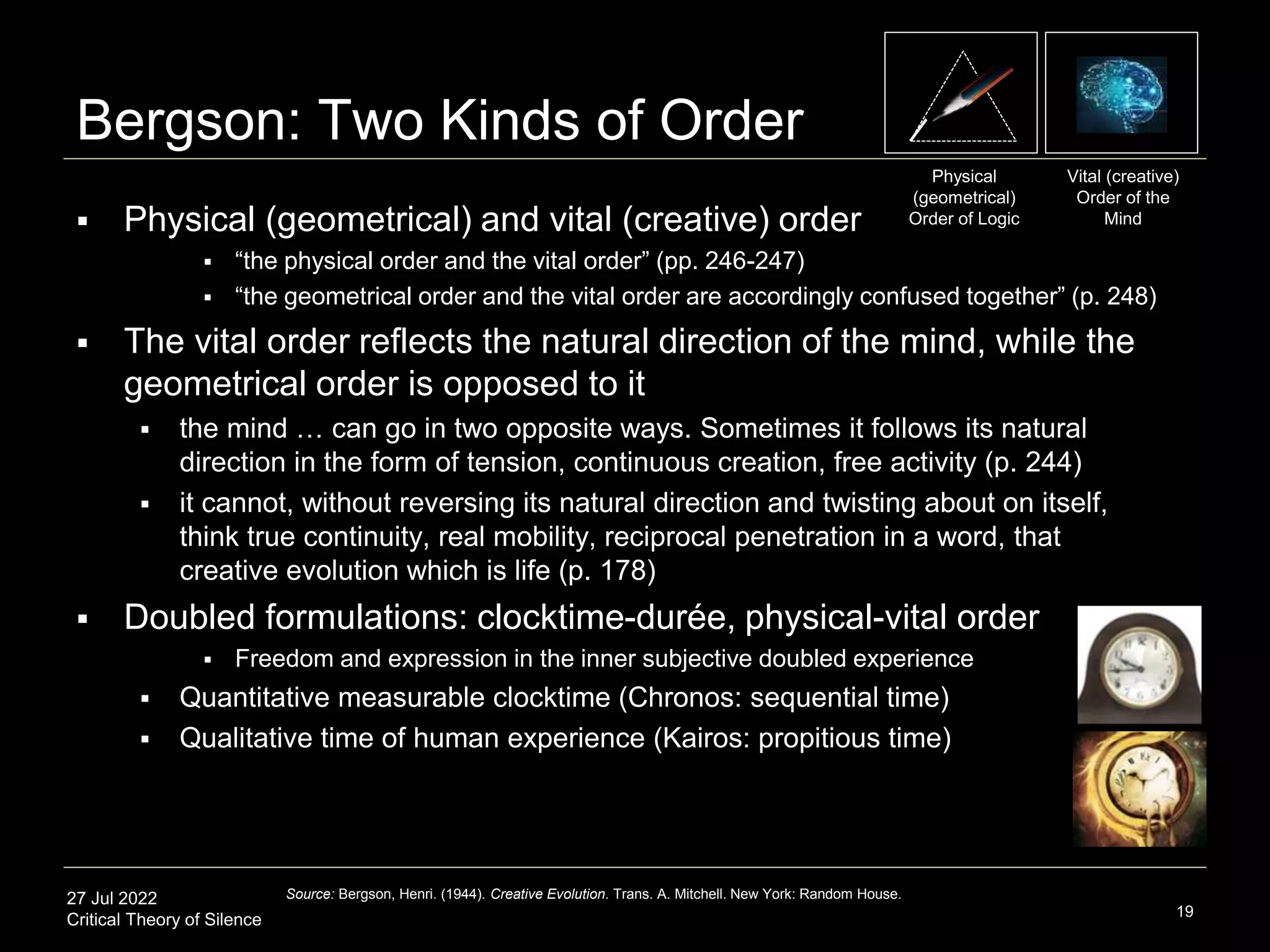
Bergson: Two Kinds of Order
 Physical (geometrical) and vital (creative) order
 “the physical order and the vital order” (pp. 246-247)
 “the geometrical order and the vital order are accordingly confused together” (p. 248)
 The vital order reflects the natural direction of the mind, while the
geometrical order is opposed to it
 the mind … can go in two opposite ways. Sometimes it follows its natural
direction in the form of tension, continuous creation, free activity (p. 244)
 it cannot, without reversing its natural direction and twisting about on itself,
think true continuity, real mobility, reciprocal penetration in a word, that
creative evolution which is life (p. 178)
 Doubled formulations: clocktime-durée, physical-vital order
 Freedom and expression in the inner subjective doubled experience
 Quantitative measurable clocktime (Chronos: sequential time)
 Qualitative time of human experience (Kairos: propitious time)
19
Source: Bergson, Henri. (1944). Creative Evolution. Trans. A. Mitchell. New York: Random House.
Vital (creative)
Order of the
Mind
Physical
(geometrical)
Order of Logic
27 Jul 2022
Critical Theory of Silence
Agenda
 Philosophy of silence
 Critical silence as grammatology
 Silent thinking vs noisy speaking; silence-noise
 Critical silence via scientific theories of noise
 Entropy, signal-to-noise
 Critical silence and thinking
 Performativity, subjectivation, creativity
 Conclusion
20
Self-aware Performativity
27 Jul 2022
Critical Theory of Silence
Performativity
21
Source: Goffman, Erving. (1959.) The Presentation of Self in Everyday Life. Garden City NY: Doubleday Anchor Books.
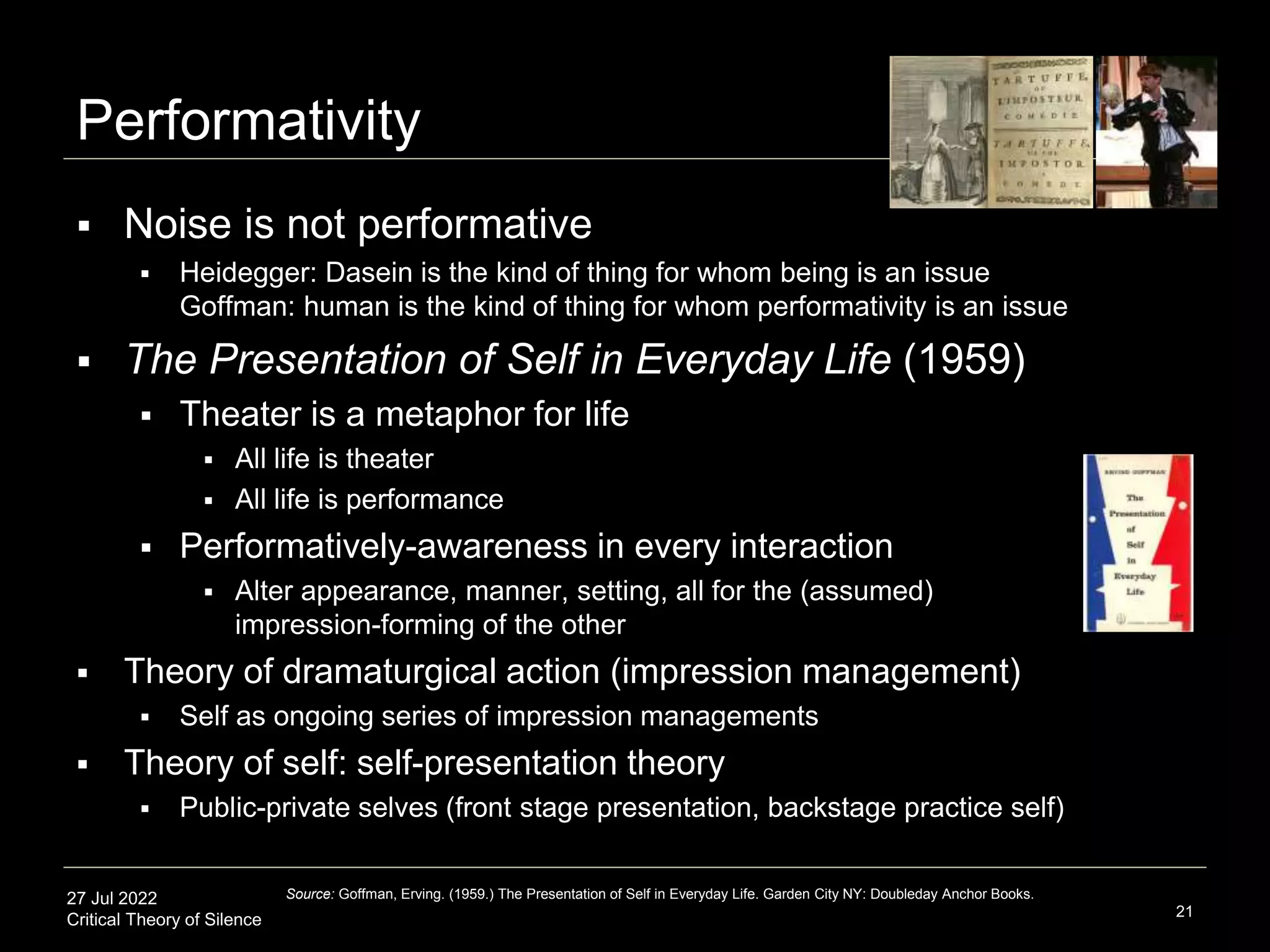
 Noise is not performative
 Heidegger: Dasein is the kind of thing for whom being is an issue
Goffman: human is the kind of thing for whom performativity is an issue
 The Presentation of Self in Everyday Life (1959)
 Theater is a metaphor for life
 All life is theater
 All life is performance
 Performatively-awareness in every interaction
 Alter appearance, manner, setting, all for the (assumed)
impression-forming of the other
 Theory of dramaturgical action (impression management)
 Self as ongoing series of impression managements
 Theory of self: self-presentation theory
 Public-private selves (front stage presentation, backstage practice self)
27 Jul 2022
Critical Theory of Silence
Performativity
Audience Sociology
22
Sources: Walmsley, B.A. (2011). Why people go to the theatre. Journal of Customer Behavior. 10(4):335-351. Bennett, Susan.
(1997). Theatre Audiences: A Theory of Production and Reception. London: Routledge.
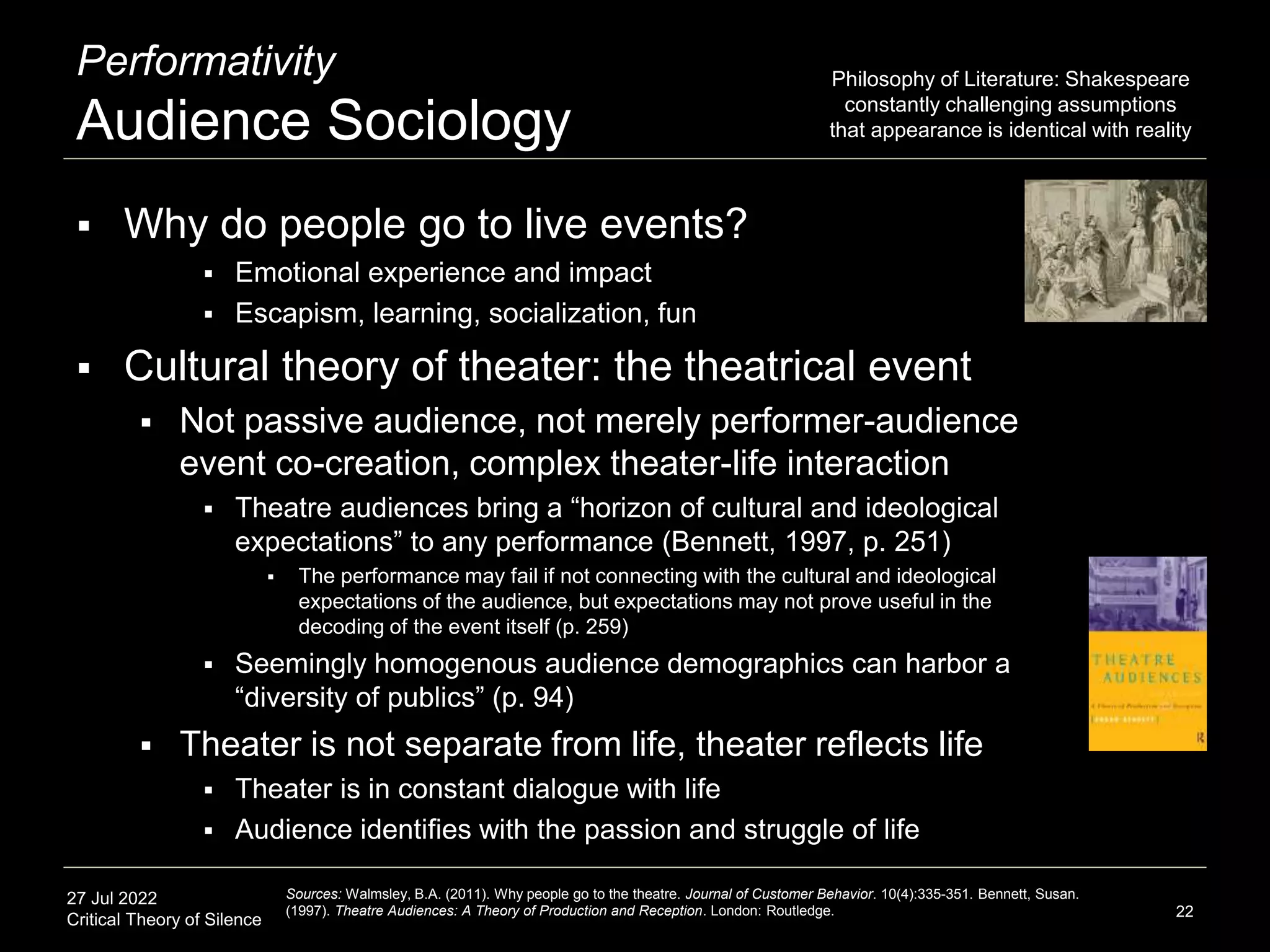
 Why do people go to live events?
 Emotional experience and impact
 Escapism, learning, socialization, fun
 Cultural theory of theater: the theatrical event
 Not passive audience, not merely performer-audience
event co-creation, complex theater-life interaction
 Theatre audiences bring a “horizon of cultural and ideological
expectations” to any performance (Bennett, 1997, p. 251)
 The performance may fail if not connecting with the cultural and ideological
expectations of the audience, but expectations may not prove useful in the
decoding of the event itself (p. 259)
 Seemingly homogenous audience demographics can harbor a
“diversity of publics” (p. 94)
 Theater is not separate from life, theater reflects life
 Theater is in constant dialogue with life
 Audience identifies with the passion and struggle of life
Philosophy of Literature: Shakespeare
constantly challenging assumptions
that appearance is identical with reality
27 Jul 2022
Critical Theory of Silence
Performativity, Sound, and Music
23
Source: Bennett, Susan. (2019) Sound. London: Bloomsbury.
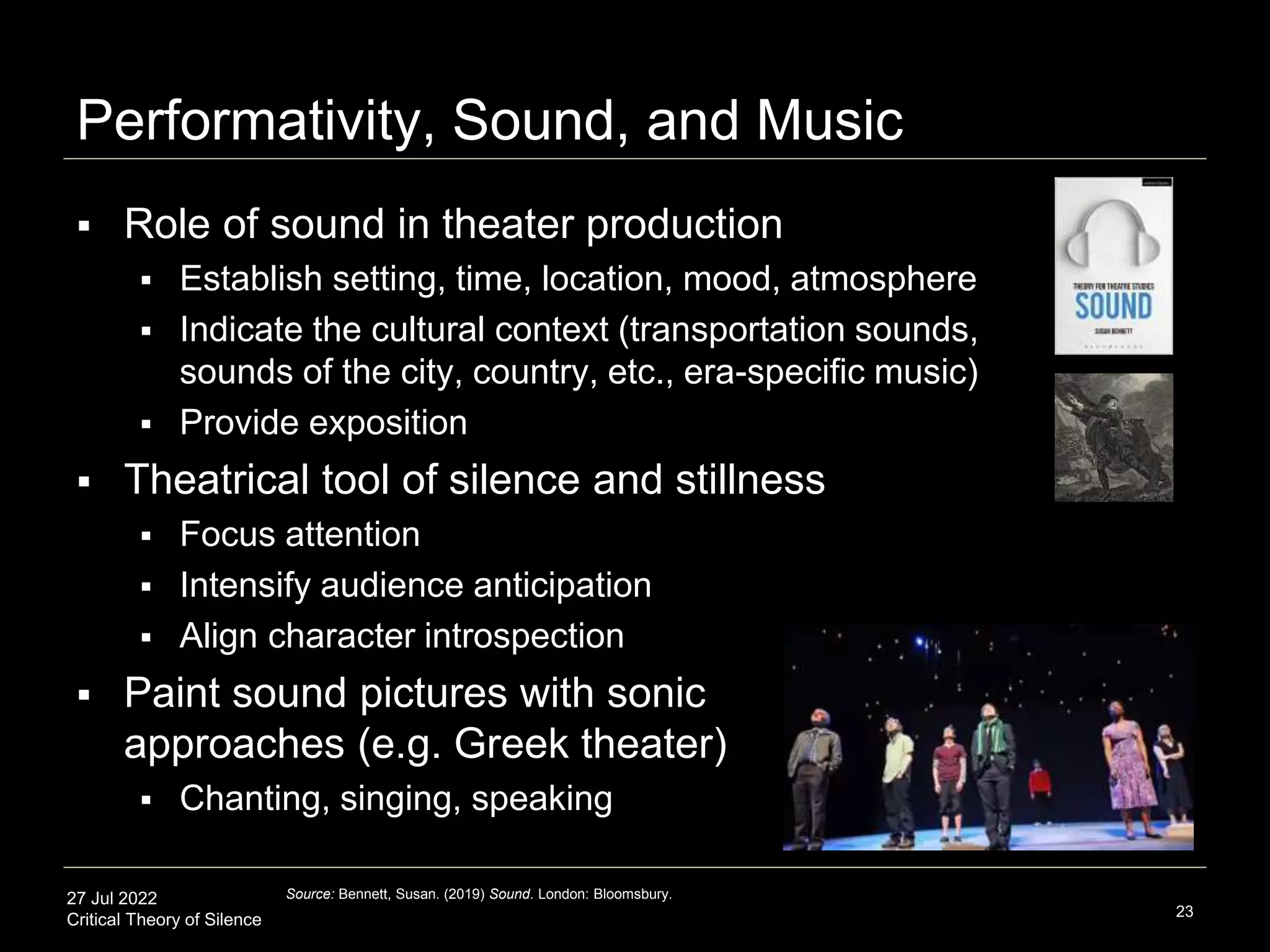
 Role of sound in theater production
 Establish setting, time, location, mood, atmosphere
 Indicate the cultural context (transportation sounds,
sounds of the city, country, etc., era-specific music)
 Provide exposition
 Theatrical tool of silence and stillness
 Focus attention
 Intensify audience anticipation
 Align character introspection
 Paint sound pictures with sonic
approaches (e.g. Greek theater)
 Chanting, singing, speaking
27 Jul 2022
Critical Theory of Silence
Evolutionary Biophysics of Hearing
24
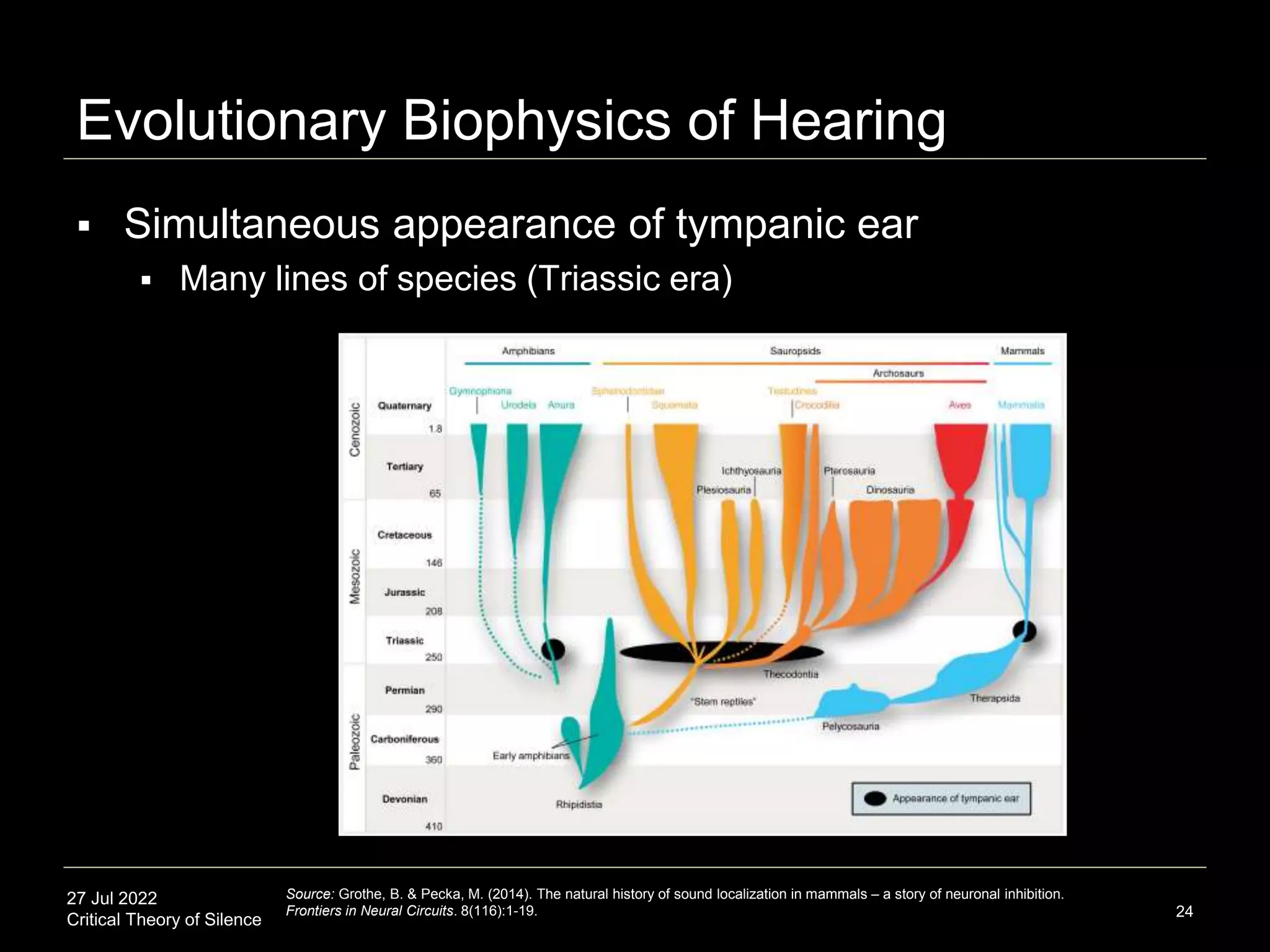
 Simultaneous appearance of tympanic ear
 Many lines of species (Triassic era)
Source: Grothe, B. & Pecka, M. (2014). The natural history of sound localization in mammals – a story of neuronal inhibition.
Frontiers in Neural Circuits. 8(116):1-19.
27 Jul 2022
Critical Theory of Silence
Performativity, Sound, and Music
25
Source: Szendy, Peter. (2008). Listen: A History of our Ears. Trans. Charlotte Mandell. New York: Fordham University Press.
The Order of Sounds: A
Sonorous Archipelago (2016)
All Ears The Aesthetics
of Espionage (2017)
Listen: A History of
Our Ears (2008)
The Supermarket
of Images (2020)
Prophecies of Leviathan:
Reading Past Melville (2010)
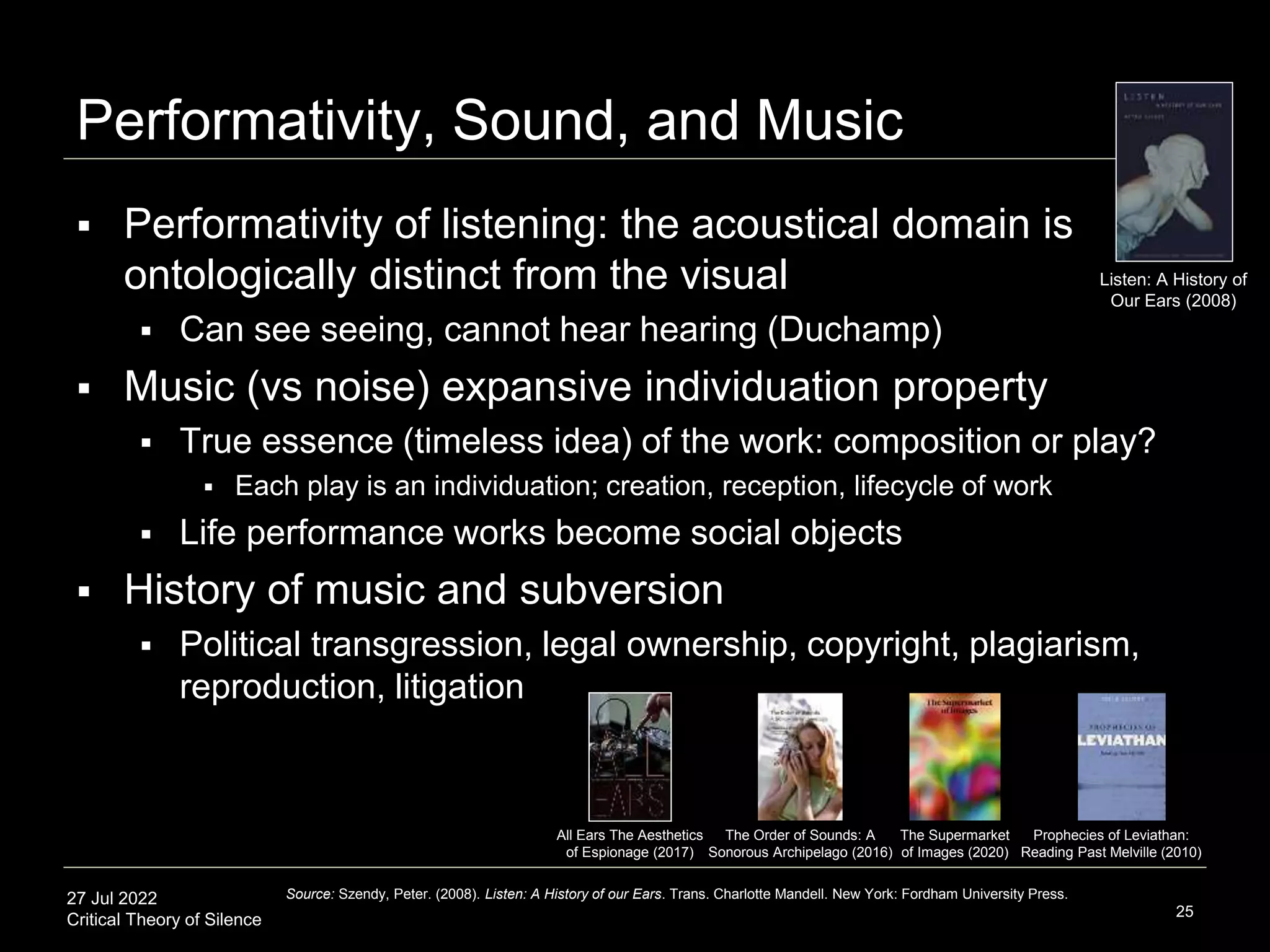
 Performativity of listening: the acoustical domain is
ontologically distinct from the visual
 Can see seeing, cannot hear hearing (Duchamp)
 Music (vs noise) expansive individuation property
 True essence (timeless idea) of the work: composition or play?
 Each play is an individuation; creation, reception, lifecycle of work
 Life performance works become social objects
 History of music and subversion
 Political transgression, legal ownership, copyright, plagiarism,
reproduction, litigation
27 Jul 2022
Critical Theory of Silence
Arrangement, Reproduction, Autonomy
26
Source: Szendy, Peter. (2008). Listen: A History of our Ears. Trans. Charlotte Mandell. New York: Fordham University Press.
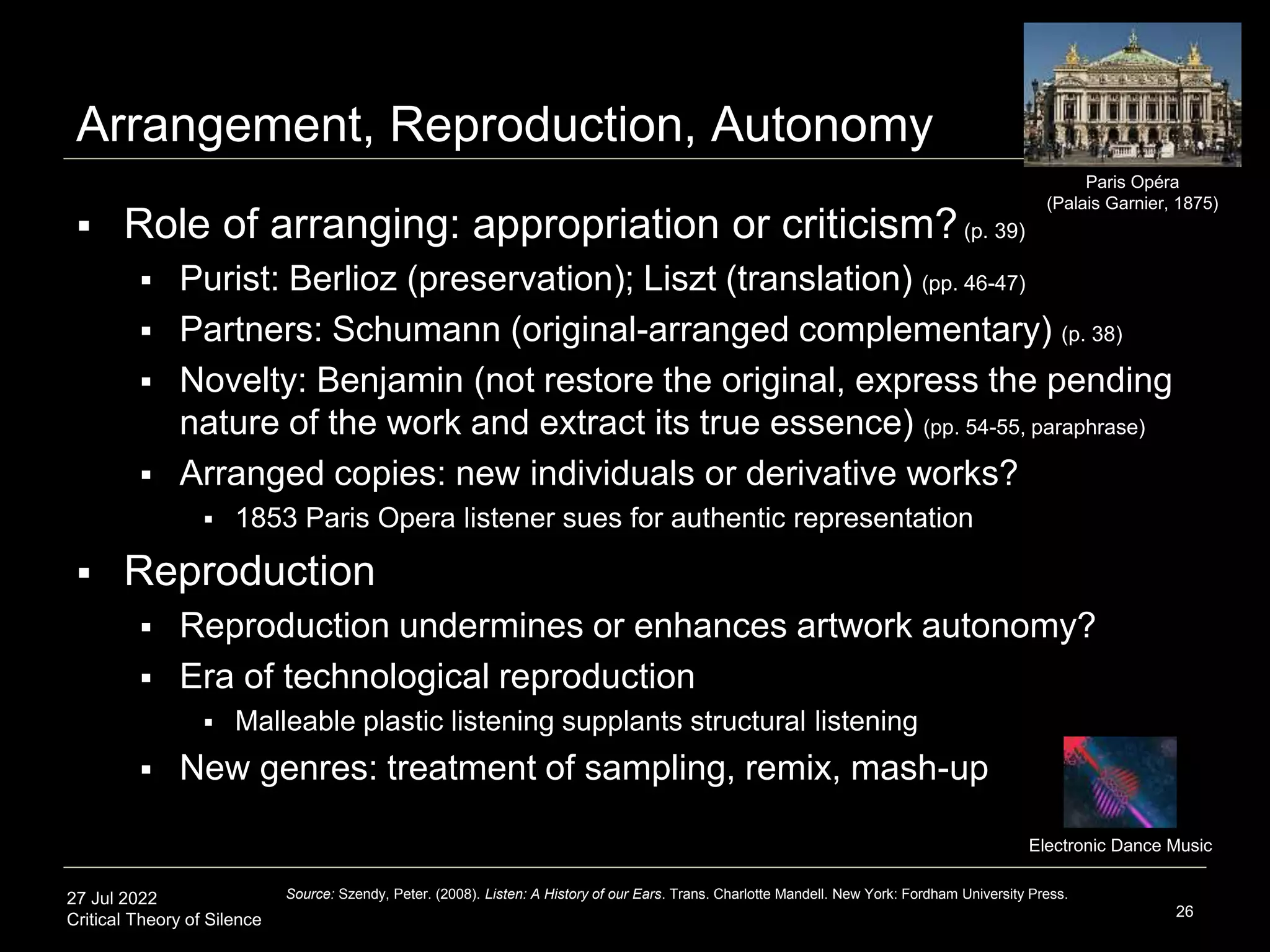
Paris Opéra
(Palais Garnier, 1875)
 Role of arranging: appropriation or criticism?(p. 39)
 Purist: Berlioz (preservation); Liszt (translation) (pp. 46-47)
 Partners: Schumann (original-arranged complementary) (p. 38)
 Novelty: Benjamin (not restore the original, express the pending
nature of the work and extract its true essence) (pp. 54-55, paraphrase)
 Arranged copies: new individuals or derivative works?
 1853 Paris Opera listener sues for authentic representation
 Reproduction
 Reproduction undermines or enhances artwork autonomy?
 Era of technological reproduction
 Malleable plastic listening supplants structural listening
 New genres: treatment of sampling, remix, mash-up
Electronic Dance Music
27 Jul 2022
Critical Theory of Silence
Temporality of Acoustical Works
27
Sources: Swan, M. (2020). Philosophy of Time: Perspectives in Science and Aesthetics; (2019). The Ekphrastic Diagram: Towards a
Quantum Theory of Ekphrasis; (forthcoming). Alexander von Humboldt’s Environmental Holism.
 Mimesis is an important tool in acoustical domains
 Perdurant (while) temporality of acoustical work
 The “while” interval needed to recognize a work, listen to a work
 Visual artwork: snapshot temporality
 Verbal artwork (music, poem): perdurant temporality
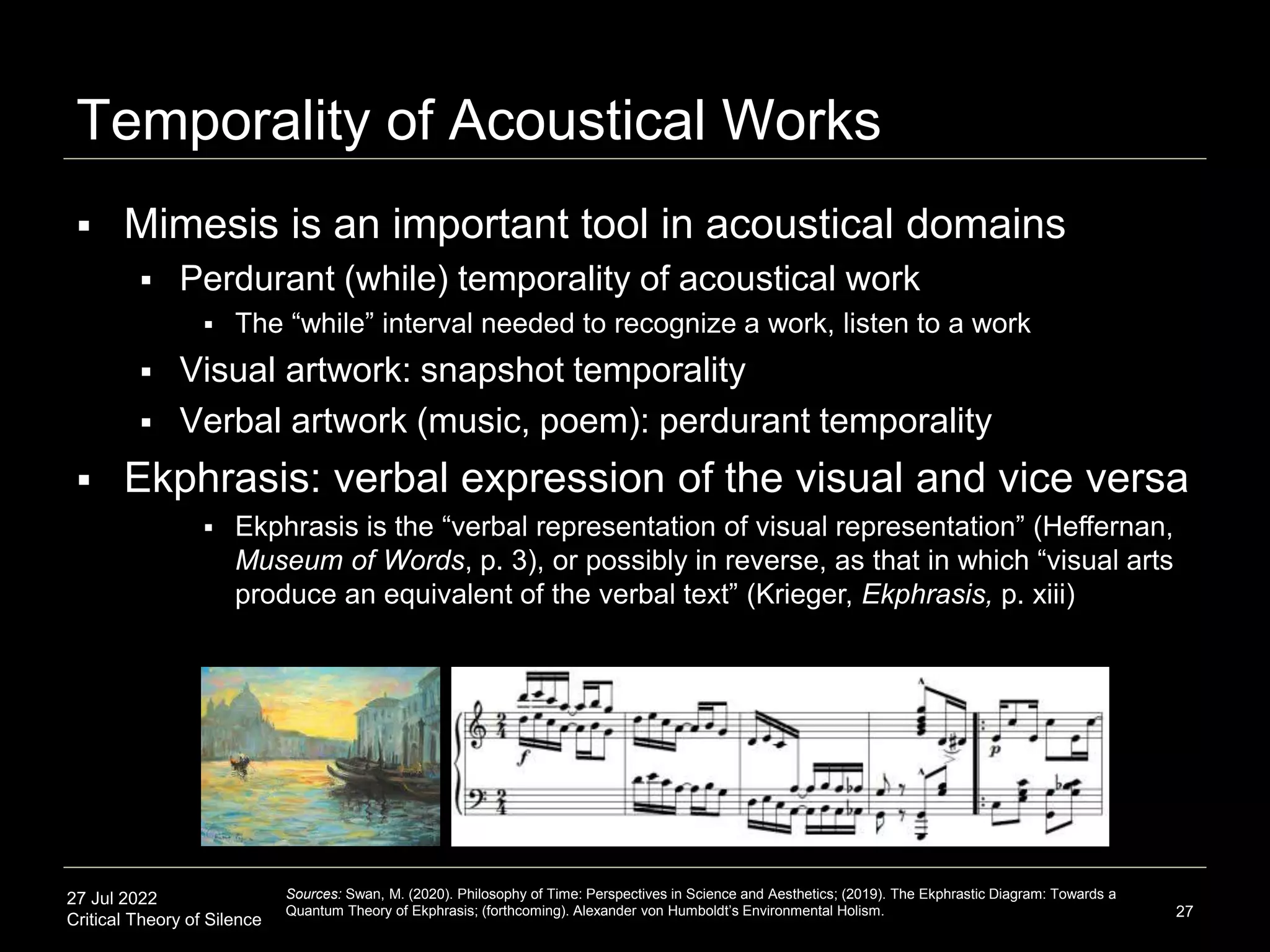
 Ekphrasis: verbal expression of the visual and vice versa
 Ekphrasis is the “verbal representation of visual representation” (Heffernan,
Museum of Words, p. 3), or possibly in reverse, as that in which “visual arts
produce an equivalent of the verbal text” (Krieger, Ekphrasis, p. xiii)
27 Jul 2022
Critical Theory of Silence
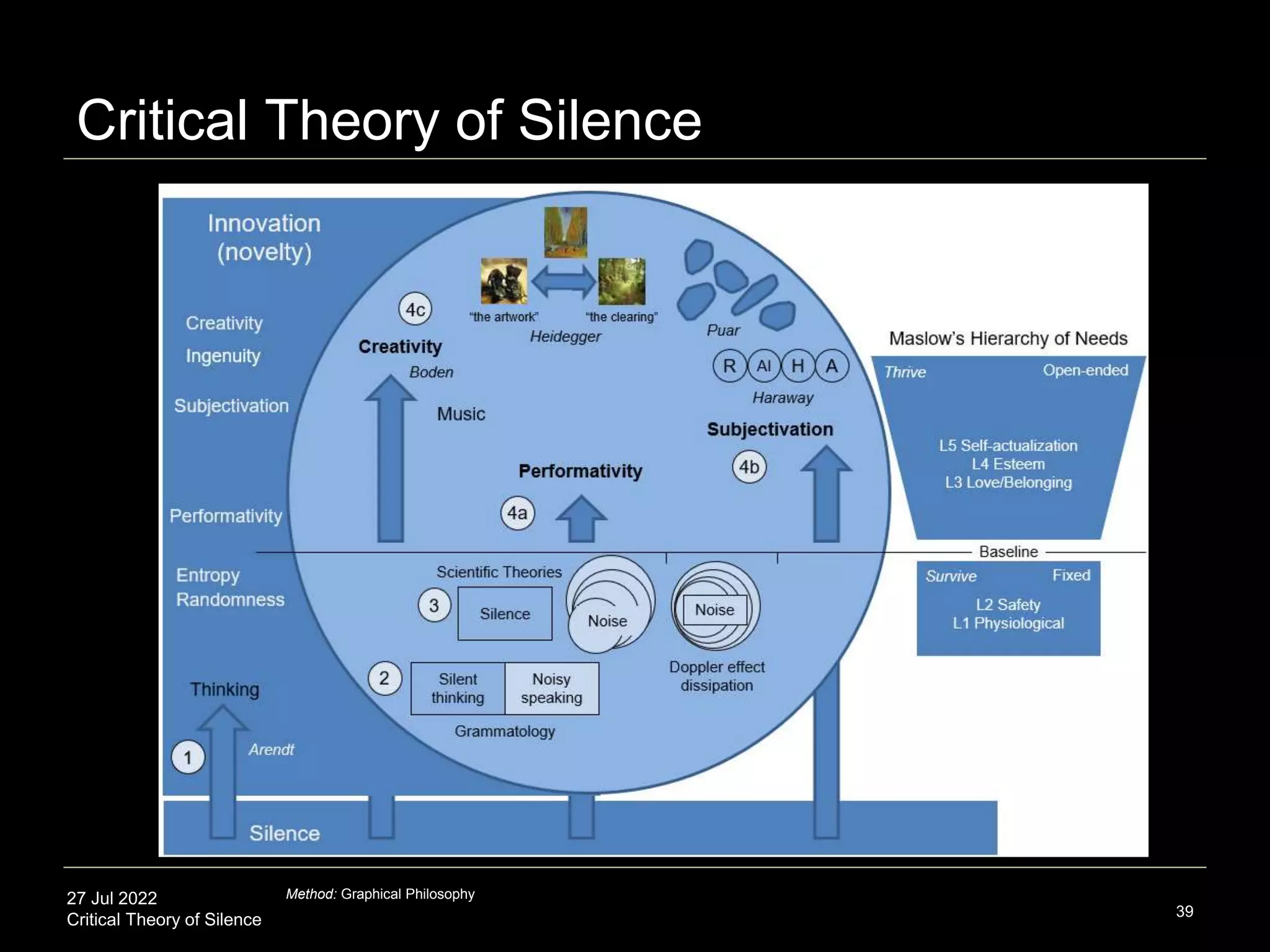
Performativity, Sound, and Music
28
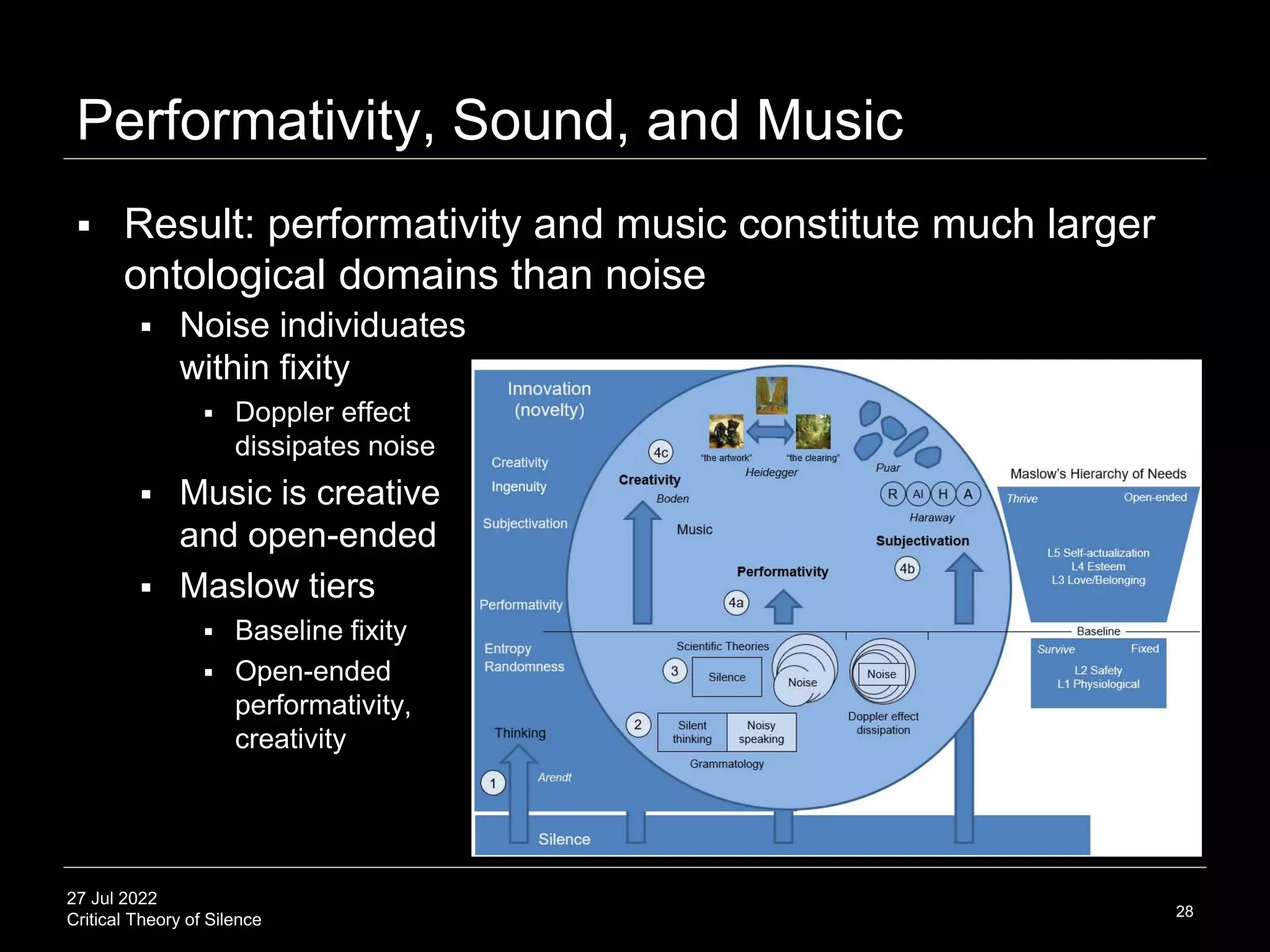
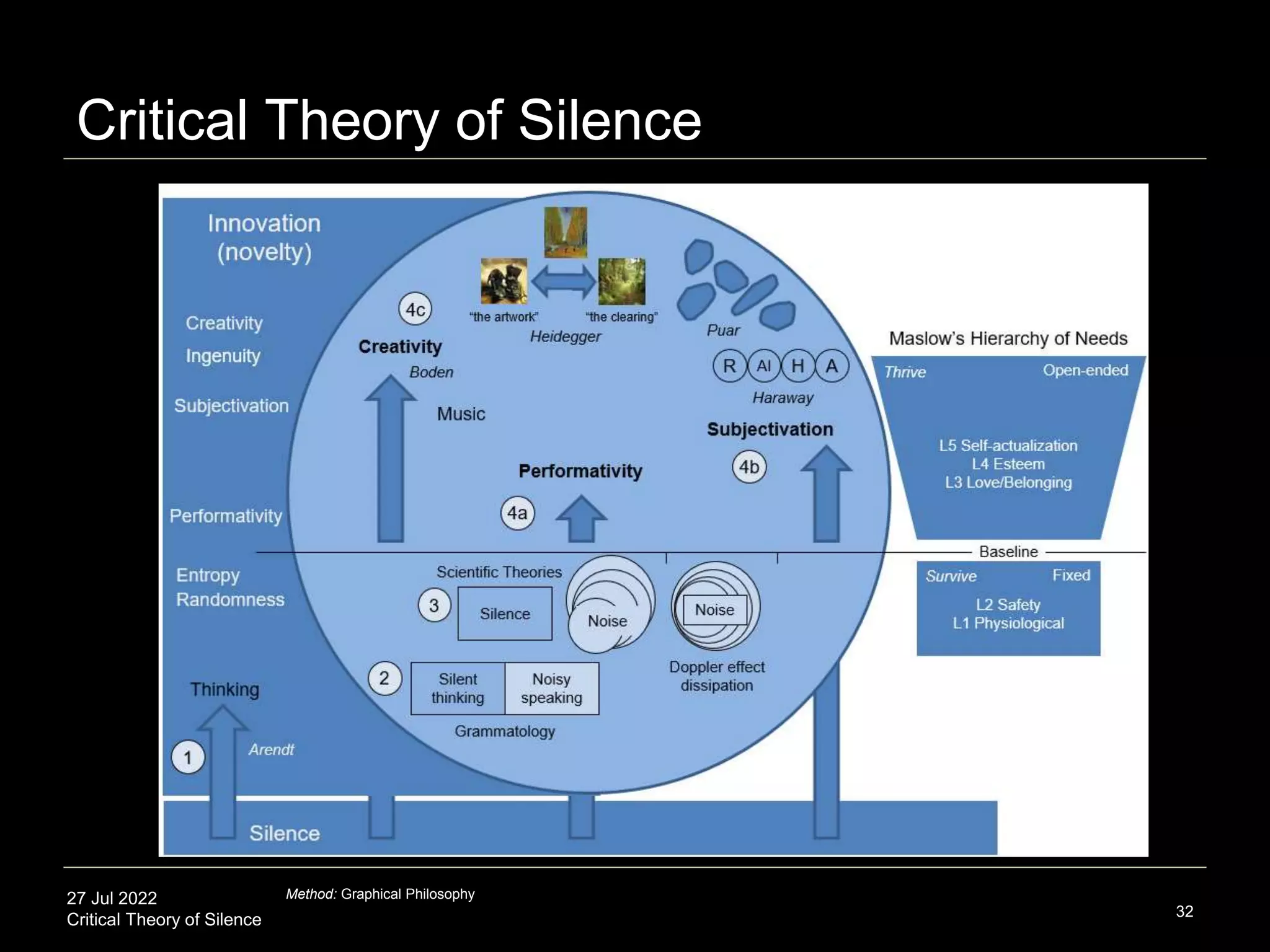
 Result: performativity and music constitute much larger
ontological domains than noise
 Noise individuates
within fixity
 Doppler effect
dissipates noise
 Music is creative
and open-ended
 Maslow tiers
 Baseline fixity
 Open-ended
performativity,
creativity
27 Jul 2022
Critical Theory of Silence
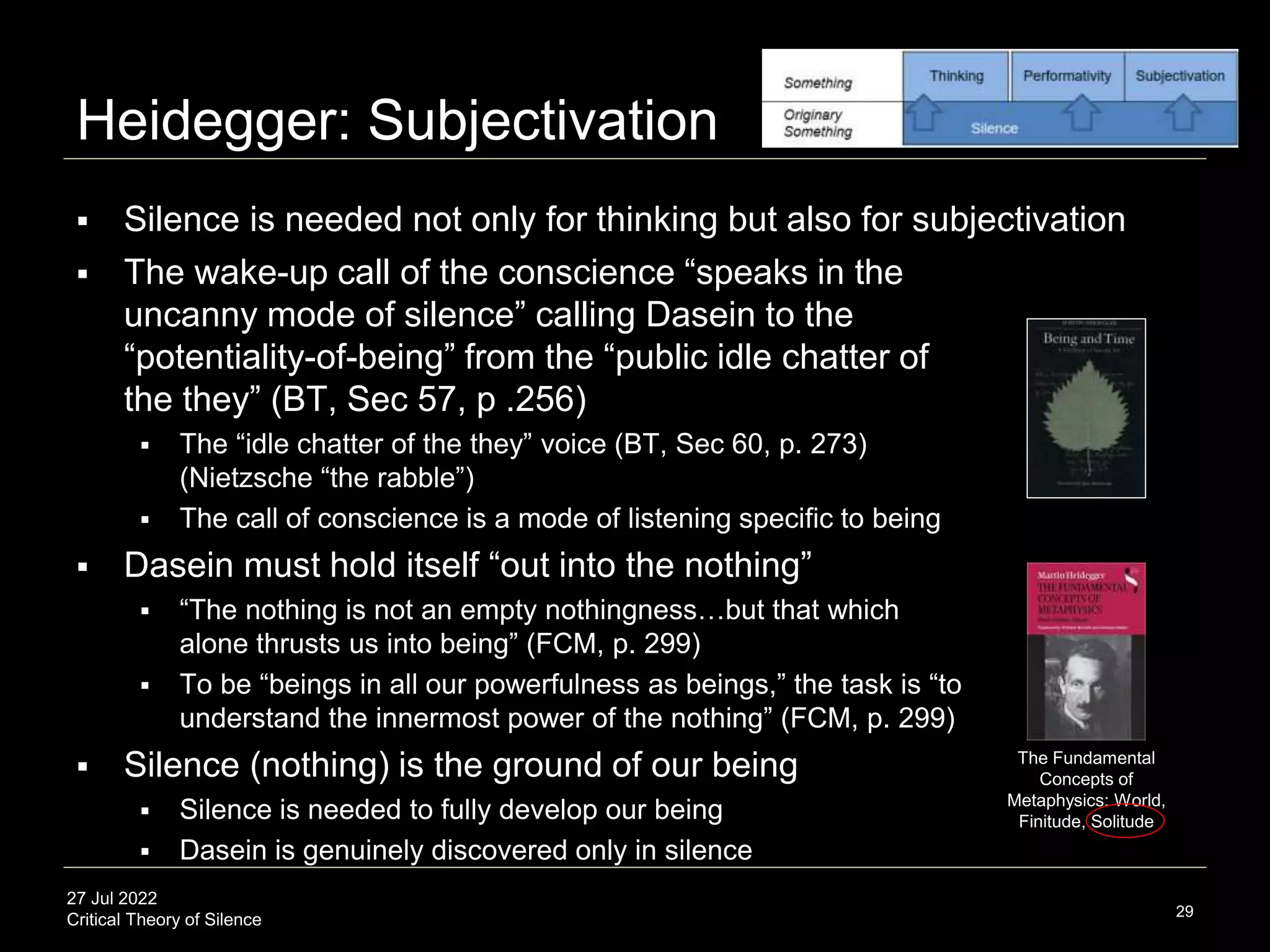
Heidegger: Subjectivation
29
 Silence is needed not only for thinking but also for subjectivation
 The wake-up call of the conscience “speaks in the
uncanny mode of silence” calling Dasein to the
“potentiality-of-being” from the “public idle chatter of
the they” (BT, Sec 57, p .256)
 The “idle chatter of the they” voice (BT, Sec 60, p. 273)
(Nietzsche “the rabble”)
 The call of conscience is a mode of listening specific to being
 Dasein must hold itself “out into the nothing”
 “The nothing is not an empty nothingness…but that which
alone thrusts us into being” (FCM, p. 299)
 To be “beings in all our powerfulness as beings,” the task is “to
understand the innermost power of the nothing” (FCM, p. 299)
 Silence (nothing) is the ground of our being
 Silence is needed to fully develop our being
 Dasein is genuinely discovered only in silence
The Fundamental
Concepts of
Metaphysics: World,
Finitude, Solitude
27 Jul 2022
Critical Theory of Silence
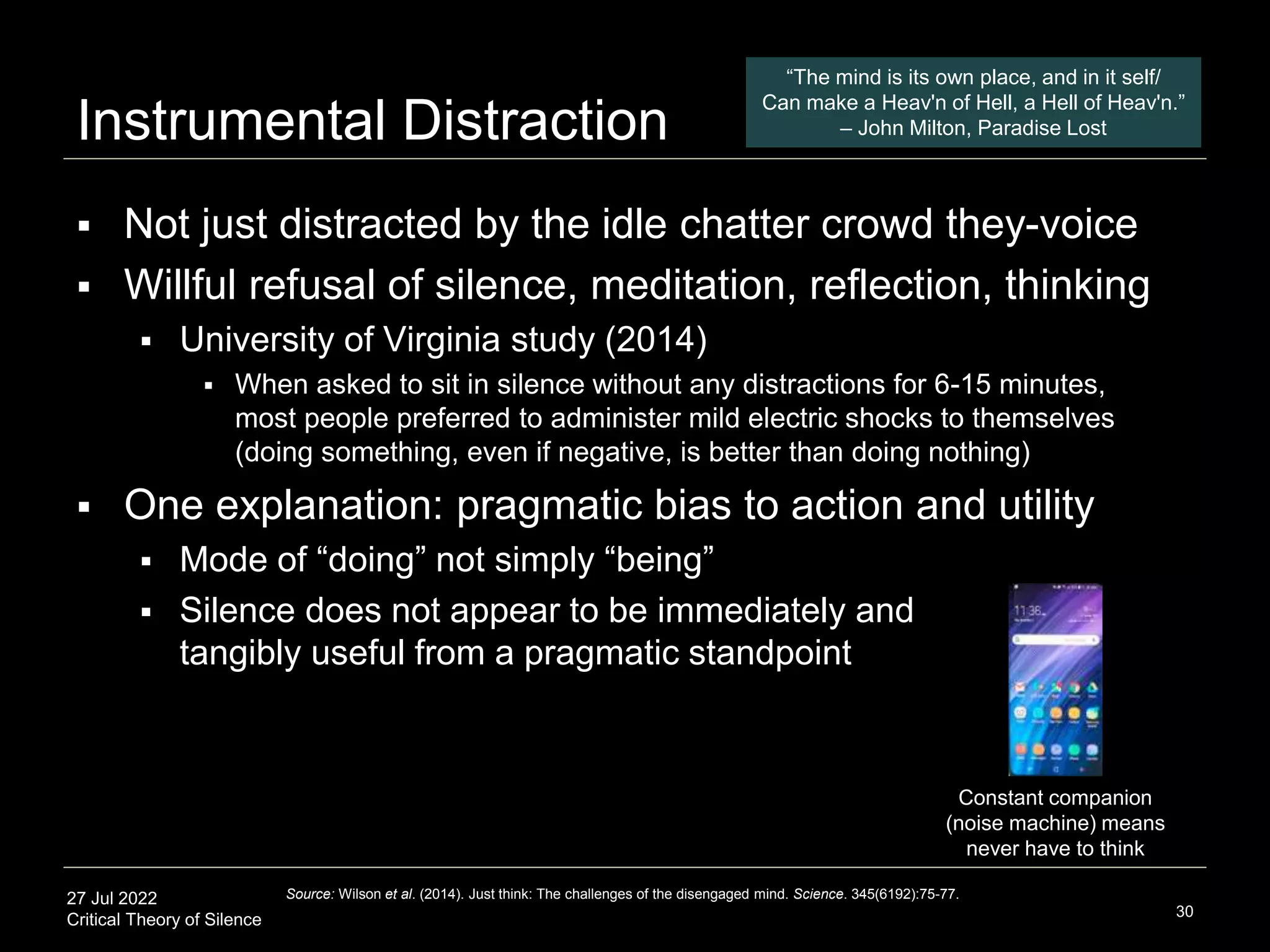
Instrumental Distraction
 Not just distracted by the idle chatter crowd they-voice
 Willful refusal of silence, meditation, reflection, thinking
 University of Virginia study (2014)
 When asked to sit in silence without any distractions for 6-15 minutes,
most people preferred to administer mild electric shocks to themselves
(doing something, even if negative, is better than doing nothing)
 One explanation: pragmatic bias to action and utility
 Mode of “doing” not simply “being”
 Silence does not appear to be immediately and
tangibly useful from a pragmatic standpoint
30
Source: Wilson et al. (2014). Just think: The challenges of the disengaged mind. Science. 345(6192):75-77.
Constant companion
(noise machine) means
never have to think
“The mind is its own place, and in it self/
Can make a Heav'n of Hell, a Hell of Heav'n.”
– John Milton, Paradise Lost
27 Jul 2022
Critical Theory of Silence
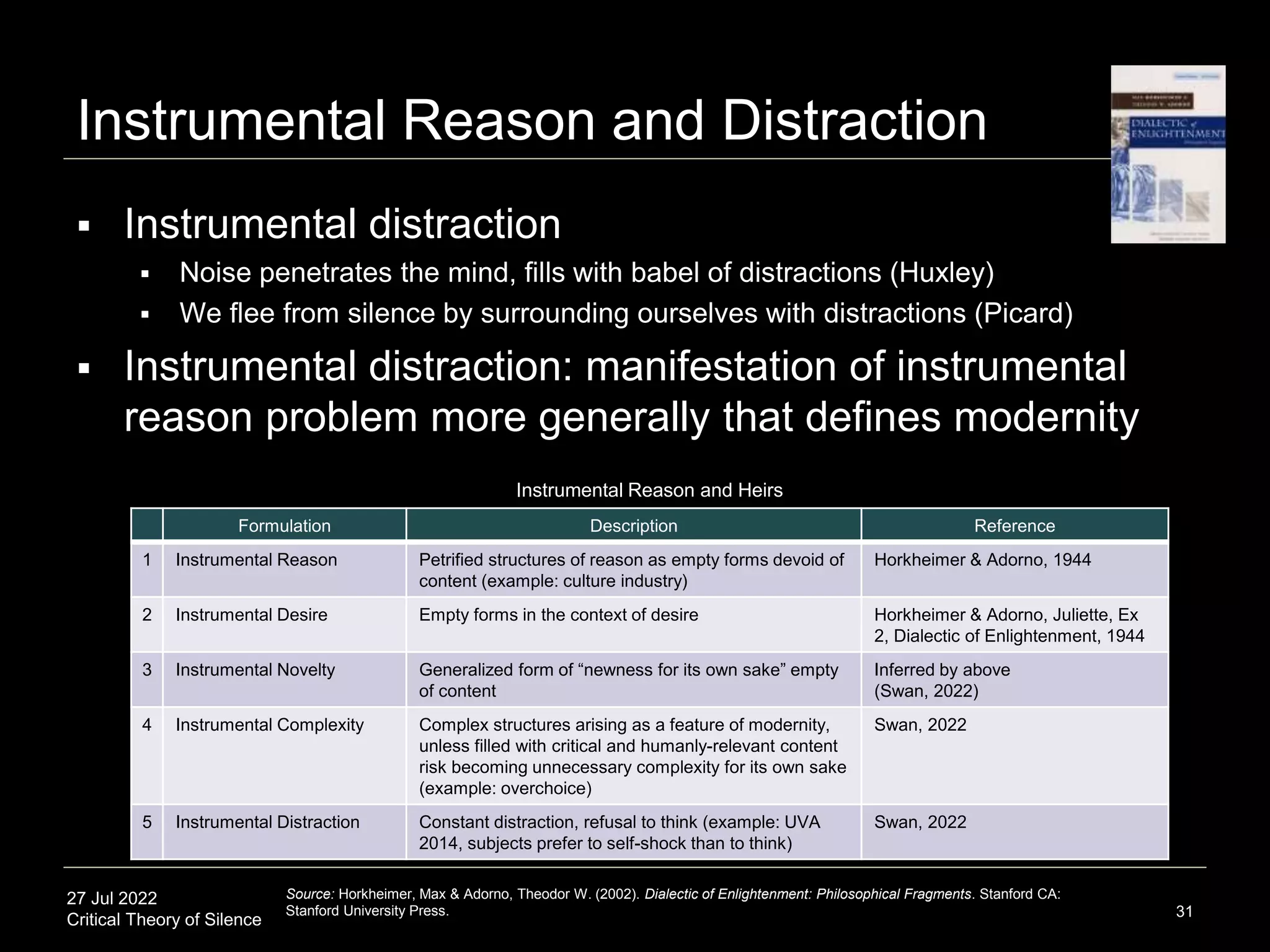
Instrumental Reason and Distraction
 Instrumental distraction
 Noise penetrates the mind, fills with babel of distractions (Huxley)
 We flee from silence by surrounding ourselves with distractions (Picard)
 Instrumental distraction: manifestation of instrumental
reason problem more generally that defines modernity
31
Instrumental Reason and Heirs
Formulation Description Reference
1 Instrumental Reason Petrified structures of reason as empty forms devoid of
content (example: culture industry)
Horkheimer & Adorno, 1944
2 Instrumental Desire Empty forms in the context of desire Horkheimer & Adorno, Juliette, Ex
2, Dialectic of Enlightenment, 1944
3 Instrumental Novelty Generalized form of “newness for its own sake” empty
of content
Inferred by above
(Swan, 2022)
4 Instrumental Complexity Complex structures arising as a feature of modernity,
unless filled with critical and humanly-relevant content
risk becoming unnecessary complexity for its own sake
(example: overchoice)
Swan, 2022
5 Instrumental Distraction Constant distraction, refusal to think (example: UVA
2014, subjects prefer to self-shock than to think)
Swan, 2022
Source: Horkheimer, Max & Adorno, Theodor W. (2002). Dialectic of Enlightenment: Philosophical Fragments. Stanford CA:
Stanford University Press.
27 Jul 2022
Critical Theory of Silence
32
Method: Graphical Philosophy
27 Jul 2022
Critical Theory of Silence
Heidegger: Artwork
33
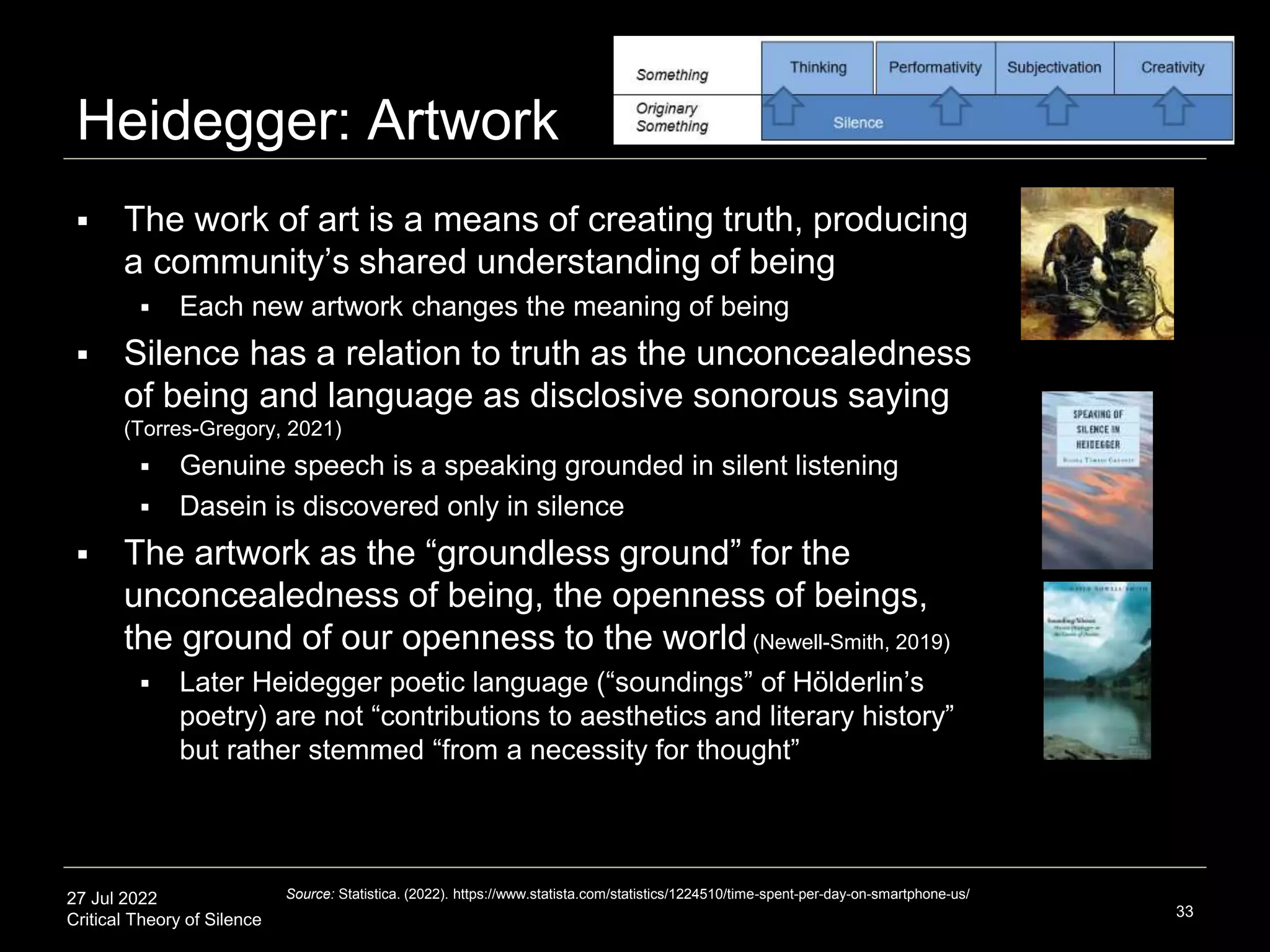
 The work of art is a means of creating truth, producing
a community’s shared understanding of being
 Each new artwork changes the meaning of being
 Silence has a relation to truth as the unconcealedness
of being and language as disclosive sonorous saying
(Torres-Gregory, 2021)
 Genuine speech is a speaking grounded in silent listening
 Dasein is discovered only in silence
 The artwork as the “groundless ground” for the
unconcealedness of being, the openness of beings,
the ground of our openness to the world (Newell-Smith, 2019)
 Later Heidegger poetic language (“soundings” of Hölderlin’s
poetry) are not “contributions to aesthetics and literary history”
but rather stemmed “from a necessity for thought”
Source: Statistica. (2022). https://www.statista.com/statistics/1224510/time-spent-per-day-on-smartphone-us/
27 Jul 2022
Critical Theory of Silence
Contemporary: Visual Silence
34
Source: Taylor, Mark. C. (2020). Seeing Silence. Chicago: University of Chicago Press.
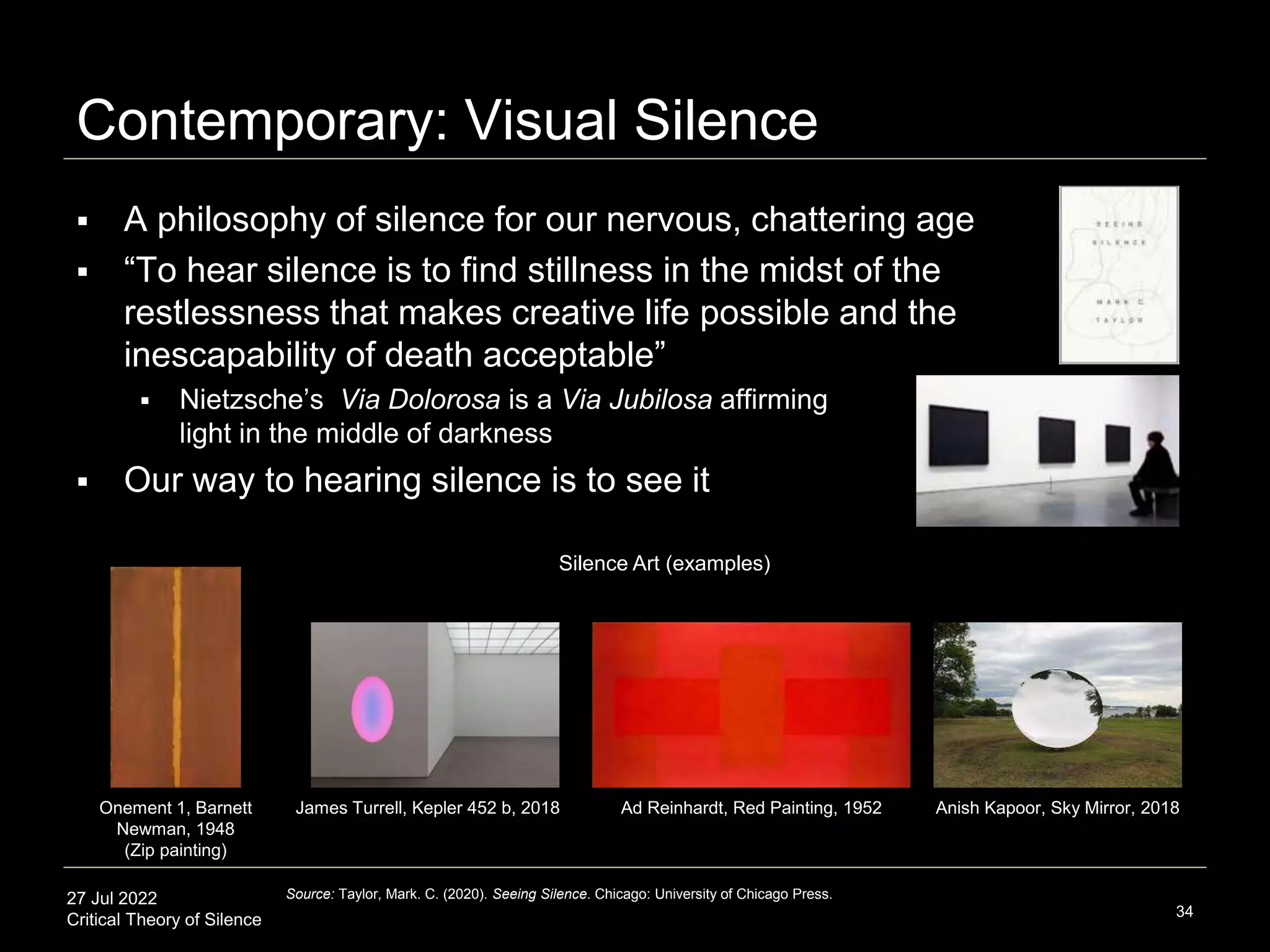
 A philosophy of silence for our nervous, chattering age
 “To hear silence is to find stillness in the midst of the
restlessness that makes creative life possible and the
inescapability of death acceptable”
 Nietzsche’s Via Dolorosa is a Via Jubilosa affirming
light in the middle of darkness
 Our way to hearing silence is to see it
Onement 1, Barnett
Newman, 1948
(Zip painting)
Anish Kapoor, Sky Mirror, 2018
Silence Art (examples)
James Turrell, Kepler 452 b, 2018 Ad Reinhardt, Red Painting, 1952
27 Jul 2022
Critical Theory of Silence
Philosophy of Creativity
 Conceptual Space (possibility space): a space where
the possible concepts exist, some of which have been
explored and some are yet to be discovered
 H-Creativity (historical creativity): new discovery in the world
 P-Creativity (personal creativity): new discovery for you
 Three kinds of creativity
1. Combinational Creativity
 Two or more existing ideas joined in a novel association
2. Exploratory Creativity
 Free exploration of the unplumbed regions of concept space
3. Transformational Creativity (highest level)
 A new idea is found outside of the original conceptual space,
thus changing the shape of the concept space itself
35
Source: Boden, Margaret A. (2004). The Creative Mind: Myths and Mechanisms. London: Routledge.
27 Jul 2022
Critical Theory of Silence
Conceptual Space of Creativity
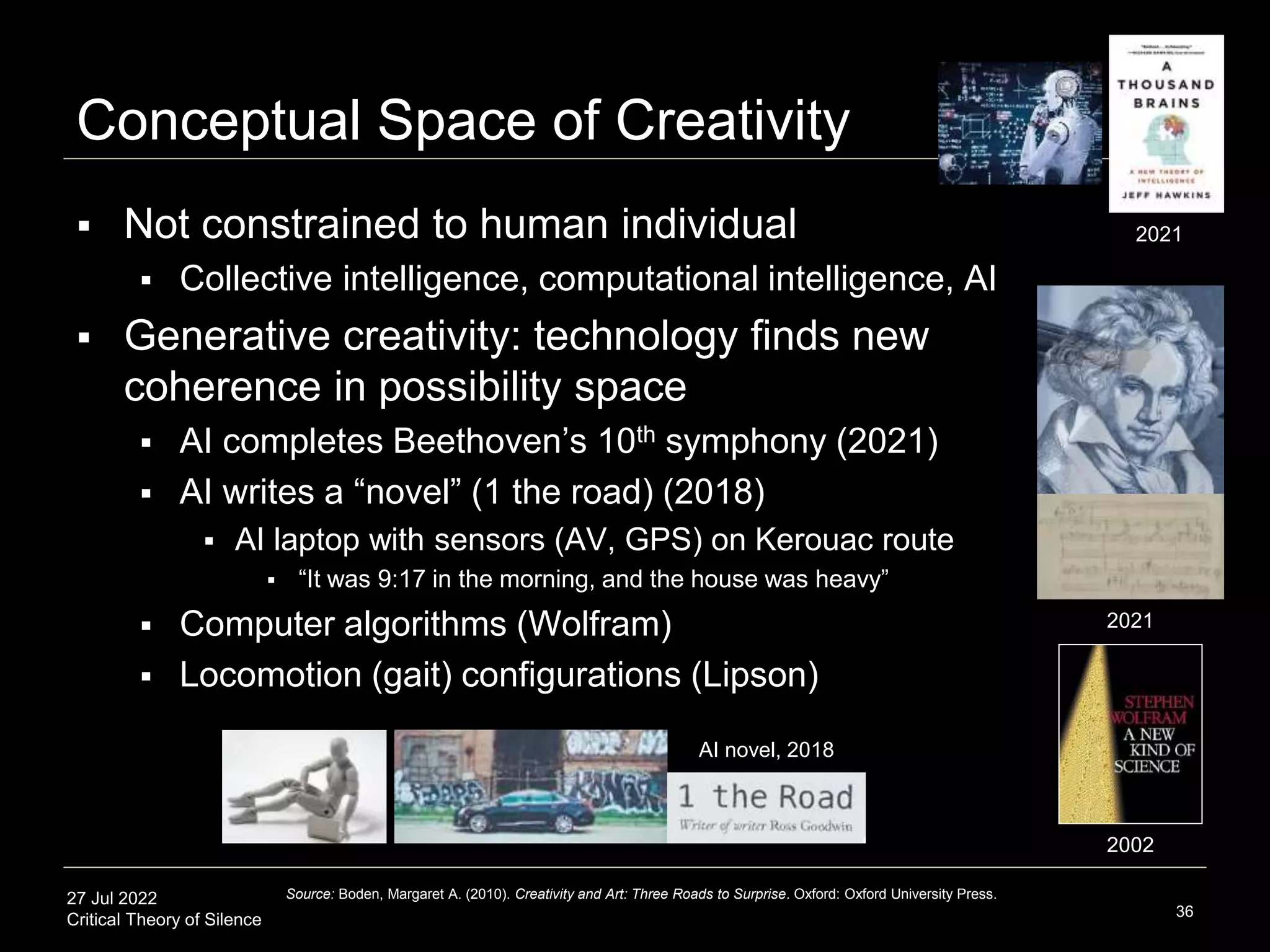
 Not constrained to human individual
 Collective intelligence, computational intelligence, AI
 Generative creativity: technology finds new
coherence in possibility space
 AI completes Beethoven’s 10th symphony (2021)
 AI writes a “novel” (1 the road) (2018)
 AI laptop with sensors (AV, GPS) on Kerouac route
 “It was 9:17 in the morning, and the house was heavy”
 Computer algorithms (Wolfram)
 Locomotion (gait) configurations (Lipson)
36
Source: Boden, Margaret A. (2010). Creativity and Art: Three Roads to Surprise. Oxford: Oxford University Press.
AI novel, 2018
2021
2021
2002
27 Jul 2022
Critical Theory of Silence
Silent Meditation
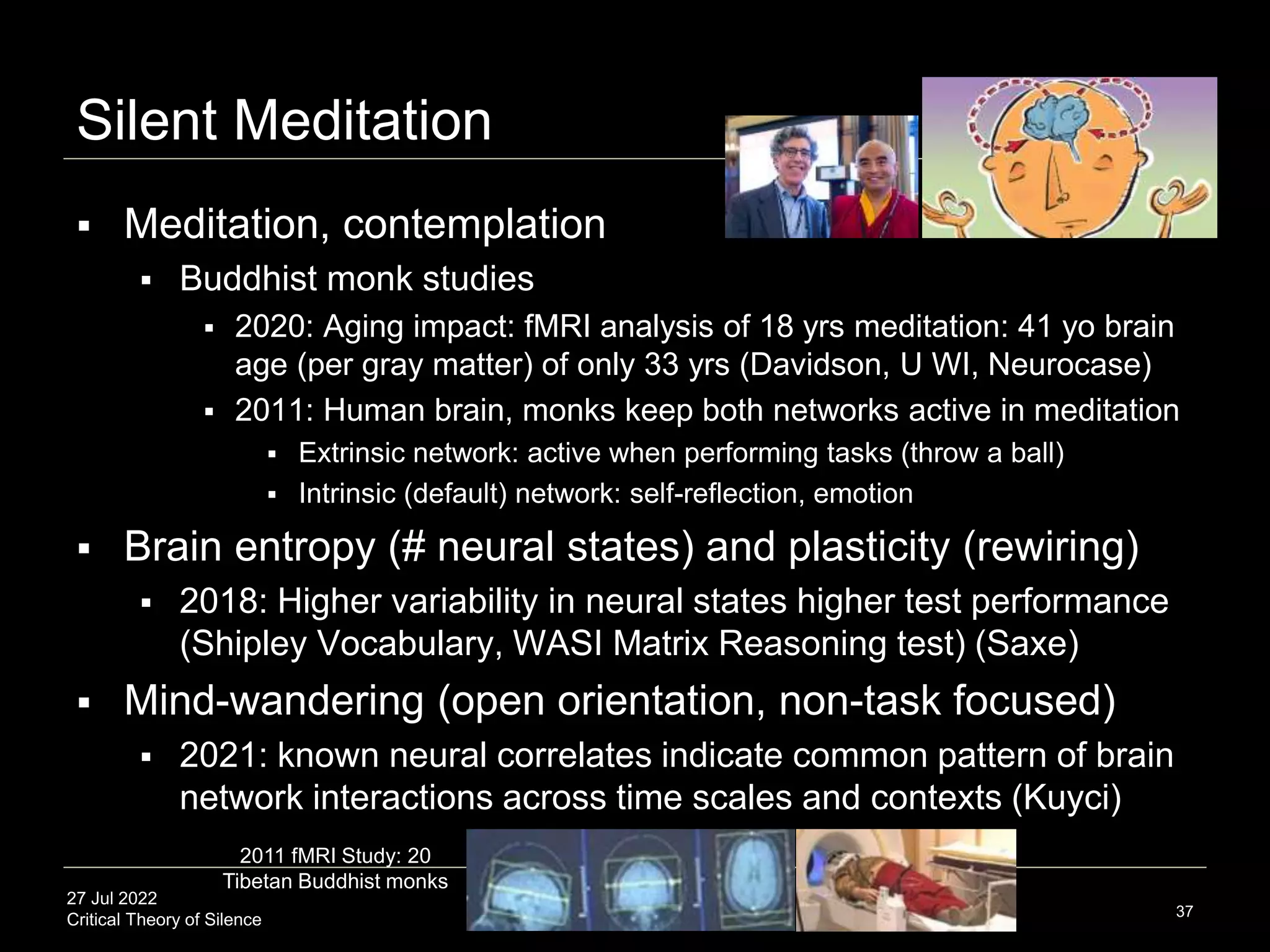
 Meditation, contemplation
 Buddhist monk studies
 2020: Aging impact: fMRI analysis of 18 yrs meditation: 41 yo brain
age (per gray matter) of only 33 yrs (Davidson, U WI, Neurocase)
 2011: Human brain, monks keep both networks active in meditation
 Extrinsic network: active when performing tasks (throw a ball)
 Intrinsic (default) network: self-reflection, emotion
 Brain entropy (# neural states) and plasticity (rewiring)
 2018: Higher variability in neural states higher test performance
(Shipley Vocabulary, WASI Matrix Reasoning test) (Saxe)
 Mind-wandering (open orientation, non-task focused)
 2021: known neural correlates indicate common pattern of brain
network interactions across time scales and contexts (Kuyci)
37
2011 fMRI Study: 20
Tibetan Buddhist monks
27 Jul 2022
Critical Theory of Silence
Agenda
 Philosophy of silence
 Critical silence as grammatology
 Silent thinking vs noisy speaking; silence-noise
 Critical silence via scientific theories of noise
 Entropy, signal-to-noise
 Critical silence and thinking
 Performativity, subjectivation, creativity
 Conclusion
38
27 Jul 2022
Critical Theory of Silence
39
Method: Graphical Philosophy
27 Jul 2022
Critical Theory of Silence
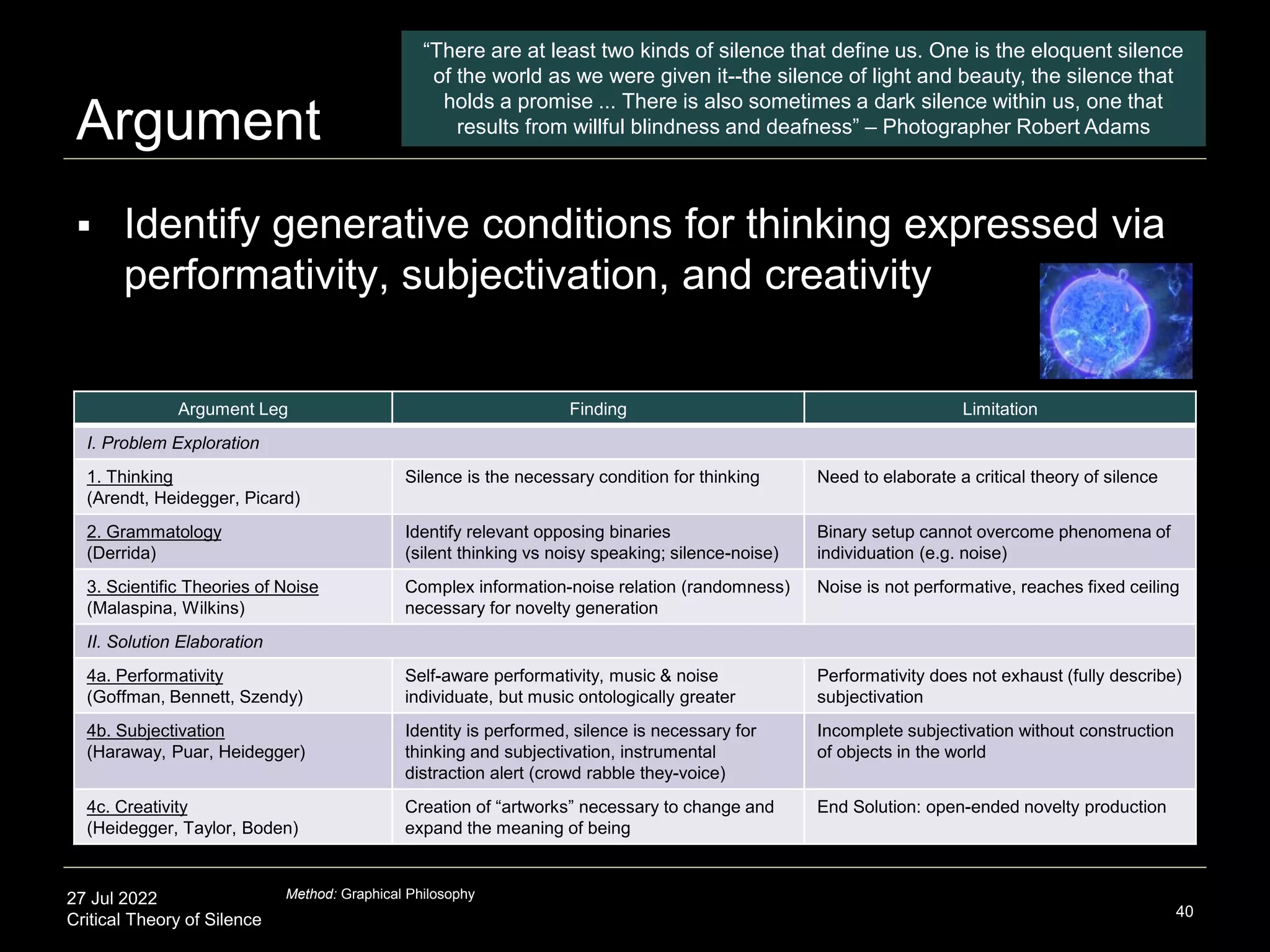
Argument
40
 Identify generative conditions for thinking expressed via
performativity, subjectivation, and creativity
Argument Leg Finding Limitation
I. Problem Exploration
1. Thinking
(Arendt, Heidegger, Picard)
Silence is the necessary condition for thinking Need to elaborate a critical theory of silence
2. Grammatology
(Derrida)
Identify relevant opposing binaries
(silent thinking vs noisy speaking; silence-noise)
Binary setup cannot overcome phenomena of
individuation (e.g. noise)
3. Scientific Theories of Noise
(Malaspina, Wilkins)
Complex information-noise relation (randomness)
necessary for novelty generation
Noise is not performative, reaches fixed ceiling
II. Solution Elaboration
4a. Performativity
(Goffman, Bennett, Szendy)
Self-aware performativity, music & noise
individuate, but music ontologically greater
Performativity does not exhaust (fully describe)
subjectivation
4b. Subjectivation
(Haraway, Puar, Heidegger)
Identity is performed, silence is necessary for
thinking and subjectivation, instrumental
distraction alert (crowd rabble they-voice)
Incomplete subjectivation without construction
of objects in the world
4c. Creativity
(Heidegger, Taylor, Boden)
Creation of “artworks” necessary to change and
expand the meaning of being
End Solution: open-ended novelty production
Method: Graphical Philosophy
“There are at least two kinds of silence that define us. One is the eloquent silence
of the world as we were given it--the silence of light and beauty, the silence that
holds a promise ... There is also sometimes a dark silence within us, one that
results from willful blindness and deafness” – Photographer Robert Adams
27 Jul 2022
Critical Theory of Silence 41
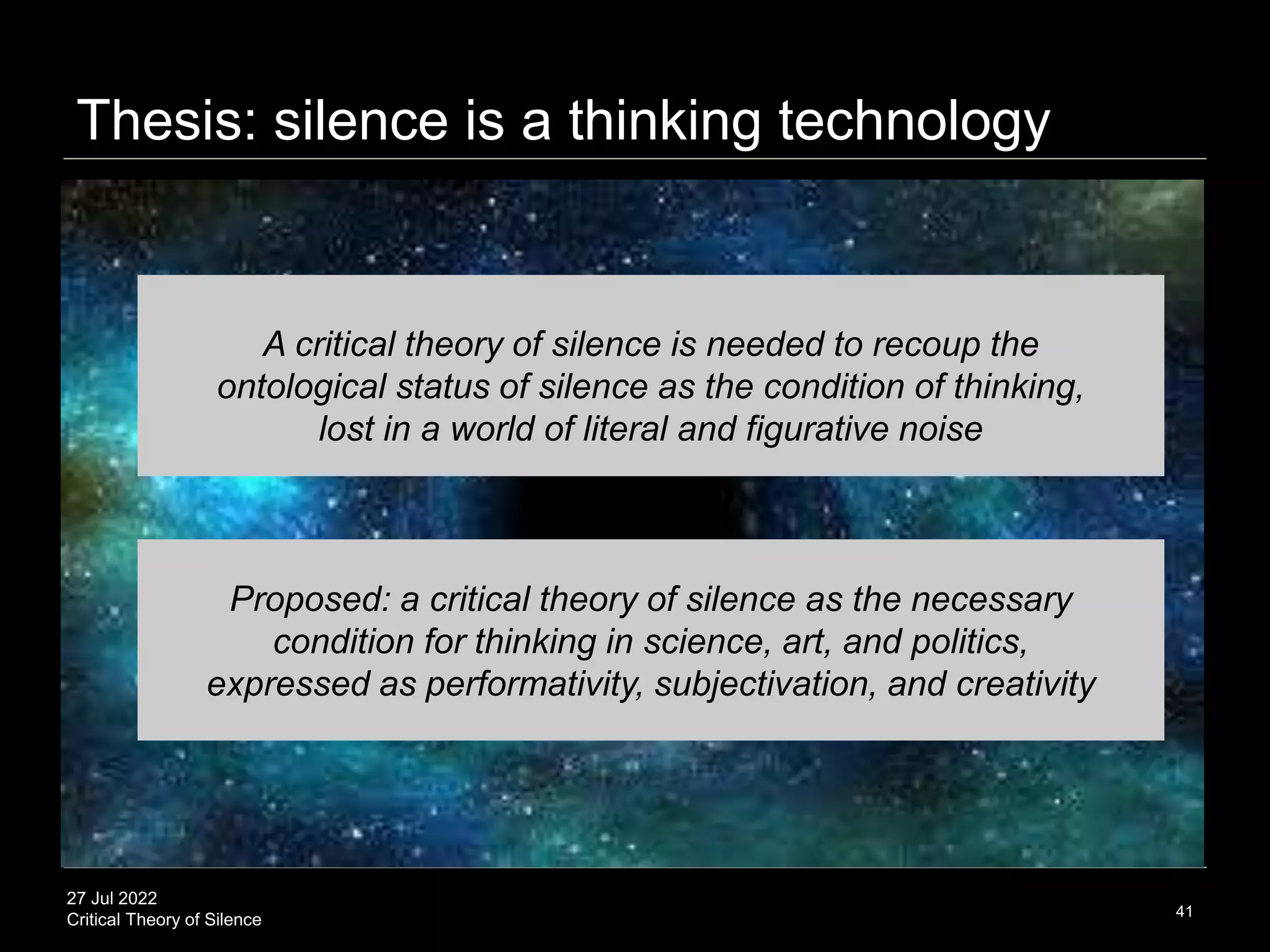
Proposed: a critical theory of silence as the necessary
condition for thinking in science, art, and politics,
expressed as performativity, subjectivation, and creativity
Thesis: silence is a thinking technology
A critical theory of silence is needed to recoup the
ontological status of silence as the condition of thinking,
lost in a world of literal and figurative noise
27 Jul 2022
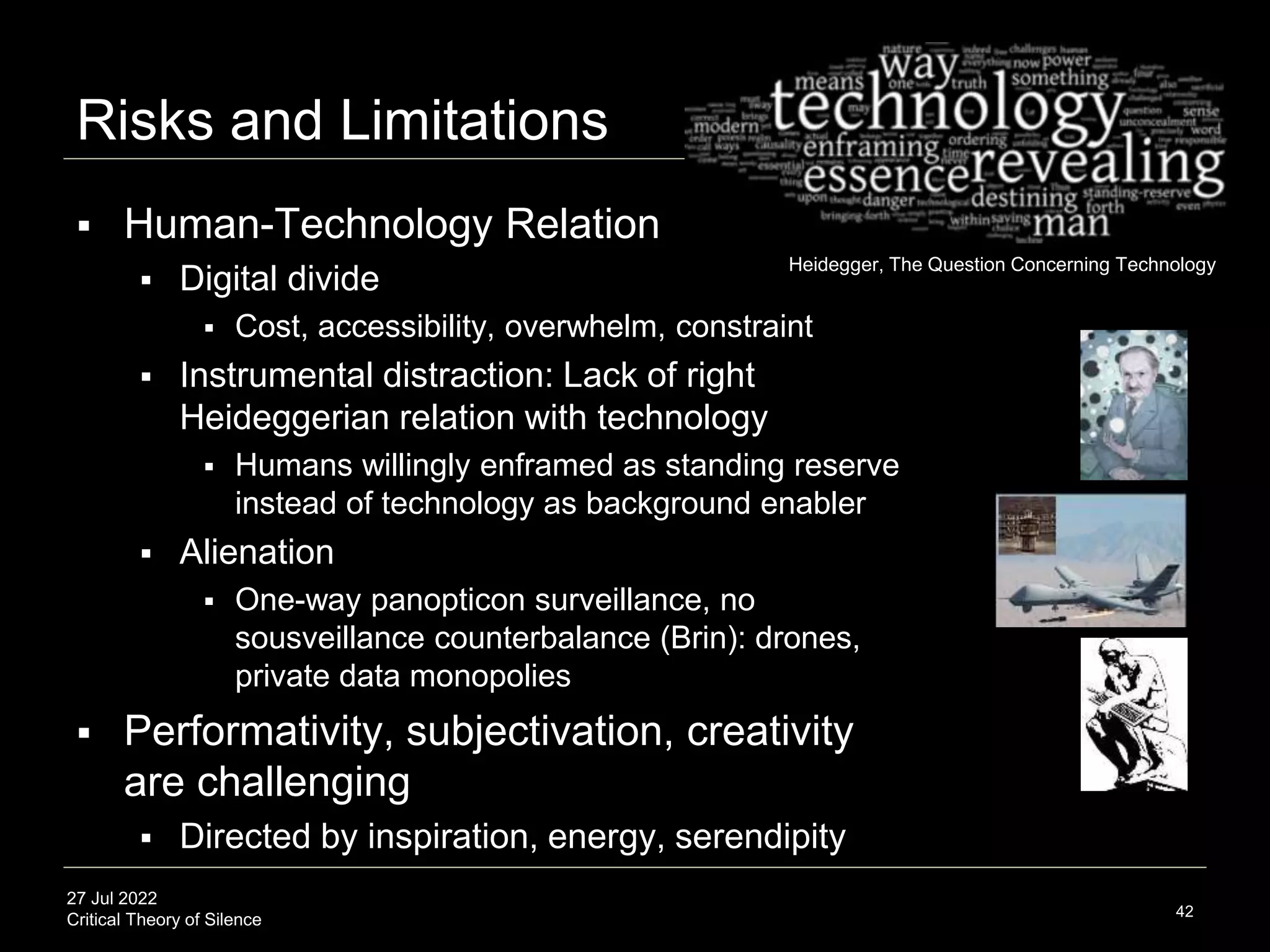
Critical Theory of Silence
Risks and Limitations
42
 Human-Technology Relation
 Digital divide
 Cost, accessibility, overwhelm, constraint
 Instrumental distraction: Lack of right
Heideggerian relation with technology
 Humans willingly enframed as standing reserve
instead of technology as background enabler
 Alienation
 One-way panopticon surveillance, no
sousveillance counterbalance (Brin): drones,
private data monopolies
 Performativity, subjectivation, creativity
are challenging
 Directed by inspiration, energy, serendipity
Heidegger, The Question Concerning Technology
Grammatology and Performativity:
A Critical Theory of Silence
Tacet ad Libitum: Poetics & Politics of Silence
Münster Germany 27 Jul 2022
Slides: http://slideshare.net/LaBlogga
Melanie Swan, PhD
University College London
Landscape with the Fall of Icarus, Bruegel the Elder, 1560
vielen Dank, Fragen?
The silence of the spheres
or the music of the spheres?
27 Jul 2022
Critical Theory of Silence
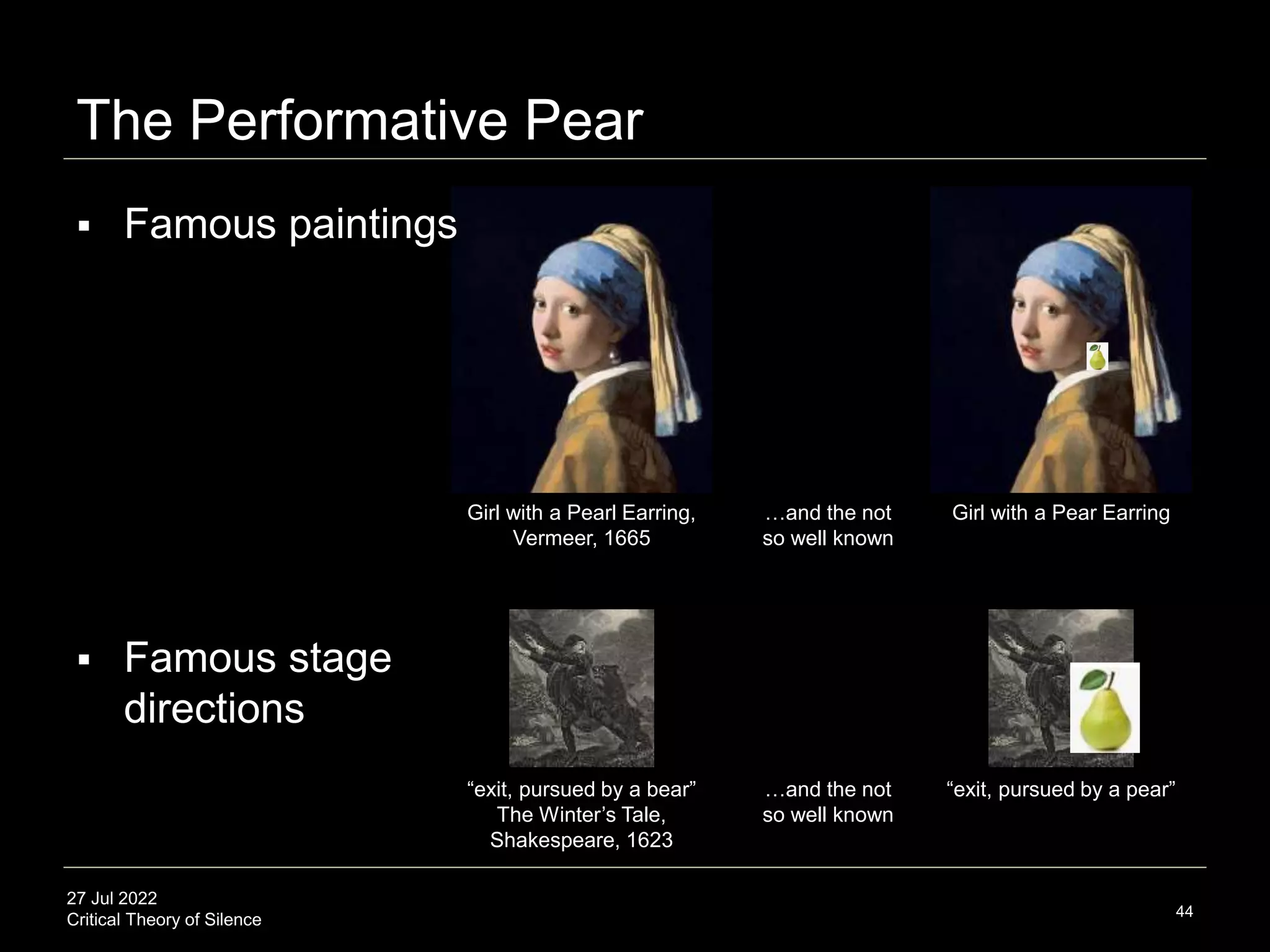
The Performative Pear
44
Girl with a Pearl Earring,
Vermeer, 1665
Girl with a Pear Earring
…and the not
so well known
 Famous paintings
 Famous stage
directions
“exit, pursued by a bear”
The Winter’s Tale,
Shakespeare, 1623
“exit, pursued by a pear”
…and the not
so well known

Critical Theory of Silence

  • 1.
    Grammatology and Performativity: ACritical Theory of Silence Tacet ad Libitum: Poetics & Politics of Silence Münster Germany 27 Jul 2022 Slides: http://slideshare.net/LaBlogga Melanie Swan, PhD University College London “Outside there was silence, as there is and has been and always should be. The perfect silence of the spheres.” - Elizabeth Bear, Ancestral Night, 2019, p. 384 Landscape with the Fall of Icarus, Bruegel the Elder, 1560
  • 2.
    27 Jul 2022 CriticalTheory of Silence 1 A critical theory of silence is needed to recoup the ontological status of silence as the condition of thinking, lost in a world of literal and figurative noise Thesis: silence is a thinking technology
  • 3.
    27 Jul 2022 CriticalTheory of Silence Argument Overview 2  Identify generative conditions for thinking expressed via performativity, subjectivation, and creativity Argument Leg Finding Limitation I. Problem Exploration 1. Thinking (Arendt, Heidegger, Picard) Silence is the necessary condition for thinking Need to elaborate a critical theory of silence 2. Grammatology (Derrida) Identify relevant opposing binaries (silent thinking vs noisy speaking; silence-noise) Binary setup cannot overcome phenomena of individuation (e.g. noise) 3. Scientific Theories of Noise (Malaspina, Wilkins) Complex information-noise relation (randomness) necessary for novelty generation Noise is not performative, reaches fixed ceiling II. Solution Elaboration 4a. Performativity (Goffman, Bennett, Szendy) Self-aware performativity, music & noise individuate, but music ontologically greater Performativity does not exhaust (fully describe) subjectivation 4b. Subjectivation (Haraway, Puar, Heidegger) Identity is performed, silence is necessary for thinking and subjectivation, instrumental distraction alert (crowd rabble they-voice) Incomplete subjectivation without construction of objects in the world 4c. Creativity (Heidegger, Taylor, Boden) Creation of “artworks” necessary to change and expand the meaning of being End Solution: open-ended novelty production Method: Graphical Philosophy
  • 4.
    27 Jul 2022 CriticalTheory of Silence Critical Theory of Silence 3 Method: Graphical Philosophy
  • 5.
    27 Jul 2022 CriticalTheory of Silence Agenda  Philosophy of silence  Critical silence as grammatology  Silent thinking vs noisy speaking; silence-noise  Critical silence via scientific theories of noise  Entropy, signal-to-noise  Critical silence and thinking  Performativity, subjectivation, creativity  Conclusion 4
  • 6.
    27 Jul 2022 CriticalTheory of Silence Philosophy of Silence 5  Is silence a nothing or a something?  There is nothing (silence) and there is something (music, noise)  The bigger question is why there is “something” (order, structure) in the universe and not just “nothing”  Given the limitless variety of ways in which matter and energy can arrange themselves, almost all of which would be “random,” the fact that the physical world is a coherent collection of mutually tolerant, quasi-stable entities is surely a key scientific fact in need of explanation (astrophysicist Paul Davies, p. 16)  Not just nothing-something, but something is simplicity-complexity  The vexing scientific mystery that pervades the universe is the peculiar conjunction of simplicity and complexity (Ibid.) Source: Davies, P.C.W. (1992). Why is the physical world so comprehensible? CTNS Bulletin. 12(2):16-21.
  • 7.
    27 Jul 2022 CriticalTheory of Silence Philosophy of Silence  Silence is originary not derived (Heidegger, Picard, Goethe)  Silence is an ontologically free-standing something  Silence is not the absence of noise  (Deleuze parallel): difference is not the opposite of identity, difference is its own standalone ontological entity  “Silence puts humanity to the test”  We flee from it by surrounding ourselves with distractions  The necessity of silence is a very deep matter  Silence take us back to the beginning of things  We leave behind “the merely derived phenomena” with which we normally live 6 Source: Picard, Max. (1989). The World of Silence. Trans. S. Godwin. Chicago: Regnery. (influences: Heidegger, Rilke, Hölderlin)
  • 8.
    27 Jul 2022 CriticalTheory of Silence Arendt  Silence is the medium in which thinking takes place 7  Propaganda (The Origins of Totalitarianism, 1951)  Totalitarian regimes prevent silence with propaganda  Constant propaganda broadcast 24/7 so no possible silence in your own home, in your own mind  24-hour news cycle, doom-scrolling, social media (self-administered propaganda)  Vita activa (The Human Condition, 1958)  Three activities of the active life: labor, work, action  Action: interstitial relation between political subjects  Theory of novelty: invent and realize new ideas  Publicly in political deliberation  Vita contemplativa (The Life of the Mind, 1978)  Three fundamental faculties of the contemplative life: thinking, willing, judging “Silence is the sleep that nourishes wisdom” – Frances Bacon “Night is … the silence of the book” – Blanchot
  • 9.
    27 Jul 2022 CriticalTheory of Silence Grammatology of Silence 8  Grammatology project: develop a science of writing  Unclear which began first, speech or writing, so cannot privilege speech  Speech and writing are part of the larger category of language (thinking)  Deconstruction: emphasis the opposition in hierarchical binaries  “divine law/human law, family/city, woman/man, night/day” (Glas, p. 142a)  Différance: the difference and deferral of meaning  Meaning is produced in the interstitial relations between terms  Any “text” (a literary text, artwork, person, or governing state) is always open to re-reading and re-writing in new assignations of meaning Silent thinking Noisy speaking Silence Silence Signal Thinking Speaking Noise Noise Noise Speech Writing Language Deconstruction: Identify Binaries Deconstruction: Binaries reveal the context of a bigger third position Deconstruction: Move Beyond the Binary Source: Derrida, J. (1968). Of Grammatology. Trans. Spivak. (ch 2).
  • 10.
    27 Jul 2022 CriticalTheory of Silence History of Noise: Italian Futurism (positive)  Marinetti, 1909, Manifesto of Futurism, Noise Music  Noise as a sign of modernity  Russolo, 1913, The Art of Noises  Musical aesthetics  Intonarumori: automated instruments that generate acoustic noise (engaged by Cage)  Futurism  Esprit of modernity  Celebration of machines, speed, automation, movement, dynamism, energy, noise 9 Severini, 1912, Dynamic Hieroglyphic of the Bal Tabarin Boccioni, 1910, The City Rises; 1913, Unique Forms of Continuity in Space
  • 11.
    27 Jul 2022 CriticalTheory of Silence Problem of Noise 10 “The twentieth century is, among other things, the Age of Noise. Physical noise, mental noise and noise of desire — we hold history’s record for all of them. And no wonder; for all the resources of our almost miraculous technology have been thrown into the current assault against silence. That most popular and influential of all recent inventions, the radio, is nothing but a conduit through which pre-fabricated din can flow into our homes. And this din goes far deeper, of course, than the ear-drums. It penetrates the mind, filling it with a babel of distractions – news items, mutually irrelevant bits of information, blasts of corybantic or sentimental music, continually repeated doses of drama that bring no catharsis, but merely create a craving for daily or even hourly emotional enemas. And where, as in most countries, the broadcasting stations support themselves by selling time to advertisers, the noise is carried from the ears, through the realms of phantasy, knowledge and feeling to the ego’s central core of wish and desire.” – Aldous Huxley, The Age of Noise, 1945
  • 12.
    27 Jul 2022 CriticalTheory of Silence Problem of Visual Noise (the image) 11 Source: Szendy interview: https://www.domusweb.it/en/art/gallery/2020/03/13/are-we-producing-way-too-many-images-the-dark- side-of-the-visible-in-exhibition-in-paris.html Hawkes, 2020 Today, “noise” is primarily visual “We live in a world that is increasingly saturated with images. Each day more than three billion images are shared on social networks. The space of visibility seems to be literally inundated with a huge number of images, making any other form of communication irrelevant. – Savio Interview with Peter Szendy, 2020 The problem is not only the pervasiveness of the image but its complete lack of an ethics of representation – Hawkes, 2020
  • 13.
    27 Jul 2022 CriticalTheory of Silence 12 “In recent years noise seems to have become an interdisciplinary concept par excellence, apt to capture important dynamics at work whether in technological, scientific, social or aesthetic domains” – Iain Campbell, Radical Philosophy, 2020 Philosophy of Noise Noise as art, music, cultural or digital practice as an unexpected means of intervening Reverberations: The Philosophy, Aesthetics and Politics of Noise. (2012). Ed. Michael Goddard, Benjamin Halligan & Paul Hegarty. New York: Continuum.
  • 14.
    27 Jul 2022 CriticalTheory of Silence Philosophy of Silence 13 Source: Hall, Suzi. (2018). Edmond Jabès’s ‘Infinite’, ‘Exploded’ Book. PhD Thesis Flinders University.  The Book of Questions, Jabès (French-Egyptian philosopher), 1976  The silence  What unites us is the silence; the long asides in a private conversation of the sand with the sand  The void  The neutral is, in a way, the nerve at the heart of the problem. To undo the neutral; to push back to infinity the frontiers of solitude. […] Unconditional presence, absence. Everywhere, always the same void  The pause  Blanchot distinguishes as more of a disjunct; it is a silence that introduces waiting, which measures the distance between two speakers (the irreducible distance, not the reducible distance)
  • 15.
    27 Jul 2022 CriticalTheory of Silence Agenda  Philosophy of silence  Critical silence as grammatology  Silent thinking vs noisy speaking; silence-noise  Critical silence via scientific theories of noise  Entropy, signal-to-noise  Critical silence and thinking  Performativity, subjectivation, creativity  Conclusion 14 Scientific Theories of Noise
  • 16.
    27 Jul 2022 CriticalTheory of Silence Scientific Conceptualizations of Noise  Scientific definitions of noise in thermodynamics, information theory, cybernetics, biology, and communications  Malaspina: noise = information, novelty (embrace uncertainty)  Wilkins: noise = randomness (warning re: manipulate/fetishize uncertainty) 15 Sources: Shannon, C.E. (1948). A Mathematical Theory of Communication. Bell System Technical Journal. 27:379–423. Schuster, T. et al. (2021). Many-body quantum teleportation via operator spreading in the traversable wormhole protocol. arXiv:2102.00010v1. Information entropy Physical entropy Messy Desk: tendency of systems to become disordered over time  Entropy  Measure of uncertainty in a system  Shannon entropy (1951)  Minimum # of bits (qubits) to send a message (information-noise)  Total bits to send information given noise (signal-to-noise/error ratio)  (Quantum) information entropy  Number of subsystem microstates and interrelatedness  # microarrangements of a system Communications Channel: total bits to send Signal-to-Noise Ratio
  • 17.
    27 Jul 2022 CriticalTheory of Silence Epistemology of Noise  Ontological interrelation of information and noise  Implication: information societies are noise societies  Argument: cannot simply reduce or dismiss noise  Cannot reduce noise to error, disorder, disorganization  The very ground of the interrelation between information and noise is the source of individuation and liberation  ‘information entropy’ can be evaluated positively as ‘freedom of choice’ that augments the quantity of information while also augmenting uncertainty, or negatively, when information is on the contrary defined as negation of entropy, as negentropy, by pitting information as reduction of uncertainty against both ‘information entropy’ and noise (p. 182)  Result: information-noise relation is the source of novelty  Novelty is individuation  Implication for Critical Theory of Noise  Not simply binary (thinking-speaking, information-noise)  Process with degrees of gradation, individuation  Suggests emergent order (chaos) (order, disorder, chaos) 16 Source: Malaspina, Cecile. (2018). An Epistemology of Noise. London: Bloomsbury Academic.
  • 18.
    27 Jul 2022 CriticalTheory of Silence Noise as Randomness  Any complex dynamic system (cognition, markets) has noise (randomness) as an intrinsic functional aspect  Argument: need to describe noise at multiple levels  Neuro-phenomenological explanation of noise  The use of noise (randomness) in music (aesthetics)  Warn: politics manipulates probability and fetishizes indeterminacy  Context: philosophies of randomness  Black Swan (Taleb): market returns are not normally distributed (as in Black Scholes Nobel prize-winning formula), but can use fat-tailed distributions to reduce “black swans” to “gray swans”  Black swan: a rare event, occurs more frequently than we think  Blank Swan (Ayache): future prices are fundamentally unknowable, hence no attempt should be made to predict them (contingency is the only necessity (Meillassoux))  Black swan: vehicle for changing context 17 Source: Wilkins, Inigo. (2017). Irreversible Noise: The Rationalization of Randomness and the Fetishization of Indeterminacy. London: Urbanomic. 2007 2006 2010 Black swan: just because you have not seen a black swan does not mean they do not exist; aka rare events happen more frequently than thought
  • 19.
    27 Jul 2022 CriticalTheory of Silence Order, Disorder, Chaos  Order (arrangement), disorder (confusion), chaos (self-organization: confusion gives way to order)  Flocking: 3D orientation vis-à-vis 5-10 neighbors  Swarmalators: self-synchronization in time and space  Krill self-position in propulsion jet of nearest front neighbor (draft) as a hydrodynamic communication channel that structures the school (via metachronal stimulation of individual krill pleopods (~fins)) 18 Source: Murphy et al. (2019). The Three-Dimensional Spatial Structure of Antarctic Krill Schools in the Laboratory. Scientific Reports. 9(381):1-12. Krill swarm: 30,000 individuals per square meter (largest known aminal aggregations) Flocking: 3D orientation vis-a-vis 5-10 nearest neighbors Black holes, quasi-particles, quantum spin liquids, schooling, flocking, swarming
  • 20.
    27 Jul 2022 CriticalTheory of Silence Bergson: Two Kinds of Order  Physical (geometrical) and vital (creative) order  “the physical order and the vital order” (pp. 246-247)  “the geometrical order and the vital order are accordingly confused together” (p. 248)  The vital order reflects the natural direction of the mind, while the geometrical order is opposed to it  the mind … can go in two opposite ways. Sometimes it follows its natural direction in the form of tension, continuous creation, free activity (p. 244)  it cannot, without reversing its natural direction and twisting about on itself, think true continuity, real mobility, reciprocal penetration in a word, that creative evolution which is life (p. 178)  Doubled formulations: clocktime-durée, physical-vital order  Freedom and expression in the inner subjective doubled experience  Quantitative measurable clocktime (Chronos: sequential time)  Qualitative time of human experience (Kairos: propitious time) 19 Source: Bergson, Henri. (1944). Creative Evolution. Trans. A. Mitchell. New York: Random House. Vital (creative) Order of the Mind Physical (geometrical) Order of Logic
  • 21.
    27 Jul 2022 CriticalTheory of Silence Agenda  Philosophy of silence  Critical silence as grammatology  Silent thinking vs noisy speaking; silence-noise  Critical silence via scientific theories of noise  Entropy, signal-to-noise  Critical silence and thinking  Performativity, subjectivation, creativity  Conclusion 20 Self-aware Performativity
  • 22.
    27 Jul 2022 CriticalTheory of Silence Performativity 21 Source: Goffman, Erving. (1959.) The Presentation of Self in Everyday Life. Garden City NY: Doubleday Anchor Books.  Noise is not performative  Heidegger: Dasein is the kind of thing for whom being is an issue Goffman: human is the kind of thing for whom performativity is an issue  The Presentation of Self in Everyday Life (1959)  Theater is a metaphor for life  All life is theater  All life is performance  Performatively-awareness in every interaction  Alter appearance, manner, setting, all for the (assumed) impression-forming of the other  Theory of dramaturgical action (impression management)  Self as ongoing series of impression managements  Theory of self: self-presentation theory  Public-private selves (front stage presentation, backstage practice self)
  • 23.
    27 Jul 2022 CriticalTheory of Silence Performativity Audience Sociology 22 Sources: Walmsley, B.A. (2011). Why people go to the theatre. Journal of Customer Behavior. 10(4):335-351. Bennett, Susan. (1997). Theatre Audiences: A Theory of Production and Reception. London: Routledge.  Why do people go to live events?  Emotional experience and impact  Escapism, learning, socialization, fun  Cultural theory of theater: the theatrical event  Not passive audience, not merely performer-audience event co-creation, complex theater-life interaction  Theatre audiences bring a “horizon of cultural and ideological expectations” to any performance (Bennett, 1997, p. 251)  The performance may fail if not connecting with the cultural and ideological expectations of the audience, but expectations may not prove useful in the decoding of the event itself (p. 259)  Seemingly homogenous audience demographics can harbor a “diversity of publics” (p. 94)  Theater is not separate from life, theater reflects life  Theater is in constant dialogue with life  Audience identifies with the passion and struggle of life Philosophy of Literature: Shakespeare constantly challenging assumptions that appearance is identical with reality
  • 24.
    27 Jul 2022 CriticalTheory of Silence Performativity, Sound, and Music 23 Source: Bennett, Susan. (2019) Sound. London: Bloomsbury.  Role of sound in theater production  Establish setting, time, location, mood, atmosphere  Indicate the cultural context (transportation sounds, sounds of the city, country, etc., era-specific music)  Provide exposition  Theatrical tool of silence and stillness  Focus attention  Intensify audience anticipation  Align character introspection  Paint sound pictures with sonic approaches (e.g. Greek theater)  Chanting, singing, speaking
  • 25.
    27 Jul 2022 CriticalTheory of Silence Evolutionary Biophysics of Hearing 24  Simultaneous appearance of tympanic ear  Many lines of species (Triassic era) Source: Grothe, B. & Pecka, M. (2014). The natural history of sound localization in mammals – a story of neuronal inhibition. Frontiers in Neural Circuits. 8(116):1-19.
  • 26.
    27 Jul 2022 CriticalTheory of Silence Performativity, Sound, and Music 25 Source: Szendy, Peter. (2008). Listen: A History of our Ears. Trans. Charlotte Mandell. New York: Fordham University Press. The Order of Sounds: A Sonorous Archipelago (2016) All Ears The Aesthetics of Espionage (2017) Listen: A History of Our Ears (2008) The Supermarket of Images (2020) Prophecies of Leviathan: Reading Past Melville (2010)  Performativity of listening: the acoustical domain is ontologically distinct from the visual  Can see seeing, cannot hear hearing (Duchamp)  Music (vs noise) expansive individuation property  True essence (timeless idea) of the work: composition or play?  Each play is an individuation; creation, reception, lifecycle of work  Life performance works become social objects  History of music and subversion  Political transgression, legal ownership, copyright, plagiarism, reproduction, litigation
  • 27.
    27 Jul 2022 CriticalTheory of Silence Arrangement, Reproduction, Autonomy 26 Source: Szendy, Peter. (2008). Listen: A History of our Ears. Trans. Charlotte Mandell. New York: Fordham University Press. Paris Opéra (Palais Garnier, 1875)  Role of arranging: appropriation or criticism?(p. 39)  Purist: Berlioz (preservation); Liszt (translation) (pp. 46-47)  Partners: Schumann (original-arranged complementary) (p. 38)  Novelty: Benjamin (not restore the original, express the pending nature of the work and extract its true essence) (pp. 54-55, paraphrase)  Arranged copies: new individuals or derivative works?  1853 Paris Opera listener sues for authentic representation  Reproduction  Reproduction undermines or enhances artwork autonomy?  Era of technological reproduction  Malleable plastic listening supplants structural listening  New genres: treatment of sampling, remix, mash-up Electronic Dance Music
  • 28.
    27 Jul 2022 CriticalTheory of Silence Temporality of Acoustical Works 27 Sources: Swan, M. (2020). Philosophy of Time: Perspectives in Science and Aesthetics; (2019). The Ekphrastic Diagram: Towards a Quantum Theory of Ekphrasis; (forthcoming). Alexander von Humboldt’s Environmental Holism.  Mimesis is an important tool in acoustical domains  Perdurant (while) temporality of acoustical work  The “while” interval needed to recognize a work, listen to a work  Visual artwork: snapshot temporality  Verbal artwork (music, poem): perdurant temporality  Ekphrasis: verbal expression of the visual and vice versa  Ekphrasis is the “verbal representation of visual representation” (Heffernan, Museum of Words, p. 3), or possibly in reverse, as that in which “visual arts produce an equivalent of the verbal text” (Krieger, Ekphrasis, p. xiii)
  • 29.
    27 Jul 2022 CriticalTheory of Silence Performativity, Sound, and Music 28  Result: performativity and music constitute much larger ontological domains than noise  Noise individuates within fixity  Doppler effect dissipates noise  Music is creative and open-ended  Maslow tiers  Baseline fixity  Open-ended performativity, creativity
  • 30.
    27 Jul 2022 CriticalTheory of Silence Heidegger: Subjectivation 29  Silence is needed not only for thinking but also for subjectivation  The wake-up call of the conscience “speaks in the uncanny mode of silence” calling Dasein to the “potentiality-of-being” from the “public idle chatter of the they” (BT, Sec 57, p .256)  The “idle chatter of the they” voice (BT, Sec 60, p. 273) (Nietzsche “the rabble”)  The call of conscience is a mode of listening specific to being  Dasein must hold itself “out into the nothing”  “The nothing is not an empty nothingness…but that which alone thrusts us into being” (FCM, p. 299)  To be “beings in all our powerfulness as beings,” the task is “to understand the innermost power of the nothing” (FCM, p. 299)  Silence (nothing) is the ground of our being  Silence is needed to fully develop our being  Dasein is genuinely discovered only in silence The Fundamental Concepts of Metaphysics: World, Finitude, Solitude
  • 31.
    27 Jul 2022 CriticalTheory of Silence Instrumental Distraction  Not just distracted by the idle chatter crowd they-voice  Willful refusal of silence, meditation, reflection, thinking  University of Virginia study (2014)  When asked to sit in silence without any distractions for 6-15 minutes, most people preferred to administer mild electric shocks to themselves (doing something, even if negative, is better than doing nothing)  One explanation: pragmatic bias to action and utility  Mode of “doing” not simply “being”  Silence does not appear to be immediately and tangibly useful from a pragmatic standpoint 30 Source: Wilson et al. (2014). Just think: The challenges of the disengaged mind. Science. 345(6192):75-77. Constant companion (noise machine) means never have to think “The mind is its own place, and in it self/ Can make a Heav'n of Hell, a Hell of Heav'n.” – John Milton, Paradise Lost
  • 32.
    27 Jul 2022 CriticalTheory of Silence Instrumental Reason and Distraction  Instrumental distraction  Noise penetrates the mind, fills with babel of distractions (Huxley)  We flee from silence by surrounding ourselves with distractions (Picard)  Instrumental distraction: manifestation of instrumental reason problem more generally that defines modernity 31 Instrumental Reason and Heirs Formulation Description Reference 1 Instrumental Reason Petrified structures of reason as empty forms devoid of content (example: culture industry) Horkheimer & Adorno, 1944 2 Instrumental Desire Empty forms in the context of desire Horkheimer & Adorno, Juliette, Ex 2, Dialectic of Enlightenment, 1944 3 Instrumental Novelty Generalized form of “newness for its own sake” empty of content Inferred by above (Swan, 2022) 4 Instrumental Complexity Complex structures arising as a feature of modernity, unless filled with critical and humanly-relevant content risk becoming unnecessary complexity for its own sake (example: overchoice) Swan, 2022 5 Instrumental Distraction Constant distraction, refusal to think (example: UVA 2014, subjects prefer to self-shock than to think) Swan, 2022 Source: Horkheimer, Max & Adorno, Theodor W. (2002). Dialectic of Enlightenment: Philosophical Fragments. Stanford CA: Stanford University Press.
  • 33.
    27 Jul 2022 CriticalTheory of Silence Critical Theory of Silence 32 Method: Graphical Philosophy
  • 34.
    27 Jul 2022 CriticalTheory of Silence Heidegger: Artwork 33  The work of art is a means of creating truth, producing a community’s shared understanding of being  Each new artwork changes the meaning of being  Silence has a relation to truth as the unconcealedness of being and language as disclosive sonorous saying (Torres-Gregory, 2021)  Genuine speech is a speaking grounded in silent listening  Dasein is discovered only in silence  The artwork as the “groundless ground” for the unconcealedness of being, the openness of beings, the ground of our openness to the world (Newell-Smith, 2019)  Later Heidegger poetic language (“soundings” of Hölderlin’s poetry) are not “contributions to aesthetics and literary history” but rather stemmed “from a necessity for thought” Source: Statistica. (2022). https://www.statista.com/statistics/1224510/time-spent-per-day-on-smartphone-us/
  • 35.
    27 Jul 2022 CriticalTheory of Silence Contemporary: Visual Silence 34 Source: Taylor, Mark. C. (2020). Seeing Silence. Chicago: University of Chicago Press.  A philosophy of silence for our nervous, chattering age  “To hear silence is to find stillness in the midst of the restlessness that makes creative life possible and the inescapability of death acceptable”  Nietzsche’s Via Dolorosa is a Via Jubilosa affirming light in the middle of darkness  Our way to hearing silence is to see it Onement 1, Barnett Newman, 1948 (Zip painting) Anish Kapoor, Sky Mirror, 2018 Silence Art (examples) James Turrell, Kepler 452 b, 2018 Ad Reinhardt, Red Painting, 1952
  • 36.
    27 Jul 2022 CriticalTheory of Silence Philosophy of Creativity  Conceptual Space (possibility space): a space where the possible concepts exist, some of which have been explored and some are yet to be discovered  H-Creativity (historical creativity): new discovery in the world  P-Creativity (personal creativity): new discovery for you  Three kinds of creativity 1. Combinational Creativity  Two or more existing ideas joined in a novel association 2. Exploratory Creativity  Free exploration of the unplumbed regions of concept space 3. Transformational Creativity (highest level)  A new idea is found outside of the original conceptual space, thus changing the shape of the concept space itself 35 Source: Boden, Margaret A. (2004). The Creative Mind: Myths and Mechanisms. London: Routledge.
  • 37.
    27 Jul 2022 CriticalTheory of Silence Conceptual Space of Creativity  Not constrained to human individual  Collective intelligence, computational intelligence, AI  Generative creativity: technology finds new coherence in possibility space  AI completes Beethoven’s 10th symphony (2021)  AI writes a “novel” (1 the road) (2018)  AI laptop with sensors (AV, GPS) on Kerouac route  “It was 9:17 in the morning, and the house was heavy”  Computer algorithms (Wolfram)  Locomotion (gait) configurations (Lipson) 36 Source: Boden, Margaret A. (2010). Creativity and Art: Three Roads to Surprise. Oxford: Oxford University Press. AI novel, 2018 2021 2021 2002
  • 38.
    27 Jul 2022 CriticalTheory of Silence Silent Meditation  Meditation, contemplation  Buddhist monk studies  2020: Aging impact: fMRI analysis of 18 yrs meditation: 41 yo brain age (per gray matter) of only 33 yrs (Davidson, U WI, Neurocase)  2011: Human brain, monks keep both networks active in meditation  Extrinsic network: active when performing tasks (throw a ball)  Intrinsic (default) network: self-reflection, emotion  Brain entropy (# neural states) and plasticity (rewiring)  2018: Higher variability in neural states higher test performance (Shipley Vocabulary, WASI Matrix Reasoning test) (Saxe)  Mind-wandering (open orientation, non-task focused)  2021: known neural correlates indicate common pattern of brain network interactions across time scales and contexts (Kuyci) 37 2011 fMRI Study: 20 Tibetan Buddhist monks
  • 39.
    27 Jul 2022 CriticalTheory of Silence Agenda  Philosophy of silence  Critical silence as grammatology  Silent thinking vs noisy speaking; silence-noise  Critical silence via scientific theories of noise  Entropy, signal-to-noise  Critical silence and thinking  Performativity, subjectivation, creativity  Conclusion 38
  • 40.
    27 Jul 2022 CriticalTheory of Silence Critical Theory of Silence 39 Method: Graphical Philosophy
  • 41.
    27 Jul 2022 CriticalTheory of Silence Argument 40  Identify generative conditions for thinking expressed via performativity, subjectivation, and creativity Argument Leg Finding Limitation I. Problem Exploration 1. Thinking (Arendt, Heidegger, Picard) Silence is the necessary condition for thinking Need to elaborate a critical theory of silence 2. Grammatology (Derrida) Identify relevant opposing binaries (silent thinking vs noisy speaking; silence-noise) Binary setup cannot overcome phenomena of individuation (e.g. noise) 3. Scientific Theories of Noise (Malaspina, Wilkins) Complex information-noise relation (randomness) necessary for novelty generation Noise is not performative, reaches fixed ceiling II. Solution Elaboration 4a. Performativity (Goffman, Bennett, Szendy) Self-aware performativity, music & noise individuate, but music ontologically greater Performativity does not exhaust (fully describe) subjectivation 4b. Subjectivation (Haraway, Puar, Heidegger) Identity is performed, silence is necessary for thinking and subjectivation, instrumental distraction alert (crowd rabble they-voice) Incomplete subjectivation without construction of objects in the world 4c. Creativity (Heidegger, Taylor, Boden) Creation of “artworks” necessary to change and expand the meaning of being End Solution: open-ended novelty production Method: Graphical Philosophy “There are at least two kinds of silence that define us. One is the eloquent silence of the world as we were given it--the silence of light and beauty, the silence that holds a promise ... There is also sometimes a dark silence within us, one that results from willful blindness and deafness” – Photographer Robert Adams
  • 42.
    27 Jul 2022 CriticalTheory of Silence 41 Proposed: a critical theory of silence as the necessary condition for thinking in science, art, and politics, expressed as performativity, subjectivation, and creativity Thesis: silence is a thinking technology A critical theory of silence is needed to recoup the ontological status of silence as the condition of thinking, lost in a world of literal and figurative noise
  • 43.
    27 Jul 2022 CriticalTheory of Silence Risks and Limitations 42  Human-Technology Relation  Digital divide  Cost, accessibility, overwhelm, constraint  Instrumental distraction: Lack of right Heideggerian relation with technology  Humans willingly enframed as standing reserve instead of technology as background enabler  Alienation  One-way panopticon surveillance, no sousveillance counterbalance (Brin): drones, private data monopolies  Performativity, subjectivation, creativity are challenging  Directed by inspiration, energy, serendipity Heidegger, The Question Concerning Technology
  • 44.
    Grammatology and Performativity: ACritical Theory of Silence Tacet ad Libitum: Poetics & Politics of Silence Münster Germany 27 Jul 2022 Slides: http://slideshare.net/LaBlogga Melanie Swan, PhD University College London Landscape with the Fall of Icarus, Bruegel the Elder, 1560 vielen Dank, Fragen? The silence of the spheres or the music of the spheres?
  • 45.
    27 Jul 2022 CriticalTheory of Silence The Performative Pear 44 Girl with a Pearl Earring, Vermeer, 1665 Girl with a Pear Earring …and the not so well known  Famous paintings  Famous stage directions “exit, pursued by a bear” The Winter’s Tale, Shakespeare, 1623 “exit, pursued by a pear” …and the not so well known