Hospital Universitari Vall d’Hebron
Institut de Recerca - VHIR
Institut d’Investigació Sanitària de l’Instituto de Salud Carlos III (ISCIII)
Bioinformàtica per la
Recerca Biomèdica
http://ueb.vhir.org/2014BRB
Alex Sánchez
alex.sanchez@vhir.org
13/05/2014
STORING AND ACCESSING INFORMATION
DATABASES AND QUERIES
1. Data banks and databases
● Information in the genomics era
● Distinct DB usages
● To take into account
● Main resources providers
2. Types of databases
● EMBL vs NCBI
● Bibliography DB
● Taxonomy DB
● Nucleotide DB
● Genome DB
● Protein DB
● Microarray DB
● Other DB
● Lists of DB
PRESENTATION OUTLINE
213/05/2014
3. Structure and formats of the databases
● Structure of the DB
● Formats of the DB
● Sequence FASTA format
● GenBank entry example
● EMBL entry example
4. Submitting data
● Submitting sequences
● Submitting expression data
5. Tools for DB exploitation
● ENTREZ
● Cross-search tables
● Entrez queries
● Entrez fields
● Help system
Data banks and databases
313/05/2014
INFORMATION IN THE GENOMICS ERA
4
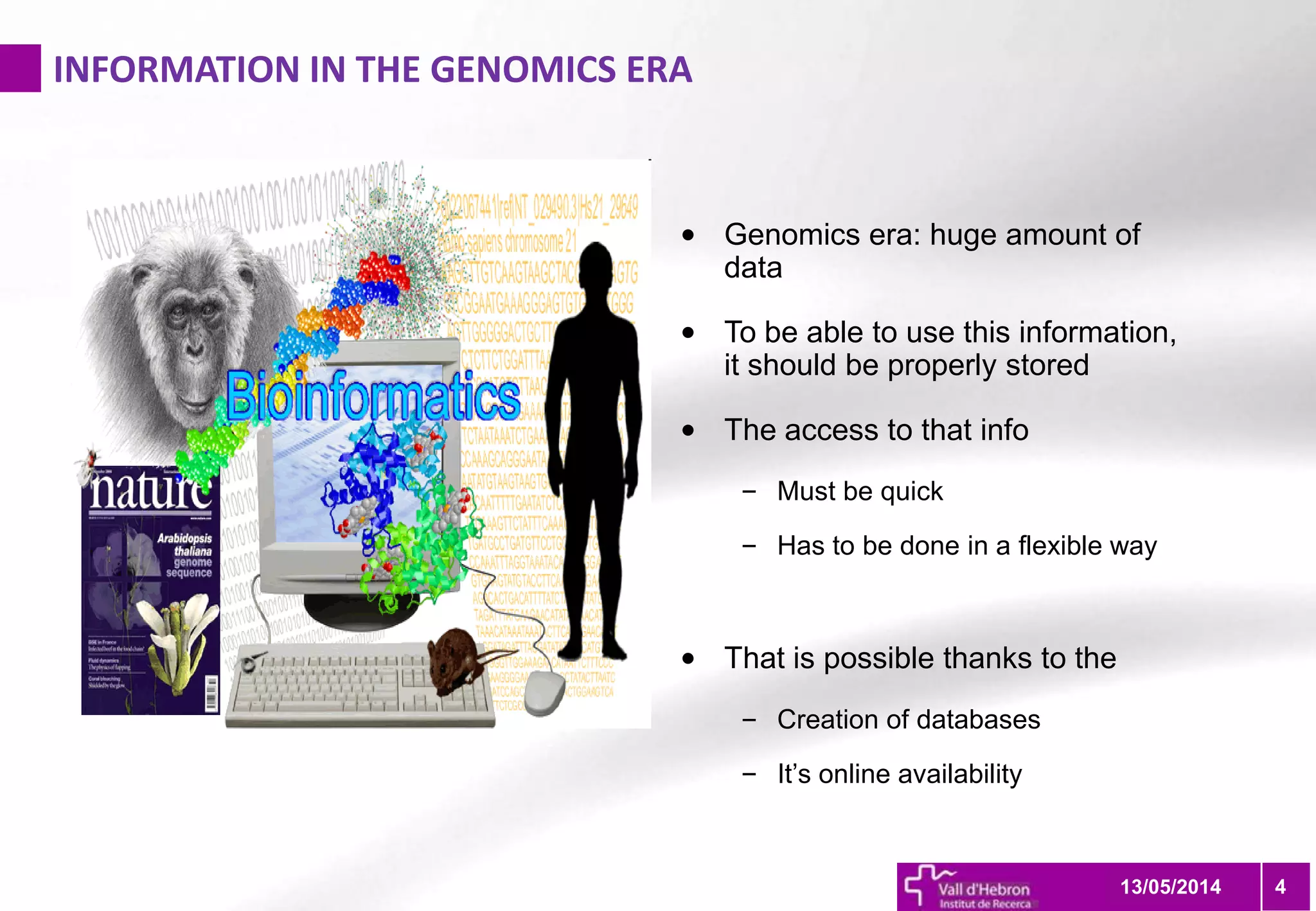
• Genomics era: huge amount of
data
• To be able to use this information,
it should be properly stored
• The access to that info
– Must be quick
– Has to be done in a flexible way
• That is possible thanks to the
– Creation of databases
– It’s online availability
13/05/2014
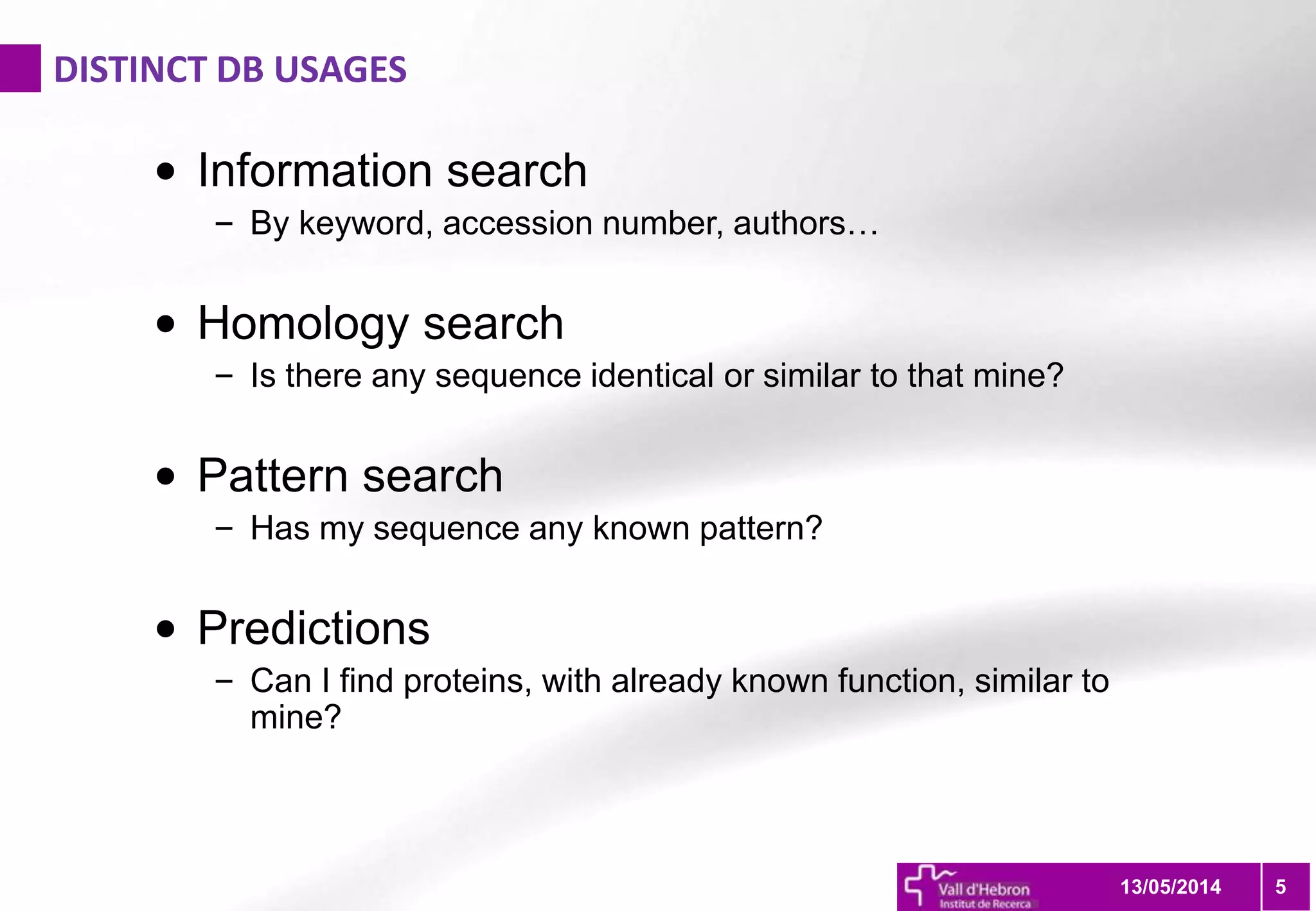
DISTINCT DB USAGES
5
• Information search
– By keyword, accession number, authors…
• Homology search
– Is there any sequence identical or similar to that mine?
• Pattern search
– Has my sequence any known pattern?
• Predictions
– Can I find proteins, with already known function, similar to
mine?
13/05/2014
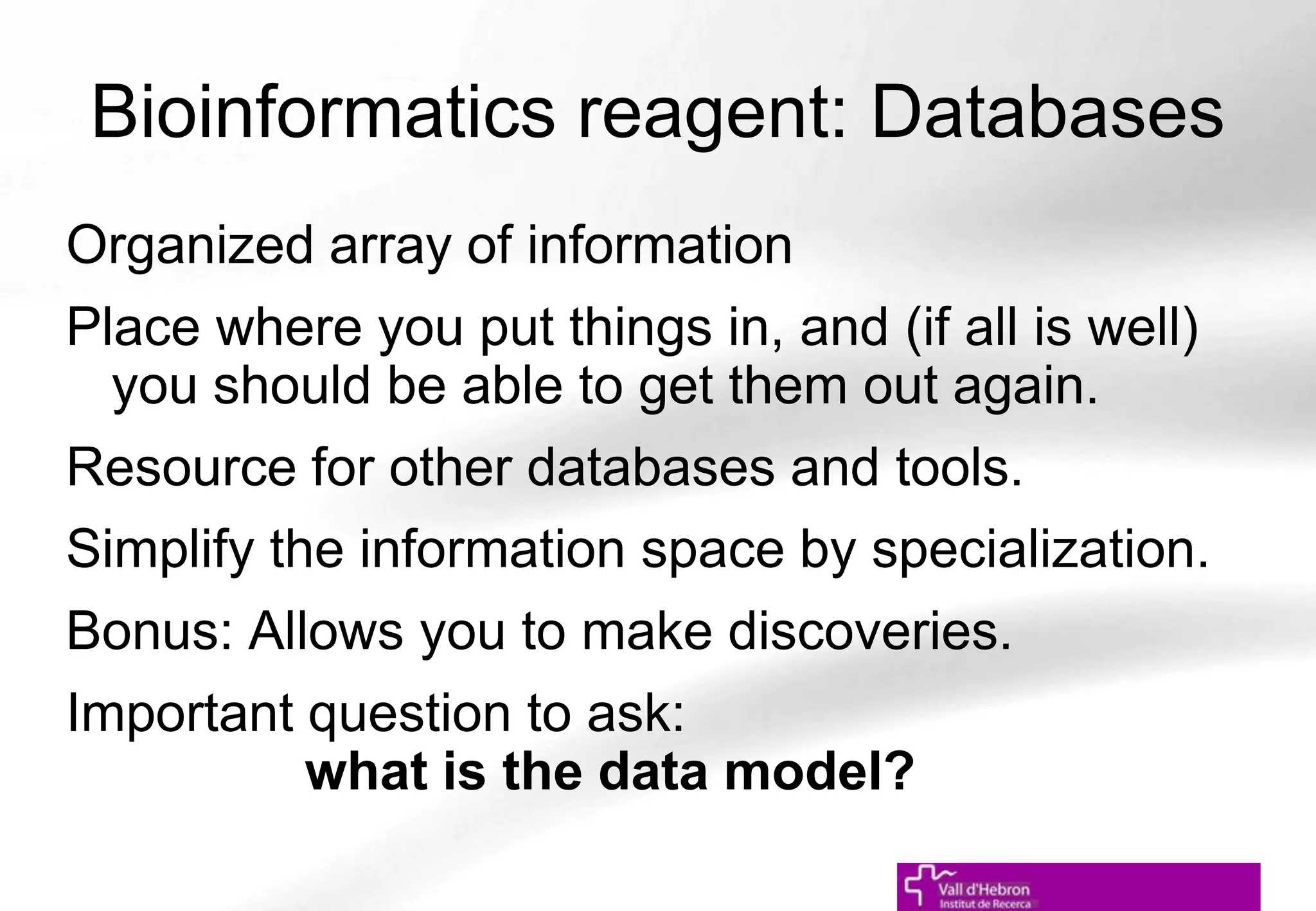
Bioinformatics reagent: Databases
Organized array of information
Place where you put things in, and (if all is well)
you should be able to get them out again.
Resource for other databases and tools.
Simplify the information space by specialization.
Bonus: Allows you to make discoveries.
Important question to ask:
what is the data model?
7
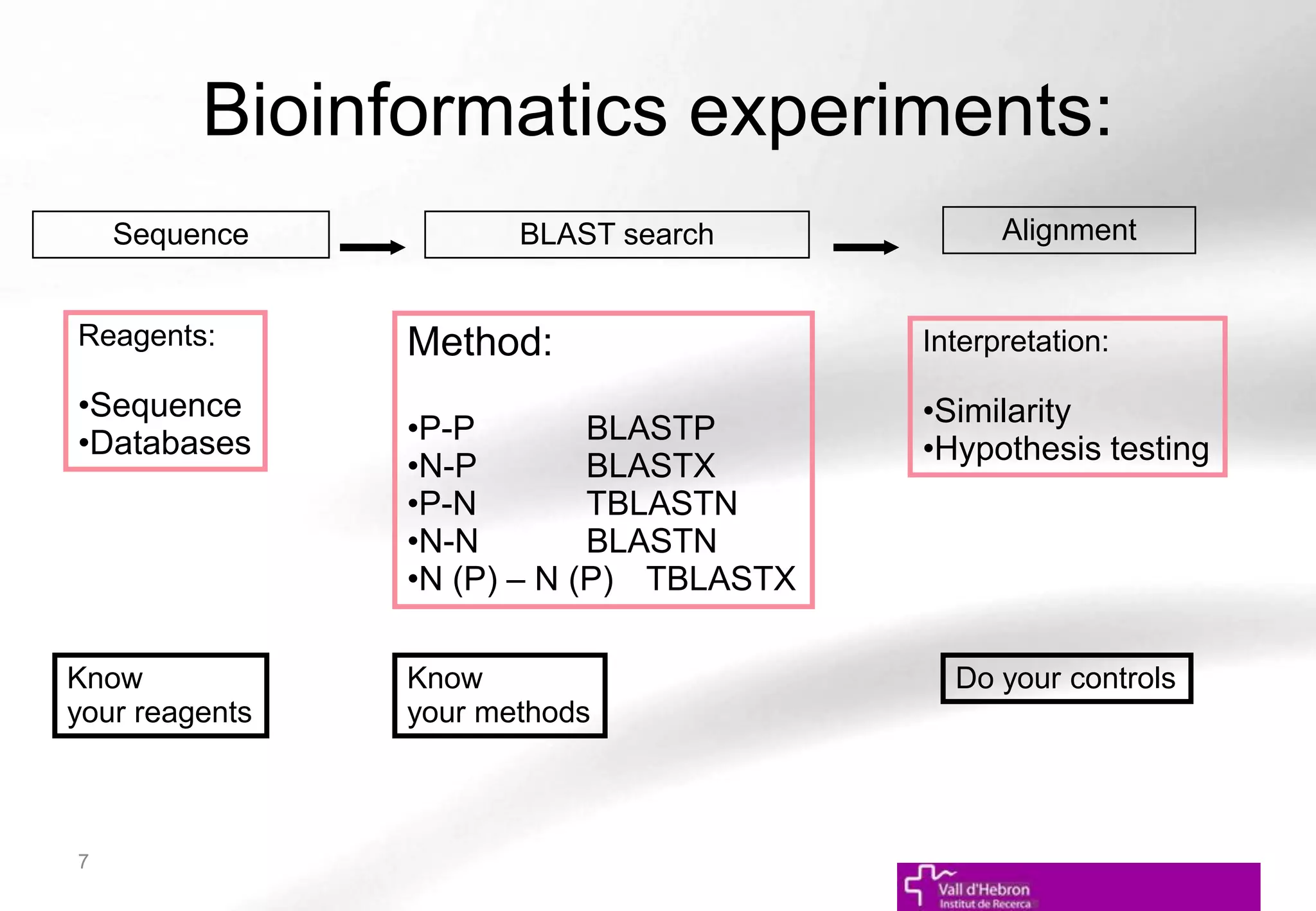
Bioinformatics experiments:
BLAST searchSequence Alignment
Reagents:
•Sequence
•Databases
Method:
•P-P BLASTP
•N-P BLASTX
•P-N TBLASTN
•N-N BLASTN
•N (P) – N (P) TBLASTX
Interpretation:
•Similarity
•Hypothesis testing
Know
your reagents
Know
your methods
Do your controls
8
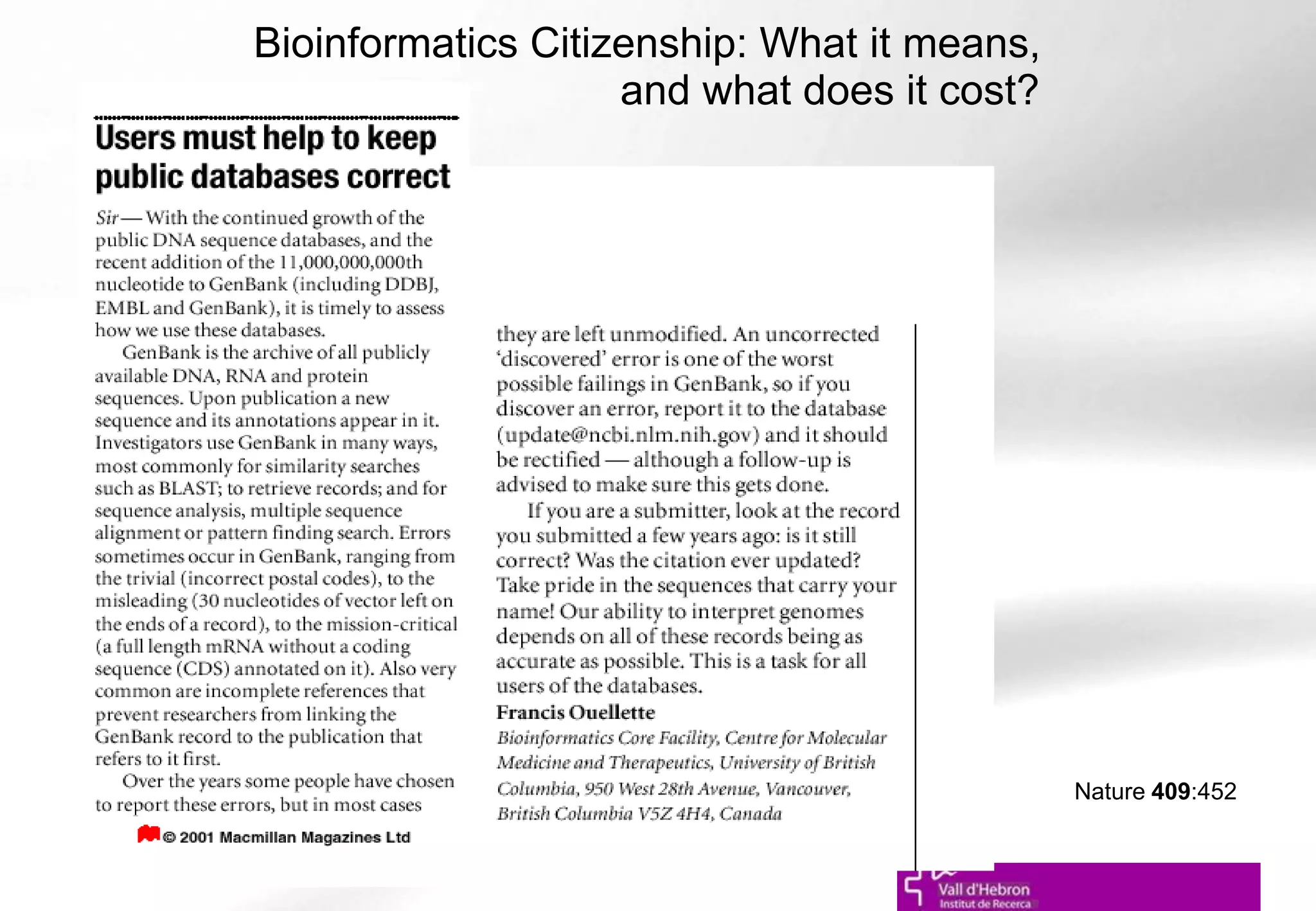
Nature 409:452
Bioinformatics Citizenship: What it means,
and what does it cost?
Databases
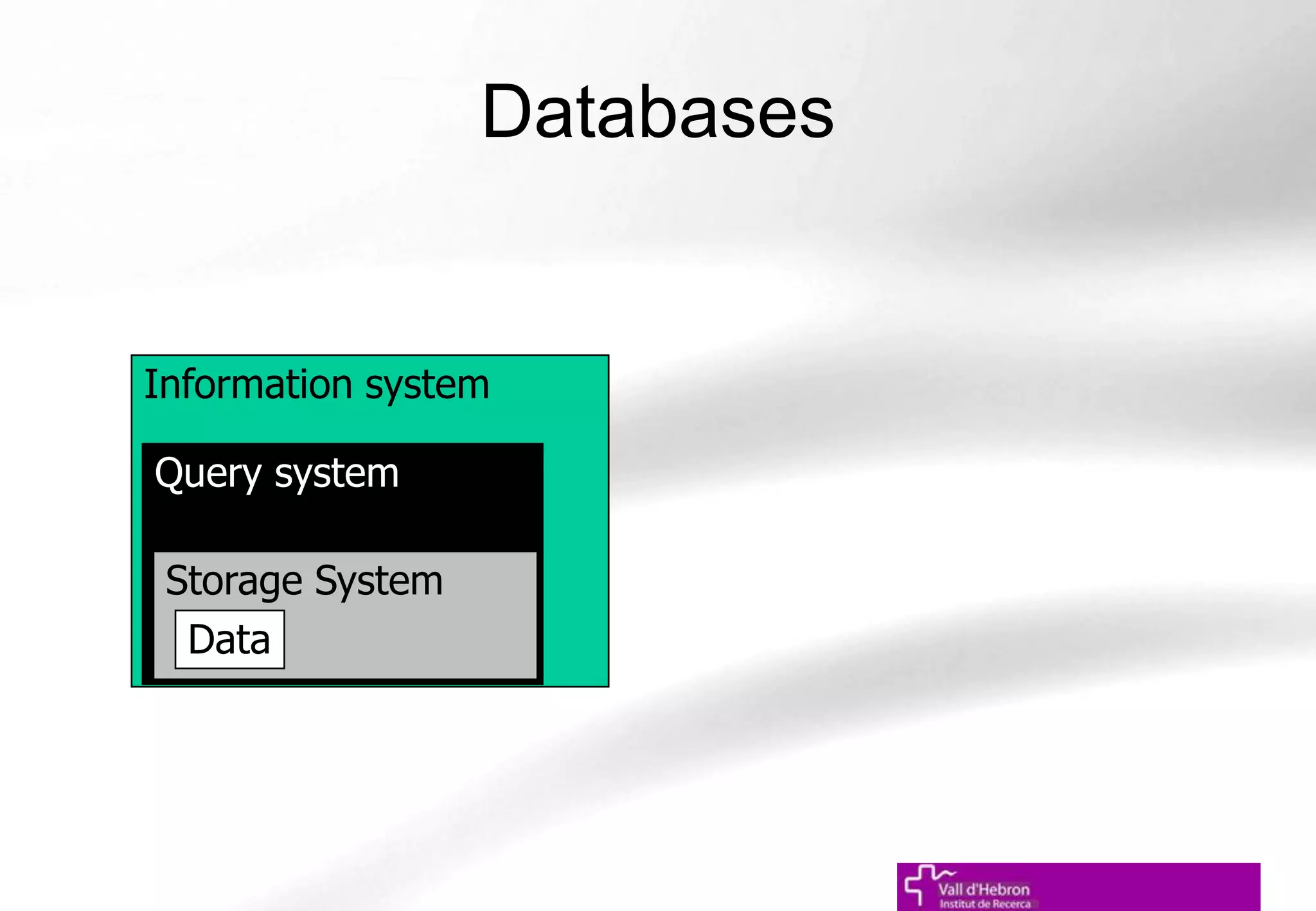
Information system
Query system
Storage System
Data
Databases
Information system
Query system
Storage System
Data
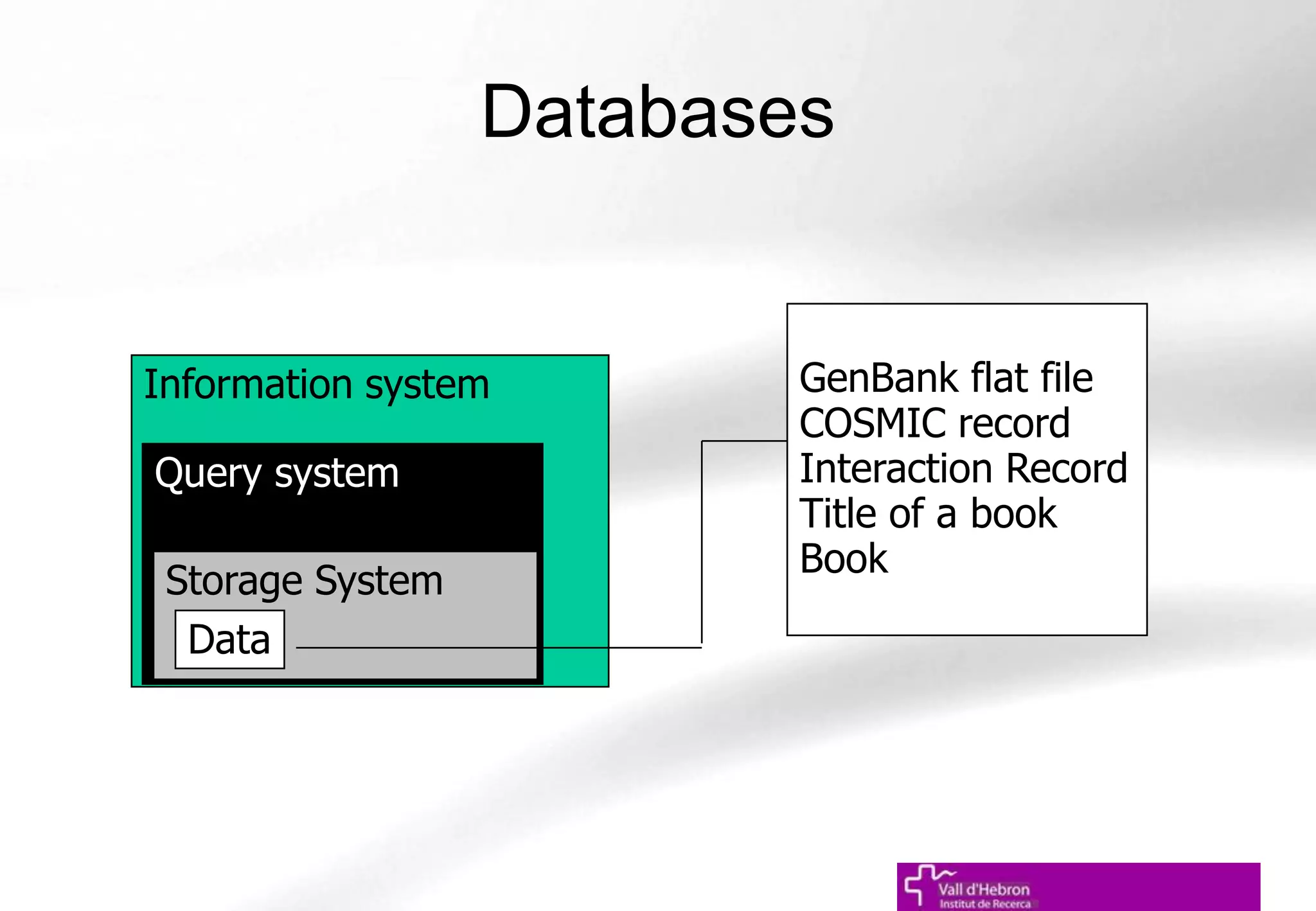
GenBank flat file
COSMIC record
Interaction Record
Title of a book
Book
Databases
Information system
Query system
Storage System
Data
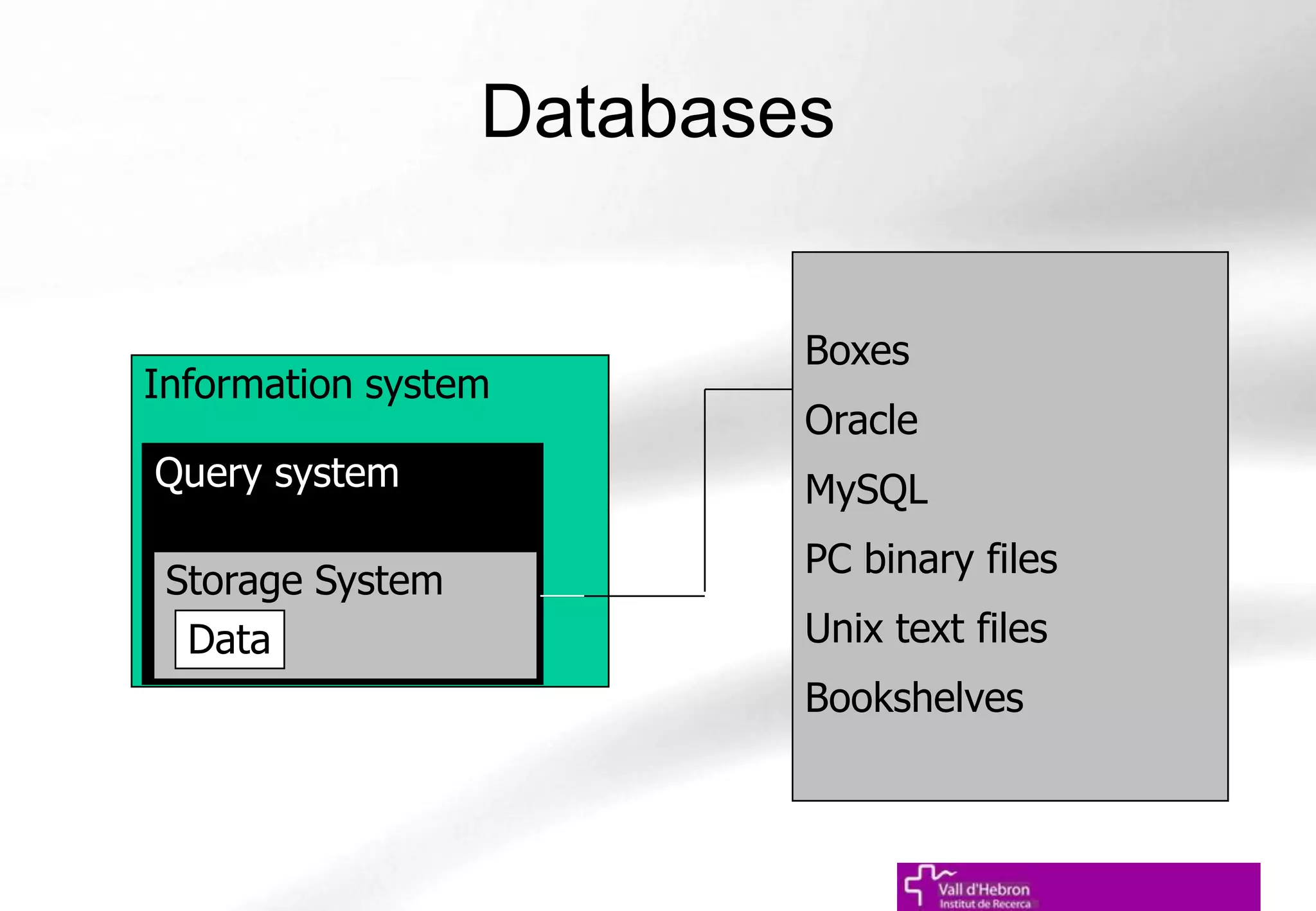
Boxes
Oracle
MySQL
PC binary files
Unix text files
Bookshelves
Databases
Information system
Query system
Storage System
Data
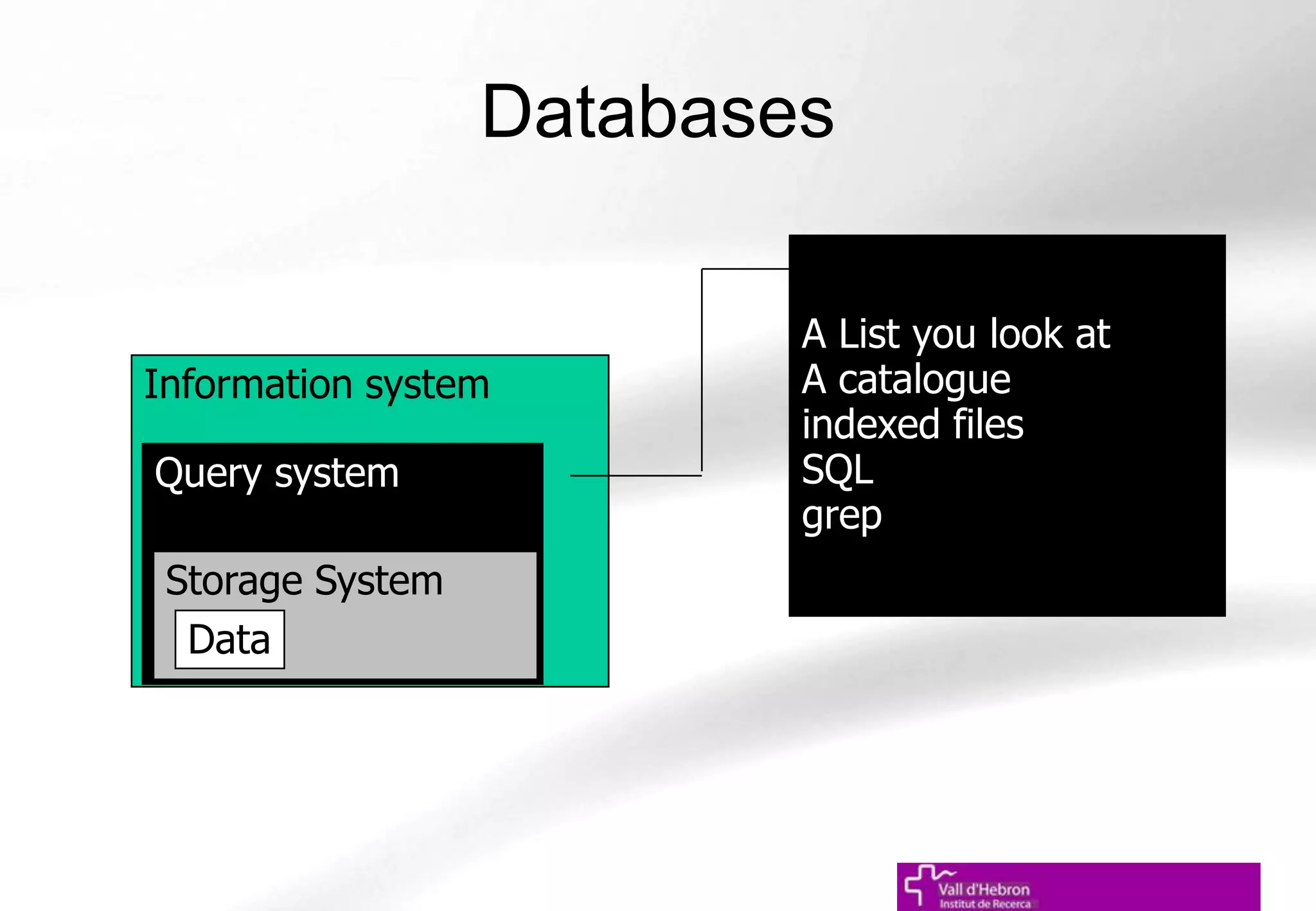
A List you look at
A catalogue
indexed files
SQL
grep
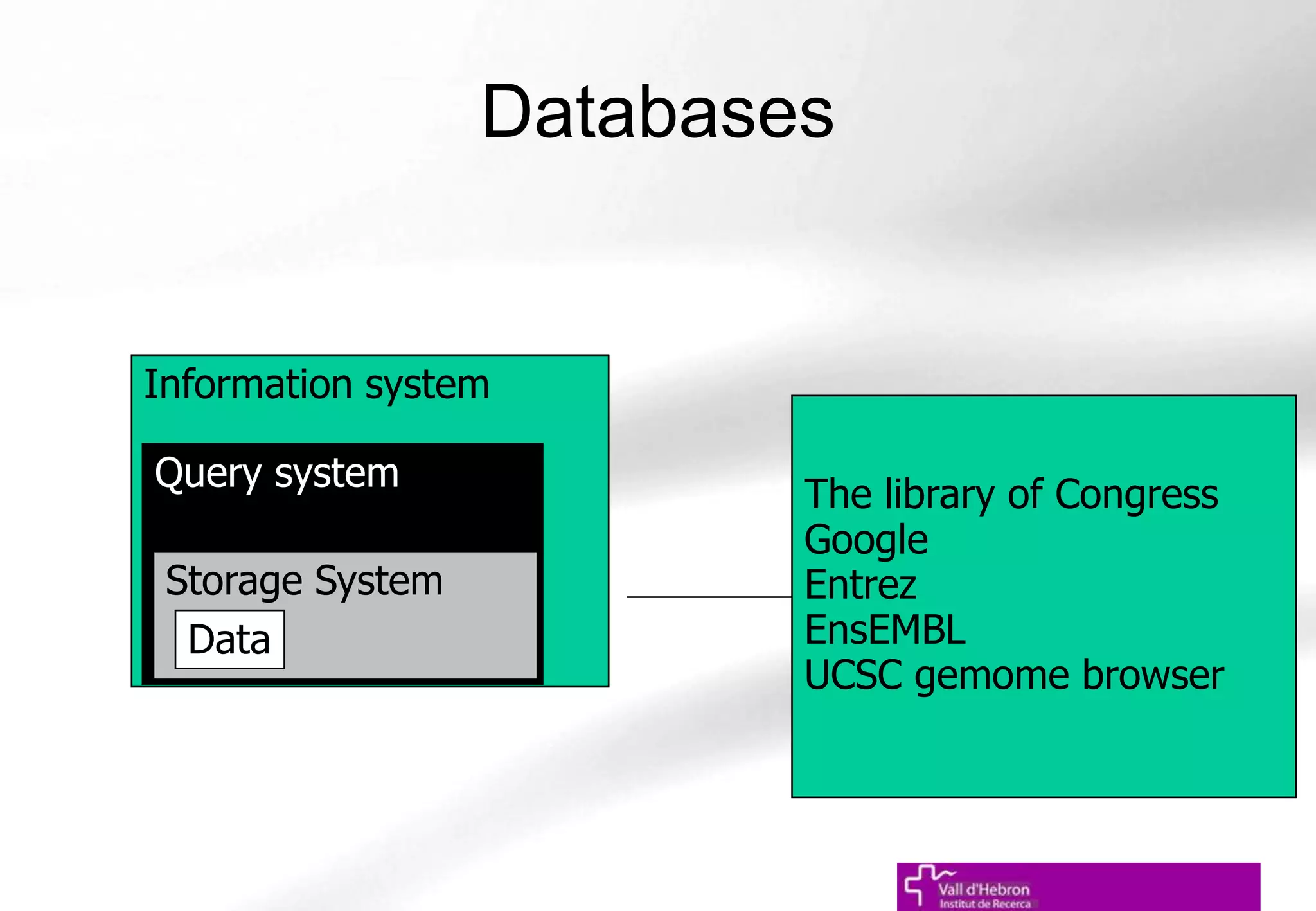
The library of Congress
Google
Entrez
EnsEMBL
UCSC gemome browser
Databases
Information system
Query system
Storage System
Data
TO TAKE INTO ACCOUNT
1413/05/2014
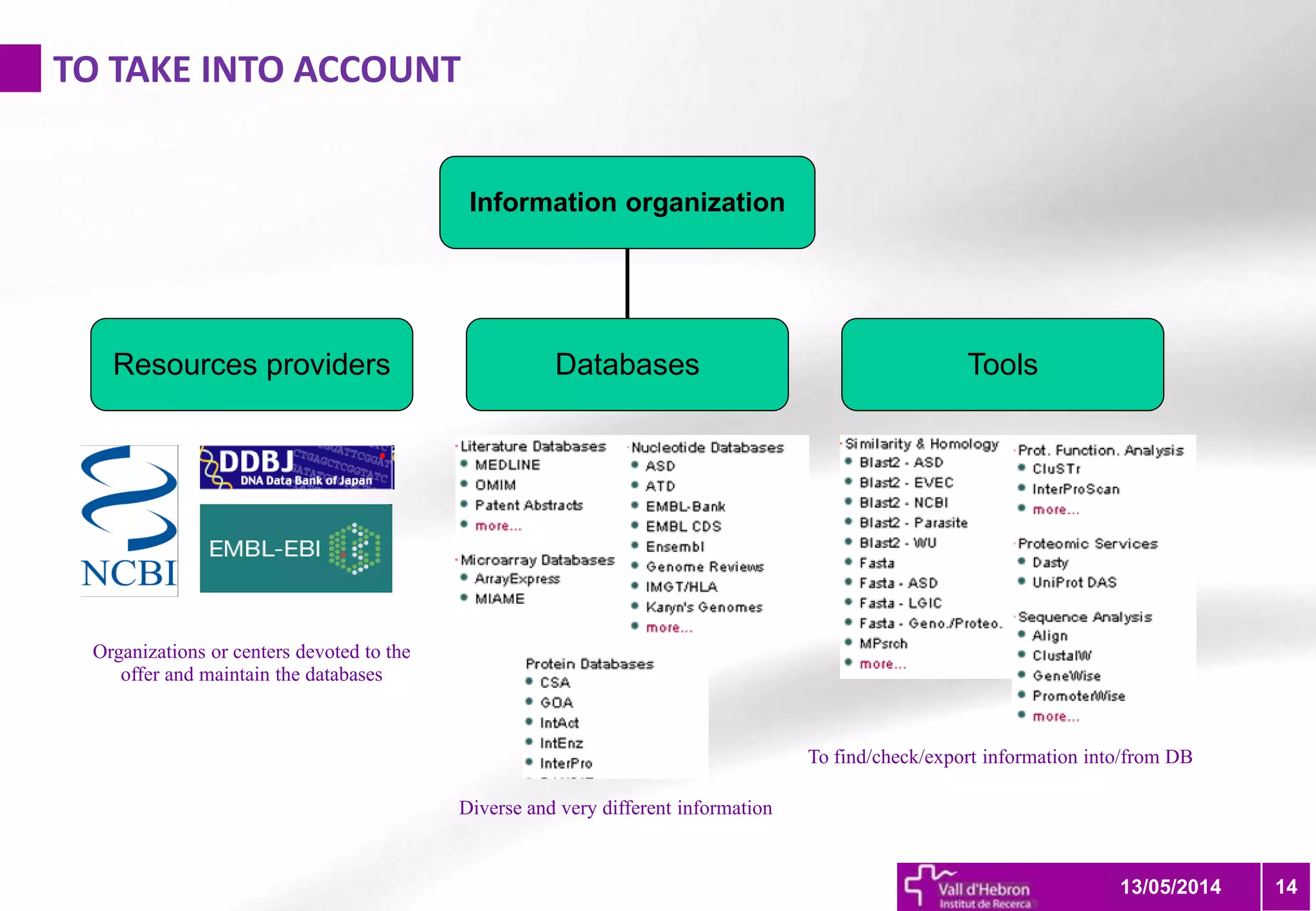
Information organization
Resources providers Databases Tools
Organizations or centers devoted to the
offer and maintain the databases
To find/check/export information into/from DB
Diverse and very different information
MAIN RESOURCES PROVIDERS
1513/05/2014
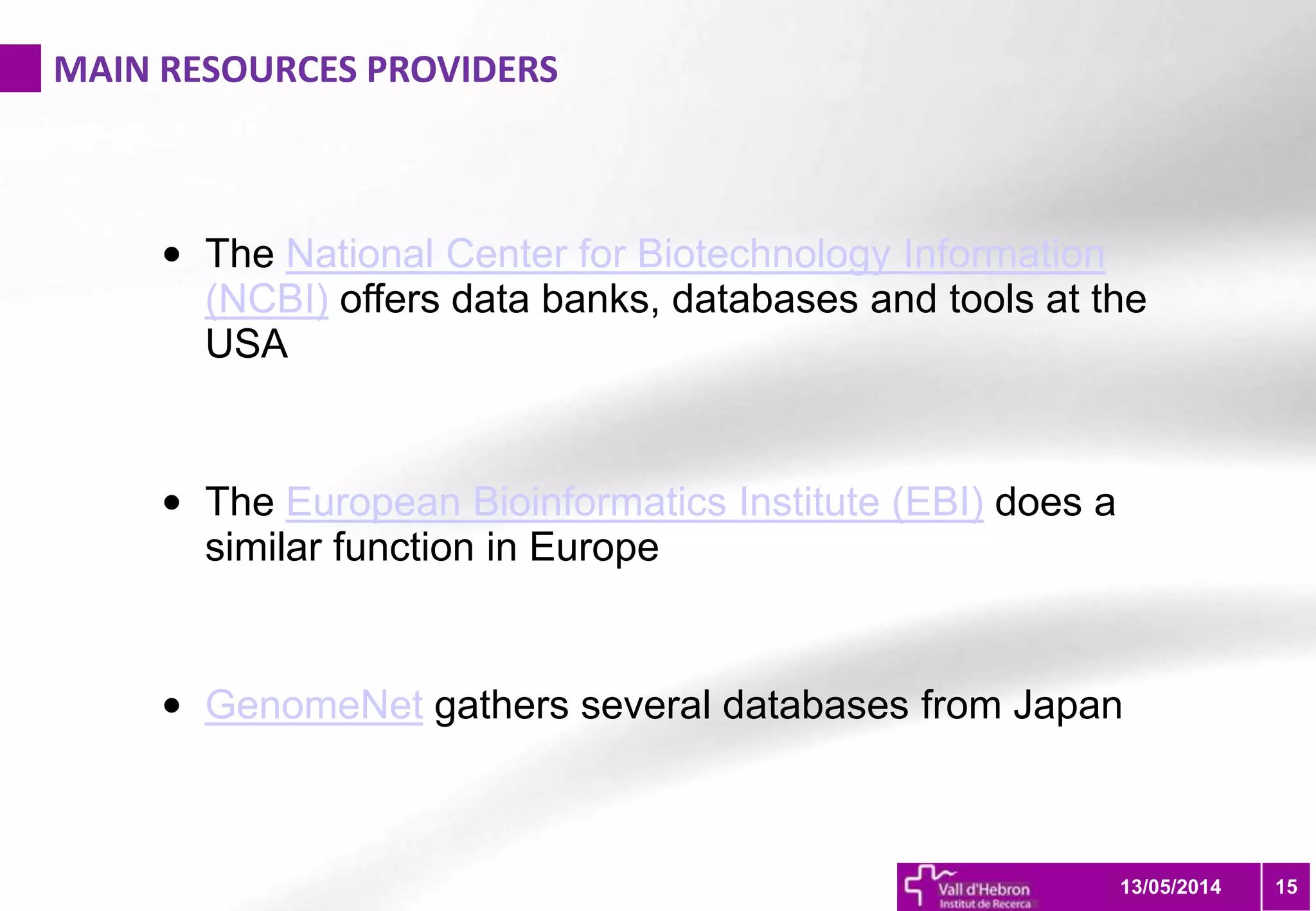
• The National Center for Biotechnology Information
(NCBI) offers data banks, databases and tools at the
USA
• The European Bioinformatics Institute (EBI) does a
similar function in Europe
• GenomeNet gathers several databases from Japan
Types of databases
1613/05/2014
TYPES OF DB
1713/05/2014
• There are hundreds of BD, so it is not feasible to
enumerate them (but they have tried here)
• We can classify them by multiple criteria
• The structural organization of the EMBL and the
NCBI resources is radically different
EMBL vs NCBI
1813/05/2014
• EMBL
– Bibliographic DB
– Taxonomic DB
– Nucleotide DB
– Genomic BD
– Protein BD
– Microarrays DB
…
• NCBI
– PubMed
– Entrez
– OMIM
– Books
– TaxBrowser
– Structure
…
BIBLIOGRAPHY DB
1913/05/2014
• Collection of papers published in
scientific journals
– Pubmed (NCBI)
– Medline (EBI)
– Biocatalog: papers organized by
concrete molecular biology topics
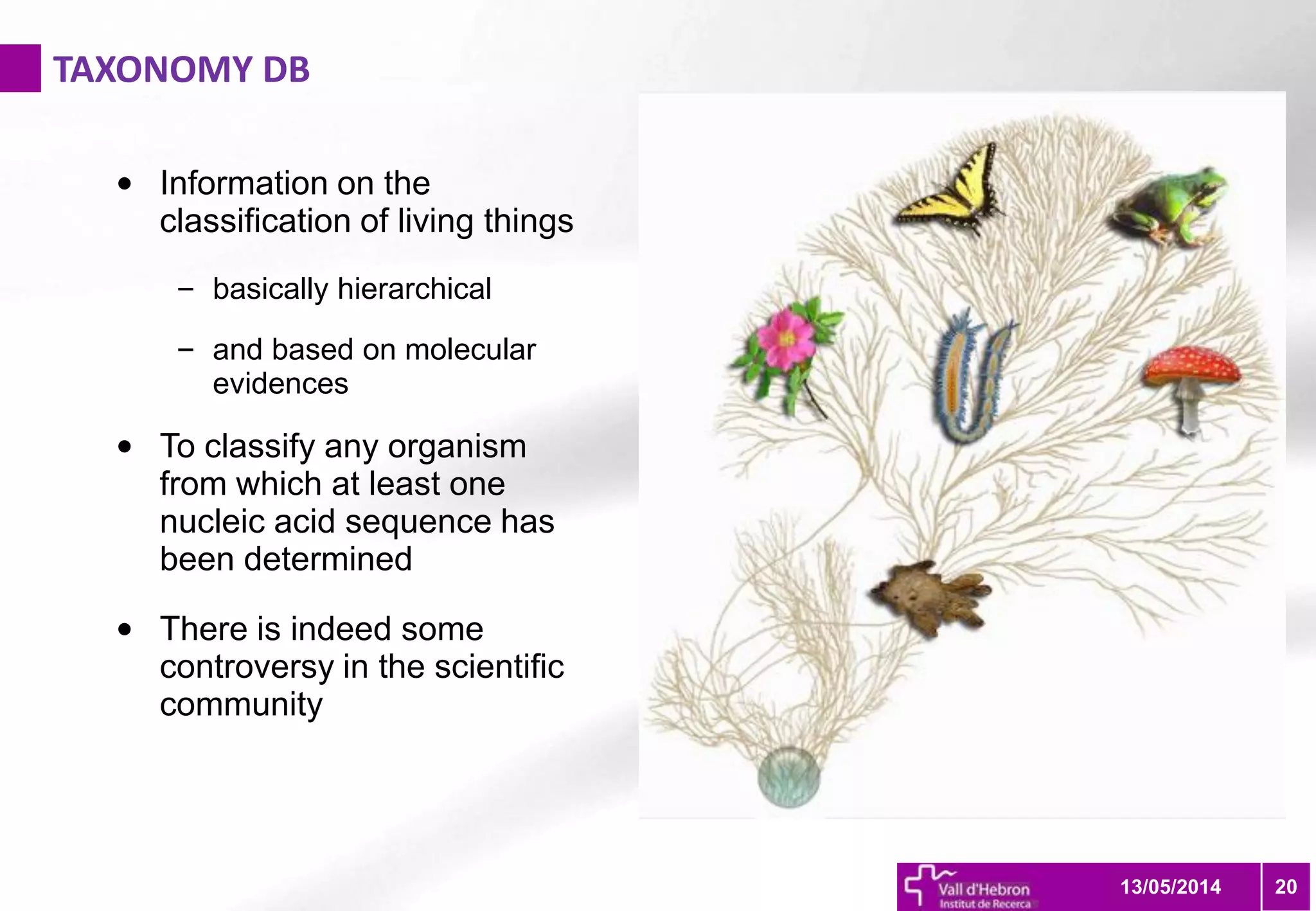
TAXONOMY DB
2013/05/2014
• Information on the
classification of living things
– basically hierarchical
– and based on molecular
evidences
• To classify any organism
from which at least one
nucleic acid sequence has
been determined
• There is indeed some
controversy in the scientific
community
NUCLEOTIDE DB
2113/05/2014
• Sequences from experimental laboratories
• Daily updated
• Daily exchanging of its contents
– Genbank (NCBI)
– EMBL (EBI)
– KEGG (Genome net)
Sequences NOT in NucleotideDB
• WGS: whole genome shotgun
• TPA: third party annotations
• SNPs
• SAGE tags (serial analysis of gene expression)
• RefSeq (Genomic, mRNA, or protein)
• Consensus sequences
GENOME DB
2313/05/2014
• Sequences and annotations of
whole genomes
– Ensembl (EBI)
– Genome viewer (NCBI)
– Goldenpath (UCSC)
• Specialized genomic resources
– Transfact
– EST
– UTRDB
– SpliceSitesDB
…
PROTEIN DB (I)
2413/05/2014
• Aminoacids primary
sequences
– Without human revision
• Trembl (EBI)
• NR (NCBI)
– With annotation’s curation
• Uniprot (EBI)
– Proteome DB
• Proteome analysis (EBI)
PROTEIN DB (II)
2513/05/2014
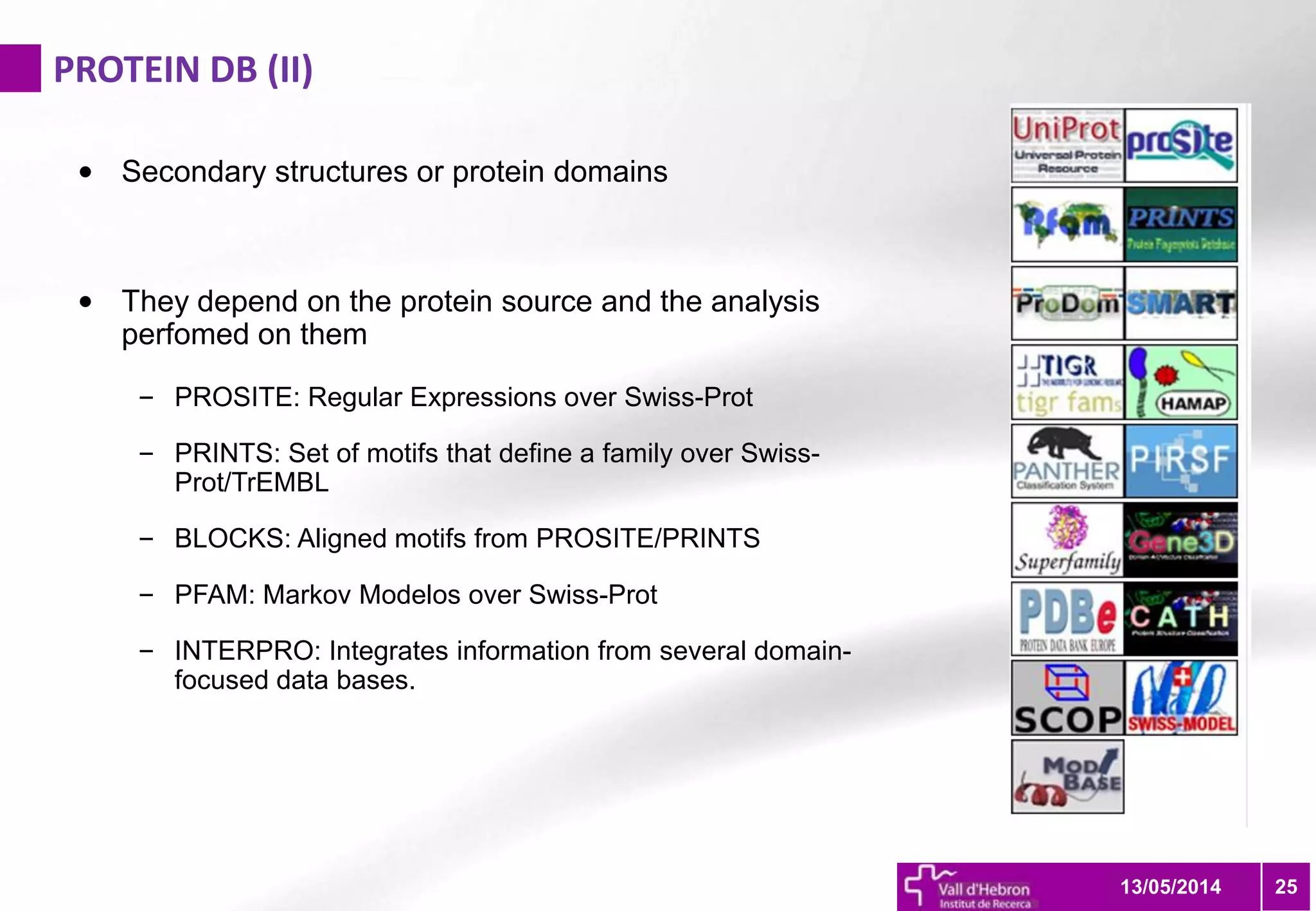
• Secondary structures or protein domains
• They depend on the protein source and the analysis
perfomed on them
– PROSITE: Regular Expressions over Swiss-Prot
– PRINTS: Set of motifs that define a family over Swiss-
Prot/TrEMBL
– BLOCKS: Aligned motifs from PROSITE/PRINTS
– PFAM: Markov Modelos over Swiss-Prot
– INTERPRO: Integrates information from several domain-
focused data bases.
PROTEIN DB (III)
2613/05/2014
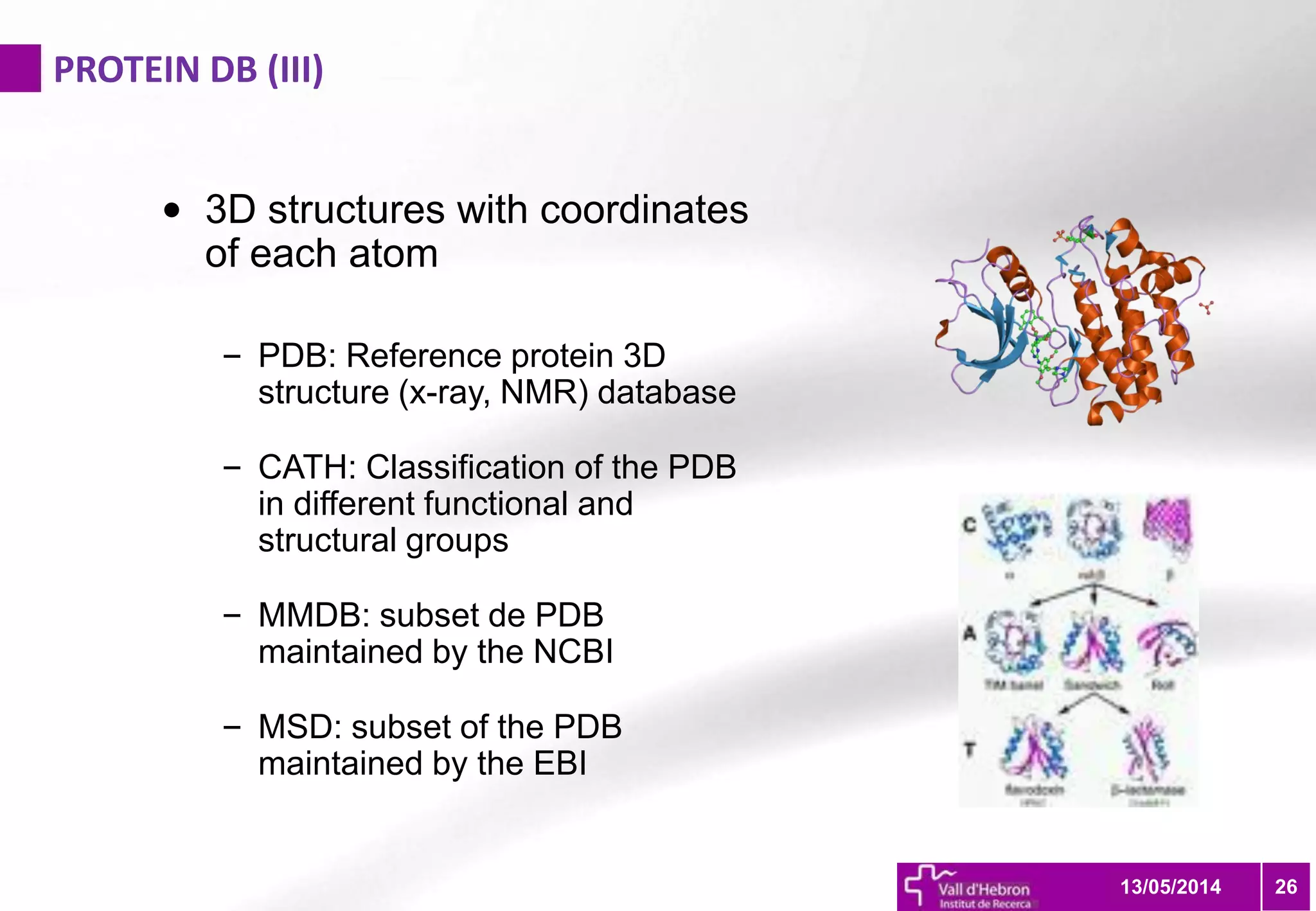
• 3D structures with coordinates
of each atom
– PDB: Reference protein 3D
structure (x-ray, NMR) database
– CATH: Classification of the PDB
in different functional and
structural groups
– MMDB: subset de PDB
maintained by the NCBI
– MSD: subset of the PDB
maintained by the EBI
MICROARRAY DB
2713/05/2014
• Expression arrays results
– ArrayExpress
– caArray
– Gene Expression Omnibus
OTHER DB (1)
2813/05/2014
• Biological Annotations
– Gene Ontology
– KEGG
– Gene Cards
• Therapeutic targets
– Therapeutic targets database
– PharmGKB
…
Historical perspective on the Human
Genome Data
Human Expressed Seq Tags (mRNA) sequencing
Human genome mapping and sequencing
Population analysis and polymorphism measurements
Genome Wide Association Studies
<the Homer paper>
The Cancer Genome Atlas pilot
The 1000 genome project
The Cancer Genome Atlas
The International Cancer Genome Consortium
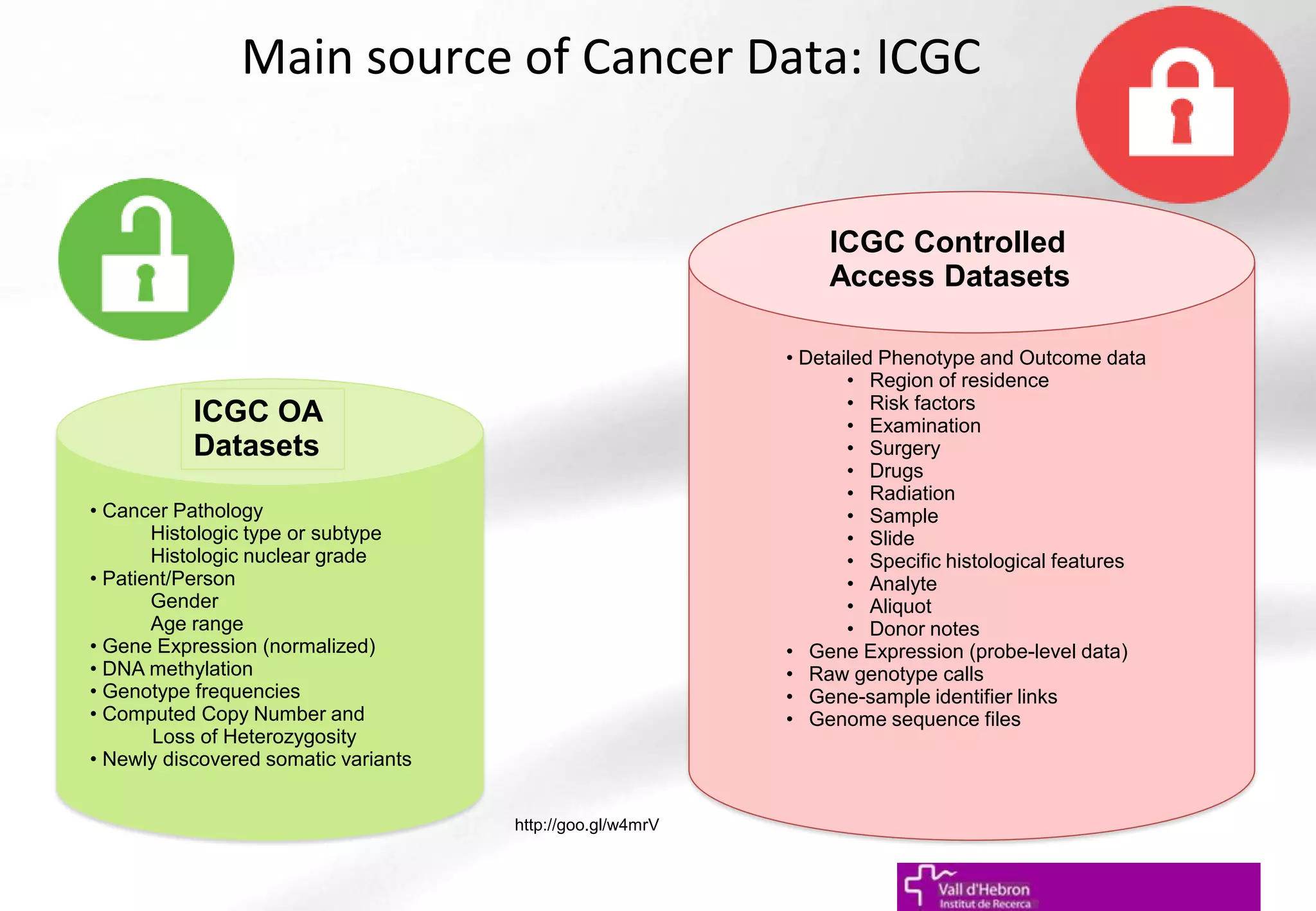
• Detailed Phenotype and Outcome data
• Region of residence
• Risk factors
• Examination
• Surgery
• Drugs
• Radiation
• Sample
• Slide
• Specific histological features
• Analyte
• Aliquot
• Donor notes
• Gene Expression (probe-level data)
• Raw genotype calls
• Gene-sample identifier links
• Genome sequence files
ICGC Controlled
Access Datasets
• Cancer Pathology
Histologic type or subtype
Histologic nuclear grade
• Patient/Person
Gender
Age range
• Gene Expression (normalized)
• DNA methylation
• Genotype frequencies
• Computed Copy Number and
Loss of Heterozygosity
• Newly discovered somatic variants
ICGC OA
Datasets
http://goo.gl/w4mrV
Main source of Cancer Data: ICGC
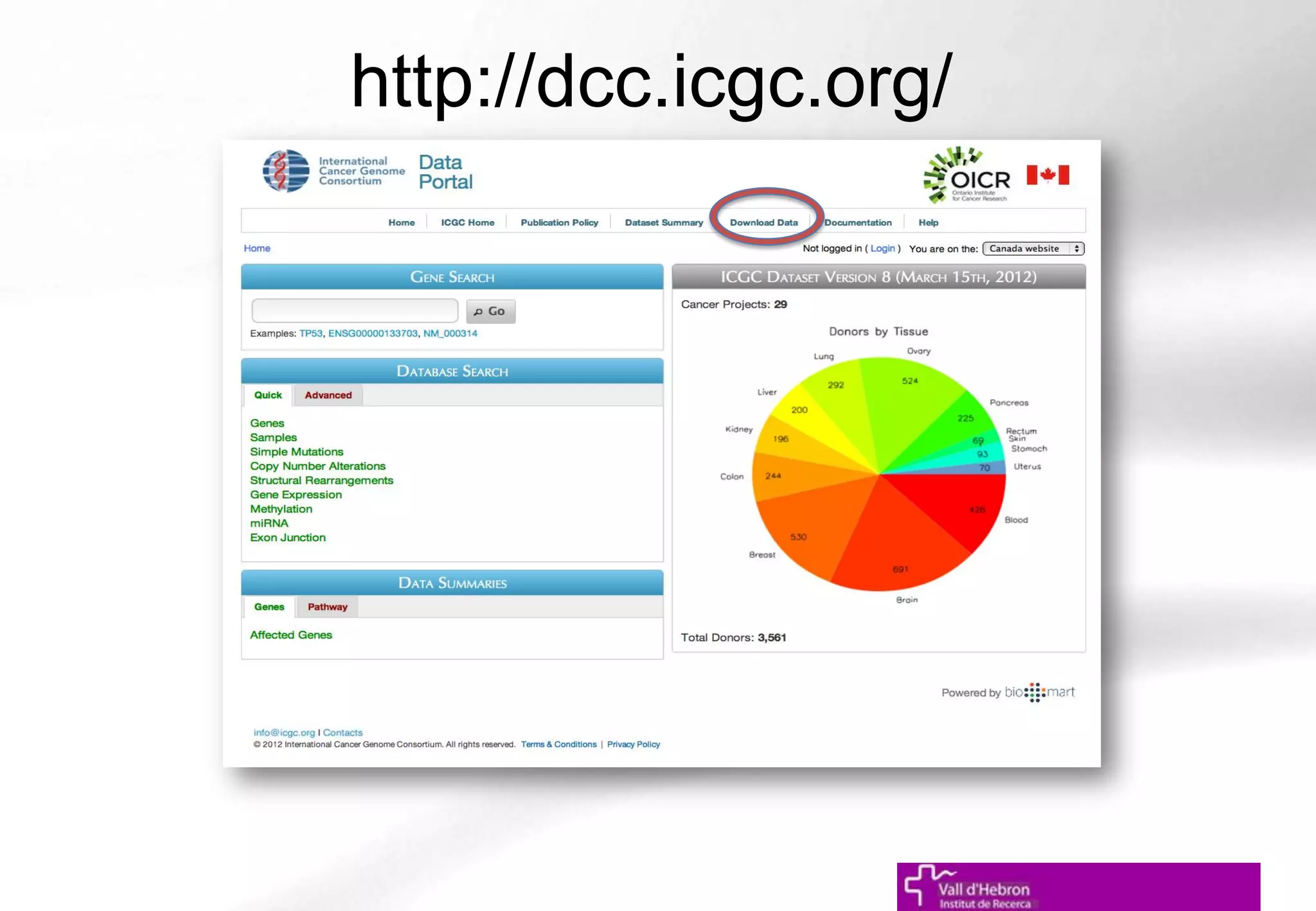
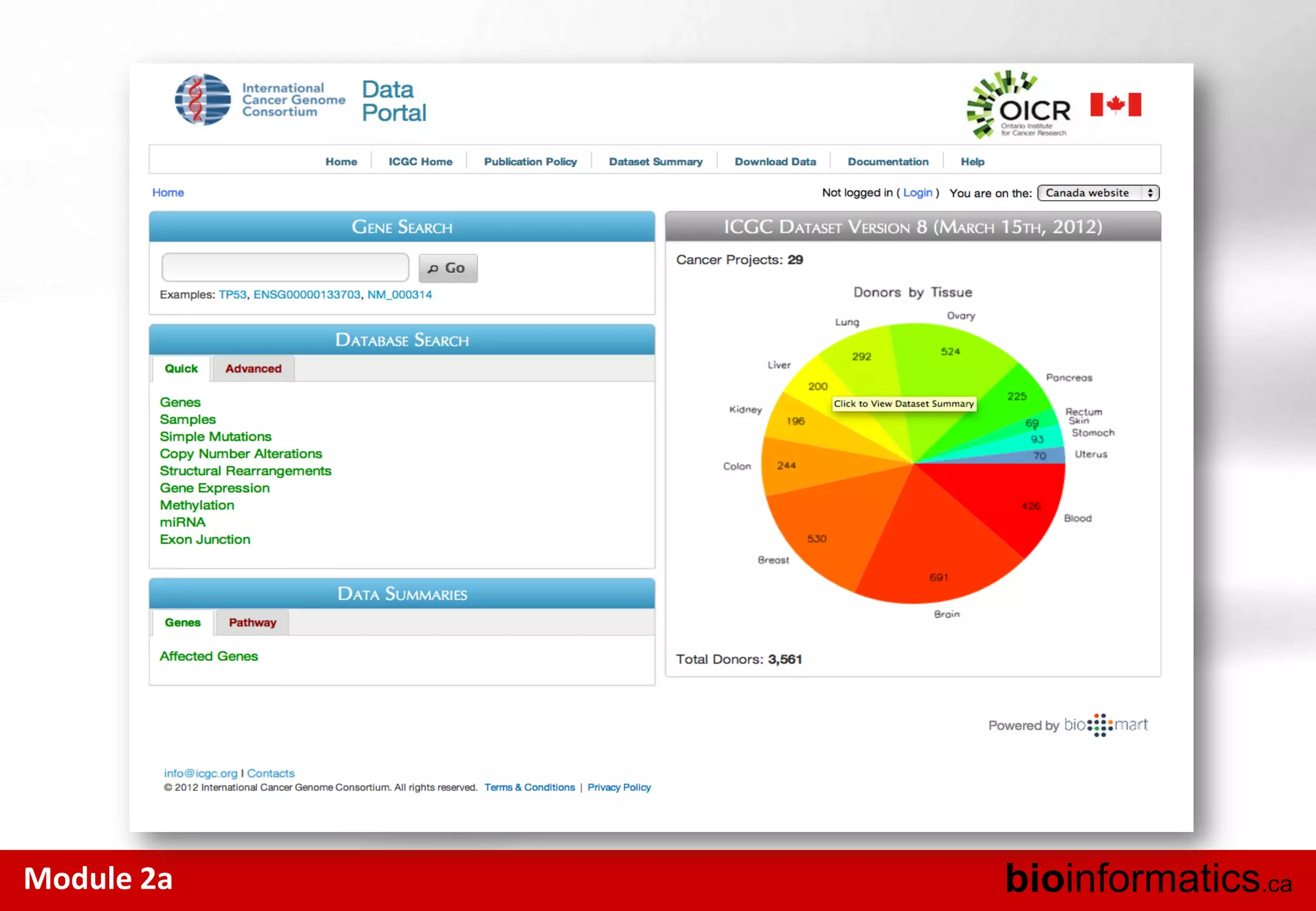
http://dcc.icgc.org/
Module 2a bioinformatics.ca
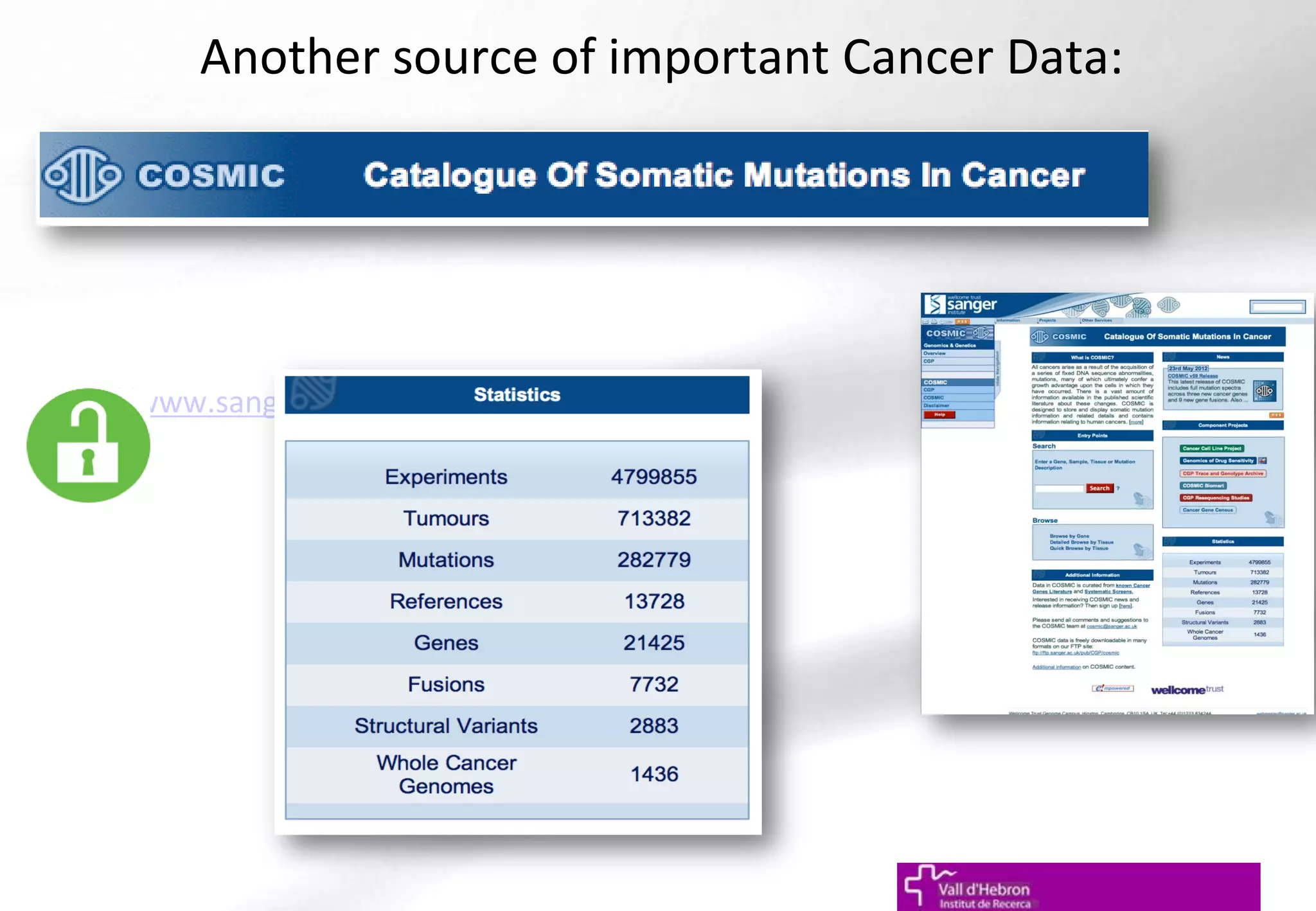
Another source of important Cancer Data:
:
http://www.sanger.ac.uk/genetics/CGP/cosmic/
Module 2a bioinformatics.ca
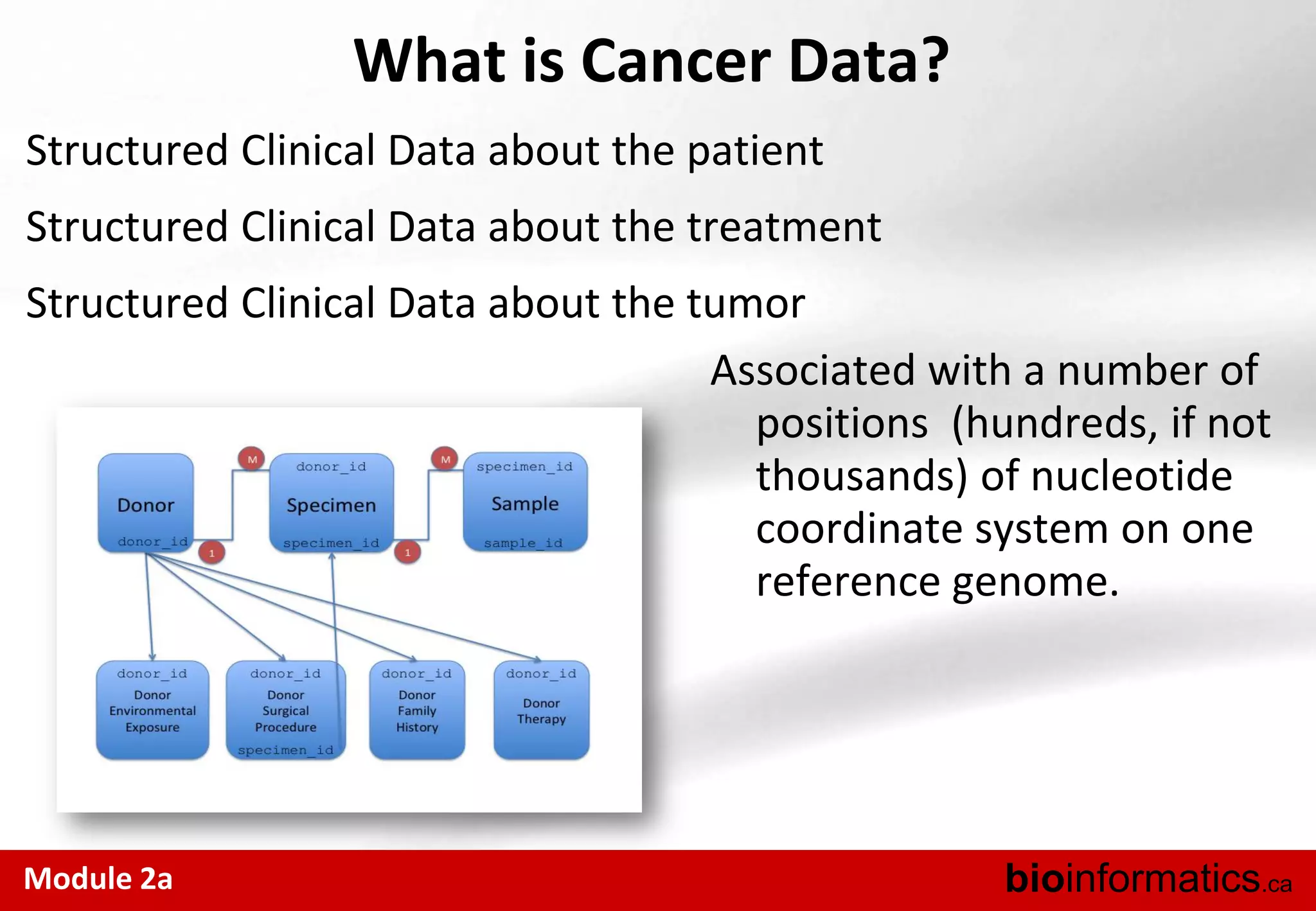
What is Cancer Data?
Structured Clinical Data about the patient
Structured Clinical Data about the treatment
Structured Clinical Data about the tumor
Associated with a number of
positions (hundreds, if not
thousands) of nucleotide
coordinate system on one
reference genome.
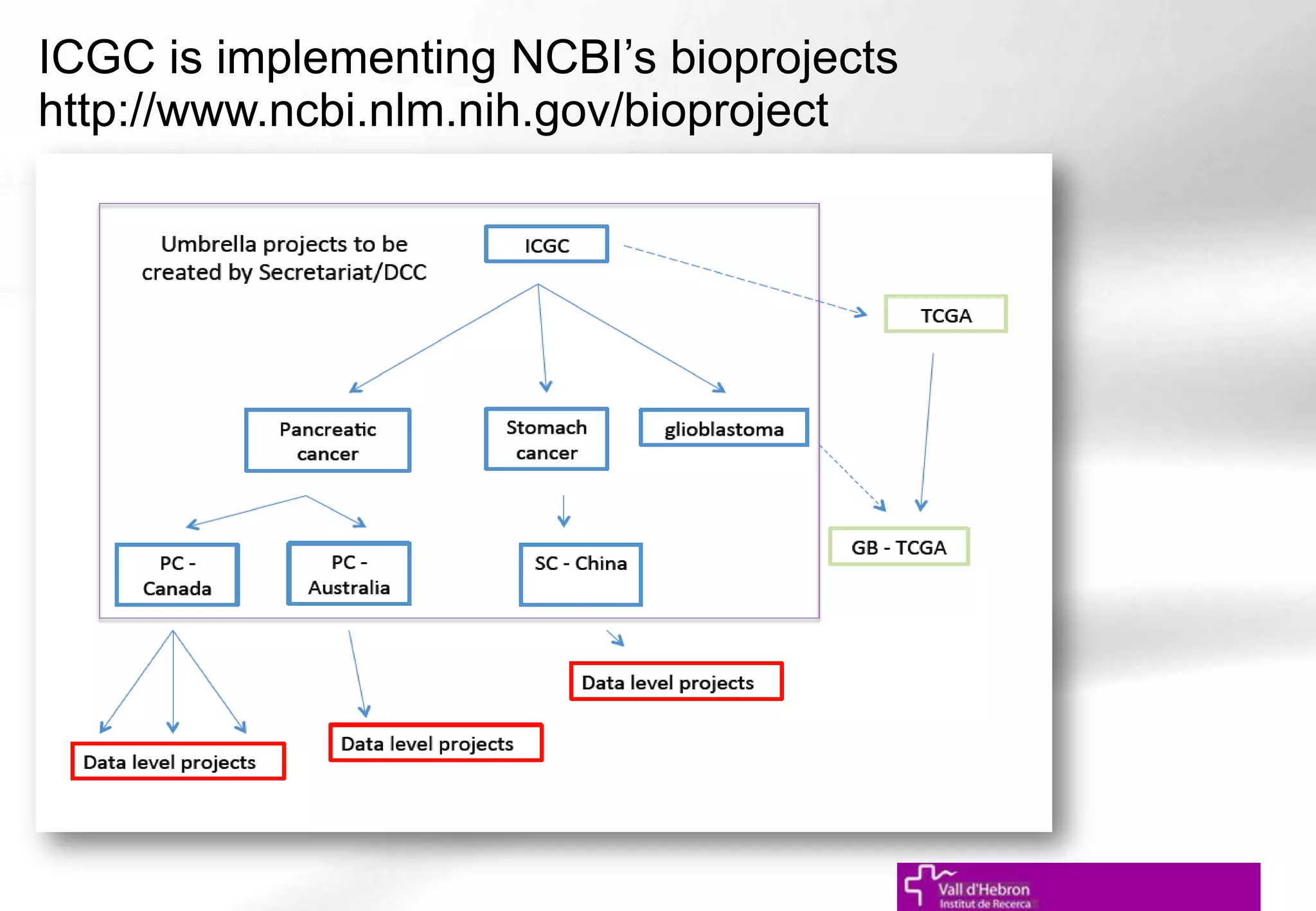
ICGC is implementing NCBI’s bioprojects
http://www.ncbi.nlm.nih.gov/bioproject
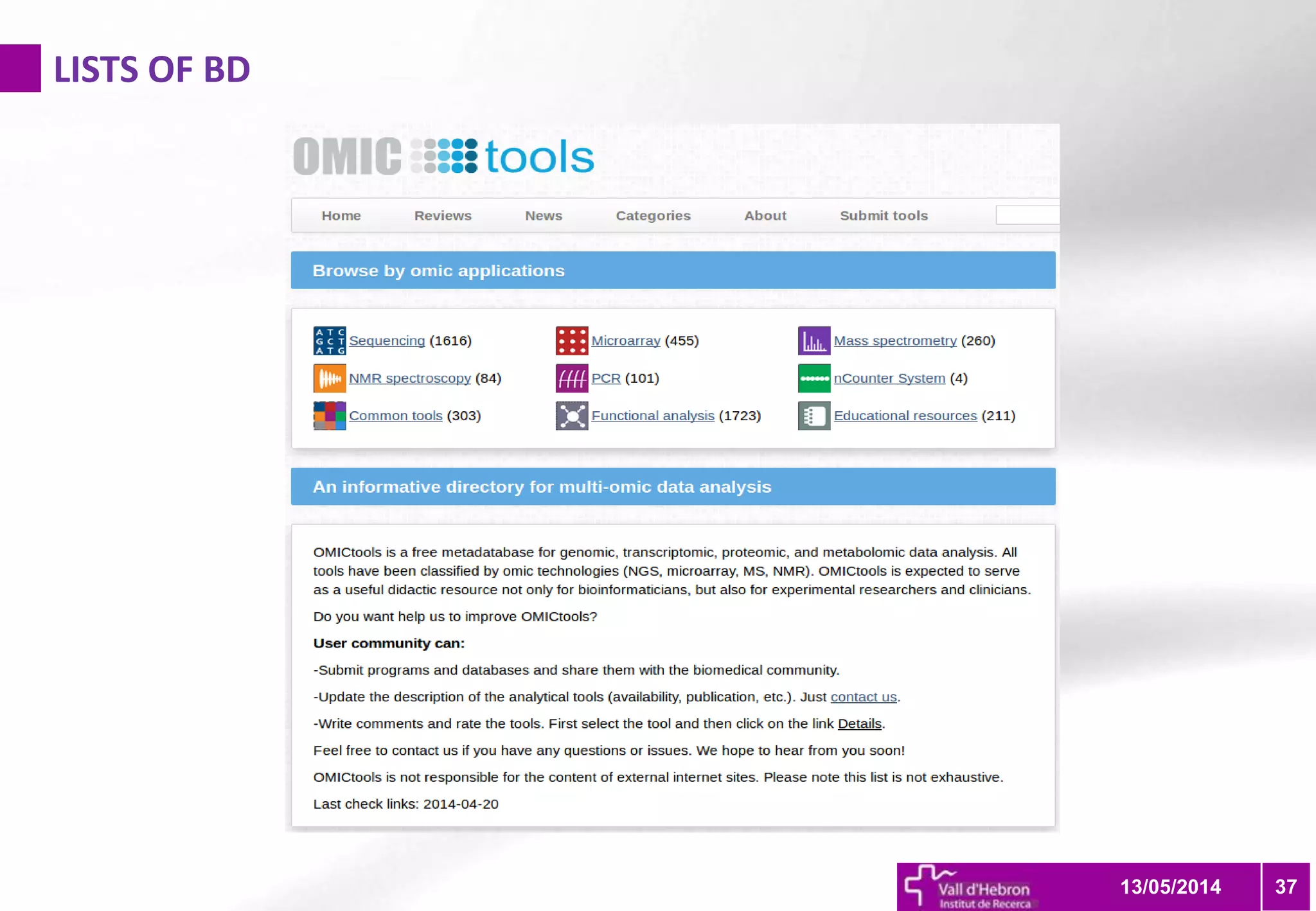
LISTS OF BD
3613/05/2014
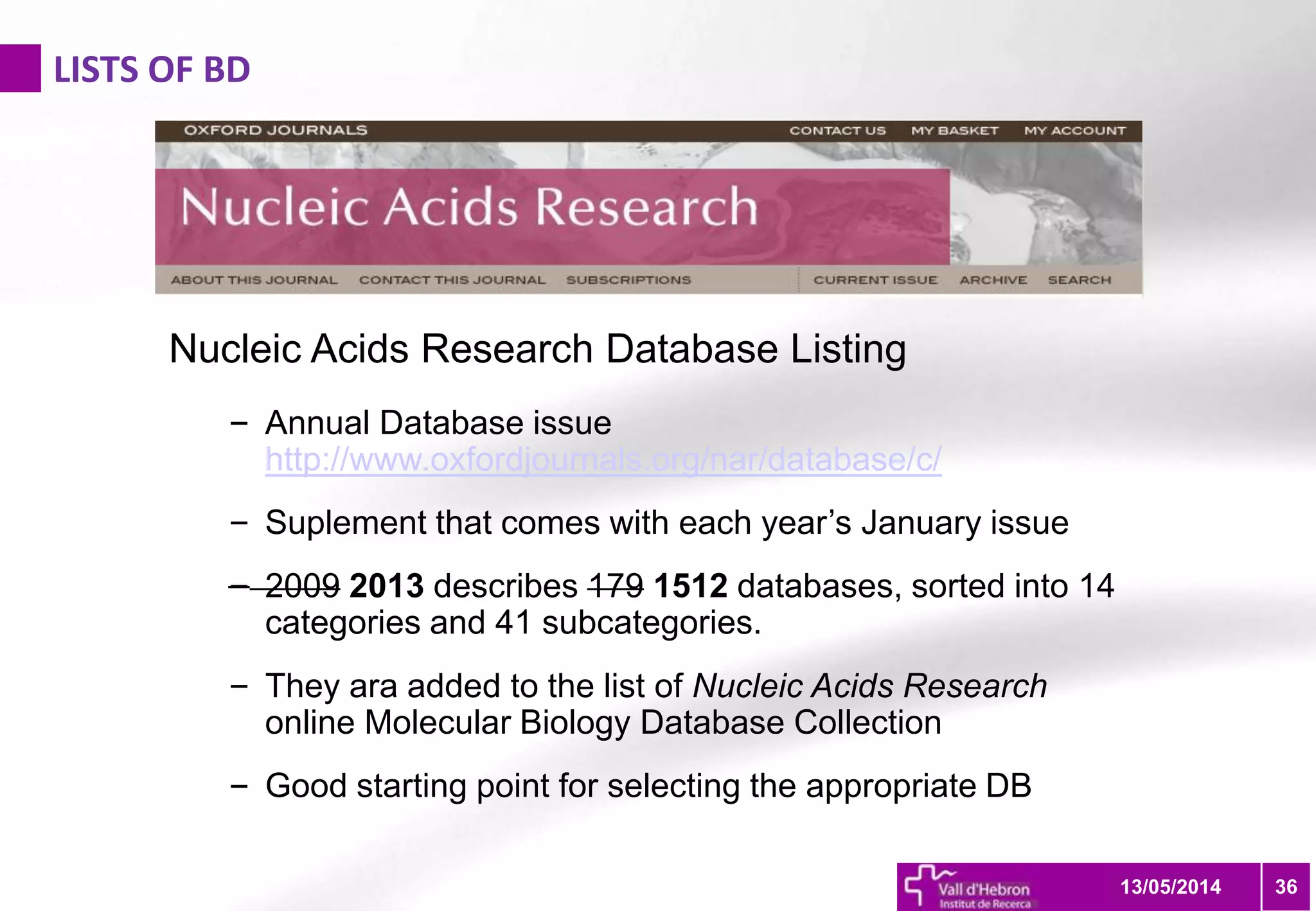
Nucleic Acids Research Database Listing
– Annual Database issue
http://www.oxfordjournals.org/nar/database/c/
– Suplement that comes with each year’s January issue
– 2009 2013 describes 179 1512 databases, sorted into 14
categories and 41 subcategories.
– They ara added to the list of Nucleic Acids Research
online Molecular Biology Database Collection
– Good starting point for selecting the appropriate DB
LISTS OF BD
3713/05/2014
Structure and formats
of the DB
3813/05/2014
STRUCTURE OF THE DB
3913/05/2014
• The way of organizing data in any DB
depends mainly in the model or architecture
in which it is based on
• There are multiple models
Relational, Hierarchical, Network-based…
but the most usual relational
– Several tables, that could have relationships
between them
– The relationships are done through key fields
FORMATS OF THE DB
4013/05/2014
• To work with relational DB implies the use of
plane data formats
– Text files
– Some kind of labels to specify the contents of
every line or region of the file
• There are multiple formats, so a good
program or application should be able to
recognize (and even interchange) them.
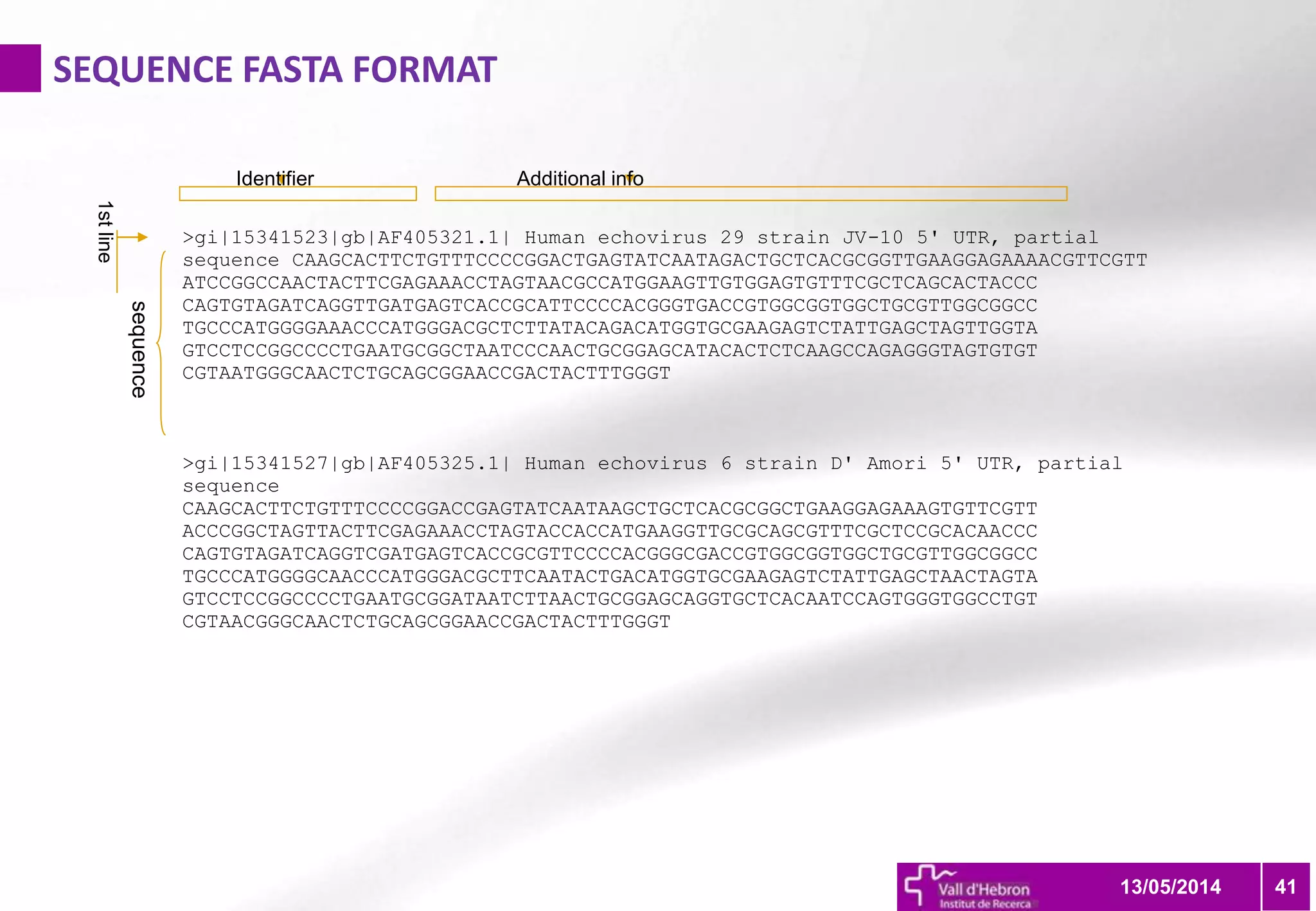
SEQUENCE FASTA FORMAT
4113/05/2014
Identifier Additional info
sequence
1stline
>gi|15341523|gb|AF405321.1| Human echovirus 29 strain JV-10 5' UTR, partial
sequence CAAGCACTTCTGTTTCCCCGGACTGAGTATCAATAGACTGCTCACGCGGTTGAAGGAGAAAACGTTCGTT
ATCCGGCCAACTACTTCGAGAAACCTAGTAACGCCATGGAAGTTGTGGAGTGTTTCGCTCAGCACTACCC
CAGTGTAGATCAGGTTGATGAGTCACCGCATTCCCCACGGGTGACCGTGGCGGTGGCTGCGTTGGCGGCC
TGCCCATGGGGAAACCCATGGGACGCTCTTATACAGACATGGTGCGAAGAGTCTATTGAGCTAGTTGGTA
GTCCTCCGGCCCCTGAATGCGGCTAATCCCAACTGCGGAGCATACACTCTCAAGCCAGAGGGTAGTGTGT
CGTAATGGGCAACTCTGCAGCGGAACCGACTACTTTGGGT
>gi|15341527|gb|AF405325.1| Human echovirus 6 strain D' Amori 5' UTR, partial
sequence
CAAGCACTTCTGTTTCCCCGGACCGAGTATCAATAAGCTGCTCACGCGGCTGAAGGAGAAAGTGTTCGTT
ACCCGGCTAGTTACTTCGAGAAACCTAGTACCACCATGAAGGTTGCGCAGCGTTTCGCTCCGCACAACCC
CAGTGTAGATCAGGTCGATGAGTCACCGCGTTCCCCACGGGCGACCGTGGCGGTGGCTGCGTTGGCGGCC
TGCCCATGGGGCAACCCATGGGACGCTTCAATACTGACATGGTGCGAAGAGTCTATTGAGCTAACTAGTA
GTCCTCCGGCCCCTGAATGCGGATAATCTTAACTGCGGAGCAGGTGCTCACAATCCAGTGGGTGGCCTGT
CGTAACGGGCAACTCTGCAGCGGAACCGACTACTTTGGGT
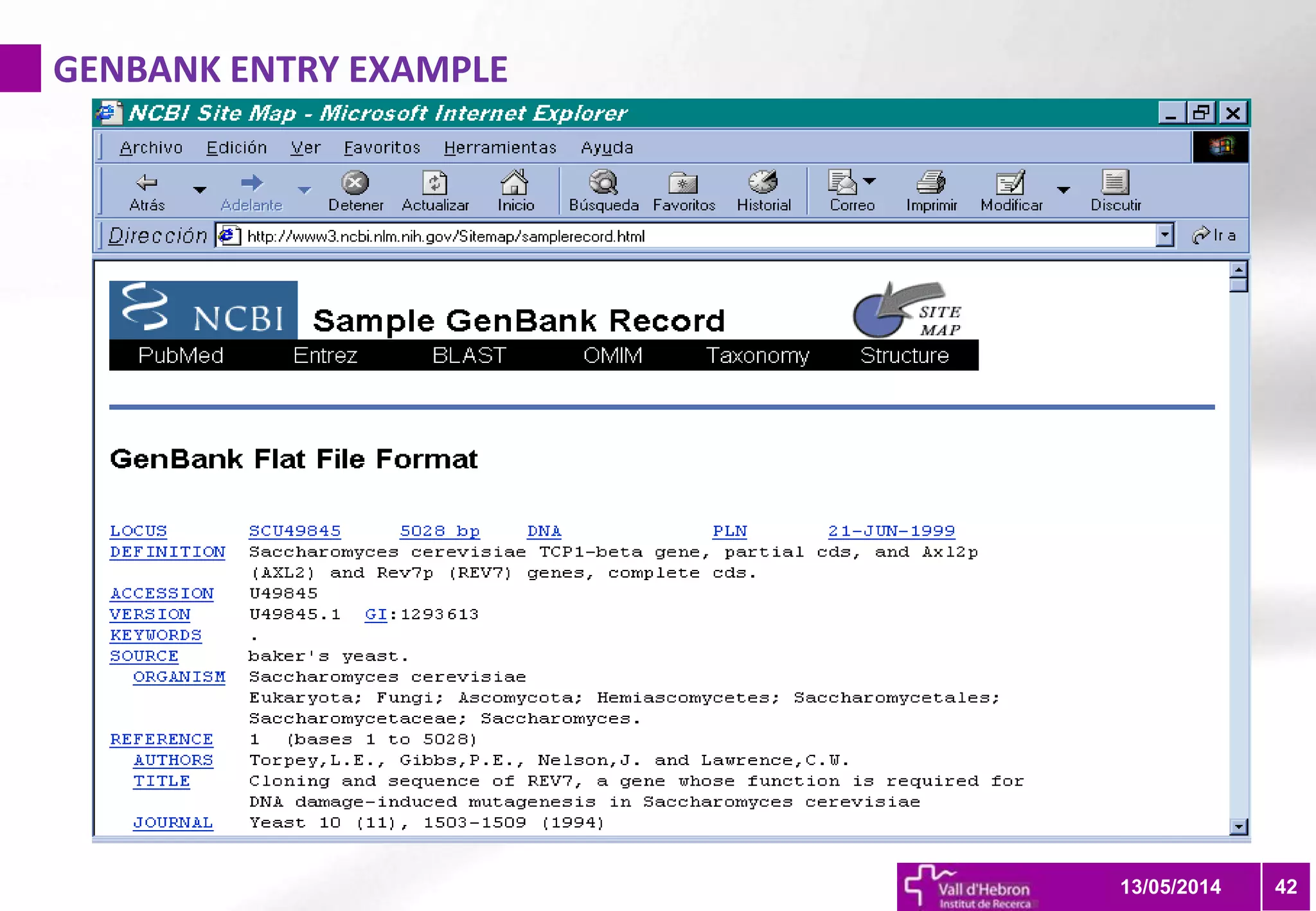
GENBANK ENTRY EXAMPLE
4213/05/2014
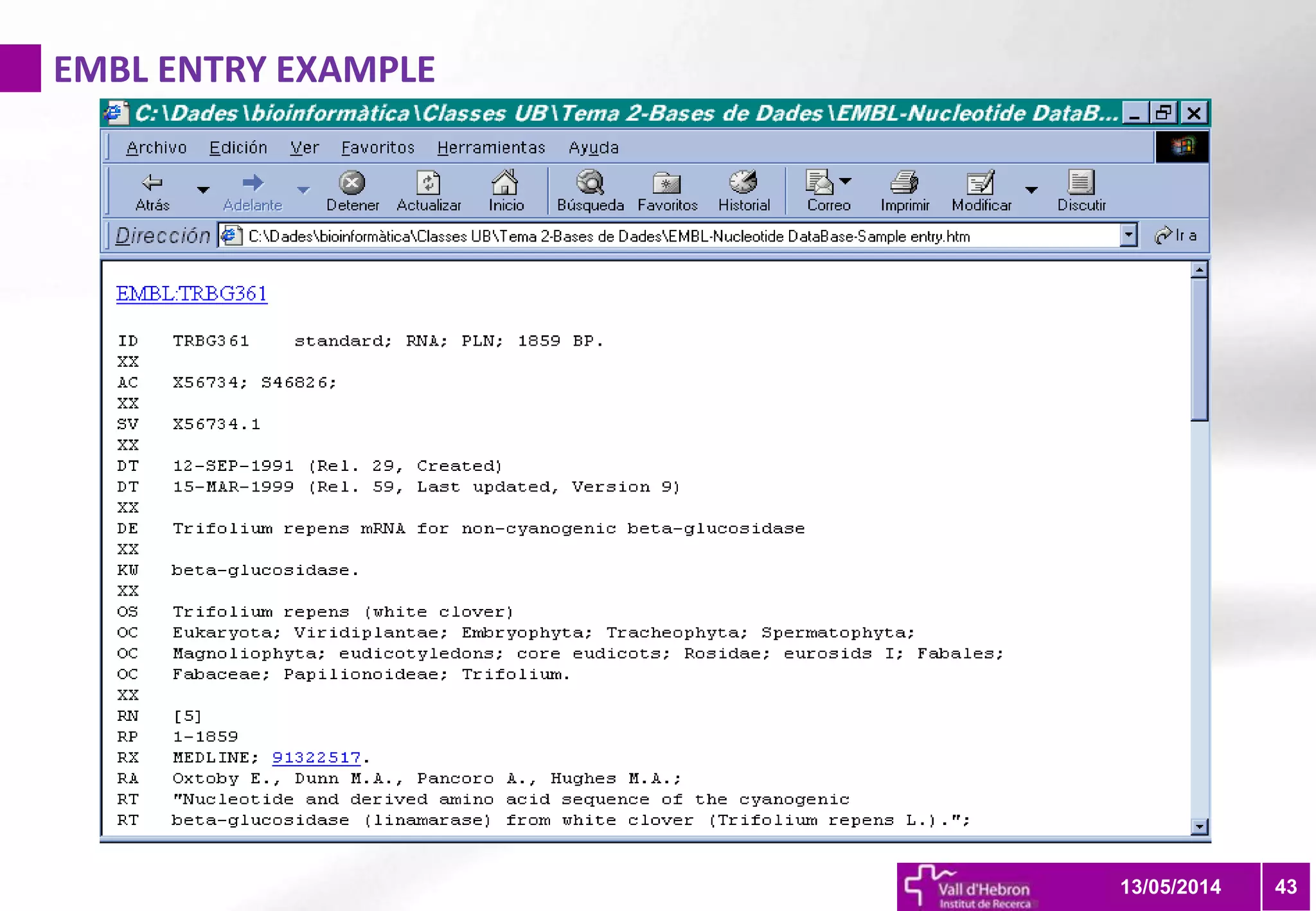
EMBL ENTRY EXAMPLE
4313/05/2014
Submitting data
4413/05/2014
SUBMITTING DATA
4513/05/2014
• Several biological databases are public, so
any (properly identified) user can contribute
uploading new data
• There are multiple types of data to upload,
but the most usual are
– Sequencies
– Expression data (from microarrays)
SUBMITTING SEQUENCES
4613/05/2014
How to submit your sequences to…
• EMBL
– http://www.ebi.ac.uk/embl/Submission/
• GeneBank
– http://www.nlm.nih.gov/pubs/factsheets/sdgenbk.html
SUBMITTING EXPRESSION DATA
4713/05/2014
And your expression data to…
• ArrayExpress (EBI)
– http://www.ebi.ac.uk/microarray/submissions.html
• Gene Expression Omnibus (NCBI)
– https://www.ncbi.nlm.nih.gov/geo/info/faq.html
Tools for DB exploitation
4813/05/2014
ENTREZ
4913/05/2014
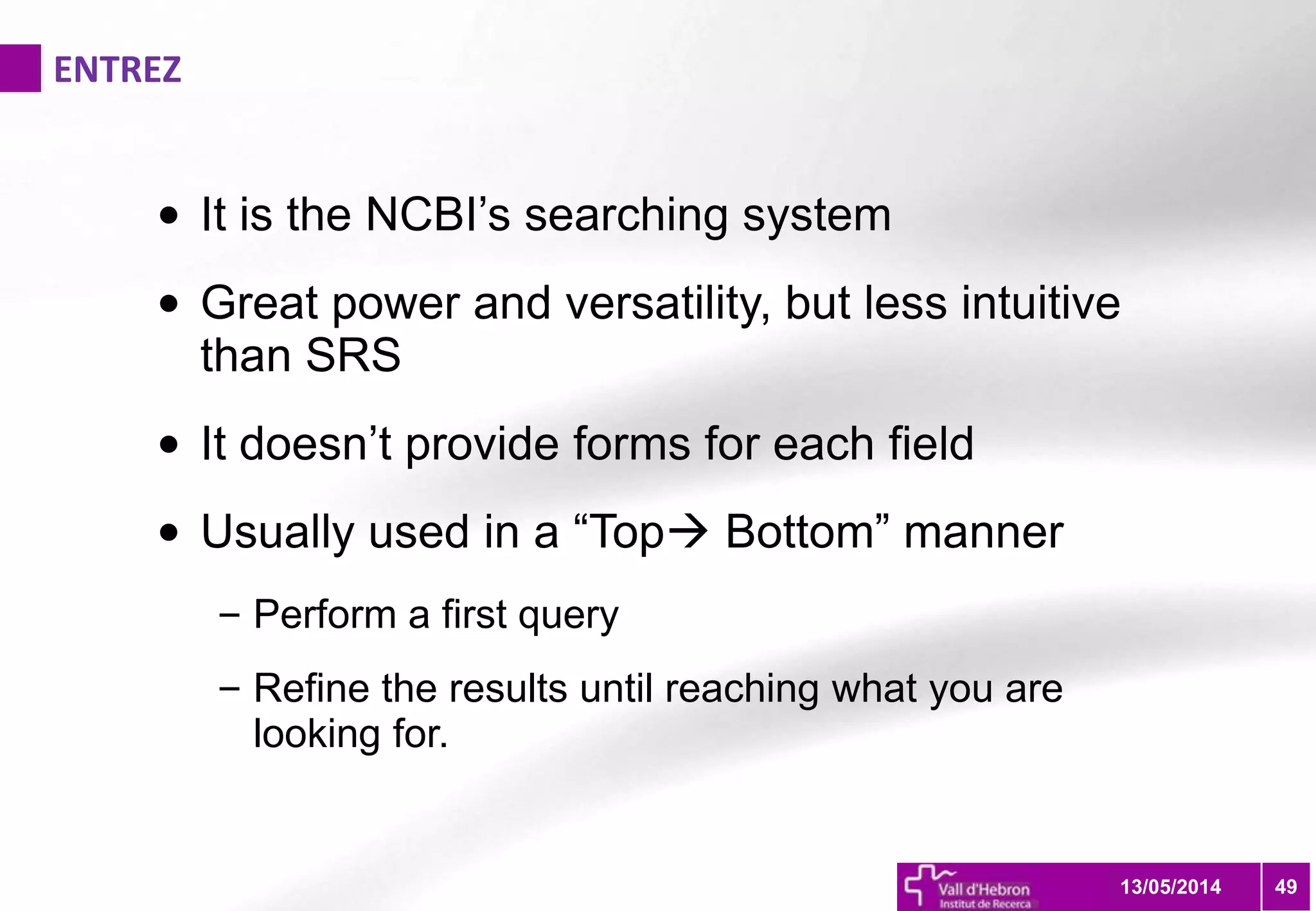
• It is the NCBI’s searching system
• Great power and versatility, but less intuitive
than SRS
• It doesn’t provide forms for each field
• Usually used in a “Top Bottom” manner
– Perform a first query
– Refine the results until reaching what you are
looking for.
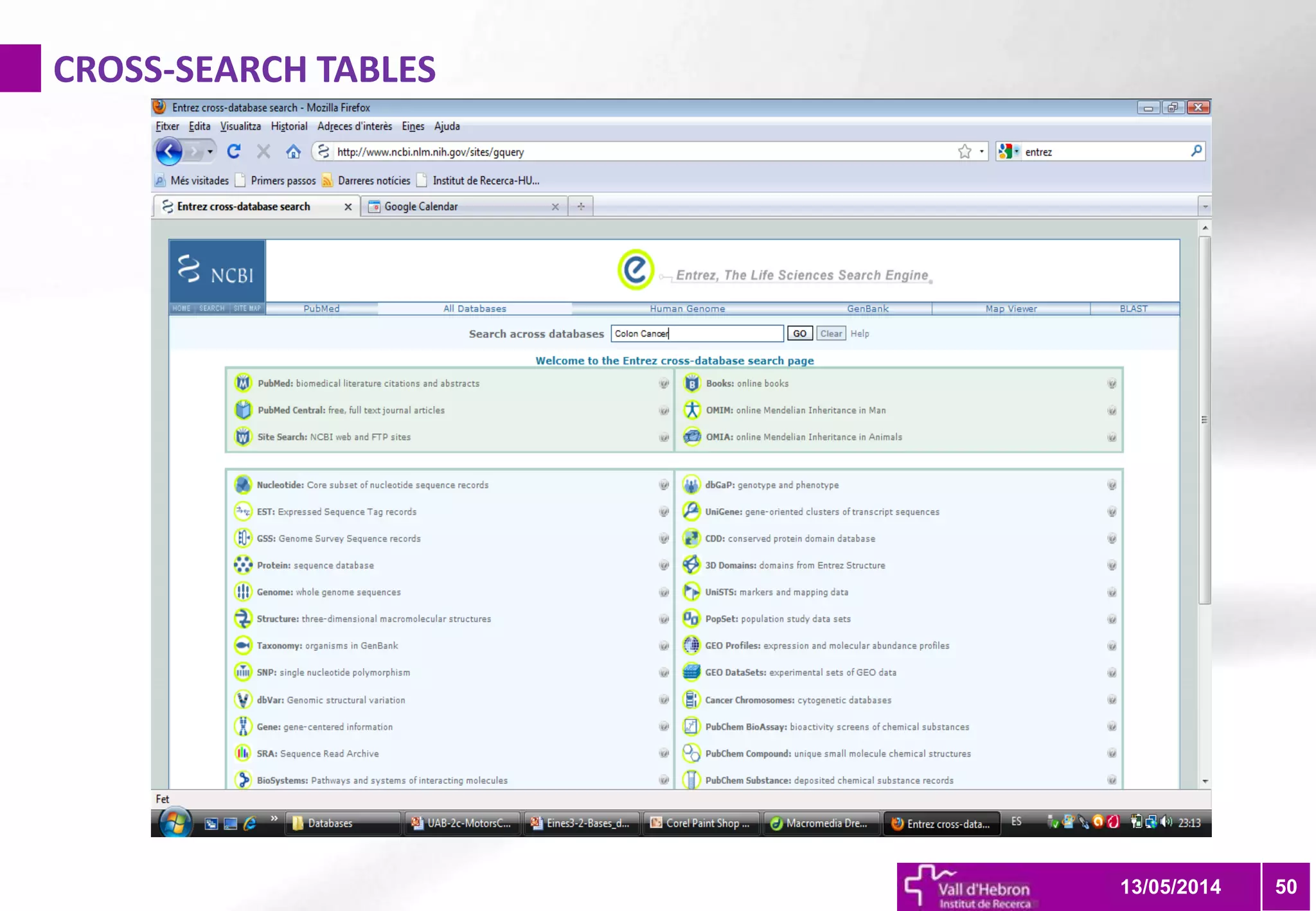
CROSS-SEARCH TABLES
5013/05/2014
ENTREZ QUERIES
5113/05/2014
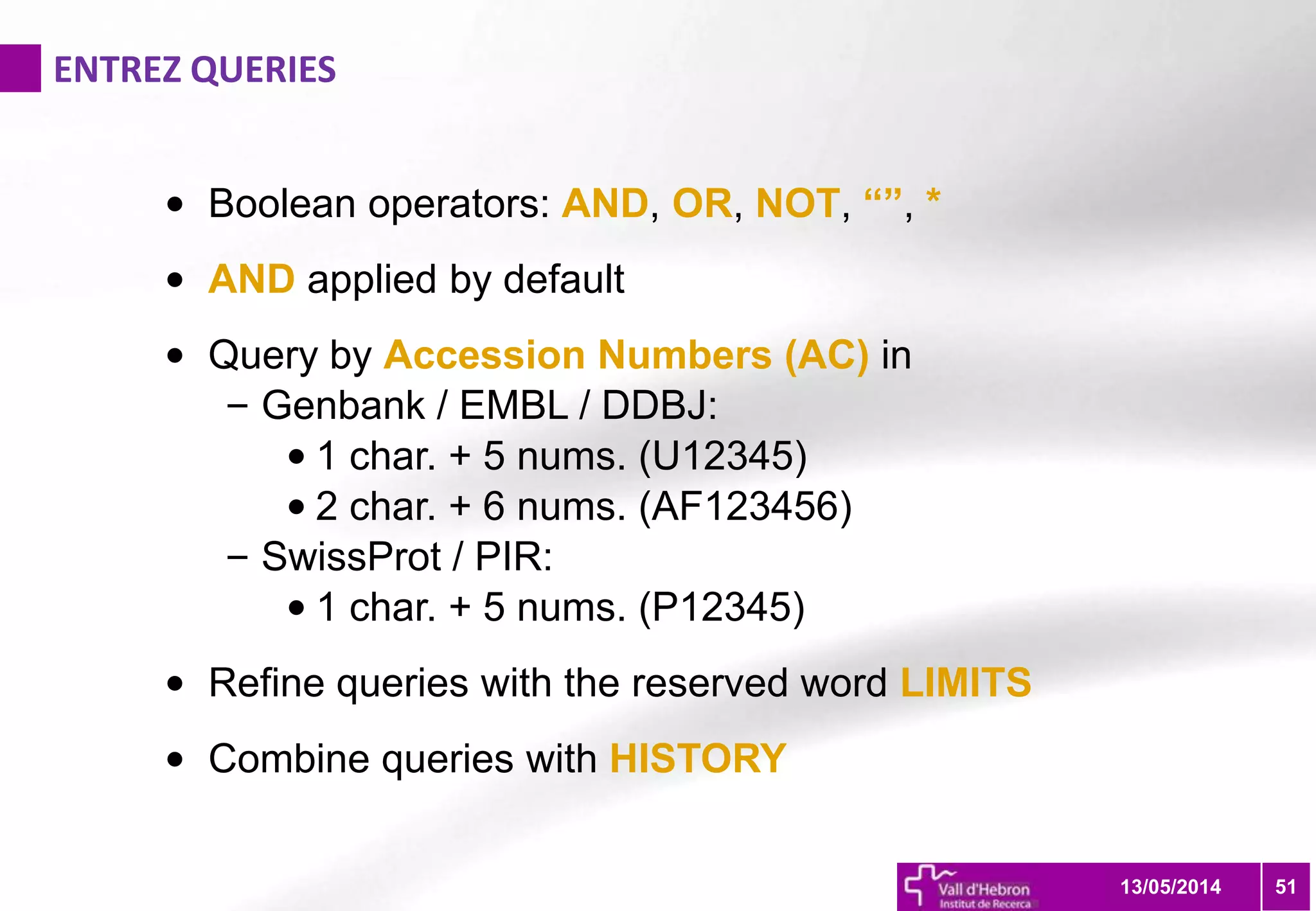
• Boolean operators: AND, OR, NOT, “”, *
• AND applied by default
• Query by Accession Numbers (AC) in
– Genbank / EMBL / DDBJ:
• 1 char. + 5 nums. (U12345)
• 2 char. + 6 nums. (AF123456)
– SwissProt / PIR:
• 1 char. + 5 nums. (P12345)
• Refine queries with the reserved word LIMITS
• Combine queries with HISTORY
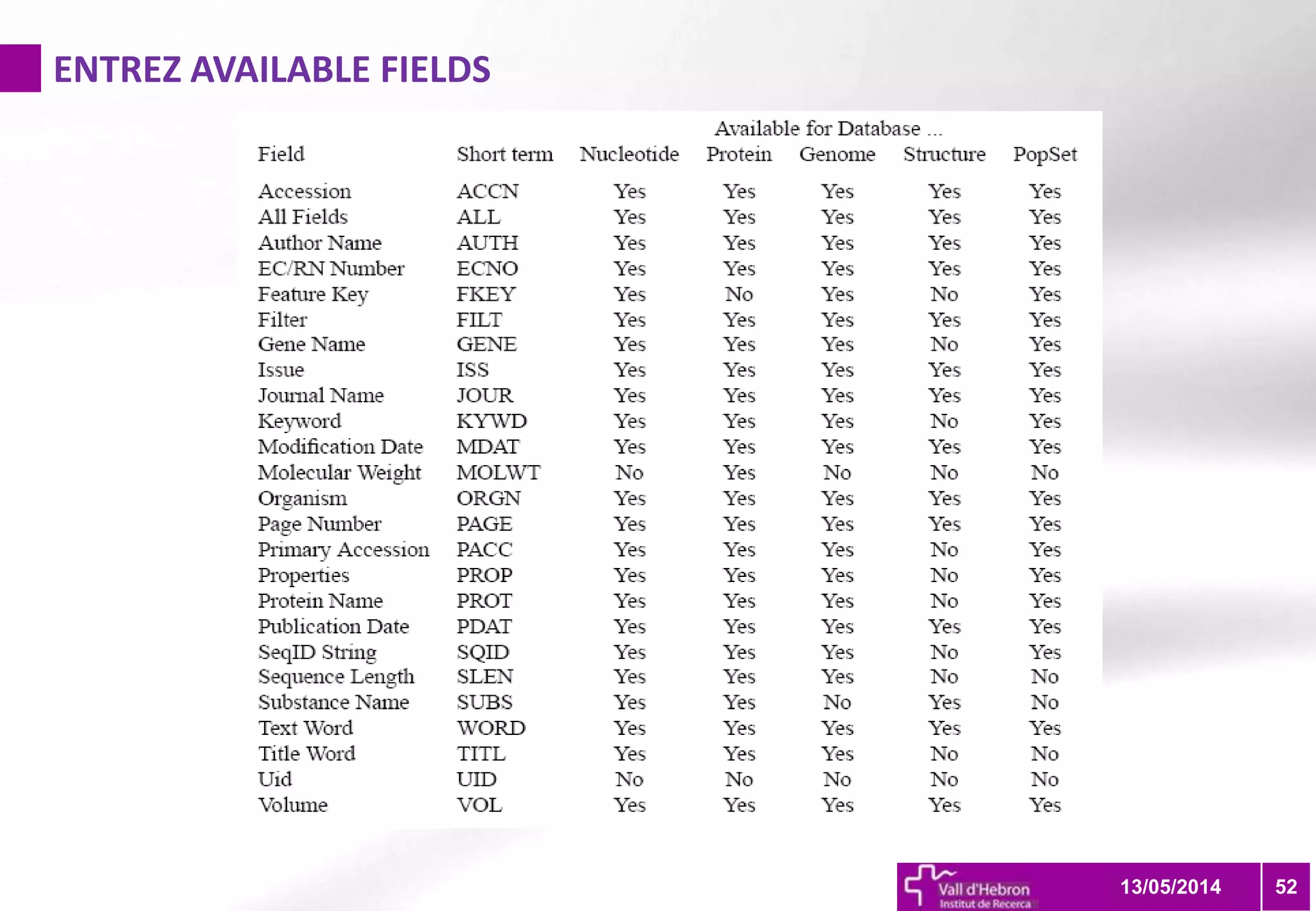
ENTREZ AVAILABLE FIELDS
5213/05/2014
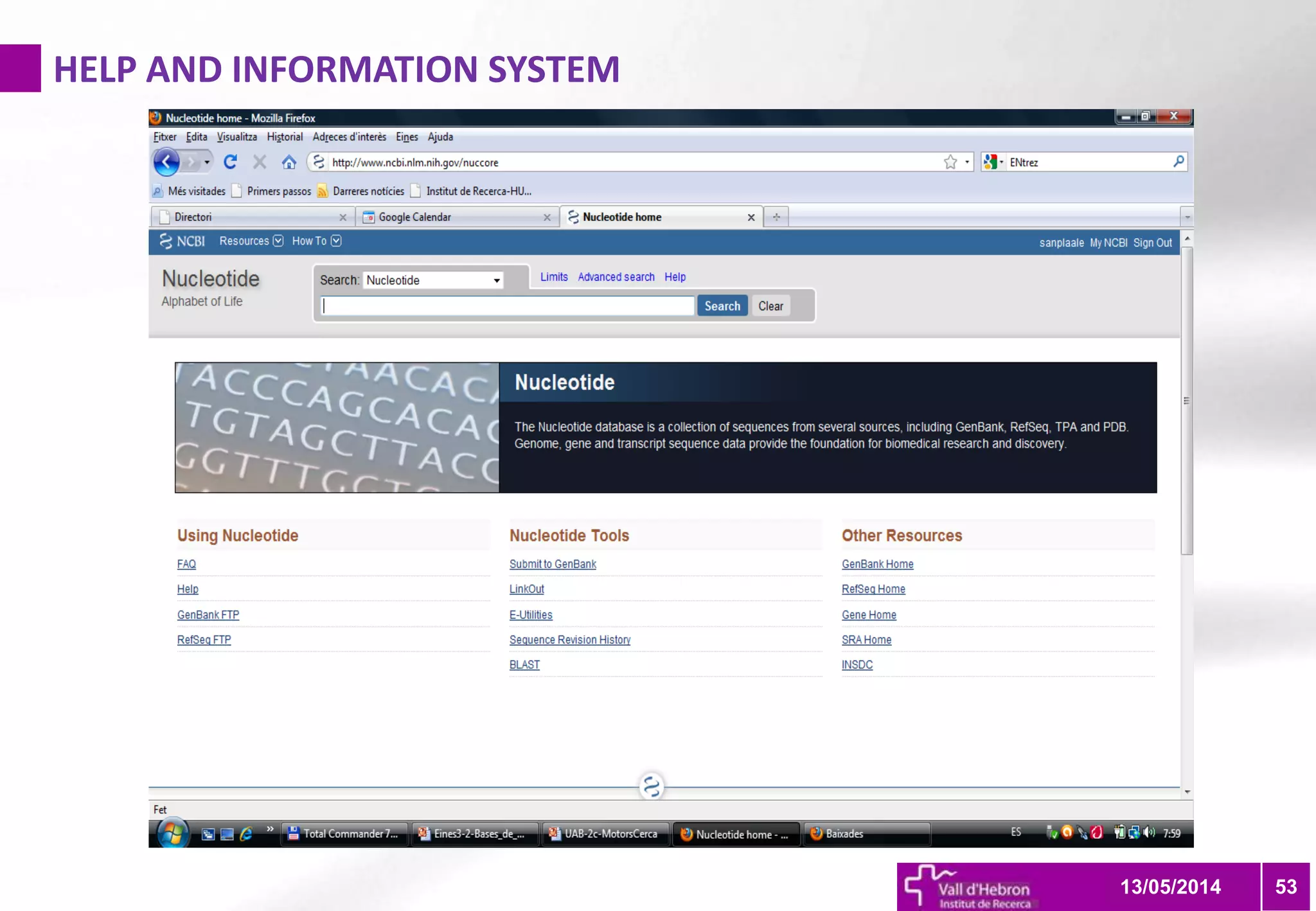
HELP AND INFORMATION SYSTEM
5313/05/2014
Estamos interesados en el gen MLH1 humano, implicado en el cáncer de
colon
– Separar el grano de la paja: identificar una secuencia de mRNA
representativa y bien anotada del gen MLH1.
– Obtener literatura asociada y su secuencia protéica.
– Identificar proteínas similares.
– Identificar dominios conservados dentro de la proteína.
– Identificar mutaciones conocidas en el gen o la proteína.
– Encontrar la estructura tridimensional de la proteína, si esta es
conocida, o si no es así, identificar estructuras de secuencia homóloga.
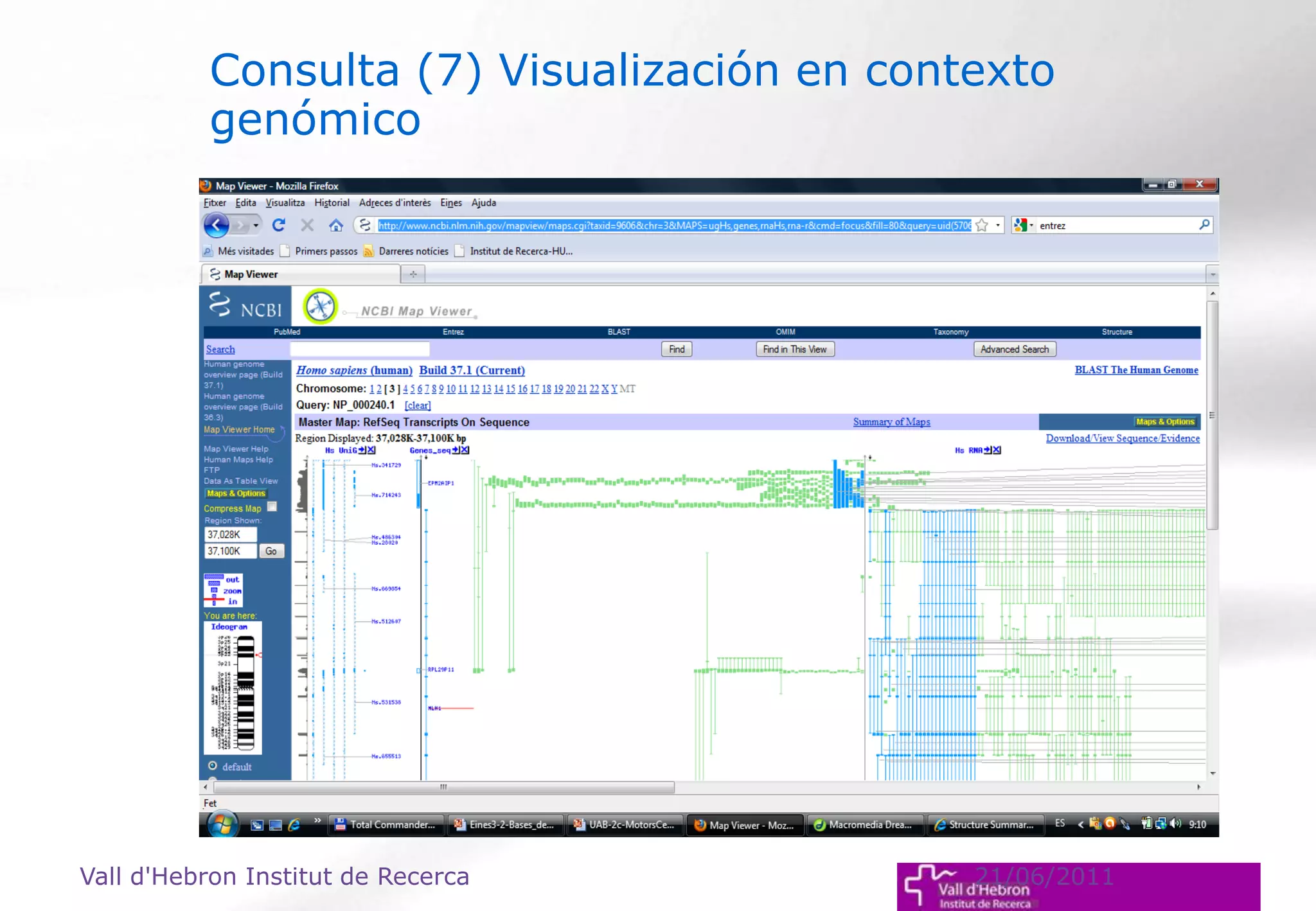
– Ver el contexto genómico del gen y descargar la región que lo contiene.
Vall d'Hebron Institut de Recerca 21/06/2011
Ejemplos de búsqueda con Entrez
Vall d'Hebron Institut de Recerca 21/06/2011
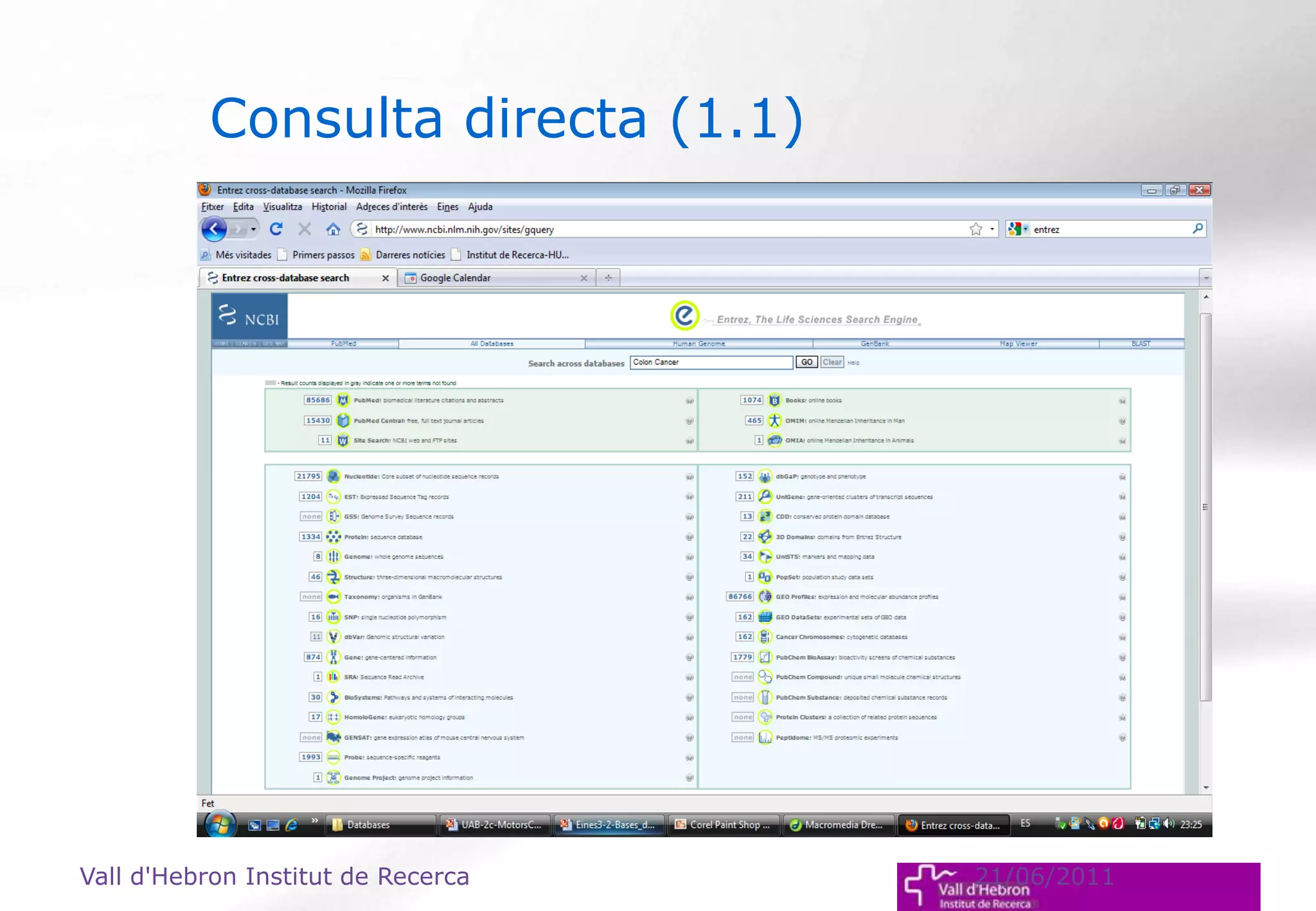
Consulta directa (1.1)
Vall d'Hebron Institut de Recerca 21/06/2011
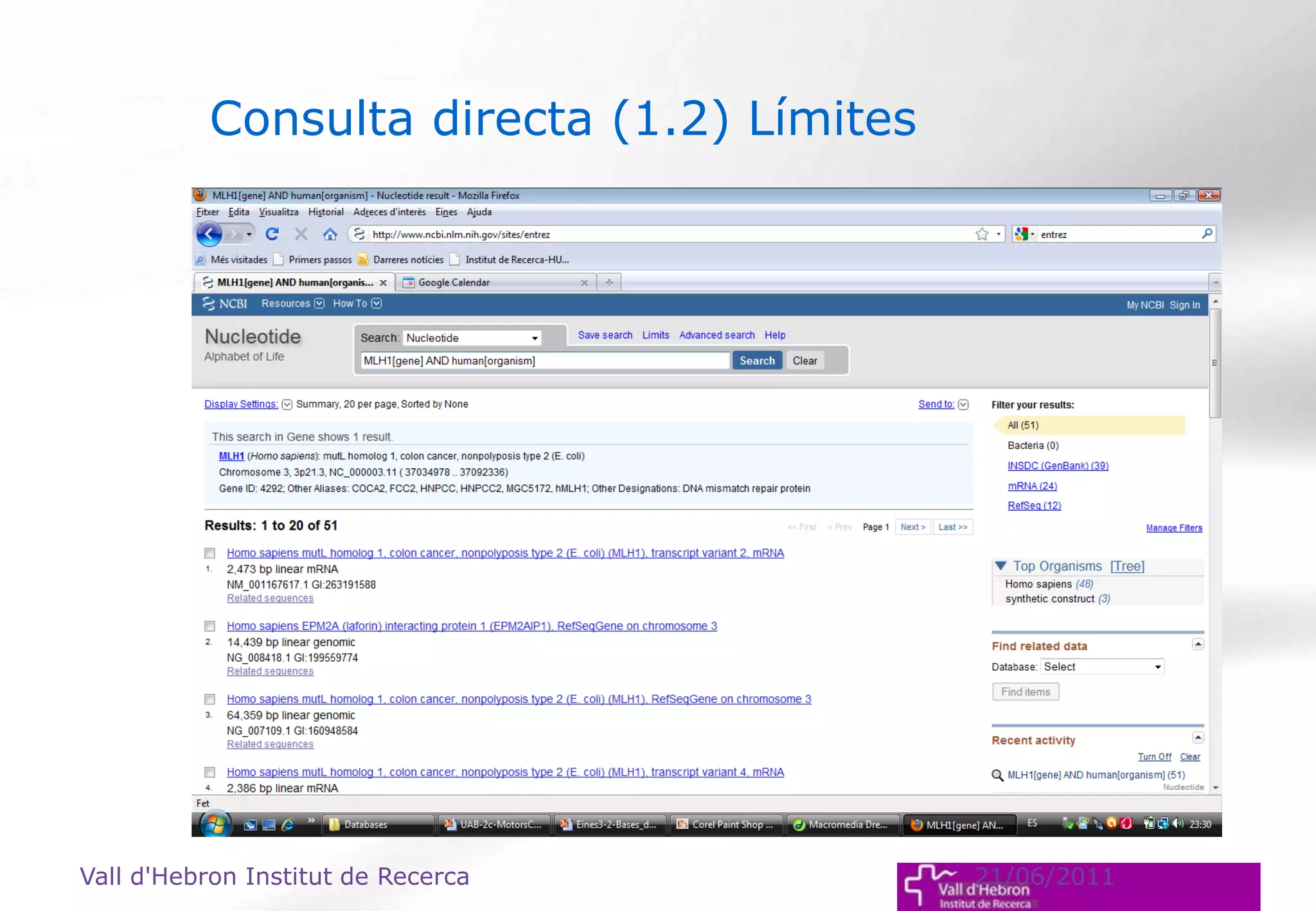
Consulta directa (1.2) Límites
Vall d'Hebron Institut de Recerca 21/06/2011
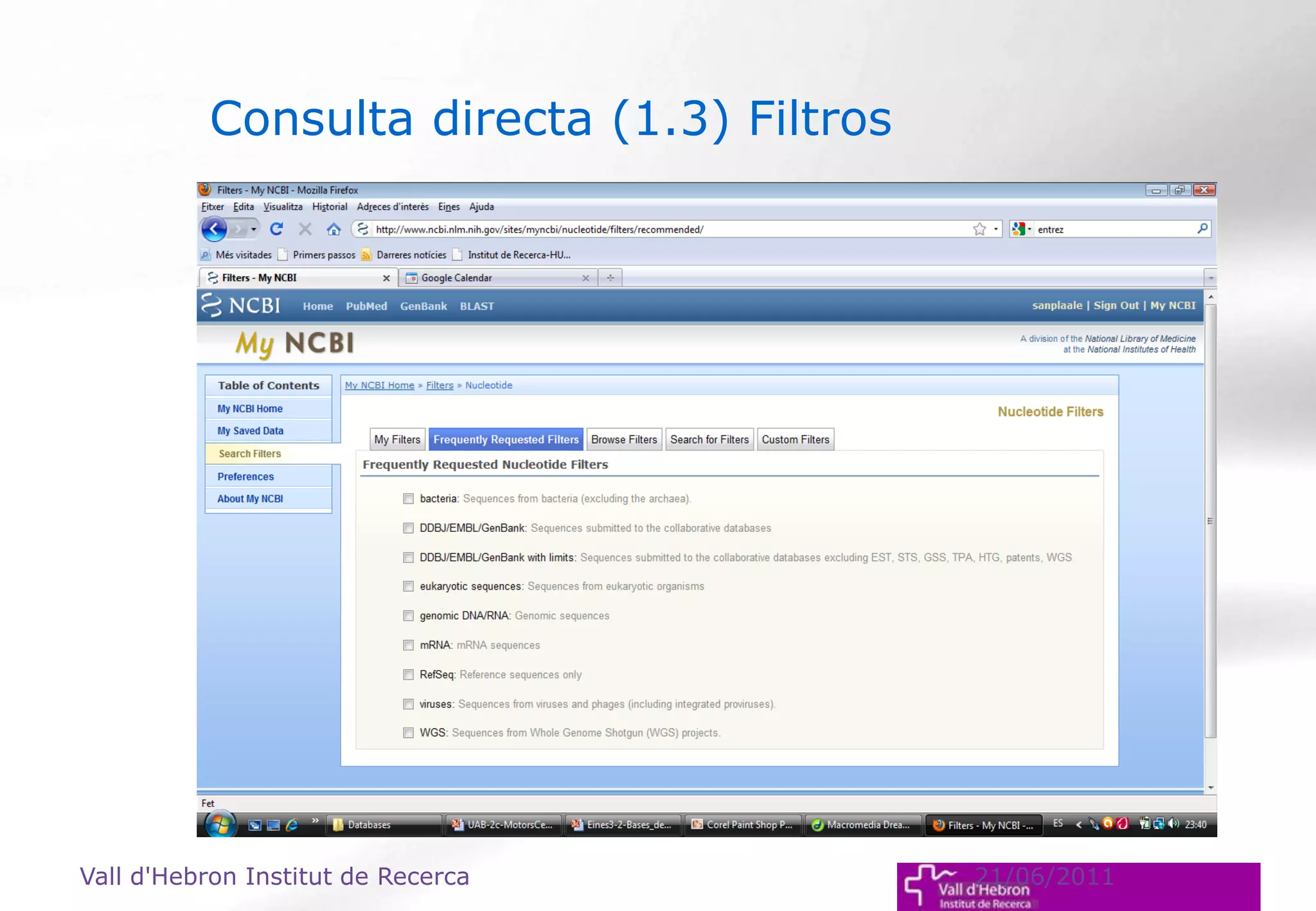
Consulta directa (1.3) Filtros
Vall d'Hebron Institut de Recerca 21/06/2011
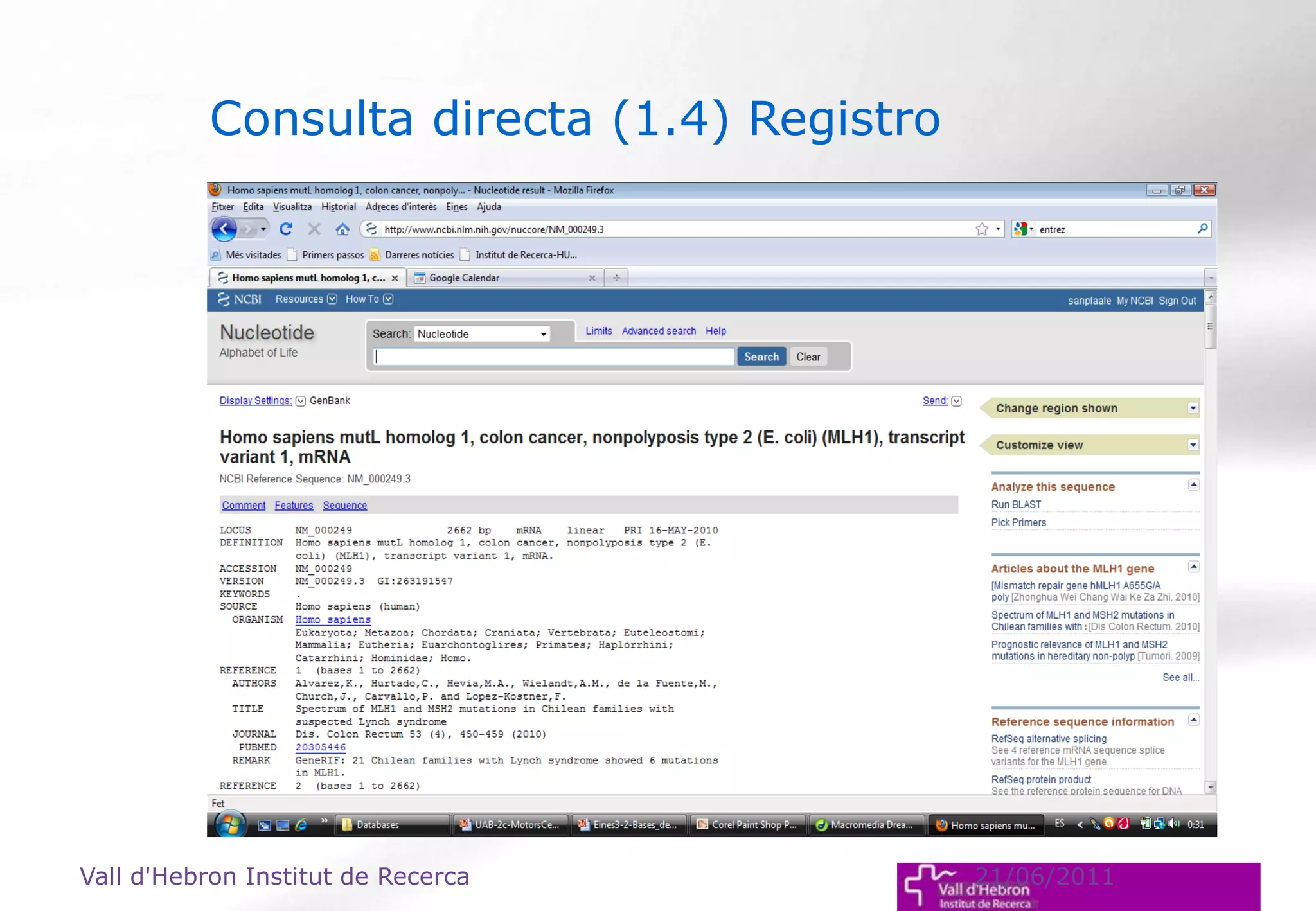
Consulta directa (1.4) Registro
Vall d'Hebron Institut de Recerca 21/06/2011
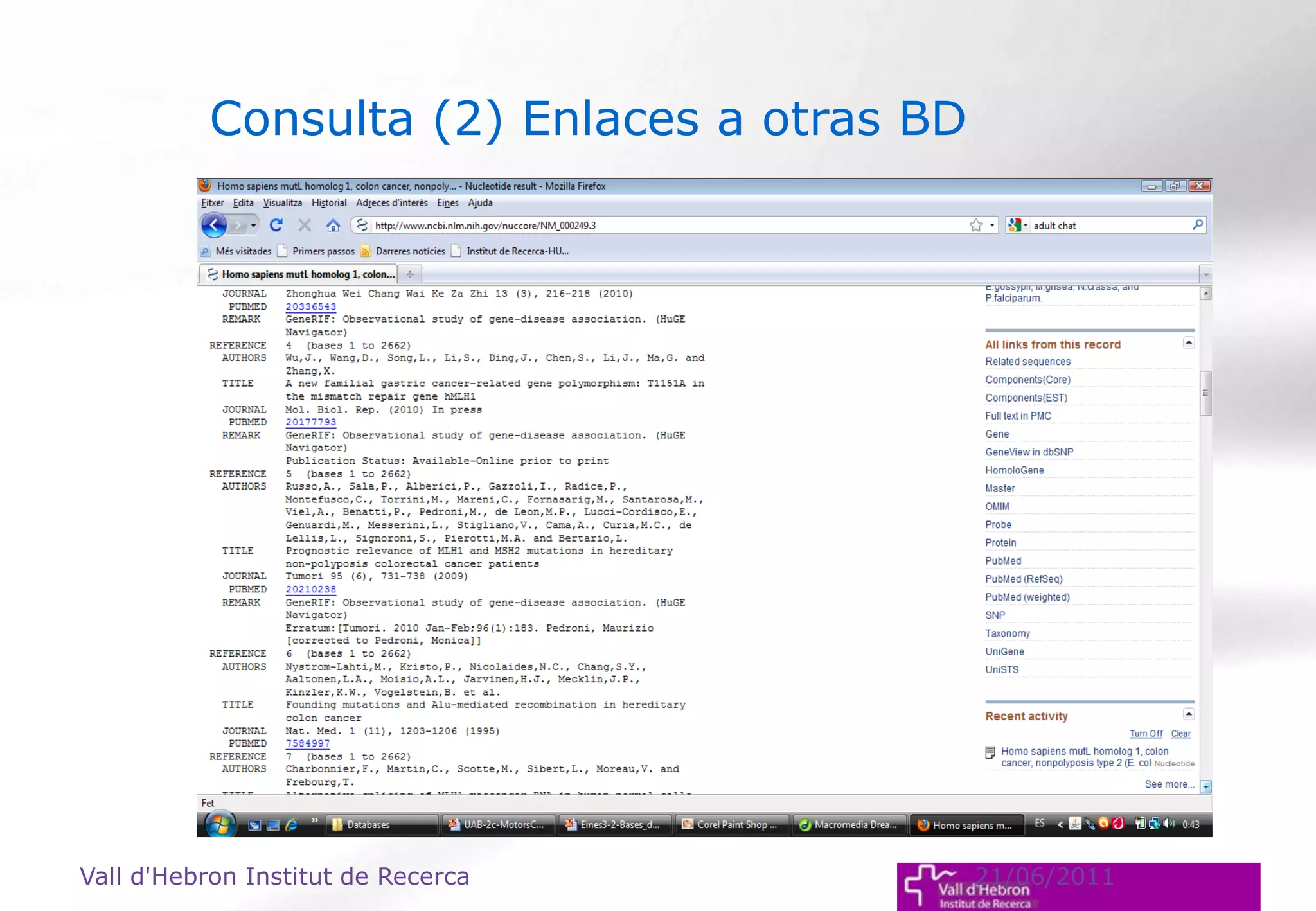
Consulta (2) Enlaces a otras BD
Vall d'Hebron Institut de Recerca 21/06/2011
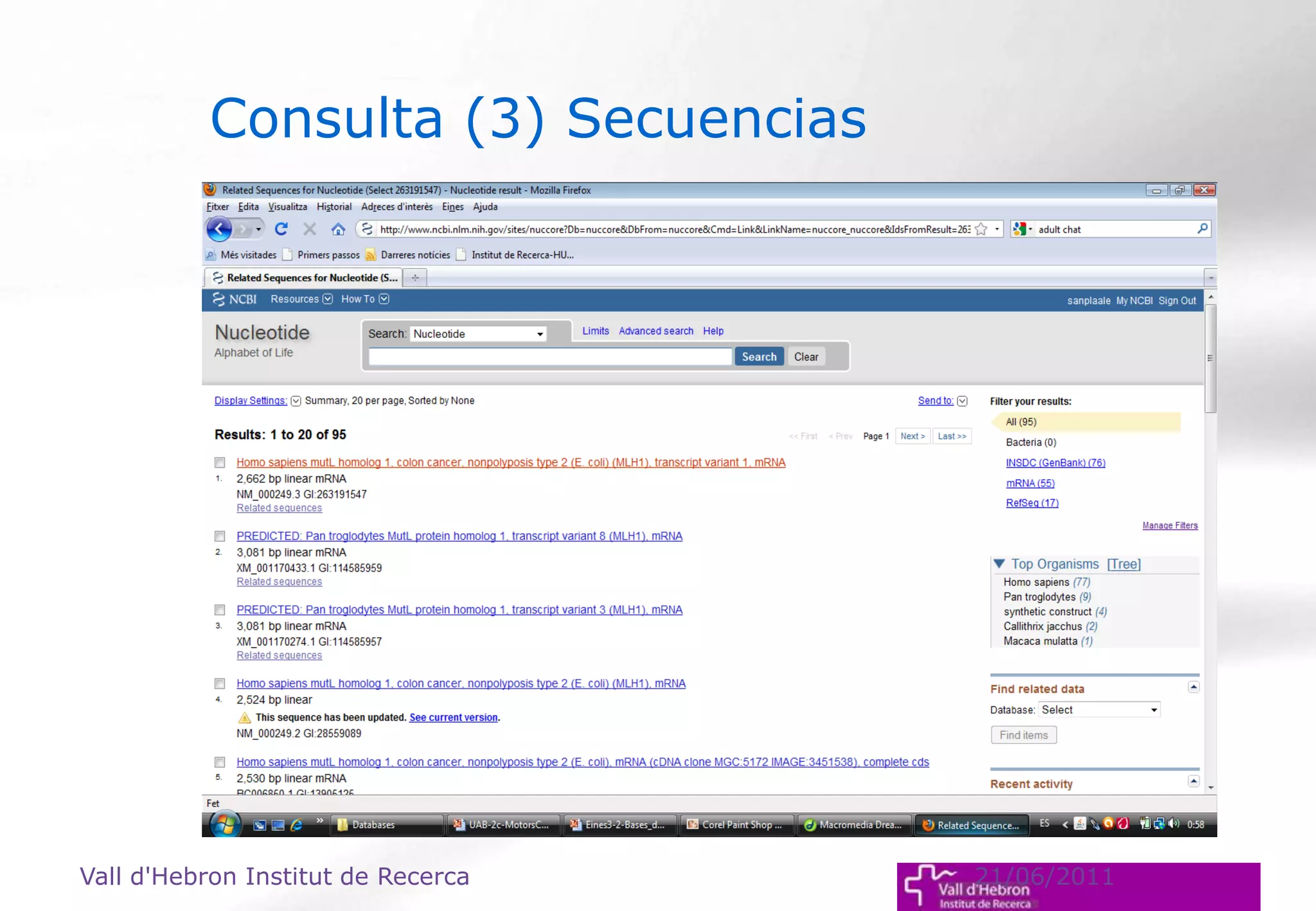
Consulta (3) Secuencias
Vall d'Hebron Institut de Recerca 21/06/2011
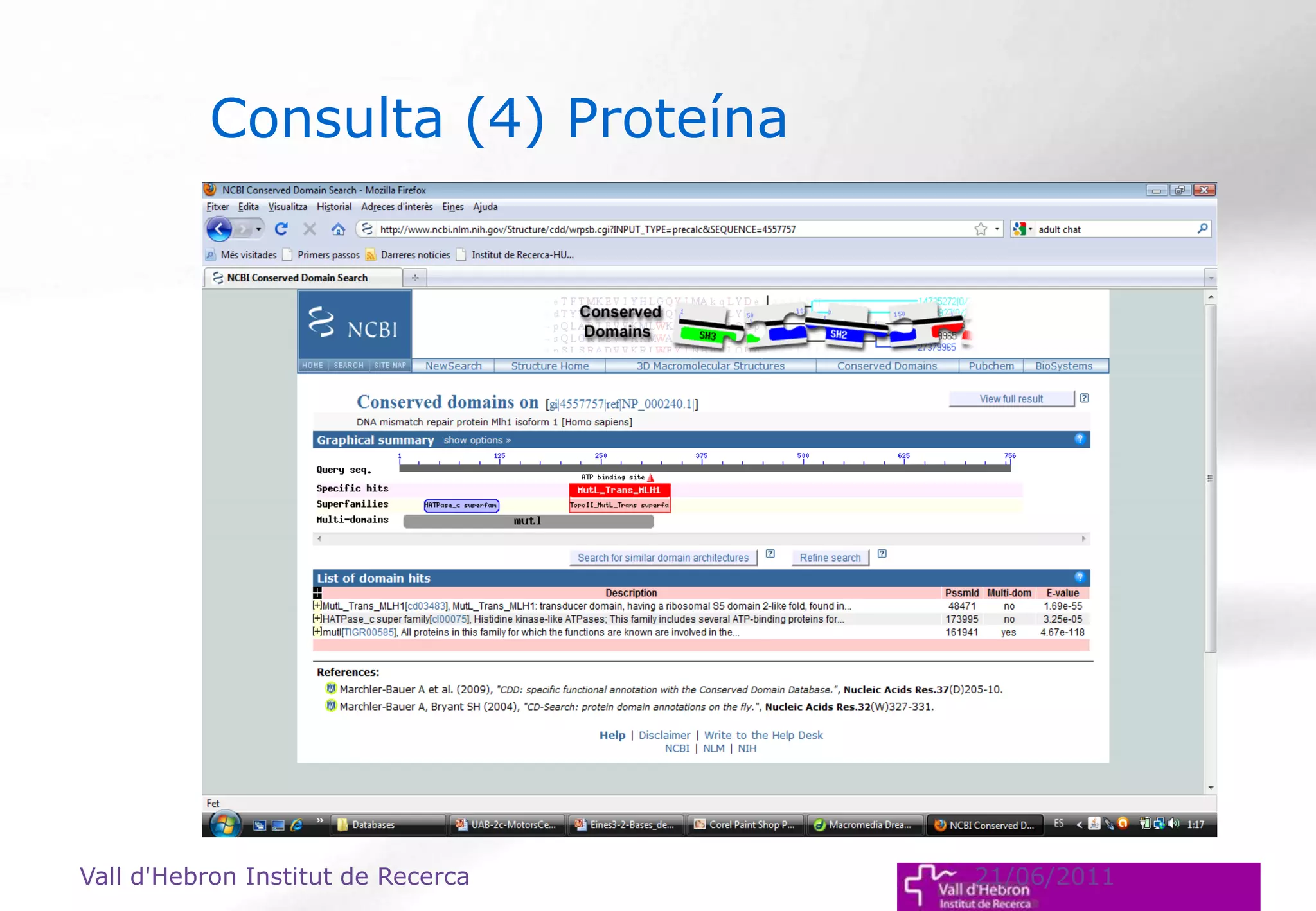
Consulta (4) Proteína
Vall d'Hebron Institut de Recerca 21/06/2011
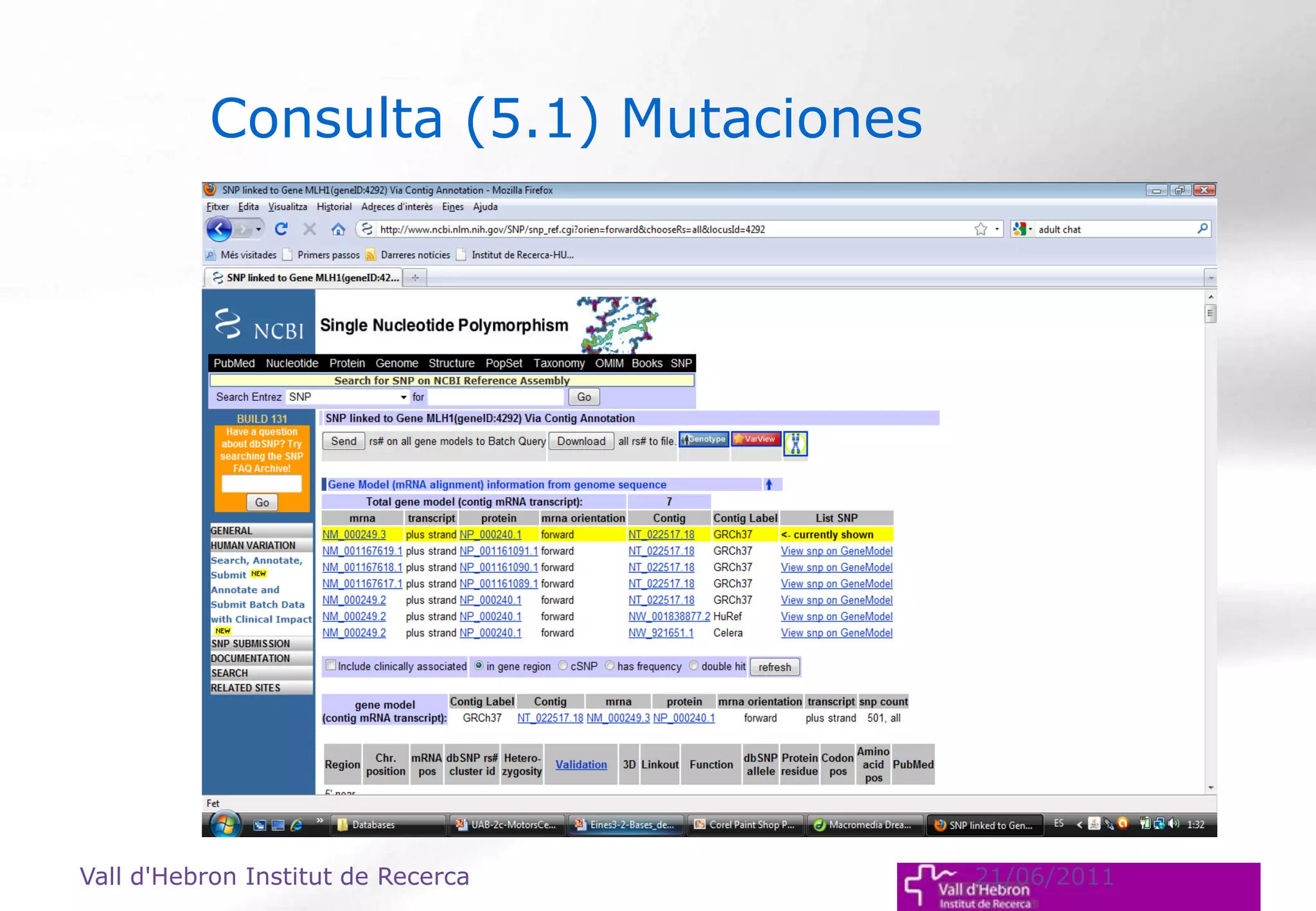
Consulta (5.1) Mutaciones
Vall d'Hebron Institut de Recerca 21/06/2011
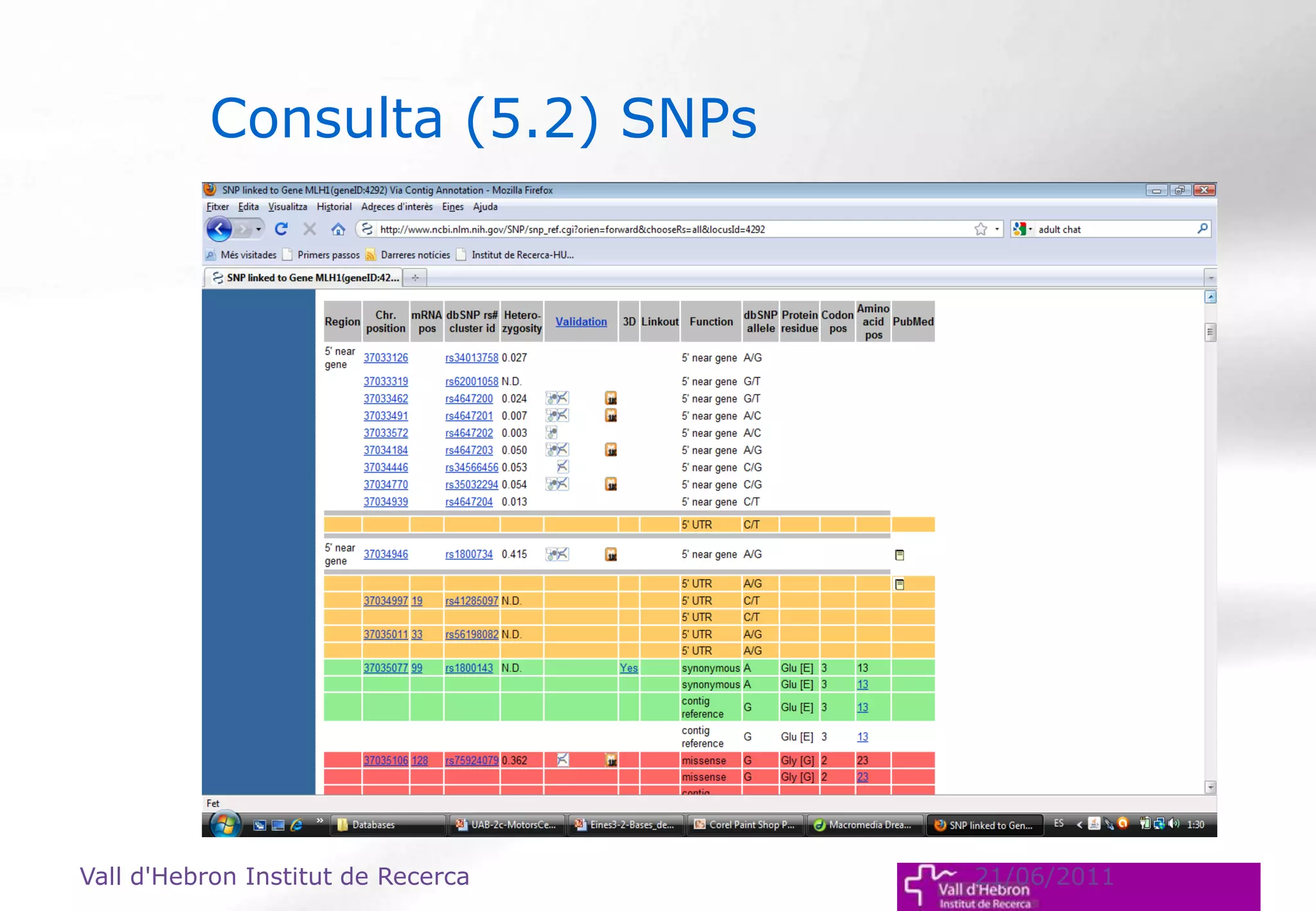
Consulta (5.2) SNPs
Vall d'Hebron Institut de Recerca 21/06/2011
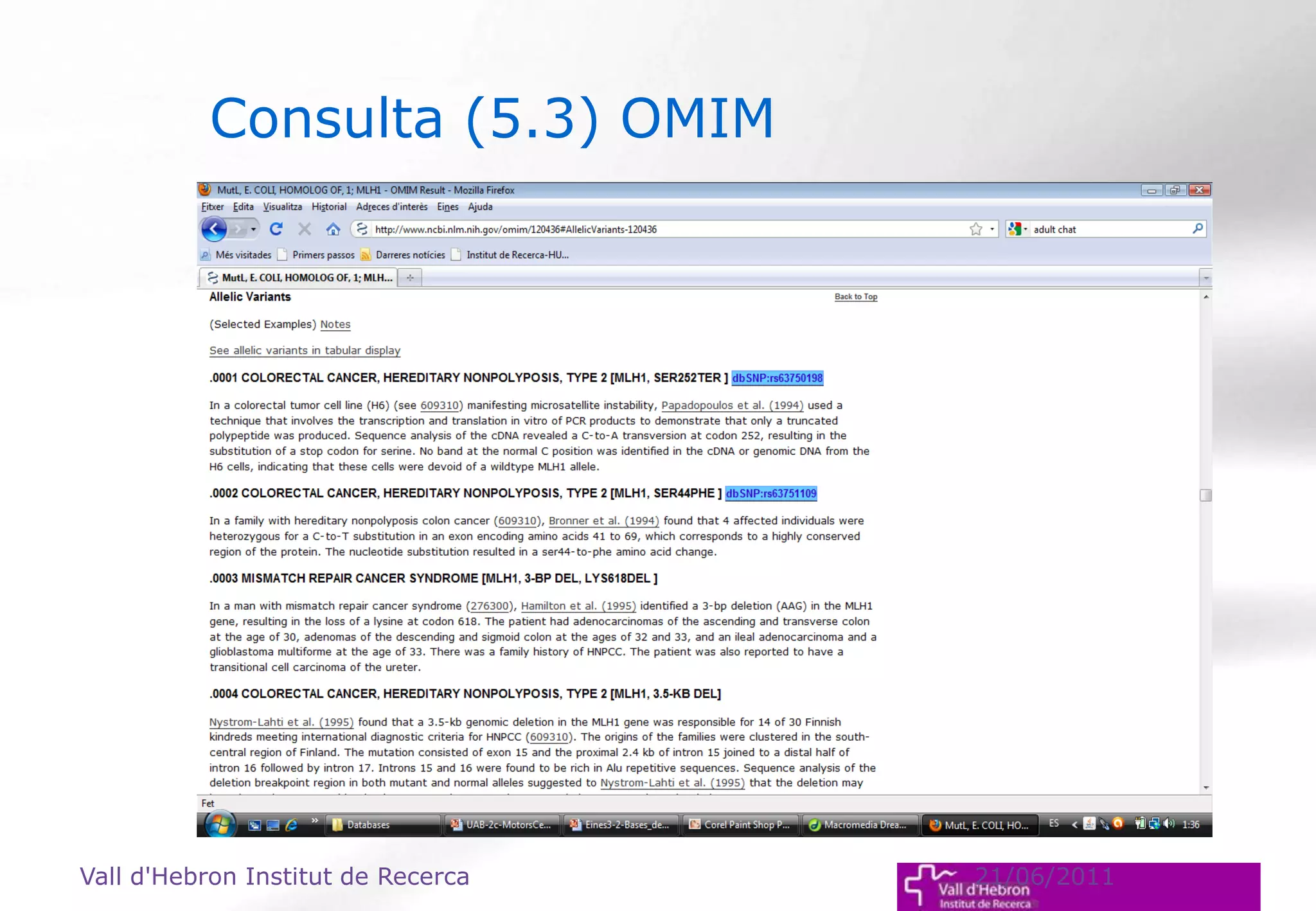
Consulta (5.3) OMIM
Vall d'Hebron Institut de Recerca 21/06/2011
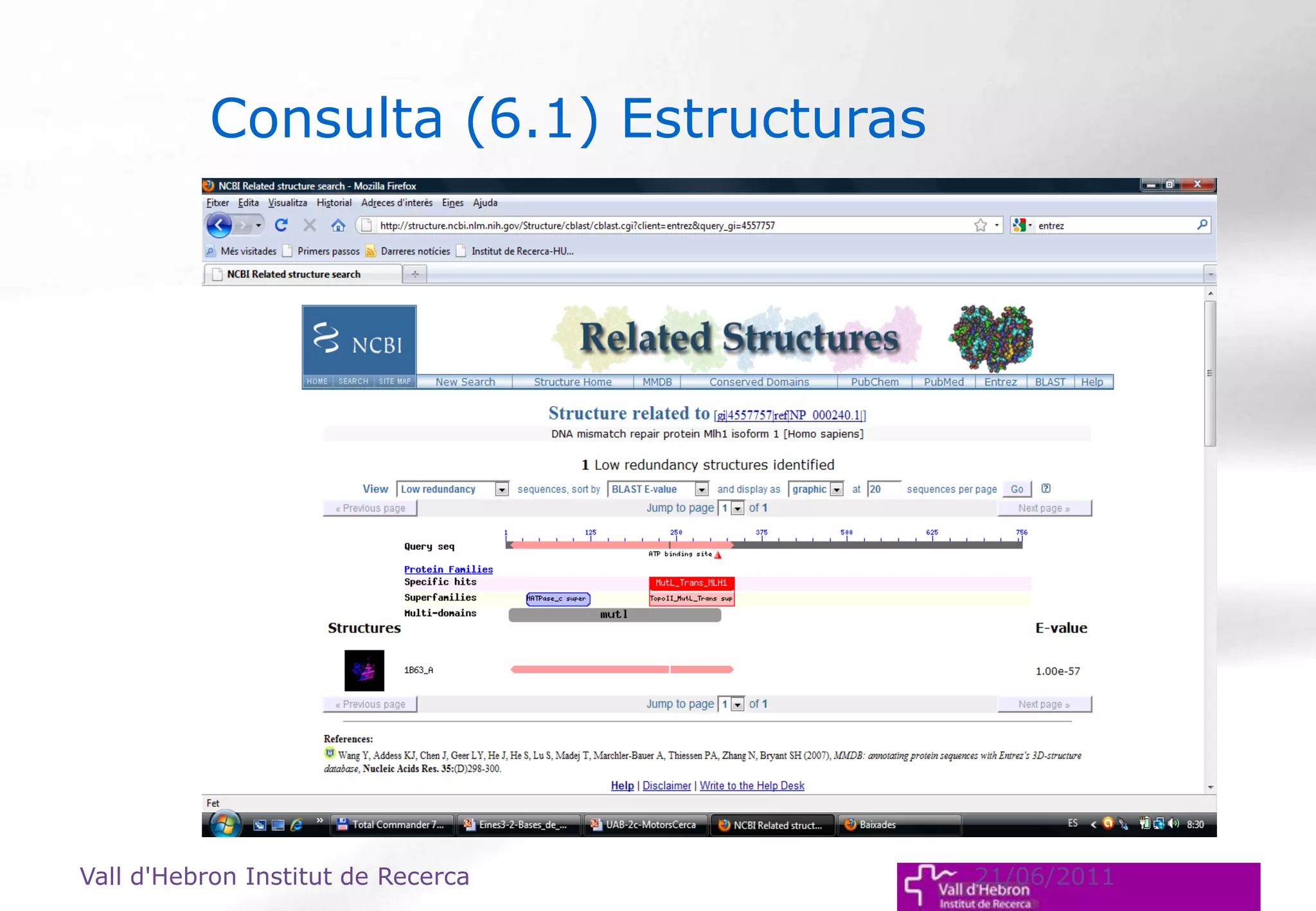
Consulta (6.1) Estructuras
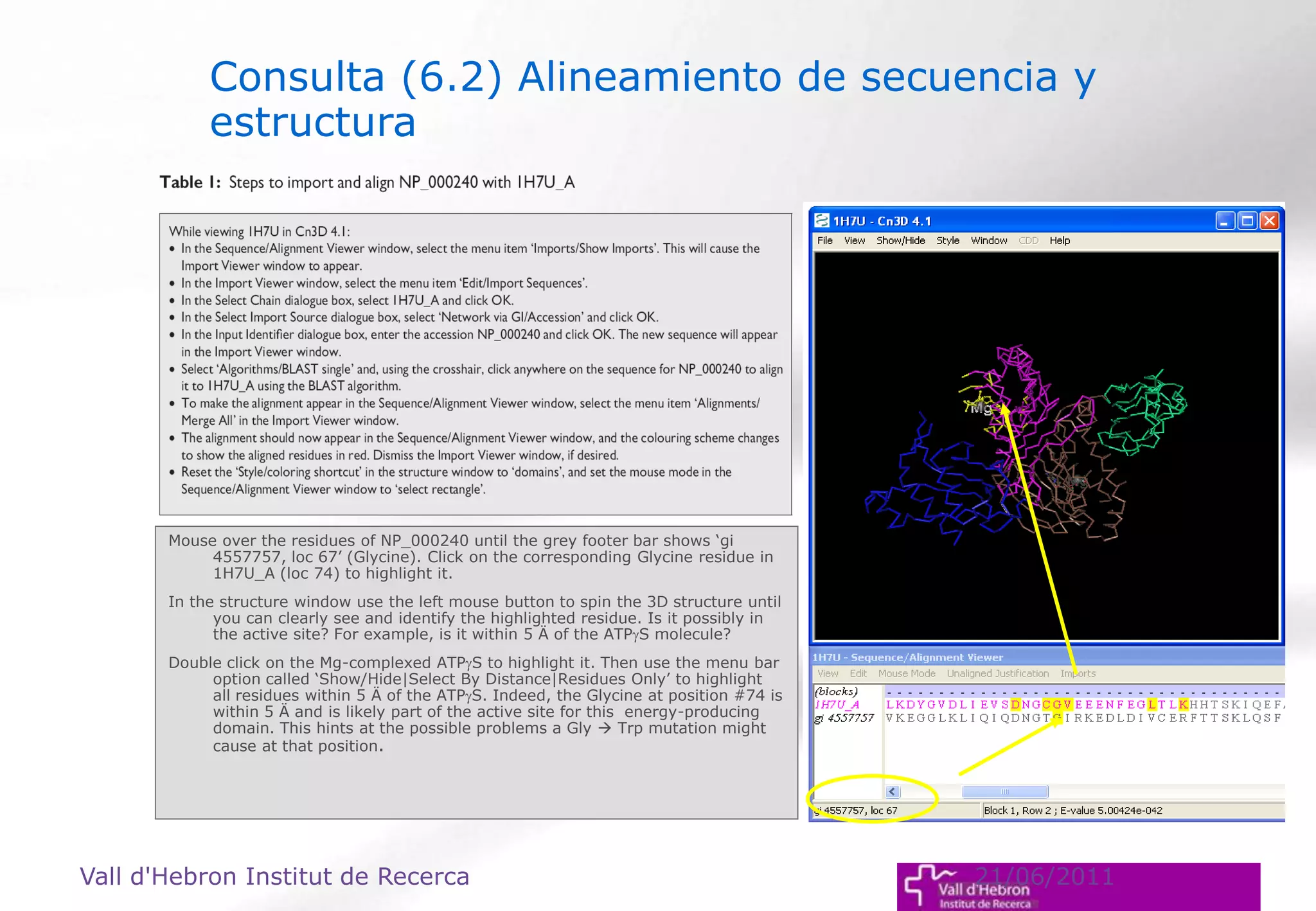
Mouse over the residues of NP_000240 until the grey footer bar shows ‘gi
4557757, loc 67’ (Glycine). Click on the corresponding Glycine residue in
1H7U_A (loc 74) to highlight it.
In the structure window use the left mouse button to spin the 3D structure until
you can clearly see and identify the highlighted residue. Is it possibly in
the active site? For example, is it within 5 Ä of the ATPS molecule?
Double click on the Mg-complexed ATPS to highlight it. Then use the menu bar
option called ‘Show/Hide|Select By Distance|Residues Only’ to highlight
all residues within 5 Ä of the ATPS. Indeed, the Glycine at position #74 is
within 5 Ä and is likely part of the active site for this energy-producing
domain. This hints at the possible problems a Gly  Trp mutation might
cause at that position.
Vall d'Hebron Institut de Recerca 21/06/2011
Consulta (6.2) Alineamiento de secuencia y
estructura
Vall d'Hebron Institut de Recerca 21/06/2011
Consulta (7) Visualización en contexto
genómico

Storing and Accessing Information. Databases and Queries (UEB-UAT Bioinformatics Course - Session 1.2 - VHIR, Barcelona)

  • 1.
    Hospital Universitari Valld’Hebron Institut de Recerca - VHIR Institut d’Investigació Sanitària de l’Instituto de Salud Carlos III (ISCIII) Bioinformàtica per la Recerca Biomèdica http://ueb.vhir.org/2014BRB Alex Sánchez alex.sanchez@vhir.org 13/05/2014 STORING AND ACCESSING INFORMATION DATABASES AND QUERIES
  • 2.
    1. Data banksand databases ● Information in the genomics era ● Distinct DB usages ● To take into account ● Main resources providers 2. Types of databases ● EMBL vs NCBI ● Bibliography DB ● Taxonomy DB ● Nucleotide DB ● Genome DB ● Protein DB ● Microarray DB ● Other DB ● Lists of DB PRESENTATION OUTLINE 213/05/2014 3. Structure and formats of the databases ● Structure of the DB ● Formats of the DB ● Sequence FASTA format ● GenBank entry example ● EMBL entry example 4. Submitting data ● Submitting sequences ● Submitting expression data 5. Tools for DB exploitation ● ENTREZ ● Cross-search tables ● Entrez queries ● Entrez fields ● Help system
  • 3.
    Data banks anddatabases 313/05/2014
  • 4.
    INFORMATION IN THEGENOMICS ERA 4 • Genomics era: huge amount of data • To be able to use this information, it should be properly stored • The access to that info – Must be quick – Has to be done in a flexible way • That is possible thanks to the – Creation of databases – It’s online availability 13/05/2014
  • 5.
    DISTINCT DB USAGES 5 •Information search – By keyword, accession number, authors… • Homology search – Is there any sequence identical or similar to that mine? • Pattern search – Has my sequence any known pattern? • Predictions – Can I find proteins, with already known function, similar to mine? 13/05/2014
  • 6.
    Bioinformatics reagent: Databases Organizedarray of information Place where you put things in, and (if all is well) you should be able to get them out again. Resource for other databases and tools. Simplify the information space by specialization. Bonus: Allows you to make discoveries. Important question to ask: what is the data model?
  • 7.
    7 Bioinformatics experiments: BLAST searchSequenceAlignment Reagents: •Sequence •Databases Method: •P-P BLASTP •N-P BLASTX •P-N TBLASTN •N-N BLASTN •N (P) – N (P) TBLASTX Interpretation: •Similarity •Hypothesis testing Know your reagents Know your methods Do your controls
  • 8.
    8 Nature 409:452 Bioinformatics Citizenship:What it means, and what does it cost?
  • 9.
  • 10.
    Databases Information system Query system StorageSystem Data GenBank flat file COSMIC record Interaction Record Title of a book Book
  • 11.
    Databases Information system Query system StorageSystem Data Boxes Oracle MySQL PC binary files Unix text files Bookshelves
  • 12.
    Databases Information system Query system StorageSystem Data A List you look at A catalogue indexed files SQL grep
  • 13.
    The library ofCongress Google Entrez EnsEMBL UCSC gemome browser Databases Information system Query system Storage System Data
  • 14.
    TO TAKE INTOACCOUNT 1413/05/2014 Information organization Resources providers Databases Tools Organizations or centers devoted to the offer and maintain the databases To find/check/export information into/from DB Diverse and very different information
  • 15.
    MAIN RESOURCES PROVIDERS 1513/05/2014 •The National Center for Biotechnology Information (NCBI) offers data banks, databases and tools at the USA • The European Bioinformatics Institute (EBI) does a similar function in Europe • GenomeNet gathers several databases from Japan
  • 16.
  • 17.
    TYPES OF DB 1713/05/2014 •There are hundreds of BD, so it is not feasible to enumerate them (but they have tried here) • We can classify them by multiple criteria • The structural organization of the EMBL and the NCBI resources is radically different
  • 18.
    EMBL vs NCBI 1813/05/2014 •EMBL – Bibliographic DB – Taxonomic DB – Nucleotide DB – Genomic BD – Protein BD – Microarrays DB … • NCBI – PubMed – Entrez – OMIM – Books – TaxBrowser – Structure …
  • 19.
    BIBLIOGRAPHY DB 1913/05/2014 • Collectionof papers published in scientific journals – Pubmed (NCBI) – Medline (EBI) – Biocatalog: papers organized by concrete molecular biology topics
  • 20.
    TAXONOMY DB 2013/05/2014 • Informationon the classification of living things – basically hierarchical – and based on molecular evidences • To classify any organism from which at least one nucleic acid sequence has been determined • There is indeed some controversy in the scientific community
  • 21.
    NUCLEOTIDE DB 2113/05/2014 • Sequencesfrom experimental laboratories • Daily updated • Daily exchanging of its contents – Genbank (NCBI) – EMBL (EBI) – KEGG (Genome net)
  • 22.
    Sequences NOT inNucleotideDB • WGS: whole genome shotgun • TPA: third party annotations • SNPs • SAGE tags (serial analysis of gene expression) • RefSeq (Genomic, mRNA, or protein) • Consensus sequences
  • 23.
    GENOME DB 2313/05/2014 • Sequencesand annotations of whole genomes – Ensembl (EBI) – Genome viewer (NCBI) – Goldenpath (UCSC) • Specialized genomic resources – Transfact – EST – UTRDB – SpliceSitesDB …
  • 24.
    PROTEIN DB (I) 2413/05/2014 •Aminoacids primary sequences – Without human revision • Trembl (EBI) • NR (NCBI) – With annotation’s curation • Uniprot (EBI) – Proteome DB • Proteome analysis (EBI)
  • 25.
    PROTEIN DB (II) 2513/05/2014 •Secondary structures or protein domains • They depend on the protein source and the analysis perfomed on them – PROSITE: Regular Expressions over Swiss-Prot – PRINTS: Set of motifs that define a family over Swiss- Prot/TrEMBL – BLOCKS: Aligned motifs from PROSITE/PRINTS – PFAM: Markov Modelos over Swiss-Prot – INTERPRO: Integrates information from several domain- focused data bases.
  • 26.
    PROTEIN DB (III) 2613/05/2014 •3D structures with coordinates of each atom – PDB: Reference protein 3D structure (x-ray, NMR) database – CATH: Classification of the PDB in different functional and structural groups – MMDB: subset de PDB maintained by the NCBI – MSD: subset of the PDB maintained by the EBI
  • 27.
    MICROARRAY DB 2713/05/2014 • Expressionarrays results – ArrayExpress – caArray – Gene Expression Omnibus
  • 28.
    OTHER DB (1) 2813/05/2014 •Biological Annotations – Gene Ontology – KEGG – Gene Cards • Therapeutic targets – Therapeutic targets database – PharmGKB …
  • 29.
    Historical perspective onthe Human Genome Data Human Expressed Seq Tags (mRNA) sequencing Human genome mapping and sequencing Population analysis and polymorphism measurements Genome Wide Association Studies <the Homer paper> The Cancer Genome Atlas pilot The 1000 genome project The Cancer Genome Atlas The International Cancer Genome Consortium
  • 30.
    • Detailed Phenotypeand Outcome data • Region of residence • Risk factors • Examination • Surgery • Drugs • Radiation • Sample • Slide • Specific histological features • Analyte • Aliquot • Donor notes • Gene Expression (probe-level data) • Raw genotype calls • Gene-sample identifier links • Genome sequence files ICGC Controlled Access Datasets • Cancer Pathology Histologic type or subtype Histologic nuclear grade • Patient/Person Gender Age range • Gene Expression (normalized) • DNA methylation • Genotype frequencies • Computed Copy Number and Loss of Heterozygosity • Newly discovered somatic variants ICGC OA Datasets http://goo.gl/w4mrV Main source of Cancer Data: ICGC
  • 31.
  • 32.
  • 33.
    Another source ofimportant Cancer Data: : http://www.sanger.ac.uk/genetics/CGP/cosmic/
  • 34.
    Module 2a bioinformatics.ca Whatis Cancer Data? Structured Clinical Data about the patient Structured Clinical Data about the treatment Structured Clinical Data about the tumor Associated with a number of positions (hundreds, if not thousands) of nucleotide coordinate system on one reference genome.
  • 35.
    ICGC is implementingNCBI’s bioprojects http://www.ncbi.nlm.nih.gov/bioproject
  • 36.
    LISTS OF BD 3613/05/2014 NucleicAcids Research Database Listing – Annual Database issue http://www.oxfordjournals.org/nar/database/c/ – Suplement that comes with each year’s January issue – 2009 2013 describes 179 1512 databases, sorted into 14 categories and 41 subcategories. – They ara added to the list of Nucleic Acids Research online Molecular Biology Database Collection – Good starting point for selecting the appropriate DB
  • 37.
  • 38.
    Structure and formats ofthe DB 3813/05/2014
  • 39.
    STRUCTURE OF THEDB 3913/05/2014 • The way of organizing data in any DB depends mainly in the model or architecture in which it is based on • There are multiple models Relational, Hierarchical, Network-based… but the most usual relational – Several tables, that could have relationships between them – The relationships are done through key fields
  • 40.
    FORMATS OF THEDB 4013/05/2014 • To work with relational DB implies the use of plane data formats – Text files – Some kind of labels to specify the contents of every line or region of the file • There are multiple formats, so a good program or application should be able to recognize (and even interchange) them.
  • 41.
    SEQUENCE FASTA FORMAT 4113/05/2014 IdentifierAdditional info sequence 1stline >gi|15341523|gb|AF405321.1| Human echovirus 29 strain JV-10 5' UTR, partial sequence CAAGCACTTCTGTTTCCCCGGACTGAGTATCAATAGACTGCTCACGCGGTTGAAGGAGAAAACGTTCGTT ATCCGGCCAACTACTTCGAGAAACCTAGTAACGCCATGGAAGTTGTGGAGTGTTTCGCTCAGCACTACCC CAGTGTAGATCAGGTTGATGAGTCACCGCATTCCCCACGGGTGACCGTGGCGGTGGCTGCGTTGGCGGCC TGCCCATGGGGAAACCCATGGGACGCTCTTATACAGACATGGTGCGAAGAGTCTATTGAGCTAGTTGGTA GTCCTCCGGCCCCTGAATGCGGCTAATCCCAACTGCGGAGCATACACTCTCAAGCCAGAGGGTAGTGTGT CGTAATGGGCAACTCTGCAGCGGAACCGACTACTTTGGGT >gi|15341527|gb|AF405325.1| Human echovirus 6 strain D' Amori 5' UTR, partial sequence CAAGCACTTCTGTTTCCCCGGACCGAGTATCAATAAGCTGCTCACGCGGCTGAAGGAGAAAGTGTTCGTT ACCCGGCTAGTTACTTCGAGAAACCTAGTACCACCATGAAGGTTGCGCAGCGTTTCGCTCCGCACAACCC CAGTGTAGATCAGGTCGATGAGTCACCGCGTTCCCCACGGGCGACCGTGGCGGTGGCTGCGTTGGCGGCC TGCCCATGGGGCAACCCATGGGACGCTTCAATACTGACATGGTGCGAAGAGTCTATTGAGCTAACTAGTA GTCCTCCGGCCCCTGAATGCGGATAATCTTAACTGCGGAGCAGGTGCTCACAATCCAGTGGGTGGCCTGT CGTAACGGGCAACTCTGCAGCGGAACCGACTACTTTGGGT
  • 42.
  • 43.
  • 44.
  • 45.
    SUBMITTING DATA 4513/05/2014 • Severalbiological databases are public, so any (properly identified) user can contribute uploading new data • There are multiple types of data to upload, but the most usual are – Sequencies – Expression data (from microarrays)
  • 46.
    SUBMITTING SEQUENCES 4613/05/2014 How tosubmit your sequences to… • EMBL – http://www.ebi.ac.uk/embl/Submission/ • GeneBank – http://www.nlm.nih.gov/pubs/factsheets/sdgenbk.html
  • 47.
    SUBMITTING EXPRESSION DATA 4713/05/2014 Andyour expression data to… • ArrayExpress (EBI) – http://www.ebi.ac.uk/microarray/submissions.html • Gene Expression Omnibus (NCBI) – https://www.ncbi.nlm.nih.gov/geo/info/faq.html
  • 48.
    Tools for DBexploitation 4813/05/2014
  • 49.
    ENTREZ 4913/05/2014 • It isthe NCBI’s searching system • Great power and versatility, but less intuitive than SRS • It doesn’t provide forms for each field • Usually used in a “Top Bottom” manner – Perform a first query – Refine the results until reaching what you are looking for.
  • 50.
  • 51.
    ENTREZ QUERIES 5113/05/2014 • Booleanoperators: AND, OR, NOT, “”, * • AND applied by default • Query by Accession Numbers (AC) in – Genbank / EMBL / DDBJ: • 1 char. + 5 nums. (U12345) • 2 char. + 6 nums. (AF123456) – SwissProt / PIR: • 1 char. + 5 nums. (P12345) • Refine queries with the reserved word LIMITS • Combine queries with HISTORY
  • 52.
  • 53.
    HELP AND INFORMATIONSYSTEM 5313/05/2014
  • 54.
    Estamos interesados enel gen MLH1 humano, implicado en el cáncer de colon – Separar el grano de la paja: identificar una secuencia de mRNA representativa y bien anotada del gen MLH1. – Obtener literatura asociada y su secuencia protéica. – Identificar proteínas similares. – Identificar dominios conservados dentro de la proteína. – Identificar mutaciones conocidas en el gen o la proteína. – Encontrar la estructura tridimensional de la proteína, si esta es conocida, o si no es así, identificar estructuras de secuencia homóloga. – Ver el contexto genómico del gen y descargar la región que lo contiene. Vall d'Hebron Institut de Recerca 21/06/2011 Ejemplos de búsqueda con Entrez
  • 55.
    Vall d'Hebron Institutde Recerca 21/06/2011 Consulta directa (1.1)
  • 56.
    Vall d'Hebron Institutde Recerca 21/06/2011 Consulta directa (1.2) Límites
  • 57.
    Vall d'Hebron Institutde Recerca 21/06/2011 Consulta directa (1.3) Filtros
  • 58.
    Vall d'Hebron Institutde Recerca 21/06/2011 Consulta directa (1.4) Registro
  • 59.
    Vall d'Hebron Institutde Recerca 21/06/2011 Consulta (2) Enlaces a otras BD
  • 60.
    Vall d'Hebron Institutde Recerca 21/06/2011 Consulta (3) Secuencias
  • 61.
    Vall d'Hebron Institutde Recerca 21/06/2011 Consulta (4) Proteína
  • 62.
    Vall d'Hebron Institutde Recerca 21/06/2011 Consulta (5.1) Mutaciones
  • 63.
    Vall d'Hebron Institutde Recerca 21/06/2011 Consulta (5.2) SNPs
  • 64.
    Vall d'Hebron Institutde Recerca 21/06/2011 Consulta (5.3) OMIM
  • 65.
    Vall d'Hebron Institutde Recerca 21/06/2011 Consulta (6.1) Estructuras
  • 66.
    Mouse over theresidues of NP_000240 until the grey footer bar shows ‘gi 4557757, loc 67’ (Glycine). Click on the corresponding Glycine residue in 1H7U_A (loc 74) to highlight it. In the structure window use the left mouse button to spin the 3D structure until you can clearly see and identify the highlighted residue. Is it possibly in the active site? For example, is it within 5 Ä of the ATPS molecule? Double click on the Mg-complexed ATPS to highlight it. Then use the menu bar option called ‘Show/Hide|Select By Distance|Residues Only’ to highlight all residues within 5 Ä of the ATPS. Indeed, the Glycine at position #74 is within 5 Ä and is likely part of the active site for this energy-producing domain. This hints at the possible problems a Gly  Trp mutation might cause at that position. Vall d'Hebron Institut de Recerca 21/06/2011 Consulta (6.2) Alineamiento de secuencia y estructura
  • 67.
    Vall d'Hebron Institutde Recerca 21/06/2011 Consulta (7) Visualización en contexto genómico