Hospital Universitari Vall d’Hebron
Institut de Recerca - VHIR
Institut d’Investigació Sanitària de l’Instituto de Salud Carlos III (ISCIII)
Bioinformàtica per la
Recerca Biomèdica
http://ueb.vhir.org/2014BRB
Ferran Briansó
ferran.brianso@vhir.org
15/05/2014
INTRODUCTION TO NGS
VARIANT CALLING ANALYSIS
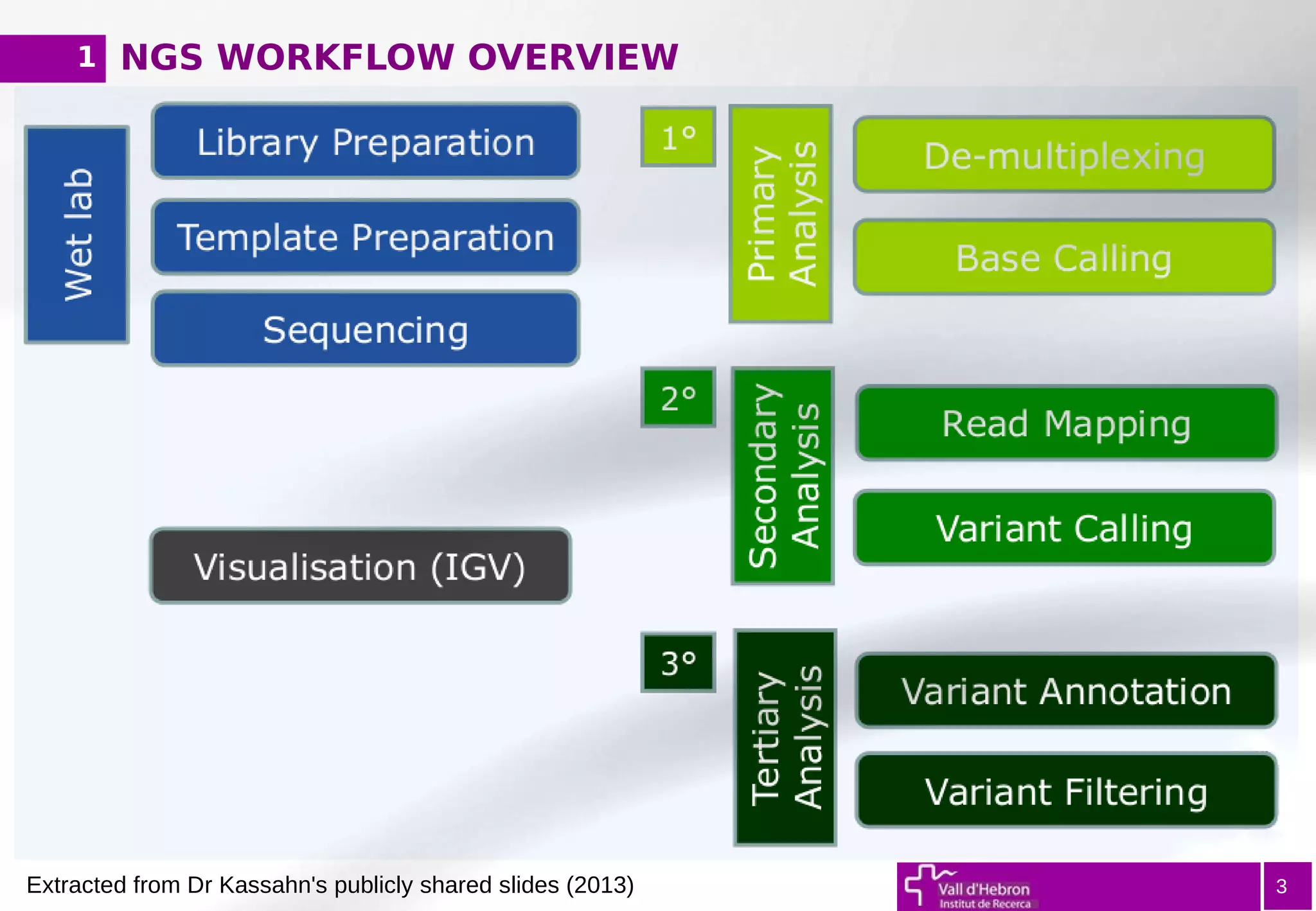
1. NGS WORKFLOW OVERVIEW
2. WET LAB STEPS
3. IMPORTANT SEQUENCING CONCEPTS
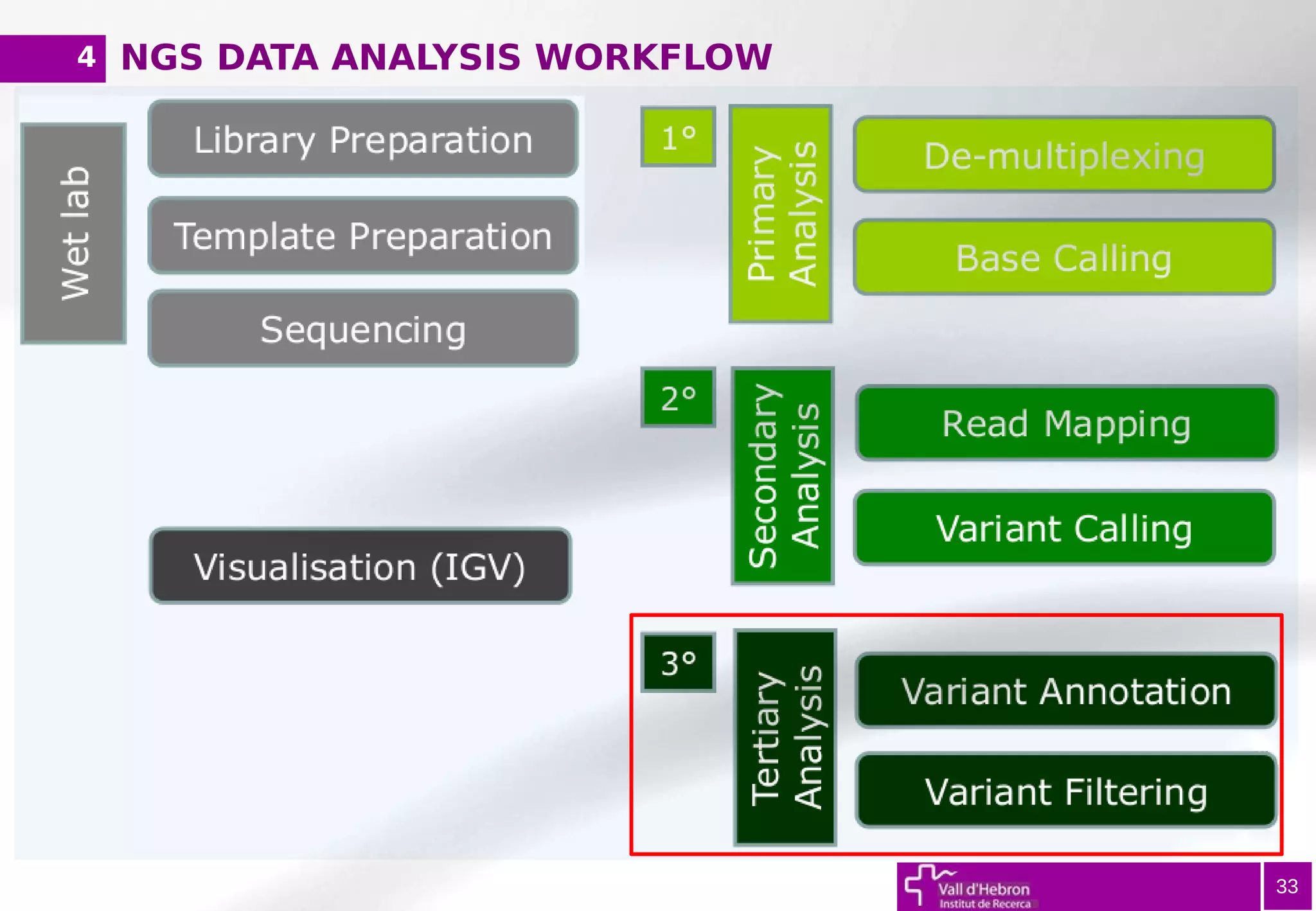
4. NGS ANALYSIS WORKFLOW
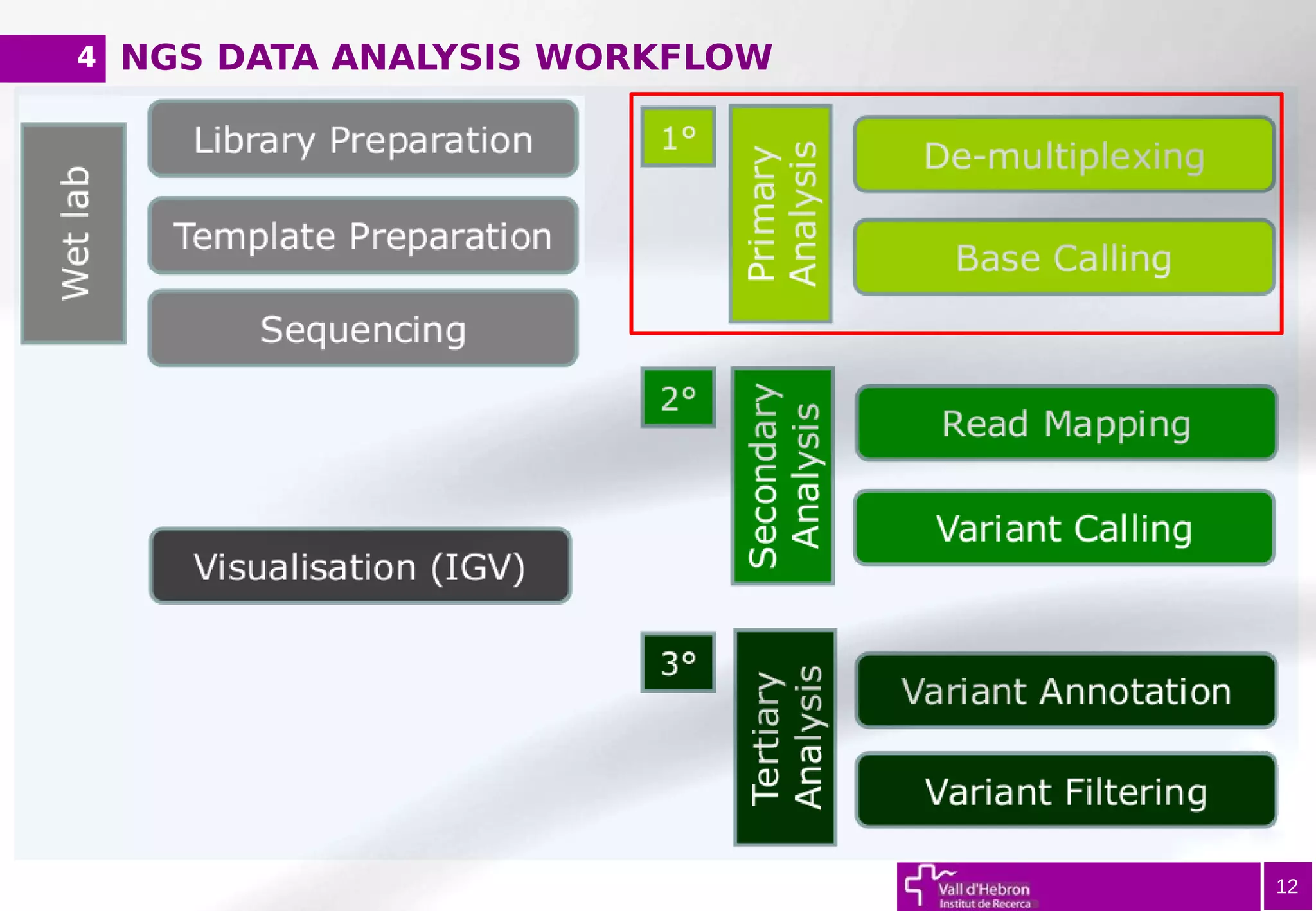
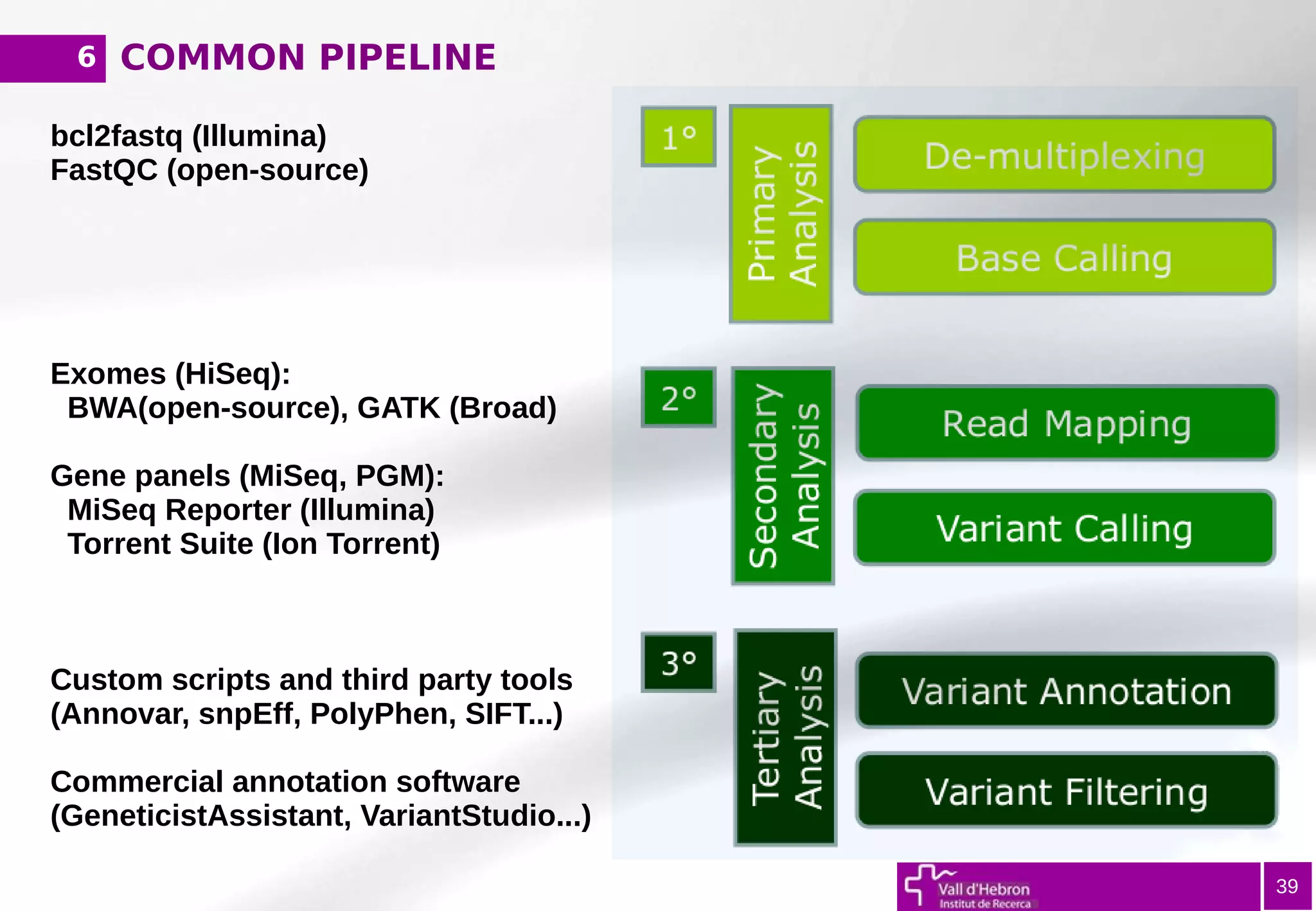
1. Primary analysis: de-multiplexing, QC
2. Secondary analysis: read mapping
and variant calling
3. Tertiary analysis: annotation, filtering...
5. VISUALIZATION
6. COMMON PIPELINES AND FORMATS
7. CONCLUSIONS
5
1
2
3
5
6
PRESENTATION OUTLINE
4
7
NGS WORKFLOW OVERVIEW1
3Extracted from Dr Kassahn's publicly shared slides (2013)
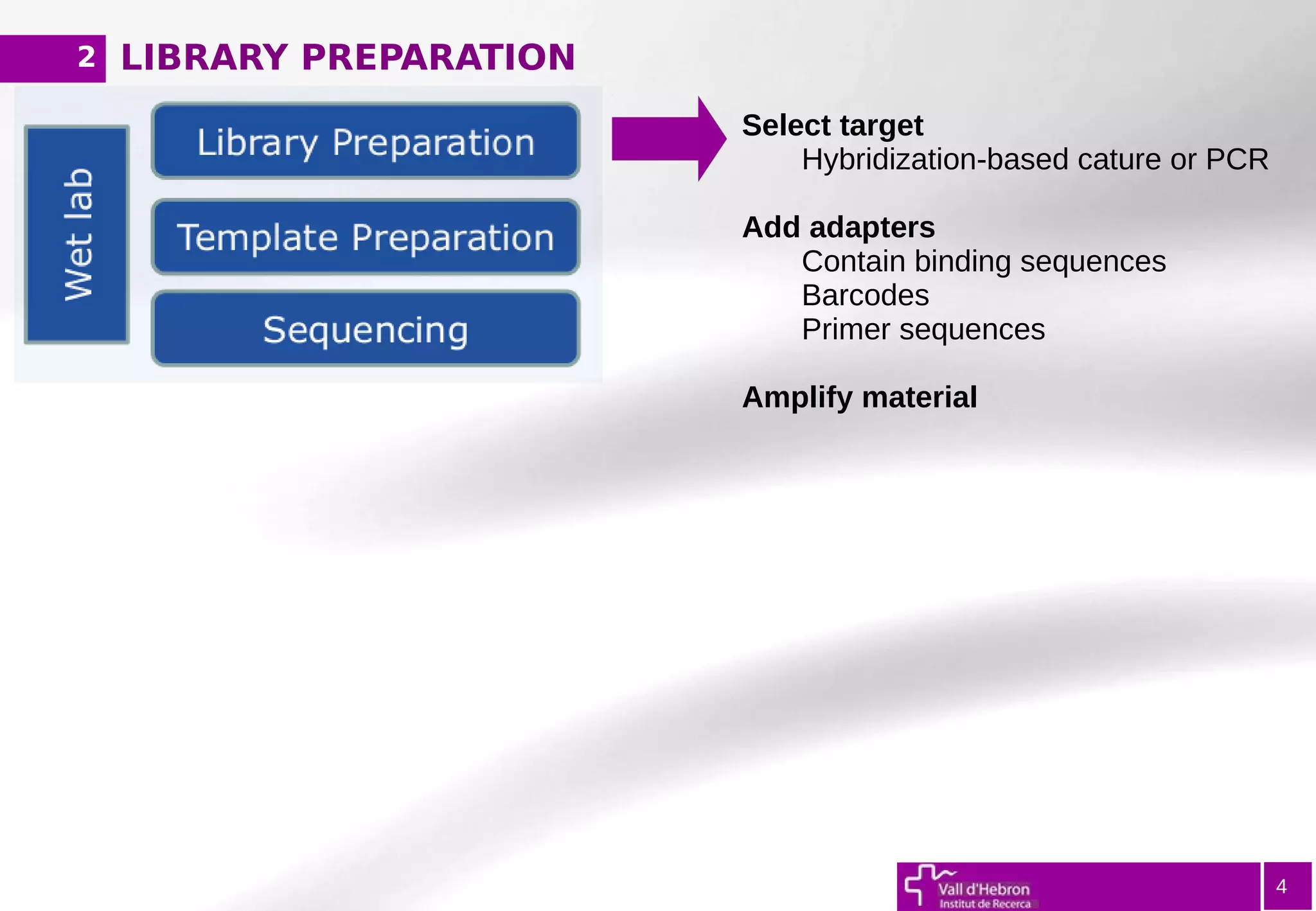
LIBRARY PREPARATION2
4
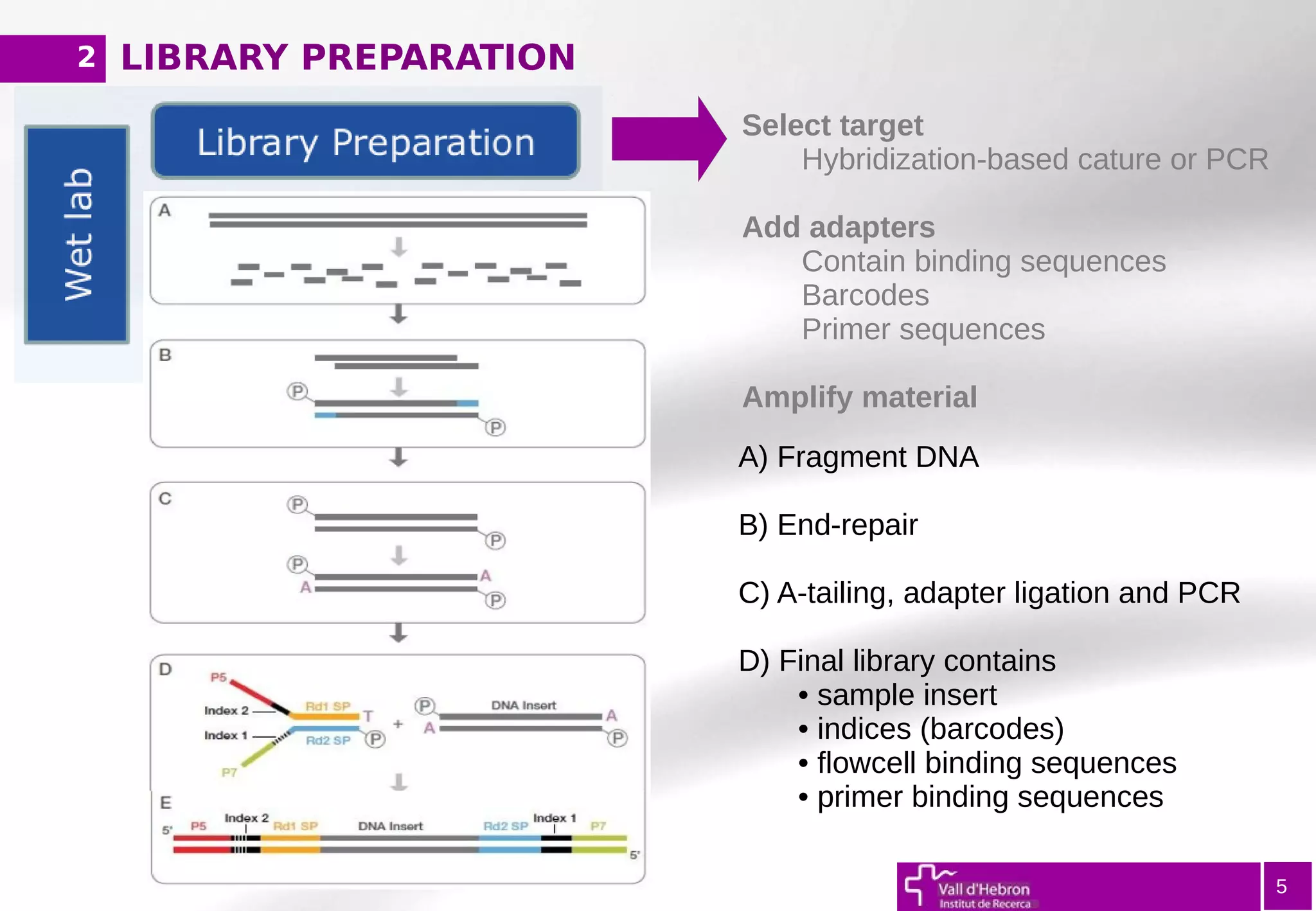
Select target
Hybridization-based cature or PCR
Add adapters
Contain binding sequences
Barcodes
Primer sequences
Amplify material
2
5
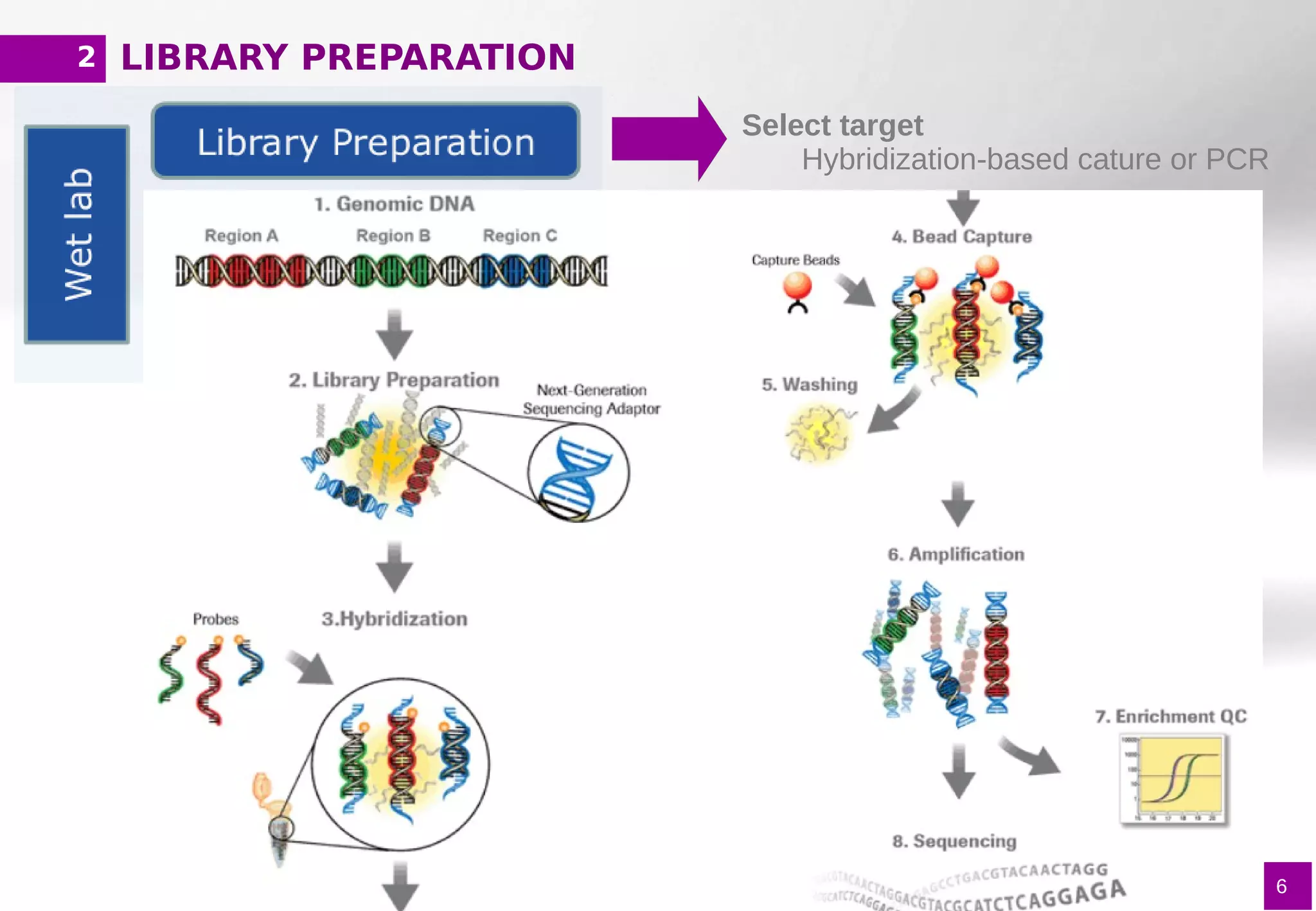
Select target
Hybridization-based cature or PCR
Add adapters
Contain binding sequences
Barcodes
Primer sequences
Amplify material
A) Fragment DNA
B) End-repair
C) A-tailing, adapter ligation and PCR
D) Final library contains
• sample insert
• indices (barcodes)
• flowcell binding sequences
• primer binding sequences
LIBRARY PREPARATION2
6
Select target
Hybridization-based cature or PCR
Add adapters
Contain binding sequences
Barcodes
Primer sequences
Amplify material
LIBRARY PREPARATION2
TEMPLATE PREPARATION
7
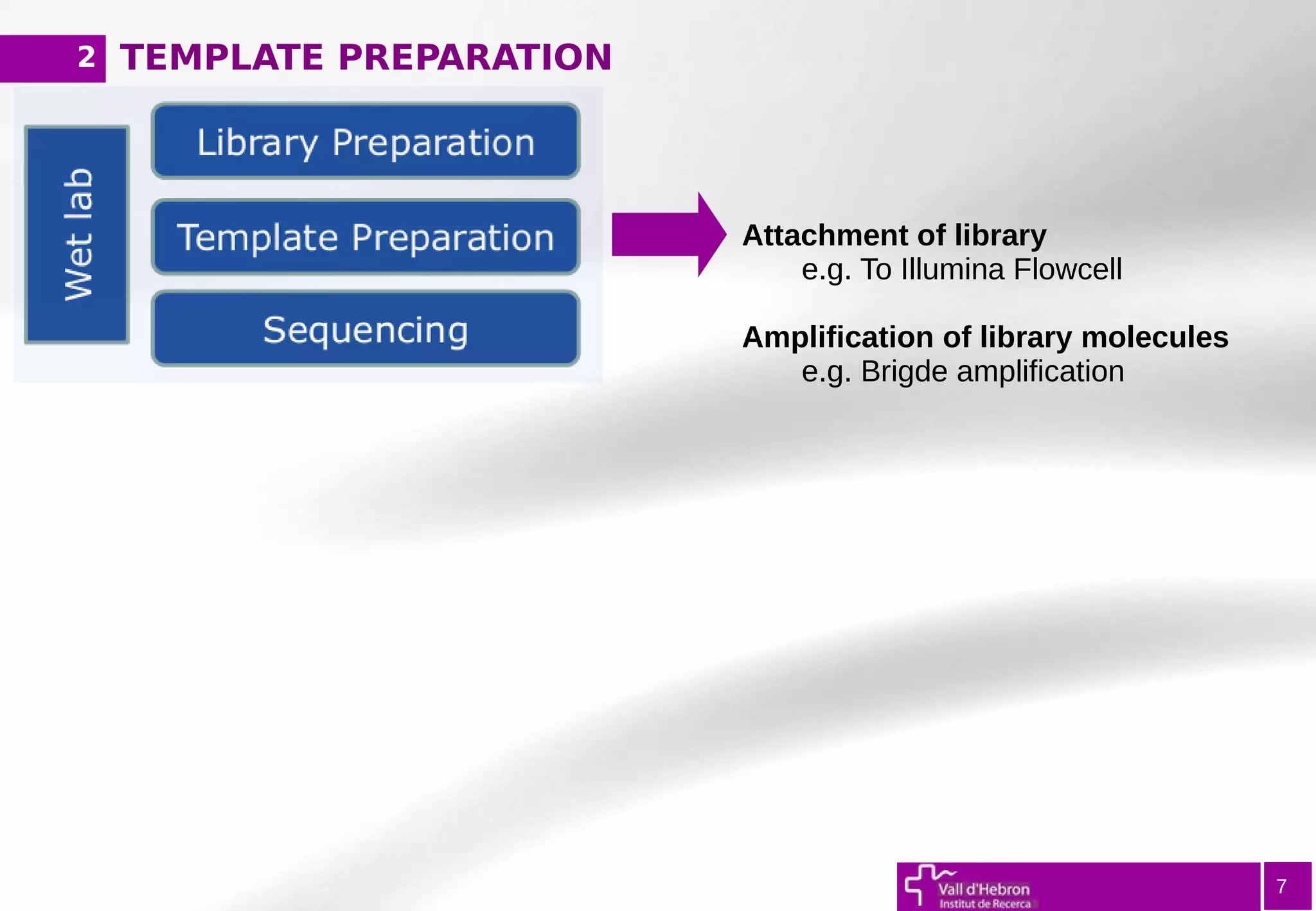
Attachment of library
e.g. To Illumina Flowcell
Amplification of library molecules
e.g. Brigde amplification
2
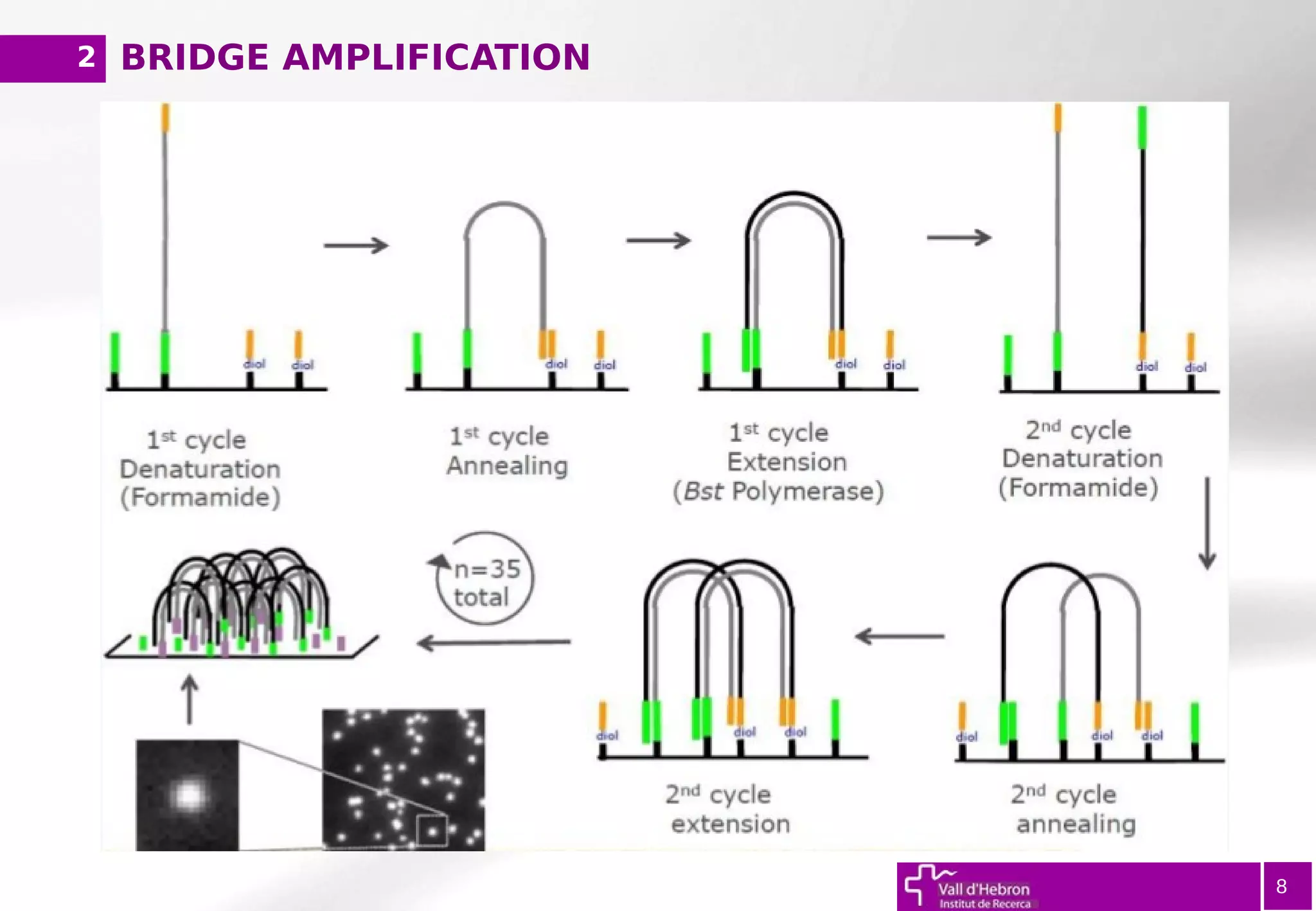
BRIDGE AMPLIFICATION
8
2
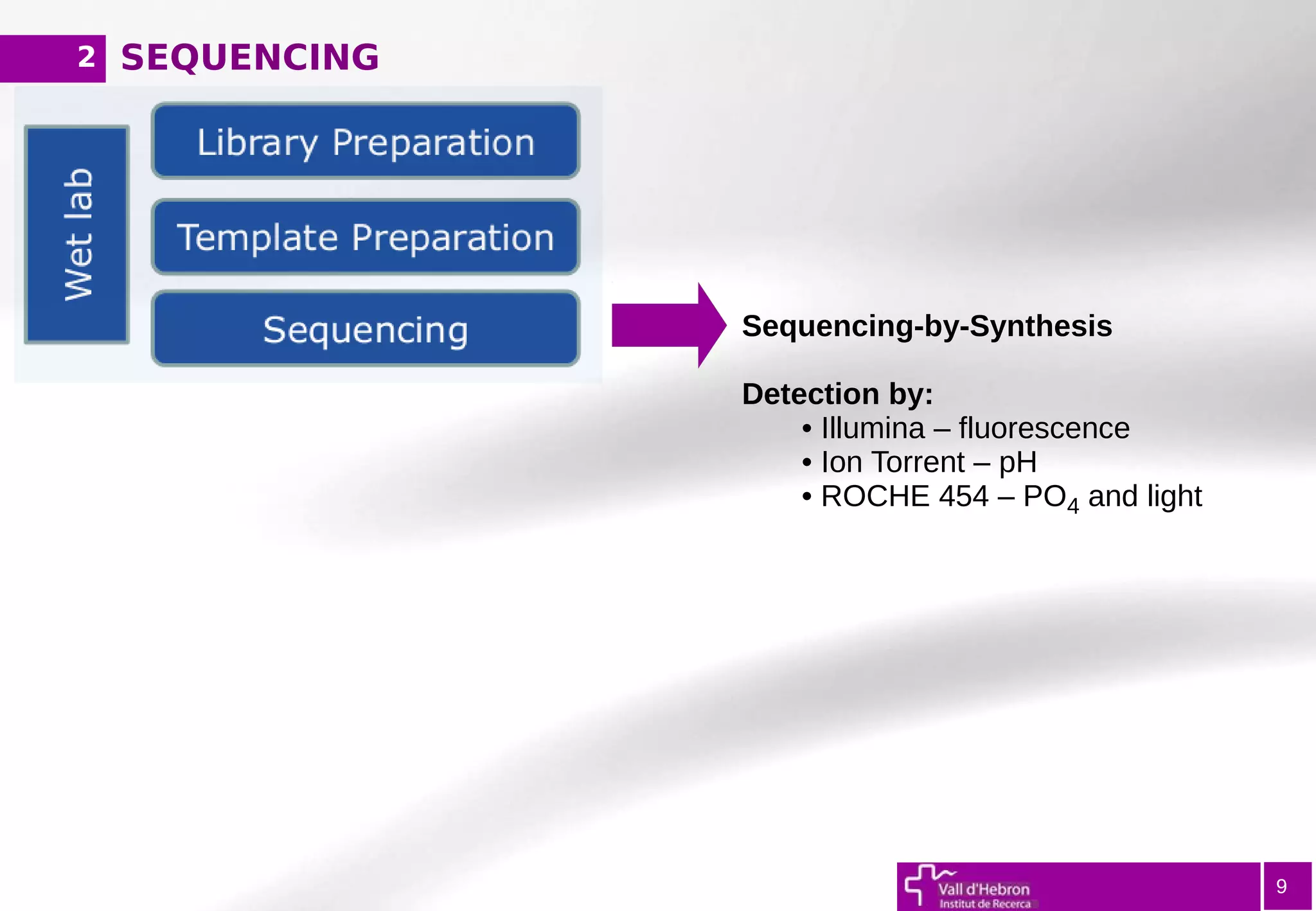
SEQUENCING
9
Sequencing-by-Synthesis
Detection by:
• Illumina – fluorescence
• Ion Torrent – pH
• ROCHE 454 – PO4 and light
2
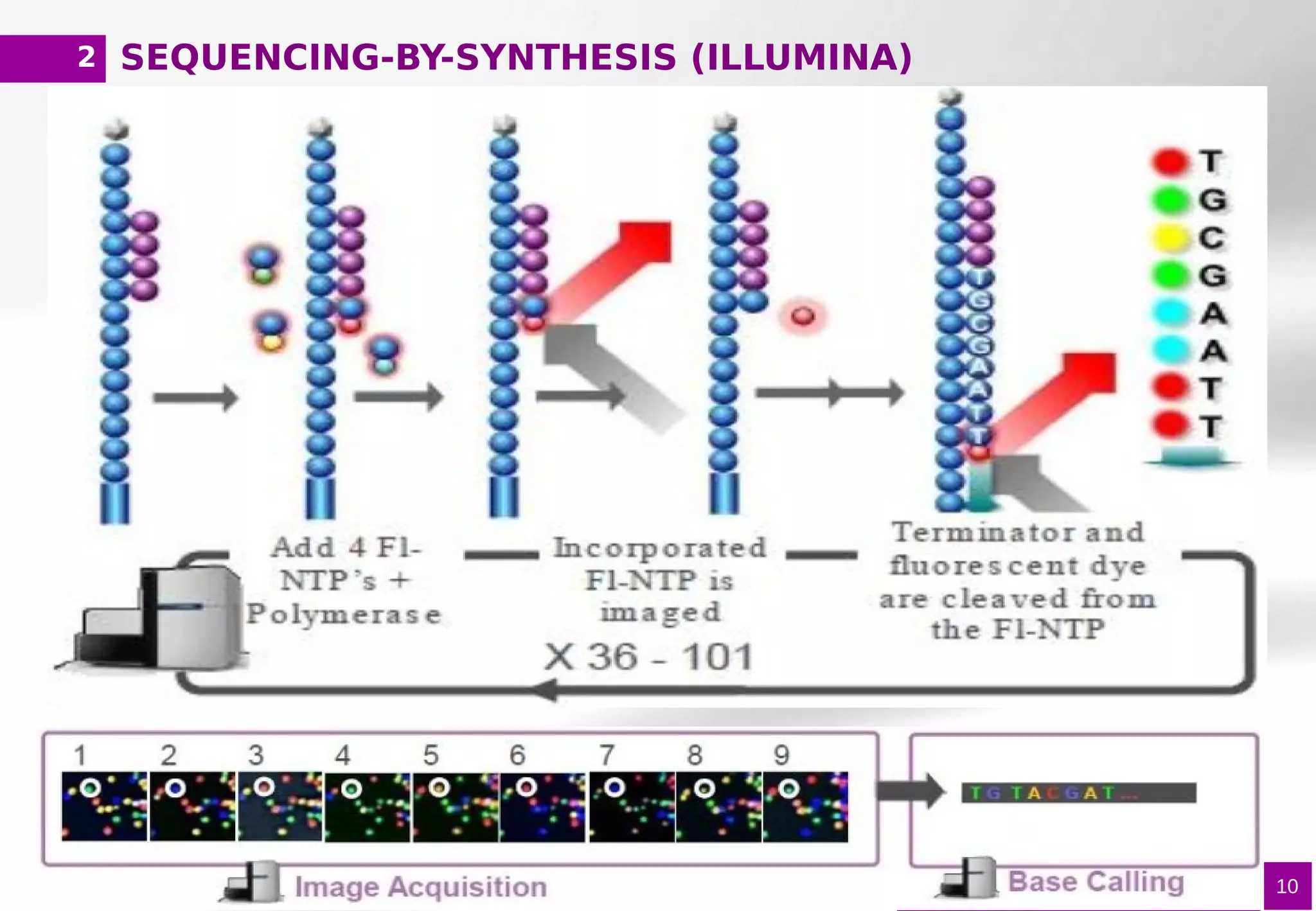
SEQUENCING-BY-SYNTHESIS (ILLUMINA)
10
2
IMPORTANT SEQUENCING CONCEPTS1
11
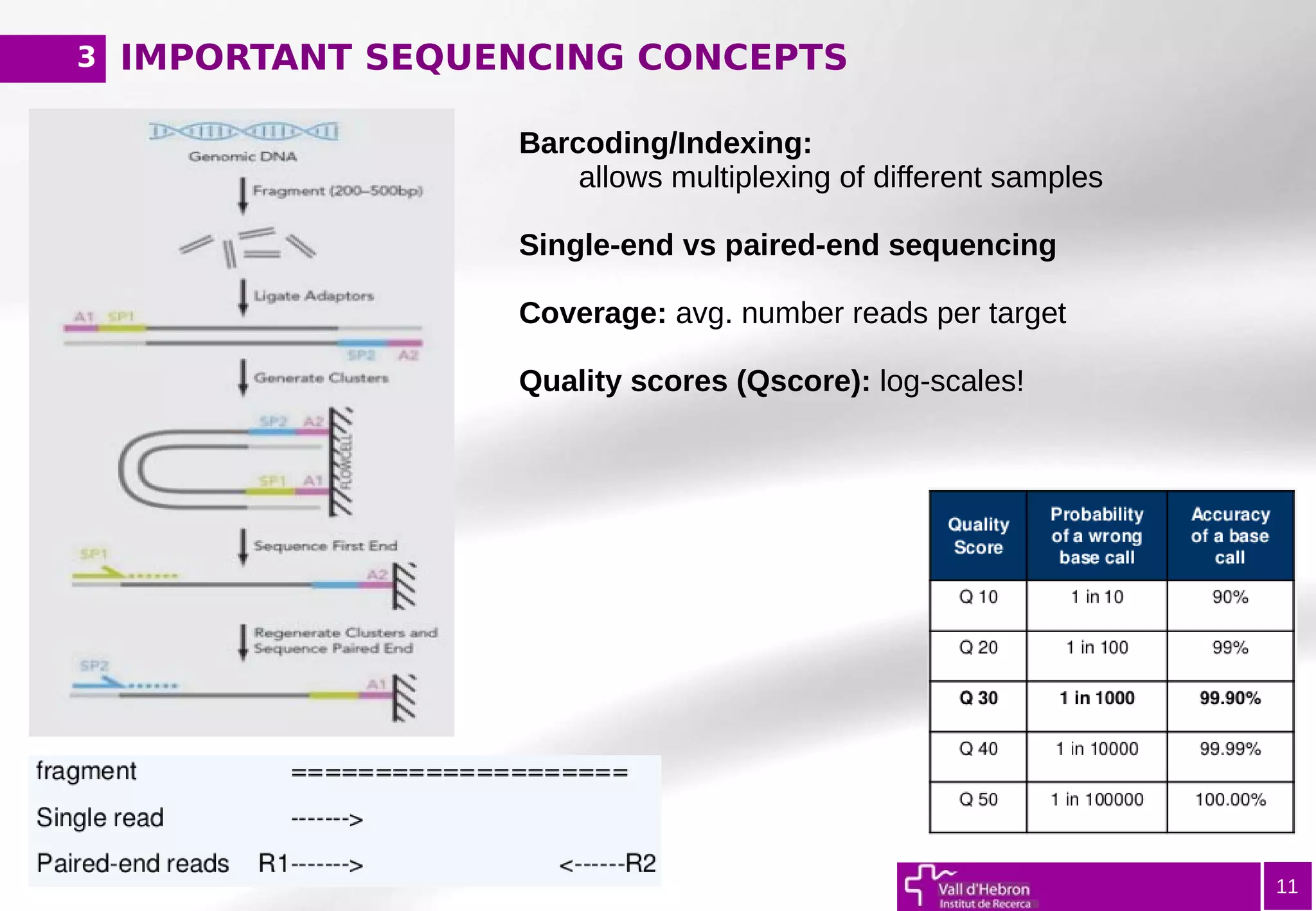
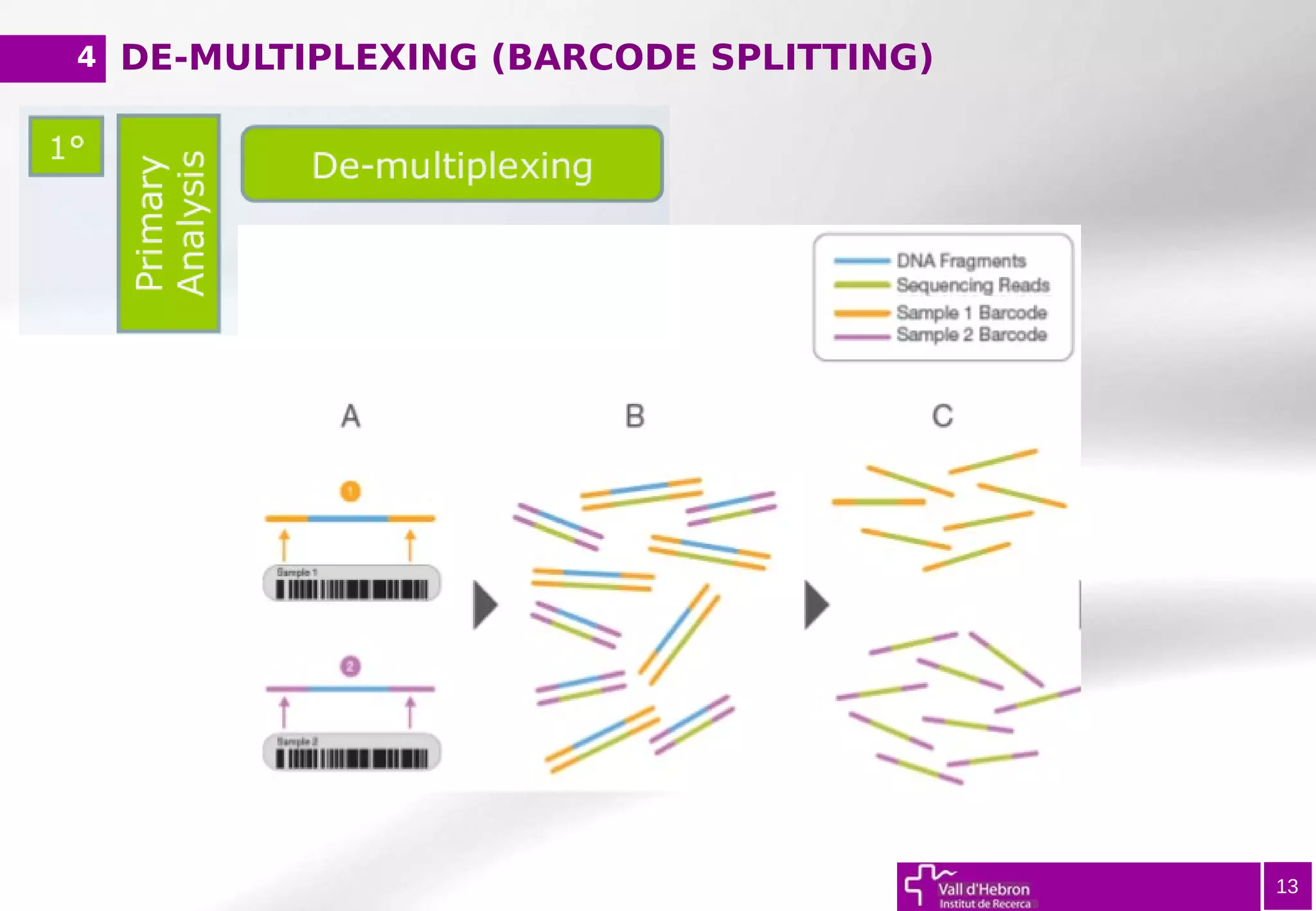
Barcoding/Indexing:
allows multiplexing of different samples
Single-end vs paired-end sequencing
Coverage: avg. number reads per target
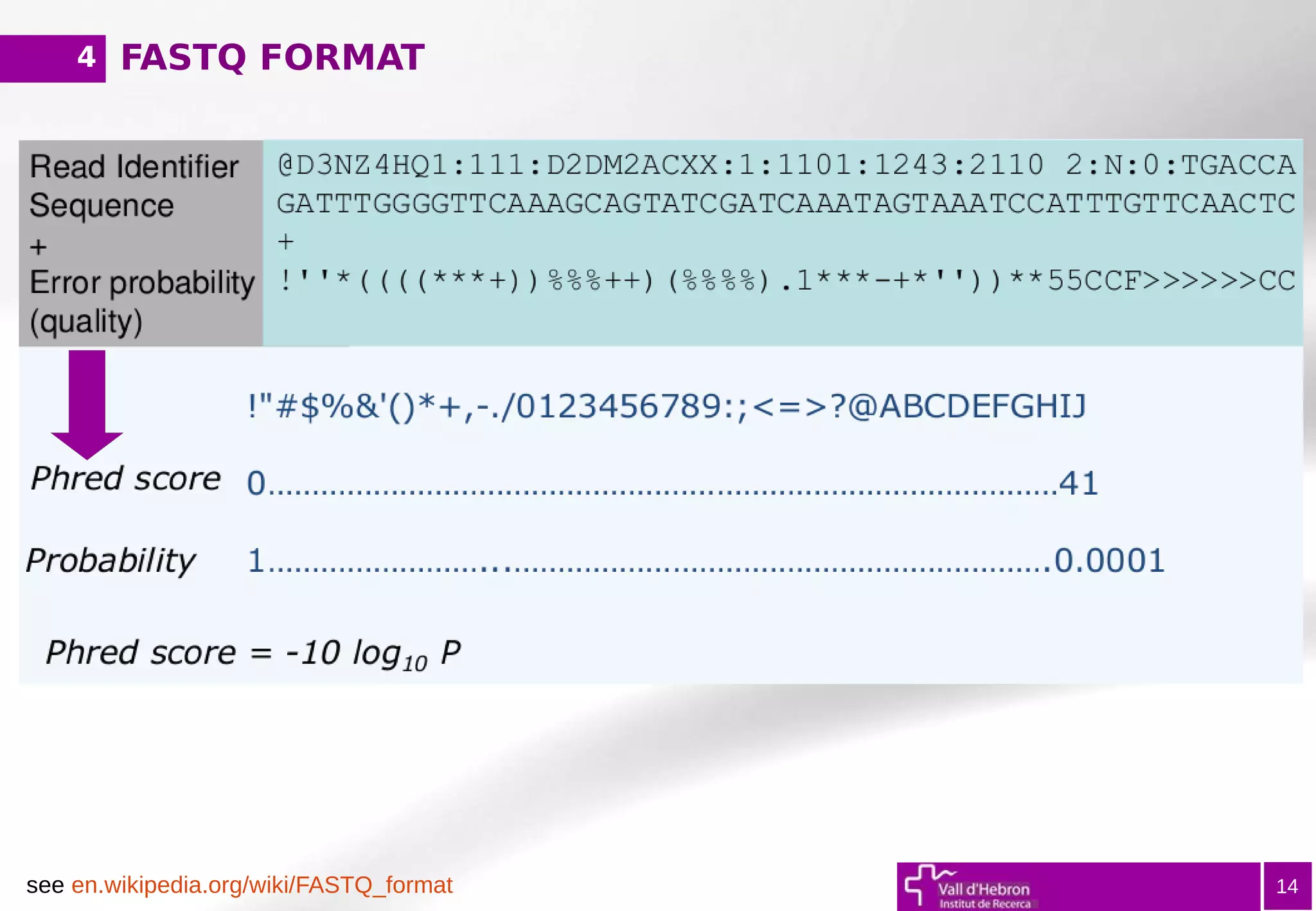
Quality scores (Qscore): log-scales!
3
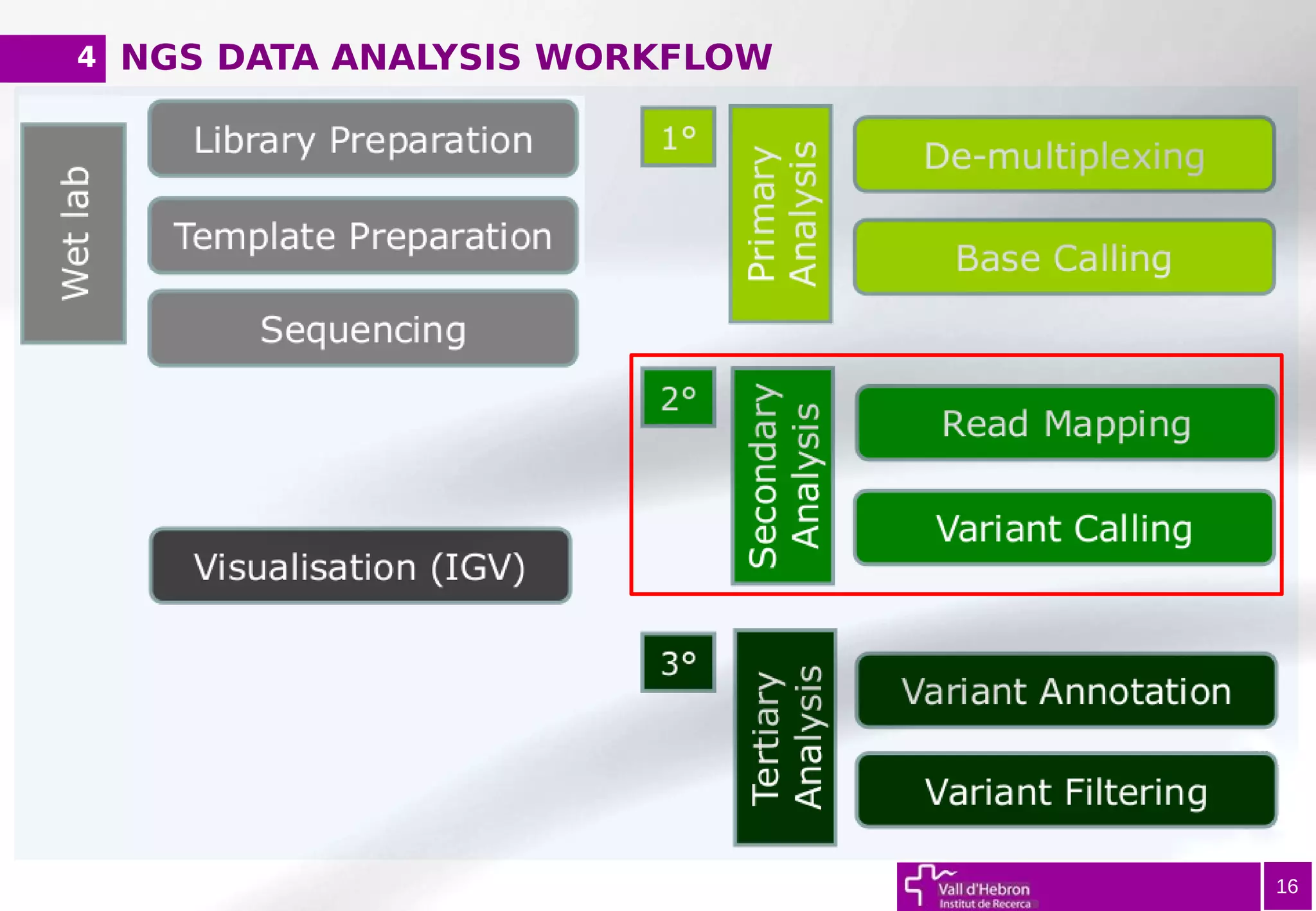
NGS DATA ANALYSIS WORKFLOW4
12
DE-MULTIPLEXING (BARCODE SPLITTING)
13
4
FASTQ FORMAT
14
4
see en.wikipedia.org/wiki/FASTQ_format
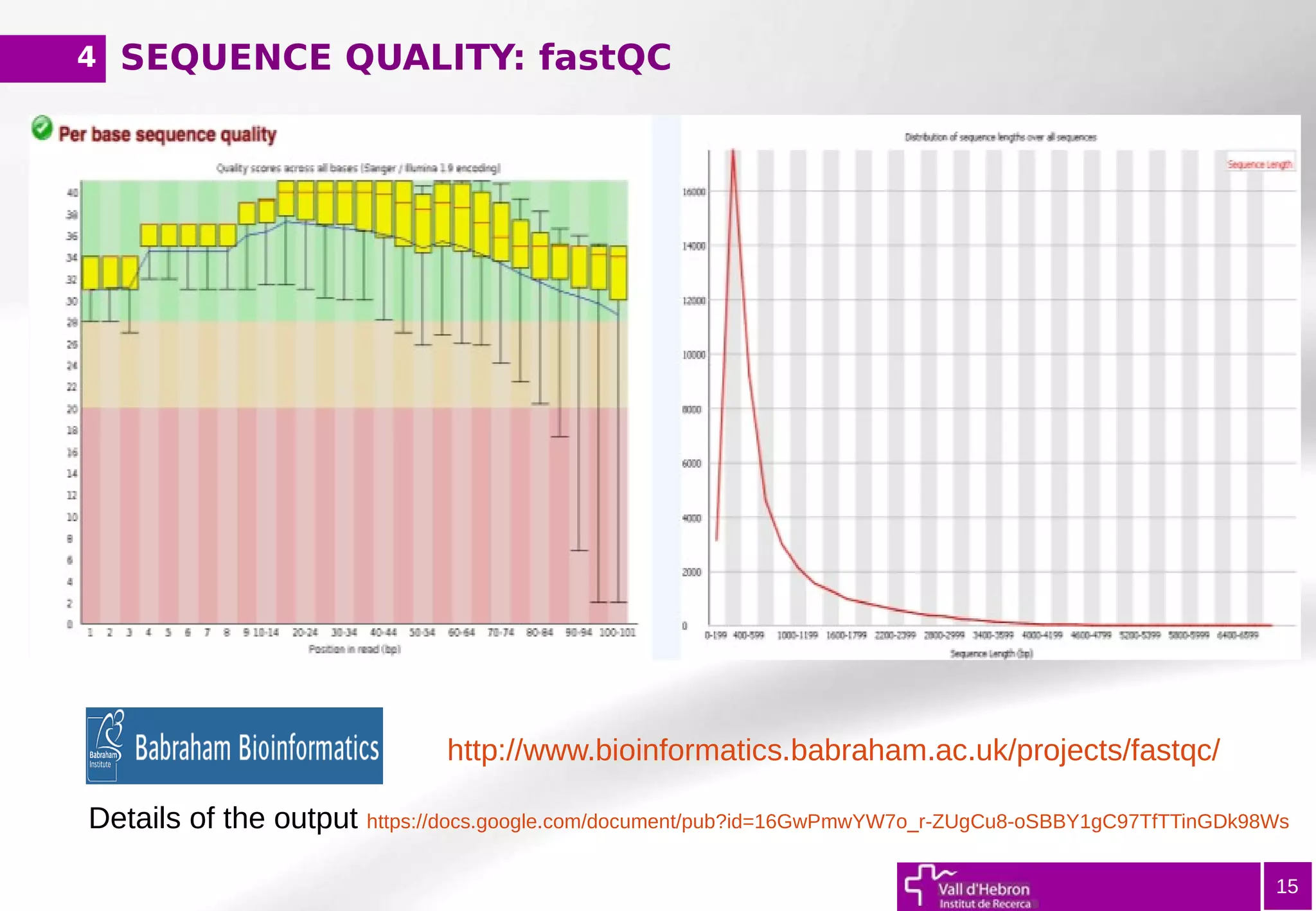
SEQUENCE QUALITY: fastQC
15
http://www.bioinformatics.babraham.ac.uk/projects/fastqc/
Details of the output https://docs.google.com/document/pub?id=16GwPmwYW7o_r-ZUgCu8-oSBBY1gC97TfTTinGDk98Ws
4
NGS DATA ANALYSIS WORKFLOW4
16
READ MAPPING (BASIC ALIGNMENT)4
17
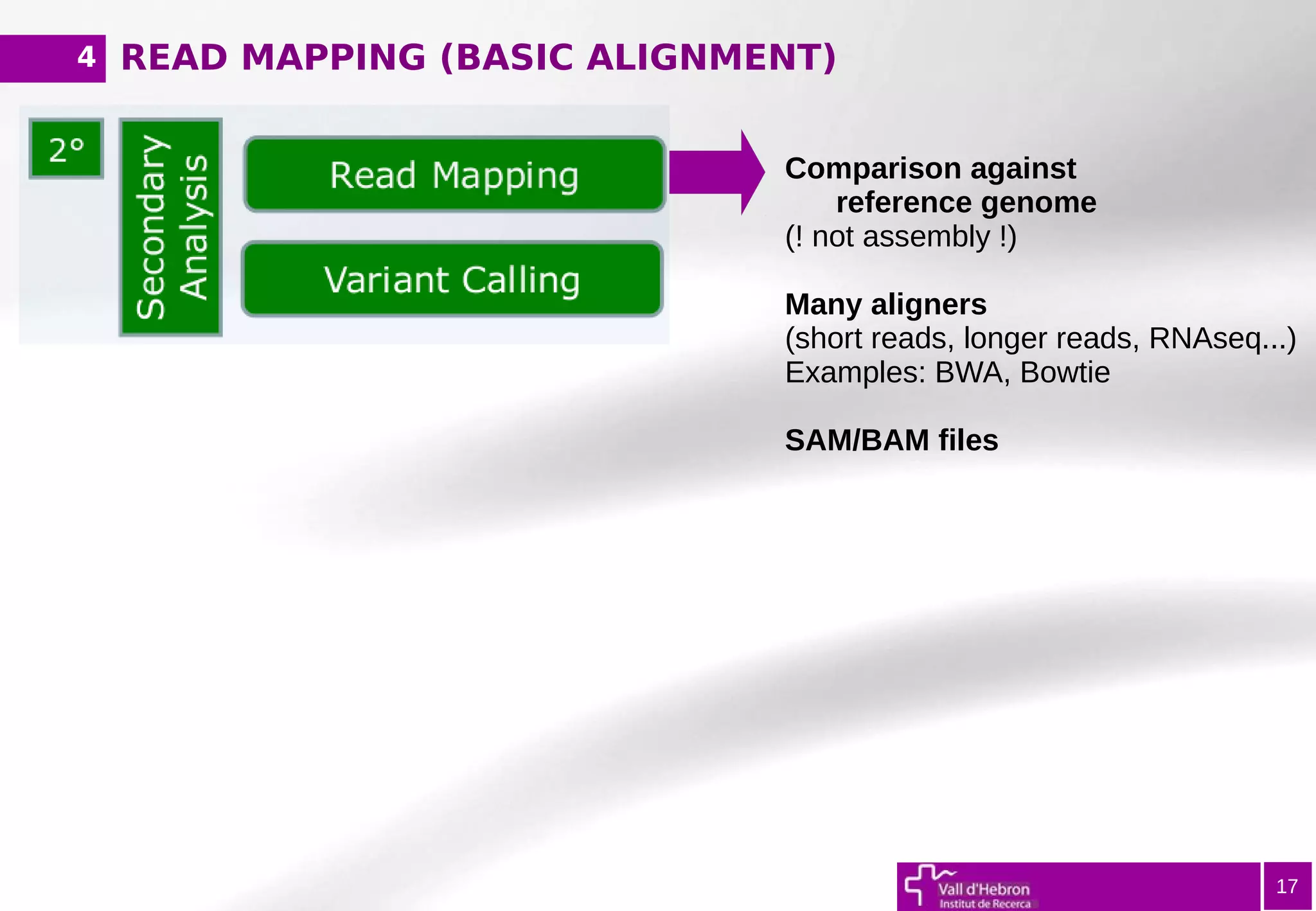
Comparison against
reference genome
(! not assembly !)
Many aligners
(short reads, longer reads, RNAseq...)
Examples: BWA, Bowtie
SAM/BAM files
BURROWS-WHEELER ALIGNMENT TOOL (BWA)
18
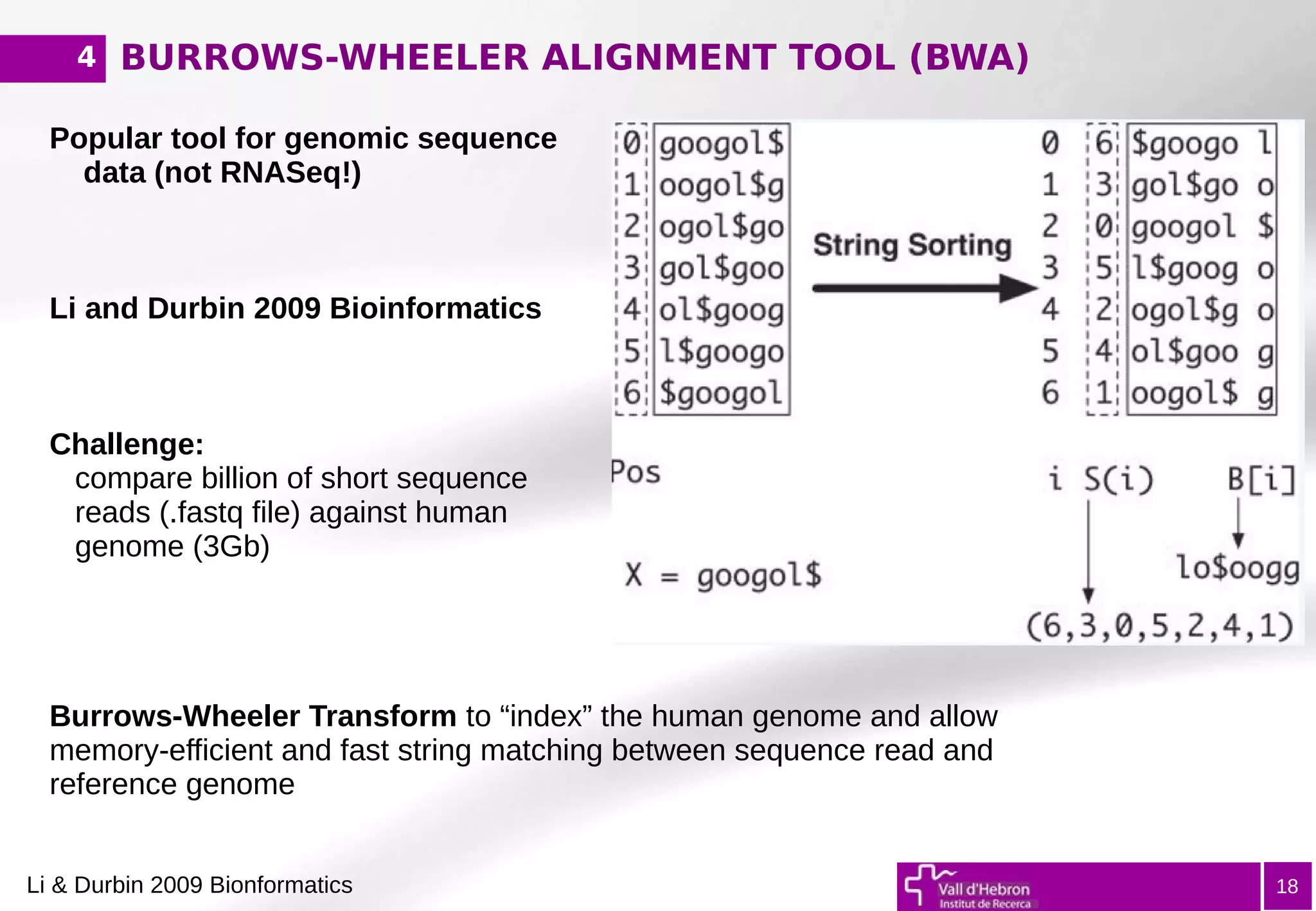
Popular tool for genomic sequence
data (not RNASeq!)
Li and Durbin 2009 Bioinformatics
Challenge:
compare billion of short sequence
reads (.fastq file) against human
genome (3Gb)
Burrows-Wheeler Transform to “index” the human genome and allow
memory-efficient and fast string matching between sequence read and
reference genome
4
Li & Durbin 2009 Bionformatics
SAM/BAM FILES
19
4
see http://samtools.sourceforge.net/SAMv1.pdf
SAM/BAM FILES
20
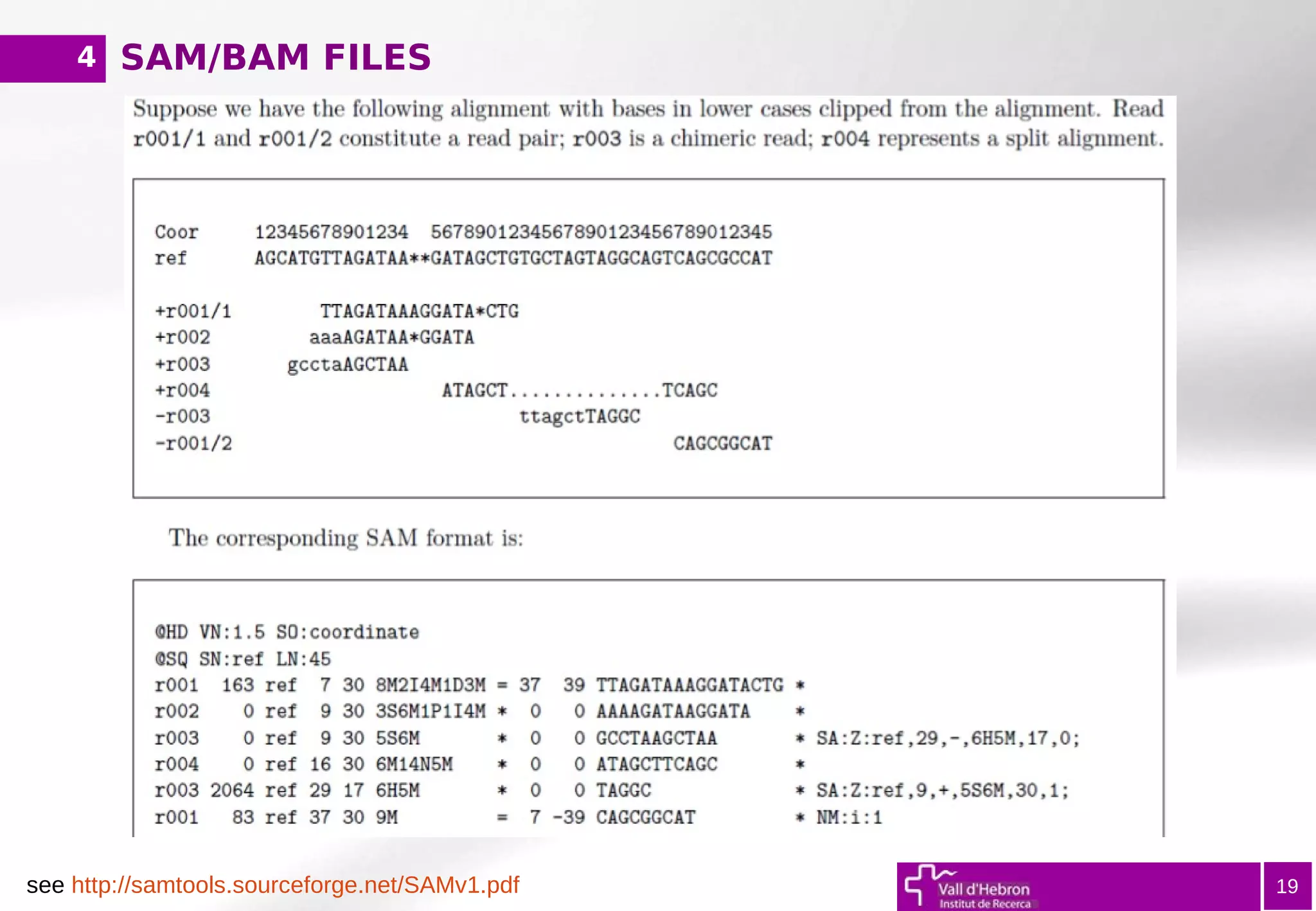
@ Header (information regarding reference genome, alignment method...)
1) Read ID (QNAME)
2) Bitwise FLAG (first/second read in pair, both reads mapped...)
3) ReferenceSequence Name (RNAME)
4) Position (POS, coordinate)
5) MapQuality (MAPQ = -10log10P[wrong mapping position])
6) CIGAR (describes alignment – matches, skipped regions, insertions..)
7) ReferenceSequence (RNEXT, Ref seq of the pair)
8) Position of the pair (PNEXT)
9) TemplateLength (TLEN)
10) ReadSequence
11) QUAL (in Fastq format, '*' if NA)
...
4
VARIANT CALLING
21
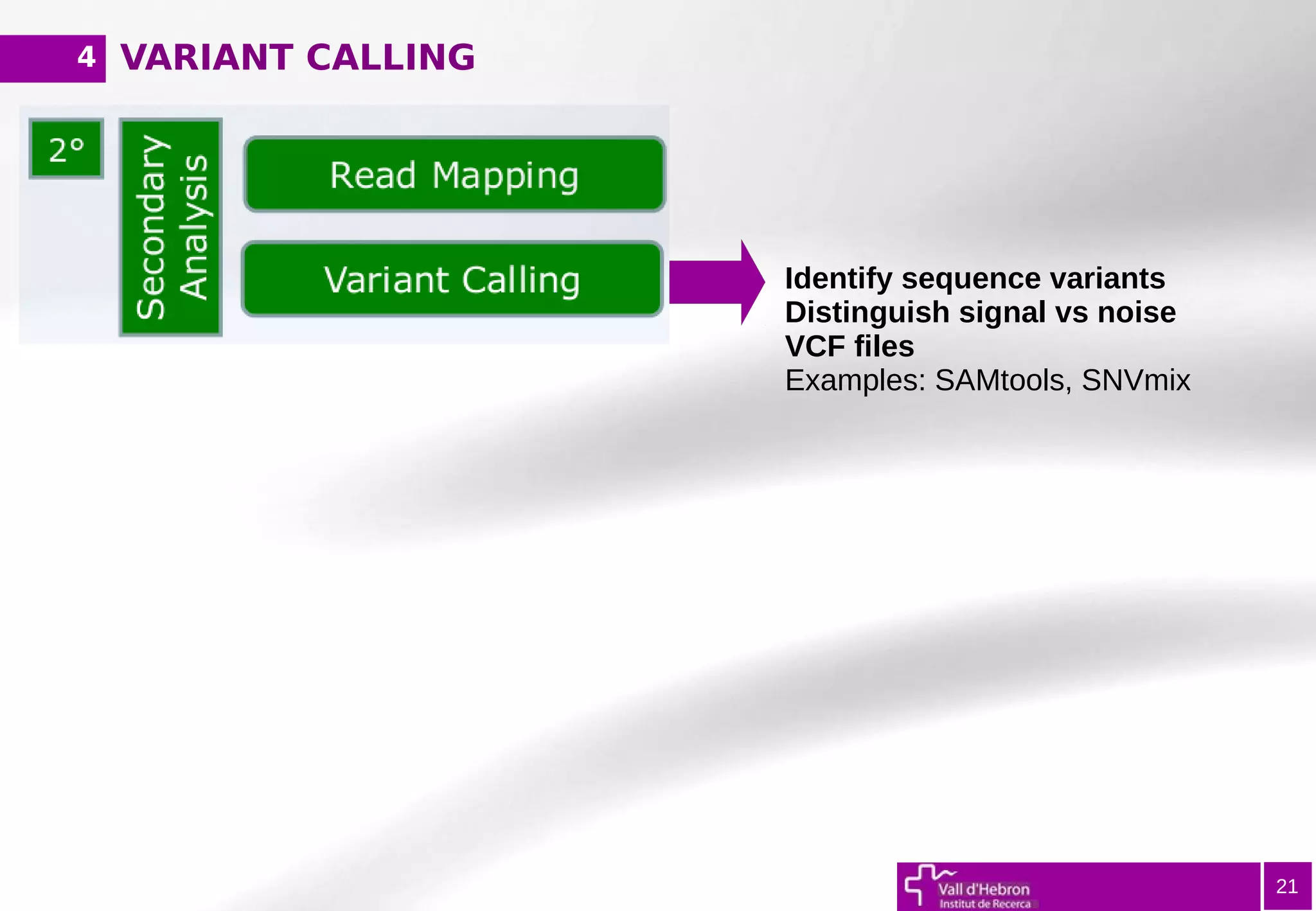
Identify sequence variants
Distinguish signal vs noise
VCF files
Examples: SAMtools, SNVmix
4
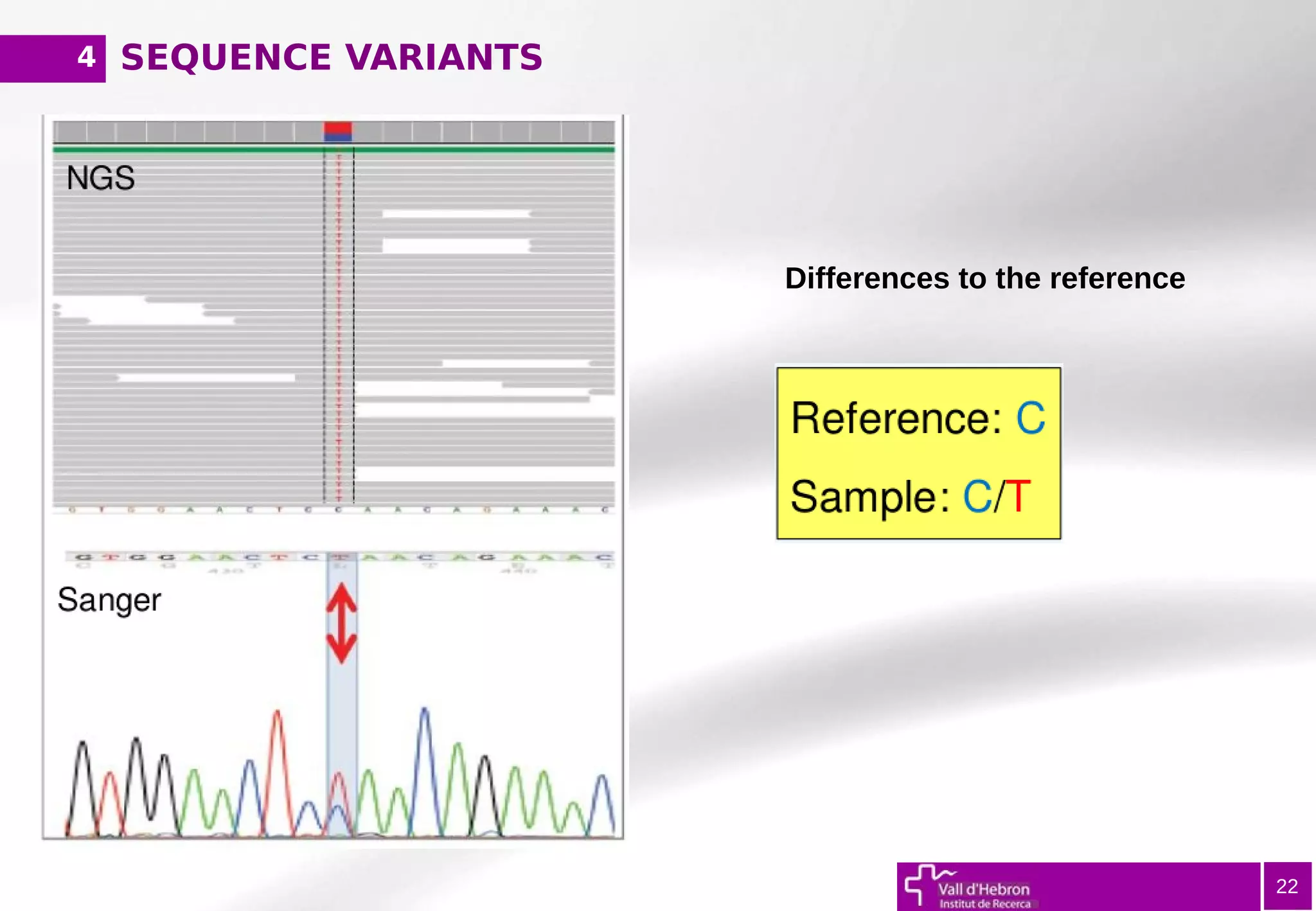
SEQUENCE VARIANTS
22
Differences to the reference
4
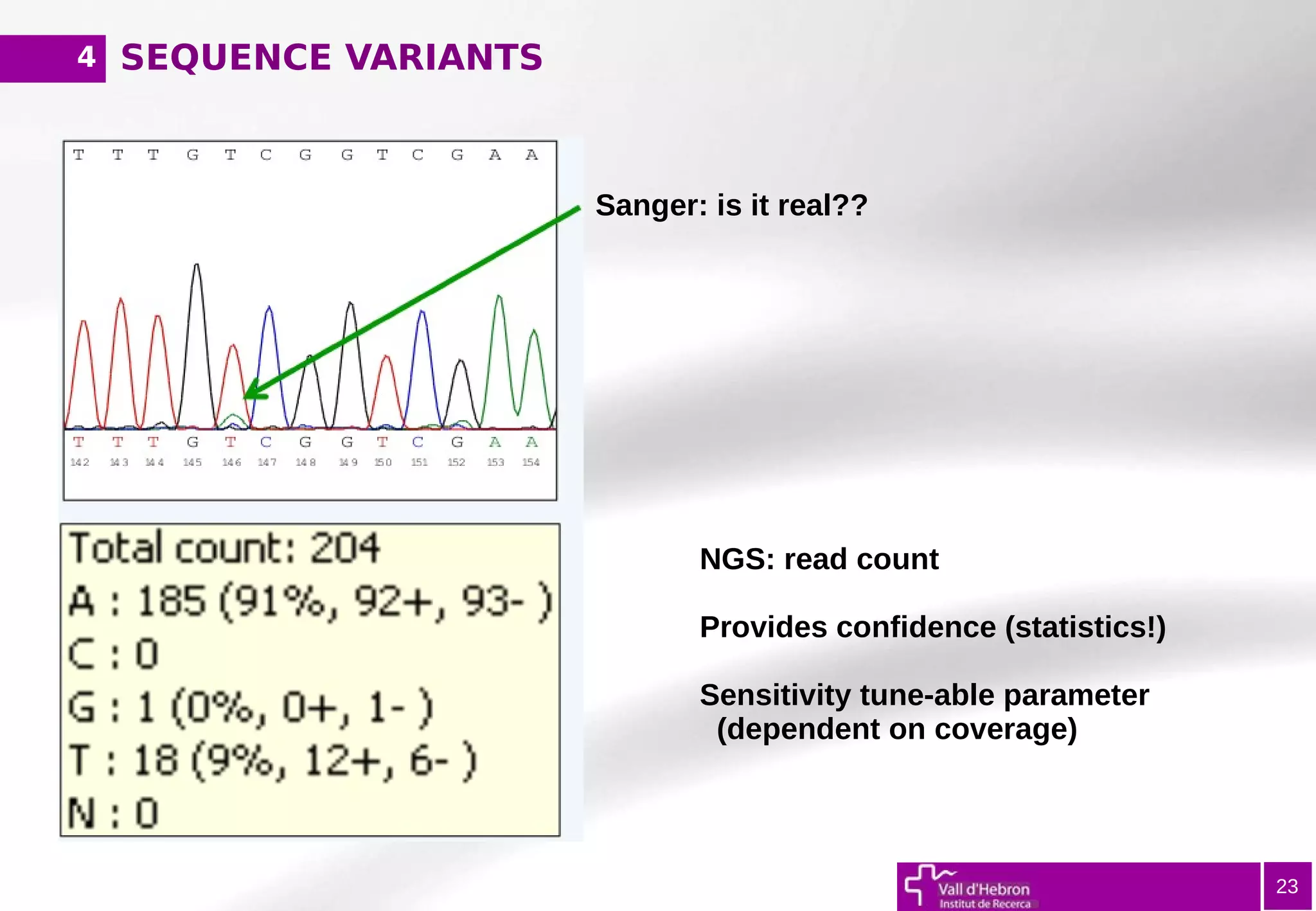
SEQUENCE VARIANTS
23
Sanger: is it real??
NGS: read count
Provides confidence (statistics!)
Sensitivity tune-able parameter
(dependent on coverage)
4
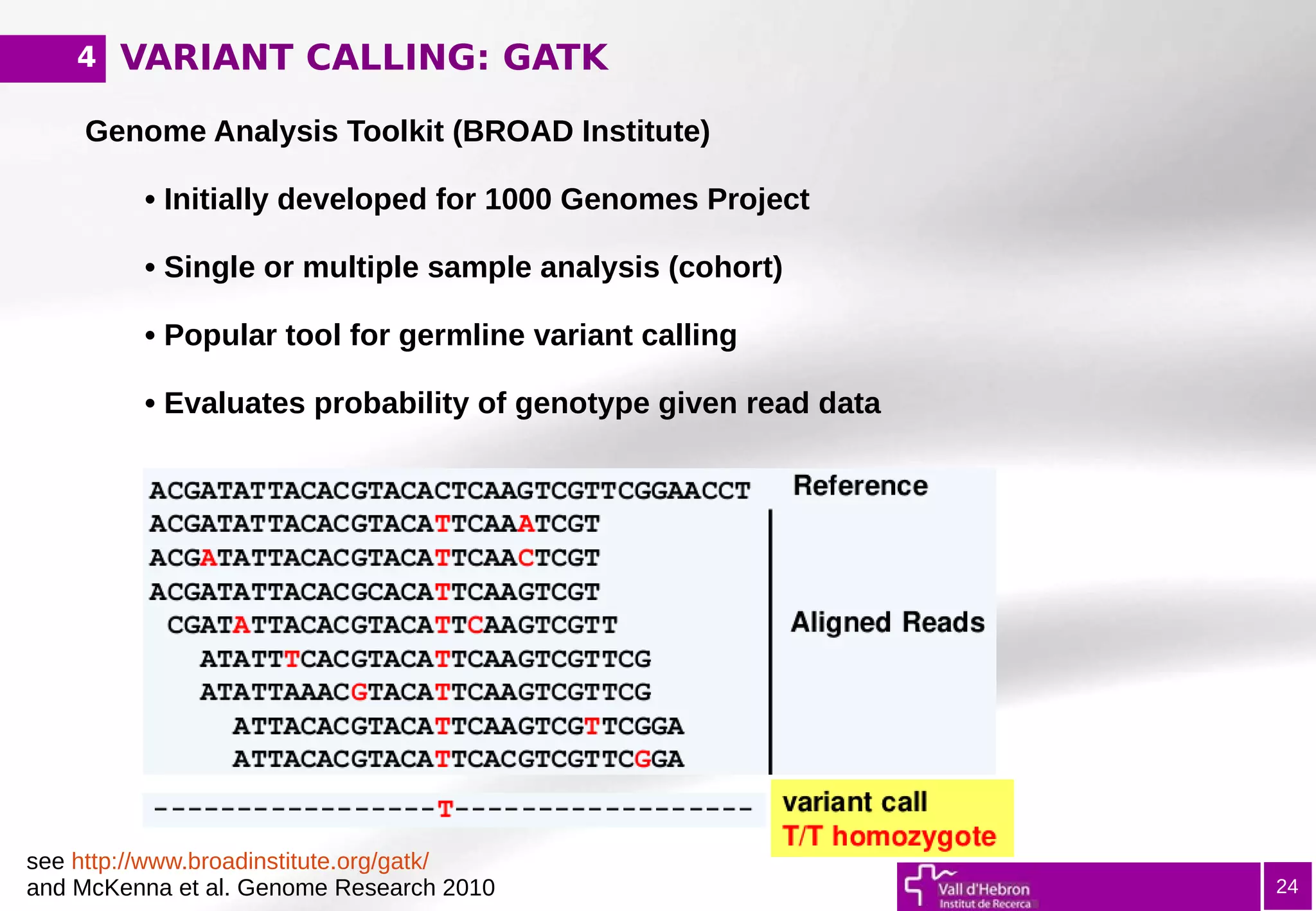
VARIANT CALLING: GATK
24
Genome Analysis Toolkit (BROAD Institute)
• Initially developed for 1000 Genomes Project
• Single or multiple sample analysis (cohort)
• Popular tool for germline variant calling
• Evaluates probability of genotype given read data
4
see http://www.broadinstitute.org/gatk/
and McKenna et al. Genome Research 2010
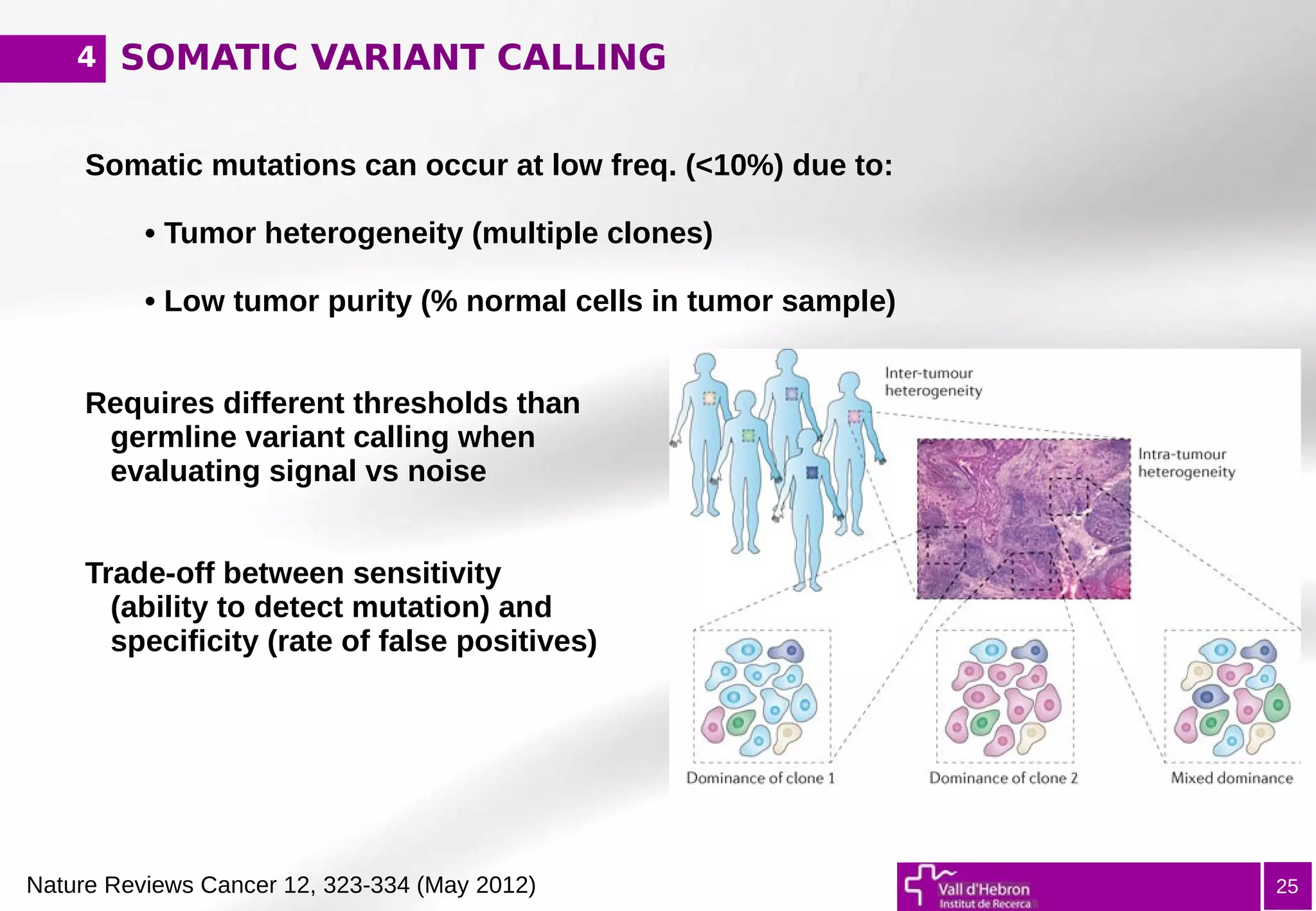
SOMATIC VARIANT CALLING
25
Somatic mutations can occur at low freq. (<10%) due to:
• Tumor heterogeneity (multiple clones)
• Low tumor purity (% normal cells in tumor sample)
Requires different thresholds than
germline variant calling when
evaluating signal vs noise
Trade-off between sensitivity
(ability to detect mutation) and
specificity (rate of false positives)
Nature Reviews Cancer 12, 323-334 (May 2012)
4
INDELS DETECTION1
26
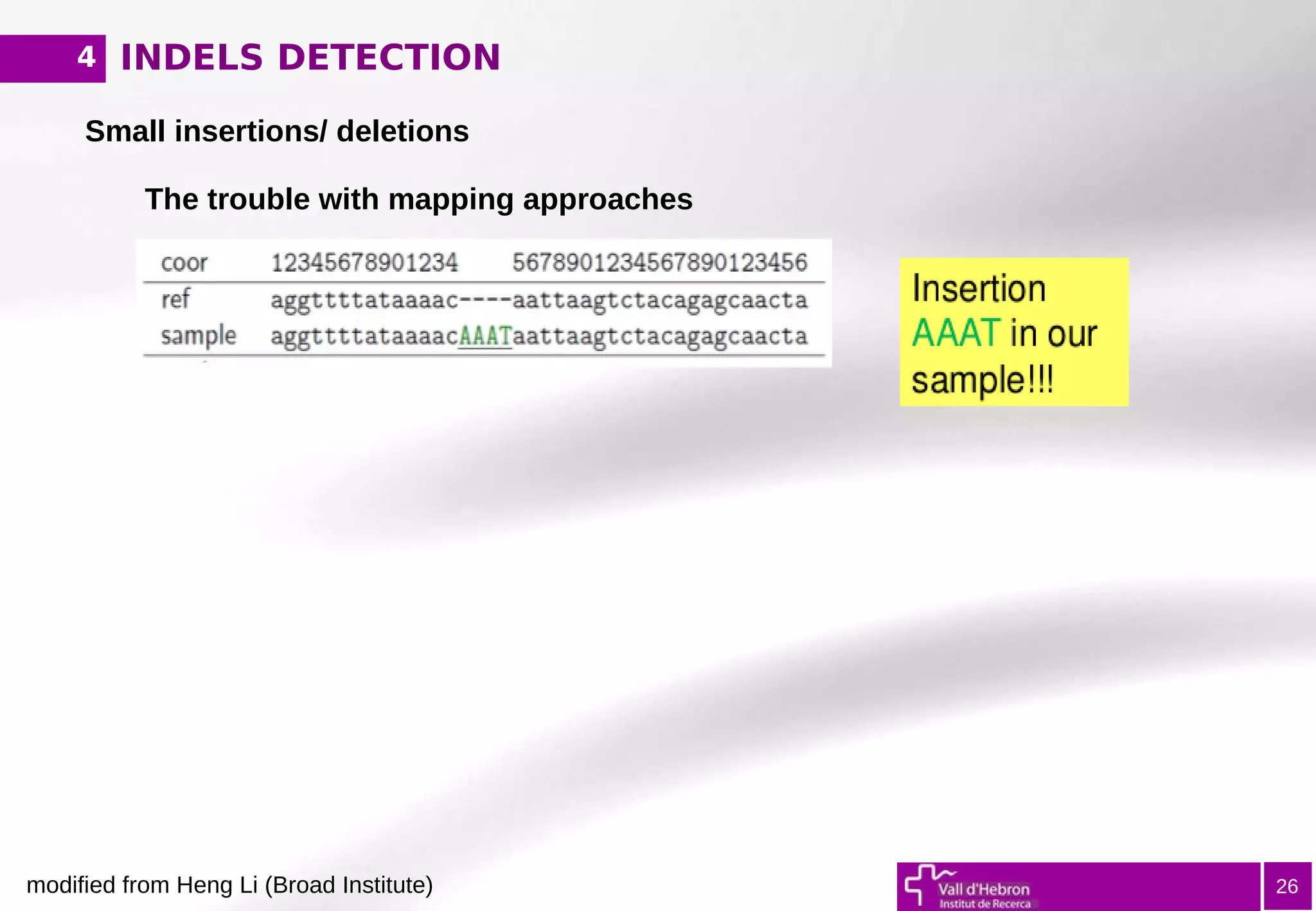
Small insertions/ deletions
The trouble with mapping approaches
4
modified from Heng Li (Broad Institute)
INDELS DETECTION
27
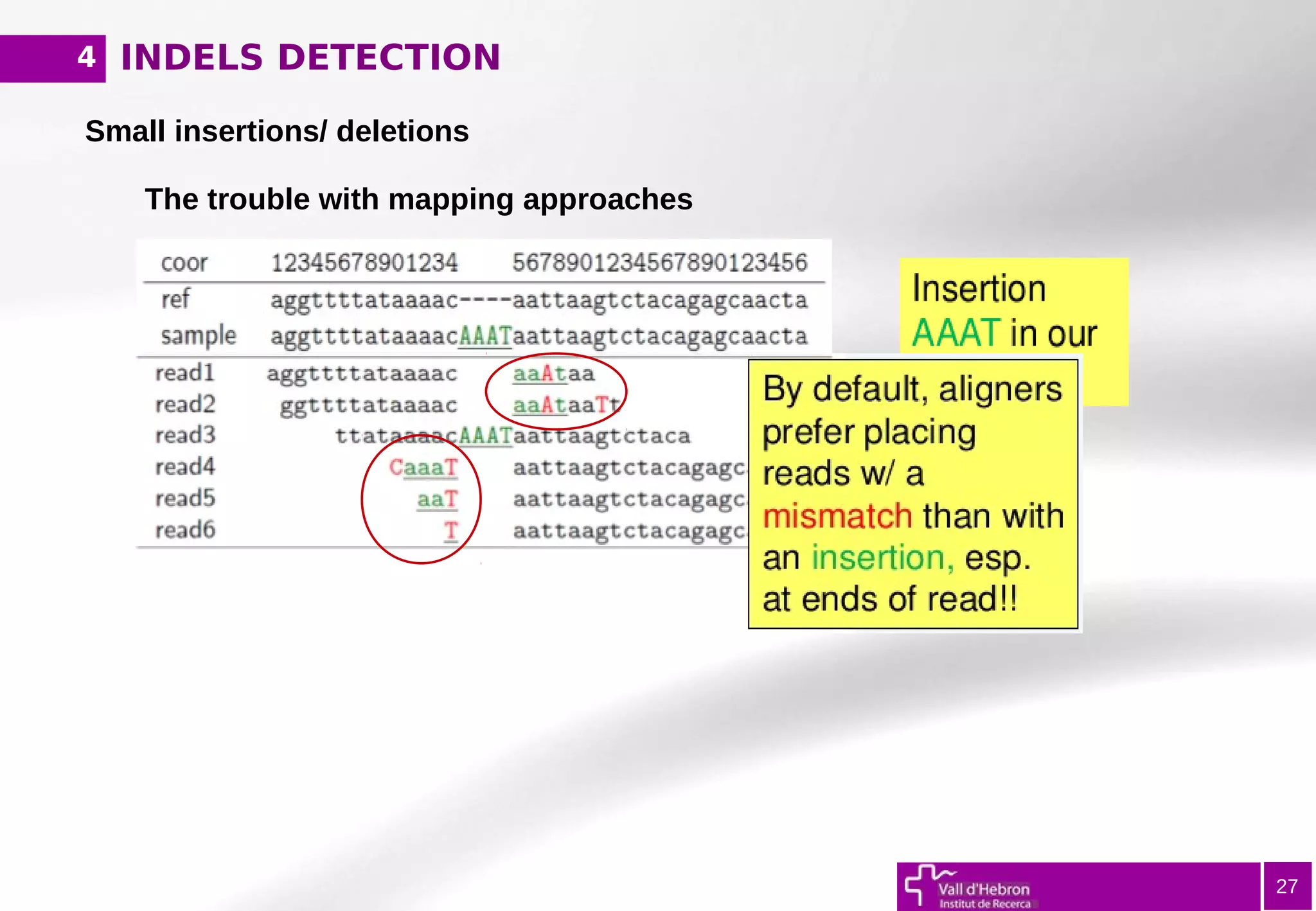
Small insertions/ deletions
The trouble with mapping approaches
4
INDELS DETECTION
28
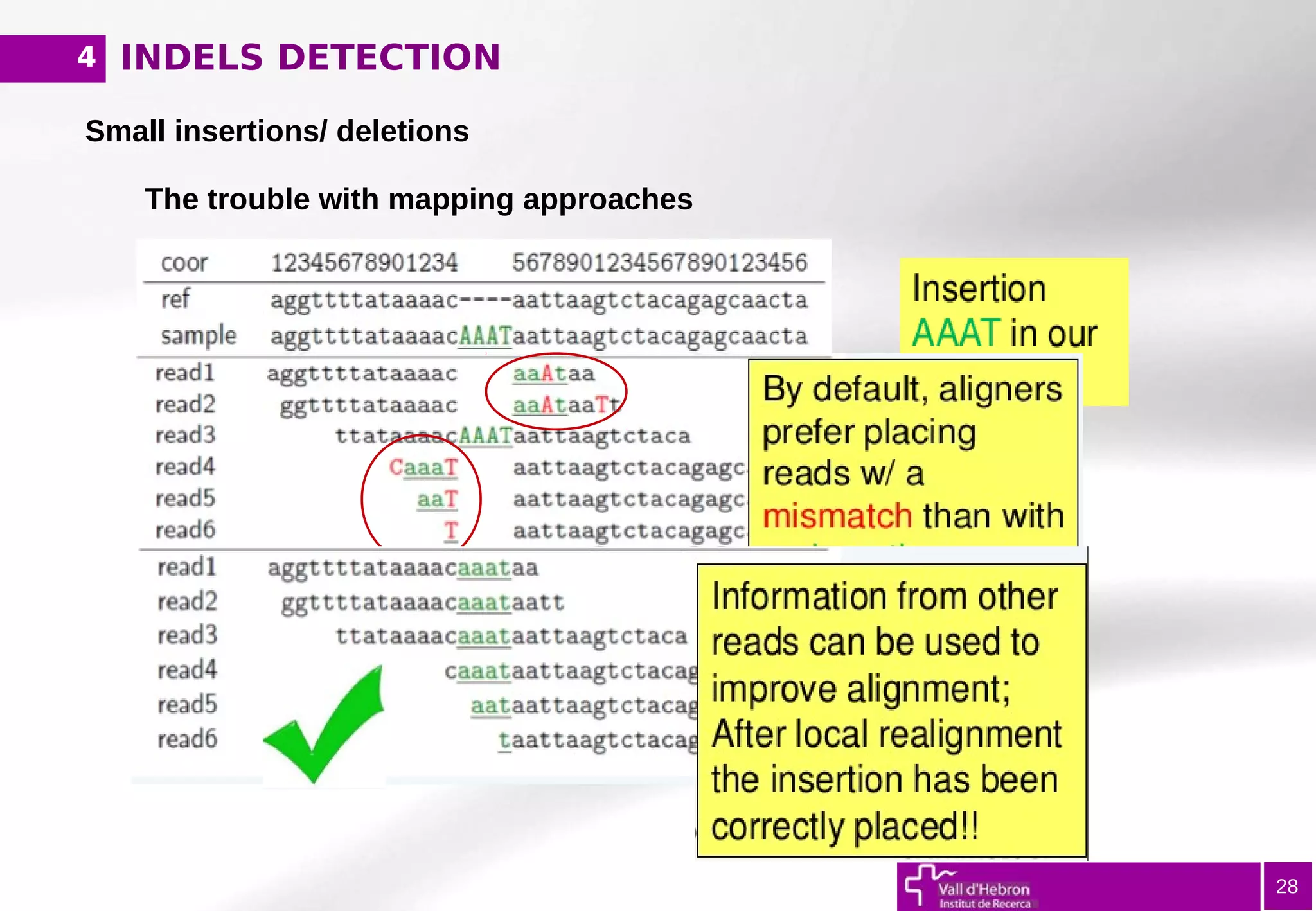
Small insertions/ deletions
The trouble with mapping approaches
4
RE-ALIGNMENT
29
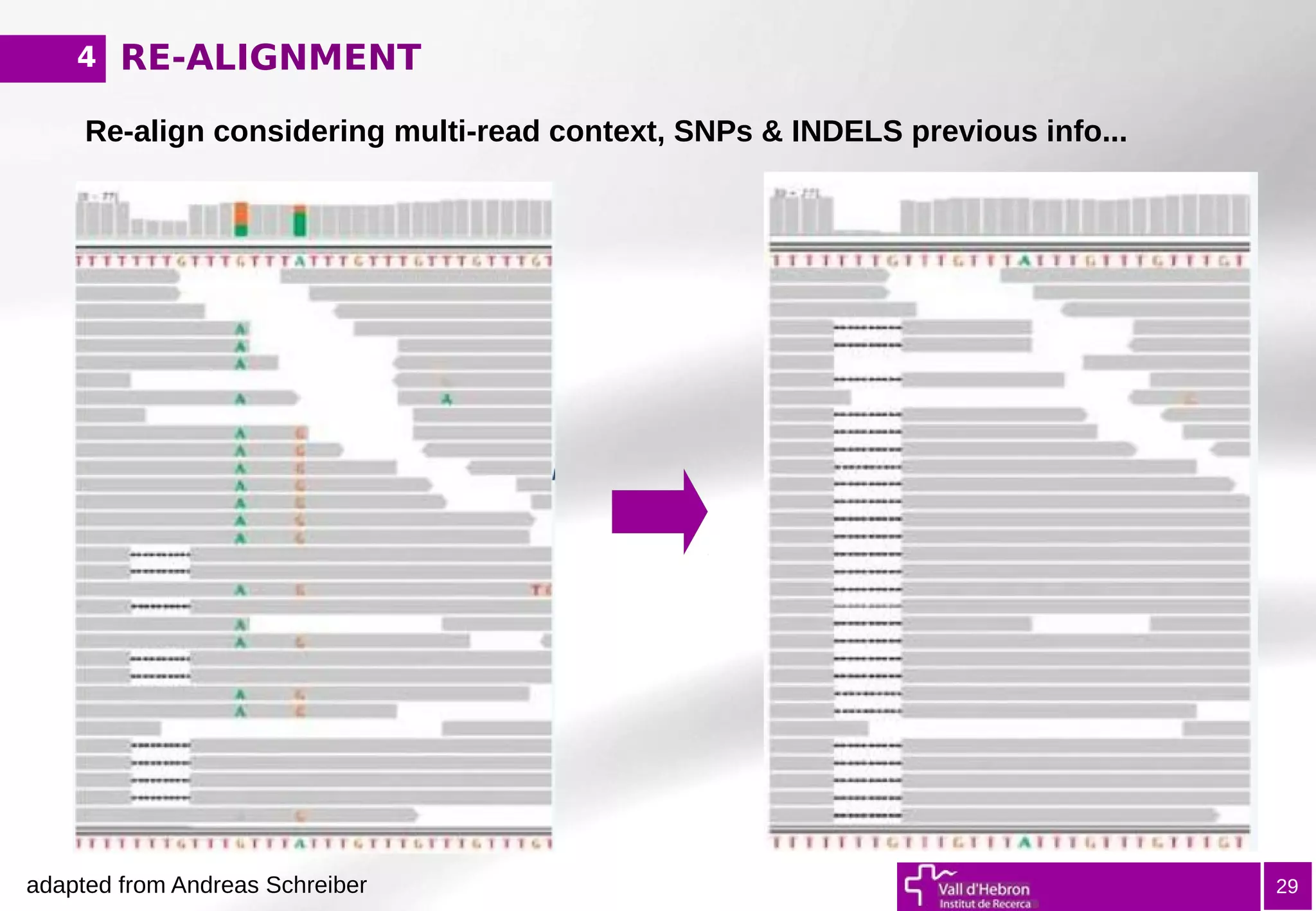
Re-align considering multi-read context, SNPs & INDELS previous info...
4
adapted from Andreas Schreiber
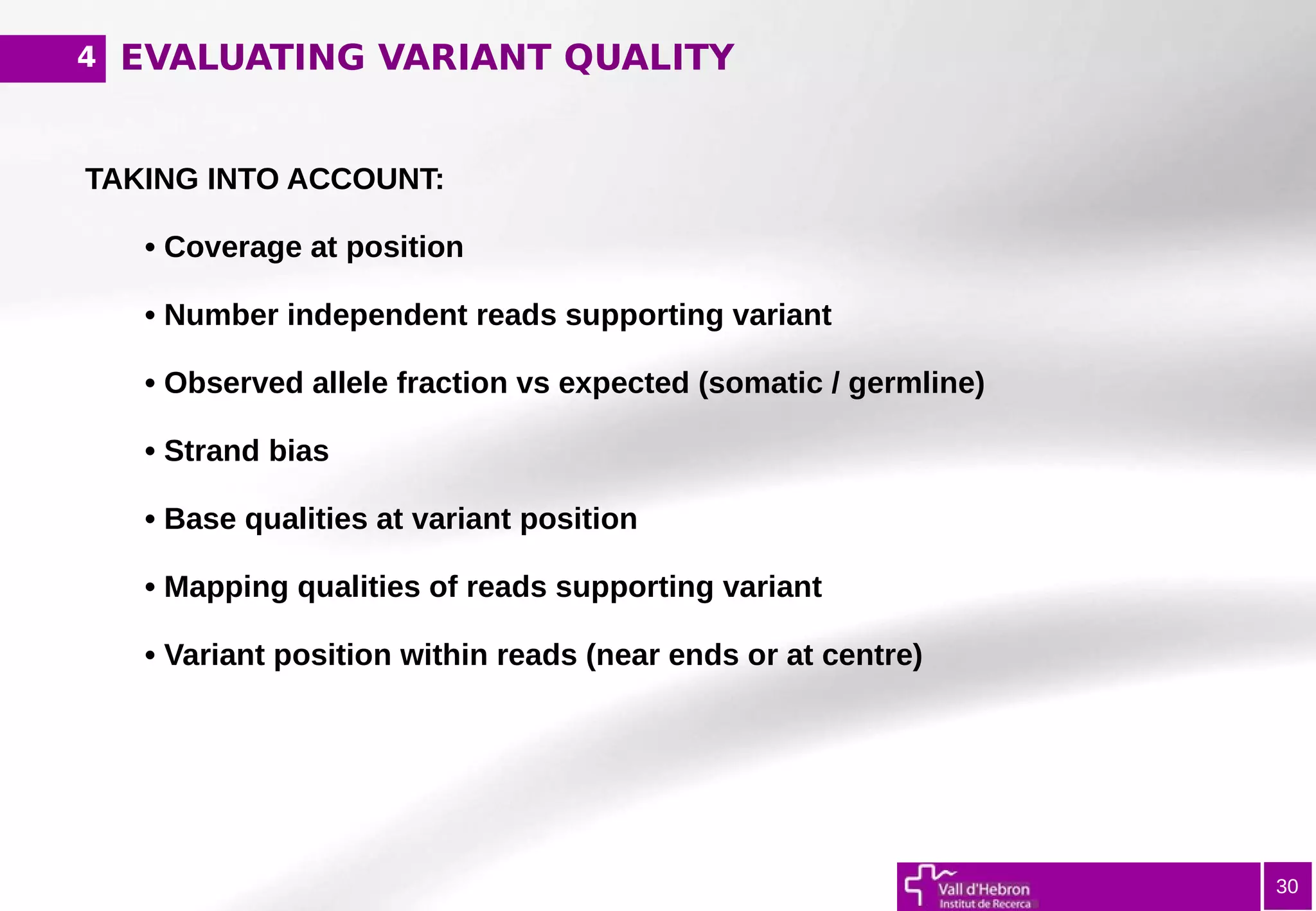
EVALUATING VARIANT QUALITY
30
TAKING INTO ACCOUNT:
• Coverage at position
• Number independent reads supporting variant
• Observed allele fraction vs expected (somatic / germline)
• Strand bias
• Base qualities at variant position
• Mapping qualities of reads supporting variant
• Variant position within reads (near ends or at centre)
4
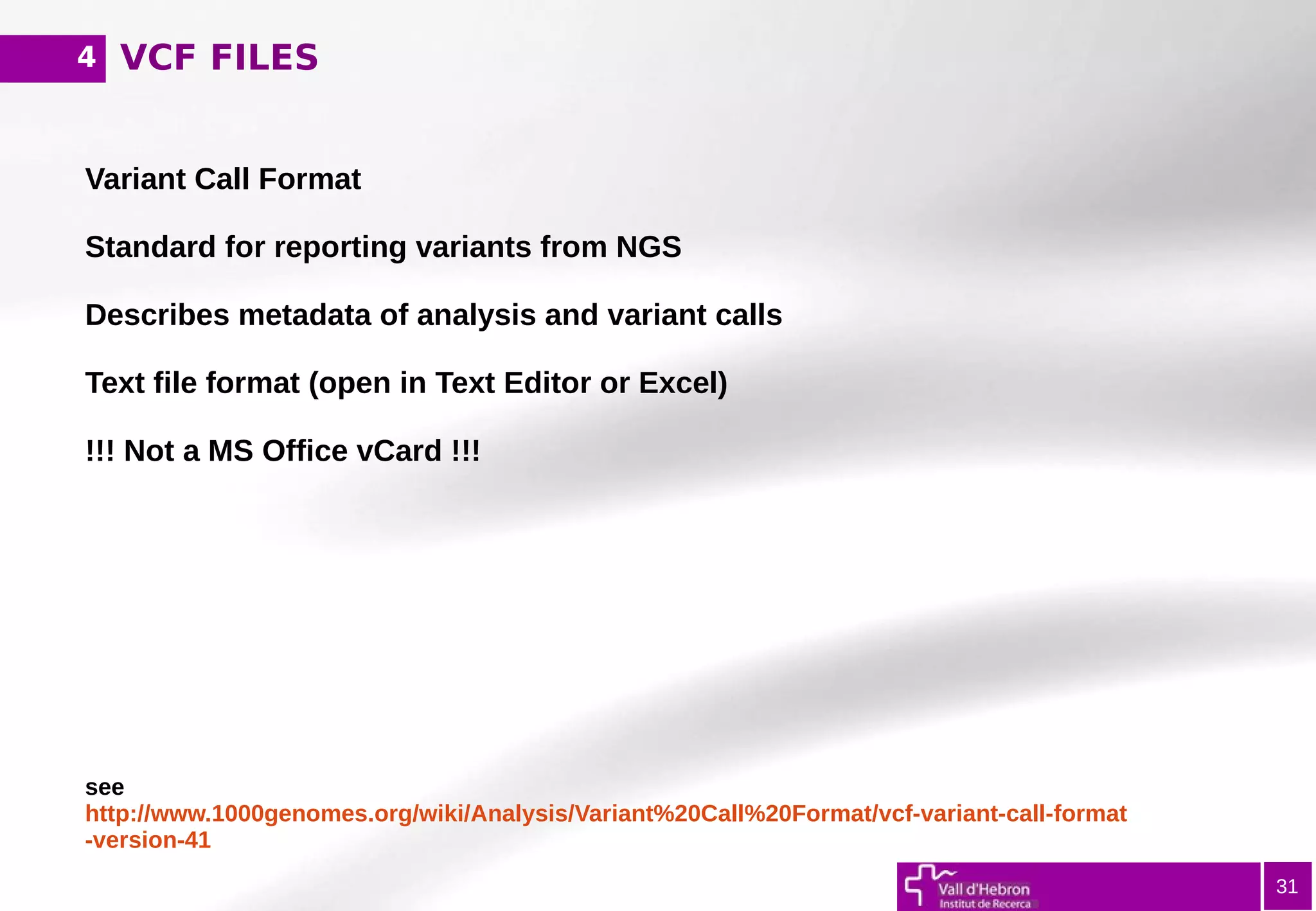
VCF FILES
31
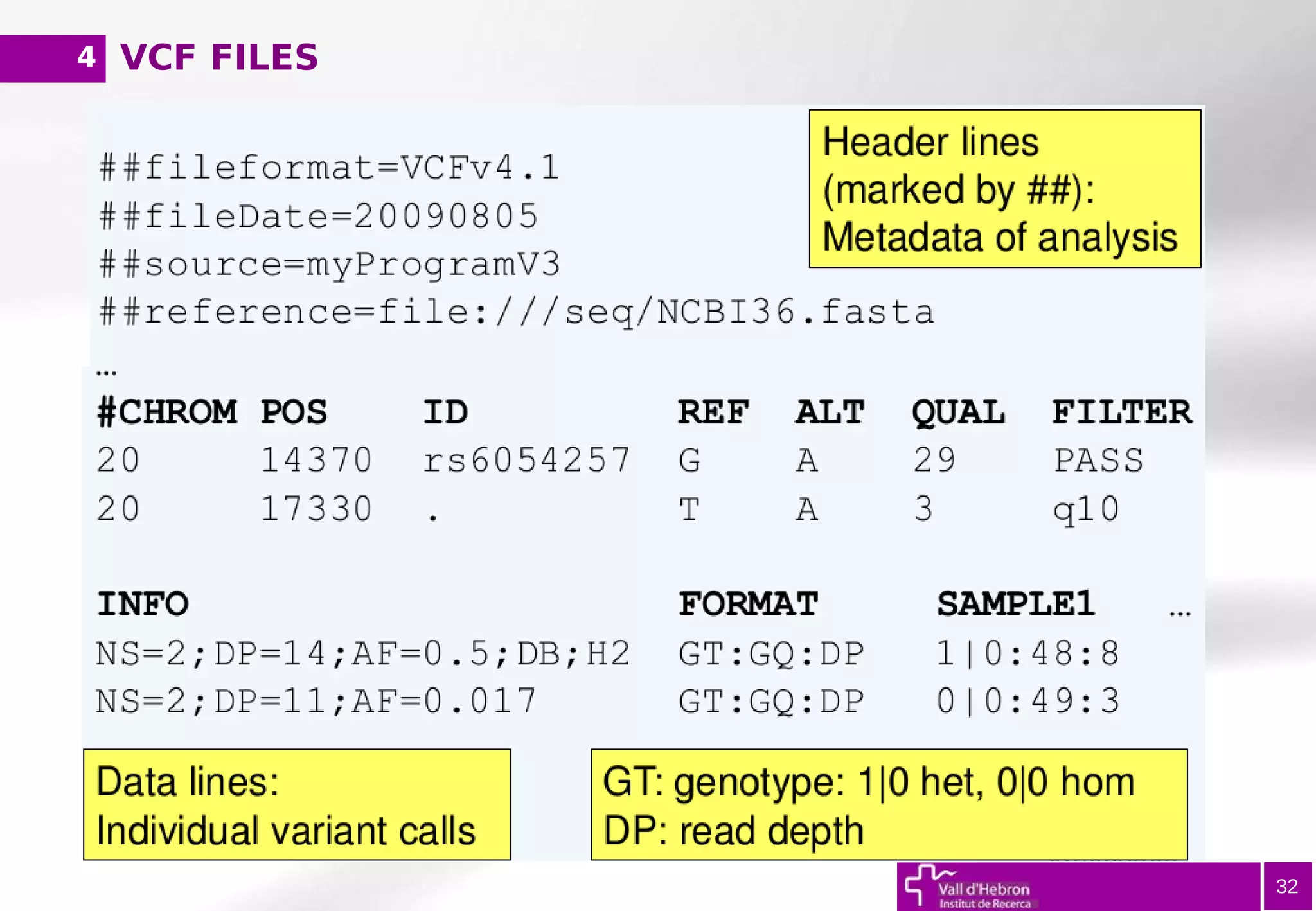
Variant Call Format
Standard for reporting variants from NGS
Describes metadata of analysis and variant calls
Text file format (open in Text Editor or Excel)
!!! Not a MS Office vCard !!!
see
http://www.1000genomes.org/wiki/Analysis/Variant%20Call%20Format/vcf-variant-call-format
-version-41
4
VCF FILES
32
4
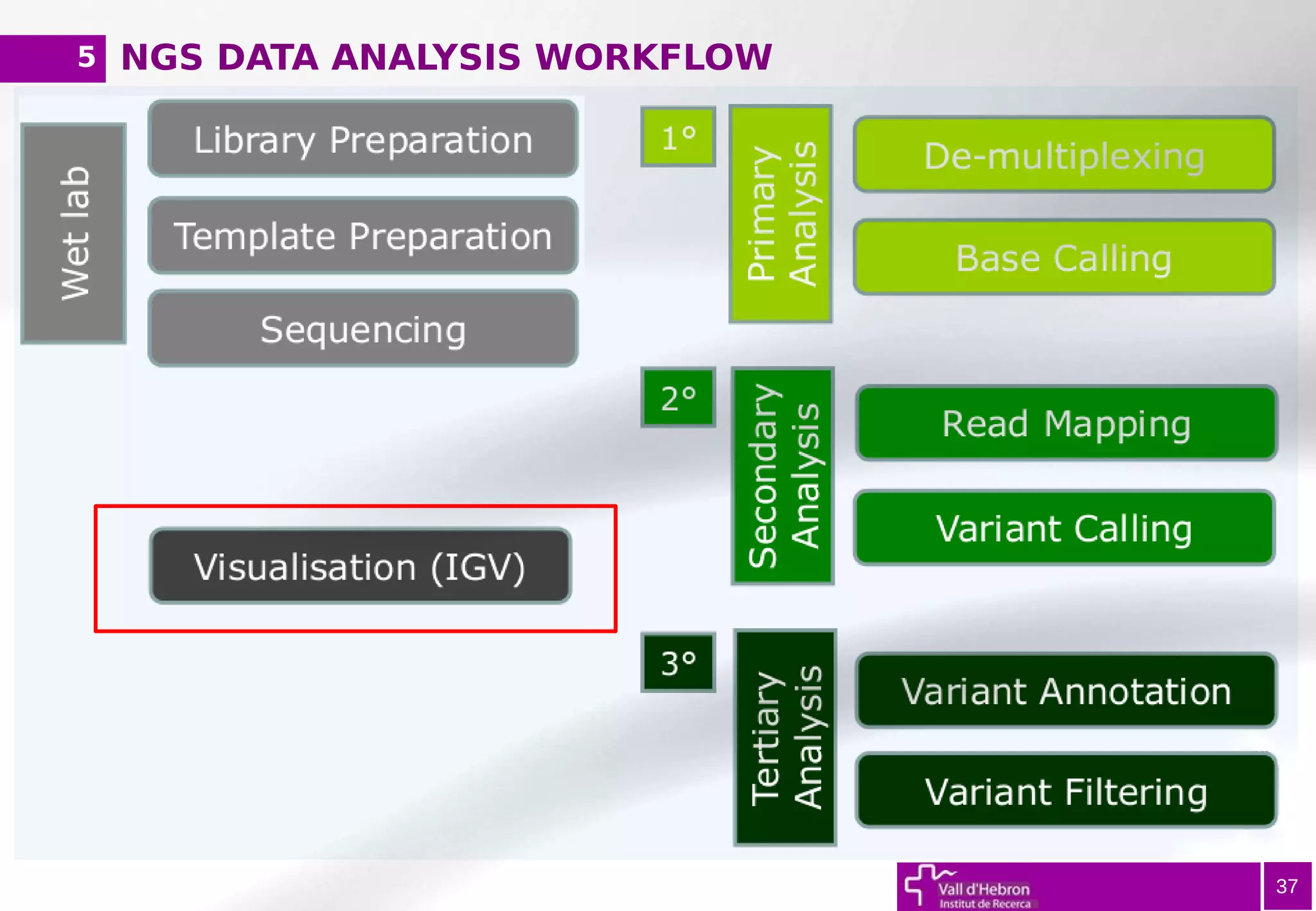
NGS DATA ANALYSIS WORKFLOW
33
4
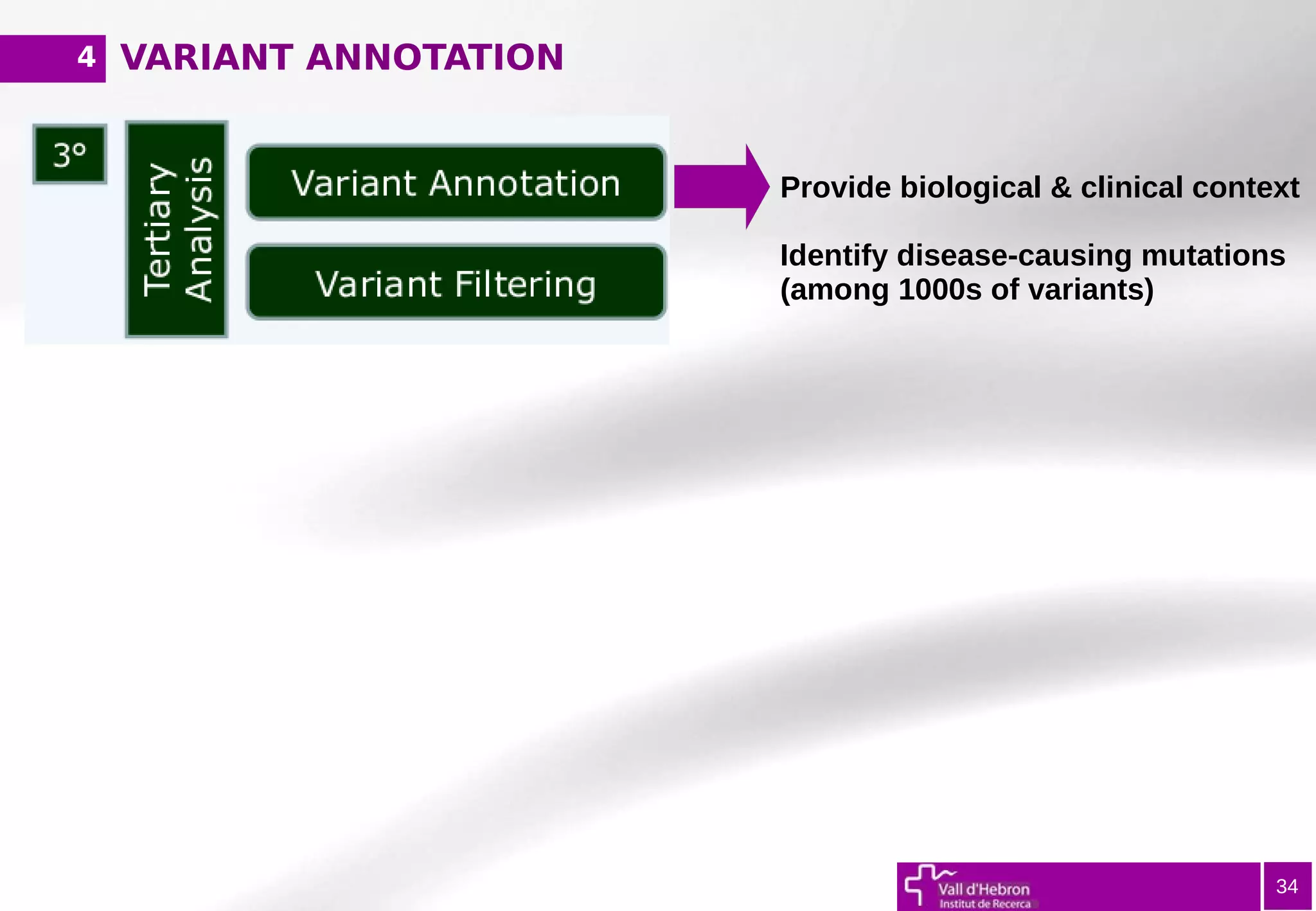
VARIANT ANNOTATION
34
Provide biological & clinical context
Identify disease-causing mutations
(among 1000s of variants)
4
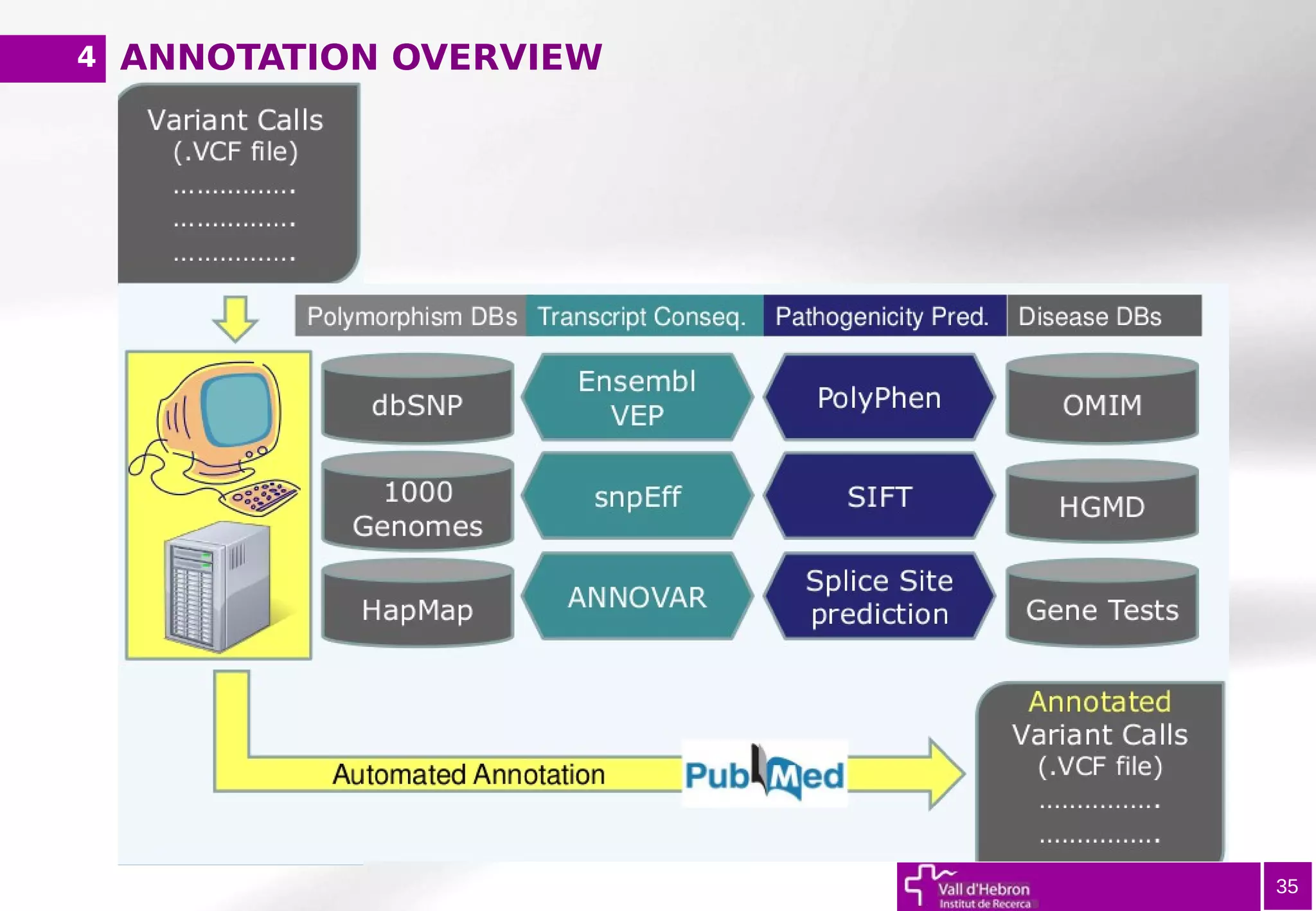
ANNOTATION OVERVIEW
35
4
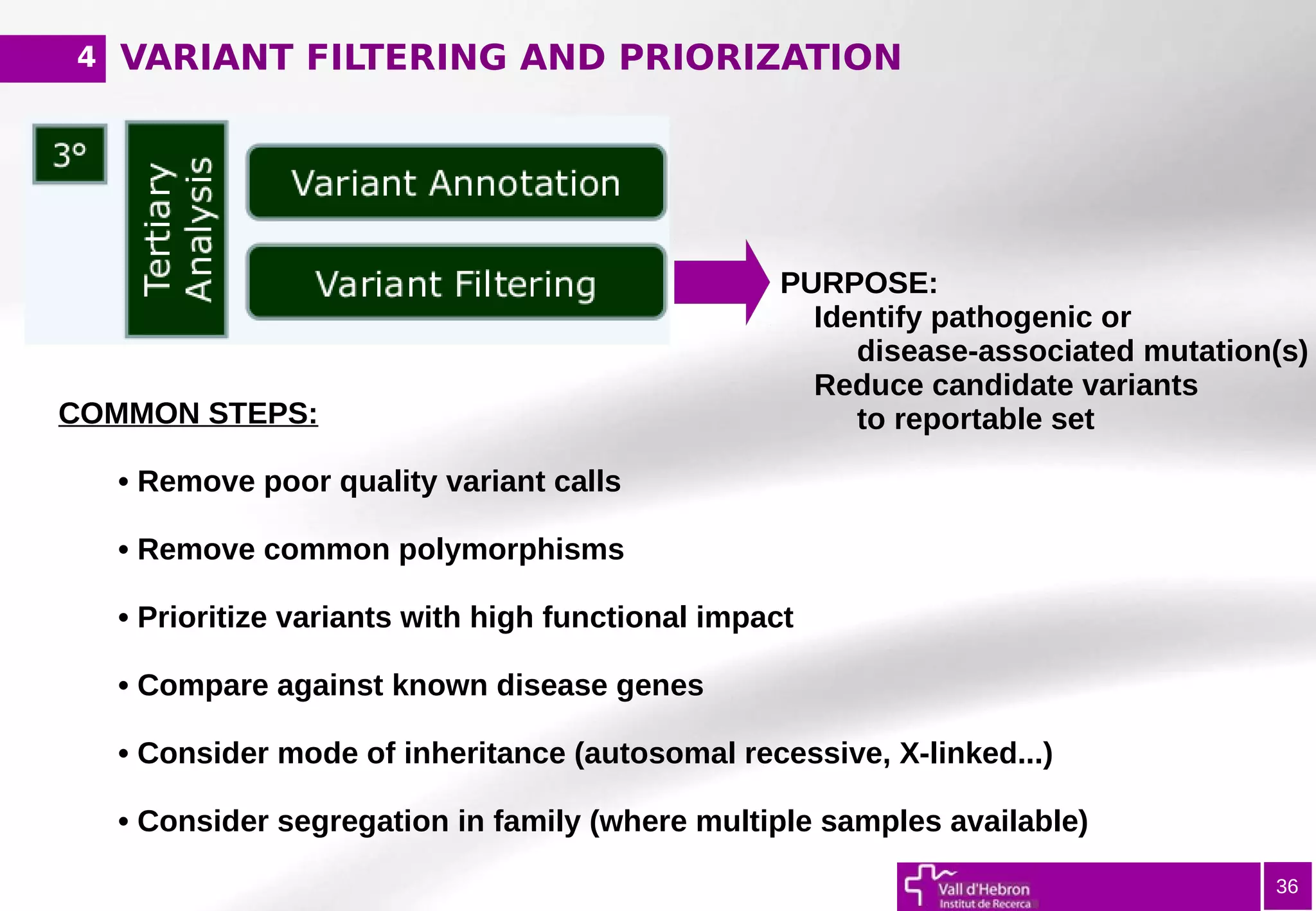
VARIANT FILTERING AND PRIORIZATION
36
PURPOSE:
Identify pathogenic or
disease-associated mutation(s)
Reduce candidate variants
to reportable setCOMMON STEPS:
• Remove poor quality variant calls
• Remove common polymorphisms
• Prioritize variants with high functional impact
• Compare against known disease genes
• Consider mode of inheritance (autosomal recessive, X-linked...)
• Consider segregation in family (where multiple samples available)
4
NGS DATA ANALYSIS WORKFLOW
37
5
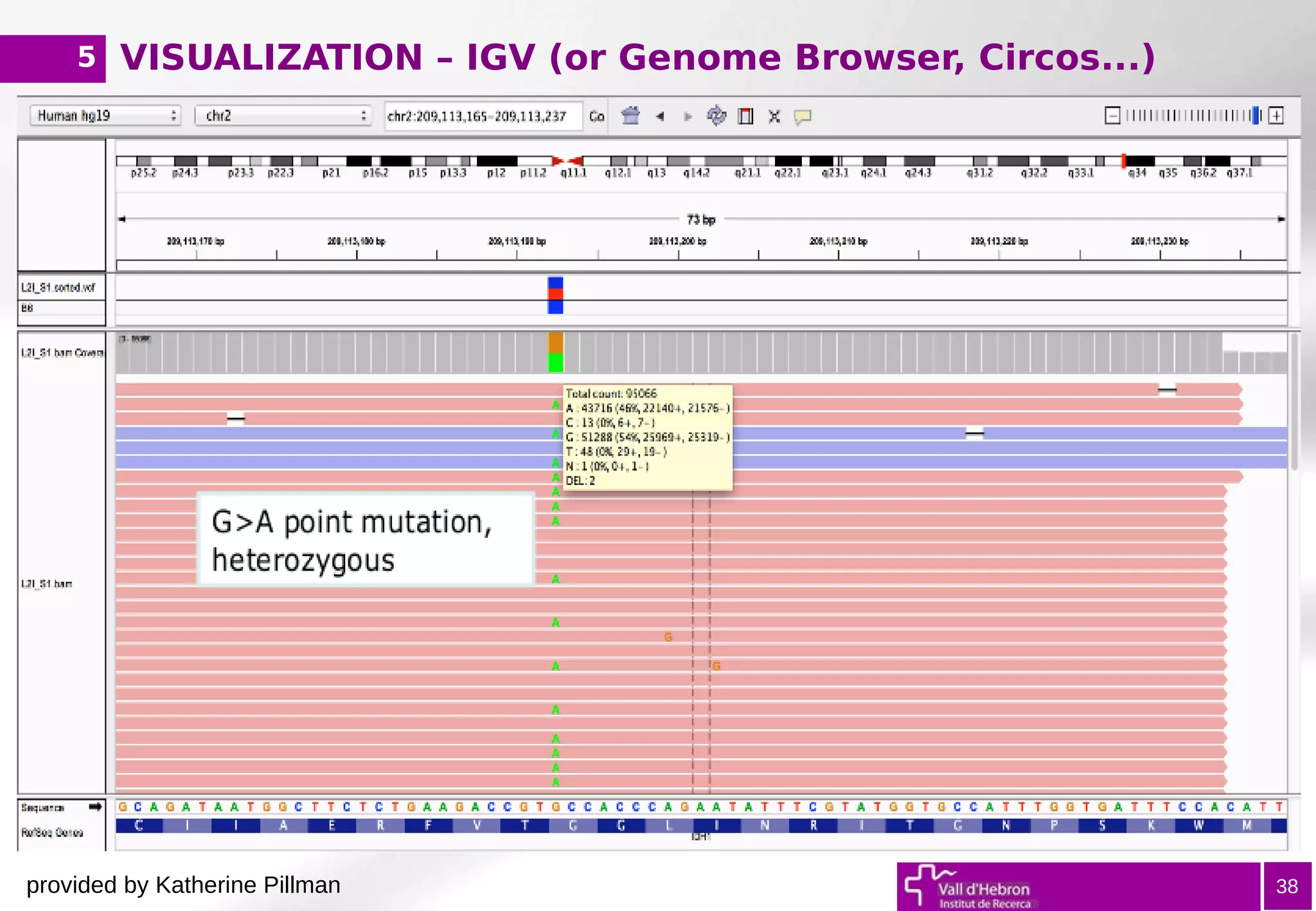
VISUALIZATION – IGV (or Genome Browser, Circos...)
38
5
provided by Katherine Pillman
COMMON PIPELINE6
39
bcl2fastq (Illumina)
FastQC (open-source)
Exomes (HiSeq):
BWA(open-source), GATK (Broad)
Gene panels (MiSeq, PGM):
MiSeq Reporter (Illumina)
Torrent Suite (Ion Torrent)
Custom scripts and third party tools
(Annovar, snpEff, PolyPhen, SIFT...)
Commercial annotation software
(GeneticistAssistant, VariantStudio...)
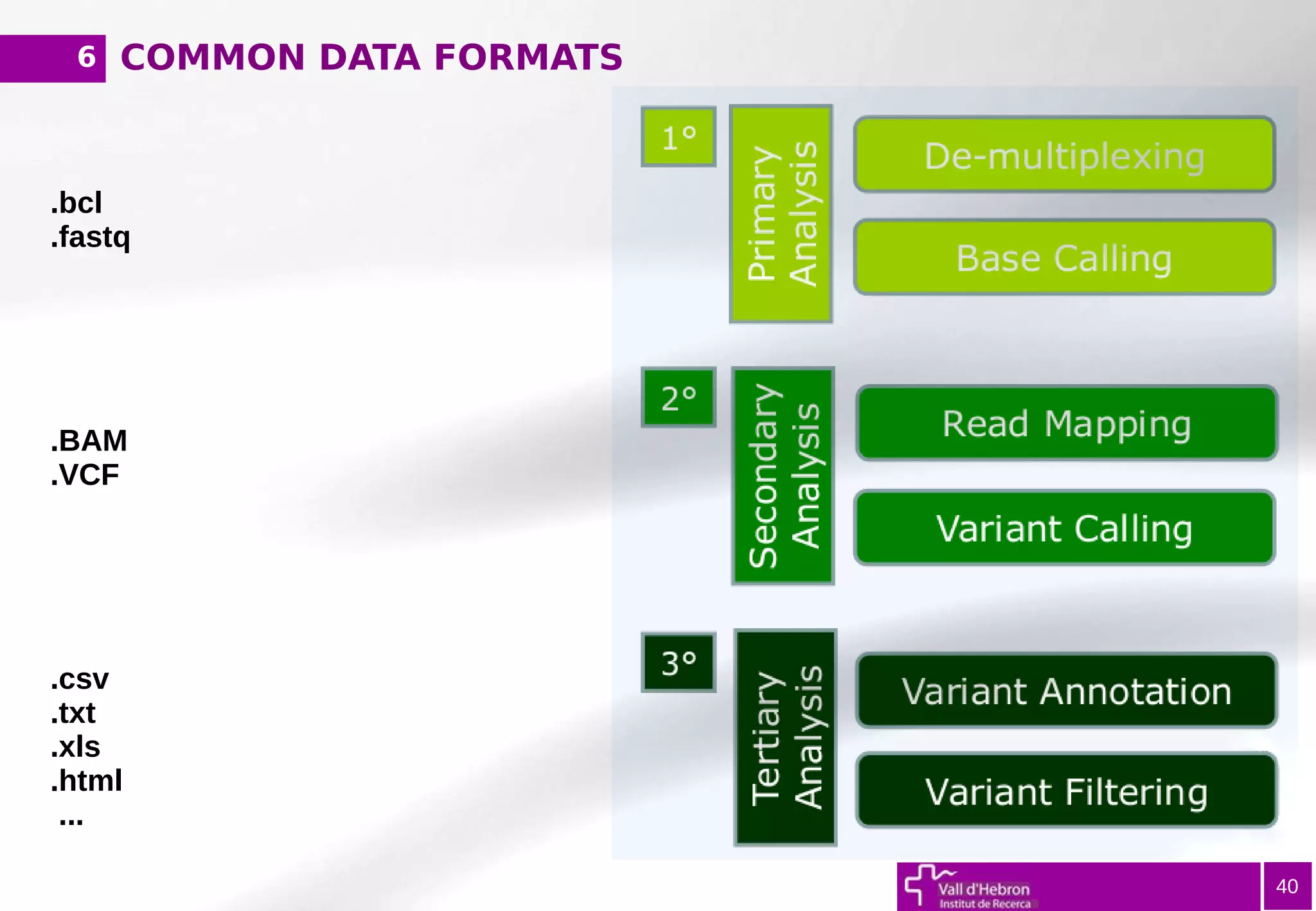
COMMON DATA FORMATS6
40
.bcl
.fastq
.BAM
.VCF
.csv
.txt
.xls
.html
...
CONCLUSIONS7
41
NGS data - the new currency of (molecular) biology
Broad applications (ecology, evolution, ag sciences, medical research and
clinical diagnostics...).
Rapidly evolving (sequencing technologies, library preparation methods,
analysis approaches, software).
Different tools/pipelines/parametrization gives different results,
(more standards needed).
Bioinformatics pipelines typically combine vendor software, third-party
tools and custom scripts.
Requires skills in scripting, Linux/Unix, HPC.
Requires advanced hardware (not always available).
Understanding of data (SE, PE, RNA-Seq) important for successful analysis.

Introduction to NGS Variant Calling Analysis (UEB-UAT Bioinformatics Course - Session 2.3 - VHIR, Barcelona)

  • 1.
    Hospital Universitari Valld’Hebron Institut de Recerca - VHIR Institut d’Investigació Sanitària de l’Instituto de Salud Carlos III (ISCIII) Bioinformàtica per la Recerca Biomèdica http://ueb.vhir.org/2014BRB Ferran Briansó ferran.brianso@vhir.org 15/05/2014 INTRODUCTION TO NGS VARIANT CALLING ANALYSIS
  • 2.
    1. NGS WORKFLOWOVERVIEW 2. WET LAB STEPS 3. IMPORTANT SEQUENCING CONCEPTS 4. NGS ANALYSIS WORKFLOW 1. Primary analysis: de-multiplexing, QC 2. Secondary analysis: read mapping and variant calling 3. Tertiary analysis: annotation, filtering... 5. VISUALIZATION 6. COMMON PIPELINES AND FORMATS 7. CONCLUSIONS 5 1 2 3 5 6 PRESENTATION OUTLINE 4 7
  • 3.
    NGS WORKFLOW OVERVIEW1 3Extractedfrom Dr Kassahn's publicly shared slides (2013)
  • 4.
    LIBRARY PREPARATION2 4 Select target Hybridization-basedcature or PCR Add adapters Contain binding sequences Barcodes Primer sequences Amplify material 2
  • 5.
    5 Select target Hybridization-based catureor PCR Add adapters Contain binding sequences Barcodes Primer sequences Amplify material A) Fragment DNA B) End-repair C) A-tailing, adapter ligation and PCR D) Final library contains • sample insert • indices (barcodes) • flowcell binding sequences • primer binding sequences LIBRARY PREPARATION2
  • 6.
    6 Select target Hybridization-based catureor PCR Add adapters Contain binding sequences Barcodes Primer sequences Amplify material LIBRARY PREPARATION2
  • 7.
    TEMPLATE PREPARATION 7 Attachment oflibrary e.g. To Illumina Flowcell Amplification of library molecules e.g. Brigde amplification 2
  • 8.
  • 9.
    SEQUENCING 9 Sequencing-by-Synthesis Detection by: • Illumina– fluorescence • Ion Torrent – pH • ROCHE 454 – PO4 and light 2
  • 10.
  • 11.
    IMPORTANT SEQUENCING CONCEPTS1 11 Barcoding/Indexing: allowsmultiplexing of different samples Single-end vs paired-end sequencing Coverage: avg. number reads per target Quality scores (Qscore): log-scales! 3
  • 12.
    NGS DATA ANALYSISWORKFLOW4 12
  • 13.
  • 14.
  • 15.
    SEQUENCE QUALITY: fastQC 15 http://www.bioinformatics.babraham.ac.uk/projects/fastqc/ Detailsof the output https://docs.google.com/document/pub?id=16GwPmwYW7o_r-ZUgCu8-oSBBY1gC97TfTTinGDk98Ws 4
  • 16.
    NGS DATA ANALYSISWORKFLOW4 16
  • 17.
    READ MAPPING (BASICALIGNMENT)4 17 Comparison against reference genome (! not assembly !) Many aligners (short reads, longer reads, RNAseq...) Examples: BWA, Bowtie SAM/BAM files
  • 18.
    BURROWS-WHEELER ALIGNMENT TOOL(BWA) 18 Popular tool for genomic sequence data (not RNASeq!) Li and Durbin 2009 Bioinformatics Challenge: compare billion of short sequence reads (.fastq file) against human genome (3Gb) Burrows-Wheeler Transform to “index” the human genome and allow memory-efficient and fast string matching between sequence read and reference genome 4 Li & Durbin 2009 Bionformatics
  • 19.
  • 20.
    SAM/BAM FILES 20 @ Header(information regarding reference genome, alignment method...) 1) Read ID (QNAME) 2) Bitwise FLAG (first/second read in pair, both reads mapped...) 3) ReferenceSequence Name (RNAME) 4) Position (POS, coordinate) 5) MapQuality (MAPQ = -10log10P[wrong mapping position]) 6) CIGAR (describes alignment – matches, skipped regions, insertions..) 7) ReferenceSequence (RNEXT, Ref seq of the pair) 8) Position of the pair (PNEXT) 9) TemplateLength (TLEN) 10) ReadSequence 11) QUAL (in Fastq format, '*' if NA) ... 4
  • 21.
    VARIANT CALLING 21 Identify sequencevariants Distinguish signal vs noise VCF files Examples: SAMtools, SNVmix 4
  • 22.
  • 23.
    SEQUENCE VARIANTS 23 Sanger: isit real?? NGS: read count Provides confidence (statistics!) Sensitivity tune-able parameter (dependent on coverage) 4
  • 24.
    VARIANT CALLING: GATK 24 GenomeAnalysis Toolkit (BROAD Institute) • Initially developed for 1000 Genomes Project • Single or multiple sample analysis (cohort) • Popular tool for germline variant calling • Evaluates probability of genotype given read data 4 see http://www.broadinstitute.org/gatk/ and McKenna et al. Genome Research 2010
  • 25.
    SOMATIC VARIANT CALLING 25 Somaticmutations can occur at low freq. (<10%) due to: • Tumor heterogeneity (multiple clones) • Low tumor purity (% normal cells in tumor sample) Requires different thresholds than germline variant calling when evaluating signal vs noise Trade-off between sensitivity (ability to detect mutation) and specificity (rate of false positives) Nature Reviews Cancer 12, 323-334 (May 2012) 4
  • 26.
    INDELS DETECTION1 26 Small insertions/deletions The trouble with mapping approaches 4 modified from Heng Li (Broad Institute)
  • 27.
    INDELS DETECTION 27 Small insertions/deletions The trouble with mapping approaches 4
  • 28.
    INDELS DETECTION 28 Small insertions/deletions The trouble with mapping approaches 4
  • 29.
    RE-ALIGNMENT 29 Re-align considering multi-readcontext, SNPs & INDELS previous info... 4 adapted from Andreas Schreiber
  • 30.
    EVALUATING VARIANT QUALITY 30 TAKINGINTO ACCOUNT: • Coverage at position • Number independent reads supporting variant • Observed allele fraction vs expected (somatic / germline) • Strand bias • Base qualities at variant position • Mapping qualities of reads supporting variant • Variant position within reads (near ends or at centre) 4
  • 31.
    VCF FILES 31 Variant CallFormat Standard for reporting variants from NGS Describes metadata of analysis and variant calls Text file format (open in Text Editor or Excel) !!! Not a MS Office vCard !!! see http://www.1000genomes.org/wiki/Analysis/Variant%20Call%20Format/vcf-variant-call-format -version-41 4
  • 32.
  • 33.
    NGS DATA ANALYSISWORKFLOW 33 4
  • 34.
    VARIANT ANNOTATION 34 Provide biological& clinical context Identify disease-causing mutations (among 1000s of variants) 4
  • 35.
  • 36.
    VARIANT FILTERING ANDPRIORIZATION 36 PURPOSE: Identify pathogenic or disease-associated mutation(s) Reduce candidate variants to reportable setCOMMON STEPS: • Remove poor quality variant calls • Remove common polymorphisms • Prioritize variants with high functional impact • Compare against known disease genes • Consider mode of inheritance (autosomal recessive, X-linked...) • Consider segregation in family (where multiple samples available) 4
  • 37.
    NGS DATA ANALYSISWORKFLOW 37 5
  • 38.
    VISUALIZATION – IGV(or Genome Browser, Circos...) 38 5 provided by Katherine Pillman
  • 39.
    COMMON PIPELINE6 39 bcl2fastq (Illumina) FastQC(open-source) Exomes (HiSeq): BWA(open-source), GATK (Broad) Gene panels (MiSeq, PGM): MiSeq Reporter (Illumina) Torrent Suite (Ion Torrent) Custom scripts and third party tools (Annovar, snpEff, PolyPhen, SIFT...) Commercial annotation software (GeneticistAssistant, VariantStudio...)
  • 40.
  • 41.
    CONCLUSIONS7 41 NGS data -the new currency of (molecular) biology Broad applications (ecology, evolution, ag sciences, medical research and clinical diagnostics...). Rapidly evolving (sequencing technologies, library preparation methods, analysis approaches, software). Different tools/pipelines/parametrization gives different results, (more standards needed). Bioinformatics pipelines typically combine vendor software, third-party tools and custom scripts. Requires skills in scripting, Linux/Unix, HPC. Requires advanced hardware (not always available). Understanding of data (SE, PE, RNA-Seq) important for successful analysis.