Bayesian Model-Agnostic Meta-Learning
(NeurIPS 2018 spotlight)
2019.01.02.
Sangwoo Mo
1
Introduction
• Meta-Learning
• Learning is to find a model which works well for the given task 𝑇
• Meta-learning is to learn a “way to learn” a model when some task 𝑇𝑖 ∼ 𝑝(𝑇) is given
2
Introduction
• Meta-Learning
• Learning is to find a model which works well for the given task 𝑇
• Meta-learning is to learn a “way to learn” a model when some task 𝑇𝑖 ∼ 𝑝(𝑇) is given
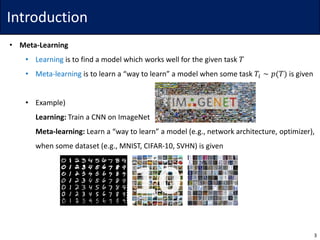
• Example)
Learning: Train a CNN on ImageNet
Meta-learning: Learn a “way to learn” a model (e.g., network architecture, optimizer),
when some dataset (e.g., MNIST, CIFAR-10, SVHN) is given
3
Introduction
• Meta-Learning
• Learning is to find a model which works well for the given task 𝑇
• Meta-learning is to learn a “way to learn” a model when some task 𝑇𝑖 ∼ 𝑝(𝑇) is given
• Model-Agnostic Meta Learning (MAML)1
• Find a good initial point 𝜃, which can be easily adopted to 𝜃𝑖 for the task 𝑇𝑖
41. Finn et al. Model-Agnostic Meta-Learning for Fast Adaptation of Deep Networks. ICML 2017.
inner loop
outer loop
Background
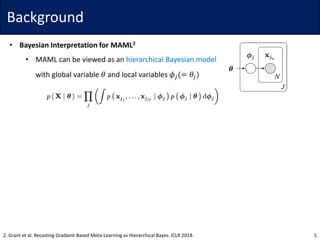
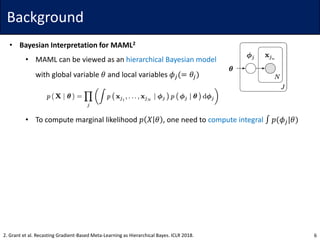
• Bayesian Interpretation for MAML2
• MAML can be viewed as an hierarchical Bayesian model
with global variable 𝜃 and local variables 𝜙𝑗(= 𝜃𝑗)
52. Grant et al. Recasting Gradient-Based Meta-Learning as Hierarchical Bayes. ICLR 2018.
Background
• Bayesian Interpretation for MAML2
• MAML can be viewed as an hierarchical Bayesian model
with global variable 𝜃 and local variables 𝜙𝑗(= 𝜃𝑗)
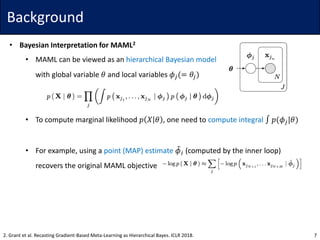
• To compute marginal likelihood 𝑝 𝑋 𝜃 , one need to compute integral ∫ 𝑝(𝜙𝑗|𝜃)
62. Grant et al. Recasting Gradient-Based Meta-Learning as Hierarchical Bayes. ICLR 2018.
Background
• Bayesian Interpretation for MAML2
• MAML can be viewed as an hierarchical Bayesian model
with global variable 𝜃 and local variables 𝜙𝑗(= 𝜃𝑗)
• To compute marginal likelihood 𝑝 𝑋 𝜃 , one need to compute integral ∫ 𝑝(𝜙𝑗|𝜃)
• For example, using a point (MAP) estimate ෠𝜙𝑗 (computed by the inner loop)
recovers the original MAML objective
72. Grant et al. Recasting Gradient-Based Meta-Learning as Hierarchical Bayes. ICLR 2018.
Background
• Bayesian Interpretation for MAML2
• MAML can be viewed as an hierarchical Bayesian model
with global variable 𝜃 and local variables 𝜙𝑗(= 𝜃𝑗)
• To compute marginal likelihood 𝑝 𝑋 𝜃 , one need to compute integral ∫ 𝑝(𝜙𝑗|𝜃)
• For example, using a point (MAP) estimate ෠𝜙𝑗 (computed by the inner loop)
recovers the original MAML objective
• [2] propose to use a Laplace approximation
which allows to measure the uncertainty and improves the performance
82. Grant et al. Recasting Gradient-Based Meta-Learning as Hierarchical Bayes. ICLR 2018.
Background
• Bayesian Interpretation for MAML2
• [2] propose to use a Laplace approximation
which allows to measure the uncertainty and improves the performance
92. Grant et al. Recasting Gradient-Based Meta-Learning as Hierarchical Bayes. ICLR 2018.
Method
• Bayesian Model-Agnostic Meta-Learning (BMAML)3
• Can one extend [2] to more complex Bayesian neural network?
• Instead of approximating 𝑝(𝜙𝑗|𝜃) with tractable form, simply sampling from
• Here, the sampled 𝜙𝑗s should be differentiable
103. Kim et al. Bayesian Model-Agnostic Meta-Learning. NeurIPS 2018.
Method
• Bayesian Model-Agnostic Meta-Learning (BMAML)3
• Can one extend [2] to more complex Bayesian neural network?
• Instead of approximating 𝑝(𝜙𝑗|𝜃) with tractable form, simply sampling from
• Here, the sampled 𝜙𝑗s should be differentiable
• Idea: Use Stein Variational Gradient Descent (SVGD)*
11
3. Kim et al. Bayesian Model-Agnostic Meta-Learning. NeurIPS 2018.
* One can use any gradient-based MCMC algorithms (e.g., SGLD or SGHMC), but SVGD is deterministic and adapt faster.
Recall: Stein Variational Gradient Descent
• Stein Variational Gradient Descent (SVGD)4
• Goal: Find an approximated distribution 𝑞∗ (s.t. 𝑞 ∈ 𝒬) of true distribution 𝑝
124. Liu et al. Stein Variational Gradient Descent: A General Purpose Bayesian Inference Algorithm. NeurIPS 2016.
Recall: Stein Variational Gradient Descent
• Stein Variational Gradient Descent (SVGD)4
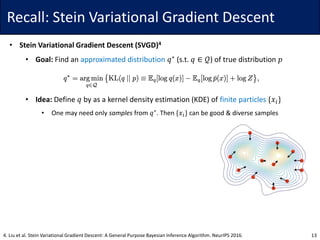
• Goal: Find an approximated distribution 𝑞∗ (s.t. 𝑞 ∈ 𝒬) of true distribution 𝑝
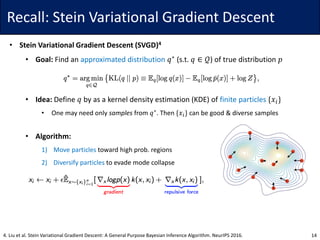
• Idea: Define 𝑞 by as a kernel density estimation (KDE) of finite particles {𝑥𝑖}
• One may need only samples from 𝑞∗
. Then {𝑥𝑖} can be good & diverse samples
134. Liu et al. Stein Variational Gradient Descent: A General Purpose Bayesian Inference Algorithm. NeurIPS 2016.
Recall: Stein Variational Gradient Descent
• Stein Variational Gradient Descent (SVGD)4
• Goal: Find an approximated distribution 𝑞∗ (s.t. 𝑞 ∈ 𝒬) of true distribution 𝑝
• Idea: Define 𝑞 by as a kernel density estimation (KDE) of finite particles {𝑥𝑖}
• One may need only samples from 𝑞∗
. Then {𝑥𝑖} can be good & diverse samples
• Algorithm:
1) Move particles toward high prob. regions
2) Diversify particles to evade mode collapse
144. Liu et al. Stein Variational Gradient Descent: A General Purpose Bayesian Inference Algorithm. NeurIPS 2016.
Recall: Stein Variational Gradient Descent
• Stein Variational Gradient Descent (SVGD)4
• Goal: Find an approximated distribution 𝑞∗ (s.t. 𝑞 ∈ 𝒬) of true distribution 𝑝
• Idea: Define 𝑞 by as a kernel density estimation (KDE) of finite particles {𝑥𝑖}
• One may need only samples from 𝑞∗
. Then {𝑥𝑖} can be good & diverse samples
• Algorithm:
1) Move particles toward high prob. regions
2) Diversify particles to evade mode collapse
• Cf. It is the steepest gradient direction (of KL div.) in the unit ball of a RKHS
(derivate of KL in RKHS = kernelized Stein discrepancy (KSD), hence named SVGD)
154. Liu et al. Stein Variational Gradient Descent: A General Purpose Bayesian Inference Algorithm. NeurIPS 2016.
Method
• Bayesian Model-Agnostic Meta-Learning (BMAML)3
• Can one extend [2] to more complex Bayesian neural network?
• Instead of approximating 𝑝(𝜙𝑗|𝜃) with tractable form, simply sampling from
• Idea: Use Stein Variational Gradient Descent (SVGD)
• Learn a task-specific posterior Θ 𝜏 with SVGD (start from the prior Θ0)*
• Meta-update for Θ0 is given by the mean of val. likelihoods of 𝑀 particles
• Cf. To reduce complexity, all particles share parameters all but the last linear layer
16
3. Kim et al. Bayesian Model-Agnostic Meta-Learning. NeurIPS 2018.
* Both Θ0 and Θ 𝜏 are given by 𝑀 particles.
Method
• Bayesian Model-Agnostic Meta-Learning (BMAML)3
• Can one extend [2] to more complex Bayesian neural network?
• Idea 1: Use Stein Variational Gradient Descent (SVGD)
• Learn a task-specific posterior Θ 𝜏 with SVGD (start from the prior Θ0)
• Meta-update for Θ0 is given by the mean of val. likelihoods of 𝑀 particles
• However, this meta-update it not Bayesian inference
• Same as MAML, minimizes empirical loss on task-validation sets (but ensembled)
• It is numerically unstable (task-validation likelihoods) and easily overfitted
173. Kim et al. Bayesian Model-Agnostic Meta-Learning. NeurIPS 2018.
Method
• Bayesian Model-Agnostic Meta-Learning (BMAML)3
• Can one extend [2] to more complex Bayesian neural network?
• Idea 1: Use Stein Variational Gradient Descent (SVGD)
• Learn a task-specific posterior Θ 𝜏 with SVGD (start from the prior Θ0)
• Meta-update for Θ0 is given by the mean of val. likelihoods of 𝑀 particles
• However, this meta-update it not Bayesian inference
• Same as MAML, minimizes empirical loss on task-validation sets (but ensembled)
• It is numerically unstable (task-validation likelihoods) and easily overfitted
• Instead, [3] propose a new meta-update algorithm in Bayesian scheme
183. Kim et al. Bayesian Model-Agnostic Meta-Learning. NeurIPS 2018.
Method
• Bayesian Model-Agnostic Meta-Learning (BMAML)3
• Can one extend [2] to more complex Bayesian neural network?
• Idea 1: Use Stein Variational Gradient Descent (SVGD)
• Idea 2: New meta-update algorithm (coined chaser loss) for Bayesian setting
• Directly minimize the distance between task-train posterior 𝑝𝜏
𝑛
and true posterior 𝑝𝜏
∞
193. Kim et al. Bayesian Model-Agnostic Meta-Learning. NeurIPS 2018.
Method
• Bayesian Model-Agnostic Meta-Learning (BMAML)3
• Can one extend [2] to more complex Bayesian neural network?
• Idea 1: Use Stein Variational Gradient Descent (SVGD)
• Idea 2: New meta-update algorithm (coined chaser loss) for Bayesian setting
• Directly minimize the distance between task-train posterior 𝑝𝜏
𝑛
and true posterior 𝑝𝜏
∞
• However, the problem is that one does not know the true posterior 𝑝𝜏
∞
203. Kim et al. Bayesian Model-Agnostic Meta-Learning. NeurIPS 2018.
Method
• Bayesian Model-Agnostic Meta-Learning (BMAML)3
• Can one extend [2] to more complex Bayesian neural network?
• Idea 1: Use Stein Variational Gradient Descent (SVGD)
• Idea 2: New meta-update algorithm (coined chaser loss) for Bayesian setting
• Directly minimize the distance between task-train posterior 𝑝𝜏
𝑛
and true posterior 𝑝𝜏
∞
• However, the problem is that one does not know the true posterior 𝑝𝜏
∞
• Hence, [3] approximates 𝑝𝜏
∞
with 𝑝𝜏
𝑛+𝑠
, updated by both task-train & task-validation data
• Here, 𝑝𝜏
𝑛+𝑠
(both train & val) is the leader, and 𝑝𝜏
𝑛
(train only) is the chaser
213. Kim et al. Bayesian Model-Agnostic Meta-Learning. NeurIPS 2018.
Method
• Bayesian Model-Agnostic Meta-Learning (BMAML)3
• Can one extend [2] to more complex Bayesian neural network?
• Idea 1: Use Stein Variational Gradient Descent (SVGD)
• Idea 2: New meta-update algorithm (coined chaser loss) for Bayesian setting
• Directly minimize the distance between task-train posterior 𝑝𝜏
𝑛
and true posterior 𝑝𝜏
∞
• [3] approximates 𝑝𝜏
∞
with 𝑝𝜏
𝑛+𝑠
, updated by both task-train & task-validation data
• Q. How to compute the distance between 𝑝𝜏
𝑛+𝑠
and 𝑝𝜏
𝑛
?
223. Kim et al. Bayesian Model-Agnostic Meta-Learning. NeurIPS 2018.
Method
• Bayesian Model-Agnostic Meta-Learning (BMAML)3
• Can one extend [2] to more complex Bayesian neural network?
• Idea 1: Use Stein Variational Gradient Descent (SVGD)
• Idea 2: New meta-update algorithm (coined chaser loss) for Bayesian setting
• Directly minimize the distance between task-train posterior 𝑝𝜏
𝑛
and true posterior 𝑝𝜏
∞
• [3] approximates 𝑝𝜏
∞
with 𝑝𝜏
𝑛+𝑠
, updated by both task-train & task-validation data
• Q. How to compute the distance between 𝑝𝜏
𝑛+𝑠
and 𝑝𝜏
𝑛
?
• Since both posteriors are given by finite particles, one can simply find a one-to-one
mapping, and minimize the pairwise 𝑙2 distance
233. Kim et al. Bayesian Model-Agnostic Meta-Learning. NeurIPS 2018.
Method
• Bayesian Model-Agnostic Meta-Learning (BMAML)3
• Can one extend [2] to more complex Bayesian neural network?
• Idea 1: Use Stein Variational Gradient Descent (SVGD)
• Idea 2: New meta-update algorithm (coined chaser loss) for Bayesian setting
• [3] approximates 𝑝𝜏
∞
with 𝑝𝜏
𝑛+𝑠
, updated by both task-train & task-validation data
• For posterior distance, simply minimize the pairwise 𝑙2 distance
243. Kim et al. Bayesian Model-Agnostic Meta-Learning. NeurIPS 2018.
Experiments
• Evaluate performance on various few-shot learning tasks
• E.g., regression, classification, active learning, reinforcement learning
• Compare with MAML and ensemble of MAML (EMAML)
25
Experiments
• Evaluate performance on various few-shot learning tasks
• E.g., regression, classification, active learning, reinforcement learning
• Compare with MAML and ensemble of MAML (EMAML)
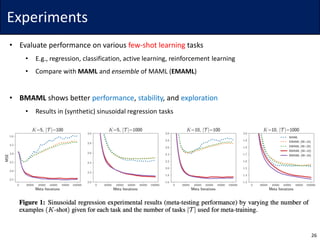
• BMAML shows better performance, stability, and exploration
• Results in (synthetic) sinusoidal regression tasks
26
Experiments
• Evaluate performance on various few-shot learning tasks
• E.g., regression, classification, active learning, reinforcement learning
• Compare with MAML and ensemble of MAML (EMAML)
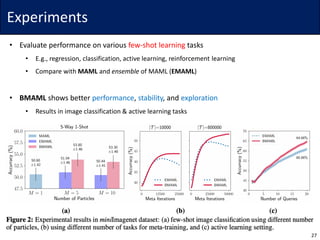
• BMAML shows better performance, stability, and exploration
• Results in image classification & active learning tasks
27
Experiments
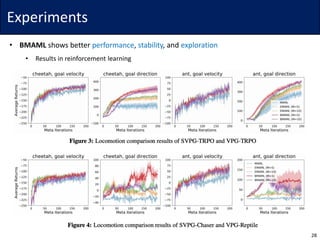
• BMAML shows better performance, stability, and exploration
• Results in reinforcement learning
28
Conclusion
• MAML can be interpreted as an hierarchical Bayesian model
• BMAML propose two ideas
1) Use SVGD for the inner loop of algorithm
2) New meta-update (outer loop) algorithm (chaser loss)
• which shows better performance, stability, and explorations results
29

Bayesian Model-Agnostic Meta-Learning

  • 1.
    Bayesian Model-Agnostic Meta-Learning (NeurIPS2018 spotlight) 2019.01.02. Sangwoo Mo 1
  • 2.
    Introduction • Meta-Learning • Learningis to find a model which works well for the given task 𝑇 • Meta-learning is to learn a “way to learn” a model when some task 𝑇𝑖 ∼ 𝑝(𝑇) is given 2
  • 3.
    Introduction • Meta-Learning • Learningis to find a model which works well for the given task 𝑇 • Meta-learning is to learn a “way to learn” a model when some task 𝑇𝑖 ∼ 𝑝(𝑇) is given • Example) Learning: Train a CNN on ImageNet Meta-learning: Learn a “way to learn” a model (e.g., network architecture, optimizer), when some dataset (e.g., MNIST, CIFAR-10, SVHN) is given 3
  • 4.
    Introduction • Meta-Learning • Learningis to find a model which works well for the given task 𝑇 • Meta-learning is to learn a “way to learn” a model when some task 𝑇𝑖 ∼ 𝑝(𝑇) is given • Model-Agnostic Meta Learning (MAML)1 • Find a good initial point 𝜃, which can be easily adopted to 𝜃𝑖 for the task 𝑇𝑖 41. Finn et al. Model-Agnostic Meta-Learning for Fast Adaptation of Deep Networks. ICML 2017. inner loop outer loop
  • 5.
    Background • Bayesian Interpretationfor MAML2 • MAML can be viewed as an hierarchical Bayesian model with global variable 𝜃 and local variables 𝜙𝑗(= 𝜃𝑗) 52. Grant et al. Recasting Gradient-Based Meta-Learning as Hierarchical Bayes. ICLR 2018.
  • 6.
    Background • Bayesian Interpretationfor MAML2 • MAML can be viewed as an hierarchical Bayesian model with global variable 𝜃 and local variables 𝜙𝑗(= 𝜃𝑗) • To compute marginal likelihood 𝑝 𝑋 𝜃 , one need to compute integral ∫ 𝑝(𝜙𝑗|𝜃) 62. Grant et al. Recasting Gradient-Based Meta-Learning as Hierarchical Bayes. ICLR 2018.
  • 7.
    Background • Bayesian Interpretationfor MAML2 • MAML can be viewed as an hierarchical Bayesian model with global variable 𝜃 and local variables 𝜙𝑗(= 𝜃𝑗) • To compute marginal likelihood 𝑝 𝑋 𝜃 , one need to compute integral ∫ 𝑝(𝜙𝑗|𝜃) • For example, using a point (MAP) estimate ෠𝜙𝑗 (computed by the inner loop) recovers the original MAML objective 72. Grant et al. Recasting Gradient-Based Meta-Learning as Hierarchical Bayes. ICLR 2018.
  • 8.
    Background • Bayesian Interpretationfor MAML2 • MAML can be viewed as an hierarchical Bayesian model with global variable 𝜃 and local variables 𝜙𝑗(= 𝜃𝑗) • To compute marginal likelihood 𝑝 𝑋 𝜃 , one need to compute integral ∫ 𝑝(𝜙𝑗|𝜃) • For example, using a point (MAP) estimate ෠𝜙𝑗 (computed by the inner loop) recovers the original MAML objective • [2] propose to use a Laplace approximation which allows to measure the uncertainty and improves the performance 82. Grant et al. Recasting Gradient-Based Meta-Learning as Hierarchical Bayes. ICLR 2018.
  • 9.
    Background • Bayesian Interpretationfor MAML2 • [2] propose to use a Laplace approximation which allows to measure the uncertainty and improves the performance 92. Grant et al. Recasting Gradient-Based Meta-Learning as Hierarchical Bayes. ICLR 2018.
  • 10.
    Method • Bayesian Model-AgnosticMeta-Learning (BMAML)3 • Can one extend [2] to more complex Bayesian neural network? • Instead of approximating 𝑝(𝜙𝑗|𝜃) with tractable form, simply sampling from • Here, the sampled 𝜙𝑗s should be differentiable 103. Kim et al. Bayesian Model-Agnostic Meta-Learning. NeurIPS 2018.
  • 11.
    Method • Bayesian Model-AgnosticMeta-Learning (BMAML)3 • Can one extend [2] to more complex Bayesian neural network? • Instead of approximating 𝑝(𝜙𝑗|𝜃) with tractable form, simply sampling from • Here, the sampled 𝜙𝑗s should be differentiable • Idea: Use Stein Variational Gradient Descent (SVGD)* 11 3. Kim et al. Bayesian Model-Agnostic Meta-Learning. NeurIPS 2018. * One can use any gradient-based MCMC algorithms (e.g., SGLD or SGHMC), but SVGD is deterministic and adapt faster.
  • 12.
    Recall: Stein VariationalGradient Descent • Stein Variational Gradient Descent (SVGD)4 • Goal: Find an approximated distribution 𝑞∗ (s.t. 𝑞 ∈ 𝒬) of true distribution 𝑝 124. Liu et al. Stein Variational Gradient Descent: A General Purpose Bayesian Inference Algorithm. NeurIPS 2016.
  • 13.
    Recall: Stein VariationalGradient Descent • Stein Variational Gradient Descent (SVGD)4 • Goal: Find an approximated distribution 𝑞∗ (s.t. 𝑞 ∈ 𝒬) of true distribution 𝑝 • Idea: Define 𝑞 by as a kernel density estimation (KDE) of finite particles {𝑥𝑖} • One may need only samples from 𝑞∗ . Then {𝑥𝑖} can be good & diverse samples 134. Liu et al. Stein Variational Gradient Descent: A General Purpose Bayesian Inference Algorithm. NeurIPS 2016.
  • 14.
    Recall: Stein VariationalGradient Descent • Stein Variational Gradient Descent (SVGD)4 • Goal: Find an approximated distribution 𝑞∗ (s.t. 𝑞 ∈ 𝒬) of true distribution 𝑝 • Idea: Define 𝑞 by as a kernel density estimation (KDE) of finite particles {𝑥𝑖} • One may need only samples from 𝑞∗ . Then {𝑥𝑖} can be good & diverse samples • Algorithm: 1) Move particles toward high prob. regions 2) Diversify particles to evade mode collapse 144. Liu et al. Stein Variational Gradient Descent: A General Purpose Bayesian Inference Algorithm. NeurIPS 2016.
  • 15.
    Recall: Stein VariationalGradient Descent • Stein Variational Gradient Descent (SVGD)4 • Goal: Find an approximated distribution 𝑞∗ (s.t. 𝑞 ∈ 𝒬) of true distribution 𝑝 • Idea: Define 𝑞 by as a kernel density estimation (KDE) of finite particles {𝑥𝑖} • One may need only samples from 𝑞∗ . Then {𝑥𝑖} can be good & diverse samples • Algorithm: 1) Move particles toward high prob. regions 2) Diversify particles to evade mode collapse • Cf. It is the steepest gradient direction (of KL div.) in the unit ball of a RKHS (derivate of KL in RKHS = kernelized Stein discrepancy (KSD), hence named SVGD) 154. Liu et al. Stein Variational Gradient Descent: A General Purpose Bayesian Inference Algorithm. NeurIPS 2016.
  • 16.
    Method • Bayesian Model-AgnosticMeta-Learning (BMAML)3 • Can one extend [2] to more complex Bayesian neural network? • Instead of approximating 𝑝(𝜙𝑗|𝜃) with tractable form, simply sampling from • Idea: Use Stein Variational Gradient Descent (SVGD) • Learn a task-specific posterior Θ 𝜏 with SVGD (start from the prior Θ0)* • Meta-update for Θ0 is given by the mean of val. likelihoods of 𝑀 particles • Cf. To reduce complexity, all particles share parameters all but the last linear layer 16 3. Kim et al. Bayesian Model-Agnostic Meta-Learning. NeurIPS 2018. * Both Θ0 and Θ 𝜏 are given by 𝑀 particles.
  • 17.
    Method • Bayesian Model-AgnosticMeta-Learning (BMAML)3 • Can one extend [2] to more complex Bayesian neural network? • Idea 1: Use Stein Variational Gradient Descent (SVGD) • Learn a task-specific posterior Θ 𝜏 with SVGD (start from the prior Θ0) • Meta-update for Θ0 is given by the mean of val. likelihoods of 𝑀 particles • However, this meta-update it not Bayesian inference • Same as MAML, minimizes empirical loss on task-validation sets (but ensembled) • It is numerically unstable (task-validation likelihoods) and easily overfitted 173. Kim et al. Bayesian Model-Agnostic Meta-Learning. NeurIPS 2018.
  • 18.
    Method • Bayesian Model-AgnosticMeta-Learning (BMAML)3 • Can one extend [2] to more complex Bayesian neural network? • Idea 1: Use Stein Variational Gradient Descent (SVGD) • Learn a task-specific posterior Θ 𝜏 with SVGD (start from the prior Θ0) • Meta-update for Θ0 is given by the mean of val. likelihoods of 𝑀 particles • However, this meta-update it not Bayesian inference • Same as MAML, minimizes empirical loss on task-validation sets (but ensembled) • It is numerically unstable (task-validation likelihoods) and easily overfitted • Instead, [3] propose a new meta-update algorithm in Bayesian scheme 183. Kim et al. Bayesian Model-Agnostic Meta-Learning. NeurIPS 2018.
  • 19.
    Method • Bayesian Model-AgnosticMeta-Learning (BMAML)3 • Can one extend [2] to more complex Bayesian neural network? • Idea 1: Use Stein Variational Gradient Descent (SVGD) • Idea 2: New meta-update algorithm (coined chaser loss) for Bayesian setting • Directly minimize the distance between task-train posterior 𝑝𝜏 𝑛 and true posterior 𝑝𝜏 ∞ 193. Kim et al. Bayesian Model-Agnostic Meta-Learning. NeurIPS 2018.
  • 20.
    Method • Bayesian Model-AgnosticMeta-Learning (BMAML)3 • Can one extend [2] to more complex Bayesian neural network? • Idea 1: Use Stein Variational Gradient Descent (SVGD) • Idea 2: New meta-update algorithm (coined chaser loss) for Bayesian setting • Directly minimize the distance between task-train posterior 𝑝𝜏 𝑛 and true posterior 𝑝𝜏 ∞ • However, the problem is that one does not know the true posterior 𝑝𝜏 ∞ 203. Kim et al. Bayesian Model-Agnostic Meta-Learning. NeurIPS 2018.
  • 21.
    Method • Bayesian Model-AgnosticMeta-Learning (BMAML)3 • Can one extend [2] to more complex Bayesian neural network? • Idea 1: Use Stein Variational Gradient Descent (SVGD) • Idea 2: New meta-update algorithm (coined chaser loss) for Bayesian setting • Directly minimize the distance between task-train posterior 𝑝𝜏 𝑛 and true posterior 𝑝𝜏 ∞ • However, the problem is that one does not know the true posterior 𝑝𝜏 ∞ • Hence, [3] approximates 𝑝𝜏 ∞ with 𝑝𝜏 𝑛+𝑠 , updated by both task-train & task-validation data • Here, 𝑝𝜏 𝑛+𝑠 (both train & val) is the leader, and 𝑝𝜏 𝑛 (train only) is the chaser 213. Kim et al. Bayesian Model-Agnostic Meta-Learning. NeurIPS 2018.
  • 22.
    Method • Bayesian Model-AgnosticMeta-Learning (BMAML)3 • Can one extend [2] to more complex Bayesian neural network? • Idea 1: Use Stein Variational Gradient Descent (SVGD) • Idea 2: New meta-update algorithm (coined chaser loss) for Bayesian setting • Directly minimize the distance between task-train posterior 𝑝𝜏 𝑛 and true posterior 𝑝𝜏 ∞ • [3] approximates 𝑝𝜏 ∞ with 𝑝𝜏 𝑛+𝑠 , updated by both task-train & task-validation data • Q. How to compute the distance between 𝑝𝜏 𝑛+𝑠 and 𝑝𝜏 𝑛 ? 223. Kim et al. Bayesian Model-Agnostic Meta-Learning. NeurIPS 2018.
  • 23.
    Method • Bayesian Model-AgnosticMeta-Learning (BMAML)3 • Can one extend [2] to more complex Bayesian neural network? • Idea 1: Use Stein Variational Gradient Descent (SVGD) • Idea 2: New meta-update algorithm (coined chaser loss) for Bayesian setting • Directly minimize the distance between task-train posterior 𝑝𝜏 𝑛 and true posterior 𝑝𝜏 ∞ • [3] approximates 𝑝𝜏 ∞ with 𝑝𝜏 𝑛+𝑠 , updated by both task-train & task-validation data • Q. How to compute the distance between 𝑝𝜏 𝑛+𝑠 and 𝑝𝜏 𝑛 ? • Since both posteriors are given by finite particles, one can simply find a one-to-one mapping, and minimize the pairwise 𝑙2 distance 233. Kim et al. Bayesian Model-Agnostic Meta-Learning. NeurIPS 2018.
  • 24.
    Method • Bayesian Model-AgnosticMeta-Learning (BMAML)3 • Can one extend [2] to more complex Bayesian neural network? • Idea 1: Use Stein Variational Gradient Descent (SVGD) • Idea 2: New meta-update algorithm (coined chaser loss) for Bayesian setting • [3] approximates 𝑝𝜏 ∞ with 𝑝𝜏 𝑛+𝑠 , updated by both task-train & task-validation data • For posterior distance, simply minimize the pairwise 𝑙2 distance 243. Kim et al. Bayesian Model-Agnostic Meta-Learning. NeurIPS 2018.
  • 25.
    Experiments • Evaluate performanceon various few-shot learning tasks • E.g., regression, classification, active learning, reinforcement learning • Compare with MAML and ensemble of MAML (EMAML) 25
  • 26.
    Experiments • Evaluate performanceon various few-shot learning tasks • E.g., regression, classification, active learning, reinforcement learning • Compare with MAML and ensemble of MAML (EMAML) • BMAML shows better performance, stability, and exploration • Results in (synthetic) sinusoidal regression tasks 26
  • 27.
    Experiments • Evaluate performanceon various few-shot learning tasks • E.g., regression, classification, active learning, reinforcement learning • Compare with MAML and ensemble of MAML (EMAML) • BMAML shows better performance, stability, and exploration • Results in image classification & active learning tasks 27
  • 28.
    Experiments • BMAML showsbetter performance, stability, and exploration • Results in reinforcement learning 28
  • 29.
    Conclusion • MAML canbe interpreted as an hierarchical Bayesian model • BMAML propose two ideas 1) Use SVGD for the inner loop of algorithm 2) New meta-update (outer loop) algorithm (chaser loss) • which shows better performance, stability, and explorations results 29