2023.02.22.
Sangwoo Mo
1
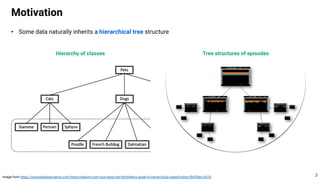
• Some data naturally inherits a hierarchical tree structure
Motivation
2
Image from https://towardsdatascience.com/https-medium-com-noa-weiss-the-hitchhikers-guide-to-hierarchical-classification-f8428ea1e076
Hierarchy of classes Tree structures of episodes
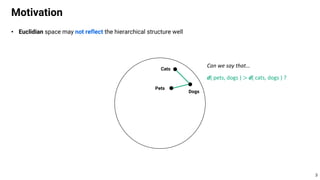
• Euclidian space may not reflect the hierarchical structure well
Motivation
3
Pets
Cats
Dogs
Can we say that…
d( pets, dogs ) > d( cats, dogs ) ?
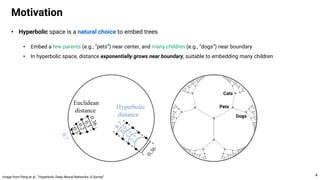
• Hyperbolic space is a natural choice to embed trees
• Embed a few parents (e.g., “pets”) near center, and many children (e.g., “dogs”) near boundary
• In hyperbolic space, distance exponentially grows near boundary, suitable to embedding many children
Motivation
4
Image from Peng et al., “Hyperbolic Deep Neural Networks: A Survey”
Pets
Dogs
Cats
• Why I choose this paper?
• Interpreting a sequence (e.g., episode, video) as a tree is an interesting and useful idea
• It is the first paper to make hyperbolic embedding to work in RL
• Contributions
• The concept of hyperbolic space is appealing… but was not successful in practice
• It is mostly due to an optimization issue, and a simple regularization trick makes it work well
• Trick. Reduce the gradient norm of NN
(apply spectral normalization (SN) and then rescaling outputs)
TL;DR
5
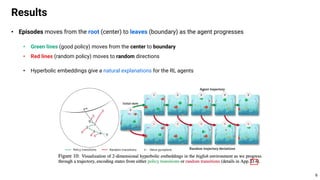
• Episodes moves from the root (center) to leaves (boundary) as the agent progresses
• Green lines (good policy) moves from the center to boundary
• Red lines (random policy) moves to random directions
• Hyperbolic embeddings give a natural explanations for the RL agents
Results
6
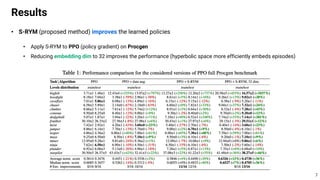
• S-RYM (proposed method) improves the learned policies
• Apply S-RYM to PPO (policy gradient) on Procgen
• Reducing embedding dim to 32 improves the performance (hyperbolic space more efficiently embeds episodes)
Results
7
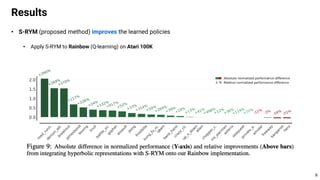
• S-RYM (proposed method) improves the learned policies
• Apply S-RYM to Rainbow (Q-learning) on Atari 100K
Results
8
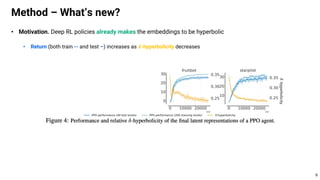
• Motivation. Deep RL policies already makes the embeddings to be hyperbolic
• Return (both train -- and test –) increases as 𝜹-hyperbolicity decreases
Method – What’s new?
9
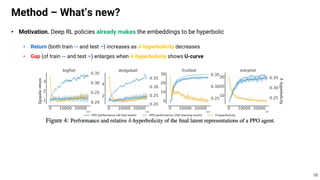
• Motivation. Deep RL policies already makes the embeddings to be hyperbolic
• Return (both train -- and test –) increases as 𝜹-hyperbolicity decreases
• Gap (of train -- and test –) enlarges when 𝜹-hyperbolicity shows U-curve
Method – What’s new?
10
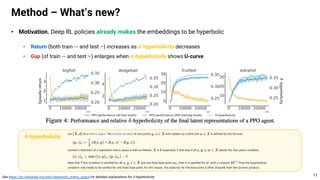
• Motivation. Deep RL policies already makes the embeddings to be hyperbolic
• Return (both train -- and test –) increases as 𝜹-hyperbolicity decreases
• Gap (of train -- and test –) enlarges when 𝜹-hyperbolicity shows U-curve
Method – What’s new?
11
𝜹-hyperbolicity
See https://en.wikipedia.org/wiki/Hyperbolic_metric_space for detailed explanations for 𝛿-hyperbolicity
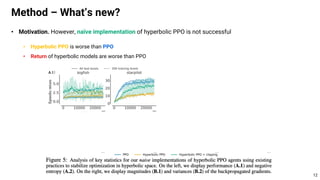
• Motivation. However, naïve implementation of hyperbolic PPO is not successful
• Hyperbolic PPO is worse than PPO
• Return of hyperbolic models are worse than PPO
Method – What’s new?
12
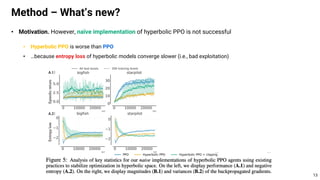
• Motivation. However, naïve implementation of hyperbolic PPO is not successful
• Hyperbolic PPO is worse than PPO
• …because entropy loss of hyperbolic models converge slower (i.e., bad exploitation)
Method – What’s new?
13
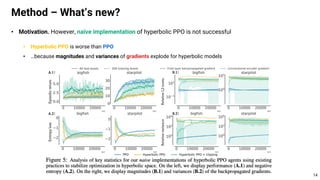
• Motivation. However, naïve implementation of hyperbolic PPO is not successful
• Hyperbolic PPO is worse than PPO
• …because magnitudes and variances of gradients explode for hyperbolic models
Method – What’s new?
14
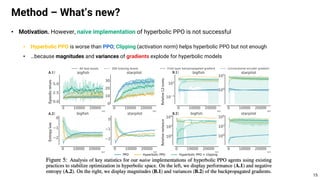
• Motivation. However, naïve implementation of hyperbolic PPO is not successful
• Hyperbolic PPO is worse than PPO; Clipping (activation norm) helps hyperbolic PPO but not enough
• …because magnitudes and variances of gradients explode for hyperbolic models
Method – What’s new?
15
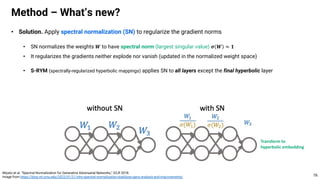
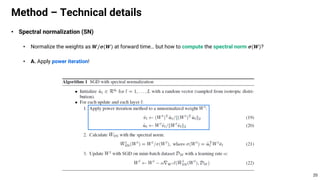
• Solution. Apply spectral normalization (SN) to regularize the gradient norms
• SN normalizes the weights 𝑾 to have spectral norm (largest singular value) 𝝈 𝑾 ≈ 𝟏
• It regularizes the gradients neither explode nor vanish (updated in the normalized weight space)
• S-RYM (spectrally-regularized hyperbolic mappings) applies SN to all layers except the final hyperbolic layer
Method – What’s new?
16
Miyato et al. “Spectral Normalization for Generative Adversarial Networks,” ICLR 2018.
Image from https://blog.ml.cmu.edu/2022/01/21/why-spectral-normalization-stabilizes-gans-analysis-and-improvements/
Transform to
hyperbolic embedding
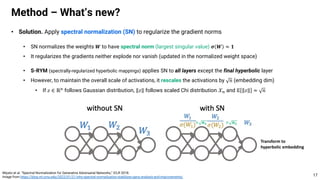
• Solution. Apply spectral normalization (SN) to regularize the gradient norms
• SN normalizes the weights 𝑾 to have spectral norm (largest singular value) 𝝈 𝑾 ≈ 𝟏
• It regularizes the gradients neither explode nor vanish (updated in the normalized weight space)
• S-RYM (spectrally-regularized hyperbolic mappings) applies SN to all layers except the final hyperbolic layer
• However, to maintain the overall scale of activations, it rescales the activations by 𝑛 (embedding dim)
• If 𝑧 ∈ ℝ! follows Gaussian distribution, 𝑧 follows scaled Chi distribution 𝒳! and 𝔼 𝑧 ≈ 𝑛
Method – What’s new?
17
Miyato et al. “Spectral Normalization for Generative Adversarial Networks,” ICLR 2018.
Image from https://blog.ml.cmu.edu/2022/01/21/why-spectral-normalization-stabilizes-gans-analysis-and-improvements/
× 𝒏𝟏 × 𝒏𝟐
Transform to
hyperbolic embedding
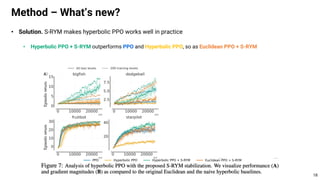
• Solution. S-RYM makes hyperbolic PPO works well in practice
• Hyperbolic PPO + S-RYM outperforms PPO and Hyperbolic PPO, so as Euclidean PPO + S-RYM
Method – What’s new?
18
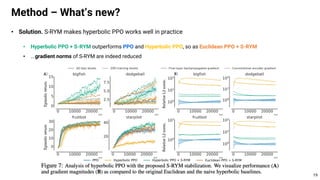
• Solution. S-RYM makes hyperbolic PPO works well in practice
• Hyperbolic PPO + S-RYM outperforms PPO and Hyperbolic PPO, so as Euclidean PPO + S-RYM
• ...gradient norms of S-RYM are indeed reduced
Method – What’s new?
19
• Spectral normalization (SN)
• Normalize the weights as 𝑾/𝝈(𝑾) at forward time… but how to compute the spectral norm 𝝈(𝑾)?
• A. Apply power iteration!
Method – Technical details
20
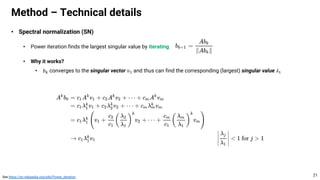
• Spectral normalization (SN)
• Power iteration finds the largest singular value by iterating
• Why it works?
• 𝑏" converges to the singular vector 𝑣# and thus can find the corresponding (largest) singular value 𝜆#
Method – Technical details
21
See https://en.wikipedia.org/wiki/Power_iteration
• Hyperbolic embedding
• Recent hyperbolic models follow the standard Euclidean embeddings for all layers
except converting the final embedding 𝐱$ = 𝑓$(𝐱) to the hyperbolic embedding 𝐱%
Method – Technical details
22
• Hyperbolic embedding
• Recent hyperbolic models follow the standard Euclidean embeddings for all layers
except converting the final embedding 𝐱$ = 𝑓$(𝐱) to the hyperbolic embedding 𝐱%
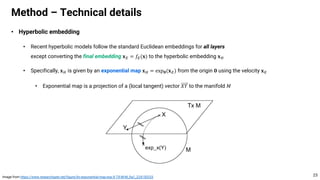
• Specifically, 𝐱% is given by an exponential map 𝐱% = exp𝟎(𝐱$) from the origin 𝟎 using the velocity 𝐱$
• Exponential map is a projection of a (local tangent) vector 𝑋𝑌 to the manifold 𝑀
Method – Technical details
23
Image from https://www.researchgate.net/figure/An-exponential-map-exp-X-TX-M-M_fig1_224150233
• Hyperbolic embedding
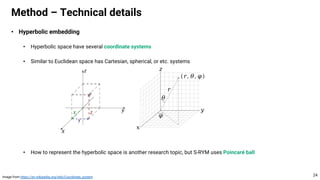
• Hyperbolic space have several coordinate systems
• Similar to Euclidean space has Cartesian, spherical, or etc. systems
• How to represent the hyperbolic space is another research topic, but S-RYM uses Poincaré ball
Method – Technical details
24
Image from https://en.wikipedia.org/wiki/Coordinate_system
• Hyperbolic embedding
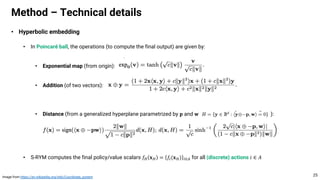
• In Poincaré ball, the operations (to compute the final output) are given by:
• Exponential map (from origin):
• Addition (of two vectors):
• Distance (from a generalized hyperplane parametrized by 𝐩 and 𝐰 ):
• S-RYM computes the final policy/value scalars 𝑓% 𝐱% = 𝑓'(𝐱%) '∈) for all (discrete) actions 𝑖 ∈ 𝐴
Method – Technical details
25
Image from https://en.wikipedia.org/wiki/Coordinate_system
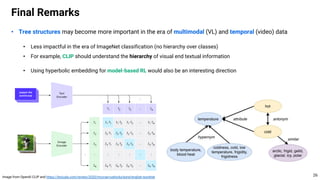
• Tree structures may become more important in the era of multimodal (VL) and temporal (video) data
• Less impactful in the era of ImageNet classification (no hierarchy over classes)
• For example, CLIP should understand the hierarchy of visual end textual information
• Using hyperbolic embedding for model-based RL would also be an interesting direction
Final Remarks
26
Image from OpenAI CLIP and https://lexicala.com/review/2020/mccrae-rudnicka-bond-english-wordnet
Thank you for listening! 😀
27

Hyperbolic Deep Reinforcement Learning

  • 1.
  • 2.
    • Some datanaturally inherits a hierarchical tree structure Motivation 2 Image from https://towardsdatascience.com/https-medium-com-noa-weiss-the-hitchhikers-guide-to-hierarchical-classification-f8428ea1e076 Hierarchy of classes Tree structures of episodes
  • 3.
    • Euclidian spacemay not reflect the hierarchical structure well Motivation 3 Pets Cats Dogs Can we say that… d( pets, dogs ) > d( cats, dogs ) ?
  • 4.
    • Hyperbolic spaceis a natural choice to embed trees • Embed a few parents (e.g., “pets”) near center, and many children (e.g., “dogs”) near boundary • In hyperbolic space, distance exponentially grows near boundary, suitable to embedding many children Motivation 4 Image from Peng et al., “Hyperbolic Deep Neural Networks: A Survey” Pets Dogs Cats
  • 5.
    • Why Ichoose this paper? • Interpreting a sequence (e.g., episode, video) as a tree is an interesting and useful idea • It is the first paper to make hyperbolic embedding to work in RL • Contributions • The concept of hyperbolic space is appealing… but was not successful in practice • It is mostly due to an optimization issue, and a simple regularization trick makes it work well • Trick. Reduce the gradient norm of NN (apply spectral normalization (SN) and then rescaling outputs) TL;DR 5
  • 6.
    • Episodes movesfrom the root (center) to leaves (boundary) as the agent progresses • Green lines (good policy) moves from the center to boundary • Red lines (random policy) moves to random directions • Hyperbolic embeddings give a natural explanations for the RL agents Results 6
  • 7.
    • S-RYM (proposedmethod) improves the learned policies • Apply S-RYM to PPO (policy gradient) on Procgen • Reducing embedding dim to 32 improves the performance (hyperbolic space more efficiently embeds episodes) Results 7
  • 8.
    • S-RYM (proposedmethod) improves the learned policies • Apply S-RYM to Rainbow (Q-learning) on Atari 100K Results 8
  • 9.
    • Motivation. DeepRL policies already makes the embeddings to be hyperbolic • Return (both train -- and test –) increases as 𝜹-hyperbolicity decreases Method – What’s new? 9
  • 10.
    • Motivation. DeepRL policies already makes the embeddings to be hyperbolic • Return (both train -- and test –) increases as 𝜹-hyperbolicity decreases • Gap (of train -- and test –) enlarges when 𝜹-hyperbolicity shows U-curve Method – What’s new? 10
  • 11.
    • Motivation. DeepRL policies already makes the embeddings to be hyperbolic • Return (both train -- and test –) increases as 𝜹-hyperbolicity decreases • Gap (of train -- and test –) enlarges when 𝜹-hyperbolicity shows U-curve Method – What’s new? 11 𝜹-hyperbolicity See https://en.wikipedia.org/wiki/Hyperbolic_metric_space for detailed explanations for 𝛿-hyperbolicity
  • 12.
    • Motivation. However,naïve implementation of hyperbolic PPO is not successful • Hyperbolic PPO is worse than PPO • Return of hyperbolic models are worse than PPO Method – What’s new? 12
  • 13.
    • Motivation. However,naïve implementation of hyperbolic PPO is not successful • Hyperbolic PPO is worse than PPO • …because entropy loss of hyperbolic models converge slower (i.e., bad exploitation) Method – What’s new? 13
  • 14.
    • Motivation. However,naïve implementation of hyperbolic PPO is not successful • Hyperbolic PPO is worse than PPO • …because magnitudes and variances of gradients explode for hyperbolic models Method – What’s new? 14
  • 15.
    • Motivation. However,naïve implementation of hyperbolic PPO is not successful • Hyperbolic PPO is worse than PPO; Clipping (activation norm) helps hyperbolic PPO but not enough • …because magnitudes and variances of gradients explode for hyperbolic models Method – What’s new? 15
  • 16.
    • Solution. Applyspectral normalization (SN) to regularize the gradient norms • SN normalizes the weights 𝑾 to have spectral norm (largest singular value) 𝝈 𝑾 ≈ 𝟏 • It regularizes the gradients neither explode nor vanish (updated in the normalized weight space) • S-RYM (spectrally-regularized hyperbolic mappings) applies SN to all layers except the final hyperbolic layer Method – What’s new? 16 Miyato et al. “Spectral Normalization for Generative Adversarial Networks,” ICLR 2018. Image from https://blog.ml.cmu.edu/2022/01/21/why-spectral-normalization-stabilizes-gans-analysis-and-improvements/ Transform to hyperbolic embedding
  • 17.
    • Solution. Applyspectral normalization (SN) to regularize the gradient norms • SN normalizes the weights 𝑾 to have spectral norm (largest singular value) 𝝈 𝑾 ≈ 𝟏 • It regularizes the gradients neither explode nor vanish (updated in the normalized weight space) • S-RYM (spectrally-regularized hyperbolic mappings) applies SN to all layers except the final hyperbolic layer • However, to maintain the overall scale of activations, it rescales the activations by 𝑛 (embedding dim) • If 𝑧 ∈ ℝ! follows Gaussian distribution, 𝑧 follows scaled Chi distribution 𝒳! and 𝔼 𝑧 ≈ 𝑛 Method – What’s new? 17 Miyato et al. “Spectral Normalization for Generative Adversarial Networks,” ICLR 2018. Image from https://blog.ml.cmu.edu/2022/01/21/why-spectral-normalization-stabilizes-gans-analysis-and-improvements/ × 𝒏𝟏 × 𝒏𝟐 Transform to hyperbolic embedding
  • 18.
    • Solution. S-RYMmakes hyperbolic PPO works well in practice • Hyperbolic PPO + S-RYM outperforms PPO and Hyperbolic PPO, so as Euclidean PPO + S-RYM Method – What’s new? 18
  • 19.
    • Solution. S-RYMmakes hyperbolic PPO works well in practice • Hyperbolic PPO + S-RYM outperforms PPO and Hyperbolic PPO, so as Euclidean PPO + S-RYM • ...gradient norms of S-RYM are indeed reduced Method – What’s new? 19
  • 20.
    • Spectral normalization(SN) • Normalize the weights as 𝑾/𝝈(𝑾) at forward time… but how to compute the spectral norm 𝝈(𝑾)? • A. Apply power iteration! Method – Technical details 20
  • 21.
    • Spectral normalization(SN) • Power iteration finds the largest singular value by iterating • Why it works? • 𝑏" converges to the singular vector 𝑣# and thus can find the corresponding (largest) singular value 𝜆# Method – Technical details 21 See https://en.wikipedia.org/wiki/Power_iteration
  • 22.
    • Hyperbolic embedding •Recent hyperbolic models follow the standard Euclidean embeddings for all layers except converting the final embedding 𝐱$ = 𝑓$(𝐱) to the hyperbolic embedding 𝐱% Method – Technical details 22
  • 23.
    • Hyperbolic embedding •Recent hyperbolic models follow the standard Euclidean embeddings for all layers except converting the final embedding 𝐱$ = 𝑓$(𝐱) to the hyperbolic embedding 𝐱% • Specifically, 𝐱% is given by an exponential map 𝐱% = exp𝟎(𝐱$) from the origin 𝟎 using the velocity 𝐱$ • Exponential map is a projection of a (local tangent) vector 𝑋𝑌 to the manifold 𝑀 Method – Technical details 23 Image from https://www.researchgate.net/figure/An-exponential-map-exp-X-TX-M-M_fig1_224150233
  • 24.
    • Hyperbolic embedding •Hyperbolic space have several coordinate systems • Similar to Euclidean space has Cartesian, spherical, or etc. systems • How to represent the hyperbolic space is another research topic, but S-RYM uses Poincaré ball Method – Technical details 24 Image from https://en.wikipedia.org/wiki/Coordinate_system
  • 25.
    • Hyperbolic embedding •In Poincaré ball, the operations (to compute the final output) are given by: • Exponential map (from origin): • Addition (of two vectors): • Distance (from a generalized hyperplane parametrized by 𝐩 and 𝐰 ): • S-RYM computes the final policy/value scalars 𝑓% 𝐱% = 𝑓'(𝐱%) '∈) for all (discrete) actions 𝑖 ∈ 𝐴 Method – Technical details 25 Image from https://en.wikipedia.org/wiki/Coordinate_system
  • 26.
    • Tree structuresmay become more important in the era of multimodal (VL) and temporal (video) data • Less impactful in the era of ImageNet classification (no hierarchy over classes) • For example, CLIP should understand the hierarchy of visual end textual information • Using hyperbolic embedding for model-based RL would also be an interesting direction Final Remarks 26 Image from OpenAI CLIP and https://lexicala.com/review/2020/mccrae-rudnicka-bond-english-wordnet
  • 27.
    Thank you forlistening! 😀 27