IS ANYONE INTEREST IN AUTO-ENCODING
VARIATIONAL-BAYES ?
INSTEAD OF “VAE”
1. TBD
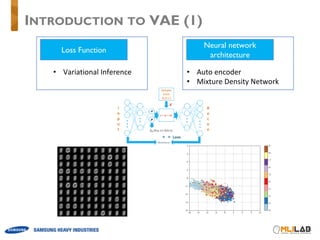
INTRODUCTION TO VAE (1)
Loss Function
Neural network
architecture
• Variational Inference • Auto	encoder
• Mixture	Density	Network
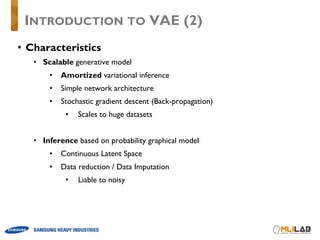
• Characteristics
• Scalable generative model
• Amortized variational inference
• Simple network architecture
• Stochastic gradient descent (Back-propagation)
• Scales to huge datasets
• Inference based on probability graphical model
• Continuous Latent Space
• Data reduction / Data Imputation
• Liable to noisy
INTRODUCTION TO VAE (2)
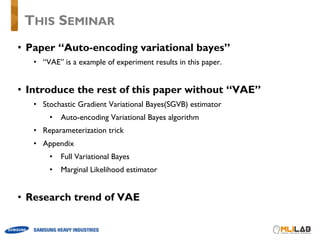
• Paper “Auto-encoding variational bayes”
• “VAE” is a example of experiment results in this paper.
• Introduce the rest of this paper without “VAE”
• Stochastic Gradient Variational Bayes(SGVB) estimator
• Auto-encoding Variational Bayes algorithm
• Reparameterization trick
• Appendix
• Full Variational Bayes
• Marginal Likelihood estimator
• Research trend of VAE
THIS SEMINAR
PRELIMINARY
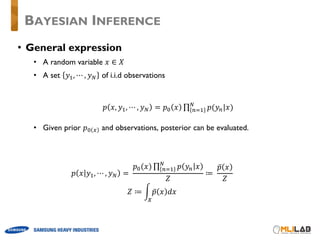
• General expression
• A random variable 𝑥 ∈ 𝑋
• A set 𝑦%, ⋯ , 𝑦( of i.i.d observations
𝑝 𝑥, 𝑦%, ⋯ , 𝑦( = 𝑝+ 𝑥 ∏ 𝑝(𝑦.|𝑥)(
.1%
• Given prior 𝑝+ 2 and observations, posterior can be evaluated.
𝑝 𝑥 𝑦%, ⋯ , 𝑦( =	
𝑝+(𝑥) ∏ 𝑝 𝑦. 𝑥(
.1%
𝑍
≔	
𝑝̅ 𝑥
𝑍
𝑍 ≔ 7 𝑝̅ 𝑥 𝑑𝑥
:
BAYESIAN INFERENCE
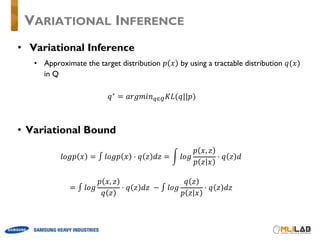
• Variational Inference
• Approximate the target distribution 𝑝 𝑥 by using a tractable distribution 𝑞(𝑥)
in Q
𝑞∗
= 𝑎𝑟𝑔𝑚𝑖𝑛C∈D 𝐾𝐿(𝑞||𝑝)
• Variational Bound
𝑙𝑜𝑔𝑝 𝑥 = ∫ 𝑙𝑜𝑔𝑝 𝑥 ⋅ 𝑞 𝑧 𝑑𝑧 = 7 𝑙𝑜𝑔
𝑝 𝑥, 𝑧
𝑝 𝑧 𝑥
⋅ 𝑞 𝑧 𝑑
= ∫ 𝑙𝑜𝑔
𝑝 𝑥, 𝑧
𝑞 𝑧
⋅ 𝑞 𝑧 𝑑𝑧	 − ∫ 𝑙𝑜𝑔
𝑞 𝑧
𝑝 𝑧 𝑥
⋅ 𝑞 𝑧 𝑑𝑧
VARIATIONAL INFERENCE
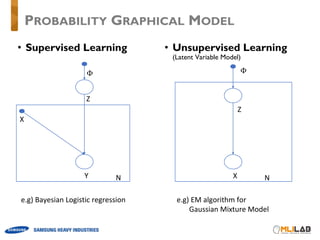
• Supervised Learning
PROBABILITY GRAPHICAL MODEL
• Unsupervised Learning
(Latent Variable Model)
NX
Z
Φ
NY
Z
Φ
X
e.g)	Bayesian	Logistic	regression e.g)	EM	algorithm	for	
Gaussian	Mixture	Model
• Supervised learning
e.g) Bayesian logistic regression
𝑝 𝑥 𝑤, 𝑦 ⋅ 𝑝 𝑤 ∝ 𝑝 𝑤, 𝑥 𝑦
𝑝 𝑥 𝑤, 𝑦 ∶ ∏ 𝜎 𝑤R
𝑥 ST ⋅ (1 − 𝜎 𝑤R
𝑥 %VST).
W1% à Approximate	Gaussian	Dist.	
• Latent Variable Model
e.g) Gaussian Mixture Model (EM algorithm)
à tractable conditional pdf : 𝑝(𝑧|𝑥)
	𝑞 𝑧 ≈ 𝑝 𝑧 𝑥, 𝜃Z[
𝜃∗
= 𝑎𝑟𝑔𝑚𝑎𝑥] 	^ 𝑝 𝑧 𝑥, 𝜃Z[
⋅ 𝑙𝑛𝑝(𝑥, 𝑧|𝜃)
_
PROBABILITY GRAPHICAL MODEL
• Mean field assumption
• If 𝑝(𝑧|𝑥) is intractable ?
𝑞 𝒛 = a 𝑞W(𝑧W)
W
𝑙𝑛𝑞b
∗
𝑧b = 𝐸Wdb 𝑙𝑛𝑝 𝒙, 𝒛 + 𝑐𝑜𝑛𝑠𝑡
𝑞b
∗
𝑧b =	
exp	( 𝐸Wdb[𝑙𝑛𝑝 𝒙, 𝒛 ]
∫ exp	( 𝐸Wdb 𝑙𝑛𝑝 𝒙, 𝒛 𝑑𝑧
• Under specific probabilistic graphical model, approximate distribution can be evaluated by
expectation of 𝐸Wdb[𝑙𝑛𝑝 𝒙, 𝒛 ]
• Depending on each problem, we have to derive the form of 𝐸Wdb[𝑙𝑛𝑝 𝒙, 𝒛 ]
• Through sequential optimization, All of 𝑞b(𝑧b) can be updated in order until converged.
TRADITIONAL VARIATIONAL INFERENCE
• VI with Stochastic gradient descent
𝐿 = ∫ 𝑙𝑜𝑔
𝑝 𝑥, 𝑧
𝑞o 𝑧
⋅ 𝑞o 𝑧 𝑑𝑧
𝛻o 𝐿 = ∫ 𝑙𝑛𝑝 𝑥, 𝑧 ⋅ 𝛻o 𝑙𝑛𝑞 𝑧 ⋅ 𝑞 𝑧 𝑑𝑧 = 𝐸2∼C[𝑙𝑛𝑝 𝑥, 𝑧 ⋅ 𝛻o 𝑙𝑛𝑞 𝑧 ]
𝛻o 𝐿 = 𝐸2∼C 𝑙𝑛𝑝 𝑥, 𝑧 ⋅ 𝛻o 𝑙𝑛𝑞 𝑧 ≈
1
𝑛
^ 𝑙𝑛𝑝 𝑥W, 𝑧	
W
⋅ 𝛻o 𝑙𝑛𝑞 𝑧
• In order to avoid exact derivation of expectation and sequential optimization, stochastic
gradient descent method was introduced.
• This method only requires 𝑙𝑜𝑔𝑝 𝑥, 𝑧 , 𝑞o 𝑧 and its derivative
• All components can be easily handed
• 𝑙𝑜𝑔𝑝 𝑥, 𝑧 can be derived from probabilistic graphical model
• 𝑞o 𝑧 and 𝛻o 𝑞o 𝑧 are decided by users.
• However, since this estimator has a huge variance, it also requires many samples.
TRADITIONAL VARIATIONAL INFERENCE (2)
• Mixture density network
• 𝑝 𝑥 𝑤, 𝑦 ⋅ 𝑝 𝑤 ∝ 𝑝 𝑤, 𝑥 𝑦
𝐸 𝑤 = − ^ ln	{ ^ 𝜋v 𝑥., 𝑤 𝑁(𝑡.|𝑢v 𝑥., 𝑤 , 𝜎v
y
𝑥., 𝑤 )}	
{
v1%
(
.1%
Mixture density network presents that artificial neural network trains hyper-parameters for
learning parameters of distributions
NETWORK FOR LEARNING PARAMETERS
[	Structure	of	Mixture	density	Network	] [	Data	point	and	result	by	Mixture	Density	Network]
• Variational Inference
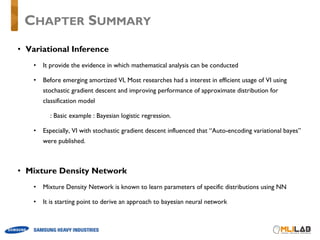
• It provide the evidence in which mathematical analysis can be conducted
• Before emerging amortized VI, Most researches had a interest in efficient usage of VI using
stochastic gradient descent and improving performance of approximate distribution for
classification model
: Basic example : Bayesian logistic regression.
• Especially, VI with stochastic gradient descent influenced that “Auto-encoding variational bayes”
were published.
• Mixture Density Network
• Mixture Density Network is known to learn parameters of specific distributions using NN
• It is starting point to derive an approach to bayesian neural network
CHAPTER SUMMARY
AUTO-ENCODING VARIATIONAL BAYES
• Amortized generative model
• 𝜙 : hyper-parameters in recognition network
• 	𝜃 : hyper-parameters in generative network
PROBABILISTIC GRAPHICAL MODEL
NX
Z
𝜙 𝜃
p
𝜇 𝜎
NX
Z
𝜃
𝜙
Generative	model
Variational
approximation
[	AEVB	algorithm	] [	VAE	]
• Traditional Latent variable model
• Intractable : 𝑝(𝑧|𝑥)
• A large data set : Sampling based EM algorithm à Too slow
• This paper has interested in
• Using stochastic gradient descent
• Efficient approximate posterior inference of latent variable 𝑧
• This paper introduce (The reason why this method referred ”Variational”)
• 𝑞o 𝑧 𝑥 : recognition model / approximate posterior distribution to 𝑝] 𝑧 𝑥
• Figure out parameters of approximate distribution
• 𝑝] 𝑥 𝑧 : generative model (defined as graphical model)
• Learning the recognition model parameter 𝜙	with generative model parameter 𝜃
using reparameterization trick
PROBLEMS SCENARIO
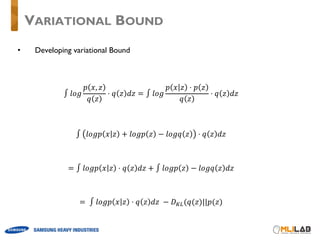
• Developing variational Bound
∫ 𝑙𝑜𝑔
𝑝 𝑥, 𝑧
𝑞 𝑧
⋅ 𝑞 𝑧 𝑑𝑧 = ∫ 𝑙𝑜𝑔
𝑝 𝑥 𝑧 ⋅ 𝑝 𝑧
𝑞 𝑧
⋅ 𝑞 𝑧 𝑑𝑧
∫ 𝑙𝑜𝑔𝑝 𝑥 𝑧 + 𝑙𝑜𝑔𝑝 𝑧 − 𝑙𝑜𝑔𝑞 𝑧 ⋅ 𝑞 𝑧 𝑑𝑧
= ∫ 𝑙𝑜𝑔𝑝 𝑥 𝑧 ⋅ 𝑞 𝑧 𝑑𝑧 + ∫ 𝑙𝑜𝑔𝑝 𝑧 − 𝑙𝑜𝑔𝑞 𝑧 𝑑𝑧
=	∫ 𝑙𝑜𝑔𝑝 𝑥 𝑧 ⋅ 𝑞 𝑧 𝑑𝑧	 − 𝐷{•(𝑞(𝑧)||𝑝(𝑧)
VARIATIONAL BOUND
• Reparametrization Trick
• Random variable z à Function of variables (Deterministic)
• Capable of using neural network
• 𝑧	~	𝑞 𝑧 𝑥 à 𝑧̅ = 𝑔o(𝑥, ϵ), 𝜖	~	𝑝 𝜖
• Assume that 𝑝 𝜖 is defined (𝑝 𝜖 ~	𝑁(0,1))
• The function 𝑔] is determined depending on 𝑞 𝑧 𝑥
(In subsequent chapter, the forms of function 𝑔] is represented)
• Form of function 𝑔]
• Tractable inverse CDF : similar to finding PDF
• 𝐹 𝑥 = 𝑝, 𝐹V%
𝑝 = 𝑥	 𝑢𝑛𝑖𝑞𝑢𝑒	𝑥 / 𝑔o 𝜖, 𝑥 = Fo
V%
𝜖; 𝑥 = 𝑍̅
• Location Scale Model :
• 𝑔o 𝜖, 𝑥 = location + scale ⋅ 𝜖
STOCHASTIC GRADIENT VARIATIONAL BAYES
ESTIMATOR (1)
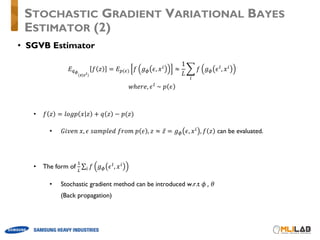
• SGVB Estimator
𝐸Cˆ
(‰|ŠT)
𝑓 𝑧 = 𝐸Œ(•) 𝑓 𝑔o 𝜖, 𝑥W ≈
1
𝐿
^ 𝑓 𝑔o 𝜖[, 𝑥W
W
𝑤ℎ𝑒𝑟𝑒, 𝜖[	~	𝑝 𝜖
• 𝑓 𝑧 = 𝑙𝑜𝑔𝑝 𝑥 𝑧 + 𝑞 𝑧 − 𝑝(𝑧)
• 𝐺𝑖𝑣𝑒𝑛	𝑥, 𝜖	𝑠𝑎𝑚𝑝𝑙𝑒𝑑	𝑓𝑟𝑜𝑚	𝑝 𝜖 , 𝑧 ≈ 𝑧̅ = 𝑔o 𝜖, 𝑥W , 𝑓 𝑧 can be evaluated.
• The form of
%
•
∑ 𝑓 𝑔o 𝜖[, 𝑥W
W
• Stochastic gradient method can be introduced w.r.t 𝜙	, 𝜃	
(Back propagation)
STOCHASTIC GRADIENT VARIATIONAL BAYES
ESTIMATOR (2)
• SGVB Estimator A
𝐿’“(𝜃, 𝜙; 𝑥W
) =
1
𝐿
^ 𝑙𝑜𝑔𝑝	] 𝑥W
, 𝑧W,[
− 𝑙𝑜𝑔𝑞o(𝑧W,[
|𝑥W
)
[
𝑤ℎ𝑒𝑟𝑒, 𝑔o 𝜖, 𝑥W
, 𝜖[
	~	𝑝 𝜖
• 𝑙𝑜𝑔𝑝	] 𝑥W
, 𝑧W,[
is defined by probabilistic graphical model
• 𝑙𝑜𝑔𝑞o(𝑧W,[
|𝑥W
) can be determined 𝑔o 𝜖, 𝑥W
, 𝜖[
	~	𝑝 𝜖
• SGVB Estimator B
𝐿”“(𝜃, 𝜙; 𝑥W
) =
1
𝐿
^ 𝑙𝑜𝑔𝑝	] 𝑥W
|𝑧W,[
− 𝐷{•(𝑞o(𝑧|𝑥W
)||𝑝] 𝑧 )
[
𝑤ℎ𝑒𝑟𝑒, 𝑔o 𝜖, 𝑥W
, 𝜖[
	~	𝑝 𝜖
• 𝐷{•(𝑞o(𝑧|𝑥W
)||𝑝] 𝑧 ) is analytically evaluated (Gaussian Dist.)
• 𝐷{•(𝑞o(𝑧|𝑥W
)||𝑝] 𝑧 ) doesn’t require sample z, only require parameter of approximate dist.
STOCHASTIC GRADIENT VARIATIONAL BAYES
ESTIMATOR (3)
𝑙𝑛𝑝] 𝑋, 𝑍 = ^ 𝑙𝑛𝑝](𝑥W
|𝑧W
)
W
𝑙𝑛𝑞o 𝑍 = ^ 𝑙𝑛𝑞o(𝑧W
)
W
𝑙𝑛𝑝] 𝑍 = ^ 𝑙𝑛𝑝](𝑧W
)
W
AUTO ENCODING VARIATIONAL BAYES
ALGORITHM(1)
NX
Z𝜙 𝜃
AUTO ENCODING VARIATIONAL BAYES
ALGORITHM (2)
• AEVB for SGVB estimator
1
𝑀
^ 𝐿’“(𝜃, 𝜙; 𝑥W
)
W
	 =
1
𝑀
^
1
𝐿
^ 𝑙𝑜𝑔𝑝	] 𝑥W
, 𝑧W,[
− 𝑙𝑜𝑔𝑞o(𝑧W,[
|𝑥W
)
[
	
W
1
𝑀
^ 𝐿”“(𝜃, 𝜙; 𝑥W
)
W
=
1
𝑀
^
1
𝐿
^ 𝑙𝑜𝑔𝑝	] 𝑥W
|𝑧W,[
− 𝐷{•(𝑞o(𝑧|𝑥W
)||𝑝] 𝑧 )
[W
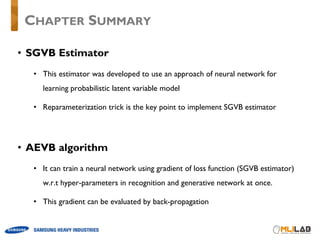
• SGVB Estimator
• This estimator was developed to use an approach of neural network for
learning probabilistic latent variable model
• Reparameterization trick is the key point to implement SGVB estimator
• AEVB algorithm
• It can train a neural network using gradient of loss function (SGVB estimator)
w.r.t hyper-parameters in recognition and generative network at once.
• This gradient can be evaluated by back-propagation
CHAPTER SUMMARY
VARIATIONAL AUTO ENCODER
• Loss function (Bernoulli Case)
• 𝑝 𝑧 	~	𝑁(0, 𝐼)
• 𝑝] 𝑥|𝑧 	~	𝑁 𝑢] 𝑧 , 𝜎] 𝑧 	𝑜𝑟	𝐵𝑒𝑟𝑛(p] 𝑧 )
• 𝑞o 𝑧|𝑥 	~	𝑁(𝑢o(𝑥), 𝑑𝑖𝑎𝑔o(𝑥))
• Estimator (Loss function)
𝐿”“(𝜃, 𝜙; 𝑥W
) =
1
𝐿
^ 𝑙𝑜𝑔𝑝	] 𝑥W
|𝑧W,[
− 𝐷{•(𝑞o(𝑧|𝑥W
)||𝑝] 𝑧 )
[
𝑤ℎ𝑒𝑟𝑒	𝑔o 𝜖, 𝑥W
= 𝑢] 𝑥 + 𝜖 ⋅ 𝜎] 𝑥 		
𝜖	~	𝑁 0, 𝐼 , 𝑙 = 1
• Since 𝑙 = 1, neural network architecture can be similar to “auto-encoder”
FRAMEWORK (1)
• Loss function
• 𝑝] 𝑥|𝑧 	~	𝐵𝑒𝑟𝑛 p] 𝑧
à 𝑙𝑜𝑔𝑝] 𝑥|𝑧 	~ ∑ 𝑥W 𝑙𝑜𝑔pW ]
𝑧W + 1 − 𝑥W 𝑙𝑜𝑔(1 − p](𝑧W))
• 𝐷{•(𝑞o(𝑧|𝑥W)||𝑝] 𝑧 )
• 𝑝 𝑧 	~	𝑁 0, 𝐼 , 𝑞o 𝑧|𝑥 	~	𝑁(𝑢o(𝑥), 𝑑𝑖𝑎𝑔o(𝑥))
• 𝐷{•(𝑞o(𝑧|𝑥)| 𝑝] 𝑧 =
%
y
{ 0 − 𝑢o 𝑥 𝐼V% 0 − 𝑢o 𝑥 + 𝑡𝑟𝑎𝑐𝑒(𝐼V% 𝑑𝑖𝑎𝑔o(𝑥)) −	𝑘 + 𝑙𝑛
|™|
|Wš›ˆ 2 |
= ^ 𝑢o 𝑥 (b)
y
	− 1 + 𝜎o
y
𝑥 b − 𝑙𝑛𝜎o
y
𝑥 (b)	
b
𝑤ℎ𝑒𝑟𝑒	𝑗 = 𝑖𝑛𝑑𝑒𝑥	𝑜𝑓	𝑑𝑖𝑚𝑒𝑛𝑠𝑖𝑜𝑛	𝑜𝑓	𝑙𝑎𝑡𝑒𝑛𝑡	𝑣𝑎𝑟𝑖𝑎𝑏𝑙𝑒	𝑧
FRAMEWORK (2)
• Loss Function
∴ ∑ 𝑥W 𝑙𝑜𝑔pW ]
𝑧W + 1 − 𝑥W 𝑙𝑜𝑔(1 − p](𝑧W)) +
^ ^ 𝑢o 𝑥W (b)
y
	− 1 + 𝜎o
y
𝑥W b − 𝑙𝑛𝜎o
y
𝑥W (b)	
bW
FRAMEWORK (3)
• Network Architecture
• Recognition network (like density network)
𝑢o 𝑥W = 𝑤y 𝑡𝑎𝑛ℎ 𝑤% 𝑥W + 𝑏% + 𝑏y
𝜎o 𝑥W = 𝑤Ÿ 𝑡𝑎𝑛ℎ 𝑤 𝑥W + 𝑏 + 𝑏Ÿ
• Generative network
• Bernoulli Case
p] 𝑧W = 𝑓š 𝑤y tanh 𝑤% 𝑧W + 𝑏% + 𝑏y
𝑤ℎ𝑒𝑟𝑒	𝑓š ⋅ : 𝑒𝑙𝑒𝑚𝑒𝑛𝑡 − 𝑤𝑖𝑠𝑒	𝑠𝑖𝑔𝑚𝑜𝑖𝑑	𝑓𝑢𝑛𝑐𝑡𝑖𝑜𝑛
𝜃 = {𝑤%, 𝑏%, 𝑤y, 𝑏y}
• Gaussian Case
𝑢] 𝑧W = 𝑤Ÿ(𝑡𝑎𝑛ℎ 𝑤 𝑧 + 𝑏 + 𝑏Ÿ
𝜎] 𝑧W = 𝑤¥(𝑡𝑎𝑛ℎ 𝑤 𝑧 + 𝑏 + 𝑏¥
𝜃 = {𝑤 , 𝑤Ÿ, 𝑤¥, 𝑏 , 𝑏Ÿ, 𝑏¥}
STRUCTURE OF VAE(1)
VAE
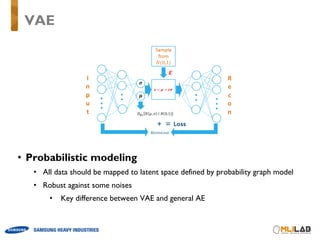
• Probabilistic modeling
• All data should be mapped to latent space defined by probability graph model
• Robust against some noises
• Key difference between VAE and general AE
• Derivation
• Marginal Likelihood : 𝑝	]	(𝑥)
• Marginal likelihood estimator
1
𝑝](𝑥W)
= ∫
𝑞 𝑧
𝑝] 𝑥W
𝑑𝑧 =
∫ 𝑞 𝑧 ⋅
𝑝] 𝑥W, 𝑧
𝑝] 𝑥W, 𝑧
𝑑𝑧
𝑝] 𝑥W
= ∫
𝑝] 𝑥W, 𝑧
𝑝] 𝑥W
⋅
𝑞 𝑧
𝑝] 𝑥W, 𝑧
𝑑𝑧
= ∫ 𝑝] 𝑧 𝑥W
𝑞 𝑧
𝑝] 𝑥W, 𝑧
𝑑𝑧 ≈
1
𝐿
^
𝑞o(𝑧 [
)	
𝑝] 𝑧 𝑝](𝑥W|𝑧 [ )
[
• In VAE, marginal likelihood estimator cannot be evaluated
because it requires 𝑙 > 1
• If it was forced to evaluate the marginal likelihood in VAE, the result is almost same
as loss function, it doesn’t give any special meaning.
MARGINAL LIKELIHOOD ESTIMATOR (1)
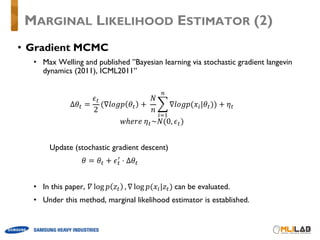
• Gradient MCMC
• Max Welling and published ”Bayesian learning via stochastic gradient langevin
dynamics (2011), ICML2011”
Δ𝜃¨ =
𝜖¨
2
(∇𝑙𝑜𝑔𝑝 𝜃¨ +	
𝑁
𝑛
^ ∇𝑙𝑜𝑔𝑝(𝑥W|𝜃¨
.
W1%
)) + 𝜂¨
𝑤ℎ𝑒𝑟𝑒	𝜂¨~𝑁(0, 𝜖¨)
Update (stochastic gradient descent)
𝜃 = 𝜃¨ + 𝜖¨
¬
⋅ Δ𝜃¨
• In this paper, 𝛻 log 𝑝 𝑧¨ , ∇ log 𝑝(𝑥W|𝑧¨)	can be evaluated.
• Under this method, marginal likelihood estimator is established.
MARGINAL LIKELIHOOD ESTIMATOR (2)
• Framework
• 𝑝] 𝑧 	~	𝑁 0, 𝐼 , 𝑤ℎ𝑒𝑟𝑒	𝑧 ∈ 𝑅°, 𝐼 ∈ 𝑅°×°
• 𝑝² 𝜃 	~	𝑁 0, 𝐼 , 𝑤ℎ𝑒𝑟𝑒	𝜃 ∈ 𝑅³, 𝐼 ∈ 𝑅³×³
• 𝑝] 𝑥|𝑧 	~	𝑁 𝑢] 𝑧 , 𝜎] 𝑧 	𝑜𝑟	𝐵𝑒𝑟𝑛(p] 𝑧 )
• 𝑞o 𝑧|𝑥 	~	𝑁(𝑢o(𝑥), 𝑑𝑖𝑎𝑔o(𝑥))
FULL VARIATIONAL BAYES
NX
Z
𝜙 𝜃
[	AEVB	algorithm	]
𝛼
• Variational Bound
𝑙𝑛𝑝] 𝑋 ≈	∫ 𝑙𝑛𝑃² 𝑋 𝜃 + 𝑙𝑛𝑃² 𝜃 − 𝑙𝑛𝑞o 𝜃 ⋅ 𝑞] 𝜃 𝑑𝜃
=
1
𝐿
^ 𝐸 𝑙𝑛𝑃² 𝑋 𝜃 +
1
2
^{1 + 𝑙𝑛𝜎]
y

[
− 𝜇]
y

[
³
³1%
−𝜎]·
y ([)
		}	
•
[1%
𝑙𝑛𝑃² 𝑋 𝜃 = ∫ 𝑙𝑜𝑔
𝑝 𝑥, 𝑧
𝑞 𝑧
⋅ 𝑞 𝑧 𝑑𝑧	 − ∫ 𝑙𝑜𝑔
𝑞 𝑧
𝑝 𝑧 𝑥
⋅ 𝑞 𝑧 𝑑𝑧
										≈
1
𝐾
^(
(
W1%
^ ln𝑝] 𝑥W 𝑧W,b +
1
2
{
v1%
^{1 + 𝑙𝑛𝜎_
y
W,b
v
− 𝜇_
y
W,b
v
°
b1%
−𝜎_T,b
y (v)
		})
• In this paper, 𝐿 = 𝐾 = 1 and ln𝑝] 𝑥W 𝑧W,b = 𝑙𝑛𝑝](𝑥|𝑧) , ∀𝑥W
∴ 𝑁 ⋅ 𝑙𝑛𝑝 𝑥 𝑧 +
𝑁
2
⋅ ^{1 + 𝑙𝑛𝜎_
y
W,b
¬
− 𝜇_
y
W,b
¬
°
b1%
−𝜎_T,b
y ¬
		} +
1
2
^{1 + 𝑙𝑛𝜎]
y

[
− 𝜇]
y

[
³
³1%
−𝜎]·
y ([)
		}
FULL VARIATIONAL BAYES
EXPERIMENTAL RESULT
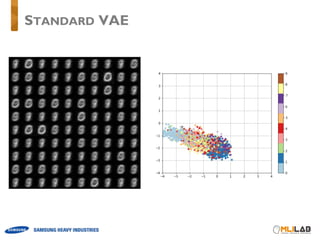
STANDARD VAE
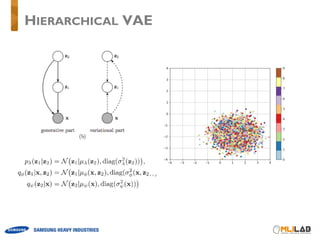
HIERARCHICAL VAE
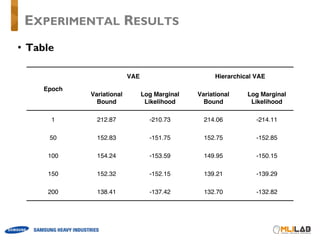
• Table
EXPERIMENTAL RESULTS
WHAT’S NEXT?
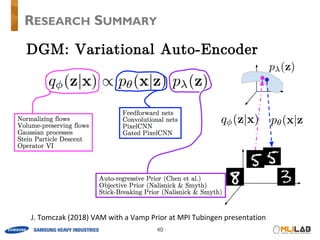
RESEARCH SUMMARY
J.	Tomczak	(2018)	VAM	with	a	Vamp	Prior	at	MPI	Tubingen	presentation
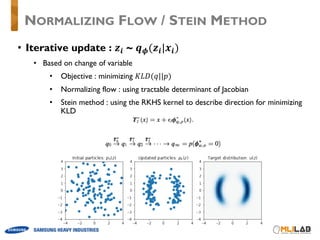
• Iterative update : 𝒛𝒊 ~ 𝒒 𝝓(𝒛𝒊|𝒙𝒊)
• Based on change of variable
• Objective : minimizing 𝐾𝐿𝐷(𝑞||𝑝)
• Normalizing flow : using tractable determinant of Jacobian
• Stein method : using the RKHS kernel to describe direction for minimizing
KLD
NORMALIZING FLOW / STEIN METHOD
VAE WITH VAMPPRIOR
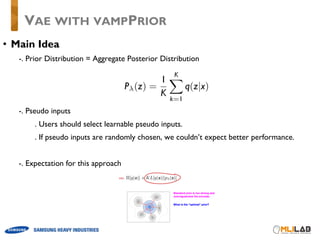
• Main Idea
-. Prior Distribution = Aggregate Posterior Distribution
-. Pseudo inputs
. Users should select learnable pseudo inputs.
. If pseudo inputs are randomly chosen, we couldn’t expect better performance.
-. Expectation for this approach
VAE WITH VAMPPRIOR
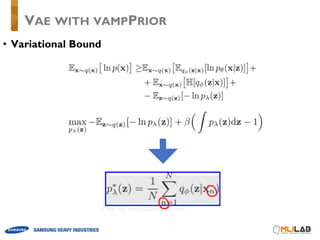
• Variational Bound
VAE WITH VAMPPRIOR
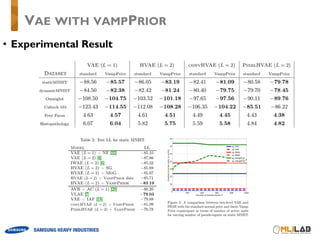
• Experimental Result
ANY QUESTIONS?
• Kingma and Welling(2013), Auto-encoding Variational Bayes,
ICLR2014
• Bishop(2006), Pattern recognition and Machine learning
• Rezende, Mohamed and Wiestra(2014) Stochastic
Backpropagation and Approximate Inference in Deep Generative
Models, ICML2014
• Liu and Wang(2016), Stein Variational Gradient Descent: A
General Purpose Bayesian Inference Algorithm, NIPS2016
• Tomczak and Welling(2018), VAE with a VampPrior,
AISTAT2018
REFERENCES
J.	Tomczak	(2018)	VAM	with	a	Vamp	Prior	at	MPI	Tubingen	presentation

is anyone_interest_in_auto-encoding_variational-bayes

  • 1.
    IS ANYONE INTERESTIN AUTO-ENCODING VARIATIONAL-BAYES ? INSTEAD OF “VAE”
  • 2.
  • 3.
    INTRODUCTION TO VAE(1) Loss Function Neural network architecture • Variational Inference • Auto encoder • Mixture Density Network
  • 4.
    • Characteristics • Scalablegenerative model • Amortized variational inference • Simple network architecture • Stochastic gradient descent (Back-propagation) • Scales to huge datasets • Inference based on probability graphical model • Continuous Latent Space • Data reduction / Data Imputation • Liable to noisy INTRODUCTION TO VAE (2)
  • 5.
    • Paper “Auto-encodingvariational bayes” • “VAE” is a example of experiment results in this paper. • Introduce the rest of this paper without “VAE” • Stochastic Gradient Variational Bayes(SGVB) estimator • Auto-encoding Variational Bayes algorithm • Reparameterization trick • Appendix • Full Variational Bayes • Marginal Likelihood estimator • Research trend of VAE THIS SEMINAR
  • 6.
  • 7.
    • General expression •A random variable 𝑥 ∈ 𝑋 • A set 𝑦%, ⋯ , 𝑦( of i.i.d observations 𝑝 𝑥, 𝑦%, ⋯ , 𝑦( = 𝑝+ 𝑥 ∏ 𝑝(𝑦.|𝑥)( .1% • Given prior 𝑝+ 2 and observations, posterior can be evaluated. 𝑝 𝑥 𝑦%, ⋯ , 𝑦( = 𝑝+(𝑥) ∏ 𝑝 𝑦. 𝑥( .1% 𝑍 ≔ 𝑝̅ 𝑥 𝑍 𝑍 ≔ 7 𝑝̅ 𝑥 𝑑𝑥 : BAYESIAN INFERENCE
  • 8.
    • Variational Inference •Approximate the target distribution 𝑝 𝑥 by using a tractable distribution 𝑞(𝑥) in Q 𝑞∗ = 𝑎𝑟𝑔𝑚𝑖𝑛C∈D 𝐾𝐿(𝑞||𝑝) • Variational Bound 𝑙𝑜𝑔𝑝 𝑥 = ∫ 𝑙𝑜𝑔𝑝 𝑥 ⋅ 𝑞 𝑧 𝑑𝑧 = 7 𝑙𝑜𝑔 𝑝 𝑥, 𝑧 𝑝 𝑧 𝑥 ⋅ 𝑞 𝑧 𝑑 = ∫ 𝑙𝑜𝑔 𝑝 𝑥, 𝑧 𝑞 𝑧 ⋅ 𝑞 𝑧 𝑑𝑧 − ∫ 𝑙𝑜𝑔 𝑞 𝑧 𝑝 𝑧 𝑥 ⋅ 𝑞 𝑧 𝑑𝑧 VARIATIONAL INFERENCE
  • 9.
    • Supervised Learning PROBABILITYGRAPHICAL MODEL • Unsupervised Learning (Latent Variable Model) NX Z Φ NY Z Φ X e.g) Bayesian Logistic regression e.g) EM algorithm for Gaussian Mixture Model
  • 10.
    • Supervised learning e.g)Bayesian logistic regression 𝑝 𝑥 𝑤, 𝑦 ⋅ 𝑝 𝑤 ∝ 𝑝 𝑤, 𝑥 𝑦 𝑝 𝑥 𝑤, 𝑦 ∶ ∏ 𝜎 𝑤R 𝑥 ST ⋅ (1 − 𝜎 𝑤R 𝑥 %VST). W1% à Approximate Gaussian Dist. • Latent Variable Model e.g) Gaussian Mixture Model (EM algorithm) à tractable conditional pdf : 𝑝(𝑧|𝑥) 𝑞 𝑧 ≈ 𝑝 𝑧 𝑥, 𝜃Z[ 𝜃∗ = 𝑎𝑟𝑔𝑚𝑎𝑥] ^ 𝑝 𝑧 𝑥, 𝜃Z[ ⋅ 𝑙𝑛𝑝(𝑥, 𝑧|𝜃) _ PROBABILITY GRAPHICAL MODEL
  • 11.
    • Mean fieldassumption • If 𝑝(𝑧|𝑥) is intractable ? 𝑞 𝒛 = a 𝑞W(𝑧W) W 𝑙𝑛𝑞b ∗ 𝑧b = 𝐸Wdb 𝑙𝑛𝑝 𝒙, 𝒛 + 𝑐𝑜𝑛𝑠𝑡 𝑞b ∗ 𝑧b = exp ( 𝐸Wdb[𝑙𝑛𝑝 𝒙, 𝒛 ] ∫ exp ( 𝐸Wdb 𝑙𝑛𝑝 𝒙, 𝒛 𝑑𝑧 • Under specific probabilistic graphical model, approximate distribution can be evaluated by expectation of 𝐸Wdb[𝑙𝑛𝑝 𝒙, 𝒛 ] • Depending on each problem, we have to derive the form of 𝐸Wdb[𝑙𝑛𝑝 𝒙, 𝒛 ] • Through sequential optimization, All of 𝑞b(𝑧b) can be updated in order until converged. TRADITIONAL VARIATIONAL INFERENCE
  • 12.
    • VI withStochastic gradient descent 𝐿 = ∫ 𝑙𝑜𝑔 𝑝 𝑥, 𝑧 𝑞o 𝑧 ⋅ 𝑞o 𝑧 𝑑𝑧 𝛻o 𝐿 = ∫ 𝑙𝑛𝑝 𝑥, 𝑧 ⋅ 𝛻o 𝑙𝑛𝑞 𝑧 ⋅ 𝑞 𝑧 𝑑𝑧 = 𝐸2∼C[𝑙𝑛𝑝 𝑥, 𝑧 ⋅ 𝛻o 𝑙𝑛𝑞 𝑧 ] 𝛻o 𝐿 = 𝐸2∼C 𝑙𝑛𝑝 𝑥, 𝑧 ⋅ 𝛻o 𝑙𝑛𝑞 𝑧 ≈ 1 𝑛 ^ 𝑙𝑛𝑝 𝑥W, 𝑧 W ⋅ 𝛻o 𝑙𝑛𝑞 𝑧 • In order to avoid exact derivation of expectation and sequential optimization, stochastic gradient descent method was introduced. • This method only requires 𝑙𝑜𝑔𝑝 𝑥, 𝑧 , 𝑞o 𝑧 and its derivative • All components can be easily handed • 𝑙𝑜𝑔𝑝 𝑥, 𝑧 can be derived from probabilistic graphical model • 𝑞o 𝑧 and 𝛻o 𝑞o 𝑧 are decided by users. • However, since this estimator has a huge variance, it also requires many samples. TRADITIONAL VARIATIONAL INFERENCE (2)
  • 13.
    • Mixture densitynetwork • 𝑝 𝑥 𝑤, 𝑦 ⋅ 𝑝 𝑤 ∝ 𝑝 𝑤, 𝑥 𝑦 𝐸 𝑤 = − ^ ln { ^ 𝜋v 𝑥., 𝑤 𝑁(𝑡.|𝑢v 𝑥., 𝑤 , 𝜎v y 𝑥., 𝑤 )} { v1% ( .1% Mixture density network presents that artificial neural network trains hyper-parameters for learning parameters of distributions NETWORK FOR LEARNING PARAMETERS [ Structure of Mixture density Network ] [ Data point and result by Mixture Density Network]
  • 14.
    • Variational Inference •It provide the evidence in which mathematical analysis can be conducted • Before emerging amortized VI, Most researches had a interest in efficient usage of VI using stochastic gradient descent and improving performance of approximate distribution for classification model : Basic example : Bayesian logistic regression. • Especially, VI with stochastic gradient descent influenced that “Auto-encoding variational bayes” were published. • Mixture Density Network • Mixture Density Network is known to learn parameters of specific distributions using NN • It is starting point to derive an approach to bayesian neural network CHAPTER SUMMARY
  • 15.
  • 16.
    • Amortized generativemodel • 𝜙 : hyper-parameters in recognition network • 𝜃 : hyper-parameters in generative network PROBABILISTIC GRAPHICAL MODEL NX Z 𝜙 𝜃 p 𝜇 𝜎 NX Z 𝜃 𝜙 Generative model Variational approximation [ AEVB algorithm ] [ VAE ]
  • 17.
    • Traditional Latentvariable model • Intractable : 𝑝(𝑧|𝑥) • A large data set : Sampling based EM algorithm à Too slow • This paper has interested in • Using stochastic gradient descent • Efficient approximate posterior inference of latent variable 𝑧 • This paper introduce (The reason why this method referred ”Variational”) • 𝑞o 𝑧 𝑥 : recognition model / approximate posterior distribution to 𝑝] 𝑧 𝑥 • Figure out parameters of approximate distribution • 𝑝] 𝑥 𝑧 : generative model (defined as graphical model) • Learning the recognition model parameter 𝜙 with generative model parameter 𝜃 using reparameterization trick PROBLEMS SCENARIO
  • 18.
    • Developing variationalBound ∫ 𝑙𝑜𝑔 𝑝 𝑥, 𝑧 𝑞 𝑧 ⋅ 𝑞 𝑧 𝑑𝑧 = ∫ 𝑙𝑜𝑔 𝑝 𝑥 𝑧 ⋅ 𝑝 𝑧 𝑞 𝑧 ⋅ 𝑞 𝑧 𝑑𝑧 ∫ 𝑙𝑜𝑔𝑝 𝑥 𝑧 + 𝑙𝑜𝑔𝑝 𝑧 − 𝑙𝑜𝑔𝑞 𝑧 ⋅ 𝑞 𝑧 𝑑𝑧 = ∫ 𝑙𝑜𝑔𝑝 𝑥 𝑧 ⋅ 𝑞 𝑧 𝑑𝑧 + ∫ 𝑙𝑜𝑔𝑝 𝑧 − 𝑙𝑜𝑔𝑞 𝑧 𝑑𝑧 = ∫ 𝑙𝑜𝑔𝑝 𝑥 𝑧 ⋅ 𝑞 𝑧 𝑑𝑧 − 𝐷{•(𝑞(𝑧)||𝑝(𝑧) VARIATIONAL BOUND
  • 19.
    • Reparametrization Trick •Random variable z à Function of variables (Deterministic) • Capable of using neural network • 𝑧 ~ 𝑞 𝑧 𝑥 à 𝑧̅ = 𝑔o(𝑥, ϵ), 𝜖 ~ 𝑝 𝜖 • Assume that 𝑝 𝜖 is defined (𝑝 𝜖 ~ 𝑁(0,1)) • The function 𝑔] is determined depending on 𝑞 𝑧 𝑥 (In subsequent chapter, the forms of function 𝑔] is represented) • Form of function 𝑔] • Tractable inverse CDF : similar to finding PDF • 𝐹 𝑥 = 𝑝, 𝐹V% 𝑝 = 𝑥 𝑢𝑛𝑖𝑞𝑢𝑒 𝑥 / 𝑔o 𝜖, 𝑥 = Fo V% 𝜖; 𝑥 = 𝑍̅ • Location Scale Model : • 𝑔o 𝜖, 𝑥 = location + scale ⋅ 𝜖 STOCHASTIC GRADIENT VARIATIONAL BAYES ESTIMATOR (1)
  • 20.
    • SGVB Estimator 𝐸Cˆ (‰|ŠT) 𝑓𝑧 = 𝐸Œ(•) 𝑓 𝑔o 𝜖, 𝑥W ≈ 1 𝐿 ^ 𝑓 𝑔o 𝜖[, 𝑥W W 𝑤ℎ𝑒𝑟𝑒, 𝜖[ ~ 𝑝 𝜖 • 𝑓 𝑧 = 𝑙𝑜𝑔𝑝 𝑥 𝑧 + 𝑞 𝑧 − 𝑝(𝑧) • 𝐺𝑖𝑣𝑒𝑛 𝑥, 𝜖 𝑠𝑎𝑚𝑝𝑙𝑒𝑑 𝑓𝑟𝑜𝑚 𝑝 𝜖 , 𝑧 ≈ 𝑧̅ = 𝑔o 𝜖, 𝑥W , 𝑓 𝑧 can be evaluated. • The form of % • ∑ 𝑓 𝑔o 𝜖[, 𝑥W W • Stochastic gradient method can be introduced w.r.t 𝜙 , 𝜃 (Back propagation) STOCHASTIC GRADIENT VARIATIONAL BAYES ESTIMATOR (2)
  • 21.
    • SGVB EstimatorA 𝐿’“(𝜃, 𝜙; 𝑥W ) = 1 𝐿 ^ 𝑙𝑜𝑔𝑝 ] 𝑥W , 𝑧W,[ − 𝑙𝑜𝑔𝑞o(𝑧W,[ |𝑥W ) [ 𝑤ℎ𝑒𝑟𝑒, 𝑔o 𝜖, 𝑥W , 𝜖[ ~ 𝑝 𝜖 • 𝑙𝑜𝑔𝑝 ] 𝑥W , 𝑧W,[ is defined by probabilistic graphical model • 𝑙𝑜𝑔𝑞o(𝑧W,[ |𝑥W ) can be determined 𝑔o 𝜖, 𝑥W , 𝜖[ ~ 𝑝 𝜖 • SGVB Estimator B 𝐿”“(𝜃, 𝜙; 𝑥W ) = 1 𝐿 ^ 𝑙𝑜𝑔𝑝 ] 𝑥W |𝑧W,[ − 𝐷{•(𝑞o(𝑧|𝑥W )||𝑝] 𝑧 ) [ 𝑤ℎ𝑒𝑟𝑒, 𝑔o 𝜖, 𝑥W , 𝜖[ ~ 𝑝 𝜖 • 𝐷{•(𝑞o(𝑧|𝑥W )||𝑝] 𝑧 ) is analytically evaluated (Gaussian Dist.) • 𝐷{•(𝑞o(𝑧|𝑥W )||𝑝] 𝑧 ) doesn’t require sample z, only require parameter of approximate dist. STOCHASTIC GRADIENT VARIATIONAL BAYES ESTIMATOR (3)
  • 22.
    𝑙𝑛𝑝] 𝑋, 𝑍= ^ 𝑙𝑛𝑝](𝑥W |𝑧W ) W 𝑙𝑛𝑞o 𝑍 = ^ 𝑙𝑛𝑞o(𝑧W ) W 𝑙𝑛𝑝] 𝑍 = ^ 𝑙𝑛𝑝](𝑧W ) W AUTO ENCODING VARIATIONAL BAYES ALGORITHM(1) NX Z𝜙 𝜃
  • 23.
    AUTO ENCODING VARIATIONALBAYES ALGORITHM (2) • AEVB for SGVB estimator 1 𝑀 ^ 𝐿’“(𝜃, 𝜙; 𝑥W ) W = 1 𝑀 ^ 1 𝐿 ^ 𝑙𝑜𝑔𝑝 ] 𝑥W , 𝑧W,[ − 𝑙𝑜𝑔𝑞o(𝑧W,[ |𝑥W ) [ W 1 𝑀 ^ 𝐿”“(𝜃, 𝜙; 𝑥W ) W = 1 𝑀 ^ 1 𝐿 ^ 𝑙𝑜𝑔𝑝 ] 𝑥W |𝑧W,[ − 𝐷{•(𝑞o(𝑧|𝑥W )||𝑝] 𝑧 ) [W
  • 24.
    • SGVB Estimator •This estimator was developed to use an approach of neural network for learning probabilistic latent variable model • Reparameterization trick is the key point to implement SGVB estimator • AEVB algorithm • It can train a neural network using gradient of loss function (SGVB estimator) w.r.t hyper-parameters in recognition and generative network at once. • This gradient can be evaluated by back-propagation CHAPTER SUMMARY
  • 25.
  • 26.
    • Loss function(Bernoulli Case) • 𝑝 𝑧 ~ 𝑁(0, 𝐼) • 𝑝] 𝑥|𝑧 ~ 𝑁 𝑢] 𝑧 , 𝜎] 𝑧 𝑜𝑟 𝐵𝑒𝑟𝑛(p] 𝑧 ) • 𝑞o 𝑧|𝑥 ~ 𝑁(𝑢o(𝑥), 𝑑𝑖𝑎𝑔o(𝑥)) • Estimator (Loss function) 𝐿”“(𝜃, 𝜙; 𝑥W ) = 1 𝐿 ^ 𝑙𝑜𝑔𝑝 ] 𝑥W |𝑧W,[ − 𝐷{•(𝑞o(𝑧|𝑥W )||𝑝] 𝑧 ) [ 𝑤ℎ𝑒𝑟𝑒 𝑔o 𝜖, 𝑥W = 𝑢] 𝑥 + 𝜖 ⋅ 𝜎] 𝑥 𝜖 ~ 𝑁 0, 𝐼 , 𝑙 = 1 • Since 𝑙 = 1, neural network architecture can be similar to “auto-encoder” FRAMEWORK (1)
  • 27.
    • Loss function •𝑝] 𝑥|𝑧 ~ 𝐵𝑒𝑟𝑛 p] 𝑧 à 𝑙𝑜𝑔𝑝] 𝑥|𝑧 ~ ∑ 𝑥W 𝑙𝑜𝑔pW ] 𝑧W + 1 − 𝑥W 𝑙𝑜𝑔(1 − p](𝑧W)) • 𝐷{•(𝑞o(𝑧|𝑥W)||𝑝] 𝑧 ) • 𝑝 𝑧 ~ 𝑁 0, 𝐼 , 𝑞o 𝑧|𝑥 ~ 𝑁(𝑢o(𝑥), 𝑑𝑖𝑎𝑔o(𝑥)) • 𝐷{•(𝑞o(𝑧|𝑥)| 𝑝] 𝑧 = % y { 0 − 𝑢o 𝑥 𝐼V% 0 − 𝑢o 𝑥 + 𝑡𝑟𝑎𝑐𝑒(𝐼V% 𝑑𝑖𝑎𝑔o(𝑥)) − 𝑘 + 𝑙𝑛 |™| |Wš›ˆ 2 | = ^ 𝑢o 𝑥 (b) y − 1 + 𝜎o y 𝑥 b − 𝑙𝑛𝜎o y 𝑥 (b) b 𝑤ℎ𝑒𝑟𝑒 𝑗 = 𝑖𝑛𝑑𝑒𝑥 𝑜𝑓 𝑑𝑖𝑚𝑒𝑛𝑠𝑖𝑜𝑛 𝑜𝑓 𝑙𝑎𝑡𝑒𝑛𝑡 𝑣𝑎𝑟𝑖𝑎𝑏𝑙𝑒 𝑧 FRAMEWORK (2)
  • 28.
    • Loss Function ∴∑ 𝑥W 𝑙𝑜𝑔pW ] 𝑧W + 1 − 𝑥W 𝑙𝑜𝑔(1 − p](𝑧W)) + ^ ^ 𝑢o 𝑥W (b) y − 1 + 𝜎o y 𝑥W b − 𝑙𝑛𝜎o y 𝑥W (b) bW FRAMEWORK (3)
  • 29.
    • Network Architecture •Recognition network (like density network) 𝑢o 𝑥W = 𝑤y 𝑡𝑎𝑛ℎ 𝑤% 𝑥W + 𝑏% + 𝑏y 𝜎o 𝑥W = 𝑤Ÿ 𝑡𝑎𝑛ℎ 𝑤 𝑥W + 𝑏 + 𝑏Ÿ • Generative network • Bernoulli Case p] 𝑧W = 𝑓š 𝑤y tanh 𝑤% 𝑧W + 𝑏% + 𝑏y 𝑤ℎ𝑒𝑟𝑒 𝑓š ⋅ : 𝑒𝑙𝑒𝑚𝑒𝑛𝑡 − 𝑤𝑖𝑠𝑒 𝑠𝑖𝑔𝑚𝑜𝑖𝑑 𝑓𝑢𝑛𝑐𝑡𝑖𝑜𝑛 𝜃 = {𝑤%, 𝑏%, 𝑤y, 𝑏y} • Gaussian Case 𝑢] 𝑧W = 𝑤Ÿ(𝑡𝑎𝑛ℎ 𝑤 𝑧 + 𝑏 + 𝑏Ÿ 𝜎] 𝑧W = 𝑤¥(𝑡𝑎𝑛ℎ 𝑤 𝑧 + 𝑏 + 𝑏¥ 𝜃 = {𝑤 , 𝑤Ÿ, 𝑤¥, 𝑏 , 𝑏Ÿ, 𝑏¥} STRUCTURE OF VAE(1)
  • 30.
    VAE • Probabilistic modeling •All data should be mapped to latent space defined by probability graph model • Robust against some noises • Key difference between VAE and general AE
  • 31.
    • Derivation • MarginalLikelihood : 𝑝 ] (𝑥) • Marginal likelihood estimator 1 𝑝](𝑥W) = ∫ 𝑞 𝑧 𝑝] 𝑥W 𝑑𝑧 = ∫ 𝑞 𝑧 ⋅ 𝑝] 𝑥W, 𝑧 𝑝] 𝑥W, 𝑧 𝑑𝑧 𝑝] 𝑥W = ∫ 𝑝] 𝑥W, 𝑧 𝑝] 𝑥W ⋅ 𝑞 𝑧 𝑝] 𝑥W, 𝑧 𝑑𝑧 = ∫ 𝑝] 𝑧 𝑥W 𝑞 𝑧 𝑝] 𝑥W, 𝑧 𝑑𝑧 ≈ 1 𝐿 ^ 𝑞o(𝑧 [ ) 𝑝] 𝑧 𝑝](𝑥W|𝑧 [ ) [ • In VAE, marginal likelihood estimator cannot be evaluated because it requires 𝑙 > 1 • If it was forced to evaluate the marginal likelihood in VAE, the result is almost same as loss function, it doesn’t give any special meaning. MARGINAL LIKELIHOOD ESTIMATOR (1)
  • 32.
    • Gradient MCMC •Max Welling and published ”Bayesian learning via stochastic gradient langevin dynamics (2011), ICML2011” Δ𝜃¨ = 𝜖¨ 2 (∇𝑙𝑜𝑔𝑝 𝜃¨ + 𝑁 𝑛 ^ ∇𝑙𝑜𝑔𝑝(𝑥W|𝜃¨ . W1% )) + 𝜂¨ 𝑤ℎ𝑒𝑟𝑒 𝜂¨~𝑁(0, 𝜖¨) Update (stochastic gradient descent) 𝜃 = 𝜃¨ + 𝜖¨ ¬ ⋅ Δ𝜃¨ • In this paper, 𝛻 log 𝑝 𝑧¨ , ∇ log 𝑝(𝑥W|𝑧¨) can be evaluated. • Under this method, marginal likelihood estimator is established. MARGINAL LIKELIHOOD ESTIMATOR (2)
  • 33.
    • Framework • 𝑝]𝑧 ~ 𝑁 0, 𝐼 , 𝑤ℎ𝑒𝑟𝑒 𝑧 ∈ 𝑅°, 𝐼 ∈ 𝑅°×° • 𝑝² 𝜃 ~ 𝑁 0, 𝐼 , 𝑤ℎ𝑒𝑟𝑒 𝜃 ∈ 𝑅³, 𝐼 ∈ 𝑅³×³ • 𝑝] 𝑥|𝑧 ~ 𝑁 𝑢] 𝑧 , 𝜎] 𝑧 𝑜𝑟 𝐵𝑒𝑟𝑛(p] 𝑧 ) • 𝑞o 𝑧|𝑥 ~ 𝑁(𝑢o(𝑥), 𝑑𝑖𝑎𝑔o(𝑥)) FULL VARIATIONAL BAYES NX Z 𝜙 𝜃 [ AEVB algorithm ] 𝛼
  • 34.
    • Variational Bound 𝑙𝑛𝑝]𝑋 ≈ ∫ 𝑙𝑛𝑃² 𝑋 𝜃 + 𝑙𝑛𝑃² 𝜃 − 𝑙𝑛𝑞o 𝜃 ⋅ 𝑞] 𝜃 𝑑𝜃 = 1 𝐿 ^ 𝐸 𝑙𝑛𝑃² 𝑋 𝜃 + 1 2 ^{1 + 𝑙𝑛𝜎] y ¶ [ − 𝜇] y ¶ [ ³ ³1% −𝜎]· y ([) } • [1% 𝑙𝑛𝑃² 𝑋 𝜃 = ∫ 𝑙𝑜𝑔 𝑝 𝑥, 𝑧 𝑞 𝑧 ⋅ 𝑞 𝑧 𝑑𝑧 − ∫ 𝑙𝑜𝑔 𝑞 𝑧 𝑝 𝑧 𝑥 ⋅ 𝑞 𝑧 𝑑𝑧 ≈ 1 𝐾 ^( ( W1% ^ ln𝑝] 𝑥W 𝑧W,b + 1 2 { v1% ^{1 + 𝑙𝑛𝜎_ y W,b v − 𝜇_ y W,b v ° b1% −𝜎_T,b y (v) }) • In this paper, 𝐿 = 𝐾 = 1 and ln𝑝] 𝑥W 𝑧W,b = 𝑙𝑛𝑝](𝑥|𝑧) , ∀𝑥W ∴ 𝑁 ⋅ 𝑙𝑛𝑝 𝑥 𝑧 + 𝑁 2 ⋅ ^{1 + 𝑙𝑛𝜎_ y W,b ¬ − 𝜇_ y W,b ¬ ° b1% −𝜎_T,b y ¬ } + 1 2 ^{1 + 𝑙𝑛𝜎] y ¶ [ − 𝜇] y ¶ [ ³ ³1% −𝜎]· y ([) } FULL VARIATIONAL BAYES
  • 35.
  • 36.
  • 37.
  • 38.
  • 39.
  • 40.
  • 41.
    • Iterative update: 𝒛𝒊 ~ 𝒒 𝝓(𝒛𝒊|𝒙𝒊) • Based on change of variable • Objective : minimizing 𝐾𝐿𝐷(𝑞||𝑝) • Normalizing flow : using tractable determinant of Jacobian • Stein method : using the RKHS kernel to describe direction for minimizing KLD NORMALIZING FLOW / STEIN METHOD
  • 42.
    VAE WITH VAMPPRIOR •Main Idea -. Prior Distribution = Aggregate Posterior Distribution -. Pseudo inputs . Users should select learnable pseudo inputs. . If pseudo inputs are randomly chosen, we couldn’t expect better performance. -. Expectation for this approach
  • 43.
    VAE WITH VAMPPRIOR •Variational Bound
  • 44.
    VAE WITH VAMPPRIOR •Experimental Result
  • 45.
  • 46.
    • Kingma andWelling(2013), Auto-encoding Variational Bayes, ICLR2014 • Bishop(2006), Pattern recognition and Machine learning • Rezende, Mohamed and Wiestra(2014) Stochastic Backpropagation and Approximate Inference in Deep Generative Models, ICML2014 • Liu and Wang(2016), Stein Variational Gradient Descent: A General Purpose Bayesian Inference Algorithm, NIPS2016 • Tomczak and Welling(2018), VAE with a VampPrior, AISTAT2018 REFERENCES J. Tomczak (2018) VAM with a Vamp Prior at MPI Tubingen presentation