Case-based Reasoning (CBR) 
• Collection of a set of cases 
– Store a case in the Case Base 
• CBR is based on human information processing (HIP) 
model in some problem areas 
– Thinking about how human processes information 
– Try to remember previous case/recall similar cases 
& modify to fit a new situation 
• Examples: Law, diagnosis, strategic planning 
– CEO: How should we modify last year’s plan? 
• Human experts depend heavily on past experiences 
when solving new problems
Case-based Reasoning 
• A CBR emulates this HIP model and 
maintains a historical case 
• It retrieves cases relevant to the present 
problem situation from the case base 
and decides on the solution to the 
current problem on the basis of the 
outcomes from previous cases
CBR Components 
• A case-based ES consists of 
– a case base 
– a retriever 
– an adapter 
– a refiner 
– an executer 
– an evaluator 
– (See diagram on next slide)
CBR Components 
User Interface 
Request Relevant 
Adapter 
Evaluator 
Retriever 
Case Base 
New 
Cases 
(w/ Results) 
Executer Refiner 
Prior Cases 
Prior 
Result 
Draft 
Solution 
Refined 
Solution 
Solution 
Performance 
Cases 
w/o Results
Case-based Parts 
• A case base functions as a repository of 
prior cases 
• The cases are indexed ( a key as with a 
database) so that they can be quickly 
recalled when necessary 
• A case contains the general 
descriptions of old problems 
• In Knowledge Base: Set of Rules 
• In Case Base: Set of Cases 
– Creates extra difficulty in retrieving
Case-base Parts - The Retriever 
• When a new problem is entered into a 
case based system, a retriever decides 
on the features similar to the stored 
cases 
• Retrieval is done by using features of 
the new cases as indexes into the case 
base
Case-based Parts - The Adapter 
• An adapter examines the differences 
between these cases and the current 
problem 
• It then applies rules to modify the old 
solution to fit the new problem
Case-based Parts - The Refiner 
• A refiner critiques the adapted solution 
against prior outcomes 
• One way to do this is to compare it to 
similar solutions of prior cases 
• If a known failure exists for a derived 
solution, the system then decides 
whether the similarities is sufficient to 
suspect that the new solution will fail
Case-based Parts - The Executor 
• Once a solution is critiqued, an executer 
applies the refined solution to the 
current problem
Case-based Parts - The Evaluator 
• If the results are as expected, no further 
analysis is made, and the cases and its 
solution is stored for use in future 
problem solving 
• If not, the solution is repaired
Model-based Reasoning 
• A model-based system is based on a model of the 
structure and behavior of the device that the 
system is designed to simulate 
• Used for well structured problems 
– Not for stock pricing/modeling, not well 
structured 
– Engineering Problems 
• Ex: Diagnosing hardware or a machine 
• Ex: Automobile diagnostics 
• Based on written documentation 
• The problem is extracting knowledge
Model-based Reasoning 
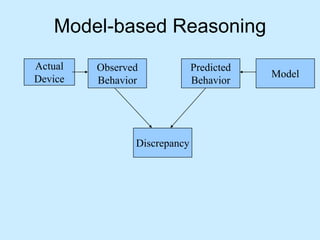
• Observed behavior (what the device is 
actually doing) is compared with 
predicted behavior (what the device 
should do) 
• The difference between them is called a 
discrepancy, indicating a defect 
• Then a process is initiated to diagnose 
the nature and location of the defect 
• Could be a mathematical equation
Model-based Reasoning 
Actual 
Device 
Model 
Predicted 
Behavior 
Observed 
Behavior 
Discrepancy
Model-based Reasoning 
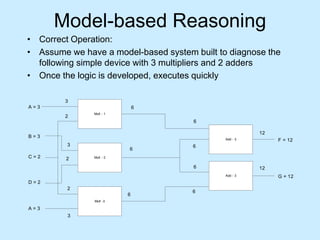
• Correct Operation: 
• Assume we have a model-based system built to diagnose the 
following simple device with 3 multipliers and 2 adders 
• Once the logic is developed, executes quickly 
A = 3 
B = 3 
C = 2 
D = 2 
A = 3 
Mult - 1 
Mult - 2 
Mult -3 
Add - 3 
Add - 3 
F = 12 
G = 12 
3 
2 
3 
2 
2 
3 
6 
6 
6 
6 
6 
6 
6 
12 
12
Model-based Reasoning 
• Incorrect Operation: 
– Diagnostics 
A = 3 
B = 3 
C = 2 
D = 2 
A = 3 
Mult - 1 
Mult - 2 
Mult -3 
Add - 3 
Add - 3 
F = 10 
G = 12 
3 
2 
3 
2 
2 
3 
6 
6 
6 
6 
6 
6 
6 
10 
12 
6 
6 
6 
Culprit of problem? 
No - 6 comes out 
Culprit of problem? 
No - 6 comes out 
Culprit of problem? 
No - 6 comes out 
Culprit of problem? 
Yes - 10 comes out, 
problem with Carry Bit 
Predicate Logic 
can be used here

Artificial Intelligence: Case-based & Model-based Reasoning

  • 1.
    Case-based Reasoning (CBR) • Collection of a set of cases – Store a case in the Case Base • CBR is based on human information processing (HIP) model in some problem areas – Thinking about how human processes information – Try to remember previous case/recall similar cases & modify to fit a new situation • Examples: Law, diagnosis, strategic planning – CEO: How should we modify last year’s plan? • Human experts depend heavily on past experiences when solving new problems
  • 2.
    Case-based Reasoning •A CBR emulates this HIP model and maintains a historical case • It retrieves cases relevant to the present problem situation from the case base and decides on the solution to the current problem on the basis of the outcomes from previous cases
  • 3.
    CBR Components •A case-based ES consists of – a case base – a retriever – an adapter – a refiner – an executer – an evaluator – (See diagram on next slide)
  • 4.
    CBR Components UserInterface Request Relevant Adapter Evaluator Retriever Case Base New Cases (w/ Results) Executer Refiner Prior Cases Prior Result Draft Solution Refined Solution Solution Performance Cases w/o Results
  • 5.
    Case-based Parts •A case base functions as a repository of prior cases • The cases are indexed ( a key as with a database) so that they can be quickly recalled when necessary • A case contains the general descriptions of old problems • In Knowledge Base: Set of Rules • In Case Base: Set of Cases – Creates extra difficulty in retrieving
  • 6.
    Case-base Parts -The Retriever • When a new problem is entered into a case based system, a retriever decides on the features similar to the stored cases • Retrieval is done by using features of the new cases as indexes into the case base
  • 7.
    Case-based Parts -The Adapter • An adapter examines the differences between these cases and the current problem • It then applies rules to modify the old solution to fit the new problem
  • 8.
    Case-based Parts -The Refiner • A refiner critiques the adapted solution against prior outcomes • One way to do this is to compare it to similar solutions of prior cases • If a known failure exists for a derived solution, the system then decides whether the similarities is sufficient to suspect that the new solution will fail
  • 9.
    Case-based Parts -The Executor • Once a solution is critiqued, an executer applies the refined solution to the current problem
  • 10.
    Case-based Parts -The Evaluator • If the results are as expected, no further analysis is made, and the cases and its solution is stored for use in future problem solving • If not, the solution is repaired
  • 11.
    Model-based Reasoning •A model-based system is based on a model of the structure and behavior of the device that the system is designed to simulate • Used for well structured problems – Not for stock pricing/modeling, not well structured – Engineering Problems • Ex: Diagnosing hardware or a machine • Ex: Automobile diagnostics • Based on written documentation • The problem is extracting knowledge
  • 12.
    Model-based Reasoning •Observed behavior (what the device is actually doing) is compared with predicted behavior (what the device should do) • The difference between them is called a discrepancy, indicating a defect • Then a process is initiated to diagnose the nature and location of the defect • Could be a mathematical equation
  • 13.
    Model-based Reasoning Actual Device Model Predicted Behavior Observed Behavior Discrepancy
  • 14.
    Model-based Reasoning •Correct Operation: • Assume we have a model-based system built to diagnose the following simple device with 3 multipliers and 2 adders • Once the logic is developed, executes quickly A = 3 B = 3 C = 2 D = 2 A = 3 Mult - 1 Mult - 2 Mult -3 Add - 3 Add - 3 F = 12 G = 12 3 2 3 2 2 3 6 6 6 6 6 6 6 12 12
  • 15.
    Model-based Reasoning •Incorrect Operation: – Diagnostics A = 3 B = 3 C = 2 D = 2 A = 3 Mult - 1 Mult - 2 Mult -3 Add - 3 Add - 3 F = 10 G = 12 3 2 3 2 2 3 6 6 6 6 6 6 6 10 12 6 6 6 Culprit of problem? No - 6 comes out Culprit of problem? No - 6 comes out Culprit of problem? No - 6 comes out Culprit of problem? Yes - 10 comes out, problem with Carry Bit Predicate Logic can be used here