Download as PDF, PPTX

![Algorithmic Intelligence Laboratory
Recap: RNN & CNN for Sequence Modeling
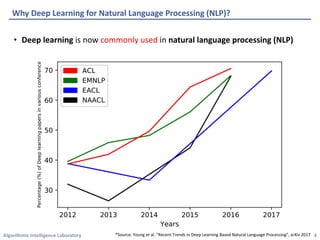
• Language is sequential: It is natural to use RNN architectures
• RNN (or LSTM variants) is a natural choice for sequence modelling
• Language is translation-invariant: It is natural to use CNN architectures
• One can use CNN [Gehring et al., 2017] for parallelization
*Source: https://towardsdatascience.com/introduction-to-recurrent-neural-network-27202c3945f3
Gehring et al. “Convolutional Sequence to Sequence Learning”, ICML 2017 5](https://image.slidesharecdn.com/181125advancedmodelsforlanguage-181125125300/85/Deep-Learning-for-Natural-Language-Processing-5-320.jpg)
![Algorithmic Intelligence Laboratory
Limitations of prior works
• However, prior works have several limitations…
• Network architecture
• Long-term dependencies: Network forgets previous information as it summarizes
inputs into a single feature vector
• Limitations of softmax: Computation linearly increases to the vocabulary size,
and expressivity is bounded by the feature dimension
• Training methods
• Exposure bias: Model only sees true tokens at training, but it sees generated
tokens at inference (and noise accumulates sequentially)
• Loss/evaluation mismatch: Model uses MLE objective at training, but use other
evaluation metrics (e.g., BLEU score [Papineni et al., 2002]) at inference
• Unsupervised setting: How to train models if there are no paired data?
6](https://image.slidesharecdn.com/181125advancedmodelsforlanguage-181125125300/85/Deep-Learning-for-Natural-Language-Processing-6-320.jpg)

![Algorithmic Intelligence Laboratory
Attention [Bahdanau et al., 2015]
• Motivation:
• Previous models summarize inputs into a single feature vector
• Hence, the model forgets old inputs, especially for long sequences
• Idea:
• Use input features, but attend on the most importance features
• Example) Translate “Ich mochte ein bier” ⇔ “I’d like a beer”
• Here, when the model generates “beer”, it should attend on “bier”
8*Source: https://ratsgo.github.io/from%20frequency%20to%20semantics/2017/10/06/attention/](https://image.slidesharecdn.com/181125advancedmodelsforlanguage-181125125300/85/Deep-Learning-for-Natural-Language-Processing-8-320.jpg)
![Algorithmic Intelligence Laboratory
Attention [Bahdanau et al., 2015]
• Method:
• Task: Translate source sequence [𝑥$, … , 𝑥'] to target sequence [𝑦$, … , 𝑦*]
• Now the decoder hidden state 𝑠, is a function of previous state 𝑠,-$, current input
𝑦.,-$, and context vector 𝑐,, i.e., 𝑠, = 𝑓 𝑠,-$, 𝑦.,-$, 𝑐,
9*Source: https://medium.com/syncedreview/a-brief-overview-of-attention-mechanism-13c578ba9129
𝑐,
𝑠,𝑠,-$
𝑦.,-$](https://image.slidesharecdn.com/181125advancedmodelsforlanguage-181125125300/85/Deep-Learning-for-Natural-Language-Processing-9-320.jpg)
![Algorithmic Intelligence Laboratory
Attention [Bahdanau et al., 2015]
• Method:
• Task: Translate source sequence [𝑥$, … , 𝑥'] to target sequence [𝑦$, … , 𝑦*]
• Now the decoder hidden state 𝑠, is a function of previous state 𝑠,-$, current input
𝑦.,-$, and context vector 𝑐,, i.e., 𝑠, = 𝑓 𝑠,-$, 𝑦.,-$, 𝑐,
• The context vector 𝑐, is linear combination of input hidden features [ℎ$, … , ℎ']
• Here, the weight 𝛼,,4 is alignment score of two words 𝑦, and 𝑥4
where score is also jointly trained, e.g.,
10](https://image.slidesharecdn.com/181125advancedmodelsforlanguage-181125125300/85/Deep-Learning-for-Natural-Language-Processing-10-320.jpg)
![Algorithmic Intelligence Laboratory
Attention [Bahdanau et al., 2015]
• Results: Attention shows good correlation between source and target
11](https://image.slidesharecdn.com/181125advancedmodelsforlanguage-181125125300/85/Deep-Learning-for-Natural-Language-Processing-11-320.jpg)
![Algorithmic Intelligence Laboratory
Attention [Bahdanau et al., 2015]
• Results: Attention improves machine translation performance
• RNNenc: no attention / RNNsearch: with attention / #: max length of train data
12
No UNK: omit unknown words
*: longer train until converge](https://image.slidesharecdn.com/181125advancedmodelsforlanguage-181125125300/85/Deep-Learning-for-Natural-Language-Processing-12-320.jpg)
![Algorithmic Intelligence Laboratory
Show, Attend, and Tell [Xu et al., 2015]
• Motivation: Can apply attention for image captioning?
• Task: Translate source image [𝑥] to target sequence [𝑦$, … , 𝑦*]
• Now attend on specific location on the image, not the words
• Idea: Apply attention to convolutional features [ℎ$, … , ℎ:] (with 𝐾 channels)
• Apply deterministic soft attention (as previous one) and stochastic hard attention
(pick one ℎ4 by sampling multinomial distribution with parameter 𝛼)
• Hard attention picks more specific area and shows better results, but training is
less stable due to the stochasticity and differentiability
13
Up: hard attention / Down: soft attention](https://image.slidesharecdn.com/181125advancedmodelsforlanguage-181125125300/85/Deep-Learning-for-Natural-Language-Processing-13-320.jpg)
![Algorithmic Intelligence Laboratory
Show, Attend, and Tell [Xu et al., 2015]
• Results: Attention picks visually plausible locations
14](https://image.slidesharecdn.com/181125advancedmodelsforlanguage-181125125300/85/Deep-Learning-for-Natural-Language-Processing-14-320.jpg)
![Algorithmic Intelligence Laboratory
Show, Attend, and Tell [Xu et al., 2015]
• Results: Attention improves the image captioning performance
15](https://image.slidesharecdn.com/181125advancedmodelsforlanguage-181125125300/85/Deep-Learning-for-Natural-Language-Processing-15-320.jpg)
![Algorithmic Intelligence Laboratory
Transformer [Vaswani et al., 2017]
• Motivation:
• Prior works use RNN/CNN to solve sequence-to-sequence problems
• Attention already handles arbitrary length of sequences, easy to parallelize, and
not suffer from forgetting problems… Why should one use RNN/CNN modules?
• Idea:
• Design architecture only using attention modules
• To extract features, the authors use self-attention, that features attend on itself
• Self-attention has many advantages over RNN/CNN blocks
16
𝑛: sequence length, 𝑑: feature dimension, 𝑘: (conv) kernel size, 𝑟: window size to consider
Maximum path length: maximum traversal between any two input/outputs (lower is better)
*Cf. Now self-attention is widely used in other architectures, e.g., CNN [Wang et al., 2018] or GAN [Zhang et al., 2018]](https://image.slidesharecdn.com/181125advancedmodelsforlanguage-181125125300/85/Deep-Learning-for-Natural-Language-Processing-16-320.jpg)
![Algorithmic Intelligence Laboratory
Transformer [Vaswani et al., 2017]
• Multi-head attention: The building block of the Transformer
• In previous slide, we introduced additive attention [Bahdanau et al., 2015]
• Here, the context vector is a linear combination of
• weight 𝛼,,4, a function of inputs [𝑥4] and output 𝑦,
• and input hidden states [ℎ4]
• In general, attention is a function of key 𝐾, value 𝑉, and query 𝑄
• key [𝑥4] and query 𝑦, defines weights 𝛼,,4, which are applied to value [ℎ4]
• For sequence length 𝑇 and feature dimension 𝑑, (𝐾, 𝑉, 𝑄) are 𝑇×𝑑, 𝑇×𝑑, and 1×𝑑 matrices
• Transformer use scaled dot-product attention
• In addition, transformer use multi-head attention,
ensemble of attentions
17](https://image.slidesharecdn.com/181125advancedmodelsforlanguage-181125125300/85/Deep-Learning-for-Natural-Language-Processing-17-320.jpg)
![Algorithmic Intelligence Laboratory
Transformer [Vaswani et al., 2017]
• Transformer:
• The final transformer model is built upon the (multi-head) attention blocks
• First, extract features with self-attention (see lower part of the block)
• Then decode feature with usual attention (see middle part of the block)
• Since the model don’t have a sequential structure,
the authors give position embedding (some handcrafted
feature that represents the location in sequence)
18](https://image.slidesharecdn.com/181125advancedmodelsforlanguage-181125125300/85/Deep-Learning-for-Natural-Language-Processing-18-320.jpg)
![Algorithmic Intelligence Laboratory
Transformer [Vaswani et al., 2017]
• Results: Transformer architecture shows good performance for languages
19](https://image.slidesharecdn.com/181125advancedmodelsforlanguage-181125125300/85/Deep-Learning-for-Natural-Language-Processing-19-320.jpg)
![Algorithmic Intelligence Laboratory
BERT [Delvin et al., 2018]
• Motivation:
• Many success of CNN comes from ImageNet-pretrained networks
• Can train a universal encoder for natural languages?
• Method:
• BERT (bidirectional encoder representations from transformers): Design a neural
network based on bidirectional transformer, and use it as a pretraining model
• Pretrain with two tasks (masked language model, next sentence prediction)
• Use fixed BERT encoder, and fine-tune simple 1-layer decoder for each task
20
Sentence classification Question answering](https://image.slidesharecdn.com/181125advancedmodelsforlanguage-181125125300/85/Deep-Learning-for-Natural-Language-Processing-20-320.jpg)
![Algorithmic Intelligence Laboratory
BERT [Delvin et al., 2018]
• Results:
• Even without task-specific complex architectures, BERT achieves SOTA for 11 NLP
tasks, including classification, question answering, tagging, etc.
21](https://image.slidesharecdn.com/181125advancedmodelsforlanguage-181125125300/85/Deep-Learning-for-Natural-Language-Processing-21-320.jpg)

![Algorithmic Intelligence Laboratory
Adaptive Softmax [Grave et al., 2017]
• Motivation:
• Computation of softmax is expensive, especially for large vocabularies
• Hierarchical softmax [Mnih & Hinton, 2009]:
• Cluster 𝑘 words into balanced 𝑘 groups, which reduces the complexity to 𝑂( 𝑘)
• For hidden state ℎ, word 𝑤, and cluster 𝐶 𝑤 ,
• One can repeat clustering for subtrees (i.e., build a balanced 𝑛-ary tree), which
reduces the complexity to 𝑂(log 𝑘)
23*Source: http://opendatastructures.org/versions/edition-0.1d/ods-java/node40.html](https://image.slidesharecdn.com/181125advancedmodelsforlanguage-181125125300/85/Deep-Learning-for-Natural-Language-Processing-23-320.jpg)
![Algorithmic Intelligence Laboratory
Adaptive Softmax [Grave et al., 2017]
• Limitation of prior works & Proposed idea:
• Cluster 𝑘 words into balanced 𝑘 groups, which reduces the complexity to 𝑂( 𝑘)
• One can repeat clustering for subtrees, which reduces the complexity to 𝑂(log 𝑘)
• However, putting all words to the leaves drop the performance (around 5-10%)
• Instead, one can put frequent words in front (similar to Huffman coding)
• Put top 𝒌 𝒉 words (𝑝Q of frequencies) and token “NEXT-𝒊” in the first layer, and
put 𝑘4 words (𝑝4 of frequencies) in the next layers
24](https://image.slidesharecdn.com/181125advancedmodelsforlanguage-181125125300/85/Deep-Learning-for-Natural-Language-Processing-24-320.jpg)
![Algorithmic Intelligence Laboratory
Adaptive Softmax [Grave et al., 2017]
• Limitation of prior works & Proposed idea:
• Put top 𝒌 𝒉 words (𝑝Q of frequencies) and token “NEXT-𝒊” in the first layer, and
put 𝑘4 words (𝑝4 of frequencies) in the next layers
• Let 𝑔(𝑘, 𝐵) be the computation time for 𝑘 words and batch size 𝐵
• Then the computation time of adaptive softmax (with 𝐽 clusters) is
• For 𝑘, 𝐵 larger than some threshold, one can simply assume 𝑔 𝑘, 𝐵 = 𝑘𝐵 (see paper for details)
• By solving the optimization problem (for 𝑘4 and 𝐽), the model is 3-5x faster than
the original softmax (in practice, 𝐽 = 5 works well)
25](https://image.slidesharecdn.com/181125advancedmodelsforlanguage-181125125300/85/Deep-Learning-for-Natural-Language-Processing-25-320.jpg)
![Algorithmic Intelligence Laboratory
Adaptive Softmax [Grave et al., 2017]
• Results: Adaptive softmax shows comparable results to the original softmax
(while much faster)
26
ppl: perplexity (lower is better)](https://image.slidesharecdn.com/181125advancedmodelsforlanguage-181125125300/85/Deep-Learning-for-Natural-Language-Processing-26-320.jpg)
![Algorithmic Intelligence Laboratory
Mixture of Softmax [Yang et al., 2018]
• Motivation:
• Rank of softmax layer is bounded by the feature dimension 𝑑
• Recall: By definition of softmax
we have (which is called logit)
• Let 𝑁 be number of possible contexts, and 𝑀 be vocabulary size, then
which implies that softmax can represent at most rank 𝒅 (real 𝐀 can be larger)
27*Source: https://www.facebook.com/iclr.cc/videos/2127071060655282/](https://image.slidesharecdn.com/181125advancedmodelsforlanguage-181125125300/85/Deep-Learning-for-Natural-Language-Processing-27-320.jpg)
![Algorithmic Intelligence Laboratory
Mixture of Softmax [Yang et al., 2018]
• Motivation:
• Rank of softmax layer is bounded by the feature dimension 𝑑
• Naïvely increasing dimension 𝑑 to vocab size 𝑀 is inefficient
• Idea:
• Use mixture of softmaxes (MoS)
• It is easily implemented by defining 𝜋,] and 𝐡,] as a function of original 𝐡
• Note that now
is a nonlinear (log-sum-exp) function of 𝐡 and 𝐰, hence can represent high rank
28](https://image.slidesharecdn.com/181125advancedmodelsforlanguage-181125125300/85/Deep-Learning-for-Natural-Language-Processing-28-320.jpg)
![Algorithmic Intelligence Laboratory
Mixture of Softmax [Yang et al., 2018]
• Results: MoS learns full rank (= vocab size) while softmax is bounded by 𝑑
• Measured empirical rank, collect every empirical contexts & outputs
29
MoC: mixture of contexts
(mixture before softmax)
𝑑 = 400, 280, 280 for
Softmax, MoC, MoS, respectively
Note that 9981 is full rank
as vocab size = 9981](https://image.slidesharecdn.com/181125advancedmodelsforlanguage-181125125300/85/Deep-Learning-for-Natural-Language-Processing-29-320.jpg)
![Algorithmic Intelligence Laboratory
Mixture of Softmax [Yang et al., 2018]
• Results: Simply changing Softmax to MoS improves the performance
• By applying MoS to SOTA models, the authors achieved new SOTA records
30](https://image.slidesharecdn.com/181125advancedmodelsforlanguage-181125125300/85/Deep-Learning-for-Natural-Language-Processing-30-320.jpg)

![Algorithmic Intelligence Laboratory
Scheduled Sampling [Bengio et al., 2015]
• Motivation:
• Teacher forcing [Williams et al., 1989] is widely used for sequential training
• It use real previous token and current state to predict current output
32
*Source: https://satopirka.com/2018/02/encoder-decoder%E3%83%A2%E3%83%87%E3%83%AB%E3%81%A8
teacher-forcingscheduled-samplingprofessor-forcing/](https://image.slidesharecdn.com/181125advancedmodelsforlanguage-181125125300/85/Deep-Learning-for-Natural-Language-Processing-32-320.jpg)
![Algorithmic Intelligence Laboratory
Scheduled Sampling [Bengio et al., 2015]
• Motivation:
• Teacher forcing [Williams et al., 1989] is widely used for sequential training
• It use real previous token and current state to predict current output
• However, the model use predicted token at inference (a.k.a. exposure bias)
33
*Source: https://satopirka.com/2018/02/encoder-decoder%E3%83%A2%E3%83%87%E3%83%AB%E3%81%A8
teacher-forcingscheduled-samplingprofessor-forcing/](https://image.slidesharecdn.com/181125advancedmodelsforlanguage-181125125300/85/Deep-Learning-for-Natural-Language-Processing-33-320.jpg)
![Algorithmic Intelligence Laboratory
Scheduled Sampling [Bengio et al., 2015]
• Motivation:
• Teacher forcing [Williams et al., 1989] is widely used for sequential training
• It use real previous token and current state to predict current output
• However, the model use predicted token at inference (a.k.a. exposure bias)
• Training with predicted token is not trivial, since (a) training is unstable, and (b) as
previous token is changed, target also should be changed
• Idea: Apply curriculum learning
• At beginning, use real tokens, and slowly move to predicted tokens
34](https://image.slidesharecdn.com/181125advancedmodelsforlanguage-181125125300/85/Deep-Learning-for-Natural-Language-Processing-34-320.jpg)
![Algorithmic Intelligence Laboratory
Scheduled Sampling [Bengio et al., 2015]
• Results: Scheduled sampling improves baseline for many tasks
35
Image captioning
Constituency parsing](https://image.slidesharecdn.com/181125advancedmodelsforlanguage-181125125300/85/Deep-Learning-for-Natural-Language-Processing-35-320.jpg)
![Algorithmic Intelligence Laboratory
Professor Forcing [Lamb et al., 2016]
• Motivation:
• Scheduled sampling (SS) is known to optimize wrong objective [Huszár et al., 2015]
• Idea:
• Make features of predicted tokens be similar to the features of true tokens
• To this end, train a discriminator classifies features of true/predicted tokens
• Teacher forcing: use real tokens / Free running: use predicted tokens
36](https://image.slidesharecdn.com/181125advancedmodelsforlanguage-181125125300/85/Deep-Learning-for-Natural-Language-Processing-36-320.jpg)
![Algorithmic Intelligence Laboratory
Professor Forcing [Lamb et al., 2016]
• Results:
• Professor forcing improves the generalization performance, especially for the
long sequences (test samples are much longer than training samples)
37
NLL for MNIST
generation
Human evaluation
for handwriting
generation](https://image.slidesharecdn.com/181125advancedmodelsforlanguage-181125125300/85/Deep-Learning-for-Natural-Language-Processing-37-320.jpg)
![Algorithmic Intelligence Laboratory
MIXER [Ranzato et al., 2016]
• Motivation:
• Prior works use word-level objectives (e.g., cross-entropy) for training, but use
sequence-level objectives (e.g., BLEU [Papineni et al., 2002]) for evaluation
• Idea: Directly optimize model with sequence-level objective (e.g., BLEU)
• Q. How to backprop (usually not differentiable) sequence-level objective?
• Sequence generation is a kind of RL problem
• state: hidden state, action: output, policy: generation algorithm
• Sequence-level objective is the reward of current algorithm
• Hence, one can use policy gradient (e.g., REINFORCE) algorithm
• However, the gradient estimator of REINFORCE has high variance
• To reduce variance, MIXER (mixed incremental cross-entropy reinforce) use
MLE for first 𝑇′ steps and REINFOCE for next 𝑇 − 𝑇′ steps (𝑇′ goes to zero)
• Cf. One can also use other variance reduction techniques, e.g., actor-critic [Bahdanau et al., 2017]
39](https://image.slidesharecdn.com/181125advancedmodelsforlanguage-181125125300/85/Deep-Learning-for-Natural-Language-Processing-39-320.jpg)
![Algorithmic Intelligence Laboratory
MIXER [Ranzato et al., 2016]
• Results:
• MIXER shows better performance than other baselines
• XENT (= cross entropy): another name of maximum likelihood estimation (MLE)
• DAD (= data as demonstrator): another name of scheduled sampling
• E2D (= end-to-end backprop): use top-K vector as input (approx. beam search)
40](https://image.slidesharecdn.com/181125advancedmodelsforlanguage-181125125300/85/Deep-Learning-for-Natural-Language-Processing-40-320.jpg)
![Algorithmic Intelligence Laboratory
SeqGAN [Yu et al., 2017]
• Motivation:
• RL-based method still relies on handcrafted objective (e.g., BLEU)
• Instead, one can use GAN loss to generate realistic sequences
• However, it is not trivial to apply GAN for natural languages, since data is discrete
(hence not differentiable) and sequence (hence need new architecture)
• Idea: Backprop discriminator’s output with policy gradient
• Similar to actor-critic; only difference is now the reward is discriminator’s output
• Use LSTM-generator and CNN (or Bi-LSTM)-discriminator architectures
41](https://image.slidesharecdn.com/181125advancedmodelsforlanguage-181125125300/85/Deep-Learning-for-Natural-Language-Processing-41-320.jpg)
![Algorithmic Intelligence Laboratory
SeqGAN [Yu et al., 2017]
• Results:
• SeqGAN shows better performance than prior methods
42
Synthetic generation
(follow the oracle)
Chinese poem generation Obama speech generation](https://image.slidesharecdn.com/181125advancedmodelsforlanguage-181125125300/85/Deep-Learning-for-Natural-Language-Processing-42-320.jpg)

![Algorithmic Intelligence Laboratory
UNMT [Artetxe et al., 2018]
• Motivation:
• Can train neural machine translation models in unsupervised way?
• Idea: Apply the idea of domain transfer in Lecture 12
• Combine two losses: reconstruction loss and cycle-consistency loss
• Recall: Cycle-consistency loss forces twice cross-domain generated (e.g., L1→L2→L1) data to
become the original data
44*Source: Lample et al. “Unsupervised Machine Translation Using Monolingual Corpora Only”, ICLR 2018.
Model architecture (L1/L2: language 1, 2)
reconstruction
cross-domain generation](https://image.slidesharecdn.com/181125advancedmodelsforlanguage-181125125300/85/Deep-Learning-for-Natural-Language-Processing-44-320.jpg)
![Algorithmic Intelligence Laboratory
UNMT [Artetxe et al., 2018]
• Results: UNMT produces good translation results
45
BPE (byte pair encoding),
a preprocessing method](https://image.slidesharecdn.com/181125advancedmodelsforlanguage-181125125300/85/Deep-Learning-for-Natural-Language-Processing-45-320.jpg)

![Algorithmic Intelligence Laboratory
Introduction
• [Papineni et al., 2002] BLEU: a method for automatic evaluation of machine translation. ACL 2002.
link : https://dl.acm.org/citation.cfm?id=1073135
• [Cho et al., 2014] Learning Phrase Representations using RNN Encoder-Decoder for Statistical... EMNLP 2014.
link : https://arxiv.org/abs/1406.1078
• [Sutskever et al., 2014] Sequence to Sequence Learning with Neural Networks. NIPS 2014.
link : https://arxiv.org/abs/1409.3215
• [Gehring et al., 2017] Convolutional Sequence to Sequence Learning. ICML 2017.
link : https://arxiv.org/abs/1705.03122
• [Young et al., 2017] Recent Trends in Deep Learning Based Natural Language Processing. arXiv 2017.
link : https://arxiv.org/abs/1708.02709
Extension to unsupervised setting
• [Artetxe et al., 2018] Unsupervised Neural Machine Translation. ICLR 2018.
link : https://arxiv.org/abs/1710.11041
• [Lample et al., 2018] Unsupervised Machine Translation Using Monolingual Corpora Only. ICLR 2018.
link : https://arxiv.org/abs/1711.00043
References
47](https://image.slidesharecdn.com/181125advancedmodelsforlanguage-181125125300/85/Deep-Learning-for-Natural-Language-Processing-47-320.jpg)
![Algorithmic Intelligence Laboratory
Learning long-term dependencies
• [Bahdanau et al., 2015] Neural Machine Translation by Jointly Learning to Align and Translate. ICLR 2015.
link : https://arxiv.org/abs/1409.0473
• [Weston et al., 2015] Memory Networks. ICLR 2015.
link : https://arxiv.org/abs/1410.3916
• [Xu et al., 2015] Show, Attend and Tell: Neural Image Caption Generation with Visual Attention. ICML 2015.
link : https://arxiv.org/abs/1502.03044
• [Sukhbaatar et al., 2015] End-To-End Memory Networks. NIPS 2015.
link : https://arxiv.org/abs/1503.08895
• [Kumar et al., 2016] Ask Me Anything: Dynamic Memory Networks for Natural Language Processing. ICML 2016.
link : https://arxiv.org/abs/1506.07285
• [Vaswani et al., 2017] Attention Is All You Need. NIPS 2017.
link : https://arxiv.org/abs/1706.03762
• [Wang et al., 2018] Non-local Neural Networks. CVPR 2018.
link : https://arxiv.org/abs/1711.07971
• [Zhang et al., 2018] Self-Attention Generative Adversarial Networks. arXiv 2018.
link : https://arxiv.org/abs/1805.08318
• [Peters et al., 2018] Deep contextualized word representations. NAACL 2018.
link : https://arxiv.org/abs/1802.05365
• [Delvin et al., 2018] BERT: Pre-training of Deep Bidirectional Transformers for Language Understanding. arXiv 2018.
link : https://arxiv.org/abs/1810.04805
References
48](https://image.slidesharecdn.com/181125advancedmodelsforlanguage-181125125300/85/Deep-Learning-for-Natural-Language-Processing-48-320.jpg)
![Algorithmic Intelligence Laboratory
Improve softmax layers
• [Mnih & Hinton, 2009] A Scalable Hierarchical Distributed Language Model. NIPS 2009.
link : https://papers.nips.cc/paper/3583-a-scalable-hierarchical-distributed-language-model
• [Grave et al., 2017] Efficient softmax approximation for GPUs. ICML 2017.
link : https://arxiv.org/abs/1609.04309
• [Yang et al., 2018] Breaking the Softmax Bottleneck: A High-Rank RNN Language Model. ICLR 2018.
link : https://arxiv.org/abs/1711.03953
Reduce exposure bias
• [Williams et al., 1989] A Learning Algorithm for Continually Running Fully Recurrent... Neural Computation 1989.
link : https://ieeexplore.ieee.org/document/6795228
• [Bengio et al., 2015] Scheduled Sampling for Sequence Prediction with Recurrent Neural Networks. NIPS 2015.
link : https://arxiv.org/abs/1506.03099
• [Huszár et al., 2015] How (not) to Train your Generative Model: Scheduled Sampling, Likelihood... arXiv 2015.
link : https://arxiv.org/abs/1511.05101
• [Lamb et al., 2016] Professor Forcing: A New Algorithm for Training Recurrent Networks. NIPS 2016.
link : https://arxiv.org/abs/1610.09038
References
49](https://image.slidesharecdn.com/181125advancedmodelsforlanguage-181125125300/85/Deep-Learning-for-Natural-Language-Processing-49-320.jpg)
![Algorithmic Intelligence Laboratory
Reduce loss/evaluation mismatch
• [Ranzato et al., 2016] Sequence Level Training with Recurrent Neural Networks. ICLR 2016.
link : https://arxiv.org/abs/1511.06732
• [Bahdanau et al., 2017] An Actor-Critic Algorithm for Sequence Prediction. ICLR 2017.
link : https://arxiv.org/abs/1607.07086
• [Yu et al., 2017] SeqGAN: Sequence Generative Adversarial Nets with Policy Gradient. AAAI 2017.
link : https://arxiv.org/abs/1609.05473
• [Rajeswar et al., 2017] Adversarial Generation of Natural Language. arXiv 2017.
link : https://arxiv.org/abs/1705.10929
• [Maddison et al., 2017] The Concrete Distribution: A Continuous Relaxation of Discrete Random... ICLR 2017.
link : https://arxiv.org/abs/1611.00712
• [Jang et al., 2017] Categorical Reparameterization with Gumbel-Softmax. ICLR 2017.
link : https://arxiv.org/abs/1611.01144
• [Kusner et al., 2016] GANS for Sequences of Discrete Elements with the Gumbel-softmax... NIPS Workshop 2016.
link : https://arxiv.org/abs/1611.04051
• [Tucker et al., 2017] REBAR: Low-variance, unbiased gradient estimates for discrete latent variable... NIPS 2017.
link : https://arxiv.org/abs/1703.07370
• [Hjelm et al., 2018] Boundary-Seeking Generative Adversarial Networks. ICLR 2018.
link : https://arxiv.org/abs/1702.08431
• [Zhao et al., 2018] Adversarially Regularized Autoencoders. ICML 2018.
link : https://arxiv.org/abs/1706.04223
References
50](https://image.slidesharecdn.com/181125advancedmodelsforlanguage-181125125300/85/Deep-Learning-for-Natural-Language-Processing-50-320.jpg)
![Algorithmic Intelligence Laboratory
Transformer [Vaswani et al., 2017]
• Method:
• (Scaled dot-product) attention is given by
• Use multi-head attention (i.e., ensemble of attentions)
• The final transformer model is built upon the attention blocks
• First, extract features with self-attention
• Then decode feature with usual attention
• Since the model don’t have a sequential structure,
the authors give position embedding (some handcrafted
feature that represents the location in sequence)
51
*Notation: (𝐊, 𝐕) is (key, value) pair, and 𝐐 is query](https://image.slidesharecdn.com/181125advancedmodelsforlanguage-181125125300/85/Deep-Learning-for-Natural-Language-Processing-51-320.jpg)
![Algorithmic Intelligence Laboratory
Adaptive Softmax [Grave et al., 2017]
• Limitation of prior works & Proposed idea:
• Put top 𝒌 𝒉 words (𝑝Q of frequencies) and a token “NEXT” in the first layer, and
put 𝑘, = 𝑘 − 𝑘Q words (𝑝, = 1 − 𝑝Q of frequencies) in the next layer
• Let 𝑔(𝑘, 𝐵) be a computation time for 𝑘 vocabularies and batch size 𝐵
• Then the computation time of the proposed method is
• Here, 𝑔(𝑘, 𝐵) is a threshold function (due to the initial setup of GPU)
52](https://image.slidesharecdn.com/181125advancedmodelsforlanguage-181125125300/85/Deep-Learning-for-Natural-Language-Processing-52-320.jpg)
![Algorithmic Intelligence Laboratory
Adaptive Softmax [Grave et al., 2017]
• Limitation of prior works & Proposed idea:
• The computation time of the proposed method is
• Hence, give a constraint that 𝑘𝐵 ≥ 𝑘l 𝐵l (for efficient usage for GPU)
• Also, extend the model to multi-cluster setting (with 𝐽 clusters):
• By solving the optimization problem (for 𝑘4 and 𝐽), the model is 3-5x faster than
the original softmax (in practice, 𝐽 = 5 shows good computation/performance trade-off)
53](https://image.slidesharecdn.com/181125advancedmodelsforlanguage-181125125300/85/Deep-Learning-for-Natural-Language-Processing-53-320.jpg)
![Algorithmic Intelligence Laboratory
Professor Forcing [Lamb et al., 2016]
• Motivation:
• Scheduled sampling (SS) is known to optimize wrong objective [Huszár et al., 2015]
• Let 𝑃 and 𝑄 be data and model distribution, respectively
• Assume length 2 sequence 𝑥$ 𝑥n, and let 𝜖 be the ratio of real sample
• Then the objective of scheduled sampling is
• If 𝜖 = 1, it is usual MLE objective, but as 𝜖 → 0, it pushes the conditional
distribution 𝑄pq|ps
to the marginal distribution 𝑃pq
instead of 𝑃pq|ps
• Hence, the factorized 𝑄∗
= 𝑃ps
𝑃pq
can minimize the objective
54](https://image.slidesharecdn.com/181125advancedmodelsforlanguage-181125125300/85/Deep-Learning-for-Natural-Language-Processing-54-320.jpg)
![Algorithmic Intelligence Laboratory
More Methods for Discrete GAN
• Gumbel-Softmax (a.k.a. concrete distribution):
• Gradient estimator of REINFORCE has high variance
• One can apply reparameterization trick… but how for discrete variables?
• One can use Gumbel-softmax trick [Jang et al., 2017]; [Maddison et al., 2017] to
achieve a biased but low variance gradient estimator
• One can also get unbiased estimator using Gumbel-softmax estimator as a control
variate for REINFORCE, called REBAR [Tucker et al., 2017]
• Discrete GAN is still an active research area
• BSGAN [Hjelm et al., 2018], ARAE [Zhao et al., 2018], etc.
• However, GAN is not popular for sequences (natural languages) as images yet
55](https://image.slidesharecdn.com/181125advancedmodelsforlanguage-181125125300/85/Deep-Learning-for-Natural-Language-Processing-55-320.jpg)

This document summarizes a lecture on recent advances in deep learning for natural language processing. It discusses improvements to network architectures like attention mechanisms and self-attention, which help models learn long-term dependencies and attend to relevant parts of the input. It also discusses improved training methods to reduce exposure bias and the loss-evaluation mismatch. Newer models presented include the Transformer, which uses only self-attention, and BERT, which introduces a pretrained bidirectional transformer encoder that achieves state-of-the-art results on many NLP tasks.


