DR. PALLAB KANTI NATH
MBBS, MD (ANESTHESIOLOGY)
CONSULTANT PAIN MEDICINE, ANESTHESIOLOGIST,
INTENSIVIST
Basics of Electrocardiography for
Technicians
What will we learn?
1. Basics of the conduction system of heart
2. ECG leads and recording methodology
3. ECG waveforms and intervals
4. Normal ECG and its variants
5. Interpretation and reporting of an ECG
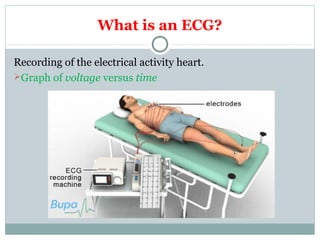
What is an ECG?
Recording of the electrical activity heart.
Graph of voltage versus time
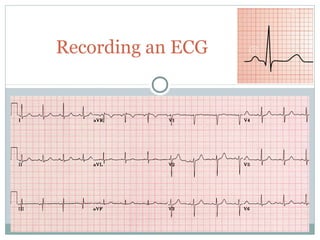
Recording an ECG
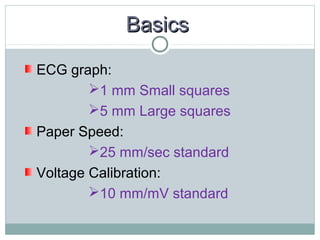
BasicsBasics
ECG graph:
1 mm Small squares
5 mm Large squares
Paper Speed:
25 mm/sec standard
Voltage Calibration:
10 mm/mV standard
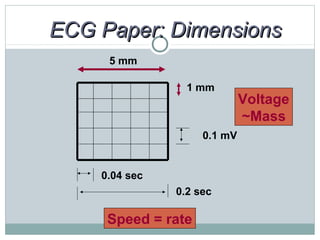
ECG Paper: DimensionsECG Paper: Dimensions
5 mm
1 mm
0.1 mV
0.04 sec
0.2 sec
Speed = rate
Voltage
~Mass
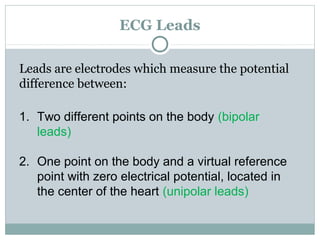
ECG Leads
Leads are electrodes which measure the potential
difference between:
1. Two different points on the body (bipolar
leads)
2. One point on the body and a virtual reference
point with zero electrical potential, located in
the center of the heart (unipolar leads)
ECG Leads
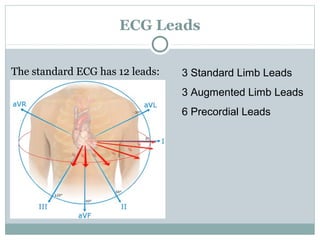
The standard ECG has 12 leads: 3 Standard Limb Leads
3 Augmented Limb Leads
6 Precordial Leads
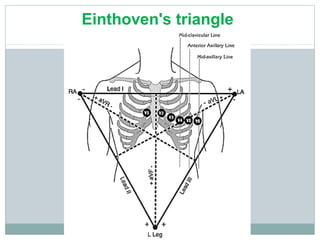
Einthoven's triangle
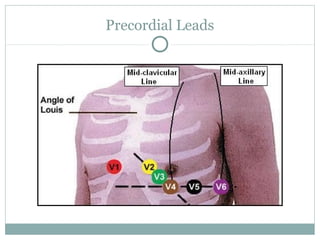
Precordial Leads
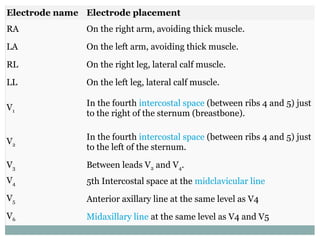
Electrode name Electrode placement
RA On the right arm, avoiding thick muscle.
LA On the left arm, avoiding thick muscle.
RL On the right leg, lateral calf muscle.
LL On the left leg, lateral calf muscle.
V1
In the fourth intercostal space (between ribs 4 and 5) just
to the right of the sternum (breastbone).
V2
In the fourth intercostal space (between ribs 4 and 5) just
to the left of the sternum.
V3 Between leads V2 and V4.
V4 5th Intercostal space at the midclavicular line
V5 Anterior axillary line at the same level as V4
V6 Midaxillary line at the same level as V4 and V5
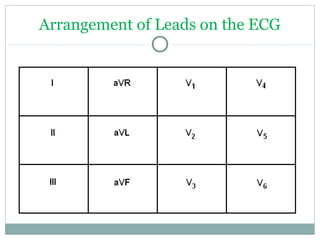
Arrangement of Leads on the ECG
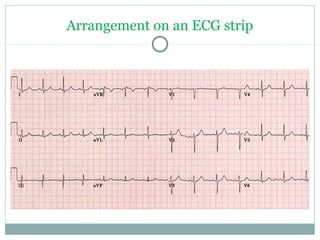
Arrangement on an ECG strip
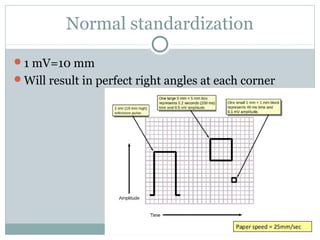
Normal standardization
1 mV=10 mm
Will result in perfect right angles at each corner
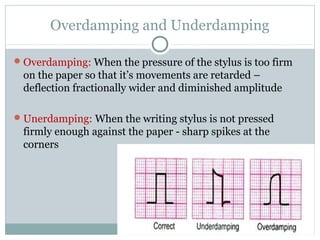
Overdamping and Underdamping
Overdamping: When the pressure of the stylus is too firm
on the paper so that it’s movements are retarded –
deflection fractionally wider and diminished amplitude
Unerdamping: When the writing stylus is not pressed
firmly enough against the paper - sharp spikes at the
corners
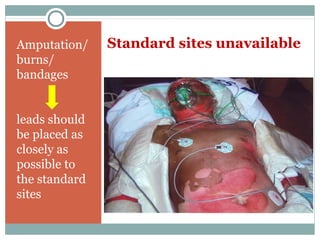
Standard sites unavailableAmputation/
burns/
bandages
leads should
be placed as
closely as
possible to
the standard
sites
Specific cardiac abnormalities
dextrocardia right & left arm electrodes should be
reversed
pre-cordial leads should be recorded from V1R(V2)
to V6
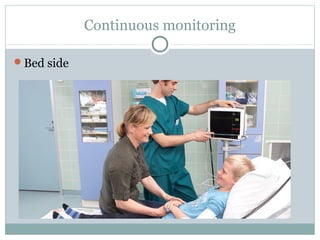
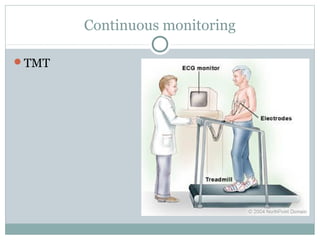
Continuous monitoring
Bed side
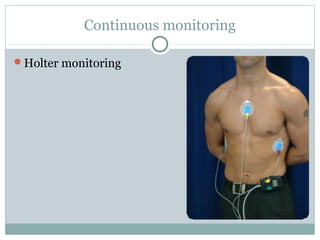
Continuous monitoring
Holter monitoring
Continuous monitoring
TMT
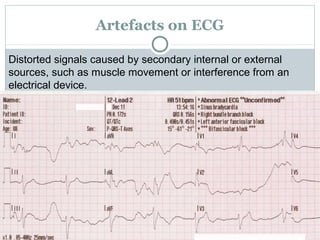
Artefacts on ECG
Distorted signals caused by secondary internal or external
sources, such as muscle movement or interference from an
electrical device.
ECG Artefacts
ECG tracing is affected by patient’s motion.
rhythmic motions (shivering or tremors) can create
the illusion of arrhythmia.
May lead to:
Altered diagnosis, treatment, outcome of
therapy and legal liabilities
Reducing Artefacts during an ECG
Patient Positioning
Supine or semi-Fowler’s position.
 If patient can’t tolerate lying flat, do the ECG in a more upright
position.
Instruct patient to place arms down by his side and
to relax the shoulders.
Patient’s legs should be uncrossed.
Place electrical devices, such as cell phones, away
from the patient as they may interfere with the
machine.
Reducing Artefacts during an ECG
Skin Preparation
Dry the skin if it’s moist or diaphoretic.
Shave any hair that interferes with electrode
placement.
 ensures a better electrode contact with the skin.
Rub an alcohol prep pad or benzoin tincture on the
skin to remove any oils and help with electrode
adhesion.
Reducing Artefacts during an ECG
Electrode Application
Check the electrodes to make sure the gel is still
moist.
Do not place the electrodes over bones.
Do not place the electrodes over areas where there is
a lot of muscle movement.
Interpretation of an ECG
Heart Rate
Rhythm
Axis
Wave morphology
Intervals and segments analysis
Specific changes (If any)
Determining the Heart Rate
Rule of 300
10 Second Rule
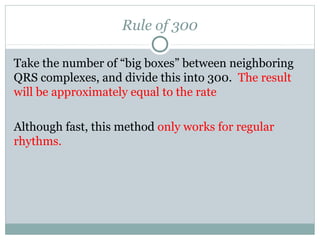
Rule of 300
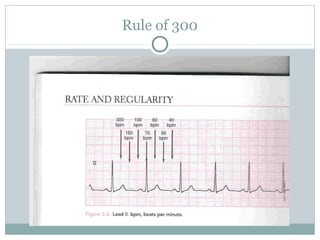
Take the number of “big boxes” between neighboring
QRS complexes, and divide this into 300. The result
will be approximately equal to the rate
Although fast, this method only works for regular
rhythms.
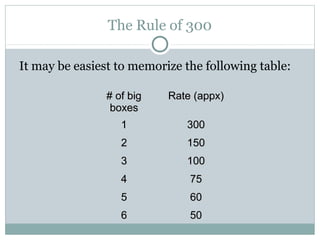
The Rule of 300
It may be easiest to memorize the following table:
# of big# of big
boxesboxes
Rate (appx)Rate (appx)
11 300300
22 150150
33 100100
44 7575
55 6060
66 5050
Rule of 300
10 Second Rule
As most ECGs record 10 seconds of rhythm per
page, one can simply count the number of beats
present on the ECG and multiply by 6 to get the
number of beats per 60 seconds.
This method works well for irregular rhythms.
QRS axis
The QRS axis represents the net overall direction of the
heart’s electrical activity.
Abnormalities of axis can hint at:
Ventricular enlargement
Conduction blocks (i.e. hemiblocks)
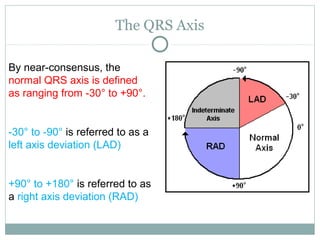
The QRS Axis
By near-consensus, the
normal QRS axis is defined
as ranging from -30° to +90°.
-30° to -90° is referred to as a
left axis deviation (LAD)
+90° to +180° is referred to as
a right axis deviation (RAD)
Determining the Axis
The Quadrant Approach
The Equiphasic Approach
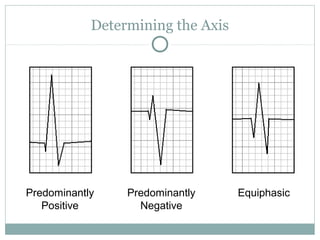
Determining the Axis
Predominantly
Positive
Predominantly
Negative
Equiphasic
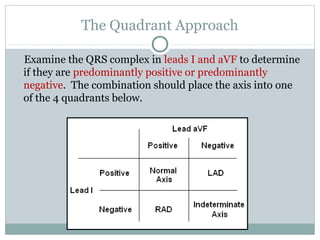
The Quadrant Approach
Examine the QRS complex in leads I and aVF to determine
if they are predominantly positive or predominantly
negative. The combination should place the axis into one
of the 4 quadrants below.
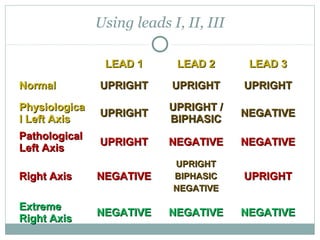
Using leads I, II, III
LEAD 1LEAD 1 LEAD 2LEAD 2 LEAD 3LEAD 3
NormalNormal UPRIGHTUPRIGHT UPRIGHTUPRIGHT UPRIGHTUPRIGHT
PhysiologicaPhysiologica
l Left Axisl Left Axis
UPRIGHTUPRIGHT
UPRIGHT /UPRIGHT /
BIPHASICBIPHASIC
NEGATIVENEGATIVE
PathologicalPathological
Left AxisLeft Axis
UPRIGHTUPRIGHT NEGATIVENEGATIVE NEGATIVENEGATIVE
Right AxisRight Axis NEGATIVENEGATIVE
UPRIGHTUPRIGHT
BIPHASICBIPHASIC
NEGATIVENEGATIVE
UPRIGHTUPRIGHT
ExtremeExtreme
Right AxisRight Axis
NEGATIVENEGATIVE NEGATIVENEGATIVE NEGATIVENEGATIVE
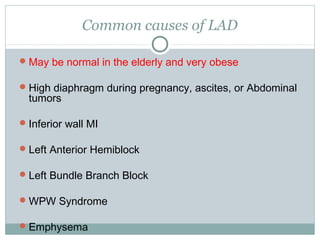
Common causes of LAD
May be normal in the elderly and very obese
High diaphragm during pregnancy, ascites, or Abdominal
tumors
Inferior wall MI
Left Anterior Hemiblock
Left Bundle Branch Block
WPW Syndrome
Emphysema
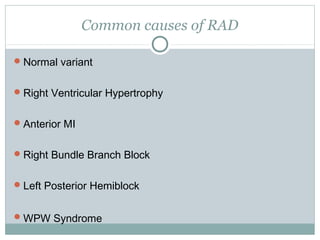
Common causes of RAD
Normal variant
Right Ventricular Hypertrophy
Anterior MI
Right Bundle Branch Block
Left Posterior Hemiblock
WPW Syndrome
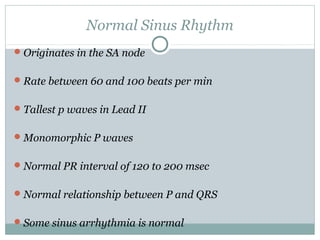
Normal Sinus Rhythm
Originates in the SA node
Rate between 60 and 100 beats per min
Tallest p waves in Lead II
Monomorphic P waves
Normal PR interval of 120 to 200 msec
Normal relationship between P and QRS
Some sinus arrhythmia is normal
Normal QRS complex
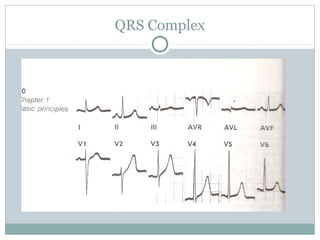
Completely negative in lead aVR , maximum positivity in
lead II
rS in right oriented leads and qR in left oriented leads
(septal vector)
Transition zone commonly in V3-V4
RV5 > RV6 normally
Normal duration 50-110 msec, not more than 120 msec
Physiological q wave not > 0.03 sec
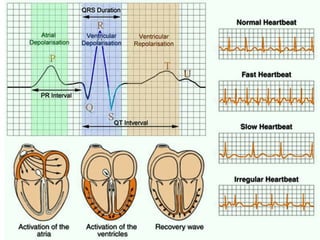
QRS Complex
Amplitude of QRS
Formed by electrical force generated by the
ventricular myocardium
Depends on:
 distance of the sensing electrode from the
ventricles
 Body build - a thin individual has larger
complexes when compared to obese individuals
Normal T wave
Same direction as the preceding QRS complex
Blunt apex with asymmetric limbs
Height < 5mm in limb leads and <10 mm in
precordial leads
Smooth contours
May be tall in athletes
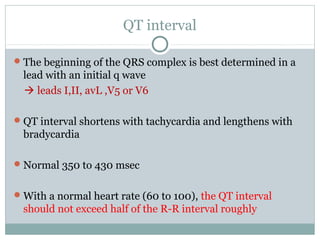
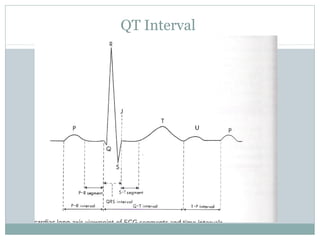
QT interval
The beginning of the QRS complex is best determined in a
lead with an initial q wave
 leads I,II, avL ,V5 or V6
QT interval shortens with tachycardia and lengthens with
bradycardia
Normal 350 to 430 msec
With a normal heart rate (60 to 100), the QT interval
should not exceed half of the R-R interval roughly
QT Interval
Reporting an ECG
“ WHOSE ECG IS IT ?!”
1. Patient Details
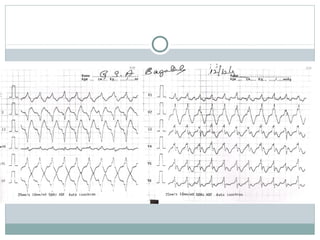
“IS IT PROPERLY TAKEN ?”
2. Standardisation and lead
placement
NORMAL OR ABNORMAL?
4. Segment and wave form
analysis
“ DOES THE ECG CORRELATE WITH
THE CLINICAL SCENARIO ?”
Final Impression
Thank you !

Basics of ecg

  • 1.
    DR. PALLAB KANTINATH MBBS, MD (ANESTHESIOLOGY) CONSULTANT PAIN MEDICINE, ANESTHESIOLOGIST, INTENSIVIST Basics of Electrocardiography for Technicians
  • 2.
    What will welearn? 1. Basics of the conduction system of heart 2. ECG leads and recording methodology 3. ECG waveforms and intervals 4. Normal ECG and its variants 5. Interpretation and reporting of an ECG
  • 4.
    What is anECG? Recording of the electrical activity heart. Graph of voltage versus time
  • 5.
  • 6.
    BasicsBasics ECG graph: 1 mmSmall squares 5 mm Large squares Paper Speed: 25 mm/sec standard Voltage Calibration: 10 mm/mV standard
  • 7.
    ECG Paper: DimensionsECGPaper: Dimensions 5 mm 1 mm 0.1 mV 0.04 sec 0.2 sec Speed = rate Voltage ~Mass
  • 8.
    ECG Leads Leads areelectrodes which measure the potential difference between: 1. Two different points on the body (bipolar leads) 2. One point on the body and a virtual reference point with zero electrical potential, located in the center of the heart (unipolar leads)
  • 9.
    ECG Leads The standardECG has 12 leads: 3 Standard Limb Leads 3 Augmented Limb Leads 6 Precordial Leads
  • 10.
  • 11.
  • 12.
    Electrode name Electrodeplacement RA On the right arm, avoiding thick muscle. LA On the left arm, avoiding thick muscle. RL On the right leg, lateral calf muscle. LL On the left leg, lateral calf muscle. V1 In the fourth intercostal space (between ribs 4 and 5) just to the right of the sternum (breastbone). V2 In the fourth intercostal space (between ribs 4 and 5) just to the left of the sternum. V3 Between leads V2 and V4. V4 5th Intercostal space at the midclavicular line V5 Anterior axillary line at the same level as V4 V6 Midaxillary line at the same level as V4 and V5
  • 13.
  • 14.
  • 15.
    Normal standardization 1 mV=10mm Will result in perfect right angles at each corner
  • 16.
    Overdamping and Underdamping Overdamping:When the pressure of the stylus is too firm on the paper so that it’s movements are retarded – deflection fractionally wider and diminished amplitude Unerdamping: When the writing stylus is not pressed firmly enough against the paper - sharp spikes at the corners
  • 17.
    Standard sites unavailableAmputation/ burns/ bandages leadsshould be placed as closely as possible to the standard sites
  • 18.
    Specific cardiac abnormalities dextrocardiaright & left arm electrodes should be reversed pre-cordial leads should be recorded from V1R(V2) to V6
  • 19.
  • 20.
  • 21.
  • 22.
    Artefacts on ECG Distortedsignals caused by secondary internal or external sources, such as muscle movement or interference from an electrical device.
  • 23.
    ECG Artefacts ECG tracingis affected by patient’s motion. rhythmic motions (shivering or tremors) can create the illusion of arrhythmia. May lead to: Altered diagnosis, treatment, outcome of therapy and legal liabilities
  • 24.
    Reducing Artefacts duringan ECG Patient Positioning Supine or semi-Fowler’s position.  If patient can’t tolerate lying flat, do the ECG in a more upright position. Instruct patient to place arms down by his side and to relax the shoulders. Patient’s legs should be uncrossed. Place electrical devices, such as cell phones, away from the patient as they may interfere with the machine.
  • 25.
    Reducing Artefacts duringan ECG Skin Preparation Dry the skin if it’s moist or diaphoretic. Shave any hair that interferes with electrode placement.  ensures a better electrode contact with the skin. Rub an alcohol prep pad or benzoin tincture on the skin to remove any oils and help with electrode adhesion.
  • 26.
    Reducing Artefacts duringan ECG Electrode Application Check the electrodes to make sure the gel is still moist. Do not place the electrodes over bones. Do not place the electrodes over areas where there is a lot of muscle movement.
  • 27.
    Interpretation of anECG Heart Rate Rhythm Axis Wave morphology Intervals and segments analysis Specific changes (If any)
  • 29.
    Determining the HeartRate Rule of 300 10 Second Rule
  • 30.
    Rule of 300 Takethe number of “big boxes” between neighboring QRS complexes, and divide this into 300. The result will be approximately equal to the rate Although fast, this method only works for regular rhythms.
  • 31.
    The Rule of300 It may be easiest to memorize the following table: # of big# of big boxesboxes Rate (appx)Rate (appx) 11 300300 22 150150 33 100100 44 7575 55 6060 66 5050
  • 32.
  • 33.
    10 Second Rule Asmost ECGs record 10 seconds of rhythm per page, one can simply count the number of beats present on the ECG and multiply by 6 to get the number of beats per 60 seconds. This method works well for irregular rhythms.
  • 34.
    QRS axis The QRSaxis represents the net overall direction of the heart’s electrical activity. Abnormalities of axis can hint at: Ventricular enlargement Conduction blocks (i.e. hemiblocks)
  • 35.
    The QRS Axis Bynear-consensus, the normal QRS axis is defined as ranging from -30° to +90°. -30° to -90° is referred to as a left axis deviation (LAD) +90° to +180° is referred to as a right axis deviation (RAD)
  • 36.
    Determining the Axis TheQuadrant Approach The Equiphasic Approach
  • 37.
  • 38.
    The Quadrant Approach Examinethe QRS complex in leads I and aVF to determine if they are predominantly positive or predominantly negative. The combination should place the axis into one of the 4 quadrants below.
  • 39.
    Using leads I,II, III LEAD 1LEAD 1 LEAD 2LEAD 2 LEAD 3LEAD 3 NormalNormal UPRIGHTUPRIGHT UPRIGHTUPRIGHT UPRIGHTUPRIGHT PhysiologicaPhysiologica l Left Axisl Left Axis UPRIGHTUPRIGHT UPRIGHT /UPRIGHT / BIPHASICBIPHASIC NEGATIVENEGATIVE PathologicalPathological Left AxisLeft Axis UPRIGHTUPRIGHT NEGATIVENEGATIVE NEGATIVENEGATIVE Right AxisRight Axis NEGATIVENEGATIVE UPRIGHTUPRIGHT BIPHASICBIPHASIC NEGATIVENEGATIVE UPRIGHTUPRIGHT ExtremeExtreme Right AxisRight Axis NEGATIVENEGATIVE NEGATIVENEGATIVE NEGATIVENEGATIVE
  • 40.
    Common causes ofLAD May be normal in the elderly and very obese High diaphragm during pregnancy, ascites, or Abdominal tumors Inferior wall MI Left Anterior Hemiblock Left Bundle Branch Block WPW Syndrome Emphysema
  • 41.
    Common causes ofRAD Normal variant Right Ventricular Hypertrophy Anterior MI Right Bundle Branch Block Left Posterior Hemiblock WPW Syndrome
  • 42.
    Normal Sinus Rhythm Originatesin the SA node Rate between 60 and 100 beats per min Tallest p waves in Lead II Monomorphic P waves Normal PR interval of 120 to 200 msec Normal relationship between P and QRS Some sinus arrhythmia is normal
  • 43.
    Normal QRS complex Completelynegative in lead aVR , maximum positivity in lead II rS in right oriented leads and qR in left oriented leads (septal vector) Transition zone commonly in V3-V4 RV5 > RV6 normally Normal duration 50-110 msec, not more than 120 msec Physiological q wave not > 0.03 sec
  • 44.
  • 45.
    Amplitude of QRS Formedby electrical force generated by the ventricular myocardium Depends on:  distance of the sensing electrode from the ventricles  Body build - a thin individual has larger complexes when compared to obese individuals
  • 46.
    Normal T wave Samedirection as the preceding QRS complex Blunt apex with asymmetric limbs Height < 5mm in limb leads and <10 mm in precordial leads Smooth contours May be tall in athletes
  • 47.
    QT interval The beginningof the QRS complex is best determined in a lead with an initial q wave  leads I,II, avL ,V5 or V6 QT interval shortens with tachycardia and lengthens with bradycardia Normal 350 to 430 msec With a normal heart rate (60 to 100), the QT interval should not exceed half of the R-R interval roughly
  • 48.
  • 49.
  • 50.
    “ WHOSE ECGIS IT ?!” 1. Patient Details
  • 51.
    “IS IT PROPERLYTAKEN ?” 2. Standardisation and lead placement
  • 53.
    NORMAL OR ABNORMAL? 4.Segment and wave form analysis
  • 54.
    “ DOES THEECG CORRELATE WITH THE CLINICAL SCENARIO ?” Final Impression
  • 55.

Editor's Notes

  • #10 Limb leads: Leads I, II and III are called the limb leads. The electrodes that form these signals are located on the limbs—one on each arm and one on the left leg. The limb leads form the points of what is known as Einthoven&amp;apos;s triangle. Augmented limb leads: Leads aVR, aVL, and aVF are the augmented limb leads. They are derived from the same three electrodes as leads I, II, and III, but they use Goldberger&amp;apos;s central terminal as their negative pole which is a combination of inputs from other two limb electrodes. Precordial leads: The precordial leads lie in the transverse (horizontal) plane, perpendicular to the other six leads. The six precordial electrodes act as the positive poles for the six corresponding precordial leads: (V1, V2, V3, V4, V5 and V6). Wilson&amp;apos;s central terminal is used as the negative pole.
  • #11 Einthoven&amp;apos;s triangle is an imaginary formation of three limb leads in a triangle It is formed by the two shoulders and the pubis.  The shape forms an inverted equilateral triangle with the heart at the center that produces zero potential when the voltages are summed It is named after Willem Einthoven who theorized its existence
  • #35 -0