Jijo Thomas
Cath Lab
Cath Lab
 A catheterization laboratory or cath lab is an
examination room in a hospital or clinic with
diagnostic imaging equipment used to visualize the
arteries of the heart and the chambers of the heart and
treat any stenosis or abnormality found.
Cath Lab unit
 It is a sterile unit, similar to OT.
 Equipped with all emergency equipments.
 It’s a radiation department, all the procedures done
under fluoroscopy.
 Most of the procedures done under local anesthesia
and the co operation of patient is very important.
 A medical contrast medium (Dye) is used for
visualisation of structures or fluids within the body in
medical imaging.
Cath Lab procedures
 Angiogram
 Angioplasty and stenting
 Pacemaker implantation
 IABP
 Device closures
 Thrombus aspiration
 EPS and RFA
 Embolisation
Pre - cath Care and preparations
 History and physical examination
 Explain the procedure to the patient
 Informed consent
 Financial clearance
 Part preparation
 I V line
 NPO
 Remove ornaments and dentures.
 Blood investigations
 Record Vital signs, height and weight
Contd.
 Last dose of heparin or any anti coagulants.
 Previous cath records.
 Investigations such as ECG, Echo, TMT etc.
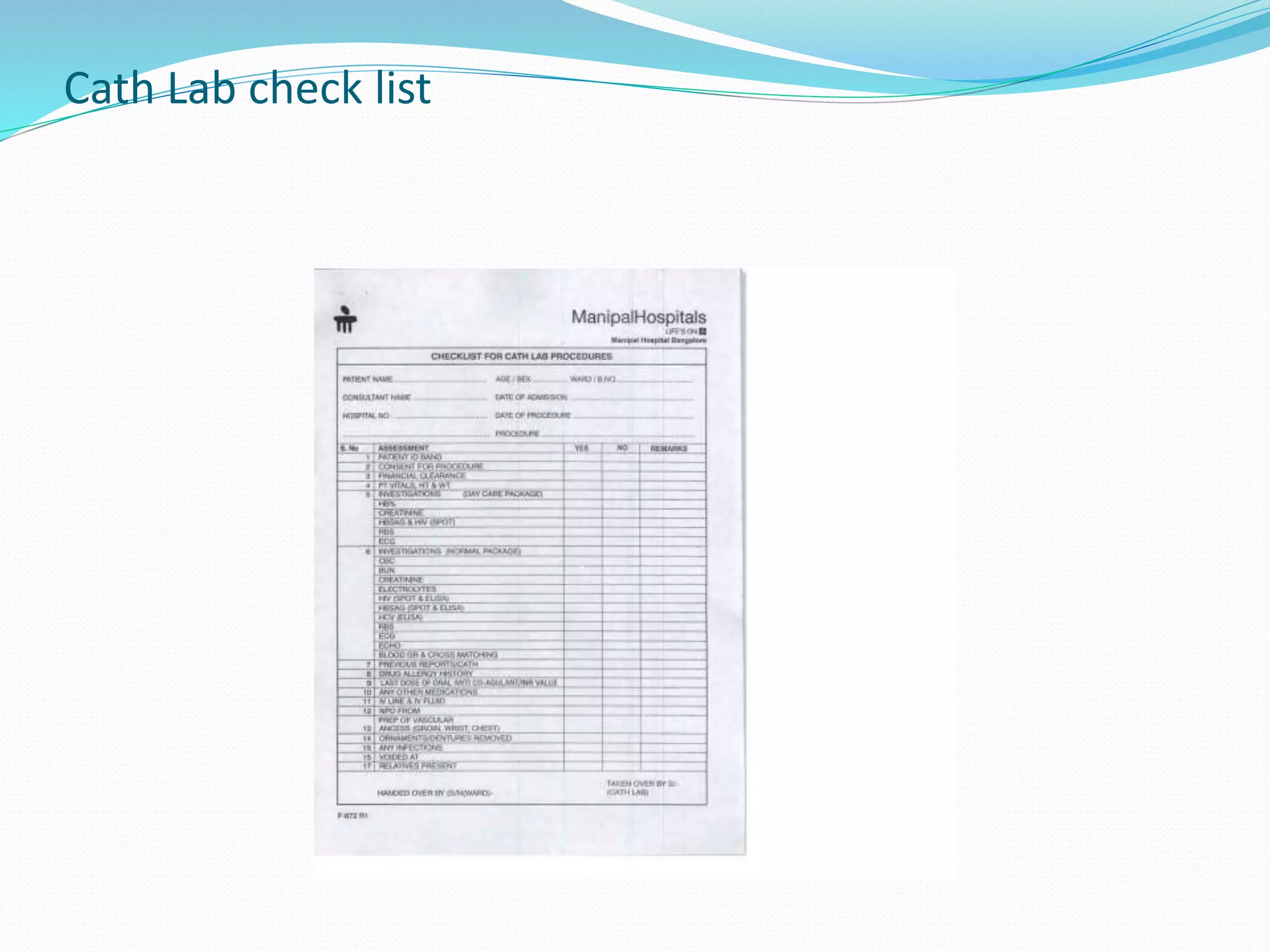
 Follow the check list for Cath Lab procedures F- 872.
 Inform and transfer the patient to the cath lab
according to the time scheduled for the procedure.
 Relatives of the patient , must be present.
Cath Lab check list
Intra - Cath care
• Explani the procedure to the patient and provide
psychological support
• Make the patient lie on the cath table.
• Ensure monitoring vitals, ECG, Spo2, BP etc.
• Maintain good I V line and I V Fluid on flow.
• Prepare the preferred site for the procedure ( radial,
femoral, brachial, jugular etc.)
• Scrub and prepare the sterile trolley with all necessory
equipments
• Sterile draping and connect the necessary devises
• Assist the Doctor for the procedure
• Monitoring and recording ECG, Spo2 and Arterial Blood
Pressure.
Post Cath Care
 Clean the cath site and apply pressure dressing
 Shift the patient to Recovery ( CCU )
 Monitor Vitals and take a 12 Lead ECG
 Educate the patient not to mobilize the cath site for 4 to 6
hrs.
 Watch for complications such as
hematoma and Bleeding
dye reactions
cardiac arrhythmia
Pulmonary Embolism
Pneumothorax
Myocardial Infraction etc.
gg
Jijo Thomas
Cath Lab – MHW

catheterization laboratory procedure

  • 1.
  • 2.
    Cath Lab  Acatheterization laboratory or cath lab is an examination room in a hospital or clinic with diagnostic imaging equipment used to visualize the arteries of the heart and the chambers of the heart and treat any stenosis or abnormality found.
  • 4.
    Cath Lab unit It is a sterile unit, similar to OT.  Equipped with all emergency equipments.  It’s a radiation department, all the procedures done under fluoroscopy.  Most of the procedures done under local anesthesia and the co operation of patient is very important.  A medical contrast medium (Dye) is used for visualisation of structures or fluids within the body in medical imaging.
  • 5.
    Cath Lab procedures Angiogram  Angioplasty and stenting  Pacemaker implantation  IABP  Device closures  Thrombus aspiration  EPS and RFA  Embolisation
  • 6.
    Pre - cathCare and preparations  History and physical examination  Explain the procedure to the patient  Informed consent  Financial clearance  Part preparation  I V line  NPO  Remove ornaments and dentures.  Blood investigations  Record Vital signs, height and weight
  • 7.
    Contd.  Last doseof heparin or any anti coagulants.  Previous cath records.  Investigations such as ECG, Echo, TMT etc.  Follow the check list for Cath Lab procedures F- 872.  Inform and transfer the patient to the cath lab according to the time scheduled for the procedure.  Relatives of the patient , must be present.
  • 8.
  • 9.
    Intra - Cathcare • Explani the procedure to the patient and provide psychological support • Make the patient lie on the cath table. • Ensure monitoring vitals, ECG, Spo2, BP etc. • Maintain good I V line and I V Fluid on flow. • Prepare the preferred site for the procedure ( radial, femoral, brachial, jugular etc.) • Scrub and prepare the sterile trolley with all necessory equipments • Sterile draping and connect the necessary devises • Assist the Doctor for the procedure • Monitoring and recording ECG, Spo2 and Arterial Blood Pressure.
  • 10.
    Post Cath Care Clean the cath site and apply pressure dressing  Shift the patient to Recovery ( CCU )  Monitor Vitals and take a 12 Lead ECG  Educate the patient not to mobilize the cath site for 4 to 6 hrs.  Watch for complications such as hematoma and Bleeding dye reactions cardiac arrhythmia Pulmonary Embolism Pneumothorax Myocardial Infraction etc.
  • 11.