IABP- Instrumentation, Indications
and Complications
Dr Sajeer KT
Senior Resident
Dept.of Cardiology, MCH Calicut
1
Intra aortic balloon counter pulsation( IABP):
Concepts:
- Systolic unloading
- Diastolic augmentation
Indications for IABP
1. Cardiogenic shock:
2. In association with CABG :
Preoperative insertion
- Patients with severe LV dysfunction
- Patients with intractable ischemic arrhythmias
Postoperative insertion
- Postcardiotomy cardiogenic shock
- Associated with acute MI
- Mechanical complications of MI - MR , VSD
3. In association with nonsurgical revascularization:
- Hemodynamically unstable infarct patients
- High risk coronary interventions
●
- severe LV dysfunction, LMCA, complex coronary artery
disease
4. Stabilization of cardiac transplant recipient before insertion of VAD
Post infarction angina
Ventricular arrhythmias relathed to ischemia
Contraindications to IABP
 Severe aortic insufficiency
 Aortic aneurysm
 Aortic dissection
 Limb ischemia
 Thrombo embolism
LV contraction:
- Isovol. Contraction (b)
- maximal ejection (c)
LV relaxation:
- start of relaxation and reduced
ejection (d)
- isovol.relaxation (e)
LV filling:
- LV filling , rapid phase (f)
- slow LV filling (g)
- atrial systole( a)
Cardiac cycle
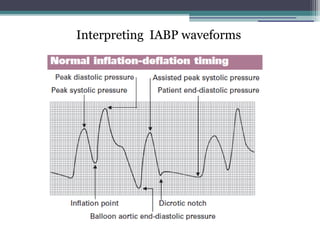
Interpreting IABP waveforms
IABP –instrumentation and
techniques
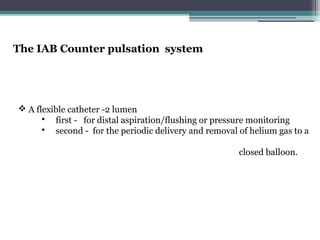
The IAB Counter pulsation system
 A flexible catheter -2 lumen
• first - for distal aspiration/flushing or pressure monitoring
• second - for the periodic delivery and removal of helium gas to a
closed balloon.
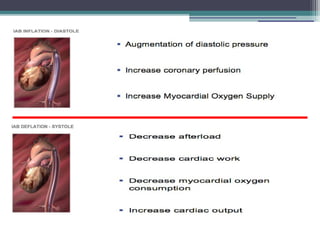
HEMODYNAMIC EFFECTS — Inflation and deflation of the balloon
• Blood is displaced to the proximal aorta by inflation during
• diastole.
• Aortic volume ( afterload) is reduced during systole through
a
vacuum effect created by rapid balloon deflation
Expected changes with IABP support in hemodynamic profile in
patients with Cardiogenic shock
- Decrease in SBP by 20 %
- Increase in aortic Diastolic Press. by 30 % ( raise coronary blood flow)
- Increase in MAP
- Reduction of the HR by 20%
-Decrease in the mean PCWP by 20 %
- Elevation in the COP by 20%
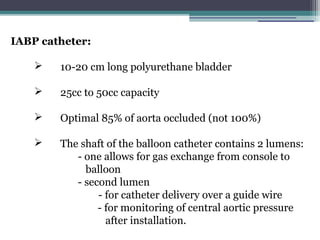
IABP catheter:
 10-20 cm long polyurethane bladder
 25cc to 50cc capacity
 Optimal 85% of aorta occluded (not 100%)
 The shaft of the balloon catheter contains 2 lumens:
- one allows for gas exchange from console to
balloon
- second lumen
- for catheter delivery over a guide wire
- for monitoring of central aortic pressure
after installation.
Intra Aortic Balloon
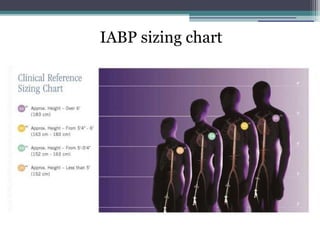
IABP sizing chart
Benefits of larger volume IABs
􀁑 More blood volume displacement
􀁑 More diastolic augmentation
􀁑 More systolic unloading
Introducer needle
• Guide wire
• Vessel dilators
• Sheath
• IABP (34 or 40cc)
• Gas tubing
• 60-mL syringe
• Three-way stopcock
IABP Kit Contents
Intraaortic balloon
Connect ECG
Set up pressure lines
Femoral access – followed by insertion of the supplied
sheath(7.5 F)
0.030 inch supplied J-shaped guide wire to the level of the
aortic arch (LAO view)
STEP BY STEP- IABP insertion
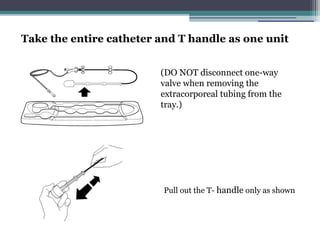
Before taking the Catheter out of Tray
Take the entire catheter and T handle as one unit
(DO NOT disconnect one-way
valve when removing the
extracorporeal tubing from the
tray.)
Pull out the T- handle only as shown
●
• Remove stylet/aspirate/Flush
●
• Insert the balloon only over the guide wire
●
• Hold the catheter close to skin insertion point
●
• Advance in small steps of 1 to 2 cm at a time and
●
stop if any resistance.
●
• The IABP should advance freely
Inserting the Balloon catheter
- Many vascular complications occur during insertion itself
- Resistance during insertion either indicates PVOD, or dissection
- Kinking of IABP » improper inflation/deflation
- The end of the balloon should be just distal (1-2 cm) to the takeoff of the
left subclavian artery
- Position should be confirmed by fluoroscopy or chest x-ray
Positioning
Connecting to console:
- Connect helium gas tube to the console via a long extender
- Open helium tank.
- The central lumen of the catheter is flushed and connected to
pressure
tubing with 3 way and then to a pressure transducer to allow for
monitoring of central aortic pressure.
- Zero the transducer
Initial set-up:
- Once connected properly the console would show ECG and pressure
waveforms.
- Check Basal mean pressure
- Make sure the setting is at “auto”
- Usually IABP started at 1:1 or 1:2 augmentation
- Usually Augmentation is kept at maxim
Trigger modes
Trigger :
- Event the pump uses to identify the onset of cardiac cycle (systole)
- Pump must have consistent trigger in order to provide patient assist
- If selected trigger not detected, counter pulsation will interrupted
1.ECG
- uses the slope of QR segment to detect triggering point
2. AP(Arterial pressure wave)
- Systolic upstroke of the arterial pressure wave form is the trigger
3. IN(Internal trigger)
ECG signal – most common
• Inflation
- middle of T wave
• Deflation
– peak of R wave
• Pacer (v/a)
• Arterial waveform
• An intrinsic pump rate
(VF, CPB)
Auto Operation Mode
􀁑 Automatic lead and trigger selection
􀁑 Automatic and continuous inflation
and deflation timing management
- User has ability to fine-tune
deflation timing
􀁑 Automatic management of irregular
rhythms
Semi-Auto Operation Mode
􀁑 Operator selects most appropriate
lead and trigger source
Initial settings
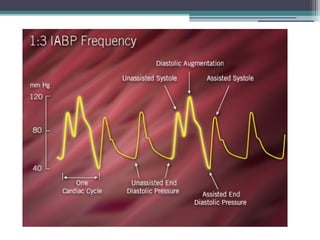
Increased coronary
perfusion
The “normal” augmented waveform
Not all Sub optimal augmentation is due to Timing
errors/kinks
Factors affecting diastolic augmentation
Patient
- Heart rate
- Mean arterial pressure
- Stroke volume
- Systemic vascular resistance
Intra aortic balloon catheter
- IAB in sheath
- IAB not unfolded
- IAB position
- Kink in the IAB catheter
- IAB leak
- Low helium concentration
Intra aortic balloon pump
- Timing
- Position of IAB augmentation control
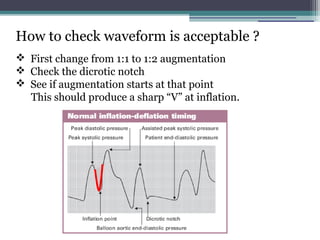
How to check waveform is acceptable ?
 First change from 1:1 to 1:2 augmentation
How to check waveform is acceptable ?
 First change from 1:1 to 1:2 augmentation
 Check the dicrotic notch
 See if augmentation starts at that point
This should produce a sharp “V” at inflation.
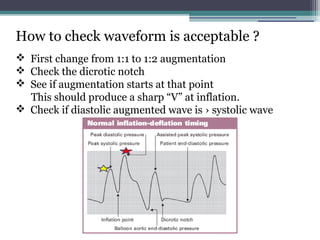
How to check waveform is acceptable ?
 First change from 1:1 to 1:2 augmentation
 Check the dicrotic notch
 See if augmentation starts at that point
This should produce a sharp “V” at inflation.
 Check if diastolic augmented wave is › systolic wave
How to check waveform is acceptable ?
 First change from 1:1 to 1:2 augmentation
 Check the dicrotic notch
 See if augmentation starts at that point
This should produce a sharp “V” at inflation.
 Check if diastolic augmented wave is › systolic wave
 Confirm if end diastolic wave
following the augmented wave
is less than an non augmented
wave.
 Is Deflation slope ok
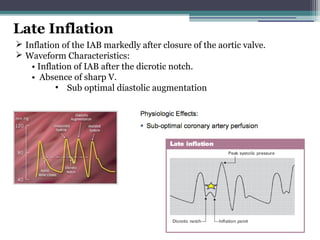
Late Inflation
 Inflation of the IAB markedly after closure of the aortic valve.
 Waveform Characteristics:
• Inflation of IAB after the dicrotic notch.
• Absence of sharp V.
●
Sub optimal diastolic augmentation
Early Deflation
 Premature deflation of the IAB during the diastolic phase.
Late Deflation
 Late deflation of the IAB during the diastolic phase.
 Waveform Characteristics:
• Assisted aortic end diastolic pressure may be equal to the
unassisted aortic end diastolic pressure.
• Rate of rise of assisted systole is prolonged.
• Diastolic augmentation may appear widened
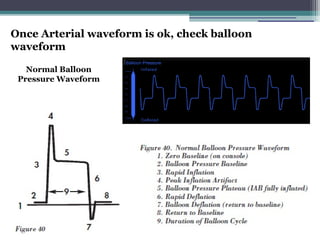
Once Arterial waveform is ok, check balloon
waveform
Normal Balloon
Pressure Waveform
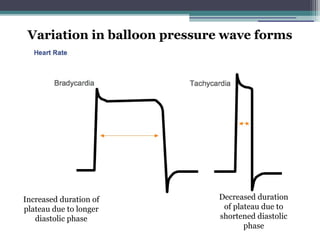
Variation in balloon pressure wave forms
Increased duration of
plateau due to longer
diastolic phase
Decreased duration
of plateau due to
shortened diastolic
phase
Variation in balloon pressure wave forms
Varying R-R intervals
result in irregular
plateau durations
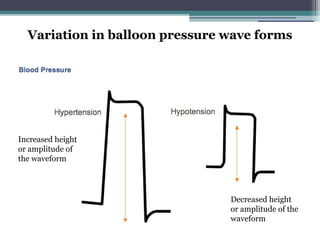
Variation in balloon pressure wave forms
Increased height
or amplitude of
the waveform
Decreased height
or amplitude of the
waveform
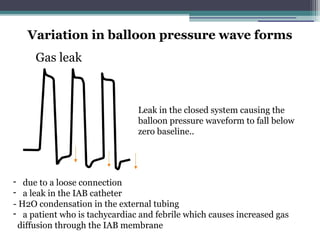
Variation in balloon pressure wave forms
Gas leak
Leak in the closed system causing the
balloon pressure waveform to fall below
zero baseline..
- due to a loose connection
- a leak in the IAB catheter
- H2O condensation in the external tubing
- a patient who is tachycardiac and febrile which causes increased gas
diffusion through the IAB membrane
Catheter Kink
Rounded balloon pressure waveform
- Loss of plateau resulting from a kink or
obstruction of shuttle gas
- Kink in the catheter tubing
- Improper IAB catheter position
- Sheath not being pulled back to allow
inflation of the IAB
- IAB is too large for the aorta
- IAB is not fully unwrapped
- H2O condensation in the external tubing
“Balloon too
large”
syndrome
Patient Management During IABP support
 Anticoagulation-- maintain apTT at 50 to 70 seconds
 CXR daily – to R/O IAB migration
 Check lower limb pulses - 2 hourly.
- If not palpable » ? - vascular obstruction
- thrombus, embolus, or dissection
(urgent surgical consultation)
 Prophylactic antibiotics --??
 Hip flexion is restricted, and the head of the bed should not be
elevated beyond 30°.
 Never leave in standby by mode for more than 20 minutes >
thrombus formation
 Daily
– Haemoglobin (risk of bleeding or haemolysis)
– Platelet count (risk of thrombocytopenia)
– Renal function (risk of acute kidney injury secondary to distal
migration of IABP catheter)
 Wean off the IABP as early as possible as longer duration is associated
with higher incidence of limb complications
Patient Management During IABP support
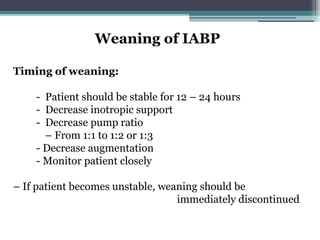
Weaning of IABP
Timing of weaning:
- Patient should be stable for 12 – 24 hours
- Decrease inotropic support
- Decrease pump ratio
– From 1:1 to 1:2 or 1:3
- Decrease augmentation
- Monitor patient closely
– If patient becomes unstable, weaning should be
immediately discontinued
IABP Removal
- Discontinue heparin six hours prior to removal
- Disconnect the IAB catheter from the IAB pump
- Patient blood pressure will collapse the balloon membrane for withdrawal
- Withdraw the IAB catheter through the introducer sheath until resistance
is met.
- NEVER attempt to withdraw the balloon membrane through the
introducer sheath.
- Remove the IAB catheter and the introducer sheath as a unit
- Check for adequacy of limb perfusion after hemostasis is achieved.
Thank you
• 1. Major physiological effects of counter pulsation include?
▫ A) increased coronary artery perfusion, increased preload, decreased
after load, decreased myocardial oxygen consumption
▫ B) increased coronary artery perfusion, increased preload, increased
after load, decreased myocardial oxygen consumption
▫ C) increased coronary artery perfusion, decreased preload, decreased
after load, increased myocardial oxygen consumption
▫ D) increased coronary artery perfusion, decreased preload, decreased
after load, decreased myocardial oxygen consumption
2. the dicrotic notch on the arterial wave form
reflects
A) aortic valve opening
B) aortic valve closure
C) isovolumetric contraction
D)rapid ejection
3. Expected changes with IABP support in hemodynamic
profile in patients with Cardiogenic shock include all except?
A) Decrease in SBP by 20 %
B) Increase in aortic DP by 30 %
C) Decrease in MAP by 10%
D) Reduction of the HR by 20%
E)Decrease in the mean PCWP by 20 %
4. late inflation of the balloon can result in?
A) premature augmentation
B) increased augmentation
C) decreased augmentation
D) increased coronary perfusion
5. A rounded balloon pressure wave form indicate?
A) helium leak
B) power failure
C) hypovolemia
D) balloon occluding the aorta
6. width of balloon pressure wave form
corresponds to
A) length of systole
B) length of diastole
C) arterial pressure
D) helium level
7. true statement
a) Dicrotic notch- land mark used to set deflation
b) Deflation is timed to occur during period of iso
volumetric contraction
c) Most common trigger used is arterial pressure wave
method
d) Internal trigger mode is acceptable to use in a patient
with normal sinus rhythm
8. true statement
A) pacing spikes are automatically rejected in ECG
triggered modes
B) pacing trigger modes can be used in a patient of
50% paced rhythm
C) Varying R-R interval result in regular plateau
durations in Balloon pressureWave form
9. Identify the tracing abnormality
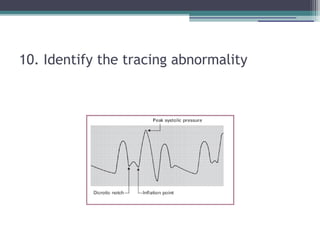
10. Identify the tracing abnormality
• 1. Major physiological effects of counter pulsation include?
▫ A) increased coronary artery perfusion, increased preload, decreased
after load, decreased myocardial oxygen consumption
▫ B) increased coronary artery perfusion, increased preload, increased
after load, decreased myocardial oxygen consumption
▫ C) increased coronary artery perfusion, decreased preload, decreased
after load, increased myocardial oxygen consumption
▫ D) increased coronary artery perfusion, decreased preload, decreased
after load, decreased myocardial oxygen consumption
2. the dicrotic notch on the arterial wave form
reflects
A) aortic valve opening
B) aortic valve closure
C) isovolumetric contraction
D)rapid ejection
3. Expected changes with IABP support in hemodynamic
profile in patients with Cardiogenic shock include all except?
•A) Decrease in SBP by 20 %
•B) Increase in aortic DP by 30 %
•C) Decrease in MAP by 10%
•D) Reduction of the HR by 20%
•E)Decrease in the mean PCWP by 20 %
4. late inflation of the balloon can result in?
• A) premature augmentation
• B) increased augmentation
• C) decreased augmentation
• D) increased coronary perfusion
5. A rounded balloon pressure wave form indicate?
• A) helium leak
• B) power failure
• C) hypovolemia
• D) balloon occluding the aorta
6. width of balloon pressure wave form
corresponds to
• A) length of systole
• B) length of diastole
• C) arterial pressure
• D) helium level
7. true statement
a) Dicrotic notch- land mark used to set deflation
b) Deflation is timed to occur during period of iso
volumetric contraction
c) Most common trigger used is arterial pressure wave
method
d) Internal trigger mode is acceptable to use in a patient
with normal sinus rhythm
8. true statement
A) pacing spikes are automatically rejected in ECG
triggered modes
B) pacing trigger modes can be used in a patient of
50% paced rhyth
C) Varying R-R interval result in regular plateau
durations in Balloon press. Wave form
9.
10.

INTRA AORTIC BALLON PUMP (IABP)

  • 1.
    IABP- Instrumentation, Indications andComplications Dr Sajeer KT Senior Resident Dept.of Cardiology, MCH Calicut 1
  • 2.
    Intra aortic ballooncounter pulsation( IABP): Concepts: - Systolic unloading - Diastolic augmentation
  • 4.
    Indications for IABP 1.Cardiogenic shock: 2. In association with CABG : Preoperative insertion - Patients with severe LV dysfunction - Patients with intractable ischemic arrhythmias Postoperative insertion - Postcardiotomy cardiogenic shock - Associated with acute MI - Mechanical complications of MI - MR , VSD 3. In association with nonsurgical revascularization: - Hemodynamically unstable infarct patients - High risk coronary interventions ● - severe LV dysfunction, LMCA, complex coronary artery disease 4. Stabilization of cardiac transplant recipient before insertion of VAD Post infarction angina Ventricular arrhythmias relathed to ischemia
  • 5.
    Contraindications to IABP Severe aortic insufficiency  Aortic aneurysm  Aortic dissection  Limb ischemia  Thrombo embolism
  • 7.
    LV contraction: - Isovol.Contraction (b) - maximal ejection (c) LV relaxation: - start of relaxation and reduced ejection (d) - isovol.relaxation (e) LV filling: - LV filling , rapid phase (f) - slow LV filling (g) - atrial systole( a) Cardiac cycle
  • 13.
  • 14.
  • 15.
    The IAB Counterpulsation system  A flexible catheter -2 lumen • first - for distal aspiration/flushing or pressure monitoring • second - for the periodic delivery and removal of helium gas to a closed balloon.
  • 17.
    HEMODYNAMIC EFFECTS —Inflation and deflation of the balloon • Blood is displaced to the proximal aorta by inflation during • diastole. • Aortic volume ( afterload) is reduced during systole through a vacuum effect created by rapid balloon deflation
  • 18.
    Expected changes withIABP support in hemodynamic profile in patients with Cardiogenic shock - Decrease in SBP by 20 % - Increase in aortic Diastolic Press. by 30 % ( raise coronary blood flow) - Increase in MAP - Reduction of the HR by 20% -Decrease in the mean PCWP by 20 % - Elevation in the COP by 20%
  • 20.
    IABP catheter:  10-20cm long polyurethane bladder  25cc to 50cc capacity  Optimal 85% of aorta occluded (not 100%)  The shaft of the balloon catheter contains 2 lumens: - one allows for gas exchange from console to balloon - second lumen - for catheter delivery over a guide wire - for monitoring of central aortic pressure after installation.
  • 21.
  • 22.
  • 23.
    Benefits of largervolume IABs 􀁑 More blood volume displacement 􀁑 More diastolic augmentation 􀁑 More systolic unloading
  • 24.
    Introducer needle • Guidewire • Vessel dilators • Sheath • IABP (34 or 40cc) • Gas tubing • 60-mL syringe • Three-way stopcock IABP Kit Contents
  • 25.
  • 26.
    Connect ECG Set uppressure lines Femoral access – followed by insertion of the supplied sheath(7.5 F) 0.030 inch supplied J-shaped guide wire to the level of the aortic arch (LAO view) STEP BY STEP- IABP insertion
  • 27.
    Before taking theCatheter out of Tray
  • 28.
    Take the entirecatheter and T handle as one unit (DO NOT disconnect one-way valve when removing the extracorporeal tubing from the tray.) Pull out the T- handle only as shown
  • 29.
    ● • Remove stylet/aspirate/Flush ● •Insert the balloon only over the guide wire ● • Hold the catheter close to skin insertion point ● • Advance in small steps of 1 to 2 cm at a time and ● stop if any resistance. ● • The IABP should advance freely Inserting the Balloon catheter - Many vascular complications occur during insertion itself - Resistance during insertion either indicates PVOD, or dissection - Kinking of IABP » improper inflation/deflation
  • 30.
    - The endof the balloon should be just distal (1-2 cm) to the takeoff of the left subclavian artery - Position should be confirmed by fluoroscopy or chest x-ray Positioning
  • 31.
    Connecting to console: -Connect helium gas tube to the console via a long extender - Open helium tank. - The central lumen of the catheter is flushed and connected to pressure tubing with 3 way and then to a pressure transducer to allow for monitoring of central aortic pressure. - Zero the transducer Initial set-up: - Once connected properly the console would show ECG and pressure waveforms. - Check Basal mean pressure - Make sure the setting is at “auto” - Usually IABP started at 1:1 or 1:2 augmentation - Usually Augmentation is kept at maxim
  • 33.
    Trigger modes Trigger : -Event the pump uses to identify the onset of cardiac cycle (systole) - Pump must have consistent trigger in order to provide patient assist - If selected trigger not detected, counter pulsation will interrupted 1.ECG - uses the slope of QR segment to detect triggering point 2. AP(Arterial pressure wave) - Systolic upstroke of the arterial pressure wave form is the trigger 3. IN(Internal trigger)
  • 34.
    ECG signal –most common • Inflation - middle of T wave • Deflation – peak of R wave • Pacer (v/a) • Arterial waveform • An intrinsic pump rate (VF, CPB)
  • 35.
    Auto Operation Mode 􀁑Automatic lead and trigger selection 􀁑 Automatic and continuous inflation and deflation timing management - User has ability to fine-tune deflation timing 􀁑 Automatic management of irregular rhythms Semi-Auto Operation Mode 􀁑 Operator selects most appropriate lead and trigger source Initial settings
  • 40.
  • 41.
    Not all Suboptimal augmentation is due to Timing errors/kinks
  • 42.
    Factors affecting diastolicaugmentation Patient - Heart rate - Mean arterial pressure - Stroke volume - Systemic vascular resistance Intra aortic balloon catheter - IAB in sheath - IAB not unfolded - IAB position - Kink in the IAB catheter - IAB leak - Low helium concentration Intra aortic balloon pump - Timing - Position of IAB augmentation control
  • 43.
    How to checkwaveform is acceptable ?  First change from 1:1 to 1:2 augmentation
  • 45.
    How to checkwaveform is acceptable ?  First change from 1:1 to 1:2 augmentation  Check the dicrotic notch  See if augmentation starts at that point This should produce a sharp “V” at inflation.
  • 46.
    How to checkwaveform is acceptable ?  First change from 1:1 to 1:2 augmentation  Check the dicrotic notch  See if augmentation starts at that point This should produce a sharp “V” at inflation.  Check if diastolic augmented wave is › systolic wave
  • 47.
    How to checkwaveform is acceptable ?  First change from 1:1 to 1:2 augmentation  Check the dicrotic notch  See if augmentation starts at that point This should produce a sharp “V” at inflation.  Check if diastolic augmented wave is › systolic wave  Confirm if end diastolic wave following the augmented wave is less than an non augmented wave.  Is Deflation slope ok
  • 49.
    Late Inflation  Inflationof the IAB markedly after closure of the aortic valve.  Waveform Characteristics: • Inflation of IAB after the dicrotic notch. • Absence of sharp V. ● Sub optimal diastolic augmentation
  • 50.
    Early Deflation  Prematuredeflation of the IAB during the diastolic phase.
  • 51.
    Late Deflation  Latedeflation of the IAB during the diastolic phase.  Waveform Characteristics: • Assisted aortic end diastolic pressure may be equal to the unassisted aortic end diastolic pressure. • Rate of rise of assisted systole is prolonged. • Diastolic augmentation may appear widened
  • 52.
    Once Arterial waveformis ok, check balloon waveform Normal Balloon Pressure Waveform
  • 54.
    Variation in balloonpressure wave forms Increased duration of plateau due to longer diastolic phase Decreased duration of plateau due to shortened diastolic phase
  • 55.
    Variation in balloonpressure wave forms Varying R-R intervals result in irregular plateau durations
  • 56.
    Variation in balloonpressure wave forms Increased height or amplitude of the waveform Decreased height or amplitude of the waveform
  • 57.
    Variation in balloonpressure wave forms Gas leak Leak in the closed system causing the balloon pressure waveform to fall below zero baseline.. - due to a loose connection - a leak in the IAB catheter - H2O condensation in the external tubing - a patient who is tachycardiac and febrile which causes increased gas diffusion through the IAB membrane
  • 58.
    Catheter Kink Rounded balloonpressure waveform - Loss of plateau resulting from a kink or obstruction of shuttle gas - Kink in the catheter tubing - Improper IAB catheter position - Sheath not being pulled back to allow inflation of the IAB - IAB is too large for the aorta - IAB is not fully unwrapped - H2O condensation in the external tubing
  • 59.
  • 60.
    Patient Management DuringIABP support  Anticoagulation-- maintain apTT at 50 to 70 seconds  CXR daily – to R/O IAB migration  Check lower limb pulses - 2 hourly. - If not palpable » ? - vascular obstruction - thrombus, embolus, or dissection (urgent surgical consultation)  Prophylactic antibiotics --??  Hip flexion is restricted, and the head of the bed should not be elevated beyond 30°.
  • 61.
     Never leavein standby by mode for more than 20 minutes > thrombus formation  Daily – Haemoglobin (risk of bleeding or haemolysis) – Platelet count (risk of thrombocytopenia) – Renal function (risk of acute kidney injury secondary to distal migration of IABP catheter)  Wean off the IABP as early as possible as longer duration is associated with higher incidence of limb complications Patient Management During IABP support
  • 63.
    Weaning of IABP Timingof weaning: - Patient should be stable for 12 – 24 hours - Decrease inotropic support - Decrease pump ratio – From 1:1 to 1:2 or 1:3 - Decrease augmentation - Monitor patient closely – If patient becomes unstable, weaning should be immediately discontinued
  • 64.
    IABP Removal - Discontinueheparin six hours prior to removal - Disconnect the IAB catheter from the IAB pump - Patient blood pressure will collapse the balloon membrane for withdrawal - Withdraw the IAB catheter through the introducer sheath until resistance is met. - NEVER attempt to withdraw the balloon membrane through the introducer sheath. - Remove the IAB catheter and the introducer sheath as a unit - Check for adequacy of limb perfusion after hemostasis is achieved.
  • 65.
  • 66.
    • 1. Majorphysiological effects of counter pulsation include? ▫ A) increased coronary artery perfusion, increased preload, decreased after load, decreased myocardial oxygen consumption ▫ B) increased coronary artery perfusion, increased preload, increased after load, decreased myocardial oxygen consumption ▫ C) increased coronary artery perfusion, decreased preload, decreased after load, increased myocardial oxygen consumption ▫ D) increased coronary artery perfusion, decreased preload, decreased after load, decreased myocardial oxygen consumption
  • 67.
    2. the dicroticnotch on the arterial wave form reflects A) aortic valve opening B) aortic valve closure C) isovolumetric contraction D)rapid ejection
  • 68.
    3. Expected changeswith IABP support in hemodynamic profile in patients with Cardiogenic shock include all except? A) Decrease in SBP by 20 % B) Increase in aortic DP by 30 % C) Decrease in MAP by 10% D) Reduction of the HR by 20% E)Decrease in the mean PCWP by 20 %
  • 69.
    4. late inflationof the balloon can result in? A) premature augmentation B) increased augmentation C) decreased augmentation D) increased coronary perfusion
  • 70.
    5. A roundedballoon pressure wave form indicate? A) helium leak B) power failure C) hypovolemia D) balloon occluding the aorta
  • 71.
    6. width ofballoon pressure wave form corresponds to A) length of systole B) length of diastole C) arterial pressure D) helium level
  • 72.
    7. true statement a)Dicrotic notch- land mark used to set deflation b) Deflation is timed to occur during period of iso volumetric contraction c) Most common trigger used is arterial pressure wave method d) Internal trigger mode is acceptable to use in a patient with normal sinus rhythm
  • 73.
    8. true statement A)pacing spikes are automatically rejected in ECG triggered modes B) pacing trigger modes can be used in a patient of 50% paced rhythm C) Varying R-R interval result in regular plateau durations in Balloon pressureWave form
  • 74.
    9. Identify thetracing abnormality
  • 75.
    10. Identify thetracing abnormality
  • 76.
    • 1. Majorphysiological effects of counter pulsation include? ▫ A) increased coronary artery perfusion, increased preload, decreased after load, decreased myocardial oxygen consumption ▫ B) increased coronary artery perfusion, increased preload, increased after load, decreased myocardial oxygen consumption ▫ C) increased coronary artery perfusion, decreased preload, decreased after load, increased myocardial oxygen consumption ▫ D) increased coronary artery perfusion, decreased preload, decreased after load, decreased myocardial oxygen consumption
  • 77.
    2. the dicroticnotch on the arterial wave form reflects A) aortic valve opening B) aortic valve closure C) isovolumetric contraction D)rapid ejection
  • 78.
    3. Expected changeswith IABP support in hemodynamic profile in patients with Cardiogenic shock include all except? •A) Decrease in SBP by 20 % •B) Increase in aortic DP by 30 % •C) Decrease in MAP by 10% •D) Reduction of the HR by 20% •E)Decrease in the mean PCWP by 20 %
  • 79.
    4. late inflationof the balloon can result in? • A) premature augmentation • B) increased augmentation • C) decreased augmentation • D) increased coronary perfusion
  • 80.
    5. A roundedballoon pressure wave form indicate? • A) helium leak • B) power failure • C) hypovolemia • D) balloon occluding the aorta
  • 81.
    6. width ofballoon pressure wave form corresponds to • A) length of systole • B) length of diastole • C) arterial pressure • D) helium level
  • 82.
    7. true statement a)Dicrotic notch- land mark used to set deflation b) Deflation is timed to occur during period of iso volumetric contraction c) Most common trigger used is arterial pressure wave method d) Internal trigger mode is acceptable to use in a patient with normal sinus rhythm
  • 83.
    8. true statement A)pacing spikes are automatically rejected in ECG triggered modes B) pacing trigger modes can be used in a patient of 50% paced rhyth C) Varying R-R interval result in regular plateau durations in Balloon press. Wave form
  • 84.
  • 85.