Basics of digital image processing

Lecture 4
September 23, 2006
What is image processing
Is enhancing an image or extracting
information or features from an image
Computerized routines for information
extraction (eg, pattern recognition,
classification) from remotely sensed
images to obtain categories of information
about specific features.
Many more
Image Processing Includes
Image quality and statistical evaluation
Radiometric correction
Geometric correction
Image enhancement and sharpening
Image classification
Pixel based
Object-oriented based

Accuracy assessment of classification
Post-classification and GIS
Change detection
Image Quality
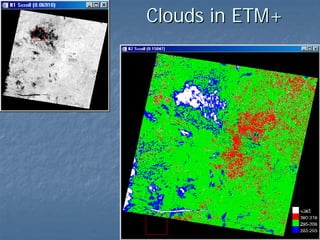
Many remote sensing datasets contain high-quality,
accurate data. Unfortunately, sometimes error (or
noise) is introduced into the remote sensor data by:
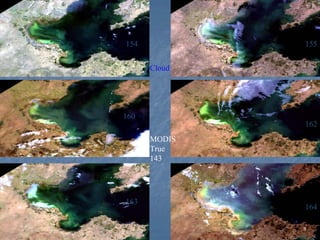
the environment (e.g., atmospheric scattering,
cloud),
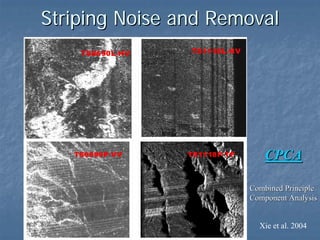
random or systematic malfunction of the remote
sensing system (e.g., an uncalibrated detector
creates striping), or
improper pre-processing of the remote sensor
data prior to actual data analysis (e.g., inaccurate
analog-to-digital conversion).
154

155
Cloud
155

160
162
MODIS
True
143

163

164
Clouds in ETM+
Striping Noise and Removal

CPCA
Combined Principle
Component Analysis

Xie et al. 2004
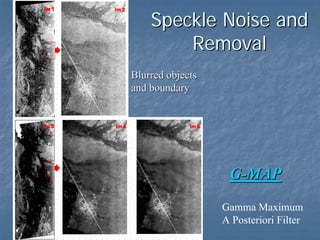
Speckle Noise and
Removal
Blurred objects
and boundary

G-MAP
Gamma Maximum
A Posteriori Filter
Univariate descriptive image statistics
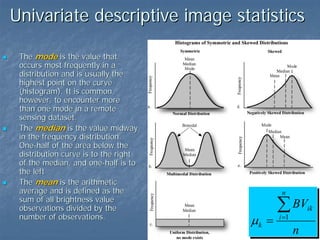
The mode is the value that
occurs most frequently in a
distribution and is usually the
highest point on the curve
(histogram). It is common,
however, to encounter more
than one mode in a remote
sensing dataset.
The median is the value midway
in the frequency distribution.
One-half of the area below the
distribution curve is to the right
of the median, and one-half is to
the left
The mean is the arithmetic
average and is defined as the
sum of all brightness value
observations divided by the
number of observations.

n

µk =

∑ BV

ik

i =1

n
Cont’
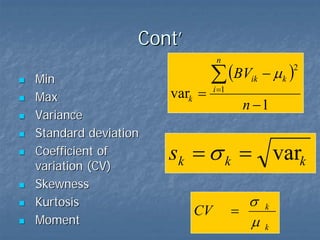
n

Min
Max
Variance
Standard deviation
Coefficient of
variation (CV)
Skewness
Kurtosis
Moment

vark =

∑ (BV
i =1

ik

− µk )

2

n −1

sk = σ k = vark
CV

σ
=
µ

k
k
Multivariate Image Statistics
Remote sensing research is often concerned
with the measurement of how much radiant
flux is reflected or emitted from an object in
more than one band. It is useful to compute
multivariate statistical measures such as
covariance and correlation among the several
bands to determine how the measurements
covary. Variance–covariance and correlation
matrices are used in remote sensing principal
components analysis (PCA), feature
selection, classification and accuracy
assessment.
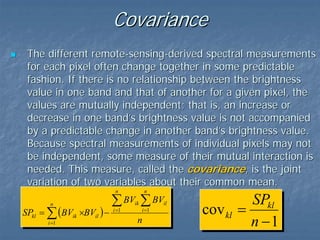
Covariance
The different remote-sensing-derived spectral measurements
for each pixel often change together in some predictable
fashion. If there is no relationship between the brightness
value in one band and that of another for a given pixel, the
values are mutually independent; that is, an increase or
decrease in one band’s brightness value is not accompanied
by a predictable change in another band’s brightness value.
Because spectral measurements of individual pixels may not
be independent, some measure of their mutual interaction is
needed. This measure, called the covariance, is the joint
variation of two variables about their common mean.
n

n

SPkl = ∑ (BVik ×BVil ) −
i =1

n

∑ BV ∑ BV
i =1

ik

i =1

n

il

SPkl
cov kl =
n −1
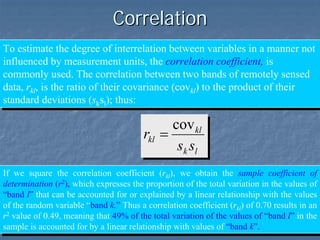
Correlation
To estimate the degree of interrelation between variables in aamanner not
To estimate the degree of interrelation between variables in manner not
influenced by measurement units, the correlation coefficient, is
commonly used. The correlation between two bands of remotely sensed
data, rr ,,is the ratio of their covariance (covkl))to the product of their
data, kl is the ratio of their covariance (covkl to the product of their
kl
standard deviations (skss); thus:
standard deviations (sk l l); thus:

cov kl
rkl =
sk sl
If we square the correlation coefficient (rkl), we obtain the sample coefficient of
determination (r22),which expresses the proportion of the total variation in the values of
determination (r), which expresses the proportion of the total variation in the values of
“band l” that can be accounted for or explained by aalinear relationship with the values
“band l” that can be accounted for or explained by linear relationship with the values
of the random variable “band k.” Thus aacorrelation coefficient (rkl))of 0.70 results in an
of the random variable “band k.” Thus correlation coefficient (rkl of 0.70 results in an
2
rr2value of 0.49, meaning that 49% of the total variation of the values of “band l” in the
value of 0.49, meaning that 49% of the total variation of the values of “band l” in the
sample is accounted for by aalinear relationship with values of “band k”.
sample is accounted for by linear relationship with values of “band k”.
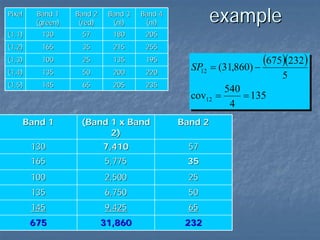
Pixel

Band 1
(green)

Band 2
(red)

Band 3
(ni)

(1,1)

130

57

180

205

(1,2)

165

35

215

255

(1,3)

100

25

135

195

(1,4)

135

50

200

220

(1,5)

145

65

205

235

example

Band 4
(ni)

SP
12

(675)(232)
= (31,860) −

540
cov12 =
= 135
4

Band 1

(Band 1 x Band
2)

Band 2

130

7,410

57

165

5,775

35

100

2,500

25

135

6,750

50

145

9,425

65

675

31,860

232

5
Band 1

Band 2

Band 3

Band 4

Mean (µk)

135

46.40

187

222

Variance (vark)

562.50

264.80

1007

570

(s k )

23.71

16.27

31.4

23.87

(mink)

100

25

135

195

(maxk)

165

65

215

255

Range (BVr)

65

40

80

60

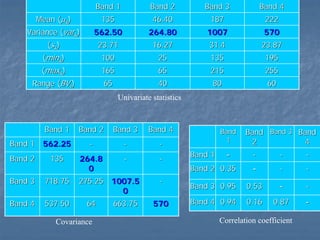
Univariate statistics

Band 1
Band 1 562.25
Band 2

135

Band 3

718.75

Band 4

537.50

Band 2

Band 3

Band 4

-

-

-

264.8
0

-

-

275.25 1007.5
0
64

Covariance

663.75

570

Band
1

Band 1

-

Band 2 0.35

Band Band 3 Band
2
4
-

-

-

-

-

-

Band 3 0.95

0.53 covariance -

Band 4 0.94

0.16

0.87

Correlation coefficient

-
Types of radiometric correction

Detector error or sensor error (internal
error)
Atmospheric error (external error)
Topographic error (external error)
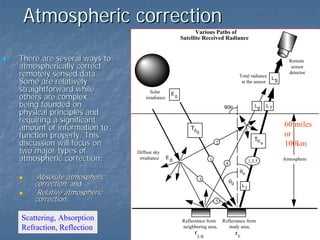
Atmospheric correction
Various Paths of
Satellite Received Radiance

There are several ways to
atmospherically correct
remotely sensed data.
Some are relatively
straightforward while
others are complex,
being founded on
physical principles and
requiring a significant
amount of information to
function properly. This
discussion will focus on
two major types of
atmospheric correction:

Total radiance L
S
at the sensor
Solar
irradiance

E

0

Tθ

LT

0

Tθ

2
Ed

1

1,3,5

4

θv

Absolute atmospheric
correction, and
Relative atmospheric
correction.

Scattering, Absorption
Refraction, Reflection

Lp

90Þ

Diffuse sky
irradiance

Remote
sensor
detector

θ0

3

LI

5

Reflectance from
neighboring area,

r

λn

Reflectance from
study area,

rλ

v

60 miles
or
100km
Atmosphere
Absolute atmospheric correction
Solar radiation is largely unaffected as it travels through the
vacuum of space. When it interacts with the Earth’s atmosphere,
however, it is selectively scattered and absorbed. The sum of
these two forms of energy loss is called atmospheric attenuation.
Atmospheric attenuation may 1) make it difficult to relate handheld in situ spectroradiometer measurements with remote
measurements, 2) make it difficult to extend spectral signatures
through space and time, and (3) have an impact on classification
accuracy within a scene if atmospheric attenuation varies
significantly throughout the image.
The general goal of absolute radiometric correction is to turn
the digital brightness values (or DN) recorded by a remote sensing
system into scaled surface reflectance values. These values can
then be compared or used in conjunction with scaled surface
reflectance values obtained anywhere else on the planet.
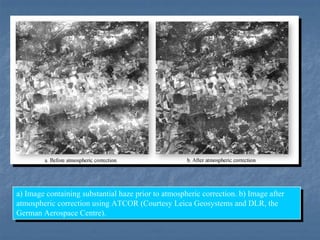
a) Image containing substantial haze prior to atmospheric correction. b) Image after
atmospheric correction using ATCOR (Courtesy Leica Geosystems and DLR, the
German Aerospace Centre).
relative radiometric correction
When required data is not available for
absolute radiometric correction, we can
do relative radiometric correction
Relative radiometric correction may be
used to
Single-image normalization using histogram
adjustment
Multiple-data image normalization using
regression
Single-image normalization using
histogram adjustment
The method is based on the fact that infrared
data (>0.7 µm) is free of atmospheric
scattering effects, whereas the visible region
(0.4-0.7 µm) is strongly influenced by them.
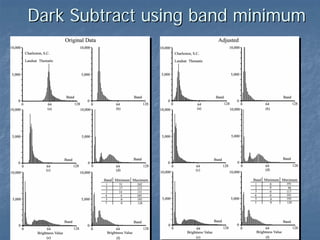
Use Dark Subtract to apply atmospheric
scattering corrections to the image data. The
digital number to subtract from each band
can be either the band minimum, an average
based upon a user defined region of interest,
or a specific value
Dark Subtract using band minimum
Topographic correction
Topographic slope and aspect also introduce
radiometric distortion (for example, areas in
shadow)
The goal of a slope-aspect correction is to
remove topographically induced illumination
variation so that two objects having the same
reflectance properties show the same
brightness value (or DN) in the image despite
their different orientation to the Sun’s position
Based on DEM, sun-elevation
Conceptions of geometric correction
Geocoding: geographical referencing
Registration: geographically or nongeographically (no coordination system)

Image to Map (or Ground Geocorrection)

The correction of digital images to ground coordinates using ground control
points collected from maps (Topographic map, DLG) or ground GPS points.

Image to Image Geocorrection

Image to Image correction involves matching the coordinate systems or
column and row systems of two digital images with one image acting as a
reference image and the other as the image to be rectified.
Spatial interpolation: from input position to output position or coordinates.
RST (rotation, scale, and transformation), Polynomial, Triangulation
Root Mean Square Error (RMS): The RMS is the error term used to
determine the accuracy of the transformation from one system to another. It is
the difference between the desired output coordinate for a GCP and the actual.
Intensity (or pixel value) interpolation (also called resampling): The process of
extrapolating data values to a new grid, and is the step in rectifying an image that
calculates pixel values for the rectified grid from the original data grid.
Nearest neighbor, Bilinear, Cubic
Image enhancement
image reduction,
image magnification,
transect extraction,
contrast adjustments (linear and non-linear),
band ratioing,
spatial filtering,
fourier transformations,
principle components analysis,
texture transformations, and
image sharpening
Contrast Enhancement (stretch)
Materials or objects reflect or emit similar amounts of radiant flux (so
similar pixel value)
Low-contrast imagery with pixel range less than the designed
radiometric range
20-100 for TM less than the designed 0-255

To improve the contrast:
Linear technique

Minimum-maximum contrast stretch
Percentage linear contrast stretch
Standard deviation contrast stretch
Piecewise linear contrast stretch

Non-linear technique

Histogram equalization

Contrast enhancement is only intended to improve the visual quality
of a displayed image by increasing the range (spreading or
stretching) of data values to occupy the available image display range
(usually 0-255). It does not change the pixel values, unless save it as
a new image. It is not good practice to use saved image for
classification and change detection.
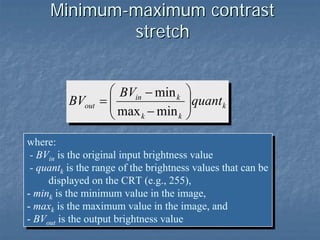
Minimum-maximum contrast
stretch

BVout

⎛ BVin − min k
=⎜
⎜ max − min
k
k
⎝

⎞
⎟quant k
⎟
⎠

where:
where:
--BVin is the original input brightness value
BVin is the original input brightness value
--quantk is the range of the brightness values that can be
quantk is the range of the brightness values that can be
displayed on the CRT (e.g., 255),
--mink is the minimum value in the image,
mink is the minimum value in the image,
--maxk is the maximum value in the image, and
maxk is the maximum value in the image, and
--BVout is the output brightness value
BVout is the output brightness value
Percentage linear and
standard deviation contrast
stretch
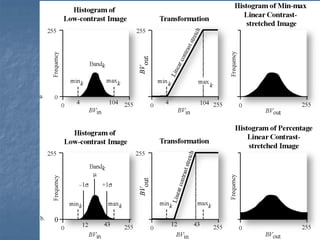
X percentage (say 5%) top or low values of the image
will be set to 0 or 255, rest of values will be linearly
stretched to 0 to 255
ENVI has a default of a 2% linear stretch applied to each
image band, meaning the bottom and top 2% of image
values are excluded by positioning the range bars at the
appropriate points. Low 2% and top 2% will be saturated
to 0 and 255, respectively. The values between the range
bars are then stretched linearly between 0 and 255
resulting in a new image.
If the percentage coincides with a standard deviation
percentage, then it is called a standard deviation contrast
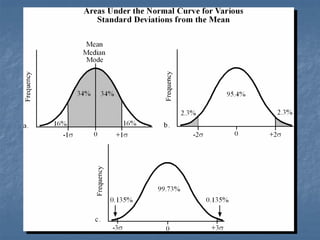
stretch. For a normal distribution, 68%, 95.4%, 99.73%
values lie in ±1σ, ±2 σ, ±3 σ. So 16% linear contrast
stretch is the ±1σ contrast stretch.
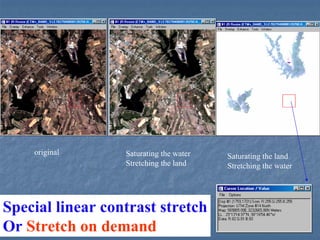
original

Saturating the water
Stretching the land

Special linear contrast stretch
Or Stretch on demand

Saturating the land
Stretching the water
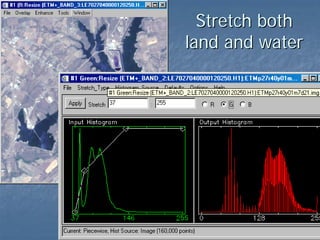
Piecewise linear contrast stretch
When the histogram of an image is not
Gaussian (bimodal, trimodal, …), it is
possible to apply a piecewise linear contrast
stretch.
But you better to know what each mode in
the histogram represents in the real world.
Stretch both
land and water
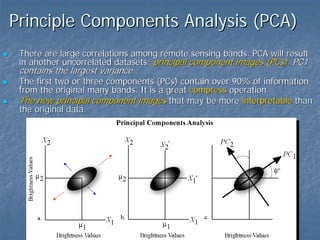
Principle Components Analysis (PCA)
There are large correlations among remote sensing bands. PCA will result
in another uncorrelated datasets: principal component images (PCs). PC1

contains the largest variance

The first two or three components (PCs) contain over 90% of information
from the original many bands. It is a great compress operation
The new principal component images that may be more interpretable than
the original data.
Purposes of image classification
Land use and land cover (LULC)
Vegetation types
Geologic terrains
Mineral exploration
Alteration mapping
…….
What is image classification or
pattern recognition
Is a process of classifying multispectral (hyperspectral) images into
patterns of varying gray or assigned colors that represent either

clusters of statistically different sets of multiband data, some of which
can be correlated with separable classes/features/materials. This is the
result of Unsupervised Classification, or
numerical discriminators composed of these sets of data that have been
grouped and specified by associating each with a particular class, etc.
whose identity is known independently and which has representative
areas (training sites) within the image where that class is located. This is
the result of Supervised Classification.

Spectral classes are those that are inherent in the remote sensor

data and must be identified and then labeled by the analyst.

Information classes are those that human beings define.
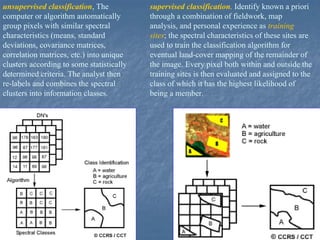
unsupervised classification, The
computer or algorithm automatically
group pixels with similar spectral
characteristics (means, standard
deviations, covariance matrices,
correlation matrices, etc.) into unique
clusters according to some statistically
determined criteria. The analyst then
re-labels and combines the spectral
clusters into information classes.

supervised classification. Identify known a priori
through a combination of fieldwork, map
analysis, and personal experience as training
sites; the spectral characteristics of these sites are
used to train the classification algorithm for
eventual land-cover mapping of the remainder of
the image. Every pixel both within and outside the
training sites is then evaluated and assigned to the
class of which it has the highest likelihood of
being a member.
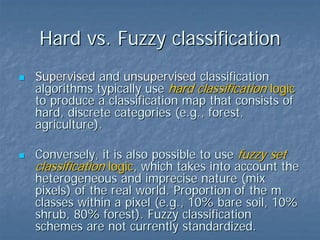
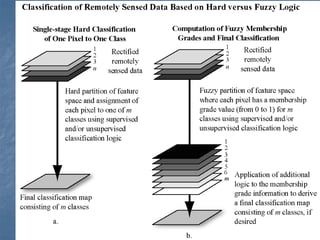
Hard vs. Fuzzy classification
Supervised and unsupervised classification
algorithms typically use hard classification logic
to produce a classification map that consists of
hard, discrete categories (e.g., forest,
agriculture).
Conversely, it is also possible to use fuzzy set
classification logic, which takes into account the
heterogeneous and imprecise nature (mix
pixels) of the real world. Proportion of the m
classes within a pixel (e.g., 10% bare soil, 10%
shrub, 80% forest). Fuzzy classification
schemes are not currently standardized.
Pixel-based vs. Object-oriented
classification
In the past, most digital image classification was based on
processing the entire scene pixel by pixel. This is commonly
referred to as per-pixel (pixel-based) classification.

Object-oriented classification techniques allow the

analyst to decompose the scene into many relatively
homogenous image objects (referred to as patches or
segments) using a multi-resolution image segmentation
process. The various statistical characteristics of these
homogeneous image objects in the scene are then subjected
to traditional statistical or fuzzy logic classification. Objectoriented classification based on image segmentation is often
used for the analysis of high-spatial-resolution imagery (e.g.,
1 × 1 m Space Imaging IKONOS and 0.61 × 0.61 m Digital
Globe QuickBird).
Unsupervised classification
Uses statistical techniques to group n-dimensional data into their natural
spectral clusters, and uses the iterative procedures
label certain clusters as specific information classes
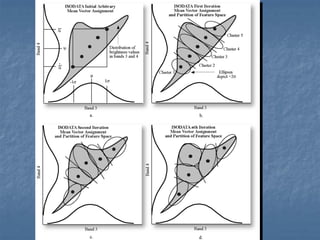
K-mean and ISODATA

For the first iteration arbitrary starting values (i.e., the cluster properties)
have to be selected. These initial values can influence the outcome of the
classification.
In general, both methods assign first arbitrary initial cluster values. The
second step classifies each pixel to the closest cluster. In the third step the
new cluster mean vectors are calculated based on all the pixels in one
cluster. The second and third steps are repeated until the "change" between
the iteration is small. The "change" can be defined in several different ways,
either by measuring the distances of the mean cluster vector have changed
from one iteration to another or by the percentage of pixels that have
changed between iterations.
The ISODATA algorithm has some further refinements by splitting and
merging of clusters. Clusters are merged if either the number of members
(pixel) in a cluster is less than a certain threshold or if the centers of two
clusters are closer than a certain threshold. Clusters are split into two
different clusters if the cluster standard deviation exceeds a predefined value
and the number of members (pixels) is twice the threshold for the minimum
number of members.
Supervised classification:
training sites selection
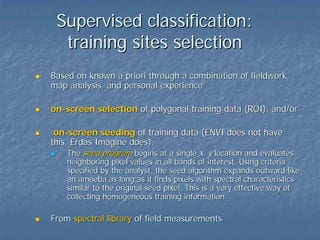
Based on known a priori through a combination of fieldwork,
map analysis, and personal experience
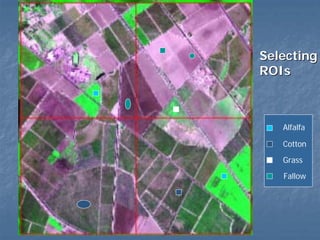
on-screen selection of polygonal training data (ROI), and/or
on-screen seeding of training data (ENVI does not have
this, Erdas Imagine does).
The seed program begins at a single x, y location and evaluates

neighboring pixel values in all bands of interest. Using criteria
specified by the analyst, the seed algorithm expands outward like
an amoeba as long as it finds pixels with spectral characteristics
similar to the original seed pixel. This is a very effective way of
collecting homogeneous training information.

From spectral library of field measurements
Selecting
ROIs

Alfalfa
Cotton
Grass
Fallow
Supervised classification methods
Various supervised classification algorithms may be used to assign an unknown pixel to one
of m possible classes. The choice of a particular classifier or decision rule depends on the
nature of the input data and the desired output. Parametric classification algorithms
assumes that the observed measurement vectors Xc obtained for each class in each spectral
band during the training phase of the supervised classification are Gaussian; that is, they are
normally distributed. Nonparametric classification algorithms make no such assumption.
Several widely adopted nonparametric classification algorithms include:
one-dimensional density slicing
parallepiped,
minimum distance,
nearest-neighbor, and
neural network and expert system analysis.
The most widely adopted parametric classification algorithms is the:
maximum likelihood.
Hyperspectral classification methods
Binary Encoding
Spectral Angle Mapper
Matched Filtering
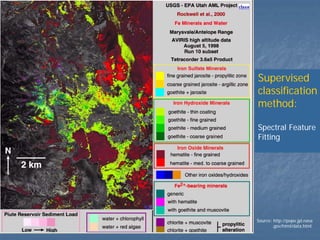
Spectral Feature Fitting
Linear Spectral Unmixing
Supervised
classification
method:
Spectral Feature
Fitting

Source: http://popo.jpl.nasa
.gov/html/data.html
Accuracy assessment of classification
Remote sensing-derived thematic information are
becoming increasingly important. Unfortunately, they
contain errors.
Errors come from 5 sources:
Geometric error still there
None of atmospheric correction is perfect
Clusters incorrectly labeled after unsupervised classification
Training sites incorrectly labeled before supervised
classification
None of classification method is perfect

We should identify the sources of the error, minimize it,
do accuracy assessment, create metadata before being
used in scientific investigations and policy decisions.
We usually need GIS layers to assist our classification.
training vs. ground reference
Several ways to do error evaluation
Based on training pixels (areas)

The problem is that the locations of training sites are usually not
random. They are biased by analyst’s a priori knowledge of
where certain LULC types exist in the scene.
This will results in higher classification accuracies than the one
below

Based on ground reference pixels

These sites are not used to train the classification algorithm and
therefore represent unbiased reference information
It is possible to collect some ground sites prior to the
classification, perhaps at the same time as the training data
But majority of test reference is often collected after
classification.

Landscape often change rapidly. Therefore, it is best to
collect both the training and ground reference as close
to the data of remote sensing data acquisition as
possible. (for example, agriculture crops change fast)
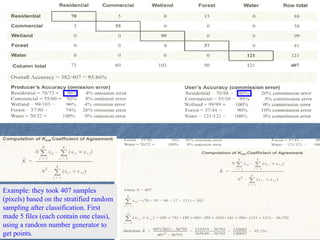
Error (Confusion) Matrix
Producer (analyst) accuracy is a measure indicating the probability that
the classifier has labeled an image pixel into Class A given that the
ground truth is Class A. it is the probability of a reference pixel being
correctly classified.
Omission error represent pixels that belong to the ground truth class but
that the classification technique has failed to classify them into the
proper class.
User accuracy is a measure indicating the probability that a pixel is Class
A given that the classifier has labeled the pixel into Class A. it is the
probability that a pixel classified on the map actually represents that
category on the ground.
Commission error represent pixels that belong to another class but are
labeled as belonging to the class.
Overall accuracy is total classification accuracy.
Kappa coefficient (Khat) is a discrete multivariate technique of use in
accuracy assessment. Khat>80% represent strong agreement and good
accuracy. 40%-80% is middle, <40% is poor.
Example: they took 407 samples
(pixels) based on the stratified random
sampling after classification. First
made 5 files (each contain one class),
using a random number generator to
get points.
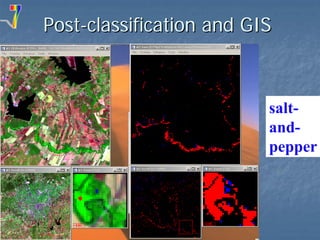
Post-classification and GIS

saltandpepper
types
Majority/Minority Analysis
Clump Classes
Morphology Filters
Sieve Classes
Combine Classes
Classification to vector (GIS)
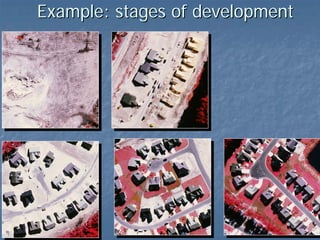
Change detection
Change detect involves the use of multi-temporal datasets to
discriminate areas of land cover change between dates of imaging.
Ideally, it requires
Same or similar sensor, resolution, viewing geometry, spectral bands,
radiomatric resolution, acquisition time of data, and anniversary dates
Accurate spatial registration (less than 0.5 pixel error)

Methods

Independently classified and registered, then compare them
Classification of combined multi-temporal datasets,
Principal components analysis of combined multi-temporal datasets
Image differencing (subtracting), (needs to find change/no change threshold,
change area will be in the tails of the histogram distribution)
Image ratioing (dividing), (needs to find change/no change threshold,
change area will be in the tails of the histogram distribution)
Change vector analysis
Delta transformation
Example: stages of development
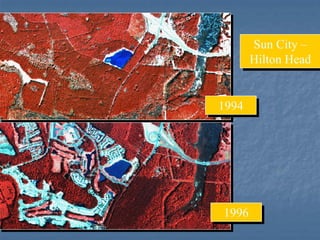
Sun City –
Sun City –
Hilton Head
Hilton Head

1994
1994

1996
1996
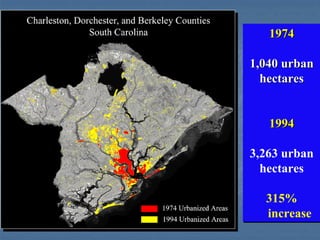
1974
1,040 urban
hectares

1994
3,263 urban
hectares
315%
increase

Basics of dip

  • 1.
    Basics of digitalimage processing Lecture 4 September 23, 2006
  • 2.
    What is imageprocessing Is enhancing an image or extracting information or features from an image Computerized routines for information extraction (eg, pattern recognition, classification) from remotely sensed images to obtain categories of information about specific features. Many more
  • 3.
    Image Processing Includes Imagequality and statistical evaluation Radiometric correction Geometric correction Image enhancement and sharpening Image classification Pixel based Object-oriented based Accuracy assessment of classification Post-classification and GIS Change detection
  • 4.
    Image Quality Many remotesensing datasets contain high-quality, accurate data. Unfortunately, sometimes error (or noise) is introduced into the remote sensor data by: the environment (e.g., atmospheric scattering, cloud), random or systematic malfunction of the remote sensing system (e.g., an uncalibrated detector creates striping), or improper pre-processing of the remote sensor data prior to actual data analysis (e.g., inaccurate analog-to-digital conversion).
  • 5.
  • 6.
  • 7.
    Striping Noise andRemoval CPCA Combined Principle Component Analysis Xie et al. 2004
  • 8.
    Speckle Noise and Removal Blurredobjects and boundary G-MAP Gamma Maximum A Posteriori Filter
  • 9.
    Univariate descriptive imagestatistics The mode is the value that occurs most frequently in a distribution and is usually the highest point on the curve (histogram). It is common, however, to encounter more than one mode in a remote sensing dataset. The median is the value midway in the frequency distribution. One-half of the area below the distribution curve is to the right of the median, and one-half is to the left The mean is the arithmetic average and is defined as the sum of all brightness value observations divided by the number of observations. n µk = ∑ BV ik i =1 n
  • 10.
    Cont’ n Min Max Variance Standard deviation Coefficient of variation(CV) Skewness Kurtosis Moment vark = ∑ (BV i =1 ik − µk ) 2 n −1 sk = σ k = vark CV σ = µ k k
  • 13.
    Multivariate Image Statistics Remotesensing research is often concerned with the measurement of how much radiant flux is reflected or emitted from an object in more than one band. It is useful to compute multivariate statistical measures such as covariance and correlation among the several bands to determine how the measurements covary. Variance–covariance and correlation matrices are used in remote sensing principal components analysis (PCA), feature selection, classification and accuracy assessment.
  • 14.
    Covariance The different remote-sensing-derivedspectral measurements for each pixel often change together in some predictable fashion. If there is no relationship between the brightness value in one band and that of another for a given pixel, the values are mutually independent; that is, an increase or decrease in one band’s brightness value is not accompanied by a predictable change in another band’s brightness value. Because spectral measurements of individual pixels may not be independent, some measure of their mutual interaction is needed. This measure, called the covariance, is the joint variation of two variables about their common mean. n n SPkl = ∑ (BVik ×BVil ) − i =1 n ∑ BV ∑ BV i =1 ik i =1 n il SPkl cov kl = n −1
  • 15.
    Correlation To estimate thedegree of interrelation between variables in aamanner not To estimate the degree of interrelation between variables in manner not influenced by measurement units, the correlation coefficient, is influenced by measurement units, the correlation coefficient, is commonly used. The correlation between two bands of remotely sensed commonly used. The correlation between two bands of remotely sensed data, rr ,,is the ratio of their covariance (covkl))to the product of their data, kl is the ratio of their covariance (covkl to the product of their kl standard deviations (skss); thus: standard deviations (sk l l); thus: cov kl rkl = sk sl If we square the correlation coefficient (rkl), we obtain the sample coefficient of If we square the correlation coefficient (rkl), we obtain the sample coefficient of determination (r22),which expresses the proportion of the total variation in the values of determination (r), which expresses the proportion of the total variation in the values of “band l” that can be accounted for or explained by aalinear relationship with the values “band l” that can be accounted for or explained by linear relationship with the values of the random variable “band k.” Thus aacorrelation coefficient (rkl))of 0.70 results in an of the random variable “band k.” Thus correlation coefficient (rkl of 0.70 results in an 2 rr2value of 0.49, meaning that 49% of the total variation of the values of “band l” in the value of 0.49, meaning that 49% of the total variation of the values of “band l” in the sample is accounted for by aalinear relationship with values of “band k”. sample is accounted for by linear relationship with values of “band k”.
  • 16.
    Pixel Band 1 (green) Band 2 (red) Band3 (ni) (1,1) 130 57 180 205 (1,2) 165 35 215 255 (1,3) 100 25 135 195 (1,4) 135 50 200 220 (1,5) 145 65 205 235 example Band 4 (ni) SP 12 (675)(232) = (31,860) − 540 cov12 = = 135 4 Band 1 (Band 1 x Band 2) Band 2 130 7,410 57 165 5,775 35 100 2,500 25 135 6,750 50 145 9,425 65 675 31,860 232 5
  • 17.
    Band 1 Band 2 Band3 Band 4 Mean (µk) 135 46.40 187 222 Variance (vark) 562.50 264.80 1007 570 (s k ) 23.71 16.27 31.4 23.87 (mink) 100 25 135 195 (maxk) 165 65 215 255 Range (BVr) 65 40 80 60 Univariate statistics Band 1 Band 1 562.25 Band 2 135 Band 3 718.75 Band 4 537.50 Band 2 Band 3 Band 4 - - - 264.8 0 - - 275.25 1007.5 0 64 Covariance 663.75 570 Band 1 Band 1 - Band 2 0.35 Band Band 3 Band 2 4 - - - - - - Band 3 0.95 0.53 covariance - Band 4 0.94 0.16 0.87 Correlation coefficient -
  • 18.
    Types of radiometriccorrection Detector error or sensor error (internal error) Atmospheric error (external error) Topographic error (external error)
  • 19.
    Atmospheric correction Various Pathsof Satellite Received Radiance There are several ways to atmospherically correct remotely sensed data. Some are relatively straightforward while others are complex, being founded on physical principles and requiring a significant amount of information to function properly. This discussion will focus on two major types of atmospheric correction: Total radiance L S at the sensor Solar irradiance E 0 Tθ LT 0 Tθ 2 Ed 1 1,3,5 4 θv Absolute atmospheric correction, and Relative atmospheric correction. Scattering, Absorption Refraction, Reflection Lp 90Þ Diffuse sky irradiance Remote sensor detector θ0 3 LI 5 Reflectance from neighboring area, r λn Reflectance from study area, rλ v 60 miles or 100km Atmosphere
  • 20.
    Absolute atmospheric correction Solarradiation is largely unaffected as it travels through the vacuum of space. When it interacts with the Earth’s atmosphere, however, it is selectively scattered and absorbed. The sum of these two forms of energy loss is called atmospheric attenuation. Atmospheric attenuation may 1) make it difficult to relate handheld in situ spectroradiometer measurements with remote measurements, 2) make it difficult to extend spectral signatures through space and time, and (3) have an impact on classification accuracy within a scene if atmospheric attenuation varies significantly throughout the image. The general goal of absolute radiometric correction is to turn the digital brightness values (or DN) recorded by a remote sensing system into scaled surface reflectance values. These values can then be compared or used in conjunction with scaled surface reflectance values obtained anywhere else on the planet.
  • 21.
    a) Image containingsubstantial haze prior to atmospheric correction. b) Image after a) Image containing substantial haze prior to atmospheric correction. b) Image after atmospheric correction using ATCOR (Courtesy Leica Geosystems and DLR, the atmospheric correction using ATCOR (Courtesy Leica Geosystems and DLR, the German Aerospace Centre). German Aerospace Centre).
  • 22.
    relative radiometric correction Whenrequired data is not available for absolute radiometric correction, we can do relative radiometric correction Relative radiometric correction may be used to Single-image normalization using histogram adjustment Multiple-data image normalization using regression
  • 23.
    Single-image normalization using histogramadjustment The method is based on the fact that infrared data (>0.7 µm) is free of atmospheric scattering effects, whereas the visible region (0.4-0.7 µm) is strongly influenced by them. Use Dark Subtract to apply atmospheric scattering corrections to the image data. The digital number to subtract from each band can be either the band minimum, an average based upon a user defined region of interest, or a specific value
  • 24.
    Dark Subtract usingband minimum
  • 25.
    Topographic correction Topographic slopeand aspect also introduce radiometric distortion (for example, areas in shadow) The goal of a slope-aspect correction is to remove topographically induced illumination variation so that two objects having the same reflectance properties show the same brightness value (or DN) in the image despite their different orientation to the Sun’s position Based on DEM, sun-elevation
  • 26.
    Conceptions of geometriccorrection Geocoding: geographical referencing Registration: geographically or nongeographically (no coordination system) Image to Map (or Ground Geocorrection) The correction of digital images to ground coordinates using ground control points collected from maps (Topographic map, DLG) or ground GPS points. Image to Image Geocorrection Image to Image correction involves matching the coordinate systems or column and row systems of two digital images with one image acting as a reference image and the other as the image to be rectified. Spatial interpolation: from input position to output position or coordinates. RST (rotation, scale, and transformation), Polynomial, Triangulation Root Mean Square Error (RMS): The RMS is the error term used to determine the accuracy of the transformation from one system to another. It is the difference between the desired output coordinate for a GCP and the actual. Intensity (or pixel value) interpolation (also called resampling): The process of extrapolating data values to a new grid, and is the step in rectifying an image that calculates pixel values for the rectified grid from the original data grid. Nearest neighbor, Bilinear, Cubic
  • 27.
    Image enhancement image reduction, imagemagnification, transect extraction, contrast adjustments (linear and non-linear), band ratioing, spatial filtering, fourier transformations, principle components analysis, texture transformations, and image sharpening
  • 28.
    Contrast Enhancement (stretch) Materialsor objects reflect or emit similar amounts of radiant flux (so similar pixel value) Low-contrast imagery with pixel range less than the designed radiometric range 20-100 for TM less than the designed 0-255 To improve the contrast: Linear technique Minimum-maximum contrast stretch Percentage linear contrast stretch Standard deviation contrast stretch Piecewise linear contrast stretch Non-linear technique Histogram equalization Contrast enhancement is only intended to improve the visual quality of a displayed image by increasing the range (spreading or stretching) of data values to occupy the available image display range (usually 0-255). It does not change the pixel values, unless save it as a new image. It is not good practice to use saved image for classification and change detection.
  • 29.
    Minimum-maximum contrast stretch BVout ⎛ BVin− min k =⎜ ⎜ max − min k k ⎝ ⎞ ⎟quant k ⎟ ⎠ where: where: --BVin is the original input brightness value BVin is the original input brightness value --quantk is the range of the brightness values that can be quantk is the range of the brightness values that can be displayed on the CRT (e.g., 255), displayed on the CRT (e.g., 255), --mink is the minimum value in the image, mink is the minimum value in the image, --maxk is the maximum value in the image, and maxk is the maximum value in the image, and --BVout is the output brightness value BVout is the output brightness value
  • 30.
    Percentage linear and standarddeviation contrast stretch X percentage (say 5%) top or low values of the image will be set to 0 or 255, rest of values will be linearly stretched to 0 to 255 ENVI has a default of a 2% linear stretch applied to each image band, meaning the bottom and top 2% of image values are excluded by positioning the range bars at the appropriate points. Low 2% and top 2% will be saturated to 0 and 255, respectively. The values between the range bars are then stretched linearly between 0 and 255 resulting in a new image. If the percentage coincides with a standard deviation percentage, then it is called a standard deviation contrast stretch. For a normal distribution, 68%, 95.4%, 99.73% values lie in ±1σ, ±2 σ, ±3 σ. So 16% linear contrast stretch is the ±1σ contrast stretch.
  • 32.
    original Saturating the water Stretchingthe land Special linear contrast stretch Or Stretch on demand Saturating the land Stretching the water
  • 33.
    Piecewise linear contraststretch When the histogram of an image is not Gaussian (bimodal, trimodal, …), it is possible to apply a piecewise linear contrast stretch. But you better to know what each mode in the histogram represents in the real world.
  • 34.
  • 35.
    Principle Components Analysis(PCA) There are large correlations among remote sensing bands. PCA will result in another uncorrelated datasets: principal component images (PCs). PC1 contains the largest variance The first two or three components (PCs) contain over 90% of information from the original many bands. It is a great compress operation The new principal component images that may be more interpretable than the original data.
  • 36.
    Purposes of imageclassification Land use and land cover (LULC) Vegetation types Geologic terrains Mineral exploration Alteration mapping …….
  • 37.
    What is imageclassification or pattern recognition Is a process of classifying multispectral (hyperspectral) images into patterns of varying gray or assigned colors that represent either clusters of statistically different sets of multiband data, some of which can be correlated with separable classes/features/materials. This is the result of Unsupervised Classification, or numerical discriminators composed of these sets of data that have been grouped and specified by associating each with a particular class, etc. whose identity is known independently and which has representative areas (training sites) within the image where that class is located. This is the result of Supervised Classification. Spectral classes are those that are inherent in the remote sensor data and must be identified and then labeled by the analyst. Information classes are those that human beings define.
  • 38.
    unsupervised classification, The computeror algorithm automatically group pixels with similar spectral characteristics (means, standard deviations, covariance matrices, correlation matrices, etc.) into unique clusters according to some statistically determined criteria. The analyst then re-labels and combines the spectral clusters into information classes. supervised classification. Identify known a priori through a combination of fieldwork, map analysis, and personal experience as training sites; the spectral characteristics of these sites are used to train the classification algorithm for eventual land-cover mapping of the remainder of the image. Every pixel both within and outside the training sites is then evaluated and assigned to the class of which it has the highest likelihood of being a member.
  • 39.
    Hard vs. Fuzzyclassification Supervised and unsupervised classification algorithms typically use hard classification logic to produce a classification map that consists of hard, discrete categories (e.g., forest, agriculture). Conversely, it is also possible to use fuzzy set classification logic, which takes into account the heterogeneous and imprecise nature (mix pixels) of the real world. Proportion of the m classes within a pixel (e.g., 10% bare soil, 10% shrub, 80% forest). Fuzzy classification schemes are not currently standardized.

  • 41.
    Pixel-based vs. Object-oriented classification Inthe past, most digital image classification was based on processing the entire scene pixel by pixel. This is commonly referred to as per-pixel (pixel-based) classification. Object-oriented classification techniques allow the analyst to decompose the scene into many relatively homogenous image objects (referred to as patches or segments) using a multi-resolution image segmentation process. The various statistical characteristics of these homogeneous image objects in the scene are then subjected to traditional statistical or fuzzy logic classification. Objectoriented classification based on image segmentation is often used for the analysis of high-spatial-resolution imagery (e.g., 1 × 1 m Space Imaging IKONOS and 0.61 × 0.61 m Digital Globe QuickBird).
  • 42.
    Unsupervised classification Uses statisticaltechniques to group n-dimensional data into their natural spectral clusters, and uses the iterative procedures label certain clusters as specific information classes K-mean and ISODATA For the first iteration arbitrary starting values (i.e., the cluster properties) have to be selected. These initial values can influence the outcome of the classification. In general, both methods assign first arbitrary initial cluster values. The second step classifies each pixel to the closest cluster. In the third step the new cluster mean vectors are calculated based on all the pixels in one cluster. The second and third steps are repeated until the "change" between the iteration is small. The "change" can be defined in several different ways, either by measuring the distances of the mean cluster vector have changed from one iteration to another or by the percentage of pixels that have changed between iterations. The ISODATA algorithm has some further refinements by splitting and merging of clusters. Clusters are merged if either the number of members (pixel) in a cluster is less than a certain threshold or if the centers of two clusters are closer than a certain threshold. Clusters are split into two different clusters if the cluster standard deviation exceeds a predefined value and the number of members (pixels) is twice the threshold for the minimum number of members.
  • 44.
    Supervised classification: training sitesselection Based on known a priori through a combination of fieldwork, map analysis, and personal experience on-screen selection of polygonal training data (ROI), and/or on-screen seeding of training data (ENVI does not have this, Erdas Imagine does). The seed program begins at a single x, y location and evaluates neighboring pixel values in all bands of interest. Using criteria specified by the analyst, the seed algorithm expands outward like an amoeba as long as it finds pixels with spectral characteristics similar to the original seed pixel. This is a very effective way of collecting homogeneous training information. From spectral library of field measurements
  • 45.
  • 46.
    Supervised classification methods Varioussupervised classification algorithms may be used to assign an unknown pixel to one of m possible classes. The choice of a particular classifier or decision rule depends on the nature of the input data and the desired output. Parametric classification algorithms assumes that the observed measurement vectors Xc obtained for each class in each spectral band during the training phase of the supervised classification are Gaussian; that is, they are normally distributed. Nonparametric classification algorithms make no such assumption. Several widely adopted nonparametric classification algorithms include: one-dimensional density slicing parallepiped, minimum distance, nearest-neighbor, and neural network and expert system analysis. The most widely adopted parametric classification algorithms is the: maximum likelihood. Hyperspectral classification methods Binary Encoding Spectral Angle Mapper Matched Filtering Spectral Feature Fitting Linear Spectral Unmixing
  • 47.
  • 48.
    Accuracy assessment ofclassification Remote sensing-derived thematic information are becoming increasingly important. Unfortunately, they contain errors. Errors come from 5 sources: Geometric error still there None of atmospheric correction is perfect Clusters incorrectly labeled after unsupervised classification Training sites incorrectly labeled before supervised classification None of classification method is perfect We should identify the sources of the error, minimize it, do accuracy assessment, create metadata before being used in scientific investigations and policy decisions. We usually need GIS layers to assist our classification.
  • 49.
    training vs. groundreference Several ways to do error evaluation Based on training pixels (areas) The problem is that the locations of training sites are usually not random. They are biased by analyst’s a priori knowledge of where certain LULC types exist in the scene. This will results in higher classification accuracies than the one below Based on ground reference pixels These sites are not used to train the classification algorithm and therefore represent unbiased reference information It is possible to collect some ground sites prior to the classification, perhaps at the same time as the training data But majority of test reference is often collected after classification. Landscape often change rapidly. Therefore, it is best to collect both the training and ground reference as close to the data of remote sensing data acquisition as possible. (for example, agriculture crops change fast)
  • 50.
    Error (Confusion) Matrix Producer(analyst) accuracy is a measure indicating the probability that the classifier has labeled an image pixel into Class A given that the ground truth is Class A. it is the probability of a reference pixel being correctly classified. Omission error represent pixels that belong to the ground truth class but that the classification technique has failed to classify them into the proper class. User accuracy is a measure indicating the probability that a pixel is Class A given that the classifier has labeled the pixel into Class A. it is the probability that a pixel classified on the map actually represents that category on the ground. Commission error represent pixels that belong to another class but are labeled as belonging to the class. Overall accuracy is total classification accuracy. Kappa coefficient (Khat) is a discrete multivariate technique of use in accuracy assessment. Khat>80% represent strong agreement and good accuracy. 40%-80% is middle, <40% is poor.
  • 51.
    Example: they took407 samples (pixels) based on the stratified random sampling after classification. First made 5 files (each contain one class), using a random number generator to get points.
  • 52.
  • 53.
    types Majority/Minority Analysis Clump Classes MorphologyFilters Sieve Classes Combine Classes Classification to vector (GIS)
  • 54.
    Change detection Change detectinvolves the use of multi-temporal datasets to discriminate areas of land cover change between dates of imaging. Ideally, it requires Same or similar sensor, resolution, viewing geometry, spectral bands, radiomatric resolution, acquisition time of data, and anniversary dates Accurate spatial registration (less than 0.5 pixel error) Methods Independently classified and registered, then compare them Classification of combined multi-temporal datasets, Principal components analysis of combined multi-temporal datasets Image differencing (subtracting), (needs to find change/no change threshold, change area will be in the tails of the histogram distribution) Image ratioing (dividing), (needs to find change/no change threshold, change area will be in the tails of the histogram distribution) Change vector analysis Delta transformation
  • 55.
    Example: stages ofdevelopment
  • 56.
    Sun City – SunCity – Hilton Head Hilton Head 1994 1994 1996 1996
  • 57.