Digital Image Processing
Dr. Chetan Laxman Hulsure
Assistant Professor
Department of Geography
Central University of Karnataka
Kalaburgi-585367
Pictures are the most common and convenient means of
conveying or transmitting information.
The digital images are represented as numbers; brightness can
be added, subtracted, multiplied, divided and, in general,
subjected to statistical manipulations.
Such manipulations are not possible if image is presented as a
photograph.
A photograph is an analogue image produced by a continuous
signal using photographic sensor (photosensitive film).
Digital image is produced by a discrete signal using electro-
optical sensor.
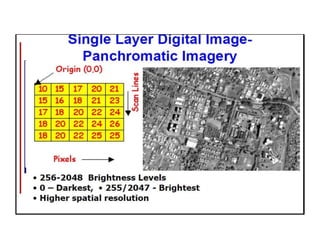
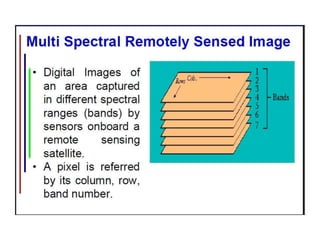
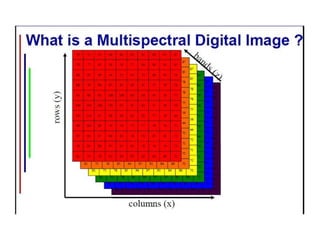
 A digital remotely sensed image is typically composed of picture
elements (pixel) located at intersection of each row, I and column,
j in each band, k of imagery.
Associated with each pixel a number known as Digital Number
(DN) or Brightness Value (BV) denotes the average radiance of a
pixel area within a scene.
 A smaller number indicates low average radiance from the area
and the higher number indicates high radiant properties of the
area.
Image Rectification
These operations aim to correct distorted or degraded image data to
create a faithful representation of the original scene. This involves
initial processing of raw image data
to correct geometric distortions,
to calibrate the data radiometrically,
to eliminate noise present in the data and
to correct atmospheric distortions.
Image rectification and restoration procedures are often termed as
preprocessing operations as they normally performed prior to
further manipulation and analysis.
Image radiometry generally refers to the digital representation of
the sensed data.
The radiance value recorded for each pixel should be ideally, a
faithful representation of the reflectance property of the
corresponding resolution element on the ground.
Radiometric correction involves the rearrangement of the digital
numbers (DN) in an image so that all areas in the image have the
same linear relationship between the DN and radiance.
Radiometric errors are caused by detector imbalance and
atmospheric deficiencies.
Multiple detectors are used in the sensor system to simultaneously
sense several image lines during each sweep.
As the detectors are not precisely equivalent in their output
characteristics, their output changes gradually over time.
Due to these variations there will be different output for the same
ground radiance.
Some of the radiometric distortions are as follows:
Correction for missing lines
Correction for periodic line striping
Random noise correction
atmospheric correction
Part of image with missing scan line
1] Correction for missing lines:
They may be cosmetically corrected in three ways-
a] Replacement by either the preceding or the succeeding line
b] Averaging method
c] Replacement with correlated band
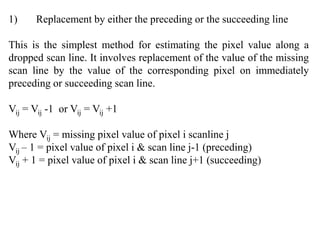
1) Replacement by either the preceding or the succeeding line
This is the simplest method for estimating the pixel value along a
dropped scan line. It involves replacement of the value of the missing
scan line by the value of the corresponding pixel on immediately
preceding or succeeding scan line.
Vij = Vij -1 or Vij = Vij +1
Where Vij = missing pixel value of pixel i scanline j
Vij – 1 = pixel value of pixel i & scan line j-1 (preceding)
Vij + 1 = pixel value of pixel i & scan line j+1 (succeeding)
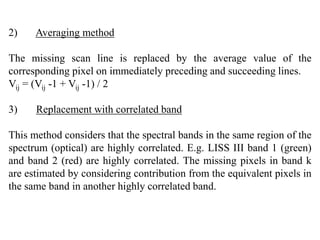
2) Averaging method
The missing scan line is replaced by the average value of the
corresponding pixel on immediately preceding and succeeding lines.
Vij = (Vij -1 + Vij -1) / 2
3) Replacement with correlated band
This method considers that the spectral bands in the same region of the
spectrum (optical) are highly correlated. E.g. LISS III band 1 (green)
and band 2 (red) are highly correlated. The missing pixels in band k
are estimated by considering contribution from the equivalent pixels in
the same band in another highly correlated band.
The Destriped image shows a small improvement compared to the original image
Destriped image (left) Original image (right)
2] Correction for periodic line striping:
A sensor is called ideal when there is a linear relationship between
input and the output.
Although all detectors are well calibrated prior to the launch, the
response of some of the detectors may shift towards lower or higher
end.
This results in a systematic horizontal banding pattern in an image.
Banding is a cosmetic defect & it interferes with the visual
appreciation of the patterns & features on the image.
A method of de-stripping is based on the shape of histogram of pixel
values generated by the individual detector in a particular band.
Linear method
This method uses linear expression to model the relationship between
input & output values.
It assumes that mean & standard deviation of data from each detector
should be same.
Detector imbalance is the only factor producing the differences in
means & standard deviations.
To get rid of this effect due to detector imbalance, the means &
standard deviations of the 3 (LISS 3) histograms are forced to
equalize the SD of the whole image.
3] Random noise correction: Random noise means pixels
having offset values from the normal. It can be easily
corrected by means of a smoothing filter on the data
4] Atmospheric correction: Atmospheric path radiance introduces
haze in the imagery which can be removed by two techniques:
a] Histogram minimum method ( Dark pixel subtraction)
b] Regression method
Atmospheric path luminance correction
Original After correction
i) Histogram minimum method (Dark pixel subtraction
technique)
Assumption is that there is a high probability that there are some
areas in the image with low reflectance (clear water or deep shadow).
These pixels will have values very close to zero in the shortwave
infrared band. Any value > 0 is assumed to be a haze contribution.
· The histograms of all the bands are computed for the full image.
· The lowest pixel values in the histograms of all the bands is taken
as the atmospheric path radiance.
These minimum values are subtracted from the respective band
images.
I0(i,j) = I (i,j) – Bias where
I0(i,j) = corrected pixel value at line i and pixel j
I (i,j) = input pixel value at same location (i,j)
Bias is the amount of offset for each spectral band.
ii) Regression method
Assumption is that scattering for the long wavelength is zero.
In this method the pixel values corresponding to regions having low
reflectance (water, deep shadow etc.) in the SWIR band are plotted
against the pixel values of the other spectral bands.
A best fit (least square) straight line is computed using standard
regression methods.
The offset (a) on the x-axis in different bands is the atmospheric
path radiance.
It has to be subtracted from the respective images.
Geometric Corrections : The geometric correction process is
normally implemented as a 2-step procedure
1] Systematic distortions are well understood and easily
corrected by applying formulas derived by modeling the sources
of the distortions mathematically. They are:
scan skew: Caused by the forward motion of the platform during
the time required for each mirror sweep
mirror-scan velocity: The mirror scanning rate is usually not
constant across a given scan, producing along-scan geometric
distortion
Panoramic distortions: The angular IFOV for scanner is
constant. As a result the effective pixel size on the ground at
extreme ends of the scan line is larger than that at the nadir. Its
produces along-track distortion.
Platform velocity: If the speed of the platform changes, the
ground track covered by successive mirror scans changes,
producing along-track scale distortion
Earth rotation: Earth rotates as the sensor scans the terrain. This
results in a shift of the ground swath being scanned, causing
along-scan distortion
2] Non systematic distortions
These distortions include errors due to:
1] Platform altitude- If the sensor platform departs from its
normal altitude or the terrain increases in elevation, this produces
changes in scale
2] Attitude- One axis of the sensor system is normal to the Earth's
surface and the other axis is parallel to the spacecraft's direction of
travel
If the sensor departs form this attitude, geometric distortion results
in x, y & z directions which are called roll, pitch & yaw
Resampling
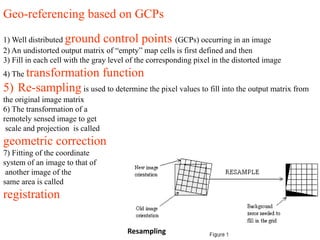
Geo-referencing based on GCPs
1) Well distributed ground control points (GCPs) occurring in an image
2) An undistorted output matrix of “empty” map cells is first defined and then
3) Fill in each cell with the gray level of the corresponding pixel in the distorted image
4) The transformation function
5) Re-sampling is used to determine the pixel values to fill into the output matrix from
the original image matrix
6) The transformation of a
remotely sensed image to get
scale and projection is called
geometric correction
7) Fitting of the coordinate
system of an image to that of
another image of the
same area is called
registration
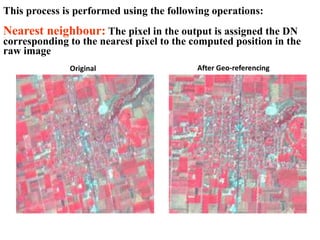
This process is performed using the following operations:
Nearest neighbour: The pixel in the output is assigned the DN
corresponding to the nearest pixel to the computed position in the
raw image
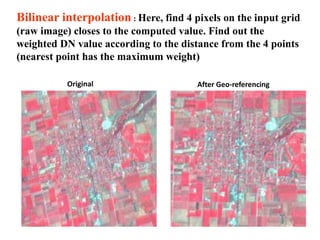
Original After Geo-referencing
Original
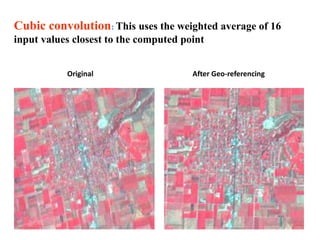
Bilinear interpolation : Here, find 4 pixels on the input grid
(raw image) closes to the computed value. Find out the
weighted DN value according to the distance from the 4 points
(nearest point has the maximum weight)
After Geo-referencing
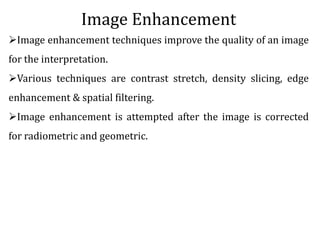
Original After Geo-referencing
Cubic convolution: This uses the weighted average of 16
input values closest to the computed point
Application of geometric correction
1] It gives location and scale properties of the desired map
projection to a raw image
2] Registration between images of different bands, of
multiple dates, multiple resolution
3] For mosaicking control points in the overlap region are
used as GCPs
Image Enhancement
Image enhancement techniques improve the quality of an image
for the interpretation.
Various techniques are contrast stretch, density slicing, edge
enhancement & spatial filtering.
Image enhancement is attempted after the image is corrected
for radiometric and geometric.
Enhancement Types
Point Operations
Modification of brightness values of each pixel in an image
data set independently. (radiometric enhancement)
Brings out contrast in the image
Local operations
Modification of pixel values based on the values of
surrounding pixels. (spatial enhancement)
Image Transformations
enhancing images by transforming the values of each pixel
on a multiband basis (spectral enhancement )
Contrast
Contrast generally refers to the difference in gray level values
in an image.
It can be defined as the ratio of the maximum intensity to the
minimum intensity over an image.
C = Imax / Imin
The data received by the sensor are meant to cover a wide
range of values, with very low reflectance for water & very high
reflectance for snow/cloud.
Contrast ratio has a strong bearing on the resolving power and
detectability of an image.
Larger this ratio, more easy it is to interpret the image.
Reasons for low contrast of image data
The scene itself has a low contrast ratio.
Scattering EMR by the atmosphere can reduce the contrast;
more pronounced effect in the shorter wavelengths.
The RS system may lack sufficient sensitivity to detect & record
the terrain contrast or signal input/output ratio of detector may
be non-linear
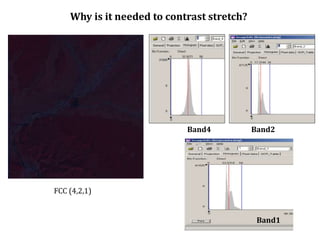
Why is it needed to contrast stretch?
FCC (4,2,1)
Band4 Band2
Band1
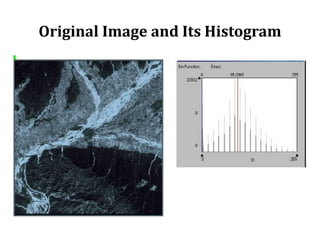
Original Image and Its Histogram
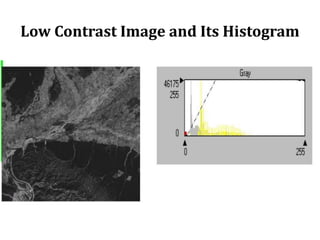
Low Contrast Image and Its Histogram
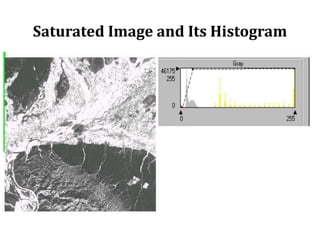
Saturated Image and Its Histogram
CONTRAST ENHANCEMENT
Contrast enhancement techniques expand the range of
brightness values in an image so that the image can be
efficiently displayed in a manner desired by the analyst.
The density values in a scene are literally pulled farther apart,
that is, expanded over a greater range.
The effect is to increase the visual contrast between two areas
of different uniform densities.
This enables the analyst to discriminate easily between areas
initially having a small difference in density.
Types
Linear - Input and Output Data Values follow a linear
relationship
Non Linear- Input and output are related via a transformation
function Y = ƒ(x)
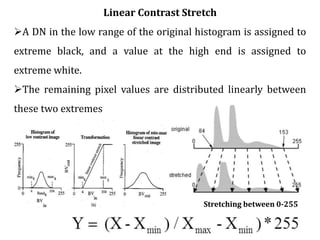
Linear Contrast Stretch
A DN in the low range of the original histogram is assigned to
extreme black, and a value at the high end is assigned to
extreme white.
The remaining pixel values are distributed linearly between
these two extremes
Stretching between 0-255
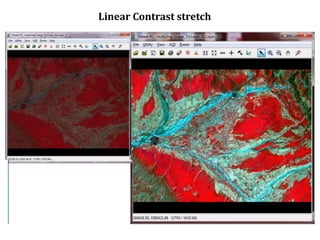
Linear Contrast stretch
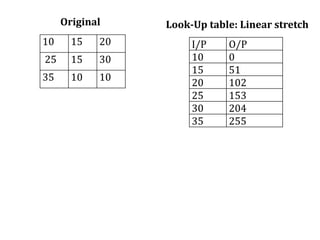
10 15 20
25 15 30
35 10 10
Original Look-Up table: Linear stretch
I/P O/P
10 0
15 51
20 102
25 153
30 204
35 255
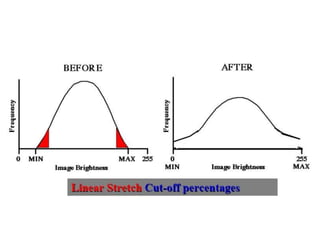
Percentage Cutoff Stretch
The percentage linear contrast stretch is similar
to the minimum – maximum linear contrast
stretch except this method uses a specified
minimum and maximum values lie in a certain
percentage of pixels from the mean of the
histogram
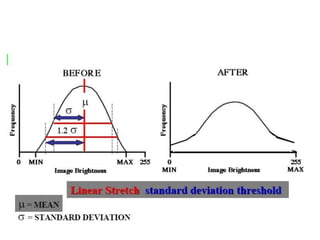
Standard Deviation Linear Stretch
The Standard Deviation linear contrast stretch is
similar to the minimum – maximum linear contrast
stretch except this method uses a specified minimum
and maximum values lie outside a certain standard
deviation of pixels from the mean of the histogram.
A standard deviation from the mean is often used to
push the tails of the histogram beyond the original
minimum and maximum values.
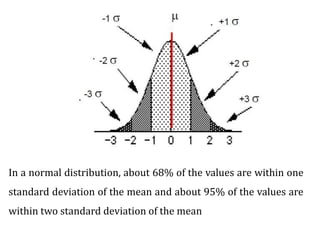
In a normal distribution, about 68% of the values are within one
standard deviation of the mean and about 95% of the values are
within two standard deviation of the mean
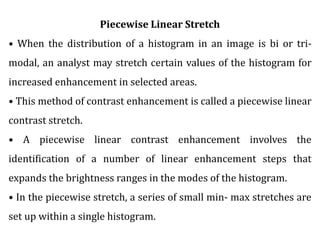
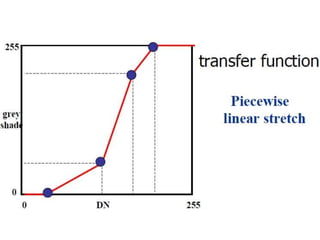
Piecewise Linear Stretch
• When the distribution of a histogram in an image is bi or tri-
modal, an analyst may stretch certain values of the histogram for
increased enhancement in selected areas.
• This method of contrast enhancement is called a piecewise linear
contrast stretch.
• A piecewise linear contrast enhancement involves the
identification of a number of linear enhancement steps that
expands the brightness ranges in the modes of the histogram.
• In the piecewise stretch, a series of small min- max stretches are
set up within a single histogram.
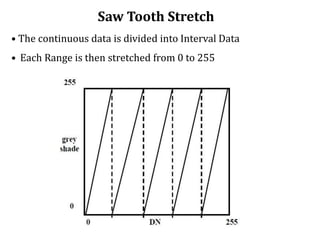
Saw Tooth Stretch
• The continuous data is divided into Interval Data
• Each Range is then stretched from 0 to 255
Non-Linear Contrast Enhancement
In these methods, the input and output data values follow a
non-linear transformation.
The general form of the non-linear contrast enhancement is
defined by y = f (x), where x is the input data value and y is the
output data value.
The non-linear contrast enhancement techniques have been
found to be useful for enhancing the colour contrast between the
nearly classes and subclasses of a main class.
Non-Linear Contrast Enhancement
Transfer Function Types
Mathematical Statistical
* Logarithmic * Histogram Equalization
* Inverse Log * Gaussian Stretch
* Exponential
* Square Trigonometrical
* Square root * Arc tangent ( tan-1)
* Cube
* Cube Root
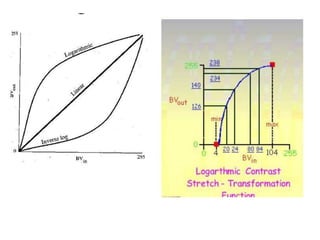
Logarithmic Contrast Stretch
In this process the logarithmic values of the input data are
linearly stretched to get the desired output values.
It is a two step process. In the first step we find out the log values
of the input DN values.
In the second step the log values are linearly stretched to fill the
complete range of DN no. (0-255).
Logarithmic stretch has greatest impact on the brightness values
found in the darker part of the histogram or on the low DN values
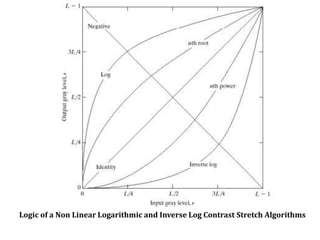
Logic of a Non Linear Logarithmic and Inverse Log Contrast Stretch Algorithms
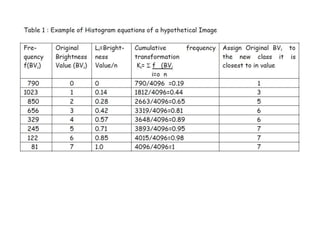
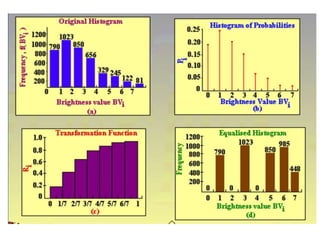
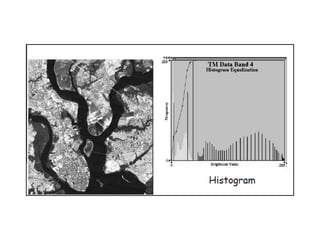
HISTOGRAM EQUALIZATION
This is another non-linear contrast enhancement technique.
In this technique, histogram of the original image is redistributed to
produce a uniform population density.
This is obtained by grouping certain adjacent grey values.
Thus the number of grey levels in the enhanced image is less than the
number of grey levels in the original image.
The redistribution of the histogram results in greatest contrast being
applied to the most populated range of brightness values in the original
image.
In this process the light and dark tails of the original histogram are
compressed, thereby resulting in some loss of detail in those regions.
This method gives large improvement in image quality when the histogram
is highly peaked.
Local Operations
pixel value is modified based on the values surrounding it.
Spatial Filtering - is the process of dividing the image into its
constituent spatial frequencies, and selectively altering certain
spatial frequencies to emphasize some image features.
Process of suppressing (de-emphasizing) certain frequencies &
passing (emphasizing) others.
This technique increases the analyst’s ability to discriminate
detail.
used for enhancing certain features
removal of noise.
Smoothening of image
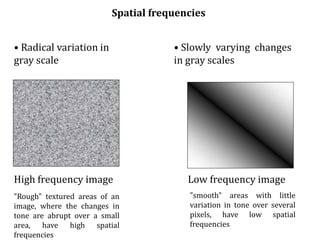
Spatial frequencies
• Radical variation in • Slowly varying changes
gray scale in gray scales
High frequency image Low frequency image
"Rough" textured areas of an
image, where the changes in
tone are abrupt over a small
area, have high spatial
frequencies
"smooth" areas with little
variation in tone over several
pixels, have low spatial
frequencies
Spatial frequencies
Definitions
Numbers of changes in the brightness values per unit distance for
any particular part of the image
Image Composed of
1. High frequency details
2. Low frequency details
Low Frequency Details
Few changes in brightness value over a given area
High Frequency Details
Brightness values change dramatically over short distances
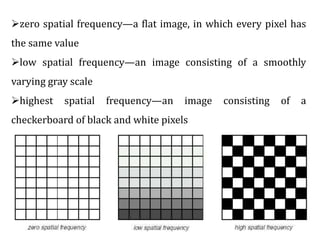
zero spatial frequency—a flat image, in which every pixel has
the same value
low spatial frequency—an image consisting of a smoothly
varying gray scale
highest spatial frequency—an image consisting of a
checkerboard of black and white pixels
Filters
are Algorithms for filtering
Composed of
Window mask /Kernal / Convolution mask and
Constants (Weights given to mask)
Mask size 3x3, 5x5, 7x7, 9x9………
ex. Square mask
1 1 1
1 1 1
1 1 1
Convolution ( Filtering Technique)
Process of evaluating the weighted neighbouring pixel values
located in a particular spatial pattern around the i,j, location in
input image.
Technique
Mask window is placed over part of image
Convolution Formula is applied over the part of image (Sum of
the Weighted product is obtained (coefficient of mask x raw DN
value)/ sum of coefficients)
Central value replaced by the output value
Window shifted by one pixel & procedure is repeated for the
entire image.
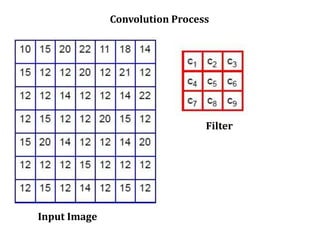
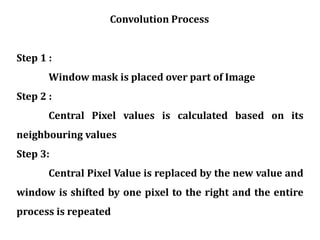
Convolution Process
Input Image
Filter
Step 1 :
Window mask is placed over part of Image
Step 2 :
Central Pixel values is calculated based on its
neighbouring values
Step 3:
Central Pixel Value is replaced by the new value and
window is shifted by one pixel to the right and the entire
process is repeated
Convolution Process
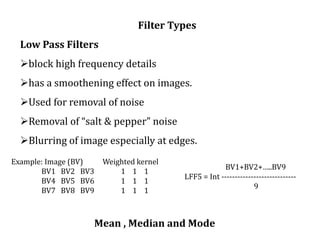
Filter Types
Low Pass Filters
block high frequency details
has a smoothening effect on images.
Used for removal of noise
Removal of “salt & pepper” noise
Blurring of image especially at edges.
Example: Image (BV) Weighted kernel
BV1 BV2 BV3 1 1 1
BV4 BV5 BV6 1 1 1
BV7 BV8 BV9 1 1 1
BV1+BV2+…..BV9
LFF5 = Int ----------------------------
9
Mean , Median and Mode
The neighborhood ranking median filter is useful for removing noise in an
image, especially shot noise by which individual pixels are corrupted or missing.
Instead of computing the average (mean) of the nine pixels in 3x3 convolution,
the median filter ranks the pixels in the neighborhood from lowest to highest and
selects the median value, which is then placed in the central value of the mask.
A median filter has certain advantages when compared with weighted
convolution filters, including (1) it does not shift boundaries, and (2) the minimal
degradation to edges allows the median filter to be applied repeatedly, which
allows fine detail to be erased and large regions to take on the same brightness
value.
A mode filter is used for removing random noise present in the imagery.
In the mode filter, the central pixel value is the window make is replaced by the
most frequently occurring value. This is a post classification filter.
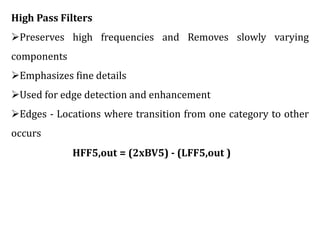
High Pass Filters
Preserves high frequencies and Removes slowly varying
components
Emphasizes fine details
Used for edge detection and enhancement
Edges - Locations where transition from one category to other
occurs
HFF5,out = (2xBV5) - (LFF5,out )
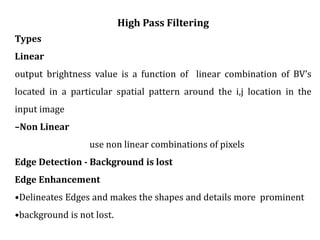
High Pass Filtering
Types
Linear
output brightness value is a function of linear combination of BV’s
located in a particular spatial pattern around the i,j location in the
input image
–Non Linear
use non linear combinations of pixels
Edge Detection - Background is lost
Edge Enhancement
•Delineates Edges and makes the shapes and details more prominent
•background is not lost.
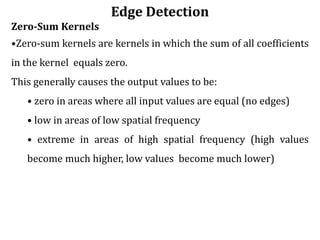
Edge Detection
Zero-Sum Kernels
•Zero-sum kernels are kernels in which the sum of all coefficients
in the kernel equals zero.
This generally causes the output values to be:
• zero in areas where all input values are equal (no edges)
• low in areas of low spatial frequency
• extreme in areas of high spatial frequency (high values
become much higher, low values become much lower)
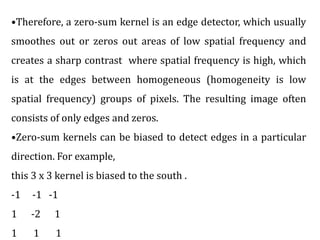
•Therefore, a zero-sum kernel is an edge detector, which usually
smoothes out or zeros out areas of low spatial frequency and
creates a sharp contrast where spatial frequency is high, which
is at the edges between homogeneous (homogeneity is low
spatial frequency) groups of pixels. The resulting image often
consists of only edges and zeros.
•Zero-sum kernels can be biased to detect edges in a particular
direction. For example,
this 3 x 3 kernel is biased to the south .
-1 -1 -1
1 -2 1
1 1 1
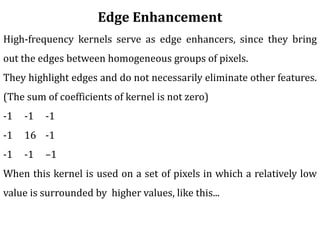
Edge Enhancement
High-frequency kernels serve as edge enhancers, since they bring
out the edges between homogeneous groups of pixels.
They highlight edges and do not necessarily eliminate other features.
(The sum of coefficients of kernel is not zero)
-1 -1 -1
-1 16 -1
-1 -1 –1
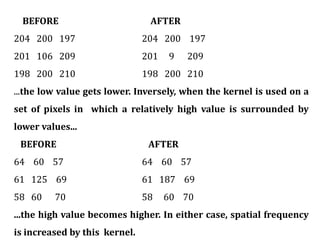
When this kernel is used on a set of pixels in which a relatively low
value is surrounded by higher values, like this...
BEFORE AFTER
204 200 197 204 200 197
201 106 209 201 9 209
198 200 210 198 200 210
...the low value gets lower. Inversely, when the kernel is used on a
set of pixels in which a relatively high value is surrounded by
lower values...
BEFORE AFTER
64 60 57 64 60 57
61 125 69 61 187 69
58 60 70 58 60 70
...the high value becomes higher. In either case, spatial frequency
is increased by this kernel.
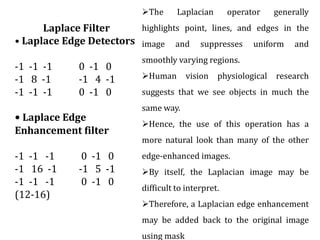
Laplace Filter
• Laplace Edge Detectors
-1 -1 -1 0 -1 0
-1 8 -1 -1 4 -1
-1 -1 -1 0 -1 0
• Laplace Edge
Enhancement filter
-1 -1 -1 0 -1 0
-1 16 -1 -1 5 -1
-1 -1 -1 0 -1 0
(12-16)
The Laplacian operator generally
highlights point, lines, and edges in the
image and suppresses uniform and
smoothly varying regions.
Human vision physiological research
suggests that we see objects in much the
same way.
Hence, the use of this operation has a
more natural look than many of the other
edge-enhanced images.
By itself, the Laplacian image may be
difficult to interpret.
Therefore, a Laplacian edge enhancement
may be added back to the original image
using mask
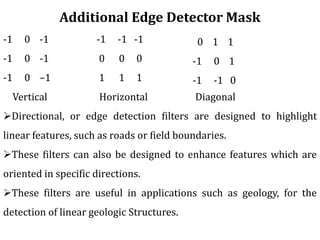
Additional Edge Detector Mask
-1 0 -1
-1 0 -1
-1 0 –1
Vertical Horizontal Diagonal
Directional, or edge detection filters are designed to highlight
linear features, such as roads or field boundaries.
These filters can also be designed to enhance features which are
oriented in specific directions.
These filters are useful in applications such as geology, for the
detection of linear geologic Structures.
-1 -1 -1
0 0 0
1 1 1
0 1 1
-1 0 1
-1 -1 0
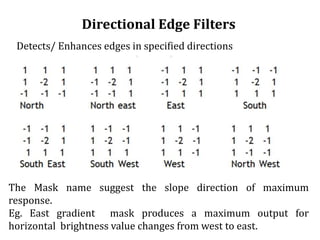
Directional Edge Filters
Detects/ Enhances edges in specified directions
The Mask name suggest the slope direction of maximum
response.
Eg. East gradient mask produces a maximum output for
horizontal brightness value changes from west to east.
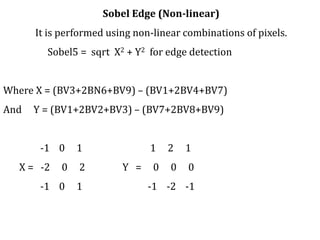
Sobel Edge (Non-linear)
It is performed using non-linear combinations of pixels.
Sobel5 = sqrt X2 + Y2 for edge detection
Where X = (BV3+2BN6+BV9) – (BV1+2BV4+BV7)
And Y = (BV1+2BV2+BV3) – (BV7+2BV8+BV9)
-1 0 1 1 2 1
X = -2 0 2 Y = 0 0 0
-1 0 1 -1 -2 -1
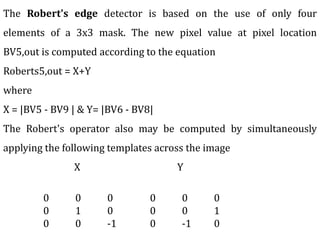
The Robert's edge detector is based on the use of only four
elements of a 3x3 mask. The new pixel value at pixel location
BV5,out is computed according to the equation
Roberts5,out = X+Y
where
X = |BV5 - BV9 | & Y= |BV6 - BV8|
The Robert's operator also may be computed by simultaneously
applying the following templates across the image
X Y
0 0 0
0 1 0
0 0 -1
0 0 0
0 0 1
0 -1 0
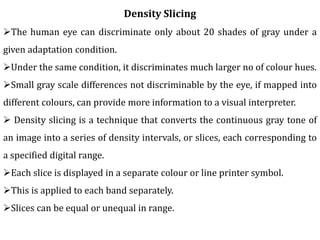
Density Slicing
The human eye can discriminate only about 20 shades of gray under a
given adaptation condition.
Under the same condition, it discriminates much larger no of colour hues.
Small gray scale differences not discriminable by the eye, if mapped into
different colours, can provide more information to a visual interpreter.
 Density slicing is a technique that converts the continuous gray tone of
an image into a series of density intervals, or slices, each corresponding to
a specified digital range.
Each slice is displayed in a separate colour or line printer symbol.
This is applied to each band separately.
Slices can be equal or unequal in range.
Image Transformation
Image transformations typically involve the manipulation of
multiple bands of data, whether from a single multispectral image
or from two or more images of the same area acquired at different
times (i.e. multitemporal image data).
Either way, image transformations generate "new" images from
two or more sources which highlight particular features or
properties of interest, better than the original input images
Image Division
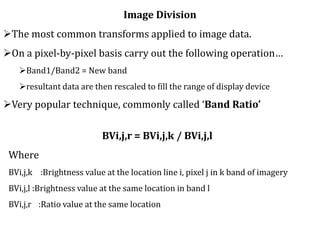
The most common transforms applied to image data.
On a pixel-by-pixel basis carry out the following operation…
Band1/Band2 = New band
resultant data are then rescaled to fill the range of display device
Very popular technique, commonly called ‘Band Ratio’
BVi,j,r = BVi,j,k / BVi,j,l
Where
BVi,j,k :Brightness value at the location line i, pixel j in k band of imagery
BVi,j,l :Brightness value at the same location in band l
BVi,j,r :Ratio value at the same location
Mathematical Domain of the Function
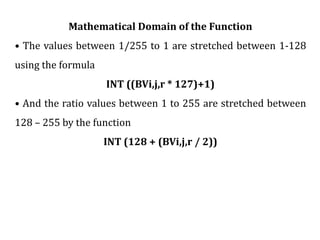
• The values between 1/255 to 1 are stretched between 1-128
using the formula
INT ((BVi,j,r * 127)+1)
• And the ratio values between 1 to 255 are stretched between
128 – 255 by the function
INT (128 + (BVi,j,r / 2))
Reasons / Application of Ratios
• Undesirable effects on recorded radiances (e.g. variable
illumination) caused by variations in topography.
– Sometimes differences in BV’s from identical surface
material are caused by topographic slope and aspect, shadows or
seasonal changes
– These conditions hamper the ability of an interpreter to
correctly identify surface material or land use in a remotely
sensed image.
• Ratio transformations can be used to reduce the effects of such
environmental conditions
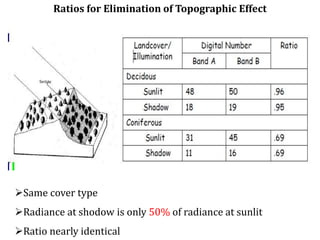
Ratios for Elimination of Topographic Effect
Same cover type
Radiance at shodow is only 50% of radiance at sunlit
Ratio nearly identical
Use/ Application of ratios
 Certain aspects of the shape of spectral reflectance curves of
different Earth surface cover types can be brought out by
ratioing.
 In addition ratios may provide unique information not
available in any single band
 Ratios discriminate subtle spectral variances
 Ratios clearly portray the variations of slopes of spectral
reflectance curves between two bands involved
 Ratios are independent of the absolute pixel values
 Ratios can be used to generate false colour composites by
combining three monochromatic ratio data sets
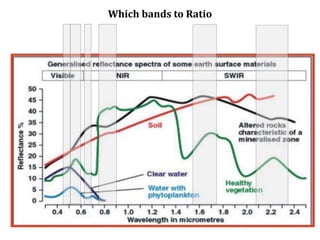
Which bands to Ratio
Which bands to Ratio-example
• Healthy vegetation reflects strongly in the near- infrared portion of
the spectrum while absorbing strongly in the visible red.
• Other surface types, such as soil and water, show near equal
reflectances in both the near- infrared and red portions.
• Thus, a ratio image of Near- Infrared (0.8 to 1.1 µm) divided by Red
(0.6 to 0.7 µ m) would result in ratios much greater than 1.0 for
vegetation, and ratios around 1.0 for soil and water.
• Thus the discrimination of vegetation from other surface cover types
is significantly enhanced.
• Also, we may be better able to identify areas of unhealthy or stressed
vegetation, which show low near- infrared reflectance, as the ratios
would be lower than for healthy green vegetation.
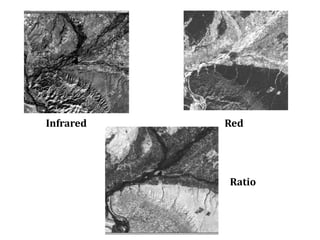
Infrared Red
Ratio
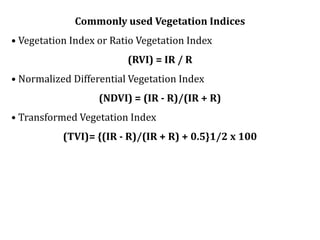
Commonly used Vegetation Indices
• Vegetation Index or Ratio Vegetation Index
(RVI) = IR / R
• Normalized Differential Vegetation Index
(NDVI) = (IR - R)/(IR + R)
• Transformed Vegetation Index
(TVI)= {(IR - R)/(IR + R) + 0.5}1/2 x 100
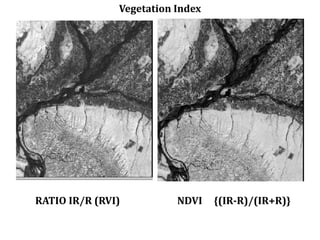
RATIO IR/R (RVI) NDVI {(IR-R)/(IR+R)}
Vegetation Index
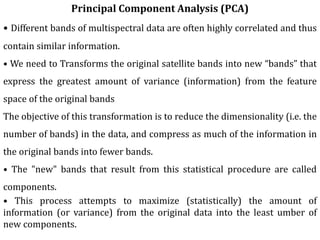
Principal Component Analysis (PCA)
• Different bands of multispectral data are often highly correlated and thus
contain similar information.
• We need to Transforms the original satellite bands into new “bands” that
express the greatest amount of variance (information) from the feature
space of the original bands
The objective of this transformation is to reduce the dimensionality (i.e. the
number of bands) in the data, and compress as much of the information in
the original bands into fewer bands.
• The "new" bands that result from this statistical procedure are called
components.
• This process attempts to maximize (statistically) the amount of
information (or variance) from the original data into the least umber of
new components.
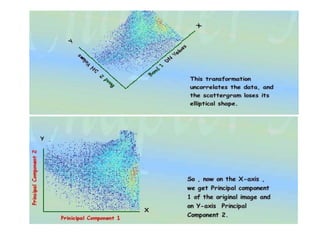
Graphical Conceptualization
• PCA is accomplished by a linear transformation of variables that
corresponds to a rotation and translation of the original coordinate
system.
•Consider the two-dimensional distribution of pixel values obtained in
two bands, which are labeled simply Band 1 and Band 2.
• A scatterplot of all the brightness values associated with each pixel in
each band is plotted, along with the location of the respective means.
• The spread or variance of the distribution of points is an indication of
the correlation and quality of information associated with both bands.
• If all the data points clustered in an extremely tight zone in the two-
dimensional space, these data would probably provide very little
information as they are highly correlated.
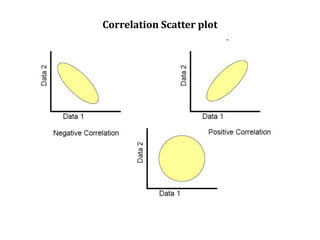
Correlation Scatter plot
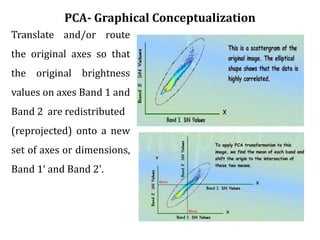
Translate and/or route
the original axes so that
the original brightness
values on axes Band 1 and
Band 2 are redistributed
(reprojected) onto a new
set of axes or dimensions,
Band 1‘ and Band 2'.
PCA- Graphical Conceptualization
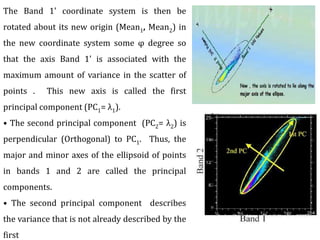
The Band 1' coordinate system is then be
rotated about its new origin (Mean1, Mean2) in
the new coordinate system some φ degree so
that the axis Band 1' is associated with the
maximum amount of variance in the scatter of
points . This new axis is called the first
principal component (PC1= λ1).
• The second principal component (PC2= λ2) is
perpendicular (Orthogonal) to PC1. Thus, the
major and minor axes of the ellipsoid of points
in bands 1 and 2 are called the principal
components.
• The second principal component describes
the variance that is not already described by the
first
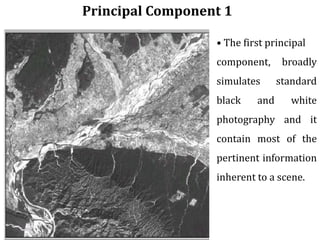
Principal Component 1
• The first principal
component, broadly
simulates standard
black and white
photography and it
contain most of the
pertinent information
inherent to a scene.
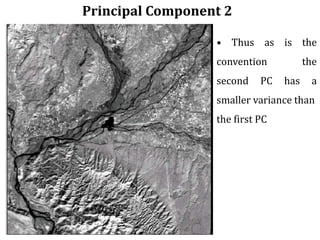
Principal Component 2
• Thus as is the
convention the
second PC has a
smaller variance than
the first PC
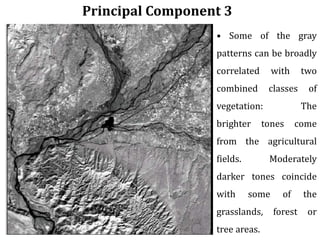
Principal Component 3
• Some of the gray
patterns can be broadly
correlated with two
combined classes of
vegetation: The
brighter tones come
from the agricultural
fields. Moderately
darker tones coincide
with some of the
grasslands, forest or
tree areas.
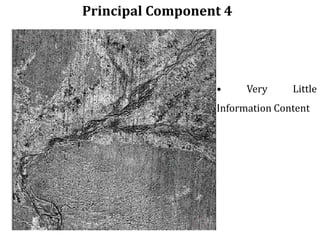
Principal Component 4
• Very Little
Information Content
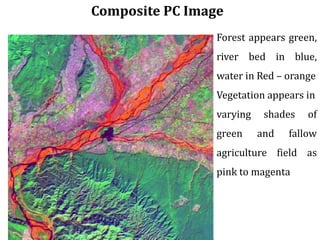
Composite PC Image
Forest appears green,
river bed in blue,
water in Red – orange
Vegetation appears in
varying shades of
green and fallow
agriculture field as
pink to magenta
DIGITAL IMAGE
CLASSIFICATION
What is Digital Image Classification
Multispectral classification is the process of sorting pixels into a
finite number of individual classes, or categories of data, based on
their data file values. If a pixel satisfies a certain set of criteria ,
the pixel is assigned to the class that corresponds to that criteria.
Multispectral classification may be performed using a variety of
algorithms
Hard classification using supervised or unsupervised
approaches.
Classification using fuzzy logic, and/or
Hybrid approaches often involving use of ancillary information.
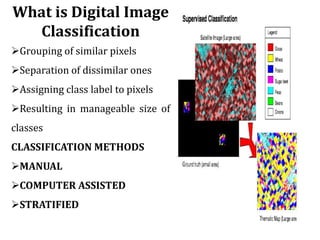
What is Digital Image
Classification
Grouping of similar pixels
Separation of dissimilar ones
Assigning class label to pixels
Resulting in manageable size of
classes
CLASSIFICATION METHODS
MANUAL
COMPUTER ASSISTED
STRATIFIED
Why use it?
To translate continuous variability of image data into map
patterns that provide meaning to the user.
To obtain insight in the data with respect to ground cover and
surface characteristics.
To find anomalous patterns in the image data set.
Cost efficient in the analyses of large data sets
Results can be reproduced
More objective then visual interpretation
Effective analysis of complex multi-band (spectral)
interrelationships
Dimensionality of Data
Spectral Dimensionality is determined by the number of sets of
values being used in a process.
In image processing, each band of data is a set of values. An
image with four bands of data is said to be four-dimensional
(Jensen, 1996).
Measurement Vector
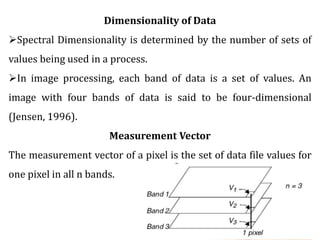
The measurement vector of a pixel is the set of data file values for
one pixel in all n bands.
Mean Vector
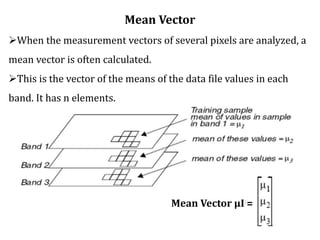
When the measurement vectors of several pixels are analyzed, a
mean vector is often calculated.
This is the vector of the means of the data file values in each
band. It has n elements.
Mean Vector μI =
Image space
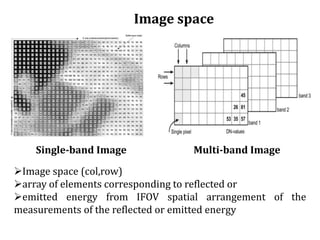
Single-band Image Multi-band Image
Image space (col,row)
array of elements corresponding to reflected or
emitted energy from IFOV spatial arrangement of the
measurements of the reflected or emitted energy
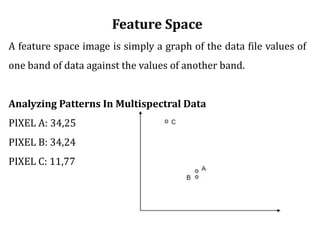
Feature Space
A feature space image is simply a graph of the data file values of
one band of data against the values of another band.
Analyzing Patterns In Multispectral Data
PIXEL A: 34,25
PIXEL B: 34,24
PIXEL C: 11,77
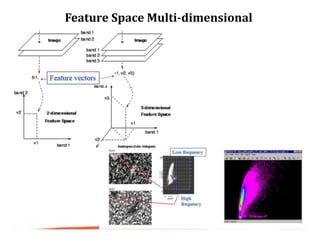
Feature Space Multi-dimensional
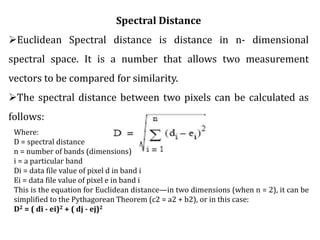
Spectral Distance
Euclidean Spectral distance is distance in n- dimensional
spectral space. It is a number that allows two measurement
vectors to be compared for similarity.
The spectral distance between two pixels can be calculated as
follows:
Where:
D = spectral distance
n = number of bands (dimensions)
i = a particular band
Di = data file value of pixel d in band i
Ei = data file value of pixel e in band i
This is the equation for Euclidean distance—in two dimensions (when n = 2), it can be
simplified to the Pythagorean Theorem (c2 = a2 + b2), or in this case:
D2 = ( di - ei)2 + ( dj - ej)2
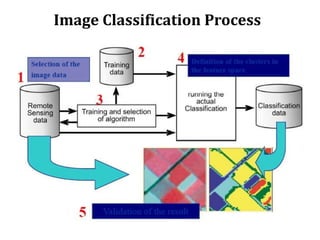
Image Classification Process
SUPERVISED CLASSIFICATION
The identity and location of some of the land cover types such
as urban, agriculture, wetland are known a priori through a
combination of field work and experience.
The analyst attempts to locate specific sites in the remotely
sensed data that represent homogenous examples of these
known land cover types known as training sites.
Multivariate statistical parameters are calculated for these
training sites.
Every pixel both inside and outside the training sites is
evaluated and assigned to the class of which it has the highest
likelihood of being a member.
In supervised training, you rely on your own pattern
recognition skills and a priori knowledge of the data to
help the system determine the statistical criteria
(signatures) for data classification.
To select reliable samples, you should know some
information—either spatial or spectral— about the
pixels that you want to classify.
Training Samples and Feature
Space Objects
Training samples (also called samples) are sets of pixels that
represent what is recognized as a discernible pattern, or
potential class.
The system calculates statistics from the sample pixels to
create a parametric signature for the class.
Selecting Training Samples
Training data for a class should be collected from homogeneous
environment.
if training data is being collected from n bands then >10n pixels
of training data is to be collected for each class.
There are a number of ways to collect training site data-
using a vector layer
defining a polygon in the image
using a class from a thematic raster layer from an image file of
the same area (i.e., the result of an unsupervised classification)
Selecting Appropriate Classification Algorithm
Various supervised classification algorithms may be used to
assign an unknown pixel to one of the classes.
The choice of particular classifier depends on nature of input
data and output required.
Parametric classification algorithms assume that the observed
measurement vectors Xc , obtained for each class in each spectral
band during the training phase are Gaussian in nature.
Non Parametric classification algorithms make no such
assumptions.
There are many classification algorithms i.e. Parallelepiped,
Minimum distance, Maximum Likelihood etc.
Parallelepiped Classification Algorithm
In the parallelepiped decision rule, the data file values of the
candidate pixel are compared to upper and lower limits. These limits
can be either:
1. the minimum and maximum data file values of each band in the
signature,
2. the mean of each band, plus and minus a number of standard
deviations, or
3. any limits that you specify, based on your knowledge of the data and
signatures.
There are high and low limits for every signature in every band. When
a pixel’s data file values are between the limits for every band in a
signature, then the pixel is assigned to that signature’s class.
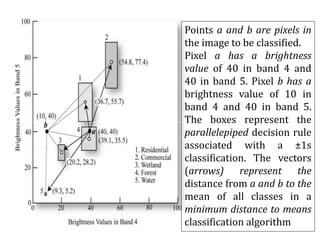
Points a and b are pixels in
the image to be classified.
Pixel a has a brightness
value of 40 in band 4 and
40 in band 5. Pixel b has a
brightness value of 10 in
band 4 and 40 in band 5.
The boxes represent the
parallelepiped decision rule
associated with a ±1s
classification. The vectors
(arrows) represent the
distance from a and b to the
mean of all classes in a
minimum distance to means
classification algorithm
Overlap Region
In cases where a pixel may fall into the overlap region of two or
more parallelepipeds, you must define how the pixel can be
classified.
 The pixel can be classified by the order of the signatures.
 The pixel can be classified by the defined parametric decision
rule.
 The pixel can be left unclassified.
Advantages
Fast and simple.
Gives a broad classification thus narrows down the number of possible
classes to which each pixel can be assigned before more time consuming
calculations are made.
Not dependent on normal distributions.
Disadvantages
Since parallelepiped has corners, pixels that are actually quite far, spectrally
from the mean of the signature may be classified
Parallelepiped Corners
Compared to the
Signature Ellipse
Minimum Distance to Means Classification Algorithm
This decision rule is computationally simple and commonly used.
Requires mean vectors for each class in each band μck from the
training data.
Euclidean distance is calculated for all the pixels with all the
signature means
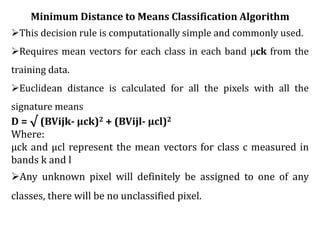
D = √ (BVijk- μck)2 + (BVijl- μcl)2
Where:
μck and μcl represent the mean vectors for class c measured in
bands k and l
Any unknown pixel will definitely be assigned to one of any
classes, there will be no unclassified pixel.
Advantages
Since every pixel is spectrally closer to either one sample mean
or other so there are no unclassified pixels.
Fastest after parallelepiped decision rule.
Disadvantages
Pixels which should be unclassified will become classified.
Does not consider class variability.
Maximum Likelihood/Bayesian Decision Rule
The maximum likelihood decision rule is based on the
probability that a pixel belongs to a particular class. The basic
equation assumes that these probabilities are equal for all
classes, and that the input bands have normal distributions.
If you have a priori knowledge that the probabilities are not
equal for all classes, you can specify weight factors for particular
classes. This variation of the maximum likelihood decision rule is
known as the Bayesian decision rule (Hord, 1982).
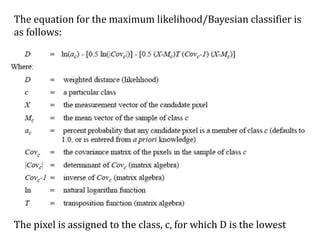
The equation for the maximum likelihood/Bayesian classifier is
as follows:
The pixel is assigned to the class, c, for which D is the lowest
Advantages
The most accurate of the classifiers (if the input samples/clusters
have a normal distribution), because it takes the most variables into
consideration.
Takes the variability of classes into account by using the covariance
matrix, as does Mahalanobis distance.
Disadvantages
An extensive equation that takes a long time to compute. The
computation time increases with the number of input bands.
Maximum likelihood is parametric, meaning that it relies heavily on a
normal distribution of the data in each input band.
Tends to overclassify signatures with relatively large values in the
covariance matrix.
UNSUPERVISED CLASSIFICATION
The identities of land cover types to be specified as classes
within a scene are generally not known a priori because ground
reference information is lacking or surface features within the
scene are not well defined.
The computer is required to group pixels with similar spectral
characteristics into unique clusters according to some
statistically determined criteria.
Analyst then combine and relabels the spectral clusters into
information classes.
It requires only a minimum amount of initial input from the analyst.
Numerical operations are performed that search for natural
groupings of the spectral properties of pixels.
User allows computer to select the class means and covariance
matrices to be used in the classification.
Once the data are classified, the analyst attempts a posteriori to
assign these natural or spectral classes to the information classes of
interest.
Some clusters may be meaningless because they represent mixed
classes.
Clustering algorithm used for the unsupervised classification
generally vary according to the efficiency with which the clustering
takes place.
Two commonly used methods are-
1.Chain method
2.Isodata clustering
CHAIN METHOD
 Operates in two pass mode( it passes through the registered
multispectral dataset two times).
 In the first pass the program reads through the dataset and
sequentially builds clusters.
 A mean vector is associated with each cluster.
 In the second pass a minimum distance to means
classification algorithm is applied to whole dataset on a pixel
by pixel basis whereby each pixel is assigned to one of the
mean vectors created in pass 1.
 The first pass automatically creates the cluster signatures to
be used by supervised classifier.
PASS 1: CLUSTER BUILDING
 During the first pass the analyst is required to supply four
types of information-
 R , the radius distance in spectral space used to determine
when a new cluster should be formed.
 C, a spectral space distance parameter used when merging
clusters when N is reached.
 N , the number of pixels to be evaluated between each major
merging of clusters.
 Cmax maximum no. of clusters to be identified.
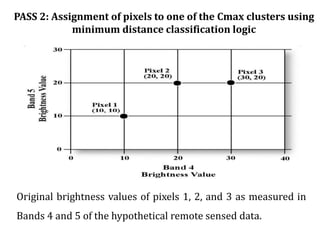
PASS 2: Assignment of pixels to one of the Cmax clusters using
minimum distance classification logic
Original brightness values of pixels 1, 2, and 3 as measured in
Bands 4 and 5 of the hypothetical remote sensed data.
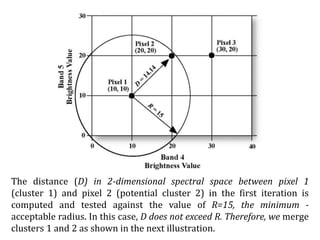
The distance (D) in 2-dimensional spectral space between pixel 1
(cluster 1) and pixel 2 (potential cluster 2) in the first iteration is
computed and tested against the value of R=15, the minimum -
acceptable radius. In this case, D does not exceed R. Therefore, we merge
clusters 1 and 2 as shown in the next illustration.
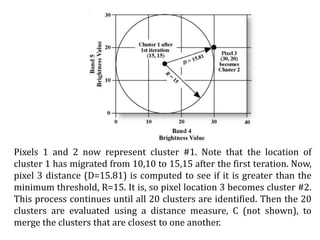
Pixels 1 and 2 now represent cluster #1. Note that the location of
cluster 1 has migrated from 10,10 to 15,15 after the first teration. Now,
pixel 3 distance (D=15.81) is computed to see if it is greater than the
minimum threshold, R=15. It is, so pixel location 3 becomes cluster #2.
This process continues until all 20 clusters are identified. Then the 20
clusters are evaluated using a distance measure, C (not shown), to
merge the clusters that are closest to one another.
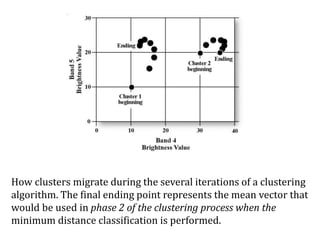
How clusters migrate during the several iterations of a clustering
algorithm. The final ending point represents the mean vector that
would be used in phase 2 of the clustering process when the
minimum distance classification is performed.
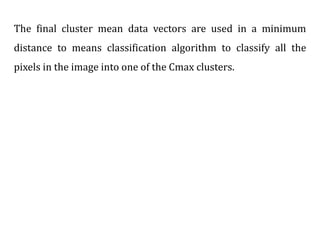
The final cluster mean data vectors are used in a minimum
distance to means classification algorithm to classify all the
pixels in the image into one of the Cmax clusters.
ISODATA Clustering
The Iterative Self-Organizing Data Analysis Technique
(ISODATA) represents a comprehensive set of heuristic (rule of
thumb) procedures that have been incorporated into an iterative
classification algorithm.
The ISODATA algorithm is a modification of the k-means
clustering algorithm, which includes a) merging clusters if their
separation distance in multispectral feature space is below a
user-specified threshold and b) rules for splitting a single cluster
into two clusters.
ISODATA is iterative because it makes a large number of
passes through the remote sensing dataset until specified
results are obtained, instead of just two passes.
ISODATA does not allocate its initial mean vectors based on
the analysis of pixels rather, an initial arbitrary assignment of
all Cmax clusters takes place along an n-dimensional vector
that runs between very specific points in feature space.
ISODATA algorithm normally requires the analyst to specify-
 Cmax : maximum no. of clusters to be identified.
 T:maximum % of pixels whose class values are allowed
to be unchanged between iterations.
 M :maximum no. of times isodata is to classify pixels and
recalculate cluster mean vectors.
 Minimum members in a cluster
 Maximum standard deviation for a cluster.
 Split separation value (if the values is changed from 0.0, it
takes the place of S.D. )
 Minimum distance between cluster means.
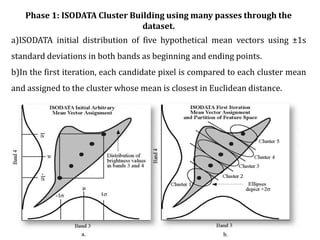
Phase 1: ISODATA Cluster Building using many passes through the
dataset.
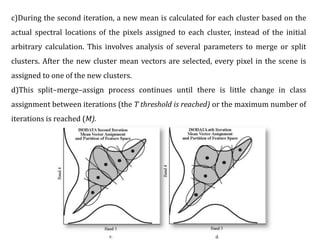
a)ISODATA initial distribution of five hypothetical mean vectors using ±1s
standard deviations in both bands as beginning and ending points.
b)In the first iteration, each candidate pixel is compared to each cluster mean
and assigned to the cluster whose mean is closest in Euclidean distance.
c)During the second iteration, a new mean is calculated for each cluster based on the
actual spectral locations of the pixels assigned to each cluster, instead of the initial
arbitrary calculation. This involves analysis of several parameters to merge or split
clusters. After the new cluster mean vectors are selected, every pixel in the scene is
assigned to one of the new clusters.
d)This split–merge–assign process continues until there is little change in class
assignment between iterations (the T threshold is reached) or the maximum number of
iterations is reached (M).
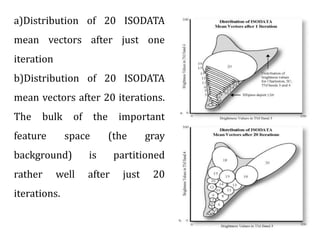
a)Distribution of 20 ISODATA
mean vectors after just one
iteration
b)Distribution of 20 ISODATA
mean vectors after 20 iterations.
The bulk of the important
feature space (the gray
background) is partitioned
rather well after just 20
iterations.
Accuracy assessment
Accuracy assessment is a general term for comparing the
classification to geographical data that are assumed to be true,
in order to determine the accuracy of the classification process.
Usually, the assumed-true data are derived from ground truth
data.
Error Matrix
Once a classification has been sampled a contingency table (also
referred to as an error matrix or confusion matrix) is developed.
This table is used to properly analyze the validity of each class
as well as the classification as a whole.
In this way the we can evaluate in more detail the efficacy of
the classification.
One way to assess accuracy is to go out in the field and observe
the actual land class at a sample of locations, and compare to the
land classification it was assigned on the thematic map.
 There are a number of ways to quantitatively express the
amount of agreement between the ground truth classes and
the remote sensing classes.
 One way is to construct a confusion error matrix,
alternatively called a error matrix
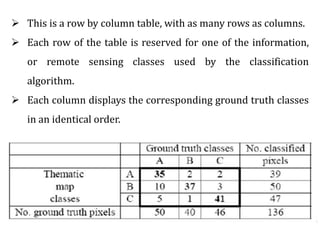
 This is a row by column table, with as many rows as columns.
 Each row of the table is reserved for one of the information,
or remote sensing classes used by the classification
algorithm.
 Each column displays the corresponding ground truth classes
in an identical order.
OVERALL ACCURACY
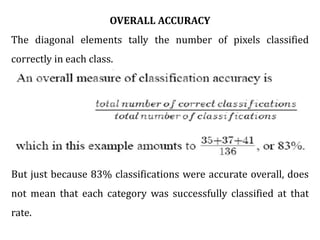
The diagonal elements tally the number of pixels classified
correctly in each class.
But just because 83% classifications were accurate overall, does
not mean that each category was successfully classified at that
rate.
USERS ACCURACY
 A user of the imagery who is particularly interested in class A,
say, might wish to know what proportion of pixels assigned to
class A were correctly assigned.
 In this example 35 of the 39 pixels were correctly assigned to
class A, and the user accuracy in this category of 35/39 = 90%
PRODUCERS ACCURACY
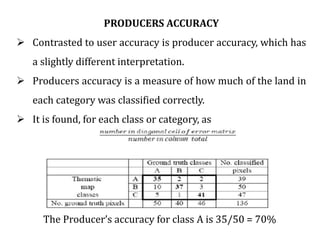
 Contrasted to user accuracy is producer accuracy, which has
a slightly different interpretation.
 Producers accuracy is a measure of how much of the land in
each category was classified correctly.
 It is found, for each class or category, as
The Producer’s accuracy for class A is 35/50 = 70%
So from this assessment we have three measures of accuracy
which address subtly different issues:
– overall accuracy : takes no account of source of error (errors
of omission or commission)
– user accuracy : measures the proportion of each TM class
which is correct.
– producer accuracy : measures the proportion of the land
base which is correctly classified.
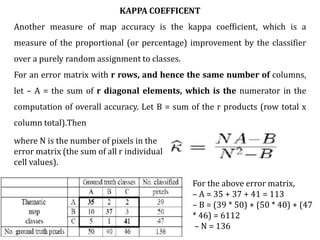
KAPPA COEFFICENT
Another measure of map accuracy is the kappa coefficient, which is a
measure of the proportional (or percentage) improvement by the classifier
over a purely random assignment to classes.
For an error matrix with r rows, and hence the same number of columns,
let – A = the sum of r diagonal elements, which is the numerator in the
computation of overall accuracy. Let B = sum of the r products (row total x
column total).Then
For the above error matrix,
– A = 35 + 37 + 41 = 113
– B = (39 * 50) + (50 * 40) + (47
* 46) = 6112
– N = 136
where N is the number of pixels in the
error matrix (the sum of all r individual
cell values).
Digital image processing

Digital image processing

  • 1.
    Digital Image Processing Dr.Chetan Laxman Hulsure Assistant Professor Department of Geography Central University of Karnataka Kalaburgi-585367
  • 3.
    Pictures are themost common and convenient means of conveying or transmitting information. The digital images are represented as numbers; brightness can be added, subtracted, multiplied, divided and, in general, subjected to statistical manipulations. Such manipulations are not possible if image is presented as a photograph. A photograph is an analogue image produced by a continuous signal using photographic sensor (photosensitive film). Digital image is produced by a discrete signal using electro- optical sensor.
  • 4.
     A digitalremotely sensed image is typically composed of picture elements (pixel) located at intersection of each row, I and column, j in each band, k of imagery. Associated with each pixel a number known as Digital Number (DN) or Brightness Value (BV) denotes the average radiance of a pixel area within a scene.  A smaller number indicates low average radiance from the area and the higher number indicates high radiant properties of the area.
  • 18.
    Image Rectification These operationsaim to correct distorted or degraded image data to create a faithful representation of the original scene. This involves initial processing of raw image data to correct geometric distortions, to calibrate the data radiometrically, to eliminate noise present in the data and to correct atmospheric distortions. Image rectification and restoration procedures are often termed as preprocessing operations as they normally performed prior to further manipulation and analysis.
  • 19.
    Image radiometry generallyrefers to the digital representation of the sensed data. The radiance value recorded for each pixel should be ideally, a faithful representation of the reflectance property of the corresponding resolution element on the ground. Radiometric correction involves the rearrangement of the digital numbers (DN) in an image so that all areas in the image have the same linear relationship between the DN and radiance.
  • 20.
    Radiometric errors arecaused by detector imbalance and atmospheric deficiencies. Multiple detectors are used in the sensor system to simultaneously sense several image lines during each sweep. As the detectors are not precisely equivalent in their output characteristics, their output changes gradually over time. Due to these variations there will be different output for the same ground radiance.
  • 21.
    Some of theradiometric distortions are as follows: Correction for missing lines Correction for periodic line striping Random noise correction atmospheric correction
  • 22.
    Part of imagewith missing scan line 1] Correction for missing lines: They may be cosmetically corrected in three ways- a] Replacement by either the preceding or the succeeding line b] Averaging method c] Replacement with correlated band
  • 23.
    1) Replacement byeither the preceding or the succeeding line This is the simplest method for estimating the pixel value along a dropped scan line. It involves replacement of the value of the missing scan line by the value of the corresponding pixel on immediately preceding or succeeding scan line. Vij = Vij -1 or Vij = Vij +1 Where Vij = missing pixel value of pixel i scanline j Vij – 1 = pixel value of pixel i & scan line j-1 (preceding) Vij + 1 = pixel value of pixel i & scan line j+1 (succeeding)
  • 24.
    2) Averaging method Themissing scan line is replaced by the average value of the corresponding pixel on immediately preceding and succeeding lines. Vij = (Vij -1 + Vij -1) / 2 3) Replacement with correlated band This method considers that the spectral bands in the same region of the spectrum (optical) are highly correlated. E.g. LISS III band 1 (green) and band 2 (red) are highly correlated. The missing pixels in band k are estimated by considering contribution from the equivalent pixels in the same band in another highly correlated band.
  • 25.
    The Destriped imageshows a small improvement compared to the original image Destriped image (left) Original image (right) 2] Correction for periodic line striping:
  • 26.
    A sensor iscalled ideal when there is a linear relationship between input and the output. Although all detectors are well calibrated prior to the launch, the response of some of the detectors may shift towards lower or higher end. This results in a systematic horizontal banding pattern in an image. Banding is a cosmetic defect & it interferes with the visual appreciation of the patterns & features on the image. A method of de-stripping is based on the shape of histogram of pixel values generated by the individual detector in a particular band.
  • 27.
    Linear method This methoduses linear expression to model the relationship between input & output values. It assumes that mean & standard deviation of data from each detector should be same. Detector imbalance is the only factor producing the differences in means & standard deviations. To get rid of this effect due to detector imbalance, the means & standard deviations of the 3 (LISS 3) histograms are forced to equalize the SD of the whole image.
  • 28.
    3] Random noisecorrection: Random noise means pixels having offset values from the normal. It can be easily corrected by means of a smoothing filter on the data
  • 29.
    4] Atmospheric correction:Atmospheric path radiance introduces haze in the imagery which can be removed by two techniques: a] Histogram minimum method ( Dark pixel subtraction) b] Regression method Atmospheric path luminance correction Original After correction
  • 30.
    i) Histogram minimummethod (Dark pixel subtraction technique) Assumption is that there is a high probability that there are some areas in the image with low reflectance (clear water or deep shadow). These pixels will have values very close to zero in the shortwave infrared band. Any value > 0 is assumed to be a haze contribution. · The histograms of all the bands are computed for the full image. · The lowest pixel values in the histograms of all the bands is taken as the atmospheric path radiance.
  • 31.
    These minimum valuesare subtracted from the respective band images. I0(i,j) = I (i,j) – Bias where I0(i,j) = corrected pixel value at line i and pixel j I (i,j) = input pixel value at same location (i,j) Bias is the amount of offset for each spectral band.
  • 32.
    ii) Regression method Assumptionis that scattering for the long wavelength is zero. In this method the pixel values corresponding to regions having low reflectance (water, deep shadow etc.) in the SWIR band are plotted against the pixel values of the other spectral bands. A best fit (least square) straight line is computed using standard regression methods. The offset (a) on the x-axis in different bands is the atmospheric path radiance. It has to be subtracted from the respective images.
  • 33.
    Geometric Corrections :The geometric correction process is normally implemented as a 2-step procedure 1] Systematic distortions are well understood and easily corrected by applying formulas derived by modeling the sources of the distortions mathematically. They are: scan skew: Caused by the forward motion of the platform during the time required for each mirror sweep mirror-scan velocity: The mirror scanning rate is usually not constant across a given scan, producing along-scan geometric distortion
  • 34.
    Panoramic distortions: Theangular IFOV for scanner is constant. As a result the effective pixel size on the ground at extreme ends of the scan line is larger than that at the nadir. Its produces along-track distortion. Platform velocity: If the speed of the platform changes, the ground track covered by successive mirror scans changes, producing along-track scale distortion Earth rotation: Earth rotates as the sensor scans the terrain. This results in a shift of the ground swath being scanned, causing along-scan distortion
  • 35.
    2] Non systematicdistortions These distortions include errors due to: 1] Platform altitude- If the sensor platform departs from its normal altitude or the terrain increases in elevation, this produces changes in scale 2] Attitude- One axis of the sensor system is normal to the Earth's surface and the other axis is parallel to the spacecraft's direction of travel If the sensor departs form this attitude, geometric distortion results in x, y & z directions which are called roll, pitch & yaw
  • 36.
    Resampling Geo-referencing based onGCPs 1) Well distributed ground control points (GCPs) occurring in an image 2) An undistorted output matrix of “empty” map cells is first defined and then 3) Fill in each cell with the gray level of the corresponding pixel in the distorted image 4) The transformation function 5) Re-sampling is used to determine the pixel values to fill into the output matrix from the original image matrix 6) The transformation of a remotely sensed image to get scale and projection is called geometric correction 7) Fitting of the coordinate system of an image to that of another image of the same area is called registration
  • 37.
    This process isperformed using the following operations: Nearest neighbour: The pixel in the output is assigned the DN corresponding to the nearest pixel to the computed position in the raw image Original After Geo-referencing
  • 38.
    Original Bilinear interpolation :Here, find 4 pixels on the input grid (raw image) closes to the computed value. Find out the weighted DN value according to the distance from the 4 points (nearest point has the maximum weight) After Geo-referencing
  • 39.
    Original After Geo-referencing Cubicconvolution: This uses the weighted average of 16 input values closest to the computed point
  • 40.
    Application of geometriccorrection 1] It gives location and scale properties of the desired map projection to a raw image 2] Registration between images of different bands, of multiple dates, multiple resolution 3] For mosaicking control points in the overlap region are used as GCPs
  • 41.
    Image Enhancement Image enhancementtechniques improve the quality of an image for the interpretation. Various techniques are contrast stretch, density slicing, edge enhancement & spatial filtering. Image enhancement is attempted after the image is corrected for radiometric and geometric.
  • 42.
    Enhancement Types Point Operations Modificationof brightness values of each pixel in an image data set independently. (radiometric enhancement) Brings out contrast in the image Local operations Modification of pixel values based on the values of surrounding pixels. (spatial enhancement) Image Transformations enhancing images by transforming the values of each pixel on a multiband basis (spectral enhancement )
  • 43.
    Contrast Contrast generally refersto the difference in gray level values in an image. It can be defined as the ratio of the maximum intensity to the minimum intensity over an image. C = Imax / Imin The data received by the sensor are meant to cover a wide range of values, with very low reflectance for water & very high reflectance for snow/cloud. Contrast ratio has a strong bearing on the resolving power and detectability of an image. Larger this ratio, more easy it is to interpret the image.
  • 44.
    Reasons for lowcontrast of image data The scene itself has a low contrast ratio. Scattering EMR by the atmosphere can reduce the contrast; more pronounced effect in the shorter wavelengths. The RS system may lack sufficient sensitivity to detect & record the terrain contrast or signal input/output ratio of detector may be non-linear
  • 45.
    Why is itneeded to contrast stretch? FCC (4,2,1) Band4 Band2 Band1
  • 46.
    Original Image andIts Histogram
  • 47.
    Low Contrast Imageand Its Histogram
  • 48.
    Saturated Image andIts Histogram
  • 49.
    CONTRAST ENHANCEMENT Contrast enhancementtechniques expand the range of brightness values in an image so that the image can be efficiently displayed in a manner desired by the analyst. The density values in a scene are literally pulled farther apart, that is, expanded over a greater range. The effect is to increase the visual contrast between two areas of different uniform densities. This enables the analyst to discriminate easily between areas initially having a small difference in density.
  • 50.
    Types Linear - Inputand Output Data Values follow a linear relationship Non Linear- Input and output are related via a transformation function Y = ƒ(x)
  • 51.
    Linear Contrast Stretch ADN in the low range of the original histogram is assigned to extreme black, and a value at the high end is assigned to extreme white. The remaining pixel values are distributed linearly between these two extremes Stretching between 0-255
  • 52.
  • 53.
    10 15 20 2515 30 35 10 10 Original Look-Up table: Linear stretch I/P O/P 10 0 15 51 20 102 25 153 30 204 35 255
  • 54.
    Percentage Cutoff Stretch Thepercentage linear contrast stretch is similar to the minimum – maximum linear contrast stretch except this method uses a specified minimum and maximum values lie in a certain percentage of pixels from the mean of the histogram
  • 56.
    Standard Deviation LinearStretch The Standard Deviation linear contrast stretch is similar to the minimum – maximum linear contrast stretch except this method uses a specified minimum and maximum values lie outside a certain standard deviation of pixels from the mean of the histogram. A standard deviation from the mean is often used to push the tails of the histogram beyond the original minimum and maximum values.
  • 57.
    In a normaldistribution, about 68% of the values are within one standard deviation of the mean and about 95% of the values are within two standard deviation of the mean
  • 59.
    Piecewise Linear Stretch •When the distribution of a histogram in an image is bi or tri- modal, an analyst may stretch certain values of the histogram for increased enhancement in selected areas. • This method of contrast enhancement is called a piecewise linear contrast stretch. • A piecewise linear contrast enhancement involves the identification of a number of linear enhancement steps that expands the brightness ranges in the modes of the histogram. • In the piecewise stretch, a series of small min- max stretches are set up within a single histogram.
  • 61.
    Saw Tooth Stretch •The continuous data is divided into Interval Data • Each Range is then stretched from 0 to 255
  • 62.
    Non-Linear Contrast Enhancement Inthese methods, the input and output data values follow a non-linear transformation. The general form of the non-linear contrast enhancement is defined by y = f (x), where x is the input data value and y is the output data value. The non-linear contrast enhancement techniques have been found to be useful for enhancing the colour contrast between the nearly classes and subclasses of a main class.
  • 63.
    Non-Linear Contrast Enhancement TransferFunction Types Mathematical Statistical * Logarithmic * Histogram Equalization * Inverse Log * Gaussian Stretch * Exponential * Square Trigonometrical * Square root * Arc tangent ( tan-1) * Cube * Cube Root
  • 64.
    Logarithmic Contrast Stretch Inthis process the logarithmic values of the input data are linearly stretched to get the desired output values. It is a two step process. In the first step we find out the log values of the input DN values. In the second step the log values are linearly stretched to fill the complete range of DN no. (0-255). Logarithmic stretch has greatest impact on the brightness values found in the darker part of the histogram or on the low DN values
  • 66.
    Logic of aNon Linear Logarithmic and Inverse Log Contrast Stretch Algorithms
  • 67.
    HISTOGRAM EQUALIZATION This isanother non-linear contrast enhancement technique. In this technique, histogram of the original image is redistributed to produce a uniform population density. This is obtained by grouping certain adjacent grey values. Thus the number of grey levels in the enhanced image is less than the number of grey levels in the original image. The redistribution of the histogram results in greatest contrast being applied to the most populated range of brightness values in the original image. In this process the light and dark tails of the original histogram are compressed, thereby resulting in some loss of detail in those regions. This method gives large improvement in image quality when the histogram is highly peaked.
  • 71.
    Local Operations pixel valueis modified based on the values surrounding it. Spatial Filtering - is the process of dividing the image into its constituent spatial frequencies, and selectively altering certain spatial frequencies to emphasize some image features. Process of suppressing (de-emphasizing) certain frequencies & passing (emphasizing) others. This technique increases the analyst’s ability to discriminate detail. used for enhancing certain features removal of noise. Smoothening of image
  • 72.
    Spatial frequencies • Radicalvariation in • Slowly varying changes gray scale in gray scales High frequency image Low frequency image "Rough" textured areas of an image, where the changes in tone are abrupt over a small area, have high spatial frequencies "smooth" areas with little variation in tone over several pixels, have low spatial frequencies
  • 73.
    Spatial frequencies Definitions Numbers ofchanges in the brightness values per unit distance for any particular part of the image Image Composed of 1. High frequency details 2. Low frequency details Low Frequency Details Few changes in brightness value over a given area High Frequency Details Brightness values change dramatically over short distances
  • 74.
    zero spatial frequency—aflat image, in which every pixel has the same value low spatial frequency—an image consisting of a smoothly varying gray scale highest spatial frequency—an image consisting of a checkerboard of black and white pixels
  • 75.
    Filters are Algorithms forfiltering Composed of Window mask /Kernal / Convolution mask and Constants (Weights given to mask) Mask size 3x3, 5x5, 7x7, 9x9……… ex. Square mask 1 1 1 1 1 1 1 1 1
  • 76.
    Convolution ( FilteringTechnique) Process of evaluating the weighted neighbouring pixel values located in a particular spatial pattern around the i,j, location in input image. Technique Mask window is placed over part of image Convolution Formula is applied over the part of image (Sum of the Weighted product is obtained (coefficient of mask x raw DN value)/ sum of coefficients) Central value replaced by the output value Window shifted by one pixel & procedure is repeated for the entire image.
  • 77.
  • 78.
    Step 1 : Windowmask is placed over part of Image Step 2 : Central Pixel values is calculated based on its neighbouring values Step 3: Central Pixel Value is replaced by the new value and window is shifted by one pixel to the right and the entire process is repeated Convolution Process
  • 79.
    Filter Types Low PassFilters block high frequency details has a smoothening effect on images. Used for removal of noise Removal of “salt & pepper” noise Blurring of image especially at edges. Example: Image (BV) Weighted kernel BV1 BV2 BV3 1 1 1 BV4 BV5 BV6 1 1 1 BV7 BV8 BV9 1 1 1 BV1+BV2+…..BV9 LFF5 = Int ---------------------------- 9 Mean , Median and Mode
  • 80.
    The neighborhood rankingmedian filter is useful for removing noise in an image, especially shot noise by which individual pixels are corrupted or missing. Instead of computing the average (mean) of the nine pixels in 3x3 convolution, the median filter ranks the pixels in the neighborhood from lowest to highest and selects the median value, which is then placed in the central value of the mask. A median filter has certain advantages when compared with weighted convolution filters, including (1) it does not shift boundaries, and (2) the minimal degradation to edges allows the median filter to be applied repeatedly, which allows fine detail to be erased and large regions to take on the same brightness value. A mode filter is used for removing random noise present in the imagery. In the mode filter, the central pixel value is the window make is replaced by the most frequently occurring value. This is a post classification filter.
  • 81.
    High Pass Filters Preserveshigh frequencies and Removes slowly varying components Emphasizes fine details Used for edge detection and enhancement Edges - Locations where transition from one category to other occurs HFF5,out = (2xBV5) - (LFF5,out )
  • 82.
    High Pass Filtering Types Linear outputbrightness value is a function of linear combination of BV’s located in a particular spatial pattern around the i,j location in the input image –Non Linear use non linear combinations of pixels Edge Detection - Background is lost Edge Enhancement •Delineates Edges and makes the shapes and details more prominent •background is not lost.
  • 83.
    Edge Detection Zero-Sum Kernels •Zero-sumkernels are kernels in which the sum of all coefficients in the kernel equals zero. This generally causes the output values to be: • zero in areas where all input values are equal (no edges) • low in areas of low spatial frequency • extreme in areas of high spatial frequency (high values become much higher, low values become much lower)
  • 84.
    •Therefore, a zero-sumkernel is an edge detector, which usually smoothes out or zeros out areas of low spatial frequency and creates a sharp contrast where spatial frequency is high, which is at the edges between homogeneous (homogeneity is low spatial frequency) groups of pixels. The resulting image often consists of only edges and zeros. •Zero-sum kernels can be biased to detect edges in a particular direction. For example, this 3 x 3 kernel is biased to the south . -1 -1 -1 1 -2 1 1 1 1
  • 85.
    Edge Enhancement High-frequency kernelsserve as edge enhancers, since they bring out the edges between homogeneous groups of pixels. They highlight edges and do not necessarily eliminate other features. (The sum of coefficients of kernel is not zero) -1 -1 -1 -1 16 -1 -1 -1 –1 When this kernel is used on a set of pixels in which a relatively low value is surrounded by higher values, like this...
  • 86.
    BEFORE AFTER 204 200197 204 200 197 201 106 209 201 9 209 198 200 210 198 200 210 ...the low value gets lower. Inversely, when the kernel is used on a set of pixels in which a relatively high value is surrounded by lower values... BEFORE AFTER 64 60 57 64 60 57 61 125 69 61 187 69 58 60 70 58 60 70 ...the high value becomes higher. In either case, spatial frequency is increased by this kernel.
  • 87.
    Laplace Filter • LaplaceEdge Detectors -1 -1 -1 0 -1 0 -1 8 -1 -1 4 -1 -1 -1 -1 0 -1 0 • Laplace Edge Enhancement filter -1 -1 -1 0 -1 0 -1 16 -1 -1 5 -1 -1 -1 -1 0 -1 0 (12-16) The Laplacian operator generally highlights point, lines, and edges in the image and suppresses uniform and smoothly varying regions. Human vision physiological research suggests that we see objects in much the same way. Hence, the use of this operation has a more natural look than many of the other edge-enhanced images. By itself, the Laplacian image may be difficult to interpret. Therefore, a Laplacian edge enhancement may be added back to the original image using mask
  • 88.
    Additional Edge DetectorMask -1 0 -1 -1 0 -1 -1 0 –1 Vertical Horizontal Diagonal Directional, or edge detection filters are designed to highlight linear features, such as roads or field boundaries. These filters can also be designed to enhance features which are oriented in specific directions. These filters are useful in applications such as geology, for the detection of linear geologic Structures. -1 -1 -1 0 0 0 1 1 1 0 1 1 -1 0 1 -1 -1 0
  • 89.
    Directional Edge Filters Detects/Enhances edges in specified directions The Mask name suggest the slope direction of maximum response. Eg. East gradient mask produces a maximum output for horizontal brightness value changes from west to east.
  • 90.
    Sobel Edge (Non-linear) Itis performed using non-linear combinations of pixels. Sobel5 = sqrt X2 + Y2 for edge detection Where X = (BV3+2BN6+BV9) – (BV1+2BV4+BV7) And Y = (BV1+2BV2+BV3) – (BV7+2BV8+BV9) -1 0 1 1 2 1 X = -2 0 2 Y = 0 0 0 -1 0 1 -1 -2 -1
  • 91.
    The Robert's edgedetector is based on the use of only four elements of a 3x3 mask. The new pixel value at pixel location BV5,out is computed according to the equation Roberts5,out = X+Y where X = |BV5 - BV9 | & Y= |BV6 - BV8| The Robert's operator also may be computed by simultaneously applying the following templates across the image X Y 0 0 0 0 1 0 0 0 -1 0 0 0 0 0 1 0 -1 0
  • 92.
    Density Slicing The humaneye can discriminate only about 20 shades of gray under a given adaptation condition. Under the same condition, it discriminates much larger no of colour hues. Small gray scale differences not discriminable by the eye, if mapped into different colours, can provide more information to a visual interpreter.  Density slicing is a technique that converts the continuous gray tone of an image into a series of density intervals, or slices, each corresponding to a specified digital range. Each slice is displayed in a separate colour or line printer symbol. This is applied to each band separately. Slices can be equal or unequal in range.
  • 93.
    Image Transformation Image transformationstypically involve the manipulation of multiple bands of data, whether from a single multispectral image or from two or more images of the same area acquired at different times (i.e. multitemporal image data). Either way, image transformations generate "new" images from two or more sources which highlight particular features or properties of interest, better than the original input images
  • 94.
    Image Division The mostcommon transforms applied to image data. On a pixel-by-pixel basis carry out the following operation… Band1/Band2 = New band resultant data are then rescaled to fill the range of display device Very popular technique, commonly called ‘Band Ratio’ BVi,j,r = BVi,j,k / BVi,j,l Where BVi,j,k :Brightness value at the location line i, pixel j in k band of imagery BVi,j,l :Brightness value at the same location in band l BVi,j,r :Ratio value at the same location
  • 95.
    Mathematical Domain ofthe Function • The values between 1/255 to 1 are stretched between 1-128 using the formula INT ((BVi,j,r * 127)+1) • And the ratio values between 1 to 255 are stretched between 128 – 255 by the function INT (128 + (BVi,j,r / 2))
  • 96.
    Reasons / Applicationof Ratios • Undesirable effects on recorded radiances (e.g. variable illumination) caused by variations in topography. – Sometimes differences in BV’s from identical surface material are caused by topographic slope and aspect, shadows or seasonal changes – These conditions hamper the ability of an interpreter to correctly identify surface material or land use in a remotely sensed image. • Ratio transformations can be used to reduce the effects of such environmental conditions
  • 97.
    Ratios for Eliminationof Topographic Effect Same cover type Radiance at shodow is only 50% of radiance at sunlit Ratio nearly identical
  • 98.
    Use/ Application ofratios  Certain aspects of the shape of spectral reflectance curves of different Earth surface cover types can be brought out by ratioing.  In addition ratios may provide unique information not available in any single band  Ratios discriminate subtle spectral variances  Ratios clearly portray the variations of slopes of spectral reflectance curves between two bands involved  Ratios are independent of the absolute pixel values  Ratios can be used to generate false colour composites by combining three monochromatic ratio data sets
  • 99.
  • 100.
    Which bands toRatio-example • Healthy vegetation reflects strongly in the near- infrared portion of the spectrum while absorbing strongly in the visible red. • Other surface types, such as soil and water, show near equal reflectances in both the near- infrared and red portions. • Thus, a ratio image of Near- Infrared (0.8 to 1.1 µm) divided by Red (0.6 to 0.7 µ m) would result in ratios much greater than 1.0 for vegetation, and ratios around 1.0 for soil and water. • Thus the discrimination of vegetation from other surface cover types is significantly enhanced. • Also, we may be better able to identify areas of unhealthy or stressed vegetation, which show low near- infrared reflectance, as the ratios would be lower than for healthy green vegetation.
  • 101.
  • 102.
    Commonly used VegetationIndices • Vegetation Index or Ratio Vegetation Index (RVI) = IR / R • Normalized Differential Vegetation Index (NDVI) = (IR - R)/(IR + R) • Transformed Vegetation Index (TVI)= {(IR - R)/(IR + R) + 0.5}1/2 x 100
  • 103.
    RATIO IR/R (RVI)NDVI {(IR-R)/(IR+R)} Vegetation Index
  • 104.
    Principal Component Analysis(PCA) • Different bands of multispectral data are often highly correlated and thus contain similar information. • We need to Transforms the original satellite bands into new “bands” that express the greatest amount of variance (information) from the feature space of the original bands The objective of this transformation is to reduce the dimensionality (i.e. the number of bands) in the data, and compress as much of the information in the original bands into fewer bands. • The "new" bands that result from this statistical procedure are called components. • This process attempts to maximize (statistically) the amount of information (or variance) from the original data into the least umber of new components.
  • 105.
    Graphical Conceptualization • PCAis accomplished by a linear transformation of variables that corresponds to a rotation and translation of the original coordinate system. •Consider the two-dimensional distribution of pixel values obtained in two bands, which are labeled simply Band 1 and Band 2. • A scatterplot of all the brightness values associated with each pixel in each band is plotted, along with the location of the respective means. • The spread or variance of the distribution of points is an indication of the correlation and quality of information associated with both bands. • If all the data points clustered in an extremely tight zone in the two- dimensional space, these data would probably provide very little information as they are highly correlated.
  • 106.
  • 107.
    Translate and/or route theoriginal axes so that the original brightness values on axes Band 1 and Band 2 are redistributed (reprojected) onto a new set of axes or dimensions, Band 1‘ and Band 2'. PCA- Graphical Conceptualization
  • 108.
    The Band 1'coordinate system is then be rotated about its new origin (Mean1, Mean2) in the new coordinate system some φ degree so that the axis Band 1' is associated with the maximum amount of variance in the scatter of points . This new axis is called the first principal component (PC1= λ1). • The second principal component (PC2= λ2) is perpendicular (Orthogonal) to PC1. Thus, the major and minor axes of the ellipsoid of points in bands 1 and 2 are called the principal components. • The second principal component describes the variance that is not already described by the first
  • 110.
    Principal Component 1 •The first principal component, broadly simulates standard black and white photography and it contain most of the pertinent information inherent to a scene.
  • 111.
    Principal Component 2 •Thus as is the convention the second PC has a smaller variance than the first PC
  • 112.
    Principal Component 3 •Some of the gray patterns can be broadly correlated with two combined classes of vegetation: The brighter tones come from the agricultural fields. Moderately darker tones coincide with some of the grasslands, forest or tree areas.
  • 113.
    Principal Component 4 •Very Little Information Content
  • 114.
    Composite PC Image Forestappears green, river bed in blue, water in Red – orange Vegetation appears in varying shades of green and fallow agriculture field as pink to magenta
  • 115.
  • 116.
    What is DigitalImage Classification Multispectral classification is the process of sorting pixels into a finite number of individual classes, or categories of data, based on their data file values. If a pixel satisfies a certain set of criteria , the pixel is assigned to the class that corresponds to that criteria. Multispectral classification may be performed using a variety of algorithms Hard classification using supervised or unsupervised approaches. Classification using fuzzy logic, and/or Hybrid approaches often involving use of ancillary information.
  • 117.
    What is DigitalImage Classification Grouping of similar pixels Separation of dissimilar ones Assigning class label to pixels Resulting in manageable size of classes CLASSIFICATION METHODS MANUAL COMPUTER ASSISTED STRATIFIED
  • 118.
    Why use it? Totranslate continuous variability of image data into map patterns that provide meaning to the user. To obtain insight in the data with respect to ground cover and surface characteristics. To find anomalous patterns in the image data set. Cost efficient in the analyses of large data sets Results can be reproduced More objective then visual interpretation Effective analysis of complex multi-band (spectral) interrelationships
  • 119.
    Dimensionality of Data SpectralDimensionality is determined by the number of sets of values being used in a process. In image processing, each band of data is a set of values. An image with four bands of data is said to be four-dimensional (Jensen, 1996). Measurement Vector The measurement vector of a pixel is the set of data file values for one pixel in all n bands.
  • 120.
    Mean Vector When themeasurement vectors of several pixels are analyzed, a mean vector is often calculated. This is the vector of the means of the data file values in each band. It has n elements. Mean Vector μI =
  • 121.
    Image space Single-band ImageMulti-band Image Image space (col,row) array of elements corresponding to reflected or emitted energy from IFOV spatial arrangement of the measurements of the reflected or emitted energy
  • 122.
    Feature Space A featurespace image is simply a graph of the data file values of one band of data against the values of another band. Analyzing Patterns In Multispectral Data PIXEL A: 34,25 PIXEL B: 34,24 PIXEL C: 11,77
  • 123.
  • 124.
    Spectral Distance Euclidean Spectraldistance is distance in n- dimensional spectral space. It is a number that allows two measurement vectors to be compared for similarity. The spectral distance between two pixels can be calculated as follows: Where: D = spectral distance n = number of bands (dimensions) i = a particular band Di = data file value of pixel d in band i Ei = data file value of pixel e in band i This is the equation for Euclidean distance—in two dimensions (when n = 2), it can be simplified to the Pythagorean Theorem (c2 = a2 + b2), or in this case: D2 = ( di - ei)2 + ( dj - ej)2
  • 125.
  • 126.
    SUPERVISED CLASSIFICATION The identityand location of some of the land cover types such as urban, agriculture, wetland are known a priori through a combination of field work and experience. The analyst attempts to locate specific sites in the remotely sensed data that represent homogenous examples of these known land cover types known as training sites. Multivariate statistical parameters are calculated for these training sites. Every pixel both inside and outside the training sites is evaluated and assigned to the class of which it has the highest likelihood of being a member.
  • 127.
    In supervised training,you rely on your own pattern recognition skills and a priori knowledge of the data to help the system determine the statistical criteria (signatures) for data classification. To select reliable samples, you should know some information—either spatial or spectral— about the pixels that you want to classify.
  • 128.
    Training Samples andFeature Space Objects Training samples (also called samples) are sets of pixels that represent what is recognized as a discernible pattern, or potential class. The system calculates statistics from the sample pixels to create a parametric signature for the class. Selecting Training Samples Training data for a class should be collected from homogeneous environment. if training data is being collected from n bands then >10n pixels of training data is to be collected for each class.
  • 129.
    There are anumber of ways to collect training site data- using a vector layer defining a polygon in the image using a class from a thematic raster layer from an image file of the same area (i.e., the result of an unsupervised classification)
  • 130.
    Selecting Appropriate ClassificationAlgorithm Various supervised classification algorithms may be used to assign an unknown pixel to one of the classes. The choice of particular classifier depends on nature of input data and output required. Parametric classification algorithms assume that the observed measurement vectors Xc , obtained for each class in each spectral band during the training phase are Gaussian in nature. Non Parametric classification algorithms make no such assumptions. There are many classification algorithms i.e. Parallelepiped, Minimum distance, Maximum Likelihood etc.
  • 131.
    Parallelepiped Classification Algorithm Inthe parallelepiped decision rule, the data file values of the candidate pixel are compared to upper and lower limits. These limits can be either: 1. the minimum and maximum data file values of each band in the signature, 2. the mean of each band, plus and minus a number of standard deviations, or 3. any limits that you specify, based on your knowledge of the data and signatures. There are high and low limits for every signature in every band. When a pixel’s data file values are between the limits for every band in a signature, then the pixel is assigned to that signature’s class.
  • 132.
    Points a andb are pixels in the image to be classified. Pixel a has a brightness value of 40 in band 4 and 40 in band 5. Pixel b has a brightness value of 10 in band 4 and 40 in band 5. The boxes represent the parallelepiped decision rule associated with a ±1s classification. The vectors (arrows) represent the distance from a and b to the mean of all classes in a minimum distance to means classification algorithm
  • 133.
    Overlap Region In caseswhere a pixel may fall into the overlap region of two or more parallelepipeds, you must define how the pixel can be classified.  The pixel can be classified by the order of the signatures.  The pixel can be classified by the defined parametric decision rule.  The pixel can be left unclassified.
  • 134.
    Advantages Fast and simple. Givesa broad classification thus narrows down the number of possible classes to which each pixel can be assigned before more time consuming calculations are made. Not dependent on normal distributions. Disadvantages Since parallelepiped has corners, pixels that are actually quite far, spectrally from the mean of the signature may be classified Parallelepiped Corners Compared to the Signature Ellipse
  • 135.
    Minimum Distance toMeans Classification Algorithm This decision rule is computationally simple and commonly used. Requires mean vectors for each class in each band μck from the training data. Euclidean distance is calculated for all the pixels with all the signature means D = √ (BVijk- μck)2 + (BVijl- μcl)2 Where: μck and μcl represent the mean vectors for class c measured in bands k and l Any unknown pixel will definitely be assigned to one of any classes, there will be no unclassified pixel.
  • 136.
    Advantages Since every pixelis spectrally closer to either one sample mean or other so there are no unclassified pixels. Fastest after parallelepiped decision rule. Disadvantages Pixels which should be unclassified will become classified. Does not consider class variability.
  • 137.
    Maximum Likelihood/Bayesian DecisionRule The maximum likelihood decision rule is based on the probability that a pixel belongs to a particular class. The basic equation assumes that these probabilities are equal for all classes, and that the input bands have normal distributions. If you have a priori knowledge that the probabilities are not equal for all classes, you can specify weight factors for particular classes. This variation of the maximum likelihood decision rule is known as the Bayesian decision rule (Hord, 1982).
  • 138.
    The equation forthe maximum likelihood/Bayesian classifier is as follows: The pixel is assigned to the class, c, for which D is the lowest
  • 139.
    Advantages The most accurateof the classifiers (if the input samples/clusters have a normal distribution), because it takes the most variables into consideration. Takes the variability of classes into account by using the covariance matrix, as does Mahalanobis distance. Disadvantages An extensive equation that takes a long time to compute. The computation time increases with the number of input bands. Maximum likelihood is parametric, meaning that it relies heavily on a normal distribution of the data in each input band. Tends to overclassify signatures with relatively large values in the covariance matrix.
  • 140.
    UNSUPERVISED CLASSIFICATION The identitiesof land cover types to be specified as classes within a scene are generally not known a priori because ground reference information is lacking or surface features within the scene are not well defined. The computer is required to group pixels with similar spectral characteristics into unique clusters according to some statistically determined criteria. Analyst then combine and relabels the spectral clusters into information classes.
  • 141.
    It requires onlya minimum amount of initial input from the analyst. Numerical operations are performed that search for natural groupings of the spectral properties of pixels. User allows computer to select the class means and covariance matrices to be used in the classification. Once the data are classified, the analyst attempts a posteriori to assign these natural or spectral classes to the information classes of interest. Some clusters may be meaningless because they represent mixed classes. Clustering algorithm used for the unsupervised classification generally vary according to the efficiency with which the clustering takes place.
  • 142.
    Two commonly usedmethods are- 1.Chain method 2.Isodata clustering
  • 143.
    CHAIN METHOD  Operatesin two pass mode( it passes through the registered multispectral dataset two times).  In the first pass the program reads through the dataset and sequentially builds clusters.  A mean vector is associated with each cluster.  In the second pass a minimum distance to means classification algorithm is applied to whole dataset on a pixel by pixel basis whereby each pixel is assigned to one of the mean vectors created in pass 1.  The first pass automatically creates the cluster signatures to be used by supervised classifier.
  • 144.
    PASS 1: CLUSTERBUILDING  During the first pass the analyst is required to supply four types of information-  R , the radius distance in spectral space used to determine when a new cluster should be formed.  C, a spectral space distance parameter used when merging clusters when N is reached.  N , the number of pixels to be evaluated between each major merging of clusters.  Cmax maximum no. of clusters to be identified.
  • 145.
    PASS 2: Assignmentof pixels to one of the Cmax clusters using minimum distance classification logic Original brightness values of pixels 1, 2, and 3 as measured in Bands 4 and 5 of the hypothetical remote sensed data.
  • 146.
    The distance (D)in 2-dimensional spectral space between pixel 1 (cluster 1) and pixel 2 (potential cluster 2) in the first iteration is computed and tested against the value of R=15, the minimum - acceptable radius. In this case, D does not exceed R. Therefore, we merge clusters 1 and 2 as shown in the next illustration.
  • 147.
    Pixels 1 and2 now represent cluster #1. Note that the location of cluster 1 has migrated from 10,10 to 15,15 after the first teration. Now, pixel 3 distance (D=15.81) is computed to see if it is greater than the minimum threshold, R=15. It is, so pixel location 3 becomes cluster #2. This process continues until all 20 clusters are identified. Then the 20 clusters are evaluated using a distance measure, C (not shown), to merge the clusters that are closest to one another.
  • 148.
    How clusters migrateduring the several iterations of a clustering algorithm. The final ending point represents the mean vector that would be used in phase 2 of the clustering process when the minimum distance classification is performed.
  • 149.
    The final clustermean data vectors are used in a minimum distance to means classification algorithm to classify all the pixels in the image into one of the Cmax clusters.
  • 150.
    ISODATA Clustering The IterativeSelf-Organizing Data Analysis Technique (ISODATA) represents a comprehensive set of heuristic (rule of thumb) procedures that have been incorporated into an iterative classification algorithm. The ISODATA algorithm is a modification of the k-means clustering algorithm, which includes a) merging clusters if their separation distance in multispectral feature space is below a user-specified threshold and b) rules for splitting a single cluster into two clusters.
  • 151.
    ISODATA is iterativebecause it makes a large number of passes through the remote sensing dataset until specified results are obtained, instead of just two passes. ISODATA does not allocate its initial mean vectors based on the analysis of pixels rather, an initial arbitrary assignment of all Cmax clusters takes place along an n-dimensional vector that runs between very specific points in feature space.
  • 152.
    ISODATA algorithm normallyrequires the analyst to specify-  Cmax : maximum no. of clusters to be identified.  T:maximum % of pixels whose class values are allowed to be unchanged between iterations.  M :maximum no. of times isodata is to classify pixels and recalculate cluster mean vectors.  Minimum members in a cluster  Maximum standard deviation for a cluster.  Split separation value (if the values is changed from 0.0, it takes the place of S.D. )  Minimum distance between cluster means.
  • 153.
    Phase 1: ISODATACluster Building using many passes through the dataset. a)ISODATA initial distribution of five hypothetical mean vectors using ±1s standard deviations in both bands as beginning and ending points. b)In the first iteration, each candidate pixel is compared to each cluster mean and assigned to the cluster whose mean is closest in Euclidean distance.
  • 154.
    c)During the seconditeration, a new mean is calculated for each cluster based on the actual spectral locations of the pixels assigned to each cluster, instead of the initial arbitrary calculation. This involves analysis of several parameters to merge or split clusters. After the new cluster mean vectors are selected, every pixel in the scene is assigned to one of the new clusters. d)This split–merge–assign process continues until there is little change in class assignment between iterations (the T threshold is reached) or the maximum number of iterations is reached (M).
  • 155.
    a)Distribution of 20ISODATA mean vectors after just one iteration b)Distribution of 20 ISODATA mean vectors after 20 iterations. The bulk of the important feature space (the gray background) is partitioned rather well after just 20 iterations.
  • 156.
    Accuracy assessment Accuracy assessmentis a general term for comparing the classification to geographical data that are assumed to be true, in order to determine the accuracy of the classification process. Usually, the assumed-true data are derived from ground truth data.
  • 157.
    Error Matrix Once aclassification has been sampled a contingency table (also referred to as an error matrix or confusion matrix) is developed. This table is used to properly analyze the validity of each class as well as the classification as a whole. In this way the we can evaluate in more detail the efficacy of the classification.
  • 158.
    One way toassess accuracy is to go out in the field and observe the actual land class at a sample of locations, and compare to the land classification it was assigned on the thematic map.  There are a number of ways to quantitatively express the amount of agreement between the ground truth classes and the remote sensing classes.  One way is to construct a confusion error matrix, alternatively called a error matrix
  • 159.
     This isa row by column table, with as many rows as columns.  Each row of the table is reserved for one of the information, or remote sensing classes used by the classification algorithm.  Each column displays the corresponding ground truth classes in an identical order.
  • 160.
    OVERALL ACCURACY The diagonalelements tally the number of pixels classified correctly in each class. But just because 83% classifications were accurate overall, does not mean that each category was successfully classified at that rate.
  • 161.
    USERS ACCURACY  Auser of the imagery who is particularly interested in class A, say, might wish to know what proportion of pixels assigned to class A were correctly assigned.  In this example 35 of the 39 pixels were correctly assigned to class A, and the user accuracy in this category of 35/39 = 90%
  • 162.
    PRODUCERS ACCURACY  Contrastedto user accuracy is producer accuracy, which has a slightly different interpretation.  Producers accuracy is a measure of how much of the land in each category was classified correctly.  It is found, for each class or category, as The Producer’s accuracy for class A is 35/50 = 70%
  • 163.
    So from thisassessment we have three measures of accuracy which address subtly different issues: – overall accuracy : takes no account of source of error (errors of omission or commission) – user accuracy : measures the proportion of each TM class which is correct. – producer accuracy : measures the proportion of the land base which is correctly classified.
  • 164.
    KAPPA COEFFICENT Another measureof map accuracy is the kappa coefficient, which is a measure of the proportional (or percentage) improvement by the classifier over a purely random assignment to classes. For an error matrix with r rows, and hence the same number of columns, let – A = the sum of r diagonal elements, which is the numerator in the computation of overall accuracy. Let B = sum of the r products (row total x column total).Then For the above error matrix, – A = 35 + 37 + 41 = 113 – B = (39 * 50) + (50 * 40) + (47 * 46) = 6112 – N = 136 where N is the number of pixels in the error matrix (the sum of all r individual cell values).